Software Design
Introduction
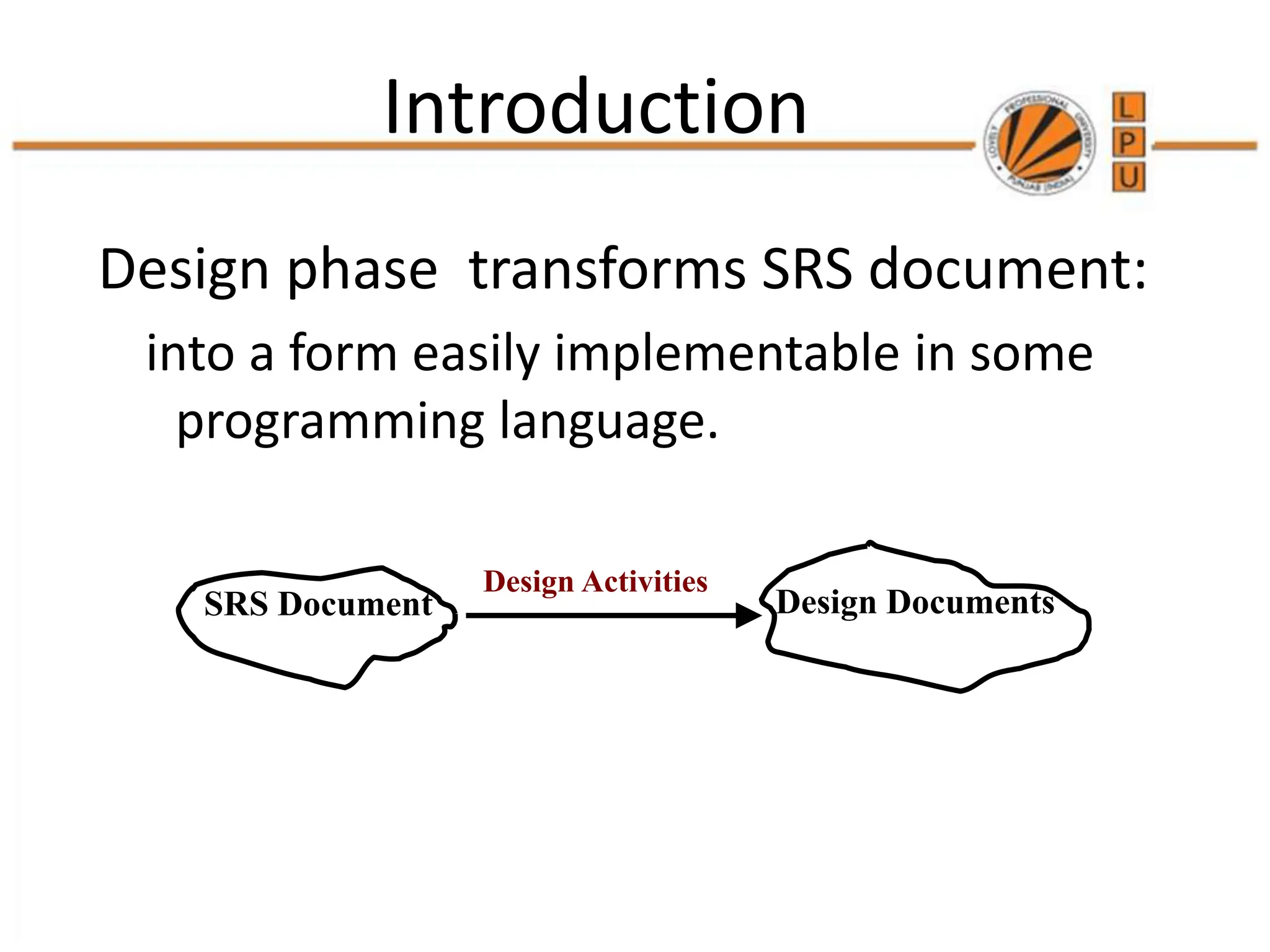
Design phase transforms SRS document:
into a form easily implementable in some
programming language.
SRS Document
Design Activities
Design Documents
Items Designed During Design Phase
1. module structure,
2. control relationship among the modules
3. interface among different modules,
data items exchanged among different modules,
4. data structures of individual modules,
5. algorithms for individual modules.
Module Structure
Introduction
A module consists of:
1. several functions
2. associated data structures.
Data
Functions
D1 ..
D2 ..
D3 ..
F1 ..
F2 ..
F3 ..
F4 ..
F5 ..
Introduction
Design activities are usually classified into two stages:
1. preliminary (or high-level) design
2. detailed design.
High-level design
Identify:
1. modules
2. control relationships among modules
3. interfaces among modules.
d1 d2
d3 d1 d4
High-level design
The outcome of high-level design:
program structure (or software
architecture).
Detailed design
For each module, design:
1. data structure
2. algorithms
Outcome of detailed design:
module specification.
What Is Good Software Design?
Correctness: Should implement all
functionalities of the system correctly.
Understandable: Should be easily
understandable.
Should be efficient.
Maintainability: Should be easily able to
change
What Is Good Software Design?
Understandability of a design is a
major issue:
determines goodness of design:
a design that is easy to understand:
also easy to maintain and change.
What Is Good Software Design?
Unless a design is easy to understand,
tremendous effort needed to maintain it.
We already know that about 60% effort is spent
in maintenance.
If the software is not easy to understand:
maintenance effort would increase many times.
Understandability
--Use consistent and meaningful names
for various design components,
--Design solution should consist of:
a cleanly decomposed set of modules (modularity),
--Different modules should be neatly arranged in a hierarchy:
in a neat tree-like diagram.
*** Means understandable design is modular and layered
Modularity
Modularity is a fundamental attribute of
any good design.
Decomposition of a problem cleanly into
modules:
1. Modules are almost independent of each
other
2. divide and conquer principle.
Modularity
If modules are independent:
modules can be understood separately.
reduces the complexity greatly.
Example of Cleanly and Non-cleanly
Decomposed Modules
Modularity
In technical terms, modules should
display:
1. high cohesion
2. low coupling.
Cohesion and Coupling
Cohesion is a measure of:
functional strength of a module.
A cohesive module performs a single task
or function.
Coupling between two modules:
a measure of the degree of
interdependence or interaction between
the two modules.
Cohesion and Coupling
A module having high cohesion and
low coupling:
functionally independent of other
modules:
A functionally independent module has
minimal interaction with other modules.
Advantages of Functional Independence
Better understandability and good design:
Complexity of design is reduced,
Different modules easily understood in
isolation:
modules are independent
Advantages of Functional Independence
Functional independence reduces error
propagation.
degree of interaction between modules is
low.
an error existing in one module does not
directly affect other modules.
Reuse of modules is possible.
Classification of Cohesiveness
coincidental
logical
temporal
procedural
sequential
communicational
functional
Degree of
cohesion
Coincidental cohesion
The module performs a set of tasks:
which relate to each other very loosely, if at
all.
the module contains a random collection of
functions.
functions have been put in the module out of
pure coincidence without any thought or
Example of coincidental cohesion
Module Name: Random-operations
Functions:
Issue-book
create member
request librarian leave
Logical cohesion
All elements of the module perform
similar operations such as error
handling, data input, data output, etc.
Example: a module containing set of print
functions for generating reports such as
grade sheet, salary slip, annual reports
etc.
Temporal cohesion
The module contains functions that are related by the fact that all
the functions must be executed in the same time span.
Example: Booting process of system, start-up and shut-down of
system
Procedural cohesion
If the set of functions of the module all part of a procedure
(algorithm) in which certain sequence of steps have to be carried
out in a certain order for achieving an objective. These functions
may work towards different purpose and operate on different
data.
e.g. 1. algorithm for decoding a message.
2. order processing module by sales clerk
containing login(), check-order(), print-bill(), place-
order-to-vendor(), update-inventory().
Communicational cohesion
If All functions of the module Refer-to
or update the same data structure.
Example:
the set of functions defined on an array
or a stack. Admit-students, enter-marks,
printgradesheet etc
Sequential cohesion
If the Elements of a module forms
different parts of a sequence, output
from one element of the sequence is input
to the next.
Example: sort
search
display
Functional cohesion
If the Different elements of a module
cooperate to achieve a single task.
Example: 1. a module containing all the functions required to
manage employees’s payroll shows functional cohesion
2. Module-name: managing-book-lending
Functions: issue-book, return-book, query-book
Coupling
Coupling indicates:
how closely two modules interact or
how interdependent they are.
The degree of coupling between two
modules depends on their interface
complexity.
Classes of coupling
content
common
stamp
control
data
Degree of
coupling
What is external coupling?
Data coupling
Two modules are data coupled,
if they communicate by an elementary
data item that is passed as a
parameter between the two, eg an
integer, a float, character etc.
Stamp coupling
Two modules are stamp coupled,
if they communicate via a composite
data item:
such as a record in PASCAL
or a structure in C.
Control coupling
It exists between two modules.
If Data from one module is used to
direct order of instruction execution in
another.
Example of control coupling:
a flag set in one module and tested in
another module.
Common Coupling
Two modules are common coupled,
if they share some global data items.
Content coupling
Content coupling exists between two
modules:
if they share code,
e.g, jump from one module into the code of
another module.
The degree of coupling increases
from data coupling to content coupling.
Neat Hierarchy
Control hierarchy represents organization of
modules. control hierarchy is also called program
structure.
Characteristics of Module Structure
Depth:
number of levels of control
Fan-out:
a measure of the number of modules
directly controlled by given module.
Module Structure
Fan out=2
Fan out=1
Fan in=2
Fan out=0
Goodness of Design
A design having modules:
with high fan-out numbers is not a good
design:
a module having high fan-out lacks
cohesion.
Visibility and Layering
A module A is said to be visible by
another module B,
if A directly or indirectly calls B.
The layering principle requires
modules at a layer can call only the
modules immediately below it.
Bad Design
Abstraction
The principle of abstraction requires:
lower-level modules do not invoke
functions of higher level modules.
Also known as layered design.
High-level Design
High-level design maps functions into
modules {fi} {mj} such that:
1. Each module has high cohesion
2. Coupling among modules is as low as
possible
3. Modules are organized in a neat
hierarchy
Design Approaches
Two fundamentally different
software design approaches:
Function-oriented design
Object-oriented design
Function-Oriented Design
A system is looked upon as something
that performs a set of functions.
Starting at this high-level view of the
system:
each function is successively refined into
more detailed functions.
Functions are mapped to a module structure.
Function-Oriented Design
Each subfunction:
split into more detailed subfunctions
and so on.
Object-Oriented Design
System is viewed as a collection of
objects (i.e. entities).
each object manages its own state
information.
Object-Oriented Design Example
Library Automation Software:
each library member is a separate
object with its own data and
functions.
Functions defined for one object:
cannot directly refer to or change
data of other objects.
Object-Oriented Design
Objects have their own internal data:
defines their state.
Similar objects constitute a class.
each object is a member of some class.
Classes may inherit features from a
super class.
Conceptually, objects communicate by
message passing.
Object-Oriented versus Function-
Oriented Design
Unlike function-oriented design,
in OOD the basic abstraction is not
functions such as “sort”, “display”,
“track”, etc.,
but real-world entities such as
“employee”, “picture”, “machine”,
“radar system”, etc.
Object-Oriented versus Function-
Oriented Design
In OOD:
software is not developed by designing
functions such as:
1. update-employee-record,
2. get-employee-address, etc.
but by designing objects such as:
1. employees,
2. departments, etc.

"Design Phase: A Deep Dive into Software Design and Development"

  • 1.
  • 2.
    Introduction Design phase transformsSRS document: into a form easily implementable in some programming language. SRS Document Design Activities Design Documents
  • 3.
    Items Designed DuringDesign Phase 1. module structure, 2. control relationship among the modules 3. interface among different modules, data items exchanged among different modules, 4. data structures of individual modules, 5. algorithms for individual modules.
  • 4.
  • 5.
    Introduction A module consistsof: 1. several functions 2. associated data structures. Data Functions D1 .. D2 .. D3 .. F1 .. F2 .. F3 .. F4 .. F5 ..
  • 6.
    Introduction Design activities areusually classified into two stages: 1. preliminary (or high-level) design 2. detailed design.
  • 7.
    High-level design Identify: 1. modules 2.control relationships among modules 3. interfaces among modules. d1 d2 d3 d1 d4
  • 8.
    High-level design The outcomeof high-level design: program structure (or software architecture).
  • 9.
    Detailed design For eachmodule, design: 1. data structure 2. algorithms Outcome of detailed design: module specification.
  • 10.
    What Is GoodSoftware Design? Correctness: Should implement all functionalities of the system correctly. Understandable: Should be easily understandable. Should be efficient. Maintainability: Should be easily able to change
  • 11.
    What Is GoodSoftware Design? Understandability of a design is a major issue: determines goodness of design: a design that is easy to understand: also easy to maintain and change.
  • 12.
    What Is GoodSoftware Design? Unless a design is easy to understand, tremendous effort needed to maintain it. We already know that about 60% effort is spent in maintenance. If the software is not easy to understand: maintenance effort would increase many times.
  • 13.
    Understandability --Use consistent andmeaningful names for various design components, --Design solution should consist of: a cleanly decomposed set of modules (modularity), --Different modules should be neatly arranged in a hierarchy: in a neat tree-like diagram. *** Means understandable design is modular and layered
  • 14.
    Modularity Modularity is afundamental attribute of any good design. Decomposition of a problem cleanly into modules: 1. Modules are almost independent of each other 2. divide and conquer principle.
  • 15.
    Modularity If modules areindependent: modules can be understood separately. reduces the complexity greatly.
  • 16.
    Example of Cleanlyand Non-cleanly Decomposed Modules
  • 17.
    Modularity In technical terms,modules should display: 1. high cohesion 2. low coupling.
  • 18.
    Cohesion and Coupling Cohesionis a measure of: functional strength of a module. A cohesive module performs a single task or function. Coupling between two modules: a measure of the degree of interdependence or interaction between the two modules.
  • 19.
    Cohesion and Coupling Amodule having high cohesion and low coupling: functionally independent of other modules: A functionally independent module has minimal interaction with other modules.
  • 20.
    Advantages of FunctionalIndependence Better understandability and good design: Complexity of design is reduced, Different modules easily understood in isolation: modules are independent
  • 21.
    Advantages of FunctionalIndependence Functional independence reduces error propagation. degree of interaction between modules is low. an error existing in one module does not directly affect other modules. Reuse of modules is possible.
  • 22.
  • 23.
    Coincidental cohesion The moduleperforms a set of tasks: which relate to each other very loosely, if at all. the module contains a random collection of functions. functions have been put in the module out of pure coincidence without any thought or
  • 24.
    Example of coincidentalcohesion Module Name: Random-operations Functions: Issue-book create member request librarian leave
  • 25.
    Logical cohesion All elementsof the module perform similar operations such as error handling, data input, data output, etc. Example: a module containing set of print functions for generating reports such as grade sheet, salary slip, annual reports etc.
  • 26.
    Temporal cohesion The modulecontains functions that are related by the fact that all the functions must be executed in the same time span. Example: Booting process of system, start-up and shut-down of system
  • 27.
    Procedural cohesion If theset of functions of the module all part of a procedure (algorithm) in which certain sequence of steps have to be carried out in a certain order for achieving an objective. These functions may work towards different purpose and operate on different data. e.g. 1. algorithm for decoding a message. 2. order processing module by sales clerk containing login(), check-order(), print-bill(), place- order-to-vendor(), update-inventory().
  • 28.
    Communicational cohesion If Allfunctions of the module Refer-to or update the same data structure. Example: the set of functions defined on an array or a stack. Admit-students, enter-marks, printgradesheet etc
  • 29.
    Sequential cohesion If theElements of a module forms different parts of a sequence, output from one element of the sequence is input to the next. Example: sort search display
  • 30.
    Functional cohesion If theDifferent elements of a module cooperate to achieve a single task. Example: 1. a module containing all the functions required to manage employees’s payroll shows functional cohesion 2. Module-name: managing-book-lending Functions: issue-book, return-book, query-book
  • 31.
    Coupling Coupling indicates: how closelytwo modules interact or how interdependent they are. The degree of coupling between two modules depends on their interface complexity.
  • 32.
  • 33.
    Data coupling Two modulesare data coupled, if they communicate by an elementary data item that is passed as a parameter between the two, eg an integer, a float, character etc.
  • 34.
    Stamp coupling Two modulesare stamp coupled, if they communicate via a composite data item: such as a record in PASCAL or a structure in C.
  • 35.
    Control coupling It existsbetween two modules. If Data from one module is used to direct order of instruction execution in another. Example of control coupling: a flag set in one module and tested in another module.
  • 36.
    Common Coupling Two modulesare common coupled, if they share some global data items.
  • 37.
    Content coupling Content couplingexists between two modules: if they share code, e.g, jump from one module into the code of another module. The degree of coupling increases from data coupling to content coupling.
  • 38.
    Neat Hierarchy Control hierarchyrepresents organization of modules. control hierarchy is also called program structure.
  • 39.
    Characteristics of ModuleStructure Depth: number of levels of control Fan-out: a measure of the number of modules directly controlled by given module.
  • 40.
    Module Structure Fan out=2 Fanout=1 Fan in=2 Fan out=0
  • 41.
    Goodness of Design Adesign having modules: with high fan-out numbers is not a good design: a module having high fan-out lacks cohesion.
  • 42.
    Visibility and Layering Amodule A is said to be visible by another module B, if A directly or indirectly calls B. The layering principle requires modules at a layer can call only the modules immediately below it.
  • 43.
  • 44.
    Abstraction The principle ofabstraction requires: lower-level modules do not invoke functions of higher level modules. Also known as layered design.
  • 45.
    High-level Design High-level designmaps functions into modules {fi} {mj} such that: 1. Each module has high cohesion 2. Coupling among modules is as low as possible 3. Modules are organized in a neat hierarchy
  • 46.
    Design Approaches Two fundamentallydifferent software design approaches: Function-oriented design Object-oriented design
  • 47.
    Function-Oriented Design A systemis looked upon as something that performs a set of functions. Starting at this high-level view of the system: each function is successively refined into more detailed functions. Functions are mapped to a module structure.
  • 48.
    Function-Oriented Design Each subfunction: splitinto more detailed subfunctions and so on.
  • 49.
    Object-Oriented Design System isviewed as a collection of objects (i.e. entities). each object manages its own state information.
  • 50.
    Object-Oriented Design Example LibraryAutomation Software: each library member is a separate object with its own data and functions. Functions defined for one object: cannot directly refer to or change data of other objects.
  • 51.
    Object-Oriented Design Objects havetheir own internal data: defines their state. Similar objects constitute a class. each object is a member of some class. Classes may inherit features from a super class. Conceptually, objects communicate by message passing.
  • 52.
    Object-Oriented versus Function- OrientedDesign Unlike function-oriented design, in OOD the basic abstraction is not functions such as “sort”, “display”, “track”, etc., but real-world entities such as “employee”, “picture”, “machine”, “radar system”, etc.
  • 53.
    Object-Oriented versus Function- OrientedDesign In OOD: software is not developed by designing functions such as: 1. update-employee-record, 2. get-employee-address, etc. but by designing objects such as: 1. employees, 2. departments, etc.