Design Patterns
    Daniel Waligóra
   Wrocław 09/01/2012


           1
Bibliography
•   Martin Fowler,Patterns of Enterprise Appication Architecture

•   Matt Zandstra , PHP5 Objects, Patters, and Practice

•   http://www.ustream.tv - New York PHP channel

•   Symfony Live Berlin 2012 - https://joind.in/event/view/1114

•   http://scholar.google.pl

•   http://pzielinski.com


                               2
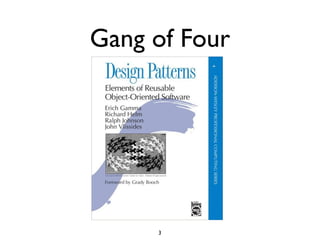
Gang of Four


     3
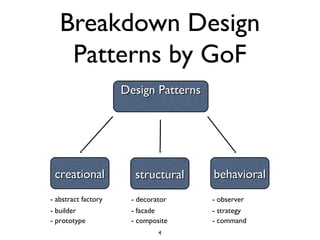
Breakdown Design
    Patterns by GoF
                     Design Patterns


 creational            structural      behavioral
- abstract factory    - decorator      - observer
- builder             - facade         - strategy
- prototype           - composite      - command
                              4
5
6
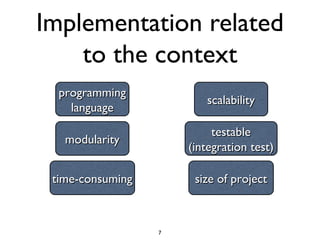
Implementation related
    to the context
  programming
                         scalability
    language
                           testable
   modularity
                      (integration test)

 time-consuming        size of project


                  7
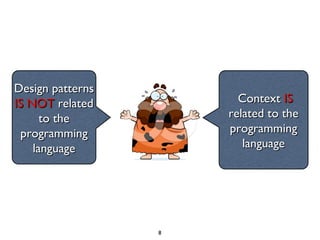
Design patterns
IS NOT related          Context IS
      to the          related to the
 programming          programming
    language             language


                  8
1.
2.
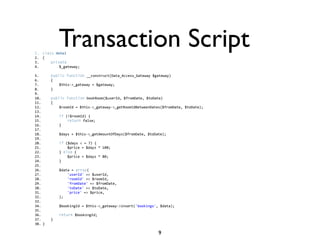
             Transaction Script
      class Hotel  
      {   
3.        private    
4.            $_gateway;

5.        public function __construct(Data_Access_Gateway $gateway)    
6.        {    
7.            $this->_gateway = $gateway;    
8.        }    
9.      
10.       public function bookRoom($userId, $fromDate, $toDate)    
11.       {    
12.           $roomId = $this->_gateway->_getRoomIdBetweenDates($fromDate, $toDate);    
13.     
14.           if (!$roomId) {    
15.               return false;    
16.           }    
17.     
18.           $days = $this->_getAmountOfDays($fromDate, $toDate);    
19.     
20.           if ($days < = 7) {  
21.               $price = $days * 100;  
22.           } else {   
23.               $price = $days * 80;  
24.           }  
25.             
26.           $data = array(  
27.               'userId' => $userId,    
28.               'roomId' => $roomId,  
29.               'fromDate' => $fromDate,    
30.               'toDate' => $toDate,    
31.               'price' => $price,    
32.           );    
33.     
34.           $bookingId = $this->_gateway->insert('bookings', $data);    
35.     
36.           return $bookingId;    
37.       }    
38.   } 

                                                              9
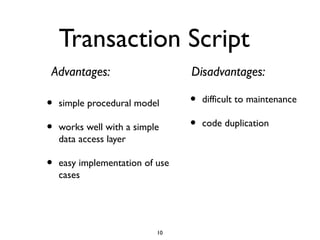
Transaction Script
Advantages:                      Disadvantages:

•   simple procedural model      •   difficult to maintenance

•   works well with a simple     •   code duplication
    data access layer

•   easy implementation of use
    cases


                           10
1.
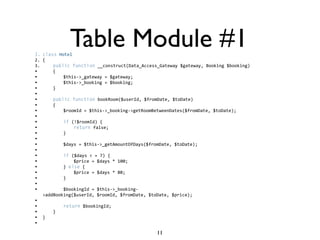
               Table Module #1
     class Hotel  
2.   {    
3.       public function __construct(Data_Access_Gateway $gateway, Booking $booking)    
•        {    
•            $this->_gateway = $gateway;  
•            $this->_booking = $booking;  
•        }    
•      
•        public function bookRoom($userId, $fromDate, $toDate)    
•        {    
•            $roomId = $this->_booking->getRoomBetweenDates($fromDate, $toDate);  
•      
•            if (!$roomId) {    
•                return false;    
•            }    
•      
•            $days = $this->_getAmountOfDays($fromDate, $toDate);    
•      
•            if ($days < = 7) {  
•                $price = $days * 100;  
•            } else {   
•                $price = $days * 80;  
•            }  
•              
•            $bookingId = $this->_booking-
     >addBooking($userId, $roomId, $fromDate, $toDate, $price);    
•      
•            return $bookingId;    
•        }    
•    }  
•      

                                                11
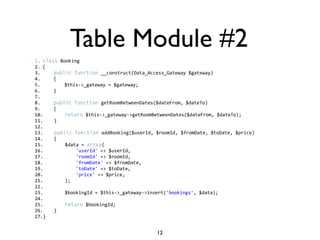
Table Module #2
1. class Booking  
2. {    
3.     public function __construct(Data_Access_Gateway $gateway)    
4.     {    
5.         $this->_gateway = $gateway;    
6.     }  
7.       
8.     public function getRoomBetweenDates($dateFrom, $dateTo)  
9.     {  
10.        return $this->_gateway->getRoomBetweenDates($dateFrom, $dateTo);  
11.    }  
12.      
13.    public function addBooking($userId, $roomId, $fromDate, $toDate, $price)    
14.    {    
15.        $data = array(  
16.            'userId' => $userId,    
17.            'roomId' => $roomId,  
18.            'fromDate' => $fromDate,    
19.            'toDate' => $toDate,    
20.            'price' => $price,    
21.        );    
22.  
23.        $bookingId = $this->_gateway->insert('bookings', $data);    
24.  
25.        return $bookingId;    
26.    }    
27.}  


                                           12
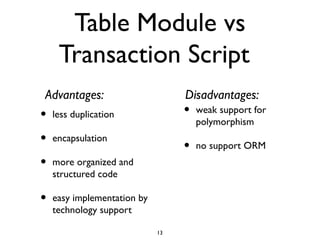
Table Module vs
     Transaction Script
Advantages:                       Disadvantages:
•   less duplication              •   weak support for
                                      polymorphism
•   encapsulation
                                  •   no support ORM
•   more organized and
    structured code

•   easy implementation by
    technology support

                             13
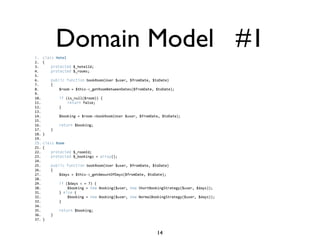
Domain Model #1
1. class Hotel  
2. {    
3.     protected $_hotelId;  
4.     protected $_rooms;  
5.       
6.     public function bookRoom(User $user, $fromDate, $toDate)    
7.     {    
8.         $room = $this->_getRoomBetweenDates($fromDate, $toDate);  
9.   
10.         if (is_null($room)) {    
11.             return false;    
12.         }    
13.   
14.         $booking = $room->bookRoom(User $user, $fromDate, $toDate);  
15.   
16.         return $booking;    
17.     }  
18. }  
19.   
20. class Room  
21. {  
22.     protected $_roomId;  
23.     protected $_bookings = array();  
24.       
25.     public function bookRoom(User $user, $fromDate, $toDate)  
26.     {  
27.         $days = $this->_getAmountOfDays($fromDate, $toDate);  
28.           
29.         if ($days < = 7) {  
30.             $booking = new Booking($user, new ShortBookingStrategy($user, $days));  
31.         } else {   
32.             $booking = new Booking($user, new NormalBookingStrategy($user, $days));  
33.         }  
34.           
35.         return $booking;  
36.     }  
37. } 


                                                           14
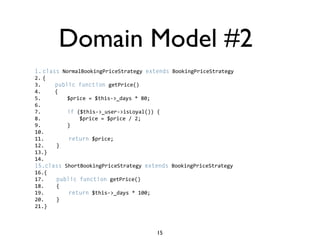
Domain Model #2
1. class NormalBookingPriceStrategy extends BookingPriceStrategy  
2. {  
3.     public function getPrice()  
4.     {  
5.         $price = $this->_days * 80;  
6.           
7.         if ($this->_user->isLoyal()) {  
8.             $price = $price / 2;  
9.         }  
10.          
11.        return $price;  
12.    }  
13.}  
14.  
15.class ShortBookingPriceStrategy extends BookingPriceStrategy  
16.{    
17.    public function getPrice()  
18.    {  
19.        return $this->_days * 100;  
20.    }  
21.}


                                       15
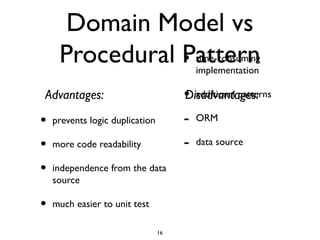
Domain Model vs
     Procedural Pattern
                •                       time-consuming
                                        implementation

Advantages:                           • additional patterns
                                      Disadvantages:

•   prevents logic duplication        - ORM
•   more code readability             - data source
•   independence from the data
    source

•   much easier to unit test

                                 16
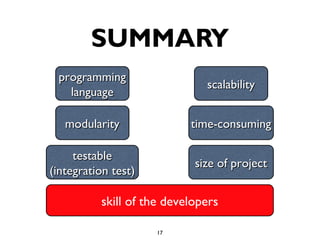
SUMMARY
 programming
                              scalability
   language

   modularity              time-consuming

     testable
                            size of project
(integration test)

          skill of the developers

                     17
Don’t be STUPID,
GRASP SOLID!


       18
Sorry, but your code is
       STUPID!


           19
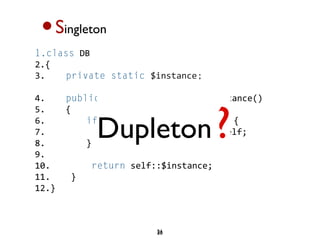
•S   ingleton
1.class DB 
2.{  
3.    private static $instance;

4.    public static function getInstance()


            Dupleton ?
5.    {  
6.        if(!isset(self::$instance)) {  
7.            self::$instance = new self;  
8.        }  
9.          
10.        return self::$instance;  
11.    }  
12.}  


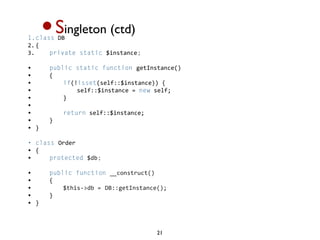
                       21
                       20
•S
1.class DB 
2. {  
            ingleton (ctd)
3.     private static $instance;

•       public static function getInstance()
•       {  
•           if(!isset(self::$instance)) {  
•               self::$instance = new self;  
•           }  
•             
•           return self::$instance;  
•       }  
•   }  

• class Order 
• {  
•     protected $db;

•       public function __construct()
•       {  
•           $this->db = DB::getInstance();           
•       }  
•   }


                                       21
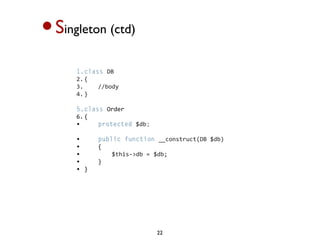
•S   ingleton (ctd)


       1.class DB 
       2. {
       3.     //body
       4. }

       5.class Order 
       6. {  
       •     protected $db;

       •       public function __construct(DB $db)
       •       {  
       •           $this->db = $db;           
       •       }  
       •   }


                               22
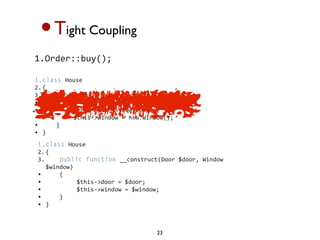
•T      ight Coupling

1.Order::buy();

1.class House 
2. {
3.     public function __construct()
•     {
•          $this->door = new Door();
•          $this->window = new Window();
•     }
• }
1.class House 
2. {
3.     public function __construct(Door $door, Window 
   $window)
•     {
•          $this->door = $door;
•          $this->window = $window;
•     }
• }


                                   23
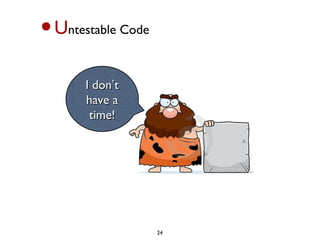
•U   ntestable Code


        I don’t
        have a
         time!


                      24
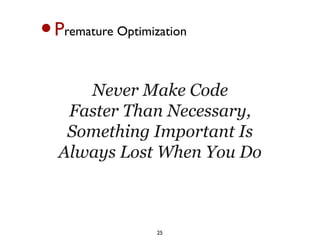
•P   remature Optimization


    Never Make Code
  Faster Than Necessary,
  Something Important Is
 Always Lost When You Do


                    25
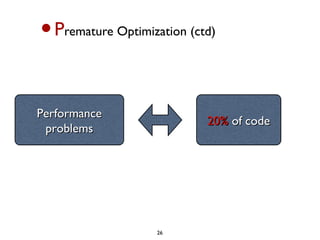
•P   remature Optimization (ctd)


Performance
                              20% of code
 problems


                     26
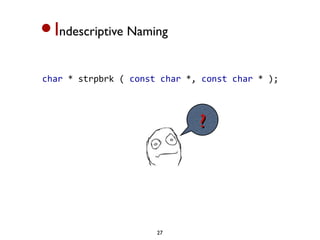
•I ndescriptive Naming


char * strpbrk ( const char *, const char * ); 


                              ?


                      27
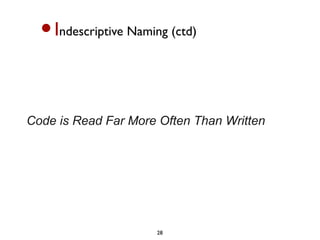
•I ndescriptive Naming (ctd)


Code is Read Far More Often Than Written


                      28
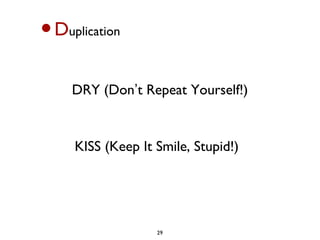
•Duplication


     DRY (Don’t Repeat Yourself!)


     KISS (Keep It Smile, Stupid!)


                   29
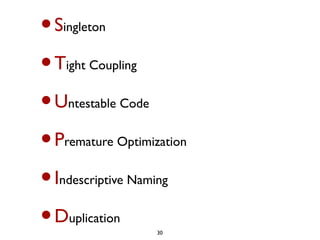
•S
 ingleton


•Tight Coupling


•Untestable Code


•P
 remature Optimization


•I
 ndescriptive Naming


•Duplication
                   30
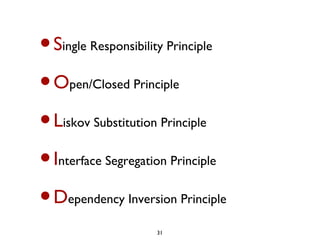
•S
 ingle Responsibility Principle


•O pen/Closed Principle


•L
 iskov Substitution Principle


•I
 nterface Segregation Principle


•Dependency Inversion Principle

                   31
32
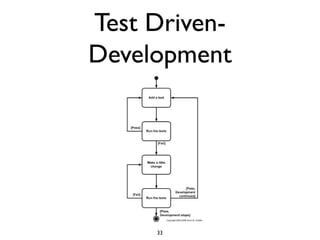
Test Driven-
Development


     33
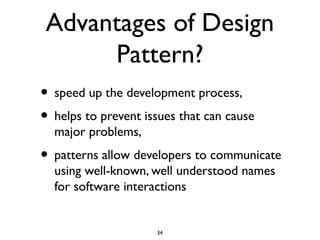
Advantages of Design
      Pattern?
• speed up the development process,
• helps to prevent issues that can cause
  major problems,
• patterns allow developers to communicate
  using well-known, well understood names
  for software interactions


                     34
EoT
Thank You

    35

Design Patterns

  • 1.
    Design Patterns Daniel Waligóra Wrocław 09/01/2012 1
  • 2.
    Bibliography • Martin Fowler,Patterns of Enterprise Appication Architecture • Matt Zandstra , PHP5 Objects, Patters, and Practice • http://www.ustream.tv - New York PHP channel • Symfony Live Berlin 2012 - https://joind.in/event/view/1114 • http://scholar.google.pl • http://pzielinski.com 2
  • 3.
  • 4.
    Breakdown Design Patterns by GoF Design Patterns creational structural behavioral - abstract factory - decorator - observer - builder - facade - strategy - prototype - composite - command 4
  • 5.
  • 6.
  • 7.
    Implementation related to the context programming scalability language testable modularity (integration test) time-consuming size of project 7
  • 8.
    Design patterns IS NOTrelated Context IS to the related to the programming programming language language 8
  • 9.
    1. 2. Transaction Script class Hotel   {    3.     private     4.         $_gateway; 5.     public function __construct(Data_Access_Gateway $gateway)     6.     {     7.         $this->_gateway = $gateway;     8.     }     9.    10.     public function bookRoom($userId, $fromDate, $toDate)     11.     {     12.         $roomId = $this->_gateway->_getRoomIdBetweenDates($fromDate, $toDate);     13.    14.         if (!$roomId) {     15.             return false;     16.         }     17.    18.         $days = $this->_getAmountOfDays($fromDate, $toDate);     19.    20.         if ($days < = 7) {   21.             $price = $days * 100;   22.         } else {    23.             $price = $days * 80;   24.         }   25.            26.         $data = array(   27.             'userId' => $userId,     28.             'roomId' => $roomId,   29.             'fromDate' => $fromDate,     30.             'toDate' => $toDate,     31.             'price' => $price,     32.         );     33.    34.         $bookingId = $this->_gateway->insert('bookings', $data);     35.    36.         return $bookingId;     37.     }     38. }  9
  • 10.
    Transaction Script Advantages: Disadvantages: • simple procedural model • difficult to maintenance • works well with a simple • code duplication data access layer • easy implementation of use cases 10
  • 11.
    1. Table Module #1 class Hotel   2. {     3.     public function __construct(Data_Access_Gateway $gateway, Booking $booking)     •     {     •         $this->_gateway = $gateway;   •         $this->_booking = $booking;   •     }     •    •     public function bookRoom($userId, $fromDate, $toDate)     •     {     •         $roomId = $this->_booking->getRoomBetweenDates($fromDate, $toDate);   •    •         if (!$roomId) {     •             return false;     •         }     •    •         $days = $this->_getAmountOfDays($fromDate, $toDate);     •    •         if ($days < = 7) {   •             $price = $days * 100;   •         } else {    •             $price = $days * 80;   •         }   •            •         $bookingId = $this->_booking- >addBooking($userId, $roomId, $fromDate, $toDate, $price);     •    •         return $bookingId;     •     }     • }   •    11
  • 12.
    Table Module #2 1.class Booking   2. {     3.     public function __construct(Data_Access_Gateway $gateway)     4.     {     5.         $this->_gateway = $gateway;     6.     }   7.        8.     public function getRoomBetweenDates($dateFrom, $dateTo)   9.     {   10.        return $this->_gateway->getRoomBetweenDates($dateFrom, $dateTo);   11.    }   12.       13.    public function addBooking($userId, $roomId, $fromDate, $toDate, $price)     14.    {     15.        $data = array(   16.            'userId' => $userId,     17.            'roomId' => $roomId,   18.            'fromDate' => $fromDate,     19.            'toDate' => $toDate,     20.            'price' => $price,     21.        );     22.   23.        $bookingId = $this->_gateway->insert('bookings', $data);     24.   25.        return $bookingId;     26.    }     27.}   12
  • 13.
    Table Module vs Transaction Script Advantages: Disadvantages: • less duplication • weak support for polymorphism • encapsulation • no support ORM • more organized and structured code • easy implementation by technology support 13
  • 14.
    Domain Model #1 1.class Hotel   2. {     3.     protected $_hotelId;   4.     protected $_rooms;   5.        6.     public function bookRoom(User $user, $fromDate, $toDate)     7.     {     8.         $room = $this->_getRoomBetweenDates($fromDate, $toDate);   9.    10.         if (is_null($room)) {     11.             return false;     12.         }     13.    14.         $booking = $room->bookRoom(User $user, $fromDate, $toDate);   15.    16.         return $booking;     17.     }   18. }   19.    20. class Room   21. {   22.     protected $_roomId;   23.     protected $_bookings = array();   24.        25.     public function bookRoom(User $user, $fromDate, $toDate)   26.     {   27.         $days = $this->_getAmountOfDays($fromDate, $toDate);   28.            29.         if ($days < = 7) {   30.             $booking = new Booking($user, new ShortBookingStrategy($user, $days));   31.         } else {    32.             $booking = new Booking($user, new NormalBookingStrategy($user, $days));   33.         }   34.            35.         return $booking;   36.     }   37. }  14
  • 15.
    Domain Model #2 1.class NormalBookingPriceStrategy extends BookingPriceStrategy   2. {   3.     public function getPrice()   4.     {   5.         $price = $this->_days * 80;   6.            7.         if ($this->_user->isLoyal()) {   8.             $price = $price / 2;   9.         }   10.           11.        return $price;   12.    }   13.}   14.   15.class ShortBookingPriceStrategy extends BookingPriceStrategy   16.{     17.    public function getPrice()   18.    {   19.        return $this->_days * 100;   20.    }   21.} 15
  • 16.
    Domain Model vs Procedural Pattern • time-consuming implementation Advantages: • additional patterns Disadvantages: • prevents logic duplication - ORM • more code readability - data source • independence from the data source • much easier to unit test 16
  • 17.
    SUMMARY programming scalability language modularity time-consuming testable size of project (integration test) skill of the developers 17
  • 18.
  • 19.
    Sorry, but yourcode is STUPID! 19
  • 20.
    •S ingleton 1.class DB  2.{   3.    private static $instance; 4.    public static function getInstance() Dupleton ? 5.    {   6.        if(!isset(self::$instance)) {   7.            self::$instance = new self;   8.        }   9.           10.        return self::$instance;   11.    }   12.}   21 20
  • 21.
    •S 1.class DB  2. {   ingleton (ctd) 3.     private static $instance; •     public static function getInstance() •     {   •         if(!isset(self::$instance)) {   •             self::$instance = new self;   •         }   •            •         return self::$instance;   •     }   • }   • class Order  • {   •     protected $db; •     public function __construct() •     {   •         $this->db = DB::getInstance();            •     }   • } 21
  • 22.
    •S ingleton (ctd) 1.class DB  2. { 3.     //body 4. } 5.class Order  6. {   •     protected $db; •     public function __construct(DB $db) •     {   •         $this->db = $db;            •     }   • } 22
  • 23.
    •T ight Coupling 1.Order::buy(); 1.class House  2. { 3.     public function __construct() •     { •          $this->door = new Door(); •          $this->window = new Window(); •     } • } 1.class House  2. { 3.     public function __construct(Door $door, Window  $window) •     { •          $this->door = $door; •          $this->window = $window; •     } • } 23
  • 24.
    •U ntestable Code I don’t have a time! 24
  • 25.
    •P remature Optimization Never Make Code Faster Than Necessary, Something Important Is Always Lost When You Do 25
  • 26.
    •P remature Optimization (ctd) Performance 20% of code problems 26
  • 27.
  • 28.
    •I ndescriptive Naming(ctd) Code is Read Far More Often Than Written 28
  • 29.
    •Duplication DRY (Don’t Repeat Yourself!) KISS (Keep It Smile, Stupid!) 29
  • 30.
    •S ingleton •Tight Coupling •UntestableCode •P remature Optimization •I ndescriptive Naming •Duplication 30
  • 31.
    •S ingle ResponsibilityPrinciple •O pen/Closed Principle •L iskov Substitution Principle •I nterface Segregation Principle •Dependency Inversion Principle 31
  • 32.
  • 33.
  • 34.
    Advantages of Design Pattern? • speed up the development process, • helps to prevent issues that can cause major problems, • patterns allow developers to communicate using well-known, well understood names for software interactions 34
  • 35.