Akshay Vaishnav1
.et. al. Int. Journal of Engineering Research and Applications www.ijera.com
ISSN: 2248-9622, Vol. 6, Issue 5, (Part - 4) May 2016, pp.58-66
www.ijera.com 58 | P a g e
Design Optimization of Hydraulic Press Plate using Finite
Element Analysis
Akshay Vaishnav1
, Path Lathiya2
, Mohit Sarvaiya3
1,2,3
(UG Student, Department of Mechanical Engineering, Sanjaybhai Rajguru College of Engineering, Gujarat
Technological University, Gujarat, India)
ABSTRACT
Metal forming is a process which is done by deforming metal work pieces to the desired shape and size using
pressing or hammering action. Hydraulic presses are being used for forming and pressing operations with wide
range of capacities. Hydraulic press machine works under continuous impact load. Because of this continuous
load, tensile and compressive stresses are experienced in various parts of machine. These stresses cause
permanent deformation in some parts of machine. This work is based on optimization of a 250-ton four pillar
type hydraulic press considering constraints like design, weight and cost. The work is focused on design and
optimization of top plate of the press machine. Top plate holds the hydraulic cylinder and is one of the most
critical parts of the machine. The design is based on sizing optimization method and the results are validated by
Finite Element method with proper boundary conditions. The CAD modelling has been carried out by PTC
CREO and for FEA, ANSYS software is used.
Keywords – CAD, Finite Element Analysis, Hydraulic press, Optimization
I. INTRODUCTION
A hydraulic press is a mechanical machine used
for lifting or compressing various parts and
components. The force is generated by the use of
hydraulic fluids to increase the pressure inside the
cylinder. The hydraulic press machine works on
Pascal's principle.
Bramah in 1795 was granted a patent for his
hydraulic press. Over the period of time that we are
evolving the press machine designs to advanced
level while, Bramah & William George Armstrong
are the two pioneers in this field.
Hydraulic press machine consists of basic
components used in a hydraulic system that includes
a hydraulic cylinder, piston, ram, pipelines for fluid
flow, oil reservoir and a controller. The piston inside
the cylinder is pushed by hydraulic fluid, which
causes the movement of piston. A ram connected
with piston, then compresses the material.
Incompressible fluid such as oil with proper density
and viscosity is used as a link for transmitting
hydraulic pressure.
Hydraulic press is used for almost all
industrial purposes, but basically it is used for
transforming metallic objects into sheets of metal. In
other industries, it is used for the thinning of glass,
making powders in case of the cosmetic industry and
for forming the tablets for medical use. Hydraulic
press can commonly be found for forging, molding,
blanking, punching, deep drawing and many other
metal forming operations.
The working drive of press has evolved
from Mechanical to Hydraulic and even Pneumatic.
With the advancement in technology, integration of
electronics and electrical devices with mechanical
devices has now been possible. These new Hydraulic
and Pneumatic presses have better capacity and are
far more reliable and easy to maintain. Mainly due to
high working capacity of these presses, they are
ubiquitous and preferred over mechanical presses.
Also maintainability is one of the key factors behind
the proper functionality of these presses.
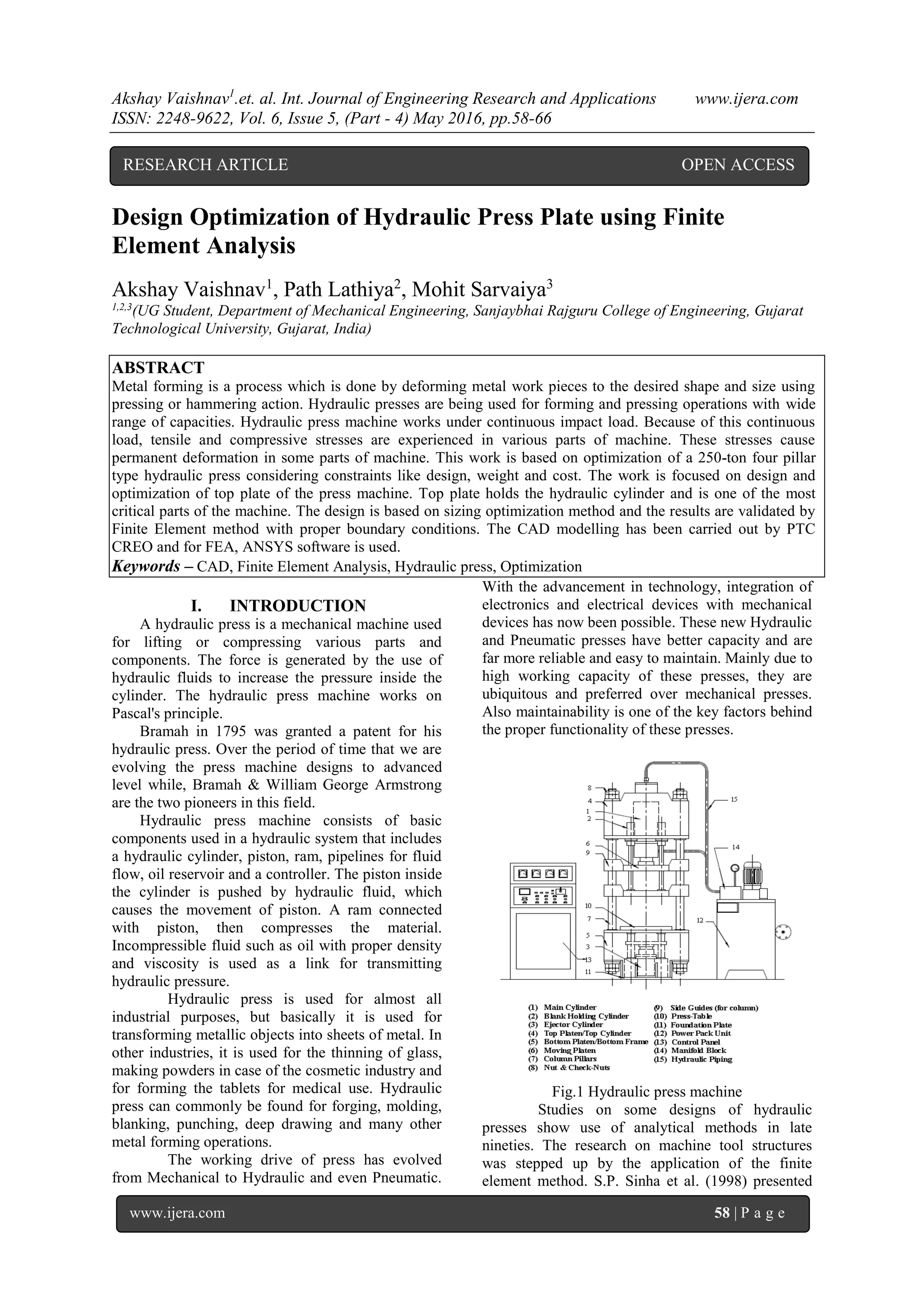
Fig.1 Hydraulic press machine
Studies on some designs of hydraulic
presses show use of analytical methods in late
nineties. The research on machine tool structures
was stepped up by the application of the finite
element method. S.P. Sinha et al. (1998) presented
RESEARCH ARTICLE OPEN ACCESS
Akshay Vaishnav1
.et. al. Int. Journal of Engineering Research and Applications www.ijera.com
ISSN: 2248-9622, Vol. 6, Issue 5, (Part - 4) May 2016, pp.58-66
www.ijera.com 59 | P a g e
the press design based on Computer Aided Design.
They presented work of C-type hydraulic press,
which is divided into two hypothetical parts to
decrease the computational time approximately 70%.
The press is applied 981 kN of load. Shell elements
of 6 DOF were used for modelling for the in-plate
membrane behavior and out-of-plane bending.
Effects of fillet, edge cutting, opening and eccentric
loading were studied on the deformation of the
frame of the machine. The permissible deformation
for this work was taken 0.5 mm/m [1].
Mohamad M. Saleh (1992) describes the
systematic procedure for investing the performance
and the design analysis of the welded structure of a
150-ton hydraulic press. The investigation discusses
the theoretical and experimental model of the
machine to establish the accurately optimal design
analysis and further development of the present
machine at minimum time and lower cost. The
theoretical model takes into account both
conventional analytical formula and numerical
technique, using Finite Element Analysis. Here, the
objective of modelling the structure of this press is
to establish an empirical method of calculation in
which the stiffness and the strength of the press
structure can be obtained. The data acquisition
system in the current work has been designed to
establish a versatile measurement system so that
processing of the experimental variables of interest
can be measured by the computer. It was concluded
that the press structure was more flexible in the
plane stress FEA model than 3D thin shell FEA
model by about 2%. This suggested that a new
design of press structure which converged to within
4% lower than that indicated by the design goal of
the press structure [2].
Malachy Sumaila et al. (2011) gave the
procedure for designing and manufacturing of a 30-
ton Hydraulic press. The initial dimension for
cylinder and the load were assumed to be 150 mm
and 300 kN load respectively. Cylinder End-Cover
Plate, Bolt, Cylinder Flange, Piston, Seals were
designed using standard design procedure. The
machine was then subjected to a load of 10 kN
provided by two compression springs of constant 9
N/mm each arranged in parallel between the plates.
The springs were then compressed axially to a length
of 100 mm. This arrangement was left to stand for
two hours and was observed for leakages. Leakage
in the system was not indicated as the lower plate
did not fall from its initial position [3].
Optimization in every design is necessary.
It reduces many factors in terms of costs,
manufacturing, material etc. Muni Prabaharan et al.
(2011) presented the work of optimization of 5 Ton
Hydraulic Press and Scrap Baling press for cost
reduction by Topology. The cost is reduced by
reduction of material; therefore, the thickness of the
press frame is reduced further from 10 mm. From
the results, it is concluded that 26.36% volume
reduction for scrap baling press and 24.54% for
hydraulic press [4].
In designing of hydraulic press, both
analytical and FEA methods are used in general
case. Cătălin Iancu (2013) compared the analytical
and FEA methods for designing of Mechanical press
bed. Open section frames with closed contour
section were used. It was found that closed frames
are approximately 15% more rigid than open
frameworks, the decisive factor in choosing the
technology and construction of the frame being
technical-economic considerations. The 3D model
was generated using CAD tools, which is simulated
by FEA tool. Based on FEA application the results
show a continuous distribution of displacements and
stresses that validate the model, proving it correct. It
can be noticed that stress values are generally low
compared with traction-compression strength of bed
material, higher values being recorded only locally.
The results of both methods show that, the stress
values obtained by classical calculus are higher than
obtained by FEA, conforming the assumption that
using only a calculation based on the simplified
structure, leads to an oversized structure, the
calculation method being usually used for
verification [5].
Ankit Parmar et al. (2014) demonstrated the
FEA based design and optimization of foremost
element of hydraulic press machine. The main
components focused are top plate, movable plate and
column design. The load was assumed to be 300-
tons. Several design iterations were performed for
designing the plates followed by some simulations.
After every simulation, the design is modified each
time. The sizing optimization approach was used for
this work. In this work, various size parameters like
plate thickness, bar cross sectional areas are
modified to design the structure under safe
conditions. For final design, the weight of bottom
plate was reduced from 2263 kg to 1303 kg.
Deformation is increased from 0.055 mm to 0.22
mm, which is still in permissible limit. Von-misses
stress is increased from 104 MPa to 141 MPa, which
is also in permissible limit and under safe working
condition [7].
Sizing optimization is a very useful method
in designing of press machines. Pritesh Prajapati et
al. (2014) presented work on design and
modification of hydraulic press based on that
method. Different thirty iterations were performed
proposing different deigns. The material used for
plate and structure is Stainless Steel with minimum
allowable deformation under 5 mm/m. The weight of
plate is reduced quite significantly due to the
optimization process, but the values of deformation
Akshay Vaishnav1
.et. al. Int. Journal of Engineering Research and Applications www.ijera.com
ISSN: 2248-9622, Vol. 6, Issue 5, (Part - 4) May 2016, pp.58-66
www.ijera.com 60 | P a g e
and stress increase, which is still under permissible
values for safe design [8].
The study on C-type power press was done
by D. Ravi (2014) under static conditions. The
capacity of press is 10 tons. The 3D model of the
power press was analyzed in static condition to find
the stresses and deflections in the structure. The
second stage of work includes the reduction in
weight of the power press by varying the thickness
of bed and frame. A CAD assembly was generated
using CAD tools and assembly features. This
assembly was subjected to FEA analysis. In the
existing design the structure, 56.68 N/mm2
stress
was acting with 1.533 mm of maximum
deformation. After being modified and redesigned,
the value of stress becomes 56.42 N/mm2
with the
maximum deformation of 1.647 mm. Due to
decrement of bed and frame thickness, the weight
machine was reduced from 1920 kg to 1660 kg [9].
The design optimization and analysis of
structure of a heavy duty forming hydraulic press
were carried out by Abhijeet S Khandekar (2015).
The work was proposed for 300-ton capacity of
machine. Conventional design calculations were
made assuming the plate structure as a simple beam.
The load is applied at the center of the beam. Stress
generated from the conventional design calculations
is 150 Kg/cm2
[11]. A review paper was presented
by Asim M. Kamte et al. (2015) on design analysis
of a 20-ton hydraulic press. The optimization of all
parts is done by FEA method, which will help to
reduce the unwanted stress [12].
II. PROBLEM STATEMENT
Every design starts with the conventional
calculations by applying various fundamentals of
design. The top plate is subjected to pure bending
stress during the operation. Therefore, design
considerations are essential for plates subjected to
bending stress. The dimensions of base plate, used
for top plate,
Table 1: Geometrical dimensions
Constraint Value
Breath (b) 860 mm
Height (h) 558.6 mm
Depth (d) 60 mm
Maximum applied load 250 tons
Based on the theoretical calculations and
design, we can model and simulate the system into
various software packages for validation. The
theoretical calculations are based on conventional
machine design using a set of equations. This gives
the basic idea of the design of the product.
Fig. 2 Load case
When a static or dynamic load acts on any
part of hydraulic press, then along with simple,
tensile, compressive, shear stress, it also develops
bending stress.
Consider a beam subjected to a bending moment M,
The bending equation is given by,
(1)
Where,
M = Bending moment at the given section
= Bending stress
I = Moment of inertia of the cross-section about the
neutral axis.
y = Distance from the neutral surface to the extreme
fiber
Bending moment is given by,
(2)
= 5.375e8 N-mm
Moment of inertia of the cross-section about the
neutral axis,
= = 8.71e8 mm4
= = 279.3 mm
Putting these values in Eq. (1)
=
172.09 N/mm2
= 172.09 MPa
The ultimate tensile strength of mild steel is,
460 MPa, Considering Factor of Safety = 2.5
for the given structure.
According to Maximum Principal stress theory,
184 MPa
So, <
Akshay Vaishnav1
.et. al. Int. Journal of Engineering Research and Applications www.ijera.com
ISSN: 2248-9622, Vol. 6, Issue 5, (Part - 4) May 2016, pp.58-66
www.ijera.com 61 | P a g e
Here the bending stress acting on the base
plate is less than the allowable stress of the plate
material. Hence, we can conclude that the given
design of base plate for design top plate is safe.
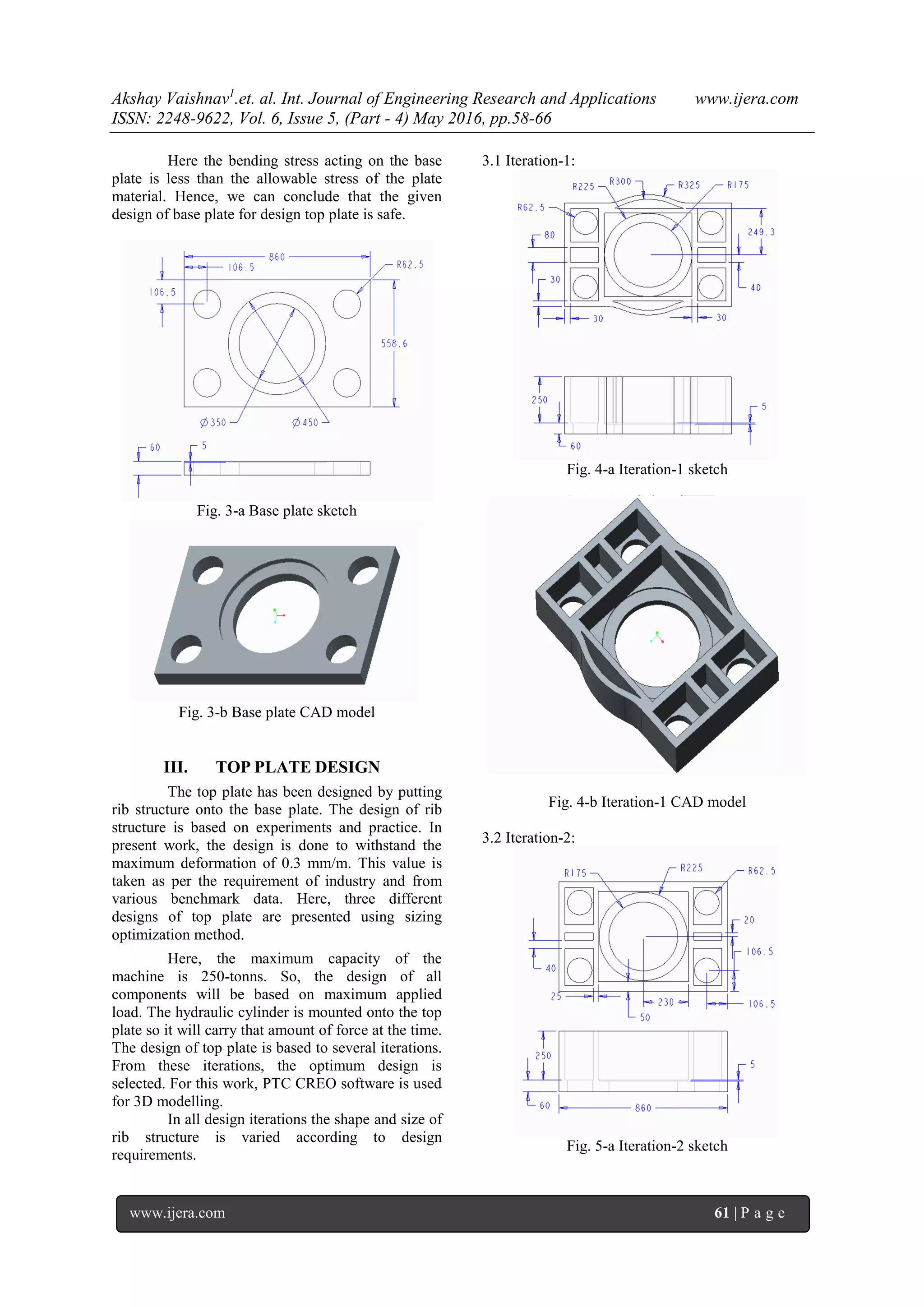
Fig. 3-a Base plate sketch
Fig. 3-b Base plate CAD model
III. TOP PLATE DESIGN
The top plate has been designed by putting
rib structure onto the base plate. The design of rib
structure is based on experiments and practice. In
present work, the design is done to withstand the
maximum deformation of 0.3 mm/m. This value is
taken as per the requirement of industry and from
various benchmark data. Here, three different
designs of top plate are presented using sizing
optimization method.
Here, the maximum capacity of the
machine is 250-tonns. So, the design of all
components will be based on maximum applied
load. The hydraulic cylinder is mounted onto the top
plate so it will carry that amount of force at the time.
The design of top plate is based to several iterations.
From these iterations, the optimum design is
selected. For this work, PTC CREO software is used
for 3D modelling.
In all design iterations the shape and size of
rib structure is varied according to design
requirements.
3.1 Iteration-1:
Fig. 4-a Iteration-1 sketch
Fig. 4-b Iteration-1 CAD model
3.2 Iteration-2:
Fig. 5-a Iteration-2 sketch
Akshay Vaishnav1
.et. al. Int. Journal of Engineering Research and Applications www.ijera.com
ISSN: 2248-9622, Vol. 6, Issue 5, (Part - 4) May 2016, pp.58-66
www.ijera.com 62 | P a g e
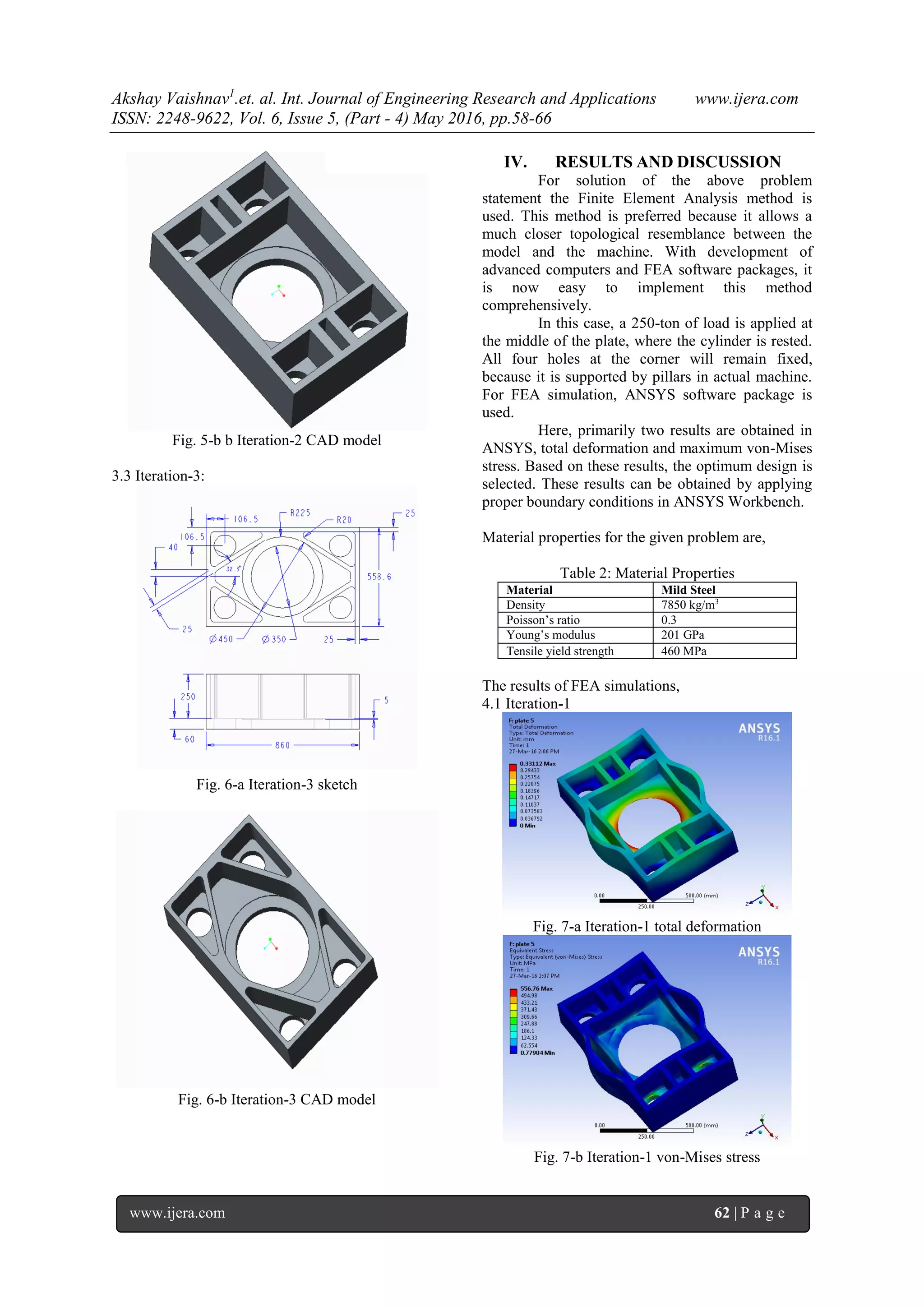
Fig. 5-b b Iteration-2 CAD model
3.3 Iteration-3:
Fig. 6-a Iteration-3 sketch
Fig. 6-b Iteration-3 CAD model
IV. RESULTS AND DISCUSSION
For solution of the above problem
statement the Finite Element Analysis method is
used. This method is preferred because it allows a
much closer topological resemblance between the
model and the machine. With development of
advanced computers and FEA software packages, it
is now easy to implement this method
comprehensively.
In this case, a 250-ton of load is applied at
the middle of the plate, where the cylinder is rested.
All four holes at the corner will remain fixed,
because it is supported by pillars in actual machine.
For FEA simulation, ANSYS software package is
used.
Here, primarily two results are obtained in
ANSYS, total deformation and maximum von-Mises
stress. Based on these results, the optimum design is
selected. These results can be obtained by applying
proper boundary conditions in ANSYS Workbench.
Material properties for the given problem are,
Table 2: Material Properties
Material Mild Steel
Density 7850 kg/m3
Poisson’s ratio 0.3
Young’s modulus 201 GPa
Tensile yield strength 460 MPa
The results of FEA simulations,
4.1 Iteration-1
Fig. 7-a Iteration-1 total deformation
Fig. 7-b Iteration-1 von-Mises stress
Akshay Vaishnav1
.et. al. Int. Journal of Engineering Research and Applications www.ijera.com
ISSN: 2248-9622, Vol. 6, Issue 5, (Part - 4) May 2016, pp.58-66
www.ijera.com 63 | P a g e
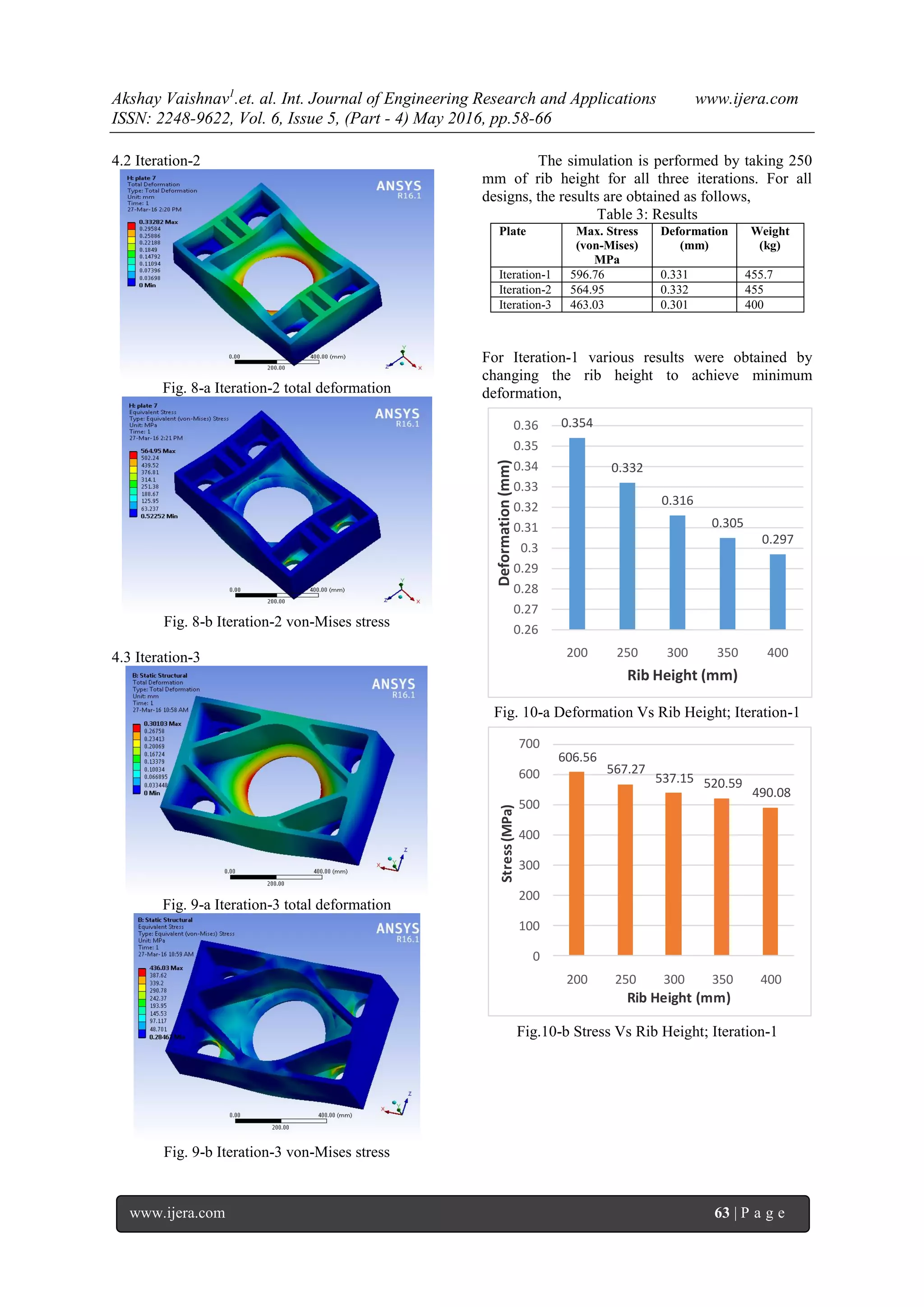
4.2 Iteration-2
Fig. 8-a Iteration-2 total deformation
Fig. 8-b Iteration-2 von-Mises stress
4.3 Iteration-3
Fig. 9-a Iteration-3 total deformation
Fig. 9-b Iteration-3 von-Mises stress
The simulation is performed by taking 250
mm of rib height for all three iterations. For all
designs, the results are obtained as follows,
Table 3: Results
Plate Max. Stress
(von-Mises)
MPa
Deformation
(mm)
Weight
(kg)
Iteration-1 596.76 0.331 455.7
Iteration-2 564.95 0.332 455
Iteration-3 463.03 0.301 400
For Iteration-1 various results were obtained by
changing the rib height to achieve minimum
deformation,
0.354
0.332
0.316
0.305
0.297
0.26
0.27
0.28
0.29
0.3
0.31
0.32
0.33
0.34
0.35
0.36
200 250 300 350 400
Deformation(mm)
Rib Height (mm)
Fig. 10-a Deformation Vs Rib Height; Iteration-1
606.56
567.27
537.15 520.59
490.08
0
100
200
300
400
500
600
700
200 250 300 350 400
Stress(MPa)
Rib Height (mm)
Fig.10-b Stress Vs Rib Height; Iteration-1
Akshay Vaishnav1
.et. al. Int. Journal of Engineering Research and Applications www.ijera.com
ISSN: 2248-9622, Vol. 6, Issue 5, (Part - 4) May 2016, pp.58-66
www.ijera.com 64 | P a g e
397.6
455.3
513.78
571.87
630.35
0
100
200
300
400
500
600
700
200 250 300 350 400
Weight(Kg)
Rib Height (mm)
Fig. 10-c Weight Vs Rib Height; Iteration-1
For Iteration-2 various results were obtained by
changing the rib height to achieve minimum
deformation,
0.357
0.333
0.317
0.31
0.304 0.301
0.27
0.28
0.29
0.3
0.31
0.32
0.33
0.34
0.35
0.36
0.37
200 250 300 350 400 450
Deformation(mm)
Rib Height (mm)
Fig. 11-a Deformation Vs Rib Height; Iteration-2
594.29
563.08
536.81
505.41 488.27 484.43
0
100
200
300
400
500
600
700
200 250 300 350 400 450
Stress(Mpa)
Rib Height (mm)
Fig.11-b Stress Vs Rib Height; Iteration-2
387.79
445.88
503.97
562.06
620.15
678.31
0
100
200
300
400
500
600
700
800
200 250 300 350 400 450
Weight(Kg)
Rib Height (mm)
Fig. 11-c Weight Vs Rib Height; Iteration-2
For Iteration-3 various results were obtained by
changing the rib height to achieve minimum
deformation,
0.387
0.339
0.312 0.304 0.298
0
0.05
0.1
0.15
0.2
0.25
0.3
0.35
0.4
0.45
100 150 200 250 300
Deformation(mm)
Rib Height (mm)
Fig. 12-a Deformation Vs Rib Height; Iteration-3
503.18
456.88
416.26
394.91 393.57
0
100
200
300
400
500
600
100 150 200 250 300
Stress(Mpa)
Rib Height (mm)
Fig.12-b Stress Vs Rib Height; Iteration-3
Akshay Vaishnav1
.et. al. Int. Journal of Engineering Research and Applications www.ijera.com
ISSN: 2248-9622, Vol. 6, Issue 5, (Part - 4) May 2016, pp.58-66
www.ijera.com 65 | P a g e
253.24
302.22
350.89
400.11
447.45
0
50
100
150
200
250
300
350
400
450
500
100 150 200 250 300
Weight(Kg)
Rib Height (mm)
Fig. 12-c Weight Vs Rib Height; Iteration-3
V. CONCLUSION
From sizing optimization method, the
design is modified by incremental iteration
approach. For 250 mm of rib height, the FEA results
were obtained. It is found that Iteration-3 is optimum
design and has deformation under desired values.
Also the maximum von-Mises stress for that design
is less than the ultimate tensile stress of the material,
so this design is safe.
For other designs, the attempt was made to
restrict the overall deformation under 0.3mm/m.
This is done by changing the rib height of the plate.
Comparison of these results is shown in graphs.
From these results it is found that for Iteration-1, the
desirable deformation can be achieved by putting the
rib height of 350 mm. For this height the value of
maximum von-Mises stress is 520.29 MPa and the
weight is 571.87 kg. For Iteration-2, the desirable
deformation can be achieved by taking 450 mm of
rib height with the value of maximum von-Mises
stress is 484.43 MPa and the weight of 678.31 kg.
For Iteration-3, the desirable deformation can be
achieved by putting 250 mm of rib height with the
maximum value of von-Mises stress of 393.57 MPa
and the weight of 400 kg.
So, from the above results, it is concluded
that design-3 can be proposed for manufacturing. It
has much lower weight compared to other designs,
so material cost can be saved. Also it fulfills all the
design constraints. It can be manufactured by casting
method.
REFERENCES
[1] S. P. Sinha, P.D. Murarka, Computer-Aided
design of Hydraulic Structures, Math1
Computer Modelling, Vol. 10, No. 9, pp.
637-645, 1988
[2] Mohamad M. Saleh, Design Study of a
Heavy Duty Hydraulic Machine using
Finite Element Techniques, Ph. D Thesis,
Dublin City University, August, 1992
[3] Malachy Sumaila, Akii Okonigbon
Akaehomen Ibhadode, Design and
Manufacture of a 30-ton Hydraulic Press,
AU J.T. 14(3): 196-200 Jan. 2011
[4] Muni Prabaharan and V.Amarnath,
Structural Optimization of 5-Ton Hydraulic
Press and Scrap Baling Press for Cost
Reduction by Topology, International
Journal of Modeling and Optimization, Vol.
1, No. 3, August 2011
[5] Cătălin Iancu, Comparison between
Analytical Calculus and FEM for a
Mechanical Press Bed, American Journal of
Mechanical Engineering, Vol. 1, No. 1, 6-
13, 2013
[6] Jiafeng Yao, Baochun Lu, Chris Zhang and
Michio Sadatomi, Optimal Design of
Hydraulic System for an Industrial Press
Machine for Performance Improvement and
Noise Reduction, Open Journal of
Mechanical Engineering, Vol.1 No.3, pp 1-
16, 2013
[7] Ankit H Parmar, Kinnarraj P Zala and
Ankit R Patel, Design and Modification of
Foremost Element of Hydraulic Press
Machine, International Journal of
Advanced Scientific and Technical
Research Issue 4 volume 3, May-June 2014
[8] Pritesh Prajapati and Ankit Parmar, Design
and Modification of Hydraulic Press,
International Journal of Engineering
Development and Research, Volume 2,
Issue 2, 2014
[9] D. Ravi, Computer Aided Design and
Analysis of Power Press, Middle-East
Journal of Scientific Research 20 (10):
1239-1246, 2014
[10] Amith Kalekar and S. B. Tuljapure, Stress
Analysis of a Frame of a Bush Pressing
Machine for Pumps, International Journal
of Innovative Research in Science,
Engineering and Technology, Vol. 4, Issue
2, February 2015
[11] Abhijeet S Khandekar, Conventional
Design Calculation &3D Modeling of
Metal Forming Heavy duty Hydraulic
Press, International Journal of Engineering
Research and Applications, Vol. 5, Issue 6,
Part – 5, pp.100-103, June 2015
[12] Asim M.Kamate and Prof. Dr. J.S. Bagi, A
Review on Design Analysis and
Optimization of a 20 Ton Hydraulic Press,
International Journal of Engineering
Technology, Management and Applied
Sciences, Volume 3, Special Issue, ISSN
2349-4476, September, 2015
Akshay Vaishnav1
.et. al. Int. Journal of Engineering Research and Applications www.ijera.com
ISSN: 2248-9622, Vol. 6, Issue 5, (Part - 4) May 2016, pp.58-66
www.ijera.com 66 | P a g e
[13] Mr. Umesh C. Rajmane, Mr. Sourabh S.
Kulkarni and Prof. Dr. A.M.Nagaraj,
Design, Development and Stress Analysis
for Twin Punching 100 ton Forging press,
International Journal of Advanced Research
in Science, Engineering and Technology,
Vol. 3, Issue 1 , January 2016.
[14] ANSYS user guide
[15] RK Jain, 2014, Production Technology
Khanna Publications, Delhi
[16] Robert D. Cook, 2001, Concepts and
Applications of Finite Element Analysis
Wiley Publication, NY
[17] Khurmi and Gupta, 2011, A Textbook of
Machine Design S Chand Publication,
Delhi

Design Optimization of Hydraulic Press Plate using Finite Element Analysis

  • 1.
    Akshay Vaishnav1 .et. al.Int. Journal of Engineering Research and Applications www.ijera.com ISSN: 2248-9622, Vol. 6, Issue 5, (Part - 4) May 2016, pp.58-66 www.ijera.com 58 | P a g e Design Optimization of Hydraulic Press Plate using Finite Element Analysis Akshay Vaishnav1 , Path Lathiya2 , Mohit Sarvaiya3 1,2,3 (UG Student, Department of Mechanical Engineering, Sanjaybhai Rajguru College of Engineering, Gujarat Technological University, Gujarat, India) ABSTRACT Metal forming is a process which is done by deforming metal work pieces to the desired shape and size using pressing or hammering action. Hydraulic presses are being used for forming and pressing operations with wide range of capacities. Hydraulic press machine works under continuous impact load. Because of this continuous load, tensile and compressive stresses are experienced in various parts of machine. These stresses cause permanent deformation in some parts of machine. This work is based on optimization of a 250-ton four pillar type hydraulic press considering constraints like design, weight and cost. The work is focused on design and optimization of top plate of the press machine. Top plate holds the hydraulic cylinder and is one of the most critical parts of the machine. The design is based on sizing optimization method and the results are validated by Finite Element method with proper boundary conditions. The CAD modelling has been carried out by PTC CREO and for FEA, ANSYS software is used. Keywords – CAD, Finite Element Analysis, Hydraulic press, Optimization I. INTRODUCTION A hydraulic press is a mechanical machine used for lifting or compressing various parts and components. The force is generated by the use of hydraulic fluids to increase the pressure inside the cylinder. The hydraulic press machine works on Pascal's principle. Bramah in 1795 was granted a patent for his hydraulic press. Over the period of time that we are evolving the press machine designs to advanced level while, Bramah & William George Armstrong are the two pioneers in this field. Hydraulic press machine consists of basic components used in a hydraulic system that includes a hydraulic cylinder, piston, ram, pipelines for fluid flow, oil reservoir and a controller. The piston inside the cylinder is pushed by hydraulic fluid, which causes the movement of piston. A ram connected with piston, then compresses the material. Incompressible fluid such as oil with proper density and viscosity is used as a link for transmitting hydraulic pressure. Hydraulic press is used for almost all industrial purposes, but basically it is used for transforming metallic objects into sheets of metal. In other industries, it is used for the thinning of glass, making powders in case of the cosmetic industry and for forming the tablets for medical use. Hydraulic press can commonly be found for forging, molding, blanking, punching, deep drawing and many other metal forming operations. The working drive of press has evolved from Mechanical to Hydraulic and even Pneumatic. With the advancement in technology, integration of electronics and electrical devices with mechanical devices has now been possible. These new Hydraulic and Pneumatic presses have better capacity and are far more reliable and easy to maintain. Mainly due to high working capacity of these presses, they are ubiquitous and preferred over mechanical presses. Also maintainability is one of the key factors behind the proper functionality of these presses. Fig.1 Hydraulic press machine Studies on some designs of hydraulic presses show use of analytical methods in late nineties. The research on machine tool structures was stepped up by the application of the finite element method. S.P. Sinha et al. (1998) presented RESEARCH ARTICLE OPEN ACCESS
  • 2.
    Akshay Vaishnav1 .et. al.Int. Journal of Engineering Research and Applications www.ijera.com ISSN: 2248-9622, Vol. 6, Issue 5, (Part - 4) May 2016, pp.58-66 www.ijera.com 59 | P a g e the press design based on Computer Aided Design. They presented work of C-type hydraulic press, which is divided into two hypothetical parts to decrease the computational time approximately 70%. The press is applied 981 kN of load. Shell elements of 6 DOF were used for modelling for the in-plate membrane behavior and out-of-plane bending. Effects of fillet, edge cutting, opening and eccentric loading were studied on the deformation of the frame of the machine. The permissible deformation for this work was taken 0.5 mm/m [1]. Mohamad M. Saleh (1992) describes the systematic procedure for investing the performance and the design analysis of the welded structure of a 150-ton hydraulic press. The investigation discusses the theoretical and experimental model of the machine to establish the accurately optimal design analysis and further development of the present machine at minimum time and lower cost. The theoretical model takes into account both conventional analytical formula and numerical technique, using Finite Element Analysis. Here, the objective of modelling the structure of this press is to establish an empirical method of calculation in which the stiffness and the strength of the press structure can be obtained. The data acquisition system in the current work has been designed to establish a versatile measurement system so that processing of the experimental variables of interest can be measured by the computer. It was concluded that the press structure was more flexible in the plane stress FEA model than 3D thin shell FEA model by about 2%. This suggested that a new design of press structure which converged to within 4% lower than that indicated by the design goal of the press structure [2]. Malachy Sumaila et al. (2011) gave the procedure for designing and manufacturing of a 30- ton Hydraulic press. The initial dimension for cylinder and the load were assumed to be 150 mm and 300 kN load respectively. Cylinder End-Cover Plate, Bolt, Cylinder Flange, Piston, Seals were designed using standard design procedure. The machine was then subjected to a load of 10 kN provided by two compression springs of constant 9 N/mm each arranged in parallel between the plates. The springs were then compressed axially to a length of 100 mm. This arrangement was left to stand for two hours and was observed for leakages. Leakage in the system was not indicated as the lower plate did not fall from its initial position [3]. Optimization in every design is necessary. It reduces many factors in terms of costs, manufacturing, material etc. Muni Prabaharan et al. (2011) presented the work of optimization of 5 Ton Hydraulic Press and Scrap Baling press for cost reduction by Topology. The cost is reduced by reduction of material; therefore, the thickness of the press frame is reduced further from 10 mm. From the results, it is concluded that 26.36% volume reduction for scrap baling press and 24.54% for hydraulic press [4]. In designing of hydraulic press, both analytical and FEA methods are used in general case. Cătălin Iancu (2013) compared the analytical and FEA methods for designing of Mechanical press bed. Open section frames with closed contour section were used. It was found that closed frames are approximately 15% more rigid than open frameworks, the decisive factor in choosing the technology and construction of the frame being technical-economic considerations. The 3D model was generated using CAD tools, which is simulated by FEA tool. Based on FEA application the results show a continuous distribution of displacements and stresses that validate the model, proving it correct. It can be noticed that stress values are generally low compared with traction-compression strength of bed material, higher values being recorded only locally. The results of both methods show that, the stress values obtained by classical calculus are higher than obtained by FEA, conforming the assumption that using only a calculation based on the simplified structure, leads to an oversized structure, the calculation method being usually used for verification [5]. Ankit Parmar et al. (2014) demonstrated the FEA based design and optimization of foremost element of hydraulic press machine. The main components focused are top plate, movable plate and column design. The load was assumed to be 300- tons. Several design iterations were performed for designing the plates followed by some simulations. After every simulation, the design is modified each time. The sizing optimization approach was used for this work. In this work, various size parameters like plate thickness, bar cross sectional areas are modified to design the structure under safe conditions. For final design, the weight of bottom plate was reduced from 2263 kg to 1303 kg. Deformation is increased from 0.055 mm to 0.22 mm, which is still in permissible limit. Von-misses stress is increased from 104 MPa to 141 MPa, which is also in permissible limit and under safe working condition [7]. Sizing optimization is a very useful method in designing of press machines. Pritesh Prajapati et al. (2014) presented work on design and modification of hydraulic press based on that method. Different thirty iterations were performed proposing different deigns. The material used for plate and structure is Stainless Steel with minimum allowable deformation under 5 mm/m. The weight of plate is reduced quite significantly due to the optimization process, but the values of deformation
  • 3.
    Akshay Vaishnav1 .et. al.Int. Journal of Engineering Research and Applications www.ijera.com ISSN: 2248-9622, Vol. 6, Issue 5, (Part - 4) May 2016, pp.58-66 www.ijera.com 60 | P a g e and stress increase, which is still under permissible values for safe design [8]. The study on C-type power press was done by D. Ravi (2014) under static conditions. The capacity of press is 10 tons. The 3D model of the power press was analyzed in static condition to find the stresses and deflections in the structure. The second stage of work includes the reduction in weight of the power press by varying the thickness of bed and frame. A CAD assembly was generated using CAD tools and assembly features. This assembly was subjected to FEA analysis. In the existing design the structure, 56.68 N/mm2 stress was acting with 1.533 mm of maximum deformation. After being modified and redesigned, the value of stress becomes 56.42 N/mm2 with the maximum deformation of 1.647 mm. Due to decrement of bed and frame thickness, the weight machine was reduced from 1920 kg to 1660 kg [9]. The design optimization and analysis of structure of a heavy duty forming hydraulic press were carried out by Abhijeet S Khandekar (2015). The work was proposed for 300-ton capacity of machine. Conventional design calculations were made assuming the plate structure as a simple beam. The load is applied at the center of the beam. Stress generated from the conventional design calculations is 150 Kg/cm2 [11]. A review paper was presented by Asim M. Kamte et al. (2015) on design analysis of a 20-ton hydraulic press. The optimization of all parts is done by FEA method, which will help to reduce the unwanted stress [12]. II. PROBLEM STATEMENT Every design starts with the conventional calculations by applying various fundamentals of design. The top plate is subjected to pure bending stress during the operation. Therefore, design considerations are essential for plates subjected to bending stress. The dimensions of base plate, used for top plate, Table 1: Geometrical dimensions Constraint Value Breath (b) 860 mm Height (h) 558.6 mm Depth (d) 60 mm Maximum applied load 250 tons Based on the theoretical calculations and design, we can model and simulate the system into various software packages for validation. The theoretical calculations are based on conventional machine design using a set of equations. This gives the basic idea of the design of the product. Fig. 2 Load case When a static or dynamic load acts on any part of hydraulic press, then along with simple, tensile, compressive, shear stress, it also develops bending stress. Consider a beam subjected to a bending moment M, The bending equation is given by, (1) Where, M = Bending moment at the given section = Bending stress I = Moment of inertia of the cross-section about the neutral axis. y = Distance from the neutral surface to the extreme fiber Bending moment is given by, (2) = 5.375e8 N-mm Moment of inertia of the cross-section about the neutral axis, = = 8.71e8 mm4 = = 279.3 mm Putting these values in Eq. (1) = 172.09 N/mm2 = 172.09 MPa The ultimate tensile strength of mild steel is, 460 MPa, Considering Factor of Safety = 2.5 for the given structure. According to Maximum Principal stress theory, 184 MPa So, <
  • 4.
    Akshay Vaishnav1 .et. al.Int. Journal of Engineering Research and Applications www.ijera.com ISSN: 2248-9622, Vol. 6, Issue 5, (Part - 4) May 2016, pp.58-66 www.ijera.com 61 | P a g e Here the bending stress acting on the base plate is less than the allowable stress of the plate material. Hence, we can conclude that the given design of base plate for design top plate is safe. Fig. 3-a Base plate sketch Fig. 3-b Base plate CAD model III. TOP PLATE DESIGN The top plate has been designed by putting rib structure onto the base plate. The design of rib structure is based on experiments and practice. In present work, the design is done to withstand the maximum deformation of 0.3 mm/m. This value is taken as per the requirement of industry and from various benchmark data. Here, three different designs of top plate are presented using sizing optimization method. Here, the maximum capacity of the machine is 250-tonns. So, the design of all components will be based on maximum applied load. The hydraulic cylinder is mounted onto the top plate so it will carry that amount of force at the time. The design of top plate is based to several iterations. From these iterations, the optimum design is selected. For this work, PTC CREO software is used for 3D modelling. In all design iterations the shape and size of rib structure is varied according to design requirements. 3.1 Iteration-1: Fig. 4-a Iteration-1 sketch Fig. 4-b Iteration-1 CAD model 3.2 Iteration-2: Fig. 5-a Iteration-2 sketch
  • 5.
    Akshay Vaishnav1 .et. al.Int. Journal of Engineering Research and Applications www.ijera.com ISSN: 2248-9622, Vol. 6, Issue 5, (Part - 4) May 2016, pp.58-66 www.ijera.com 62 | P a g e Fig. 5-b b Iteration-2 CAD model 3.3 Iteration-3: Fig. 6-a Iteration-3 sketch Fig. 6-b Iteration-3 CAD model IV. RESULTS AND DISCUSSION For solution of the above problem statement the Finite Element Analysis method is used. This method is preferred because it allows a much closer topological resemblance between the model and the machine. With development of advanced computers and FEA software packages, it is now easy to implement this method comprehensively. In this case, a 250-ton of load is applied at the middle of the plate, where the cylinder is rested. All four holes at the corner will remain fixed, because it is supported by pillars in actual machine. For FEA simulation, ANSYS software package is used. Here, primarily two results are obtained in ANSYS, total deformation and maximum von-Mises stress. Based on these results, the optimum design is selected. These results can be obtained by applying proper boundary conditions in ANSYS Workbench. Material properties for the given problem are, Table 2: Material Properties Material Mild Steel Density 7850 kg/m3 Poisson’s ratio 0.3 Young’s modulus 201 GPa Tensile yield strength 460 MPa The results of FEA simulations, 4.1 Iteration-1 Fig. 7-a Iteration-1 total deformation Fig. 7-b Iteration-1 von-Mises stress
  • 6.
    Akshay Vaishnav1 .et. al.Int. Journal of Engineering Research and Applications www.ijera.com ISSN: 2248-9622, Vol. 6, Issue 5, (Part - 4) May 2016, pp.58-66 www.ijera.com 63 | P a g e 4.2 Iteration-2 Fig. 8-a Iteration-2 total deformation Fig. 8-b Iteration-2 von-Mises stress 4.3 Iteration-3 Fig. 9-a Iteration-3 total deformation Fig. 9-b Iteration-3 von-Mises stress The simulation is performed by taking 250 mm of rib height for all three iterations. For all designs, the results are obtained as follows, Table 3: Results Plate Max. Stress (von-Mises) MPa Deformation (mm) Weight (kg) Iteration-1 596.76 0.331 455.7 Iteration-2 564.95 0.332 455 Iteration-3 463.03 0.301 400 For Iteration-1 various results were obtained by changing the rib height to achieve minimum deformation, 0.354 0.332 0.316 0.305 0.297 0.26 0.27 0.28 0.29 0.3 0.31 0.32 0.33 0.34 0.35 0.36 200 250 300 350 400 Deformation(mm) Rib Height (mm) Fig. 10-a Deformation Vs Rib Height; Iteration-1 606.56 567.27 537.15 520.59 490.08 0 100 200 300 400 500 600 700 200 250 300 350 400 Stress(MPa) Rib Height (mm) Fig.10-b Stress Vs Rib Height; Iteration-1
  • 7.
    Akshay Vaishnav1 .et. al.Int. Journal of Engineering Research and Applications www.ijera.com ISSN: 2248-9622, Vol. 6, Issue 5, (Part - 4) May 2016, pp.58-66 www.ijera.com 64 | P a g e 397.6 455.3 513.78 571.87 630.35 0 100 200 300 400 500 600 700 200 250 300 350 400 Weight(Kg) Rib Height (mm) Fig. 10-c Weight Vs Rib Height; Iteration-1 For Iteration-2 various results were obtained by changing the rib height to achieve minimum deformation, 0.357 0.333 0.317 0.31 0.304 0.301 0.27 0.28 0.29 0.3 0.31 0.32 0.33 0.34 0.35 0.36 0.37 200 250 300 350 400 450 Deformation(mm) Rib Height (mm) Fig. 11-a Deformation Vs Rib Height; Iteration-2 594.29 563.08 536.81 505.41 488.27 484.43 0 100 200 300 400 500 600 700 200 250 300 350 400 450 Stress(Mpa) Rib Height (mm) Fig.11-b Stress Vs Rib Height; Iteration-2 387.79 445.88 503.97 562.06 620.15 678.31 0 100 200 300 400 500 600 700 800 200 250 300 350 400 450 Weight(Kg) Rib Height (mm) Fig. 11-c Weight Vs Rib Height; Iteration-2 For Iteration-3 various results were obtained by changing the rib height to achieve minimum deformation, 0.387 0.339 0.312 0.304 0.298 0 0.05 0.1 0.15 0.2 0.25 0.3 0.35 0.4 0.45 100 150 200 250 300 Deformation(mm) Rib Height (mm) Fig. 12-a Deformation Vs Rib Height; Iteration-3 503.18 456.88 416.26 394.91 393.57 0 100 200 300 400 500 600 100 150 200 250 300 Stress(Mpa) Rib Height (mm) Fig.12-b Stress Vs Rib Height; Iteration-3
  • 8.
    Akshay Vaishnav1 .et. al.Int. Journal of Engineering Research and Applications www.ijera.com ISSN: 2248-9622, Vol. 6, Issue 5, (Part - 4) May 2016, pp.58-66 www.ijera.com 65 | P a g e 253.24 302.22 350.89 400.11 447.45 0 50 100 150 200 250 300 350 400 450 500 100 150 200 250 300 Weight(Kg) Rib Height (mm) Fig. 12-c Weight Vs Rib Height; Iteration-3 V. CONCLUSION From sizing optimization method, the design is modified by incremental iteration approach. For 250 mm of rib height, the FEA results were obtained. It is found that Iteration-3 is optimum design and has deformation under desired values. Also the maximum von-Mises stress for that design is less than the ultimate tensile stress of the material, so this design is safe. For other designs, the attempt was made to restrict the overall deformation under 0.3mm/m. This is done by changing the rib height of the plate. Comparison of these results is shown in graphs. From these results it is found that for Iteration-1, the desirable deformation can be achieved by putting the rib height of 350 mm. For this height the value of maximum von-Mises stress is 520.29 MPa and the weight is 571.87 kg. For Iteration-2, the desirable deformation can be achieved by taking 450 mm of rib height with the value of maximum von-Mises stress is 484.43 MPa and the weight of 678.31 kg. For Iteration-3, the desirable deformation can be achieved by putting 250 mm of rib height with the maximum value of von-Mises stress of 393.57 MPa and the weight of 400 kg. So, from the above results, it is concluded that design-3 can be proposed for manufacturing. It has much lower weight compared to other designs, so material cost can be saved. Also it fulfills all the design constraints. It can be manufactured by casting method. REFERENCES [1] S. P. Sinha, P.D. Murarka, Computer-Aided design of Hydraulic Structures, Math1 Computer Modelling, Vol. 10, No. 9, pp. 637-645, 1988 [2] Mohamad M. Saleh, Design Study of a Heavy Duty Hydraulic Machine using Finite Element Techniques, Ph. D Thesis, Dublin City University, August, 1992 [3] Malachy Sumaila, Akii Okonigbon Akaehomen Ibhadode, Design and Manufacture of a 30-ton Hydraulic Press, AU J.T. 14(3): 196-200 Jan. 2011 [4] Muni Prabaharan and V.Amarnath, Structural Optimization of 5-Ton Hydraulic Press and Scrap Baling Press for Cost Reduction by Topology, International Journal of Modeling and Optimization, Vol. 1, No. 3, August 2011 [5] Cătălin Iancu, Comparison between Analytical Calculus and FEM for a Mechanical Press Bed, American Journal of Mechanical Engineering, Vol. 1, No. 1, 6- 13, 2013 [6] Jiafeng Yao, Baochun Lu, Chris Zhang and Michio Sadatomi, Optimal Design of Hydraulic System for an Industrial Press Machine for Performance Improvement and Noise Reduction, Open Journal of Mechanical Engineering, Vol.1 No.3, pp 1- 16, 2013 [7] Ankit H Parmar, Kinnarraj P Zala and Ankit R Patel, Design and Modification of Foremost Element of Hydraulic Press Machine, International Journal of Advanced Scientific and Technical Research Issue 4 volume 3, May-June 2014 [8] Pritesh Prajapati and Ankit Parmar, Design and Modification of Hydraulic Press, International Journal of Engineering Development and Research, Volume 2, Issue 2, 2014 [9] D. Ravi, Computer Aided Design and Analysis of Power Press, Middle-East Journal of Scientific Research 20 (10): 1239-1246, 2014 [10] Amith Kalekar and S. B. Tuljapure, Stress Analysis of a Frame of a Bush Pressing Machine for Pumps, International Journal of Innovative Research in Science, Engineering and Technology, Vol. 4, Issue 2, February 2015 [11] Abhijeet S Khandekar, Conventional Design Calculation &3D Modeling of Metal Forming Heavy duty Hydraulic Press, International Journal of Engineering Research and Applications, Vol. 5, Issue 6, Part – 5, pp.100-103, June 2015 [12] Asim M.Kamate and Prof. Dr. J.S. Bagi, A Review on Design Analysis and Optimization of a 20 Ton Hydraulic Press, International Journal of Engineering Technology, Management and Applied Sciences, Volume 3, Special Issue, ISSN 2349-4476, September, 2015
  • 9.
    Akshay Vaishnav1 .et. al.Int. Journal of Engineering Research and Applications www.ijera.com ISSN: 2248-9622, Vol. 6, Issue 5, (Part - 4) May 2016, pp.58-66 www.ijera.com 66 | P a g e [13] Mr. Umesh C. Rajmane, Mr. Sourabh S. Kulkarni and Prof. Dr. A.M.Nagaraj, Design, Development and Stress Analysis for Twin Punching 100 ton Forging press, International Journal of Advanced Research in Science, Engineering and Technology, Vol. 3, Issue 1 , January 2016. [14] ANSYS user guide [15] RK Jain, 2014, Production Technology Khanna Publications, Delhi [16] Robert D. Cook, 2001, Concepts and Applications of Finite Element Analysis Wiley Publication, NY [17] Khurmi and Gupta, 2011, A Textbook of Machine Design S Chand Publication, Delhi