Design for Public Health
principles for an emerging discipline

Greater Good Studio

December 2013
Public health must develop a capacity for design thinking.
There is both a growing need and opportunity to build collaboration between public
health and the design community to address the critical health issues of our time.
Public health interventions, particularly to address complex problems, must become
more human-centered, providing environments and experiences that make healthy
behaviors easy, enjoyable, and economical parts of everyday life.
!

This document provides a case study from a Greater Good Studio project that can
form the basis of a new discipline: design for public health. Eight principles bring
design thinking practices to life through tangible examples.

Greater Good Studio

http://www.rwjf.org/en/blogs/culture-of-health/2013/10/leveraging_the_power.html

December 2013
CHALLENGE

Design a public school cafeteria
that encourages healthy eating

Greater Good Studio

December 2013
PRINCIPLE 1
!

Don’t know the
answer until you
know the question.
!
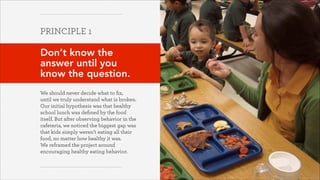
We should never decide what to fix,
until we truly understand what is broken.
Our initial hypothesis was that healthy
school lunch was defined by the food
itself. But after observing behavior in the
cafeteria, we noticed the biggest gap was
that kids simply weren’t eating all their
food, no matter how healthy it was. 

We reframed the project around
encouraging healthy eating behavior.

October 2013
PRINCIPLE 2
!

Understand an
experience from
multiple angles.
!
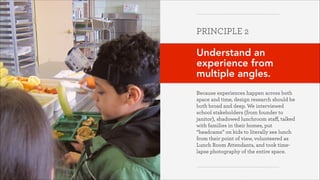
Because experiences happen across both
space and time, design research should be
both broad and deep. We interviewed
school stakeholders (from founder to
janitor), shadowed lunchroom staff, talked
with families in their homes, put
“headcams” on kids to literally see lunch
from their point of view, volunteered as
Lunch Room Attendants, and took timelapse photography of the entire space.

Greater Good Studio
PRINCIPLE 3
!

Articulate the 

user journey.
!
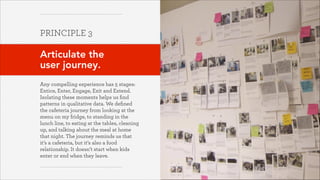
Any compelling experience has 5 stages:
Entice, Enter, Engage, Exit and Extend. 

Isolating these moments helps us find
patterns in qualitative data. We defined
the cafeteria journey from looking at the
menu on my fridge, to standing in the
lunch line, to eating at the tables, cleaning
up, and talking about the meal at home
that night. The journey reminds us that
it’s a cafeteria, but it’s also a food
relationship. It doesn’t start when kids
enter or end when they leave.
October 2013
PRINCIPLE 4
!

Talk about 

the solution.
!
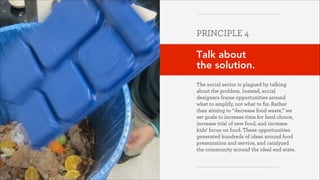
The social sector is plagued by talking
about the problem. Instead, social
designers frame opportunities around
what to amplify, not what to fix. Rather
than aiming to “decrease food waste,” we
set goals to increase time for food choice,
increase trial of new food, and increase
kids’ focus on food. These opportunities
generated hundreds of ideas around food
presentation and service, and catalyzed
the community around the ideal end state.

Greater Good Studio
PRINCIPLE 5
!

Ask what you can
make and measure.
!
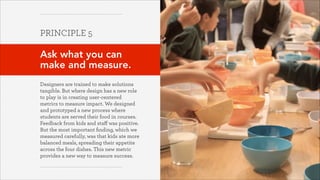
Designers are trained to make solutions
tangible. But where design has a new role
to play is in creating user-centered
metrics to measure impact. We designed
and prototyped a new process where
students are served their food in courses.
Feedback from kids and staff was positive.
But the most important finding, which we
measured carefully, was that kids ate more
balanced meals, spreading their appetite
across the four dishes. This new metric
provides a new way to measure success.
October 2013
PRINCIPLE 6
!

Design for 

every last barrier.
!
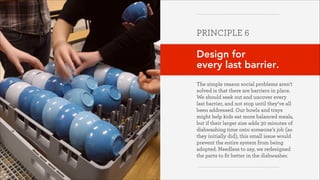
The simple reason social problems aren’t
solved is that there are barriers in place.
We should seek out and uncover every
last barrier, and not stop until they’ve all
been addressed. Our bowls and trays
might help kids eat more balanced meals,
but if their larger size adds 30 minutes of
dishwashing time onto someone’s job (as
they initially did), this small issue would
prevent the entire system from being
adopted. Needless to say, we redesigned
the parts to fit better in the dishwasher.
Greater Good Studio
PRINCIPLE 7
!

Engage users in 

the entire process.
!
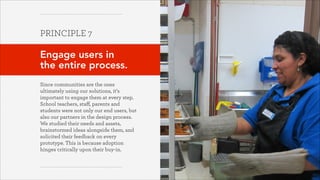
Since communities are the ones
ultimately using our solutions, it’s
important to engage them at every step.
School teachers, staff, parents and
students were not only our end users, but
also our partners in the design process.
We studied their needs and assets,
brainstormed ideas alongside them, and
solicited their feedback on every
prototype. This is because adoption
hinges critically upon their buy-in.

October 2013
PRINCIPLE 8
!

Impact first,
scale second.
!
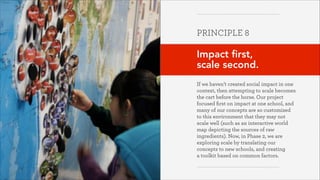
If we haven’t created social impact in one
context, then attempting to scale becomes
the cart before the horse. Our project
focused first on impact at one school, and
many of our concepts are so customized
to this environment that they may not
scale well (such as an interactive world
map depicting the sources of raw
ingredients). Now, in Phase 2, we are
exploring scale by translating our
concepts to new schools, and creating 

a toolkit based on common factors.
Greater Good Studio
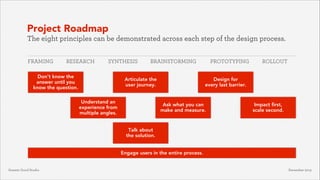
Project Roadmap
The eight principles can be demonstrated across each step of the design process.
FRAMING

RESEARCH

SYNTHESIS

Don’t know the
answer until you
know the question.

BRAINSTORMING

Articulate the 

user journey.
Understand an
experience from
multiple angles.

PROTOTYPING

ROLLOUT

Design for
every last barrier.

Ask what you can
make and measure.

Impact first, 

scale second.

Talk about 

the solution.

Engage users in the entire process.

Greater Good Studio

December 2013
Design for Public Health
we look forward to growing this field with you

Greater Good Studio

December 2013

Design for Public Health

  • 1.
    Design for PublicHealth principles for an emerging discipline Greater Good Studio December 2013
  • 2.
    Public health mustdevelop a capacity for design thinking. There is both a growing need and opportunity to build collaboration between public health and the design community to address the critical health issues of our time. Public health interventions, particularly to address complex problems, must become more human-centered, providing environments and experiences that make healthy behaviors easy, enjoyable, and economical parts of everyday life. ! This document provides a case study from a Greater Good Studio project that can form the basis of a new discipline: design for public health. Eight principles bring design thinking practices to life through tangible examples. Greater Good Studio http://www.rwjf.org/en/blogs/culture-of-health/2013/10/leveraging_the_power.html December 2013
  • 3.
    CHALLENGE Design a publicschool cafeteria that encourages healthy eating Greater Good Studio December 2013
  • 4.
    PRINCIPLE 1 ! Don’t knowthe answer until you know the question. ! We should never decide what to fix, until we truly understand what is broken. Our initial hypothesis was that healthy school lunch was defined by the food itself. But after observing behavior in the cafeteria, we noticed the biggest gap was that kids simply weren’t eating all their food, no matter how healthy it was. 
 We reframed the project around encouraging healthy eating behavior. October 2013
  • 5.
    PRINCIPLE 2 ! Understand an experiencefrom multiple angles. ! Because experiences happen across both space and time, design research should be both broad and deep. We interviewed school stakeholders (from founder to janitor), shadowed lunchroom staff, talked with families in their homes, put “headcams” on kids to literally see lunch from their point of view, volunteered as Lunch Room Attendants, and took timelapse photography of the entire space. Greater Good Studio
  • 6.
    PRINCIPLE 3 ! Articulate the
 user journey. ! Any compelling experience has 5 stages: Entice, Enter, Engage, Exit and Extend. 
 Isolating these moments helps us find patterns in qualitative data. We defined the cafeteria journey from looking at the menu on my fridge, to standing in the lunch line, to eating at the tables, cleaning up, and talking about the meal at home that night. The journey reminds us that it’s a cafeteria, but it’s also a food relationship. It doesn’t start when kids enter or end when they leave. October 2013
  • 7.
    PRINCIPLE 4 ! Talk about
 the solution. ! The social sector is plagued by talking about the problem. Instead, social designers frame opportunities around what to amplify, not what to fix. Rather than aiming to “decrease food waste,” we set goals to increase time for food choice, increase trial of new food, and increase kids’ focus on food. These opportunities generated hundreds of ideas around food presentation and service, and catalyzed the community around the ideal end state. Greater Good Studio
  • 8.
    PRINCIPLE 5 ! Ask whatyou can make and measure. ! Designers are trained to make solutions tangible. But where design has a new role to play is in creating user-centered metrics to measure impact. We designed and prototyped a new process where students are served their food in courses. Feedback from kids and staff was positive. But the most important finding, which we measured carefully, was that kids ate more balanced meals, spreading their appetite across the four dishes. This new metric provides a new way to measure success. October 2013
  • 9.
    PRINCIPLE 6 ! Design for
 every last barrier. ! The simple reason social problems aren’t solved is that there are barriers in place. We should seek out and uncover every last barrier, and not stop until they’ve all been addressed. Our bowls and trays might help kids eat more balanced meals, but if their larger size adds 30 minutes of dishwashing time onto someone’s job (as they initially did), this small issue would prevent the entire system from being adopted. Needless to say, we redesigned the parts to fit better in the dishwasher. Greater Good Studio
  • 10.
    PRINCIPLE 7 ! Engage usersin 
 the entire process. ! Since communities are the ones ultimately using our solutions, it’s important to engage them at every step. School teachers, staff, parents and students were not only our end users, but also our partners in the design process. We studied their needs and assets, brainstormed ideas alongside them, and solicited their feedback on every prototype. This is because adoption hinges critically upon their buy-in. October 2013
  • 11.
    PRINCIPLE 8 ! Impact first, scalesecond. ! If we haven’t created social impact in one context, then attempting to scale becomes the cart before the horse. Our project focused first on impact at one school, and many of our concepts are so customized to this environment that they may not scale well (such as an interactive world map depicting the sources of raw ingredients). Now, in Phase 2, we are exploring scale by translating our concepts to new schools, and creating 
 a toolkit based on common factors. Greater Good Studio
  • 12.
    Project Roadmap The eightprinciples can be demonstrated across each step of the design process. FRAMING RESEARCH SYNTHESIS Don’t know the answer until you know the question. BRAINSTORMING Articulate the 
 user journey. Understand an experience from multiple angles. PROTOTYPING ROLLOUT Design for every last barrier. Ask what you can make and measure. Impact first, 
 scale second. Talk about 
 the solution. Engage users in the entire process. Greater Good Studio December 2013
  • 13.
    Design for PublicHealth we look forward to growing this field with you Greater Good Studio December 2013