Introduction to
Analysis of Algorithms
1-2
1-2
Analysis of Algorithms
• To determine how efficient an algorithm is
we compute the amount of time that the
algorithm needs to solve a problem.
• Given two algorithms for the same problem,
the preferred one is the faster.
1-3
1-3
Time Complexity
• The time complexity of an algorithm is a
function that gives the amount of time that
the algorithm takes to complete.
• The time complexity depends on the size of
the input, or the number of data items in the
input.
1-4
1-4
Time Complexity
• The time complexity of an algorithm is
denoted as t(n) or f(n), where n is the size
of the input.
• The time complexity is non-decreasing in
the size of the input, i.e. the amount of time
needed by an algorithm cannot decrease
as the size of the input increases. (For
example, copying a large array cannot take
less time than making a copy of a smaller
array.)
1-5
1-5
Asymptotic Growth
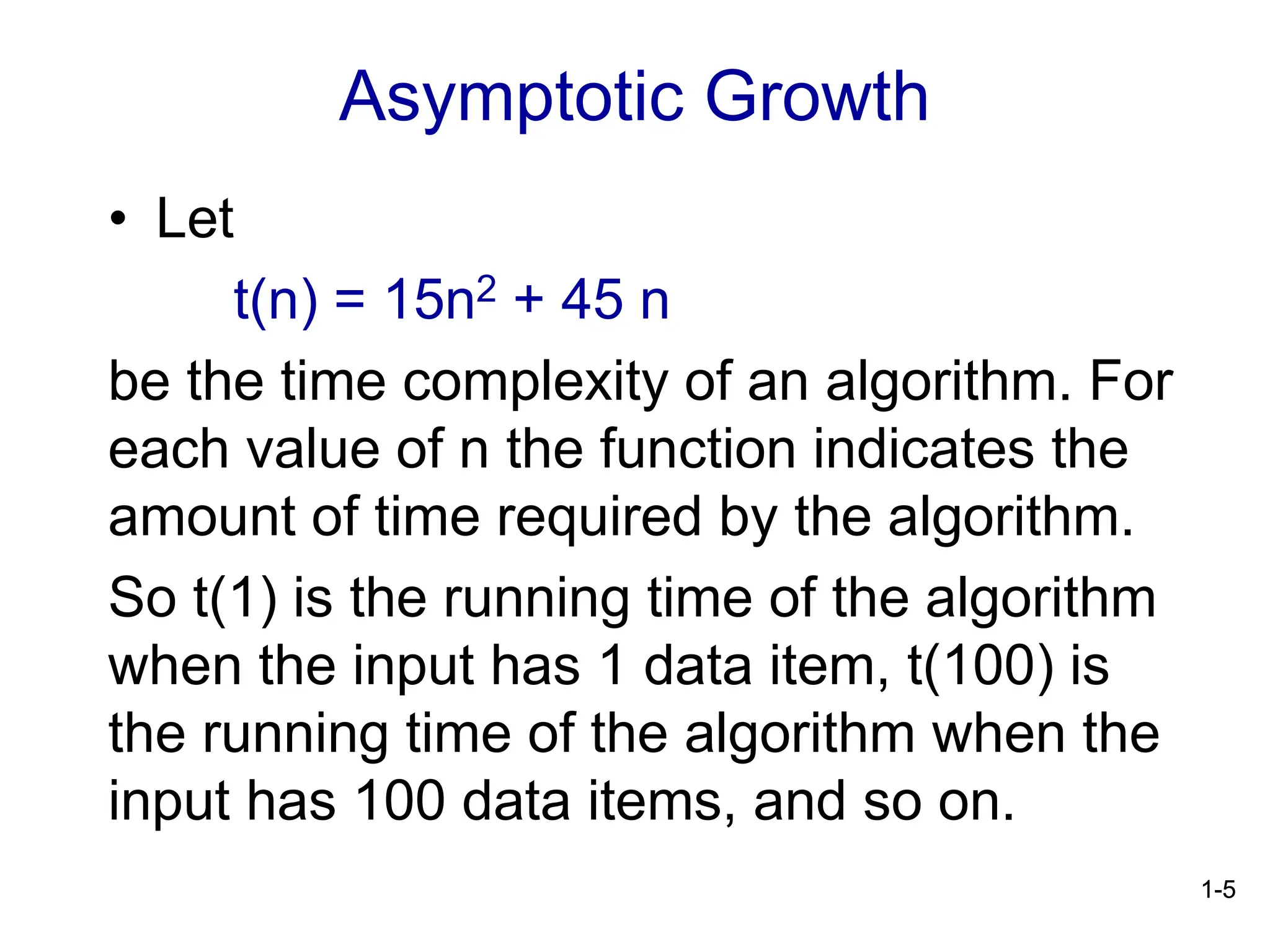
• Let
t(n) = 15n2 + 45 n
be the time complexity of an algorithm. For
each value of n the function indicates the
amount of time required by the algorithm.
So t(1) is the running time of the algorithm
when the input has 1 data item, t(100) is
the running time of the algorithm when the
input has 100 data items, and so on.
1-6
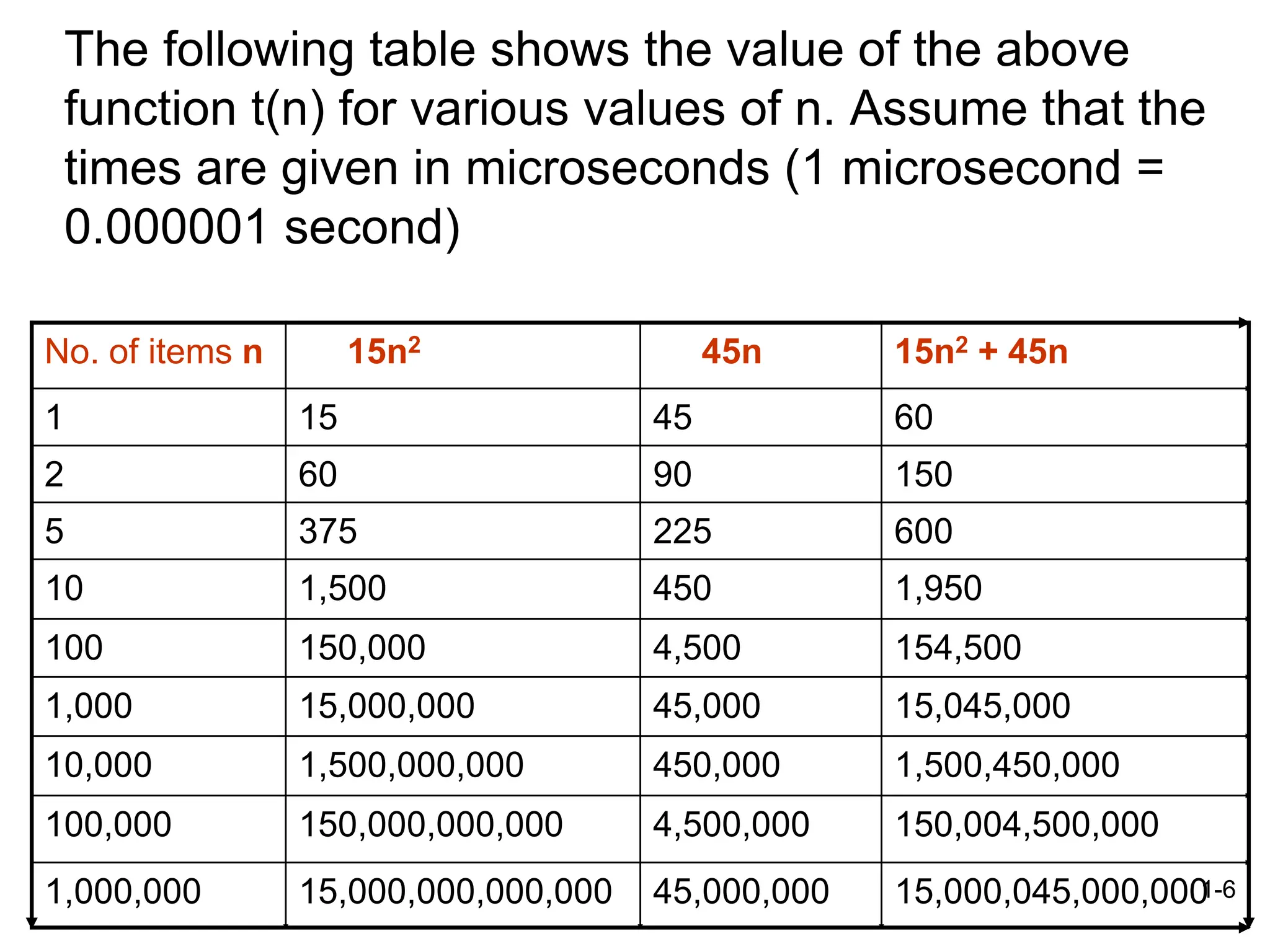
No. of items n 15n2 45n 15n2 + 45n
1 15 45 60
2 60 90 150
5 375 225 600
10 1,500 450 1,950
100 150,000 4,500 154,500
1,000 15,000,000 45,000 15,045,000
10,000 1,500,000,000 450,000 1,500,450,000
100,000 150,000,000,000 4,500,000 150,004,500,000
1,000,000 15,000,000,000,000 45,000,000 15,000,045,000,000
The following table shows the value of the above
function t(n) for various values of n. Assume that the
times are given in microseconds (1 microsecond =
0.000001 second)
1-7
Asymptotic Growth
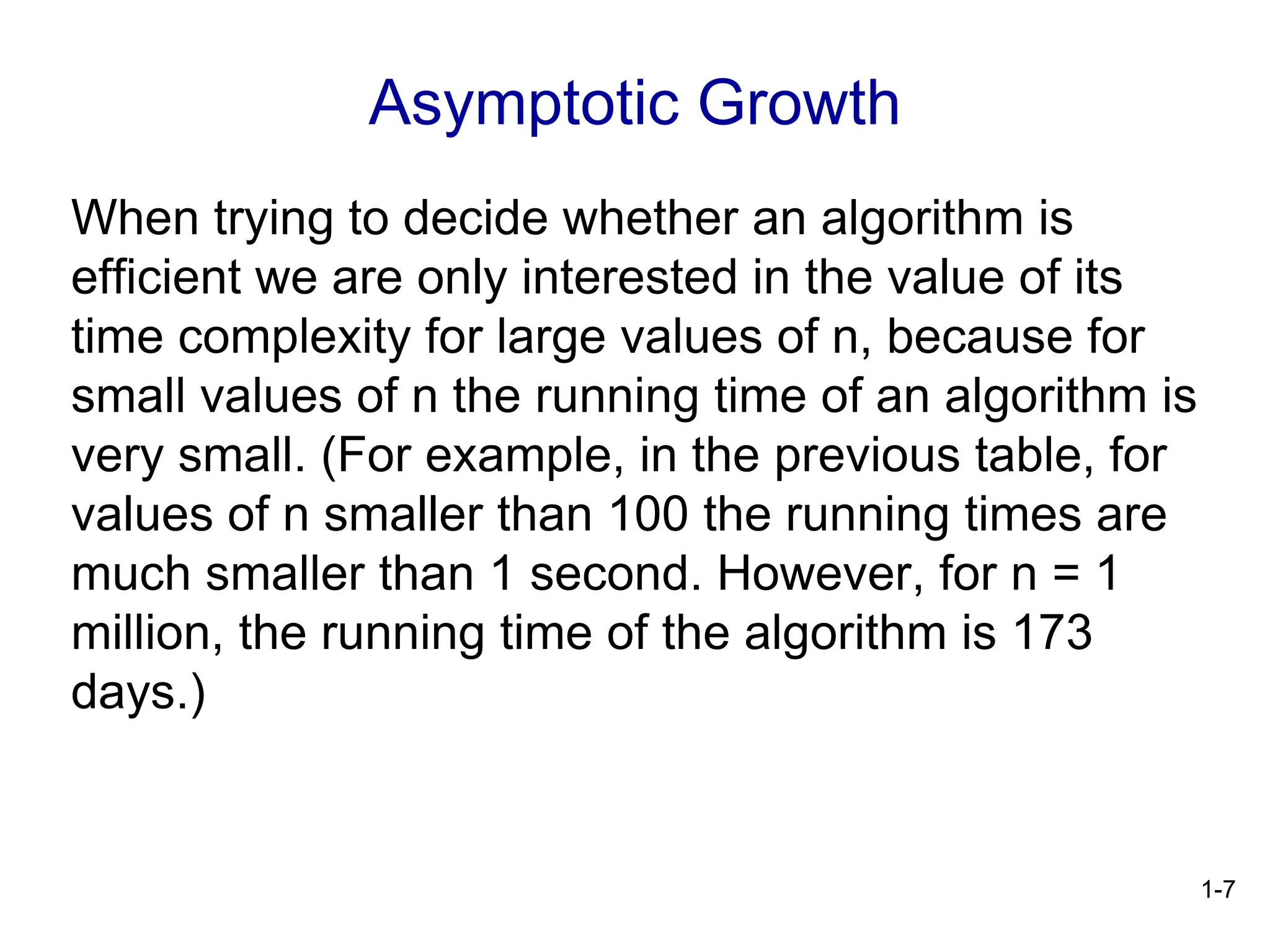
When trying to decide whether an algorithm is
efficient we are only interested in the value of its
time complexity for large values of n, because for
small values of n the running time of an algorithm is
very small. (For example, in the previous table, for
values of n smaller than 100 the running times are
much smaller than 1 second. However, for n = 1
million, the running time of the algorithm is 173
days.)
1-8
Asymptotic Growth
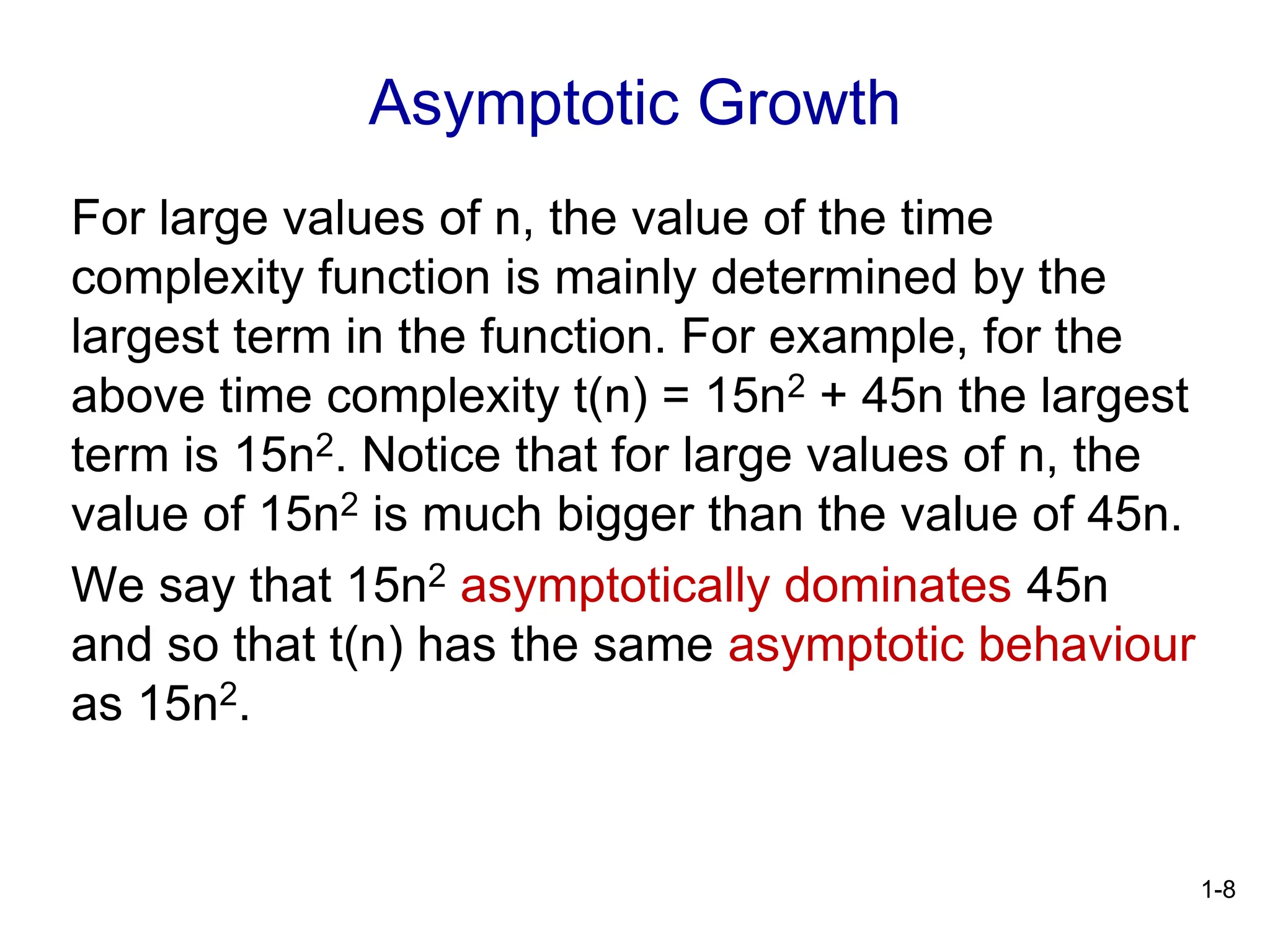
For large values of n, the value of the time
complexity function is mainly determined by the
largest term in the function. For example, for the
above time complexity t(n) = 15n2 + 45n the largest
term is 15n2. Notice that for large values of n, the
value of 15n2 is much bigger than the value of 45n.
We say that 15n2 asymptotically dominates 45n
and so that t(n) has the same asymptotic behaviour
as 15n2.
1-9
1-9
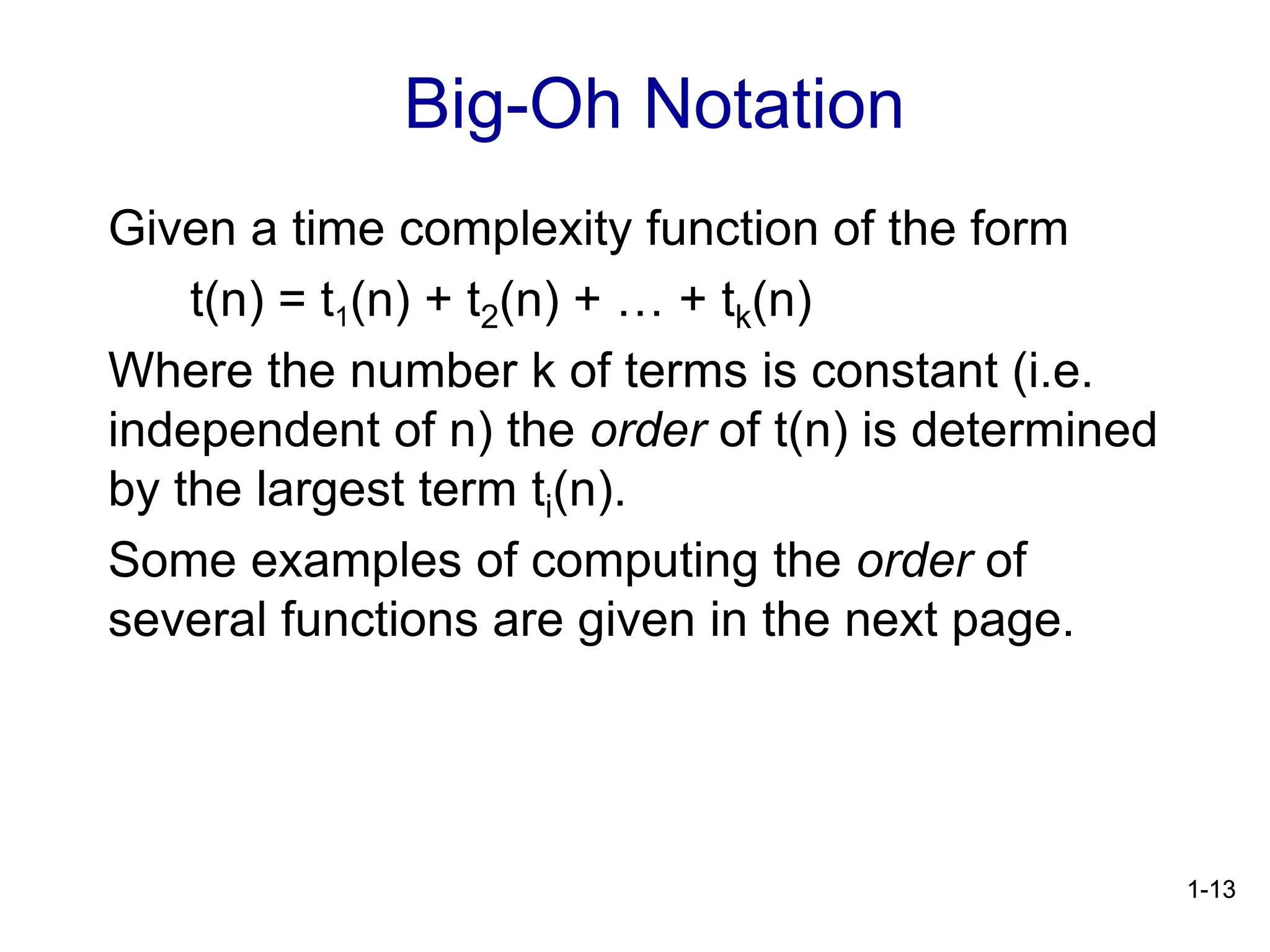
Big-Oh Notation
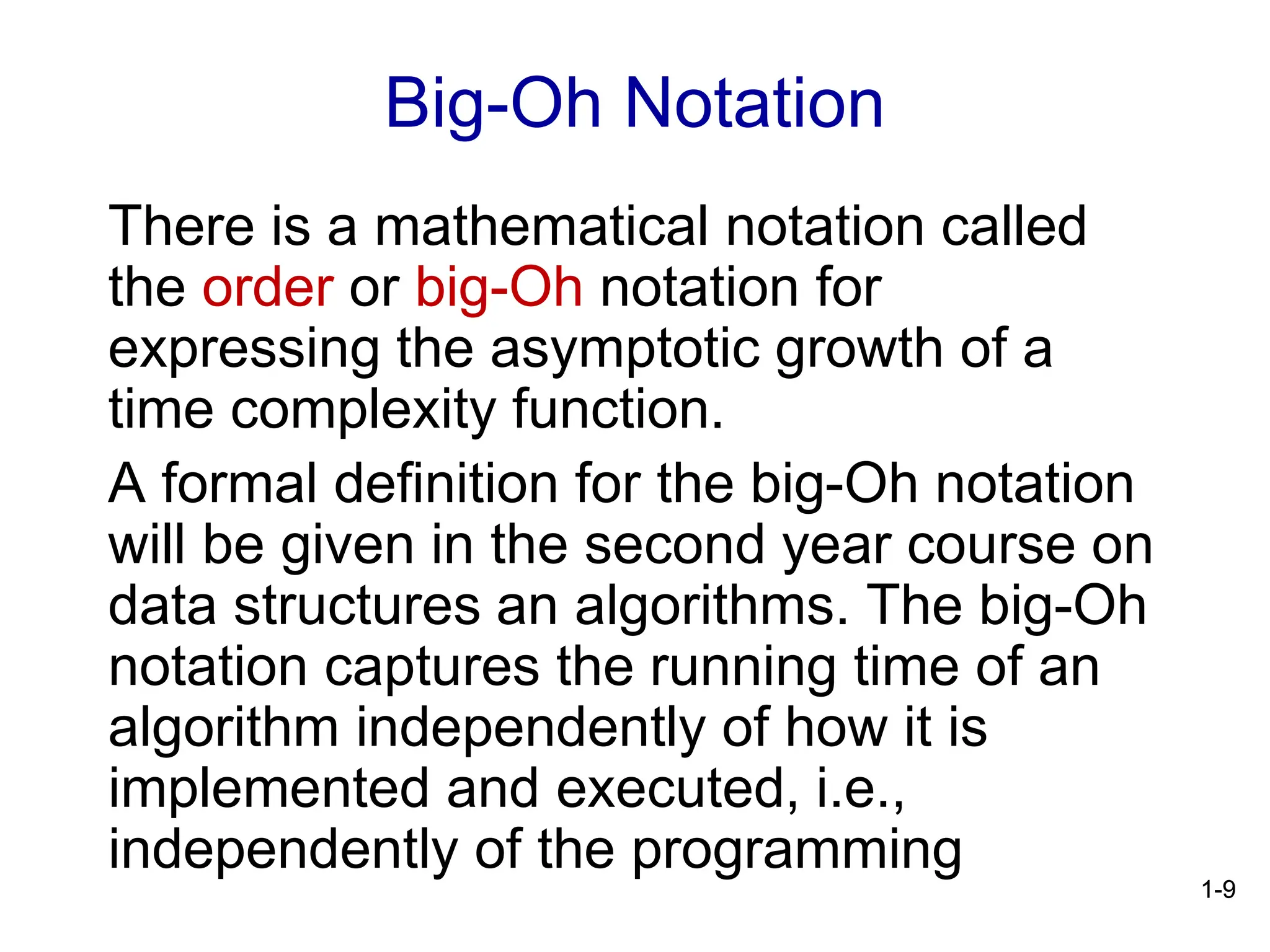
There is a mathematical notation called
the order or big-Oh notation for
expressing the asymptotic growth of a
time complexity function.
A formal definition for the big-Oh notation
will be given in the second year course on
data structures an algorithms. The big-Oh
notation captures the running time of an
algorithm independently of how it is
implemented and executed, i.e.,
independently of the programming
1-10
1-10
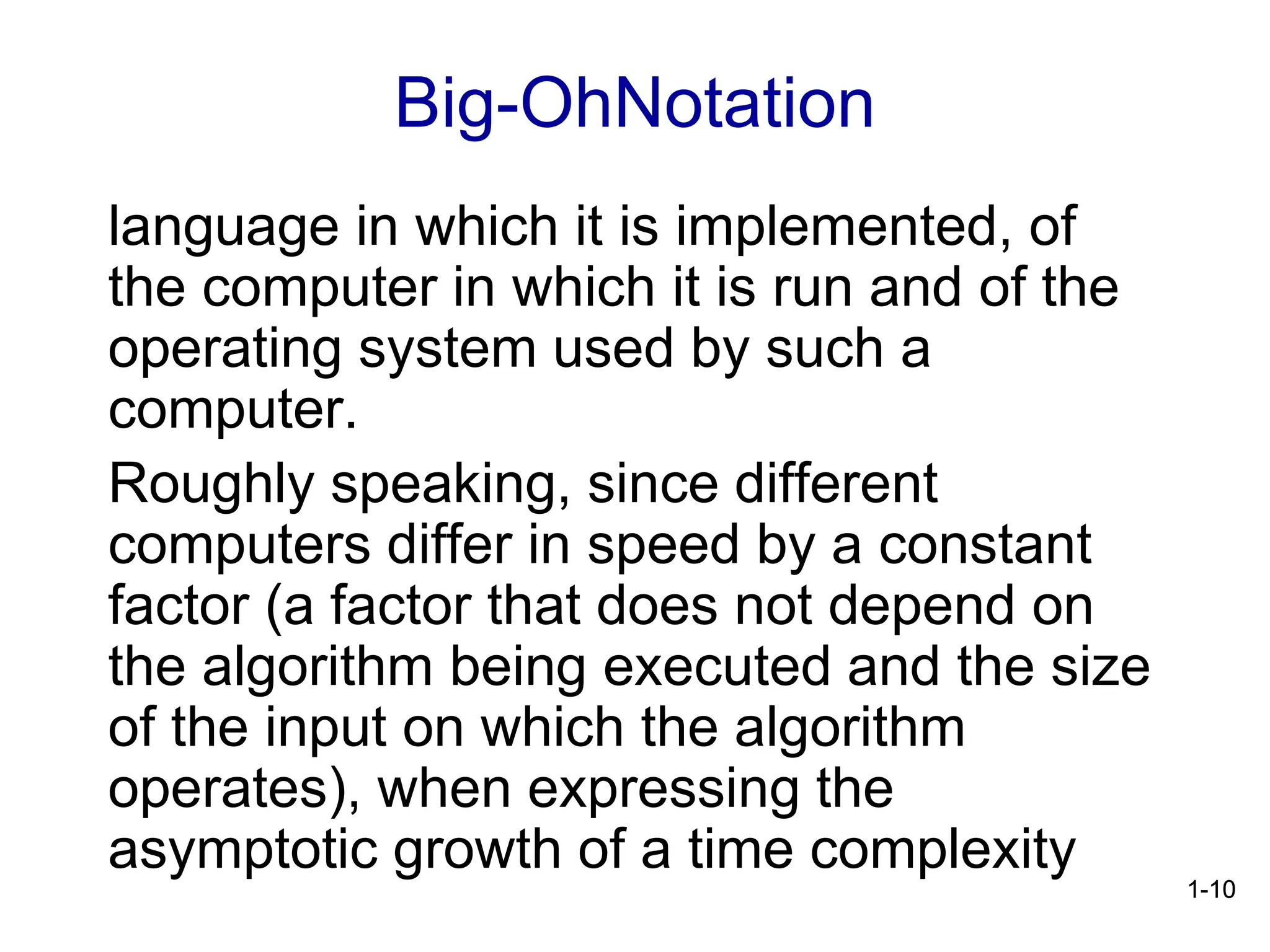
Big-OhNotation
language in which it is implemented, of
the computer in which it is run and of the
operating system used by such a
computer.
Roughly speaking, since different
computers differ in speed by a constant
factor (a factor that does not depend on
the algorithm being executed and the size
of the input on which the algorithm
operates), when expressing the
asymptotic growth of a time complexity
1-11
1-11
Big-Oh Notation
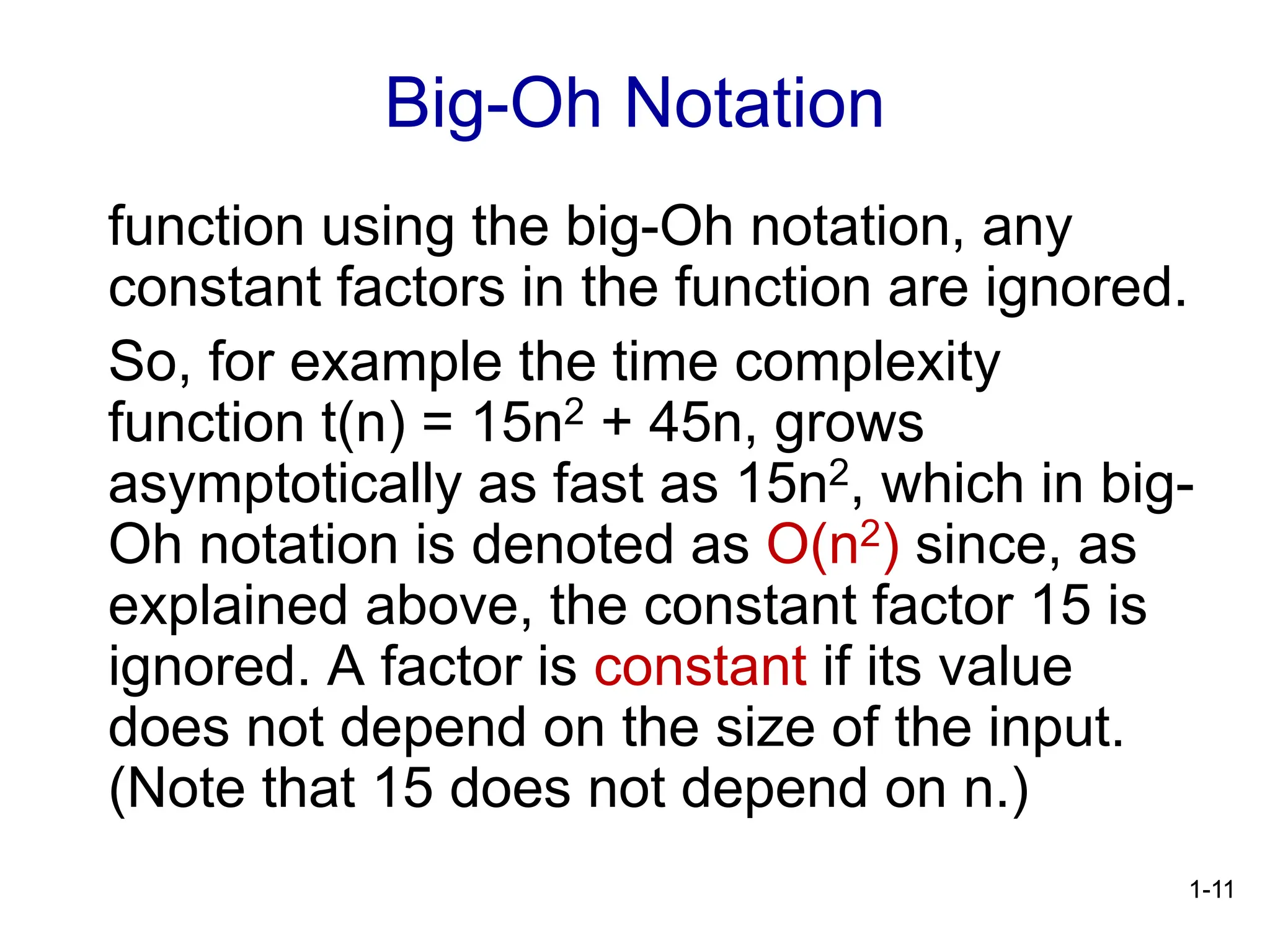
function using the big-Oh notation, any
constant factors in the function are ignored.
So, for example the time complexity
function t(n) = 15n2 + 45n, grows
asymptotically as fast as 15n2, which in big-
Oh notation is denoted as O(n2) since, as
explained above, the constant factor 15 is
ignored. A factor is constant if its value
does not depend on the size of the input.
(Note that 15 does not depend on n.)
1-12
1-12
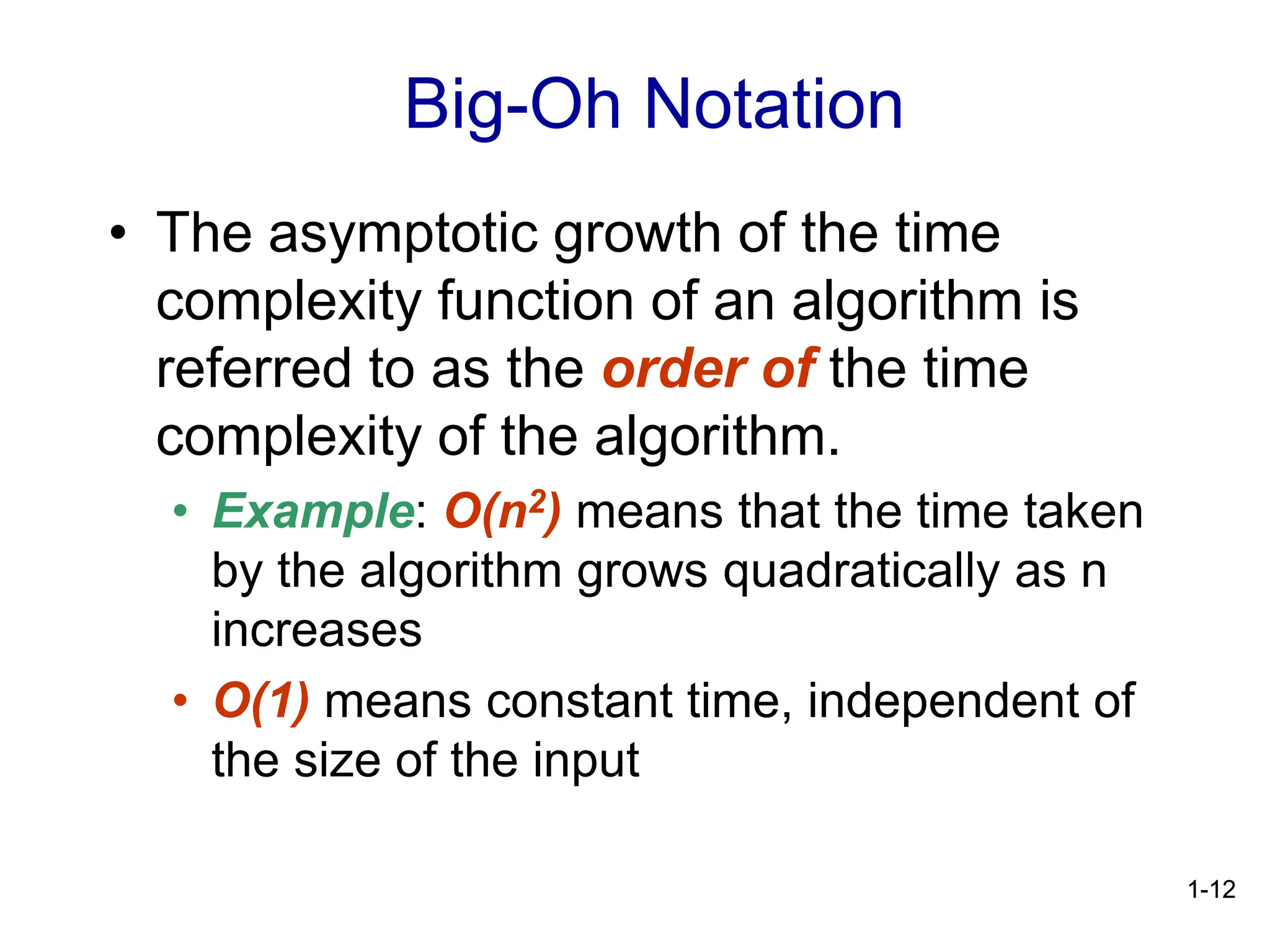
• The asymptotic growth of the time
complexity function of an algorithm is
referred to as the order of the time
complexity of the algorithm.
• Example: O(n2) means that the time taken
by the algorithm grows quadratically as n
increases
• O(1) means constant time, independent of
the size of the input
Big-Oh Notation
1-13
1-13
Given a time complexity function of the form
t(n) = t1(n) + t2(n) + … + tk(n)
Where the number k of terms is constant (i.e.
independent of n) the order of t(n) is determined
by the largest term ti(n).
Some examples of computing the order of
several functions are given in the next page.
Big-Oh Notation
1-14
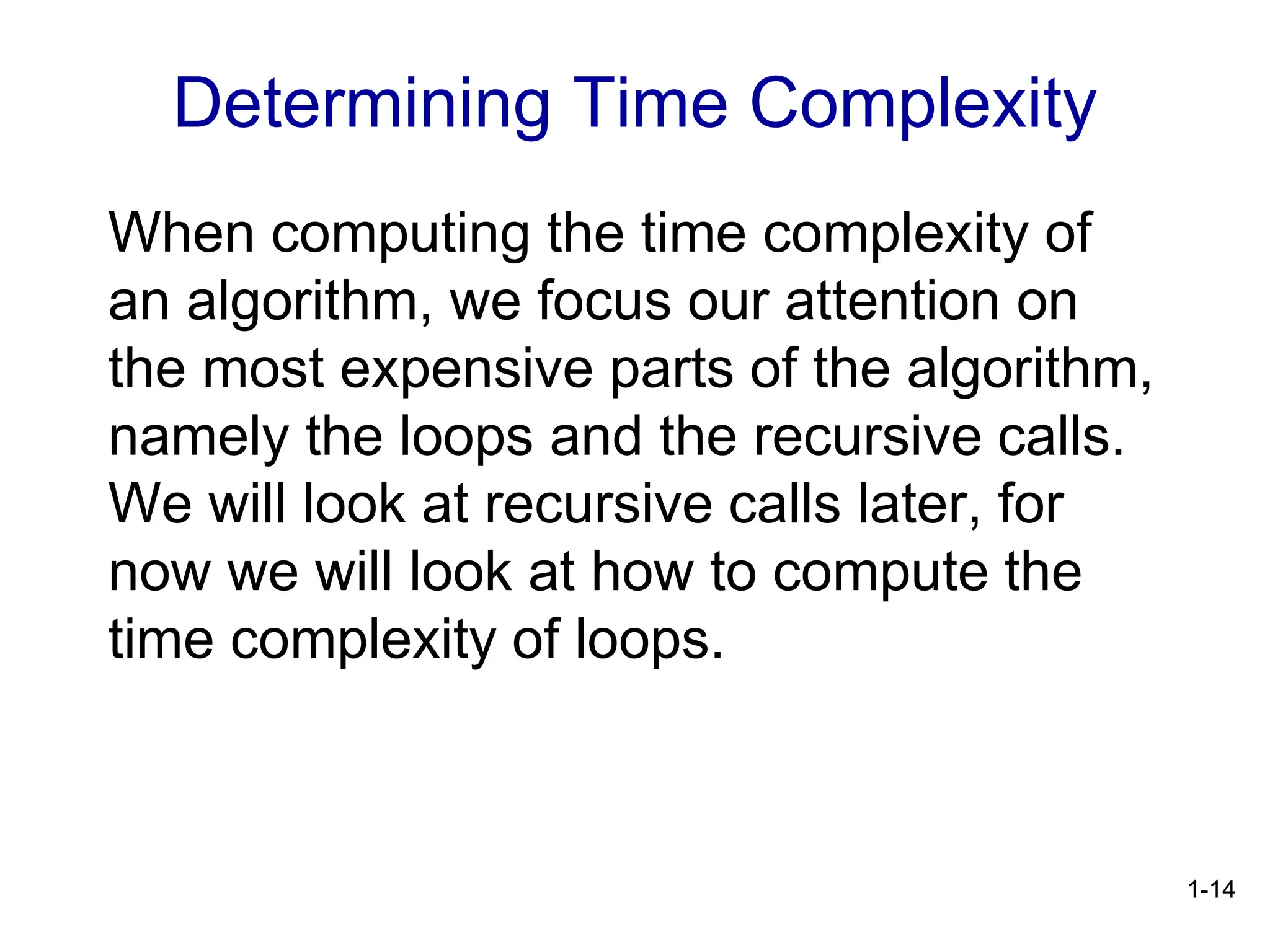
Determining Time Complexity
When computing the time complexity of
an algorithm, we focus our attention on
the most expensive parts of the algorithm,
namely the loops and the recursive calls.
We will look at recursive calls later, for
now we will look at how to compute the
time complexity of loops.
1-15
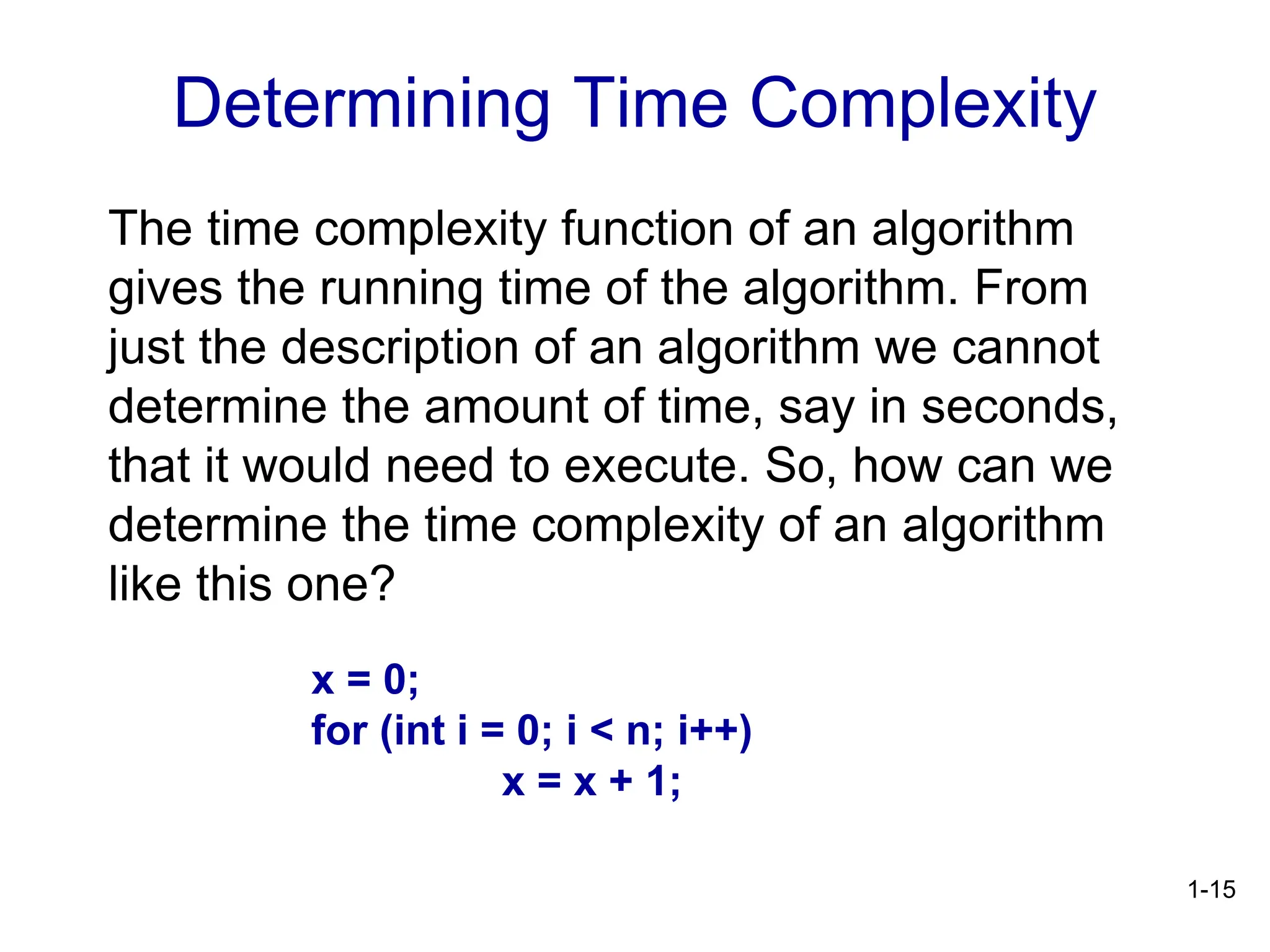
Determining Time Complexity
The time complexity function of an algorithm
gives the running time of the algorithm. From
just the description of an algorithm we cannot
determine the amount of time, say in seconds,
that it would need to execute. So, how can we
determine the time complexity of an algorithm
like this one?
x = 0;
for (int i = 0; i < n; i++)
x = x + 1;
1-16
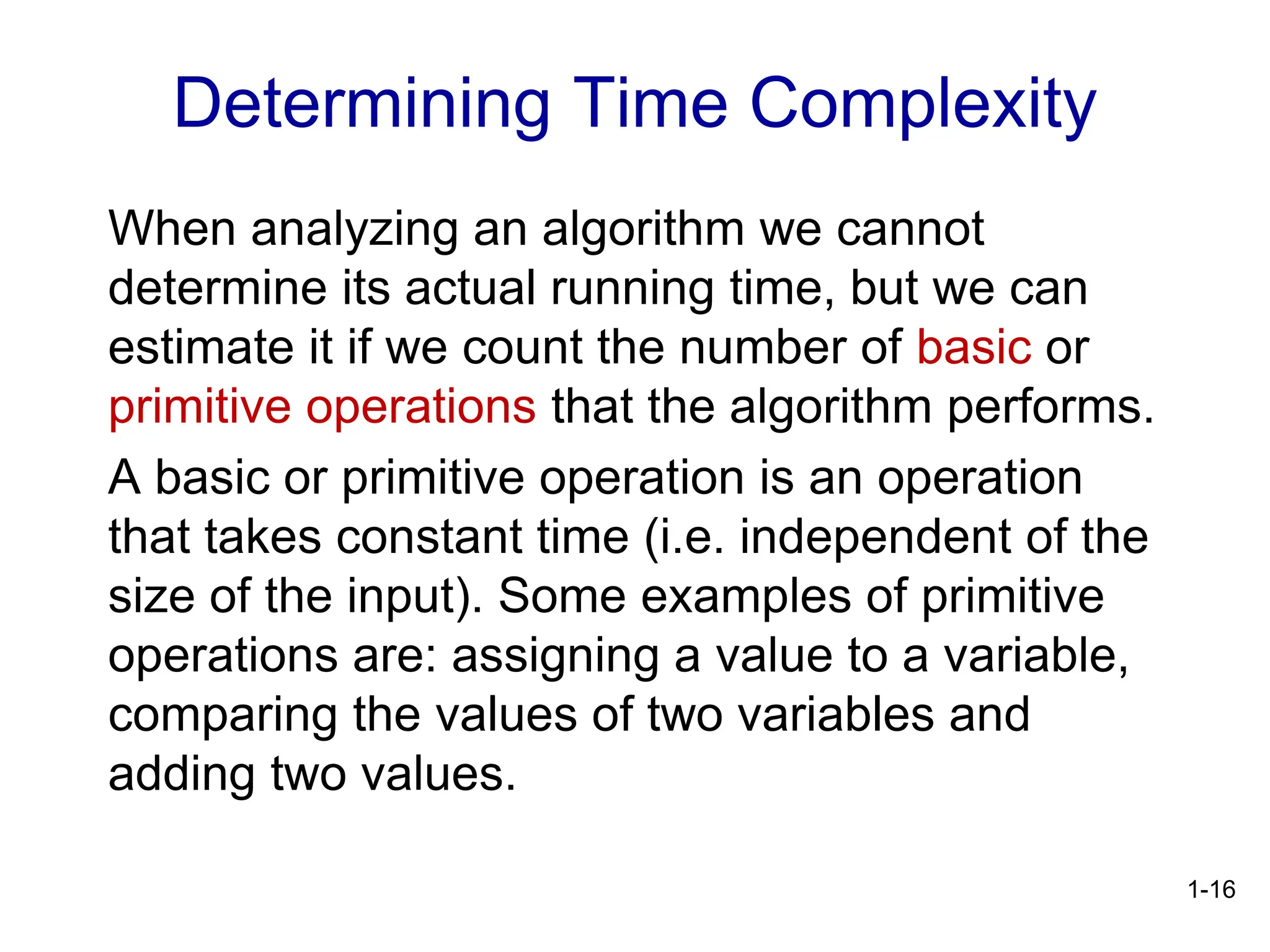
Determining Time Complexity
When analyzing an algorithm we cannot
determine its actual running time, but we can
estimate it if we count the number of basic or
primitive operations that the algorithm performs.
A basic or primitive operation is an operation
that takes constant time (i.e. independent of the
size of the input). Some examples of primitive
operations are: assigning a value to a variable,
comparing the values of two variables and
adding two values.
1-17
1-17
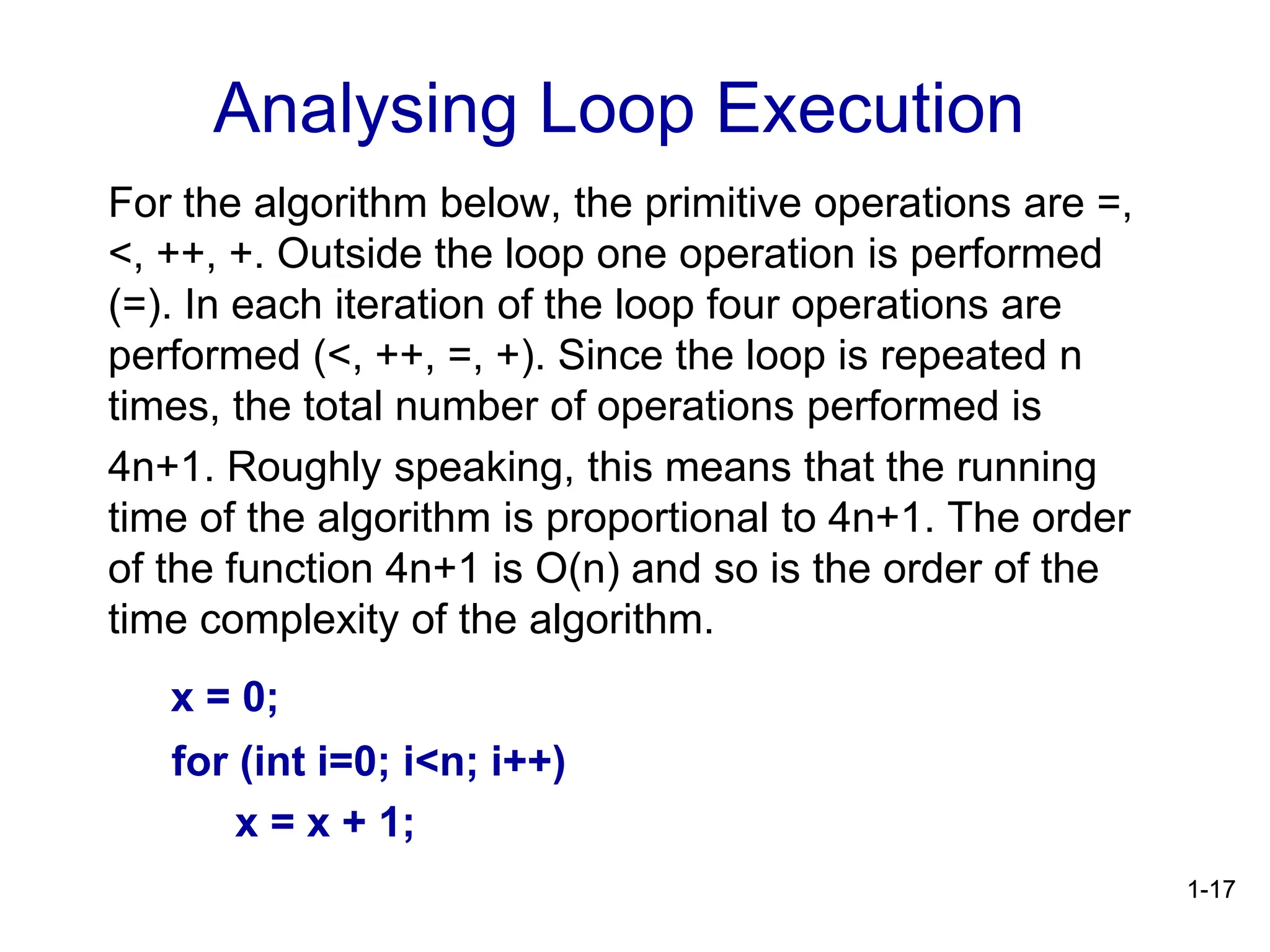
Analysing Loop Execution
For the algorithm below, the primitive operations are =,
<, ++, +. Outside the loop one operation is performed
(=). In each iteration of the loop four operations are
performed (<, ++, =, +). Since the loop is repeated n
times, the total number of operations performed is
4n+1. Roughly speaking, this means that the running
time of the algorithm is proportional to 4n+1. The order
of the function 4n+1 is O(n) and so is the order of the
time complexity of the algorithm.
x = 0;
for (int i=0; i<n; i++)
x = x + 1;
1-18
1-18
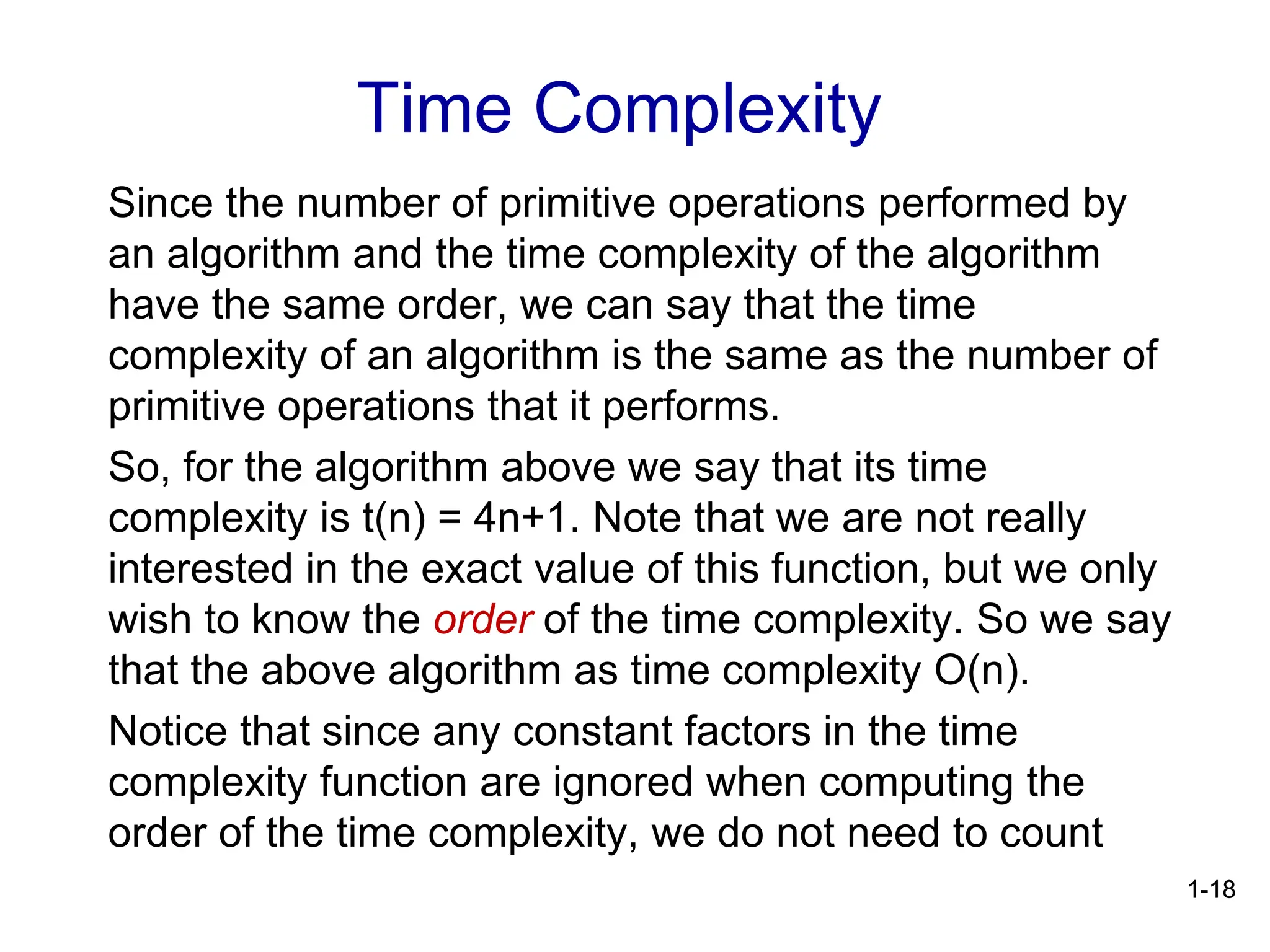
Time Complexity
Since the number of primitive operations performed by
an algorithm and the time complexity of the algorithm
have the same order, we can say that the time
complexity of an algorithm is the same as the number of
primitive operations that it performs.
So, for the algorithm above we say that its time
complexity is t(n) = 4n+1. Note that we are not really
interested in the exact value of this function, but we only
wish to know the order of the time complexity. So we say
that the above algorithm as time complexity O(n).
Notice that since any constant factors in the time
complexity function are ignored when computing the
order of the time complexity, we do not need to count
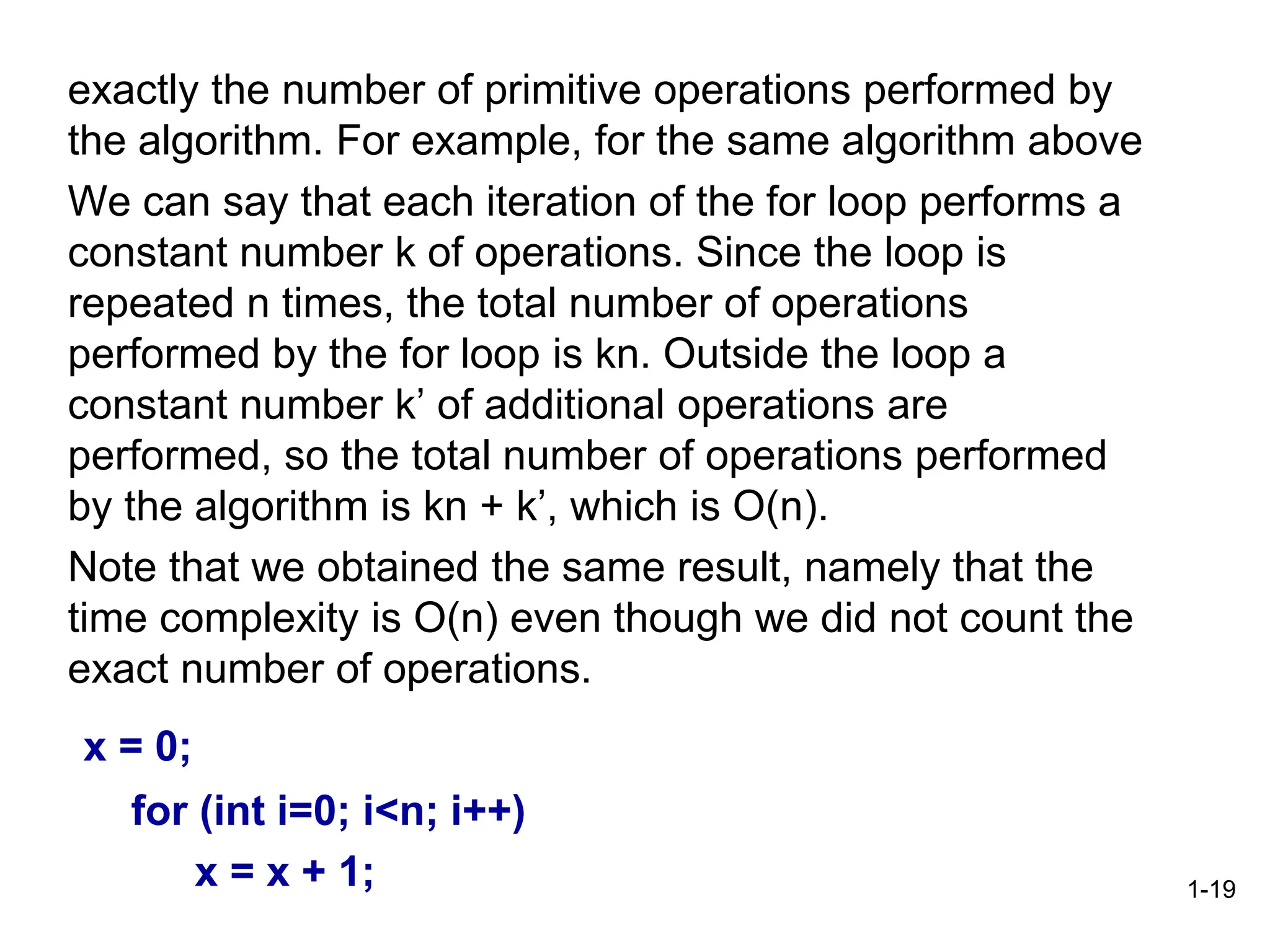
exactly the number of primitive operations performed by
the algorithm. For example, for the same algorithm above
We can say that each iteration of the for loop performs a
constant number k of operations. Since the loop is
repeated n times, the total number of operations
performed by the for loop is kn. Outside the loop a
constant number k’ of additional operations are
performed, so the total number of operations performed
by the algorithm is kn + k’, which is O(n).
Note that we obtained the same result, namely that the
time complexity is O(n) even though we did not count the
exact number of operations.
x = 0;
for (int i=0; i<n; i++)
x = x + 1; 1-19
1-20
1-20
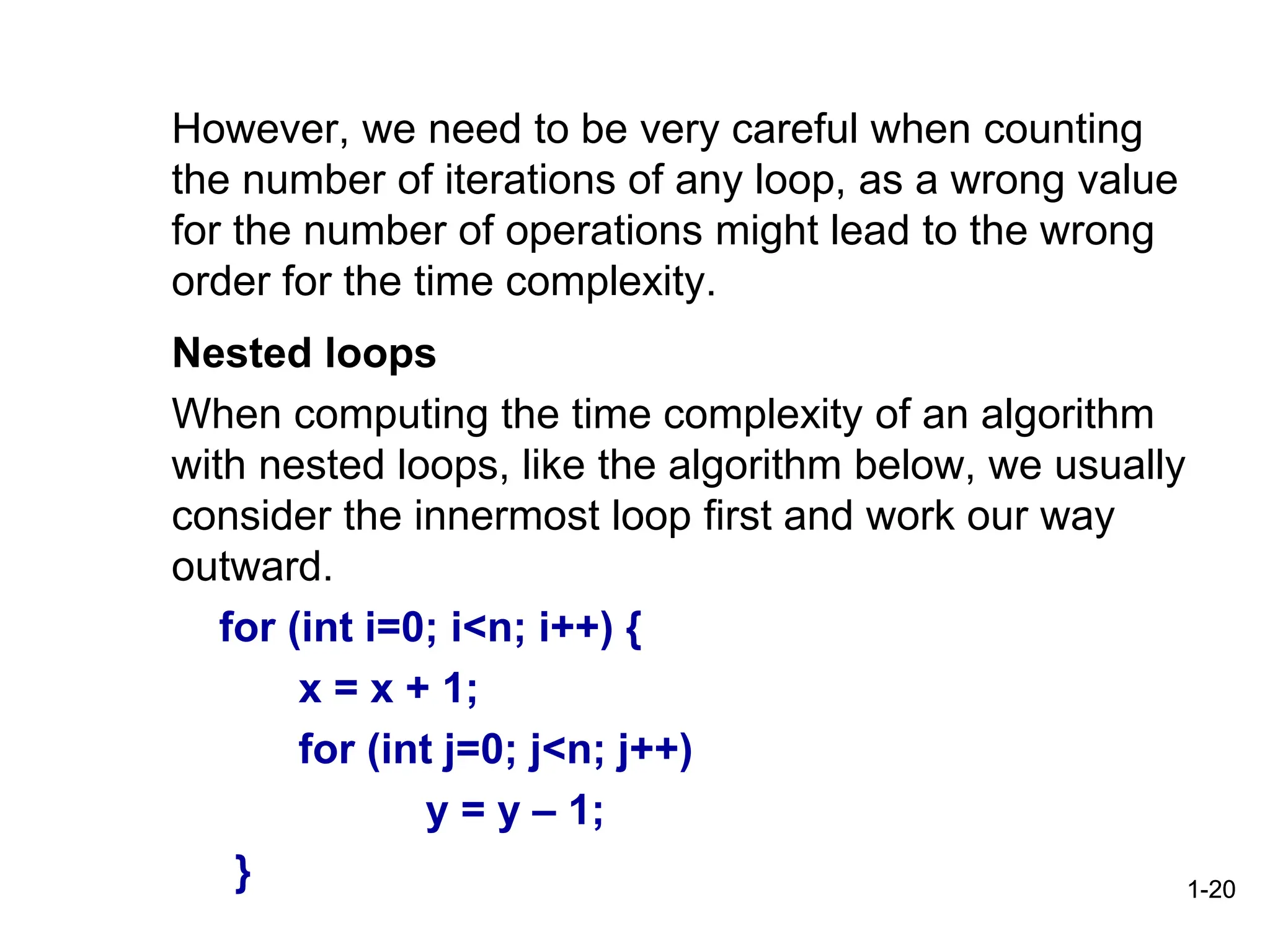
However, we need to be very careful when counting
the number of iterations of any loop, as a wrong value
for the number of operations might lead to the wrong
order for the time complexity.
Nested loops
When computing the time complexity of an algorithm
with nested loops, like the algorithm below, we usually
consider the innermost loop first and work our way
outward.
for (int i=0; i<n; i++) {
x = x + 1;
for (int j=0; j<n; j++)
y = y – 1;
}
1-21
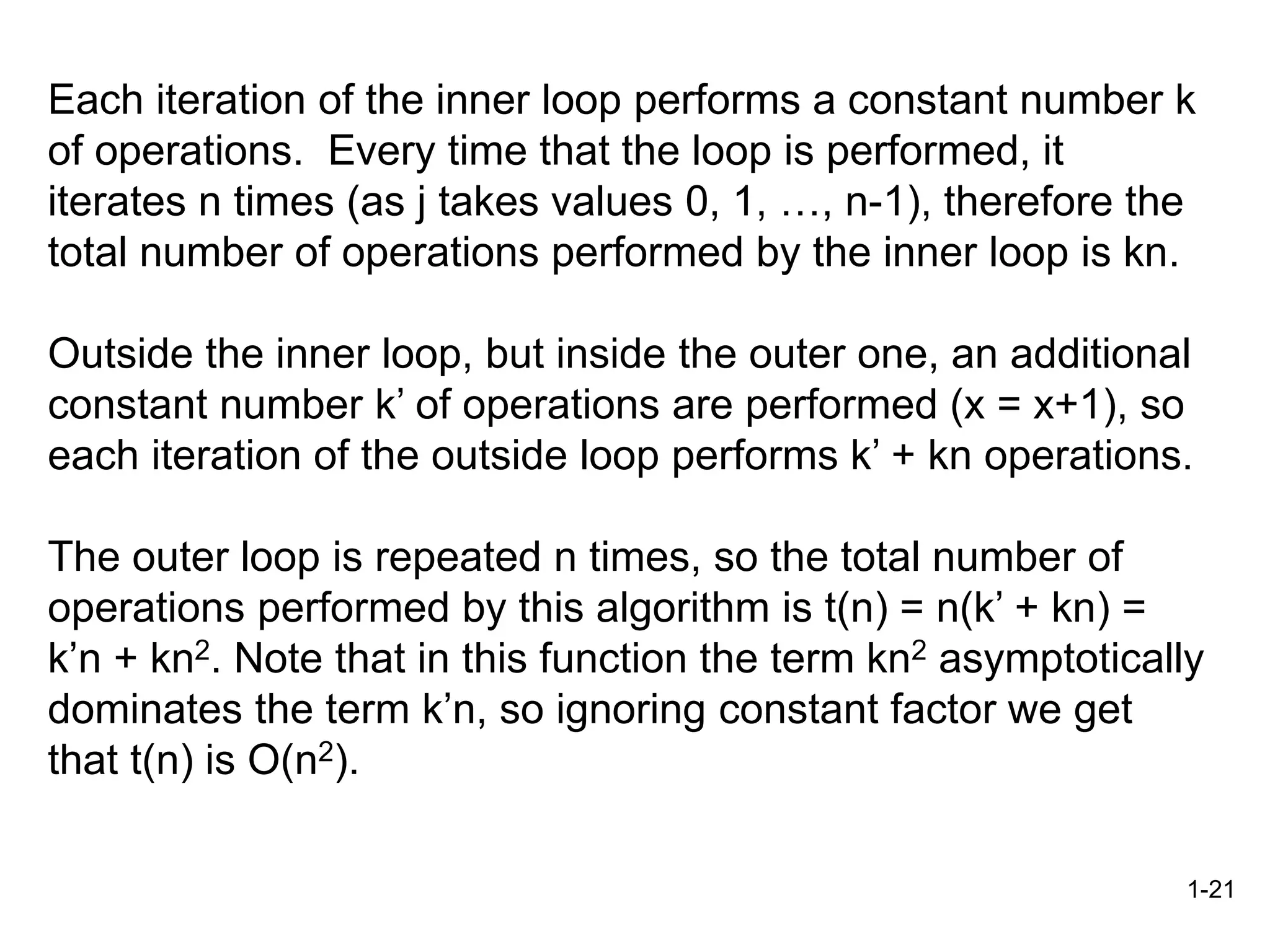
Each iteration of the inner loop performs a constant number k
of operations. Every time that the loop is performed, it
iterates n times (as j takes values 0, 1, …, n-1), therefore the
total number of operations performed by the inner loop is kn.
Outside the inner loop, but inside the outer one, an additional
constant number k’ of operations are performed (x = x+1), so
each iteration of the outside loop performs k’ + kn operations.
The outer loop is repeated n times, so the total number of
operations performed by this algorithm is t(n) = n(k’ + kn) =
k’n + kn2. Note that in this function the term kn2 asymptotically
dominates the term k’n, so ignoring constant factor we get
that t(n) is O(n2).
1-22
1-22
More Loop Analysis Examples
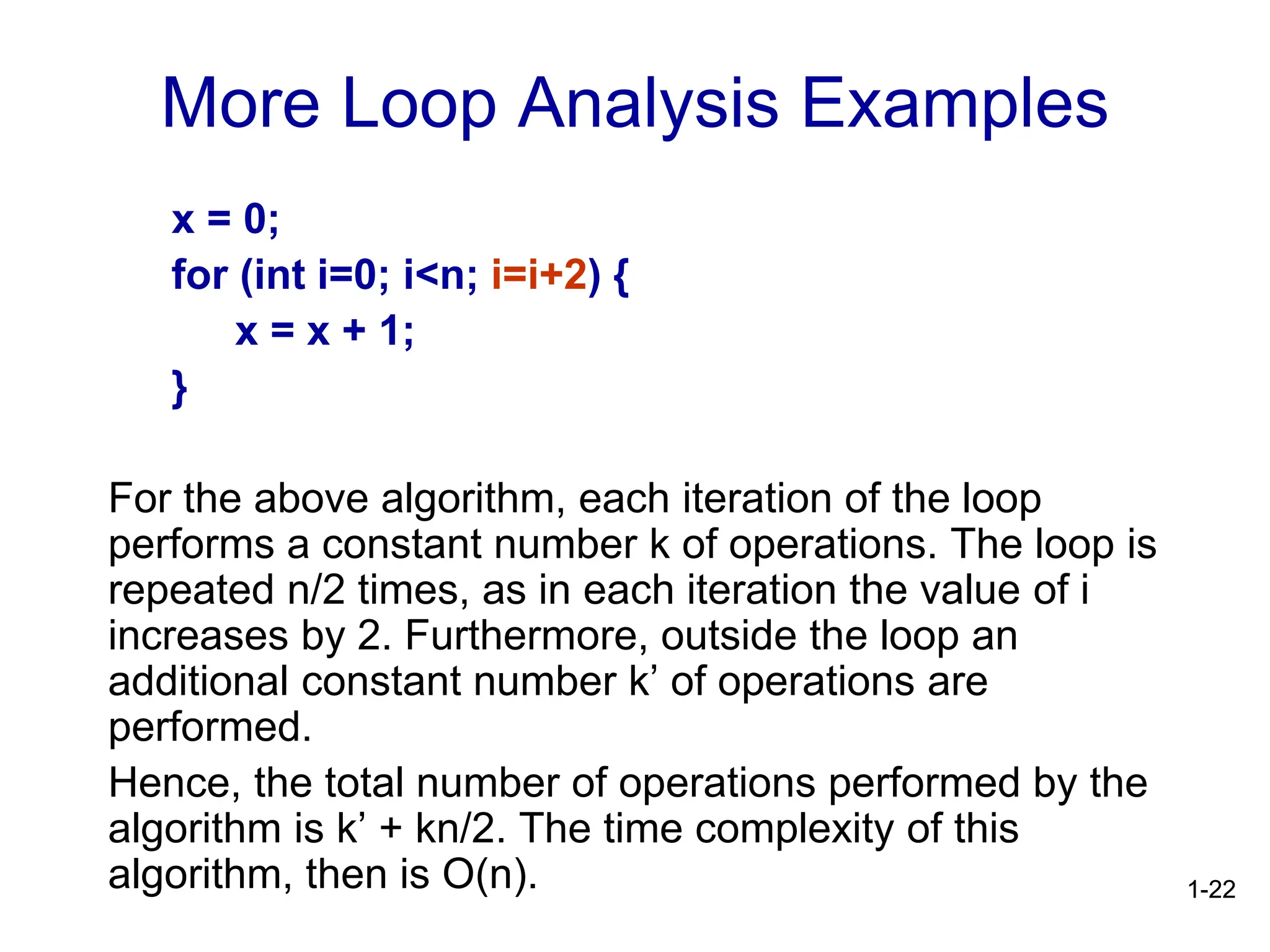
x = 0;
for (int i=0; i<n; i=i+2) {
x = x + 1;
}
For the above algorithm, each iteration of the loop
performs a constant number k of operations. The loop is
repeated n/2 times, as in each iteration the value of i
increases by 2. Furthermore, outside the loop an
additional constant number k’ of operations are
performed.
Hence, the total number of operations performed by the
algorithm is k’ + kn/2. The time complexity of this
algorithm, then is O(n).
1-23
1-23
More Loop Analysis Examples
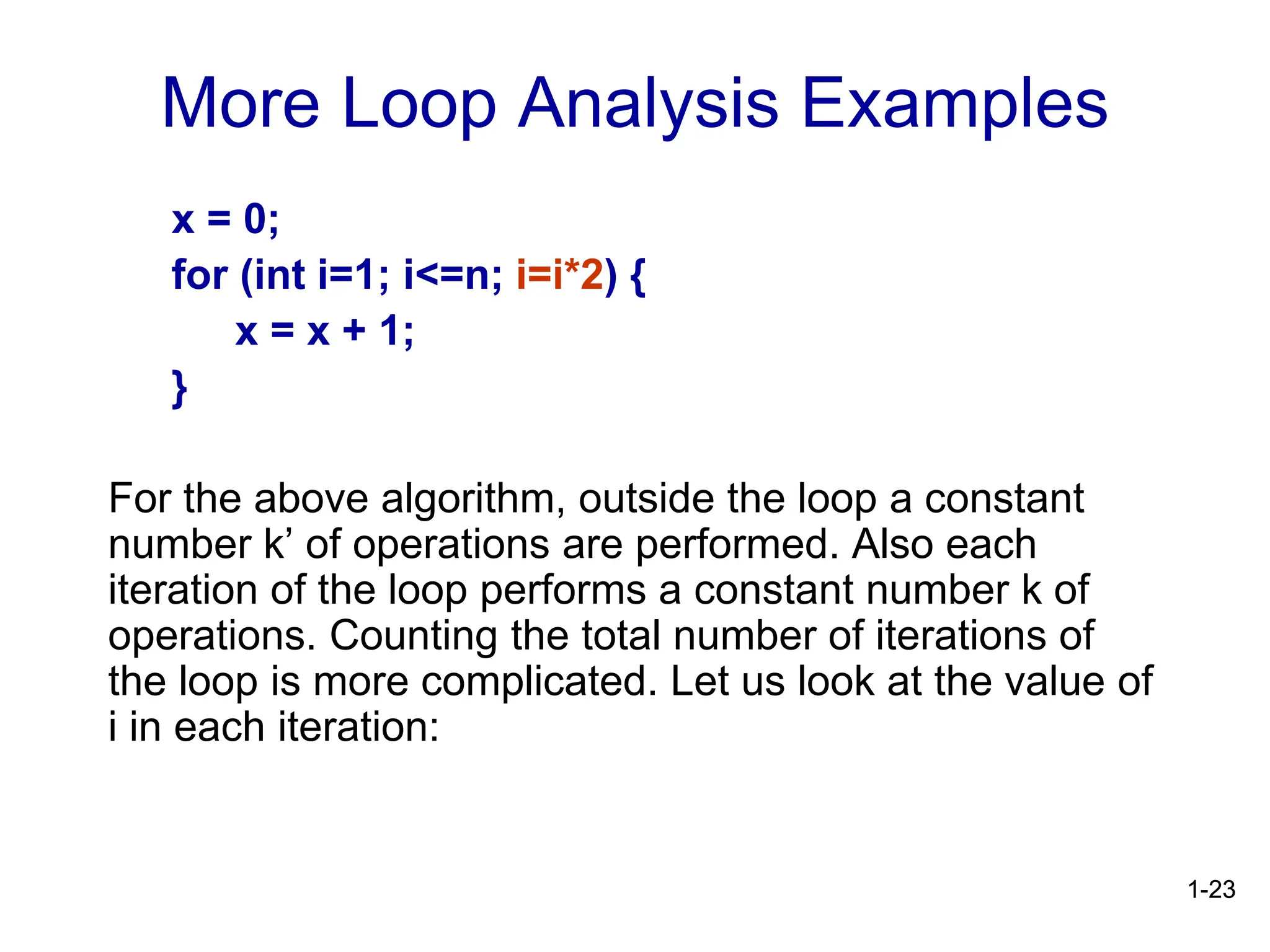
x = 0;
for (int i=1; i<=n; i=i*2) {
x = x + 1;
}
For the above algorithm, outside the loop a constant
number k’ of operations are performed. Also each
iteration of the loop performs a constant number k of
operations. Counting the total number of iterations of
the loop is more complicated. Let us look at the value of
i in each iteration:
1-24
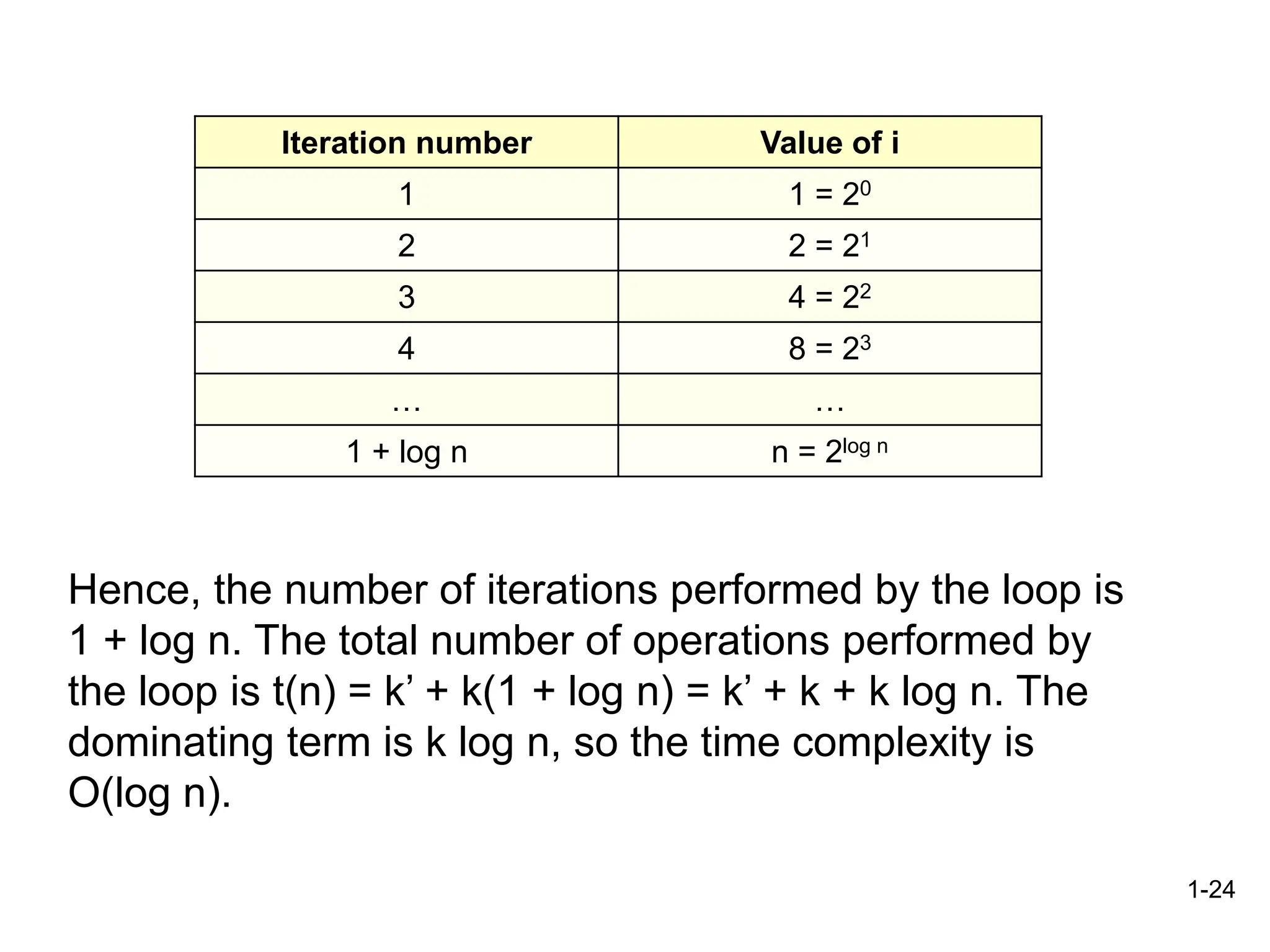
Iteration number Value of i
1 1 = 20
2 2 = 21
3 4 = 22
4 8 = 23
… …
1 + log n n = 2log n
Hence, the number of iterations performed by the loop is
1 + log n. The total number of operations performed by
the loop is t(n) = k’ + k(1 + log n) = k’ + k + k log n. The
dominating term is k log n, so the time complexity is
O(log n).
1-25
1-25
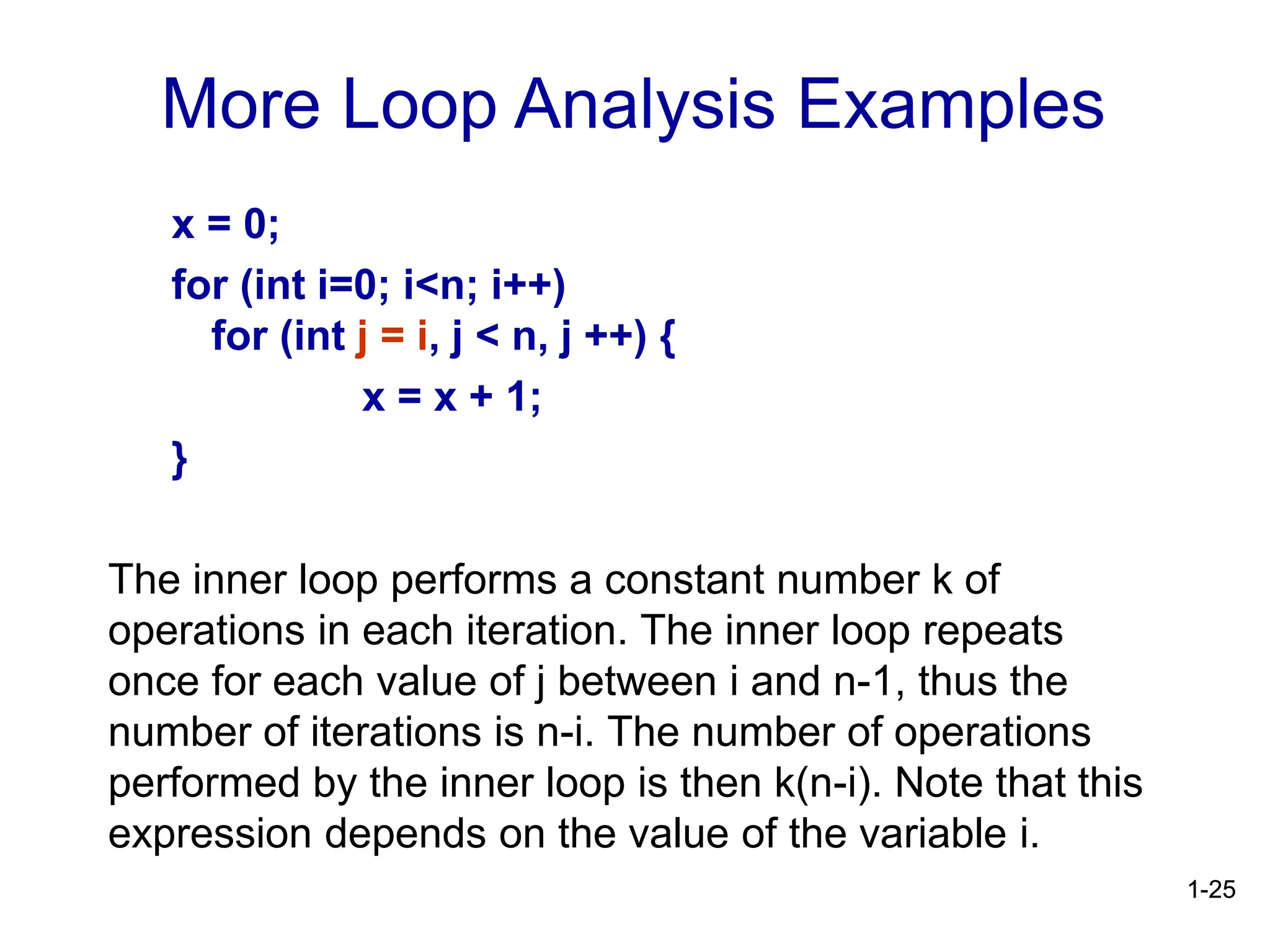
x = 0;
for (int i=0; i<n; i++)
for (int j = i, j < n, j ++) {
x = x + 1;
}
The inner loop performs a constant number k of
operations in each iteration. The inner loop repeats
once for each value of j between i and n-1, thus the
number of iterations is n-i. The number of operations
performed by the inner loop is then k(n-i). Note that this
expression depends on the value of the variable i.
More Loop Analysis Examples
1-26
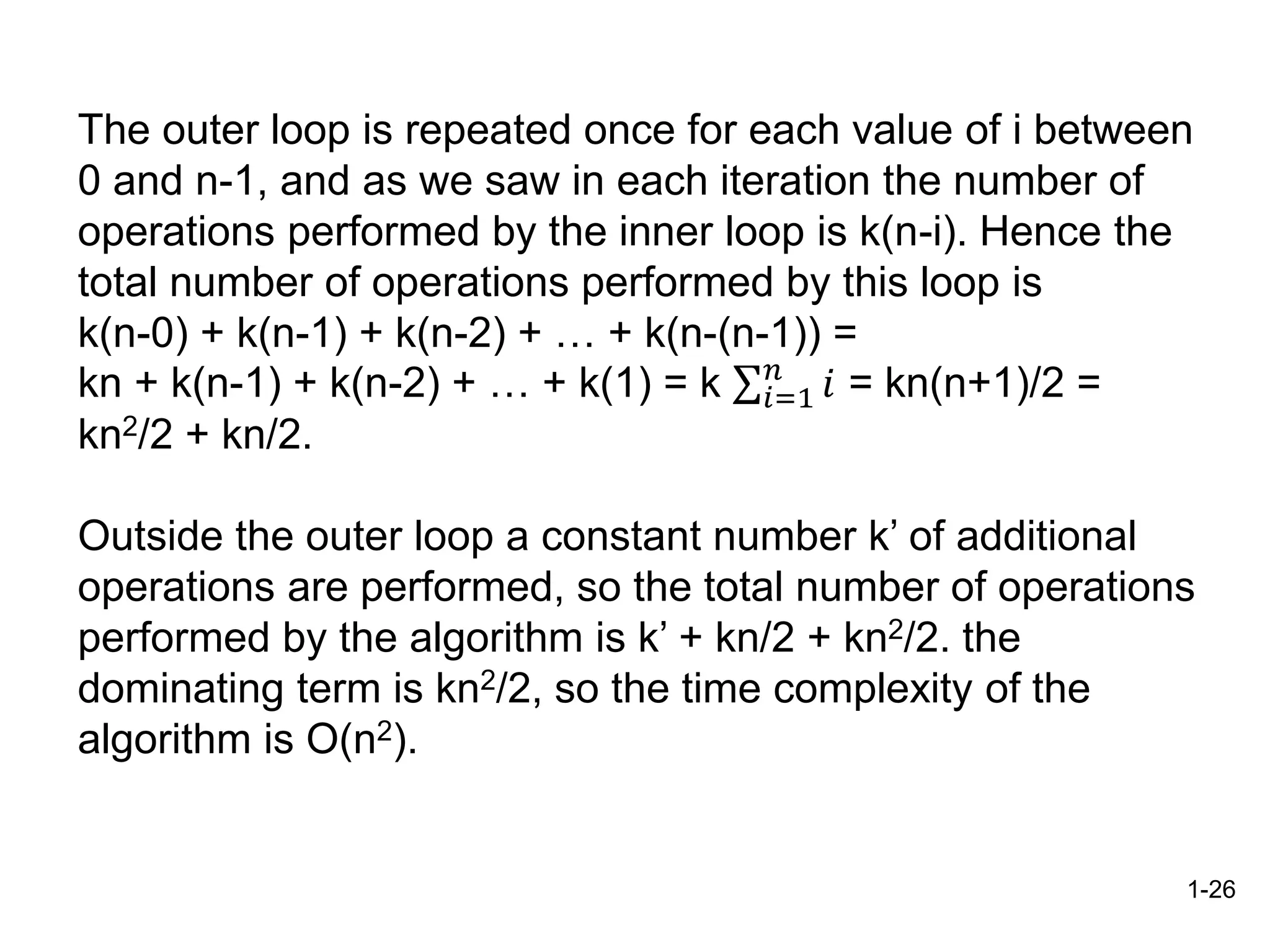
The outer loop is repeated once for each value of i between
0 and n-1, and as we saw in each iteration the number of
operations performed by the inner loop is k(n-i). Hence the
total number of operations performed by this loop is
k(n-0) + k(n-1) + k(n-2) + … + k(n-(n-1)) =
kn + k(n-1) + k(n-2) + … + k(1) = k σ𝑖=1
𝑛
𝑖 = kn(n+1)/2 =
kn2/2 + kn/2.
Outside the outer loop a constant number k’ of additional
operations are performed, so the total number of operations
performed by the algorithm is k’ + kn/2 + kn2/2. the
dominating term is kn2/2, so the time complexity of the
algorithm is O(n2).

design and analysis of algorithm basic concepts.pdf

  • 1.
  • 2.
    1-2 1-2 Analysis of Algorithms •To determine how efficient an algorithm is we compute the amount of time that the algorithm needs to solve a problem. • Given two algorithms for the same problem, the preferred one is the faster.
  • 3.
    1-3 1-3 Time Complexity • Thetime complexity of an algorithm is a function that gives the amount of time that the algorithm takes to complete. • The time complexity depends on the size of the input, or the number of data items in the input.
  • 4.
    1-4 1-4 Time Complexity • Thetime complexity of an algorithm is denoted as t(n) or f(n), where n is the size of the input. • The time complexity is non-decreasing in the size of the input, i.e. the amount of time needed by an algorithm cannot decrease as the size of the input increases. (For example, copying a large array cannot take less time than making a copy of a smaller array.)
  • 5.
    1-5 1-5 Asymptotic Growth • Let t(n)= 15n2 + 45 n be the time complexity of an algorithm. For each value of n the function indicates the amount of time required by the algorithm. So t(1) is the running time of the algorithm when the input has 1 data item, t(100) is the running time of the algorithm when the input has 100 data items, and so on.
  • 6.
    1-6 No. of itemsn 15n2 45n 15n2 + 45n 1 15 45 60 2 60 90 150 5 375 225 600 10 1,500 450 1,950 100 150,000 4,500 154,500 1,000 15,000,000 45,000 15,045,000 10,000 1,500,000,000 450,000 1,500,450,000 100,000 150,000,000,000 4,500,000 150,004,500,000 1,000,000 15,000,000,000,000 45,000,000 15,000,045,000,000 The following table shows the value of the above function t(n) for various values of n. Assume that the times are given in microseconds (1 microsecond = 0.000001 second)
  • 7.
    1-7 Asymptotic Growth When tryingto decide whether an algorithm is efficient we are only interested in the value of its time complexity for large values of n, because for small values of n the running time of an algorithm is very small. (For example, in the previous table, for values of n smaller than 100 the running times are much smaller than 1 second. However, for n = 1 million, the running time of the algorithm is 173 days.)
  • 8.
    1-8 Asymptotic Growth For largevalues of n, the value of the time complexity function is mainly determined by the largest term in the function. For example, for the above time complexity t(n) = 15n2 + 45n the largest term is 15n2. Notice that for large values of n, the value of 15n2 is much bigger than the value of 45n. We say that 15n2 asymptotically dominates 45n and so that t(n) has the same asymptotic behaviour as 15n2.
  • 9.
    1-9 1-9 Big-Oh Notation There isa mathematical notation called the order or big-Oh notation for expressing the asymptotic growth of a time complexity function. A formal definition for the big-Oh notation will be given in the second year course on data structures an algorithms. The big-Oh notation captures the running time of an algorithm independently of how it is implemented and executed, i.e., independently of the programming
  • 10.
    1-10 1-10 Big-OhNotation language in whichit is implemented, of the computer in which it is run and of the operating system used by such a computer. Roughly speaking, since different computers differ in speed by a constant factor (a factor that does not depend on the algorithm being executed and the size of the input on which the algorithm operates), when expressing the asymptotic growth of a time complexity
  • 11.
    1-11 1-11 Big-Oh Notation function usingthe big-Oh notation, any constant factors in the function are ignored. So, for example the time complexity function t(n) = 15n2 + 45n, grows asymptotically as fast as 15n2, which in big- Oh notation is denoted as O(n2) since, as explained above, the constant factor 15 is ignored. A factor is constant if its value does not depend on the size of the input. (Note that 15 does not depend on n.)
  • 12.
    1-12 1-12 • The asymptoticgrowth of the time complexity function of an algorithm is referred to as the order of the time complexity of the algorithm. • Example: O(n2) means that the time taken by the algorithm grows quadratically as n increases • O(1) means constant time, independent of the size of the input Big-Oh Notation
  • 13.
    1-13 1-13 Given a timecomplexity function of the form t(n) = t1(n) + t2(n) + … + tk(n) Where the number k of terms is constant (i.e. independent of n) the order of t(n) is determined by the largest term ti(n). Some examples of computing the order of several functions are given in the next page. Big-Oh Notation
  • 14.
    1-14 Determining Time Complexity Whencomputing the time complexity of an algorithm, we focus our attention on the most expensive parts of the algorithm, namely the loops and the recursive calls. We will look at recursive calls later, for now we will look at how to compute the time complexity of loops.
  • 15.
    1-15 Determining Time Complexity Thetime complexity function of an algorithm gives the running time of the algorithm. From just the description of an algorithm we cannot determine the amount of time, say in seconds, that it would need to execute. So, how can we determine the time complexity of an algorithm like this one? x = 0; for (int i = 0; i < n; i++) x = x + 1;
  • 16.
    1-16 Determining Time Complexity Whenanalyzing an algorithm we cannot determine its actual running time, but we can estimate it if we count the number of basic or primitive operations that the algorithm performs. A basic or primitive operation is an operation that takes constant time (i.e. independent of the size of the input). Some examples of primitive operations are: assigning a value to a variable, comparing the values of two variables and adding two values.
  • 17.
    1-17 1-17 Analysing Loop Execution Forthe algorithm below, the primitive operations are =, <, ++, +. Outside the loop one operation is performed (=). In each iteration of the loop four operations are performed (<, ++, =, +). Since the loop is repeated n times, the total number of operations performed is 4n+1. Roughly speaking, this means that the running time of the algorithm is proportional to 4n+1. The order of the function 4n+1 is O(n) and so is the order of the time complexity of the algorithm. x = 0; for (int i=0; i<n; i++) x = x + 1;
  • 18.
    1-18 1-18 Time Complexity Since thenumber of primitive operations performed by an algorithm and the time complexity of the algorithm have the same order, we can say that the time complexity of an algorithm is the same as the number of primitive operations that it performs. So, for the algorithm above we say that its time complexity is t(n) = 4n+1. Note that we are not really interested in the exact value of this function, but we only wish to know the order of the time complexity. So we say that the above algorithm as time complexity O(n). Notice that since any constant factors in the time complexity function are ignored when computing the order of the time complexity, we do not need to count
  • 19.
    exactly the numberof primitive operations performed by the algorithm. For example, for the same algorithm above We can say that each iteration of the for loop performs a constant number k of operations. Since the loop is repeated n times, the total number of operations performed by the for loop is kn. Outside the loop a constant number k’ of additional operations are performed, so the total number of operations performed by the algorithm is kn + k’, which is O(n). Note that we obtained the same result, namely that the time complexity is O(n) even though we did not count the exact number of operations. x = 0; for (int i=0; i<n; i++) x = x + 1; 1-19
  • 20.
    1-20 1-20 However, we needto be very careful when counting the number of iterations of any loop, as a wrong value for the number of operations might lead to the wrong order for the time complexity. Nested loops When computing the time complexity of an algorithm with nested loops, like the algorithm below, we usually consider the innermost loop first and work our way outward. for (int i=0; i<n; i++) { x = x + 1; for (int j=0; j<n; j++) y = y – 1; }
  • 21.
    1-21 Each iteration ofthe inner loop performs a constant number k of operations. Every time that the loop is performed, it iterates n times (as j takes values 0, 1, …, n-1), therefore the total number of operations performed by the inner loop is kn. Outside the inner loop, but inside the outer one, an additional constant number k’ of operations are performed (x = x+1), so each iteration of the outside loop performs k’ + kn operations. The outer loop is repeated n times, so the total number of operations performed by this algorithm is t(n) = n(k’ + kn) = k’n + kn2. Note that in this function the term kn2 asymptotically dominates the term k’n, so ignoring constant factor we get that t(n) is O(n2).
  • 22.
    1-22 1-22 More Loop AnalysisExamples x = 0; for (int i=0; i<n; i=i+2) { x = x + 1; } For the above algorithm, each iteration of the loop performs a constant number k of operations. The loop is repeated n/2 times, as in each iteration the value of i increases by 2. Furthermore, outside the loop an additional constant number k’ of operations are performed. Hence, the total number of operations performed by the algorithm is k’ + kn/2. The time complexity of this algorithm, then is O(n).
  • 23.
    1-23 1-23 More Loop AnalysisExamples x = 0; for (int i=1; i<=n; i=i*2) { x = x + 1; } For the above algorithm, outside the loop a constant number k’ of operations are performed. Also each iteration of the loop performs a constant number k of operations. Counting the total number of iterations of the loop is more complicated. Let us look at the value of i in each iteration:
  • 24.
    1-24 Iteration number Valueof i 1 1 = 20 2 2 = 21 3 4 = 22 4 8 = 23 … … 1 + log n n = 2log n Hence, the number of iterations performed by the loop is 1 + log n. The total number of operations performed by the loop is t(n) = k’ + k(1 + log n) = k’ + k + k log n. The dominating term is k log n, so the time complexity is O(log n).
  • 25.
    1-25 1-25 x = 0; for(int i=0; i<n; i++) for (int j = i, j < n, j ++) { x = x + 1; } The inner loop performs a constant number k of operations in each iteration. The inner loop repeats once for each value of j between i and n-1, thus the number of iterations is n-i. The number of operations performed by the inner loop is then k(n-i). Note that this expression depends on the value of the variable i. More Loop Analysis Examples
  • 26.
    1-26 The outer loopis repeated once for each value of i between 0 and n-1, and as we saw in each iteration the number of operations performed by the inner loop is k(n-i). Hence the total number of operations performed by this loop is k(n-0) + k(n-1) + k(n-2) + … + k(n-(n-1)) = kn + k(n-1) + k(n-2) + … + k(1) = k σ𝑖=1 𝑛 𝑖 = kn(n+1)/2 = kn2/2 + kn/2. Outside the outer loop a constant number k’ of additional operations are performed, so the total number of operations performed by the algorithm is k’ + kn/2 + kn2/2. the dominating term is kn2/2, so the time complexity of the algorithm is O(n2).