PHILIPPINE NORMAL UNIVERSITY
The National Center for Teacher Education
Mindanao
Descriptive Statistic
Statistics- is commonly defined as an applied mathematics that deals with the
collection, tabulation or presentation, analysis, and interpretationof numerical
or quantitative data.
Statistics is almost everywhere. Almost all of the activities that we do
involve statistics, when we play , work and do many things in life require
statistics, its importance can never be underscored. Most often, our decisions
were based from statistics.
Collection of Data – refers to a process of obtaining numerical measurements.
Tabulation or presentationof data- refers tothe organizationof dataintotables,
graphs or charts, so that logical and statistical conclusions can be derived from
the collected measurements.
Analysis of data- pertains to the process of extracting from the given data
relevant information from which numerical description can be found.
Interpretation of Data- refers to the task of drawing conclusions from the
analyzed data.
Descriptive Statistics
- Is concernedwiththecollection,organizationandinterpretationofdata
in a form understandable to all.
- Its objective is tosummarize some of the important features of a set of
data.
- It is employed when measuring a trait or characteristics of a group
without any intention to generalize that statistics beyond that group.
- It is relevant when the researcher needs to summarize or describe the
distribution of a single variable and when the researcher wishes to
understand the relationship between two or more variables.
Uses of Statistics
Statistics has general applicability. It is an essential tool in education,
government, business, economics, medicine, psychology, sociology, sports and
others.
1. Sports- one of the most common exposures of the youthtoday tostatistics
is in the existing world of sports. In basketball, for instance, after each
quarterof a game, thenewscasterwouldreportnumericalfiguresandtheir
average to millions of thrilled basketball fans watching the game in
television.
2. Education- In education, statistics are usedinthe evaluationof instruction
and programs which are important aspects of the educational system. In
the classroom, it is frequently used to describe test result. For
administrative functions. It is used to get information on enrollment,
finance, physical facilities and so on.
3. Government- statistics are gathered for the purpose of providing
government with data necessary to guide government authorities in
managing the affairs of the state.
4. Medicines-methods for the statistical designof experimentsare valuable
to researchers inmedicine andthe physical sciences. Causes andeffects of
factors which affect experiments are best evaluated using statistical
techniques.
5. Psychology- psychologist s are able to understandthe human beings that
their behavior better if they are able to systematize andinterpret dataon
intelligence score, personality traits ratings and attitudes.
6. Sociology- in sociology, statistics is used in the study of human beings in
the society. Observations, when properly analyzed and interpreted.
Population-is a collection, or set of individuals, objects or measurements
whose properties are to be analyzed.
The population of concern must be clearly defined. When we say “
clearly defined”elements inthe givenpopulationare cautiously specified.
Philippine Normal University college students can be considered as a
populationfromwhichagroupof studentssayfourthyear collegestudents
( a sample ) will be randomly selected.
Sample- is a subset of a population.
Variable- is anything that varies or changes invalue. It is a characteristic or
property whereby the members of the groupor set vary or differ from one
another.
Classification of variables according to functional relationship
1. IndependentVariable-issometimestermedasa predictorvariable.This
is the change that occurs in the study population when one or
experiment, this is the object manipulated or controlled by the
researcher.
2. Dependent Variable- is sometimes calledthe criterionvariable. This is
the condition or characteristics which is influence by the independent
variables.
3. Intervening Variable- is a variable that strengthen or weaken the
influence of the independent variable to the dependent variable in
other words the intervening variable is afactor that works betweenthe
independent and dependent variable. It is also called moderator
variable.
Example:
1. The Relationship Between Exposure to Mass Media and Smoking Habits
among young adults.
2. The Effect of Peer Counseling on the Students’ Study Habits.
3. Knowledge of the Dangers of Smoking, Attitudes Towards Life and
Smoking Habits of Young Professionals.
4. The relationship between the Emotional Intelligence and teaching
performance of public elementary school.
5. The effect of whole language instruction on the vocabulary and reading
comprehension skills of first year high school students.
6. The level of stress, study habits and academic performance of the math
major students of Philippine Normal University.
Exercises:
I- Direction:The following are titlesof researches, Identify the variables involved
and label it as independent, dependent, or intervening.
1. “ The Effects of Meyers’ Critical Thinking Strategies onthe Achievementof
Grade V Students, History and Civics ( HEKASI V ).”
2. “ Emotional Intelligence and Teaching Performance of Public Secondary
School Teachers in Relationto Students’ Academic Achievement:Basis for
Faculty Development Program.”
3. “ The Impact of Outdoor Activities on the Attitude and Performance in
Mathematics of Grade Six Students of Iliranan Elementary School Division
of San Carlos City.
4. “ Academic Achievement , Self Concept, and Reading Attitude of Kabalaka
Freshmen Students of Philippine Normal University ,Cadiz City. “
5. “ Ang Epektong Paggamit ng Computer– AssistedInstructionsaAtsibment
ng Pagbasa ng Maikling Kwento. “
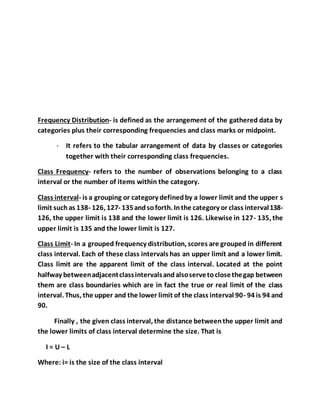
Frequency Distribution- is defined as the arrangement of the gathered data by
categories plus their corresponding frequencies and class marks or midpoint.
- It refers to the tabular arrangement of data by classes or categories
together with their corresponding class frequencies.
Class Frequency- refers to the number of observations belonging to a class
interval or the number of items within the category.
Class interval- is a grouping or category definedby a lower limit and the upper s
limit suchas 138- 126, 127- 135andsoforth. Inthe category or class interval138-
126, the upper limit is 138 and the lower limit is 126. Likewise in 127- 135, the
upper limit is 135 and the lower limit is 127.
Class Limit- In a grouped frequency distribution, scores are grouped in different
class interval. Each of these class intervals has an upper limit and a lower limit.
Class limit are the apparent limit of the class interval. Located at the point
halfway betweenadjacentclassintervalsandalsoservetoclosethegap between
them are class boundaries which are in fact the true or real limit of the class
interval. Thus, the upper and the lower limit of the class interval 90- 94 is 94 and
90.
Finally , the given class interval, the distance betweenthe upper limit and
the lower limits of class interval determine the size. That is
I = U – L
Where: i= is the size of the class interval
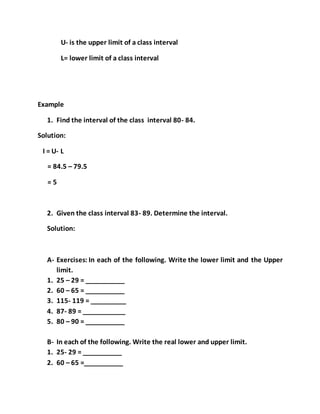
U- is the upper limit of a class interval
L= lower limit of a class interval
Example
1. Find the interval of the class interval 80- 84.
Solution:
I = U- L
= 84.5 – 79.5
= 5
2. Given the class interval 83- 89. Determine the interval.
Solution:
A- Exercises: In each of the following. Write the lower limit and the Upper
limit.
1. 25 – 29 = ___________
2. 60 – 65 = ___________
3. 115- 119 = __________
4. 87- 89 = ____________
5. 80 – 90 = ___________
B- In each of the following. Write the real lower and upper limit.
1. 25- 29 = ___________
2. 60 – 65 =___________
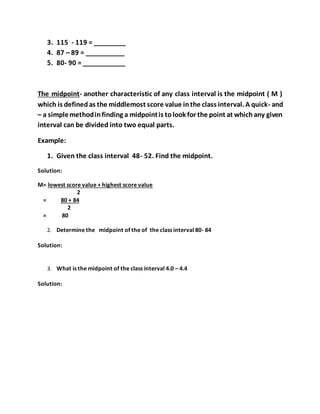
3. 115 - 119 = _________
4. 87 – 89 = ___________
5. 80- 90 = ____________
The midpoint- another characteristic of any class interval is the midpoint ( M )
which is definedas the middlemost score value inthe class interval. A quick- and
– a simplemethodinfinding a midpointis tolook for the point at whichany given
interval can be divided into two equal parts.
Example:
1. Given the class interval 48- 52. Find the midpoint.
Solution:
M= lowest score value + highest score value
2
= 80 + 84
2
= 80
2. Determine the midpoint of the of the class interval 80- 84
Solution:
3. What is the midpoint of the class interval 4.0 – 4.4
Solution:
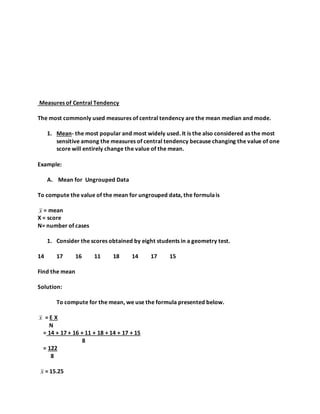
Measures of Central Tendency
The most commonly used measures of central tendency are the mean median and mode.
1. Mean- the most popular and most widely used. It is the also considered as the most
sensitive among the measures of central tendency because changing the value of one
score will entirely change the value of the mean.
Example:
A. Mean for Ungrouped Data
To compute the value of the mean for ungrouped data, the formulais
x = mean
X = score
N= number of cases
1. Consider the scores obtained by eight students in a geometry test.
14 17 16 11 18 14 17 15
Find the mean
Solution:
To compute for the mean, we use the formula presented below.
x = E X
N
= 14 + 17 + 16 + 11 + 18 + 14 + 17 + 15
8
= 122
8
x = 15.25
Exercises:
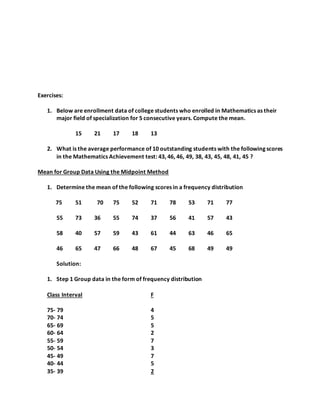
1. Below are enrollment data of college students who enrolled in Mathematics as their
major field of specialization for 5 consecutive years. Compute the mean.
15 21 17 18 13
2. What is the average performance of 10 outstanding students with the following scores
in the Mathematics Achievement test: 43, 46, 46, 49, 38, 43, 45, 48, 41, 45 ?
Mean for Group Data Using the Midpoint Method
1. Determine the mean of the following scores in a frequency distribution
75 51 70 75 52 71 78 53 71 77
55 73 36 55 74 37 56 41 57 43
58 40 57 59 43 61 44 63 46 65
46 65 47 66 48 67 45 68 49 49
Solution:
1. Step 1 Group data in the form of frequency distribution
Class Interval F
75- 79 4
70- 74 5
65- 69 5
60- 64 2
55- 59 7
50- 54 3
45- 49 7
40- 44 5
35- 39 2
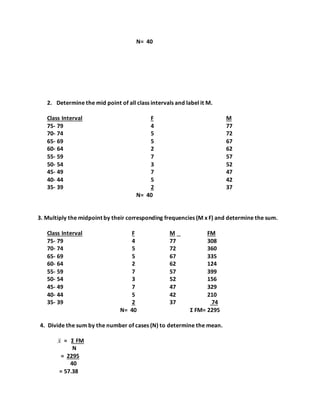
N= 40
2. Determine the mid point of all class intervals and label it M.
Class Interval F M
75- 79 4 77
70- 74 5 72
65- 69 5 67
60- 64 2 62
55- 59 7 57
50- 54 3 52
45- 49 7 47
40- 44 5 42
35- 39 2 37
N= 40
3. Multiply the midpoint by their corresponding frequencies (M x F) and determine the sum.
Class Interval F M FM
75- 79 4 77 308
70- 74 5 72 360
65- 69 5 67 335
60- 64 2 62 124
55- 59 7 57 399
50- 54 3 52 156
45- 49 7 47 329
40- 44 5 42 210
35- 39 2 37 74
N= 40 Ʃ FM= 2295
4. Divide the sum by the number of cases (N) to determine the mean.
x = Ʃ FM
N
= 2295
40
= 57.38
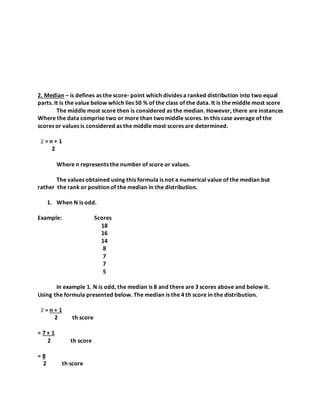
2. Median – is defines as the score- point which divides a ranked distribution into two equal
parts. It is the value below which lies 50 % of the class of the data. It is the middle most score
The middle most score then is considered as the median. However, there are instances
Where the data comprise two or more than twomiddle scores. In this case average of the
scores or values is considered as the middle most scores are determined.
~x = n + 1
2
Where n represents the number of score or values.
The values obtained using this formula is not a numerical value of the median but
rather the rank or position of the median in the distribution.
1. When N is odd.
Example: Scores
18
16
14
8
7
7
5
In example 1. N is odd, the median is 8 and there are 3 scores above and below it.
Using the formula presented below. The median is the 4 th score in the distribution.
~x = n + 1
2 th score
= 7 + 1
2 th score
= 8
2 th score
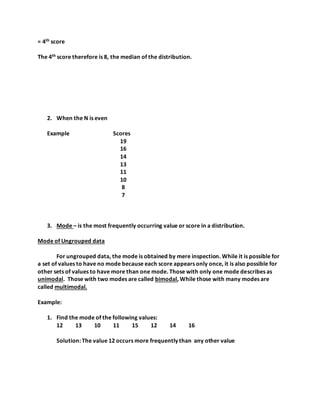
= 4th score
The 4th score therefore is 8, the median of the distribution.
2. When the N is even
Example Scores
19
16
14
13
11
10
8
7
3. Mode – is the most frequently occurring value or score in a distribution.
Mode of Ungrouped data
For ungrouped data, the mode is obtained by mere inspection. While it is possible for
a set of values to have no mode because each score appears only once, it is also possible for
other sets of values to have more than one mode. Those with only one mode describes as
unimodal. Those with two modes are called bimodal, While those with many modes are
called multimodal.
Example:
1. Find the mode of the following values:
12 13 10 11 15 12 14 16
Solution: The value 12 occurs more frequently than any other value

Descriptive statistics. final

  • 1.
    PHILIPPINE NORMAL UNIVERSITY TheNational Center for Teacher Education Mindanao Descriptive Statistic Statistics- is commonly defined as an applied mathematics that deals with the collection, tabulation or presentation, analysis, and interpretationof numerical or quantitative data. Statistics is almost everywhere. Almost all of the activities that we do involve statistics, when we play , work and do many things in life require statistics, its importance can never be underscored. Most often, our decisions were based from statistics. Collection of Data – refers to a process of obtaining numerical measurements. Tabulation or presentationof data- refers tothe organizationof dataintotables, graphs or charts, so that logical and statistical conclusions can be derived from the collected measurements. Analysis of data- pertains to the process of extracting from the given data relevant information from which numerical description can be found. Interpretation of Data- refers to the task of drawing conclusions from the analyzed data. Descriptive Statistics - Is concernedwiththecollection,organizationandinterpretationofdata in a form understandable to all. - Its objective is tosummarize some of the important features of a set of data.
  • 2.
    - It isemployed when measuring a trait or characteristics of a group without any intention to generalize that statistics beyond that group. - It is relevant when the researcher needs to summarize or describe the distribution of a single variable and when the researcher wishes to understand the relationship between two or more variables. Uses of Statistics Statistics has general applicability. It is an essential tool in education, government, business, economics, medicine, psychology, sociology, sports and others. 1. Sports- one of the most common exposures of the youthtoday tostatistics is in the existing world of sports. In basketball, for instance, after each quarterof a game, thenewscasterwouldreportnumericalfiguresandtheir average to millions of thrilled basketball fans watching the game in television. 2. Education- In education, statistics are usedinthe evaluationof instruction and programs which are important aspects of the educational system. In the classroom, it is frequently used to describe test result. For administrative functions. It is used to get information on enrollment, finance, physical facilities and so on. 3. Government- statistics are gathered for the purpose of providing government with data necessary to guide government authorities in managing the affairs of the state. 4. Medicines-methods for the statistical designof experimentsare valuable to researchers inmedicine andthe physical sciences. Causes andeffects of factors which affect experiments are best evaluated using statistical techniques. 5. Psychology- psychologist s are able to understandthe human beings that their behavior better if they are able to systematize andinterpret dataon intelligence score, personality traits ratings and attitudes. 6. Sociology- in sociology, statistics is used in the study of human beings in the society. Observations, when properly analyzed and interpreted.
  • 3.
    Population-is a collection,or set of individuals, objects or measurements whose properties are to be analyzed. The population of concern must be clearly defined. When we say “ clearly defined”elements inthe givenpopulationare cautiously specified. Philippine Normal University college students can be considered as a populationfromwhichagroupof studentssayfourthyear collegestudents ( a sample ) will be randomly selected. Sample- is a subset of a population. Variable- is anything that varies or changes invalue. It is a characteristic or property whereby the members of the groupor set vary or differ from one another. Classification of variables according to functional relationship 1. IndependentVariable-issometimestermedasa predictorvariable.This is the change that occurs in the study population when one or experiment, this is the object manipulated or controlled by the researcher. 2. Dependent Variable- is sometimes calledthe criterionvariable. This is the condition or characteristics which is influence by the independent variables. 3. Intervening Variable- is a variable that strengthen or weaken the influence of the independent variable to the dependent variable in other words the intervening variable is afactor that works betweenthe independent and dependent variable. It is also called moderator variable.
  • 4.
    Example: 1. The RelationshipBetween Exposure to Mass Media and Smoking Habits among young adults. 2. The Effect of Peer Counseling on the Students’ Study Habits. 3. Knowledge of the Dangers of Smoking, Attitudes Towards Life and Smoking Habits of Young Professionals. 4. The relationship between the Emotional Intelligence and teaching performance of public elementary school. 5. The effect of whole language instruction on the vocabulary and reading comprehension skills of first year high school students. 6. The level of stress, study habits and academic performance of the math major students of Philippine Normal University. Exercises: I- Direction:The following are titlesof researches, Identify the variables involved and label it as independent, dependent, or intervening. 1. “ The Effects of Meyers’ Critical Thinking Strategies onthe Achievementof Grade V Students, History and Civics ( HEKASI V ).” 2. “ Emotional Intelligence and Teaching Performance of Public Secondary School Teachers in Relationto Students’ Academic Achievement:Basis for Faculty Development Program.” 3. “ The Impact of Outdoor Activities on the Attitude and Performance in Mathematics of Grade Six Students of Iliranan Elementary School Division of San Carlos City. 4. “ Academic Achievement , Self Concept, and Reading Attitude of Kabalaka Freshmen Students of Philippine Normal University ,Cadiz City. “ 5. “ Ang Epektong Paggamit ng Computer– AssistedInstructionsaAtsibment ng Pagbasa ng Maikling Kwento. “
  • 5.
    Frequency Distribution- isdefined as the arrangement of the gathered data by categories plus their corresponding frequencies and class marks or midpoint. - It refers to the tabular arrangement of data by classes or categories together with their corresponding class frequencies. Class Frequency- refers to the number of observations belonging to a class interval or the number of items within the category. Class interval- is a grouping or category definedby a lower limit and the upper s limit suchas 138- 126, 127- 135andsoforth. Inthe category or class interval138- 126, the upper limit is 138 and the lower limit is 126. Likewise in 127- 135, the upper limit is 135 and the lower limit is 127. Class Limit- In a grouped frequency distribution, scores are grouped in different class interval. Each of these class intervals has an upper limit and a lower limit. Class limit are the apparent limit of the class interval. Located at the point halfway betweenadjacentclassintervalsandalsoservetoclosethegap between them are class boundaries which are in fact the true or real limit of the class interval. Thus, the upper and the lower limit of the class interval 90- 94 is 94 and 90. Finally , the given class interval, the distance betweenthe upper limit and the lower limits of class interval determine the size. That is I = U – L Where: i= is the size of the class interval
  • 6.
    U- is theupper limit of a class interval L= lower limit of a class interval Example 1. Find the interval of the class interval 80- 84. Solution: I = U- L = 84.5 – 79.5 = 5 2. Given the class interval 83- 89. Determine the interval. Solution: A- Exercises: In each of the following. Write the lower limit and the Upper limit. 1. 25 – 29 = ___________ 2. 60 – 65 = ___________ 3. 115- 119 = __________ 4. 87- 89 = ____________ 5. 80 – 90 = ___________ B- In each of the following. Write the real lower and upper limit. 1. 25- 29 = ___________ 2. 60 – 65 =___________
  • 7.
    3. 115 -119 = _________ 4. 87 – 89 = ___________ 5. 80- 90 = ____________ The midpoint- another characteristic of any class interval is the midpoint ( M ) which is definedas the middlemost score value inthe class interval. A quick- and – a simplemethodinfinding a midpointis tolook for the point at whichany given interval can be divided into two equal parts. Example: 1. Given the class interval 48- 52. Find the midpoint. Solution: M= lowest score value + highest score value 2 = 80 + 84 2 = 80 2. Determine the midpoint of the of the class interval 80- 84 Solution: 3. What is the midpoint of the class interval 4.0 – 4.4 Solution:
  • 8.
    Measures of CentralTendency The most commonly used measures of central tendency are the mean median and mode. 1. Mean- the most popular and most widely used. It is the also considered as the most sensitive among the measures of central tendency because changing the value of one score will entirely change the value of the mean. Example: A. Mean for Ungrouped Data To compute the value of the mean for ungrouped data, the formulais x = mean X = score N= number of cases 1. Consider the scores obtained by eight students in a geometry test. 14 17 16 11 18 14 17 15 Find the mean Solution: To compute for the mean, we use the formula presented below. x = E X N = 14 + 17 + 16 + 11 + 18 + 14 + 17 + 15 8 = 122 8 x = 15.25
  • 9.
    Exercises: 1. Below areenrollment data of college students who enrolled in Mathematics as their major field of specialization for 5 consecutive years. Compute the mean. 15 21 17 18 13 2. What is the average performance of 10 outstanding students with the following scores in the Mathematics Achievement test: 43, 46, 46, 49, 38, 43, 45, 48, 41, 45 ? Mean for Group Data Using the Midpoint Method 1. Determine the mean of the following scores in a frequency distribution 75 51 70 75 52 71 78 53 71 77 55 73 36 55 74 37 56 41 57 43 58 40 57 59 43 61 44 63 46 65 46 65 47 66 48 67 45 68 49 49 Solution: 1. Step 1 Group data in the form of frequency distribution Class Interval F 75- 79 4 70- 74 5 65- 69 5 60- 64 2 55- 59 7 50- 54 3 45- 49 7 40- 44 5 35- 39 2
  • 10.
    N= 40 2. Determinethe mid point of all class intervals and label it M. Class Interval F M 75- 79 4 77 70- 74 5 72 65- 69 5 67 60- 64 2 62 55- 59 7 57 50- 54 3 52 45- 49 7 47 40- 44 5 42 35- 39 2 37 N= 40 3. Multiply the midpoint by their corresponding frequencies (M x F) and determine the sum. Class Interval F M FM 75- 79 4 77 308 70- 74 5 72 360 65- 69 5 67 335 60- 64 2 62 124 55- 59 7 57 399 50- 54 3 52 156 45- 49 7 47 329 40- 44 5 42 210 35- 39 2 37 74 N= 40 Ʃ FM= 2295 4. Divide the sum by the number of cases (N) to determine the mean. x = Ʃ FM N = 2295 40 = 57.38
  • 11.
    2. Median –is defines as the score- point which divides a ranked distribution into two equal parts. It is the value below which lies 50 % of the class of the data. It is the middle most score The middle most score then is considered as the median. However, there are instances Where the data comprise two or more than twomiddle scores. In this case average of the scores or values is considered as the middle most scores are determined. ~x = n + 1 2 Where n represents the number of score or values. The values obtained using this formula is not a numerical value of the median but rather the rank or position of the median in the distribution. 1. When N is odd. Example: Scores 18 16 14 8 7 7 5 In example 1. N is odd, the median is 8 and there are 3 scores above and below it. Using the formula presented below. The median is the 4 th score in the distribution. ~x = n + 1 2 th score = 7 + 1 2 th score = 8 2 th score
  • 12.
    = 4th score The4th score therefore is 8, the median of the distribution. 2. When the N is even Example Scores 19 16 14 13 11 10 8 7 3. Mode – is the most frequently occurring value or score in a distribution. Mode of Ungrouped data For ungrouped data, the mode is obtained by mere inspection. While it is possible for a set of values to have no mode because each score appears only once, it is also possible for other sets of values to have more than one mode. Those with only one mode describes as unimodal. Those with two modes are called bimodal, While those with many modes are called multimodal. Example: 1. Find the mode of the following values: 12 13 10 11 15 12 14 16 Solution: The value 12 occurs more frequently than any other value