UN Home | UN DESA Home                                                                                February 2012, Vol. 16, No. 2


 IN THIS ISSUE >>>

 Facing the challenge of measuring the unmeasurable| Making strides towards extreme poverty eradication| New
 ECOSOC President outlines focus for 2012


 Global dialogue on development: Highlighting role of cooperatives for communities and youth, Reflecting on a rapidly changing
 development context, Rio+20: Accreditation and registration now open

 Trends and analysis: IGF convenes meetings in Geneva, Employing youth for a better future

 Capacity development: Capacity building sessions at UNEP Governing Council

 Publications and websites | Comings and goings | Calendar


                                                                     Professor Cheung, recognized for his pioneering research in the
Feature Articles and                                                 fields of manpower, population and social planning, highlights
                                                                     the importance of statistics and their contributions to global
Webcast                                                              development. “It is clear that without solid information we
                                                                     cannot measure where we are and what needs to be done, with
                                                                     respect to the MDGs or in other domains. If the world cannot get
Facing the challenge of measuring                                    the right numbers, it cannot come out with the right solutions,”
the unmeasurable                                                     he says. Professor Cheung moreover gives praise to official
                                                                     statisticians around the globe, spotlighting the fact that this
                                                                     community “has worked steadfastly in the past six decades in
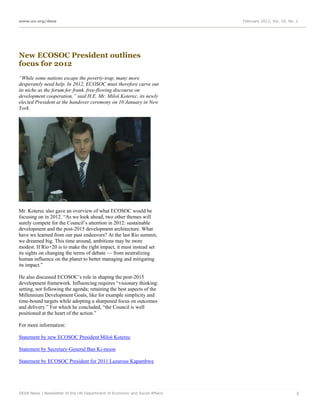
UN DESA’s Statistics Division plays a vital role in collecting and   building a global statistical system that the world relies on.”
analyzing data from around the world. Leading this work is
Professor Paul Cheung, known worldwide for his contributions to      Thanks to the work of the Statistics Division, important data is
the development of official statistics. “Statistics are crucial to   being collected helping the world to make informed decisions.
economic and social development,” he says in an interview for        What do you see as the main challenges in the work gathering
DESA News.                                                           and analyzing data from around the world?
                                                                     “Indeed, an informed policy debate should be supported and
                                                                     facilitated by timely, consistent and relevant data at all levels.
                                                                     For the international users of data, an important quality
                                                                     dimension has to be added: data have to be comparable across
                                                                     countries. This is achieved by the United Nations Statistical
                                                                     Commission who has the unique mandate to set international
                                                                     statistical standards and methodologies in the various statistical
                                                                     fields. Based on the international standards, countries from all
                                                                     over the world can then produce and submit reliable and
                                                                     comparable data to the United Nations Statistics Division. Just
                                                                     imagine if there was no common standard in the compilation of
                                                                     ‘national income’ or ‘Gross Domestic Product (GDP)’. We
                                                                     would have all kinds of economic data with no common
                                                                     assessment platform.

                                                                     Since 1946, the United Nations Statistics Division has collected
                                                                     billions of data records from all around the globe. In this context,
www.un.org/desa                                                                                                  February 2012, Vol. 16, No. 2


I want to pay tribute to the professional community of official              the capital, making the Statistical Commission a truly global
statisticians around the globe. This community has worked                    forum on official statistics. It has been said before that ‘Official
steadfastly in the past six decades in building a global statistical         Statistics’ is an area where the United Nations truly works well.
system that the world relies on. “Service, Professionalism and               The normative work of the Commission over the past 65 years is
Integrity” were the key themes of our first World Statistics Day             an important example of how the United Nations Member States
celebrated on 20 October 2010 (twenty-ten-twenty-ten) in which               can effectively act in unison, especially at times where the
over 140 countries participated with high-level events, involving            ability of the international community to act together in other
some heads of states and government. We are proud to be part of              areas is sometimes limited.
this global statistical community and the very existence of this
global professional statistical family, which transcends political,          As mentioned before the core business of the United Nations
economic and cultural differences among countries and works                  Statistical Commission is to adopt international methodological
hand-in-hand to build common standards and databases, is perhaps             standards and guidelines in virtually every area of statistics. This
our biggest achievement of all.”                                             year the Commission has again a busy programme with over 30
                                                                             technical reports to look at. In particular, the Commission will
What do you think is the most important contribution of statistics           look at the proposals for a new Framework on the Development
in promoting global development?                                             of Environmental Statistics and for the System of Environmental
“In his address on the occasion of the first World Statistics Day,           and Economic Accounting, which are highly relevant in the
the Secretary-General observed that ‘Statistics permeate modern              context of the Rio+20 Summit. This Commission session will
life. They are the basis for many governmental, business and                 also review the lessons learnt from the 2010 census round, where
community decisions.’                                                        as of 1 January 2012, 180 countries and areas have conducted a
                                                                             census, enumerating 87 per cent of the world population.
Statistics are crucial to economic and social development. They              Censuses have helped countries collect enormous amounts of
serve as reference points in public debates and contribute to the            demographic and social data. Moreover, the Commission will
progress of our nations. They are indispensable to academic                  address the issue of how coordination in statistics within the UN
research and the development of businesses and the civil society.            System can be improved further. Finally, given its
Statistics ultimately serve everyone in society.                             overwhelming success, it is also expected that the Commission
                                                                             will approve a five-year cycle for the celebration of World
A good example of the contribution of statistics in global                   Statistics Day.”
development relates to the Millennium Development Goals. When
the MDGs were established after the adoption of the Millennium               There will be a high-level forum on “Measuring the
Declaration, specific goals and targets were established and                 Unmeasurable: Challenging the Limits of Official Statistics” on
statistical monitoring was urgently required to assess the pace with         27 February. Can you highlight some examples of the
which the world is progressing towards the MDGS. The member                  “unmeasurable” and how your division tries to tackle these
states and international agencies have worked very hard and very             challenges?
closely together to develop and harmonize their statistical tools in         “In order to remain relevant in a rapidly changing world, the
order to provide the data for the monitoring. We are happy to                statistical community has to continuously examine and push its
report that, as a result of this joint effort, we are able to produce a      own boundaries. Phenomena, which are not easily measurable
yearly assessment of the MDG progress. We are now working                    today, may become important tomorrow, so we have to be
towards the final assessment of the MDGs when it reaches the                 prepared. In the past years it has become customary to explore
target year of 2015.                                                         ‘cutting edge’ issues in the format of a ‘high level forum’, which
                                                                             allows brainstorming and free-flowing exchange. In these
It is clear that without solid information we cannot measure where           discussions, we have to balance the desire to explore new ideas
we are and what needs to be done, with respect to the MDGs or in             which may require new measurement tools and the need to
other domains. If the world cannot get the right numbers, it cannot          preserve the credibility and reputation of official statistics.
come out with the right solutions. This is why we are committed to
participate actively in the discussion on the post-2015 development          This year’s event will focus on issues such as the measurement
agenda, in order to advise policy decision makers on which targets           of happiness, well-being and ecosystem services and other
are actually measurable and for which indicators data can reliably           difficult concepts. These are complicated topics with no clear
be produced.”                                                                measurement yardsticks. How to take the complex interaction
                                                                             between the environment and the economy into account and how
What do you hope the 43rd Session of the Statistical Commission              to capture the level of well being in a country, which may
will accomplish this year?                                                   include a high degree of subjectivity, will be discussed among
“The 43rd session of the Statistical Commission will be held from            the chief statisticians of the world.”
28 February to 2 March 2012. We are again looking forward to
strong participation from member states. As in past years, we                Last year, the Statistics Division arranged many seminars and
expect about 140 countries to be represented by their experts from           workshops around the world focusing on a variety of issues


DESA News | Newsletter of the UN Department of Economic and Social Affairs                                                                   2
www.un.org/desa                                                                                                 February 2012, Vol. 16, No. 2


including statistics on the MDGs, energy, environment and on                 facing the geospatial information community before they are
population and housing censuses. Can you describe this type of               being formally addressed by the inter-governmental
work?                                                                        Committee.”
“Capacity building is a fundamental pillar of the work of our
Division. In 2011 alone, more than 2600 official statisticians               For more information: http://unstats.un.org/unsd/default.htm
around the world participated in one of our events (conferences,
expert groups, workshops and fellowship programmes).                         Bio of Professor Paul Cheung:
Specifically, over 35 training workshops and seminars were                   http://unstats.un.org/unsd/newsletter/unsd_director.htm
organized in the developing countries to assist the countries to gain
the requisite knowledge. In this effort we always work closely with
member states and with our partners in the international statistical
agencies. To give an example of such cooperation, we launched in
2011 the China International Statistical Training Center which
                                                                             Making strides towards extreme
operates in collaboration with ‘UN Statistics’. Through this center,         poverty eradication
we have organized 8 international training activities. More are
being planned.                                                               As the global economy remains fragile at the outset of 2012, the
                                                                             need to eradicate extreme poverty is clearer than ever. UN
Through our training activities, we are able to understand the needs         DESA renews its commitment to work with stakeholders to
of national statistical systems and how they are performing. This            promote sustained, inclusive and equitable growth, and reach
will allow us to direct more resources to those countries in need. In        the Millennium Development Goal of halving extreme poverty by
2011, the global statistical community has adopted a Busan Plan of           2015.
Action on Statistical development at the High Level Forum on Aid
Effectiveness. In this document, we highlighted the areas that
would require greater injection of resources as we bring the global
statistical system forward. We will be working with the
development partners in implementing this Plan of Action. The UN
Statistical Commission will discuss this Plan of Action in its
forthcoming session.”

A new UN Committee of Experts on Global Geospatial
Information Management (GGIM) was created and inaugurated
last year. Are there any special events or projects that the
Committee will focus on during the coming year?
“The resolution of the UN Economic and Social Council to create
a UN Committee of Experts on Global Geospatial Information
Management came at a time when few new bodies are being
created. This bold decision reflects the Council’s conviction that
promoting greater and wider use of geospatial information globally
is essential, especially in a context where we are discussing how to         Heralded at the 1995 World Summit for Social Development,
manage the resources on this planet responsibly.                             poverty eradication continues to be an overarching objective of
                                                                             national and international development efforts. There has been
The Committee, which will hold its second formal meeting in                  significant success in recent decades in reducing poverty. In
August 2012 in New York, is in the process for formulating its               1980, for example, 1.5 billion people were living below $1 per
priorities and deciding on its work plan for the coming years. The           day; by 2005, the number had been cut to 850 million.
setting of global standards on geospatial information, the evolution
of an ethical statement on the production and use of geospatial              However, there is still more that needs to be done. Rising
information, and the pooling of information and platforms are                income inequality, worsening environmental conditions, poor
clearly the main issues to be tackled. As new technologies have              job creation and weakening social stability all pose serious and
deeply transformed the availability and accessibility of geospatial          ongoing challenges to accelerating poverty eradication.
information and its potential uses, we are working very closely on           Moreover, the financial crisis, volatility of energy and food
these issues with our partners in the international organizations and        prices, climate change and loss of biodiversity has increased
in the private sector. A second high-level forum on GGIM, to be              vulnerabilities and inequalities, particularly in developing
hosted by the Government of Qatar in Doha, is now planned for 4-             countries.
6 February 2013. This Forum will bring together all the
stakeholders in an inclusive fashion to discuss the priority issues


DESA News | Newsletter of the UN Department of Economic and Social Affairs                                                                  3
www.un.org/desa                                                                                                   February 2012, Vol. 16, No. 2


Adopting action-oriented recommendations                                     Rio+20, in June 2012. In the closing remarks of the 2nd
To help address these critical issues and kick-off the development           Intersessional Meeting for Rio+20 in December 2011, DESA’s
efforts slated for this year, the Commission for Social                      Under-Secretary-General and the Secretary-General for Rio+20,
Development (CSD) will convene in New York for its fiftieth                  Mr. Sha Zukang, encouraged, “Our minimalist ambition at
session from 1-10 February, focusing on the priority theme                   Rio+20 should be to eradicate poverty. This should be a
“Poverty Eradication”. The Session will be chaired by His                    centerpiece of our efforts to achieve sustainable development.
Excellency Mr. Jorge Valero (Bolivarian Republic of Venezuela)               To start with, this will require that stability and inclusive growth
with expected participation of 46 Member States and accredited               be restored to the global economy.”
NGOs.
                                                                             For more information:
Taking into account poverty’s interrelationship with social                  http://social.un.org/index/CommissionforSocialDevelopment/Se
integration, full employment and decent work for all, the session            ssions/2012.aspx
will complete the biennial cycle by adopting action-oriented policy
recommendations on poverty eradication. The work of the
Commission is expected to focus on the structural barriers to
poverty eradication. This focus is seen as an effective means of
ensuring that proposed policy guidance emphasizes inclusive
growth, building up the asset base of the poor, and opening up
social and economic opportunities for large numbers of people, in
particular the most disadvantaged.

Creating jobs, reducing inequalities and providing social
protection
In concert with ECOSOC resolution 2010/10, the promotion of
macroeconomic and social policies which focus on creating jobs,
reducing inequalities and providing social protection, are expected
to be part of the discussion. Investing in agriculture, rural
development and climate change adaptation and mitigation
measures are also elements expected to be addressed in the
discussions.

The scale of investment required to eradicate poverty exceeds the
capacity of Governments, civil society organizations or the private
sector working alone. Discussions in the session are also expected
to address truly transformational public-private partnerships in the
formulation and implementation of development programmes.

Addressing youth poverty and unemployment
In conjunction with the primary theme, the Commission will also
discuss the emergent issue on youth poverty and unemployment,
underscored at the World Summit for Social Development and the
Twenty-fourth Special Session of the General Assembly. Young
people between 15 and 24 years of age, particularly from
developing countries, are not only disproportionately affected by
unemployment over the past decades, but are now faced with an
onslaught of difficulties as a consequence of the financial crisis.
Unemployment among disadvantaged youth, young women,
indigenous peoples and ethnic minorities perpetuates a vicious
cycle of poverty and social exclusion.

Poverty eradication is the centerpiece of sustainable
development
The anti-poverty objectives and expected outcomes of the fiftieth
session will make a significant contribution towards this year’s
events dedicated to the International Year of Sustainable Energy,
culminating in the UN Conference on Sustainable Development,


DESA News | Newsletter of the UN Department of Economic and Social Affairs                                                                    4
www.un.org/desa                                                              February 2012, Vol. 16, No. 2


New ECOSOC President outlines
focus for 2012
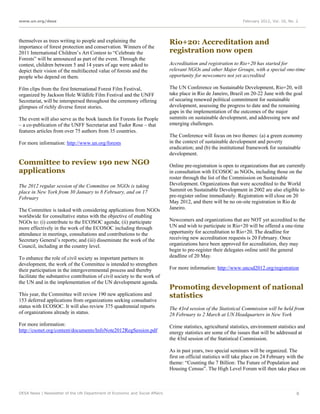
“While some nations escape the poverty-trap, many more
desperately need help. In 2012, ECOSOC must therefore carve out
its niche as the forum for frank, free-flowing discourse on
development cooperation,” said H.E. Mr. Miloš Koterec, its newly
elected President at the handover ceremony on 10 January in New
York.


Mr. Koterec also gave an overview of what ECOSOC would be
focusing on in 2012. “As we look ahead, two other themes will
surely compete for the Council’s attention in 2012: sustainable
development and the post-2015 development architecture. What
have we learned from our past endeavors? At the last Rio summit,
we dreamed big. This time around, ambitions may be more
modest. If Rio+20 is to make the right impact, it must instead set
its sights on changing the terms of debate — from neutralizing
human influence on the planet to better managing and mitigating
its impact.”

He also discussed ECOSOC’s role in shaping the post-2015
development framework. Influencing requires “visionary thinking:
setting, not following the agenda; retaining the best aspects of the
Millennium Development Goals, like for example simplicity and
time-bound targets while adopting a sharpened focus on outcomes
and delivery.” For which he concluded, “the Council is well
positioned at the heart of the action.”

For more information:

Statement by new ECOSOC President Miloš Koterec

Statement by Secretary-General Ban Ki-moon

Statement by ECOSOC President for 2011 Lazarous Kapambwe


DESA News | Newsletter of the UN Department of Economic and Social Affairs                               5
www.un.org/desa                                                                                                   February 2012, Vol. 16, No. 2


                                                                             (c) Recognizing that universal access to basic social protection is
                                                                             necessary to break the cycle of poverty and reduce inequality,
                                                                             Governments may wish to consider implementing national social
Global Dialogue on                                                           protection floors consistent with national priorities and
                                                                             circumstances;
Development
                                                                             (d) In strengthening social protection systems, and reducing
                                                                             intergenerational transmission of poverty, Governments should
Advancing social development                                                 actively pursue family-focused social transfer programmes,
worldwide                                                                    paying particular attention to women, children, the elderly,
                                                                             persons with disabilities and indigenous groups;
The fiftieth session of the Commission for Social Development
                                                                             (e) Countries must address society-wide patterns of social and
(CSD) will convene at UN Headquarters in New York on 1-10
                                                                             economic inequality and discrimination by ensuring that poor
February                                                                     women and men have access to land, credit and other productive
                                                                             resources, housing, fair inheritance rights and justice, and that all
CSD is a functional commission of the Economic and Social                    segments of society participate in decision-making processes;
Council (ECOSOC) of the UN. Since the convening of the World
Summit for Social Development in Copenhagen in 1995, it has                  (f) The international community should support national efforts to
been the key UN body in charge of the follow-up and                          eradicate poverty by creating a favorable international
implementation of the Copenhagen Declaration and Programme of                environment and
Action.                                                                      ensuring greater coherence among macroeconomic, trade and
                                                                             social policies.
During its fiftieth session, the Commission will focus on the
priority theme of poverty eradication and, in this context, will also        See the report of the Secretary-General on poverty eradication
review relevant plans and programmes of action pertaining to the             prepared for CSD
situation of youth, families, older persons, and persons with
disabilities.

It will also feature a special event on Financing for Social                 For further information and access to relevant documentation:
Development, scheduled for Friday, 3 February at 3:00 pm. The                http://social.un.org/index/CommissionforSocialDevelopment/Se
event will highlight effective strategies for mobilizing resources           ssions/2012.aspx
for social development and feature panellists from various regions
in the world.

Also under discussion during the current session is the emerging
issue related to youth poverty and unemployment. An expert panel
                                                                             Highlighting role of cooperatives
has been put in place for 6 February to facilitate an interactive            for communities and youth
dialogue on this topic.
                                                                             The International Year of Cooperatives (IYC) Secretariat will
The Commission for Social Development (CSD) will consider
the following recommendations with respect to its primary
                                                                             host two interactive dialogues at UN Headquarters in New York
theme in accordance with the report of the Secretary-General                 on 1 and 2 February
on poverty eradication prepared for CSD:
                                                                             The International Year of Cooperatives 2012 is underway, and
(a) The creation of full and productive employment and decent work           UN DESA’s Division for Social Policy and Development
for                                                                          (DSDP) has continued to play its role in the promotion and
all should be at the centre of policies. Countries are encouraged to         advocacy of cooperatives as agents for development.
implement the principles and objectives of the Global Jobs Pact
[…];                                                                         During the month of February, the Division will be using its
                                                                             social media outlets and blog to discuss the contributions of
(b) Countries with large agricultural sectors should focus on raising        cooperatives to social justice. In addition, the Secretariat is
smallholder agricultural productivity and output quality in a                working with cooperative partners to host two interactive
sustainable                                                                  dialogues during the Commission for Social Development which
manner. Increasing the productivity of smallholder farmers requires          opens on 1 February at UN Headquarters in New York.
enabling their access to fertilizers, high-yielding seeds,
infrastructure, information and markets[…];
                                                                             On 1 February at 1:15 pm, Cynthia Giagnocavo, research Fellow
                                                                             at the University of Almería, Spain will present the case of


DESA News | Newsletter of the UN Department of Economic and Social Affairs                                                                    6
www.un.org/desa                                                                                                  February 2012, Vol. 16, No. 2


Almería’s development, and show the pivotal role of cooperatives             approaches to development cooperation and new aid modalities
in developing the social, economic and political well-being of the           are making an increasingly important contribution to
community.                                                                   development.

On 2 February at 1:15 pm, cooperative practitioners from the                 Against this backdrop, ECOSOC will hold this one-day DCF
United States will discuss the advantages of cooperatives as an              preparatory meeting in New York on “The Changing Context of
outlet for youth to secure sustainable livelihoods through                   Development: What does it mean for Cooperation and Global
entrepreneurship.                                                            Parntership”. The meeting will examine key trends in
                                                                             development cooperation that have emerged in recent years and
For more information: http://social.un.org/coopsyear                         how they are shaping the future of development cooperation and
                                                                             the institutional arrangements that govern this cooperation.

                                                                             Two panel discussions will focus on “New dynamics of
Spotlight on economic and financial                                          development cooperation: challenges and opportunities” and
situation                                                                    “Gearing development cooperation towards sustainable
                                                                             development” respectively.
ECOSOC will arrange an “Interactive dialogue on the current
                                                                             For more information:
economic and financial situation” in New York on 7 February
                                                                             http://www.un.org/en/ecosoc/dcf/index.shtml
The global economy faces acute uncertainties and volatility, which
present serious concerns to all United Nations Member States. In
order to better understand the structural or systemic challenges of          Forests for people comes full circle
the current global economic and financial order and to explore
adequate policy responses, the United Nations Economic and                   The International Year of Forests, 2011 closing ceremony is
Social Council (ECOSOC) will convene a special session to brief              being held on 9 February at the United Nations headquarters in
Member States on the current economic and financial situation.               New York
Distinguished economists are invited to provide their views and
perspectives on the present situation and future prospects.
                                                                                                      The event is being organized by the
Chaired by ECOSOC President Miloš Koterec and moderated by                                            United Nations Forum on Forests
the Director of UN DESA’s Divison for Development Policy and                                          Secretariat, which was designated as the
Analysis, Rob Vos, the event will feature keynote speakers                                            focal point for the International Year by
including 2010 Nobel Laureate in Economics, Professor Peter                                           the General Assembly.
Diamond. Discussions will focus on three main areas: 1)
Unresolved structural fragilities in the global economy; 2)                                          Throughout 2011, over a thousand
Alternative developmental models for sustained growth and job                                        events have been organized worldwide
creation; and 3) Global policy coordination to mitigate                                              by member states, international and
uncertainties and reduce risk.                                                                       regional organizations and forest-related
                                                                                                     stakeholders to amplify the year’s
For more information: http://www.un.org/en/ecosoc/                           theme of “Forests for People”. The closing ceremony marks the
                                                                             culmination of these events and stories.

Reflecting on a rapidly changing                                             The event will feature an awards ceremony for the five regional
                                                                             winners of the 2011 Forest Heroes Award, recognizing their
development context                                                          innovative approach and dedication in nurturing and sustaining
                                                                             our world’s forests. Regional winners were selected from the
ECOSOC will hold a Development Cooperation Forum (DCF)                       fifteen short-listed finalists announced at Forest Day 5 alongside
preparatory meeting on “The Changing Context of Development:                 the UNFCC COP17 in Durban.
What does it mean for Cooperation and Global Parntership” on 9
February                                                                     Children and youth have an important role in raising awareness
                                                                             and in inspiring public action for forests, and their contributions
The global partnership for development agreed at major UN                    will be showcased at the closing ceremony. First place winners
conferences, remains the centrepiece of international development            of the Universal Postal Union’s international letter-writing
cooperation. However, in a changing development landscape, the               competition, Charlée Gittens from Barbados and Wang Sa from
global partnership itself is evolving as new players with new                China, will present their compositions in which they imagine


DESA News | Newsletter of the UN Department of Economic and Social Affairs                                                                   7
www.un.org/desa                                                                                                   February 2012, Vol. 16, No. 2


themselves as trees writing to people and explaining the                     Rio+20: Accreditation and
importance of forest protection and conservation. Winners of the
2011 International Children’s Art Contest to “Celebrate the                  registration now open
Forests” will be announced as part of the event. Through the
contest, children between 5 and 14 years of age were asked to                Accreditation and registration to Rio+20 has started for
depict their vision of the multifaceted value of forests and the             relevant NGOs and other Major Groups, with a special one-time
people who depend on them.                                                   opportunity for newcomers not yet accredited

Film clips from the first International Forest Film Festival,                The UN Conference on Sustainable Development, Rio+20, will
organized by Jackson Hole Wildlife Film Festival and the UNFF                take place in Rio de Janeiro, Brazil on 20-22 June with the goal
Secretariat, will be interspersed throughout the ceremony offering           of securing renewed political commitment for sustainable
glimpses of richly diverse forest stories.                                   development, assessing the progress to date and the remaining
                                                                             gaps in the implementation of the outcomes of the major
The event will also serve as the book launch for Forests for People          summits on sustainable development, and addressing new and
– a co-publication of the UNFF Secretariat and Tudor Rose – that             emerging challenges.
features articles from over 75 authors from 35 countries.
                                                                             The Conference will focus on two themes: (a) a green economy
For more information: http://www.un.org/forests                              in the context of sustainable development and poverty
                                                                             eradication; and (b) the institutional framework for sustainable
                                                                             development.
Committee to review 190 new NGO                                              Online pre-registration is open to organizations that are currently
applications                                                                 in consultation with ECOSOC as NGOs, including those on the
                                                                             roster through the list of the Commission on Sustainable
The 2012 regular session of the Committee on NGOs is taking                  Development. Organizations that were accredited to the World
place in New York from 30 January to 8 February, and on 17                   Summit on Sustainable Development in 2002 are also eligible to
February                                                                     pre-register online immediately. Registration will close on 20
                                                                             May 2012, and there will be no on-site registration in Rio de
The Committee is tasked with considering applications from NGOs              Janeiro.
worldwide for consultative status with the objective of enabling
NGOs to: (i) contribute to the ECOSOC agenda; (ii) participate               Newcomers and organizations that are NOT yet accredited to the
more effectively in the work of the ECOSOC including through                 UN and wish to participate in Rio+20 will be offered a one-time
attendance in meetings, consultations and contributions to the               opportunity for accreditation to Rio+20. The deadline for
Secretary General’s reports; and (iii) disseminate the work of the           receiving new accreditation requests is 20 February. Once
Council, including at the country level.                                     organizations have been approved for accreditation, they may
                                                                             begin to pre-register their delegates online until the general
To enhance the role of civil society as important partners in                deadline of 20 May.
development, the work of the Committee is intended to strengthen
their participation in the intergovernmental process and thereby             For more information: http://www.uncsd2012.org/registration
facilitate the substantive contribution of civil society to the work of
the UN and in the implementation of the UN development agenda.
                                                                             Promoting development of national
This year, the Committee will review 190 new applications and                statistics
153 deferred applications from organizations seeking consultative
status with ECOSOC. It will also review 375 quadrennial reports              The 43rd session of the Statistical Commission will be held from
of organizations already in status.                                          28 February to 2 March at UN Headquarters in New York
For more information:                                                        Crime statistics, agricultural statistics, environment statistics and
http://csonet.org/content/documents/InfoNote2012RegSession.pdf               energy statistics are some of the issues that will be addressed at
                                                                             the 43rd session of the Statistical Commission.

                                                                             As in past years, two special seminars will be organized. The
                                                                             first on official statistics will take place on 24 February with the
                                                                             theme: “Counting the 7 Billion: The Future of Population and
                                                                             Housing Census”. The High Level Forum will then take place on


DESA News | Newsletter of the UN Department of Economic and Social Affairs                                                                    8
www.un.org/desa                                                                                                  February 2012, Vol. 16, No. 2


27 February focusing on “Measuring the Unmeasurable:                         of the World Social Forum; and in São Paulo, Brazil in early
Challenging the Limits of Official Statistics”.                              February.

The United Nations Statistical Commission, established in 1947, is           Check the official Rio+20 website for more details, including the
the apex entity of the global statistical system. It brings together         zero draft: http://www.uncsd2012.org/rio20/index.html
the Chief Statisticians from member states from around the world.
It is the highest decision making body for international statistical         Towards a new sustainable development architecture
activities especially the setting of statistical standards, the              DCF Advisory Group Special Event was arranged on 29
development of concepts and methods and their implementation at              November 2011, in conjunction with the Fourth High Level
the national and international level.                                        Forum on Aid Effectiveness in Busan, Republic of South Korea

The Statistical Commission oversees the work of the United                   With the theme “Rethinking Development: Towards a New
Nations Statistics Division (UNSD), and is a Functional                      Sustainable Development Architecture”, the meeting was held in
Commission of the UN Economic and Social Council.                            preparation for the 2012 DCF and as a contribution to the UN
                                                                             Conference on Sustainable Development (Rio+20).
For more information:
http://unstats.un.org/unsd/statcom/commission_43rd_session.htm               The event discussed the implications of the sustainable
                                                                             development agenda for international development cooperation.
                                                                             It also debated the challenges and opportunities for donor and
Discussing the Rio+20 zero draft                                             programme countries arising from the concept of sustainable
                                                                             development.
An informal meeting in preparation of the UN Conference on
Sustainable Development took place at UN Headquarters on 25-27               Also, the potential impact of this concept on aid quantity, quality
January, with initial discussions on the zero draft of the Rio+20            and allocation between countries, regions and sectors was
outcome document                                                             discussed. Participants came from developing and developed
                                                                             countries, civil society, parliamentarians, and international
Over the course of three days, Member States devoted three                   organizations.
sessions to general discussions and comments, and three sessions
to informal negotiations on Sections I and II of the zero draft,             For more information:
covering the Preamble/Stage setting and the objective of Renewing            http://www.un.org/en/ecosoc/newfunct/advisory.shtml
Political Commitment to sustainable development. Member States
were invited to submit their written comments on those Sections by
23 January.                                                                  Wide range of social issues
                                                                             addressed
Likewise, Member States will have until 17 February to submit
comments on Sections III, IV and V of the zero draft in time for             Member States call for inclusive and equitable development, the
further negotiations in March. More than 200 delegates from Major            eradication of poverty and respect for human rights during the
Groups were registered to participate in the meeting, and many               working session of the Third Committee that took place from 3
held stakeholder consultations on the margins of the informal                October to 23 November 2011
negotiating sessions between Governments.
                                                                             When the Committee met to discuss social development during
The High-level Panel on Global Sustainability further briefed                the 66th Session of the General Assembly, many issues were put
delegates on 25 January and UN DESA hosted a series of                       on the table for consideration. The general discussion focused on
workshops for Major Groups and other stakeholders on the                     the role of volunteerism, youth, persons with disabilities, older
margins of Member State consultations and negotiations on the                persons, families, social integration, cooperatives, and MDGs
zero draft of the Rio+20 outcome document.                                   among others.
Developed for trainers, the workshops were designed to enhance               Seven resolutions were approved and one decision taken with
awareness of the themes of sustainable development and build                 the over arching message that economic and financial recovery
stakeholder capacity to engage with the intergovernmental process.           and sustainable socio-economic development could not be
Each workshop was built on previous training and provided                    achieved without the full and effective participation of all groups
participants with the most current information relevant to the               in society, the elimination of systemic inequality through respect
Rio+20 process. Workshops will be hosted in New York in                      for human rights and the promotion of inclusive social and
January, March and April; in Porto Alegre, Brazil on the margins             economic policies.


DESA News | Newsletter of the UN Department of Economic and Social Affairs                                                                   9
www.un.org/desa                                                              February 2012, Vol. 16, No. 2


The draft resolution on policies and programmes involving youth
emphasized the importance of addressing youth employment issues
and ensuring the full and effective participation of young people in
society as a means not only for supporting youth development, but
for effecting sustainable development as a whole.

Similarly, the resolutions on ageing, family, persons with
disabilities and follow-up to the World Summit for Social
development, emphasised the centrality of the equality of
individuals and social inclusion to strong social and economic
development at all levels.

Special emphasis was placed on the inclusion of persons with
disabilities in social development efforts, and the General
Assembly has called for a High level Meeting on the Realization of
the Millennium Development Goals and other internationally
agreed development goals for person with disabilities. This event
will take place on 23 September 2013, before the start of the
general debate of the 68th session.

For more information:
http://social.un.org/index/Home/GAThirdCommittee.aspx


DESA News | Newsletter of the UN Department of Economic and Social Affairs                               10
www.un.org/desa                                                                                                 February 2012, Vol. 16, No. 2


                                                                                broadening of the range of stakeholders involved in the
Trends and Analysis                                                              work of ECOSOC, as well as increasing the awareness
                                                                                 amongst the philanthropic community on the progress made
IGF convenes meetings in Geneva                                                  and the challenges faced in achieving MDG 1;
                                                                                promoting concrete initiatives by the philanthropic
                                                                                 community and initiating new partnerships that would
The Internet Governance Forum (IGF) will hold Open                               accelerate progress in reaching the targets in MDG 1; and
Consultations and a meeting of the Multi-Stakeholder Advisory                   expanding multi-stakeholder engagement in the
Group (MAG) on 14-16 February in Geneva, Switzerland                             international community’s efforts to help advance the
                                                                                 achievement of the two priority areas mentioned above.
The meetings will take stock of the Nairobi 2011 IGF annual
meeting and focus on discussions on the programme and schedule               The event has a number of co-convenors dedicated to
of the 2012 IGF meeting that will take place in Baku, Azerbaijan.            strengthening multi-stakeholder partnerships in support of youth
Mr. Elmir Velizadeh, Deputy Minister of the Ministry of                      employment, including UNDP, UNICEF, UNFPA, the World
Communication and Information Technologies of the Republic of                Bank, Committee Encouraging Corporate Philanthropy, Clinton
Azerbaijan will chair the meetings.                                          Global Initiative, Princes Youth Business International, United
                                                                             Nations Foundation, Young Americas Business Trust, Youth
The MAG currently consists of 55 Members from governments,                   Employment Network and the Youth Employment Summit.
the private sector and civil society, intergovernmental
organisations including representatives from the academic and                For more information:
technical communities.                                                       http://www.un.org/en/ecosoc/philanthropy1/index.shtml
For more information: http://www.intgovforum.org

                                                                             UN DESA and UNU-IIST to
Employing youth for a better future                                          collaborate on e-Government

ECOSOC will hold an exclusive event, “Breaking new ground:                   After a presentation made by Mr. Tomasz Janowski, Senior
Partnerships for more and better jobs for young people” on 27                Research Fellow, UN University – International Institute for
February from 3:00 to 6:00 pm at UN Headquarters in New York                 Software Technology (UNU-IIST) on 10 January, the Division
                                                                             for Public Administration and Development Management
This event will serve as part of the preparatory process for the             (DPADM) and UNU-IIST agreed to collaborate
ECOSOC’s 2012 Annual Ministerial Review (AMR) on
“Promoting productive capacity, employment and decent work to                The presentation introduced the concept of electronic
eradicate poverty in the context of inclusive, sustainable and               governance for sustainable development (EGOV4SD) by
equitable economic growth at all levels for achieving the MDGs”,             systematically mapping the sustainable development (SD) and
and is organized by UN DESA and the International Labour                     EGOV domains and presenting examples from around the world
Organization (ILO), in collaboration with the UN Office for                  on how EGOV is being applied to advance the social,
Partnerships (UNOP) and the United Nations Global Compact.                   environmental, economic and transitional SD goals.

The event will seek to strengthen the partnership between                    It explained the fundamental challenges in realizing the
governments, the private sector and the philanthropic community              transition from EGOV to EGOV4SD and proposed an
in advancing youth employment and decent work. The themes to                 international research, development, monitoring and education
be explored will include issues affecting policy setting for youth           agenda to address such challenges. Haiyan Qian thanked Mr.
employment and innovations for promoting youth employment.                   Janowski for the presentation, noting that the research findings
The outcome of the deliberations will be submitted to the Member             of UNU-IIST were in line with DPADM’s work in the context of
States during the ECOSOC High-level session in July 2012.                    the UN E-Government Survey 2012: E-Government for
                                                                             Sustainable Development.
The programme will consist of an opening plenary, to be followed
by two leadership dialogues on “Innovations in promoting youth               The collaboration will focus on: (i) strengthening the UN E-
employment” and “Creating a new dynamic for youth at work”.                  Government Survey platform by providing DPADM data as a
The key outcomes of the exclusive event will be to provide                   benchmarking resource specifically for policy makers to carry
increased focus to issues central to the achievement of promoting            out selection which will enable the creation of an instrument to
youth employment and decent work for all, through:                           reflect local conditions and priorities, and (ii) developing a


DESA News | Newsletter of the UN Department of Economic and Social Affairs                                                                  11
www.un.org/desa                                                                                                  February 2012, Vol. 16, No. 2


Global Chief Information Officer (CIO) curriculum for the UN                 This and other findings were presented as DESA’s flagship
Member States based on the joint research of UNDESA/DPADM                    report the World Economic Situation and Prospects (WESP)
and UNU-IIST.                                                                2012 was launched on 17 January in Addis Ababa, Beijing,
                                                                             Geneva, Johannesburg, Moscow and New Delhi. Regional
For more information:                                                        releases of the report followed in Mexico City on 18 January;
http://www.unpan.org/DPADM/Home/BilateralMeetingsInHouseS                    and in Bangkok and Beirut on 19 January.
eminars/tabid/1511/language/en-US/Default.aspx
                                                                             There are multiple concerns, but policymakers throughout
                                                                             Europe and the United States are mainly fixated on reducing
                                                                             large fiscal deficits and public debt. The concerns are serious,
Recognizing important role of                                                and the ongoing sovereign debt crises in the euro zone have been
e-government                                                                 a source of continuous turmoil in financial markets.

On 22 December 2011, the General Assembly adopted the                        Unfortunately, the present policy responses are highly
resolution A/66/437 on “Information and communications                       inadequate. Most developed economies have phased out
technologies for development”, recognizing the important roles of            stimulus measures and shifted to fiscal austerity. With
e-government, enhanced cooperation on public policy issues                   unemployment rates remaining very high and financial sectors
pertaining to the Internet and the Internet Governance Forum                 still clogged, this approach is pulling the plug on the recovery by
(IGF).                                                                       exacerbating the lack of aggregate demand, further weakening
                                                                             the prospects for jobs recovery and economic development in the
The resolution mentions UN DESA particularly, taking note of the             longer run.
department’s work in the area of enhanced cooperation on public
policy issues pertaining to the Internet (for the first time for this        Bleaker medium and long-term growth prospects would also
particular topic). The resolution also acknowledges the positive             undermine the financial sustainability of health and pension
trends of e-government among others (also for the first time) and            systems over time, thus achieving precisely the opposite of what
stresses the important role of governments in the design of their            policymakers are aiming at through fiscal austerity.
national public policies and in the provision of public services
responsive to national needs and priorities through, inter alia, the         Is there an alternative? Yes. As shown in the WESP 2012, many
effective use of information and communication technologies.                 developed countries have more than adequate fiscal space for
                                                                             additional stimulus. If well targeted at job creation and green
In addition, the resolution appreciates the role of the United               growth and adequately coordinated internationally, additional
Nations Group on the Information Society (UNGIS) as an inter-                stimulus could quicken the recovery and put the global economy
agency mechanism designed to coordinate the United Nations                   on a more balanced and sustainable growth path.
implementation of the outcomes of the World Summit on the
Information Society (WSIS). DESA is currently a Vice–Chair of                In conjunction with the launch of the report, the Development
UNGIS, together with ITU as Chair and UNESCO as another                      Policy and Analysis Division (DPAD) of UN DESA organized a
Vice-Chair.                                                                  live chat on Facebook to answer questions concerning the risks
                                                                             and opportunities for the world economy, as well as the scope
For more information:                                                        for policy action in the year ahead. The online chat was led by
http://unpan1.un.org/intradoc/groups/public/documents/un/unpan0              Rob Vos, Director of DPAD, and included economists from the
48016.pdf                                                                    Global Economic Monitoring Unit.

                                                                             For more information:
                                                                             http://www.un.org/en/development/desa/policy/wesp/index.shtm
WESP 2012: Worldwide launch and                                              l
live Facebook chat
                                                                             Targeting violence against
The World Economic Situation and Prospects (WESP) 2012 was
launched on multi-city locations on 17, 18 and 19 January,
                                                                             indigenous women and girls
followed by a live Facebook chat on 20 January on the world
economy                                                                      A three-day expert group meeting was held in New York on the
                                                                             theme “Combating violence against indigenous women and
The world economy is teetering on the brink of another major                 girls: article 22 of the United Nations Declaration on the Rights
downturn. As in 2008, economic woes in the major developed                   of Indigenous Peoples” on 18-20 January
economies are weakening economic prospects around the world.


DESA News | Newsletter of the UN Department of Economic and Social Affairs                                                                   12
www.un.org/desa                                                              February 2012, Vol. 16, No. 2


Throughout the world, indigenous women and girls are exposed to
diverse forms of physical, psychological and sexual violence. This
is a significant obstacle to the capacity and potential of indigenous
women and girls to exercise their rights to participate fully in
society.

This pressing reality, as detailed in the concept note prepared by
the UN Permanent Forum on Indigenous issues, laid the foundation
for the three-day international expert group meeting.

Ms. Daniela Bas, Director of DESA’s Division for Social Policy
and Development (DSPD) highlighted the fact that this meeting is
the “first one addressing the issue of violence against indigenous
women and girls.” Ms. Bas went on to say that it “shows that the
Permanent Forum is addressing an issue that is critical and
resonates with governments, indigenous peoples and the UN
system.”

The Expert Group meeting was attended by experts on indigenous
issues, members of the Permanent Forum on Indigenous Issues,
participants from the UN system, Member States, indigenous
peoples and other organizations.

The attendees discussed the way in which the UNPFII should
address its mandate under Article 22 of the Declaration which
ensures that indigenous women and children enjoy the full
protection and guarantees against all forms of violence and
discrimination.

During the meeting, the “experts will analyze the human rights
enshrined within international standards and policies and will
indicate how these respond to the challenge of advancing the rights
of indigenous women and girls”, said Ms. Chandra Roy-Henriksen,
Chief, Secretariat of the UN Permanent Forum on Indigenous
Issues.

The results of the meeting will be reported to the Permanent Forum
at its eleventh session in May, to the General Assembly at its sixty-
seventh session starting in September and to the Commission on
the Status of Women at its fifty-sixth session beginning on 27
February.

For more information: http://bit.ly/IndigenousIssues


DESA News | Newsletter of the UN Department of Economic and Social Affairs                               13
www.un.org/desa                                                                                                 February 2012, Vol. 16, No. 2


                                                                             statements via video. DPADM’s IRA, Mr. Jonas Rabinovitch
Capacity Development                                                         added to Haiyan Qian’s statements by elaborating on how e-
                                                                             government (including e-infrastructure, e-literacy and e-service)
                                                                             and e-governance (comprised of e-information, e-consultation
Capacity building sessions at UNEP                                           and e-decision-making) can compliment each other.
Governing Council
                                                                             For more information:
In an ongoing series of workshops hosted by UN DESA, training                http://www.unpan.org/DPADM/Home/tabid/420/language/en-
will be offered to Major groups on the margins of the 12th                   US/Default.aspx
Governing Council Session of UNEP in Nairobi on 20-22
February

Developed for trainers, the workshops are designed to enhance
awareness of the themes of sustainable development and build
stakeholder capacity to engage with the intergovernmental process.
Each workshop builds on previous training and provides
participants with the most current information relevant to the
Rio+20 process.

Workshops will be hosted in New York in January, March and
April; in Porto Alegre, Brazil on the margins of the World Social
Forum; and in São Paulo, Brazil in early February.

For more information:
http://hqweb.unep.org/Documents.multilingual/Default.asp?Docu
mentID=75


Underscoring the importance of
e-government
Haiyan Qian, the Director of UN DESA’s Division for Public
Administration Development Management (DPADM) delivered a
keynote address at the “International Seminar on e-Government
Best Practices” taking place in Bogotá, Colombia on 13-14
December, 2011

Ms. Qian highlighted the importance of e-government as the
foundation for holistic government operations as opposed to a
technological add-on, in government relations with citizens and the
private sector.

She further pointed out objective indicators and benchmarking
policy tools to engage citizens as co-producers in decision-making
processes leading to enhanced public service delivery. Noting
Colombia’s leading position in Latin America and 9th position
worldwide in relation to having an online presence and based on
the most recent UN e-Government Survey, she acknowledged the
high level leadership of the government in harmonizing national
development policies with their e-Government Programme.

Columbia’s Ministry of Information and Communication
Technology organized the seminar and heard Haiyan Qian’s


DESA News | Newsletter of the UN Department of Economic and Social Affairs                                                                  14
www.un.org/desa                                                                                                  February 2012, Vol. 16, No. 2


                                                                             gross product (WGP) is 2.6 per cent for 2012 and 3.2 per cent
                                                                             for 2013, which is below the pre-crisis pace of global growth.
Publications and Websites
                                                                             The report is also available now in Kindle, Nook and iBook.
Technical reports
World Youth Report 2011: youth perspectives on the                           Statistical compilations
pursuit of decent work in changing times
                                                                             2010 Revision of the World Population Prospects
                       The World Youth Report, to be officially              Volume II: Demographic Profiles
                       released on 6 February, explores the
                       transition of young people from schools and           This report presents the highlights of the results of the 2010
                       training institutions into the labour market,         Revision of the official United Nations population estimates and
                       a phase marking a critical period in the life         projections prepared by the Population Division of the
                       cycle. The current employment scenario for            Department of Economic and Social Affairs of the United
young people, worsened by the global economic crisis, poses an               Nations Secretariat. The 2010 Revision constitutes the twenty
urgent challenge with long-term implications for both young                  second round of the global population estimates and projections
people and society as a whole.                                               produced by the Population Division since 1951.

For the first time, the 2011 edition of the World Youth Report is            The 2010 Revision breaks new ground in the production of
largely dedicated to the voices of young people themselves. The              population projections. It is the first standard Revision to include
report is based on contributions from youth and representatives of           projections up to 2100 for all countries and areas of the world.
youth-led organizations to an e-discussion, in which they shared             Previous Revisions presented country projections only for the
their own views, experiences and recommendations on preparing                period ending in 2050. In order to extend the projection period to
for, entering, and remaining active in the workforce. The 2011               2100, a new method for the projection of fertility had to be
edition of the report is also the first to be produced in an interactive     developed. The method used in the 2010 Revision is based on
website that allows readers to engage on youth employment issues:            the advances made in projecting fertility since the 2000
how young people are experiencing and addressing employment                  Revision, advances that have been combined with a probabilistic
challenges; where and how young people are succeeding in                     approach to yield the future paths of fertility used in producing
employment; how youth employment interacts with social                       the medium variant of the 2010 Revision. The standard output of
practices; and what Governments can do to help prepare young                 the 2010 Revision does not, however, include fully probabilistic
people in the transition from education to work.                             projections. The standard output of the 2010 Revision includes
                                                                             only the usual projection variants and scenarios included in other
The report aims to shed light on such complex issues, while                  Revisions of World Population Prospects.
bringing the voices of young people themselves into fora where
youth issues are discussed and acted upon. The report will be                To download:
officially launched at a side event to the Commission on Social              http://esa.un.org/unpd/wpp/Documentation/pdf/WPP2010_Volu
Development on 6 February, at 1:15-2:30 pm in Conference Room                me-II_Demographic-Profiles.pdf
7 (NLB), bringing together main contributors to the report as well
as representatives from Member States, the UN system, youth and              In addition, the Population Division has now made available the
the private sector.                                                          country profiles in individual pdf-files for each country and all
                                                                             major regions of the world. The profiles can be found at:
For more information: http://social.un.org/index/Youth.aspx                  http://esa.un.org/unpd/wpp/Multiple-Figures/multiple-
                                                                             figures_1.htm

World Economic Situation and Prospects 2012
                                                                             Rural Population, Development and the
                      The report, released on 17 January, is now             Environment 2011
                      available online. According to this flagship           The wall chart, prepared by UN DESA’s Population Division,
                      publication, the global economic growth                presents the latest data available for 15 indicators of rural
                      started to decelerate on a broad front in mid-         population, land use, development and environment. It provides
                      2011 and is estimated to have averaged 2.8 per         estimates at the national, regional and world levels.
                      cent over the last year. This slowdown is
                      expected to continue into 2012 and 2013. The           For more information: http://bit.ly/RuralPopWallChart
                      UN baseline forecast for the growth of world


DESA News | Newsletter of the UN Department of Economic and Social Affairs                                                                   15
www.un.org/desa                                                                                                   February 2012, Vol. 16, No. 2


Urban Population, Development and the                                        For more information:
Environment 2011                                                             http://www.uncsd2012.org/rio20/index.php?menu=40
The wall chart, prepared by UN DESA’s Population Division,
presents the latest data available for 15 indicators of urban
population, living conditions in urban settlements and economic              DESA NGO News
development. It provides estimates at the national, regional and
world levels.                                                                The latest issue highlights the 2012 regular session of the
                                                                             Committee on NGOs and its work ahead as well as the five-year
For more information: http://bit.ly/UrbanPopWallChart                        action plan outlined by the Secretary-General to build “the future
                                                                             we want”. It also spotlights the fact that 740 ECOSOC NGOs
                                                                             need to submit their quadrennial reports in 2012, and that an
                                                                             updated list of all 3,536 organizations in consultative status was
Monthly Bulletin of Statistics and MBS Online                                published late last year.

                                                                             The online monthly newsletter is issued monthly in electronic
                   The Monthly Bulletin of Statistics presents               format to suscribers in English, French and Spanish, providing
                   current economic and social statistics for more           the most up-to-date information on news and upcoming events
                   than 200 countries and territories of the world.          of interest to civil society at UN headquarters in New York,
                   It contains over 50 tables of monthly and/or              Geneva and elsewhere.
                   bimonthly, quarterly and annual data on a
                   variety of subjects illustrating important                For more information: http://csonet.org/?menu=124
                   economic trends and developments, including
                   population, prices, employment and earnings,
energy, manufacturing, transport, construction, international                Discussion papers
merchandise trade and finance.
                                                                             Monthly Briefing on the World Economic
Vol. LXV – No. 12, December 2011
                                                                             Situation and Prospects
This month, the following tables, which are featured in the MBS              The December issue of the Monthly Briefing of the World
on a quarterly or bimonthly basis, are presented along with the              Economic Situation and Prospects, No. 38, highlights the grim
regular recurrent monthly tables: Retail price indices relating to           prospects for the world economy in the coming year. The most
living expenditures of UN officials; Earnings in non-agricultural            pressing challenge is the continued jobs crisis and the declining
activities, by sex; Fuel imports of developed economies; External            prospects for economic growth, especially among developed
trade conversion factors; Manufactured goods exports; and                    countries. In this context, fiscal austerity measures can only
Selected series of world statistics..                                        hamper recovery by curtailing aggregate demand in the short run
                                                                             with negative effects on employment and incomes.
For more information: http://unstats.un.org/unsd/mbs
                                                                             For more information:
                                                                             http://www.un.org/en/development/desa/policy/wesp/wesp_mb/
                                                                             wesp_mb38.pdf
Outreach material
Rio+20: Making it Happen
                                                                             Working papers
Demographic trends are placing more pressure on water-stressed
                                                                             Beyond market access: Trade-related measures
regions than ever before. With the global population expected to
                                                                             for the least developed countries. What strategy?
increase by up to 50 per-cent in the next fifty years, sustainable
management of water resources will present a significant                     This paper assesses the effectiveness of non-tariff special and
development challenge. In Volume 2, Issue 24, the Rio+20:                    differential treatment (SDT) offered exclusively to the least
Making it Happen newsletter focuses on water, one of the seven               developed countries by WTO agreements. SDTs are inefficient
priority issues that the Conference will address. Also in this issue,        in at least four aspects. First, they are not easily accessed as they
news from the 66th session of the UN General Assembly as it                  require a certain level of institutional capacity. Second, when
wraps up the work of its main session, important deadlines for               accessible they either need to be complemented by other policy
Rio+20, and the updated negotiating schedule for the UNCSD.                  interventions or are offset by measures taken elsewhere. Third,
                                                                             some do not respond to LDC needs. Fourth, many are too


DESA News | Newsletter of the UN Department of Economic and Social Affairs                                                                    16
www.un.org/desa                                                              February 2012, Vol. 16, No. 2


vaguely defined to provide concrete benefits. Effectiveness can be
enhanced by increased LDC ownership and improved policy
coherence by trading and development partners.

To download:
http://www.un.org/en/development/desa/papers/2011/outline.shtml
#109


Policy briefs
Can a protracted slowdown be avoided?

UN DESA Policy Brief No. 36, by Oliver Paddison and Rob Vos
of DPAD/DESA, states that the world economy is teetering on the
brink of another major downturn. As in 2008, economic woes in
the major developed economies are weakening economic prospects
around the world. There are multiple concerns, but policymakers
throughout Europe and the United States are mainly fixated on
reducing large fiscal deficits and public debt. The concerns are
serious, and the ongoing sovereign debt crises in the euro zone
have been a source of continuous turmoil in financial markets.

For more information:
http://dev.un.org/en/development/desa/policy/publications/policy_
briefs/policybrief36.pdf


DESA News | Newsletter of the UN Department of Economic and Social Affairs                               17
www.un.org/desa                                                                                                 February 2012, Vol. 16, No. 2


Comings and Goings
Goings                                                                       Comings

                    Ms. Hania Zlotnik, Director of UN DESA’s                                     Ms. Wenyan Yang has been appointed Chief
                    Population Division, retired at the end of                                   of the Social Perspective on Development
                    January 2012. A Mexican national, Ms. Zlotnik                                Branch (SPDB) within the Division for Social
                    studied mathematics at the Universidad                                       Policy and Development (DSPD). Previously
                    Nacional Autónoma de México (UNAM) and                                       Senior Social Affairs Officer in DSPD, she is
                    holds a Ph.D. in Statistics and Demography                                   the Division’s focal point supporting the
                    from Princeton University.                                                   work of the Commission for Social
                                                                                                 Development and plays a key role in the
During her long career at the Division, which she joined in 1982,            preparation of the publication Report on World Social Situation.
Ms. Zlotnik has worked in all the major areas of population
research, serving as Chief of the Mortality and Migration Section            Previously, as Acting Chief of the Coordination and Outreach
(1993-1999), chief of the Population Estimates and Projections               Unit, she was responsible for implementing overall outreach and
Section (1999-2003), and Assistant Director (2003-2005),                     communications activities in the UN Division for the
overseeing work on fertility, mortality and migration. She was               Advancement of Women and for facilitation of the Non-
appointed Director of the Population Division in February 2005;              Governmental Organization participation in the UN
she is the tenth person to serve as Director of the Division and the         intergovernmental processes, especially the Commission on the
first woman to do so.                                                        Status of Women and the Committee on the Elimination of All
                                                                             Forms of Violence against Women.
Ms. Zlotnik has edited or written numerous reports published by
the United Nations, including studies of international migration             She started her UN career as an Economic Affairs Officer in the
and development, trends in international migration, female                   Macroeconomic and Development Policy Analysis Division,
migration, population distribution and migration, population                 contributing to the major departmental publication World
estimates and projections, population ageing, and levels and trends          Economic and Social Survey.
of urbanization. Her work has contributed in particular to provide
better estimates of international migration worldwide and to the             Ms. Wenyan is a graduate of Peking University in China and
improvement of statistics on international migration.                        New York University in the US.

Ms. Zlotnik has been an active member of several professional
associations, serving as Board Member for the Population
Association of America from 2001 to 2003 and as Vice-President
of the International Union for the Study of Population (IUSSP)
from 2001 to 2005.


The following staff members also retired in January:

Muhammad A Chaudhry, Chief of Branch, Division for
Sustainable Development

Teguest Debebe Haile, Programming Assistant, Statistics Division


DESA News | Newsletter of the UN Department of Economic and Social Affairs                                                                  18
www.un.org/desa                                                                                               February 2012, Vol. 16, No. 2


Calendar                                                                     IGF holds Open Consultations and Multi-Stakeholder
                                                                             Advisory Group (MAG) meeting
February                                                                     Geneva, 14-16 February
                                                                             http://www.intgovforum.org/cms/
2012 regular session of the Committee on NGOs                                Training offered to Major groups on the margins of the 12th
New York, 30 January - 8 February, and on 17 February                        Governing Council Session of UNEP
http://csonet.org/content/documents/InfoNote2012RegSession.pdf               Nairobi, 20-22 February
                                                                             http://hqweb.unep.org/Documents.multilingual/Default.asp?Doc
Commission for Social Development                                            umentID=75
50th Session, New York, 1-10 February
http://social.un.org/index/CommissionforSocialDevelopment/Sessi              ECOSOC exclusive event “Breaking new ground:
ons/2012.aspx                                                                Partnerships for more and better jobs for young people"
                                                                             New York, 27 February
Interactive dialogues on the International Year of                           http://www.un.org/en/ecosoc/philanthropy1/index.shtml
Cooperatives 2012
New York, 1-2 February                                                       Statistical Commission
http://social.un.org/coopsyear                                               43rd session, New York, 28 February – 2 March
                                                                             http://unstats.un.org/unsd/statcom/commission.htm
Interactive dialogue on the current economic and financial
situation
New York, 7 February
http://www.un.org/en/ecosoc/

Development Cooperation Forum (DCF) preparatory meeting                      March
on “The Changing Context of Development: What does it
mean for Cooperation and Global Parntership”                                 3rd Intersessional Meeting of the UN Conference on
New York, 9 February                                                         Sustainable Development
http://www.un.org/en/ecosoc/dcf/index.shtml                                  New York, 26-27 March
                                                                             http://www.uncsd2012.org/rio20/index.php?page=view&type=1
International Year of Forests 2011 closing ceremony                          3&nr=46&menu=25
New York, 9 February
http://www.un.org/forests


          DESA News is an insider's look at the United Nations in the area of economic and
         social development policy. The newsletter is produced by the Communications and
        Information Management Service of the United Nations Department of Economic and
           Social Affairs in collaboration with DESA Divisions. DESA News is issued every
                               month. Please click here to send inquiries.


DESA News | Newsletter of the UN Department of Economic and Social Affairs                                                                19

DESA News, February 2012

  • 1.
    UN Home |UN DESA Home February 2012, Vol. 16, No. 2 IN THIS ISSUE >>> Facing the challenge of measuring the unmeasurable| Making strides towards extreme poverty eradication| New ECOSOC President outlines focus for 2012 Global dialogue on development: Highlighting role of cooperatives for communities and youth, Reflecting on a rapidly changing development context, Rio+20: Accreditation and registration now open Trends and analysis: IGF convenes meetings in Geneva, Employing youth for a better future Capacity development: Capacity building sessions at UNEP Governing Council Publications and websites | Comings and goings | Calendar Professor Cheung, recognized for his pioneering research in the Feature Articles and fields of manpower, population and social planning, highlights the importance of statistics and their contributions to global Webcast development. “It is clear that without solid information we cannot measure where we are and what needs to be done, with respect to the MDGs or in other domains. If the world cannot get Facing the challenge of measuring the right numbers, it cannot come out with the right solutions,” the unmeasurable he says. Professor Cheung moreover gives praise to official statisticians around the globe, spotlighting the fact that this community “has worked steadfastly in the past six decades in UN DESA’s Statistics Division plays a vital role in collecting and building a global statistical system that the world relies on.” analyzing data from around the world. Leading this work is Professor Paul Cheung, known worldwide for his contributions to Thanks to the work of the Statistics Division, important data is the development of official statistics. “Statistics are crucial to being collected helping the world to make informed decisions. economic and social development,” he says in an interview for What do you see as the main challenges in the work gathering DESA News. and analyzing data from around the world? “Indeed, an informed policy debate should be supported and facilitated by timely, consistent and relevant data at all levels. For the international users of data, an important quality dimension has to be added: data have to be comparable across countries. This is achieved by the United Nations Statistical Commission who has the unique mandate to set international statistical standards and methodologies in the various statistical fields. Based on the international standards, countries from all over the world can then produce and submit reliable and comparable data to the United Nations Statistics Division. Just imagine if there was no common standard in the compilation of ‘national income’ or ‘Gross Domestic Product (GDP)’. We would have all kinds of economic data with no common assessment platform. Since 1946, the United Nations Statistics Division has collected billions of data records from all around the globe. In this context,
  • 2.
    www.un.org/desa February 2012, Vol. 16, No. 2 I want to pay tribute to the professional community of official the capital, making the Statistical Commission a truly global statisticians around the globe. This community has worked forum on official statistics. It has been said before that ‘Official steadfastly in the past six decades in building a global statistical Statistics’ is an area where the United Nations truly works well. system that the world relies on. “Service, Professionalism and The normative work of the Commission over the past 65 years is Integrity” were the key themes of our first World Statistics Day an important example of how the United Nations Member States celebrated on 20 October 2010 (twenty-ten-twenty-ten) in which can effectively act in unison, especially at times where the over 140 countries participated with high-level events, involving ability of the international community to act together in other some heads of states and government. We are proud to be part of areas is sometimes limited. this global statistical community and the very existence of this global professional statistical family, which transcends political, As mentioned before the core business of the United Nations economic and cultural differences among countries and works Statistical Commission is to adopt international methodological hand-in-hand to build common standards and databases, is perhaps standards and guidelines in virtually every area of statistics. This our biggest achievement of all.” year the Commission has again a busy programme with over 30 technical reports to look at. In particular, the Commission will What do you think is the most important contribution of statistics look at the proposals for a new Framework on the Development in promoting global development? of Environmental Statistics and for the System of Environmental “In his address on the occasion of the first World Statistics Day, and Economic Accounting, which are highly relevant in the the Secretary-General observed that ‘Statistics permeate modern context of the Rio+20 Summit. This Commission session will life. They are the basis for many governmental, business and also review the lessons learnt from the 2010 census round, where community decisions.’ as of 1 January 2012, 180 countries and areas have conducted a census, enumerating 87 per cent of the world population. Statistics are crucial to economic and social development. They Censuses have helped countries collect enormous amounts of serve as reference points in public debates and contribute to the demographic and social data. Moreover, the Commission will progress of our nations. They are indispensable to academic address the issue of how coordination in statistics within the UN research and the development of businesses and the civil society. System can be improved further. Finally, given its Statistics ultimately serve everyone in society. overwhelming success, it is also expected that the Commission will approve a five-year cycle for the celebration of World A good example of the contribution of statistics in global Statistics Day.” development relates to the Millennium Development Goals. When the MDGs were established after the adoption of the Millennium There will be a high-level forum on “Measuring the Declaration, specific goals and targets were established and Unmeasurable: Challenging the Limits of Official Statistics” on statistical monitoring was urgently required to assess the pace with 27 February. Can you highlight some examples of the which the world is progressing towards the MDGS. The member “unmeasurable” and how your division tries to tackle these states and international agencies have worked very hard and very challenges? closely together to develop and harmonize their statistical tools in “In order to remain relevant in a rapidly changing world, the order to provide the data for the monitoring. We are happy to statistical community has to continuously examine and push its report that, as a result of this joint effort, we are able to produce a own boundaries. Phenomena, which are not easily measurable yearly assessment of the MDG progress. We are now working today, may become important tomorrow, so we have to be towards the final assessment of the MDGs when it reaches the prepared. In the past years it has become customary to explore target year of 2015. ‘cutting edge’ issues in the format of a ‘high level forum’, which allows brainstorming and free-flowing exchange. In these It is clear that without solid information we cannot measure where discussions, we have to balance the desire to explore new ideas we are and what needs to be done, with respect to the MDGs or in which may require new measurement tools and the need to other domains. If the world cannot get the right numbers, it cannot preserve the credibility and reputation of official statistics. come out with the right solutions. This is why we are committed to participate actively in the discussion on the post-2015 development This year’s event will focus on issues such as the measurement agenda, in order to advise policy decision makers on which targets of happiness, well-being and ecosystem services and other are actually measurable and for which indicators data can reliably difficult concepts. These are complicated topics with no clear be produced.” measurement yardsticks. How to take the complex interaction between the environment and the economy into account and how What do you hope the 43rd Session of the Statistical Commission to capture the level of well being in a country, which may will accomplish this year? include a high degree of subjectivity, will be discussed among “The 43rd session of the Statistical Commission will be held from the chief statisticians of the world.” 28 February to 2 March 2012. We are again looking forward to strong participation from member states. As in past years, we Last year, the Statistics Division arranged many seminars and expect about 140 countries to be represented by their experts from workshops around the world focusing on a variety of issues DESA News | Newsletter of the UN Department of Economic and Social Affairs 2
  • 3.
    www.un.org/desa February 2012, Vol. 16, No. 2 including statistics on the MDGs, energy, environment and on facing the geospatial information community before they are population and housing censuses. Can you describe this type of being formally addressed by the inter-governmental work? Committee.” “Capacity building is a fundamental pillar of the work of our Division. In 2011 alone, more than 2600 official statisticians For more information: http://unstats.un.org/unsd/default.htm around the world participated in one of our events (conferences, expert groups, workshops and fellowship programmes). Bio of Professor Paul Cheung: Specifically, over 35 training workshops and seminars were http://unstats.un.org/unsd/newsletter/unsd_director.htm organized in the developing countries to assist the countries to gain the requisite knowledge. In this effort we always work closely with member states and with our partners in the international statistical agencies. To give an example of such cooperation, we launched in 2011 the China International Statistical Training Center which Making strides towards extreme operates in collaboration with ‘UN Statistics’. Through this center, poverty eradication we have organized 8 international training activities. More are being planned. As the global economy remains fragile at the outset of 2012, the need to eradicate extreme poverty is clearer than ever. UN Through our training activities, we are able to understand the needs DESA renews its commitment to work with stakeholders to of national statistical systems and how they are performing. This promote sustained, inclusive and equitable growth, and reach will allow us to direct more resources to those countries in need. In the Millennium Development Goal of halving extreme poverty by 2011, the global statistical community has adopted a Busan Plan of 2015. Action on Statistical development at the High Level Forum on Aid Effectiveness. In this document, we highlighted the areas that would require greater injection of resources as we bring the global statistical system forward. We will be working with the development partners in implementing this Plan of Action. The UN Statistical Commission will discuss this Plan of Action in its forthcoming session.” A new UN Committee of Experts on Global Geospatial Information Management (GGIM) was created and inaugurated last year. Are there any special events or projects that the Committee will focus on during the coming year? “The resolution of the UN Economic and Social Council to create a UN Committee of Experts on Global Geospatial Information Management came at a time when few new bodies are being created. This bold decision reflects the Council’s conviction that promoting greater and wider use of geospatial information globally is essential, especially in a context where we are discussing how to Heralded at the 1995 World Summit for Social Development, manage the resources on this planet responsibly. poverty eradication continues to be an overarching objective of national and international development efforts. There has been The Committee, which will hold its second formal meeting in significant success in recent decades in reducing poverty. In August 2012 in New York, is in the process for formulating its 1980, for example, 1.5 billion people were living below $1 per priorities and deciding on its work plan for the coming years. The day; by 2005, the number had been cut to 850 million. setting of global standards on geospatial information, the evolution of an ethical statement on the production and use of geospatial However, there is still more that needs to be done. Rising information, and the pooling of information and platforms are income inequality, worsening environmental conditions, poor clearly the main issues to be tackled. As new technologies have job creation and weakening social stability all pose serious and deeply transformed the availability and accessibility of geospatial ongoing challenges to accelerating poverty eradication. information and its potential uses, we are working very closely on Moreover, the financial crisis, volatility of energy and food these issues with our partners in the international organizations and prices, climate change and loss of biodiversity has increased in the private sector. A second high-level forum on GGIM, to be vulnerabilities and inequalities, particularly in developing hosted by the Government of Qatar in Doha, is now planned for 4- countries. 6 February 2013. This Forum will bring together all the stakeholders in an inclusive fashion to discuss the priority issues DESA News | Newsletter of the UN Department of Economic and Social Affairs 3
  • 4.
    www.un.org/desa February 2012, Vol. 16, No. 2 Adopting action-oriented recommendations Rio+20, in June 2012. In the closing remarks of the 2nd To help address these critical issues and kick-off the development Intersessional Meeting for Rio+20 in December 2011, DESA’s efforts slated for this year, the Commission for Social Under-Secretary-General and the Secretary-General for Rio+20, Development (CSD) will convene in New York for its fiftieth Mr. Sha Zukang, encouraged, “Our minimalist ambition at session from 1-10 February, focusing on the priority theme Rio+20 should be to eradicate poverty. This should be a “Poverty Eradication”. The Session will be chaired by His centerpiece of our efforts to achieve sustainable development. Excellency Mr. Jorge Valero (Bolivarian Republic of Venezuela) To start with, this will require that stability and inclusive growth with expected participation of 46 Member States and accredited be restored to the global economy.” NGOs. For more information: Taking into account poverty’s interrelationship with social http://social.un.org/index/CommissionforSocialDevelopment/Se integration, full employment and decent work for all, the session ssions/2012.aspx will complete the biennial cycle by adopting action-oriented policy recommendations on poverty eradication. The work of the Commission is expected to focus on the structural barriers to poverty eradication. This focus is seen as an effective means of ensuring that proposed policy guidance emphasizes inclusive growth, building up the asset base of the poor, and opening up social and economic opportunities for large numbers of people, in particular the most disadvantaged. Creating jobs, reducing inequalities and providing social protection In concert with ECOSOC resolution 2010/10, the promotion of macroeconomic and social policies which focus on creating jobs, reducing inequalities and providing social protection, are expected to be part of the discussion. Investing in agriculture, rural development and climate change adaptation and mitigation measures are also elements expected to be addressed in the discussions. The scale of investment required to eradicate poverty exceeds the capacity of Governments, civil society organizations or the private sector working alone. Discussions in the session are also expected to address truly transformational public-private partnerships in the formulation and implementation of development programmes. Addressing youth poverty and unemployment In conjunction with the primary theme, the Commission will also discuss the emergent issue on youth poverty and unemployment, underscored at the World Summit for Social Development and the Twenty-fourth Special Session of the General Assembly. Young people between 15 and 24 years of age, particularly from developing countries, are not only disproportionately affected by unemployment over the past decades, but are now faced with an onslaught of difficulties as a consequence of the financial crisis. Unemployment among disadvantaged youth, young women, indigenous peoples and ethnic minorities perpetuates a vicious cycle of poverty and social exclusion. Poverty eradication is the centerpiece of sustainable development The anti-poverty objectives and expected outcomes of the fiftieth session will make a significant contribution towards this year’s events dedicated to the International Year of Sustainable Energy, culminating in the UN Conference on Sustainable Development, DESA News | Newsletter of the UN Department of Economic and Social Affairs 4
  • 5.
    www.un.org/desa February 2012, Vol. 16, No. 2 New ECOSOC President outlines focus for 2012 “While some nations escape the poverty-trap, many more desperately need help. In 2012, ECOSOC must therefore carve out its niche as the forum for frank, free-flowing discourse on development cooperation,” said H.E. Mr. Miloš Koterec, its newly elected President at the handover ceremony on 10 January in New York. Mr. Koterec also gave an overview of what ECOSOC would be focusing on in 2012. “As we look ahead, two other themes will surely compete for the Council’s attention in 2012: sustainable development and the post-2015 development architecture. What have we learned from our past endeavors? At the last Rio summit, we dreamed big. This time around, ambitions may be more modest. If Rio+20 is to make the right impact, it must instead set its sights on changing the terms of debate — from neutralizing human influence on the planet to better managing and mitigating its impact.” He also discussed ECOSOC’s role in shaping the post-2015 development framework. Influencing requires “visionary thinking: setting, not following the agenda; retaining the best aspects of the Millennium Development Goals, like for example simplicity and time-bound targets while adopting a sharpened focus on outcomes and delivery.” For which he concluded, “the Council is well positioned at the heart of the action.” For more information: Statement by new ECOSOC President Miloš Koterec Statement by Secretary-General Ban Ki-moon Statement by ECOSOC President for 2011 Lazarous Kapambwe DESA News | Newsletter of the UN Department of Economic and Social Affairs 5
  • 6.
    www.un.org/desa February 2012, Vol. 16, No. 2 (c) Recognizing that universal access to basic social protection is necessary to break the cycle of poverty and reduce inequality, Governments may wish to consider implementing national social Global Dialogue on protection floors consistent with national priorities and circumstances; Development (d) In strengthening social protection systems, and reducing intergenerational transmission of poverty, Governments should Advancing social development actively pursue family-focused social transfer programmes, worldwide paying particular attention to women, children, the elderly, persons with disabilities and indigenous groups; The fiftieth session of the Commission for Social Development (e) Countries must address society-wide patterns of social and (CSD) will convene at UN Headquarters in New York on 1-10 economic inequality and discrimination by ensuring that poor February women and men have access to land, credit and other productive resources, housing, fair inheritance rights and justice, and that all CSD is a functional commission of the Economic and Social segments of society participate in decision-making processes; Council (ECOSOC) of the UN. Since the convening of the World Summit for Social Development in Copenhagen in 1995, it has (f) The international community should support national efforts to been the key UN body in charge of the follow-up and eradicate poverty by creating a favorable international implementation of the Copenhagen Declaration and Programme of environment and Action. ensuring greater coherence among macroeconomic, trade and social policies. During its fiftieth session, the Commission will focus on the priority theme of poverty eradication and, in this context, will also See the report of the Secretary-General on poverty eradication review relevant plans and programmes of action pertaining to the prepared for CSD situation of youth, families, older persons, and persons with disabilities. It will also feature a special event on Financing for Social For further information and access to relevant documentation: Development, scheduled for Friday, 3 February at 3:00 pm. The http://social.un.org/index/CommissionforSocialDevelopment/Se event will highlight effective strategies for mobilizing resources ssions/2012.aspx for social development and feature panellists from various regions in the world. Also under discussion during the current session is the emerging issue related to youth poverty and unemployment. An expert panel Highlighting role of cooperatives has been put in place for 6 February to facilitate an interactive for communities and youth dialogue on this topic. The International Year of Cooperatives (IYC) Secretariat will The Commission for Social Development (CSD) will consider the following recommendations with respect to its primary host two interactive dialogues at UN Headquarters in New York theme in accordance with the report of the Secretary-General on 1 and 2 February on poverty eradication prepared for CSD: The International Year of Cooperatives 2012 is underway, and (a) The creation of full and productive employment and decent work UN DESA’s Division for Social Policy and Development for (DSDP) has continued to play its role in the promotion and all should be at the centre of policies. Countries are encouraged to advocacy of cooperatives as agents for development. implement the principles and objectives of the Global Jobs Pact […]; During the month of February, the Division will be using its social media outlets and blog to discuss the contributions of (b) Countries with large agricultural sectors should focus on raising cooperatives to social justice. In addition, the Secretariat is smallholder agricultural productivity and output quality in a working with cooperative partners to host two interactive sustainable dialogues during the Commission for Social Development which manner. Increasing the productivity of smallholder farmers requires opens on 1 February at UN Headquarters in New York. enabling their access to fertilizers, high-yielding seeds, infrastructure, information and markets[…]; On 1 February at 1:15 pm, Cynthia Giagnocavo, research Fellow at the University of Almería, Spain will present the case of DESA News | Newsletter of the UN Department of Economic and Social Affairs 6
  • 7.
    www.un.org/desa February 2012, Vol. 16, No. 2 Almería’s development, and show the pivotal role of cooperatives approaches to development cooperation and new aid modalities in developing the social, economic and political well-being of the are making an increasingly important contribution to community. development. On 2 February at 1:15 pm, cooperative practitioners from the Against this backdrop, ECOSOC will hold this one-day DCF United States will discuss the advantages of cooperatives as an preparatory meeting in New York on “The Changing Context of outlet for youth to secure sustainable livelihoods through Development: What does it mean for Cooperation and Global entrepreneurship. Parntership”. The meeting will examine key trends in development cooperation that have emerged in recent years and For more information: http://social.un.org/coopsyear how they are shaping the future of development cooperation and the institutional arrangements that govern this cooperation. Two panel discussions will focus on “New dynamics of Spotlight on economic and financial development cooperation: challenges and opportunities” and situation “Gearing development cooperation towards sustainable development” respectively. ECOSOC will arrange an “Interactive dialogue on the current For more information: economic and financial situation” in New York on 7 February http://www.un.org/en/ecosoc/dcf/index.shtml The global economy faces acute uncertainties and volatility, which present serious concerns to all United Nations Member States. In order to better understand the structural or systemic challenges of Forests for people comes full circle the current global economic and financial order and to explore adequate policy responses, the United Nations Economic and The International Year of Forests, 2011 closing ceremony is Social Council (ECOSOC) will convene a special session to brief being held on 9 February at the United Nations headquarters in Member States on the current economic and financial situation. New York Distinguished economists are invited to provide their views and perspectives on the present situation and future prospects. The event is being organized by the Chaired by ECOSOC President Miloš Koterec and moderated by United Nations Forum on Forests the Director of UN DESA’s Divison for Development Policy and Secretariat, which was designated as the Analysis, Rob Vos, the event will feature keynote speakers focal point for the International Year by including 2010 Nobel Laureate in Economics, Professor Peter the General Assembly. Diamond. Discussions will focus on three main areas: 1) Unresolved structural fragilities in the global economy; 2) Throughout 2011, over a thousand Alternative developmental models for sustained growth and job events have been organized worldwide creation; and 3) Global policy coordination to mitigate by member states, international and uncertainties and reduce risk. regional organizations and forest-related stakeholders to amplify the year’s For more information: http://www.un.org/en/ecosoc/ theme of “Forests for People”. The closing ceremony marks the culmination of these events and stories. Reflecting on a rapidly changing The event will feature an awards ceremony for the five regional winners of the 2011 Forest Heroes Award, recognizing their development context innovative approach and dedication in nurturing and sustaining our world’s forests. Regional winners were selected from the ECOSOC will hold a Development Cooperation Forum (DCF) fifteen short-listed finalists announced at Forest Day 5 alongside preparatory meeting on “The Changing Context of Development: the UNFCC COP17 in Durban. What does it mean for Cooperation and Global Parntership” on 9 February Children and youth have an important role in raising awareness and in inspiring public action for forests, and their contributions The global partnership for development agreed at major UN will be showcased at the closing ceremony. First place winners conferences, remains the centrepiece of international development of the Universal Postal Union’s international letter-writing cooperation. However, in a changing development landscape, the competition, Charlée Gittens from Barbados and Wang Sa from global partnership itself is evolving as new players with new China, will present their compositions in which they imagine DESA News | Newsletter of the UN Department of Economic and Social Affairs 7
  • 8.
    www.un.org/desa February 2012, Vol. 16, No. 2 themselves as trees writing to people and explaining the Rio+20: Accreditation and importance of forest protection and conservation. Winners of the 2011 International Children’s Art Contest to “Celebrate the registration now open Forests” will be announced as part of the event. Through the contest, children between 5 and 14 years of age were asked to Accreditation and registration to Rio+20 has started for depict their vision of the multifaceted value of forests and the relevant NGOs and other Major Groups, with a special one-time people who depend on them. opportunity for newcomers not yet accredited Film clips from the first International Forest Film Festival, The UN Conference on Sustainable Development, Rio+20, will organized by Jackson Hole Wildlife Film Festival and the UNFF take place in Rio de Janeiro, Brazil on 20-22 June with the goal Secretariat, will be interspersed throughout the ceremony offering of securing renewed political commitment for sustainable glimpses of richly diverse forest stories. development, assessing the progress to date and the remaining gaps in the implementation of the outcomes of the major The event will also serve as the book launch for Forests for People summits on sustainable development, and addressing new and – a co-publication of the UNFF Secretariat and Tudor Rose – that emerging challenges. features articles from over 75 authors from 35 countries. The Conference will focus on two themes: (a) a green economy For more information: http://www.un.org/forests in the context of sustainable development and poverty eradication; and (b) the institutional framework for sustainable development. Committee to review 190 new NGO Online pre-registration is open to organizations that are currently applications in consultation with ECOSOC as NGOs, including those on the roster through the list of the Commission on Sustainable The 2012 regular session of the Committee on NGOs is taking Development. Organizations that were accredited to the World place in New York from 30 January to 8 February, and on 17 Summit on Sustainable Development in 2002 are also eligible to February pre-register online immediately. Registration will close on 20 May 2012, and there will be no on-site registration in Rio de The Committee is tasked with considering applications from NGOs Janeiro. worldwide for consultative status with the objective of enabling NGOs to: (i) contribute to the ECOSOC agenda; (ii) participate Newcomers and organizations that are NOT yet accredited to the more effectively in the work of the ECOSOC including through UN and wish to participate in Rio+20 will be offered a one-time attendance in meetings, consultations and contributions to the opportunity for accreditation to Rio+20. The deadline for Secretary General’s reports; and (iii) disseminate the work of the receiving new accreditation requests is 20 February. Once Council, including at the country level. organizations have been approved for accreditation, they may begin to pre-register their delegates online until the general To enhance the role of civil society as important partners in deadline of 20 May. development, the work of the Committee is intended to strengthen their participation in the intergovernmental process and thereby For more information: http://www.uncsd2012.org/registration facilitate the substantive contribution of civil society to the work of the UN and in the implementation of the UN development agenda. Promoting development of national This year, the Committee will review 190 new applications and statistics 153 deferred applications from organizations seeking consultative status with ECOSOC. It will also review 375 quadrennial reports The 43rd session of the Statistical Commission will be held from of organizations already in status. 28 February to 2 March at UN Headquarters in New York For more information: Crime statistics, agricultural statistics, environment statistics and http://csonet.org/content/documents/InfoNote2012RegSession.pdf energy statistics are some of the issues that will be addressed at the 43rd session of the Statistical Commission. As in past years, two special seminars will be organized. The first on official statistics will take place on 24 February with the theme: “Counting the 7 Billion: The Future of Population and Housing Census”. The High Level Forum will then take place on DESA News | Newsletter of the UN Department of Economic and Social Affairs 8
  • 9.
    www.un.org/desa February 2012, Vol. 16, No. 2 27 February focusing on “Measuring the Unmeasurable: of the World Social Forum; and in São Paulo, Brazil in early Challenging the Limits of Official Statistics”. February. The United Nations Statistical Commission, established in 1947, is Check the official Rio+20 website for more details, including the the apex entity of the global statistical system. It brings together zero draft: http://www.uncsd2012.org/rio20/index.html the Chief Statisticians from member states from around the world. It is the highest decision making body for international statistical Towards a new sustainable development architecture activities especially the setting of statistical standards, the DCF Advisory Group Special Event was arranged on 29 development of concepts and methods and their implementation at November 2011, in conjunction with the Fourth High Level the national and international level. Forum on Aid Effectiveness in Busan, Republic of South Korea The Statistical Commission oversees the work of the United With the theme “Rethinking Development: Towards a New Nations Statistics Division (UNSD), and is a Functional Sustainable Development Architecture”, the meeting was held in Commission of the UN Economic and Social Council. preparation for the 2012 DCF and as a contribution to the UN Conference on Sustainable Development (Rio+20). For more information: http://unstats.un.org/unsd/statcom/commission_43rd_session.htm The event discussed the implications of the sustainable development agenda for international development cooperation. It also debated the challenges and opportunities for donor and Discussing the Rio+20 zero draft programme countries arising from the concept of sustainable development. An informal meeting in preparation of the UN Conference on Sustainable Development took place at UN Headquarters on 25-27 Also, the potential impact of this concept on aid quantity, quality January, with initial discussions on the zero draft of the Rio+20 and allocation between countries, regions and sectors was outcome document discussed. Participants came from developing and developed countries, civil society, parliamentarians, and international Over the course of three days, Member States devoted three organizations. sessions to general discussions and comments, and three sessions to informal negotiations on Sections I and II of the zero draft, For more information: covering the Preamble/Stage setting and the objective of Renewing http://www.un.org/en/ecosoc/newfunct/advisory.shtml Political Commitment to sustainable development. Member States were invited to submit their written comments on those Sections by 23 January. Wide range of social issues addressed Likewise, Member States will have until 17 February to submit comments on Sections III, IV and V of the zero draft in time for Member States call for inclusive and equitable development, the further negotiations in March. More than 200 delegates from Major eradication of poverty and respect for human rights during the Groups were registered to participate in the meeting, and many working session of the Third Committee that took place from 3 held stakeholder consultations on the margins of the informal October to 23 November 2011 negotiating sessions between Governments. When the Committee met to discuss social development during The High-level Panel on Global Sustainability further briefed the 66th Session of the General Assembly, many issues were put delegates on 25 January and UN DESA hosted a series of on the table for consideration. The general discussion focused on workshops for Major Groups and other stakeholders on the the role of volunteerism, youth, persons with disabilities, older margins of Member State consultations and negotiations on the persons, families, social integration, cooperatives, and MDGs zero draft of the Rio+20 outcome document. among others. Developed for trainers, the workshops were designed to enhance Seven resolutions were approved and one decision taken with awareness of the themes of sustainable development and build the over arching message that economic and financial recovery stakeholder capacity to engage with the intergovernmental process. and sustainable socio-economic development could not be Each workshop was built on previous training and provided achieved without the full and effective participation of all groups participants with the most current information relevant to the in society, the elimination of systemic inequality through respect Rio+20 process. Workshops will be hosted in New York in for human rights and the promotion of inclusive social and January, March and April; in Porto Alegre, Brazil on the margins economic policies. DESA News | Newsletter of the UN Department of Economic and Social Affairs 9
  • 10.
    www.un.org/desa February 2012, Vol. 16, No. 2 The draft resolution on policies and programmes involving youth emphasized the importance of addressing youth employment issues and ensuring the full and effective participation of young people in society as a means not only for supporting youth development, but for effecting sustainable development as a whole. Similarly, the resolutions on ageing, family, persons with disabilities and follow-up to the World Summit for Social development, emphasised the centrality of the equality of individuals and social inclusion to strong social and economic development at all levels. Special emphasis was placed on the inclusion of persons with disabilities in social development efforts, and the General Assembly has called for a High level Meeting on the Realization of the Millennium Development Goals and other internationally agreed development goals for person with disabilities. This event will take place on 23 September 2013, before the start of the general debate of the 68th session. For more information: http://social.un.org/index/Home/GAThirdCommittee.aspx DESA News | Newsletter of the UN Department of Economic and Social Affairs 10
  • 11.
    www.un.org/desa February 2012, Vol. 16, No. 2  broadening of the range of stakeholders involved in the Trends and Analysis work of ECOSOC, as well as increasing the awareness amongst the philanthropic community on the progress made IGF convenes meetings in Geneva and the challenges faced in achieving MDG 1;  promoting concrete initiatives by the philanthropic community and initiating new partnerships that would The Internet Governance Forum (IGF) will hold Open accelerate progress in reaching the targets in MDG 1; and Consultations and a meeting of the Multi-Stakeholder Advisory  expanding multi-stakeholder engagement in the Group (MAG) on 14-16 February in Geneva, Switzerland international community’s efforts to help advance the achievement of the two priority areas mentioned above. The meetings will take stock of the Nairobi 2011 IGF annual meeting and focus on discussions on the programme and schedule The event has a number of co-convenors dedicated to of the 2012 IGF meeting that will take place in Baku, Azerbaijan. strengthening multi-stakeholder partnerships in support of youth Mr. Elmir Velizadeh, Deputy Minister of the Ministry of employment, including UNDP, UNICEF, UNFPA, the World Communication and Information Technologies of the Republic of Bank, Committee Encouraging Corporate Philanthropy, Clinton Azerbaijan will chair the meetings. Global Initiative, Princes Youth Business International, United Nations Foundation, Young Americas Business Trust, Youth The MAG currently consists of 55 Members from governments, Employment Network and the Youth Employment Summit. the private sector and civil society, intergovernmental organisations including representatives from the academic and For more information: technical communities. http://www.un.org/en/ecosoc/philanthropy1/index.shtml For more information: http://www.intgovforum.org UN DESA and UNU-IIST to Employing youth for a better future collaborate on e-Government ECOSOC will hold an exclusive event, “Breaking new ground: After a presentation made by Mr. Tomasz Janowski, Senior Partnerships for more and better jobs for young people” on 27 Research Fellow, UN University – International Institute for February from 3:00 to 6:00 pm at UN Headquarters in New York Software Technology (UNU-IIST) on 10 January, the Division for Public Administration and Development Management This event will serve as part of the preparatory process for the (DPADM) and UNU-IIST agreed to collaborate ECOSOC’s 2012 Annual Ministerial Review (AMR) on “Promoting productive capacity, employment and decent work to The presentation introduced the concept of electronic eradicate poverty in the context of inclusive, sustainable and governance for sustainable development (EGOV4SD) by equitable economic growth at all levels for achieving the MDGs”, systematically mapping the sustainable development (SD) and and is organized by UN DESA and the International Labour EGOV domains and presenting examples from around the world Organization (ILO), in collaboration with the UN Office for on how EGOV is being applied to advance the social, Partnerships (UNOP) and the United Nations Global Compact. environmental, economic and transitional SD goals. The event will seek to strengthen the partnership between It explained the fundamental challenges in realizing the governments, the private sector and the philanthropic community transition from EGOV to EGOV4SD and proposed an in advancing youth employment and decent work. The themes to international research, development, monitoring and education be explored will include issues affecting policy setting for youth agenda to address such challenges. Haiyan Qian thanked Mr. employment and innovations for promoting youth employment. Janowski for the presentation, noting that the research findings The outcome of the deliberations will be submitted to the Member of UNU-IIST were in line with DPADM’s work in the context of States during the ECOSOC High-level session in July 2012. the UN E-Government Survey 2012: E-Government for Sustainable Development. The programme will consist of an opening plenary, to be followed by two leadership dialogues on “Innovations in promoting youth The collaboration will focus on: (i) strengthening the UN E- employment” and “Creating a new dynamic for youth at work”. Government Survey platform by providing DPADM data as a The key outcomes of the exclusive event will be to provide benchmarking resource specifically for policy makers to carry increased focus to issues central to the achievement of promoting out selection which will enable the creation of an instrument to youth employment and decent work for all, through: reflect local conditions and priorities, and (ii) developing a DESA News | Newsletter of the UN Department of Economic and Social Affairs 11
  • 12.
    www.un.org/desa February 2012, Vol. 16, No. 2 Global Chief Information Officer (CIO) curriculum for the UN This and other findings were presented as DESA’s flagship Member States based on the joint research of UNDESA/DPADM report the World Economic Situation and Prospects (WESP) and UNU-IIST. 2012 was launched on 17 January in Addis Ababa, Beijing, Geneva, Johannesburg, Moscow and New Delhi. Regional For more information: releases of the report followed in Mexico City on 18 January; http://www.unpan.org/DPADM/Home/BilateralMeetingsInHouseS and in Bangkok and Beirut on 19 January. eminars/tabid/1511/language/en-US/Default.aspx There are multiple concerns, but policymakers throughout Europe and the United States are mainly fixated on reducing large fiscal deficits and public debt. The concerns are serious, Recognizing important role of and the ongoing sovereign debt crises in the euro zone have been e-government a source of continuous turmoil in financial markets. On 22 December 2011, the General Assembly adopted the Unfortunately, the present policy responses are highly resolution A/66/437 on “Information and communications inadequate. Most developed economies have phased out technologies for development”, recognizing the important roles of stimulus measures and shifted to fiscal austerity. With e-government, enhanced cooperation on public policy issues unemployment rates remaining very high and financial sectors pertaining to the Internet and the Internet Governance Forum still clogged, this approach is pulling the plug on the recovery by (IGF). exacerbating the lack of aggregate demand, further weakening the prospects for jobs recovery and economic development in the The resolution mentions UN DESA particularly, taking note of the longer run. department’s work in the area of enhanced cooperation on public policy issues pertaining to the Internet (for the first time for this Bleaker medium and long-term growth prospects would also particular topic). The resolution also acknowledges the positive undermine the financial sustainability of health and pension trends of e-government among others (also for the first time) and systems over time, thus achieving precisely the opposite of what stresses the important role of governments in the design of their policymakers are aiming at through fiscal austerity. national public policies and in the provision of public services responsive to national needs and priorities through, inter alia, the Is there an alternative? Yes. As shown in the WESP 2012, many effective use of information and communication technologies. developed countries have more than adequate fiscal space for additional stimulus. If well targeted at job creation and green In addition, the resolution appreciates the role of the United growth and adequately coordinated internationally, additional Nations Group on the Information Society (UNGIS) as an inter- stimulus could quicken the recovery and put the global economy agency mechanism designed to coordinate the United Nations on a more balanced and sustainable growth path. implementation of the outcomes of the World Summit on the Information Society (WSIS). DESA is currently a Vice–Chair of In conjunction with the launch of the report, the Development UNGIS, together with ITU as Chair and UNESCO as another Policy and Analysis Division (DPAD) of UN DESA organized a Vice-Chair. live chat on Facebook to answer questions concerning the risks and opportunities for the world economy, as well as the scope For more information: for policy action in the year ahead. The online chat was led by http://unpan1.un.org/intradoc/groups/public/documents/un/unpan0 Rob Vos, Director of DPAD, and included economists from the 48016.pdf Global Economic Monitoring Unit. For more information: http://www.un.org/en/development/desa/policy/wesp/index.shtm WESP 2012: Worldwide launch and l live Facebook chat Targeting violence against The World Economic Situation and Prospects (WESP) 2012 was launched on multi-city locations on 17, 18 and 19 January, indigenous women and girls followed by a live Facebook chat on 20 January on the world economy A three-day expert group meeting was held in New York on the theme “Combating violence against indigenous women and The world economy is teetering on the brink of another major girls: article 22 of the United Nations Declaration on the Rights downturn. As in 2008, economic woes in the major developed of Indigenous Peoples” on 18-20 January economies are weakening economic prospects around the world. DESA News | Newsletter of the UN Department of Economic and Social Affairs 12
  • 13.
    www.un.org/desa February 2012, Vol. 16, No. 2 Throughout the world, indigenous women and girls are exposed to diverse forms of physical, psychological and sexual violence. This is a significant obstacle to the capacity and potential of indigenous women and girls to exercise their rights to participate fully in society. This pressing reality, as detailed in the concept note prepared by the UN Permanent Forum on Indigenous issues, laid the foundation for the three-day international expert group meeting. Ms. Daniela Bas, Director of DESA’s Division for Social Policy and Development (DSPD) highlighted the fact that this meeting is the “first one addressing the issue of violence against indigenous women and girls.” Ms. Bas went on to say that it “shows that the Permanent Forum is addressing an issue that is critical and resonates with governments, indigenous peoples and the UN system.” The Expert Group meeting was attended by experts on indigenous issues, members of the Permanent Forum on Indigenous Issues, participants from the UN system, Member States, indigenous peoples and other organizations. The attendees discussed the way in which the UNPFII should address its mandate under Article 22 of the Declaration which ensures that indigenous women and children enjoy the full protection and guarantees against all forms of violence and discrimination. During the meeting, the “experts will analyze the human rights enshrined within international standards and policies and will indicate how these respond to the challenge of advancing the rights of indigenous women and girls”, said Ms. Chandra Roy-Henriksen, Chief, Secretariat of the UN Permanent Forum on Indigenous Issues. The results of the meeting will be reported to the Permanent Forum at its eleventh session in May, to the General Assembly at its sixty- seventh session starting in September and to the Commission on the Status of Women at its fifty-sixth session beginning on 27 February. For more information: http://bit.ly/IndigenousIssues DESA News | Newsletter of the UN Department of Economic and Social Affairs 13
  • 14.
    www.un.org/desa February 2012, Vol. 16, No. 2 statements via video. DPADM’s IRA, Mr. Jonas Rabinovitch Capacity Development added to Haiyan Qian’s statements by elaborating on how e- government (including e-infrastructure, e-literacy and e-service) and e-governance (comprised of e-information, e-consultation Capacity building sessions at UNEP and e-decision-making) can compliment each other. Governing Council For more information: In an ongoing series of workshops hosted by UN DESA, training http://www.unpan.org/DPADM/Home/tabid/420/language/en- will be offered to Major groups on the margins of the 12th US/Default.aspx Governing Council Session of UNEP in Nairobi on 20-22 February Developed for trainers, the workshops are designed to enhance awareness of the themes of sustainable development and build stakeholder capacity to engage with the intergovernmental process. Each workshop builds on previous training and provides participants with the most current information relevant to the Rio+20 process. Workshops will be hosted in New York in January, March and April; in Porto Alegre, Brazil on the margins of the World Social Forum; and in São Paulo, Brazil in early February. For more information: http://hqweb.unep.org/Documents.multilingual/Default.asp?Docu mentID=75 Underscoring the importance of e-government Haiyan Qian, the Director of UN DESA’s Division for Public Administration Development Management (DPADM) delivered a keynote address at the “International Seminar on e-Government Best Practices” taking place in Bogotá, Colombia on 13-14 December, 2011 Ms. Qian highlighted the importance of e-government as the foundation for holistic government operations as opposed to a technological add-on, in government relations with citizens and the private sector. She further pointed out objective indicators and benchmarking policy tools to engage citizens as co-producers in decision-making processes leading to enhanced public service delivery. Noting Colombia’s leading position in Latin America and 9th position worldwide in relation to having an online presence and based on the most recent UN e-Government Survey, she acknowledged the high level leadership of the government in harmonizing national development policies with their e-Government Programme. Columbia’s Ministry of Information and Communication Technology organized the seminar and heard Haiyan Qian’s DESA News | Newsletter of the UN Department of Economic and Social Affairs 14
  • 15.
    www.un.org/desa February 2012, Vol. 16, No. 2 gross product (WGP) is 2.6 per cent for 2012 and 3.2 per cent for 2013, which is below the pre-crisis pace of global growth. Publications and Websites The report is also available now in Kindle, Nook and iBook. Technical reports World Youth Report 2011: youth perspectives on the Statistical compilations pursuit of decent work in changing times 2010 Revision of the World Population Prospects The World Youth Report, to be officially Volume II: Demographic Profiles released on 6 February, explores the transition of young people from schools and This report presents the highlights of the results of the 2010 training institutions into the labour market, Revision of the official United Nations population estimates and a phase marking a critical period in the life projections prepared by the Population Division of the cycle. The current employment scenario for Department of Economic and Social Affairs of the United young people, worsened by the global economic crisis, poses an Nations Secretariat. The 2010 Revision constitutes the twenty urgent challenge with long-term implications for both young second round of the global population estimates and projections people and society as a whole. produced by the Population Division since 1951. For the first time, the 2011 edition of the World Youth Report is The 2010 Revision breaks new ground in the production of largely dedicated to the voices of young people themselves. The population projections. It is the first standard Revision to include report is based on contributions from youth and representatives of projections up to 2100 for all countries and areas of the world. youth-led organizations to an e-discussion, in which they shared Previous Revisions presented country projections only for the their own views, experiences and recommendations on preparing period ending in 2050. In order to extend the projection period to for, entering, and remaining active in the workforce. The 2011 2100, a new method for the projection of fertility had to be edition of the report is also the first to be produced in an interactive developed. The method used in the 2010 Revision is based on website that allows readers to engage on youth employment issues: the advances made in projecting fertility since the 2000 how young people are experiencing and addressing employment Revision, advances that have been combined with a probabilistic challenges; where and how young people are succeeding in approach to yield the future paths of fertility used in producing employment; how youth employment interacts with social the medium variant of the 2010 Revision. The standard output of practices; and what Governments can do to help prepare young the 2010 Revision does not, however, include fully probabilistic people in the transition from education to work. projections. The standard output of the 2010 Revision includes only the usual projection variants and scenarios included in other The report aims to shed light on such complex issues, while Revisions of World Population Prospects. bringing the voices of young people themselves into fora where youth issues are discussed and acted upon. The report will be To download: officially launched at a side event to the Commission on Social http://esa.un.org/unpd/wpp/Documentation/pdf/WPP2010_Volu Development on 6 February, at 1:15-2:30 pm in Conference Room me-II_Demographic-Profiles.pdf 7 (NLB), bringing together main contributors to the report as well as representatives from Member States, the UN system, youth and In addition, the Population Division has now made available the the private sector. country profiles in individual pdf-files for each country and all major regions of the world. The profiles can be found at: For more information: http://social.un.org/index/Youth.aspx http://esa.un.org/unpd/wpp/Multiple-Figures/multiple- figures_1.htm World Economic Situation and Prospects 2012 Rural Population, Development and the The report, released on 17 January, is now Environment 2011 available online. According to this flagship The wall chart, prepared by UN DESA’s Population Division, publication, the global economic growth presents the latest data available for 15 indicators of rural started to decelerate on a broad front in mid- population, land use, development and environment. It provides 2011 and is estimated to have averaged 2.8 per estimates at the national, regional and world levels. cent over the last year. This slowdown is expected to continue into 2012 and 2013. The For more information: http://bit.ly/RuralPopWallChart UN baseline forecast for the growth of world DESA News | Newsletter of the UN Department of Economic and Social Affairs 15
  • 16.
    www.un.org/desa February 2012, Vol. 16, No. 2 Urban Population, Development and the For more information: Environment 2011 http://www.uncsd2012.org/rio20/index.php?menu=40 The wall chart, prepared by UN DESA’s Population Division, presents the latest data available for 15 indicators of urban population, living conditions in urban settlements and economic DESA NGO News development. It provides estimates at the national, regional and world levels. The latest issue highlights the 2012 regular session of the Committee on NGOs and its work ahead as well as the five-year For more information: http://bit.ly/UrbanPopWallChart action plan outlined by the Secretary-General to build “the future we want”. It also spotlights the fact that 740 ECOSOC NGOs need to submit their quadrennial reports in 2012, and that an updated list of all 3,536 organizations in consultative status was Monthly Bulletin of Statistics and MBS Online published late last year. The online monthly newsletter is issued monthly in electronic The Monthly Bulletin of Statistics presents format to suscribers in English, French and Spanish, providing current economic and social statistics for more the most up-to-date information on news and upcoming events than 200 countries and territories of the world. of interest to civil society at UN headquarters in New York, It contains over 50 tables of monthly and/or Geneva and elsewhere. bimonthly, quarterly and annual data on a variety of subjects illustrating important For more information: http://csonet.org/?menu=124 economic trends and developments, including population, prices, employment and earnings, energy, manufacturing, transport, construction, international Discussion papers merchandise trade and finance. Monthly Briefing on the World Economic Vol. LXV – No. 12, December 2011 Situation and Prospects This month, the following tables, which are featured in the MBS The December issue of the Monthly Briefing of the World on a quarterly or bimonthly basis, are presented along with the Economic Situation and Prospects, No. 38, highlights the grim regular recurrent monthly tables: Retail price indices relating to prospects for the world economy in the coming year. The most living expenditures of UN officials; Earnings in non-agricultural pressing challenge is the continued jobs crisis and the declining activities, by sex; Fuel imports of developed economies; External prospects for economic growth, especially among developed trade conversion factors; Manufactured goods exports; and countries. In this context, fiscal austerity measures can only Selected series of world statistics.. hamper recovery by curtailing aggregate demand in the short run with negative effects on employment and incomes. For more information: http://unstats.un.org/unsd/mbs For more information: http://www.un.org/en/development/desa/policy/wesp/wesp_mb/ wesp_mb38.pdf Outreach material Rio+20: Making it Happen Working papers Demographic trends are placing more pressure on water-stressed Beyond market access: Trade-related measures regions than ever before. With the global population expected to for the least developed countries. What strategy? increase by up to 50 per-cent in the next fifty years, sustainable management of water resources will present a significant This paper assesses the effectiveness of non-tariff special and development challenge. In Volume 2, Issue 24, the Rio+20: differential treatment (SDT) offered exclusively to the least Making it Happen newsletter focuses on water, one of the seven developed countries by WTO agreements. SDTs are inefficient priority issues that the Conference will address. Also in this issue, in at least four aspects. First, they are not easily accessed as they news from the 66th session of the UN General Assembly as it require a certain level of institutional capacity. Second, when wraps up the work of its main session, important deadlines for accessible they either need to be complemented by other policy Rio+20, and the updated negotiating schedule for the UNCSD. interventions or are offset by measures taken elsewhere. Third, some do not respond to LDC needs. Fourth, many are too DESA News | Newsletter of the UN Department of Economic and Social Affairs 16
  • 17.
    www.un.org/desa February 2012, Vol. 16, No. 2 vaguely defined to provide concrete benefits. Effectiveness can be enhanced by increased LDC ownership and improved policy coherence by trading and development partners. To download: http://www.un.org/en/development/desa/papers/2011/outline.shtml #109 Policy briefs Can a protracted slowdown be avoided? UN DESA Policy Brief No. 36, by Oliver Paddison and Rob Vos of DPAD/DESA, states that the world economy is teetering on the brink of another major downturn. As in 2008, economic woes in the major developed economies are weakening economic prospects around the world. There are multiple concerns, but policymakers throughout Europe and the United States are mainly fixated on reducing large fiscal deficits and public debt. The concerns are serious, and the ongoing sovereign debt crises in the euro zone have been a source of continuous turmoil in financial markets. For more information: http://dev.un.org/en/development/desa/policy/publications/policy_ briefs/policybrief36.pdf DESA News | Newsletter of the UN Department of Economic and Social Affairs 17
  • 18.
    www.un.org/desa February 2012, Vol. 16, No. 2 Comings and Goings Goings Comings Ms. Hania Zlotnik, Director of UN DESA’s Ms. Wenyan Yang has been appointed Chief Population Division, retired at the end of of the Social Perspective on Development January 2012. A Mexican national, Ms. Zlotnik Branch (SPDB) within the Division for Social studied mathematics at the Universidad Policy and Development (DSPD). Previously Nacional Autónoma de México (UNAM) and Senior Social Affairs Officer in DSPD, she is holds a Ph.D. in Statistics and Demography the Division’s focal point supporting the from Princeton University. work of the Commission for Social Development and plays a key role in the During her long career at the Division, which she joined in 1982, preparation of the publication Report on World Social Situation. Ms. Zlotnik has worked in all the major areas of population research, serving as Chief of the Mortality and Migration Section Previously, as Acting Chief of the Coordination and Outreach (1993-1999), chief of the Population Estimates and Projections Unit, she was responsible for implementing overall outreach and Section (1999-2003), and Assistant Director (2003-2005), communications activities in the UN Division for the overseeing work on fertility, mortality and migration. She was Advancement of Women and for facilitation of the Non- appointed Director of the Population Division in February 2005; Governmental Organization participation in the UN she is the tenth person to serve as Director of the Division and the intergovernmental processes, especially the Commission on the first woman to do so. Status of Women and the Committee on the Elimination of All Forms of Violence against Women. Ms. Zlotnik has edited or written numerous reports published by the United Nations, including studies of international migration She started her UN career as an Economic Affairs Officer in the and development, trends in international migration, female Macroeconomic and Development Policy Analysis Division, migration, population distribution and migration, population contributing to the major departmental publication World estimates and projections, population ageing, and levels and trends Economic and Social Survey. of urbanization. Her work has contributed in particular to provide better estimates of international migration worldwide and to the Ms. Wenyan is a graduate of Peking University in China and improvement of statistics on international migration. New York University in the US. Ms. Zlotnik has been an active member of several professional associations, serving as Board Member for the Population Association of America from 2001 to 2003 and as Vice-President of the International Union for the Study of Population (IUSSP) from 2001 to 2005. The following staff members also retired in January: Muhammad A Chaudhry, Chief of Branch, Division for Sustainable Development Teguest Debebe Haile, Programming Assistant, Statistics Division DESA News | Newsletter of the UN Department of Economic and Social Affairs 18
  • 19.
    www.un.org/desa February 2012, Vol. 16, No. 2 Calendar IGF holds Open Consultations and Multi-Stakeholder Advisory Group (MAG) meeting February Geneva, 14-16 February http://www.intgovforum.org/cms/ 2012 regular session of the Committee on NGOs Training offered to Major groups on the margins of the 12th New York, 30 January - 8 February, and on 17 February Governing Council Session of UNEP http://csonet.org/content/documents/InfoNote2012RegSession.pdf Nairobi, 20-22 February http://hqweb.unep.org/Documents.multilingual/Default.asp?Doc Commission for Social Development umentID=75 50th Session, New York, 1-10 February http://social.un.org/index/CommissionforSocialDevelopment/Sessi ECOSOC exclusive event “Breaking new ground: ons/2012.aspx Partnerships for more and better jobs for young people" New York, 27 February Interactive dialogues on the International Year of http://www.un.org/en/ecosoc/philanthropy1/index.shtml Cooperatives 2012 New York, 1-2 February Statistical Commission http://social.un.org/coopsyear 43rd session, New York, 28 February – 2 March http://unstats.un.org/unsd/statcom/commission.htm Interactive dialogue on the current economic and financial situation New York, 7 February http://www.un.org/en/ecosoc/ Development Cooperation Forum (DCF) preparatory meeting March on “The Changing Context of Development: What does it mean for Cooperation and Global Parntership” 3rd Intersessional Meeting of the UN Conference on New York, 9 February Sustainable Development http://www.un.org/en/ecosoc/dcf/index.shtml New York, 26-27 March http://www.uncsd2012.org/rio20/index.php?page=view&type=1 International Year of Forests 2011 closing ceremony 3&nr=46&menu=25 New York, 9 February http://www.un.org/forests DESA News is an insider's look at the United Nations in the area of economic and social development policy. The newsletter is produced by the Communications and Information Management Service of the United Nations Department of Economic and Social Affairs in collaboration with DESA Divisions. DESA News is issued every month. Please click here to send inquiries. DESA News | Newsletter of the UN Department of Economic and Social Affairs 19