DEPENDENCY
INJECTION IN
JAVA
Essential for Building
Maintainable Projects in a Java
Full Stack Developer Course
INTRODUCTION TO DEPENDENCY
INJECTION (DI)
1
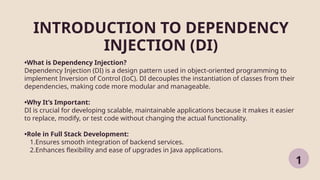
•What is Dependency Injection?
Dependency Injection (DI) is a design pattern used in object-oriented programming to
implement Inversion of Control (IoC). DI decouples the instantiation of classes from their
dependencies, making code more modular and manageable.
•Why It’s Important:
DI is crucial for developing scalable, maintainable applications because it makes it easier
to replace, modify, or test code without changing the actual functionality.
•Role in Full Stack Development:
1.Ensures smooth integration of backend services.
2.Enhances flexibility and ease of upgrades in Java applications.
KEY BENEFITS OF DEPENDENCY
INJECTION
2
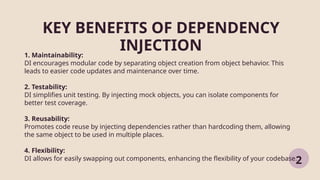
1. Maintainability:
DI encourages modular code by separating object creation from object behavior. This
leads to easier code updates and maintenance over time.
2. Testability:
DI simplifies unit testing. By injecting mock objects, you can isolate components for
better test coverage.
3. Reusability:
Promotes code reuse by injecting dependencies rather than hardcoding them, allowing
the same object to be used in multiple places.
4. Flexibility:
DI allows for easily swapping out components, enhancing the flexibility of your codebase.
TYPES OF DEPENDENCY INJECTION
3
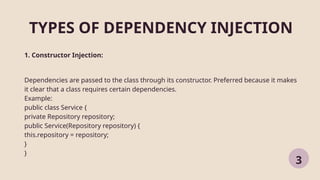
1. Constructor Injection:
Dependencies are passed to the class through its constructor. Preferred because it makes
it clear that a class requires certain dependencies.
Example:
public class Service {
private Repository repository;
public Service(Repository repository) {
this.repository = repository;
}
}
TYPES OF DEPENDENCY INJECTION
4
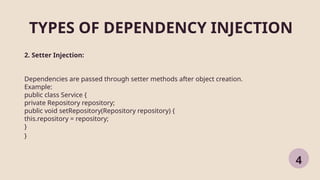
2. Setter Injection:
Dependencies are passed through setter methods after object creation.
Example:
public class Service {
private Repository repository;
public void setRepository(Repository repository) {
this.repository = repository;
}
}
TYPES OF DEPENDENCY INJECTION
5
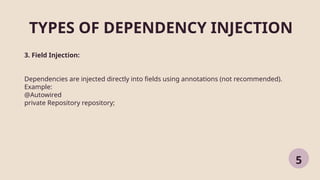
3. Field Injection:
Dependencies are injected directly into fields using annotations (not recommended).
Example:
@Autowired
private Repository repository;
HOW DI WORKS IN SPRING
FRAMEWORK
6
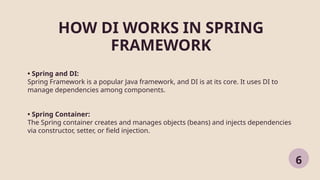
• Spring and DI:
Spring Framework is a popular Java framework, and DI is at its core. It uses DI to
manage dependencies among components.
• Spring Container:
The Spring container creates and manages objects (beans) and injects dependencies
via constructor, setter, or field injection.
HOW DI WORKS IN SPRING
FRAMEWORK
7
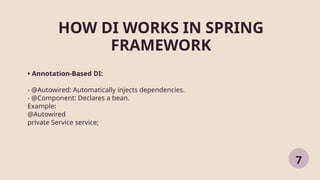
• Annotation-Based DI:
- @Autowired: Automatically injects dependencies.
- @Component: Declares a bean.
Example:
@Autowired
private Service service;
REAL-WORLD USE CASE IN JAVA FULL
STACK DEVELOPMENT
8
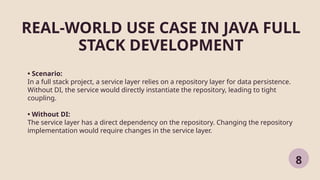
• Scenario:
In a full stack project, a service layer relies on a repository layer for data persistence.
Without DI, the service would directly instantiate the repository, leading to tight
coupling.
• Without DI:
The service layer has a direct dependency on the repository. Changing the repository
implementation would require changes in the service layer.
REAL-WORLD USE CASE IN JAVA FULL
STACK DEVELOPMENT
9
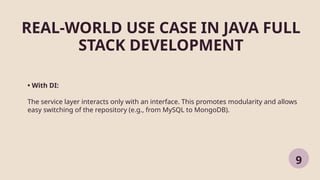
• With DI:
The service layer interacts only with an interface. This promotes modularity and allows
easy switching of the repository (e.g., from MySQL to MongoDB).
BEST PRACTICES FOR USING DI IN
PROJECTS
10
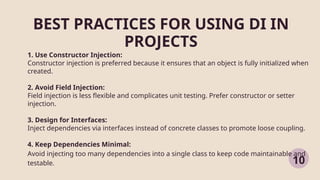
1. Use Constructor Injection:
Constructor injection is preferred because it ensures that an object is fully initialized when
created.
2. Avoid Field Injection:
Field injection is less flexible and complicates unit testing. Prefer constructor or setter
injection.
3. Design for Interfaces:
Inject dependencies via interfaces instead of concrete classes to promote loose coupling.
4. Keep Dependencies Minimal:
Avoid injecting too many dependencies into a single class to keep code maintainable and
testable.
CONCLUSION & KEY TAKEAWAYS
11
• Summary:
Dependency Injection is essential for building maintainable, flexible, and testable Java
applications, especially in full stack development.
• Key Takeaways:
- Promotes loose coupling and modularity.
- Integral in frameworks like Spring.
- Ensures maintainable, testable, and scalable code.
• Call to Action:
Explore Dependency Injection in your Java Full Stack Developer course to build cleaner,
more maintainable projects.
THANK YOU
12
Business Name: ExcelR - Full Stack Developer And Business
Analyst Course in Bangalore
Address: 10, 3rd floor, Safeway Plaza, 27th Main Rd, Old
Madiwala, Jay Bheema Nagar, 1st Stage, BTM 1st Stage,
Bengaluru, Karnataka 560068
Phone: 07353006061

Dependency Injection in Java Essential for Building Maintainable Projects in a Java Full Stack Developer Course.pptx

  • 1.
    DEPENDENCY INJECTION IN JAVA Essential forBuilding Maintainable Projects in a Java Full Stack Developer Course
  • 2.
    INTRODUCTION TO DEPENDENCY INJECTION(DI) 1 •What is Dependency Injection? Dependency Injection (DI) is a design pattern used in object-oriented programming to implement Inversion of Control (IoC). DI decouples the instantiation of classes from their dependencies, making code more modular and manageable. •Why It’s Important: DI is crucial for developing scalable, maintainable applications because it makes it easier to replace, modify, or test code without changing the actual functionality. •Role in Full Stack Development: 1.Ensures smooth integration of backend services. 2.Enhances flexibility and ease of upgrades in Java applications.
  • 3.
    KEY BENEFITS OFDEPENDENCY INJECTION 2 1. Maintainability: DI encourages modular code by separating object creation from object behavior. This leads to easier code updates and maintenance over time. 2. Testability: DI simplifies unit testing. By injecting mock objects, you can isolate components for better test coverage. 3. Reusability: Promotes code reuse by injecting dependencies rather than hardcoding them, allowing the same object to be used in multiple places. 4. Flexibility: DI allows for easily swapping out components, enhancing the flexibility of your codebase.
  • 4.
    TYPES OF DEPENDENCYINJECTION 3 1. Constructor Injection: Dependencies are passed to the class through its constructor. Preferred because it makes it clear that a class requires certain dependencies. Example: public class Service { private Repository repository; public Service(Repository repository) { this.repository = repository; } }
  • 5.
    TYPES OF DEPENDENCYINJECTION 4 2. Setter Injection: Dependencies are passed through setter methods after object creation. Example: public class Service { private Repository repository; public void setRepository(Repository repository) { this.repository = repository; } }
  • 6.
    TYPES OF DEPENDENCYINJECTION 5 3. Field Injection: Dependencies are injected directly into fields using annotations (not recommended). Example: @Autowired private Repository repository;
  • 7.
    HOW DI WORKSIN SPRING FRAMEWORK 6 • Spring and DI: Spring Framework is a popular Java framework, and DI is at its core. It uses DI to manage dependencies among components. • Spring Container: The Spring container creates and manages objects (beans) and injects dependencies via constructor, setter, or field injection.
  • 8.
    HOW DI WORKSIN SPRING FRAMEWORK 7 • Annotation-Based DI: - @Autowired: Automatically injects dependencies. - @Component: Declares a bean. Example: @Autowired private Service service;
  • 9.
    REAL-WORLD USE CASEIN JAVA FULL STACK DEVELOPMENT 8 • Scenario: In a full stack project, a service layer relies on a repository layer for data persistence. Without DI, the service would directly instantiate the repository, leading to tight coupling. • Without DI: The service layer has a direct dependency on the repository. Changing the repository implementation would require changes in the service layer.
  • 10.
    REAL-WORLD USE CASEIN JAVA FULL STACK DEVELOPMENT 9 • With DI: The service layer interacts only with an interface. This promotes modularity and allows easy switching of the repository (e.g., from MySQL to MongoDB).
  • 11.
    BEST PRACTICES FORUSING DI IN PROJECTS 10 1. Use Constructor Injection: Constructor injection is preferred because it ensures that an object is fully initialized when created. 2. Avoid Field Injection: Field injection is less flexible and complicates unit testing. Prefer constructor or setter injection. 3. Design for Interfaces: Inject dependencies via interfaces instead of concrete classes to promote loose coupling. 4. Keep Dependencies Minimal: Avoid injecting too many dependencies into a single class to keep code maintainable and testable.
  • 12.
    CONCLUSION & KEYTAKEAWAYS 11 • Summary: Dependency Injection is essential for building maintainable, flexible, and testable Java applications, especially in full stack development. • Key Takeaways: - Promotes loose coupling and modularity. - Integral in frameworks like Spring. - Ensures maintainable, testable, and scalable code. • Call to Action: Explore Dependency Injection in your Java Full Stack Developer course to build cleaner, more maintainable projects.
  • 13.
    THANK YOU 12 Business Name:ExcelR - Full Stack Developer And Business Analyst Course in Bangalore Address: 10, 3rd floor, Safeway Plaza, 27th Main Rd, Old Madiwala, Jay Bheema Nagar, 1st Stage, BTM 1st Stage, Bengaluru, Karnataka 560068 Phone: 07353006061