deSymfonyDay
Barcelona 2014
DIC To The
Limit
Ronny López
ABOUT ME US
Hard way learner	

!
Technical Lead at Social Point	

Do stuff atTangoTree in the nights	

!
@ronnylt

www.tangotree.io

https://github.com/ronnylt
AGENDA
• The problems	

• Dependency Injection	

• Coupling done right	

• Dependency Inversion Principle	

• Types of DI	

• Dependency Injection Containers	

• Symfony Dependency Injection Container	

• Interchangeable Services
THE PROBLEMS
• We require to switch out data access layer without
compromising all the other parts of the application	

• We need to use different implementations in different
deployments (dragon game, monster game, etc…)	

• We wish to deploy the application in different environments
(testing, integration, staging, production, etc…)	

• We need different configurations in each environment
YAGNI	

You aren't gonna need it, let’s go home!
IN CASEYOU NEED IT
• You have to do Dependency Injection, correctly	

• You have to know and apply Dependency Inversion
Principles
WHAT WE REALLY WANT IS
• Code that is easy to test	

• Clear separation of infrastructure logic from
application logic	

• Interchangeable infrastructure
WHY?
• Multiple deployments share parts of the same code,
but each deployment has specific infrastructure
needs	

• Multiple environments with different needs	

• We want to automatically test all the things	

• We want to go fast, and the only way to go fast is…
you know…
“The only way to
go fast, is to go
well”

Uncle Bob
DEPENDENCY 	

INJECTION
Dependency injection is a
simple way to decouple
classes from what they
depend on
Dependency injection
decouples classes
construction from the
construction of it’s
dependencies
IS IT ALL ABOUT
COUPLING?
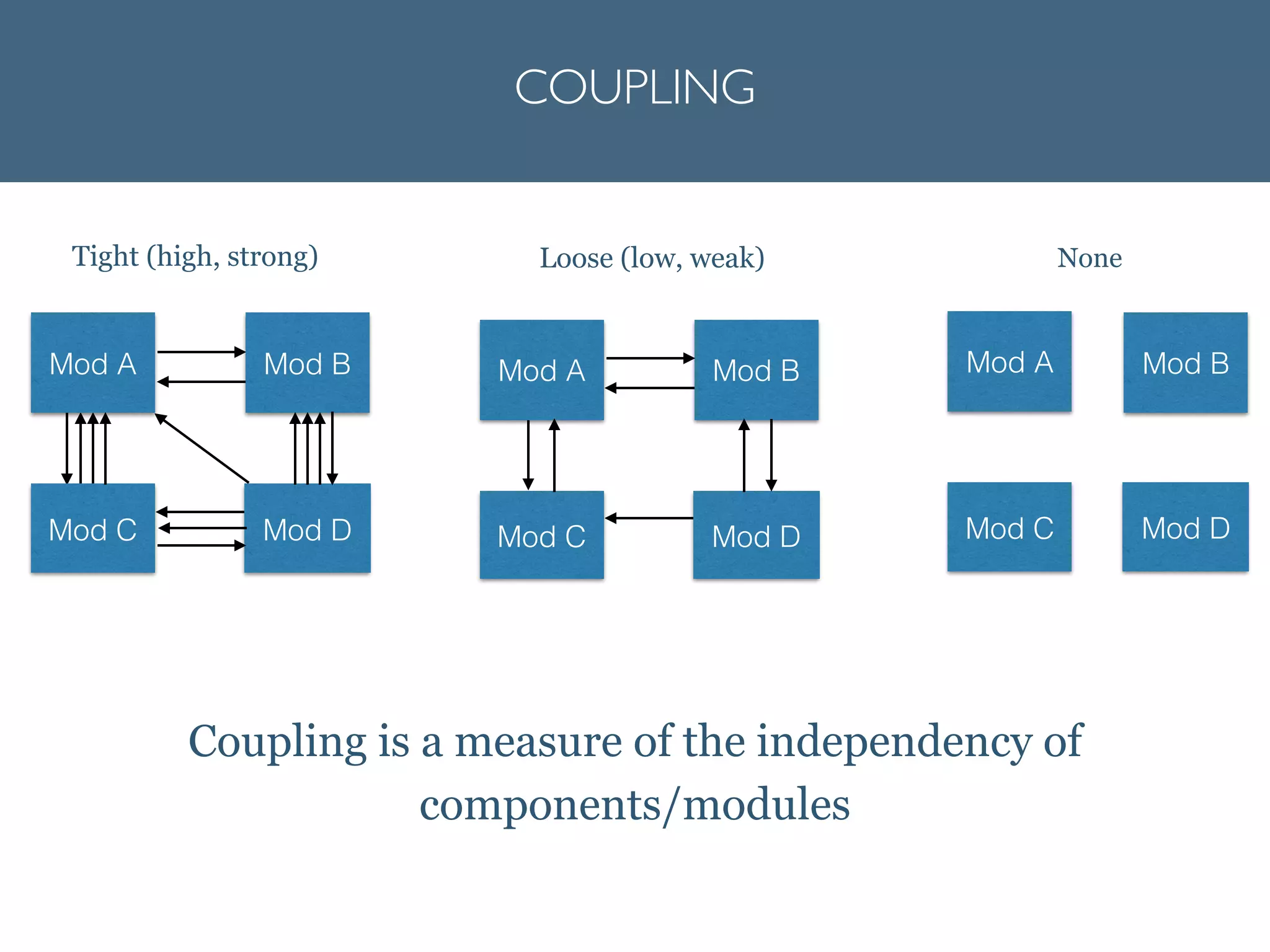
COUPLING
Mod A Mod B
Mod C Mod D
Tight (high, strong)
Mod A Mod B
Mod C Mod D
Loose (low, weak)
Mod A Mod B
Mod C Mod D
None
Coupling is a measure of the independency of
components/modules
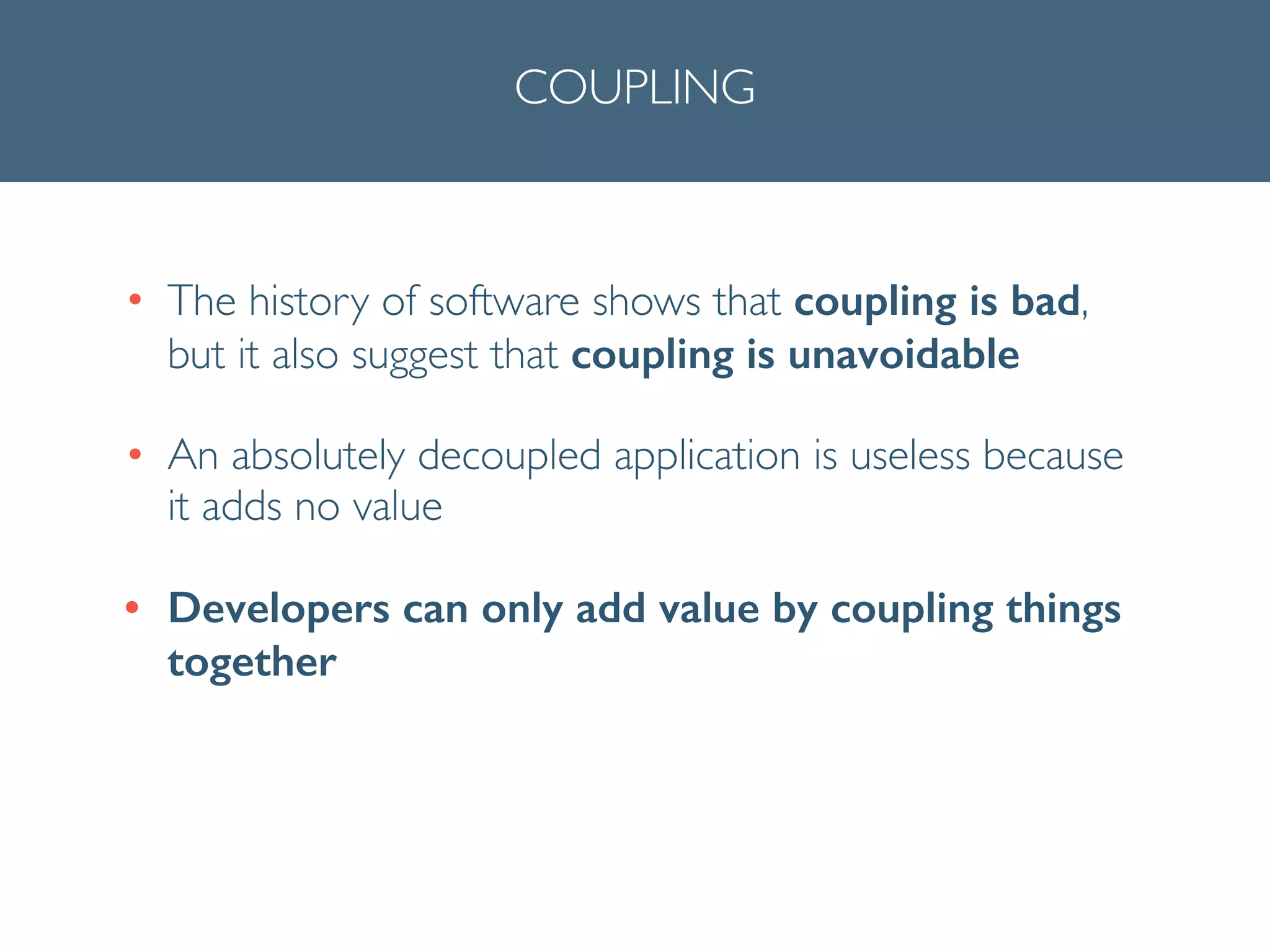
COUPLING
• The history of software shows that coupling is bad,
but it also suggest that coupling is unavoidable 	

• An absolutely decoupled application is useless because
it adds no value	

• Developers can only add value by coupling things
together
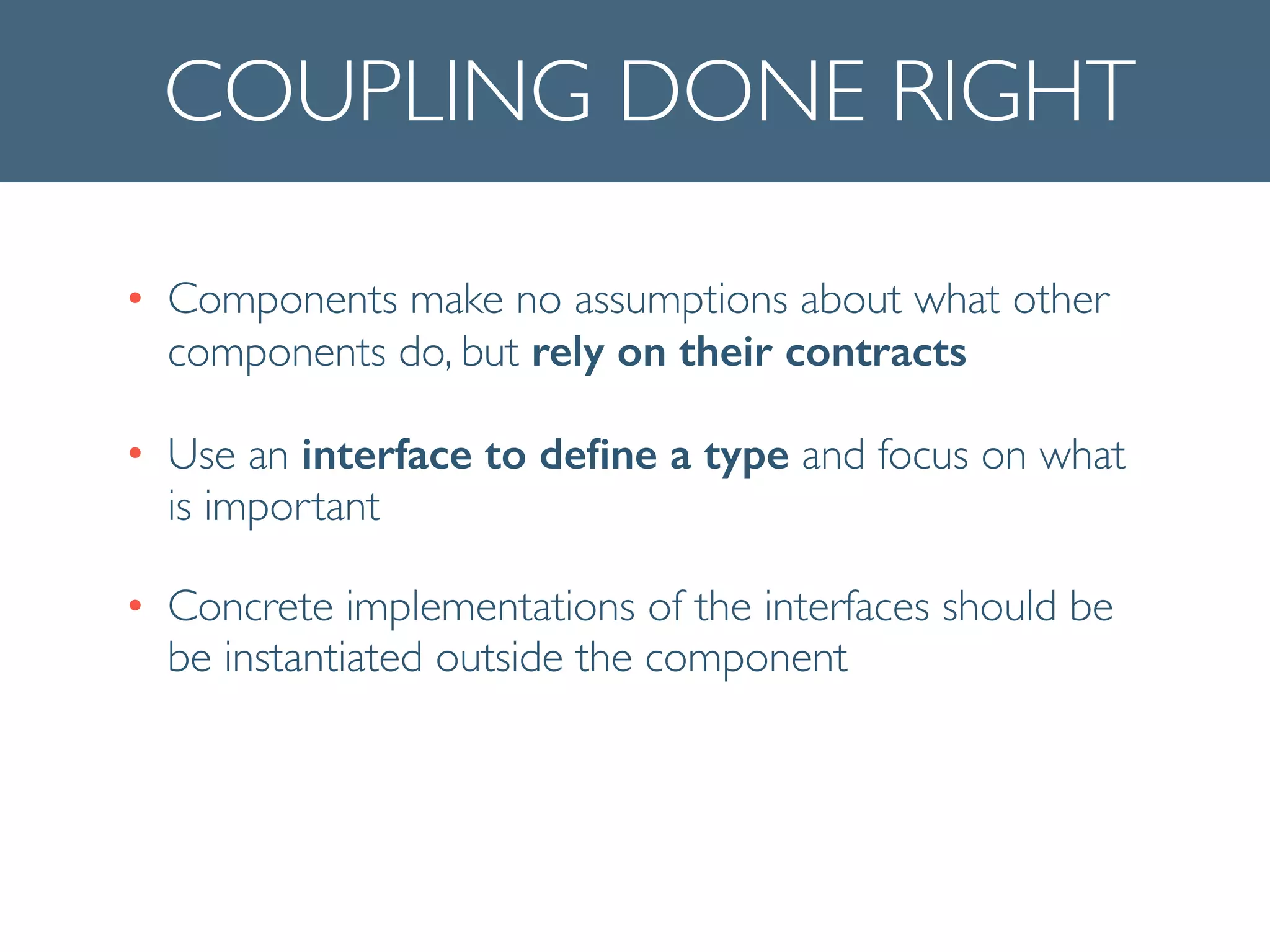
COUPLING DONE RIGHT
• Components make no assumptions about what other
components do, but rely on their contracts	

• Use an interface to define a type and focus on what
is important	

• Concrete implementations of the interfaces should be
be instantiated outside the component
DEPENDENCY INVERSION
PRINCIPLE
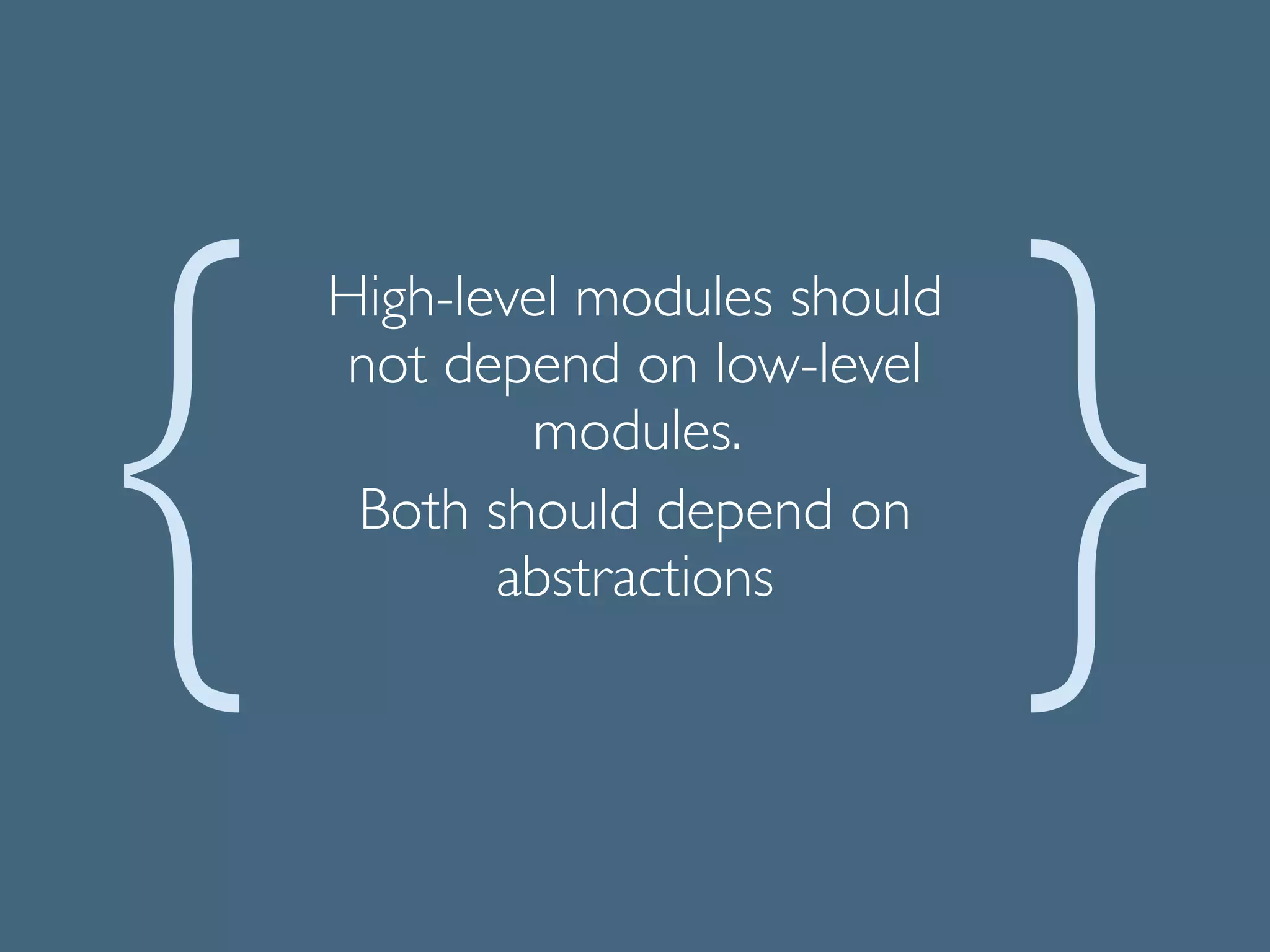
High-level modules should
not depend on low-level
modules. 	
Both should depend on
abstractions
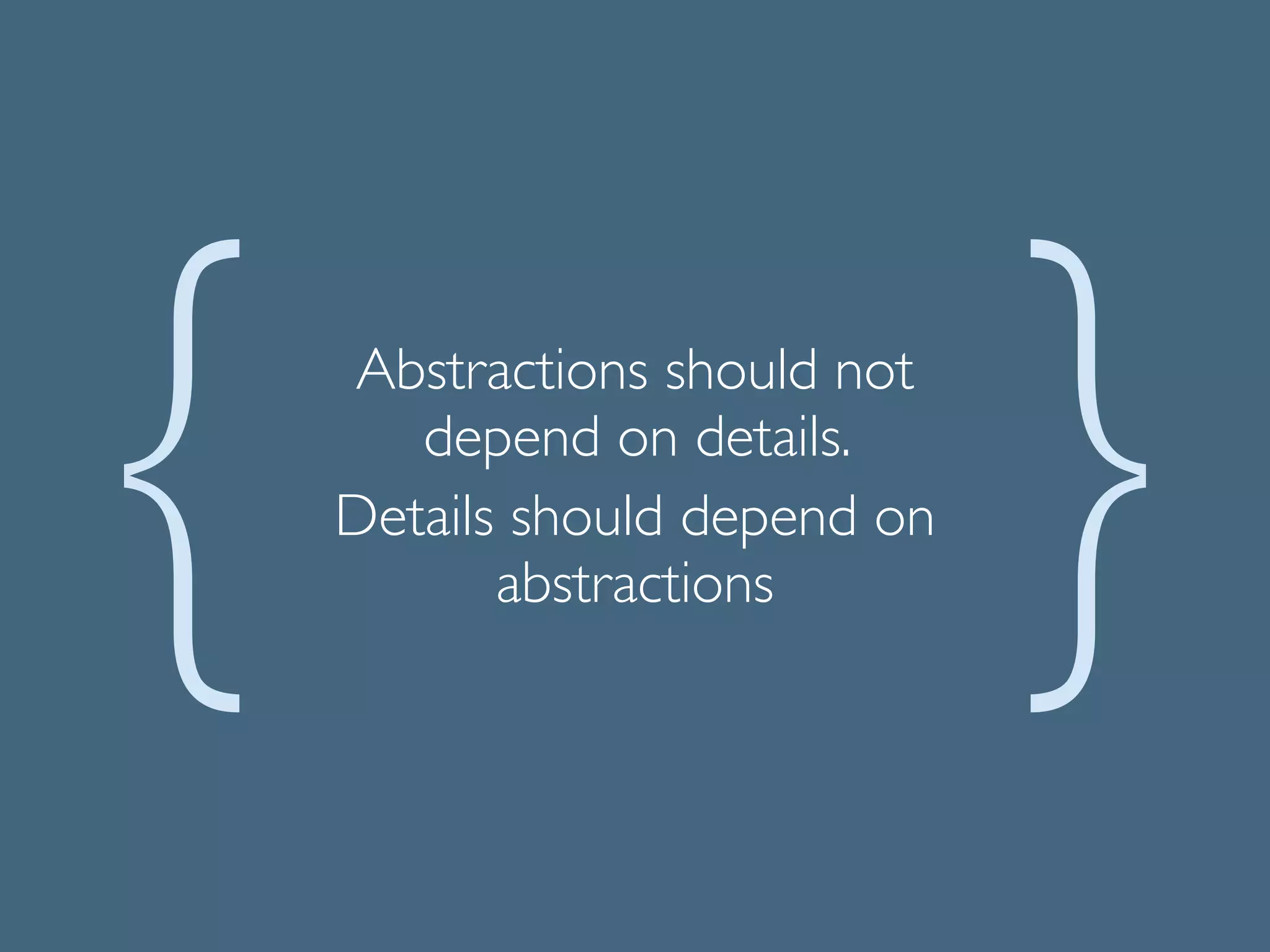
Abstractions should not
depend on details. 	
Details should depend on
abstractions
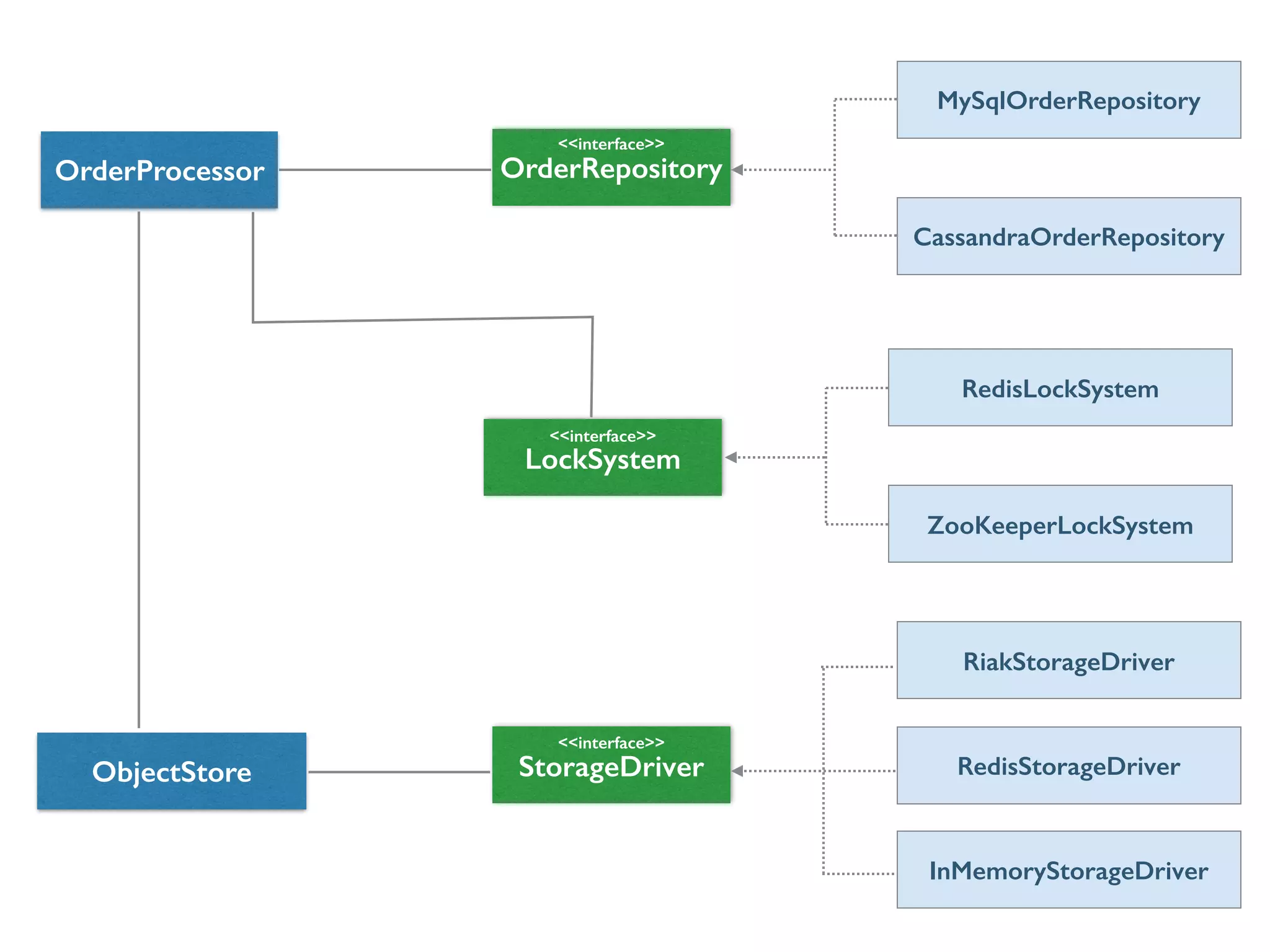
DEPENDENCY INVERSION
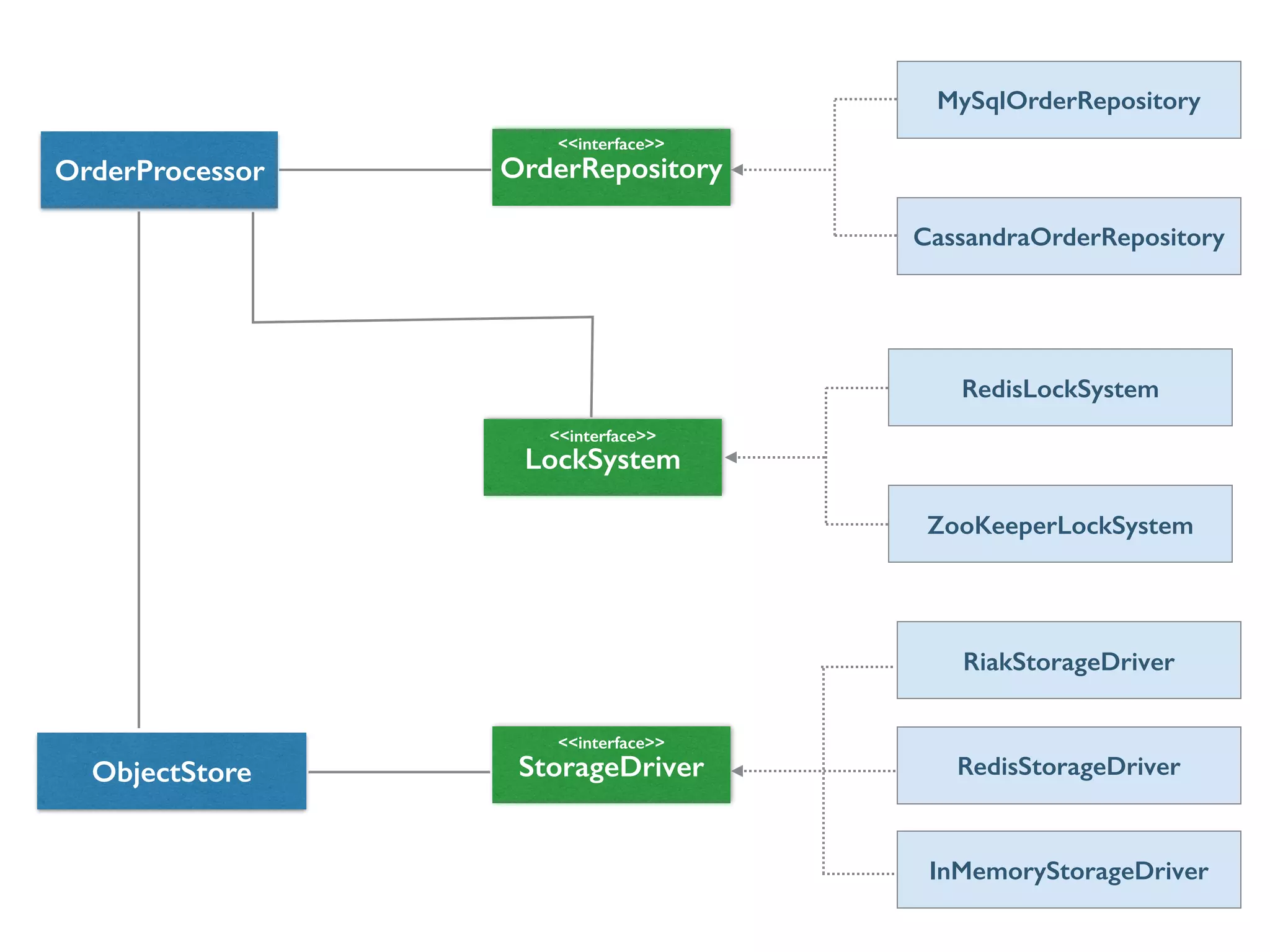
• Decouple high level parts of the system from low level
parts by using interfaces
OrderProcessor OrderRepository
MySqlOrderRepository
CassandraOrderRepository
LockSystem
RedisLockSystem
ZooKeeperLockSystem
<<interface>>
<<interface>>
ObjectStore RedisStorageDriver
InMemoryStorageDriver
RiakStorageDriver
StorageDriver
<<interface>>
TYPES OF DEPENDENCY
INJECTIONS	

!
TYPES OF DI
• Constructor Injection	

• Setter Injection	

• Interface Injection	

• Property Injection	

• Service Locator
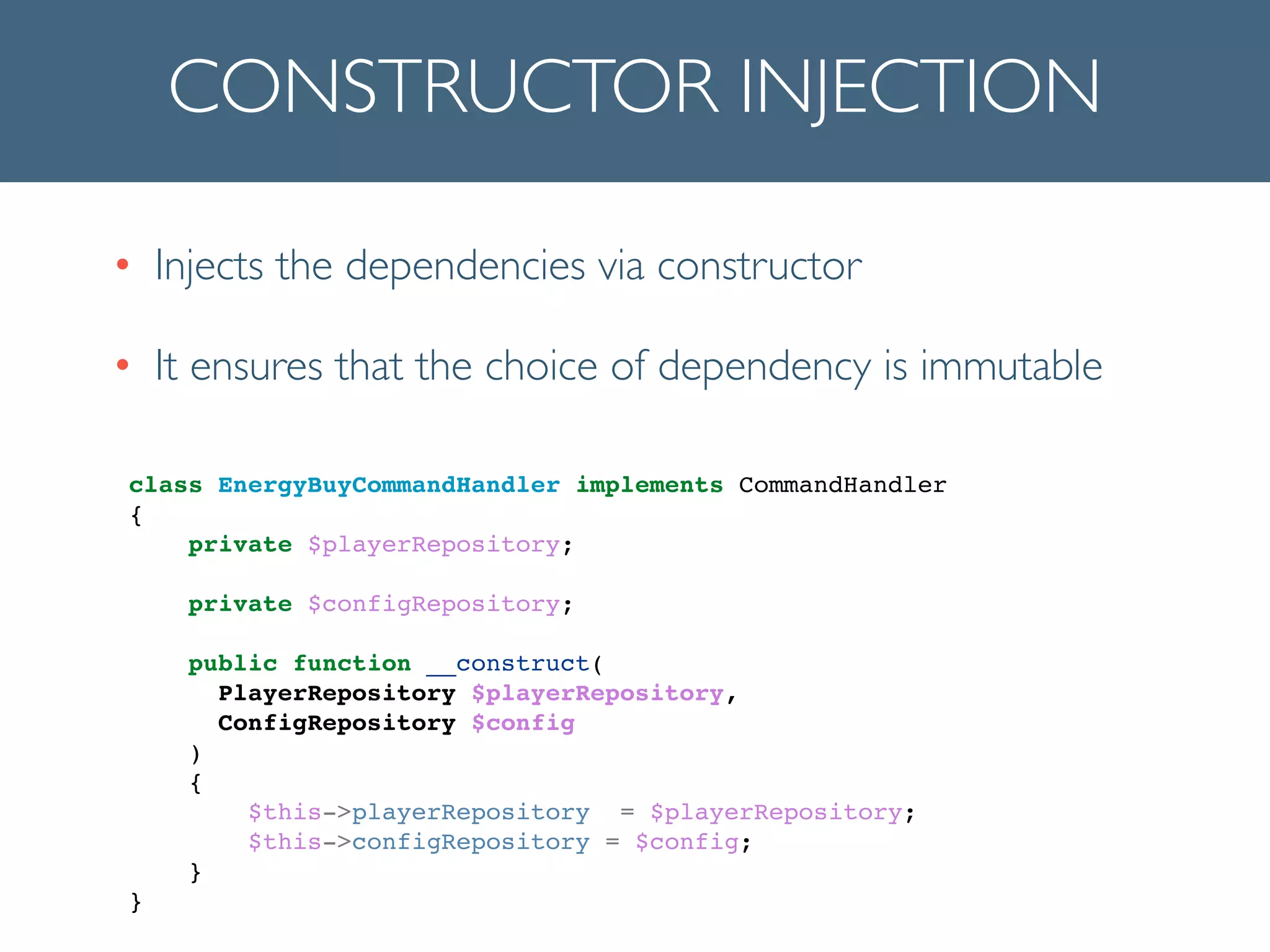
CONSTRUCTOR INJECTION
• Injects the dependencies via constructor	

• It ensures that the choice of dependency is immutable
!
class EnergyBuyCommandHandler implements CommandHandler!
{!
private $playerRepository;!
!
private $configRepository;!
!
public function __construct(!
! ! PlayerRepository $playerRepository, !
! ! ConfigRepository $config!
! )!
{!
$this->playerRepository = $playerRepository;!
$this->configRepository = $config;!
}!
}!
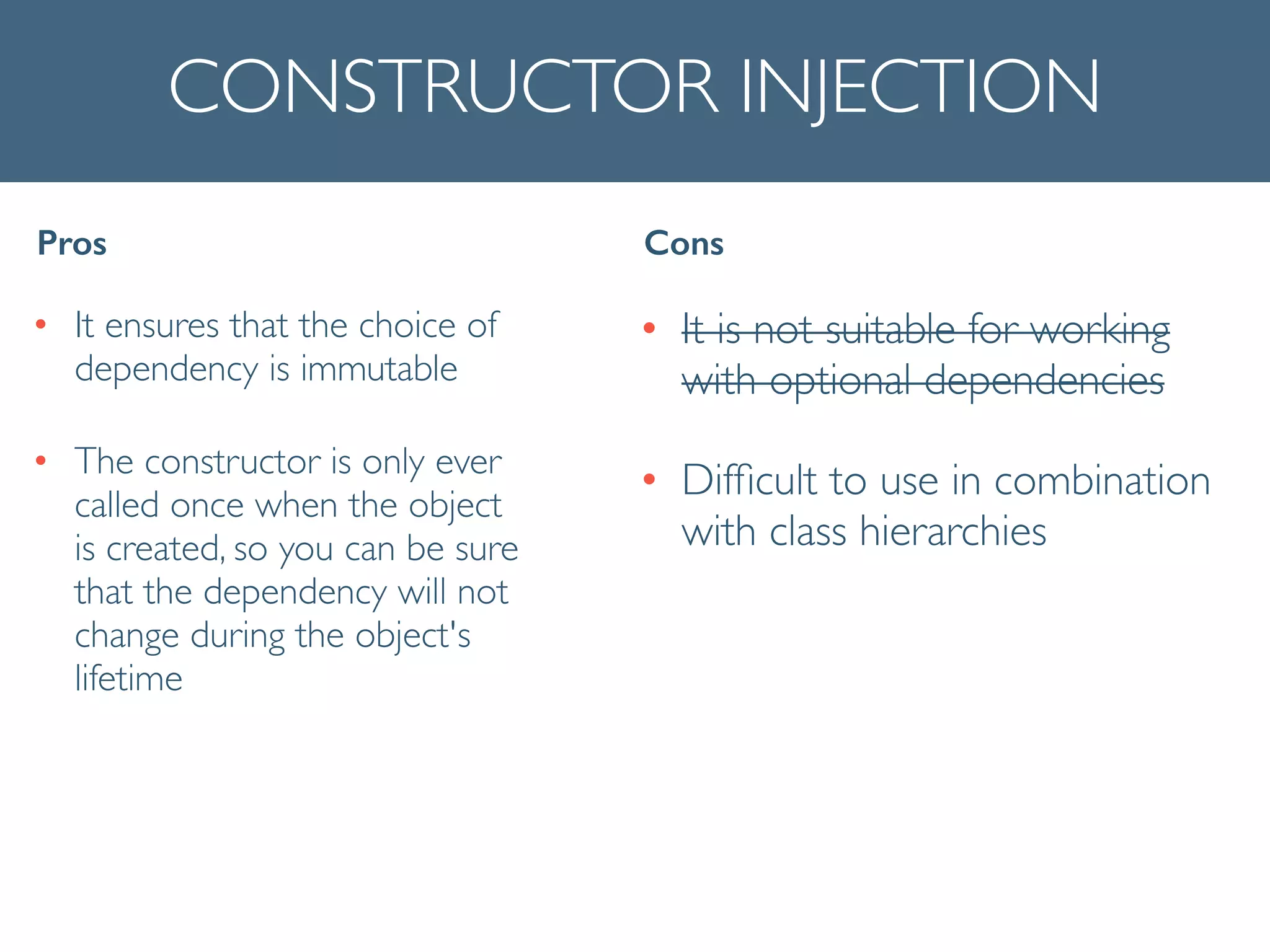
CONSTRUCTOR INJECTION
• It ensures that the choice of
dependency is immutable	

• The constructor is only ever
called once when the object
is created, so you can be sure
that the dependency will not
change during the object's
lifetime
Pros Cons
• It is not suitable for working
with optional dependencies	

• Difficult to use in combination
with class hierarchies
CONSTRUCTOR INJECTION
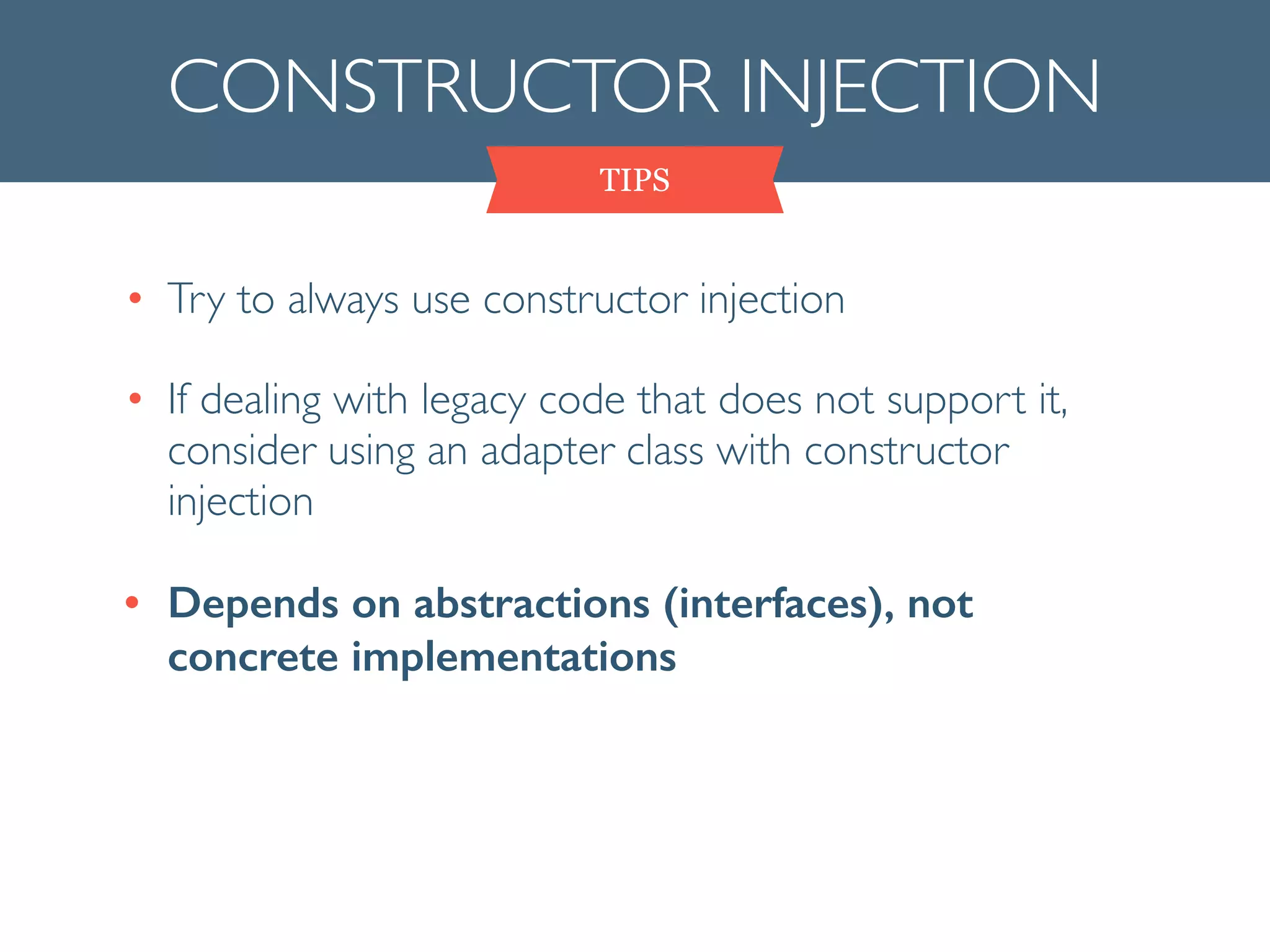
• Try to always use constructor injection	

• If dealing with legacy code that does not support it,
consider using an adapter class with constructor
injection	

• Depends on abstractions (interfaces), not
concrete implementations
TIPS
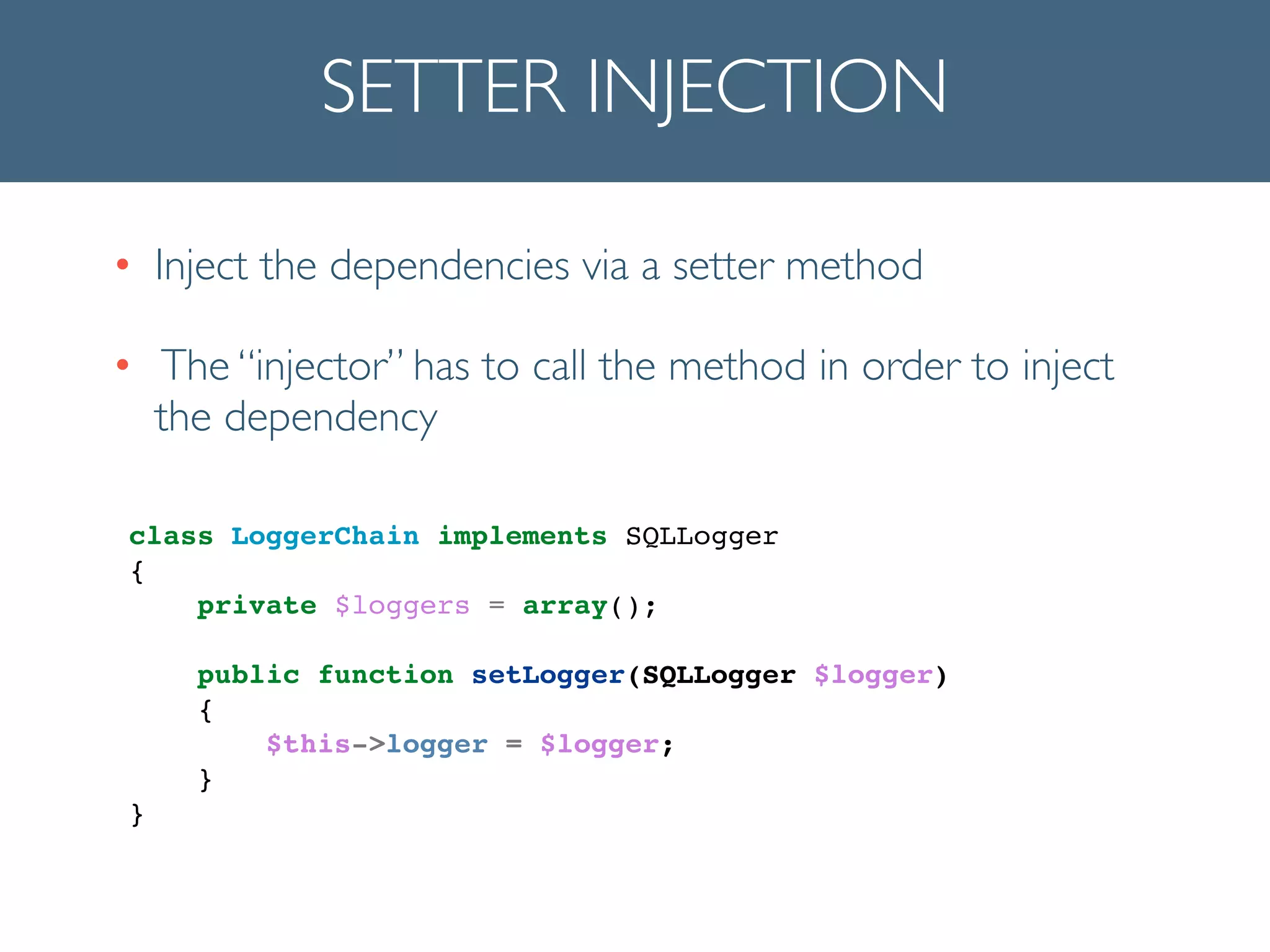
SETTER INJECTION
• Inject the dependencies via a setter method	

• The “injector” has to call the method in order to inject
the dependency
!
class LoggerChain implements SQLLogger!
{!
private $loggers = array();!
!
public function setLogger(SQLLogger $logger)!
{!
$this->logger = $logger;!
}!
}!
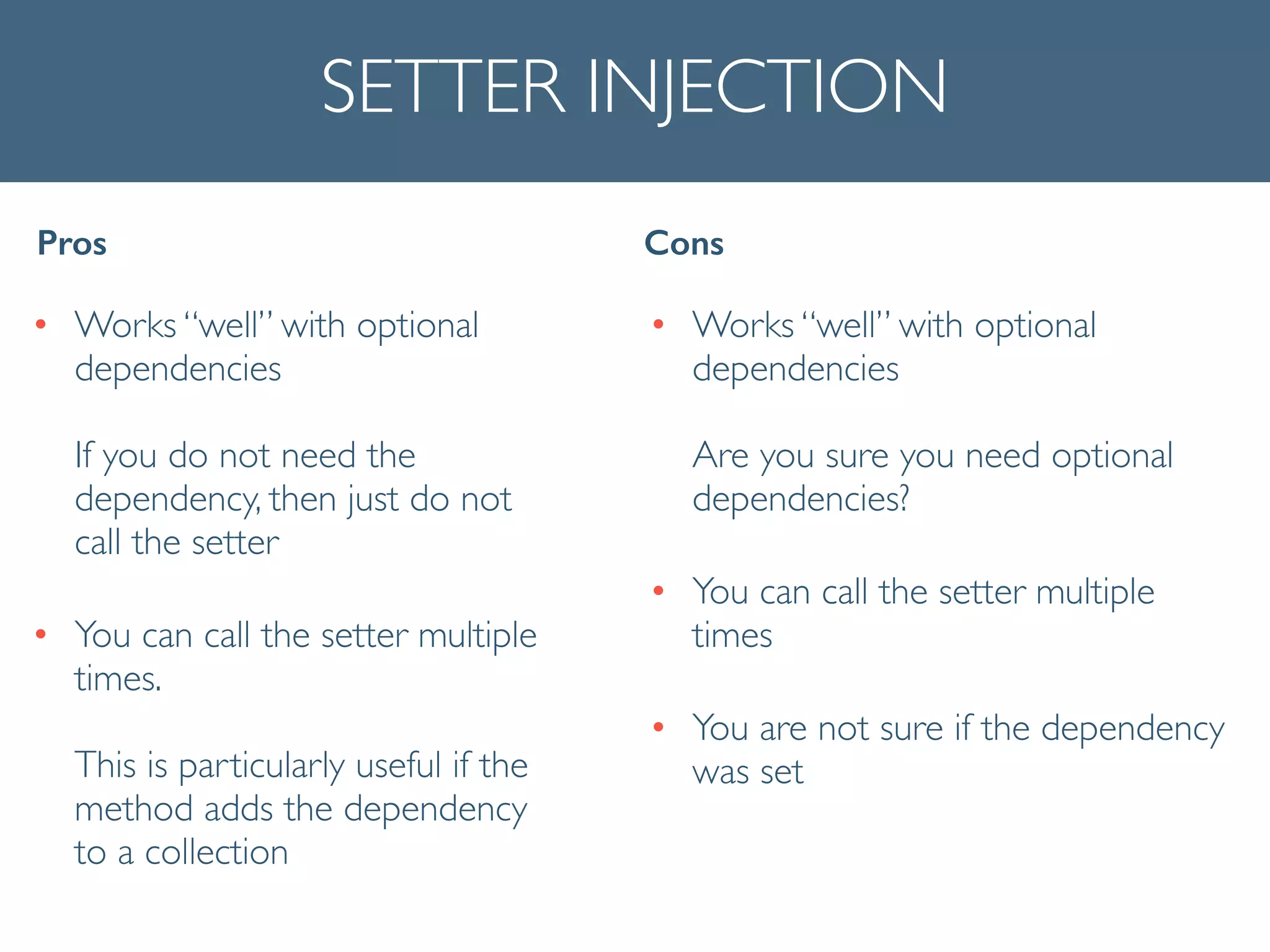
SETTER INJECTION
• Works “well” with optional
dependencies


If you do not need the
dependency, then just do not
call the setter	

• You can call the setter multiple
times.


This is particularly useful if the
method adds the dependency
to a collection
Pros Cons
• Works “well” with optional
dependencies 


Are you sure you need optional
dependencies?	

• You can call the setter multiple
times	

• You are not sure if the dependency
was set
SETTER INJECTION
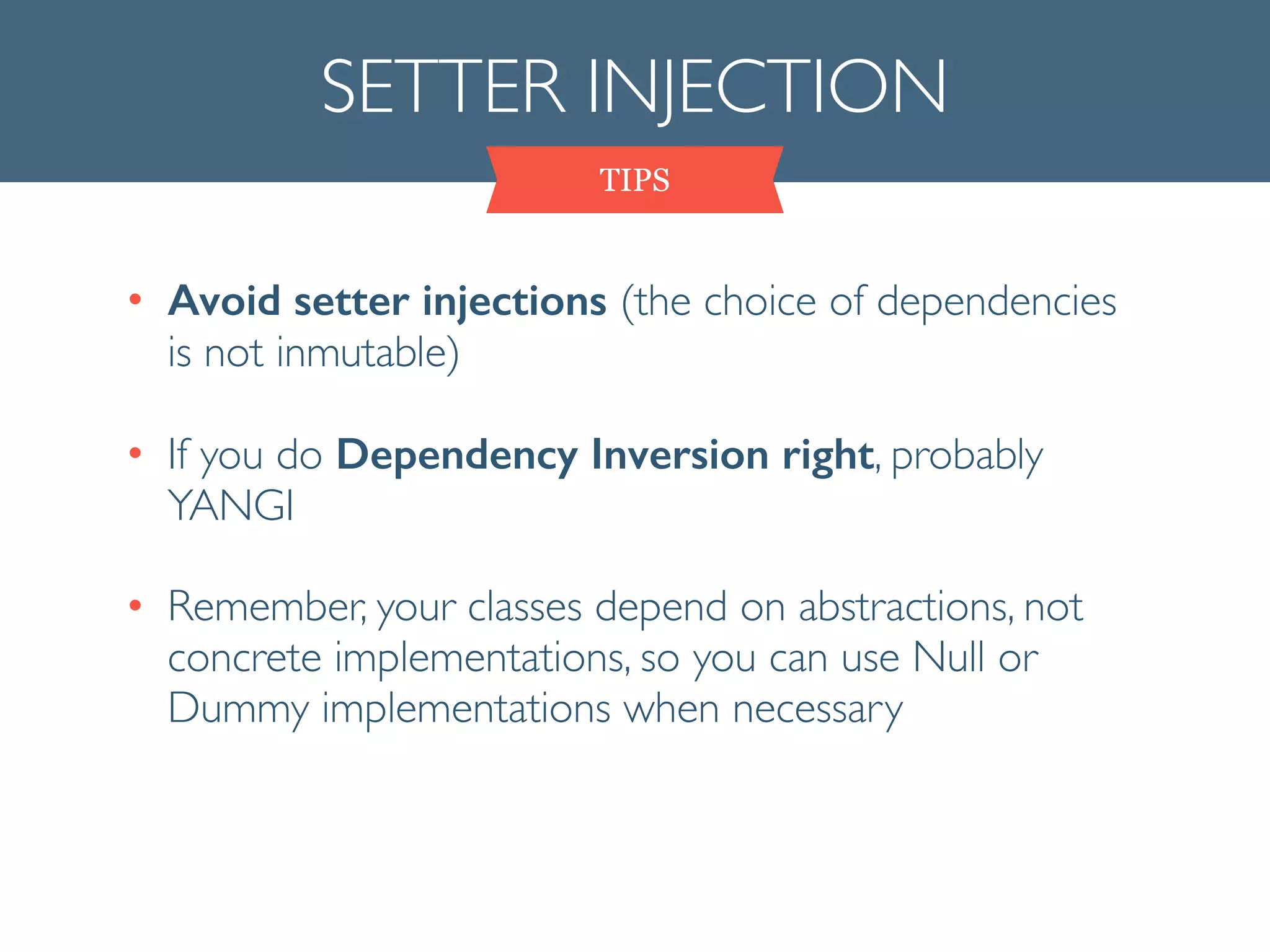
TIPS
• Avoid setter injections (the choice of dependencies
is not inmutable)	

• If you do Dependency Inversion right, probably
YANGI	

• Remember, your classes depend on abstractions, not
concrete implementations, so you can use Null or
Dummy implementations when necessary
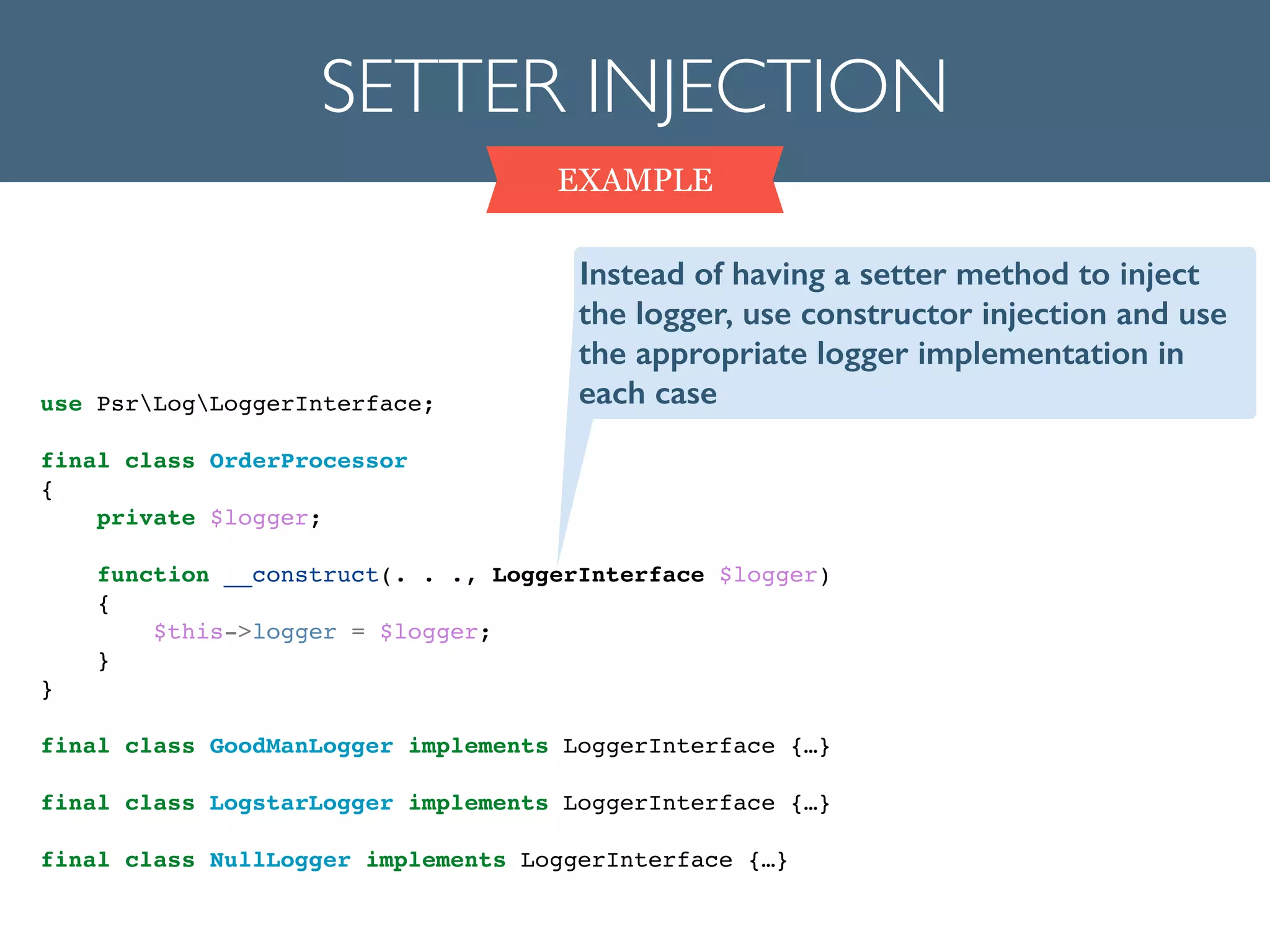
SETTER INJECTION
EXAMPLE
use PsrLogLoggerInterface;!
!
final class OrderProcessor!
{!
private $logger;!
!
function __construct(. . ., LoggerInterface $logger)!
{!
$this->logger = $logger;!
}!
}!
!
final class GoodManLogger implements LoggerInterface {…}!
!
final class LogstarLogger implements LoggerInterface {…}!
!
final class NullLogger implements LoggerInterface {…}!
Instead of having a setter method to inject
the logger, use constructor injection and use
the appropriate logger implementation in
each case
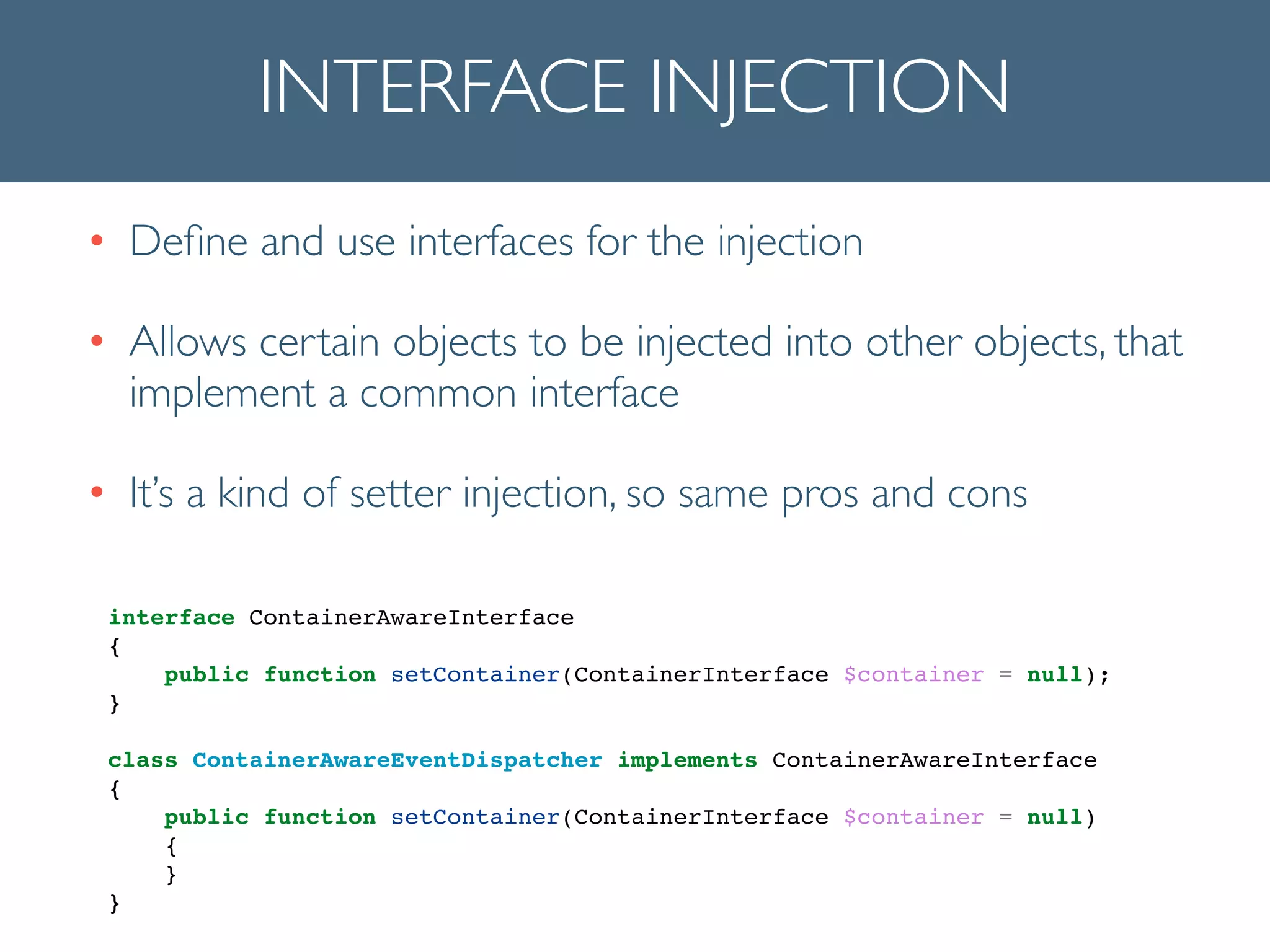
INTERFACE INJECTION
• Define and use interfaces for the injection	

• Allows certain objects to be injected into other objects, that
implement a common interface	

• It’s a kind of setter injection, so same pros and cons	

interface ContainerAwareInterface!
{!
public function setContainer(ContainerInterface $container = null);!
}!
!
class ContainerAwareEventDispatcher implements ContainerAwareInterface!
{!
public function setContainer(ContainerInterface $container = null)!
{!
}!
}!
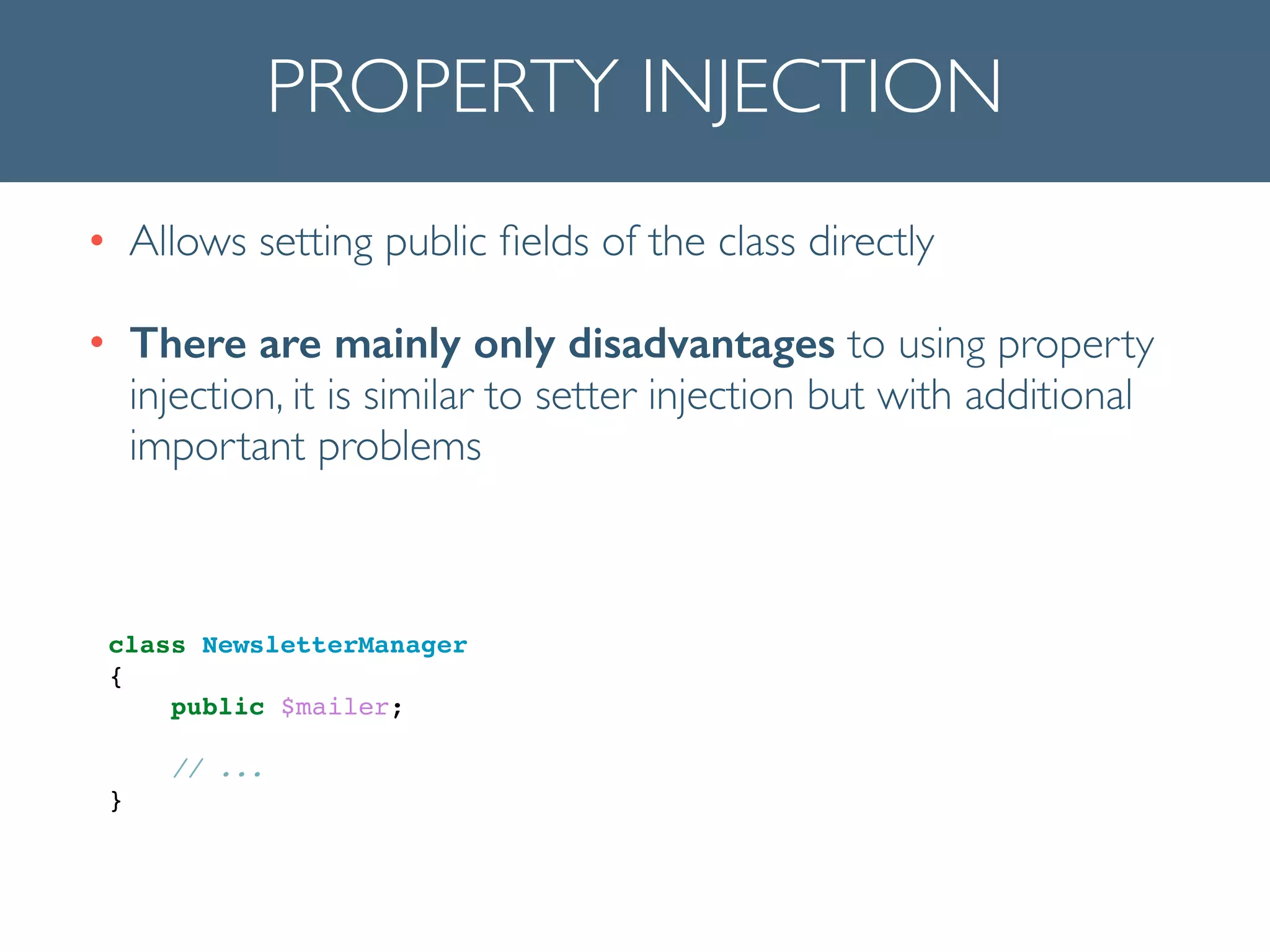
PROPERTY INJECTION
• Allows setting public fields of the class directly	

• There are mainly only disadvantages to using property
injection, it is similar to setter injection but with additional
important problems
!
!
class NewsletterManager!
{!
public $mailer;!
!
// ...!
}!
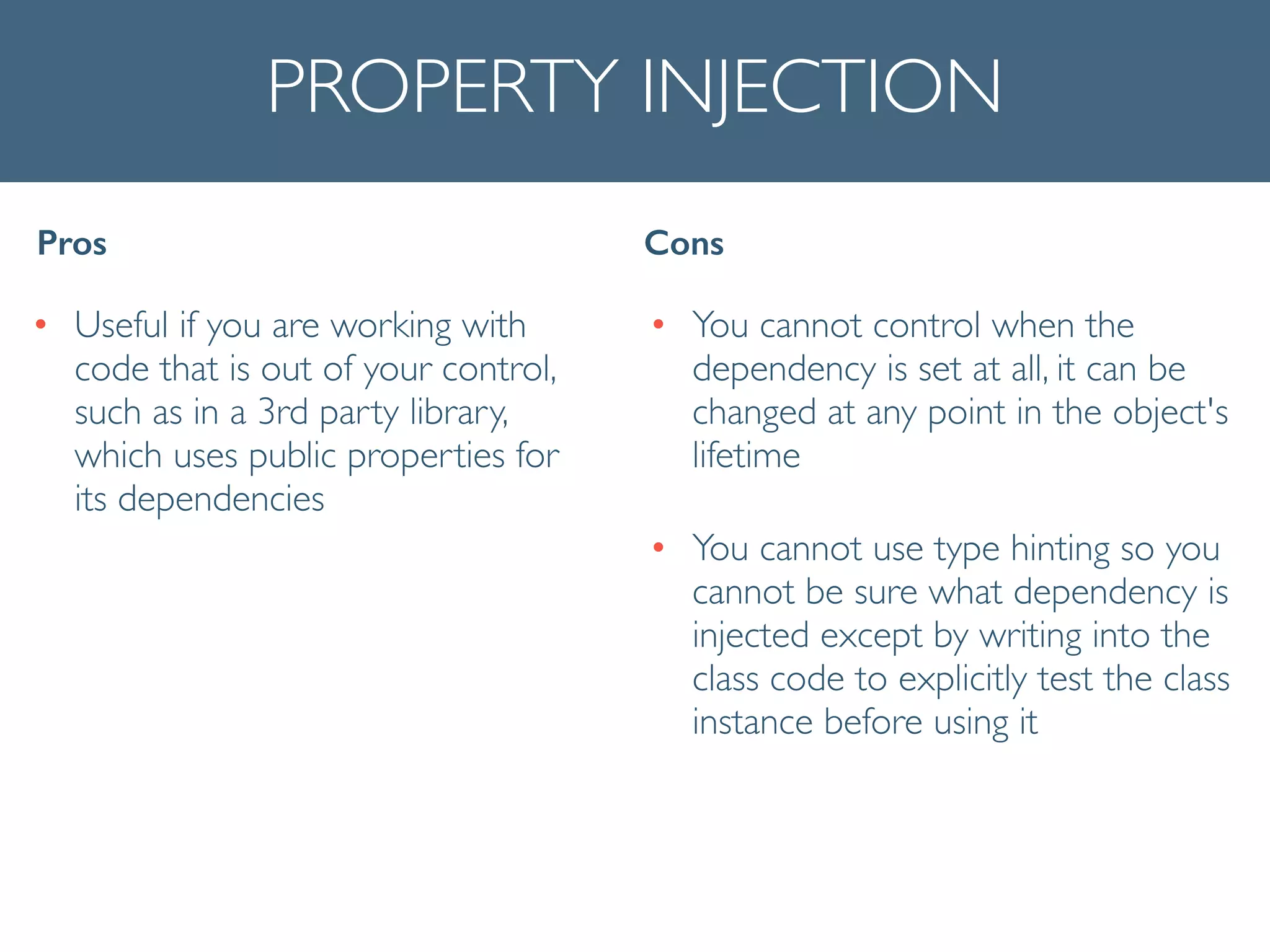
PROPERTY INJECTION
• Useful if you are working with
code that is out of your control,
such as in a 3rd party library,
which uses public properties for
its dependencies
Pros Cons
• You cannot control when the
dependency is set at all, it can be
changed at any point in the object's
lifetime	

• You cannot use type hinting so you
cannot be sure what dependency is
injected except by writing into the
class code to explicitly test the class
instance before using it
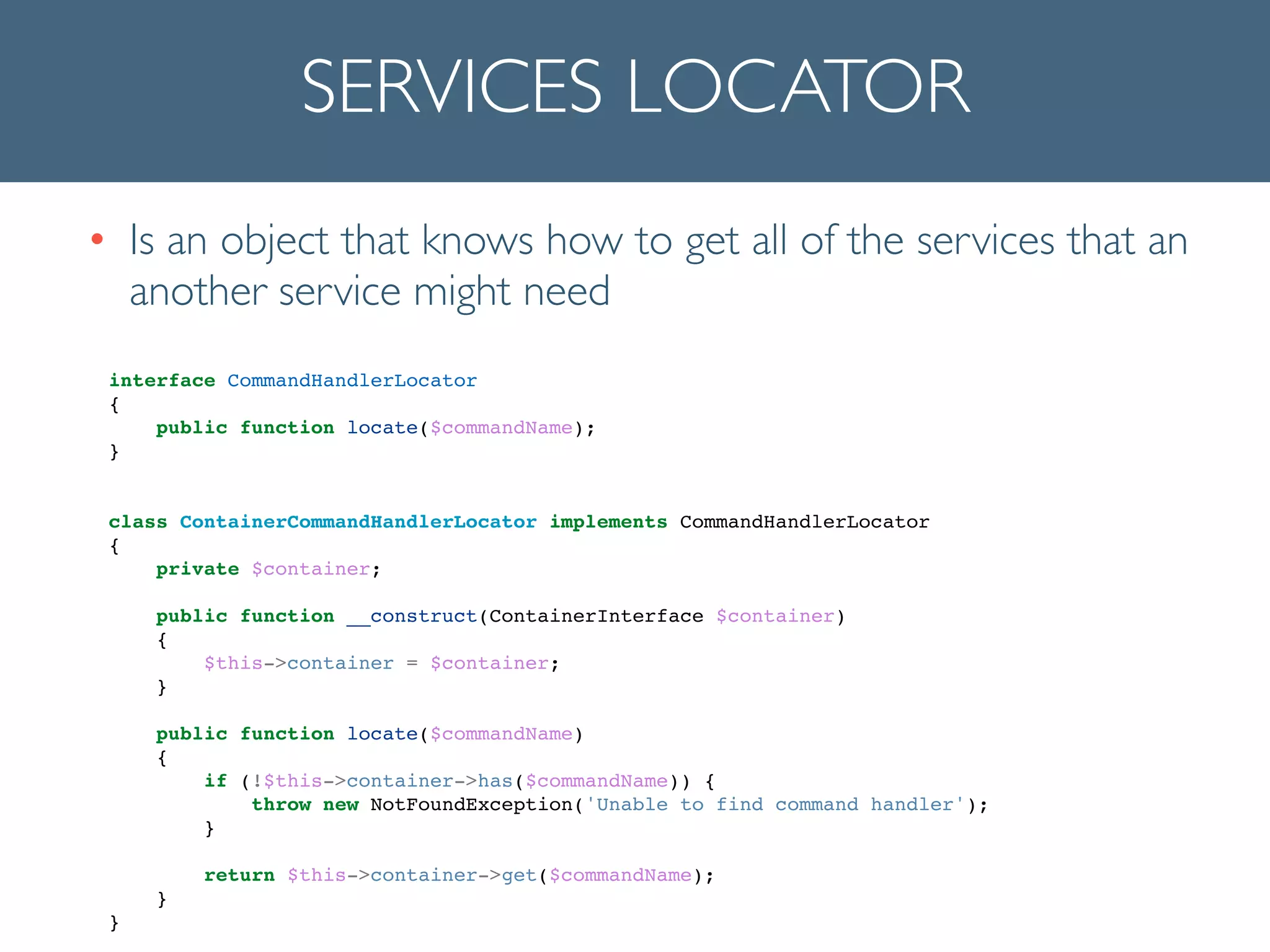
SERVICES LOCATOR
• Is an object that knows how to get all of the services that an
another service might need
interface CommandHandlerLocator !
{!
public function locate($commandName);!
}!
!
!
class ContainerCommandHandlerLocator implements CommandHandlerLocator!
{!
private $container;!
!
public function __construct(ContainerInterface $container)!
{!
$this->container = $container;!
}!
!
public function locate($commandName)!
{!
if (!$this->container->has($commandName)) {!
throw new NotFoundException('Unable to find command handler');!
}!
!
return $this->container->get($commandName);!
}!
}!
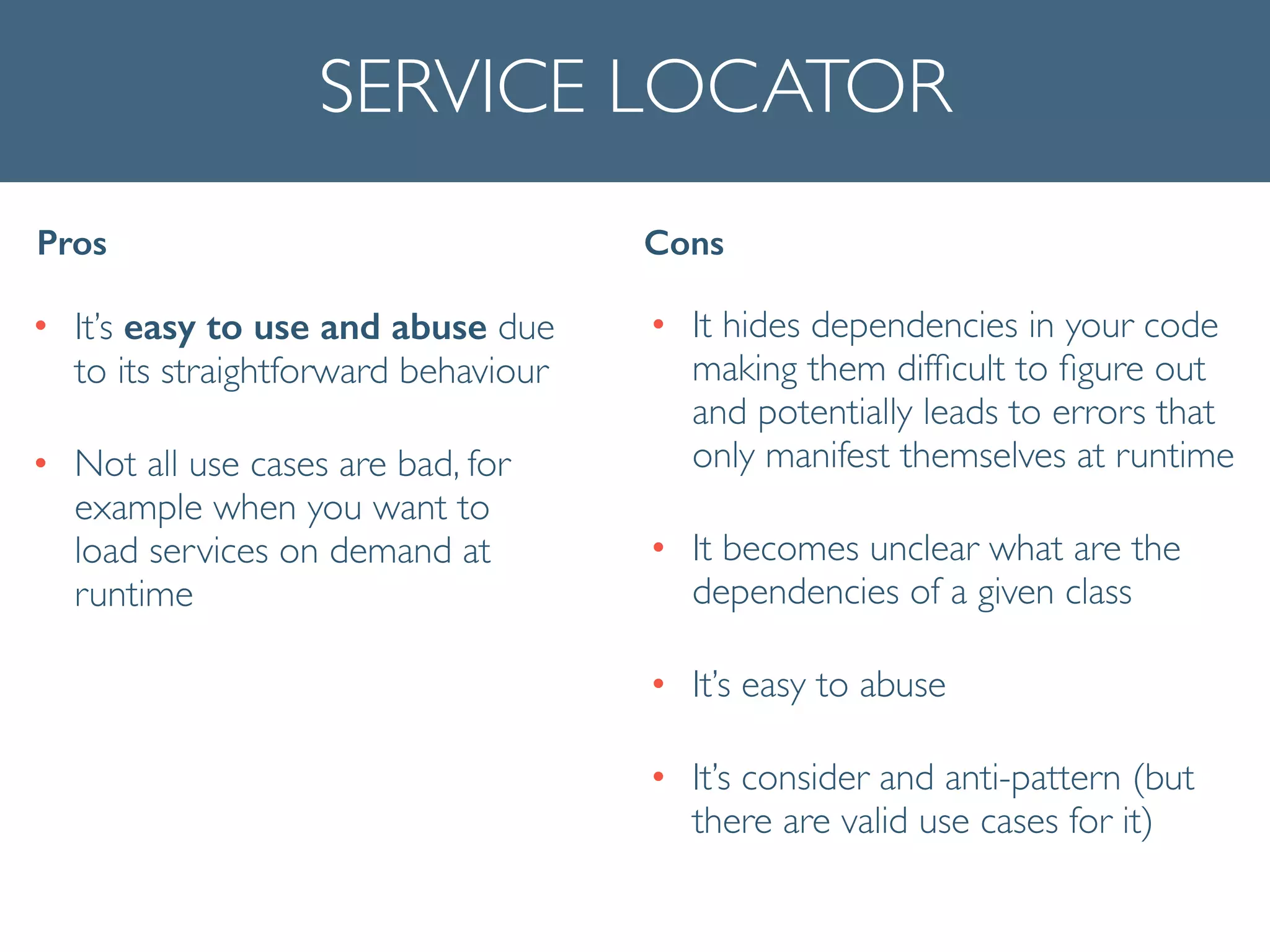
SERVICE LOCATOR
• It’s easy to use and abuse due
to its straightforward behaviour	

• Not all use cases are bad, for
example when you want to
load services on demand at
runtime
Pros Cons
• It hides dependencies in your code
making them difficult to figure out
and potentially leads to errors that
only manifest themselves at runtime	

• It becomes unclear what are the
dependencies of a given class	

• It’s easy to abuse	

• It’s consider and anti-pattern (but
there are valid use cases for it)
SERVICE LOCATOR
TIPS
• Use a segregated interface for the locator, do not
depends on the whole locator (container)	

!
• Limit the types of services a locator provides
DEPENDENCY INJECTION 	

CONTAINER
Dependency Injection
Container is simply an
object that manages the
instantiation of other objects
Automagically creates a
given type with all the
required dependencies
DIC
• Most of the time you do not need a DIC to benefit from
Dependency Injection	

• But… creating and maintaining the dependencies by hand
can become a nightmare pretty fast	

• A DIC manages objects from their instantiation to their
configuration	

• The objects themselves should not know that they are
managed by a container and should not know nothing
about it
DEPENDENCY INJECTION 	

CONTAINERS IN PHP
PHP DIC IMPLEMENTATIONS
• Twittee 	

• Pimple	

• IlluminateDi	

• ZendDi	

• SymfonyDependencyInjection	

• http://php-di.org/	

• Build your own
SYMFONY 

DEPENDENCY
INJECTION CONTAINER
The Dependency Injection
component allows you to
standardize and centralize
the way objects are
constructed in a SF
application
HOW IT WORKS?
• Reads definition of how objects (services) should be
constructed (XML,YAML, PHP, etc…)	

• Collects all definitions and builds a container	

• When requested, creates objects and injects the
dependencies
ADVANCED
HOW IT WORKS
• Compiler Passes	

• Container Extensions	

• Services Configurator	

• Tagged Services
SYMFONY DIC
• Basic (and advances) usages are well documented in
the Symfony official documentation	

• Probably you are comfortable creating your own
objects via the container	

• So, let’s try to solve the problems we stated at the
beginning
INTERCHANGEABLE
SERVICES
OrderProcessor OrderRepository
MySqlOrderRepository
CassandraOrderRepository
LockSystem
RedisLockSystem
ZooKeeperLockSystem
<<interface>>
<<interface>>
ObjectStore RedisStorageDriver
InMemoryStorageDriver
RiakStorageDriver
StorageDriver
<<interface>>
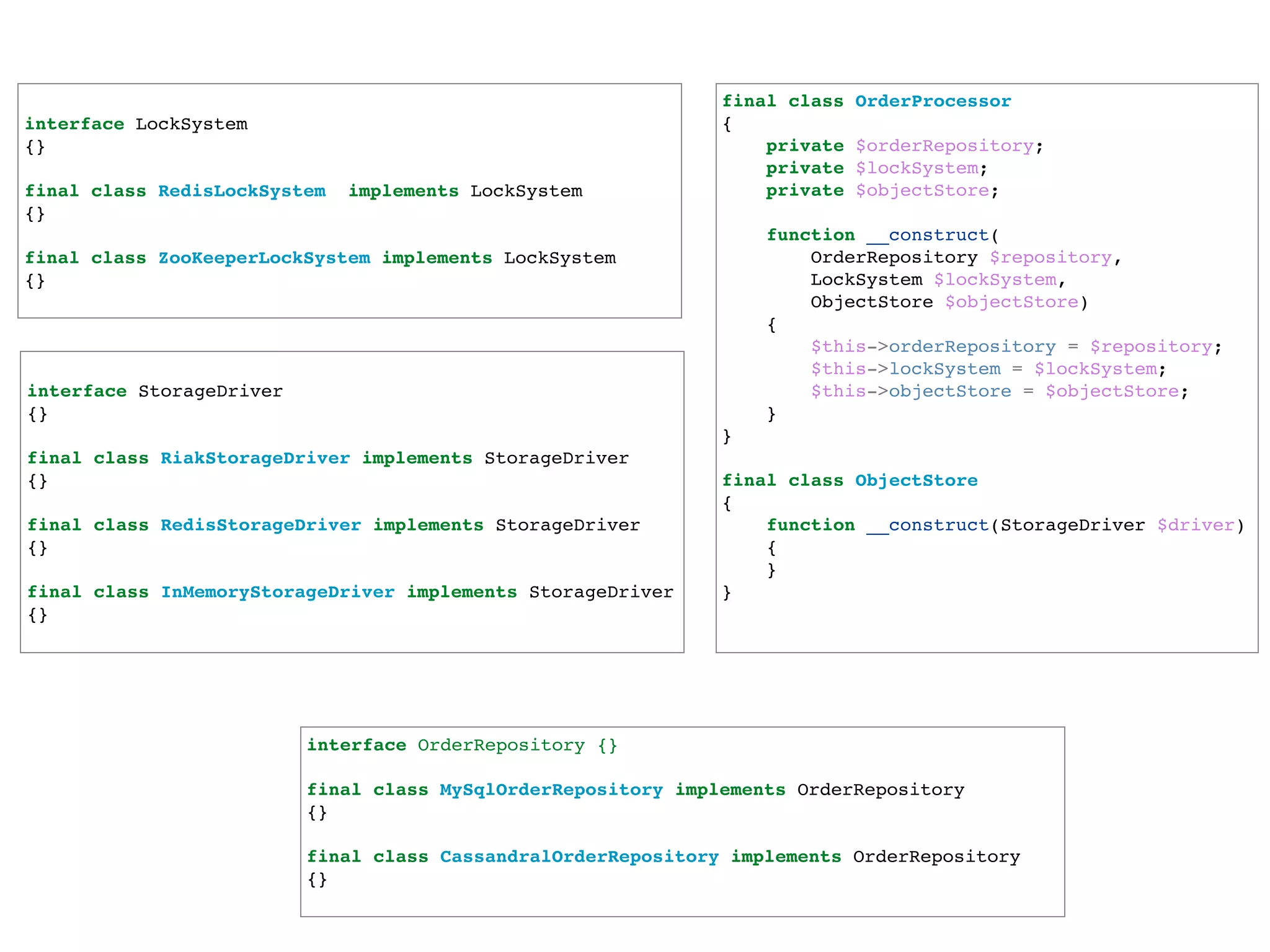
final class OrderProcessor!
{!
private $orderRepository;!
private $lockSystem;!
private $objectStore;!
!
function __construct(!
! ! OrderRepository $repository, !
! ! LockSystem $lockSystem, !
! ! ObjectStore $objectStore)!
{!
$this->orderRepository = $repository;!
$this->lockSystem = $lockSystem;!
$this->objectStore = $objectStore;!
}!
}!
!
final class ObjectStore!
{!
function __construct(StorageDriver $driver)!
{!
}!
}!
!
!
interface StorageDriver !
{}!
!
final class RiakStorageDriver implements StorageDriver!
{}!
!
final class RedisStorageDriver implements StorageDriver!
{}!
!
final class InMemoryStorageDriver implements StorageDriver!
{}!
!
interface LockSystem !
{}!
!
final class RedisLockSystem implements LockSystem!
{}!
!
final class ZooKeeperLockSystem implements LockSystem!
{}!
interface OrderRepository {}!
!
final class MySqlOrderRepository implements OrderRepository!
{}!
!
final class CassandralOrderRepository implements OrderRepository!
{}!
services:!
! order_processor:!
! ! class: OrderProcessor!
arguments:!
! ! ! object_store: @object_store!
! ! ! order_repository: [mysql|cassandra] !
! ! ! lock_system: [redis|zookeeper]!
! ! ! !
!
! object_store:!
! ! class: ObjectStore!
! ! arguments:!
! ! storage_driver: [riak|redis|inmemory]!
MySqlOrderRepository
CassandraOrderRepository
RedisLockSystem
ZooKeeperLockSystem
RedisStorageDriver
InMemoryStorageDriver
RiakStorageDriver
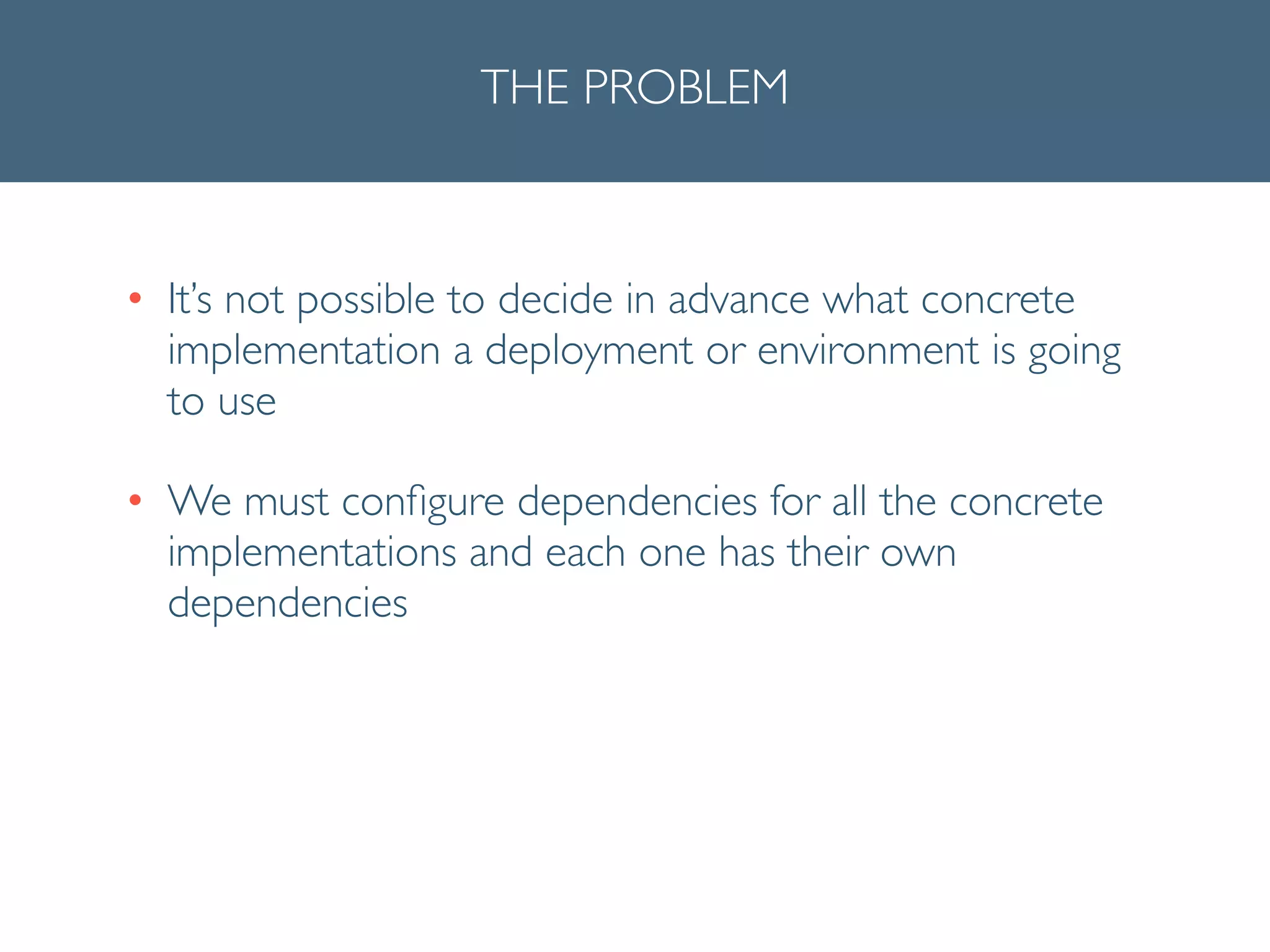
THE PROBLEM
• It’s not possible to decide in advance what concrete
implementation a deployment or environment is going
to use	

• We must configure dependencies for all the concrete
implementations and each one has their own
dependencies
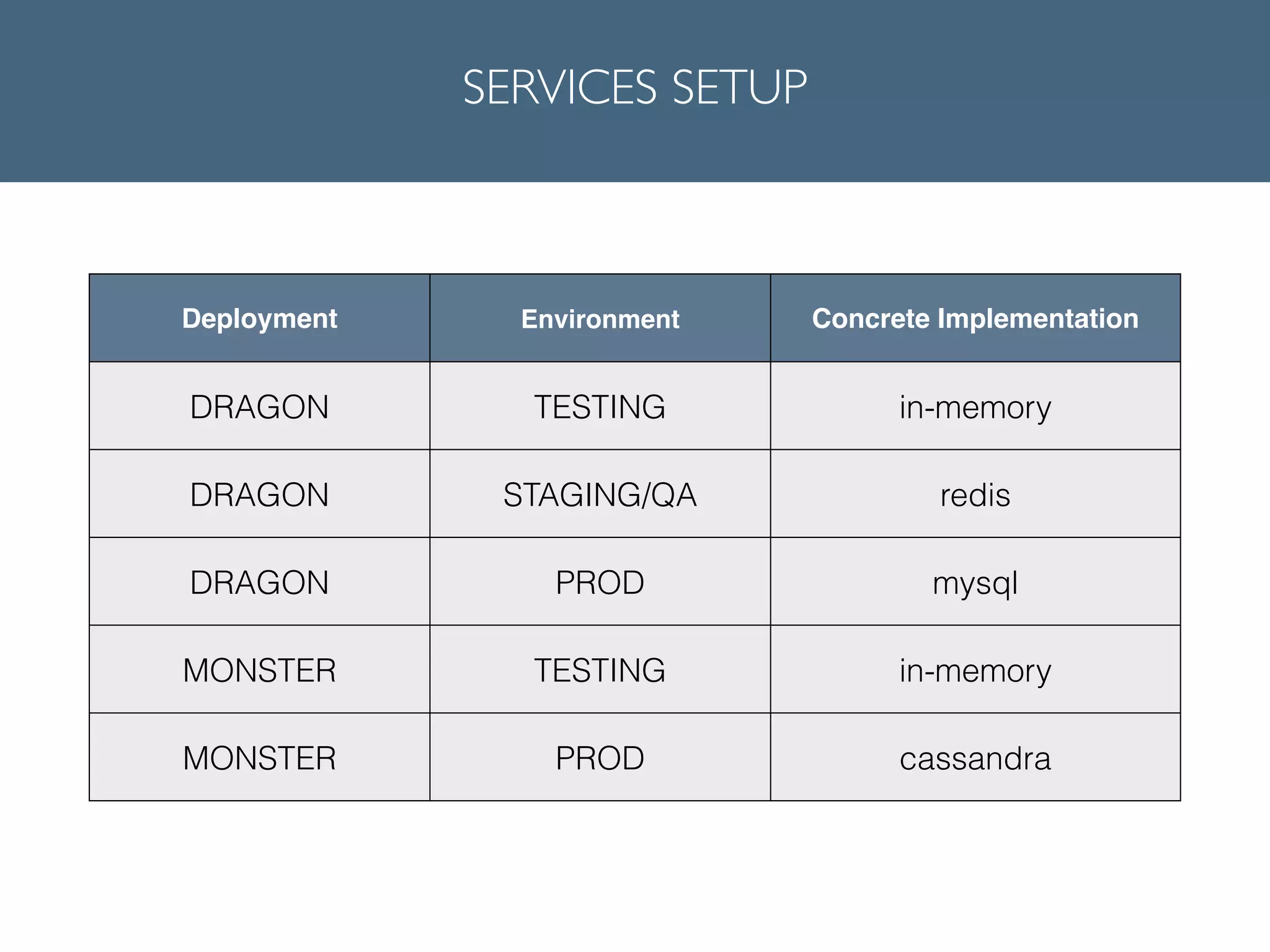
SERVICES SETUP
Deployment Environment Concrete Implementation
DRAGON TESTING in-memory
DRAGON STAGING/QA redis
DRAGON PROD mysql
MONSTER TESTING in-memory
MONSTER PROD cassandra
SOLUTIONS
1. Loading different configurations depending on the
environment and aliasing services	

2. Using synthetic services and aliases	

3. Managing semantic configuration with extensions	

4. Using a custom injector
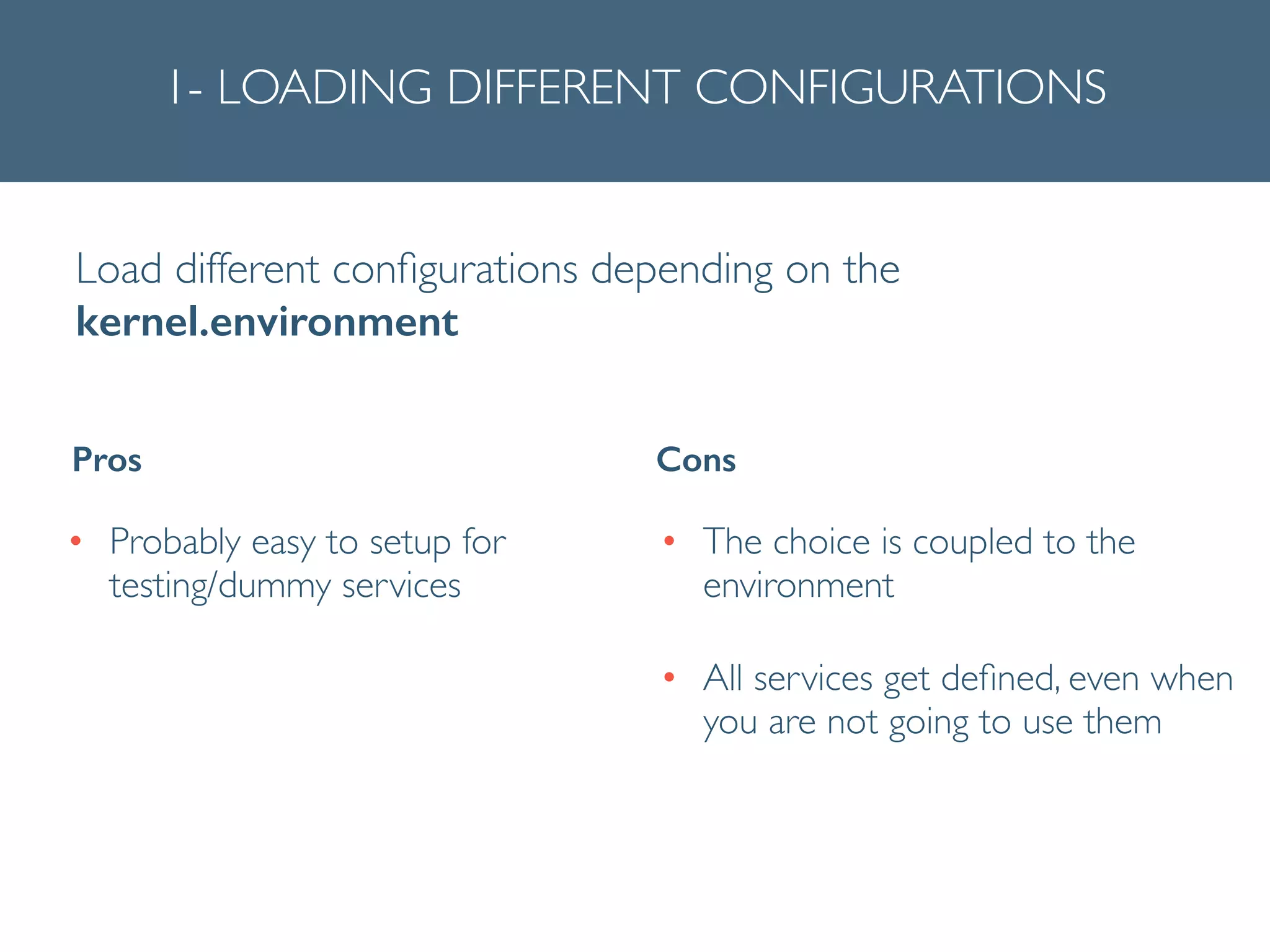
1- LOADING DIFFERENT CONFIGURATIONS
Load different configurations depending on the
kernel.environment
• Probably easy to setup for
testing/dummy services
Pros Cons
• The choice is coupled to the
environment	

• All services get defined, even when
you are not going to use them
!
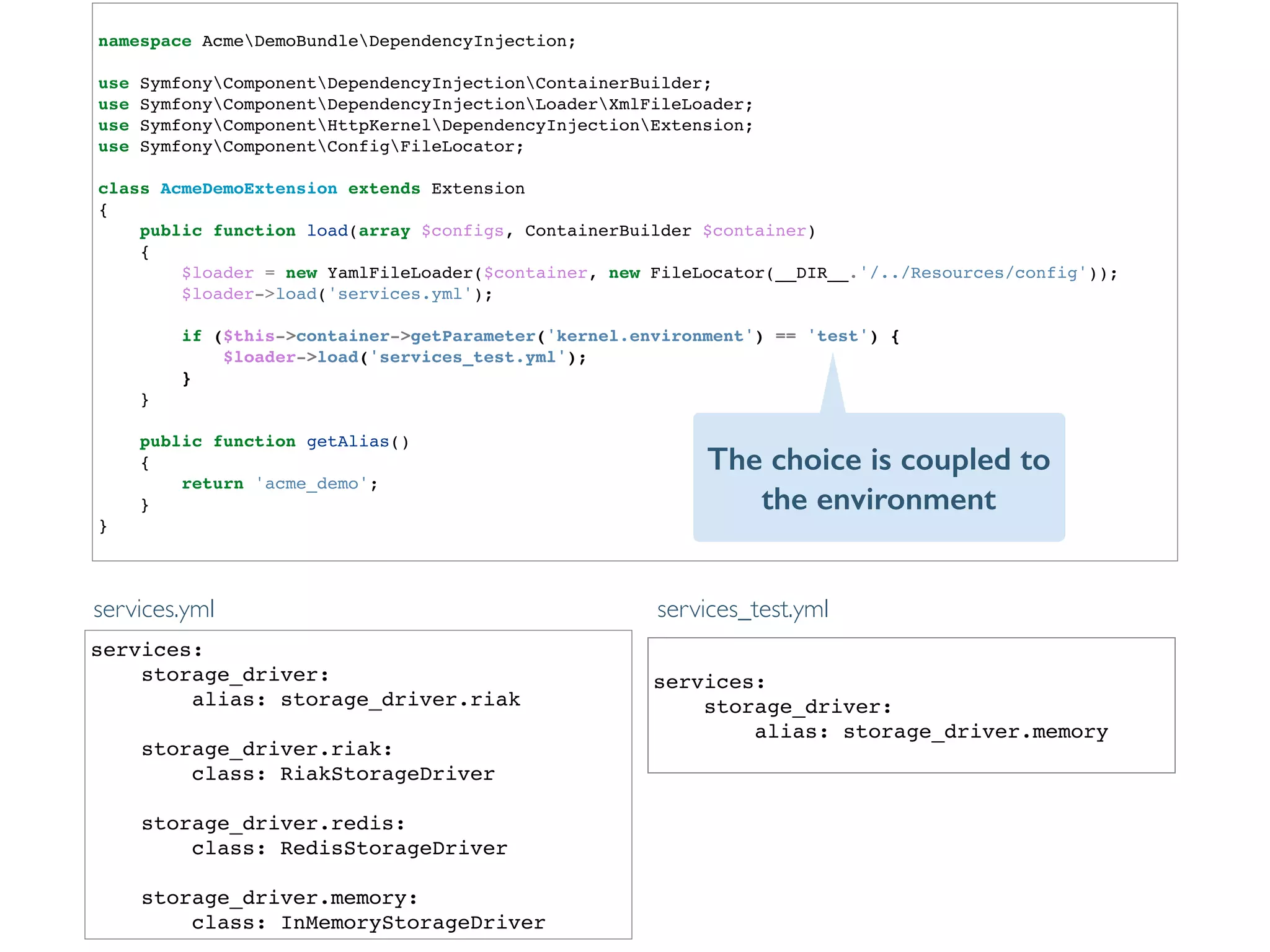
namespace AcmeDemoBundleDependencyInjection;!
!
use SymfonyComponentDependencyInjectionContainerBuilder;!
use SymfonyComponentDependencyInjectionLoaderXmlFileLoader;!
use SymfonyComponentHttpKernelDependencyInjectionExtension;!
use SymfonyComponentConfigFileLocator;!
!
class AcmeDemoExtension extends Extension!
{!
public function load(array $configs, ContainerBuilder $container)!
{!
$loader = new YamlFileLoader($container, new FileLocator(__DIR__.'/../Resources/config'));!
$loader->load('services.yml');!
!
if ($this->container->getParameter('kernel.environment') == 'test') {!
$loader->load('services_test.yml');!
}!
}!
!
public function getAlias()!
{!
return 'acme_demo';!
}!
}!
services:!
storage_driver:!
alias: storage_driver.riak!
!
storage_driver.riak:!
class: RiakStorageDriver!
!
storage_driver.redis:!
class: RedisStorageDriver!
!
storage_driver.memory:!
class: InMemoryStorageDriver
!
services:!
storage_driver:!
alias: storage_driver.memory!
services.yml services_test.yml
The choice is coupled to
the environment
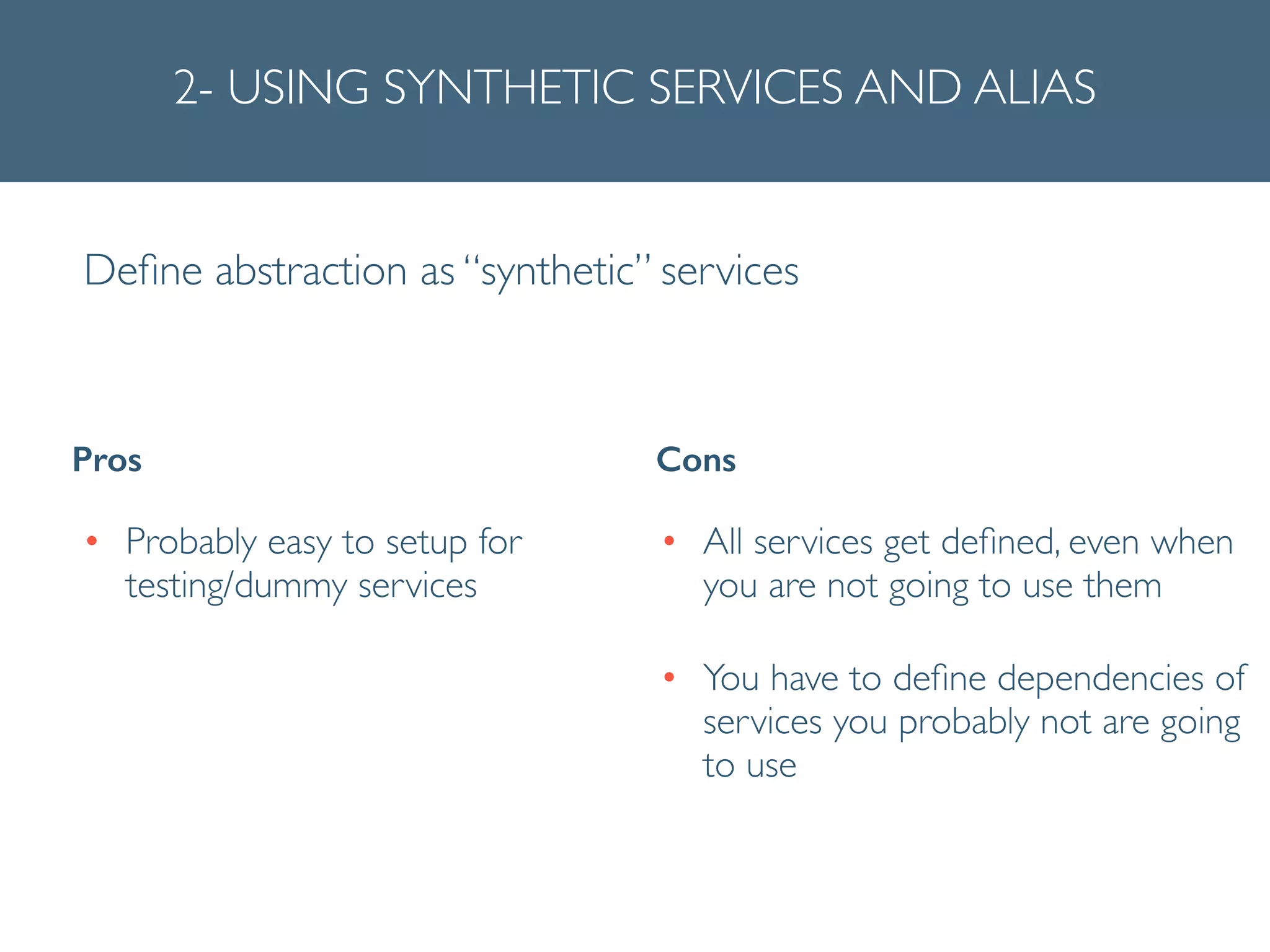
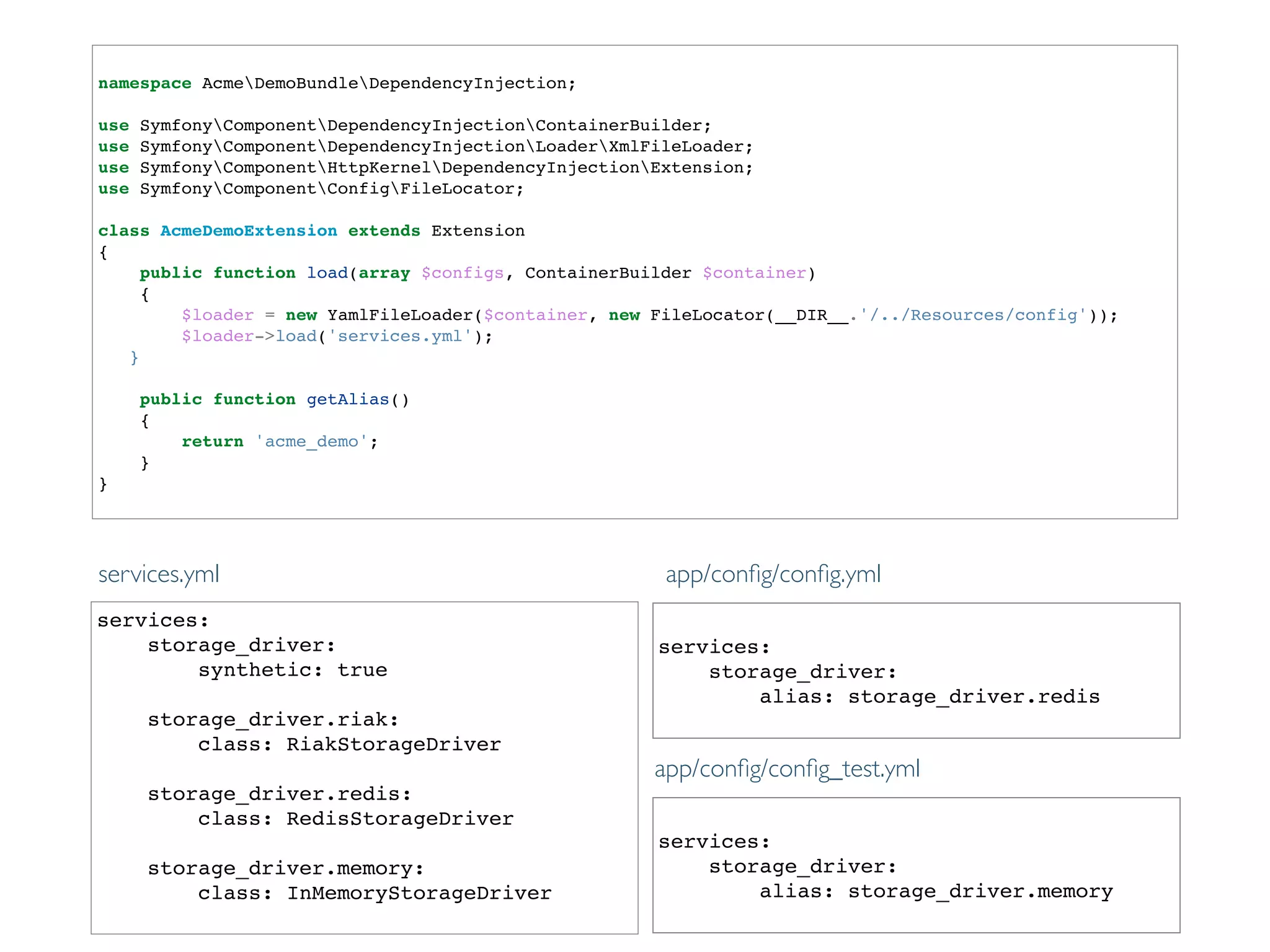
2- USING SYNTHETIC SERVICES AND ALIAS
Define abstraction as “synthetic” services
• Probably easy to setup for
testing/dummy services
Pros Cons
• All services get defined, even when
you are not going to use them	

• You have to define dependencies of
services you probably not are going
to use
!
namespace AcmeDemoBundleDependencyInjection;!
!
use SymfonyComponentDependencyInjectionContainerBuilder;!
use SymfonyComponentDependencyInjectionLoaderXmlFileLoader;!
use SymfonyComponentHttpKernelDependencyInjectionExtension;!
use SymfonyComponentConfigFileLocator;!
!
class AcmeDemoExtension extends Extension!
{!
public function load(array $configs, ContainerBuilder $container)!
{!
$loader = new YamlFileLoader($container, new FileLocator(__DIR__.'/../Resources/config'));!
$loader->load('services.yml');!
}!
!
public function getAlias()!
{!
return 'acme_demo';!
}!
}!
services:!
storage_driver:!
synthetic: true!
!
storage_driver.riak:!
class: RiakStorageDriver!
!
storage_driver.redis:!
class: RedisStorageDriver!
!
storage_driver.memory:!
class: InMemoryStorageDriver!
!
services:!
storage_driver:!
alias: storage_driver.redis!
services.yml app/config/config.yml
!
services:!
storage_driver:!
alias: storage_driver.memory!
app/config/config_test.yml
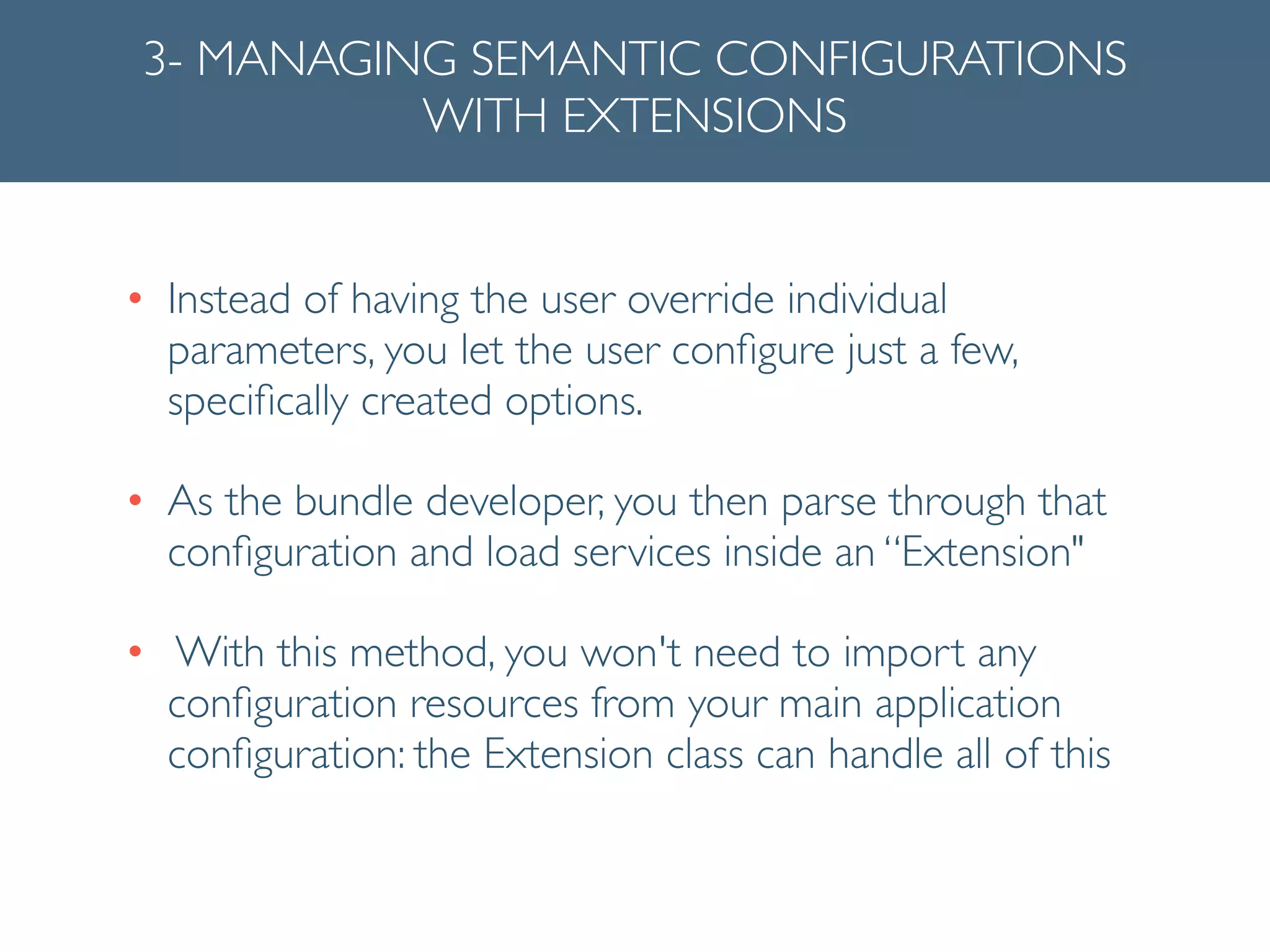
3- MANAGING SEMANTIC CONFIGURATIONS
WITH EXTENSIONS
• Instead of having the user override individual
parameters, you let the user configure just a few,
specifically created options.	

• As the bundle developer, you then parse through that
configuration and load services inside an “Extension"	

• With this method, you won't need to import any
configuration resources from your main application
configuration: the Extension class can handle all of this
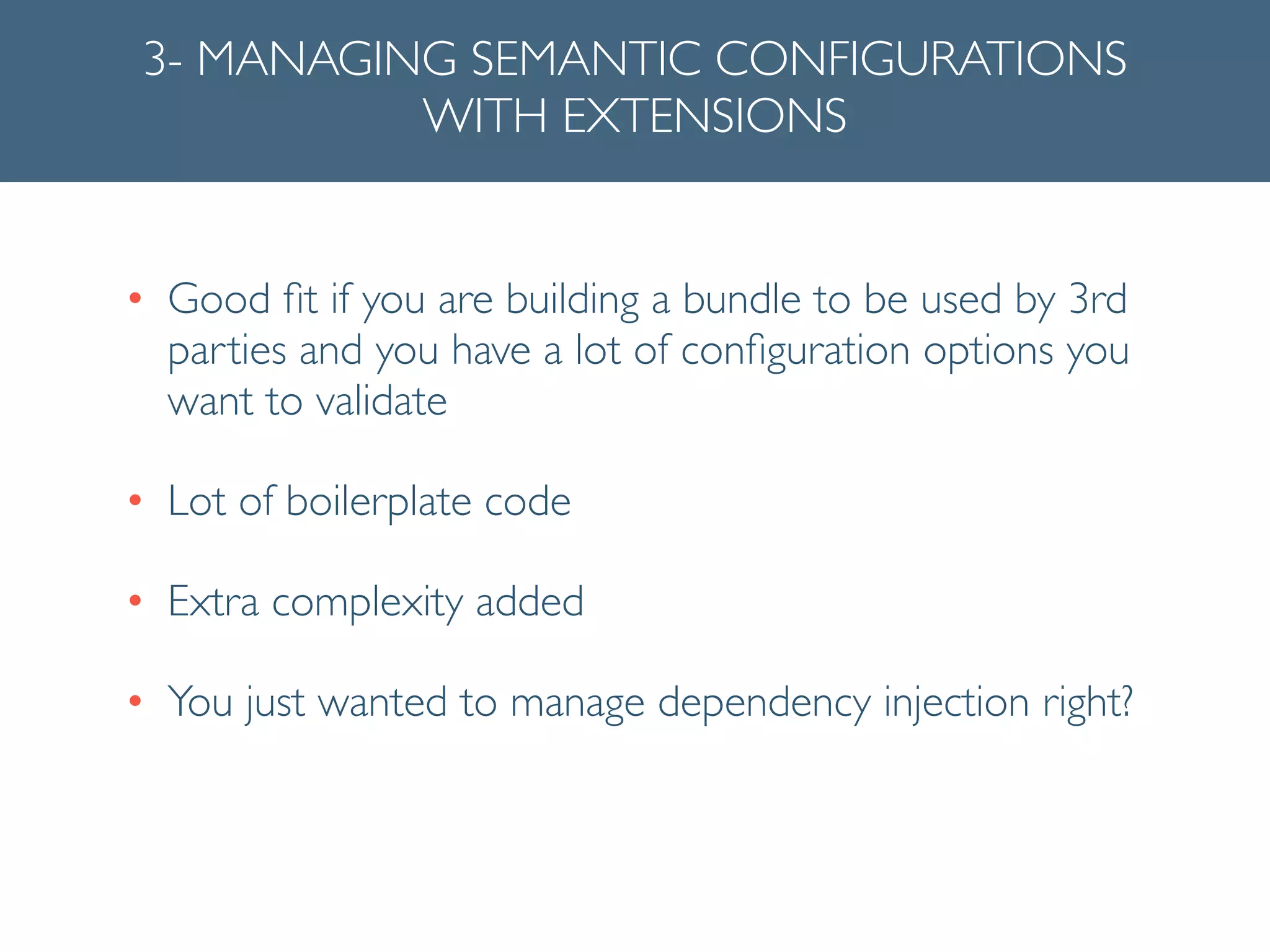
3- MANAGING SEMANTIC CONFIGURATIONS
WITH EXTENSIONS
• Good fit if you are building a bundle to be used by 3rd
parties and you have a lot of configuration options you
want to validate	

• Lot of boilerplate code	

• Extra complexity added	

• You just wanted to manage dependency injection right?
class Configuration implements ConfigurationInterface!
{!
protected function addObjectStoreSection(ArrayNodeDefinition $rootNode)!
{!
$rootNode!
->children()!
->arrayNode('object_store')!
->isRequired()!
->children()!
->arrayNode('store_driver')!
->children()!
->scalarNode('type')->isRequired()->end()!
->scalarNode('connection')->end()!
->scalarNode('create_buckets')->end()!
->end()!
->validate()!
->ifTrue(function ($v) {!
switch ($v['type']) {!
case 'doctrine_dbal':!
if (!isset($v['connection']) ||!
!isset($v['create_buckets'])) {!
return true;!
}!
break;!
}!
!
return false;!
})!
->thenInvalid('children configuration')!
->end()!
->isRequired()!
->end()!
->end()!
->end();!
}!
}
!
$definition = $container->getDefinition($storageDriver);!
switch ($config['storage_driver']['type']) {!
case 'doctrine_dbal':!
$definition->replaceArgument(0, new Reference($config['storage_driver']['connection']));!
$definition->replaceArgument(1, $config['storage_driver']['create_buckets']);!
break;!
case 'redis':!
$definition->replaceArgument(0, new Reference($config['storage_driver']['connection']));!
break;!
}!
!
$container->setAlias('object_storage.driver', $storageDriver);!
Configuration
Extension
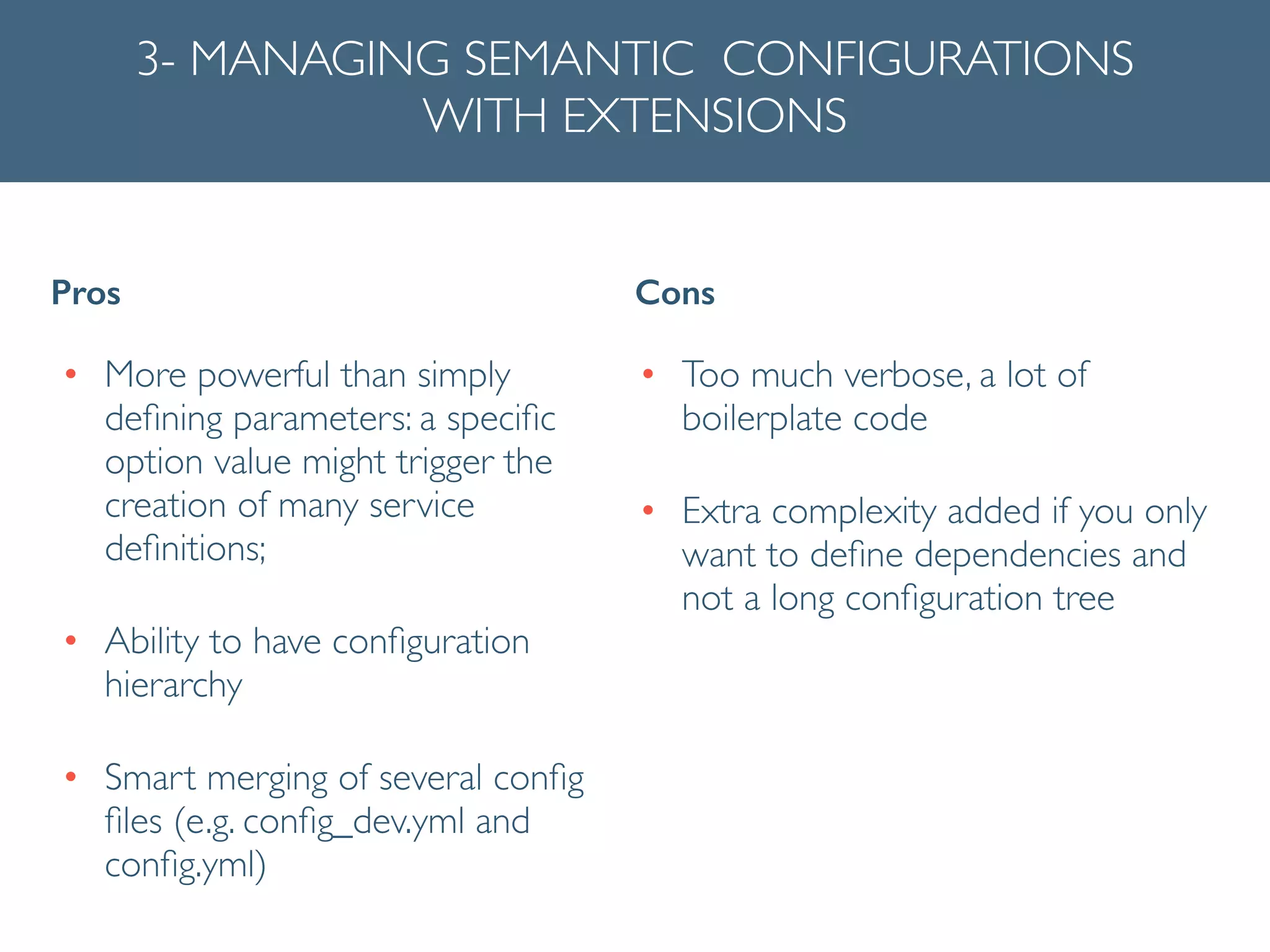
3- MANAGING SEMANTIC CONFIGURATIONS
WITH EXTENSIONS
• More powerful than simply
defining parameters: a specific
option value might trigger the
creation of many service
definitions;	

• Ability to have configuration
hierarchy	

• Smart merging of several config
files (e.g. config_dev.yml and
config.yml)
Pros Cons
• Too much verbose, a lot of
boilerplate code	

• Extra complexity added if you only
want to define dependencies and
not a long configuration tree	

!
4- USING A CUSTOM INJECTOR
• Let’s forget the Symfony DIC for a moment	

• Let’s go back to dependency management problem
again
services:!
! order_processor:!
! ! class: OrderProcessor!
arguments:!
! ! ! object_store: @object_store!
! ! ! order_repository: [mysql|cassandra] !
! ! ! lock_system: [redis|zookeeper]!
! ! ! !
!
! object_store:!
! ! class: ObjectStore!
! ! arguments:!
! ! storage_driver: [riak|redis|inmemory]!
MySqlOrderRepository
CassandraOrderRepository
RedisLockSystem
ZooKeeperLockSystem
RedisStorageDriver
InMemoryStorageDriver
RiakStorageDriver
“A good architecture allows
you to defer critical decisions,
it doesn’t force you to defer
them. 	

However, if you can defer
them, it means you have lots
of flexibility”	

!
Uncle Bob
“A good architecture allows
volatile decisions to be easily
changed”	

!
Uncle Bob
services:!
! order_processor:!
! ! class: OrderProcessor!
arguments:!
! ! ! object_store: @object_store!
! ! ! order_repository: [mysql|cassandra] !
! ! ! lock_system: [redis|zookeeper]!
! ! ! !
!
! object_store:!
! ! class: ObjectStore!
! ! arguments:!
! ! storage_driver: [riak|redis|inmemory]!
MySqlOrderRepository
CassandraOrderRepository
RedisLockSystem
ZooKeeperLockSystem
RedisStorageDriver
InMemoryStorageDriver
RiakStorageDriver
We need a dependency injection
tool that allow us to easily change
volatile decisions
We need a dependency injection
tool that allow us to defer critical
decisions
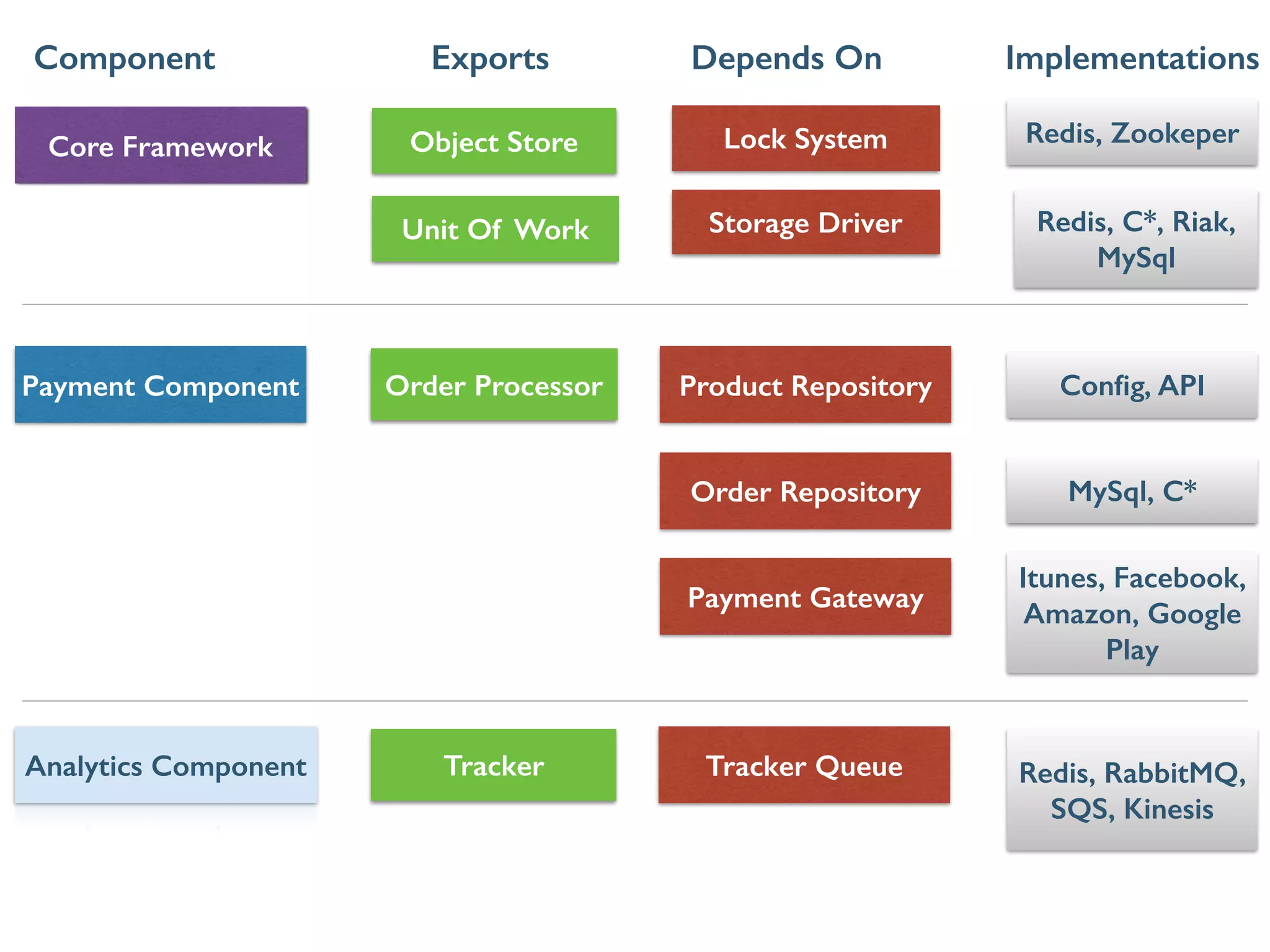
Core Framework
Payment Component
Analytics Component
Object Store Lock System
Component Exports Depends On
Unit Of Work Storage Driver
Order Processor Product Repository
Order Repository
Payment Gateway
Tracker Tracker Queue
Implementations
Redis, Zookeper
Redis, C*, Riak,
MySql
Config, API
MySql, C*
Itunes, Facebook,
Amazon, Google
Play
Redis, RabbitMQ,
SQS, Kinesis
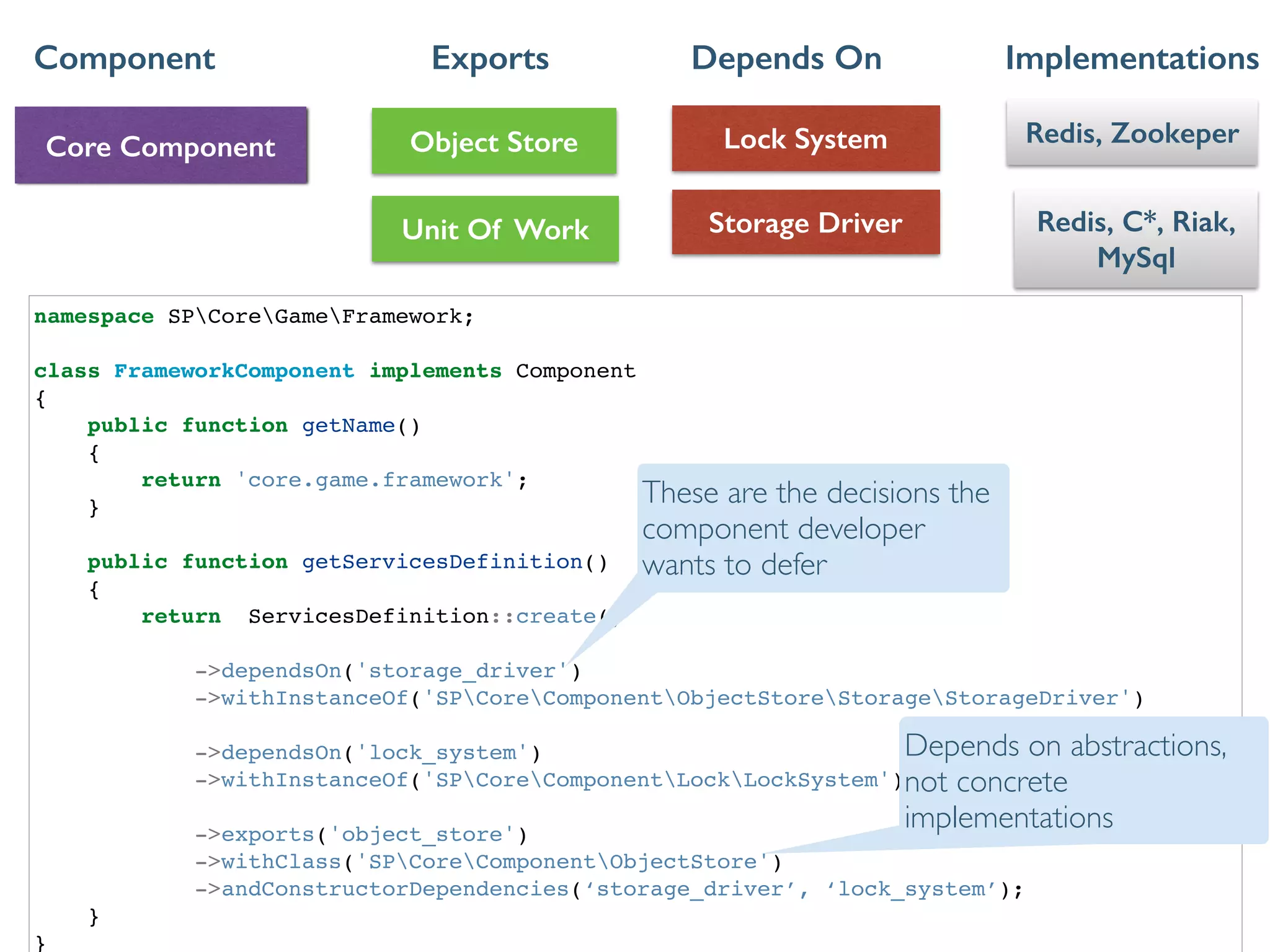
Core Component Object Store Lock System
Component Exports Depends On
Unit Of Work Storage Driver
Implementations
Redis, Zookeper
Redis, C*, Riak,
MySql
namespace SPCoreGameFramework;!
!
class FrameworkComponent implements Component!
{!
public function getName()!
{!
return 'core.game.framework';!
}!
!
public function getServicesDefinition()!
{!
return ServicesDefinition::create()!
!
->dependsOn('storage_driver')!
->withInstanceOf('SPCoreComponentObjectStoreStorageStorageDriver')!
!
->dependsOn('lock_system')!
->withInstanceOf('SPCoreComponentLockLockSystem')!
!
->exports('object_store')!
->withClass('SPCoreComponentObjectStore')!
->andConstructorDependencies(‘storage_driver’, ‘lock_system’);!
}!
}
These are the decisions the
component developer
wants to defer
Depends on abstractions,
not concrete
implementations
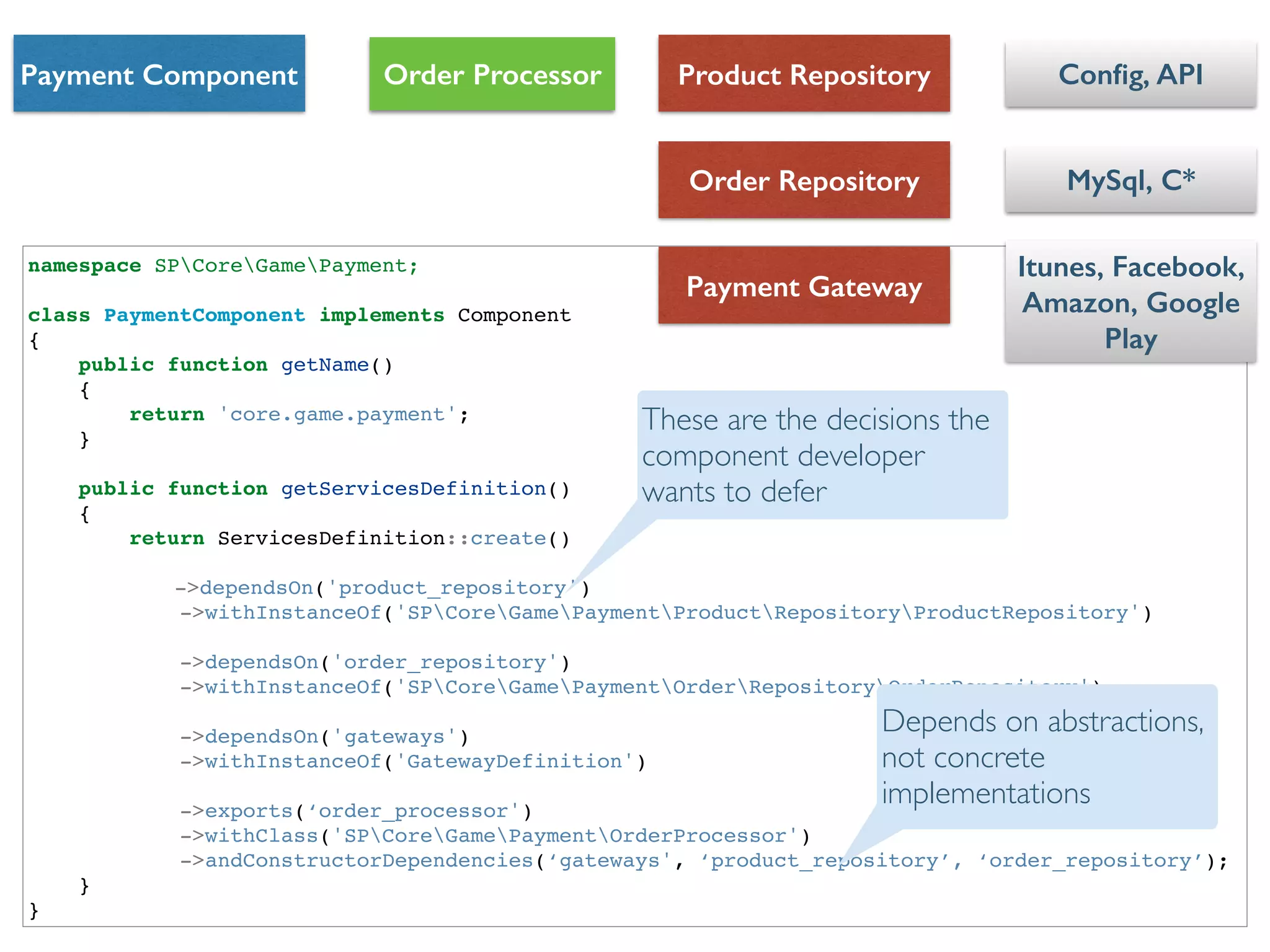
Payment Component Order Processor Product Repository
Order Repository
Config, API
MySql, C*
namespace SPCoreGamePayment;!
!
class PaymentComponent implements Component!
{!
public function getName()!
{!
return 'core.game.payment';!
}!
!
public function getServicesDefinition()!
{!
return ServicesDefinition::create()!
!
! ! ! ->dependsOn('product_repository')!
->withInstanceOf('SPCoreGamePaymentProductRepositoryProductRepository')!
!
->dependsOn('order_repository')!
->withInstanceOf('SPCoreGamePaymentOrderRepositoryOrderRepository')!
!
->dependsOn('gateways')!
->withInstanceOf('GatewayDefinition')!
!
->exports(‘order_processor')!
->withClass('SPCoreGamePaymentOrderProcessor')!
->andConstructorDependencies(‘gateways', ‘product_repository’, ‘order_repository’);!
}!
}
Itunes, Facebook,
Amazon, Google
Play
Payment Gateway
These are the decisions the
component developer
wants to defer
Depends on abstractions,
not concrete
implementations
WHERE DOESTHE MAGIC COME FROM?
• There is not such “magic”	

• Each component define it’s dependencies in a easy and
legible way	

• Framework agnostic dependency definition	

• Based on the dependency definitions, services are
added to the container during the container building
phase
HOW?
• First, collect services definitions from installed
components	

• Second, inject services definitions into the Symfony (or
Silex, or…) container	

• No magic, just code !!!
USING SYMFONY
• Collect services definitions from installed components	

• Inject services definitions into the Symfony (or Silex,
or…) container
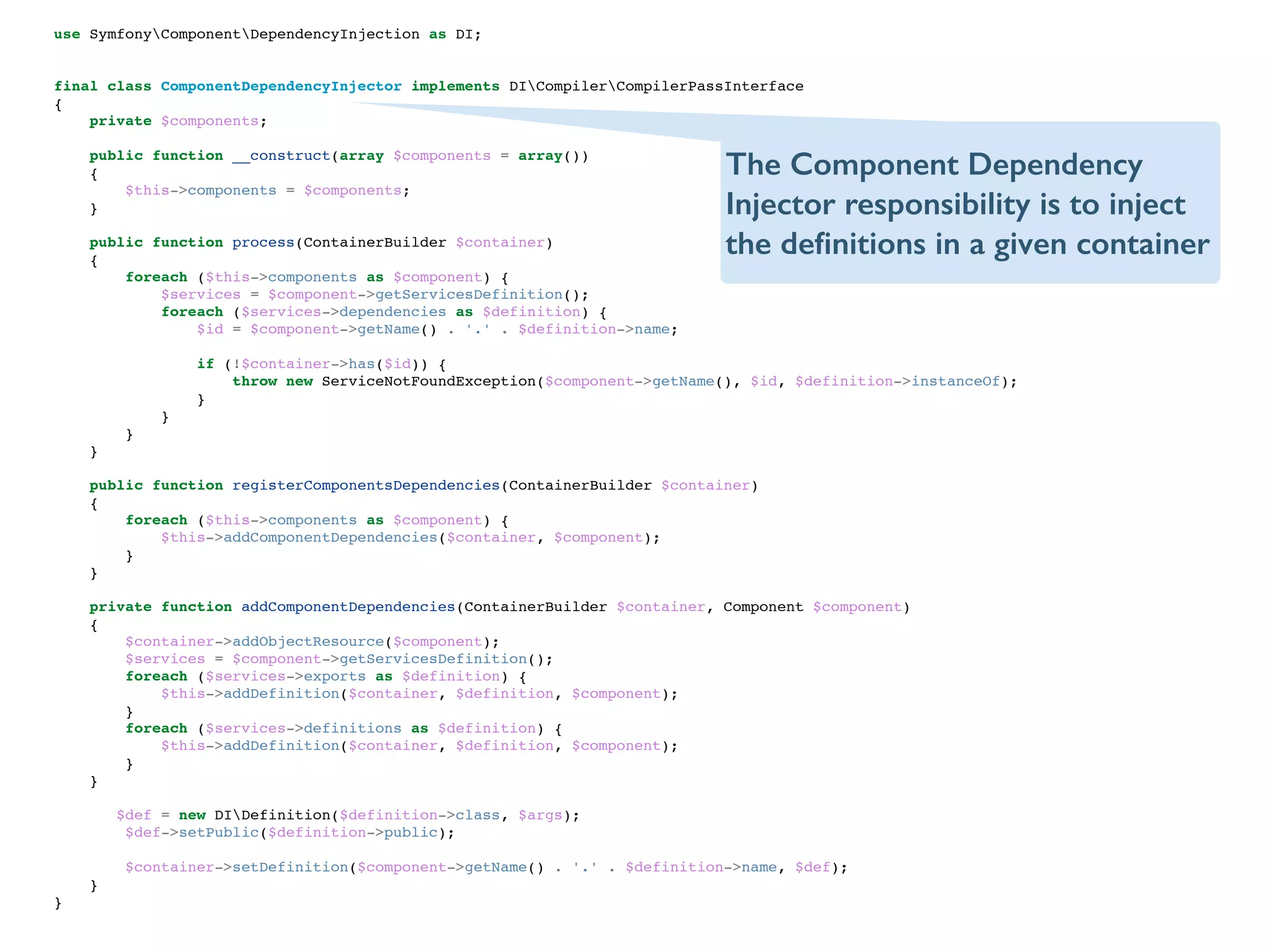
use SymfonyComponentDependencyInjection as DI;!
!
!
final class ComponentDependencyInjector implements DICompilerCompilerPassInterface!
{!
private $components;!
!
public function __construct(array $components = array())!
{!
$this->components = $components;!
}!
!
public function process(ContainerBuilder $container)!
{!
foreach ($this->components as $component) {!
$services = $component->getServicesDefinition();!
foreach ($services->dependencies as $definition) {!
$id = $component->getName() . '.' . $definition->name;!
!
if (!$container->has($id)) {!
throw new ServiceNotFoundException($component->getName(), $id, $definition->instanceOf);!
}!
}!
}!
}!
!
public function registerComponentsDependencies(ContainerBuilder $container)!
{!
foreach ($this->components as $component) {!
$this->addComponentDependencies($container, $component);!
}!
}!
!
private function addComponentDependencies(ContainerBuilder $container, Component $component)!
{!
$container->addObjectResource($component);!
$services = $component->getServicesDefinition();!
foreach ($services->exports as $definition) {!
$this->addDefinition($container, $definition, $component);!
}!
foreach ($services->definitions as $definition) {!
$this->addDefinition($container, $definition, $component);!
}!
}!
!
$def = new DIDefinition($definition->class, $args);!
$def->setPublic($definition->public);!
!
$container->setDefinition($component->getName() . '.' . $definition->name, $def);!
}!
}!
The Component Dependency
Injector responsibility is to inject
the definitions in a given container
use SymfonyComponentHttpKernelKernel;!
use SymfonyComponentConfigLoaderLoaderInterface;!
!
class AppKernel extends Kernel!
{!
public function registerBundles()!
{!
$bundles = array(!
new SymfonyBundleFrameworkBundleFrameworkBundle(),!
new SymfonyBundleMonologBundleMonologBundle(),!
!
new SPCoreBundleGameFrameworkBundleGameFrameworkBundle([!
new SPCoreGameFrameworkFrameworkComponent(),!
new SPCoreGameFrameworkPaymentComponent(),!
new SPCoreGameFrameworkAnalyticsComponent(),!
]),!
);!
}!
}!
The AppKernel
These are the framework agnostic components that
provide infrastructure and logic for the application
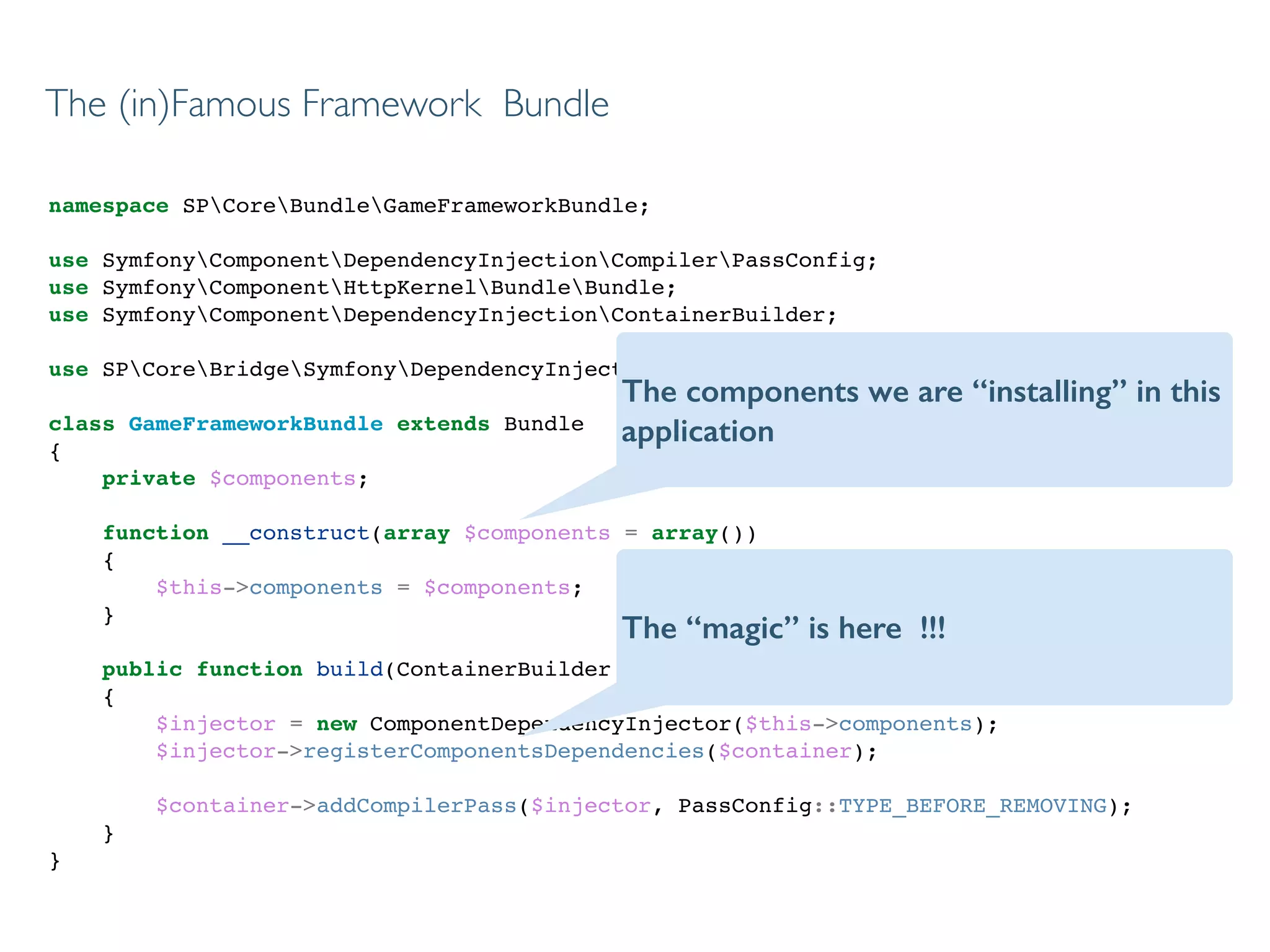
namespace SPCoreBundleGameFrameworkBundle;!
!
use SymfonyComponentDependencyInjectionCompilerPassConfig;!
use SymfonyComponentHttpKernelBundleBundle;!
use SymfonyComponentDependencyInjectionContainerBuilder;!
!
use SPCoreBridgeSymfonyDependencyInjectionComponentDependencyInjector;!
!
class GameFrameworkBundle extends Bundle!
{!
private $components;!
!
function __construct(array $components = array())!
{!
$this->components = $components;!
}!
!
public function build(ContainerBuilder $container)!
{!
$injector = new ComponentDependencyInjector($this->components);!
$injector->registerComponentsDependencies($container);!
!
$container->addCompilerPass($injector, PassConfig::TYPE_BEFORE_REMOVING);!
}!
}!
The (in)Famous Framework Bundle
The components we are “installing” in this
application
The “magic” is here !!!
[SPCoreBridgeSymfonyDependencyInjectionExceptionServiceNotFoundException]
Component "core.game.framework" requires the service
"core.game.framework.lock_system" as an implementation of "SPCoreComponentLock
LockSystem" but the service is not defined.
[SPCoreBridgeSymfonyDependencyInjectionExceptionServiceNotFoundException]
Component "core.game.payment" requires the service
“core.game.payment.product_repository” as an implementation of "ProductRepository" but
the service is not defined.
$ php app/console
The application complains about
missing dependencies required
by installed components
We are planning to add
suggested implementations for
this requirement
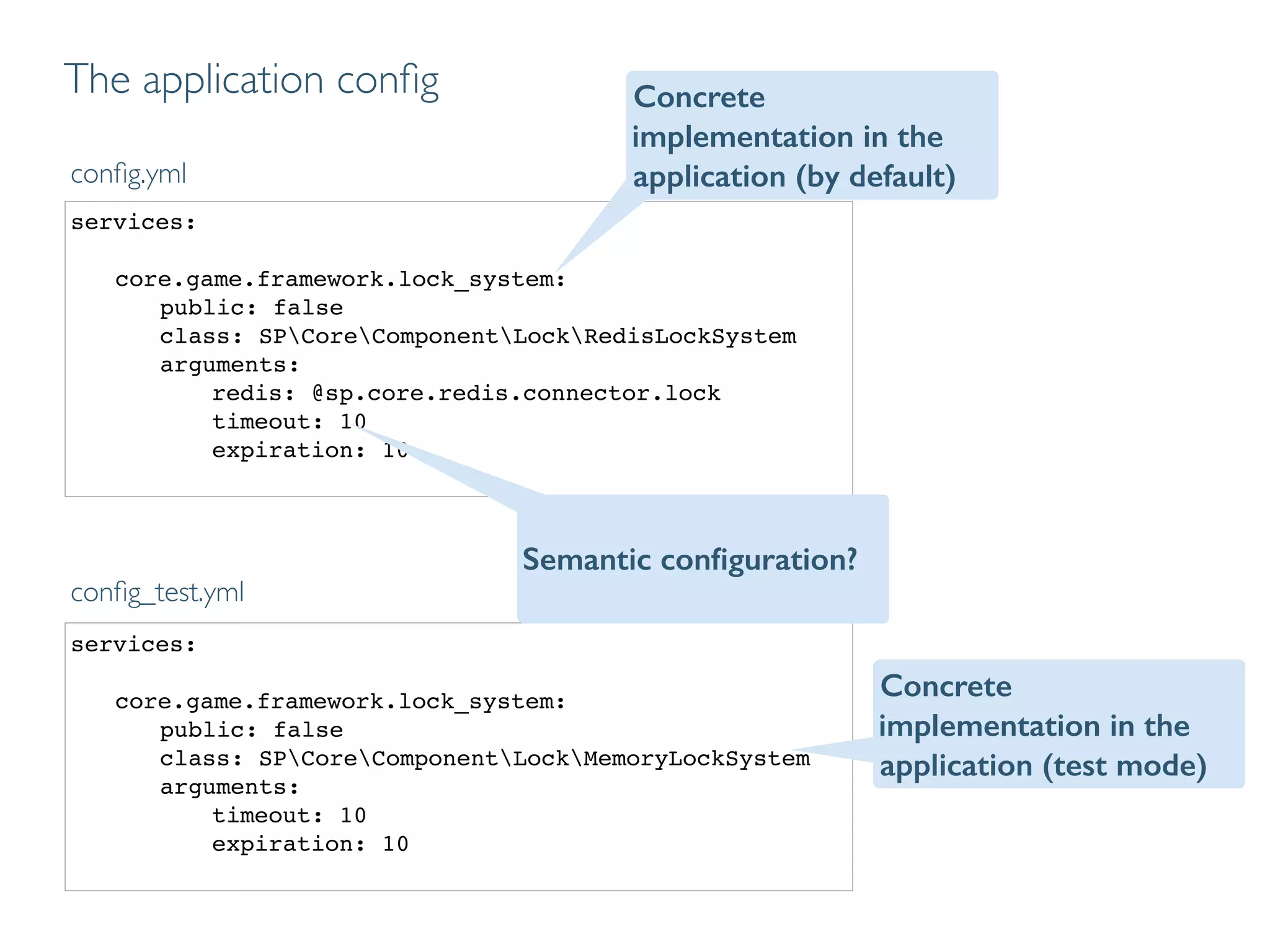
services:!
!
! core.game.framework.lock_system:!
! ! public: false!
! ! class: SPCoreComponentLockRedisLockSystem!
! ! arguments:!
redis: @sp.core.redis.connector.lock!
timeout: 10!
expiration: 10!
config.yml
services:!
!
! core.game.framework.lock_system:!
! ! public: false!
! ! class: SPCoreComponentLockMemoryLockSystem!
! ! arguments:!
timeout: 10!
expiration: 10!
config_test.yml
The application config Concrete
implementation in the
application (by default)
Semantic configuration?
Concrete
implementation in the
application (test mode)
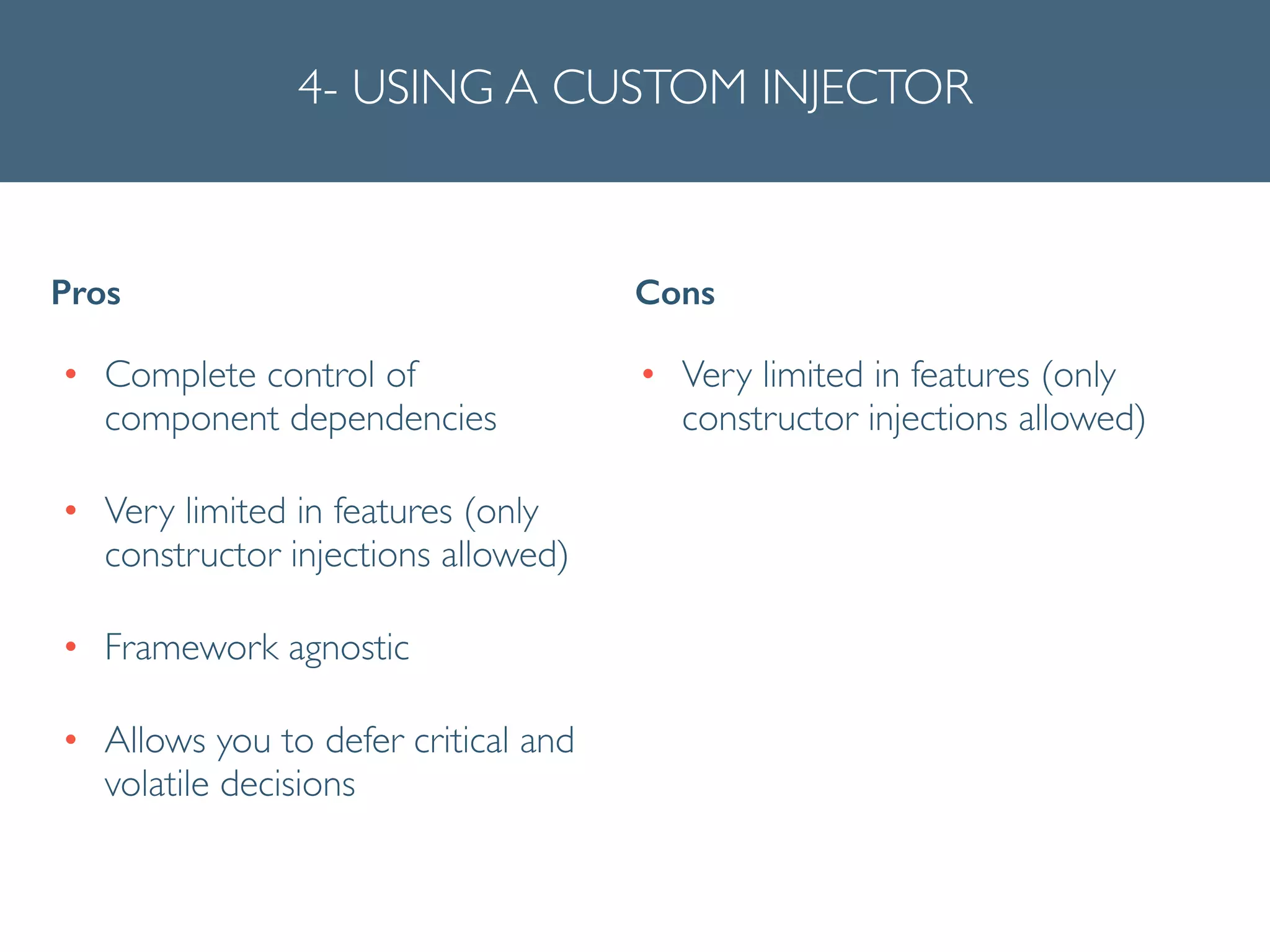
4- USING A CUSTOM INJECTOR
• Complete control of
component dependencies	

• Very limited in features (only
constructor injections allowed)	

• Framework agnostic	

• Allows you to defer critical and
volatile decisions
Pros Cons
• Very limited in features (only
constructor injections allowed)	

!
!
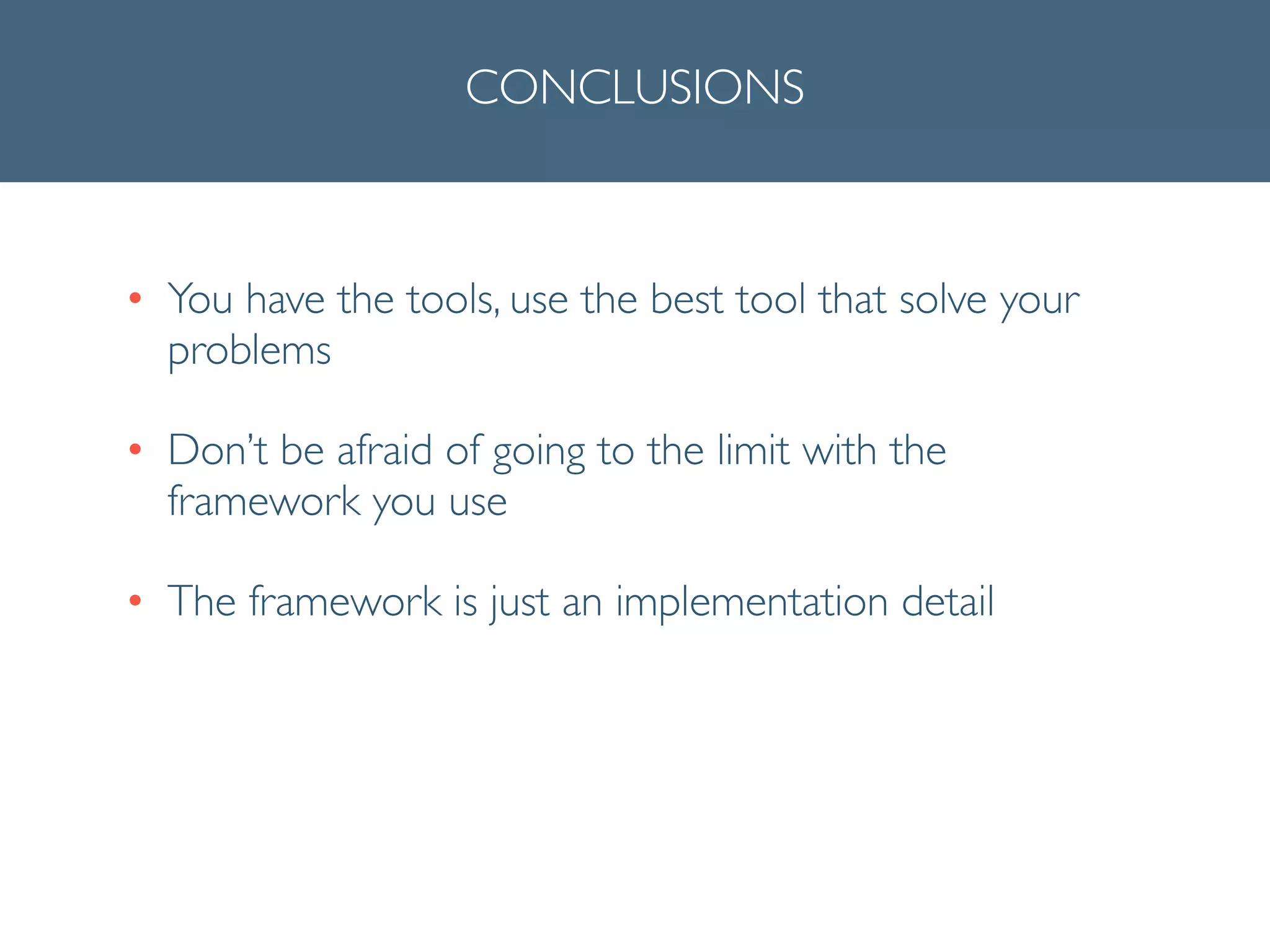
CONCLUSIONS
• You have the tools, use the best tool that solve your
problems	

• Don’t be afraid of going to the limit with the
framework you use	

• The framework is just an implementation detail
SOME REFERENCES
http://www.objectmentor.com/resources/articles/dip.pdf
!
http://www.martinfowler.com/articles/injection.html
!
http://martinfowler.com/articles/dipInTheWild.html
!
http://desymfony.com/ponencia/2013/inyeccion-dependencias-aplicaciones-php
!
http://fabien.potencier.org/article/11/what-is-dependency-injection
!
http://fabien.potencier.org/article/12/do-you-need-a-dependency-injection-container
!
http://fabien.potencier.org/article/13/introduction-to-the-symfony-service-container
!
https://www.youtube.com/watch?v=IKD2-MAkXyQ
!
http://richardmiller.co.uk/2014/03/12/avoiding-setter-injection/
!
http://richardmiller.co.uk/2014/03/28/symfony2-configuring-different-services-for-different-environments/
!
http://www.infoq.com/news/2013/07/architecture_intent_frameworks
!
http://blog.8thlight.com/uncle-bob/2012/08/13/the-clean-architecture.html
!
THANK YOU
For your attention
@ronnylt

DIC To The Limit – deSymfonyDay, Barcelona 2014

  • 1.
  • 3.
    Ronny López ABOUT MEUS Hard way learner ! Technical Lead at Social Point Do stuff atTangoTree in the nights ! @ronnylt
 www.tangotree.io
 https://github.com/ronnylt
  • 4.
    AGENDA • The problems •Dependency Injection • Coupling done right • Dependency Inversion Principle • Types of DI • Dependency Injection Containers • Symfony Dependency Injection Container • Interchangeable Services
  • 5.
    THE PROBLEMS • Werequire to switch out data access layer without compromising all the other parts of the application • We need to use different implementations in different deployments (dragon game, monster game, etc…) • We wish to deploy the application in different environments (testing, integration, staging, production, etc…) • We need different configurations in each environment
  • 6.
    YAGNI You aren't gonnaneed it, let’s go home!
  • 7.
    IN CASEYOU NEEDIT • You have to do Dependency Injection, correctly • You have to know and apply Dependency Inversion Principles
  • 8.
    WHAT WE REALLYWANT IS • Code that is easy to test • Clear separation of infrastructure logic from application logic • Interchangeable infrastructure
  • 9.
    WHY? • Multiple deploymentsshare parts of the same code, but each deployment has specific infrastructure needs • Multiple environments with different needs • We want to automatically test all the things • We want to go fast, and the only way to go fast is… you know…
  • 11.
    “The only wayto go fast, is to go well”
 Uncle Bob
  • 12.
  • 13.
    Dependency injection isa simple way to decouple classes from what they depend on
  • 14.
    Dependency injection decouples classes constructionfrom the construction of it’s dependencies
  • 15.
    IS IT ALLABOUT COUPLING?
  • 16.
    COUPLING Mod A ModB Mod C Mod D Tight (high, strong) Mod A Mod B Mod C Mod D Loose (low, weak) Mod A Mod B Mod C Mod D None Coupling is a measure of the independency of components/modules
  • 17.
    COUPLING • The historyof software shows that coupling is bad, but it also suggest that coupling is unavoidable • An absolutely decoupled application is useless because it adds no value • Developers can only add value by coupling things together
  • 18.
    COUPLING DONE RIGHT •Components make no assumptions about what other components do, but rely on their contracts • Use an interface to define a type and focus on what is important • Concrete implementations of the interfaces should be be instantiated outside the component
  • 19.
  • 20.
    High-level modules should notdepend on low-level modules. Both should depend on abstractions
  • 21.
    Abstractions should not dependon details. Details should depend on abstractions
  • 22.
    DEPENDENCY INVERSION • Decouplehigh level parts of the system from low level parts by using interfaces
  • 23.
  • 24.
  • 25.
    TYPES OF DI •Constructor Injection • Setter Injection • Interface Injection • Property Injection • Service Locator
  • 26.
    CONSTRUCTOR INJECTION • Injectsthe dependencies via constructor • It ensures that the choice of dependency is immutable ! class EnergyBuyCommandHandler implements CommandHandler! {! private $playerRepository;! ! private $configRepository;! ! public function __construct(! ! ! PlayerRepository $playerRepository, ! ! ! ConfigRepository $config! ! )! {! $this->playerRepository = $playerRepository;! $this->configRepository = $config;! }! }!
  • 27.
    CONSTRUCTOR INJECTION • Itensures that the choice of dependency is immutable • The constructor is only ever called once when the object is created, so you can be sure that the dependency will not change during the object's lifetime Pros Cons • It is not suitable for working with optional dependencies • Difficult to use in combination with class hierarchies
  • 28.
    CONSTRUCTOR INJECTION • Tryto always use constructor injection • If dealing with legacy code that does not support it, consider using an adapter class with constructor injection • Depends on abstractions (interfaces), not concrete implementations TIPS
  • 29.
    SETTER INJECTION • Injectthe dependencies via a setter method • The “injector” has to call the method in order to inject the dependency ! class LoggerChain implements SQLLogger! {! private $loggers = array();! ! public function setLogger(SQLLogger $logger)! {! $this->logger = $logger;! }! }!
  • 30.
    SETTER INJECTION • Works“well” with optional dependencies
 
 If you do not need the dependency, then just do not call the setter • You can call the setter multiple times.
 
 This is particularly useful if the method adds the dependency to a collection Pros Cons • Works “well” with optional dependencies 
 
 Are you sure you need optional dependencies? • You can call the setter multiple times • You are not sure if the dependency was set
  • 31.
    SETTER INJECTION TIPS • Avoidsetter injections (the choice of dependencies is not inmutable) • If you do Dependency Inversion right, probably YANGI • Remember, your classes depend on abstractions, not concrete implementations, so you can use Null or Dummy implementations when necessary
  • 32.
    SETTER INJECTION EXAMPLE use PsrLogLoggerInterface;! ! finalclass OrderProcessor! {! private $logger;! ! function __construct(. . ., LoggerInterface $logger)! {! $this->logger = $logger;! }! }! ! final class GoodManLogger implements LoggerInterface {…}! ! final class LogstarLogger implements LoggerInterface {…}! ! final class NullLogger implements LoggerInterface {…}! Instead of having a setter method to inject the logger, use constructor injection and use the appropriate logger implementation in each case
  • 33.
    INTERFACE INJECTION • Defineand use interfaces for the injection • Allows certain objects to be injected into other objects, that implement a common interface • It’s a kind of setter injection, so same pros and cons interface ContainerAwareInterface! {! public function setContainer(ContainerInterface $container = null);! }! ! class ContainerAwareEventDispatcher implements ContainerAwareInterface! {! public function setContainer(ContainerInterface $container = null)! {! }! }!
  • 34.
    PROPERTY INJECTION • Allowssetting public fields of the class directly • There are mainly only disadvantages to using property injection, it is similar to setter injection but with additional important problems ! ! class NewsletterManager! {! public $mailer;! ! // ...! }!
  • 35.
    PROPERTY INJECTION • Usefulif you are working with code that is out of your control, such as in a 3rd party library, which uses public properties for its dependencies Pros Cons • You cannot control when the dependency is set at all, it can be changed at any point in the object's lifetime • You cannot use type hinting so you cannot be sure what dependency is injected except by writing into the class code to explicitly test the class instance before using it
  • 36.
    SERVICES LOCATOR • Isan object that knows how to get all of the services that an another service might need interface CommandHandlerLocator ! {! public function locate($commandName);! }! ! ! class ContainerCommandHandlerLocator implements CommandHandlerLocator! {! private $container;! ! public function __construct(ContainerInterface $container)! {! $this->container = $container;! }! ! public function locate($commandName)! {! if (!$this->container->has($commandName)) {! throw new NotFoundException('Unable to find command handler');! }! ! return $this->container->get($commandName);! }! }!
  • 37.
    SERVICE LOCATOR • It’seasy to use and abuse due to its straightforward behaviour • Not all use cases are bad, for example when you want to load services on demand at runtime Pros Cons • It hides dependencies in your code making them difficult to figure out and potentially leads to errors that only manifest themselves at runtime • It becomes unclear what are the dependencies of a given class • It’s easy to abuse • It’s consider and anti-pattern (but there are valid use cases for it)
  • 38.
    SERVICE LOCATOR TIPS • Usea segregated interface for the locator, do not depends on the whole locator (container) ! • Limit the types of services a locator provides
  • 39.
  • 40.
    Dependency Injection Container issimply an object that manages the instantiation of other objects
  • 41.
    Automagically creates a giventype with all the required dependencies
  • 42.
    DIC • Most ofthe time you do not need a DIC to benefit from Dependency Injection • But… creating and maintaining the dependencies by hand can become a nightmare pretty fast • A DIC manages objects from their instantiation to their configuration • The objects themselves should not know that they are managed by a container and should not know nothing about it
  • 43.
  • 44.
    PHP DIC IMPLEMENTATIONS •Twittee • Pimple • IlluminateDi • ZendDi • SymfonyDependencyInjection • http://php-di.org/ • Build your own
  • 45.
  • 46.
    The Dependency Injection componentallows you to standardize and centralize the way objects are constructed in a SF application
  • 47.
    HOW IT WORKS? •Reads definition of how objects (services) should be constructed (XML,YAML, PHP, etc…) • Collects all definitions and builds a container • When requested, creates objects and injects the dependencies
  • 48.
    ADVANCED HOW IT WORKS •Compiler Passes • Container Extensions • Services Configurator • Tagged Services
  • 49.
    SYMFONY DIC • Basic(and advances) usages are well documented in the Symfony official documentation • Probably you are comfortable creating your own objects via the container • So, let’s try to solve the problems we stated at the beginning
  • 50.
  • 51.
  • 52.
    final class OrderProcessor! {! private$orderRepository;! private $lockSystem;! private $objectStore;! ! function __construct(! ! ! OrderRepository $repository, ! ! ! LockSystem $lockSystem, ! ! ! ObjectStore $objectStore)! {! $this->orderRepository = $repository;! $this->lockSystem = $lockSystem;! $this->objectStore = $objectStore;! }! }! ! final class ObjectStore! {! function __construct(StorageDriver $driver)! {! }! }! ! ! interface StorageDriver ! {}! ! final class RiakStorageDriver implements StorageDriver! {}! ! final class RedisStorageDriver implements StorageDriver! {}! ! final class InMemoryStorageDriver implements StorageDriver! {}! ! interface LockSystem ! {}! ! final class RedisLockSystem implements LockSystem! {}! ! final class ZooKeeperLockSystem implements LockSystem! {}! interface OrderRepository {}! ! final class MySqlOrderRepository implements OrderRepository! {}! ! final class CassandralOrderRepository implements OrderRepository! {}!
  • 53.
    services:! ! order_processor:! ! !class: OrderProcessor! arguments:! ! ! ! object_store: @object_store! ! ! ! order_repository: [mysql|cassandra] ! ! ! ! lock_system: [redis|zookeeper]! ! ! ! ! ! ! object_store:! ! ! class: ObjectStore! ! ! arguments:! ! ! storage_driver: [riak|redis|inmemory]! MySqlOrderRepository CassandraOrderRepository RedisLockSystem ZooKeeperLockSystem RedisStorageDriver InMemoryStorageDriver RiakStorageDriver
  • 54.
    THE PROBLEM • It’snot possible to decide in advance what concrete implementation a deployment or environment is going to use • We must configure dependencies for all the concrete implementations and each one has their own dependencies
  • 55.
    SERVICES SETUP Deployment EnvironmentConcrete Implementation DRAGON TESTING in-memory DRAGON STAGING/QA redis DRAGON PROD mysql MONSTER TESTING in-memory MONSTER PROD cassandra
  • 56.
    SOLUTIONS 1. Loading differentconfigurations depending on the environment and aliasing services 2. Using synthetic services and aliases 3. Managing semantic configuration with extensions 4. Using a custom injector
  • 57.
    1- LOADING DIFFERENTCONFIGURATIONS Load different configurations depending on the kernel.environment • Probably easy to setup for testing/dummy services Pros Cons • The choice is coupled to the environment • All services get defined, even when you are not going to use them
  • 58.
    ! namespace AcmeDemoBundleDependencyInjection;! ! use SymfonyComponentDependencyInjectionContainerBuilder;! useSymfonyComponentDependencyInjectionLoaderXmlFileLoader;! use SymfonyComponentHttpKernelDependencyInjectionExtension;! use SymfonyComponentConfigFileLocator;! ! class AcmeDemoExtension extends Extension! {! public function load(array $configs, ContainerBuilder $container)! {! $loader = new YamlFileLoader($container, new FileLocator(__DIR__.'/../Resources/config'));! $loader->load('services.yml');! ! if ($this->container->getParameter('kernel.environment') == 'test') {! $loader->load('services_test.yml');! }! }! ! public function getAlias()! {! return 'acme_demo';! }! }! services:! storage_driver:! alias: storage_driver.riak! ! storage_driver.riak:! class: RiakStorageDriver! ! storage_driver.redis:! class: RedisStorageDriver! ! storage_driver.memory:! class: InMemoryStorageDriver ! services:! storage_driver:! alias: storage_driver.memory! services.yml services_test.yml The choice is coupled to the environment
  • 59.
    2- USING SYNTHETICSERVICES AND ALIAS Define abstraction as “synthetic” services • Probably easy to setup for testing/dummy services Pros Cons • All services get defined, even when you are not going to use them • You have to define dependencies of services you probably not are going to use
  • 60.
    ! namespace AcmeDemoBundleDependencyInjection;! ! use SymfonyComponentDependencyInjectionContainerBuilder;! useSymfonyComponentDependencyInjectionLoaderXmlFileLoader;! use SymfonyComponentHttpKernelDependencyInjectionExtension;! use SymfonyComponentConfigFileLocator;! ! class AcmeDemoExtension extends Extension! {! public function load(array $configs, ContainerBuilder $container)! {! $loader = new YamlFileLoader($container, new FileLocator(__DIR__.'/../Resources/config'));! $loader->load('services.yml');! }! ! public function getAlias()! {! return 'acme_demo';! }! }! services:! storage_driver:! synthetic: true! ! storage_driver.riak:! class: RiakStorageDriver! ! storage_driver.redis:! class: RedisStorageDriver! ! storage_driver.memory:! class: InMemoryStorageDriver! ! services:! storage_driver:! alias: storage_driver.redis! services.yml app/config/config.yml ! services:! storage_driver:! alias: storage_driver.memory! app/config/config_test.yml
  • 61.
    3- MANAGING SEMANTICCONFIGURATIONS WITH EXTENSIONS • Instead of having the user override individual parameters, you let the user configure just a few, specifically created options. • As the bundle developer, you then parse through that configuration and load services inside an “Extension" • With this method, you won't need to import any configuration resources from your main application configuration: the Extension class can handle all of this
  • 62.
    3- MANAGING SEMANTICCONFIGURATIONS WITH EXTENSIONS • Good fit if you are building a bundle to be used by 3rd parties and you have a lot of configuration options you want to validate • Lot of boilerplate code • Extra complexity added • You just wanted to manage dependency injection right?
  • 63.
    class Configuration implementsConfigurationInterface! {! protected function addObjectStoreSection(ArrayNodeDefinition $rootNode)! {! $rootNode! ->children()! ->arrayNode('object_store')! ->isRequired()! ->children()! ->arrayNode('store_driver')! ->children()! ->scalarNode('type')->isRequired()->end()! ->scalarNode('connection')->end()! ->scalarNode('create_buckets')->end()! ->end()! ->validate()! ->ifTrue(function ($v) {! switch ($v['type']) {! case 'doctrine_dbal':! if (!isset($v['connection']) ||! !isset($v['create_buckets'])) {! return true;! }! break;! }! ! return false;! })! ->thenInvalid('children configuration')! ->end()! ->isRequired()! ->end()! ->end()! ->end();! }! } ! $definition = $container->getDefinition($storageDriver);! switch ($config['storage_driver']['type']) {! case 'doctrine_dbal':! $definition->replaceArgument(0, new Reference($config['storage_driver']['connection']));! $definition->replaceArgument(1, $config['storage_driver']['create_buckets']);! break;! case 'redis':! $definition->replaceArgument(0, new Reference($config['storage_driver']['connection']));! break;! }! ! $container->setAlias('object_storage.driver', $storageDriver);! Configuration Extension
  • 64.
    3- MANAGING SEMANTICCONFIGURATIONS WITH EXTENSIONS • More powerful than simply defining parameters: a specific option value might trigger the creation of many service definitions; • Ability to have configuration hierarchy • Smart merging of several config files (e.g. config_dev.yml and config.yml) Pros Cons • Too much verbose, a lot of boilerplate code • Extra complexity added if you only want to define dependencies and not a long configuration tree !
  • 65.
    4- USING ACUSTOM INJECTOR • Let’s forget the Symfony DIC for a moment • Let’s go back to dependency management problem again
  • 66.
    services:! ! order_processor:! ! !class: OrderProcessor! arguments:! ! ! ! object_store: @object_store! ! ! ! order_repository: [mysql|cassandra] ! ! ! ! lock_system: [redis|zookeeper]! ! ! ! ! ! ! object_store:! ! ! class: ObjectStore! ! ! arguments:! ! ! storage_driver: [riak|redis|inmemory]! MySqlOrderRepository CassandraOrderRepository RedisLockSystem ZooKeeperLockSystem RedisStorageDriver InMemoryStorageDriver RiakStorageDriver
  • 67.
    “A good architectureallows you to defer critical decisions, it doesn’t force you to defer them. However, if you can defer them, it means you have lots of flexibility” ! Uncle Bob
  • 68.
    “A good architectureallows volatile decisions to be easily changed” ! Uncle Bob
  • 69.
    services:! ! order_processor:! ! !class: OrderProcessor! arguments:! ! ! ! object_store: @object_store! ! ! ! order_repository: [mysql|cassandra] ! ! ! ! lock_system: [redis|zookeeper]! ! ! ! ! ! ! object_store:! ! ! class: ObjectStore! ! ! arguments:! ! ! storage_driver: [riak|redis|inmemory]! MySqlOrderRepository CassandraOrderRepository RedisLockSystem ZooKeeperLockSystem RedisStorageDriver InMemoryStorageDriver RiakStorageDriver We need a dependency injection tool that allow us to easily change volatile decisions We need a dependency injection tool that allow us to defer critical decisions
  • 70.
    Core Framework Payment Component AnalyticsComponent Object Store Lock System Component Exports Depends On Unit Of Work Storage Driver Order Processor Product Repository Order Repository Payment Gateway Tracker Tracker Queue Implementations Redis, Zookeper Redis, C*, Riak, MySql Config, API MySql, C* Itunes, Facebook, Amazon, Google Play Redis, RabbitMQ, SQS, Kinesis
  • 71.
    Core Component ObjectStore Lock System Component Exports Depends On Unit Of Work Storage Driver Implementations Redis, Zookeper Redis, C*, Riak, MySql namespace SPCoreGameFramework;! ! class FrameworkComponent implements Component! {! public function getName()! {! return 'core.game.framework';! }! ! public function getServicesDefinition()! {! return ServicesDefinition::create()! ! ->dependsOn('storage_driver')! ->withInstanceOf('SPCoreComponentObjectStoreStorageStorageDriver')! ! ->dependsOn('lock_system')! ->withInstanceOf('SPCoreComponentLockLockSystem')! ! ->exports('object_store')! ->withClass('SPCoreComponentObjectStore')! ->andConstructorDependencies(‘storage_driver’, ‘lock_system’);! }! } These are the decisions the component developer wants to defer Depends on abstractions, not concrete implementations
  • 72.
    Payment Component OrderProcessor Product Repository Order Repository Config, API MySql, C* namespace SPCoreGamePayment;! ! class PaymentComponent implements Component! {! public function getName()! {! return 'core.game.payment';! }! ! public function getServicesDefinition()! {! return ServicesDefinition::create()! ! ! ! ! ->dependsOn('product_repository')! ->withInstanceOf('SPCoreGamePaymentProductRepositoryProductRepository')! ! ->dependsOn('order_repository')! ->withInstanceOf('SPCoreGamePaymentOrderRepositoryOrderRepository')! ! ->dependsOn('gateways')! ->withInstanceOf('GatewayDefinition')! ! ->exports(‘order_processor')! ->withClass('SPCoreGamePaymentOrderProcessor')! ->andConstructorDependencies(‘gateways', ‘product_repository’, ‘order_repository’);! }! } Itunes, Facebook, Amazon, Google Play Payment Gateway These are the decisions the component developer wants to defer Depends on abstractions, not concrete implementations
  • 73.
    WHERE DOESTHE MAGICCOME FROM? • There is not such “magic” • Each component define it’s dependencies in a easy and legible way • Framework agnostic dependency definition • Based on the dependency definitions, services are added to the container during the container building phase
  • 74.
    HOW? • First, collectservices definitions from installed components • Second, inject services definitions into the Symfony (or Silex, or…) container • No magic, just code !!!
  • 75.
    USING SYMFONY • Collectservices definitions from installed components • Inject services definitions into the Symfony (or Silex, or…) container
  • 76.
    use SymfonyComponentDependencyInjection asDI;! ! ! final class ComponentDependencyInjector implements DICompilerCompilerPassInterface! {! private $components;! ! public function __construct(array $components = array())! {! $this->components = $components;! }! ! public function process(ContainerBuilder $container)! {! foreach ($this->components as $component) {! $services = $component->getServicesDefinition();! foreach ($services->dependencies as $definition) {! $id = $component->getName() . '.' . $definition->name;! ! if (!$container->has($id)) {! throw new ServiceNotFoundException($component->getName(), $id, $definition->instanceOf);! }! }! }! }! ! public function registerComponentsDependencies(ContainerBuilder $container)! {! foreach ($this->components as $component) {! $this->addComponentDependencies($container, $component);! }! }! ! private function addComponentDependencies(ContainerBuilder $container, Component $component)! {! $container->addObjectResource($component);! $services = $component->getServicesDefinition();! foreach ($services->exports as $definition) {! $this->addDefinition($container, $definition, $component);! }! foreach ($services->definitions as $definition) {! $this->addDefinition($container, $definition, $component);! }! }! ! $def = new DIDefinition($definition->class, $args);! $def->setPublic($definition->public);! ! $container->setDefinition($component->getName() . '.' . $definition->name, $def);! }! }! The Component Dependency Injector responsibility is to inject the definitions in a given container
  • 77.
    use SymfonyComponentHttpKernelKernel;! use SymfonyComponentConfigLoaderLoaderInterface;! ! classAppKernel extends Kernel! {! public function registerBundles()! {! $bundles = array(! new SymfonyBundleFrameworkBundleFrameworkBundle(),! new SymfonyBundleMonologBundleMonologBundle(),! ! new SPCoreBundleGameFrameworkBundleGameFrameworkBundle([! new SPCoreGameFrameworkFrameworkComponent(),! new SPCoreGameFrameworkPaymentComponent(),! new SPCoreGameFrameworkAnalyticsComponent(),! ]),! );! }! }! The AppKernel These are the framework agnostic components that provide infrastructure and logic for the application
  • 78.
    namespace SPCoreBundleGameFrameworkBundle;! ! use SymfonyComponentDependencyInjectionCompilerPassConfig;! useSymfonyComponentHttpKernelBundleBundle;! use SymfonyComponentDependencyInjectionContainerBuilder;! ! use SPCoreBridgeSymfonyDependencyInjectionComponentDependencyInjector;! ! class GameFrameworkBundle extends Bundle! {! private $components;! ! function __construct(array $components = array())! {! $this->components = $components;! }! ! public function build(ContainerBuilder $container)! {! $injector = new ComponentDependencyInjector($this->components);! $injector->registerComponentsDependencies($container);! ! $container->addCompilerPass($injector, PassConfig::TYPE_BEFORE_REMOVING);! }! }! The (in)Famous Framework Bundle The components we are “installing” in this application The “magic” is here !!!
  • 79.
    [SPCoreBridgeSymfonyDependencyInjectionExceptionServiceNotFoundException] Component "core.game.framework" requiresthe service "core.game.framework.lock_system" as an implementation of "SPCoreComponentLock LockSystem" but the service is not defined. [SPCoreBridgeSymfonyDependencyInjectionExceptionServiceNotFoundException] Component "core.game.payment" requires the service “core.game.payment.product_repository” as an implementation of "ProductRepository" but the service is not defined. $ php app/console The application complains about missing dependencies required by installed components We are planning to add suggested implementations for this requirement
  • 80.
    services:! ! ! core.game.framework.lock_system:! ! !public: false! ! ! class: SPCoreComponentLockRedisLockSystem! ! ! arguments:! redis: @sp.core.redis.connector.lock! timeout: 10! expiration: 10! config.yml services:! ! ! core.game.framework.lock_system:! ! ! public: false! ! ! class: SPCoreComponentLockMemoryLockSystem! ! ! arguments:! timeout: 10! expiration: 10! config_test.yml The application config Concrete implementation in the application (by default) Semantic configuration? Concrete implementation in the application (test mode)
  • 81.
    4- USING ACUSTOM INJECTOR • Complete control of component dependencies • Very limited in features (only constructor injections allowed) • Framework agnostic • Allows you to defer critical and volatile decisions Pros Cons • Very limited in features (only constructor injections allowed) ! !
  • 82.
    CONCLUSIONS • You havethe tools, use the best tool that solve your problems • Don’t be afraid of going to the limit with the framework you use • The framework is just an implementation detail
  • 83.
    SOME REFERENCES http://www.objectmentor.com/resources/articles/dip.pdf ! http://www.martinfowler.com/articles/injection.html ! http://martinfowler.com/articles/dipInTheWild.html ! http://desymfony.com/ponencia/2013/inyeccion-dependencias-aplicaciones-php ! http://fabien.potencier.org/article/11/what-is-dependency-injection ! http://fabien.potencier.org/article/12/do-you-need-a-dependency-injection-container ! http://fabien.potencier.org/article/13/introduction-to-the-symfony-service-container ! https://www.youtube.com/watch?v=IKD2-MAkXyQ ! http://richardmiller.co.uk/2014/03/12/avoiding-setter-injection/ ! http://richardmiller.co.uk/2014/03/28/symfony2-configuring-different-services-for-different-environments/ ! http://www.infoq.com/news/2013/07/architecture_intent_frameworks ! http://blog.8thlight.com/uncle-bob/2012/08/13/the-clean-architecture.html !
  • 84.
    THANK YOU For yourattention @ronnylt