Sample Lesson Script
Catch-Up Fridays
Sample Lesson Script
Grade 4 – Science
Reading Integration
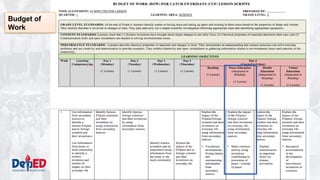
The Budget of Work
(BOW)
Note: Present BOW and sample lesson script by LA
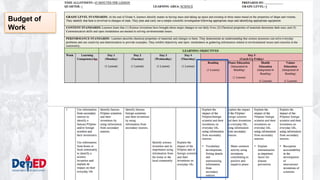
Budget of
Work
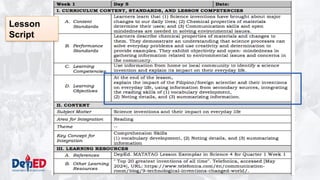
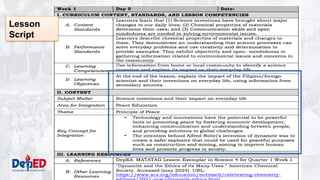
Lesson
Script
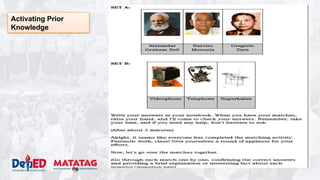
Activating Prior
Knowledge
Activating Prior
Knowledge
TEACHING AND LEARNING PROCEDURES
Before the Lesson / Pre-Lesson Proper
Lesson
Purpose/Intention
(2 minutes)
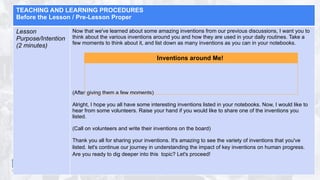
Now that we've learned about some amazing inventions from our previous discussions, I want you to
think about the various inventions around you and how they are used in your daily routines. Take a
few moments to think about it, and list down as many inventions as you can in your notebooks.
(After giving them a few moments)
Alright, I hope you all have some interesting inventions listed in your notebooks. Now, I would like to
hear from some volunteers. Raise your hand if you would like to share one of the inventions you
listed.
(Call on volunteers and write their inventions on the board)
Thank you all for sharing your inventions. It's amazing to see the variety of inventions that you've
listed. let's continue our journey in understanding the impact of key inventions on human progress.
Are you ready to dig deeper into this topic? Let's proceed!
Inventions around Me!
TEACHING AND LEARNING PROCEDURES
Before the Lesson / Pre-Lesson Proper
Lesson Language
Practice
(5 minutes)
Please take out your science notebooks and write down these words:
Technology, Revolutionized, Eradicating
Raise your hand if you have an idea or definition for any of these words.
Possible Learners Response:
Technology is like computers, smartphones, and other electronic devices that help us
do things more easily and quickly.
Wonderful explanation! Technology refers to the tools, equipment, and inventions that
we use to solve problems, perform tasks, and improve our lives. Who else would like
to share their ideas for the other words?
(Learners share their ideas for "revolutionized" and "eradicating")
Great thoughts, everyone! Now, let's explore some possible synonyms for these
words. I will provide you with synonyms, and I want you to use each synonym in a
sentence of your own. Write these sentences in your science notebooks.
TEACHING AND LEARNING PROCEDURES
Before the Lesson / Pre-Lesson Proper
Lesson Language
Practice
(5 minutes)
For "technology," a synonym could be "innovation." Try using the word "innovation" in a
sentence of your own.
(Learners write their sentences using the synonym "innovation")
Well done, everyone! Now, let's move on to the next word. A synonym for "revolutionized"
could be "transformed." Use the word "transformed" in a sentence of your own.
(Learners write their sentences using the synonym "transformed")
Excellent work, class! For the last word, a synonym for "eradicating" could be "eliminating."
Use the word "eliminating" in a sentence of your own.
(Learners write their sentences using the synonym "eliminating")
Fantastic job, everyone! I'm impressed with your sentences using the synonyms. Now, I have
an exciting announcement for you. These words we've discussed, along with their synonyms,
can be found in a reading article that you will get to read soon.
In the article, we will learn more about the impact of key inventions on human progress. Get
ready to discover fascinating information and deepen our understanding of these words in
context. Are you excited to delve into the reading article?
TEACHING AND LEARNING PROCEDURES
During / Lesson Proper
Reading the Key
Idea/Stem
(10 minutes)
I have prepared copies of the article titled "Greatest Inventions of All Time" for each
group.
(Distribute copies of the article to each group)
In your groups, I want you to read the article carefully. Take note that I have assigned
different sections of the article to each group. This way, we can cover more ground and
have a better understanding of the entire article. Begin by reading the title of the article
together as a group.
Now, each group can start reading their assigned sections. Remember to read the
article silently and pay attention to the pronunciation and meaning of the words we
discussed earlier. Feel free to discuss and help each other understand the content.
(After giving them a few moments)
Alright, it seems like everyone has finished reading their sections. Now, I would like to
invite volunteers to come up and read their assigned sections to the class.
(Call on volunteers, one by one, to read their sections)
TEACHING AND LEARNING PROCEDURES
During / Lesson Proper
Reading the Key
Idea/Stem
(10 minutes)
Thank you to all the volunteers for reading the article sections. You did a fantastic job.
Now, let's take a moment to appreciate the effort and practice in their reading. I want
to make a few pronunciation corrections to ensure we understand the words clearly.
(Provides pronunciation corrections as necessary, emphasizing key words from the
article)
Thank you for your participation and engagement in this reading activity. It's wonderful
to see your progress. Now, let's move on to our next activity, where we will discuss the
article and share our thoughts.
TEACHING AND LEARNING PROCEDURES
During / Lesson Proper
Developing
Understanding of the
Key Idea/Stem
(10 minutes)
Now that we have read the article, I want to hear from all of you about what you learned.
Please raise your hand if you can answer the following questions:
What is the article about?
Possible Learners Response:
The article gives a list of remarkable inventions that have a significant impact on human
progress. It also gives the importance and influence of these inventions in shaping various
aspects of our lives.
Are the technologies or inventions familiar to you? Which is not?
(Learners share their responses)
Thank you for sharing your thoughts. It's interesting to hear which technologies or inventions
are familiar to you and which ones are new. This shows that our experiences and exposure
to different inventions may vary.
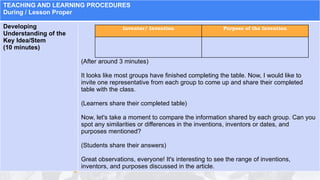
Now, I would like you to return to your groups. I have prepared a task for you to complete
based on the article you read. Each group will receive a table to fill in with the name of the
invention, the inventor or date of invention, and the purpose of the invention. Work together
with your group to complete the table based on the information from the article.
TEACHING AND LEARNING PROCEDURES
During / Lesson Proper
Developing
Understanding of the
Key Idea/Stem
(10 minutes)
(After around 3 minutes)
It looks like most groups have finished completing the table. Now, I would like to
invite one representative from each group to come up and share their completed
table with the class.
(Learners share their completed table)
Now, let's take a moment to compare the information shared by each group. Can you
spot any similarities or differences in the inventions, inventors or dates, and
purposes mentioned?
(Students share their answers)
Great observations, everyone! It's interesting to see the range of inventions,
inventors, and purposes discussed in the article.
Inventor/ Invention Purpose of the Invention
TEACHING AND LEARNING PROCEDURES
During / Lesson Proper
Deepening
Understanding of
the Key Idea/Stem
(5 minutes)
To deepen your understanding of the lesson, I would like to ask the questions:
1. What invention allowed early humans to control fire and utilize it for various purposes?
Possible Learners Response:
Fire was the invention that allowed early humans to control it and use it for warmth, protection,
and cooking.
2. Which invention revolutionized transportation and commerce?
Possible Learners Response:
The invention of the wheel revolutionized transportation and commerce, making it easier to move
goods and travel.
3. What invention helped ancient Egyptians and Mesopotamians improve their vision and
contributed to the development of photography, film, and television?
Possible Learners Response:
Optical lenses, such as those used in glasses, microscopes, and telescopes, helped improve
vision and played a crucial role in the development of media technologies.
TEACHING AND LEARNING PROCEDURES
During / Lesson Proper
Deepening
Understanding of
the Key Idea/Stem
(5 minutes)
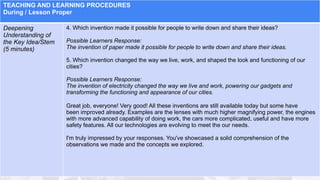
4. Which invention made it possible for people to write down and share their ideas?
Possible Learners Response:
The invention of paper made it possible for people to write down and share their ideas.
5. Which invention changed the way we live, work, and shaped the look and functioning of our
cities?
Possible Learners Response:
The invention of electricity changed the way we live and work, powering our gadgets and
transforming the functioning and appearance of our cities.
Great job, everyone! Very good! All these inventions are still available today but some have
been improved already. Examples are the lenses with much higher magnifying power, the engines
with more advanced capability of doing work, the cars more complicated, useful and have more
safety features. All our technologies are evolving to meet the our needs.
I'm truly impressed by your responses. You've showcased a solid comprehension of the
observations we made and the concepts we explored.
TEACHING AND LEARNING PROCEDURES
After the Lesson / Post-Lesson Proper
Making
Generalization
and Abstraction
(5 minutes)
Now, I want you to return to your groups and revisit the 10 inventions we discussed in the
article. Your task is to group these inventions into three categories: Information and
Communication, Power and Energy, and Health and Well-being.
Use the table provided to categorize the inventions accordingly.
Now, I would like to invite volunteers from each group to share their ideas on how they grouped
the inventions into the three categories.
(Learners share their answers)
Possible Learners Answer:
Information and Communication: Optical Lenses, Paper, Printing Press
Power and Energy: Fire, Electricity, Internal Combustion Engine, Car
Health and Well-being: Vaccination
That’s all good answers! You were able to see conectinons the these inventions we discussed.
Information and
Communication
Power and Energy Health and Well-being
TEACHING AND LEARNING PROCEDURES
After the Lesson / Post-Lesson Proper
Evaluating
Learning
(5 minutes
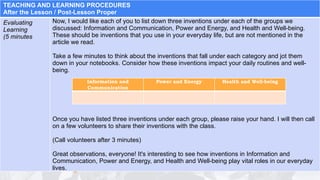
Now, I would like each of you to list down three inventions under each of the groups we
discussed: Information and Communication, Power and Energy, and Health and Well-being.
These should be inventions that you use in your everyday life, but are not mentioned in the
article we read.
Take a few minutes to think about the inventions that fall under each category and jot them
down in your notebooks. Consider how these inventions impact your daily routines and well-
being.
Once you have listed three inventions under each group, please raise your hand. I will then call
on a few volunteers to share their inventions with the class.
(Call volunteers after 3 minutes)
Great observations, everyone! It's interesting to see how inventions in Information and
Communication, Power and Energy, and Health and Well-being play vital roles in our everyday
lives.
Information and
Communication
Power and Energy Health and Well-being
Sample Lesson Script
Grade 4 – Science
Peace Education
Integration
Budget of
Work
Lesson
Script
Activating Prior
Knowledge
Activating Prior
Knowledge
TEACHING AND LEARNING PROCEDURES
Before the Lesson / Pre-Lesson Proper
Lesson
Purpose/Intention
(2 minutes)
Let me present this picture. Can you tell me what are these pictures? (Show the pictures to the class)
Possible Learners Response:
Dynamite Lumpia, Dynamite explosive, and Dynamite by BTS
Alright, let's hear some responses. What do you think is common among these pictures?
Possible Learners Response:
One common element is that they all have the word "Dynamite" in their name. Another commonality
is that dynamite, whether in the form of an explosive or a song, can have a powerful impact or create
excitement.
Excellent observations! You've all highlighted the common thread, which is the word "Dynamite."
Now, let's use these pictures as a starting point to introduce our lesson on the invention of Dynamite
as a known explosive.
Let's continue our discussion on important inventions through this advancement in technology.
TEACHING AND LEARNING PROCEDURES
Before the Lesson / Pre-Lesson Proper
Lesson Language
Practice
(5 minutes)
Please take out your science notebooks and write down these words:
Blast, Explosion, Energy
Now, let's explore some key terms related to our topic. Are you familiar with the words
"blast," "explosion," and "energy"? Please raise your hand if you have heard these
words before.
Which do you think are the synonym of those words? Can you identify and match the
word that are synonyms of our given words?
Release of heat, Doing work, Loud noise
(Call learners to response)
Answer:
Blast – Loud noise
Explosion – Release of heat
Energy – Doing work
TEACHING AND LEARNING PROCEDURES
Before the Lesson / Pre-Lesson Proper
Lesson Language
Practice
(5 minutes)
Very good everyone! Now, can you provide a definition for each term and try to use
them in your own sentence?
Possible Learners Response:
A blast is a sudden and powerful release of energy, often resulting in a loud noise and
forceful impact.
An explosion is a rapid expansion of gases with the release of heat and pressure,
causing a damage to objects nearby.
Energy is the capacity to do work or drives us to do activities and tasks.
(Calls learners to response)
Well done, everyone! You all have a good understanding of these words. Keep up the
great work in expanding your knowledge of these useful terms. Keep them in mind as
we will use these words in our lesson.
TEACHING AND LEARNING PROCEDURES
During / Lesson Proper
Reading the
Key Idea/Stem
(10 minutes)
I have prepared copies of the article titled " Alfred Nobel and Dynamite" for each group.
(Distribute copies of the article to each group)
In your groups, I want you to read the article carefully. Begin by reading the title of the
article together as a group.
Now, each group can start reading the article. Remember to read the article silently and pay
attention on the invention mentioned in the article and how it was developed and its uses.
(After giving them a few moments)
Alright, it seems like everyone has finished reading the article. Now, I would like to invite
volunteers to come up and read a certain section or paragraph to the class.
(Call on volunteers, one by one, to read their sections)
Thank you to all the volunteers for reading the article sections. You did a fantastic job. I
hope all can follow and understand what your classmates have read.
TEACHING AND LEARNING PROCEDURES
During / Lesson Proper
Developing
Understanding of
the Key Idea/Stem
(10 minutes)
Now that we have read the article, I would like you to provide answer to these
questions by three/triad. Discuss the questions with your small group and write your
answers in your notebook. Then we will discuss your answers in the class.
1. Who invented dynamite and how does dynamite help in removing large rocks?
2. What is the purpose of adding clay to nitroglycerin in the creation of dynamite?
3. What other uses did dynamite have apart from building and mining?
4. Why did Alfred Nobel decide to leave the money earned from his inventions for
special awards?
5. What is the significance of the Nobel Peace Prize among the five Nobel Prizes?
(After giving them a few moments)
I want to hear from all of you about what you learned. Please raise your hand if you
can answer the following questions:
Who invented dynamite and how does dynamite help in removing large rocks?
Possible Learners Response:
Dynamite was invented by Alfred Nobel and it helps in removing large rocks by using
the energy released from the nitroglycerin in the explosive to break apart the rocks
quickly and effectively.
TEACHING AND LEARNING PROCEDURES
During / Lesson Proper
Developing
Understanding of
the Key Idea/Stem
(10 minutes)
2. What is the purpose of adding clay to nitroglycerin in the creation of dynamite??
Possible Learners Response:
Clay is added to nitroglycerin in the creation of dynamite to make it a safer product that
can be used more effectively without the risk of unexpected explosions.
3. What other uses did dynamite have apart from building and mining?
Possible Learners Response:
Apart from building and mining, dynamite was also used to create bombs, cannons,
and rockets for warfare purposes, which deviated from Alfred Nobel's original intention
of using it for peaceful activities.
4. Why did Alfred Nobel decide to leave the money earned from his inventions for
special awards??
Possible Learners Response:
Alfred Nobel decided to leave the money earned from his inventions for special
awards, including the Nobel Prizes, to recognize and reward important inventions and
actions that contribute positively to society, in contrast to the negative impacts of
dynamite in warfare.
TEACHING AND LEARNING PROCEDURES
During / Lesson Proper
Developing
Understanding of
the Key Idea/Stem
(10 minutes)
5. What is the significance of the Nobel Peace Prize among the five Nobel Prizes?
Possible Learners Response:
The Nobel Peace Prize holds significant importance among the five Nobel Prizes as it
is awarded to individuals who promote peace and make significant contributions to
global harmony and humanitarian efforts.
Thank you for sharing your thoughts. It's interesting to hear how you understand the
reading text.
From the article, Alfred Nobel invented dynamite, which is used to remove large rocks
by utilizing the energy released from nitroglycerin to break them apart swiftly and
efficiently. To enhance safety, clay is added to nitroglycerin during its creation, reducing
the risk of unexpected explosions. Despite being initially intended for peaceful
purposes, dynamite was also repurposed for warfare, deviating from Nobel's original
vision. In response, Nobel established the Nobel Prizes, utilizing the earnings from his
inventions to recognize and reward positive contributions to society and innovation,
counterbalancing the negative effects of dynamite in warfare.
TEACHING AND LEARNING PROCEDURES
During / Lesson Proper
Deepening
Understanding of
the Key Idea/Stem
(5 minutes)
To deepen your understanding of the lesson, I would like to ask the questions: (Show the
questions one at a time.)
1. How did the invention of dynamite by Alfred Nobel help in building things, but also
have the potential to be used in harmful ways during conflicts?
Possible Learners Response:
The invention of dynamite by Alfred Nobel contributed to advancements in construction
by enabling safer and more efficient methods, while also introducing the potential for
destructive purposes in conflicts due to the explosive nature of dynamite, showcasing
the dual impact of technological innovations on society.
2. How did the unintended uses of dynamite, like in wars, go against what Alfred Nobel
wanted when he invented it to be used for safer activities?
Possible Learners Response:
The unintended uses of dynamite in warfare conflicted with Alfred Nobel's original
intention of creating a safer explosive for peaceful activities, as it led to the destructive
capabilities of dynamite being exploited in conflicts, contrary to his vision of promoting
safety and progress through innovation.
TEACHING AND LEARNING PROCEDURES
During / Lesson Proper
Deepening
Understanding of
the Key Idea/Stem
(5 minutes)
3. Why do you think Alfred Nobel created the Nobel Prizes, including the Nobel Peace
Prize, as a way to recognize people who contribute to peace and make the world a
better place, even though dynamite could be used for destructive purposes?
Possible Learners Response:
The Nobel Peace Prize, can be seen as a way to reconcile the dual impact of dynamite
on society by recognizing and rewarding positive contributions to peace and humanity,
aligning with Alfred Nobel's desire to promote beneficial innovations that benefit society
as a whole.
Great job, everyone! I'm truly impressed by your responses. Alfred Nobel's invention of
dynamite revolutionized construction methods, enhancing safety and efficiency.
However, the dual impact of technological innovations became evident as dynamite's
explosive nature posed a threat in conflicts, showcasing its potential for destruction. The
unintended use of dynamite in warfare contradicted Nobel's peaceful intentions,
highlighting the ethical dilemma of creating powerful inventions. This connection
underscores the importance of ethical considerations in technological advancements,
emphasizing the need to balance innovation with promoting peace and societal
progress.
You've showcased a solid comprehension of the observations we made and the
concepts we explored.
TEACHING AND LEARNING PROCEDURES
After the Lesson / Post-Lesson Proper
Making
Generalization
and
Abstraction
(5 minutes)
As we conclude our discussions on the invention of dynamite, I have a summarizing activity
for you. In pairs, I want each pair to fill up the table with one piece of information on the
Beneficial use of Dynamite, Harmful use of Dynamite. Share your knowledge on these topics
with your partner. Feel free to refer back to our previous discussions and the article we
explored today.
Use the table provided for your answers:
Share your responses with your partner and ensure that each section is accurately and
comprehensively filled.
(After giving them a few moments)
Now, I would like to invite volunteers from each group to share their ideas on information
Beneficial use of Dynamite, Harmful use of Dynamite.
(Learners share their answers)
That’s all good answers! You were able to see the importance of these inventions in our life.
Beneficial use of Dynamite Harmful use of Dynamite
Implementation of Catch-Up Fridays
 DM 001 s., 2024
 Provided the Suggested strategies for Reading
and Suggested Routines and Activities for
Reading Enhancement
 Provided the Suggested Strategies for Values
Education, Peace Education and Health
Education
General Guidelines for Lesson Script Writing
 Be Clear and Concise: Use clear and simple language that is easy for
students to understand. Avoid jargon or overly complex terms that may
confuse your students.
 Provide Transitions: Use transitional phrases to smoothly transition
between different parts of the lesson. This helps maintain flow and
coherence in your instruction.
 Use Positive Language: Frame instructions and feedback in a
positive way to encourage student participation and confidence.
Instead of saying "Don't do this," say "Try doing this instead."
General Guidelines for Lesson Script Writing
 Be Specific: Provide specific instructions and examples to clarify
expectations for students. Avoid vague or ambiguous language that may
lead to confusion.
 Use Active Voice: Write your lesson script in the active voice to make it
more engaging and dynamic. For example, instead of saying "The book
was read by the teacher," say "The teacher read the book.”
 Model Thinking Processes: Verbalize your thinking processes and
problem-solving strategies to help students develop their own critical
thinking skills. This can include asking questions like "Why do you think
that?" or "What evidence supports your answer?"
General Guidelines for Lesson Script Writing
 Encourage Interaction: Include opportunities for student interaction
and participation throughout the lesson. This can include asking
questions, eliciting responses, or facilitating group discussions.
 Anticipate Student Responses: Anticipate common student
responses or misconceptions and prepare appropriate responses or
explanations in advance.
 Be Flexible: Be prepared to adapt your lesson script based on student
reactions, questions, or needs. Flexibility is key to effective teaching
and learning.
Bansang Makabata
Batang Makabansa

DepEd_Sample-CUF_LessonScripts_Format.pptx

  • 1.
  • 2.
    Sample Lesson Script Grade4 – Science Reading Integration
  • 3.
    The Budget ofWork (BOW) Note: Present BOW and sample lesson script by LA
  • 4.
  • 5.
  • 6.
  • 7.
  • 8.
    TEACHING AND LEARNINGPROCEDURES Before the Lesson / Pre-Lesson Proper Lesson Purpose/Intention (2 minutes) Now that we've learned about some amazing inventions from our previous discussions, I want you to think about the various inventions around you and how they are used in your daily routines. Take a few moments to think about it, and list down as many inventions as you can in your notebooks. (After giving them a few moments) Alright, I hope you all have some interesting inventions listed in your notebooks. Now, I would like to hear from some volunteers. Raise your hand if you would like to share one of the inventions you listed. (Call on volunteers and write their inventions on the board) Thank you all for sharing your inventions. It's amazing to see the variety of inventions that you've listed. let's continue our journey in understanding the impact of key inventions on human progress. Are you ready to dig deeper into this topic? Let's proceed! Inventions around Me!
  • 9.
    TEACHING AND LEARNINGPROCEDURES Before the Lesson / Pre-Lesson Proper Lesson Language Practice (5 minutes) Please take out your science notebooks and write down these words: Technology, Revolutionized, Eradicating Raise your hand if you have an idea or definition for any of these words. Possible Learners Response: Technology is like computers, smartphones, and other electronic devices that help us do things more easily and quickly. Wonderful explanation! Technology refers to the tools, equipment, and inventions that we use to solve problems, perform tasks, and improve our lives. Who else would like to share their ideas for the other words? (Learners share their ideas for "revolutionized" and "eradicating") Great thoughts, everyone! Now, let's explore some possible synonyms for these words. I will provide you with synonyms, and I want you to use each synonym in a sentence of your own. Write these sentences in your science notebooks.
  • 10.
    TEACHING AND LEARNINGPROCEDURES Before the Lesson / Pre-Lesson Proper Lesson Language Practice (5 minutes) For "technology," a synonym could be "innovation." Try using the word "innovation" in a sentence of your own. (Learners write their sentences using the synonym "innovation") Well done, everyone! Now, let's move on to the next word. A synonym for "revolutionized" could be "transformed." Use the word "transformed" in a sentence of your own. (Learners write their sentences using the synonym "transformed") Excellent work, class! For the last word, a synonym for "eradicating" could be "eliminating." Use the word "eliminating" in a sentence of your own. (Learners write their sentences using the synonym "eliminating") Fantastic job, everyone! I'm impressed with your sentences using the synonyms. Now, I have an exciting announcement for you. These words we've discussed, along with their synonyms, can be found in a reading article that you will get to read soon. In the article, we will learn more about the impact of key inventions on human progress. Get ready to discover fascinating information and deepen our understanding of these words in context. Are you excited to delve into the reading article?
  • 11.
    TEACHING AND LEARNINGPROCEDURES During / Lesson Proper Reading the Key Idea/Stem (10 minutes) I have prepared copies of the article titled "Greatest Inventions of All Time" for each group. (Distribute copies of the article to each group) In your groups, I want you to read the article carefully. Take note that I have assigned different sections of the article to each group. This way, we can cover more ground and have a better understanding of the entire article. Begin by reading the title of the article together as a group. Now, each group can start reading their assigned sections. Remember to read the article silently and pay attention to the pronunciation and meaning of the words we discussed earlier. Feel free to discuss and help each other understand the content. (After giving them a few moments) Alright, it seems like everyone has finished reading their sections. Now, I would like to invite volunteers to come up and read their assigned sections to the class. (Call on volunteers, one by one, to read their sections)
  • 12.
    TEACHING AND LEARNINGPROCEDURES During / Lesson Proper Reading the Key Idea/Stem (10 minutes) Thank you to all the volunteers for reading the article sections. You did a fantastic job. Now, let's take a moment to appreciate the effort and practice in their reading. I want to make a few pronunciation corrections to ensure we understand the words clearly. (Provides pronunciation corrections as necessary, emphasizing key words from the article) Thank you for your participation and engagement in this reading activity. It's wonderful to see your progress. Now, let's move on to our next activity, where we will discuss the article and share our thoughts.
  • 13.
    TEACHING AND LEARNINGPROCEDURES During / Lesson Proper Developing Understanding of the Key Idea/Stem (10 minutes) Now that we have read the article, I want to hear from all of you about what you learned. Please raise your hand if you can answer the following questions: What is the article about? Possible Learners Response: The article gives a list of remarkable inventions that have a significant impact on human progress. It also gives the importance and influence of these inventions in shaping various aspects of our lives. Are the technologies or inventions familiar to you? Which is not? (Learners share their responses) Thank you for sharing your thoughts. It's interesting to hear which technologies or inventions are familiar to you and which ones are new. This shows that our experiences and exposure to different inventions may vary. Now, I would like you to return to your groups. I have prepared a task for you to complete based on the article you read. Each group will receive a table to fill in with the name of the invention, the inventor or date of invention, and the purpose of the invention. Work together with your group to complete the table based on the information from the article.
  • 14.
    TEACHING AND LEARNINGPROCEDURES During / Lesson Proper Developing Understanding of the Key Idea/Stem (10 minutes) (After around 3 minutes) It looks like most groups have finished completing the table. Now, I would like to invite one representative from each group to come up and share their completed table with the class. (Learners share their completed table) Now, let's take a moment to compare the information shared by each group. Can you spot any similarities or differences in the inventions, inventors or dates, and purposes mentioned? (Students share their answers) Great observations, everyone! It's interesting to see the range of inventions, inventors, and purposes discussed in the article. Inventor/ Invention Purpose of the Invention
  • 15.
    TEACHING AND LEARNINGPROCEDURES During / Lesson Proper Deepening Understanding of the Key Idea/Stem (5 minutes) To deepen your understanding of the lesson, I would like to ask the questions: 1. What invention allowed early humans to control fire and utilize it for various purposes? Possible Learners Response: Fire was the invention that allowed early humans to control it and use it for warmth, protection, and cooking. 2. Which invention revolutionized transportation and commerce? Possible Learners Response: The invention of the wheel revolutionized transportation and commerce, making it easier to move goods and travel. 3. What invention helped ancient Egyptians and Mesopotamians improve their vision and contributed to the development of photography, film, and television? Possible Learners Response: Optical lenses, such as those used in glasses, microscopes, and telescopes, helped improve vision and played a crucial role in the development of media technologies.
  • 16.
    TEACHING AND LEARNINGPROCEDURES During / Lesson Proper Deepening Understanding of the Key Idea/Stem (5 minutes) 4. Which invention made it possible for people to write down and share their ideas? Possible Learners Response: The invention of paper made it possible for people to write down and share their ideas. 5. Which invention changed the way we live, work, and shaped the look and functioning of our cities? Possible Learners Response: The invention of electricity changed the way we live and work, powering our gadgets and transforming the functioning and appearance of our cities. Great job, everyone! Very good! All these inventions are still available today but some have been improved already. Examples are the lenses with much higher magnifying power, the engines with more advanced capability of doing work, the cars more complicated, useful and have more safety features. All our technologies are evolving to meet the our needs. I'm truly impressed by your responses. You've showcased a solid comprehension of the observations we made and the concepts we explored.
  • 17.
    TEACHING AND LEARNINGPROCEDURES After the Lesson / Post-Lesson Proper Making Generalization and Abstraction (5 minutes) Now, I want you to return to your groups and revisit the 10 inventions we discussed in the article. Your task is to group these inventions into three categories: Information and Communication, Power and Energy, and Health and Well-being. Use the table provided to categorize the inventions accordingly. Now, I would like to invite volunteers from each group to share their ideas on how they grouped the inventions into the three categories. (Learners share their answers) Possible Learners Answer: Information and Communication: Optical Lenses, Paper, Printing Press Power and Energy: Fire, Electricity, Internal Combustion Engine, Car Health and Well-being: Vaccination That’s all good answers! You were able to see conectinons the these inventions we discussed. Information and Communication Power and Energy Health and Well-being
  • 18.
    TEACHING AND LEARNINGPROCEDURES After the Lesson / Post-Lesson Proper Evaluating Learning (5 minutes Now, I would like each of you to list down three inventions under each of the groups we discussed: Information and Communication, Power and Energy, and Health and Well-being. These should be inventions that you use in your everyday life, but are not mentioned in the article we read. Take a few minutes to think about the inventions that fall under each category and jot them down in your notebooks. Consider how these inventions impact your daily routines and well- being. Once you have listed three inventions under each group, please raise your hand. I will then call on a few volunteers to share their inventions with the class. (Call volunteers after 3 minutes) Great observations, everyone! It's interesting to see how inventions in Information and Communication, Power and Energy, and Health and Well-being play vital roles in our everyday lives. Information and Communication Power and Energy Health and Well-being
  • 19.
    Sample Lesson Script Grade4 – Science Peace Education Integration
  • 20.
  • 21.
  • 22.
  • 23.
  • 24.
    TEACHING AND LEARNINGPROCEDURES Before the Lesson / Pre-Lesson Proper Lesson Purpose/Intention (2 minutes) Let me present this picture. Can you tell me what are these pictures? (Show the pictures to the class) Possible Learners Response: Dynamite Lumpia, Dynamite explosive, and Dynamite by BTS Alright, let's hear some responses. What do you think is common among these pictures? Possible Learners Response: One common element is that they all have the word "Dynamite" in their name. Another commonality is that dynamite, whether in the form of an explosive or a song, can have a powerful impact or create excitement. Excellent observations! You've all highlighted the common thread, which is the word "Dynamite." Now, let's use these pictures as a starting point to introduce our lesson on the invention of Dynamite as a known explosive. Let's continue our discussion on important inventions through this advancement in technology.
  • 25.
    TEACHING AND LEARNINGPROCEDURES Before the Lesson / Pre-Lesson Proper Lesson Language Practice (5 minutes) Please take out your science notebooks and write down these words: Blast, Explosion, Energy Now, let's explore some key terms related to our topic. Are you familiar with the words "blast," "explosion," and "energy"? Please raise your hand if you have heard these words before. Which do you think are the synonym of those words? Can you identify and match the word that are synonyms of our given words? Release of heat, Doing work, Loud noise (Call learners to response) Answer: Blast – Loud noise Explosion – Release of heat Energy – Doing work
  • 26.
    TEACHING AND LEARNINGPROCEDURES Before the Lesson / Pre-Lesson Proper Lesson Language Practice (5 minutes) Very good everyone! Now, can you provide a definition for each term and try to use them in your own sentence? Possible Learners Response: A blast is a sudden and powerful release of energy, often resulting in a loud noise and forceful impact. An explosion is a rapid expansion of gases with the release of heat and pressure, causing a damage to objects nearby. Energy is the capacity to do work or drives us to do activities and tasks. (Calls learners to response) Well done, everyone! You all have a good understanding of these words. Keep up the great work in expanding your knowledge of these useful terms. Keep them in mind as we will use these words in our lesson.
  • 27.
    TEACHING AND LEARNINGPROCEDURES During / Lesson Proper Reading the Key Idea/Stem (10 minutes) I have prepared copies of the article titled " Alfred Nobel and Dynamite" for each group. (Distribute copies of the article to each group) In your groups, I want you to read the article carefully. Begin by reading the title of the article together as a group. Now, each group can start reading the article. Remember to read the article silently and pay attention on the invention mentioned in the article and how it was developed and its uses. (After giving them a few moments) Alright, it seems like everyone has finished reading the article. Now, I would like to invite volunteers to come up and read a certain section or paragraph to the class. (Call on volunteers, one by one, to read their sections) Thank you to all the volunteers for reading the article sections. You did a fantastic job. I hope all can follow and understand what your classmates have read.
  • 28.
    TEACHING AND LEARNINGPROCEDURES During / Lesson Proper Developing Understanding of the Key Idea/Stem (10 minutes) Now that we have read the article, I would like you to provide answer to these questions by three/triad. Discuss the questions with your small group and write your answers in your notebook. Then we will discuss your answers in the class. 1. Who invented dynamite and how does dynamite help in removing large rocks? 2. What is the purpose of adding clay to nitroglycerin in the creation of dynamite? 3. What other uses did dynamite have apart from building and mining? 4. Why did Alfred Nobel decide to leave the money earned from his inventions for special awards? 5. What is the significance of the Nobel Peace Prize among the five Nobel Prizes? (After giving them a few moments) I want to hear from all of you about what you learned. Please raise your hand if you can answer the following questions: Who invented dynamite and how does dynamite help in removing large rocks? Possible Learners Response: Dynamite was invented by Alfred Nobel and it helps in removing large rocks by using the energy released from the nitroglycerin in the explosive to break apart the rocks quickly and effectively.
  • 29.
    TEACHING AND LEARNINGPROCEDURES During / Lesson Proper Developing Understanding of the Key Idea/Stem (10 minutes) 2. What is the purpose of adding clay to nitroglycerin in the creation of dynamite?? Possible Learners Response: Clay is added to nitroglycerin in the creation of dynamite to make it a safer product that can be used more effectively without the risk of unexpected explosions. 3. What other uses did dynamite have apart from building and mining? Possible Learners Response: Apart from building and mining, dynamite was also used to create bombs, cannons, and rockets for warfare purposes, which deviated from Alfred Nobel's original intention of using it for peaceful activities. 4. Why did Alfred Nobel decide to leave the money earned from his inventions for special awards?? Possible Learners Response: Alfred Nobel decided to leave the money earned from his inventions for special awards, including the Nobel Prizes, to recognize and reward important inventions and actions that contribute positively to society, in contrast to the negative impacts of dynamite in warfare.
  • 30.
    TEACHING AND LEARNINGPROCEDURES During / Lesson Proper Developing Understanding of the Key Idea/Stem (10 minutes) 5. What is the significance of the Nobel Peace Prize among the five Nobel Prizes? Possible Learners Response: The Nobel Peace Prize holds significant importance among the five Nobel Prizes as it is awarded to individuals who promote peace and make significant contributions to global harmony and humanitarian efforts. Thank you for sharing your thoughts. It's interesting to hear how you understand the reading text. From the article, Alfred Nobel invented dynamite, which is used to remove large rocks by utilizing the energy released from nitroglycerin to break them apart swiftly and efficiently. To enhance safety, clay is added to nitroglycerin during its creation, reducing the risk of unexpected explosions. Despite being initially intended for peaceful purposes, dynamite was also repurposed for warfare, deviating from Nobel's original vision. In response, Nobel established the Nobel Prizes, utilizing the earnings from his inventions to recognize and reward positive contributions to society and innovation, counterbalancing the negative effects of dynamite in warfare.
  • 31.
    TEACHING AND LEARNINGPROCEDURES During / Lesson Proper Deepening Understanding of the Key Idea/Stem (5 minutes) To deepen your understanding of the lesson, I would like to ask the questions: (Show the questions one at a time.) 1. How did the invention of dynamite by Alfred Nobel help in building things, but also have the potential to be used in harmful ways during conflicts? Possible Learners Response: The invention of dynamite by Alfred Nobel contributed to advancements in construction by enabling safer and more efficient methods, while also introducing the potential for destructive purposes in conflicts due to the explosive nature of dynamite, showcasing the dual impact of technological innovations on society. 2. How did the unintended uses of dynamite, like in wars, go against what Alfred Nobel wanted when he invented it to be used for safer activities? Possible Learners Response: The unintended uses of dynamite in warfare conflicted with Alfred Nobel's original intention of creating a safer explosive for peaceful activities, as it led to the destructive capabilities of dynamite being exploited in conflicts, contrary to his vision of promoting safety and progress through innovation.
  • 32.
    TEACHING AND LEARNINGPROCEDURES During / Lesson Proper Deepening Understanding of the Key Idea/Stem (5 minutes) 3. Why do you think Alfred Nobel created the Nobel Prizes, including the Nobel Peace Prize, as a way to recognize people who contribute to peace and make the world a better place, even though dynamite could be used for destructive purposes? Possible Learners Response: The Nobel Peace Prize, can be seen as a way to reconcile the dual impact of dynamite on society by recognizing and rewarding positive contributions to peace and humanity, aligning with Alfred Nobel's desire to promote beneficial innovations that benefit society as a whole. Great job, everyone! I'm truly impressed by your responses. Alfred Nobel's invention of dynamite revolutionized construction methods, enhancing safety and efficiency. However, the dual impact of technological innovations became evident as dynamite's explosive nature posed a threat in conflicts, showcasing its potential for destruction. The unintended use of dynamite in warfare contradicted Nobel's peaceful intentions, highlighting the ethical dilemma of creating powerful inventions. This connection underscores the importance of ethical considerations in technological advancements, emphasizing the need to balance innovation with promoting peace and societal progress. You've showcased a solid comprehension of the observations we made and the concepts we explored.
  • 33.
    TEACHING AND LEARNINGPROCEDURES After the Lesson / Post-Lesson Proper Making Generalization and Abstraction (5 minutes) As we conclude our discussions on the invention of dynamite, I have a summarizing activity for you. In pairs, I want each pair to fill up the table with one piece of information on the Beneficial use of Dynamite, Harmful use of Dynamite. Share your knowledge on these topics with your partner. Feel free to refer back to our previous discussions and the article we explored today. Use the table provided for your answers: Share your responses with your partner and ensure that each section is accurately and comprehensively filled. (After giving them a few moments) Now, I would like to invite volunteers from each group to share their ideas on information Beneficial use of Dynamite, Harmful use of Dynamite. (Learners share their answers) That’s all good answers! You were able to see the importance of these inventions in our life. Beneficial use of Dynamite Harmful use of Dynamite
  • 34.
    Implementation of Catch-UpFridays  DM 001 s., 2024  Provided the Suggested strategies for Reading and Suggested Routines and Activities for Reading Enhancement  Provided the Suggested Strategies for Values Education, Peace Education and Health Education
  • 35.
    General Guidelines forLesson Script Writing  Be Clear and Concise: Use clear and simple language that is easy for students to understand. Avoid jargon or overly complex terms that may confuse your students.  Provide Transitions: Use transitional phrases to smoothly transition between different parts of the lesson. This helps maintain flow and coherence in your instruction.  Use Positive Language: Frame instructions and feedback in a positive way to encourage student participation and confidence. Instead of saying "Don't do this," say "Try doing this instead."
  • 36.
    General Guidelines forLesson Script Writing  Be Specific: Provide specific instructions and examples to clarify expectations for students. Avoid vague or ambiguous language that may lead to confusion.  Use Active Voice: Write your lesson script in the active voice to make it more engaging and dynamic. For example, instead of saying "The book was read by the teacher," say "The teacher read the book.”  Model Thinking Processes: Verbalize your thinking processes and problem-solving strategies to help students develop their own critical thinking skills. This can include asking questions like "Why do you think that?" or "What evidence supports your answer?"
  • 37.
    General Guidelines forLesson Script Writing  Encourage Interaction: Include opportunities for student interaction and participation throughout the lesson. This can include asking questions, eliciting responses, or facilitating group discussions.  Anticipate Student Responses: Anticipate common student responses or misconceptions and prepare appropriate responses or explanations in advance.  Be Flexible: Be prepared to adapt your lesson script based on student reactions, questions, or needs. Flexibility is key to effective teaching and learning.
  • 38.