Federal Deficit Reduction Deal. What’s at stake for Ohioans in Need?Featuring:Lisa Hamler-Fugitt, Executive Director of the Ohio Association of Second Harvest FoodbanksLuke Russell, Associate State Director for Advocacy, AARP OhioCathy Levine, Executive Director, UHCAN Ohio, Co-Chair of Ohio Consumers for Health CoverageDeborah Nebel, Director of Public Policy, Linking Employment, Ability, and Potential Wendy Patton, Senior Associate, Policy Matters Ohio (PMO)
www.oashf.org Lisa Hamler-FugittExecutive Director lisa@oashf.org614.221.4336, ext. 222Ohio Association of second harvest foodbanksThe Super Committee: What's at stake for Ohioans in need?September 27, 2011
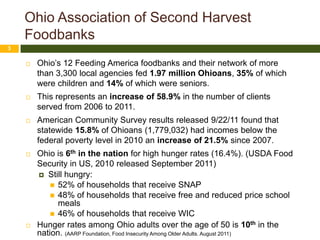
3Ohio Association of Second Harvest FoodbanksOhio’s 12 Feeding America foodbanks and their network of more than 3,300 local agencies fed 1.97 million Ohioans, 35% of which were children and 14% of which were seniors.
This represents an increase of 58.9% in the number of clients served from 2006 to 2011.
American Community Survey results released 9/22/11 found that statewide 15.8% of Ohioans (1,779,032) had incomes below the federal poverty level in 2010 an increase of 21.5% since 2007.
Ohio is 6th in the nation for high hunger rates (16.4%). (USDA Food Security in US, 2010 released September 2011)
Still hungry:
52% of households that receive SNAP
48% of households that receive free and reduced price school meals
46% of households that receive WIC
Hunger rates among Ohio adults over the age of 50 is 10th in the nation. (AARP Foundation, Food Insecurity Among Older Adults. August 2011)Federal budget & debt ceiling impact4Elimination of National Service Programs, Senior Corps, Emergency Food & Shelter Program (already cut by 80%) and/or The Supplemental Nutrition Program for Women, Infants and Children.
Other threats: Possible fundamental changes to programs should as those proposed in Senator Coburn’s “Back in Black” that would:
Terminate “categorical eligibility,” which allows individuals to automatically qualify for food stamps if they are enrolled in the Temporary Assistance for Needy Families (TANF) program or certain other assistance programs.
Reduce funding for USDA’s domestic nutrition assistance ($17 billion FY 2010 enacted by 10 percent to save $18.7 billion over ten years. GAO recently studied 18 of the 70 identified federal hunger programs. Of these 18, only 7 were found to have sufficient reported data to assess their overall effectiveness. However, little is known about the effectiveness of the remaining 11 programs, because they have never been well studied. Only two of the 11 programs had been studied at all.Get engaged – we need to be proactive!Post your recommendations on Senator Portman’s website http://portman.senate.gov/public/index.cfm/reduce-the-deficitRead reports submitted to the Joint Select Committee, including Senator Ron Johnsons, $1.4 Trillion in Savings http://ronjohnson.senate.gov/public/index.cfm/files/serve?File_id=b61bc3d5-a0e9-4d48-ba25-17d4b1f238b6U.S. Senator Tom Coburn, M.D. (R-OK) report “Back in Black” that outlines how the federal government can reduce the deficit by $9 trillion over the next ten years and balance the federal budget. The 614-page plan was the result of a thorough and exhaustive review of thousands of federal programs.http://coburn.senate.gov/public//index.cfm?a=Files.Serve&File_id=c6590d01-017a-47b0-a15c-1336220ea7bf
Debt Ceiling Debate: 5If the Joint Committee on Deficit Reduction fails to report out a bill that achieves at least $1.2 trillion in deficit reduction OR if Congress fails to enact its plan, then automatic, across-the-board spending cuts will be triggered for 2013-2021.The automatic, across-the-board cuts  (known as sequestration) will equal the difference between what is enacted and $1.2 trillion.
These cuts would take effect in January 2013 assuming no cuts or revenue increases were enacted by the Joint Select Committee on Deficit Reduction, approximately 9% annual cut in affected non-security programs, along with roughly a 9% cut in defense programs.
Fortunately, low income entitlement programs, such as the Commodity Supplemental Food Program, Supplemental Nutrition Assistance Program, Child Nutrition Programs (with the exception of special milk programs), and Temporary Assistance for Needy Families.
Medicaid and SSI programs, are exempted from the automatic, across the board cuts (although 2% Medicare provider cuts are allowed). Federal Budget: Where does the money go?6Source: Center on Budget and Policy Priorities
Ohio has a powerful congressional delegationRepublican Study CommissionCHAIR: Jim Jordan (R-04)Joint Select Committee on Deficit ReductionRob Portman (R)Speaker of the HouseJohn Boehner (R-08)House Agriculture CommitteeMarcia Fudge (D-11)Jean Schmidt (R-02): CHAIR, Nutrition & Horticulture SubcommitteeSenate Agriculture CommitteeSherrod Brown (D): Nutrition SubcommitteeCHAIR, Jobs, Rural Economic Growth & Energy Innovation SubcommitteeHouse Appropriations CommitteeMarcy Kaptur (D-09): Agriculture Subcommittee, Transportation & HUD SubcommitteeSenate Appropriations CommitteeSherrod Brown (D): Health, Education, Labor & Pensions SubcommitteeHouse Budget CommitteeTim Ryan (D-17)Marcy Kaptur (D-09): CHAIR, Nutrition & HorticultureHouse Education & Workforce CommitteeDennis Kucinich (D-10): Health, Education, Labor & Pensions SubcommitteeSenate Banking, Housing & Urban Affairs CommitteeSherrod Brown (D): Housing, Transportation, and Community Development SubcommitteeHouse Oversight & Government Reform CommitteeMichael Turner (R-03) Dennis Kucinich (D-10) Jim Jordan (D-04): CHAIR, Regulatory Affairs, Stimulus Oversight & Government Reform SubcommitteeSenate Budget CommitteeRob Portman (R)House Ways & Means CommitteePat Tiberi (R-12) CHAIR, Subcommittee on Select RevenueHouse Energy & Commerce CommitteeBob Latta (R-05): Health Subcommittee
Protect Medicare &Social Security from Harmful Benefit CutsLuke Russell, Associate State Director of AdvocacyAARP Ohio
AARP’s Position:Today’s seniors and future generations have earned their benefits through a lifetime of hard work.   We should be strengthening Medicare and Social Security, not slashing their budgets and putting future generations’ retirement security in jeopardy.
AARP’s Position:AARP is fighting to stop Congress from making a political deal that cuts Medicare and Social Security benefits.  Instead of cutting the benefits 50+ members worked for, Congress should reduce the deficit by cutting waste and close tax loopholes.
AARP’s Position:Cuts Hurt Real People: In these tough economic times, Washington shouldn’t cut the benefits seniors and middle class Americans have worked for and depend on.  Cuts to Social Security and Medicare benefits could dramatically increase seniors’ health costs, threaten their access to doctors and hospitals and reduce the benefits checks they rely on to pay the bills.
Target Waste Not Seniors: Congress needs to make tough choices to reduce the deficit, but they shouldn’t harm seniors or the middle class by cutting the retirement benefits they’ve paid into their entire lives.AARP’s Position:Worked Hard: Seniors have worked hard their entire lives, paying into the system to earn their Social Security and Medicare  - benefits that protect America’s middle class.
Voice in the Discussion: Seniors and middle class Americans have earned a voice in any discussion about the future of Medicare and Social Security.  Actions:Teletown Hall
Calls to Members of Congress (including robo-calls)
Sign our Petition
Share Your Story - Cuts to Social Security and Medicare (Call in Testimonies)
Meetings with Key Members of Congress
Facebook and Twitter
Web Banner AdsThreats to Health Care from the Super CommitteeCathy LevineUHCAN Ohio and Ohio Consumers for Health Coverage
Super Committee ChargeRecommend between $1.2 and $1.5 TRILLION in deficit reductions
Congress must pass the recommendations and the President must sign or else…
Automatic cuts are triggered--50% from defense.If Congress gets part way there, the trigger will raise the remaining revenues to get to $1.5 T. Second Stage – What’s at Stake?Medicaid is  protected if the automatic cuts go  into effect
Medicare: Across-the-board cuts limited to 2% (about $10 billion) of program’s costs and can only come from cuts to providers and insurers.Second Stage – What’s Really At StakeCongress is under tremendous pressure on Congress to come up with a deal.Possible Medicare Cuts:Raise Medicare eligibility age (in the original “grand bargain” proposal)
Raise Medicare cost-sharing (in the original “grand bargain”)
Means-test Medicare premiums
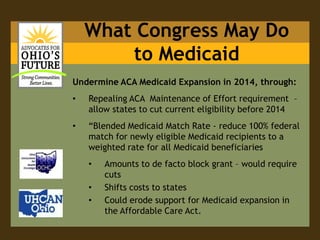
Eliminate or scale back Part D? unlikelyWhat Congress May Do to MedicaidUndermine ACA Medicaid Expansion in 2014, through:Repealing ACA  Maintenance of Effort requirement  – allow states to cut current eligibility before 2014
“Blended Medicaid Match Rate - reduce 100% federal match for newly eligible Medicaid recipients to a weighted rate for all Medicaid beneficiaries
Amounts to de facto block grant – would require cuts
Shifts costs to states
Could erode support for Medicaid expansion in the Affordable Care Act.Who’s at Risk from Medicaid Cuts2 million Ohioans and their familiesChildren and adults with disabilities Home and community based services that allow people to live independently, work and contribute to societyFrail seniors and their family caregiversHome and community based services to live safely and with dignity in setting of choiceLow-income children and families
JobsWe need real reformsReward providers for good care and outcomes, not volume of servicese.g. don’t pay for hospital-acquired harmPromote services in high value, lower cost outpatient settings, instead of institutional care
But, these savings will not raise $1.5 – we must balance cuts and savings with revenues.
Resources:  The Insider (Community Catalyst); Say Ahhh!  (Georgetown University Center for Children and Families); Center on Budget and Policy Priorities.Persons with disabilities in the Federal Deficit Reduction DealDeborah Nebel, Director of Public PolicyLinking Employment, Abilities and Potential (LEAP)
People with disabilities remain unemployed at higher rate than other Americans16.8% unemployment rate (July, 2011, Bureau of Labor Statistics)

AOF.webinar.09.27.11

  • 1.
    Federal Deficit ReductionDeal. What’s at stake for Ohioans in Need?Featuring:Lisa Hamler-Fugitt, Executive Director of the Ohio Association of Second Harvest FoodbanksLuke Russell, Associate State Director for Advocacy, AARP OhioCathy Levine, Executive Director, UHCAN Ohio, Co-Chair of Ohio Consumers for Health CoverageDeborah Nebel, Director of Public Policy, Linking Employment, Ability, and Potential Wendy Patton, Senior Associate, Policy Matters Ohio (PMO)
  • 2.
    www.oashf.org Lisa Hamler-FugittExecutiveDirector lisa@oashf.org614.221.4336, ext. 222Ohio Association of second harvest foodbanksThe Super Committee: What's at stake for Ohioans in need?September 27, 2011
  • 3.
    3Ohio Association ofSecond Harvest FoodbanksOhio’s 12 Feeding America foodbanks and their network of more than 3,300 local agencies fed 1.97 million Ohioans, 35% of which were children and 14% of which were seniors.
  • 4.
    This represents anincrease of 58.9% in the number of clients served from 2006 to 2011.
  • 5.
    American Community Surveyresults released 9/22/11 found that statewide 15.8% of Ohioans (1,779,032) had incomes below the federal poverty level in 2010 an increase of 21.5% since 2007.
  • 6.
    Ohio is 6thin the nation for high hunger rates (16.4%). (USDA Food Security in US, 2010 released September 2011)
  • 7.
  • 8.
    52% of householdsthat receive SNAP
  • 9.
    48% of householdsthat receive free and reduced price school meals
  • 10.
    46% of householdsthat receive WIC
  • 11.
    Hunger rates amongOhio adults over the age of 50 is 10th in the nation. (AARP Foundation, Food Insecurity Among Older Adults. August 2011)Federal budget & debt ceiling impact4Elimination of National Service Programs, Senior Corps, Emergency Food & Shelter Program (already cut by 80%) and/or The Supplemental Nutrition Program for Women, Infants and Children.
  • 12.
    Other threats: Possiblefundamental changes to programs should as those proposed in Senator Coburn’s “Back in Black” that would:
  • 13.
    Terminate “categorical eligibility,”which allows individuals to automatically qualify for food stamps if they are enrolled in the Temporary Assistance for Needy Families (TANF) program or certain other assistance programs.
  • 14.
    Reduce funding forUSDA’s domestic nutrition assistance ($17 billion FY 2010 enacted by 10 percent to save $18.7 billion over ten years. GAO recently studied 18 of the 70 identified federal hunger programs. Of these 18, only 7 were found to have sufficient reported data to assess their overall effectiveness. However, little is known about the effectiveness of the remaining 11 programs, because they have never been well studied. Only two of the 11 programs had been studied at all.Get engaged – we need to be proactive!Post your recommendations on Senator Portman’s website http://portman.senate.gov/public/index.cfm/reduce-the-deficitRead reports submitted to the Joint Select Committee, including Senator Ron Johnsons, $1.4 Trillion in Savings http://ronjohnson.senate.gov/public/index.cfm/files/serve?File_id=b61bc3d5-a0e9-4d48-ba25-17d4b1f238b6U.S. Senator Tom Coburn, M.D. (R-OK) report “Back in Black” that outlines how the federal government can reduce the deficit by $9 trillion over the next ten years and balance the federal budget. The 614-page plan was the result of a thorough and exhaustive review of thousands of federal programs.http://coburn.senate.gov/public//index.cfm?a=Files.Serve&File_id=c6590d01-017a-47b0-a15c-1336220ea7bf
  • 15.
    Debt Ceiling Debate:5If the Joint Committee on Deficit Reduction fails to report out a bill that achieves at least $1.2 trillion in deficit reduction OR if Congress fails to enact its plan, then automatic, across-the-board spending cuts will be triggered for 2013-2021.The automatic, across-the-board cuts  (known as sequestration) will equal the difference between what is enacted and $1.2 trillion.
  • 16.
    These cuts wouldtake effect in January 2013 assuming no cuts or revenue increases were enacted by the Joint Select Committee on Deficit Reduction, approximately 9% annual cut in affected non-security programs, along with roughly a 9% cut in defense programs.
  • 17.
    Fortunately, low incomeentitlement programs, such as the Commodity Supplemental Food Program, Supplemental Nutrition Assistance Program, Child Nutrition Programs (with the exception of special milk programs), and Temporary Assistance for Needy Families.
  • 18.
    Medicaid and SSIprograms, are exempted from the automatic, across the board cuts (although 2% Medicare provider cuts are allowed). Federal Budget: Where does the money go?6Source: Center on Budget and Policy Priorities
  • 19.
    Ohio has apowerful congressional delegationRepublican Study CommissionCHAIR: Jim Jordan (R-04)Joint Select Committee on Deficit ReductionRob Portman (R)Speaker of the HouseJohn Boehner (R-08)House Agriculture CommitteeMarcia Fudge (D-11)Jean Schmidt (R-02): CHAIR, Nutrition & Horticulture SubcommitteeSenate Agriculture CommitteeSherrod Brown (D): Nutrition SubcommitteeCHAIR, Jobs, Rural Economic Growth & Energy Innovation SubcommitteeHouse Appropriations CommitteeMarcy Kaptur (D-09): Agriculture Subcommittee, Transportation & HUD SubcommitteeSenate Appropriations CommitteeSherrod Brown (D): Health, Education, Labor & Pensions SubcommitteeHouse Budget CommitteeTim Ryan (D-17)Marcy Kaptur (D-09): CHAIR, Nutrition & HorticultureHouse Education & Workforce CommitteeDennis Kucinich (D-10): Health, Education, Labor & Pensions SubcommitteeSenate Banking, Housing & Urban Affairs CommitteeSherrod Brown (D): Housing, Transportation, and Community Development SubcommitteeHouse Oversight & Government Reform CommitteeMichael Turner (R-03) Dennis Kucinich (D-10) Jim Jordan (D-04): CHAIR, Regulatory Affairs, Stimulus Oversight & Government Reform SubcommitteeSenate Budget CommitteeRob Portman (R)House Ways & Means CommitteePat Tiberi (R-12) CHAIR, Subcommittee on Select RevenueHouse Energy & Commerce CommitteeBob Latta (R-05): Health Subcommittee
  • 20.
    Protect Medicare &SocialSecurity from Harmful Benefit CutsLuke Russell, Associate State Director of AdvocacyAARP Ohio
  • 21.
    AARP’s Position:Today’s seniorsand future generations have earned their benefits through a lifetime of hard work. We should be strengthening Medicare and Social Security, not slashing their budgets and putting future generations’ retirement security in jeopardy.
  • 22.
    AARP’s Position:AARP isfighting to stop Congress from making a political deal that cuts Medicare and Social Security benefits. Instead of cutting the benefits 50+ members worked for, Congress should reduce the deficit by cutting waste and close tax loopholes.
  • 23.
    AARP’s Position:Cuts HurtReal People: In these tough economic times, Washington shouldn’t cut the benefits seniors and middle class Americans have worked for and depend on. Cuts to Social Security and Medicare benefits could dramatically increase seniors’ health costs, threaten their access to doctors and hospitals and reduce the benefits checks they rely on to pay the bills.
  • 24.
    Target Waste NotSeniors: Congress needs to make tough choices to reduce the deficit, but they shouldn’t harm seniors or the middle class by cutting the retirement benefits they’ve paid into their entire lives.AARP’s Position:Worked Hard: Seniors have worked hard their entire lives, paying into the system to earn their Social Security and Medicare - benefits that protect America’s middle class.
  • 25.
    Voice in theDiscussion: Seniors and middle class Americans have earned a voice in any discussion about the future of Medicare and Social Security. Actions:Teletown Hall
  • 26.
    Calls to Membersof Congress (including robo-calls)
  • 27.
  • 28.
    Share Your Story- Cuts to Social Security and Medicare (Call in Testimonies)
  • 29.
    Meetings with KeyMembers of Congress
  • 30.
  • 31.
    Web Banner AdsThreatsto Health Care from the Super CommitteeCathy LevineUHCAN Ohio and Ohio Consumers for Health Coverage
  • 32.
    Super Committee ChargeRecommendbetween $1.2 and $1.5 TRILLION in deficit reductions
  • 33.
    Congress must passthe recommendations and the President must sign or else…
  • 34.
    Automatic cuts aretriggered--50% from defense.If Congress gets part way there, the trigger will raise the remaining revenues to get to $1.5 T. Second Stage – What’s at Stake?Medicaid is protected if the automatic cuts go into effect
  • 35.
    Medicare: Across-the-board cutslimited to 2% (about $10 billion) of program’s costs and can only come from cuts to providers and insurers.Second Stage – What’s Really At StakeCongress is under tremendous pressure on Congress to come up with a deal.Possible Medicare Cuts:Raise Medicare eligibility age (in the original “grand bargain” proposal)
  • 36.
    Raise Medicare cost-sharing(in the original “grand bargain”)
  • 37.
  • 38.
    Eliminate or scaleback Part D? unlikelyWhat Congress May Do to MedicaidUndermine ACA Medicaid Expansion in 2014, through:Repealing ACA Maintenance of Effort requirement – allow states to cut current eligibility before 2014
  • 39.
    “Blended Medicaid MatchRate - reduce 100% federal match for newly eligible Medicaid recipients to a weighted rate for all Medicaid beneficiaries
  • 40.
    Amounts to defacto block grant – would require cuts
  • 41.
  • 42.
    Could erode supportfor Medicaid expansion in the Affordable Care Act.Who’s at Risk from Medicaid Cuts2 million Ohioans and their familiesChildren and adults with disabilities Home and community based services that allow people to live independently, work and contribute to societyFrail seniors and their family caregiversHome and community based services to live safely and with dignity in setting of choiceLow-income children and families
  • 43.
    JobsWe need realreformsReward providers for good care and outcomes, not volume of servicese.g. don’t pay for hospital-acquired harmPromote services in high value, lower cost outpatient settings, instead of institutional care
  • 44.
    But, these savingswill not raise $1.5 – we must balance cuts and savings with revenues.
  • 45.
    Resources: TheInsider (Community Catalyst); Say Ahhh! (Georgetown University Center for Children and Families); Center on Budget and Policy Priorities.Persons with disabilities in the Federal Deficit Reduction DealDeborah Nebel, Director of Public PolicyLinking Employment, Abilities and Potential (LEAP)
  • 46.
    People with disabilitiesremain unemployed at higher rate than other Americans16.8% unemployment rate (July, 2011, Bureau of Labor Statistics)

Editor's Notes

  • #7 Most of federal budget goes for defense, social security, major health programs.