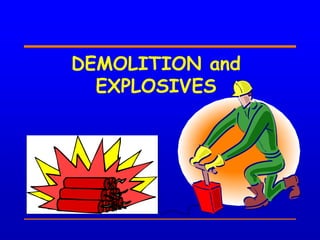
DEMOLITION and
EXPLOSIVES
SAFE DEMOLITION REQUIRES ADEQUATE
PLANNING
Why Plan?
Identify the Hazards
Meet Legislative Requirements
Ensure Appropriate Equipment
Ensure Safe Disposal of Materials
Determine Appropriate Methods of Demolition
Determine Cost of Demolition
SAFE DEMOLITION REQUIRES ADEQUATE
PLANNING
Key Areas for Planning
Type of Construction
Type of Structure (Ht., Use)
State of Structure
Structural Hazards
Hazardous Substances
Location of Services
General Conditions of Adjoining Structures
Access and Egress
Suitability of Site for Equipment
DEMOLITION TECHNIQUE
Sequential – gradual reduction of
height in reverse order to its
construction
Induced – key structural members
are weakened or removed, causing the
whole part of the structure to collapse
METHODS OF DEMOLITION
Manual – use of hand held tools
Mechanical – use of heavy
equipment, wires and chain, power
shear, etc.
Explosives – use of explosives
RULE 1417 - 1418: DEMOLITION
1. Structures over 6m high must be under the
supervision of a competent person
2. The area is strictly for demolition workers only
(Demolition area - w/in a distance equal to 1.5 x H of
structure)
3. If the above distance is not possible, the structure
shall be fenced around
4. Danger signs should be posted around the structure
5. Ensure all electrical services are cut-off
RULE 1417 - 1418: DEMOLITION
7. Demolition should proceed storey by storey, in a
descending order; work on the upper floors should be
completely over before removing the supporting
members on the lower floor
8. No part of the structure shall be overloaded w/ debris
or mat’ls.
9. Stairs (incl. railings), passageways & ladders should
be demolished last
HAZARDS ASSOCIATED WITH DEMOLITION
Falls
Being Hit/Trapped/Crushed by Objects
Manual Handling
Hazardous Substances and Dangerous Goods
Noise and Vibration
Electric Shock
Fires and Explosions
Equipment
EXPLOSIVES
By Competent Person
Precautions from:
Smokes, matches & open flames
Radio Frequency for Electrical Detonators
Transport of Explosives
Vehicles shall have tight floors covered w/ wood
Explosives and Blasting implements shall not be
transported with other materials
EXPLOSIVES
Storage
All explosives must be accounted for
Follow manufacturer’s instructions
Detonators should be stored in a separate magazine
Storage should be fire and bullet-resistant
Proper Use
Operation between Sunup & Sundown
Precaution on the use of f mobile radio transmitting
equipment.
Suspension of operation during electrical storm
EXPLOSIVES
After Blasting
Disconnect firing line from blasting
machine
Allow dust and smoke to subside
Inspect if all charges have been
exploded

demolition.ppt

  • 1.
  • 2.
    SAFE DEMOLITION REQUIRESADEQUATE PLANNING Why Plan? Identify the Hazards Meet Legislative Requirements Ensure Appropriate Equipment Ensure Safe Disposal of Materials Determine Appropriate Methods of Demolition Determine Cost of Demolition
  • 3.
    SAFE DEMOLITION REQUIRESADEQUATE PLANNING Key Areas for Planning Type of Construction Type of Structure (Ht., Use) State of Structure Structural Hazards Hazardous Substances Location of Services General Conditions of Adjoining Structures Access and Egress Suitability of Site for Equipment
  • 4.
    DEMOLITION TECHNIQUE Sequential –gradual reduction of height in reverse order to its construction Induced – key structural members are weakened or removed, causing the whole part of the structure to collapse
  • 5.
    METHODS OF DEMOLITION Manual– use of hand held tools Mechanical – use of heavy equipment, wires and chain, power shear, etc. Explosives – use of explosives
  • 6.
    RULE 1417 -1418: DEMOLITION 1. Structures over 6m high must be under the supervision of a competent person 2. The area is strictly for demolition workers only (Demolition area - w/in a distance equal to 1.5 x H of structure) 3. If the above distance is not possible, the structure shall be fenced around 4. Danger signs should be posted around the structure 5. Ensure all electrical services are cut-off
  • 7.
    RULE 1417 -1418: DEMOLITION 7. Demolition should proceed storey by storey, in a descending order; work on the upper floors should be completely over before removing the supporting members on the lower floor 8. No part of the structure shall be overloaded w/ debris or mat’ls. 9. Stairs (incl. railings), passageways & ladders should be demolished last
  • 8.
    HAZARDS ASSOCIATED WITHDEMOLITION Falls Being Hit/Trapped/Crushed by Objects Manual Handling Hazardous Substances and Dangerous Goods Noise and Vibration Electric Shock Fires and Explosions Equipment
  • 9.
    EXPLOSIVES By Competent Person Precautionsfrom: Smokes, matches & open flames Radio Frequency for Electrical Detonators Transport of Explosives Vehicles shall have tight floors covered w/ wood Explosives and Blasting implements shall not be transported with other materials
  • 10.
    EXPLOSIVES Storage All explosives mustbe accounted for Follow manufacturer’s instructions Detonators should be stored in a separate magazine Storage should be fire and bullet-resistant Proper Use Operation between Sunup & Sundown Precaution on the use of f mobile radio transmitting equipment. Suspension of operation during electrical storm
  • 11.
    EXPLOSIVES After Blasting Disconnect firingline from blasting machine Allow dust and smoke to subside Inspect if all charges have been exploded