DEMOGRAPHIC
TRANSITION THEORY
Sivasankari.S
INTRODUCTION OF DEMOGRAPHIC
TRANSITION
◦ The term demographic transition was coined by Warren S. Thompson (1929) and later popularized by Frank W.
Notestein (1945) to describe a historical process of change that explains trends in births, deaths, and population
growth in today's industrialized societies, particularly European societies.
◦ The demographic transition theory investigate the connection between economic development
and population growth
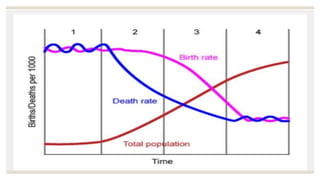
◦ Changes in the birth rate and death rate as well as the population growth
FIRST STAGE
◦ Birth rates and death rate are high
◦ No great population growth
◦ No education or birth control
◦ Lack of hygiene
◦ Large families
SECOND STAGE
◦ High brith rates but lower death rates
◦ Health care improves
◦ Less infant die
◦ More transport and medical care
◦ Improved sanitation
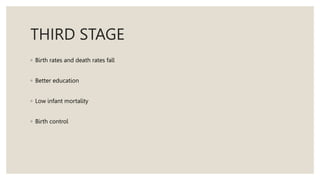
THIRD STAGE
◦ Birth rates and death rates fall
◦ Better education
◦ Low infant mortality
◦ Birth control
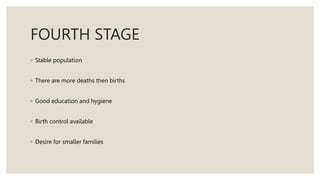
FOURTH STAGE
◦ Stable population
◦ There are more deaths then births
◦ Good education and hygiene
◦ Birth control available
◦ Desire for smaller families
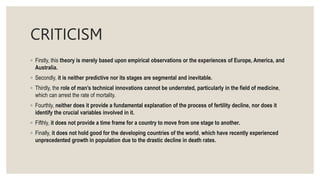
CRITICISM
◦ Firstly, this theory is merely based upon empirical observations or the experiences of Europe, America, and
Australia.
◦ Secondly, it is neither predictive nor its stages are segmental and inevitable.
◦ Thirdly, the role of man’s technical innovations cannot be underrated, particularly in the field of medicine,
which can arrest the rate of mortality.
◦ Fourthly, neither does it provide a fundamental explanation of the process of fertility decline, nor does it
identify the crucial variables involved in it.
◦ Fifthly, it does not provide a time frame for a country to move from one stage to another.
◦ Finally, it does not hold good for the developing countries of the world, which have recently experienced
unprecedented growth in population due to the drastic decline in death rates.

Demographic transition.pptx

  • 1.
  • 2.
    INTRODUCTION OF DEMOGRAPHIC TRANSITION ◦The term demographic transition was coined by Warren S. Thompson (1929) and later popularized by Frank W. Notestein (1945) to describe a historical process of change that explains trends in births, deaths, and population growth in today's industrialized societies, particularly European societies. ◦ The demographic transition theory investigate the connection between economic development and population growth ◦ Changes in the birth rate and death rate as well as the population growth
  • 4.
    FIRST STAGE ◦ Birthrates and death rate are high ◦ No great population growth ◦ No education or birth control ◦ Lack of hygiene ◦ Large families
  • 5.
    SECOND STAGE ◦ Highbrith rates but lower death rates ◦ Health care improves ◦ Less infant die ◦ More transport and medical care ◦ Improved sanitation
  • 6.
    THIRD STAGE ◦ Birthrates and death rates fall ◦ Better education ◦ Low infant mortality ◦ Birth control
  • 7.
    FOURTH STAGE ◦ Stablepopulation ◦ There are more deaths then births ◦ Good education and hygiene ◦ Birth control available ◦ Desire for smaller families
  • 8.
    CRITICISM ◦ Firstly, thistheory is merely based upon empirical observations or the experiences of Europe, America, and Australia. ◦ Secondly, it is neither predictive nor its stages are segmental and inevitable. ◦ Thirdly, the role of man’s technical innovations cannot be underrated, particularly in the field of medicine, which can arrest the rate of mortality. ◦ Fourthly, neither does it provide a fundamental explanation of the process of fertility decline, nor does it identify the crucial variables involved in it. ◦ Fifthly, it does not provide a time frame for a country to move from one stage to another. ◦ Finally, it does not hold good for the developing countries of the world, which have recently experienced unprecedented growth in population due to the drastic decline in death rates.