ODET 2010: Online Deliberation Emerging Tools Workshop
                  Fourth International Conference on Online Deliberation
                                          (Leeds, 30 June–2 July, 2010)


Moderated VS Open Deliberation:
  Hypermedia Technologies to
 Enhance Public Participation

       Anna De Liddo & Simon Buckingham Shum
                Knowledge Media Institute
                  Open University, UK
    a.deliddo@open.ac.uk ; S.Buckingham.Shum@open.ac.uk


                         olnet.org
Our Approach

We investigate different aspects and issues of Public Participation in Urban
Planning and Decision-Making focusing on the key role of
 deliberation practice,
 deliberation tracking and
 deliberation representation
to enable more effective public participation.


We look at Hypermedia discourse technologies to help move us from
a deliberation process which is often ephemeral, ill-structured and
disempowering, to deliberation which is persistent, more coherent and
participatory.
Two Research Strands


  Improving transparency:

 Supporting deliberation capturing and representation
 By recording deliberation and discourse digitally to make it possible to
 interrogate later on and use deliberation contents to actively inform decision
 making

  Empowering Community voices and ideas:

 Facilitating Open Public Inquiry and Collective Intelligence
 By developing a “virtual agora” for open public inquiry on common policy issues
Two hypermedia tools to support
Moderated Vs Open Deliberation


  Compendium


               olnet.org
Two deliberation Models: Moderated
Deliberation VS Open Deliberation


          Compendium


Compendium supports a moderated                   Cohere supports an open deliberation
deliberation model in which a facilitator/        model in which issues are created and
mapper interprets deliberations (either live or   discussed without pre-defined communication
post-hoc) in order to create hypermedia maps by   language, without facilitation and in an open
naming, classifying, linking and summarizing      deliberation environment.
deliberation contents.                            All participants have equal editing privileges, and
The mapper is entrusted to create coherent        create together new ideas, raise issues, ask
argument maps out of several dialogues and        questions, provide answers and propose
deliberation processes.                           arguments and counterarguments with an open
                                                  semantic framework (not necessarily IBIS).


                                 olnet.org
Argument Maps vs
Dynamic Collective Claims maps


      Compendium

Deliberation result is a discourse   Deliberation result is a Collective
arguments map, which is crafted      Claims map, which is a dynamic
by the information/knowledge         map of claims cooperatively
manager; who facilitate by           generated by many hands and
 Selecting/Filtering                watched by many eyes, and
 Structuring                        continuously changing. This map
 Highlighting                       is structured by an ongoing un-
 Representating                     moderated debate and potentially
deliberation contents.               can involve all citizens.
                                     It is the dynamic result of an
                                     “open virtual agora”.
Challenges:
Coherence vs Open Participation


      Compendium

On one side moderated argument     On one hand enabling the creation of
mapping improves coherence         unframed dynamic maps of claims,
and unambiguity in the message     cooperatively generated, opens up to
who is communicated.               wider participation, since it lowers
                                   usability and cognitive barriers
                                   users have to overcome to contribute
                                   to the conversation.
On the other side it introduces
an important level of discretion   On the other hand it hampers
                                   coherence and increases noise
since the mapper filters what is
                                   and ambiguity of what are relevant
meant to be relevant to inform
                                   messages to inform decision-making.
decision making.
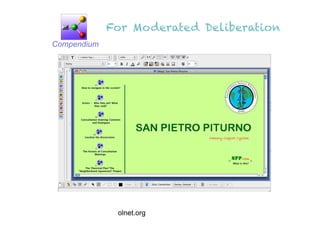
For Moderated Deliberation
Compendium


              olnet.org
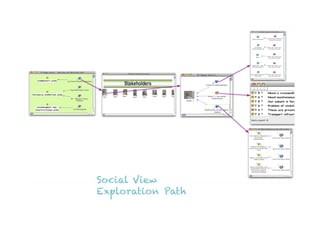
Social View
Exploration Path
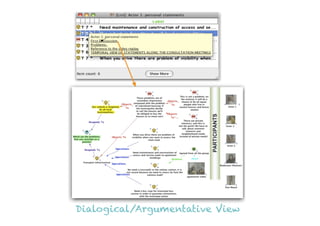
Dialogical/Argumentative View
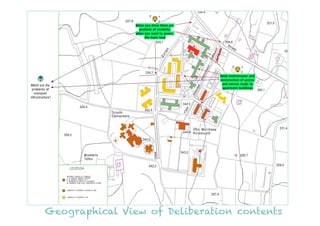
Geographical View of Deliberation contents
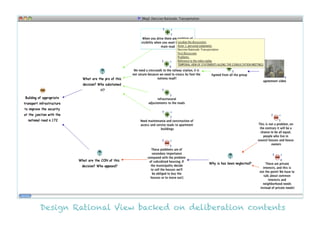
Design Rational View backed on deliberation contents
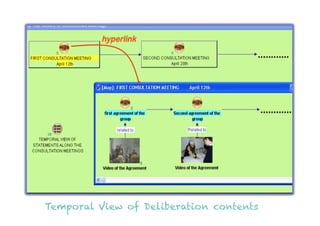
Temporal View of Deliberation contents
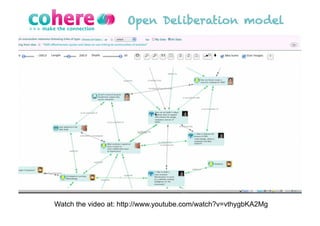
Open Deliberation model


Watch the video at: http://www.youtube.com/watch?v=vthygbKA2Mg
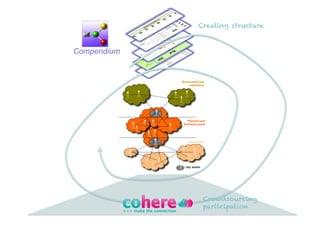
Creating structure


Compendium


              Crowdsourcing
              participation

De Liddo - ODET 2010: Online Deliberation Emerging Tools Workshop

  • 1.
    ODET 2010: OnlineDeliberation Emerging Tools Workshop Fourth International Conference on Online Deliberation (Leeds, 30 June–2 July, 2010) Moderated VS Open Deliberation: Hypermedia Technologies to Enhance Public Participation Anna De Liddo & Simon Buckingham Shum Knowledge Media Institute Open University, UK a.deliddo@open.ac.uk ; S.Buckingham.Shum@open.ac.uk olnet.org
  • 2.
    Our Approach We investigatedifferent aspects and issues of Public Participation in Urban Planning and Decision-Making focusing on the key role of  deliberation practice,  deliberation tracking and  deliberation representation to enable more effective public participation. We look at Hypermedia discourse technologies to help move us from a deliberation process which is often ephemeral, ill-structured and disempowering, to deliberation which is persistent, more coherent and participatory.
  • 3.
    Two Research Strands  Improving transparency: Supporting deliberation capturing and representation By recording deliberation and discourse digitally to make it possible to interrogate later on and use deliberation contents to actively inform decision making  Empowering Community voices and ideas: Facilitating Open Public Inquiry and Collective Intelligence By developing a “virtual agora” for open public inquiry on common policy issues
  • 4.
    Two hypermedia toolsto support Moderated Vs Open Deliberation Compendium olnet.org
  • 5.
    Two deliberation Models:Moderated Deliberation VS Open Deliberation Compendium Compendium supports a moderated Cohere supports an open deliberation deliberation model in which a facilitator/ model in which issues are created and mapper interprets deliberations (either live or discussed without pre-defined communication post-hoc) in order to create hypermedia maps by language, without facilitation and in an open naming, classifying, linking and summarizing deliberation environment. deliberation contents. All participants have equal editing privileges, and The mapper is entrusted to create coherent create together new ideas, raise issues, ask argument maps out of several dialogues and questions, provide answers and propose deliberation processes. arguments and counterarguments with an open semantic framework (not necessarily IBIS). olnet.org
  • 6.
    Argument Maps vs DynamicCollective Claims maps Compendium Deliberation result is a discourse Deliberation result is a Collective arguments map, which is crafted Claims map, which is a dynamic by the information/knowledge map of claims cooperatively manager; who facilitate by generated by many hands and  Selecting/Filtering watched by many eyes, and  Structuring continuously changing. This map  Highlighting is structured by an ongoing un-  Representating moderated debate and potentially deliberation contents. can involve all citizens. It is the dynamic result of an “open virtual agora”.
  • 7.
    Challenges: Coherence vs OpenParticipation Compendium On one side moderated argument On one hand enabling the creation of mapping improves coherence unframed dynamic maps of claims, and unambiguity in the message cooperatively generated, opens up to who is communicated. wider participation, since it lowers usability and cognitive barriers users have to overcome to contribute to the conversation. On the other side it introduces an important level of discretion On the other hand it hampers coherence and increases noise since the mapper filters what is and ambiguity of what are relevant meant to be relevant to inform messages to inform decision-making. decision making.
  • 8.
  • 9.
  • 10.
  • 11.
    Geographical View ofDeliberation contents
  • 12.
    Design Rational Viewbacked on deliberation contents
  • 13.
    Temporal View ofDeliberation contents
  • 14.
    Open Deliberation model Watchthe video at: http://www.youtube.com/watch?v=vthygbKA2Mg
  • 15.
    Creating structure Compendium Crowdsourcing participation