Training : Construction Schedule Delays and Delay Impact Analy
sis Techniques.
1
PLANNING DEPARTMENT
AL MUHAIDIB CONTRACTING CO.
Training Module 02
Presentation
Topic
: Construction Schedule Delays & Delay Impact
Analysis Techniques
Presenter : Mujahid Ishtiaq PMP®,PSP®,PMI-SP®
Al Muhaidib Contracting Co.
--Date--
2
CONTENTS
• Construction Schedule Delays.
• Causes of delays.
• Types of Construction Delays.
• Schedules to be used in Delay Analysis.
• Schedule Delay Analysis Techniques with case studies.
• Main Principals for analysing schedule delays
• Selection of Delay Analysis Methodology.
• Components of a good EOT Claim.
• References.
Training : Construction Schedule Delays and Delay Impact Analysis Techniques.
Al Muhaidib Contracting Co.
3
CONSTRUCTION SCHEDULE DELAYS
“An Event or a condition that that results in finishing the project later than stipulated
in the contract.” Mubarak (2005)
“The time during which some part of the construction project has been extended or
not executed owing to an unexpected event.” Callahn (1992)
“T o make something happen later than expected or to not act timely.” Trauner (2009)
Training : Construction Schedule Delays and Delay Impact Analysis Techniques.
Al Muhaidib Contracting Co.
4
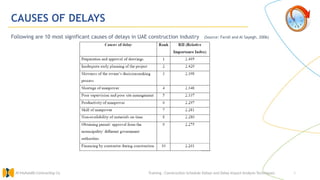
CAUSES OF DELAYS
Following are 10 most significant causes of delays in UAE construction industry (Source: Faridi and Al Sayegh. 2006)
Training : Construction Schedule Delays and Delay Impact Analysis Techniques.
Al Muhaidib Contracting Co.
5
CAUSES OF DELAYS
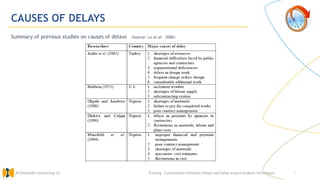
Summary of previous studies on causes of delays (Source: Lo at el . 2006)
Training : Construction Schedule Delays and Delay Impact Analysis Techniques.
Al Muhaidib Contracting Co.
6
CAUSES OF DELAYS
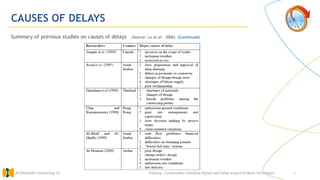
Summary of previous studies on causes of delays (Source: Lo at el . 2006) (Continued)
Training : Construction Schedule Delays and Delay Impact Analysis Techniques.
Al Muhaidib Contracting Co.
7
TYPES OF CONSTRUCTION DELAYS
Training : Construction Schedule Delays and Delay Impact Analysis Techniques.
Al Muhaidib Contracting Co.
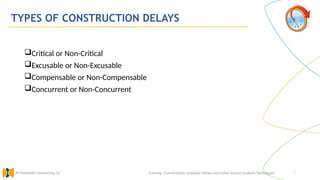
Critical or Non-Critical
Excusable or Non-Excusable
Compensable or Non-Compensable
Concurrent or Non-Concurrent
8
Critical or Non-Critical Delays
Training : Construction Schedule Delays and Delay Impact Analysis Techniques.
Al Muhaidib Contracting Co.
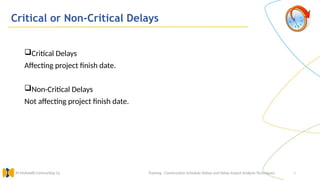
Critical Delays
Affecting project finish date.
Non-Critical Delays
Not affecting project finish date.
9
Excusable and Non-Excusable Delays
Training : Construction Schedule Delays and Delay Impact Analysis Techniques.
Al Muhaidib Contracting Co.
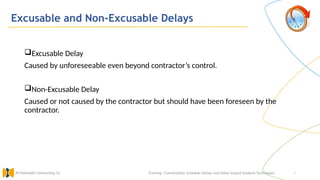
Excusable Delay
Caused by unforeseeable even beyond contractor’s control.
Non-Excusable Delay
Caused or not caused by the contractor but should have been foreseen by the
contractor.
10
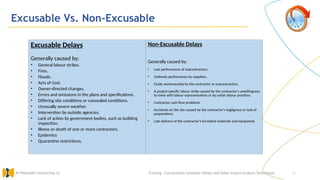
Excusable Vs. Non-Excusable
Training : Construction Schedule Delays and Delay Impact Analysis Techniques.
Al Muhaidib Contracting Co.
Excusable Delays
Generally caused by:
• General labour strikes.
• Fires.
• Floods.
• Acts of God.
• Owner-directed changes.
• Errors and omissions in the plans and specifications.
• Differing site conditions or concealed conditions.
• Unusually severe weather.
• Intervention by outside agencies.
• Lack of action by government bodies, such as building
inspection.
• Illness or death of one or more contractors.
• Epidemics
• Quarantine restrictions.
Non-Excusable Delays
Generally caused by:
• Late performance of subcontractors.
• Untimely performance by suppliers.
• Faulty workmanship by the contractor or subcontractors.
• A project-specific labour strike caused by the contractor's unwillingness
to meet with labour representatives or by unfair labour practices.
• Contractor cash-flow problems.
• Accidents on the site caused by the contractor's negligence or lack of
preparations.
• Late delivery of the contractor's furnished materials and equipment.
11
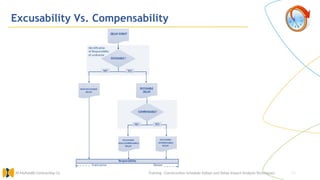
Excusability Vs. Compensability
Training : Construction Schedule Delays and Delay Impact Analysis Techniques.
Al Muhaidib Contracting Co.
12
Training : Construction Schedule Delays and Delay Impact Analysis Techniques.
Al Muhaidib Contracting Co.
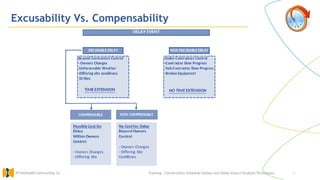
Excusability Vs. Compensability
13
Concurrent and Non-Concurrent Delays
Training : Construction Schedule Delays and Delay Impact Analysis Techniques.
Al Muhaidib Contracting Co.
Concurrent Delays
Combination of two or more independent delay events occurring within the same
time frame.
Non-Concurrent Delay
Delays events that occur independently & separately without overlapping.
14
SCHEDULES TO BE USED IN DELAYS
As-Planned Schedule
The As-Planned schedule is a graphical representation of the contractor’s original intention for the
completion of the project. It shows different critical paths as well as planned activities and their
sequence.
As-Built Schedule
The As-Built schedule shows the actual sequence and progress of activities in the project as they
occurred in real life, including the slowdowns, work stoppages and accelerations.
Training : Construction Schedule Delays and Delay Impact Analysis Techniques.
Al Muhaidib Contracting Co.
SCHEDULE DELAY ANALYSIS TECHNIQUES
Training : Construction Schedule Delays and Delay Impact Analysis Techniques. 15
Al Muhaidib Contracting Co.
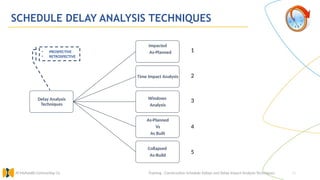
Delay Analysis
Techniques
Impacted
As-Planned
Time Impact Analysis
Windows
Analysis
As-Planned
Vs
As Built
Collapsed
As-Build
• PROSPECTIVE
• RETROSPECTIVE
1
2
3
4
5
16
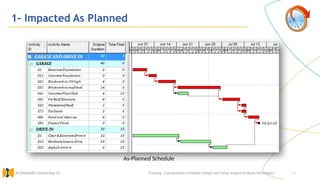
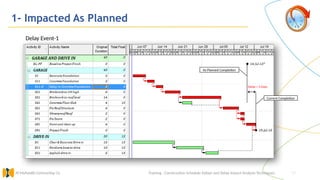
1- Impacted As Planned
Training : Construction Schedule Delays and Delay Impact Analysis Techniques.
Al Muhaidib Contracting Co.
As-Planned Schedule
17
1- Impacted As Planned
Training : Construction Schedule Delays and Delay Impact Analysis Techniques.
Al Muhaidib Contracting Co.
As Planned Completion
Current Completion
Delay = 3 Days
Delay Event-1
18
1- Impacted As Planned
Training : Construction Schedule Delays and Delay Impact Analysis Techniques.
Al Muhaidib Contracting Co.
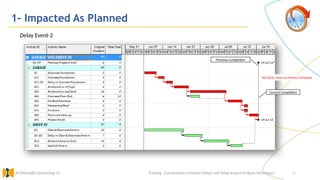
Current Completion
No Delay. Same as Previous Schedule
Previous Completion
Delay Event-2
19
1- Impacted As Planned
Training : Construction Schedule Delays and Delay Impact Analysis Techniques.
Al Muhaidib Contracting Co.
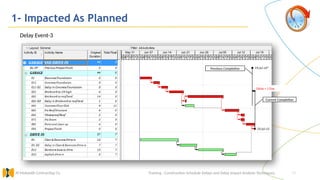
Previous Completion
Current Completion
Delay = 1 Day
Delay Event-3
20
1- Impacted As Planned
Training : Construction Schedule Delays and Delay Impact Analysis Techniques.
Al Muhaidib Contracting Co.
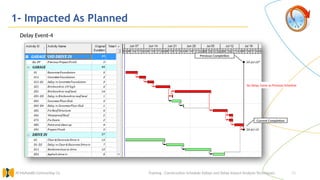
Current Completion
No Delay. Same as Previous Schedule
Previous Completion
Delay Event-4
21
1- Impacted As Planned
Training : Construction Schedule Delays and Delay Impact Analysis Techniques.
Al Muhaidib Contracting Co.
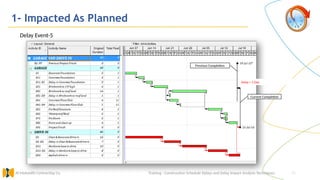
Delay Event-5
Previous Completion
Current Completion
Delay = 1 Day
22
1- Impacted As Planned
Training : Construction Schedule Delays and Delay Impact Analysis Techniques.
Al Muhaidib Contracting Co.
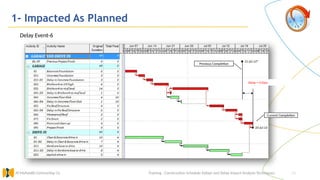
Delay Event-6
Previous Completion
Current Completion
Delay = 4 Days
23
1- Impacted As Planned
Training : Construction Schedule Delays and Delay Impact Analysis Techniques.
Al Muhaidib Contracting Co.
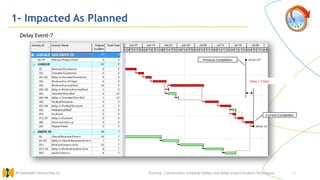
Delay Event-7
Previous Completion
Current Completion
Delay = 3 Days
24
1- Impacted As Planned
Training : Construction Schedule Delays and Delay Impact Analysis Techniques.
Al Muhaidib Contracting Co.
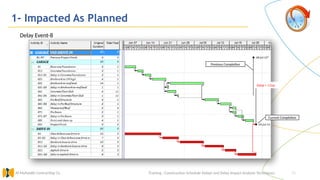
Delay Event-8
Previous Completion
Current Completion
Delay = 1 Day
25
1- Impacted As Planned
Training : Construction Schedule Delays and Delay Impact Analysis Techniques.
Al Muhaidib Contracting Co.
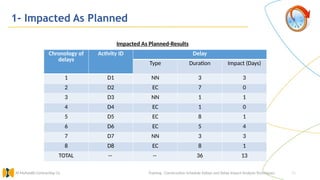
Chronology of
delays
Activity ID Delay
Type Duration Impact (Days)
1 D1 NN 3 3
2 D2 EC 7 0
3 D3 NN 1 1
4 D4 EC 1 0
5 D5 EC 8 1
6 D6 EC 5 4
7 D7 NN 3 3
8 D8 EC 8 1
TOTAL -- -- 36 13
Impacted As Planned-Results
26
1- Impacted As Planned
Training : Construction Schedule Delays and Delay Impact Analysis Techniques.
Al Muhaidib Contracting Co.
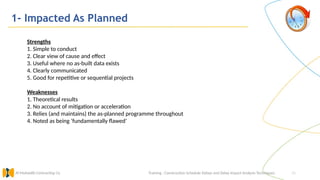
Strengths
1. Simple to conduct
2. Clear view of cause and effect
3. Useful where no as-built data exists
4. Clearly communicated
5. Good for repetitive or sequential projects
Weaknesses
1. Theoretical results
2. No account of mitigation or acceleration
3. Relies (and maintains) the as-planned programme throughout
4. Noted as being ‘fundamentally flawed’
27
2- Time Impact Analysis (TIA)
Training : Construction Schedule Delays and Delay Impact Analysis Techniques.
Al Muhaidib Contracting Co.
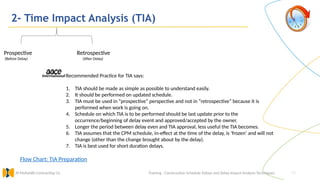
Recommended Practice for TIA says:
1. TIA should be made as simple as possible to understand easily.
2. It should be performed on updated schedule.
3. TIA must be used in “prospective” perspective and not in “retrospective” because it is
performed when work is going on.
4. Schedule on which TIA is to be performed should be last update prior to the
occurrence/beginning of delay event and approved/accepted by the owner.
5. Longer the period between delay even and TIA approval, less useful the TIA becomes.
6. TIA assumes that the CPM schedule, in-effect at the time of the delay, is ‘frozen’ and will not
change (other than the change brought about by the delay).
7. TIA is best used for short duration delays.
Flow Chart: TIA Preparation
Prospective Retrospective
(Before Delay) (After Delay)
28
2- Time Impact Analysis (TIA)
Training : Construction Schedule Delays and Delay Impact Analysis Techniques.
Al Muhaidib Contracting Co.
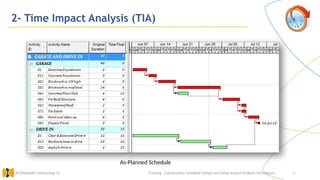
As-Planned Schedule
29
2- Time Impact Analysis (TIA)
Training : Construction Schedule Delays and Delay Impact Analysis Techniques.
Al Muhaidib Contracting Co.
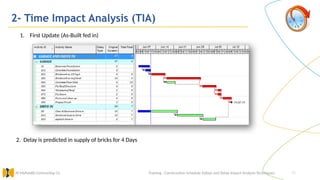
1. First Update (As-Built fed in)
2. Delay is predicted in supply of bricks for 4 Days
30
2- Time Impact Analysis (TIA)
Training : Construction Schedule Delays and Delay Impact Analysis Techniques.
Al Muhaidib Contracting Co.
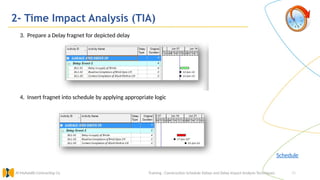
3. Prepare a Delay fragnet for depicted delay
4. Insert fragnet into schedule by applying appropriate logic
Schedule
31
2- Time Impact Analysis (TIA)
Training : Construction Schedule Delays and Delay Impact Analysis Techniques.
Al Muhaidib Contracting Co.
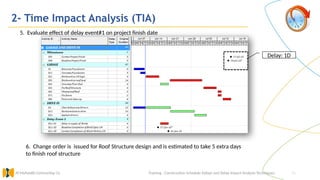
5. Evaluate effect of delay event#1 on project finish date
Delay: 1D
6. Change order is issued for Roof Structure design and is estimated to take 5 extra days
to finish roof structure
32
2- Time Impact Analysis (TIA)
Training : Construction Schedule Delays and Delay Impact Analysis Techniques.
Al Muhaidib Contracting Co.
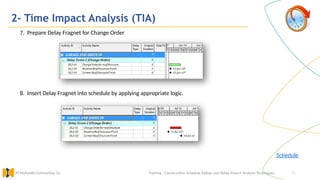
7. Prepare Delay Fragnet for Change Order
Schedule
8. Insert Delay Fragnet into schedule by applying appropriate logic.
33
2- Time Impact Analysis (TIA)
Training : Construction Schedule Delays and Delay Impact Analysis Techniques.
Al Muhaidib Contracting Co.
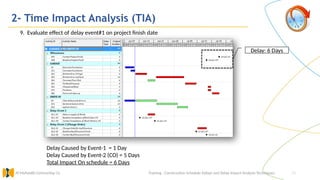
Delay: 6 Days
9. Evaluate effect of delay event#1 on project finish date
Delay Caused by Event-1 = 1 Day
Delay Caused by Event-2 (CO) = 5 Days
Total Impact On schedule = 6 Days
34
2- Time Impact Analysis (TIA)
Training : Construction Schedule Delays and Delay Impact Analysis Techniques.
Al Muhaidib Contracting Co.
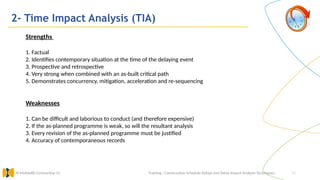
Strengths
1. Factual
2. Identifies contemporary situation at the time of the delaying event
3. Prospective and retrospective
4. Very strong when combined with an as-built critical path
5. Demonstrates concurrency, mitigation, acceleration and re-sequencing
Weaknesses
1. Can be difficult and laborious to conduct (and therefore expensive)
2. If the as-planned programme is weak, so will the resultant analysis
3. Every revision of the as-planned programme must be justified
4. Accuracy of contemporaneous records
35
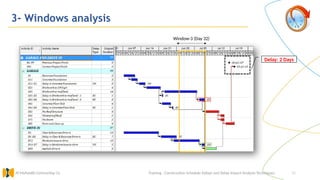
3- Windows analysis
Training : Construction Schedule Delays and Delay Impact Analysis Techniques.
Al Muhaidib Contracting Co.
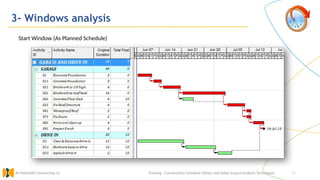
Start Window (As Planned Schedule)
36
3- Windows analysis
Training : Construction Schedule Delays and Delay Impact Analysis Techniques.
Al Muhaidib Contracting Co.
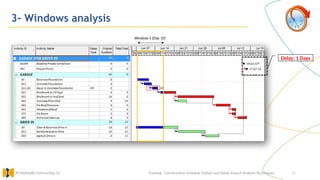
Window-1 (Day 10)
Delay: 1 Days
37
3- Windows analysis
Training : Construction Schedule Delays and Delay Impact Analysis Techniques.
Al Muhaidib Contracting Co.
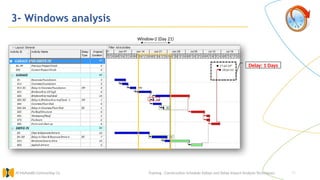
Window-2 (Day 21)
Delay: 1 Days
38
3- Windows analysis
Training : Construction Schedule Delays and Delay Impact Analysis Techniques.
Al Muhaidib Contracting Co.
Window-3 (Day 32)
Delay: 2 Days
39
3- Windows analysis
Training : Construction Schedule Delays and Delay Impact Analysis Techniques.
Al Muhaidib Contracting Co.
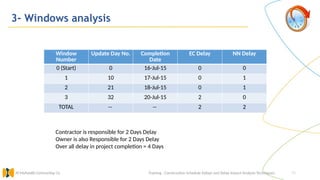
Window
Number
Update Day No. Completion
Date
EC Delay NN Delay
0 (Start) 0 16-Jul-15 0 0
1 10 17-Jul-15 0 1
2 21 18-Jul-15 0 1
3 32 20-Jul-15 2 0
TOTAL -- -- 2 2
Contractor is responsible for 2 Days Delay
Owner is also Responsible for 2 Days Delay
Over all delay in project completion = 4 Days
40
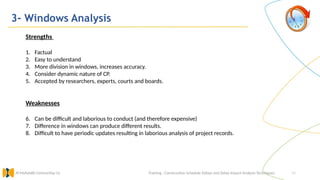
3- Windows Analysis
Training : Construction Schedule Delays and Delay Impact Analysis Techniques.
Al Muhaidib Contracting Co.
Strengths
1. Factual
2. Easy to understand
3. More division in windows, increases accuracy.
4. Consider dynamic nature of CP.
5. Accepted by researchers, experts, courts and boards.
Weaknesses
6. Can be difficult and laborious to conduct (and therefore expensive)
7. Difference in windows can produce different results.
8. Difficult to have periodic updates resulting in laborious analysis of project records.
41
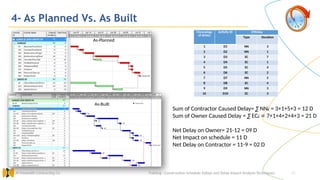
4- As Planned Vs. As Built
Training : Construction Schedule Delays and Delay Impact Analysis Techniques.
Al Muhaidib Contracting Co.
Sum of Contractor Caused Delay= ∑ NNi = 3+1+5+3 = 12 D
Sum of Owner Caused Delay = ∑ ECi = 7+1+4+2+4+3 = 21 D
Net Delay on Owner= 21-12 = 09 D
Net Impact on schedule = 11 D
Net Delay on Contractor = 11-9 = 02 D
As-Planned
As-Built
Chronology
of delays
Activity ID D9Delay
Type Duration
1 D1 NN 3
2 D2 NN 1
3 D3 EC 7
4 D4 EC 1
5 D5 EC 4
6 D6 EC 2
7 D7 NN 5
8 D8 EC 4
9 D9 NN 3
10 D10 EC 3
42
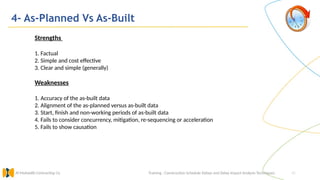
4- As-Planned Vs As-Built
Training : Construction Schedule Delays and Delay Impact Analysis Techniques.
Al Muhaidib Contracting Co.
Strengths
1. Factual
2. Simple and cost effective
3. Clear and simple (generally)
Weaknesses
1. Accuracy of the as-built data
2. Alignment of the as-planned versus as-built data
3. Start, finish and non-working periods of as-built data
4. Fails to consider concurrency, mitigation, re-sequencing or acceleration
5. Fails to show causation
43
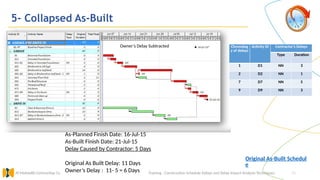
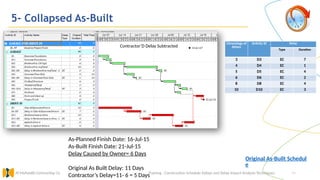
5- Collapsed As-Built
Training : Construction Schedule Delays and Delay Impact Analysis Techniques.
Al Muhaidib Contracting Co.
As-Planned Finish Date: 16-Jul-15
As-Built Finish Date: 21-Jul-15
Delay Caused by Contractor: 5 Days
Original As Built Delay: 11 Days
Owner’s Delay : 11- 5 = 6 Days
As-Built Schedule with Contractor’s Delays Subtracted
Chronolog
y of delays
Activity ID Contractor’s Delays
Type Duration
1 D1 NN 3
2 D2 NN 1
7 D7 NN 5
9 D9 NN 3
Original As-Built Schedul
e
Owner’s Delay Subtracted
44
5- Collapsed As-Built
Training : Construction Schedule Delays and Delay Impact Analysis Techniques.
Al Muhaidib Contracting Co.
As-Planned Finish Date: 16-Jul-15
As-Built Finish Date: 21-Jul-15
Delay Caused by Owner= 6 Days
Original As Built Delay: 11 Days
Contractor’s Delay=11- 6 = 5 Days
Chronology of
delays
Activity ID Delay
Type Duration
3 D3 EC 7
4 D4 EC 1
5 D5 EC 4
6 D6 EC 2
8 D8 EC 4
10 D10 EC 3
As-Built Schedule with Contractor’s Delays Subtracted
Original As-Built Schedul
e
Contractor’D Delay Subtracted
45
5- Collapsed As-built
Training : Construction Schedule Delays and Delay Impact Analysis Techniques.
Al Muhaidib Contracting Co.
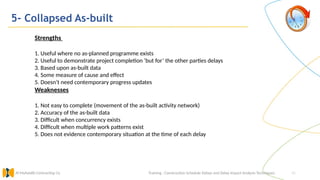
Strengths
1. Useful where no as-planned programme exists
2. Useful to demonstrate project completion ‘but for’ the other parties delays
3. Based upon as-built data
4. Some measure of cause and effect
5. Doesn’t need contemporary progress updates
Weaknesses
1. Not easy to complete (movement of the as-built activity network)
2. Accuracy of the as-built data
3. Difficult when concurrency exists
4. Difficult when multiple work patterns exist
5. Does not evidence contemporary situation at the time of each delay
46
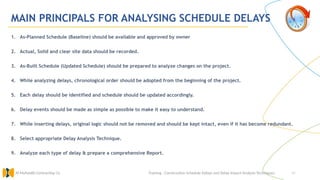
MAIN PRINCIPALS FOR ANALYSING SCHEDULE DELAYS
1. As-Planned Schedule (Baseline) should be available and approved by owner
2. Actual, Solid and clear site data should be recorded.
3. As-Built Schedule (Updated Schedule) should be prepared to analyze changes on the project.
4. While analyzing delays, chronological order should be adopted from the beginning of the project.
5. Each delay should be identified and schedule should be updated accordingly.
6. Delay events should be made as simple as possible to make it easy to understand.
7. While inserting delays, original logic should not be removed and should be kept intact, even if it has become redundant.
8. Select appropriate Delay Analysis Technique.
9. Analyze each type of delay & prepare a comprehensive Report.
Training : Construction Schedule Delays and Delay Impact Analysis Techniques.
Al Muhaidib Contracting Co.
47
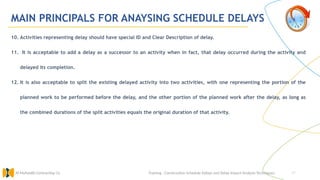
MAIN PRINCIPALS FOR ANAYSING SCHEDULE DELAYS
10. Activities representing delay should have special ID and Clear Description of delay.
11. It is acceptable to add a delay as a successor to an activity when in fact, that delay occurred during the activity and
delayed its completion.
12. It is also acceptable to split the existing delayed activity into two activities, with one representing the portion of the
planned work to be performed before the delay, and the other portion of the planned work after the delay, as long as
the combined durations of the split activities equals the original duration of that activity.
Training : Construction Schedule Delays and Delay Impact Analysis Techniques.
Al Muhaidib Contracting Co.
48
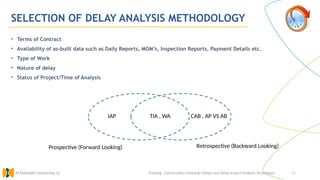
SELECTION OF DELAY ANALYSIS METHODOLOGY
Training : Construction Schedule Delays and Delay Impact Analysis Techniques.
Al Muhaidib Contracting Co.
• Terms of Contract
• Availability of as-built data such as Daily Reports, MOM’s, Inspection Reports, Payment Details etc.
• Type of Work
• Nature of delay
• Status of Project/Time of Analysis
Retrospective (Backward Looking)
Prospective (Forward Looking)
IAP TIA , WA CAB , AP VS AB
TIA
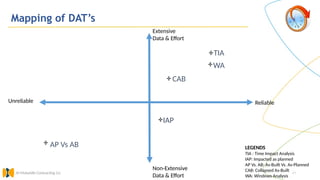
Mapping of DAT’s
49
Al Muhaidib Contracting Co.
Reliable
Unreliable
Extensive
Data & Effort
Non-Extensive
Data & Effort
IAP
AP Vs AB
CAB
WA
LEGENDS
TIA : Time Impact Analysis
IAP: Impacted as planned
AP Vs. AB: As-Built Vs. As-Planned
CAB: Collapsed As-Built
WA: Windows Analysis
50
COMPONENTS OF A GOOD EOT CLAIM
Training : Construction Schedule Delays and Delay Impact Analysis Techniques.
Al Muhaidib Contracting Co.
1. Description of Project.
2. The details of the parties.
3. The details of the contract particulars.
4. Brief detail of Delay Event on which EOT is based.
5. Definitions used in contract and in EOT document.
6. Establishing EOT entitlement (Contract Review).
7. As-Planned Schedule.
8. As-Built Schedule.
9. Complete & Detailed Delay Analysis.
10.Overall effect on completion date.
11.Evidences of delays.
12.Clear Statement of Extension of Time requested.
51
References
Training : Construction Schedule Delays and Delay Impact Analysis Techniques.
Al Muhaidib Contracting Co.
• AACE International’s Recommended Practice for TIA.
• “Prospective & Retrospective Time Impact Analysis” by Building Briefings Magazine. (Research Paper)
• “Construction Delay Analysis Techniques” by MDPI OPEN ACCESS Publishing. (Research Paper)
• “Delay Analysis and Problems with Methodologies” by David Barry (Research Paper)
• “Construction Project Scheduling” By Challahn.
• “Causes of delay in building construction projects in Egypt” by Abd El Razek.
• “Schedules and Delay Analysis Methodologies” by Richard J. Long.
52
QUERY SESSION
Training : Construction Schedule Delays and Delay Impact Analysis Techniques.
Al Muhaidib Contracting Co.
53
Al Muhaidib Contracting Co.
THANK YOU
Training : Construction Schedule Delays and Delay Impact
Analysis Techniques.

Delay Construction project Analysis.pptx

  • 1.
    Training : ConstructionSchedule Delays and Delay Impact Analy sis Techniques. 1 PLANNING DEPARTMENT AL MUHAIDIB CONTRACTING CO. Training Module 02 Presentation Topic : Construction Schedule Delays & Delay Impact Analysis Techniques Presenter : Mujahid Ishtiaq PMP®,PSP®,PMI-SP® Al Muhaidib Contracting Co. --Date--
  • 2.
    2 CONTENTS • Construction ScheduleDelays. • Causes of delays. • Types of Construction Delays. • Schedules to be used in Delay Analysis. • Schedule Delay Analysis Techniques with case studies. • Main Principals for analysing schedule delays • Selection of Delay Analysis Methodology. • Components of a good EOT Claim. • References. Training : Construction Schedule Delays and Delay Impact Analysis Techniques. Al Muhaidib Contracting Co.
  • 3.
    3 CONSTRUCTION SCHEDULE DELAYS “AnEvent or a condition that that results in finishing the project later than stipulated in the contract.” Mubarak (2005) “The time during which some part of the construction project has been extended or not executed owing to an unexpected event.” Callahn (1992) “T o make something happen later than expected or to not act timely.” Trauner (2009) Training : Construction Schedule Delays and Delay Impact Analysis Techniques. Al Muhaidib Contracting Co.
  • 4.
    4 CAUSES OF DELAYS Followingare 10 most significant causes of delays in UAE construction industry (Source: Faridi and Al Sayegh. 2006) Training : Construction Schedule Delays and Delay Impact Analysis Techniques. Al Muhaidib Contracting Co.
  • 5.
    5 CAUSES OF DELAYS Summaryof previous studies on causes of delays (Source: Lo at el . 2006) Training : Construction Schedule Delays and Delay Impact Analysis Techniques. Al Muhaidib Contracting Co.
  • 6.
    6 CAUSES OF DELAYS Summaryof previous studies on causes of delays (Source: Lo at el . 2006) (Continued) Training : Construction Schedule Delays and Delay Impact Analysis Techniques. Al Muhaidib Contracting Co.
  • 7.
    7 TYPES OF CONSTRUCTIONDELAYS Training : Construction Schedule Delays and Delay Impact Analysis Techniques. Al Muhaidib Contracting Co. Critical or Non-Critical Excusable or Non-Excusable Compensable or Non-Compensable Concurrent or Non-Concurrent
  • 8.
    8 Critical or Non-CriticalDelays Training : Construction Schedule Delays and Delay Impact Analysis Techniques. Al Muhaidib Contracting Co. Critical Delays Affecting project finish date. Non-Critical Delays Not affecting project finish date.
  • 9.
    9 Excusable and Non-ExcusableDelays Training : Construction Schedule Delays and Delay Impact Analysis Techniques. Al Muhaidib Contracting Co. Excusable Delay Caused by unforeseeable even beyond contractor’s control. Non-Excusable Delay Caused or not caused by the contractor but should have been foreseen by the contractor.
  • 10.
    10 Excusable Vs. Non-Excusable Training: Construction Schedule Delays and Delay Impact Analysis Techniques. Al Muhaidib Contracting Co. Excusable Delays Generally caused by: • General labour strikes. • Fires. • Floods. • Acts of God. • Owner-directed changes. • Errors and omissions in the plans and specifications. • Differing site conditions or concealed conditions. • Unusually severe weather. • Intervention by outside agencies. • Lack of action by government bodies, such as building inspection. • Illness or death of one or more contractors. • Epidemics • Quarantine restrictions. Non-Excusable Delays Generally caused by: • Late performance of subcontractors. • Untimely performance by suppliers. • Faulty workmanship by the contractor or subcontractors. • A project-specific labour strike caused by the contractor's unwillingness to meet with labour representatives or by unfair labour practices. • Contractor cash-flow problems. • Accidents on the site caused by the contractor's negligence or lack of preparations. • Late delivery of the contractor's furnished materials and equipment.
  • 11.
    11 Excusability Vs. Compensability Training: Construction Schedule Delays and Delay Impact Analysis Techniques. Al Muhaidib Contracting Co.
  • 12.
    12 Training : ConstructionSchedule Delays and Delay Impact Analysis Techniques. Al Muhaidib Contracting Co. Excusability Vs. Compensability
  • 13.
    13 Concurrent and Non-ConcurrentDelays Training : Construction Schedule Delays and Delay Impact Analysis Techniques. Al Muhaidib Contracting Co. Concurrent Delays Combination of two or more independent delay events occurring within the same time frame. Non-Concurrent Delay Delays events that occur independently & separately without overlapping.
  • 14.
    14 SCHEDULES TO BEUSED IN DELAYS As-Planned Schedule The As-Planned schedule is a graphical representation of the contractor’s original intention for the completion of the project. It shows different critical paths as well as planned activities and their sequence. As-Built Schedule The As-Built schedule shows the actual sequence and progress of activities in the project as they occurred in real life, including the slowdowns, work stoppages and accelerations. Training : Construction Schedule Delays and Delay Impact Analysis Techniques. Al Muhaidib Contracting Co.
  • 15.
    SCHEDULE DELAY ANALYSISTECHNIQUES Training : Construction Schedule Delays and Delay Impact Analysis Techniques. 15 Al Muhaidib Contracting Co. Delay Analysis Techniques Impacted As-Planned Time Impact Analysis Windows Analysis As-Planned Vs As Built Collapsed As-Build • PROSPECTIVE • RETROSPECTIVE 1 2 3 4 5
  • 16.
    16 1- Impacted AsPlanned Training : Construction Schedule Delays and Delay Impact Analysis Techniques. Al Muhaidib Contracting Co. As-Planned Schedule
  • 17.
    17 1- Impacted AsPlanned Training : Construction Schedule Delays and Delay Impact Analysis Techniques. Al Muhaidib Contracting Co. As Planned Completion Current Completion Delay = 3 Days Delay Event-1
  • 18.
    18 1- Impacted AsPlanned Training : Construction Schedule Delays and Delay Impact Analysis Techniques. Al Muhaidib Contracting Co. Current Completion No Delay. Same as Previous Schedule Previous Completion Delay Event-2
  • 19.
    19 1- Impacted AsPlanned Training : Construction Schedule Delays and Delay Impact Analysis Techniques. Al Muhaidib Contracting Co. Previous Completion Current Completion Delay = 1 Day Delay Event-3
  • 20.
    20 1- Impacted AsPlanned Training : Construction Schedule Delays and Delay Impact Analysis Techniques. Al Muhaidib Contracting Co. Current Completion No Delay. Same as Previous Schedule Previous Completion Delay Event-4
  • 21.
    21 1- Impacted AsPlanned Training : Construction Schedule Delays and Delay Impact Analysis Techniques. Al Muhaidib Contracting Co. Delay Event-5 Previous Completion Current Completion Delay = 1 Day
  • 22.
    22 1- Impacted AsPlanned Training : Construction Schedule Delays and Delay Impact Analysis Techniques. Al Muhaidib Contracting Co. Delay Event-6 Previous Completion Current Completion Delay = 4 Days
  • 23.
    23 1- Impacted AsPlanned Training : Construction Schedule Delays and Delay Impact Analysis Techniques. Al Muhaidib Contracting Co. Delay Event-7 Previous Completion Current Completion Delay = 3 Days
  • 24.
    24 1- Impacted AsPlanned Training : Construction Schedule Delays and Delay Impact Analysis Techniques. Al Muhaidib Contracting Co. Delay Event-8 Previous Completion Current Completion Delay = 1 Day
  • 25.
    25 1- Impacted AsPlanned Training : Construction Schedule Delays and Delay Impact Analysis Techniques. Al Muhaidib Contracting Co. Chronology of delays Activity ID Delay Type Duration Impact (Days) 1 D1 NN 3 3 2 D2 EC 7 0 3 D3 NN 1 1 4 D4 EC 1 0 5 D5 EC 8 1 6 D6 EC 5 4 7 D7 NN 3 3 8 D8 EC 8 1 TOTAL -- -- 36 13 Impacted As Planned-Results
  • 26.
    26 1- Impacted AsPlanned Training : Construction Schedule Delays and Delay Impact Analysis Techniques. Al Muhaidib Contracting Co. Strengths 1. Simple to conduct 2. Clear view of cause and effect 3. Useful where no as-built data exists 4. Clearly communicated 5. Good for repetitive or sequential projects Weaknesses 1. Theoretical results 2. No account of mitigation or acceleration 3. Relies (and maintains) the as-planned programme throughout 4. Noted as being ‘fundamentally flawed’
  • 27.
    27 2- Time ImpactAnalysis (TIA) Training : Construction Schedule Delays and Delay Impact Analysis Techniques. Al Muhaidib Contracting Co. Recommended Practice for TIA says: 1. TIA should be made as simple as possible to understand easily. 2. It should be performed on updated schedule. 3. TIA must be used in “prospective” perspective and not in “retrospective” because it is performed when work is going on. 4. Schedule on which TIA is to be performed should be last update prior to the occurrence/beginning of delay event and approved/accepted by the owner. 5. Longer the period between delay even and TIA approval, less useful the TIA becomes. 6. TIA assumes that the CPM schedule, in-effect at the time of the delay, is ‘frozen’ and will not change (other than the change brought about by the delay). 7. TIA is best used for short duration delays. Flow Chart: TIA Preparation Prospective Retrospective (Before Delay) (After Delay)
  • 28.
    28 2- Time ImpactAnalysis (TIA) Training : Construction Schedule Delays and Delay Impact Analysis Techniques. Al Muhaidib Contracting Co. As-Planned Schedule
  • 29.
    29 2- Time ImpactAnalysis (TIA) Training : Construction Schedule Delays and Delay Impact Analysis Techniques. Al Muhaidib Contracting Co. 1. First Update (As-Built fed in) 2. Delay is predicted in supply of bricks for 4 Days
  • 30.
    30 2- Time ImpactAnalysis (TIA) Training : Construction Schedule Delays and Delay Impact Analysis Techniques. Al Muhaidib Contracting Co. 3. Prepare a Delay fragnet for depicted delay 4. Insert fragnet into schedule by applying appropriate logic Schedule
  • 31.
    31 2- Time ImpactAnalysis (TIA) Training : Construction Schedule Delays and Delay Impact Analysis Techniques. Al Muhaidib Contracting Co. 5. Evaluate effect of delay event#1 on project finish date Delay: 1D 6. Change order is issued for Roof Structure design and is estimated to take 5 extra days to finish roof structure
  • 32.
    32 2- Time ImpactAnalysis (TIA) Training : Construction Schedule Delays and Delay Impact Analysis Techniques. Al Muhaidib Contracting Co. 7. Prepare Delay Fragnet for Change Order Schedule 8. Insert Delay Fragnet into schedule by applying appropriate logic.
  • 33.
    33 2- Time ImpactAnalysis (TIA) Training : Construction Schedule Delays and Delay Impact Analysis Techniques. Al Muhaidib Contracting Co. Delay: 6 Days 9. Evaluate effect of delay event#1 on project finish date Delay Caused by Event-1 = 1 Day Delay Caused by Event-2 (CO) = 5 Days Total Impact On schedule = 6 Days
  • 34.
    34 2- Time ImpactAnalysis (TIA) Training : Construction Schedule Delays and Delay Impact Analysis Techniques. Al Muhaidib Contracting Co. Strengths 1. Factual 2. Identifies contemporary situation at the time of the delaying event 3. Prospective and retrospective 4. Very strong when combined with an as-built critical path 5. Demonstrates concurrency, mitigation, acceleration and re-sequencing Weaknesses 1. Can be difficult and laborious to conduct (and therefore expensive) 2. If the as-planned programme is weak, so will the resultant analysis 3. Every revision of the as-planned programme must be justified 4. Accuracy of contemporaneous records
  • 35.
    35 3- Windows analysis Training: Construction Schedule Delays and Delay Impact Analysis Techniques. Al Muhaidib Contracting Co. Start Window (As Planned Schedule)
  • 36.
    36 3- Windows analysis Training: Construction Schedule Delays and Delay Impact Analysis Techniques. Al Muhaidib Contracting Co. Window-1 (Day 10) Delay: 1 Days
  • 37.
    37 3- Windows analysis Training: Construction Schedule Delays and Delay Impact Analysis Techniques. Al Muhaidib Contracting Co. Window-2 (Day 21) Delay: 1 Days
  • 38.
    38 3- Windows analysis Training: Construction Schedule Delays and Delay Impact Analysis Techniques. Al Muhaidib Contracting Co. Window-3 (Day 32) Delay: 2 Days
  • 39.
    39 3- Windows analysis Training: Construction Schedule Delays and Delay Impact Analysis Techniques. Al Muhaidib Contracting Co. Window Number Update Day No. Completion Date EC Delay NN Delay 0 (Start) 0 16-Jul-15 0 0 1 10 17-Jul-15 0 1 2 21 18-Jul-15 0 1 3 32 20-Jul-15 2 0 TOTAL -- -- 2 2 Contractor is responsible for 2 Days Delay Owner is also Responsible for 2 Days Delay Over all delay in project completion = 4 Days
  • 40.
    40 3- Windows Analysis Training: Construction Schedule Delays and Delay Impact Analysis Techniques. Al Muhaidib Contracting Co. Strengths 1. Factual 2. Easy to understand 3. More division in windows, increases accuracy. 4. Consider dynamic nature of CP. 5. Accepted by researchers, experts, courts and boards. Weaknesses 6. Can be difficult and laborious to conduct (and therefore expensive) 7. Difference in windows can produce different results. 8. Difficult to have periodic updates resulting in laborious analysis of project records.
  • 41.
    41 4- As PlannedVs. As Built Training : Construction Schedule Delays and Delay Impact Analysis Techniques. Al Muhaidib Contracting Co. Sum of Contractor Caused Delay= ∑ NNi = 3+1+5+3 = 12 D Sum of Owner Caused Delay = ∑ ECi = 7+1+4+2+4+3 = 21 D Net Delay on Owner= 21-12 = 09 D Net Impact on schedule = 11 D Net Delay on Contractor = 11-9 = 02 D As-Planned As-Built Chronology of delays Activity ID D9Delay Type Duration 1 D1 NN 3 2 D2 NN 1 3 D3 EC 7 4 D4 EC 1 5 D5 EC 4 6 D6 EC 2 7 D7 NN 5 8 D8 EC 4 9 D9 NN 3 10 D10 EC 3
  • 42.
    42 4- As-Planned VsAs-Built Training : Construction Schedule Delays and Delay Impact Analysis Techniques. Al Muhaidib Contracting Co. Strengths 1. Factual 2. Simple and cost effective 3. Clear and simple (generally) Weaknesses 1. Accuracy of the as-built data 2. Alignment of the as-planned versus as-built data 3. Start, finish and non-working periods of as-built data 4. Fails to consider concurrency, mitigation, re-sequencing or acceleration 5. Fails to show causation
  • 43.
    43 5- Collapsed As-Built Training: Construction Schedule Delays and Delay Impact Analysis Techniques. Al Muhaidib Contracting Co. As-Planned Finish Date: 16-Jul-15 As-Built Finish Date: 21-Jul-15 Delay Caused by Contractor: 5 Days Original As Built Delay: 11 Days Owner’s Delay : 11- 5 = 6 Days As-Built Schedule with Contractor’s Delays Subtracted Chronolog y of delays Activity ID Contractor’s Delays Type Duration 1 D1 NN 3 2 D2 NN 1 7 D7 NN 5 9 D9 NN 3 Original As-Built Schedul e Owner’s Delay Subtracted
  • 44.
    44 5- Collapsed As-Built Training: Construction Schedule Delays and Delay Impact Analysis Techniques. Al Muhaidib Contracting Co. As-Planned Finish Date: 16-Jul-15 As-Built Finish Date: 21-Jul-15 Delay Caused by Owner= 6 Days Original As Built Delay: 11 Days Contractor’s Delay=11- 6 = 5 Days Chronology of delays Activity ID Delay Type Duration 3 D3 EC 7 4 D4 EC 1 5 D5 EC 4 6 D6 EC 2 8 D8 EC 4 10 D10 EC 3 As-Built Schedule with Contractor’s Delays Subtracted Original As-Built Schedul e Contractor’D Delay Subtracted
  • 45.
    45 5- Collapsed As-built Training: Construction Schedule Delays and Delay Impact Analysis Techniques. Al Muhaidib Contracting Co. Strengths 1. Useful where no as-planned programme exists 2. Useful to demonstrate project completion ‘but for’ the other parties delays 3. Based upon as-built data 4. Some measure of cause and effect 5. Doesn’t need contemporary progress updates Weaknesses 1. Not easy to complete (movement of the as-built activity network) 2. Accuracy of the as-built data 3. Difficult when concurrency exists 4. Difficult when multiple work patterns exist 5. Does not evidence contemporary situation at the time of each delay
  • 46.
    46 MAIN PRINCIPALS FORANALYSING SCHEDULE DELAYS 1. As-Planned Schedule (Baseline) should be available and approved by owner 2. Actual, Solid and clear site data should be recorded. 3. As-Built Schedule (Updated Schedule) should be prepared to analyze changes on the project. 4. While analyzing delays, chronological order should be adopted from the beginning of the project. 5. Each delay should be identified and schedule should be updated accordingly. 6. Delay events should be made as simple as possible to make it easy to understand. 7. While inserting delays, original logic should not be removed and should be kept intact, even if it has become redundant. 8. Select appropriate Delay Analysis Technique. 9. Analyze each type of delay & prepare a comprehensive Report. Training : Construction Schedule Delays and Delay Impact Analysis Techniques. Al Muhaidib Contracting Co.
  • 47.
    47 MAIN PRINCIPALS FORANAYSING SCHEDULE DELAYS 10. Activities representing delay should have special ID and Clear Description of delay. 11. It is acceptable to add a delay as a successor to an activity when in fact, that delay occurred during the activity and delayed its completion. 12. It is also acceptable to split the existing delayed activity into two activities, with one representing the portion of the planned work to be performed before the delay, and the other portion of the planned work after the delay, as long as the combined durations of the split activities equals the original duration of that activity. Training : Construction Schedule Delays and Delay Impact Analysis Techniques. Al Muhaidib Contracting Co.
  • 48.
    48 SELECTION OF DELAYANALYSIS METHODOLOGY Training : Construction Schedule Delays and Delay Impact Analysis Techniques. Al Muhaidib Contracting Co. • Terms of Contract • Availability of as-built data such as Daily Reports, MOM’s, Inspection Reports, Payment Details etc. • Type of Work • Nature of delay • Status of Project/Time of Analysis Retrospective (Backward Looking) Prospective (Forward Looking) IAP TIA , WA CAB , AP VS AB
  • 49.
    TIA Mapping of DAT’s 49 AlMuhaidib Contracting Co. Reliable Unreliable Extensive Data & Effort Non-Extensive Data & Effort IAP AP Vs AB CAB WA LEGENDS TIA : Time Impact Analysis IAP: Impacted as planned AP Vs. AB: As-Built Vs. As-Planned CAB: Collapsed As-Built WA: Windows Analysis
  • 50.
    50 COMPONENTS OF AGOOD EOT CLAIM Training : Construction Schedule Delays and Delay Impact Analysis Techniques. Al Muhaidib Contracting Co. 1. Description of Project. 2. The details of the parties. 3. The details of the contract particulars. 4. Brief detail of Delay Event on which EOT is based. 5. Definitions used in contract and in EOT document. 6. Establishing EOT entitlement (Contract Review). 7. As-Planned Schedule. 8. As-Built Schedule. 9. Complete & Detailed Delay Analysis. 10.Overall effect on completion date. 11.Evidences of delays. 12.Clear Statement of Extension of Time requested.
  • 51.
    51 References Training : ConstructionSchedule Delays and Delay Impact Analysis Techniques. Al Muhaidib Contracting Co. • AACE International’s Recommended Practice for TIA. • “Prospective & Retrospective Time Impact Analysis” by Building Briefings Magazine. (Research Paper) • “Construction Delay Analysis Techniques” by MDPI OPEN ACCESS Publishing. (Research Paper) • “Delay Analysis and Problems with Methodologies” by David Barry (Research Paper) • “Construction Project Scheduling” By Challahn. • “Causes of delay in building construction projects in Egypt” by Abd El Razek. • “Schedules and Delay Analysis Methodologies” by Richard J. Long.
  • 52.
    52 QUERY SESSION Training :Construction Schedule Delays and Delay Impact Analysis Techniques. Al Muhaidib Contracting Co.
  • 53.
    53 Al Muhaidib ContractingCo. THANK YOU Training : Construction Schedule Delays and Delay Impact Analysis Techniques.

Editor's Notes