ATTORNEYS AND COUNSELORS
Harter Secrest & Emery LLP
Impact of Trump Administration on
Securities Regulation
March 29, 2017
HSE Overview
• Founded nearly 125 years ago
• Offices throughout New York State with over 125 attorneys
• Nationally and internationally recognized clients, including American
Express, Eastman Kodak, Northrop Grumman, Buffalo Sabres, and
Wegmans
• Sophisticated practice areas in complex areas of law with nationally-
recognized attorneys focused on delivering responsive and strategic
client service
Our clients do not sacrifice legal expertise and business insight for
cost savings; they receive the benefits of both.
About Presenters
James M. Jenkins has nearly 30 years of
public company experience representing clients
in corporate governance and general corporate
law and securities law matters, including initial
& secondary public offerings, private
placements, mergers & acquisitions, and
securities law compliance.
Email: jjenkins@hselaw.com
Phone: 646.790.5884
About Presenters
Alex R. McClean, practice group leader, focuses
his practice on securities, corporate governance,
mergers & acquisitions, and general business &
corporate matters. He regularly counsels public
companies regarding compliance with disclosure
requirements & exchange listing standards. He
represents issuers & underwriters in capital market
transactions, and counsels investment advisors &
broker-dealers on regulatory compliance.
Email: amcclean@hselaw.com
Phone: 646.790.5884
Introduction
“We need to undo many regulations which have
stifled investment in American businesses, and
restore the oversight of the financial industry in a
way that does not harm American workers.”
-President Donald J. Trump
Agenda
• SEC Commissioner Composition
• SEC 2017 Budget
• Executive Orders
• Dodd-Frank Act Repeal
• Deregulatory Efforts By SEC
SEC Commissioner Composition
• Jay Clayton – A Different Nominee
– Wall Street lawyer
– Represented some of the biggest names on Wall Street, including
Goldman Sachs and Barclays
– Helped clients weather regulatory scrutiny
– Never held any government position and no prosecutorial experience
– A shift away from enforcement
• Other Personnel Openings
– Two other open Commissioner positions (one Republican/one
Democrat)
– Head of the Office of the Comptroller of the Currency
– Chairman of the Commodity Futures Trading Commission (interim chair
expected to be nominated)
Executive Orders
• Executive Order on Reducing Regulation and Controlling Regulatory
Costs
– Implement a “one in, two out” plan, requiring federal agencies that
request new regulations to cut two existing regulations
– Direct the heads of all agencies that the total incremental cost of all new
regulations shall be no greater than zero
• Executive Order on Core Principles for Regulating the United States
Financial System
– Restore public accountability within the Federal financial regulatory
agencies and rationalize the Federal financial regulatory framework
– Make regulation efficient, effective and appropriately tailored
– Enable American companies to be competitive with foreign firms
– Foster economic growth and vibrant financial markets through more
rigorous regulatory impact analysis
Dodd-Frank Act Repeal
• Republicans are using the Congressional Review Act and the
Financial Choice Act to chip away at the Dodd Frank Act
• The reality is that it may take 1-2 years to advance a financial
services bill
– Obama administration appointees are still running most of the
government agencies that regulate the financial industry
– No agreement on a plan to replace Dodd-Frank
– Democratic support is required in the Senate
– A jam-packed agenda
CHOICE Act
• Propose changes to the structure of the CFBP
– Limit its authority to write regulations and supervise banks
– Eliminate its authority to bring claims using the Unfair Deceptive and
Abusive Standard
– Allow the President to fire the director at will
– Repeal the consumer complaint database
• Modernize Section 12(g) of the Exchange Act
– Eliminate annual verification of accredited investor status
– Increase the revenue and shareholder thresholds
• Prohibit the SEC from promulgating a rule to require universal proxy
cards
• Increase the threshold in Regulation A+ to $75 million per year
• Prohibit co-conspirators from receiving SEC Whistleblower rewards
• Remove the FDIC from the “Living Wills” process
Pay Ratio Rule
Overview
• SEC adopted rule in 2015
• Requires public companies to calculate and disclose the ratio of the
median of the annual total compensation of all employees to the
annual total compensation of the chief executive officer
• Delayed compliance until companies’ first fiscal year beginning on or
after January 1, 2017
Pay Ratio Rule
• According to SEC Acting Chairman Piwowar,
– “It was [his] understanding that some issuers have begun to
encounter unanticipated compliance difficulties that may hinder
them in meeting the reporting deadline.”
• Requested companies to submit comments regarding any
unexpected challenges
– Open for public comment for forty-five days
– 42 comment letters were submitted
• Directed SEC staff to reconsider the implementation and to
determine whether additional guidance or relief may be appropriate
• No immediate relief
Conflict Minerals Rule
Overview
• SEC adopted rule in 2012
• Requires companies to report whether their products contain conflict
minerals mined in the Democratic Republic of the Congo or
adjoining countries
– Must report annually on Form SD
• DRC Conflict Free, Not been found to be DRC Conflict Free, or DRC Conflict
Undeterminable
– Must conduct a reasonable country of origin inquiry
– Must include an independent private sector audit
• SEC partially stayed compliance
– Violation of First Amendment
Conflict Minerals Rule
• Directed SEC staff to reconsider whether the Conflict Minerals Rule
is still appropriate and to determine if additional relief is necessary
– Caused a de facto boycott of minerals from portions of Africa
– Legitimate mining operators being put out of business
• Requested comments from the public
– Open for public comment for forty-five days
– 247 comment letters were submitted
• “Leaked” draft executive order
– May suspend the rule for two years
– Unsigned
• Remains in effect
Resource Extraction Rule
Overview
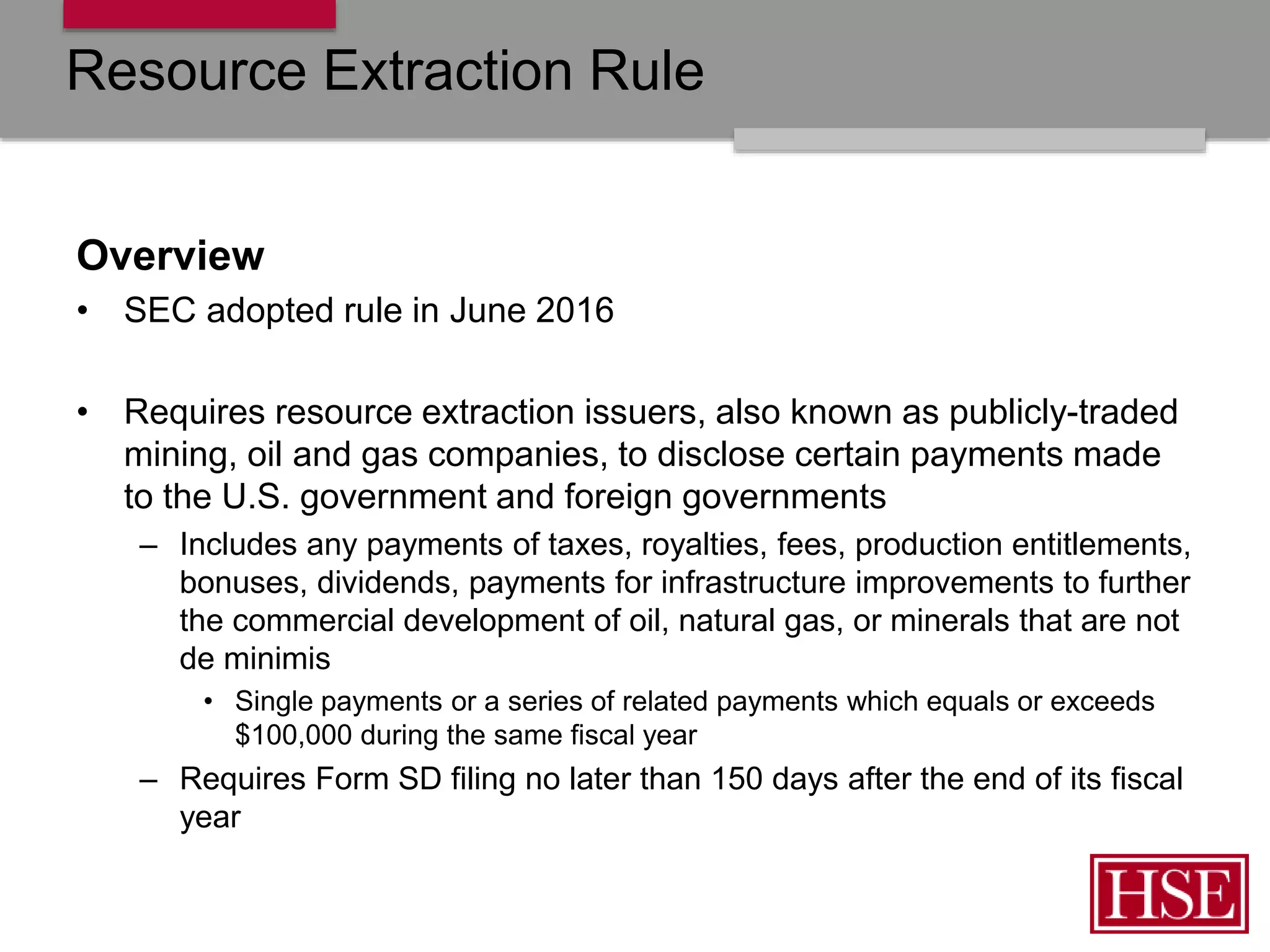
• SEC adopted rule in June 2016
• Requires resource extraction issuers, also known as publicly-traded
mining, oil and gas companies, to disclose certain payments made
to the U.S. government and foreign governments
– Includes any payments of taxes, royalties, fees, production entitlements,
bonuses, dividends, payments for infrastructure improvements to further
the commercial development of oil, natural gas, or minerals that are not
de minimis
• Single payments or a series of related payments which equals or exceeds
$100,000 during the same fiscal year
– Requires Form SD filing no later than 150 days after the end of its fiscal
year
Resource Extraction Rule
• Congress recently passed a resolution disapproving of the SEC’s
rule on resource extraction payments
• President Trump signed into law
– High annual compliance costs
– American companies disadvantaged compared to foreign competitors
• SEC can no longer enforce or reissue the rule
– Does not repeal the provision in the Dodd-Frank Act mandating that the
SEC write a rule
– SEC will be prohibited from writing another rule that is substantially the
same
Accredited Investor Definition
• The Advisory Committee on Small and Emerging Companies
recommended an expanded definition of “accredited investor”
– Include individuals who have passed examinations that test their
knowledge and understanding in the areas of securities and investing
– Take into account measures of non-financial sophistication regardless of
income or net worth
– Should not increase the current financial thresholds except to adjust for
inflation
• Acting SEC Chairman Piwowar called for an overhaul of the
definition at a recent conference
• Could the days of the “accredited investor” be numbered? Or, could
a newly revised definition be on the horizon?
SEC 2017 Budget
• According to SEC Acting Chairman Piwowar, the SEC should review
how it allocates its resources
• SEC Enforcement Division is already preparing for spending cuts in
President Trump’s 2017 budget proposal
– Banned non-essential travel
– Cancelled annual trip to Las Vegas
– Imposed a hiring freeze
– Limited the use of outside contractors
• Decreased spending is another sign that the SEC will scale back
enforcement
Investigative Powers by Enforcement Attorneys
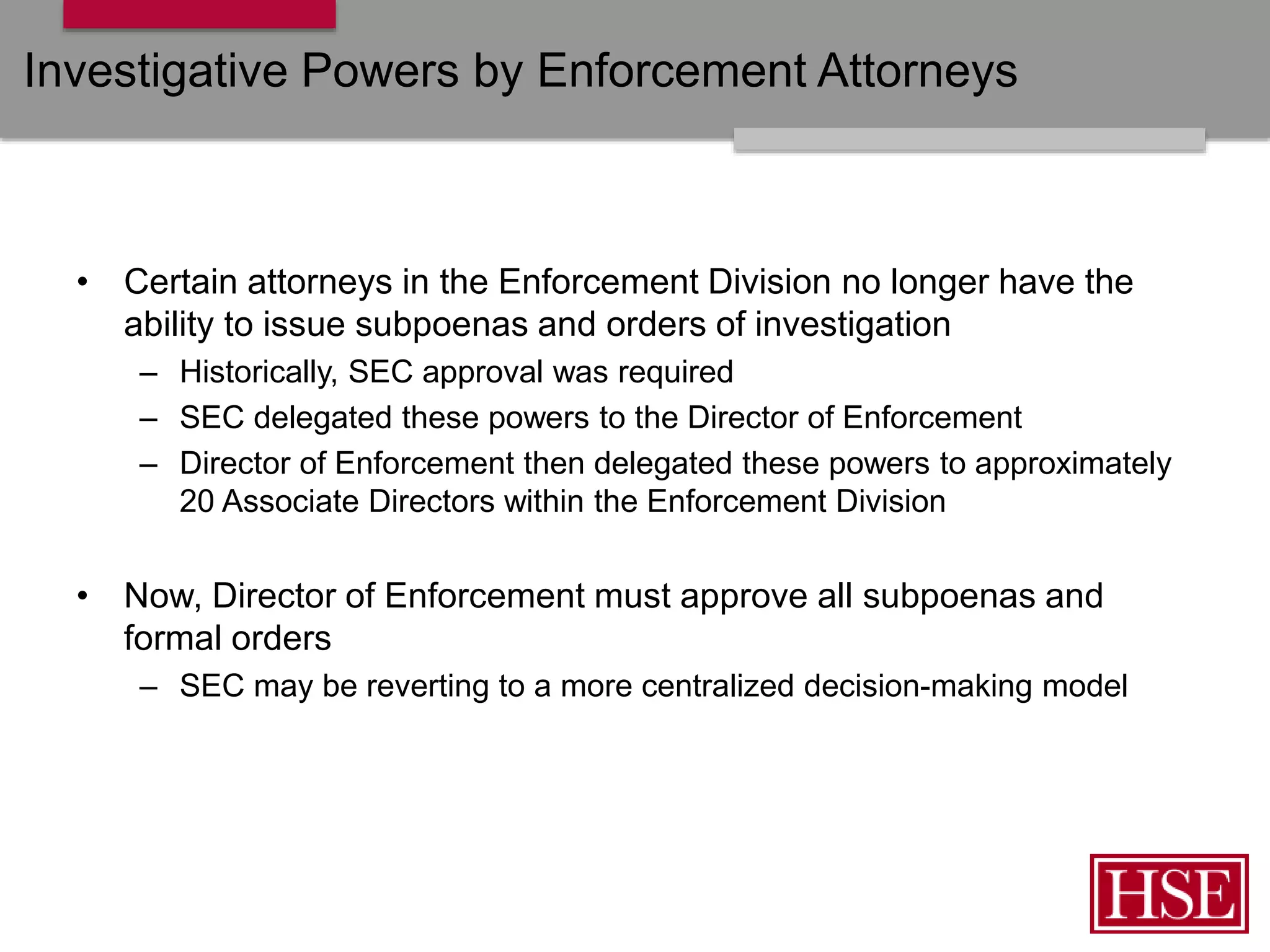
• Certain attorneys in the Enforcement Division no longer have the
ability to issue subpoenas and orders of investigation
– Historically, SEC approval was required
– SEC delegated these powers to the Director of Enforcement
– Director of Enforcement then delegated these powers to approximately
20 Associate Directors within the Enforcement Division
• Now, Director of Enforcement must approve all subpoenas and
formal orders
– SEC may be reverting to a more centralized decision-making model
Other Regulations in Danger
• Civil Penalties in Administrative Proceedings
– SEC relied on Dodd-Frank, which allowed the SEC to seek civil
penalties in administrative proceedings, to commence administrative
hearings instead of bringing actions in federal district court
• Whistleblower Protection Provisions
– SEC relied on Dodd-Frank to bring enforcement actions against
companies that retaliate against whistleblowers
• Fiduciary Rule
– The rule creates a higher fiduciary standard by revising the definition of
“investment advice fiduciary” and requiring financial professionals who
advise retirement account holders to act in the best interest of their
clients when recommending investment products.
Conclusion
• The future of the Dodd-Frank Act and other post-2008 financial crisis
legislation is unknown
• Deregulatory focus will shift priorities
• Reduced focus on enforcement
• Greater focus on facilitating capital raising
• Companies should continue to calculate their CEO’s pay ratio, to
conduct due diligence with respect to conflict minerals and to submit
their 2017 conflict mineral report
Sidoti & Company Spring 2017 Convention Presentation

Sidoti & Company Spring 2017 Convention Presentation

  • 1.
    ATTORNEYS AND COUNSELORS HarterSecrest & Emery LLP Impact of Trump Administration on Securities Regulation March 29, 2017
  • 2.
    HSE Overview • Foundednearly 125 years ago • Offices throughout New York State with over 125 attorneys • Nationally and internationally recognized clients, including American Express, Eastman Kodak, Northrop Grumman, Buffalo Sabres, and Wegmans • Sophisticated practice areas in complex areas of law with nationally- recognized attorneys focused on delivering responsive and strategic client service Our clients do not sacrifice legal expertise and business insight for cost savings; they receive the benefits of both.
  • 3.
    About Presenters James M.Jenkins has nearly 30 years of public company experience representing clients in corporate governance and general corporate law and securities law matters, including initial & secondary public offerings, private placements, mergers & acquisitions, and securities law compliance. Email: jjenkins@hselaw.com Phone: 646.790.5884
  • 4.
    About Presenters Alex R.McClean, practice group leader, focuses his practice on securities, corporate governance, mergers & acquisitions, and general business & corporate matters. He regularly counsels public companies regarding compliance with disclosure requirements & exchange listing standards. He represents issuers & underwriters in capital market transactions, and counsels investment advisors & broker-dealers on regulatory compliance. Email: amcclean@hselaw.com Phone: 646.790.5884
  • 5.
    Introduction “We need toundo many regulations which have stifled investment in American businesses, and restore the oversight of the financial industry in a way that does not harm American workers.” -President Donald J. Trump
  • 6.
    Agenda • SEC CommissionerComposition • SEC 2017 Budget • Executive Orders • Dodd-Frank Act Repeal • Deregulatory Efforts By SEC
  • 7.
    SEC Commissioner Composition •Jay Clayton – A Different Nominee – Wall Street lawyer – Represented some of the biggest names on Wall Street, including Goldman Sachs and Barclays – Helped clients weather regulatory scrutiny – Never held any government position and no prosecutorial experience – A shift away from enforcement • Other Personnel Openings – Two other open Commissioner positions (one Republican/one Democrat) – Head of the Office of the Comptroller of the Currency – Chairman of the Commodity Futures Trading Commission (interim chair expected to be nominated)
  • 8.
    Executive Orders • ExecutiveOrder on Reducing Regulation and Controlling Regulatory Costs – Implement a “one in, two out” plan, requiring federal agencies that request new regulations to cut two existing regulations – Direct the heads of all agencies that the total incremental cost of all new regulations shall be no greater than zero • Executive Order on Core Principles for Regulating the United States Financial System – Restore public accountability within the Federal financial regulatory agencies and rationalize the Federal financial regulatory framework – Make regulation efficient, effective and appropriately tailored – Enable American companies to be competitive with foreign firms – Foster economic growth and vibrant financial markets through more rigorous regulatory impact analysis
  • 9.
    Dodd-Frank Act Repeal •Republicans are using the Congressional Review Act and the Financial Choice Act to chip away at the Dodd Frank Act • The reality is that it may take 1-2 years to advance a financial services bill – Obama administration appointees are still running most of the government agencies that regulate the financial industry – No agreement on a plan to replace Dodd-Frank – Democratic support is required in the Senate – A jam-packed agenda
  • 10.
    CHOICE Act • Proposechanges to the structure of the CFBP – Limit its authority to write regulations and supervise banks – Eliminate its authority to bring claims using the Unfair Deceptive and Abusive Standard – Allow the President to fire the director at will – Repeal the consumer complaint database • Modernize Section 12(g) of the Exchange Act – Eliminate annual verification of accredited investor status – Increase the revenue and shareholder thresholds • Prohibit the SEC from promulgating a rule to require universal proxy cards • Increase the threshold in Regulation A+ to $75 million per year • Prohibit co-conspirators from receiving SEC Whistleblower rewards • Remove the FDIC from the “Living Wills” process
  • 11.
    Pay Ratio Rule Overview •SEC adopted rule in 2015 • Requires public companies to calculate and disclose the ratio of the median of the annual total compensation of all employees to the annual total compensation of the chief executive officer • Delayed compliance until companies’ first fiscal year beginning on or after January 1, 2017
  • 12.
    Pay Ratio Rule •According to SEC Acting Chairman Piwowar, – “It was [his] understanding that some issuers have begun to encounter unanticipated compliance difficulties that may hinder them in meeting the reporting deadline.” • Requested companies to submit comments regarding any unexpected challenges – Open for public comment for forty-five days – 42 comment letters were submitted • Directed SEC staff to reconsider the implementation and to determine whether additional guidance or relief may be appropriate • No immediate relief
  • 13.
    Conflict Minerals Rule Overview •SEC adopted rule in 2012 • Requires companies to report whether their products contain conflict minerals mined in the Democratic Republic of the Congo or adjoining countries – Must report annually on Form SD • DRC Conflict Free, Not been found to be DRC Conflict Free, or DRC Conflict Undeterminable – Must conduct a reasonable country of origin inquiry – Must include an independent private sector audit • SEC partially stayed compliance – Violation of First Amendment
  • 14.
    Conflict Minerals Rule •Directed SEC staff to reconsider whether the Conflict Minerals Rule is still appropriate and to determine if additional relief is necessary – Caused a de facto boycott of minerals from portions of Africa – Legitimate mining operators being put out of business • Requested comments from the public – Open for public comment for forty-five days – 247 comment letters were submitted • “Leaked” draft executive order – May suspend the rule for two years – Unsigned • Remains in effect
  • 15.
    Resource Extraction Rule Overview •SEC adopted rule in June 2016 • Requires resource extraction issuers, also known as publicly-traded mining, oil and gas companies, to disclose certain payments made to the U.S. government and foreign governments – Includes any payments of taxes, royalties, fees, production entitlements, bonuses, dividends, payments for infrastructure improvements to further the commercial development of oil, natural gas, or minerals that are not de minimis • Single payments or a series of related payments which equals or exceeds $100,000 during the same fiscal year – Requires Form SD filing no later than 150 days after the end of its fiscal year
  • 16.
    Resource Extraction Rule •Congress recently passed a resolution disapproving of the SEC’s rule on resource extraction payments • President Trump signed into law – High annual compliance costs – American companies disadvantaged compared to foreign competitors • SEC can no longer enforce or reissue the rule – Does not repeal the provision in the Dodd-Frank Act mandating that the SEC write a rule – SEC will be prohibited from writing another rule that is substantially the same
  • 17.
    Accredited Investor Definition •The Advisory Committee on Small and Emerging Companies recommended an expanded definition of “accredited investor” – Include individuals who have passed examinations that test their knowledge and understanding in the areas of securities and investing – Take into account measures of non-financial sophistication regardless of income or net worth – Should not increase the current financial thresholds except to adjust for inflation • Acting SEC Chairman Piwowar called for an overhaul of the definition at a recent conference • Could the days of the “accredited investor” be numbered? Or, could a newly revised definition be on the horizon?
  • 18.
    SEC 2017 Budget •According to SEC Acting Chairman Piwowar, the SEC should review how it allocates its resources • SEC Enforcement Division is already preparing for spending cuts in President Trump’s 2017 budget proposal – Banned non-essential travel – Cancelled annual trip to Las Vegas – Imposed a hiring freeze – Limited the use of outside contractors • Decreased spending is another sign that the SEC will scale back enforcement
  • 19.
    Investigative Powers byEnforcement Attorneys • Certain attorneys in the Enforcement Division no longer have the ability to issue subpoenas and orders of investigation – Historically, SEC approval was required – SEC delegated these powers to the Director of Enforcement – Director of Enforcement then delegated these powers to approximately 20 Associate Directors within the Enforcement Division • Now, Director of Enforcement must approve all subpoenas and formal orders – SEC may be reverting to a more centralized decision-making model
  • 20.
    Other Regulations inDanger • Civil Penalties in Administrative Proceedings – SEC relied on Dodd-Frank, which allowed the SEC to seek civil penalties in administrative proceedings, to commence administrative hearings instead of bringing actions in federal district court • Whistleblower Protection Provisions – SEC relied on Dodd-Frank to bring enforcement actions against companies that retaliate against whistleblowers • Fiduciary Rule – The rule creates a higher fiduciary standard by revising the definition of “investment advice fiduciary” and requiring financial professionals who advise retirement account holders to act in the best interest of their clients when recommending investment products.
  • 21.
    Conclusion • The futureof the Dodd-Frank Act and other post-2008 financial crisis legislation is unknown • Deregulatory focus will shift priorities • Reduced focus on enforcement • Greater focus on facilitating capital raising • Companies should continue to calculate their CEO’s pay ratio, to conduct due diligence with respect to conflict minerals and to submit their 2017 conflict mineral report

Editor's Notes

  • #6 In announcing Jay Clayton as his nominee for SEC Chairman, President Trump stated the following:
  • #8 Note: Clayton is married to a broker at Goldman Sachs—Conflict of Interest? With President Trump being able to fill two openings on the five-member SEC, the head of the Office of the Comptroller of the Currency having less than a month remaining on his term, and the Chairman of the Commodity Futures Trading Commission stepping down, President Trump may use the openings to remake the regulatory landscape. In addition, some Republicans want President Trump to fire the director of the Consumer Financial Protection Bureau, Richard Cordray. Mr. Cordray’s term expires in July 2018.
  • #9 It is widely expected that President Trump and the Republican led Congress will attempt to undo several provisions of the Dodd-Frank Act in 2017. On January 30, 2017, President Trump issued an Executive Order on Reducing Regulation and Controlling Regulatory Costs. On February 3, 2017, President Trump issued an Executive Order on Core Principles for Regulating the United States Financial System.
  • #10 According to the Senate Banking Committee Chairman, the “practical reality” is that it may take 1-2 years to advance a financial services bill It took a 1 ½ years to pass the original law
  • #11 A February 6, 2017 Memorandum provides an outline of the changes to be made to the Financial Choice Act passed by the House Financial Services Committee. The bill is more aggressive than the previous version.
  • #13 According to the Acting Director of the Division of Corporation Finance, the rules remain in effect.
  • #14 Conflict minerals include: Columbitetantalite, Cassiterite, Gold, Wolframite or their derivatives  
  • #16 Purpose: Advances U.S. foreign policy interests by promoting greater transparency about payments related to resource extraction The definition of payments also includes any payments made by subsidiaries or entities controlled by the issuer
  • #17 The Congressional Review Act allows Congress to review and cancel regulations that were introduced by federal agencies. Since the Act was enacted in 1996, there has only been one resolution of disapproval signed into law. According to Americans for Tax Return, the annual ongoing compliance cost of the Resource Extraction Rule would be between $173 million and $385 million.
  • #18 In July 2016, the Advisory Committee on Small and Emerging Companies recommended that the definition of “accredited investor” should include individuals who have passed examinations that test their knowledge and understanding in the areas of securities and investing. Acting Chairman Piwowar quoted William Graham Sumner’s Forgotten Man, “Distinguishing investors who can fend for themselves from those who cannot is a line-drawing exercise fraught with peril. The Commission did just that in 1982 when it adopted Regulation D, dividing the world of private offering investors into two categories: those persons accorded the privileged status of ‘accredited investor’ and those who are not.”
  • #20 In February, Acting SEC Chairman revoked the ability of certain attorneys in the Enforcement Division to issue subpoenas and orders of investigation. In 2010, after the Commission failed to detect and prevent several high-profile cases, it delegated these powers to the Director of Enforcement. Note: Jay Clayton, if confirmed, will be the first SEC chair with no government experience since David Sturtevant Ruder left his post as dean of Northwestern School of Law to head the agency in 1977. Note: Mary Jo White was a former prosecutor out of the Southern District of New York.
  • #21 Recently, the Commission has relied on the Dodd-Frank Act to commence administrative proceedings instead of bringing actions in federal district court. The Dodd-Frank Act provided the Commission with the power to seek civil penalties in administrative proceedings. With the future of the Dodd-Frank Act in flux, the Commission’s reliance may be reversed without congressional legislation. The Commission has relied on the Dodd-Frank Act to enforce protections for whistleblowers by bringing enforcement actions against companies that retaliate against whistleblowers. Under the new administration, the effectiveness of the Dodd-Frank’s whistleblower-protection provisions could be restricted and the Commission may devote fewer resources to protect whistleblowers. President Trump ordered the DOL to review the signature investor protection measure of the Obama Administration. The DOL was directed to examine if the rule may adversely affect the ability of Americans to gain access to retirement information and financial advice. The rule was set to go into effect in April. The rule may significantly alter the manner in which American can receive financial advice