ДЕЛАЙ САМ: SOCIAL ACTIVISM &
CONTEMPORARY ART IN A DIY
URBANISM FESTIVAL IN RUSSIA
ADEOLA	
  ENIGBOKAN,	
  PhD	
  
QUEENS	
  COLLEGE	
  	
  
DEPARTMENTS	
  OF	
  ART	
  &	
  URBAN	
  STUDIES	
  
CITY	
  UNIVERSITY	
  OF	
  NEW	
  YORK	
  
ДЕЛАЙ САМ/
DO-IT-YOURSELF
A BRIEF AND RECENT HISTORY
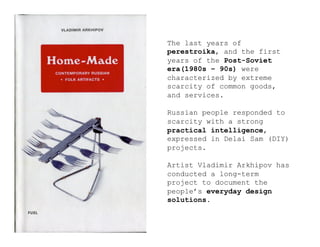
The last years of
perestroika, and the first
years of the Post-Soviet
era(1980s – 90s) were
characterized by extreme
scarcity of common goods,
and services.
Russian people responded to
scarcity with a strong
practical intelligence,
expressed in Delai Sam (DIY)
projects.
Artist Vladimir Arkhipov has
conducted a long-term
project to document the
people’s everyday design
solutions.
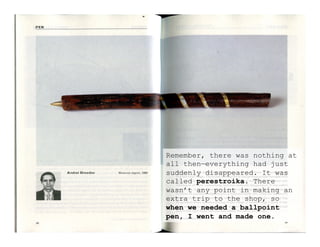
Remember, there was nothing at
all then—everything had just
suddenly disappeared. It was
called perestroika. There
wasn’t any point in making an
extra trip to the shop, so
when we needed a ballpoint
pen, I went and made one.
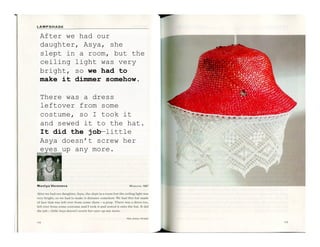
After we had our
daughter, Asya, she
slept in a room, but the
ceiling light was very
bright, so we had to
make it dimmer somehow.
There was a dress
leftover from some
costume, so I took it
and sewed it to the hat.
It did the job—little
Asya doesn’t screw her
eyes up any more.
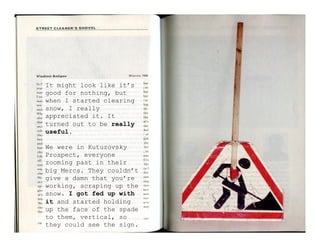
It might look like it’s
good for nothing, but
when I started clearing
snow, I really
appreciated it. It
turned out to be really
useful.
We were in Kutuzovsky
Prospect, everyone
zooming past in their
big Mercs. They couldn’t
give a damn that you’re
working, scraping up the
snow. I got fed up with
it and started holding
up the face of the spade
to them, vertical, so
they could see the sign.
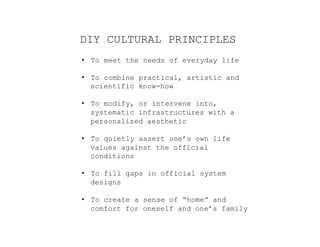
DIY CULTURAL PRINCIPLES
•  To meet the needs of everyday life
•  To combine practical, artistic and
scientific know-how
•  To modify, or intervene into,
systematic infrastructures with a
personalized aesthetic
•  To quietly assert one’s own life
values against the official
conditions
•  To fill gaps in official system
designs
•  To create a sense of “home” and
comfort for oneself and one’s family
DELAI SAM FESTIVALS
(2010 – PRESENT)
“Moscow: not the most comfortable
city for living. Last year the
Moscow [municipal] authorities
presented a master plan for the
city, which ignores a lot of its
current problems. We want to live
in a green city with convenient
public transport, bicycle lanes,
beautiful old and new buildings,
tolerant mayor, authorities and
residents. We must begin to build
for ourselves a city in which we
want to live.”
“MOSCOW 2020”
October, 2010
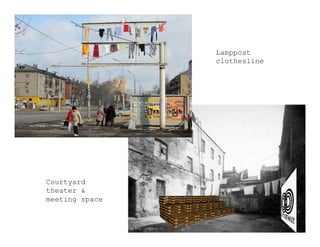
Lamppost
clothesline
Courtyard
theater &
meeting space
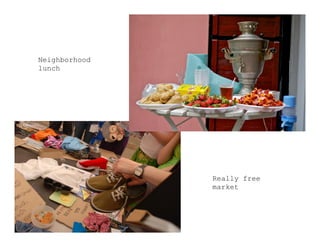
Really free
market
Neighborhood
lunch
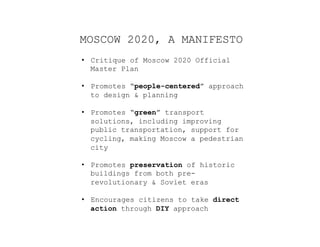
MOSCOW 2020, A MANIFESTO
•  Critique of Moscow 2020 Official
Master Plan
•  Promotes “people-centered” approach
to design & planning
•  Promotes “green” transport
solutions, including improving
public transportation, support for
cycling, making Moscow a pedestrian
city
•  Promotes preservation of historic
buildings from both pre-
revolutionary & Soviet eras
•  Encourages citizens to take direct
action through DIY approach
POLITICS & AESTHETICS IN
THE RUSSIAN CITY
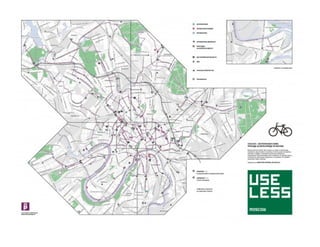
BIENNALE MAP
ART
IS
GLOB
AL
BUSI
NESS
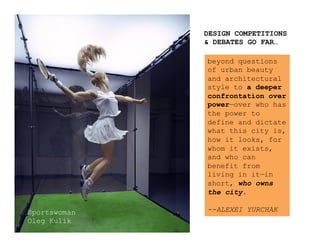
Sportswoman
Oleg Kulik
beyond questions
of urban beauty
and architectural
style to a deeper
confrontation over
power—over who has
the power to
define and dictate
what this city is,
how it looks, for
whom it exists,
and who can
benefit from
living in it—in
short, who owns
the city.
--ALEXEI YURCHAK
DESIGN COMPETITIONS
& DEBATES GO FAR…
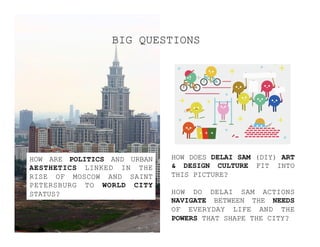
HOW DOES DELAI SAM (DIY) ART
& DESIGN CULTURE FIT INTO
THIS PICTURE?
HOW DO DELAI SAM ACTIONS
NAVIGATE BETWEEN THE NEEDS
OF EVERYDAY LIFE AND THE
POWERS THAT SHAPE THE CITY?
HOW ARE POLITICS AND URBAN
AESTHETICS LINKED IN THE
RISE OF MOSCOW AND SAINT
PETERSBURG TO WORLD CITY
STATUS?
BIG QUESTIONS
LET’S STAY IN TOUCH!
Adeola Enigbokan
base: New York City
enigbokan@gmail.com
http://archivingthecity.com

DIY-культура в России как самостоятельное направление в современном искусстве / Адеола Энигбокан

  • 1.
    ДЕЛАЙ САМ: SOCIALACTIVISM & CONTEMPORARY ART IN A DIY URBANISM FESTIVAL IN RUSSIA ADEOLA  ENIGBOKAN,  PhD   QUEENS  COLLEGE     DEPARTMENTS  OF  ART  &  URBAN  STUDIES   CITY  UNIVERSITY  OF  NEW  YORK  
  • 2.
  • 3.
    The last yearsof perestroika, and the first years of the Post-Soviet era(1980s – 90s) were characterized by extreme scarcity of common goods, and services. Russian people responded to scarcity with a strong practical intelligence, expressed in Delai Sam (DIY) projects. Artist Vladimir Arkhipov has conducted a long-term project to document the people’s everyday design solutions.
  • 4.
    Remember, there wasnothing at all then—everything had just suddenly disappeared. It was called perestroika. There wasn’t any point in making an extra trip to the shop, so when we needed a ballpoint pen, I went and made one.
  • 5.
    After we hadour daughter, Asya, she slept in a room, but the ceiling light was very bright, so we had to make it dimmer somehow. There was a dress leftover from some costume, so I took it and sewed it to the hat. It did the job—little Asya doesn’t screw her eyes up any more.
  • 6.
    It might looklike it’s good for nothing, but when I started clearing snow, I really appreciated it. It turned out to be really useful. We were in Kutuzovsky Prospect, everyone zooming past in their big Mercs. They couldn’t give a damn that you’re working, scraping up the snow. I got fed up with it and started holding up the face of the spade to them, vertical, so they could see the sign.
  • 7.
    DIY CULTURAL PRINCIPLES • To meet the needs of everyday life •  To combine practical, artistic and scientific know-how •  To modify, or intervene into, systematic infrastructures with a personalized aesthetic •  To quietly assert one’s own life values against the official conditions •  To fill gaps in official system designs •  To create a sense of “home” and comfort for oneself and one’s family
  • 8.
  • 9.
    “Moscow: not themost comfortable city for living. Last year the Moscow [municipal] authorities presented a master plan for the city, which ignores a lot of its current problems. We want to live in a green city with convenient public transport, bicycle lanes, beautiful old and new buildings, tolerant mayor, authorities and residents. We must begin to build for ourselves a city in which we want to live.” “MOSCOW 2020” October, 2010
  • 11.
  • 12.
  • 14.
    MOSCOW 2020, AMANIFESTO •  Critique of Moscow 2020 Official Master Plan •  Promotes “people-centered” approach to design & planning •  Promotes “green” transport solutions, including improving public transportation, support for cycling, making Moscow a pedestrian city •  Promotes preservation of historic buildings from both pre- revolutionary & Soviet eras •  Encourages citizens to take direct action through DIY approach
  • 15.
    POLITICS & AESTHETICSIN THE RUSSIAN CITY
  • 16.
  • 17.
    Sportswoman Oleg Kulik beyond questions ofurban beauty and architectural style to a deeper confrontation over power—over who has the power to define and dictate what this city is, how it looks, for whom it exists, and who can benefit from living in it—in short, who owns the city. --ALEXEI YURCHAK DESIGN COMPETITIONS & DEBATES GO FAR…
  • 18.
    HOW DOES DELAISAM (DIY) ART & DESIGN CULTURE FIT INTO THIS PICTURE? HOW DO DELAI SAM ACTIONS NAVIGATE BETWEEN THE NEEDS OF EVERYDAY LIFE AND THE POWERS THAT SHAPE THE CITY? HOW ARE POLITICS AND URBAN AESTHETICS LINKED IN THE RISE OF MOSCOW AND SAINT PETERSBURG TO WORLD CITY STATUS? BIG QUESTIONS
  • 19.
    LET’S STAY INTOUCH! Adeola Enigbokan base: New York City enigbokan@gmail.com http://archivingthecity.com