PRIME NUMBERS
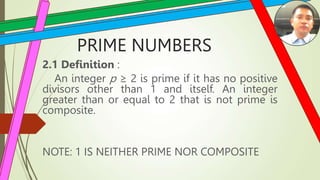
2.1 Definition :
An integer p ≥ 2 is prime if it has no positive
divisors other than 1 and itself. An integer
greater than or equal to 2 that is not prime is
composite.
NOTE: 1 IS NEITHER PRIME NOR COMPOSITE
PRIME NUMBERS
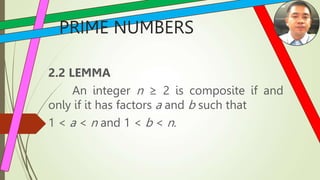
2.2 LEMMA
An integer n ≥ 2 is composite if and
only if it has factors a and b such that
1 < a < n and 1 < b < n.
PRIME NUMBERS
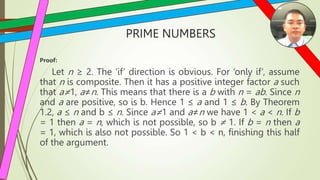
Proof:
Let n ≥ 2. The ‘if’ direction is obvious. For ‘only if’, assume
that n is composite. Then it has a positive integer factor a such
that a≠1, a≠n. This means that there is a b with n = ab. Since n
and a are positive, so is b. Hence 1 ≤ a and 1 ≤ b. By Theorem
1.2, a ≤ n and b ≤ n. Since a≠1 and a≠n we have 1 < a < n. If b
= 1 then a = n, which is not possible, so b ≠ 1. If b = n then a
= 1, which is also not possible. So 1 < b < n, finishing this half
of the argument.
PRIME NUMBERS
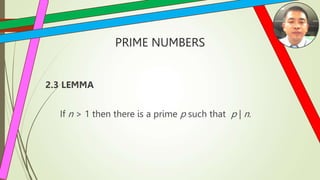
2.3 LEMMA
If n > 1 then there is a prime p such that p | n.
PRIME NUMBERS
Proof:
Let S denote the set of all integers greater than 1 that have no prime
divisor. We must show that S is empty. If S is not empty then by the Well-
Ordering Property it has a smallest member; call it m. Now m > 1 and has
no prime divisor. Then m cannot be prime (as every number is a divisor of
itself). Hence m is composite. Therefore by Lemma 2.2, m = ab where 1 < a
< m and 1 < b < m. Since 1 < a < m, the factor a is not a member of S. So a
must have a prime divisor p. Then p | a and a | m, so by Theorem 1.2, p | m.
This contradicts the assumption that m has no prime divisor. So the set S
must be empty.
Sieve of Erastosthenes
A method for finding all primes up to (and
possibly including) a given natural n.
This method works well in a relatively small,
allowing us to determine whether any natural
number less than or equal to n is a prime or
composite.
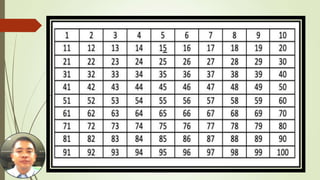
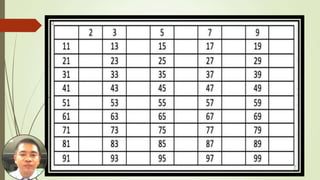
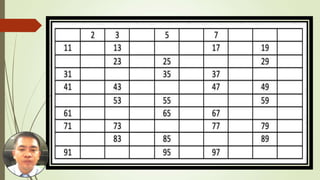
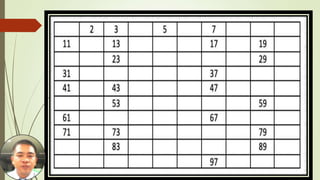
Strategy:
a. List all integers from 2 to n.
b. The first integer on the list is 2, and it is prime. Mark
out all multiples of 2 that are bigger than 2.
Try the exercises in the next slide.
Exercises:
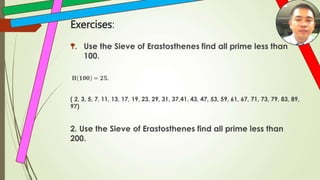
1. Use the Sieve of Erastosthenes find all prime
less than 100.
Exercises:

THANK YOU
-OSCAR H. DELA TORRE JR.

DELA TORRE_PRIME NUMBERS.ppt

  • 1.
    PRIME NUMBERS 2.1 Definition: An integer p ≥ 2 is prime if it has no positive divisors other than 1 and itself. An integer greater than or equal to 2 that is not prime is composite. NOTE: 1 IS NEITHER PRIME NOR COMPOSITE
  • 2.
    PRIME NUMBERS 2.2 LEMMA Aninteger n ≥ 2 is composite if and only if it has factors a and b such that 1 < a < n and 1 < b < n.
  • 3.
    PRIME NUMBERS Proof: Let n≥ 2. The ‘if’ direction is obvious. For ‘only if’, assume that n is composite. Then it has a positive integer factor a such that a≠1, a≠n. This means that there is a b with n = ab. Since n and a are positive, so is b. Hence 1 ≤ a and 1 ≤ b. By Theorem 1.2, a ≤ n and b ≤ n. Since a≠1 and a≠n we have 1 < a < n. If b = 1 then a = n, which is not possible, so b ≠ 1. If b = n then a = 1, which is also not possible. So 1 < b < n, finishing this half of the argument.
  • 4.
    PRIME NUMBERS 2.3 LEMMA Ifn > 1 then there is a prime p such that p | n.
  • 5.
    PRIME NUMBERS Proof: Let Sdenote the set of all integers greater than 1 that have no prime divisor. We must show that S is empty. If S is not empty then by the Well- Ordering Property it has a smallest member; call it m. Now m > 1 and has no prime divisor. Then m cannot be prime (as every number is a divisor of itself). Hence m is composite. Therefore by Lemma 2.2, m = ab where 1 < a < m and 1 < b < m. Since 1 < a < m, the factor a is not a member of S. So a must have a prime divisor p. Then p | a and a | m, so by Theorem 1.2, p | m. This contradicts the assumption that m has no prime divisor. So the set S must be empty.
  • 6.
    Sieve of Erastosthenes Amethod for finding all primes up to (and possibly including) a given natural n. This method works well in a relatively small, allowing us to determine whether any natural number less than or equal to n is a prime or composite.
  • 7.
    Strategy: a. List allintegers from 2 to n. b. The first integer on the list is 2, and it is prime. Mark out all multiples of 2 that are bigger than 2. Try the exercises in the next slide.
  • 8.
    Exercises: 1. Use theSieve of Erastosthenes find all prime less than 100.
  • 13.
  • 14.
    THANK YOU -OSCAR H.DELA TORRE JR.

Editor's Notes

  • #2 Good Morning Maam, Good Morning fellow educators. I am Oscar H. dela Torre Jr. from the group 2. to continue our reporting about PRIME Numbers together with Sir Christopher Bryan Magat. Without further a do, since our time is limited, I will begin now my reporting. A young child can understand what makes a number prime, yet lifetimes of mathematical research have been spent trying to solve some of the problems in the field.” Prime numbers have attracted human attention from the early days of civilization. We explain what they are, why their study excites mathematicians and amateurs alike, and on the way, we open a window to the mathematician’s world.   The definition of a PRIME number is so simple that it is learned in primary school: it is that natural number greater than 1 that can only be divided exactly by 1 and by itself.    
  • #6 The first known person to look specifically at this subject was the Greek mathematician Euclid of Alexandria, who around 300 B.C. demonstrated for the first time that prime numbers are infinite. A century later, another Greek mathematician, Eratosthenes, created a screening method that allows all the prime numbers of a limited list to be identified, simply by crossing out multiples.
  • #7 Sieve of Eratosthenes is an almost mechanical procedure for separating out composite numbers and leaving the primes. It was invented by the Greek scientist and mathematician Eratosthenes who lived approximately 2,300 years ago.