Definitive Guide To Arm Cortexm23 And Cortexm33 Processors Joseph Yiu
Definitive Guide To Arm Cortexm23 And Cortexm33 Processors Joseph Yiu
Definitive Guide To Arm Cortexm23 And Cortexm33 Processors Joseph Yiu
Definitive Guide To Arm Cortexm23 And Cortexm33 Processors Joseph Yiu
Definitive Guide To Arm Cortexm23 And Cortexm33 Processors Joseph Yiu
1.
Definitive Guide ToArm Cortexm23 And Cortexm33
Processors Joseph Yiu download
https://ebookbell.com/product/definitive-guide-to-arm-
cortexm23-and-cortexm33-processors-joseph-yiu-22127692
Explore and download more ebooks at ebookbell.com
2.
Here are somerecommended products that we believe you will be
interested in. You can click the link to download.
Definitive Guide To Arm Cortexm23 And Cortexm33 Processors Joseph Yiu
https://ebookbell.com/product/definitive-guide-to-arm-cortexm23-and-
cortexm33-processors-joseph-yiu-34775156
Definitive Guide To Arm Cortexm23 And Cortexm33 Processors Joseph Yiu
https://ebookbell.com/product/definitive-guide-to-arm-cortexm23-and-
cortexm33-processors-joseph-yiu-22004026
Definitive Guide To Arm Cortexm23 And Cortexm33 Processors Yiu
https://ebookbell.com/product/definitive-guide-to-arm-cortexm23-and-
cortexm33-processors-yiu-22127690
Definitive Guide To The Arm Cortexm3 Joseph Yiu
https://ebookbell.com/product/definitive-guide-to-the-arm-
cortexm3-joseph-yiu-4111794
3.
The Definitive GuideTo The Arm Cortexm3 Second Edition 2nd Edition
Joseph Yiu
https://ebookbell.com/product/the-definitive-guide-to-the-arm-
cortexm3-second-edition-2nd-edition-joseph-yiu-2117806
The Definitive Guide To The Arm Cortexm0 1 Aufl Joseph Yiu Auth
https://ebookbell.com/product/the-definitive-guide-to-the-arm-
cortexm0-1-aufl-joseph-yiu-auth-4341550
Definitive Guide To Django Web Development Done Right Second Edition
Adrian Holovaty Jacob Kaplanmoss
https://ebookbell.com/product/definitive-guide-to-django-web-
development-done-right-second-edition-adrian-holovaty-jacob-
kaplanmoss-52556316
Definitive Guide To Excel Vba 2nd Edition Michael Kofler Auth
https://ebookbell.com/product/definitive-guide-to-excel-vba-2nd-
edition-michael-kofler-auth-11853962
Definitive Guide To Apples Homekit Smart Home Automation System
Discover How To Use The Home App In Ios 10 To Build Your Own Smart
Home Using Apples Home Automation Essential Guides Book 7 Gerard
Odriscoll
https://ebookbell.com/product/definitive-guide-to-apples-homekit-
smart-home-automation-system-discover-how-to-use-the-home-app-in-
ios-10-to-build-your-own-smart-home-using-apples-home-automation-
essential-guides-book-7-gerard-odriscoll-230936642
About the imageon the book cover—Musca-S1
IoT demonstrator
The image on the book cover is a photograph of the Musca-S1, a test chip board with two Arm Cortex-
M33 processors, the Arm Corstone-200 foundation IP package and security IP components from the
Arm CryptoCell-300 family. The Musca test chip and development board were developed for ecosys-
tem enablement activities and for use as a reference platform to demonstrate the handling of Platform
Security Architecture (PSA) level 1 certification and PSA Functional API certification.
The Musca-S1 test chip is the industry’s first MRAM-enabled IoT SoC demonstrator.
Further information about the Musca-S1 can be found on the Arm’s developer website:
https://developer.arm.com/tools-and-software/development-boards/iot-test-chips-and-boards/
musca-s1-test-chip-board
Dedication
This book isdedicated to my family,
and,
all the cats and dogs in the neighborhood that kept me entertained
(but no more dead rats under my chair please!!)
Contents
Preface xi
Contributing author:Paul Beckmann xiii
Acknowledgments xv
1. Introduction
1.1 Microcontrollers and processors 1
1.2 Classification of processors 3
1.3 The Cortex-M23 and Cortex-M33
processors and the Armv8-M
architecture 3
1.4 Characteristics of the Cortex-M23 and
Cortex-M33 processors 5
1.5 Why have two different processors? 6
1.6 Applications of the Cortex-M23 and
Cortex-M33 7
1.7 Technical features 8
1.8 Comparison with previous generations of
Cortex-M processors 8
1.9 Advantages of the Cortex-M23 and Cortex-M33
processors 11
1.10 Understanding microcontroller
programming 14
1.11 Further reading 15
References 16
2. Getting started with Cortex-M
programming
2.1 Overview 19
2.2 Some basic concepts 22
2.3 Introduction to Arm Cortex-M
programming 29
2.4 Software development flow 41
2.5 Cortex Microcontroller Software Interface
Standard (CMSIS) 44
2.6 Additional information on software
development 50
Reference 51
3. Technical overview of the Cortex-M23
and Cortex-M33 processors
3.1 Design objectives of Cortex-M23 and
Cortex-M33 processors 53
3.2 Block diagrams 54
3.3 Processor 57
3.4 Instruction set 58
3.5 Memory map 58
3.6 Bus interfaces 61
3.7 Memory protection 61
3.8 Interrupt and exception handling 62
3.9 Low power features 63
3.10 OS support features 64
3.11 Floating-point unit 64
3.12 Coprocessor interface and Arm Custom
Instructions 65
3.13 Debug and trace support 65
3.14 Multicore system design support 66
3.15 Key feature enhancements in Cortex-M23 and
Cortex-M33 processors 66
3.16 Compatibility with other Cortex-M
processors 70
3.17 Processor configuration options 71
3.18 Introduction to TrustZone 71
3.19 Why TrustZone enables better security? 80
3.20 Firmware asset protection with
eXecute-Only-Memory (XOM) 83
Reference 84
4. Architecture
4.1 Introduction to the Armv8-M architecture 85
4.2 Programmer’s model 87
4.3 Memory system 112
4.4 Exceptions and Interrupts 124
4.5 Debug 131
4.6 Reset and reset sequence 133
4.7 Other related architecture information 136
References 137
vii
13.
5. Instruction set
5.1Background 139
5.2 Instruction set features in various Cortex-M
processors 141
5.3 Understanding the assembly language
syntax 143
5.4 Use of a suffix in an instruction 147
5.5 Unified Assembly Language (UAL) 150
5.6 Instruction set—Moving data within the
processors 151
5.7 Instruction set—Memory access 158
5.8 Instruction set—Arithmetic operations 182
5.9 Instruction set—Logic operations 185
5.10 Instruction set—Shift and rotate
operations 185
5.11 Instruction set—Data conversions (extend and
reverse ordering) 191
5.12 Instruction set—Bit field processing 193
5.13 Instruction set—Saturation
operations 195
5.14 Instruction set—Program flow control 198
5.15 Instruction set—DSP extension 208
5.16 Instruction set—Floating point support
instructions 219
5.17 Instruction set—Exception-related
instructions 225
5.18 Instruction set—Sleep mode-related
instructions 227
5.19 Instruction set—Memory barrier
instructions 228
5.20 Instruction set—TrustZone support
instructions 231
5.21 Instruction set—Coprocessor and Arm custom
instructions support 232
5.22 Instruction set—Other functions 236
5.23 Accessing special registers with the
CMSIS-CORE 240
References 243
6. Memory system
6.1 Overview of the memory system 245
6.2 Memory map 247
6.3 Memory types and memory attributes 251
6.4 Access permission management 254
6.5 Memory endianness 259
6.6 Data alignment and unaligned data access
support 262
6.7 Exclusive access support 263
6.8 Memory ordering and memory barrier
instructions 267
6.9 Bus wait state and error support 269
6.10 Single-cycle I/O port—Cortex-M23 only 270
6.11 Memory systems in microcontrollers 272
6.12 Software considerations 278
References 279
7. TrustZone support in the memory
system
7.1 Overview 281
7.2 SAU and IDAU 283
7.3 Banked and nonbanked registers 285
7.4 Test Target (TT) instructions and region ID
numbers 287
7.5 Memory protection controller and peripheral
protection controller 292
7.6 Security aware peripherals 296
References 297
8. Exceptions and interrupts—Architecture
overview
8.1 Overview of exceptions and interrupts 299
8.2 Exception types 303
8.3 Overview of interrupts and exceptions
management 303
8.4 Exception sequence introduction 307
8.5 Definitions of exception priority levels 310
8.6 Vector table and vector table offset register
(VTOR) 315
8.7 Interrupt input and pending behaviors 318
8.8 Target states of exceptions and interrupts in
TrustZone systems 322
8.9 Stack frames 325
8.10 EXC_RETURN 335
8.11 Classification of synchronous and asynchronous
exceptions 340
References 340
9. Management of exceptions
and interrupts
9.1 Overview of exception and interrupt
management 341
9.2 Details of the NVIC registers for interrupt
management 346
viii Contents
14.
9.3 Details ofSCB registers for system exception
management 354
9.4 Details of special registers for exception or
interrupt masking 362
9.5 Vector table definition in programming 369
9.6 Interrupt latency and exception handling
optimizations 373
9.7 Tips and hints 378
References 380
10. Low power and system
control features
10.1 The quest for low power 381
10.2 Low power features in the Cortex-M23 and
Cortex-M33 processors 383
10.3 More on WFI, WFE, and SEV instructions 395
10.4 Developing low power applications 401
10.5 System Control Block (SCB) and system control
features 404
10.6 Auxiliary Control Register 413
10.7 Other registers in the System Control
Block 415
11. OS support features
11.1 Overview of the OS support features 417
11.2 SysTick timer 418
11.3 Banked stack pointers 427
11.4 Stack limit checking 432
11.5 SVCall and PendSV exceptions 436
11.6 Unprivileged execution level and the Memory
Protection Unit (MPU) 444
11.7 Exclusive access 446
11.8 How should an RTOS run in a TrustZone
environment? 448
11.9 Concepts of RTOS operations in Cortex-M
processors 450
References 462
12. Memory Protection Unit (MPU)
12.1 Overview of the MPU 463
12.2 MPU registers 466
12.3 Configuration of the MPU 474
12.4 TrustZone and MPU 482
12.5 Key differences between the MPU in Armv8-M
architecture and the architecture of the previous
generations 484
References 485
13. Fault exceptions and fault handling
13.1 Overview 487
13.2 Cause of faults 489
13.3 Enabling fault exceptions 496
13.4 Fault handler designs considerations 497
13.5 Fault status and other information 499
13.6 Lockup 507
13.7 Analysis of fault events 509
13.8 Stack trace 512
13.9 Fault handler to extract stack frame and display
fault status 514
Reference 517
14. The Floating-Point Unit (FPU)
in the Cortex-M33 processor
14.1 Floating-point data 519
14.2 Cortex-M33 Floating-point Unit (FPU) 524
14.3 Key differences between the FPUs of the Cortex-
M33 FPU and the Cortex-M4 539
14.4 Lazy stacking in details 540
14.5 Using the FPU 547
14.6 Floating-point exceptions 553
14.7 Hints and tips 556
References 557
15. Coprocessor interface and Arm Custom
Instructions
15.1 Overview 559
15.2 Overview of the architecture 565
15.3 Accessing coprocessor instructions via intrinsic
functions in C 566
15.4 Accessing Arm Custom Instructions via the
intrinsic functions in C 568
15.5 Software steps to take when enabling the
coprocessor and the Arm Custom
Instructions 570
15.6 Coprocessor power control 571
15.7 Hints and tips 572
References 573
ix
Contents
15.
16. Introduction tothe debug and trace
features
16.1 Introduction 575
16.2 Debug architecture details 580
16.3 An introduction to debug components 596
16.4 Starting a debug session 633
16.5 Flash memory programming support 634
16.6 Software design considerations 635
References 635
17. Software development
17.1 Introduction 637
17.2 Getting started with the Keil Microcontroller
Development Kit (MDK) 639
17.3 Procedure Call Standard for the Arm
Architecture 679
17.4 Software scenarios 681
References 683
18. Secure software development
18.1 Overview of Secure software development 685
18.2 TrustZone technical details 688
18.3 Secure software development 701
18.4 Creating a Secure project in Keil MDK 720
18.5 CMSE support in other toolchains 731
18.6 Secure software design considerations 733
References 750
19. Digital signal processing on the
cortex-M33 processor
19.1 DSP on a microcontroller? 751
19.2 Why use a Cortex-M processor for a DSP
application? 752
19.3 Dot product example 754
19.4 Getting more performance by utilizing the SIMD
instructions 757
19.5 Dealing with overflows 759
19.6 Introduction to data types for signal
processing 761
19.7 Cortex-M33 DSP instructions 765
19.8 Writing optimized DSP code for the Cortex-M33
processor 779
References 798
20. Using the Arm CMSIS-DSP library
20.1 Overview of the library 799
20.2 Function naming convention 801
20.3 Getting help 802
20.4 Example 1—DTMF demodulation 802
20.5 Example 2—Least squares motion tracking 813
20.6 Example 3—Real-time filter design 818
20.7 How to determine the implemented
instruction set features in a Cortex-M33
based system 845
References 847
21. Advanced topics
21.1 Further information on stack memory
protection 849
21.2 Semaphores, load-acquire and store-release
instructions 851
21.3 Unprivileged interrupt handler 854
21.4 Re-entrant interrupt handler 859
21.5 Software optimization topics 865
Reference 876
22. Introduction to IoT security and the
PSA Certified™ framework
22.1 From processor architecture to IoT security 877
22.2 Introduction of PSA Certified 878
22.3 The Trusted Firmware-M (TF-M) project 889
22.4 Additional information 895
References 896
Index 897
The Appendix section of this book,
covering information about debug and
trace connector layouts and the graphical
representations of DSP instructions,
is available on the companion website for
this book at https://www.elsevier.com/
books-and-journals/book-companion/
9780128207352.
x Contents
16.
Preface
It has beena while since the last Definitive
Guide to Arm®
Cortex®
-M Processor book
was released. Now, Cortex-M23- and
Cortex-M33-based products are arriving in
the market and many of them provide so-
phisticated security features—the definition
of “modern microcontrollers” seems to have
taken a big step forward. Although the
mechanisms of these security features are tai-
lored for small silicon devices with a low
power footprint, many of these security tech-
nologies are, in principle, similar to high-end
computing systems.
While security is a very broad topic, a key
aspect of security in billions of connected de-
vices is the “Root of Trust,” such as secret
keys and secure boot mechanisms—all of
which need to be protected. With Arm
TrustZone®
technology, which is supported
by the Cortex-M23 and Cortex-M33 proces-
sors, these security-critical assets can be
protected in a secure processing environ-
ment (Secure world). At the same time, ap-
plications running in the normal processing
environment (Non-secure world) can be de-
veloped easily and are able to utilize security
features provided by the secure firmware.
Together with other Arm projects, such as
the Platform Security Architecture (PSA)
and Trusted Firmware-M, software devel-
opers are able to easily create software for se-
cure IoT products.
The interaction between Secure and Non-
secure software components brings a new di-
mension of complexity to the architecture.
While Non-secure software development is
still very similar to that which was needed
on previous Cortex-M processors, Secure
software developers creating secure firm-
ware now need to be familiar with a range
of new architectural features that have been
introduced in the Armv8-M architecture.
Unlike previous editions of the Definitive
Guides to Arm Cortex-M Processor, this book
is focused on the architecture of the Arm
Cortex-M23 and Cortex-M33 processors. To
enable software developers to create secure
solutions based on the Armv8-M architecture,
there is a need, as provided in this book, to
provide an in-depth explanation of the archi-
tectural features which are currently not avail-
able elsewhere. As a result, the amount of
coverage given to application-level examples
and guidance on using development tools is
reduced to keep the size of this book manage-
able. Since application-level examples and ap-
plication notes for various tools are available
from other parties, those materials should sat-
isfy the demand for those aforementioned
areas that this book does not cover.
Hopefully, you will find this book useful
and well worth reading.
Joseph Yiu
xi
Contributing author: PaulBeckmann
Paul Beckmann’s contribution to Chapters 21 and 22 of the Definitive Guide to Arm
Cortex-M3 and Cortex-M4 processor has been used in Chapters 19 and 20 of my latest book.
I have added new material to these chapters and this includes examples of a real-time filter
based on the CMSIS-DSP library.
Paul Beckmann is the founder of DSP Concepts, an engineering services company that
specializes in DSP algorithm development and supporting tools. He has many years of expe-
rience developing and implementing numerically intensive algorithms for audio, communi-
cations, and video. Paul has taught industry courses on digital signal processing and holds a
variety of patents in processing techniques. Prior to founding DSP Concepts, Paul spent
9 years at Bose Corporation and was involved in R&D and product development activities.
xiii
Acknowledgments
I would liketo thank my friends who have
been extremely supportive during this book
project, especially Ivan who spent 5 months
helping me proofread it. (He did not know
how bad my writing was when he agreed
to help … Sorry!)
I would like to thank the Arm marketing
teams for their support on this project, also
Thomas Grocutt in Arm Research for provid-
ing technical information for Secure soft-
ware, Sanjeev Sarpal in Advanced Solutions
Nederland B.V. for providing support in
the digital filter design topic, and Paul
Beckmann from DSP Concepts who contrib-
uted to the chapters covering digital signal
processing.
And of course, thanks to all the readers
who gave me feedback on my previous
books, which was a great help and assisted
me when preparing to write this new book.
Finally, thanks to the staff at Elsevier
whose input had enabled this book to be
published.
Regards,
Joseph Yiu
xv
C H AP T E R
1
Introduction
1.1 Microcontrollers and processors
Processors are used in a majority of electronic products: phones, televisions, remote
controls, home appliances, electronic toys, computers and their accessories, transportation,
building security and safety systems, bank cards, etc. In many cases, those processors are
placed inside chips called microcontrollers, which are designed to serve a wide range of ap-
plications. Microcontrollers are programmable, which require software developers to write
software that runs on those chips. Quite often we call these products embedded systems,
as the chips inside the products are usually well hidden.
In order to allow microcontrollers to interact with external environments, they contain a
range of functional blocks called peripherals. For example, an analog to digital converter
(ADC) allows external voltage signals from sensors to be measured, and a Serial Peripheral
Interface (SPI) allows an external LCD display module to be controlled. Different microcon-
trollers have different peripherals and microcontrollers from different vendors can have sim-
ilar peripherals, but with different programmer’s model and features.
To collect and process the data from peripherals and to control various interfaces, we need
to have processors in microcontrollers and software that runs on those processors. In addition
to the processor, there are many other components inside a microcontroller. Fig. 1.1 shows the
common components in a microcontroller.
In the diagram there are a lot of acronyms. They are explained in Table 1.1.
Some complex microcontroller products can contain a lot more components. In many
instances, there are also Direct Memory Access (DMA) controllers, data cryptography accel-
erators, and complex interfaces like a USB and an ethernet. Some microcontrollers can also
contain more than one processor.
Different microcontroller products can have different processors, memory sizes, periph-
erals, packages, etc. So, even for two microcontrollers that have the same processor inside,
they can have different memory maps and peripheral registers. As a result, to carry out
the same application function, the program codes required for different microcontroller
products can be completely different.
1
Definitive Guide to Arm®
Cortex®
-M23 and Cortex-M33 Processors # 2021 Elsevier Ltd. All rights reserved.
https://doi.org/10.1016/B978-0-12-820735-2.00001-9
23.
Processor
Main System Businfrastructure
Flash
Memory
SRAM
Crystal
Oscillator(s)
PLL
Bus
Bridge
GPIO
Timer
UART SPI I2C I2S
ADC
RTC
Power
Management
DAC
PWM
Manufacturing
Test support
Boot ROM
Voltage
regulator
Watchdog
Timer
System
Control
I/O Pads
Peripheral Bus Infrastructure
System analog
components
Digital Peripherals
Analog / Mixed
Signal Peripherals
Digital logic
Memories
FIG. 1.1 A simple microcontroller.
TABLE 1.1 Typical components in a microcontroller.
Item Descriptions
ROM Read-Only Memory: Nonvolatile memory storage for program code.
Flash
memory
A special type of ROM that can be reprogrammed many times, typically for storing program code.
SRAM Static Random Access Memory: for data storage (volatile)
PLL Phase Lock Loop: a device to generate a programmable clock frequency based on a reference clock.
RTC Real-Time Clock: a low power timer for counting seconds (typically runs on a low power oscillator)
and, in some cases, it also has minutes, hours, and calendar functions.
GPIO General Purpose Input/Output: a peripheral with a parallel data interface to control external devices
and to read back the status of external signals.
UART Universal Asynchronous Receiver/Transmitter: a peripheral to handle data transfers in a simple
serial data protocol.
I2C Inter-Integrated Circuit: a peripheral to handle data transfers in a serial data protocol. Unlike UART, a
clock signal is required which can also provide a higher data rate.
SPI Serial Peripheral Interface: another serial communication interface for off-chip peripherals.
I2S Inter-IC Sound: a serial data communication interface specifically for audio information
PWM Pulse Width Modulator: a peripheral to output waveform with a programmable duty cycle.
ADC Analog to Digital Converter: a peripheral to convert analog signal level information into digital form.
DAC Digital to Analog Converter: a peripheral to convert data values to analog signals.
Watchdog
timer
A programmable timer device for ensuring the processor is running a program. When enabled, the
program running needs to update the watchdog timer within a certain time gap. If the program crashes,
the watchdog times out and this can then be used to trigger a reset or a critical interrupt event.
2 1. Introduction
24.
1.2 Classification ofprocessors
There are many different types of processors and many ways of classifying them. A simple
classification method is based on the width of the data path (e.g., the data path in an ALU or in
a register bank). Using this method, we see 8-bit, 16-bit, 32-bit, and 64-bit processors. Another
classification method is based on their applications. For example, Arm®
classify their proces-
sor products into:
Application processors: These include processors that are used as the main processor in
computers, servers, tablets, mobile phones, and smart TVs. Normally those processors
support full-feature OS such as Linux, Android™, Windows™, and have a user interface
to allow users to operate the device. Typically, these processors run at a high clock frequency
and deliver a very high performance.
Real-time processors: Real-time processors are often found in systems that need high
performance, but do not require a full-feature OS, and might be well hidden inside the prod-
uct. In many cases, Real-time Operating Systems (RTOSs) are being used in those processors
for task scheduling and intertask messaging. Applications of real-time processors can be
found in baseband modems in phones, specialized microcontrollers in automotive systems,
and controllers in hard disk drives or solid-state disks (SSDs).
Microcontroller processors: Microcontroller processors are found in most microcontroller
products (although some microcontrollers might use application processors or real-time
processors instead). The design of these processors is usually focused on low power and fast
responsiveness rather than processing power or data processing throughput. In some cases,
the design needs to be extremely low power, or low cost, or both at the same time.
To cover these different requirements, Arm developed multiple processor product
families:
• Cortex®
-A processors for the application processor market
• Cortex-R processors for the real-time processor market
• Cortex-M processors for the microcontroller processor market
In 2018, Arm released a separate product line called Neoverse™, which is a processor
product line for servers and infrastructure products.
In some chip designs, it is possible to see a combination of different processors. For exam-
ple, a chip designed for Network Attached Storage (NAS) devices might contain:
• Cortex-R processors for handling data storage management,
• One or more Cortex-A processor(s) for running network protocol processing and
embedded server software to support a web-based administration interface, and
• Cortex-M processors for power management.
1.3 The Cortex-M23 and Cortex-M33 processors and the Armv8-M architecture
The Cortex®
-M23 and Cortex-M33 processors are designed by Arm®
(https://www.arm.
com) and were announced at Arm TechCon in October 2016. Silicon products based on these
two processors arrived in the market during 2018.
3
1.3 The Cortex-M23 and Cortex-M33 processors and the Armv8-M architecture
25.
The Cortex-M23 andCortex-M33 processors are based on a processor architecture version
called Armv8-M, which was announced in 2015. This architecture version is a successor to the
previous Armv6-M and Armv7-M architectures, which were used in a number of very suc-
cessful Cortex-M processor products (Fig. 1.2).
Previously, there were two versions of architecture for the Cortex-M processors:
• Armv6-M architecture: Designed for ultra-low-power applications. Supports a small,
compact instruction set and is suitable for general data processing and I/O control tasks.
• Armv7-M architecture: Designed for mid-range and high-performance systems. This
architecture supports a richer instruction set (a superset of the instructions in Armv6-M
and has an optional floating-point and DSP extensions).
The Armv8-M maintains a similar partitioning by splitting the architecture into two
subprofiles:
• Armv8-M Baseline: Architecture designed for ultra-low-power designs. The features and
instruction set are a superset of Armv6-M.
• Armv8-M Mainline: Architecture designed for mainstream and high-performance designs.
The features and instruction set are a superset of Armv7-M.
From an architectural specification point of view, Armv8-M Mainline is an extension of the
Armv8-M Baseline architecture. There are other extensions in the architecture, including:
• DSP instructions (including a range of single instruction multiple data (SIMD) operations),
available in Mainline subprofile only.
• A floating-point extension (includes the floating-point unit hardware and instructions),
available in Mainline subprofile only.
• A security extension called TrustZone®
; available for both Baseline and Mainline
subprofiles.
• Helium™ technology, a vector extension also known as M-profile Vector Extension (MVE).
This was introduced in Armv8.1-M and is available in the Cortex-M55 processor.
Armv6-M Architecture
Armv7-M Architecture
Armv8.x-M Architecture
Mainlinesubprofile
Baseline subprofile
Cortex-M23
processor
Cortex-M33
processor
Cortex-M3
processor
Cortex-M4
processor
Cortex-M0
processor
Cortex-M1
processor
Cortex-M0+
processor
Cortex-M7
processor
Area optimized – ideal for
ultra-low-power designs.
Rich instruction set – ideal
for main stream and high
performance processor
systems.
Cortex-M35P
processor
Cortex-M55
processor
FIG. 1.2 Evolution of architecture versions for Cortex-M processors.
4 1. Introduction
26.
The Cortex-M55 processorwas announced in February 2020. (Note: Helium technology is
not available in the Cortex-M33 processor).
Those extensions are optional. Additionally, a number of system-level features are also op-
tional in those processors. More detailed explanations are covered in subsequent chapters
about each of the system-level features.
The architecture specification document—called Armv8-M Architecture Reference Man-
ual [1]—is a public document that details the programmer’s model, instruction set architec-
ture (ISA), exception handling model, and debug architecture. However, this document does
not specify how the processors are built. For example, Armv8-M Architecture does not spec-
ify how many pipeline stages are needed, what bus interface design should be used, and what
the instruction cycle timing looks like.
1.4 Characteristics of the Cortex-M23 and Cortex-M33 processors
Both the Cortex-M23 and Cortex-M33 processors:
• are32-bitprocessors,with32-bitbusinterfacesandhavea32-bitarithmeticlogicunit(ALU).
• have a 32-bit linear address space, which supports up to 4GB of memories and peripherals.
• use a hardware unit called Nested Vectored Interrupt Controller (NVIC) for interrupt
management (includes peripheral interrupts and internal system exceptions).
• include various features for operating system (OS) support such as system tick timer,
shadowed stack pointers.
• include sleep mode support and various low-power optimization features.
• support separation of privileged and unprivileged execution levels, which allows the OS
(or other privileged software) to restrict unprivileged application tasks from accessing
critical system control resources.
• support the optional Memory Protection Unit (MPU), which allows the OS (or other
privileged software) to define memory spaces, which are accessible by each unprivileged
application tasks.
• can be used in a single processor or in multiprocessor designs.
• support a range of optional debug and trace features to enable software developers to
quickly analyze problems and bugs in application codes.
• support an optional TrustZone security extension to allow the software to be further
partitioned into different security domains.
There are also a number of differences between the two processors. The Cortex-M23
processor:
• is a two-stage Von-Neumann processor design. The main system bus is based on the
Advanced High-performance Bus (AHB) on-chip bus protocol from Advanced
Microcontroller Bus Architecture (AMBA®
) version 5.
• supports an optional single-cycle I/O interface (which is also available in the Cortex-M0+
processor). This interface allows some of the peripherals to be accessed with just one clock
cycle (the normal system bus is based on a pipelined on-chip bus protocol and needs a
minimum of two clock cycles per transfer).
5
1.4 Characteristics of the Cortex-M23 and Cortex-M33 processors
27.
• supports asubset of the instructions defined in the Armv8-M architecture (i.e., Baseline
subprofile).
The Cortex-M33 processor:
• is a three-stage pipeline design with Harvard bus architecture support. It has two main bus
interfaces (based on AMBA 5 AHB) which allow instruction and data accesses to be carried
out at the same time. There is also a separate AMBA Advanced Peripheral Bus (APB)
interface for extending the debug subsystem.
• supports an optional coprocessor interface. This interface allows chip designers to add
hardware accelerators that are tightly coupled to the processor for the acceleration of
specialized processing operations.
• supports instructions defined in the Armv8-M Mainline subprofile, including optional
DSP instructions and optional single-precision floating-point instructions.
In October 2019, Arm announced that the future release of the Cortex-M33 processor will
support Arm Custom Instructions. This new optional feature will enable chip designers to
optimize their products for a range of specialized data processing operations.
Traditionally, Arm processors are defined as Reduced Instruction Set Computing (RISC) ar-
chitecture. However, with the instruction set in Arm processors having evolved over a number
of years, the number of instructions supported by the Cortex-M33 processor is quite high com-
pared to classic RISC processors. At the same time, some of the Complex Instruction Set Com-
puting (CISC) processors are designed with pipeline structures similar to RISC processors. As a
result, the boundary between RISC and CISC has become blurred and somewhat nonapplicable.
1.5 Why have two different processors?
Both the Cortex-M23 and the Cortex-M33 processors are based on Armv8-M architecture
and support the TrustZone security extension. They also share many common features. How-
ever, they are also different in the following areas:
Cortex-M23 processor:
• The Cortex-M23 processor is much smaller than the Cortex-M33 (up to 75% smaller in
typical configurations).
• The Cortex-M23 processor is 50% more energy efficient than the Cortex-M33 in simple data
processing tasks (measured by running Dhrystone benchmark).
• The Cortex-M23 processor supports an optional single-cycle I/O for low latency peripheral
access.
Cortex-M33 processor:
• The Cortex-M33 processor is around 50% faster than Cortex-M23 at the same clock
frequency (measured by running Dhrystone and CoreMark®
benchmarks).
• The Cortex-M33 processor supports an optional DSP extension and an optional single
precision floating point unit (These features are not available on the Cortex-M23
processor).
6 1. Introduction
28.
• The Cortex-M33supports an optional coprocessor interface to enable chip designers to add
hardware accelerators, and supports the Arm Custom Instructions feature.
There are also some additional differences in system-level features, such as fault handling
exceptions.
The reason for separating the Cortex-M23 (Armv8-M Baseline) and the Cortex-M33
(Armv8-M Mainline) is that there are many different types of embedded systems and they
have very different and diverse requirements. In many cases, the processors inside those
systems only need to perform simple data processing or control tasks. And, potentially, some
of these systems need to be extremely low power. For example, when an energy harvesting
method is used to provide the energy for the processor system. In such a case, a simple
processor is sufficient and the Cortex-M23 processor would suffice for those applications.
In other cases, where processing requires higher performance, especially where data cal-
culations need to be frequently carried out in a floating-point format, the Cortex-M33 proces-
sor would be the one to go for. There are also some applications where the requirement could
be met by using the Cortex-M23, the Cortex-M33, as well as other Cortex-M processors. In
these instances, the selection decision could be based on the peripherals available on the chip,
on other system-level features, and on product pricing, etc.
1.6 Applications of the Cortex-M23 and Cortex-M33
The Cortex-M23 and Cortex-M33 processors are both very versatile and can be used in a
wide range of applications.
Microcontrollers: Cortex-M processors are widely used in microcontroller products, par-
ticularly designs that are focused on a range of Internet-of-Things (IoT) applications. In some
of these products, the TrustZone security extension is utilized to enhance the security of the
system. These processors can also be used in other microcontroller applications, including
consumer products (e.g., touch sensors, audio control), information technologies (e.g., com-
puter accessories), industrial systems (e.g., motor controls, data acquisitions), fitness/medical
devices (e.g., health monitoring). The low gate count nature of the Cortex-M23 processor
makes it particularly suitable for a wide range of low-cost consumer products like home
appliances and smart lighting.
Automotive: A range of specialized microcontroller products that are built for applications
that have very high functional safety requirements, such as those required in the automotive
industry. The Cortex-M23 and Cortex-M33 processors are designed to provide real-time re-
sponsiveness, which is critical in some of those systems. In addition, the Memory Protection
Unit (MPU) in Cortex-M processors enables a high-level of robustness for system-level oper-
ations. Furthermore, the Cortex-M23 and Cortex-M33 processors were tested extensively to
ensure their functional correctness in various conditions. In recent years, the automotive in-
dustry increased its security requirements due to the increased connectivity in cars and to
fight against crime (i.e., car theft and hacking). The TrustZone security extension in the
Cortex-M23 and Cortex-M33 processors is an important feature that enables automotive
system designers to create more dedicated security measures in defense of such attacks.
7
1.6 Applications of the Cortex-M23 and Cortex-M33
29.
Data communication: Today’sdatacommunication systemscan befairly complex and, at the
same time, are battery powered, thus requiring extremely good energy efficiency. Many of these
systemshaveprocessor(s)embeddedinsidetohandlefunctionssuchascommunicationchannel
management, encoding, and decoding of communication packets, as well as power manage-
ment. The energy efficiency and performance of the Cortex-M processors makes them ideal
for those applications. Some of the instructions in the Cortex-M33 processor (like bit field oper-
ations) make it particularly useful for communication packet processing tasks. Today, many
Bluetooth and ZigBee controllers are based on Cortex-M processors. As the security require-
ments in IoT applications increase, the TrustZone security extension in Cortex-M23 and
Cortex-M33 processors have become very attractive because security-sensitive information
can be protected without any significant increase in the software overhead.
System-on-Chips (SoC): Although many application SoCs used in mobile phones and tab-
lets use Cortex-A processors (a different range of Arm applications processors which have a
much higher level of performance), they also often contain Cortex-M processors for use in
various subsystems, e.g., for functions like power management, offloading of peripheral man-
agement (e.g., audio), finite state machine (FSM) replacement, and sensor hubs. The Cortex-M
processors are designed to support a wide range of multicore design scenarios and, with the
introduction of TrustZone for Armv8-M, enables even better integration with the TrustZone
support that exists on the Cortex-A processors.
Mixed-signal applications: An emerging range of products like smart sensors, Power
Management IC (PMIC), and Microelectromechanical systems (MEMS) now also include pro-
cessors to provide additional intelligence like calibration, signal conditioning, event detec-
tion, and error detection. The low gate count and low power nature of the Cortex-M23
processor make it ideal for most of those applications. In other applications like smart micro-
phones, a level of digital signal processing (DSP) capability is needed and the Cortex-M33
processor is therefore often more suitable.
Today, there are more than 3000 microcontroller parts based on Arm Cortex-M processors.
Since the Cortex-M23 and Cortex-M33 processors are new, the number of devices that are
presently available based on these two processors is relatively low. However, it is expected
that these two processors will in time become much more common.
1.7 Technical features
Table 1.2 is a summary of the key technical features of the Cortex-M23 and Cortex-M33
processors.
1.8 Comparison with previous generations of Cortex-M processors
The Cortex-M processors have been available for quite a long time (over 10 years). The
oldest Cortex-M processor is the Cortex-M3, which was announced in 2004. The Cortex-M
processors have been tremendously successful; most microcontroller vendors build their mi-
crocontroller products using Cortex-M processors and use these processors in a range of
multicore System-on-Chips (SoC), Application Specific Integrated Circuits (ASIC), Applica-
tion Specific Standard Products (ASSP), sensors, etc.
8 1. Introduction
30.
Although the previousrange of Cortex-M processors fully satisfied the requirement of
many applications, there has, in recent years, been a need to enhance the Cortex-M processors
to address new challenges in:
• Security
• Flexibility
• Processing capability
• Energy efficiency
As a result, the Cortex-M23 and Cortex-M33 processors were developed. The Cortex-M23
processor contains many enhancements over the previous Cortex-M0 and Cortex-M0+ pro-
cessors (Fig. 1.3).
The instruction set enhancements from Armv6-M to Armv8-M Baseline include:
• Signed and unsigned integer divide instructions.
• Two compare-and-branch instructions (both 16 bits) and a 32-bit branch instruction
(supports a larger branch range).
TABLE 1.2 Key features of the Cortex-M23 and Cortex-M33 processors.
Cortex-M23 Cortex-M33
Architecture
Baseline instructions
Mainline instructions (extension)
DSP extension
Floating-point extension
Armv8-M Baseline subprofile
Y
–
–
–
Armv8-M Mainline subprofile
Y
Y
Optional
Optional (single precision)
Hardware
Bus architecture
Pipeline
Main bus interface
Other bus interface
Coprocessor and Arm Custom
Instructions support
Von Neumann
Two stages
132-bit AHB5
Single-cycle I/O interface
–
Harvard
Three stages
232-bit AHB5
Private peripheral bus (PPB)
for debug components
Support up to eight
coprocessors/accelerators
Nested Vectored Interrupt
Controller (NVIC)
Interrupt support
Programmable priority levels
Non-Maskable Interrupt (NMI)
Yes
Up to 240 interrupts
2 bits (four levels)
Yes
Yes
Up to 480 interrupts
3–8-bits (8–256 levels)
Yes
Low power support (sleep modes) Yes Yes
OS support
SysTick (system tick) timer
Shadow stack pointers
Memory Protection Unit (MPU)
Yes
Optional (up to 2)
Y
Optional (4/8/12/16 regions)
Yes
Yes (up to 2)
Y
Optional (4/8/12/16 regions)
TrustZone security extension
Security Attribution Unit (SAU)
Custom attribution unit support
Optional
0/4/8 regions
Yes
Optional
0/4/8 regions
Yes
9
1.8 Comparison with previous generations of Cortex-M processors
31.
• Additional MOV(move) instructions for immediate data generation.
• Exclusive access instructions for semaphore operations.
• Load acquire, store release instructions for C11 atomic data support.
• Instructions that are required for the TrustZone security extension.
Similarly, the Cortex-M33 also has a number of enhancements when compared to the
Cortex-M3 and Cortex-M4 processors (Fig. 1.4).
The instruction set enhancements from the Cortex-M4 (Armv7-M) to Armv8-M Mainline
include:
• Floating-point instructions upgraded from FPv4 architecture to FPv5.
• Load acquire, store release instructions for C11 atomic data support.
• Instructions that are required for the TrustZone security extension.
In addition, both the Cortex-M23 and Cortex-M33 processors have a range of other en-
hancements from a chip-level design point of view. For example:
• Better flexibility in design configuration options.
• Better low power support with new multiple power-domain control interfaces.
Although there are many different enhancements, migration of most applications from the
previous Cortex-M processors to the new processors should be straightforward because:
• They are still based on 32-bit architecture and have the same 4GB architecturally defined
memory space partitioning. Processor internal components like NVIC and SysTick support
the same programming model.
• All instructions in previous processors are supported.
Adding:
• Unprivileged execution level
• Memory Protection Unit (MPU)
• Single cycle I/O interface
• Micro Trace Buffer (MTB)
Adding:
• TrustZone(R) security extension
• Instruction set enhancements
• Increases number of interrupts
• New MPU design
• Stack limit checking (Secure stacks
only)
• Embedded Trace Macrocell (ETM)
• Enhancements in debug components
Armv6-M architecture
Armv6-M architecture Armv8-M Baselinearchitecture
FIG. 1.3 Key enhancements of the Cortex-M23 processor when compared with the Cortex-M0 and Cortex-M0+
processors.
10 1. Introduction
32.
While the Armv8-Marchitecture is designed to be highly compatible with Armv6-M and
Armv7-M architectures, software developers will still need to adapt their existing application
software when migrating to the new microcontroller devices. For example, there could be
software changes needed due to differences in the peripheral programmer’s models, memory
map, etc. In addition, the development tools and Real Time Operating System (RTOS) will
need to be updated to support these new processors.
1.9 Advantages of the Cortex-M23 and Cortex-M33 processors
Similar to the previous Cortex-M processors, the Cortex-M23 and Cortex-M33 processors
have a number of advantages compared to most other processors commonly used for
microcontrollers, particularly when compared to legacy 8-bit and 16-bit designs.
Small footprint: When comparing the Cortex-M23 and Cortex-M33 processors to most
other 32-bit processors, Cortex-M processors are relatively small and, on average, have a very
low power requirement. Although they are larger than 8-bit processors and some other 16-bit
designs, especially when comparing 8-bit designs like the 8051 to the Cortex-M33 processor,
the increase in the processor’s size is offset by a higher code density—which enables the same
application to be carried out with a smaller program memory space. Since the area and power
of the processor are often proportionately small when compared to the area and power of the
overall microcontroller system (especially when compared to the area and power of flash
Armv7-M architecture
Armv7-M architecture
Adding:
• Floating point unit (single
precision)
• DSP instructions
• Faster Multiply Accumulate
(MAC) operations
Adding:
• TrustZone(R) security extension
• Instruction set enhancements
• Increases number of interrupts
• New MPU design
• Stack limit checking
• Coprocessor interface
• Arm Custom Instructions (from r1 in 2020)
• Micro Trace Buffer (MTB)
• Enhancements in debug components
• Higher performance
• Better energy efficiency
Armv8-M Mainline architecture
FIG. 1.4 Key enhancements of the Cortex-M33 processor when compared with the Cortex-M3 and Cortex-M4
processors.
11
1.9 Advantages of the Cortex-M23 and Cortex-M33 processors
33.
memories and analogcomponents), the use of a 32-bit Cortex-M processor in a microcontrol-
ler system does not greatly impinge on its cost or increase its power consumption.
Low power: In addition to its small silicon size, the Cortex-M23 and Cortex-M33 proces-
sors support a range of low power features. For example, architecturally, the processor sup-
ports specialized instructions for entering sleep modes. And there is a range of design
optimizations to reduce the power of the processors. For example, by stopping the clock
or removing power to sections of the design when those sections are not in use.
Performance: While the Cortex-M23 processor is one of the smallest 32-bit processors on
the market, it can still deliver a performance of 0.98DMIPS/MHz (Dhrystone 2.1) and 2.5
CoreMark®
/MHz, which is much higher than most 8-bit and 16-bit designs. Additionally,
it does not significantly increase the system-level power and silicon area. For applications that
need higher performance, the Cortex-M33 processor could be used instead as it offers an im-
pressive performance of 1.5 DMIPS/MHz and 4.02 CoreMark/MHz. With the high through-
put of these processors, the systems can complete their processing tasks faster and stay in
sleep mode longer to save power. Or run the processor at a slower clock rate to reduce peak
power consumption.
Energy efficiency: Combining low power and great performance, the Cortex-M23 and
Cortex-M33 are two of the most energy-efficient processors for a wide range of embedded
applications. This enables a longer battery life, a smaller battery size, and allows a simpler
power supply design at chip and circuit board level. In the past, the low-power capabilities
of other Cortex-M processors had already been demonstrated using ULPMark™-CP from
EEMBC®
(http://www.eembc.org/ulpmark/). It is therefore expected that a number of
new microcontroller devices based on the Cortex-M23 and Cortex-M33 processors will
achieve similar or better results.
Interrupt handling capabilities: All Cortex-M processors have an integrated Nested Vec-
tored Interrupt Controller (NVIC) for interrupt handling. This unit and the processor core
design supports low latency interrupt handling. For example, interrupt latency is only
15 clock cycles in the Cortex-M23 and 12 cycles in the Cortex-M33 processor. In order to re-
duce the overhead of software executions, the reading of exception vectors (the starting ad-
dresses of interrupt service routines), the stacking of essential registers, and the nesting of
interrupt services are automatically handled by the hardware. The interrupt management fea-
tures are also very flexible, e.g., all peripheral interrupts have programmable priority levels.
All these characteristics make the Cortex-M processors suitable for many real-time
applications.
Security: With the TrustZone security extension, microcontroller vendors and chip de-
signers can build a range of advanced security features for their IoT chip designs. By default,
TrustZone technology supports two security domains (Secure and Non-secure), and with
additional software, like Trusted Firmware-M, can create more security partitions in the
software.
Ease of use: The Cortex-M processors are designed to be easy to use. For example, most
applications can be programmed in C language. Since the Cortex-M processors use 32-bit lin-
ear addressing they can handle up to 4GB of address range and, by so doing, avoid a range of
architectural limitations that are typically found in 8-bit and 16-bit processors (e.g., memory
size and stack size restrictions and restrictions on re-entrant code). Typically, application soft-
ware development environments (except when developing software running on the Secure
side in a TrustZone environment) do not require a special C language extension.
12 1. Introduction
34.
Code density: Comparedwith many other architectures, the instruction set used by
Cortex-M processors (called Thumb instructions) offers very high code density. The Thumb
instruction set contains both 16-bit and 32-bit instructions (most of the instructions supported
by the Cortex-M23 processor are 16-bit), and, when they can, the C/C++ compilers will select
the 16-bit version of the instruction to reduce program size while, at the same time generating
a very efficient code sequence. The high code density enables applications to be fitted onto a
chip with a small program memory, thus reducing cost and, potentially, reducing power, and
chip package size.
OS support: Unlike many legacy processors, the Cortex-M processors are designed to sup-
port efficient OS operations. The architecture includes features like shadow stack pointers,
system tick timers, and dedicated exceptions types for OS operations. Today, there are more
than 40 different types of RTOS running on Cortex-M processors.
Scalability: Cortex-M processors are highly scalable in two ways. First, most parts of the
programmer’s models for these processors are consistent across different designs—from the
smallest Cortex-M0 to the highest performance Cortex-M7 processor. This enables software
code to be easily ported across different Cortex-M processors. The second aspect is that
Cortex-M processors are designed to be very flexible, meaning that they can either be used
in a single processor system (e.g., low-power and low-cost microcontrollers), or be part of
a complex SoC design where the chips contain many processors working together.
Software portability and reusability: The consistency of the architecture also gives rise to
an important benefit of the Cortex-M processors: a high level of software portability and
reusability. A range of Arm initiatives such as the Cortex Microcontroller Software Interface
Standard (CMSIS) enhances this further by providing a consistent software interface for the
various Cortex-M designs. This enables software vendors and developers to safeguard their
investment in the long term, as well as enabling them to develop their products much quicker.
Debug features: Cortex-M processors include many debug features that enable software
developers to test their codes and easily analyze software problems. In addition to the halting
of software execution, breakpoints, watchpoints, and single stepping, which are standard fea-
tures in modern microcontrollers, the debug features present in Cortex-M processors also in-
clude instruction trace, data trace, and profiling supports, which can be linked together in a
multicore system to enable the easier debugging of multicore systems. The debug and trace
features in the Cortex-M23 and the Cortex-M33 processors have been enhanced to make them
more flexible compared to previous designs.
Flexibility: The Cortex-M processor designs are configurable. Chip designers can,
therefore, decide which optional features to add to the design during the chip design stage.
This enables the design to achieve the best trade-off between functionality, cost, and energy
efficiency.
Software ecosystem: Cortex-M processors are supported by a wide range of software
development tools, RTOS products, as well as other middleware (e.g., audio codec). In addi-
tion to the numerous Cortex-M devices and development boards available, these software
solutions enable software developers to create high-quality products in a short time frame.
Quality: Arm processors are thoroughly tested to meet very high-quality levels and most
Cortex-M processors, like the Cortex-M23 and Cortex-M33, are designed to be compliant with
safety requirements. This enables Cortex-M microcontrollers to be used in a wide range of
13
1.9 Advantages of the Cortex-M23 and Cortex-M33 processors
35.
automotive, industrial, andmedical applications. Cortex-M based products are also used in
many safety-critical systems, including applicationsa
for the space industry.
1.10 Understanding microcontroller programming
If you have been programming on a desktop and learning how to program microcontroller
systems, you might be surprised to find that programming microcontrollers are quite differ-
ent from what you are used to, and what you have learned before. For example:
• Most microcontroller systems do not have a graphic user interface (GUI).
• The microcontroller system might not contain any operating system (typically this is called
bare metal). Or, in some instances, a light-weight RTOS is used, which only manages task
scheduling and intertask communication. Unlike desktop environments, many of these
operating systems do not provide other system Application Programming Interface (API)
for data communication and peripheral control.
• In desktop environments, the applications access peripheral functions via APIs or device
drivers provided in the OS. Whereas in microcontroller applications, it is not unusual to
access the peripheral registers directly. However, most Cortex-M microcontroller vendors
also provide device driver libraries to make it easier for software developers to create their
applications.
• Memory size and power consumption are constraining factors in many microcontroller
systems. In contrast, the amount of memory and processing power in a desktop
environment is significantly greater.
• In desktop environments, the use of assembly language is quite rare, and most application
developers use a wide range of high-level programming languages, including: Java/
JavaScript, C#, and Python. Today, most microcontroller projects are still based on C and C+
+. In some instances, a small portion of the software could be written in assembly language.
To learn microcontroller programming on the Cortex-M processor family, you need:
• Some experience in C language programming. Experience in using microcontroller
programming tools certainly helps, but this is not always necessary. Compared to using
legacy 8-bit and 16-bit microcontrollers, many people find that using microcontrollers
based on the Cortex-M processors is far easier.
• A basic understanding of electronics. Knowledge of electronics would be useful to
understand some of the examples in this book. For example, understanding what a UART
is would help because using a UART to connect to a computer to display a program’s
operation results is a commonly used technique.
• While not necessary, the experience of using Real-Time Operating Systems (RTOS) would
help to understand some of the topics in this book.
Most of the examples in this book are based on the Keil®
Microcontroller Development Kit
(Keil MDK). However, where relevant, a number of sections have information about the
IAR™ Electronic Workbench for Arm (EWARM) and the gcc toolchain.
a
Example: VA10820 from Vorago Technologies (https://www.voragotech.com/products/va10820).
14 1. Introduction
36.
1.11 Further reading
TheArm website is divided into a number of sections which has useful information on
various aspects of Arm Cortex-M processor products.
1.11.1 Product pages on developer.arm.com
This is the product information web page where you can find an overview of the products
and relevant links to the various parts of the Arm websites.
Web site
Cortex-M processor page https://developer.arm.com/products/processors/cortex-m/
Cortex-M23 processor page https://developer.arm.com/products/processors/cortex-m/cortex-m23
Cortex-M33 processor page https://developer.arm.com/products/processors/cortex-m/cortex-m33
M-Profile architecture https://developer.arm.com/products/architecture/m-profile
TrustZone https://developer.arm.com/ip-products/security-ip/trustzone
1.11.2 Documentation on developer.arm.com
There is a range of documents available on the Arm website that is useful for learning about
software development for the Cortex-M23 and Cortex-M33 processors. The main documen-
tation page is called developer.arm.com (https://developer.arm.com/documentation).
The key Cortex-M23/Cortex-M33 document that you find on the website includes:
Reference Document
[1] Armv8-M Architecture Reference Manual
This is the specification of the architecture on which the Cortex-M23 and Cortex-M33 processors are
based. It contains detailed information about the instruction set and about architecture defined
behaviors, etc.
[2] Cortex-M23 Device Generic User Guide
This is a user guide written for software developers using the Cortex-M23 processor. It provides
information on the programmer’s model, details on using core peripherals such as the NVIC and
general information about the instruction set.
[3] Cortex-M23 Technical Reference Manual
This is the specification of the Cortex-M23 processor. It gives information on the features that are
implemented and details some of the implementation-specific behaviors.
[4] Cortex-M33 Device Generic User Guide
This is a user guide written for software developers using the Cortex-M33 processor. It provides
information on the programmer’s model, details on using core peripherals such as the NVIC, and
general information about the instruction set.
Continued
15
1.11 Further reading
37.
Reference Document
[5] Cortex-M33Technical Reference Manual
This is the specification of the Cortex-M33 processor. It gives information on the features that are
implemented and details some of the implementation-specific behaviors.
[6–9] Arm CoreSight™ MTB-M23/ETM-M23/MTB-M33/ETM-M33 Technical Reference Manual
These are the specifications for the instruction trace support components and are intended for debug
tool vendors only. Software developers do not need to read these documents.
The developer website also contains various application notes and additional useful doc-
umentation. One document I would like to highlight is the Procedure Call Standard for the
Arm Architecture (AAPCS), which is referenced in several sections of Chapter 17:
Reference Document
[10] Procedure Call Standard for the Arm Architecture
This document specifies how software code should work in interfunction calls. This information is often
needed for software projects with mixed assembly and C languages.
1.11.3 Community.arm.com
This section of the website allows website users, including Arm experts, to interact and
allows individuals (including companies) to post documents or other material relating to
Arm technologies. To make it easier for Arm website users to locate information about
Cortex-M processors, I have created and continue to maintain several blog pages in the
Arm Community website:
Reference Document
[11] Armv8-M Architecture Technical Overview
This whitepaper summarizes the architecture enhancements of the Armv8-M architecture and gives an
overview of how the TrustZone®
technology works. I have also included links to various useful
documents relating to the Armv8-M architecture.
[12] Cortex-M resources
I maintain a list of useful links to papers, videos, and presentations on various Cortex-M topics.
[13] Getting started with Arm Microcontroller Resources
This is an introductory page for people who want to start using Arm microcontrollers. The blog covers
entry-level information for Cortex-A, Cortex-R, and Cortex-M processors.
References
[1] Armv8-M Architecture Reference Manual. https://developer.arm.com/documentation/ddi0553/am
(Armv8.0-M only version). https://developer.arm.com/documentation/ddi0553/latest/ (latest version includ-
ing Armv8.1-M). Note: M-profile architecture reference manuals for Armv6-M, Armv7-M, Armv8-M and
Armv8.1-M can be found here: https://developer.arm.com/architectures/cpu-architecture/m-profile/docs.
[2] Arm Cortex-M23 Devices Generic User Guide. https://developer.arm.com/documentation/dui1095/latest/.
[3] Arm Cortex-M23 Processor Technical Reference Manual. https://developer.arm.com/documentation/
ddi0550/latest/.
[4] Arm Cortex-M33 Devices Generic User Guide. https://developer.arm.com/documentation/100235/latest/.
16 1. Introduction
38.
[5] Arm Cortex-M33Processor Technical Reference Manual. https://developer.arm.com/documentation/100230/
latest/.
[6] Arm CoreSight MTB-M23 Technical Reference Manual. https://developer.arm.com/documentation/ddi0564/
latest/.
[7] Arm CoreSight ETM-M23 Technical Reference Manual. https://developer.arm.com/documentation/ddi0563/
latest/.
[8] Arm CoreSight MTB-M33 Technical Reference Manual. https://developer.arm.com/documentation/100231/
latest/.
[9] Arm CoreSight ETM-M33 Technical Reference Manual. https://developer.arm.com/documentation/100232/
latest/.
[10] Procedure Call Standard for the Arm Architecture (AAPCS). https://developer.arm.com/documentation/
ihi0042/latest/.
[11] Armv8-M Architecture Technical Overview. https://community.arm.com/developer/ip-products/
processors/b/processors-ip-blog/posts/whitepaper-armv8-m-architecture-technical-overview.
[12] Cortex-M resources. I maintain a list of useful links to papers, videos and presentations on various Cortex-M
topics. https://community.arm.com/developer/ip-products/processors/b/processors-ip-blog/posts/cortex-
m-resources.
[13] GettingstartedwithArmMicrocontrollerResources.Thisisanintroductorypageforpeoplewhowanttostartusing
arm microcontrollers. The blog covers entry level information for Cortex-A, Cortex-R and Cortex-M processors.
https://community.arm.com/developer/ip-products/processors/b/processors-ip-blog/posts/getting-started-
with-arm-microcontroller-resources.
17
References
C H AP T E R
2
Getting started with Cortex-M
programming
2.1 Overview
If you have never programmed a microcontroller before, welcome to the exciting world of
microcontroller software development. Do not worry, it is not that difficult; Arm®
Cortex®
-M
processors are very easy to use. This book covers many aspects of the processor’s architecture.
However, you do not need to understand all of those aspects to develop most of the
applications.
If you have been using other microcontrollers you will find that programming with Cortex-
M based microcontrollers is very straight forward. Almost everything can be programmed in
C/C++ because most registers (e.g., peripherals) are memory mapped, and even interrupt
handlers can be programmed fully in C/C++. Also, in most normal applications there is
no need to use compiler-specific language extensions, which is required in the architecture
of some other processors. As long as you have a basic understanding of the
C programming language, you will very soon be able to develop and run simple applications
on the Cortex-M23 and Cortex-M33 processors.
Usually, the following tools/resources for developing applications on microcontrollers
are:
• Development suites (including compilation tools and debug environment software).
• Development board with microcontroller(s).
• Potentially, you might need a debug adaptor. Some development boards provided by
MCU vendors have a USB debug adaptor built-in and can be connected directly to the USB
port of your computer.
• In some applications, you might need to use an embedded operating system (OS) and
firmware packages, like communication software libraries. These are also known as
middleware. A range of middleware solutions like Real-Time Operating Systems (RTOSs)
is available from the open source community and are free to use.
19
Definitive Guide to Arm®
Cortex®
-M23 and Cortex-M33 Processors # 2021 Elsevier Ltd. All rights reserved.
https://doi.org/10.1016/B978-0-12-820735-2.00002-0
41.
• Depending onthe application, you might need additional electronic hardware (e.g., a
motor driver circuit for motor control) and electronic equipment (e.g., multimeter,
oscilloscope).
2.1.1 Development suites
A number of development suites are available:
• Commercial development suites such as Keil®
Microcontroller Development Kit (Keil MDK,
https://www.keil.com), IAR™ Embedded Workbench for Arm (EWARM, https://www.
iar.com), Segger Embedded Studio (https://www.segger.com/embedded-studio.html), etc.
• Open source toolchains like gcc (https://developer.arm.com/open-source/gnu-
toolchain/gnu-rm) with Eclipse Embedded CDT (https://projects.eclipse.org/projects/
iot.embed-cdt).
• Tool chains from microcontroller vendors.
• Web-based development environments such as mbedOS (https://mbed.com).
Some commercial toolchains offer a free trial version, but with limited code size support.
Most of the software development examples in this book are based on Keil MDK. You can
use toolchains from other vendors. While in most cases the C code should be reusable without
modification, a number of projects that illustrate assembly or inline assembly would require
modification when using a different toolchain.
2.1.2 Development board
For beginners, it is easier to start by using development/evaluation boards from microcon-
troller vendors. While it is possible to create your own development boards, it does require a
deal of technical knowledge and a range of skills and equipment (e.g., soldering of tiny
surface-mounted electronic components require specialized tools).
A range of low-cost development kits are available for Cortex-M processors and typically
they come with software packages that contain examples and support files (e.g., C header files
and driver libraries for peripheral definitions). Worth noting is that some of the development
boards are tied into having to use certain development tools.
Some toolchains also offer instruction set simulator features which allow you to learn pro-
gramming without real hardware. However, it might be impossible to emulate certain periph-
eral features in a simulator and, additionally, real hardware development boards do allow
you to hook up the application to external devices (e.g., motors, audio, display module).
2.1.3 Debug adaptor
The debug interface of the Cortex-M processors provides access to debug features and
flash programming support (for downloading compiled program images to the chip). Most
Cortex-M microcontrollers feature a debug interface based on the Serial Wire debug (requires
two pins on the chip) or the JTAG (four or five pins) protocols. A debug adaptor is needed to
convert a USB/Ethernet interface to one of these debug protocols. A number of low-cost
20 2. Getting started with Cortex-M programming
42.
development boards comewith an extra microcontroller which acts as a debug adaptor, and
might also support a virtual COM port feature (Fig. 2.1).
If the board you are using does not have a debug adaptor, you will need to use external
debug adaptor hardware. There are a number of products available from Keil, IAR, Segger,
and other companies at various price points and with differing feature lists (Fig. 2.2). Many of
the development suites support multiple types of debug adaptors.
If you are creating your own microcontroller boards, then you need to ensure the micro-
controller can be easily connected to a debug adaptor. Please note that there is a range of stan-
dardized connector arrangements and they are covered in Appendix A of this book.
FIG. 2.1 The concept of common low-cost development boards.
FIG. 2.2 Example of debug adaptors (Keil
ULINK™2, Keil ULINKPro, IAR I-Jet, Segger
J-Link).
21
2.1 Overview
43.
2.1.4 Resources
After obtainingthe tools and the development board, remember to view the vendor’s
website and download some of the reference materials that you might need:
• Software packages, including header files, which provide definitions of peripheral
registers and peripheral driver functions.
• Example codes, tutorials.
• Documentation about the microcontroller device and the development board.
Most MCU vendors have online forums to allow you to post questions. If you have ques-
tions about Arm products, such as processors and tools, you can post them on the Arm online
forum called Arm Community (https://community.arm.com).
2.2 Some basic concepts
If this is the first time you have used a microcontroller, read on. For readers who are already
experienced with microcontroller applications, you can skip this part and move to Section 2.3.
In Section 1.1 of Chapter 1, I covered what is inside a microcontroller. I now explain what is
needed to get a microcontroller to work.
2.2.1 Reset
A microcontroller needs to be reset to get to a known state before program execution starts.
Reset is typically generated by a hardware signal from external sources. For example, you
might find a reset button on the development board which generates a reset pulse using a
simple circuit (Fig. 2.3) or, in some cases, the reset could be controlled by a more sophisticated
FIG. 2.3 An example of a reset connection on a low-cost microcontroller board (it has been assumed that the reset
pin is active low).
22 2. Getting started with Cortex-M programming
44.
power monitoring IntegratedCircuit (IC). Most microcontroller devices have an input pin for
reset.
On Arm-based microcontrollers, the reset can also be triggered by a debugger connected to
microcontroller boards. This allows software developers to reset the microcontroller via the
Integrated Development Environment (IDE). Some debugger adaptors can generate a reset
using a dedicated pin on their debug connectors. This reset signal can be connected to the
microcontroller’s reset circuit and thus be controlled by the debugger via the debug
connection.
After the reset is released, the internal microcontroller hardware might need a little time
(i.e., wait for the internal clock oscillator to become stabilized) before the processor can start
executing programs. The delay is usually very short and is not noticeable by users.
2.2.2 Clocks
Almost all processors and digital circuits (including peripherals) need clock signals to
operate. Microcontrollers typically support an external crystal for reference clock generation.
Some microcontrollers also have internal oscillators (however, the output frequency of some
of the implementations like R-C oscillators can be fairly inaccurate).
Many modern microcontrollers allow software to control which clock source is to be used
and have programmable Phase Lock Loops (PLLs) and clock dividers to generate the various
operation frequencies that are required. As a result, you might have a microcontroller circuit
with an external crystal of just 12MHz, with the processor system running at a much higher
clock speed (e.g., well over 100MHz) and some of the peripherals running at a divided clock
speed.
In order to save power, many microcontrollers also allow software to turn on/off individ-
ual oscillators and PLLs and to also turn off the clock signal to each of the peripherals. Many
microcontrollers also have an additional 32kHz crystal oscillator (the crystal can be an exter-
nal component on the board) for the operation of a low-power real-time clock.
2.2.3 Voltage level
All microcontrollers need power to run, so you will find power supply pins on a
microcontroller. Most modern microcontrollers need a very low voltage and typically use
3volts (V). Some of them can even operate with supply voltage of less than 2V.
If you are going to create your own microcontroller development board, or prototyping
circuits, you need to check the datasheet of the microcontroller that you are using and deter-
mine the voltage levels of the components that the microcontroller will be connected to. For
example, some external interfaces, like a relay switch, might require 5V signaling, which
would not work with a 3V output signal from a microcontroller. In this case, an additional
driver circuit would be needed.
When designing a microcontroller board, one should also make sure that the voltage sup-
ply is regulated. Many mains to DC adaptors do not regulate the voltage output, which means
the voltage level can constantly fluctuate, and, unless a voltage regulator is added, such an
adaptor is not suitable for powering microcontroller circuits.
23
2.2 Some basic concepts
45.
2.2.4 Inputs andoutputs
Unlike personal computers, many embedded systems do not have a display, keyboard, or
mouse. The available inputs and outputs can be limited to simple interfaces, like buttons/key-
pad, LEDs, buzzer, and maybe an LCD display module. This hardware is connected to the
microcontroller using electronic interfaces such as digital and analog inputs and outputs
(I/Os), UARTs, I2C, SPI, etc. Many microcontrollers also offer USB, Ethernet, CAN, graphic
LCD, and SD card interfaces. These interfaces are handled by specialized peripherals.
On Arm-based microcontrollers, peripherals are controlled by memory mapped registers
(examples of peripheral accesses are covered in Section 2.3.2 in this chapter). Some of these
peripherals are more sophisticated than peripherals available on 8-bit and 16-bit microcon-
trollers and might have more registers to program during the peripheral setup.
Typically, the initialization process for peripherals often consists of the following:
I. Programming the clock control circuitry to enable the clock signal connected to the
peripheral and, if needed, the corresponding I/O pins. In many low-power
microcontrollers, the clock signals reaching different parts of the chip can be individually
turned on or off for power saving. Typically, by default, most of the clock signals are
turned off and need to be enabled before the peripherals are programmed. In some
instances, you will also need to enable the clock signal for part of the bus system to access
certain peripherals.
II. Programming of I/O configurations. Most microcontrollers multiplex several functions
into each of its I/O pins. In order for a peripheral interface to work correctly, the I/O pins
assignments (e.g., configuration registers for the multiplexers) might need to be
programmed. In addition, some microcontrollers also offer configurable electrical
characteristics for the I/O pins. This results in additional I/O configuration steps.
III. Programming of the Peripheral configuration. Since most interface peripherals contain a
number of programmable registers to control their operations, a programming sequence
is usually needed in order to initialize the peripheral and to get it to work correctly.
IV. Programming of the Interrupt configuration. If a peripheral operation requires interrupt
processing, additional configuration steps are required for the interrupt controller (e.g.,
the NVIC in the Cortex-M processor).
Most microcontroller vendors provide peripheral/device driver libraries to simplify soft-
ware development. Even though device driver libraries are available, there might still be a fair
amount of low-level programming work needed, though this does depend on the applica-
tions being used. For example, if a user interface is needed you might need to develop your
own interface functions for a user-friendly standalone embedded system. (Note: there is also
commercial middleware available for creating Graphic User Interfaces (GUIs).) Nevertheless,
the device driver libraries provided by microcontroller vendors should make the develop-
ment of the embedded applications much easier.
For the development of most deeply embedded systems, it is not necessary to have a rich
user interface. However, basic interfaces like LEDs, DIP switches, and push buttons can de-
liver only a limited amount of information. To assist the debugging of software during devel-
opment, a simple text input/output console can be very useful. This can be handled by a
simple RS-232 connection through a UART interface on the microcontroller to a UART
24 2. Getting started with Cortex-M programming
46.
interface on apersonal computer (or via a USB adaptor). This arrangement allows you to
transfer and display text messages from the microcontroller applications and to enter user
inputs using a terminal application (see Fig. 2.4). Explanations for creating these message
communications are covered in Chapter 17, Section 17.2.7.
An alternative to using UART for message display, some development tools also have fea-
tures that enable messages to be transferred through the debug connection (an example of this
feature is covered in Section 17.2.8).
2.2.5 Introduction to embedded software program flows
There are many different ways to structure the processing flow of an application. Here
I will cover a few fundamental concepts. Please note, unlike the programming on a personal
computer, most embedded applications do not have an ending of the program flow.
2.2.5.1 Polling method
For simple applications, polling (sometimes also called super loop, see Fig. 2.5) is easy to
set up and works fairly well for basic tasks.
When the application is more complex and demands higher processing performance, then
polling is not suitable. For example, if process A (in Fig. 2.5) takes a long time to complete, the
other peripherals B and C will not get serviced quickly by the processor (i.e., until process A is
completed). Another disadvantage of using the polling method is that the processor has to
run the polling program all the time, even when no processing is required; thus reducing en-
ergy efficiency.
2.2.5.2 Interrupt driven method
In applications that require lower power, processing can be carried out in interrupt service
routines so that the processor can enter sleep mode when no processing is required (Fig. 2.6).
RS-232 serial
cable
Microcontroller with
an Arm Cortex-M
processor
Level shifter
Personal
computer
Terminal / console
application
Development board
FIG. 2.4 Using a UART interface for user input and output during software development.
25
2.2 Some basic concepts
47.
Start
Initialization
Peripheral A requires
processing?Y
Process A
Peripheral B requires
processing? Y
Process B
N
N
Peripheral C requires
processing? Y
Process C
N
FIG. 2.5 Polling method for simple application processing.
Start
Initialization
Enter sleep mode
Interrupt
Service
Routine A
Interrupt
Service
Routine B
Interrupt
Service
Routine C
Interrupt
FIG. 2.6 Interrupt driven application.
26 2. Getting started with Cortex-M programming
48.
Interrupts are usuallygenerated by external sources or by on-chip peripherals to wake up the
processor.
In interrupt-driven applications, the interrupts from different peripherals can be assigned
with different levels of interrupt priority. In this way, a high-priority interrupt request can get
serviced even when a lower priority interrupt service is running; in which case the lower pri-
ority interrupt service will be temporarily suspended. As a result, the latency (i.e., the delay
from the generation of the interrupt request to the servicing of the requesting peripheral) for
the higher priority interrupt service is reduced.
2.2.5.3 Combination of polling and interrupt-driven methods
In many instances, applications can use a combination of polling and interrupt methods.
By using software variables, information can be transferred between interrupt service rou-
tines and the application processes (Fig. 2.7).
Start
Initialization
Enter sleep mode
Interrupt
Service
Routine A
Interrupt
Service
Routine B
Interrupt
Service
Routine C
Peripheral A requires
processing? Y
Process A
Peripheral B requires
processing? Y
Process B
N
N
Peripheral C requires
processing? Y
Process C
N
Any more processing
required? Y
N
Software
variables
Software
variables
Software
variables
Interrupt
FIG. 2.7 Combination of polling and interrupt-driven methods in an application.
27
2.2 Some basic concepts
49.
By dividing aperipheral processing task into an interrupt service routine and into a pro-
cess running in the main program, we can reduce the duration of the interrupt service. By
shortening the duration of the various interrupt services, even lower priority interrupt ser-
vices could be serviced more quickly. At the same time, the system can still enter sleep mode
when no processing task is required. In Fig. 2.7, the application is partitioned into processes
A, B, and C, but in some instances, it might not be possible to easily partition an application
task into individual parts and, thus it would need to be written as a large process. Even then,
that does not delay the processing of the peripheral interrupt requests.
2.2.5.4 Handling concurrent processes
In some instances, an application process could take a significant amount of time to com-
plete and therefore it would be undesirable to handle it in a large application loop, as shown
in Fig. 2.7. If process A takes too long to complete, processes B and C will not able to respond
to peripheral requests fast enough, which might result in a system failure. Common solutions
to this are:
1. Breaking down a long processing task to a sequence of states. Each time the process is
processed, only one state is executed.
2. Using a Real-Time Operating System (RTOS) to manage multiple tasks.
For method 1 (Fig. 2.8), a process is divided into a number of parts and a software state
variable is used to track the state of the process. Each time the process is executed, the state
information is updated so that next time the process is executed, the processing sequence is
able to correctly resume.
Restore state
information
Process
A1
Process
A2
Process
A3
Process
A4
Process A
state = 4
state = 3
state = 2
state = 1
state = 2 state = 3 state = 4 state = 1
Process B, C, etc.
FIG. 2.8 Partitioning a process
into multiple parts in an application
loop.
28 2. Getting started with Cortex-M programming
50.
With this method,since the execution path of the process is shortened, other processes in
the main loop can be reached quicker inside the application loop. Although the total time re-
quired for the processing remains unchanged (or increased slightly due to the overhead of
state being saved and restored), the system does end up being more responsive. However,
when the application tasks get ever-more complex, manually partitioning the application task
can become impractical.
For more complex applications, a Real Time Operating System (RTOS) can be used (Fig.
2.9). An RTOS allows multiple application processes to be executed concurrently by dividing
processor execution time into time slots and then allocating time slots to each task. To use an
RTOS, a timer is needed to generate interrupt requests (usually these requests are generated
periodically). When each time slot ends, the timer interrupt service triggers the RTOS task
scheduler, which then determines whether context switching should be carried out. If context
switching is to be carried out, the task scheduler suspends the currently executing task and
then switches to the next task that is waiting to be executed.
Using an RTOS improves the responsiveness of a system by ensuring that all tasks will be
serviced within a certain amount of time. Examples of using an RTOS are covered in
Chapter 17 (Section 17.2.9) and Chapter 20 (Section 20.6.4).
2.3 Introduction to Arm Cortex-M programming
2.3.1 C Programming—Data types
C language supports a number of “standard” data types. However, the implementation of
data type is dependent upon processor architecture as well as C compiler features. For Arm
Cortex-M processors, the following data types are supported by all C compilers (Table 2.1).
Process A
Process B
Process C
OS task
scheduler
OS
initialization
Start
FIG. 2.9 Using an RTOS to handle multiple concurrent application processes.
29
2.3 Introduction to Arm Cortex-M programming
51.
When porting applicationsfrom other processor architectures to Arm processors, if the
data types are of different sizes, it might be necessary to modify the C program code in order
to ensure that the program operates correctly.
By default, data variables in Cortex-M programming are aligned, which means the
memory address of the variable should be a multiple of the size of the data. However, the
Armv8-M Mainline subprofile also allows unaligned data access. Further information on this
topic is covered in Chapter 6,Memory System (Section 6.6, Data alignment and unaligned
data access support).
In Arm programming, we refer to data sizes as byte, half word, word, and double word
(Table 2.2).
These terms are commonly found in Arm documentation, for example, in the instruction
set details.
TABLE 2.1 Sizes of data types in Cortex-M processors.
C and C99 (stdint.h) data type Number of bits Range (signed) Range (unsigned)
char, int8_t, uint8_t 8 128 to 127 0 to 255
short int16_t, uint16_t 16 32768 to 32767 0 to 65535
int, int32_t, uint32_t 32 2147483648 to 2147483647 0 to 4294967295
long 32 2147483648 to 2147483647 0 to 4294967295
long long, int64_t, uint64_t 64 (2^63) to (2^63 1) 0 to (2^64 1)
float 32 3.40282341038
to 3.40282341038
double 64 1.797693134862315710308
to 1.797693134862315710308
long double 64 1.797693134862315710308
to 1.797693134862315710308
pointers 32 0x0 to 0xFFFFFFFF
enum 8/16/32 Smallest possible data type, except when overridden by
compiler option
bool (C++ only), _Bool (C99) 8 True or false
wchar_t 16 0 to 65535
TABLE 2.2 Data size definition in Arm processors.
Term Size
Byte 8 bits
Half word 16 bits
Word 32 bits
Double word 64 bits
30 2. Getting started with Cortex-M programming
52.
2.3.2 Accessing peripheralsin C
In Arm Cortex-M based microcontrollers, peripheral registers are memory mapped and
can be accessed by data pointers. In most cases, you can use the device drivers provided
by the microcontroller vendors to simplify the software development task and make it easier
to port software between different microcontrollers. If it is necessary to access the peripheral
registers directly, the following methods can be used.
In a simple scenario of just accessing a few registers, you can define each peripheral reg-
ister as a pointer using a C macro:
Example registers definition for a UART using pointers and accessing the registers
#define UART_BASE 0x40003000 // Base of Arm Primecell PL011
#define UART_DATA (*((volatile unsigned long *)(UART_BASE + 0x00)))
#define UART_RSR (*((volatile unsigned long *)(UART_BASE + 0x04)))
#define UART_FLAG (*((volatile unsigned long *)(UART_BASE + 0x18)))
#define UART_LPR (*((volatile unsigned long *)(UART_BASE + 0x20)))
#define UART_IBRD (*((volatile unsigned long *)(UART_BASE + 0x24)))
#define UART_FBRD (*((volatile unsigned long *)(UART_BASE + 0x28)))
#define UART_LCR_H (*((volatile unsigned long *)(UART_BASE + 0x2C)))
#define UART_CR (*((volatile unsigned long *)(UART_BASE + 0x30)))
#define UART_IFLS (*((volatile unsigned long *)(UART_BASE + 0x34)))
#define UART_MSC (*((volatile unsigned long *)(UART_BASE + 0x38)))
#define UART_RIS (*((volatile unsigned long *)(UART_BASE + 0x3C)))
#define UART_MIS (*((volatile unsigned long *)(UART_BASE + 0x40)))
#define UART_ICR (*((volatile unsigned long *)(UART_BASE + 0x44)))
#define UART_DMACR (*((volatile unsigned long *)(UART_BASE + 0x48)))
/* ----- UART Initialization ---- */
void uartinit(void) // Simple initialization for Arm Primecell PL011
{
UART_IBRD =40; // ibrd : 25MHz/38400/16 = 40
UART_FBRD =11; // fbrd : 25MHz/38400 - 16*ibrd = 11.04
UART_LCR_H =0x60; // Line control : 8N1
UART_CR =0x301; // cr : Enable TX and RX, UART enable
UART_RSR =0xA; // Clear buffer overrun if any
}
/* ----- Transmit a character ---- */
int sendchar(int ch)
{
while (UART_FLAG 0x20); // Busy, wait
UART_DATA = ch; // write character
return ch;
}
/* ----- Receive a character ---- */
int getkey(void)
31
2.3 Introduction to Arm Cortex-M programming
53.
{
while ((UART_FLAG 0x40)==0); // No data, wait
return UART_DATA; // read character
}
As previously mentioned, this solution (defining each peripheral register as a pointer using
a C macro) is fine for simple applications. However, when there are multiple units of the same
peripherals available in the system, it will require defining registers for each of those periph-
erals, which can make code maintenance difficult. In addition, defining each register as an
individual pointer could result in a larger program size as each register address is stored
as a 32-bit constant in the program flash memory.
To simplify the code and to use program space more efficiently, we can define the periph-
eral register set as a data structure and then define the peripheral as a memory pointer to this
data structure (as shown in the following C program code).
Example of register-definition for a UART using a data structure and a memory pointer based on
this structure
typedef struct { // Base on Arm Primecell PL011
volatile unsigned long DATA; // 0x00
volatile unsigned long RSR; // 0x04
unsigned long RESERVED0[4];// 0x08 – 0x14
volatile unsigned long FLAG; // 0x18
unsigned long RESERVED1; // 0x1C
volatile unsigned long LPR; // 0x20
volatile unsigned long IBRD; // 0x24
volatile unsigned long FBRD; // 0x28
volatile unsigned long LCR_H; // 0x2C
volatile unsigned long CR; // 0x30
volatile unsigned long IFLS; // 0x34
volatile unsigned long MSC; // 0x38
volatile unsigned long RIS; // 0x3C
volatile unsigned long MIS; // 0x40
volatile unsigned long ICR; // 0x44
volatile unsigned long DMACR; // 0x48
} UART_TypeDef;
#define Uart0 ((UART_TypeDef *) 0x40003000)
#define Uart1 ((UART_TypeDef *) 0x40004000)
#define Uart2 ((UART_TypeDef *) 0x40005000)
/* ----- UART Initialization ---- */
void uartinit(void) // Simple initialization for Primecell PL011
{
Uart0-IBRD =40; // ibrd : 25MHz/38400/16 = 40
32 2. Getting started with Cortex-M programming
54.
Uart0-FBRD =11; //fbrd : 25MHz/38400 - 16*ibrd = 11.04
Uart0-LCR_H =0x60; // Line control : 8N1
Uart0-CR =0x301; // cr : Enable TX and RX, UART enable
Uart0-RSR =0xA; // Clear buffer overrun if any
}
/* ----- Transmit a character ---- */
int sendchar(int ch)
{
while (Uart0-FLAG 0x20); // Busy, wait
Uart0-DATA = ch; // write character
return ch;
}
/* ----- Receive a character ---- */
int getkey(void)
{
while ((Uart0-FLAG 0x40)==0); // No data, wait
return Uart0-DATA; // read character
}
In this example, as shown above, the Integer Baud Rate Divider (IBRD) register for UART
#0 is accessed by the symbol Uart0-IBRD and the same register for UART #1 is accessed by
Uart1-IBRD.
With this arrangement, the same register data structure for the UART peripheral can be
shared between multiple UARTs inside the chip, making code maintenance easier. In addi-
tion, the compiled code could be smaller due to the reduced requirement of the immediate
data storage.
With further modification, a function developed for the peripherals can be shared between
multiple units by passing the base pointer to the function:
Example of register-definition for a UART and driver code which support multiple UARTs using
passing of the base pointer as a parameter
typedef struct { // Base on Arm Primecell PL011
volatile unsigned long DATA; // 0x00
volatile unsigned long RSR; // 0x04
unsigned long RESERVED0[4];// 0x08 – 0x14
volatile unsigned long FLAG; // 0x18
unsigned long RESERVED1; // 0x1C
volatile unsigned long LPR; // 0x20
volatile unsigned long IBRD; // 0x24
volatile unsigned long FBRD; // 0x28
volatile unsigned long LCR_H; // 0x2C
volatile unsigned long CR; // 0x30
33
2.3 Introduction to Arm Cortex-M programming
man in encouragingher mother to partake of it. When the tray had
been removed, and when the pillows of the bed had been
comfortably arranged by her own hands, she at last prevailed on
herself to take leave.
Her mother's arms lingered round her neck; her mother's cheek
nestled fondly against hers. Go, my dear, go now, or I shall get too
selfish to part with you even for a few hours, murmured the sweet
voice, in the lowest, softest tones. My own Rosamond! I have no
words to bless you that are good enough; no words to thank you
that will speak as gratefully for me as they ought! Happiness has
been long in reaching me—but, oh, how mercifully it has come at
last!
Before she passed the door, Rosamond stopped and looked back
into the room. The table, the mantel-piece, the little framed prints
on the wall were bright with flowers; the musical box was just
playing the first sweet notes of the air from Mozart; Uncle Joseph
was seated already in his accustomed place by the bed, with the
basket of fruit on his knees; the pale, worn face on the pillow was
tenderly lighted up by a smile; peace and comfort and repose, all
mingled together happily in the picture of the sick-room, all joined in
leading Rosamond's thoughts to dwell quietly on the hope of a
happier time.
Three hours passed. The last glory of the sun was lighting the
long summer day to its rest in the western heaven, when Rosamond
returned to her mother's bedside.
She entered the room softly. The one window in it looked toward
the west, and on that side of the bed the chair was placed which
Uncle Joseph had occupied when she left him, and in which she now
found him still seated on her return. He raised his fingers to his lips,
and looked toward the bed, as she opened the door. Her mother was
asleep, with her hand resting in the hand of the old man.
As Rosamond noiselessly advanced, she saw that Uncle Joseph's
eyes looked dim and weary. The constraint of the position that he
57.
occupied, which madeit impossible for him to move without the risk
of awakening his niece, seemed to be beginning to fatigue him.
Rosamond removed her bonnet and shawl, and made a sign to him
to rise and let her take his place.
Yes, yes! she whispered, seeing him reply by a shake of the
head. Let me take my turn, while you go out a little and enjoy the
cool evening air. There is no fear of waking her; her hand is not
clasping yours, but only resting in it—let me steal mine into its place
gently, and we shall not disturb her.
She slipped her hand under her mother's while she spoke. Uncle
Joseph smiled as he rose from his chair, and resigned his place to
her. You will have your way, he said; you are too quick and sharp
for an old man like me.
Has she been long asleep? asked Rosamond.
Nearly two hours, answered Uncle Joseph. But it has not been
the good sleep I wanted for her—a dreaming, talking, restless sleep.
It is only ten little minutes since she has been so quiet as you see
her now.
Surely you let in too much light? whispered Rosamond, looking
round at the window, through which the glow of the evening sky
poured warmly into the room.
No, no! he hastily rejoined. Asleep or awake, she always wants
the light. If I go away for a little while, as you tell me, and if it gets
on to be dusk before I come back, light both those candles on the
chimney-piece. I shall try to be here again before that; but if the
time slips by too fast for me, and if it so happens that she wakes
and talks strangely, and looks much away from you into that far
corner of the room there, remember that the matches and the
candles are together on the chimney-piece, and that the sooner you
light them after the dim twilight-time, the better it will be. With
those words he stole on tiptoe to the door and went out.
His parting directions recalled Rosamond to a remembrance of
what had passed between the doctor and herself that morning. She
looked round again anxiously to the window.
58.
The sun wasjust sinking beyond the distant house-tops; the close
of day was not far off.
As she turned her head once more toward the bed, a momentary
chill crept over her. She trembled a little, partly at the sensation
itself, partly at the recollection it aroused of that other chill which
had struck her in the solitude of the Myrtle Room.
Stirred by the mysterious sympathies of touch, her mother's hand
at the same instant moved in hers, and over the sad peacefulness of
the weary face there fluttered a momentary trouble—the flying
shadow of a dream. The pale, parted lips opened, closed, quivered,
opened again; the toiling breath came and went quickly and more
quickly; the head moved uneasily on the pillow; the eyelids half
unclosed themselves; low, faint, moaning sounds poured rapidly
from the lips—changed ere long to half-articulated sentences—then
merged softly into intelligible speech, and uttered these words:
Swear that you will not destroy this paper! Swear that you will
not take this paper away with you if you leave the house!
The words that followed these were whispered so rapidly and so
low that Rosamond's ear failed to catch them. They were followed
by a short silence. Then the dreaming voice spoke again suddenly,
and spoke louder.
Where? where? where? it said. In the book-case? In the table-
drawer?—Stop! stop! In the picture of the ghost—
The last words struck cold on Rosamond's heart. She drew back
suddenly with a movement of alarm—checked herself the instant
after, and bent down over the pillow again. But it was too late. Her
hand had moved abruptly when she drew back, and her mother
awoke with a start and a faint cry—with vacant, terror-stricken eyes,
and with the perspiration standing thick on her forehead.
Mother! cried Rosamond, raising her on the pillow. I have come
back. Don't you know me?
Mother? she repeated, in mournful, questioning tones
—Mother? At the second repetition of the word a bright flush of
delight and surprise broke out on her face, and she clasped both
59.
arms suddenly roundher daughter's neck. Oh, my own Rosamond!
she said. If I had ever been used to waking up and seeing your
dear face look at me, I should have known you sooner, in spite of
my dream! Did you wake me, my love? or did I wake myself?
I am afraid I awoke you, mother.
Don't say 'afraid.' I would wake from the sweetest sleep that ever
woman had to see your face and to hear you say 'mother' to me.
You have delivered me, my love, from the terror of one of my
dreadful dreams. Oh, Rosamond! I think I should live to be happy in
your love, if I could only get Porthgenna Tower out of my mind—if I
could only never remember again the bed-chamber where my
mistress died, and the room where I hid the letter—
We will try and forget Porthgenna Tower now, said Rosamond.
Shall we talk about other places where I have lived, which you have
never seen? Or shall I read to you, mother? Have you got any book
here that you are fond of?
She looked across the bed at the table on the other side. There
was nothing on it but some bottles of medicine, a few of Uncle
Joseph's flowers in a glass of water, and a little oblong work-box.
She looked round at the chest of drawers behind her—there were no
books placed on the top of it. Before she turned toward the bed
again, her eyes wandered aside to the window. The sun was lost
beyond the distant house-tops; the close of day was near at hand.
If I could forget! Oh, me, if I could only forget! said her mother,
sighing wearily, and beating her hand on the coverlid of the bed.
Are you well enough, dear, to amuse yourself with work? asked
Rosamond, pointing to the little oblong box on the table, and trying
to lead the conversation to a harmless, every-day topic, by asking
questions about it. What work do you do? May I look at it?
Her face lost its weary, suffering look, and brightened once more
into a smile. There is no work there, she said. All the treasures I
had in the world, till you came to see me, are shut up in that one
little box. Open it, my love, and look inside.
60.
Rosamond obeyed, placingthe box on the bed where her mother
could see it easily. The first object that she discovered inside was a
little book, in dark, worn binding. It was an old copy of Wesley's
Hymns. Some withered blades of grass lay between its pages; and
on one of its blank leaves was this inscription—Sarah Leeson, her
book. The gift of Hugh Polwheal.
Look at it, my dear, said her mother. I want you to know it
again. When my time comes to leave you, Rosamond, lay it on my
bosom with your own dear hands, and put a little morsel of your hair
with it, and bury me in the grave in Porthgenna church-yard, where
he has been waiting for me to come to him so many weary years.
The other things in the box, Rosamond, belong to you; they are little
stolen keepsakes that used to remind me of my child, when I was
alone in the world. Perhaps, years and years hence, when your
brown hair begins to grow gray like mine, you may like to show
these poor trifles to your children when you talk about me. Don't
mind telling them, Rosamond, how your mother sinned and how she
suffered—you can always let these little trifles speak for her at the
end. The least of them will show that she always loved you.
She took out of the box a morsel of neatly folded white paper,
which had been placed under the book of Wesley's Hymns, opened
it, and showed her daughter a few faded laburnum leaves that lay
inside. I took these from your bed, Rosamond, when I came, as a
stranger, to nurse you at West Winston. I tried to take a ribbon out
of your trunk, love, after I had taken the flowers—a ribbon that I
knew had been round your neck. But the doctor came near at the
time, and frightened me.
She folded the paper up again, laid it aside on the table, and drew
from the box next a small print which had been taken from the
illustrations to a pocket-book. It represented a little girl, in gypsy-
hat, sitting by the water-side, and weaving a daisy chain. As a
design, it was worthless; as a print, it had not even the mechanical
merit of being a good impression. Underneath it a line was written in
faintly pencilled letters—Rosamond when I last saw her.
61.
It was neverpretty enough for you, she said. But still there was
something in it that helped me to remember what my own love was
like when she was a little girl.
She put the engraving aside with the laburnum leaves, and took
from the box a leaf of a copy-book, folded in two, out of which there
dropped a tiny strip of paper, covered with small printed letters. She
looked at the strip of paper first. The advertisement of your
marriage, Rosamond, she said. I used to be fond of reading it over
and over again to myself when I was alone, and trying to fancy how
you looked and what dress you wore. If I had only known when you
were going to be married, I would have ventured into the church,
my love, to look at you and at your husband. But that was not to be
—and perhaps it was best so, for the seeing you in that stolen way
might only have made my trials harder to bear afterward. I have had
no other keepsake to remind me of you, Rosamond, except this leaf
out of your first copy-book. The nurse-maid at Porthgenna tore up
the rest one day to light the fire, and I took this leaf when she was
not looking. See! you had not got as far as words then—you could
only do up-strokes and down-strokes. Oh me! how many times I
have sat looking at this one leaf of paper, and trying to fancy that I
saw your small child's hand traveling over it, with the pen held tight
in the rosy little fingers. I think I have cried oftener, my darling, over
that first copy of yours than over all my other keepsakes put
together.
Rosamond turned aside her face toward the window to hide the
tears which she could restrain no longer.
As she wiped them away, the first sight of the darkening sky
warned her that the twilight dimness was coming soon. How dull
and faint the glow in the west looked now! how near it was to the
close of day!
When she turned toward the bed again, her mother was still
looking at the leaf of the copy-book.
That nurse-maid who tore up all the rest of it to light the fire,
she said, was a kind friend to me in those early days at Porthgenna.
62.
She used sometimesto let me put you to bed, Rosamond; and never
asked questions, or teased me, as the rest of them did. She risked
the loss of her place by being so good to me. My mistress was afraid
of my betraying myself and betraying her if I was much in the
nursery, and she gave orders that I was not to go there, because it
was not my place. None of the other women-servants were so often
stopped from playing with you and kissing you, Rosamond, as I was.
But the nurse-maid—God bless and prosper her for it!—stood my
friend. I often lifted you into your little cot, my love, and wished you
good-night, when my mistress thought I was at work in her room.
You used to say you liked your nurse better than you liked me, but
you never told me so fretfully; and you always put your laughing lips
up to mine whenever I asked you for a kiss!
Rosamond laid her head gently on the pillow by the side of her
mother's. Try to think less of the past, dear, and more of the
future, she whispered pleadingly; try to think of the time when my
child will help you to recall those old days without their sorrow—the
time when you will teach him to put his lips up to yours, as I used to
put mine.
I will try, Rosamond—but my only thoughts of the future, for
years and years past, have been thoughts of meeting you in heaven.
If my sins are forgiven, how shall we meet there? Shall you be like
my little child to me—the child I never saw again after she was five
years old? I wonder if the mercy of God will recompense me for our
long separation on earth? I wonder if you will first appear to me in
the happy world with your child's face, and be what you should have
been to me on earth, my little angel that I can carry in my arms? If
we pray in heaven, shall I teach you your prayers there, as some
comfort to me for never having taught them to you here?
She paused, smiled sadly, and, closing her eyes, gave herself in
silence to the dream-thoughts that were still floating in her mind.
Thinking that she might sink to rest again if she was left
undisturbed, Rosamond neither moved nor spoke. After watching the
peaceful face for some time, she became conscious that the light
63.
was fading onit slowly. As that conviction impressed itself on her,
she looked round at the window once more.
The western clouds wore their quiet twilight colors already: the
close of day had come.
The moment she moved the chair, she felt her mother's hand on
her shoulder. When she turned again toward the bed, she saw her
mother's eyes open and looking at her—looking at her, as she
thought, with a change in their expression, a change to vacancy.
Why do I talk of heaven? she said, turning her face suddenly
toward the darkening sky, and speaking in low, muttering tones.
How do I know I am fit to go there? And yet, Rosamond, I am not
guilty of breaking my oath to my mistress. You can say for me that I
never destroyed the letter, and that I never took it away with me
when I left the house. I tried to get it out of the Myrtle Room; but I
only wanted to hide it somewhere else. I never thought to take it
away from the house: I never meant to break my oath.
It will be dark soon, mother. Let me get up for one moment to
light the candles.
Her hand crept softly upward, and clung fast round Rosamond's
neck.
I never swore to give him the letter, she said. There was no
crime in the hiding of it. You found it in a picture, Rosamond? They
used to call it a picture of the Porthgenna ghost. Nobody knew how
old it was, or when it came into the house. My mistress hated it,
because the painted face had a strange likeness to hers. She told
me, when first I lived at Porthgenna, to take it down from the wall
and destroy it. I was afraid to do that; so I hid it away, before ever
you were born, in the Myrtle Room. You found the letter at the back
of the picture, Rosamond? And yet that was a likely place to hide it
in. Nobody had ever found the picture. Why should any body find
the letter that was hid in it?
Let me get a light, mother! I am sure you would like to have a
light!
64.
No! no lightnow. Give the darkness time to gather down there in
the corner of the room. Lift me up close to you, and let me whisper.
The clinging arm tightened its grasp as Rosamond raised her in
the bed. The fading light from the window fell full on her face, and
was reflected dimly in her vacant eyes.
I am waiting for something that comes at dusk, before the
candles are lit, she whispered in low, breathless tones. My
mistress!—down there! And she pointed away to the farthest corner
of the room near the door.
Mother! for God's sake, what is it! what has changed you so?
That's right! say 'mother.' If she does come, she can't stop when
she hears you call me 'mother,' when she sees us together at last,
loving and knowing each other in spite of her. Oh, my kind, tender,
pitying child! if you can only deliver me from her, how long may I
live yet!—how happy we may both be!
Don't talk so! don't look so! Tell me quietly—dear, dear mother,
tell me quietly—
Hush! hush! I am going to tell you. She threatened me on her
death-bed, if I thwarted her—she said she would come to me from
the other world. Rosamond! I have thwarted her and she has kept
her promise—all my life since, she has kept her promise! Look!
Down there!
Her left arm was still clasped round Rosamond's neck. She
stretched her right arm out toward the far corner of the room, and
shook her hand slowly at the empty air.
Look! she said. There she is as she always comes to me at the
close of day—with the coarse, black dress on, that my guilty hands
made for her—with the smile that there was on her face when she
asked me if she looked like a servant. Mistress! mistress! Oh, rest at
last! the Secret is ours no longer! Rest at last! my child is my own
again! Rest, at last; and come between us no more!
She ceased, panting for breath; and laid her hot, throbbing cheek
against the cheek of her daughter. Call me 'mother' again! she
whispered. Say it loud; and send her away from me forever!
65.
Rosamond mastered theterror that shook her in every limb, and
pronounced the word.
Her mother leaned forward a little, still gasping heavily for breath,
and looked with straining eyes into the quiet twilight dimness at the
lower end of the room.
Gone!!! she cried suddenly, with a scream of exultation. Oh,
merciful, merciful God! gone at last!
The next instant she sprang up on her knees in the bed. For one
awful moment her eyes shone in the gray twilight with a radiant,
unearthly beauty, as they fastened their last look of fondness on her
daughter's face. Oh, my love! my angel! she murmured, how
happy we shall be together now! As she said the words, she twined
her arms round Rosamond's neck, and pressed her lips rapturously
on the lips of her child.
The kiss lingered till her head sank forward gently on Rosamond's
bosom—lingered, till the time of God's mercy came, and the weary
heart rested at last.
66.
CHAPTER V.
FORTY THOUSANDPOUNDS.
No popular saying is more commonly accepted than the maxim
which asserts that Time is the great consoler; and, probably, no
popular saying more imperfectly expresses the truth. The work that
we must do, the responsibilities that we must undertake, the
example that we must set to others—these are the great consolers,
for these apply the first remedies to the malady of grief. Time
possesses nothing but the negative virtue of helping it to wear itself
out. Who that has observed at all, has not perceived that those
among us who soonest recover from the shock of a great grief for
the dead are those who have the most duties to perform toward the
living? When the shadow of calamity rests on our houses, the
question with us is not how much time will suffice to bring back the
sunshine to us again, but how much occupation have we got to force
us forward into the place where the sunshine is waiting for us to
come? Time may claim many victories, but not the victory over grief.
The great consolation for the loss of the dead who are gone is to be
found in the great necessity of thinking of the living who remain.
The history of Rosamond's daily life, now that the darkness of a
heavy affliction had fallen on it, was in itself the sufficient illustration
of this truth. It was not the slow lapse of time that helped to raise
her up again, but the necessity which would not wait for time—the
necessity which made her remember what was due to the husband
who sorrowed with her, to the child whose young life was linked to
hers, and to the old man whose helpless grief found no support but
in the comfort she could give, learned no lesson of resignation but
from the example she could set.
From the first the responsibility of sustaining him had rested on
her shoulders alone. Before the close of day had been counted out
by the first hour of the night, she had been torn from the bedside by
67.
the necessity ofmeeting him at the door, and preparing him to know
that he was entering the chamber of death. To guide the dreadful
truth gradually and gently, till it stood face to face with him, to
support him under the shock of recognizing it, to help his mind to
recover after the inevitable blow had struck it at last—these were
the sacred duties which claimed all the devotion that Rosamond had
to give, and which forbade her heart, for his sake, to dwell selfishly
on its own grief.
He looked like a man whose faculties had been stunned past
recovery. He would sit for hours with the musical box by his side,
patting it absently from time to time, and whispering to himself as
he looked at it, but never attempting to set it playing. It was the one
memorial left that reminded him of all the joys and sorrows, the
simple family interests and affections of his past life. When
Rosamond first sat by his side and took his hand to comfort him, he
looked backward and forward with forlorn eyes from her
compassionate face to the musical box, and vacantly repeated to
himself the same words over and over again: They are all gone—
my brother Max, my wife, my little Joseph, my sister Agatha, and
Sarah, my niece! I and my little bit of box are left alone together in
the world. Mozart can sing no more. He has sung to the last of them
now!
The second day there was no change in him. On the third,
Rosamond placed the book of Hymns reverently on her mother's
bosom, laid a lock of her own hair round it, and kissed the sad,
peaceful face for the last time.
The old man was with her at that silent leave-taking, and followed
her away when it was over. By the side of the coffin, and afterward,
when she took him back with her to her husband, he was still sunk
in the same apathy of grief which had overwhelmed him from the
first. But when they began to speak of the removal of the remains
the next day to Porthgenna church-yard, they noticed that his dim
eyes brightened suddenly, and that his wandering attention followed
every word they said. After a while he rose from his chair,
approached Rosamond, and looked anxiously in her face. I think I
68.
could bear itbetter if you would let me go with her, he said. We
two should have gone back to Cornwall together, if she had lived.
Will you let us still go back together now that she has died?
Rosamond gently remonstrated, and tried to make him see that it
was best to leave the remains to be removed under the charge of
her husband's servant, whose fidelity could be depended on, and
whose position made him the fittest person to be charged with cares
and responsibilities which near relations were not capable of
undertaking with sufficient composure. She told him that her
husband intended to stop in London, to give her one day of rest and
quiet, which she absolutely needed, and that they then proposed to
return to Cornwall in time to be at Porthgenna before the funeral
took place; and she begged earnestly that he would not think of
separating his lot from theirs at a time of trouble and trial, when
they ought to be all three most closely united by the ties of mutual
sympathy and mutual sorrow.
He listened silently and submissively while Rosamond was
speaking, but he only repeated his simple petition when she had
done. The one idea in his mind now was the idea of going back to
Cornwall with all that was left on earth of his sister's child. Leonard
and Rosamond both saw that it would be useless to oppose it, both
felt that it would be cruelty to keep him with them, and kindness to
let him go away. After privately charging the servant to spare him all
trouble and difficulty, to humor him by acceding to any wishes that
he might express, and to give him all possible protection and help
without obtruding either officiously on his attention, they left him
free to follow the one purpose of his heart which still connected him
with the interests and events of the passing day. I shall thank you
better soon, he said at leave-taking, for letting me go away out of
this din of London with all that is left to me of Sarah, my niece. I will
dry up my tears as well as I can, and try to have more courage
when we meet again.
On the next day, when they were alone, Rosamond and her
husband sought refuge from the oppression of the present in
speaking together of the future, and of the influence which the
69.
change in theirfortunes ought to be allowed to exercise on their
plans and projects for the time to come. After exhausting this topic,
the conversation turned next on the subject of their friends, and on
the necessity of communicating to some of the oldest of their
associates the events which had followed the discovery in the Myrtle
Room.
The first name on their lips while they were considering this
question was the name of Doctor Chennery; and Rosamond,
dreading the effect on her spirits of allowing her mind to remain
unoccupied, volunteered to write to the vicar at once, referring
briefly to what had happened since they had last communicated with
him, and asking him to fulfill that year an engagement of long
standing, which he had made with her husband and herself, to
spend his autumn holiday with them at Porthgenna Tower.
Rosamond's heart yearned for a sight of her old friend; and she
knew him well enough to be assured that a hint at the affliction
which had befallen her, and at the hard trial which she had
undergone, would be more than enough to bring them together the
moment Doctor Chennery could make his arrangements for leaving
home.
The writing of this letter suggested recollections which called to
mind another friend, whose intimacy with Leonard and Rosamond
was of recent date, but whose connection with the earlier among the
train of circumstances which had led to the discovery of the Secret
entitled him to a certain share in their confidence. This friend was
Mr. Orridge, the doctor at West Winston, who had accidentally been
the means of bringing Rosamond's mother to her bedside. To him
she now wrote, acknowledging the promise which she had made on
leaving West Winston to communicate the result of their search for
the Myrtle Room; and informing him that it had terminated in the
discovery of some very sad events, of a family nature, which were
now numbered with the events of the past. More than this it was not
necessary to say to a friend who occupied such a position toward
them as that held by Mr. Orridge.
70.
Rosamond had writtenthe address of this second letter, and was
absently drawing lines on the blotting-paper with her pen, when she
was startled by hearing a contention of angry voices in the passage
outside. Almost before she had time to wonder what the noise
meant, the door was violently pushed open, and a tall, shabbily
dressed, elderly man, with a peevish, haggard face, and a ragged
gray beard, stalked in, followed indignantly by the head waiter of the
hotel.
I have three times told this person, began the waiter, with a
strong emphasis on the word person, that Mr. and Mrs. Frankland
—
Were not at home, broke in the shabbily dressed man, finishing
the sentence for the waiter. Yes, you told me that; and I told you
that the gift of speech was only used by mankind for the purpose of
telling lies, and that consequently I didn't believe you. You have told
a lie. Here are Mr. and Mrs. Frankland both at home. I come on
business, and I mean to have five minutes' talk with them. I sit
down unasked, and I announce my own name—Andrew Treverton.
With those words, he took his seat coolly on the nearest chair.
Leonard's cheeks reddened with anger while he was speaking, but
Rosamond interposed before her husband could say a word.
It is useless, love, to be angry with him, she whispered. The
quiet way is the best way with a man like that. She made a sign to
the waiter, which gave him permission to leave the room—then
turned to Mr. Treverton. You have forced your presence on us, Sir,
she said quietly, at a time when a very sad affliction makes us quite
unfit for contentions of any kind. We are willing to show more
consideration for your age than you have shown for our grief. If you
have any thing to say to my husband, he is ready to control himself
and to hear you quietly, for my sake.
And I shall be short with him and with you, for my own sake,
rejoined Mr. Treverton. No woman has ever yet had the chance of
sharpening her tongue long on me, or ever shall. I have come here
to say three things. First, your lawyer has told me all about the
71.
discovery in theMyrtle Room, and how you made it. Secondly, I
have got your money. Thirdly, I mean to keep it. What do you think
of that?
I think you need not give yourself the trouble of remaining in the
room any longer, if your only object in coming here is to tell us what
we know already, replied Leonard. We know you have got the
money; and we never doubted that you meant to keep it.
You are quite sure of that, I suppose? said Mr. Treverton. Quite
sure you have no lingering hope that any future twists and turns of
the law will take the money out of my pocket again and put it back
into yours? It is only fair to tell you that there is not the shadow of a
chance of any such thing ever happening, or of my ever turning
generous and rewarding you of my own accord for the sacrifice you
have made. I have been to Doctors' Commons, I have taken out a
grant of administration, I have got the money legally, I have lodged
it safe at my banker's, and I have never had one kind feeling in my
heart since I was born. That was my brother's character of me, and
he knew more of my disposition, of course, than any one else. Once
again, I tell you both, not a farthing of all that large fortune will ever
return to either of you.
And once again I tell you, said Leonard, that we have no desire
to hear what we know already. It is a relief to my conscience and to
my wife's to have resigned a fortune which we had no right to
possess; and I speak for her as well as for myself when I tell you
that your attempt to attach an interested motive to our renunciation
of that money is an insult to us both which you ought to have been
ashamed to offer.
That is your opinion, is it? said Mr. Treverton. You, who have
lost the money, speak to me, who have got it, in that manner, do
you?—Pray, do you approve of your husband's treating a rich man
who might make both your fortunes in that way? he inquired,
addressing himself sharply to Rosamond.
Most assuredly I approve of it, she answered. I never agreed
with him more heartily in my life than I agree with him now.
72.
Oh! said Mr.Treverton. Then it seems you care no more for the
loss of the money than he does?
He has told you already, said Rosamond, that it is as great a
relief to my conscience as to his, to have given it up.
Mr. Treverton carefully placed a thick stick which he carried with
him upright between his knees, crossed his hands on the top of it,
rested his chin on them, and, in that investigating position, stared
steadily in Rosamond's face.
I rather wish I had brought Shrowl here with me, he said to
himself. I should like him to have seen this. It staggers me, and I
rather think it would have staggered him. Both these people,
continued Mr. Treverton, looking perplexedly from Rosamond to
Leonard, and from Leonard back again to Rosamond, are, to all
outward appearance, human beings. They walk on their hind legs,
they express ideas readily by uttering articulate sounds, they have
the usual allowance of features, and in respect of weight, height,
and size, they appear to me to be mere average human creatures of
the regular civilized sort. And yet, there they sit, taking the loss of a
fortune of forty thousand pounds as easily as Croesus, King of Lydia,
might have taken the loss of a half-penny!
He rose, put on his hat, tucked the thick stick under his arm, and
advanced a few steps toward Rosamond.
I am going now, he said. Would you like to shake hands?
Rosamond turned her back on him contemptuously.
Mr. Treverton chuckled with an air of supreme satisfaction.
Meanwhile Leonard, who sat near the fire-place, and whose color
was rising angrily once more, had been feeling for the bell-rope, and
had just succeeded in getting it into his hand as Mr. Treverton
approached the door.
Don't ring, Lenny, said Rosamond. He is going of his own
accord.
Mr. Treverton stepped out into the passage—then glanced back
into the room with an expression of puzzled curiosity on his face, as
73.
if he waslooking into a cage which contained two animals of a
species that he had never heard of before. I have seen some
strange sights in my time, he said to himself. I have had some
queer experience of this trumpery little planet, and of the creatures
who inhabit it—but I never was staggered yet by any human
phenomenon as I am staggered now by those two. He shut the
door without saying another word, and Rosamond heard him chuckle
to himself again as he walked away along the passage.
Ten minutes afterward the waiter brought up a sealed letter
addressed to Mrs. Frankland. It had been written, he said, in the
coffee-room of the hotel by the person who had intruded himself
into Mr. and Mrs. Frankland's presence. After giving it to the waiter
to deliver, he had gone away in a hurry, swinging his thick stick
complacently, and laughing to himself.
Rosamond opened the letter.
On one side of it was a crossed check, drawn in her name, for
Forty Thousand Pounds.
On the other side were these lines of explanation:
Take your money back again. First, because you and your husband
are the only two people I have ever met with who are not likely to be
made rascals by being made rich. Secondly, because you have told
the truth, when letting it out meant losing money, and keeping it in,
saving a fortune. Thirdly, because you are not the child of the player-
woman. Fourthly, because you can't help yourself—for I shall leave it
to you at my death, if you won't have it now. Good-by. Don't come
and see me, don't write grateful letters to me, don't invite me into the
country, don't praise my generosity, and, above all things, don't have
any thing more to do with Shrowl.
Andrew Treverton.
The first thing Rosamond did, when she and her husband had a
little recovered from their astonishment, was to disobey the
injunction which forbade her to address any grateful letters to Mr.
Treverton. The messenger, who was sent with her note to Bayswater,
returned without an answer, and reported that he had received
directions from an invisible man, with a gruff voice, to throw it over
74.
the garden wall,and to go away immediately after, unless he wanted
to have his head broken.
Mr. Nixon, to whom Leonard immediately sent word of what had
happened, volunteered to go to Bayswater the same evening, and
make an attempt to see Mr. Treverton on Mr. and Mrs. Frankland's
behalf. He found Timon of London more approachable than he had
anticipated. The misanthrope was, for once in his life, in a good
humor. This extraordinary change in him had been produced by the
sense of satisfaction which he experienced in having just turned
Shrowl out of his situation, on the ground that his master was not fit
company for him after having committed such an act of folly as
giving Mrs. Frankland back her forty thousand pounds.
I told him, said Mr. Treverton, chuckling over his recollection of
the parting scene between his servant and himself—I told him that
I could not possibly expect to merit his continued approval after
what I had done, and that I could not think of detaining him in his
place under the circumstances. I begged him to view my conduct as
leniently as he could, because the first cause that led to it was, after
all, his copying the plan of Porthgenna, which guided Mrs. Frankland
to the discovery in the Myrtle Room. I congratulated him on having
got a reward of five pounds for being the means of restoring a
fortune of forty thousand; and I bowed him out with a polite humility
that half drove him mad. Shrowl and I have had a good many
tussles in our time; he was always even with me till to-day, and now
I've thrown him on his back at last!
Although Mr. Treverton was willing to talk of the defeat and
dismissal of Shrowl as long as the lawyer would listen to him, he was
perfectly unmanageable on the subject of Mrs. Frankland, when Mr.
Nixon tried to turn the conversation to that topic. He would hear no
messages—he would give no promise of any sort for the future. All
that he could be prevailed on to say about himself and his own
projects was that he intended to give up the house at Bayswater,
and to travel again for the purpose of studying human nature, in
different countries, on a plan that he had not tried yet—the plan of
endeavoring to find out the good that there might be in people as
75.
well as thebad. He said the idea had been suggested to his mind by
his anxiety to ascertain whether Mr. and Mrs. Frankland were
perfectly exceptional human beings or not. At present, he was
disposed to think that they were, and that his travels were not likely
to lead to any thing at all remarkable in the shape of a satisfactory
result. Mr. Nixon pleaded hard for something in the shape of a
friendly message to take back, along with the news of his intended
departure. The request produced nothing but a sardonic chuckle,
followed by this parting speech, delivered to the lawyer at the
garden gate.
Tell those two superhuman people, said Timon of London, that
I may give up my travels in disgust when they least expect it; and
that I may possibly come back to look at them again—I don't
personally care about either of them—but I should like to get one
satisfactory sensation more out of the lamentable spectacle of
humanity before I die.
CHAPTER VI.
THE DAWN OF A NEW LIFE.
Four days afterward, Rosamond and Leonard and Uncle Joseph
met together in the cemetery of the church of Porthgenna.
The earth to which we all return had closed over Her: the weary
pilgrimage of Sarah Leeson had come to its quiet end at last. The
miner's grave from which she had twice plucked in secret her few
memorial fragments of grass had given her the home, in death,
which, in life, she had never known. The roar of the surf was stilled
to a low murmur before it reached the place of her rest; and the
wind that swept joyously over the open moor paused a little when it
76.
met the oldtrees that watched over the graves, and wound onward
softly through the myrtle hedge which held them all embraced alike
in its circle of lustrous green.
Some hours had passed since the last words of the burial service
had been read. The fresh turf was heaped already over the mound,
and the old head-stone with the miner's epitaph on it had been
raised once more in its former place at the head of the grave.
Rosamond was reading the inscription softly to her husband. Uncle
Joseph had walked a little apart from them while she was thus
engaged, and had knelt down by himself at the foot of the mound.
He was fondly smoothing and patting the newly laid turf—as he had
often smoothed Sarah's hair in the long-past days of her youth—as
he had often patted her hand in the after-time, when her heart was
weary and her hair was gray.
Shall we add any new words to the old, worn letters as they
stand now? said Rosamond, when she had read the inscription to
the end. There is a blank space left on the stone. Shall we fill it,
love, with the initials of my mother's name, and the date of her
death? I feel something in my heart which seems to tell me to do
that, and to do no more.
So let it be, Rosamond, said her husband. That short and
simple inscription is the fittest and the best.
She looked away, as he gave that answer, to the foot of the grave,
and left him for a moment to approach the old man. Take my hand,
Uncle Joseph, she said, and touched him gently on the shoulder.
Take my hand, and let us go back together to the house.
He rose as she spoke, and looked at her doubtfully. The musical
box, inclosed in its well-worn leather case, lay on the grave near the
place where he had been kneeling. Rosamond took it up from the
grass, and slung it in the old place at his side, which it had always
occupied when he was away from home. He sighed a little as he
thanked her. Mozart can sing no more, he said. He has sung to
the last of them now!
77.
Don't say 'tothe last,' yet, said Rosamond—don't say 'to the
last,' Uncle Joseph, while I am alive. Surely Mozart will sing to me,
for my mother's sake?
A smile—the first she had seen since the time of their grief—
trembled faintly round his lips. There is comfort in that, he said;
there is comfort for Uncle Joseph still, in hearing that.
Take my hand, she repeated softly. Come home with us now.
He looked down wistfully at the grave. I will follow you, he said,
if you will go on before me to the gate.
Rosamond took her husband's arm, and guided him to the path
that led out of the church-yard. As they passed from sight, Uncle
Joseph knelt down once more at the foot of the grave, and pressed
his lips on the fresh turf.
Good-by, my child, he whispered, and laid his cheek for a
moment against the grass before he rose again.
At the gate, Rosamond was waiting for him. Her right hand was
resting on her husband's arm; her left hand was held out for Uncle
Joseph to take.
How cool the breeze is! said Leonard. How pleasantly the sea
sounds! Surely this is a fine summer day?
The calmest and loveliest of the year, said Rosamond. The only
clouds on the sky are clouds of shining white; the only shadows over
the moor lie light as down on the heather. Oh, Lenny, it is such a
different day from that day of dull oppression and misty heat when
we found the letter in the Myrtle Room! Even the dark tower of our
old house, yonder, looks its brightest and best, as if it waited to
welcome us to the beginning of a new life. I will make it a happy life
to you, and to Uncle Joseph, if I can—happy as the sunshine we are
walking in now. You shall never repent, love, if I can help it, that you
have married a wife who has no claim of her own to the honors of a
family name.
I can never repent my marriage, Rosamond, because I can never
forget the lesson that my wife has taught me.
78.
What lesson, Lenny?
Anold one, my dear, which some of us can never learn too often.
The highest honors, Rosamond, are those which no accident can
take away—the honors that are conferred by Love and Truth.
THE END.
WILKIE COLLINS'S
NOVELS.
HARPER'S
ILLUSTRATED LIBRARY
EDITION.
12mo, Cloth, $1 50 per Volume.
WITH STEEL PORTRAIT OF THE
AUTHOR BY HALPIN.
In view of the visit of Mr. Wilkie Collins
to this country, Messrs. Harper Brothers
have the pleasure of announcing a New
Library Edition of the Works of this
popular novelist, embellished with many
illustrations by English and American
artists—some of which have been drawn
expressly for this edition—and with a
New Portrait of the author, engraved on
Steel by Halpin. One volume will be
79.
issued each monthuntil the completion
of the series. The convenient size of the
volumes will commend this tasteful
edition to the favor of American readers,
among whom the author of No Name,
The Woman in White, Man and Wife,
and The New Magdalen, is no less
widely known than among his own
countrymen.
Wilkie Collins has no living superior in the art
of constructing a story. Others may equal if not
surpass him in the delineation of character, or in
the use of a story for the development of social
theories, or for the redress of a wrong against
humanity and civilization; but in his own domain
he stands alone, without a rival. * * * He holds
that the main element in the attraction of all
stories is the interest of curiosity and the
excitement of surprise. Other writers had
discovered this before Collins; but, recognizing
the clumsiness of the contrivances in use by
inferior authors, he essays, by artistic and
conscientious use of the same materials and
similar devices, to captivate his readers.—N. Y.
Evening Post.
We can not call to mind any novelist or
romancer of past times whose constructive
powers fairly can be placed above his. He is a
literary artist, and a great one too, and he always
takes his readers with him.—Boston Traveller.
Of all the living writers of English fiction, no
one better understands the art of story-telling
than Wilkie Collins. He has a faculty of coloring
the mystery of a plot, exciting terror, pity,
curiosity, and other passions, such as belongs to
few if any of his confrères, however much they
may excel him in other respects. His style, too, is
singularly appropriate—less forced and artificial
80.
than the averagemodern novelist.—Boston
Transcript.
THE NEW MAGDALEN.
BASIL.
HIDE-AND-SEEK.
NO NAME.
THE DEAD SECRET.
POOR MISS FINCH.
ARMADALE.
MAN AND WIFE.
THE MOONSTONE.
THE WOMAN IN WHITE.
QUEEN OF HEARTS.
☞Harper Brothers also publish a
Cheap Edition of
Wilkie Collins's Novels:
ARMADALE Illustrated
8vo,
Paper,
$1 00.
ANTONINA
8vo,
Paper,
50c.
MAN AND WIFE Illustrated
8vo,
Paper,
$1 00.
THE
MOONSTONE
Illustrated
8vo,
Paper,
$1 00.
NO NAME Illustrated
8vo,
Paper,
$1 00.
POOR MISS
FINCH
Illustrated
8vo,
Paper,
$1 00.
81.
THE WOMAN
IN WHITE
Illustrated
8vo,
Paper,
$100.
THE NEW
MAGDALEN
8vo,
Paper,
50c.
PUBLISHED BY HARPER BROTHERS,
NEW YORK.
☞Sent by mail, postage prepaid, to any part of
the United States, on receipt of the price.
LORD LYTTON'S WORKS.
PUBLISHED BY
HARPER BROTHERS, New York.
Who is there uniting in one person the imagination,
the passion, the humor, the energy, the knowledge of
the heart, the artist-like eye, the originality, the fancy,
and the learning of Edward Lytton Bulwer? In a vivid
wit—in profundity and a Gothic massiveness of thought
—in style—in a calm certainty and definitiveness of
purpose—in industry—and, above all, in the power of
controlling and regulating, by volition, his illimitable
faculties of mind, he is unequaled—he is
unapproached.—Edgar A. Poe.
82.
KENELM CHILLINGLY. 8vo,Paper, 75 cents; 12mo,
Cloth, $1 25.
THE PARISIANS. (In course of publication in Harper's
Weekly.)
THE COMING RACE. 12mo, Paper, 50 cents; Cloth,
$1 00.
KING ARTHUR. A Poem. 12mo, Cloth, $1 75.
THE ODES AND EPODES OF HORACE. A Metrical
Translation into English. With Introduction and
Commentaries. With Latin Text from the Editions of
Orelli, Macleane, and Yonge. 12mo, Cloth, $1 75.
MISCELLANEOUS PROSE WORKS. 2 vols., 12mo,
Cloth, $3 50.
CAXTONIANA: a Series of Essays on Life, Literature,
and Manners. 12mo, Cloth, $1 75.
THE LOST TALES OF MILETUS. 12mo, Cloth, $1 50.
A STRANGE STORY. A Novel. Illustrated by American
Artists. 8vo, Paper, $1 00; 12mo, Cloth, $1 25.
WHAT WILL HE DO WITH IT? A Novel. 8vo, Paper,
$1 50; Cloth, $2 00.
MY NOVEL; or, Varieties in English Life. 8vo, Paper, $1
50; Library Edition, 12mo, Cloth, $2 50.
THE CAXTONS. A Novel. 8vo, Paper, 75 cents; Library
Edition, 12mo, Cloth, $1 25.
LUCRETIA; or, The Children of Night. A Novel. 8vo,
Paper, 75 cents.
THE LAST OF THE BARONS. A Novel. 8vo, Paper, $1
00.
NIGHT AND MORNING. A Novel. 8vo, Paper, 75
cents.
HAROLD, the Last of the Saxon Kings. A Novel. 8vo,
Paper, $1 00.
83.
PELHAM; or, TheAdventures of a Gentleman. A
Novel. With a New Introduction. 8vo, Paper, 75
cents.
DEVEREUX. A Tale. 8vo, Paper, 50 cents.
THE DISOWNED. A Novel. 8vo, Paper, 75 cents.
THE LAST DAYS OF POMPEII. A Novel. 8vo, Paper,
50 cents.
THE PILGRIMS OF THE RHINE. A Novel. 8vo,
Paper, 25 cents.
ZANONI. A Novel. 8vo, Paper, 50 cents.
PAUL CLIFFORD. A Novel. A New and Enlarged
Edition. 8vo, Paper, 50 cents.
EUGENE ARAM. A Tale. 8vo, Paper, 50 cents.
ERNEST MALTRAVERS. A Novel. 8vo, Paper, 50
cents.
ALICE; or, The Mysteries. A Novel. A Sequel to Ernest
Maltravers. 8vo, Paper, 50 cents.
LEILA; or, The Siege of Grenada. A Novel. 12mo,
Cloth, $1 00; 8vo, Paper, 50 cents.
CALDERON THE COURTIER. A Novel. 12mo, Paper,
25 cents.
RIENZI. A Novel. 8vo, Paper, 75 cents.
GODOLPHIN. A Novel. 12mo, Cloth, $1 50; 8vo,
Paper, 50 cts.
THE STUDENT. A Novel. 12mo, Cloth, $1 50.
ATHENS, ITS RISE AND FALL. With Views of the
Literature, Philosophy, and Social Life of the
Athenians. 2 vols., 12mo, Cloth, $1 50.
ENGLAND AND THE ENGLISH. 2 vols., 12mo, Cloth,
$1 50.
THE RIGHTFUL HEIR. A Play. 16mo, Paper, 15 cents.
84.
☞Harper Brotherswill send the above books by mail, postage
free, on receipt of price.
VALUABLE AND INTERESTING WORKS
FOR
PUBLIC PRIVATE LIBRARIES,
Published by HARPER BROTHERS, New York.
☞For a full List of Books suitable for Libraries, see Harper Brothers'
Trade-List and Catalogue, which may be had gratuitously on
application to the Publishers personally, or by letter enclosing Six
Cents in Postage Stamps.
☞Harper Brothers will send any of the following works by mail,
postage prepaid, to any part of the United States, on receipt of
the price.
FLAMMARION'S ATMOSPHERE. The Atmosphere. Translated from the
French of Camille Flammarion. Edited by James Glaisher, F.R.S.,
Superintendent of the Magnetical and Meteorological Department
of the Royal Observatory at Greenwich. With 10 Chromo-
Lithographs and 86 Woodcuts. 8vo, Cloth, $6 00.
HUDSON'S HISTORY OF JOURNALISM. Journalism in the United
States, from 1690 to 1872. By Frederick Hudson. Crown 8vo, Cloth,
$5 00.
PIKE'S SUB-TROPICAL RAMBLES. Sub-Tropical Rambles in the Land
of the Aphanapteryx. By Nicolas Pike, U. S. Consul, Port Louis,
Mauritius. Profusely Illustrated from the Author's own Sketches;
85.
Welcome to ourwebsite – the perfect destination for book lovers and
knowledge seekers. We believe that every book holds a new world,
offering opportunities for learning, discovery, and personal growth.
That’s why we are dedicated to bringing you a diverse collection of
books, ranging from classic literature and specialized publications to
self-development guides and children's books.
More than just a book-buying platform, we strive to be a bridge
connecting you with timeless cultural and intellectual values. With an
elegant, user-friendly interface and a smart search system, you can
quickly find the books that best suit your interests. Additionally,
our special promotions and home delivery services help you save time
and fully enjoy the joy of reading.
Join us on a journey of knowledge exploration, passion nurturing, and
personal growth every day!
ebookbell.com



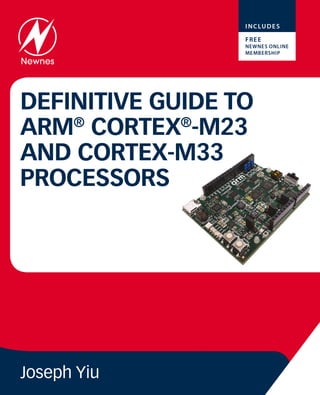





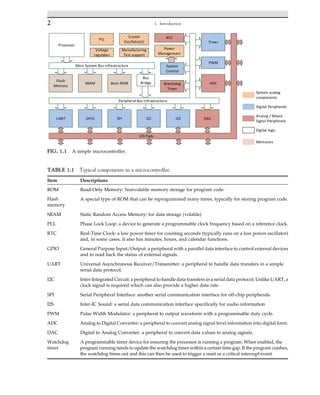
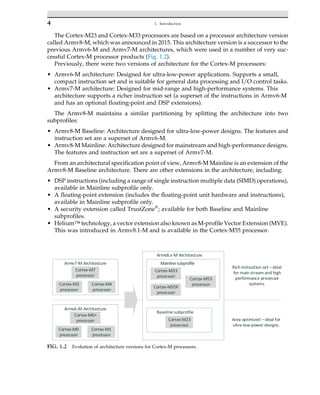
![The Cortex-M55 processor was announced in February 2020. (Note: Helium technology is
not available in the Cortex-M33 processor).
Those extensions are optional. Additionally, a number of system-level features are also op-
tional in those processors. More detailed explanations are covered in subsequent chapters
about each of the system-level features.
The architecture specification document—called Armv8-M Architecture Reference Man-
ual [1]—is a public document that details the programmer’s model, instruction set architec-
ture (ISA), exception handling model, and debug architecture. However, this document does
not specify how the processors are built. For example, Armv8-M Architecture does not spec-
ify how many pipeline stages are needed, what bus interface design should be used, and what
the instruction cycle timing looks like.
1.4 Characteristics of the Cortex-M23 and Cortex-M33 processors
Both the Cortex-M23 and Cortex-M33 processors:
• are32-bitprocessors,with32-bitbusinterfacesandhavea32-bitarithmeticlogicunit(ALU).
• have a 32-bit linear address space, which supports up to 4GB of memories and peripherals.
• use a hardware unit called Nested Vectored Interrupt Controller (NVIC) for interrupt
management (includes peripheral interrupts and internal system exceptions).
• include various features for operating system (OS) support such as system tick timer,
shadowed stack pointers.
• include sleep mode support and various low-power optimization features.
• support separation of privileged and unprivileged execution levels, which allows the OS
(or other privileged software) to restrict unprivileged application tasks from accessing
critical system control resources.
• support the optional Memory Protection Unit (MPU), which allows the OS (or other
privileged software) to define memory spaces, which are accessible by each unprivileged
application tasks.
• can be used in a single processor or in multiprocessor designs.
• support a range of optional debug and trace features to enable software developers to
quickly analyze problems and bugs in application codes.
• support an optional TrustZone security extension to allow the software to be further
partitioned into different security domains.
There are also a number of differences between the two processors. The Cortex-M23
processor:
• is a two-stage Von-Neumann processor design. The main system bus is based on the
Advanced High-performance Bus (AHB) on-chip bus protocol from Advanced
Microcontroller Bus Architecture (AMBA®
) version 5.
• supports an optional single-cycle I/O interface (which is also available in the Cortex-M0+
processor). This interface allows some of the peripherals to be accessed with just one clock
cycle (the normal system bus is based on a pipelined on-chip bus protocol and needs a
minimum of two clock cycles per transfer).
5
1.4 Characteristics of the Cortex-M23 and Cortex-M33 processors](https://image.slidesharecdn.com/11063846-250527133157-4522a934/85/Definitive-Guide-To-Arm-Cortexm23-And-Cortexm33-Processors-Joseph-Yiu-26-320.jpg)
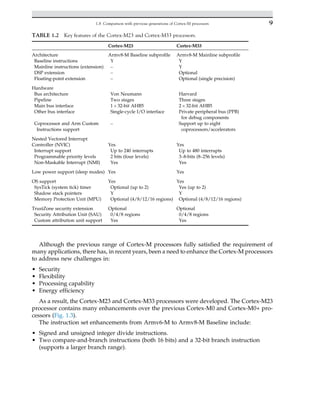
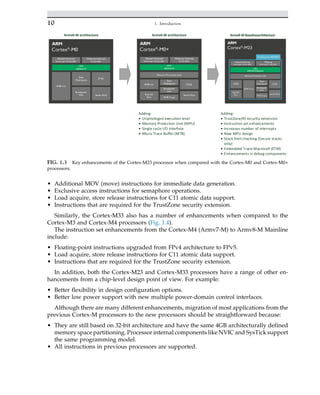
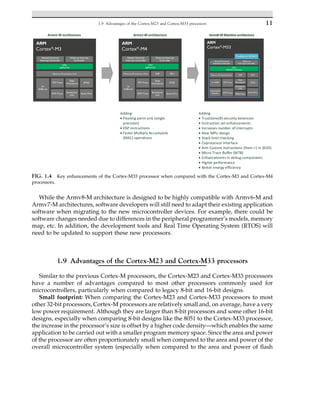
![1.11 Further reading
The Arm website is divided into a number of sections which has useful information on
various aspects of Arm Cortex-M processor products.
1.11.1 Product pages on developer.arm.com
This is the product information web page where you can find an overview of the products
and relevant links to the various parts of the Arm websites.
Web site
Cortex-M processor page https://developer.arm.com/products/processors/cortex-m/
Cortex-M23 processor page https://developer.arm.com/products/processors/cortex-m/cortex-m23
Cortex-M33 processor page https://developer.arm.com/products/processors/cortex-m/cortex-m33
M-Profile architecture https://developer.arm.com/products/architecture/m-profile
TrustZone https://developer.arm.com/ip-products/security-ip/trustzone
1.11.2 Documentation on developer.arm.com
There is a range of documents available on the Arm website that is useful for learning about
software development for the Cortex-M23 and Cortex-M33 processors. The main documen-
tation page is called developer.arm.com (https://developer.arm.com/documentation).
The key Cortex-M23/Cortex-M33 document that you find on the website includes:
Reference Document
[1] Armv8-M Architecture Reference Manual
This is the specification of the architecture on which the Cortex-M23 and Cortex-M33 processors are
based. It contains detailed information about the instruction set and about architecture defined
behaviors, etc.
[2] Cortex-M23 Device Generic User Guide
This is a user guide written for software developers using the Cortex-M23 processor. It provides
information on the programmer’s model, details on using core peripherals such as the NVIC and
general information about the instruction set.
[3] Cortex-M23 Technical Reference Manual
This is the specification of the Cortex-M23 processor. It gives information on the features that are
implemented and details some of the implementation-specific behaviors.
[4] Cortex-M33 Device Generic User Guide
This is a user guide written for software developers using the Cortex-M33 processor. It provides
information on the programmer’s model, details on using core peripherals such as the NVIC, and
general information about the instruction set.
Continued
15
1.11 Further reading](https://image.slidesharecdn.com/11063846-250527133157-4522a934/85/Definitive-Guide-To-Arm-Cortexm23-And-Cortexm33-Processors-Joseph-Yiu-36-320.jpg)
![Reference Document
[5] Cortex-M33 Technical Reference Manual
This is the specification of the Cortex-M33 processor. It gives information on the features that are
implemented and details some of the implementation-specific behaviors.
[6–9] Arm CoreSight™ MTB-M23/ETM-M23/MTB-M33/ETM-M33 Technical Reference Manual
These are the specifications for the instruction trace support components and are intended for debug
tool vendors only. Software developers do not need to read these documents.
The developer website also contains various application notes and additional useful doc-
umentation. One document I would like to highlight is the Procedure Call Standard for the
Arm Architecture (AAPCS), which is referenced in several sections of Chapter 17:
Reference Document
[10] Procedure Call Standard for the Arm Architecture
This document specifies how software code should work in interfunction calls. This information is often
needed for software projects with mixed assembly and C languages.
1.11.3 Community.arm.com
This section of the website allows website users, including Arm experts, to interact and
allows individuals (including companies) to post documents or other material relating to
Arm technologies. To make it easier for Arm website users to locate information about
Cortex-M processors, I have created and continue to maintain several blog pages in the
Arm Community website:
Reference Document
[11] Armv8-M Architecture Technical Overview
This whitepaper summarizes the architecture enhancements of the Armv8-M architecture and gives an
overview of how the TrustZone®
technology works. I have also included links to various useful
documents relating to the Armv8-M architecture.
[12] Cortex-M resources
I maintain a list of useful links to papers, videos, and presentations on various Cortex-M topics.
[13] Getting started with Arm Microcontroller Resources
This is an introductory page for people who want to start using Arm microcontrollers. The blog covers
entry-level information for Cortex-A, Cortex-R, and Cortex-M processors.
References
[1] Armv8-M Architecture Reference Manual. https://developer.arm.com/documentation/ddi0553/am
(Armv8.0-M only version). https://developer.arm.com/documentation/ddi0553/latest/ (latest version includ-
ing Armv8.1-M). Note: M-profile architecture reference manuals for Armv6-M, Armv7-M, Armv8-M and
Armv8.1-M can be found here: https://developer.arm.com/architectures/cpu-architecture/m-profile/docs.
[2] Arm Cortex-M23 Devices Generic User Guide. https://developer.arm.com/documentation/dui1095/latest/.
[3] Arm Cortex-M23 Processor Technical Reference Manual. https://developer.arm.com/documentation/
ddi0550/latest/.
[4] Arm Cortex-M33 Devices Generic User Guide. https://developer.arm.com/documentation/100235/latest/.
16 1. Introduction](https://image.slidesharecdn.com/11063846-250527133157-4522a934/85/Definitive-Guide-To-Arm-Cortexm23-And-Cortexm33-Processors-Joseph-Yiu-37-320.jpg)
![[5] Arm Cortex-M33 Processor Technical Reference Manual. https://developer.arm.com/documentation/100230/
latest/.
[6] Arm CoreSight MTB-M23 Technical Reference Manual. https://developer.arm.com/documentation/ddi0564/
latest/.
[7] Arm CoreSight ETM-M23 Technical Reference Manual. https://developer.arm.com/documentation/ddi0563/
latest/.
[8] Arm CoreSight MTB-M33 Technical Reference Manual. https://developer.arm.com/documentation/100231/
latest/.
[9] Arm CoreSight ETM-M33 Technical Reference Manual. https://developer.arm.com/documentation/100232/
latest/.
[10] Procedure Call Standard for the Arm Architecture (AAPCS). https://developer.arm.com/documentation/
ihi0042/latest/.
[11] Armv8-M Architecture Technical Overview. https://community.arm.com/developer/ip-products/
processors/b/processors-ip-blog/posts/whitepaper-armv8-m-architecture-technical-overview.
[12] Cortex-M resources. I maintain a list of useful links to papers, videos and presentations on various Cortex-M
topics. https://community.arm.com/developer/ip-products/processors/b/processors-ip-blog/posts/cortex-
m-resources.
[13] GettingstartedwithArmMicrocontrollerResources.Thisisanintroductorypageforpeoplewhowanttostartusing
arm microcontrollers. The blog covers entry level information for Cortex-A, Cortex-R and Cortex-M processors.
https://community.arm.com/developer/ip-products/processors/b/processors-ip-blog/posts/getting-started-
with-arm-microcontroller-resources.
17
References](https://image.slidesharecdn.com/11063846-250527133157-4522a934/85/Definitive-Guide-To-Arm-Cortexm23-And-Cortexm33-Processors-Joseph-Yiu-38-320.jpg)

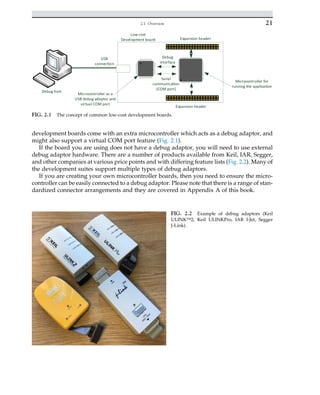
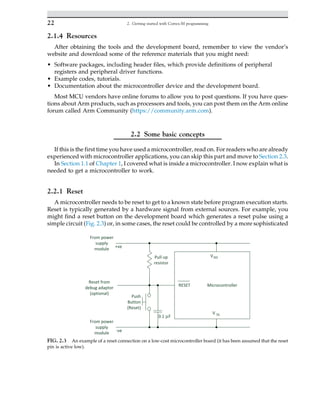
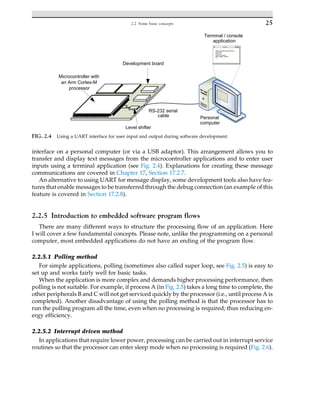
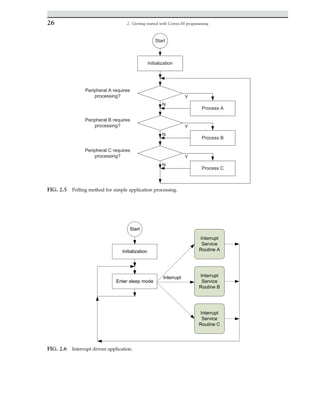
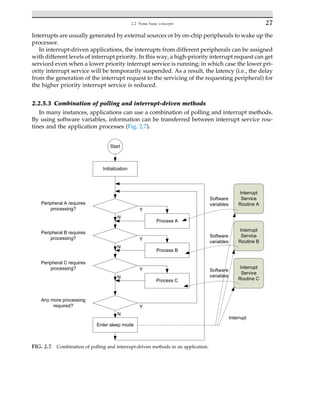
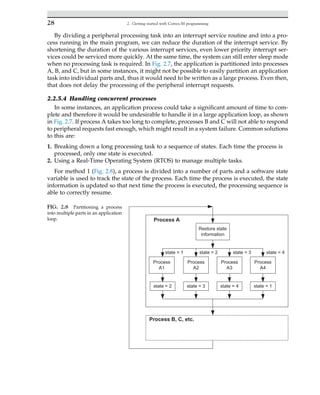
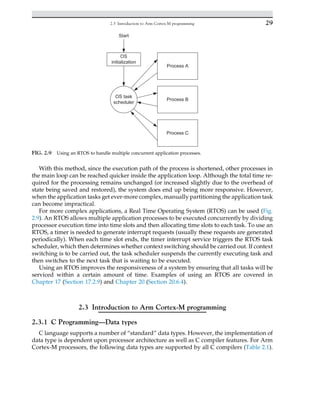
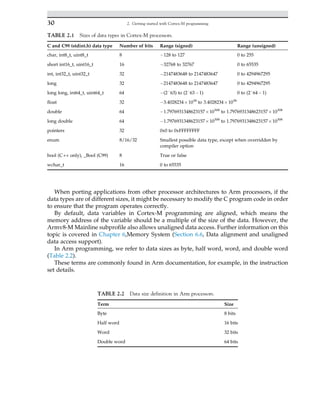
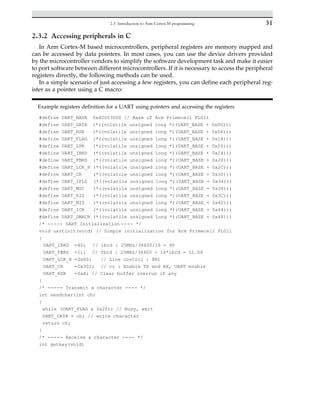
![{
while ((UART_FLAG 0x40)==0); // No data, wait
return UART_DATA; // read character
}
As previously mentioned, this solution (defining each peripheral register as a pointer using
a C macro) is fine for simple applications. However, when there are multiple units of the same
peripherals available in the system, it will require defining registers for each of those periph-
erals, which can make code maintenance difficult. In addition, defining each register as an
individual pointer could result in a larger program size as each register address is stored
as a 32-bit constant in the program flash memory.
To simplify the code and to use program space more efficiently, we can define the periph-
eral register set as a data structure and then define the peripheral as a memory pointer to this
data structure (as shown in the following C program code).
Example of register-definition for a UART using a data structure and a memory pointer based on
this structure
typedef struct { // Base on Arm Primecell PL011
volatile unsigned long DATA; // 0x00
volatile unsigned long RSR; // 0x04
unsigned long RESERVED0[4];// 0x08 – 0x14
volatile unsigned long FLAG; // 0x18
unsigned long RESERVED1; // 0x1C
volatile unsigned long LPR; // 0x20
volatile unsigned long IBRD; // 0x24
volatile unsigned long FBRD; // 0x28
volatile unsigned long LCR_H; // 0x2C
volatile unsigned long CR; // 0x30
volatile unsigned long IFLS; // 0x34
volatile unsigned long MSC; // 0x38
volatile unsigned long RIS; // 0x3C
volatile unsigned long MIS; // 0x40
volatile unsigned long ICR; // 0x44
volatile unsigned long DMACR; // 0x48
} UART_TypeDef;
#define Uart0 ((UART_TypeDef *) 0x40003000)
#define Uart1 ((UART_TypeDef *) 0x40004000)
#define Uart2 ((UART_TypeDef *) 0x40005000)
/* ----- UART Initialization ---- */
void uartinit(void) // Simple initialization for Primecell PL011
{
Uart0-IBRD =40; // ibrd : 25MHz/38400/16 = 40
32 2. Getting started with Cortex-M programming](https://image.slidesharecdn.com/11063846-250527133157-4522a934/85/Definitive-Guide-To-Arm-Cortexm23-And-Cortexm33-Processors-Joseph-Yiu-53-320.jpg)
![Uart0-FBRD =11; // fbrd : 25MHz/38400 - 16*ibrd = 11.04
Uart0-LCR_H =0x60; // Line control : 8N1
Uart0-CR =0x301; // cr : Enable TX and RX, UART enable
Uart0-RSR =0xA; // Clear buffer overrun if any
}
/* ----- Transmit a character ---- */
int sendchar(int ch)
{
while (Uart0-FLAG 0x20); // Busy, wait
Uart0-DATA = ch; // write character
return ch;
}
/* ----- Receive a character ---- */
int getkey(void)
{
while ((Uart0-FLAG 0x40)==0); // No data, wait
return Uart0-DATA; // read character
}
In this example, as shown above, the Integer Baud Rate Divider (IBRD) register for UART
#0 is accessed by the symbol Uart0-IBRD and the same register for UART #1 is accessed by
Uart1-IBRD.
With this arrangement, the same register data structure for the UART peripheral can be
shared between multiple UARTs inside the chip, making code maintenance easier. In addi-
tion, the compiled code could be smaller due to the reduced requirement of the immediate
data storage.
With further modification, a function developed for the peripherals can be shared between
multiple units by passing the base pointer to the function:
Example of register-definition for a UART and driver code which support multiple UARTs using
passing of the base pointer as a parameter
typedef struct { // Base on Arm Primecell PL011
volatile unsigned long DATA; // 0x00
volatile unsigned long RSR; // 0x04
unsigned long RESERVED0[4];// 0x08 – 0x14
volatile unsigned long FLAG; // 0x18
unsigned long RESERVED1; // 0x1C
volatile unsigned long LPR; // 0x20
volatile unsigned long IBRD; // 0x24
volatile unsigned long FBRD; // 0x28
volatile unsigned long LCR_H; // 0x2C
volatile unsigned long CR; // 0x30
33
2.3 Introduction to Arm Cortex-M programming](https://image.slidesharecdn.com/11063846-250527133157-4522a934/85/Definitive-Guide-To-Arm-Cortexm23-And-Cortexm33-Processors-Joseph-Yiu-54-320.jpg)