DEFINITIONS OF
QUALITY
SOURCES: Tanmay Vora, Quality as Excellence, Quality?
Excellence? What?
2016 Siemens Product Lifecycle Management Software Inc.
QUALITY AS EXCELLENCE
Defining QUALITY as the characteristic in a product or service is an
ELUSIVE yet appropriate definition in some cases.
Quality is generally extrinsic.
Excellence is always intrinsic.
So, how are they related?
QUALITY AS EXCELLENCE
Quality is a route to Excellence
Getting people to exercise their choice of
delivering excellence is #1 leadership challenge.
Excellence is a Moving Target
QUALITY AS EXCELLENCE
Pursuing excellence is a
worthy goal.
QUALITY AS CONFORMANCE TO
SPECIFICATION
“Conformance to Requirements”
“Conformance to Specification”
QUALITY AS CONFORMANCE TO
SPECIFICATION
Manufacturing Quality is
Conformance to Specifications.
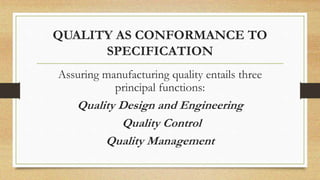
QUALITY AS CONFORMANCE TO
SPECIFICATION
Assuring manufacturing quality entails three
principal functions:
Quality Design and Engineering
Quality Control
Quality Management
QUALITY AS FITNESS FOR USE
FITNESS CONCEPT
It requires that the design of the product be appropriate for the
conditions and purpose of the user.
Fitness for intended use is more
accurate way to measure quality.
QUALITY AS VALUE FOR PRICE
ARMAND FEIGENBAUM
Our desire for conformance to a requirement is
price sensitive.
This definition is user specific.
QUALITY-RELATED PRODUCT
CHARACTERISTICS
QUALITY-RELATED PRODUCT
CHARACTERISTICS
DURABILITY
SERVICEABILITY
QUALITY-RELATED SERVICE
CHARACTERISTICS
QUALITY-RELATED SERVICE
CHARACTERISTICS
RELIABILITY
TANGIBLE
RESPONSIVENESS
ASSURANCE
EMPATHY

Definitions of quality

Editor's Notes

  • #3 The words quality and excellence are needs to be used interchangeably… Quality is generally extrinsic. It is driven by external demands. We implement best practices in line with industry standards. We write our processes to get certified against a certain standard. We develop our products and services in line with the demands of our customers. When we continuously meet these demands, adhere to processes and improve upon them, we build repeatability in our success. Excellence is always intrinsic. It is our innate desire to go out of our way to deliver a superior experience. Not because someone else demands it, but because ‘you’ want it that way. It is for your own satisfaction of having done a great job. Excellence is a ‘people’ game, and the one that pushes quality one step forward. In either cases, people are at the fulcrum.
  • #4 So, how are they related? In my view, quality is a route to excellence. People can do their best, walk that extra-mile and think of adding value once they are absolutely clear of how to do the basic things right. Processes given them a firm base on which they can build excellence. On the other hand, excellent people may fumble if they are not supported with right set of guidelines on delivering quality. Secondly, excellence has a lot to do with people’s motivation to do a great job. It is their choice. Getting people to exercise their choice of delivering excellence is #1 leadership challenge. It starts with getting the right people and building the right culture. Finally, just like quality, excellence is a moving target. Today’s excellent becomes tomorrow’s good enough and day-after-tomorrow’s mediocre.
  • #5 Bottom line: Pursuing excellence is a worthy goal. Knowing the close inter-relationship between quality and excellence is important. Defining them clearly is important. Getting people to excel, driving their motivation, creating a constantly improving culture and striking balance between adherence and motivation is a big challenge leaders face.
  • #6 Crosby’s definition of Quality is “conformance to requirements” which is different from “conformance to specification” Basing design specification on the needs and expectations of the customers eliminates that difference. Today, product and service designers are working with customers more closely than ever to help ensure that specifications yield products and service that meet customers’ need and expectations.
  • #7 At its most basic level, manufacturing quality is conformance to specifications. Quality of design and conformance to specifications provide the fundamental basis for managing operations to produce quality products. As customer expectations have risen over time, manufacturing quality has come to be an absolute requirement, regardless of where products are manufactured, distributed, and sold.
  • #8 The goal of quality engineering is to incorporate quality into the design of products and processes, as well as to predict potential quality problems prior to manufacture and delivery of the product. The principal task of quality control involves enforcing the use of specified processes and materials, ensuring qualification of operators and equipment, and making a series of planned measurements to determine if quality standards are being met. If any of these are not achieved, then corrective action and future preventive action must be taken to achieve and maintain conformance. Quality management involves the planning, organization, direction, and control of all quality assurance activities. While quality control departments have historically provided technical support for manufacturing quality, manufacturers have come to understand that quality must be integrated throughout the enterprise.
  • #9 A significant step beyond the conformance definition is to add to it the customer’s intended use of the product or service, a definition first articulated by Juran Known as FITNESS CONCEPT. FITNESS CONCEPT It requires that the design of the product be appropriate for the conditions and purpose of the user. This definition of quality has a strong component of product liability and consumer education, because the company must correctly assess the knowledge, skill, and intentions of the customer. MORE ACCURATE WAY TO MEASURE QUALITY Many companies produce products of good design and exceptional conformance, only to go out of business because they failed to meet the demands of the marketplace.
  • #10 The most comprehensive definition of the concept of quality was proposed by ARMAND FEIGENBAUM. Feigenbaum combines economic and consumenr criteria with the concepts of fitness, conformance, and excellence. PRICE SENSITIVE EXAMPLE from handout USER SPECIFIC - This definition is user specific an the array of products and prices that we see each day is an indication of the variety of values that individual consumers place on products and services.