Each group shall present a
situation that shows a
way/s people
communicate.
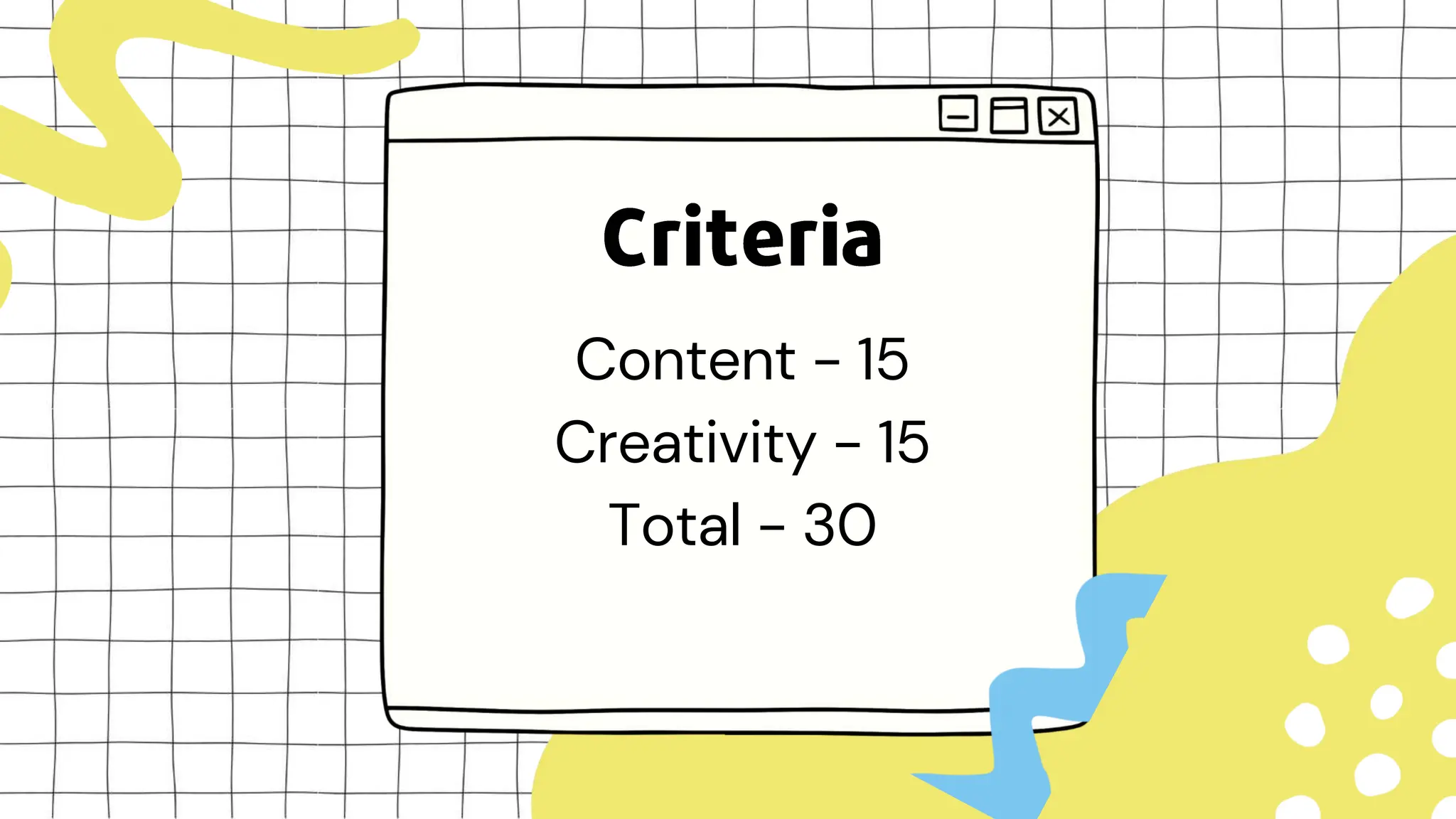
Content - 15
Creativity - 15
Total - 30
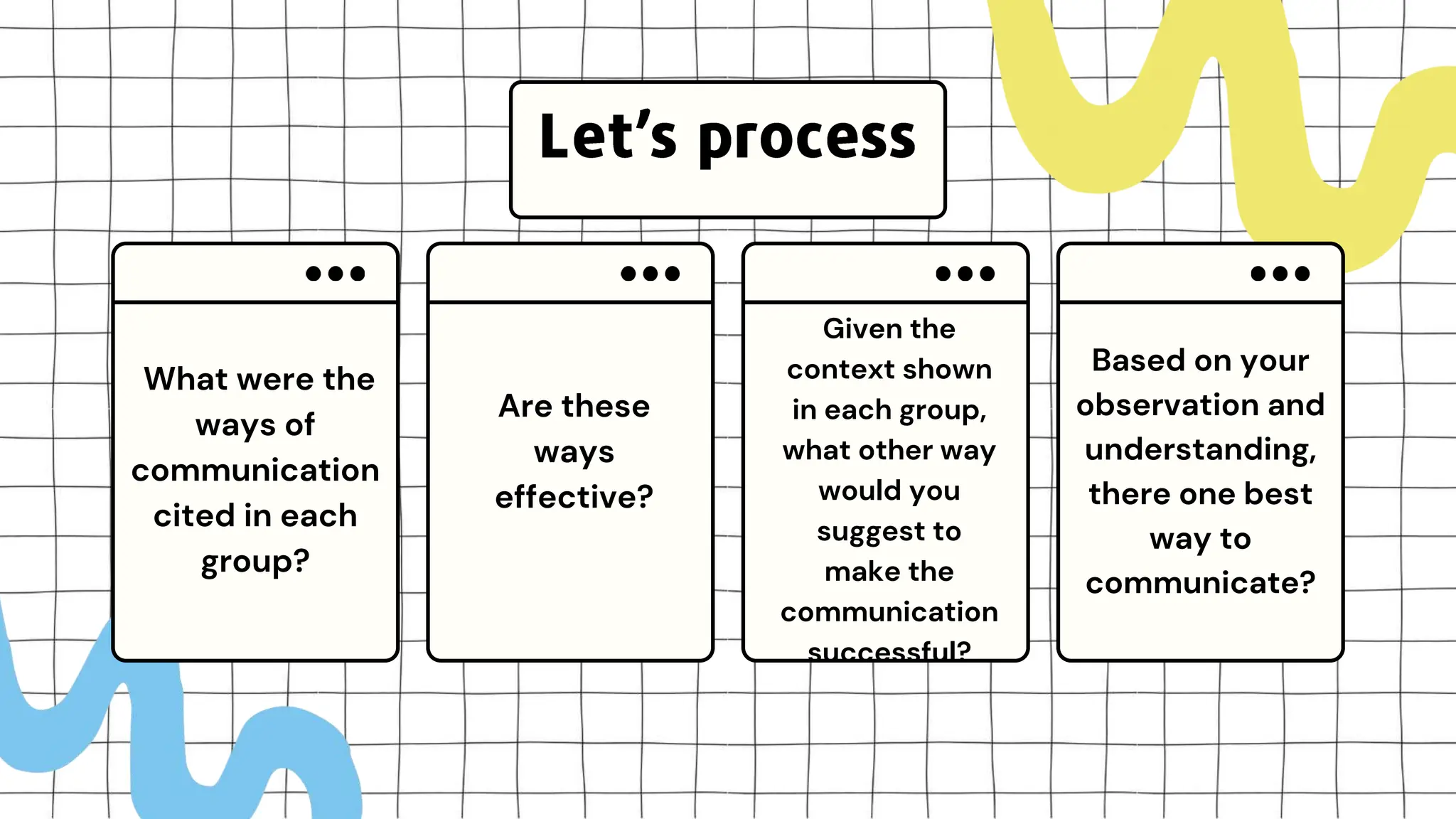
What were the
ways of
communication
cited in each
group?
Are these
ways
effective?
Given the
context shown
in each group,
what other way
would you
suggest to
make the
communication
successful?
Based on your
observation and
understanding,
there one best
way to
communicate?
the act or process of using words, sounds, signs, or
behaviors to express or exchangeinformation or to express
your ideas, thoughts, feelings, etc., to someone else: a
message that is given to someone: a letter, telephone call,
etc
can broadly be defined as exchange of ideas, messages
and information between two or more persons, through a
medium, in a manner that the sender and the receiver
understand the message in the common sense, that is, they
develop common understanding of the message.
derived from the Latin word ‘communicare’, which means to
share, impart, participate, exchange, transmit or to make
common. It emphasises on sharing common information,
ideas and messages. It is not merely issuing orders and
instructions.
“Communication is the transfer of information from
a sender to a receiver, with the information being
understood by the receiver”.
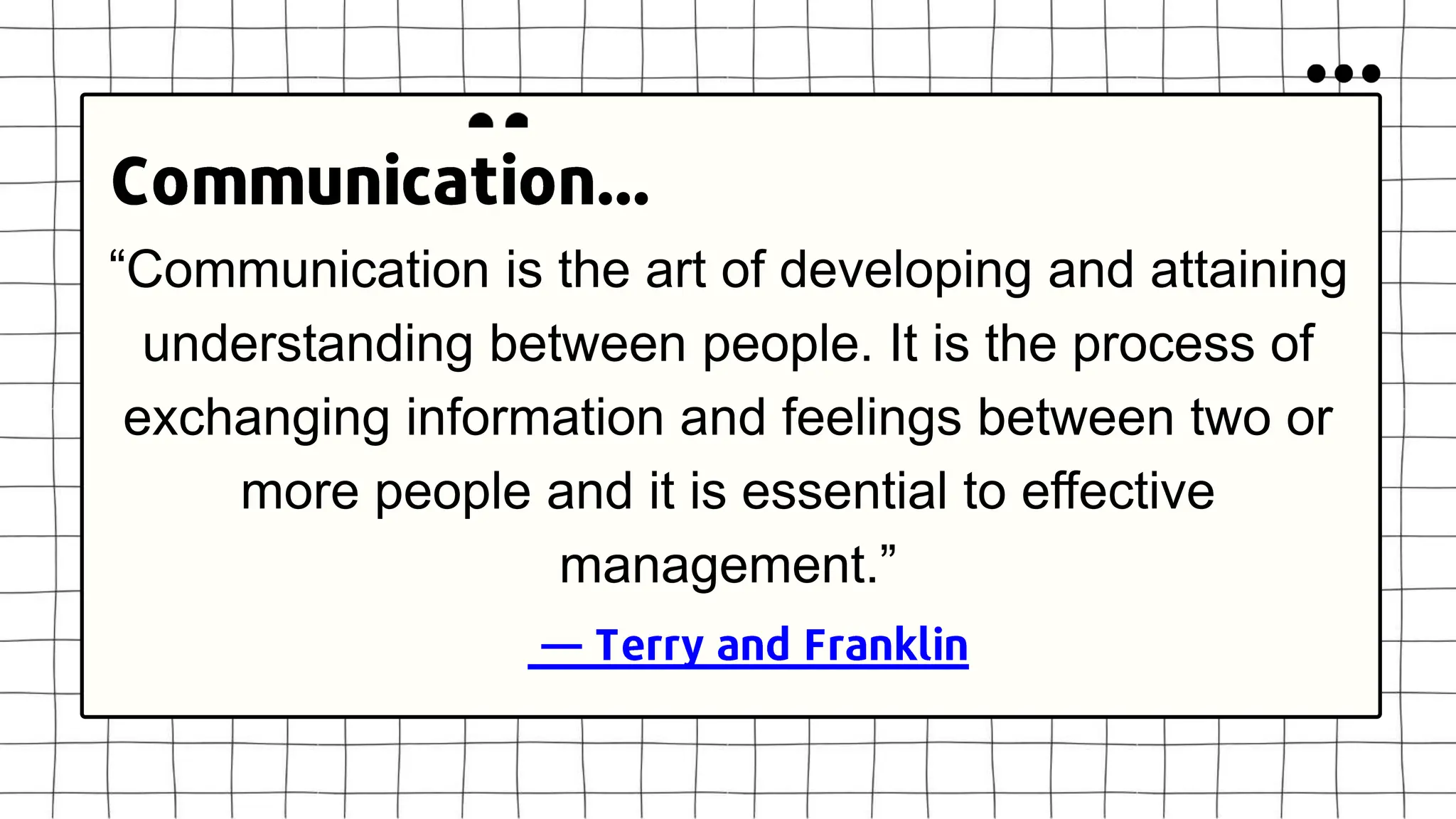
“Communication is the art of developing and attaining
understanding between people. It is the process of
exchanging information and feelings between two or
more people and it is essential to effective
management.”
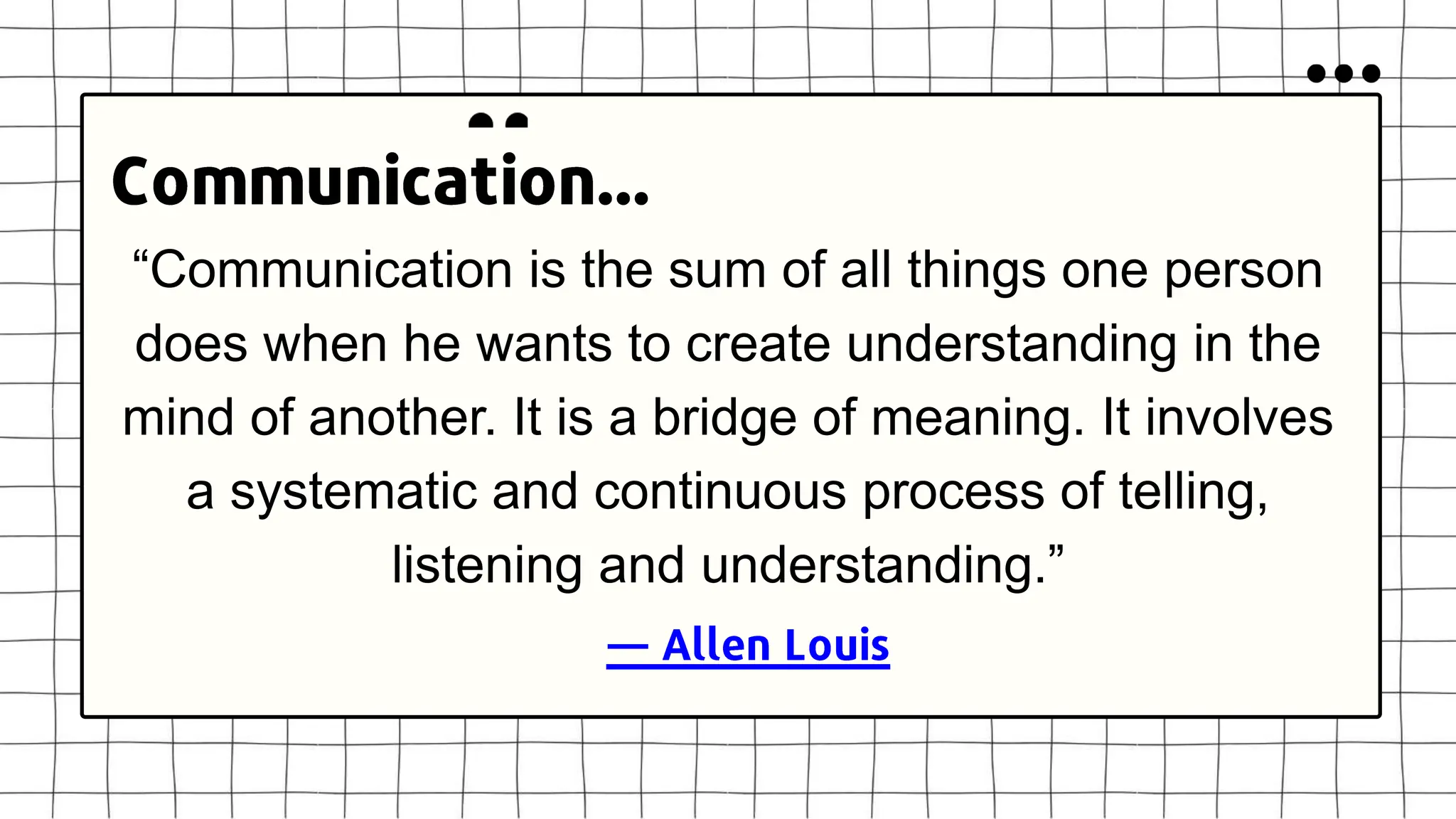
“Communication is the sum of all things one person
does when he wants to create understanding in the
mind of another. It is a bridge of meaning. It involves
a systematic and continuous process of telling,
listening and understanding.”
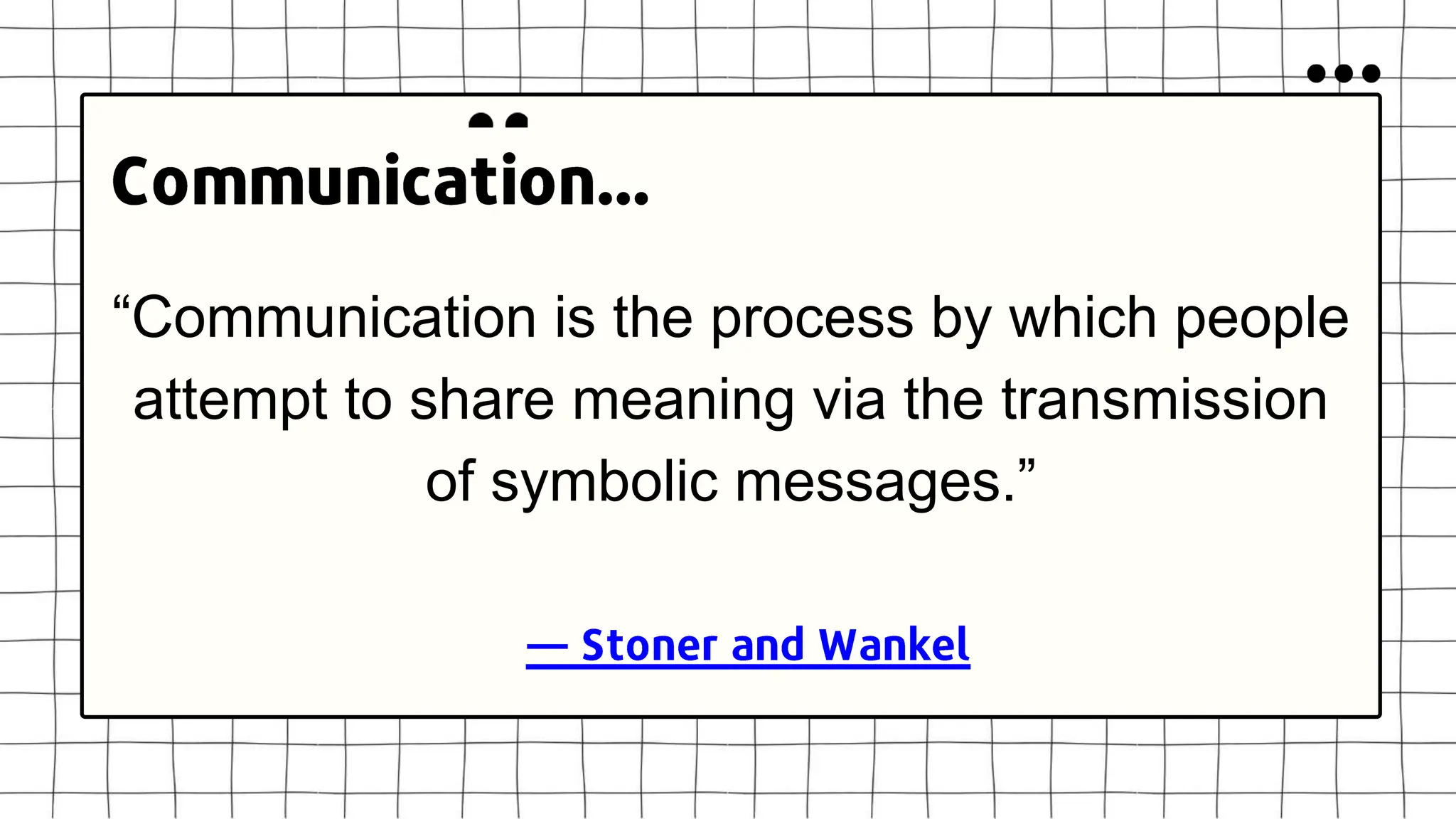
“Communication is the process by which people
attempt to share meaning via the transmission
of symbolic messages.”
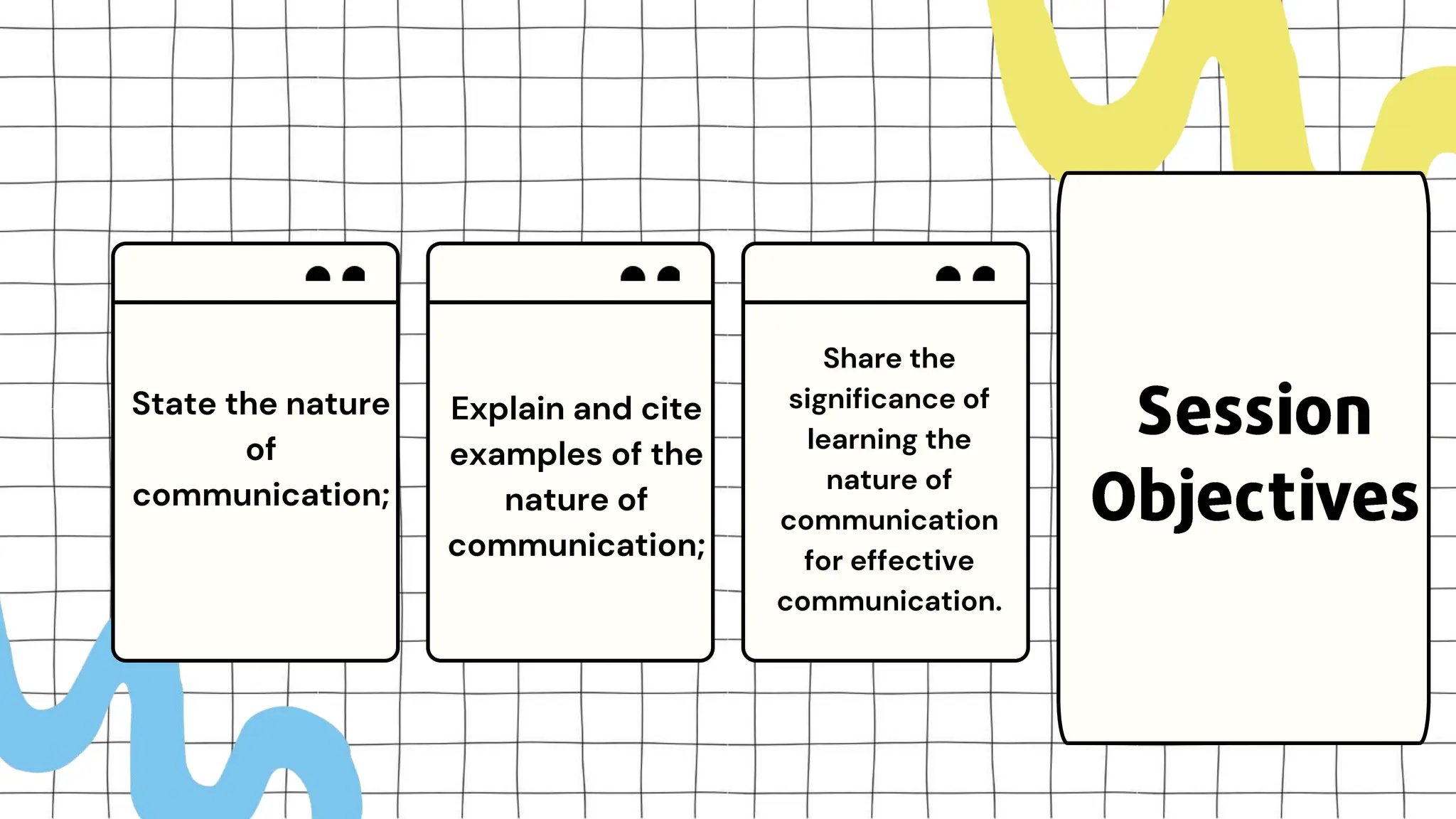
State the nature
of
communication;
Share the
significance of
learning the
nature of
communication
for effective
communication.
Explain and cite
examples of the
nature of
communication;
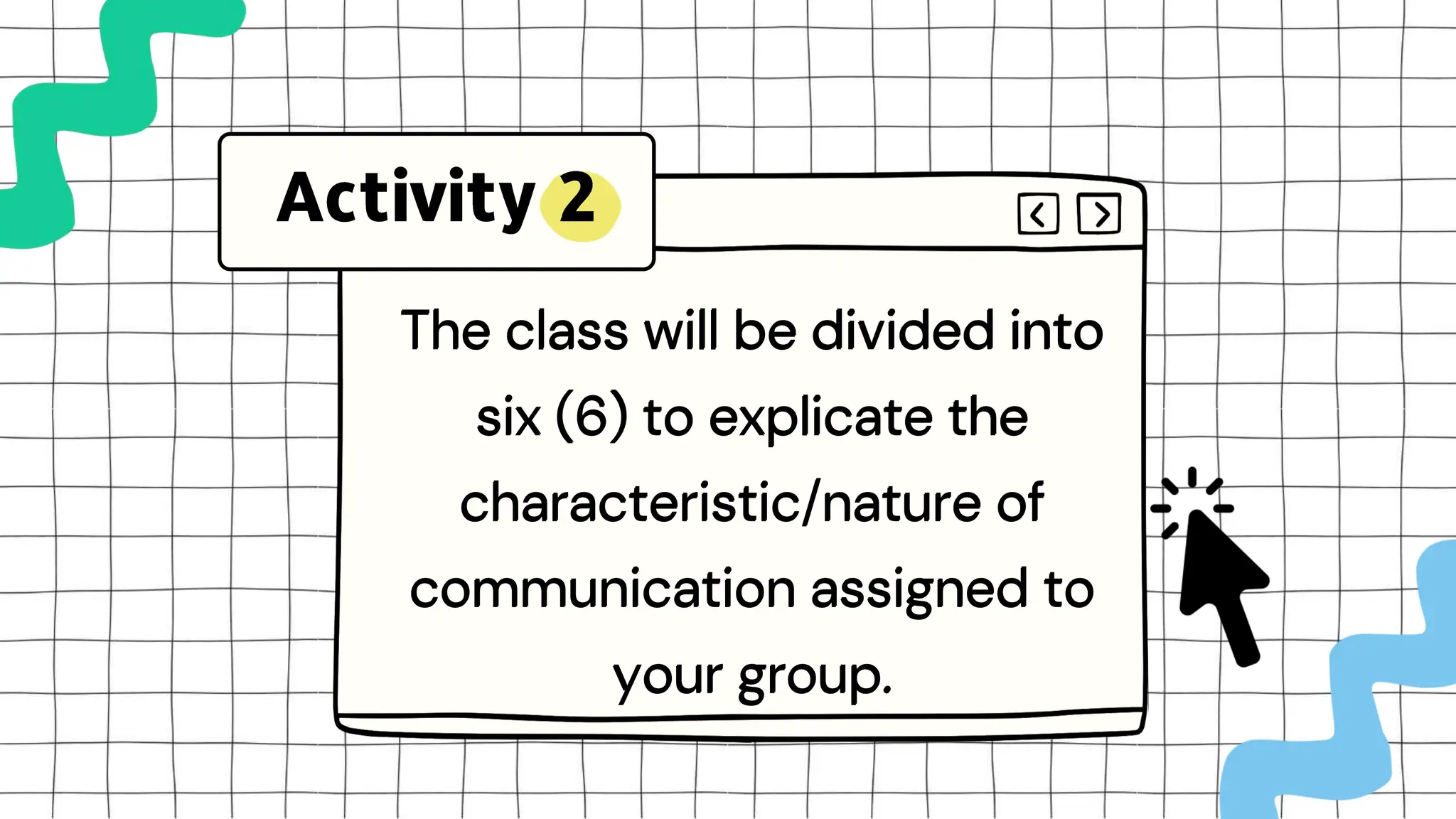
The class will be divided into
six (6) to explicate the
characteristic/nature of
communication assigned to
your group.
The class will be divided into
six (6) to explicate the
characteristic/nature of
communication assigned to
your group.
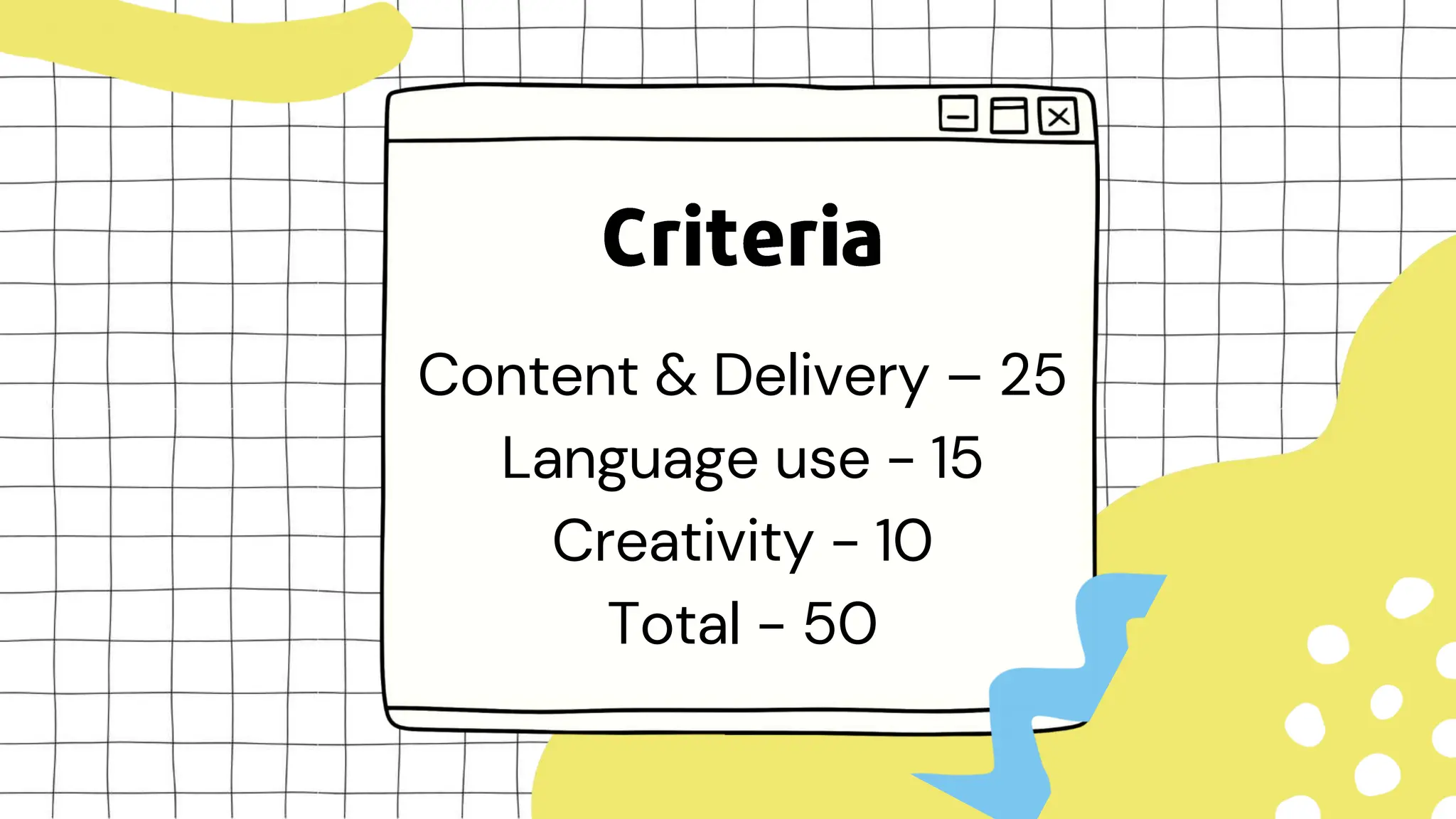
Content & Delivery – 25
Language use - 15
Creativity - 10
Total - 50
Symbol – an object that represents
something abstract – words, icons, images,
tone of voice, and facial expressions.
Remember: Words only represent our ideas.
Symbolic construction can vary in meaning.
Meaning is constructed through the sending and
receiving of messages, ideas, and values through
verbal and nonverbal communication.
N.B. The exchange of ideas occurs in a context. E.g. lawyer in a
courtroom.
Meaning is constructed through the sending and
receiving of messages, ideas, and values through
verbal and nonverbal communication.
N.B. The exchange of ideas occurs in a context. E.g. lawyer in a
courtroom.
Communication is an on-going and continuous
process. It develops and grows.
e.g. How we end a previous conversation will influence how
we begin the next conversation when we meet the same
person.
Communication is irreversible
(you can’t undo) and unrepeatable (you can’t
repeat the message in the exact same way) .
e.g. How we end a previous conversation will influence how
we begin the next conversation when we meet the same
person.
Involves human beings with different attitudes,
beliefs, and values. Variables as age, sex, race,
and social status often affect communication.
e.g. Opinion on Legalizing Divorce in the Philippines.
Environment, setting, or context will affect our
communication behavior.
e.g. roles & status of communicators and formality or
informality of setting.
Being in a closed space with strangers does not invite open
communication.
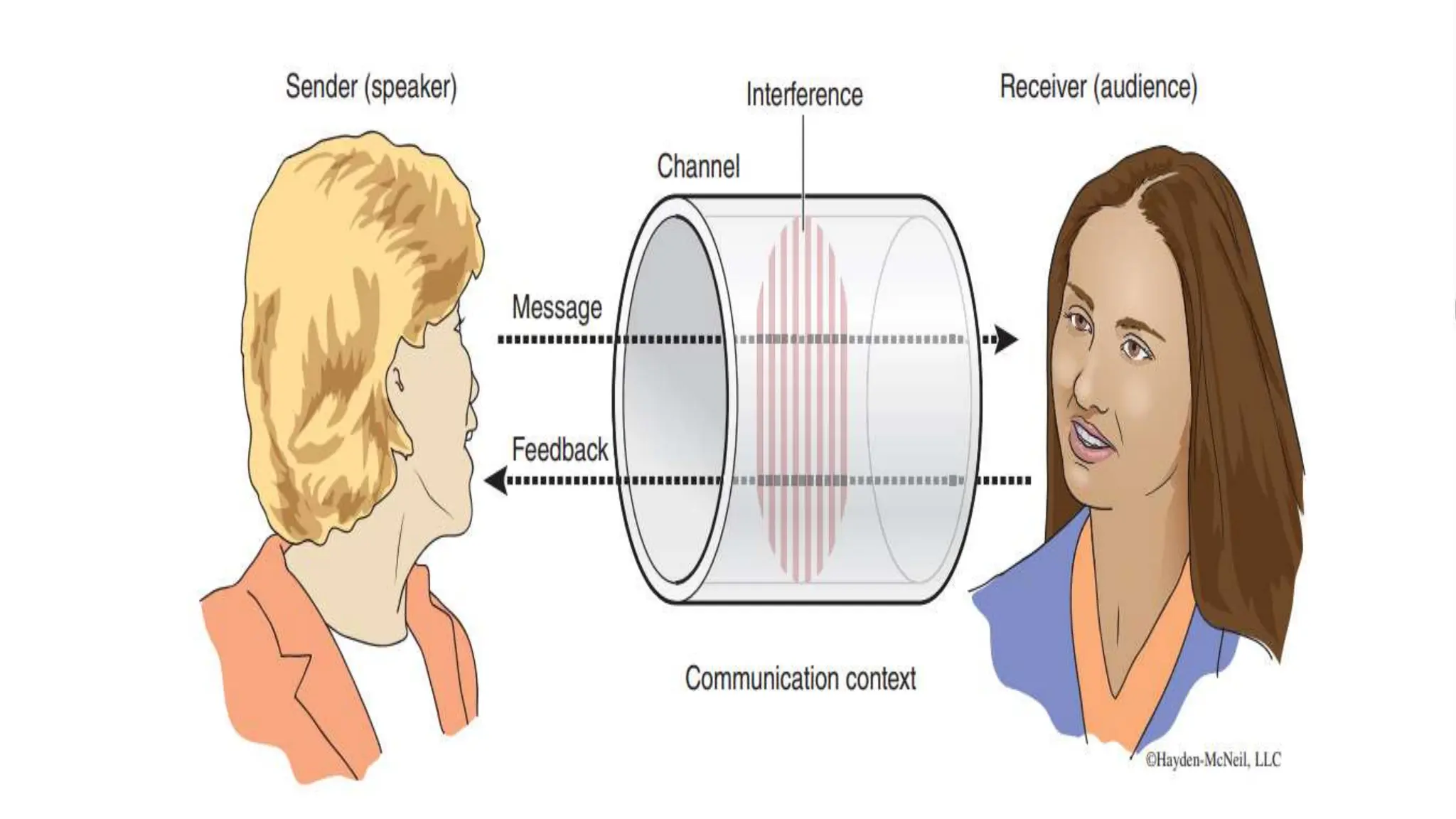
Each communicator is simultaneously a sender
and receiver of messages. Meaning is co-
created in the interaction by both
communicators.
What is the significance of
learning the nature of
communication in achieving
effective communication?
The first step in learning how to be an
effective communicator is to
understand the process of
communication.
The process of communication is
very complex. It involves individuals
and groups who possess very
different values, beliefs, and
attitudes.

Defining Communication and Characteristics

  • 2.
    Each group shallpresent a situation that shows a way/s people communicate.
  • 3.
    Content - 15 Creativity- 15 Total - 30
  • 4.
    What were the waysof communication cited in each group? Are these ways effective? Given the context shown in each group, what other way would you suggest to make the communication successful? Based on your observation and understanding, there one best way to communicate?
  • 5.
    the act orprocess of using words, sounds, signs, or behaviors to express or exchangeinformation or to express your ideas, thoughts, feelings, etc., to someone else: a message that is given to someone: a letter, telephone call, etc
  • 6.
    can broadly bedefined as exchange of ideas, messages and information between two or more persons, through a medium, in a manner that the sender and the receiver understand the message in the common sense, that is, they develop common understanding of the message.
  • 7.
    derived from theLatin word ‘communicare’, which means to share, impart, participate, exchange, transmit or to make common. It emphasises on sharing common information, ideas and messages. It is not merely issuing orders and instructions.
  • 8.
    “Communication is thetransfer of information from a sender to a receiver, with the information being understood by the receiver”.
  • 9.
    “Communication is theart of developing and attaining understanding between people. It is the process of exchanging information and feelings between two or more people and it is essential to effective management.”
  • 10.
    “Communication is thesum of all things one person does when he wants to create understanding in the mind of another. It is a bridge of meaning. It involves a systematic and continuous process of telling, listening and understanding.”
  • 11.
    “Communication is theprocess by which people attempt to share meaning via the transmission of symbolic messages.”
  • 14.
    State the nature of communication; Sharethe significance of learning the nature of communication for effective communication. Explain and cite examples of the nature of communication;
  • 15.
    The class willbe divided into six (6) to explicate the characteristic/nature of communication assigned to your group. The class will be divided into six (6) to explicate the characteristic/nature of communication assigned to your group.
  • 16.
    Content & Delivery– 25 Language use - 15 Creativity - 10 Total - 50
  • 18.
    Symbol – anobject that represents something abstract – words, icons, images, tone of voice, and facial expressions. Remember: Words only represent our ideas. Symbolic construction can vary in meaning.
  • 19.
    Meaning is constructedthrough the sending and receiving of messages, ideas, and values through verbal and nonverbal communication. N.B. The exchange of ideas occurs in a context. E.g. lawyer in a courtroom. Meaning is constructed through the sending and receiving of messages, ideas, and values through verbal and nonverbal communication. N.B. The exchange of ideas occurs in a context. E.g. lawyer in a courtroom.
  • 20.
    Communication is anon-going and continuous process. It develops and grows. e.g. How we end a previous conversation will influence how we begin the next conversation when we meet the same person.
  • 21.
    Communication is irreversible (youcan’t undo) and unrepeatable (you can’t repeat the message in the exact same way) . e.g. How we end a previous conversation will influence how we begin the next conversation when we meet the same person.
  • 23.
    Involves human beingswith different attitudes, beliefs, and values. Variables as age, sex, race, and social status often affect communication. e.g. Opinion on Legalizing Divorce in the Philippines.
  • 24.
    Environment, setting, orcontext will affect our communication behavior. e.g. roles & status of communicators and formality or informality of setting. Being in a closed space with strangers does not invite open communication.
  • 25.
    Each communicator issimultaneously a sender and receiver of messages. Meaning is co- created in the interaction by both communicators.
  • 26.
    What is thesignificance of learning the nature of communication in achieving effective communication?
  • 27.
    The first stepin learning how to be an effective communicator is to understand the process of communication.
  • 28.
    The process ofcommunication is very complex. It involves individuals and groups who possess very different values, beliefs, and attitudes.