Defence Education:
Past, Present and
Future


22 November 2012
Dr. Venkat V S S Sastry
Head of Applied Mathematics and Scientific
Computing,
Cranfield University at the Defence Academy of
the UK, Shrivenham
What is Defence
Education?


  • Education for the people concerned with defence
    sector
      • People from three services, army, navy and air
        force, MOD Civil Servants
      • Defence industry
  • Used interchangeably with Military Education
Earlier approaches to
military education


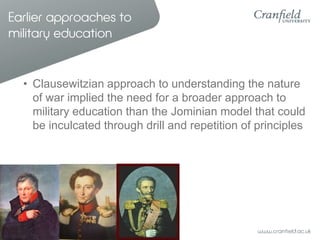
  • Clausewitzian approach to understanding the nature
    of war implied the need for a broader approach to
    military education than the Jominian model that could
    be inculcated through drill and repetition of principles
Drivers …


  • One of the drivers for defence education stems from
    the increasing use of technology in modern warfare.
  • Modern soldier is expected to be comfortable with the
    rapid adoption to enhance their analytical skills
  • Creating the 7-Dimensional soldier – challenges for
    defence education (Navneet Bhusan)
… of defence
education


  • Need for breadth of knowledge at conceptual level in
    a variety of disciplines
  • Depth of knowledge in a chosen specialization
  • Service ethos and “training mentality/approach” is
    often at odds with general educational goals where
    you are encouraged to challenge the “accepted
    wisdom” (See Peter Foot’s remark)
  • Lack of clear career progression for highly educated
    qualified service personnel
Daish writing about the
story of the Advanced
Class ~c 1920


  • Soon after its inception this course began to suffer
    from a dearth of entrants and, in fact, only one
    candidate offered himself for the 5th Class. …
    Bashforth recounts that the instruction was provided
    at a total expense to government of about £1200 per
    annum and that several officers of the Royal Artillery
    were “distressed at seeing this large sum of money
    swallowed up by the Instructional staff”
Some views of military
historians

                    Greg Kennedy and Keith Neilson, 2002


  • “Burdened with the responsibility to be operationally
    capable, and often short of money, men and
    equipment, the professional military has always seen
    a purely academic education as luxury”
  • … for the purpose of education some elements of
    training are imposed into the curriculum
  • … even multi-tiered, multiyear programs such as
    those of Russian, German, French and US military
    education systems, at all times demand that
    education be paid with training
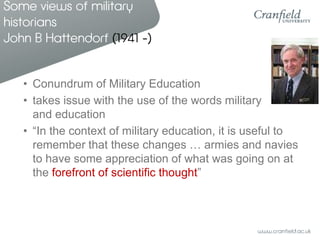
Some views of military
historians
John B Hattendorf (1941 -)


   • Conundrum of Military Education
   • takes issue with the use of the words military
     and education
   • “In the context of military education, it is useful to
     remember that these changes … armies and navies
     to have some appreciation of what was going on at
     the forefront of scientific thought”
Hattendorf (1941 - )


  • … the use of gunpowder and cannon gave rise to the
    study of ballistics, and the need to understand
    mathematics and physics
  • Gunners in the field and at sea needed a range of
    scientific education as well as technological training
    to understand and to apply these concepts
Some of the tensions
(Hattendorf, 2002)


  • Dual need for military discipline and creative thinking
  • Approach of science and technology v approach of
    liberal arts
  • Patriotic nationalism v cross cultural understanding
Hattendorf


  • Hattendorf identifies two drivers for wider and deeper
    education of officers
     • Ever-burgeoning demands of technical and
       scientific spheres
     • Continuing development of liberal thought (in the
       Western world)
Andrew Lambert


  • “The greatest problem for military education is the
    limited account of practical experience that is
    available to officers”
  • “most armed force have limited contact with their core
    activity … and hence require better education than
    their counter parts in civilian sector”
Andrew Lambert


  • “Education does not consist in the acquisition of
    proficiency in tasks that can be tested objectively –
    that is training – an essential building block of military
    performance – but not one that develops the skills
    required for leadership, planning and decision
    making.

    These attributes flow from the mastery of the
    underlying principles upon which professional
    knowledge is based”
Holley


  • “Education is quite different. It aims to help one learn
    how to develop perspective, values, and the ability to
    cope with change, novelty and uncertainty. Those
    who seek to educate can not claim to have the
    “answers”. They can challenge and stimulate thought,
    but if they attempt to give answers they indoctrinate
    but do not educate.”
Military education
conundrum -
Andrew Lambert


  “ … how to stimulate thought and debate within a
  strictly hierarchical profession, one that demands
  unquestioning loyalty and obedience in peace and war”
Peter Foot


  “Quality of thought among students is admired, but
  mostly when it conforms to the “staff solution” – a set of
  answers drafted by, and for, the military directing staff”
John Knox Laughton
(1866)


  In teaching young gunnery officers the scientific and
  mathematical basis of gunnery and navigation
  “…required a level of understanding beyond mere rote
  learning”
Observation


  • Just as practical aspects of gunpowder, artillery,
    fortification, cartography, and navigation raised the
    need for broader education in mathematics, similar
    parallels can be drawn with applications of internet
    technologies
  • Need for broader education in applications of
    mathematics - with social network analysis,
    complexity, data mining, behaviour prediction,
    asymmetric warfare, cyber warfare etc.
Future prospects


  Some of the challenges of
  educational delivery for the
  modern defence professional
  can be addressed effectively by
  innovative use of technology
     • MOOC; Blended learning;
     • TEL; Mobile learning
MoLE Project Launch
Video
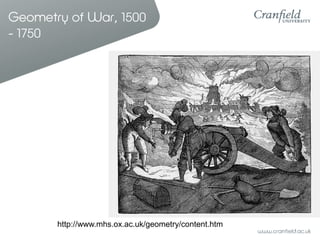
Geometry of War, 1500
- 1750


       http://www.mhs.ox.ac.uk/geometry/content.htm

Defence education past, present, future 2

  • 1.
    Defence Education: Past, Presentand Future 22 November 2012 Dr. Venkat V S S Sastry Head of Applied Mathematics and Scientific Computing, Cranfield University at the Defence Academy of the UK, Shrivenham
  • 2.
    What is Defence Education? • Education for the people concerned with defence sector • People from three services, army, navy and air force, MOD Civil Servants • Defence industry • Used interchangeably with Military Education
  • 3.
    Earlier approaches to militaryeducation • Clausewitzian approach to understanding the nature of war implied the need for a broader approach to military education than the Jominian model that could be inculcated through drill and repetition of principles
  • 4.
    Drivers … • One of the drivers for defence education stems from the increasing use of technology in modern warfare. • Modern soldier is expected to be comfortable with the rapid adoption to enhance their analytical skills • Creating the 7-Dimensional soldier – challenges for defence education (Navneet Bhusan)
  • 5.
    … of defence education • Need for breadth of knowledge at conceptual level in a variety of disciplines • Depth of knowledge in a chosen specialization • Service ethos and “training mentality/approach” is often at odds with general educational goals where you are encouraged to challenge the “accepted wisdom” (See Peter Foot’s remark) • Lack of clear career progression for highly educated qualified service personnel
  • 6.
    Daish writing aboutthe story of the Advanced Class ~c 1920 • Soon after its inception this course began to suffer from a dearth of entrants and, in fact, only one candidate offered himself for the 5th Class. … Bashforth recounts that the instruction was provided at a total expense to government of about £1200 per annum and that several officers of the Royal Artillery were “distressed at seeing this large sum of money swallowed up by the Instructional staff”
  • 7.
    Some views ofmilitary historians Greg Kennedy and Keith Neilson, 2002 • “Burdened with the responsibility to be operationally capable, and often short of money, men and equipment, the professional military has always seen a purely academic education as luxury” • … for the purpose of education some elements of training are imposed into the curriculum • … even multi-tiered, multiyear programs such as those of Russian, German, French and US military education systems, at all times demand that education be paid with training
  • 8.
    Some views ofmilitary historians John B Hattendorf (1941 -) • Conundrum of Military Education • takes issue with the use of the words military and education • “In the context of military education, it is useful to remember that these changes … armies and navies to have some appreciation of what was going on at the forefront of scientific thought”
  • 9.
    Hattendorf (1941 -) • … the use of gunpowder and cannon gave rise to the study of ballistics, and the need to understand mathematics and physics • Gunners in the field and at sea needed a range of scientific education as well as technological training to understand and to apply these concepts
  • 10.
    Some of thetensions (Hattendorf, 2002) • Dual need for military discipline and creative thinking • Approach of science and technology v approach of liberal arts • Patriotic nationalism v cross cultural understanding
  • 11.
    Hattendorf •Hattendorf identifies two drivers for wider and deeper education of officers • Ever-burgeoning demands of technical and scientific spheres • Continuing development of liberal thought (in the Western world)
  • 12.
    Andrew Lambert • “The greatest problem for military education is the limited account of practical experience that is available to officers” • “most armed force have limited contact with their core activity … and hence require better education than their counter parts in civilian sector”
  • 13.
    Andrew Lambert • “Education does not consist in the acquisition of proficiency in tasks that can be tested objectively – that is training – an essential building block of military performance – but not one that develops the skills required for leadership, planning and decision making. These attributes flow from the mastery of the underlying principles upon which professional knowledge is based”
  • 14.
    Holley •“Education is quite different. It aims to help one learn how to develop perspective, values, and the ability to cope with change, novelty and uncertainty. Those who seek to educate can not claim to have the “answers”. They can challenge and stimulate thought, but if they attempt to give answers they indoctrinate but do not educate.”
  • 15.
    Military education conundrum - AndrewLambert “ … how to stimulate thought and debate within a strictly hierarchical profession, one that demands unquestioning loyalty and obedience in peace and war”
  • 16.
    Peter Foot “Quality of thought among students is admired, but mostly when it conforms to the “staff solution” – a set of answers drafted by, and for, the military directing staff”
  • 17.
    John Knox Laughton (1866) In teaching young gunnery officers the scientific and mathematical basis of gunnery and navigation “…required a level of understanding beyond mere rote learning”
  • 18.
    Observation •Just as practical aspects of gunpowder, artillery, fortification, cartography, and navigation raised the need for broader education in mathematics, similar parallels can be drawn with applications of internet technologies • Need for broader education in applications of mathematics - with social network analysis, complexity, data mining, behaviour prediction, asymmetric warfare, cyber warfare etc.
  • 19.
    Future prospects Some of the challenges of educational delivery for the modern defence professional can be addressed effectively by innovative use of technology • MOOC; Blended learning; • TEL; Mobile learning
  • 20.
  • 21.
    Geometry of War,1500 - 1750 http://www.mhs.ox.ac.uk/geometry/content.htm

Editor's Notes

  • #3 Military education – Isn’t that an oxymoron? Why has the idea of creating an educated military force been perceived as an unattainable goal?Military is one of the important agencies of the state – hence logical to infer that educating them would be a top priorityNations often reflect on the educational needs of their defence personnel in the aftermath great disastersRecent example US after Vietnam warGulf War of 1991 – how well military education is addressing the study of asymmetric war?
  • #4 Scharnhorst (1755-1813); http://www.counter-currents.com/2010/09/the-vanguard-system/Scharnhorst (left), Clausewitz(middle),Jomini (right)
  • #11 The above tensions make up the conundrum (Hattendorf, 2002). (US Naval War College, Rhode Island)
  • #12 (Michael Howard) The fundamental characteristic of the military is not that they use violence, nor even that they use violence legHattendorf tries to avoid the two words He Reservations about the word education – this often used to imply military training and about professional initiation; not intellectual development of individual as one would in a universityThe word military often implies army, and alludes to a distinction naval and air forceitimizedby virtue of their function as instruments of the state. It is that they use violence with great deliberation.
  • #13 Andrew Lambert is the Laughton professor of Naval History in the Department of War Studies at King’s College, London. He is Hon. Secretary of the Navy Records Society and a Fellow of the Royal Historical Society.Andrew Lambert, in Kennedy & Neilson 2002, p. 85In other professions, reality normally prevents this error
  • #15 Holley – air power historian
  • #17 Peter Foot – Deputy Dean of Academic Studies at the Joint Services Command and Staff College