
Deerfield Academy
Rosetta Eun Ryong Lee
Seattle Girls’ School
Interrupting with Care and Facilitating
Courageous Conversations
Rosetta Eun Ryong Lee (http://tiny.cc/rosettalee)
About Seattle Girls’ School
Rosetta Eun Ryong Lee (http://tiny.cc/rosettalee)
Agenda
 Interrupting with Care
 Facilitating Conversations
 Resources and Tools
 Questions and Answers
Rosetta Eun Ryong Lee (http://tiny.cc/rosettalee)
Engaging in Courageous
Conversations
Rosetta Eun Ryong Lee (http://tiny.cc/rosettalee)
Debunking Some Myths
Rosetta Eun Ryong Lee (http://tiny.cc/rosettalee)
 All or None
 Mistakes
 Apologies
 “Tonsils” Theory
 Vulnerability
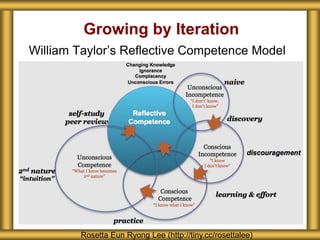
Growing by Iteration
William Taylor’s Reflective Competence Model
Rosetta Eun Ryong Lee (http://tiny.cc/rosettalee)
Interrupting with Care
Rosetta Eun Ryong Lee (http://tiny.cc/rosettalee)
Speaking From the Heart
Rosetta Eun Ryong Lee (http://tiny.cc/rosettalee)
Can you lean on the
relationship?
Can you make it personal?
* Is your relationship
hierarchical? *
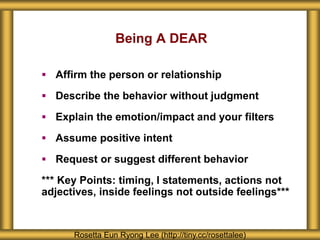
Being A DEAR
 Affirm the person or relationship
 Describe the behavior without judgment
 Explain the emotion/impact and your filters
 Assume positive intent
 Request or suggest different behavior
*** Key Points: timing, I statements, actions not
adjectives, inside feelings not outside feelings***
Rosetta Eun Ryong Lee (http://tiny.cc/rosettalee)
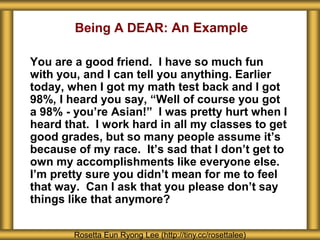
You are a good friend. I have so much fun
with you, and I can tell you anything. Earlier
today, when I got my math test back and I got
98%, I heard you say, “Well of course you got
a 98% - you’re Asian!” I was pretty hurt when I
heard that. I work hard in all my classes to get
good grades, but so many people assume it’s
because of my race. It’s sad that I don’t get to
own my accomplishments like everyone else.
I’m pretty sure you didn’t mean for me to feel
that way. Can I ask that you please don’t say
things like that anymore?
Rosetta Eun Ryong Lee (http://tiny.cc/rosettalee)
Being A DEAR: An Example
Being A Witness
Rosetta Eun Ryong Lee (http://tiny.cc/rosettalee)
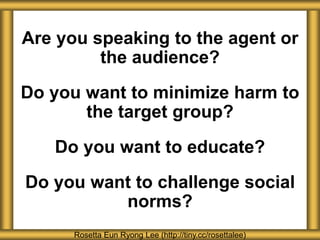
Are you speaking to the agent or
the audience?
Do you want to minimize harm to
the target group?
Do you want to educate?
Do you want to challenge social
norms?
Rosetta Eun Ryong Lee (http://tiny.cc/rosettalee)
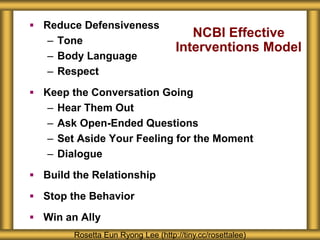
NCBI Effective
Interventions Model
 Reduce Defensiveness
– Tone
– Body Language
– Respect
 Keep the Conversation Going
– Hear Them Out
– Ask Open-Ended Questions
– Set Aside Your Feeling for the Moment
– Dialogue
 Build the Relationship
 Stop the Behavior
 Win an Ally
Rosetta Eun Ryong Lee (http://tiny.cc/rosettalee)
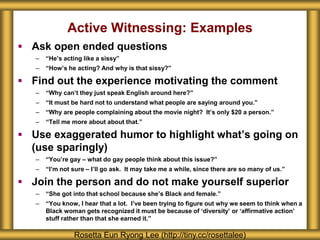
 Ask open ended questions
– “He’s acting like a sissy”
– “How’s he acting? And why is that sissy?”
 Find out the experience motivating the comment
– “Why can’t they just speak English around here?”
– “It must be hard not to understand what people are saying around you.”
– “Why are people complaining about the movie night? It’s only $20 a person.”
– “Tell me more about about that.”
 Use exaggerated humor to highlight what’s going on
(use sparingly)
– “You’re gay – what do gay people think about this issue?”
– “I’m not sure – I’ll go ask. It may take me a while, since there are so many of us.”
 Join the person and do not make yourself superior
– “She got into that school because she’s Black and female.”
– “You know, I hear that a lot. I’ve been trying to figure out why we seem to think when a
Black woman gets recognized it must be because of ‘diversity’ or ‘affirmative action’
stuff rather than that she earned it.”
Rosetta Eun Ryong Lee (http://tiny.cc/rosettalee)
Active Witnessing: Examples
Listening to the Real Message
Rosetta Eun Ryong Lee (http://tiny.cc/rosettalee)
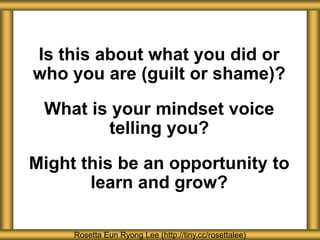
Is this about what you did or
who you are (guilt or shame)?
What is your mindset voice
telling you?
Might this be an opportunity to
learn and grow?
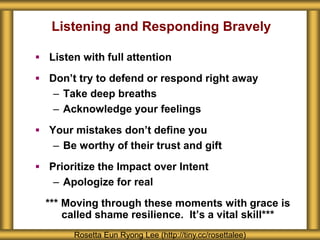
Listening and Responding Bravely
 Listen with full attention
 Don’t try to defend or respond right away
– Take deep breaths
– Acknowledge your feelings
 Your mistakes don’t define you
– Be worthy of their trust and gift
 Prioritize the Impact over Intent
– Apologize for real
*** Moving through these moments with grace is
called shame resilience. It’s a vital skill***
Rosetta Eun Ryong Lee (http://tiny.cc/rosettalee)
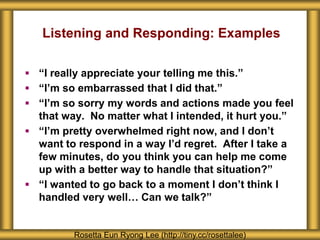
Listening and Responding: Examples
Rosetta Eun Ryong Lee (http://tiny.cc/rosettalee)
 “I really appreciate your telling me this.”
 “I’m so embarrassed that I did that.”
 “I’m so sorry my words and actions made you feel
that way. No matter what I intended, it hurt you.”
 “I’m pretty overwhelmed right now, and I don’t
want to respond in a way I’d regret. After I take a
few minutes, do you think you can help me come
up with a better way to handle that situation?”
 “I wanted to go back to a moment I don’t think I
handled very well… Can we talk?”
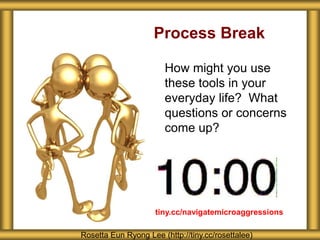
Process Break
How might you use
these tools in your
everyday life? What
questions or concerns
come up?
Rosetta Eun Ryong Lee (http://tiny.cc/rosettalee)
tiny.cc/navigatemicroaggressions
What About Group Conversations?
Rosetta Eun Ryong Lee (http://tiny.cc/rosettalee)
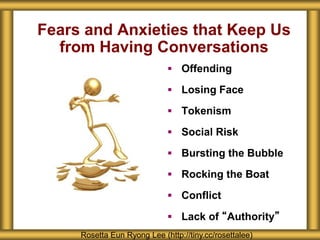
Fears and Anxieties that Keep Us
from Having Conversations
 Offending
 Losing Face
 Tokenism
 Social Risk
 Bursting the Bubble
 Rocking the Boat
 Conflict
 Lack of “Authority”
Rosetta Eun Ryong Lee (http://tiny.cc/rosettalee)
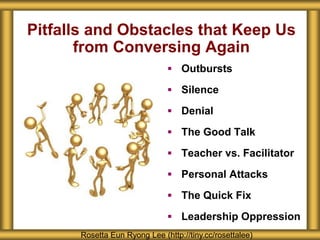
Pitfalls and Obstacles that Keep Us
from Conversing Again
 Outbursts
 Silence
 Denial
 The Good Talk
 Teacher vs. Facilitator
 Personal Attacks
 The Quick Fix
 Leadership Oppression
Rosetta Eun Ryong Lee (http://tiny.cc/rosettalee)
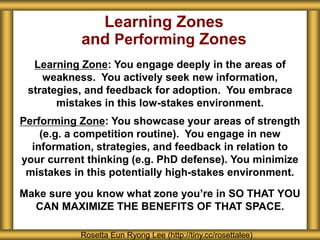
Learning Zones
and Performing Zones
Learning Zone: You engage deeply in the areas of
weakness. You actively seek new information,
strategies, and feedback for adoption. You embrace
mistakes in this low-stakes environment.
Performing Zone: You showcase your areas of strength
(e.g. a competition routine). You engage in new
information, strategies, and feedback in relation to
your current thinking (e.g. PhD defense). You minimize
mistakes in this potentially high-stakes environment.
Make sure you know what zone you’re in SO THAT YOU
CAN MAXIMIZE THE BENEFITS OF THAT SPACE.
Rosetta Eun Ryong Lee (http://tiny.cc/rosettalee)
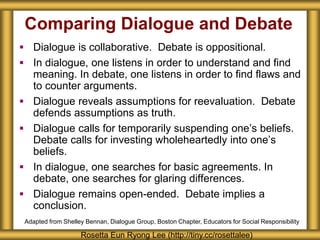
Comparing Dialogue and Debate
 Dialogue is collaborative. Debate is oppositional.
 In dialogue, one listens in order to understand and find
meaning. In debate, one listens in order to find flaws and
to counter arguments.
 Dialogue reveals assumptions for reevaluation. Debate
defends assumptions as truth.
 Dialogue calls for temporarily suspending one’s beliefs.
Debate calls for investing wholeheartedly into one’s
beliefs.
 In dialogue, one searches for basic agreements. In
debate, one searches for glaring differences.
 Dialogue remains open-ended. Debate implies a
conclusion.
Rosetta Eun Ryong Lee (http://tiny.cc/rosettalee)
Adapted from Shelley Bennan, Dialogue Group, Boston Chapter, Educators for Social Responsibility
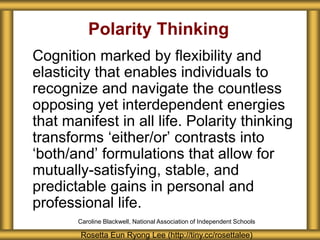
Polarity Thinking
Cognition marked by flexibility and
elasticity that enables individuals to
recognize and navigate the countless
opposing yet interdependent energies
that manifest in all life. Polarity thinking
transforms ‘either/or’ contrasts into
‘both/and’ formulations that allow for
mutually-satisfying, stable, and
predictable gains in personal and
professional life.
Rosetta Eun Ryong Lee (http://tiny.cc/rosettalee)
Caroline Blackwell, National Association of Independent Schools
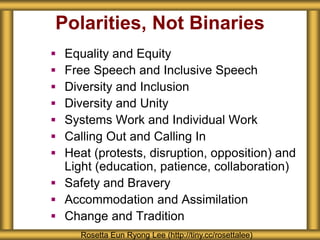
Polarities, Not Binaries
 Equality and Equity
 Free Speech and Inclusive Speech
 Diversity and Inclusion
 Diversity and Unity
 Systems Work and Individual Work
 Calling Out and Calling In
 Heat (protests, disruption, opposition) and
Light (education, patience, collaboration)
 Safety and Bravery
 Accommodation and Assimilation
 Change and Tradition
Rosetta Eun Ryong Lee (http://tiny.cc/rosettalee)
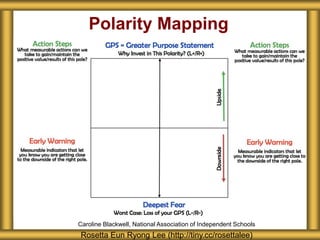
Polarity Mapping
Rosetta Eun Ryong Lee (http://tiny.cc/rosettalee)
Caroline Blackwell, National Association of Independent Schools
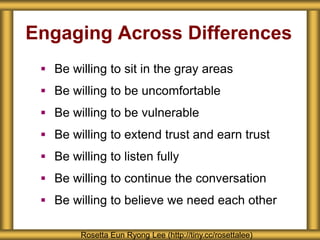
Engaging Across Differences
 Be willing to sit in the gray areas
 Be willing to be uncomfortable
 Be willing to be vulnerable
 Be willing to extend trust and earn trust
 Be willing to listen fully
 Be willing to continue the conversation
 Be willing to believe we need each other
Rosetta Eun Ryong Lee (http://tiny.cc/rosettalee)
Process Break
How might you use
these frameworks in your
everyday life and? What
questions or concerns
come up?
Rosetta Eun Ryong Lee (http://tiny.cc/rosettalee)
Inclusive Communities
Rosetta Eun Ryong Lee (http://tiny.cc/rosettalee)
Presenter Information
Rosetta Eun Ryong Lee
6th Faculty and
Professional Outreach
Seattle Girls’ School
2706 S Jackson Street
Seattle WA 98144
(206) 805-6562
rlee@seattlegirlsschool.org
http://tiny.cc/rosettalee
Rosetta Eun Ryong Lee (http://tiny.cc/rosettalee)

Deerfield Courageous Conversations Students

  • 1.
    Deerfield Academy Rosetta EunRyong Lee Seattle Girls’ School Interrupting with Care and Facilitating Courageous Conversations Rosetta Eun Ryong Lee (http://tiny.cc/rosettalee)
  • 2.
    About Seattle Girls’School Rosetta Eun Ryong Lee (http://tiny.cc/rosettalee)
  • 3.
    Agenda  Interrupting withCare  Facilitating Conversations  Resources and Tools  Questions and Answers Rosetta Eun Ryong Lee (http://tiny.cc/rosettalee)
  • 4.
    Engaging in Courageous Conversations RosettaEun Ryong Lee (http://tiny.cc/rosettalee)
  • 5.
    Debunking Some Myths RosettaEun Ryong Lee (http://tiny.cc/rosettalee)  All or None  Mistakes  Apologies  “Tonsils” Theory  Vulnerability
  • 6.
    Growing by Iteration WilliamTaylor’s Reflective Competence Model Rosetta Eun Ryong Lee (http://tiny.cc/rosettalee)
  • 7.
    Interrupting with Care RosettaEun Ryong Lee (http://tiny.cc/rosettalee)
  • 8.
    Speaking From theHeart Rosetta Eun Ryong Lee (http://tiny.cc/rosettalee)
  • 9.
    Rosetta Eun RyongLee (http://tiny.cc/rosettalee) Can you lean on the relationship? Can you make it personal? * Is your relationship hierarchical? *
  • 10.
    Being A DEAR Affirm the person or relationship  Describe the behavior without judgment  Explain the emotion/impact and your filters  Assume positive intent  Request or suggest different behavior *** Key Points: timing, I statements, actions not adjectives, inside feelings not outside feelings*** Rosetta Eun Ryong Lee (http://tiny.cc/rosettalee)
  • 11.
    You are agood friend. I have so much fun with you, and I can tell you anything. Earlier today, when I got my math test back and I got 98%, I heard you say, “Well of course you got a 98% - you’re Asian!” I was pretty hurt when I heard that. I work hard in all my classes to get good grades, but so many people assume it’s because of my race. It’s sad that I don’t get to own my accomplishments like everyone else. I’m pretty sure you didn’t mean for me to feel that way. Can I ask that you please don’t say things like that anymore? Rosetta Eun Ryong Lee (http://tiny.cc/rosettalee) Being A DEAR: An Example
  • 12.
    Being A Witness RosettaEun Ryong Lee (http://tiny.cc/rosettalee)
  • 13.
    Are you speakingto the agent or the audience? Do you want to minimize harm to the target group? Do you want to educate? Do you want to challenge social norms? Rosetta Eun Ryong Lee (http://tiny.cc/rosettalee)
  • 14.
    NCBI Effective Interventions Model Reduce Defensiveness – Tone – Body Language – Respect  Keep the Conversation Going – Hear Them Out – Ask Open-Ended Questions – Set Aside Your Feeling for the Moment – Dialogue  Build the Relationship  Stop the Behavior  Win an Ally Rosetta Eun Ryong Lee (http://tiny.cc/rosettalee)
  • 15.
     Ask openended questions – “He’s acting like a sissy” – “How’s he acting? And why is that sissy?”  Find out the experience motivating the comment – “Why can’t they just speak English around here?” – “It must be hard not to understand what people are saying around you.” – “Why are people complaining about the movie night? It’s only $20 a person.” – “Tell me more about about that.”  Use exaggerated humor to highlight what’s going on (use sparingly) – “You’re gay – what do gay people think about this issue?” – “I’m not sure – I’ll go ask. It may take me a while, since there are so many of us.”  Join the person and do not make yourself superior – “She got into that school because she’s Black and female.” – “You know, I hear that a lot. I’ve been trying to figure out why we seem to think when a Black woman gets recognized it must be because of ‘diversity’ or ‘affirmative action’ stuff rather than that she earned it.” Rosetta Eun Ryong Lee (http://tiny.cc/rosettalee) Active Witnessing: Examples
  • 16.
    Listening to theReal Message Rosetta Eun Ryong Lee (http://tiny.cc/rosettalee)
  • 17.
    Rosetta Eun RyongLee (http://tiny.cc/rosettalee) Is this about what you did or who you are (guilt or shame)? What is your mindset voice telling you? Might this be an opportunity to learn and grow?
  • 18.
    Listening and RespondingBravely  Listen with full attention  Don’t try to defend or respond right away – Take deep breaths – Acknowledge your feelings  Your mistakes don’t define you – Be worthy of their trust and gift  Prioritize the Impact over Intent – Apologize for real *** Moving through these moments with grace is called shame resilience. It’s a vital skill*** Rosetta Eun Ryong Lee (http://tiny.cc/rosettalee)
  • 19.
    Listening and Responding:Examples Rosetta Eun Ryong Lee (http://tiny.cc/rosettalee)  “I really appreciate your telling me this.”  “I’m so embarrassed that I did that.”  “I’m so sorry my words and actions made you feel that way. No matter what I intended, it hurt you.”  “I’m pretty overwhelmed right now, and I don’t want to respond in a way I’d regret. After I take a few minutes, do you think you can help me come up with a better way to handle that situation?”  “I wanted to go back to a moment I don’t think I handled very well… Can we talk?”
  • 20.
    Process Break How mightyou use these tools in your everyday life? What questions or concerns come up? Rosetta Eun Ryong Lee (http://tiny.cc/rosettalee) tiny.cc/navigatemicroaggressions
  • 21.
    What About GroupConversations? Rosetta Eun Ryong Lee (http://tiny.cc/rosettalee)
  • 22.
    Fears and Anxietiesthat Keep Us from Having Conversations  Offending  Losing Face  Tokenism  Social Risk  Bursting the Bubble  Rocking the Boat  Conflict  Lack of “Authority” Rosetta Eun Ryong Lee (http://tiny.cc/rosettalee)
  • 23.
    Pitfalls and Obstaclesthat Keep Us from Conversing Again  Outbursts  Silence  Denial  The Good Talk  Teacher vs. Facilitator  Personal Attacks  The Quick Fix  Leadership Oppression Rosetta Eun Ryong Lee (http://tiny.cc/rosettalee)
  • 24.
    Learning Zones and PerformingZones Learning Zone: You engage deeply in the areas of weakness. You actively seek new information, strategies, and feedback for adoption. You embrace mistakes in this low-stakes environment. Performing Zone: You showcase your areas of strength (e.g. a competition routine). You engage in new information, strategies, and feedback in relation to your current thinking (e.g. PhD defense). You minimize mistakes in this potentially high-stakes environment. Make sure you know what zone you’re in SO THAT YOU CAN MAXIMIZE THE BENEFITS OF THAT SPACE. Rosetta Eun Ryong Lee (http://tiny.cc/rosettalee)
  • 25.
    Comparing Dialogue andDebate  Dialogue is collaborative. Debate is oppositional.  In dialogue, one listens in order to understand and find meaning. In debate, one listens in order to find flaws and to counter arguments.  Dialogue reveals assumptions for reevaluation. Debate defends assumptions as truth.  Dialogue calls for temporarily suspending one’s beliefs. Debate calls for investing wholeheartedly into one’s beliefs.  In dialogue, one searches for basic agreements. In debate, one searches for glaring differences.  Dialogue remains open-ended. Debate implies a conclusion. Rosetta Eun Ryong Lee (http://tiny.cc/rosettalee) Adapted from Shelley Bennan, Dialogue Group, Boston Chapter, Educators for Social Responsibility
  • 26.
    Polarity Thinking Cognition markedby flexibility and elasticity that enables individuals to recognize and navigate the countless opposing yet interdependent energies that manifest in all life. Polarity thinking transforms ‘either/or’ contrasts into ‘both/and’ formulations that allow for mutually-satisfying, stable, and predictable gains in personal and professional life. Rosetta Eun Ryong Lee (http://tiny.cc/rosettalee) Caroline Blackwell, National Association of Independent Schools
  • 27.
    Polarities, Not Binaries Equality and Equity  Free Speech and Inclusive Speech  Diversity and Inclusion  Diversity and Unity  Systems Work and Individual Work  Calling Out and Calling In  Heat (protests, disruption, opposition) and Light (education, patience, collaboration)  Safety and Bravery  Accommodation and Assimilation  Change and Tradition Rosetta Eun Ryong Lee (http://tiny.cc/rosettalee)
  • 28.
    Polarity Mapping Rosetta EunRyong Lee (http://tiny.cc/rosettalee) Caroline Blackwell, National Association of Independent Schools
  • 29.
    Engaging Across Differences Be willing to sit in the gray areas  Be willing to be uncomfortable  Be willing to be vulnerable  Be willing to extend trust and earn trust  Be willing to listen fully  Be willing to continue the conversation  Be willing to believe we need each other Rosetta Eun Ryong Lee (http://tiny.cc/rosettalee)
  • 30.
    Process Break How mightyou use these frameworks in your everyday life and? What questions or concerns come up? Rosetta Eun Ryong Lee (http://tiny.cc/rosettalee)
  • 31.
    Inclusive Communities Rosetta EunRyong Lee (http://tiny.cc/rosettalee)
  • 32.
    Presenter Information Rosetta EunRyong Lee 6th Faculty and Professional Outreach Seattle Girls’ School 2706 S Jackson Street Seattle WA 98144 (206) 805-6562 rlee@seattlegirlsschool.org http://tiny.cc/rosettalee Rosetta Eun Ryong Lee (http://tiny.cc/rosettalee)