Deep Neural Networks Are Easily Fooled:
High Confidence Predictions for Unrecognizable Images
Nguyen et al., CVPR15
Reporter:Yanhua Si
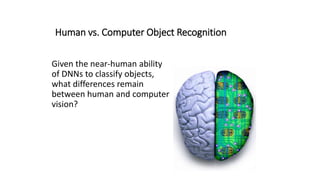
Human vs. Computer Object Recognition
Given the near-human ability
of DNNs to classify objects,
what differences remain
between human and computer
vision?
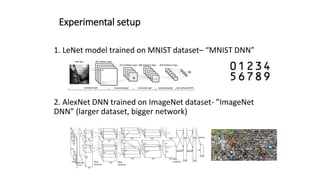
Experimental setup
1. LeNet model trained on MNIST dataset– “MNIST DNN”
2. AlexNet DNN trained on ImageNet dataset- ”ImageNet
DNN” (larger dataset, bigger network)
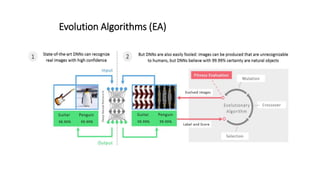
Evolution Algorithms (EA)
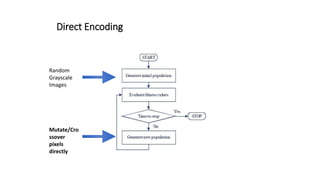
Direct Encoding
Grayscale values for MNIST, HSV values for ImageNet.
Each pixel value is initialized with uniform random
noise within the [0, 255] range. Those numbers are
independently mutated.
Direct Encoding
Random
Grayscale
Images
Mutate/Cro
ssover
pixels
directly
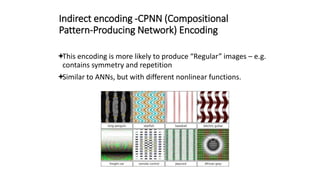
Indirect encoding -CPNN (Compositional
Pattern-Producing Network) Encoding

This encoding is more likely to produce “Regular” images – e.g.
contains symmetry and repetition

Similar to ANNs, but with different nonlinear functions.
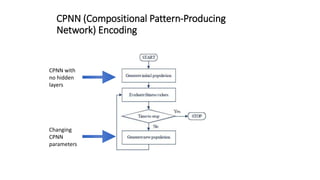
CPNN (Compositional Pattern-Producing
Network) Encoding
CPNN with
no hidden
layers
Changing
CPNN
parameters
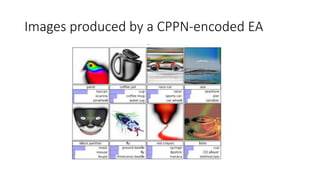
Images produced by a CPPN-encoded EA
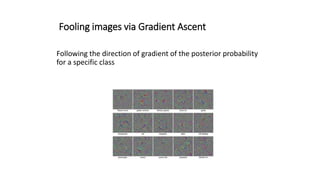
Fooling images via Gradient Ascent
Following the direction of gradient of the posterior probability
for a specific class
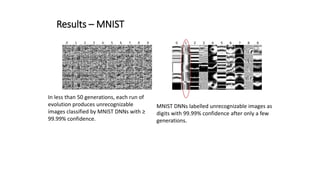
Results – MNIST
In less than 50 generations, each run of
evolution produces unrecognizable
images classified by MNIST DNNs with ≥
99.99% confidence.
MNIST DNNs labelled unrecognizable images as
digits with 99.99% confidence after only a few
generations.
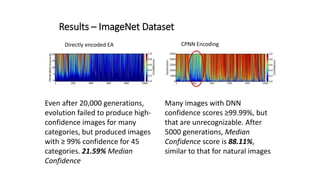
Results – ImageNet Dataset
Even after 20,000 generations,
evolution failed to produce high-
confidence images for many
categories, but produced images
with ≥ 99% confidence for 45
categories. 21.59% Median
Confidence
Directly encoded EA
Many images with DNN
confidence scores ≥99.99%, but
that are unrecognizable. After
5000 generations, Median
Confidence score is 88.11%,
similar to that for natural images
CPNN Encoding
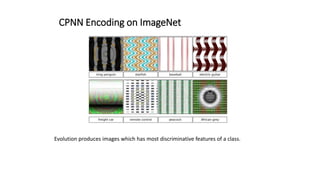
CPNN Encoding on ImageNet
Evolution produces images which has most discriminative features of a class.
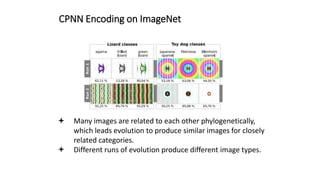
CPNN Encoding on ImageNet
 Many images are related to each other phylogenetically,
which leads evolution to produce similar images for closely
related categories.
 Different runs of evolution produce different image types.
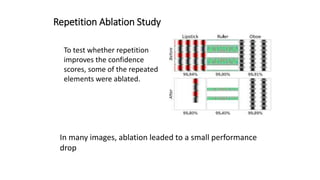
Repetition Ablation Study
To test whether repetition
improves the confidence
scores, some of the repeated
elements were ablated.
In many images, ablation leaded to a small performance
drop
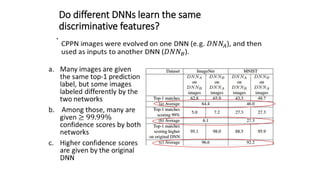
Do different DNNs learn the same
discriminative features?
•
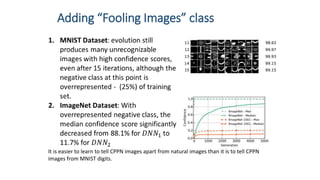
Adding “Fooling Images” class
It is easier to learn to tell CPPN images apart from natural images than it is to tell CPPN
images from MNIST digits.

Deep Neural Networks Are Easily Fooled.pptx

  • 1.
    Deep Neural NetworksAre Easily Fooled: High Confidence Predictions for Unrecognizable Images Nguyen et al., CVPR15 Reporter:Yanhua Si
  • 2.
    Human vs. ComputerObject Recognition Given the near-human ability of DNNs to classify objects, what differences remain between human and computer vision?
  • 3.
    Experimental setup 1. LeNetmodel trained on MNIST dataset– “MNIST DNN” 2. AlexNet DNN trained on ImageNet dataset- ”ImageNet DNN” (larger dataset, bigger network)
  • 4.
  • 5.
    Direct Encoding Grayscale valuesfor MNIST, HSV values for ImageNet. Each pixel value is initialized with uniform random noise within the [0, 255] range. Those numbers are independently mutated.
  • 6.
  • 7.
    Indirect encoding -CPNN(Compositional Pattern-Producing Network) Encoding  This encoding is more likely to produce “Regular” images – e.g. contains symmetry and repetition  Similar to ANNs, but with different nonlinear functions.
  • 8.
    CPNN (Compositional Pattern-Producing Network)Encoding CPNN with no hidden layers Changing CPNN parameters
  • 9.
    Images produced bya CPPN-encoded EA
  • 10.
    Fooling images viaGradient Ascent Following the direction of gradient of the posterior probability for a specific class
  • 11.
    Results – MNIST Inless than 50 generations, each run of evolution produces unrecognizable images classified by MNIST DNNs with ≥ 99.99% confidence. MNIST DNNs labelled unrecognizable images as digits with 99.99% confidence after only a few generations.
  • 12.
    Results – ImageNetDataset Even after 20,000 generations, evolution failed to produce high- confidence images for many categories, but produced images with ≥ 99% confidence for 45 categories. 21.59% Median Confidence Directly encoded EA Many images with DNN confidence scores ≥99.99%, but that are unrecognizable. After 5000 generations, Median Confidence score is 88.11%, similar to that for natural images CPNN Encoding
  • 13.
    CPNN Encoding onImageNet Evolution produces images which has most discriminative features of a class.
  • 14.
    CPNN Encoding onImageNet  Many images are related to each other phylogenetically, which leads evolution to produce similar images for closely related categories.  Different runs of evolution produce different image types.
  • 15.
    Repetition Ablation Study Totest whether repetition improves the confidence scores, some of the repeated elements were ablated. In many images, ablation leaded to a small performance drop
  • 16.
    Do different DNNslearn the same discriminative features? •
  • 17.
    Adding “Fooling Images”class It is easier to learn to tell CPPN images apart from natural images than it is to tell CPPN images from MNIST digits.

Editor's Notes

  • #3 Deep neural networks learn hierarchical layers from sensory input in order to perform pattern recognition. Recently, these deep architectures have demonstrated impressive results, sometimes it can get human-competitive results on many pattern recognition tasks, especially vision classification problems . Given the near-human ability of DNNs to classify visual objects, questions arise as to what differences remain between computer and human vision. a major difference between DNN and human vision is: changing an image, which has been correctly classified, only change a little bit that human eyes may not be able to notice, can cause a DNN to label the image as something else entirely. In this paper, we show another difference between human and computer vision, that is: for some images, which are unrecognizable to humans, but can be recognizable to DNN with a very high confidence.
  • #4 To test whether DNNs might give false positives for unrecognizable images, we need a DNN trained to near state-of-the-art performance. We choose the well-known “AlexNet” architecture To test that our results hold for other DNN architectures and datasets, we also conduct experiments with the Caffeprovided LeNet model [18] trained on the MNIST dataset
  • #5 .
  • #6 first by determining which numbers are mutated, via a rate that starts at 0.1 (each number has a 10% chance of being chosen to be mutated) and drops by half every 1000 generations. The numbers chosen to be mutated are then altered via the polynomial mutation operator [8] with a fixed mutation strength of 15
  • #7 first by determining which numbers are mutated, via a rate that starts at 0.1 (each number has a 10% chance of being chosen to be mutated) and drops by half every 1000 generations. The numbers chosen to be mutated are then altered via the polynomial mutation operator [8] with a fixed mutation strength of 15
  • #8 each image is a CPNN, pertubations are made by changing network topology, activation functions, weights idea is that CPNN evolve images which are similarly recognized by humans and DNNs sine, linear, gaussian
  • #9 each image is a CPNN, pertubations are made by changing network topology, activation functions, weights idea is that CPNN evolve images which are similarly recognized by humans and DNNs sine, linear, gaussian
  • #11 Calculating the gradient of the posterior probability for a specific class — here, a softmax output unit of the DNN — with respect to the input image using backprop, and then following the gradient to increase a chosen unit’s activation.
  • #12  By 200 generations, median confidence is 99.99%.
  • #13 smaller dataset could lead to overfitting. in some cases if target class was told one might relate the features Dogs and cats are overrepresented in Image net, more images, less overfitting, less fooling Another explanation is DNN find it hard to get images that score high in say one specific dog category
  • #14 Diversity is interesting coz it’s shown that class label can be changed by imperceptible changes to the image. second paper evolution produced images high scoring for all the classes, some classes are closely related so images produced are similar
  • #15 More than one discriminative features. More ways to fool the net.
  • #16 extra copies make DNNs more confident. Thus DNNs tend to focus on low-mid level features rather the global structure.
  • #17 which means that mostly they do
  • #18 an extra class to the DNN . the class of fooling images also retrained model learns features specific of CPPN