CS189 Discussion 9
Vashisht Madhavan
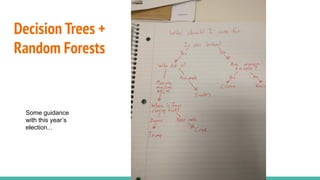
Decision Trees +
Random Forests
Some guidance
with this year’s
election...
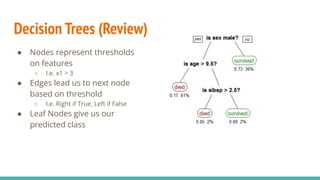
Decision Trees (Review)
● Nodes represent thresholds
on features
○ I.e. x1 > 3
● Edges lead us to next node
based on threshold
○ I.e. Right if True, Left if False
● Leaf Nodes give us our
predicted class
At Test Time
● Start at root node with unlabeled point x
● Descend to leaf node based on feature values of x
● Assign leaf node value as predicted class for x
● Usually O(log n)
○ Worst case O(n)
Training a DTree
● How do we decide which features to split on at each level of the tree?
We use this as our
metric for deciding
splits…
Here’s how
Training a DTree(cont.)
● We have this idea of Information gain
○ How much does a given feature threshold split reduce our entropy
● So we choose the feature split with the highest information gain
● We need to exhaustively search through values for all features
○ what would be a good way to do this?
Discussion Question 1 & 2
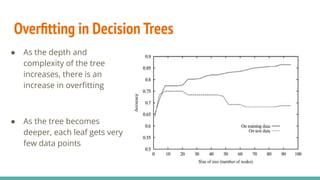
Overfitting in Decision Trees
● As the depth and
complexity of the tree
increases, there is an
increase in overfitting
● As the tree becomes
deeper, each leaf gets very
few data points
Early Stopping ● Prevents Overfitting
● Improves speed
○ Smaller tree
BENEFITS
● We have stopping
criteria to prevent our
tree from growing
further
○ Max Tree Depth
○ Min # of points at
node
○ Tree Complexity
Penalty
○ Validation Error
Monitoring
Early Stopping(cont.)
● By stopping early or pruning we do lose some modeling power
○ We cannot capture more complex distributions
Early stopping leads us to
the red line
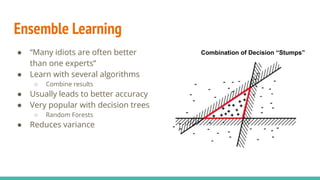
Ensemble Learning
● “Many idiots are often better
than one experts”
● Learn with several algorithms
○ Combine results
● Usually leads to better accuracy
● Very popular with decision trees
○ Random Forests
● Reduces variance
Combination of Decision “Stumps”
Random Forests
● Ensemble of short decision trees
● Averaging
○ Randomizing each model
○ I.e. different depth trees
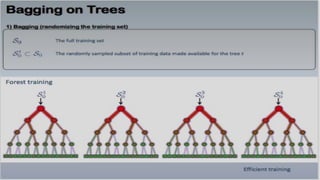
● Bagging
○ Randomize the data fed to each model
○ Take random samples from training data
■ With replacement
● To predict a new sample, we look at whichever class has the most number
of votes from the learners in the ensemble
Random Forests(cont.)
● With bagging, trees in the ensemble often look very similar. Why?
○ All trees pick same best splits (“correlated trees”)
○ Averaging won’t help then
● Feature Bagging
○ At each node pick a random subset of m features from d total features
○ Typically m = sqrt(d)
○ Has the effect of “de-correlating” trees in the ensemble
● Sometimes test error reduction up to 100s or even 1,000s of decision
trees!
● Be careful to not dumb down trees too much
○ Ideally want very strong, diverse set of learners in the ensemble
Discussion Question 3

Decision Trees- Random Forests.pdf

  • 1.
  • 2.
    Decision Trees + RandomForests Some guidance with this year’s election...
  • 3.
    Decision Trees (Review) ●Nodes represent thresholds on features ○ I.e. x1 > 3 ● Edges lead us to next node based on threshold ○ I.e. Right if True, Left if False ● Leaf Nodes give us our predicted class
  • 4.
    At Test Time ●Start at root node with unlabeled point x ● Descend to leaf node based on feature values of x ● Assign leaf node value as predicted class for x ● Usually O(log n) ○ Worst case O(n)
  • 5.
    Training a DTree ●How do we decide which features to split on at each level of the tree? We use this as our metric for deciding splits… Here’s how
  • 6.
    Training a DTree(cont.) ●We have this idea of Information gain ○ How much does a given feature threshold split reduce our entropy ● So we choose the feature split with the highest information gain ● We need to exhaustively search through values for all features ○ what would be a good way to do this?
  • 7.
  • 8.
    Overfitting in DecisionTrees ● As the depth and complexity of the tree increases, there is an increase in overfitting ● As the tree becomes deeper, each leaf gets very few data points
  • 9.
    Early Stopping ●Prevents Overfitting ● Improves speed ○ Smaller tree BENEFITS ● We have stopping criteria to prevent our tree from growing further ○ Max Tree Depth ○ Min # of points at node ○ Tree Complexity Penalty ○ Validation Error Monitoring
  • 10.
    Early Stopping(cont.) ● Bystopping early or pruning we do lose some modeling power ○ We cannot capture more complex distributions Early stopping leads us to the red line
  • 11.
    Ensemble Learning ● “Manyidiots are often better than one experts” ● Learn with several algorithms ○ Combine results ● Usually leads to better accuracy ● Very popular with decision trees ○ Random Forests ● Reduces variance Combination of Decision “Stumps”
  • 12.
    Random Forests ● Ensembleof short decision trees ● Averaging ○ Randomizing each model ○ I.e. different depth trees ● Bagging ○ Randomize the data fed to each model ○ Take random samples from training data ■ With replacement ● To predict a new sample, we look at whichever class has the most number of votes from the learners in the ensemble
  • 13.
    Random Forests(cont.) ● Withbagging, trees in the ensemble often look very similar. Why? ○ All trees pick same best splits (“correlated trees”) ○ Averaging won’t help then ● Feature Bagging ○ At each node pick a random subset of m features from d total features ○ Typically m = sqrt(d) ○ Has the effect of “de-correlating” trees in the ensemble ● Sometimes test error reduction up to 100s or even 1,000s of decision trees! ● Be careful to not dumb down trees too much ○ Ideally want very strong, diverse set of learners in the ensemble
  • 15.