Decision Control Statements
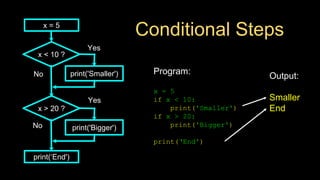
Conditional Steps
Output:
Smaller
End
Program:
x = 5
if x < 10:
print('Smaller')
if x > 20:
print('Bigger')
print(‘End')
x = 5
x < 10 ?
print('Smaller')
x > 20 ?
print('Bigger')
print(‘End')
Yes
No
Yes
No
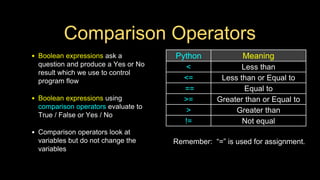
Comparison Operators
• Boolean expressions ask a
question and produce a Yes or No
result which we use to control
program flow
• Boolean expressions using
comparison operators evaluate to
True / False or Yes / No
• Comparison operators look at
variables but do not change the
variables
Remember: “=” is used for assignment.
Python Meaning
< Less than
<= Less than or Equal to
== Equal to
>= Greater than or Equal to
> Greater than
!= Not equal
Comparison Operators
x = 5
if x == 5 :
print('Equals 5')
if x > 4 :
print('Greater than 4')
if x >= 5 :
print('Greater than or Equals 5')
if x < 6 : print('Less than 6')
if x <= 5 :
print('Less than or Equals 5')
if x != 6 :
print('Not equal 6')
Equals 5
Greater than 4
Greater than or Equals 5
Less than 6
Less than or Equals 5
Not equal 6
One-Way Decisions
x = 5
print('Before 5')
if x == 5 :
print('Is 5')
print('Is Still 5')
print('Third 5')
print('Afterwards 5')
print('Before 6')
if x == 6 :
print('Is 6')
print('Is Still 6')
print('Third 6')
print('Afterwards 6')
Before 5
Is 5
Is Still 5
Third 5
Afterwards 5
Before 6
Afterwards 6
x == 5 ?
Yes
print('Still 5')
print('Third 5')
No print('Is 5’)
Indentation
• Increase indent indent after an if statement or for statement (after : )
• Maintain indent to indicate the scope of the block (which lines are affected
by the if/for)
• Reduce indent back to the level of the if statement or for statement to
indicate the end of the block
• Blank lines are ignored - they do not affect indentation
• Comments on a line by themselves are ignored with regard to indentation
x = 5
if x > 2 :
print('Bigger than 2')
print('Still bigger')
print('Done with 2')
for i in range(5) :
print(i)
if i > 2 :
print('Bigger than 2')
print('Done with i', i)
print('All Done')
increase / maintain after if or for
decrease to indicate end of block
x = 5
if x > 2 :
print('Bigger than 2')
print('Still bigger')
print('Done with 2')
for i in range(5) :
print(i)
if i > 2 :
print('Bigger than 2')
print('Done with i', i)
print('All Done')
Think About begin/end Blocks
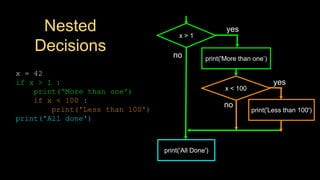
x = 42
if x > 1 :
print('More than one')
if x < 100 :
print('Less than 100')
print('All done')
Nested
Decisions
x > 1
print('More than one’)
x < 100
print('Less than 100')
print('All Done')
yes
yes
no
no
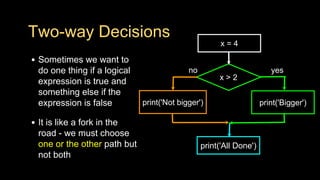
Two-way Decisions
• Sometimes we want to
do one thing if a logical
expression is true and
something else if the
expression is false
• It is like a fork in the
road - we must choose
one or the other path but
not both
x > 2
print('Bigger')
yes
no
x = 4
print('Not bigger')
print('All Done')
Two-way Decisions
with else:
x > 2
print('Bigger')
yes
no
x = 4
print('All Done')
x = 4
if x > 2 :
print('Bigger')
else :
print('Smaller')
print('All done')
print('Not bigger')
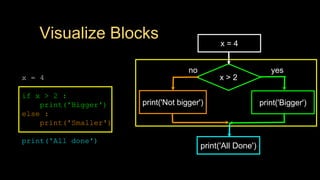
Visualize Blocks
x = 4
if x > 2 :
print('Bigger')
else :
print('Smaller')
print('All done')
x > 2
print('Bigger')
yes
no
x = 4
print('All Done')
print('Not bigger')
More Conditional Structures…
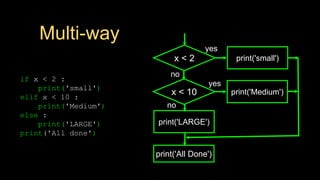
Multi-way
if x < 2 :
print('small')
elif x < 10 :
print('Medium')
else :
print('LARGE')
print('All done')
x < 2 print('small')
yes
no
print('All Done')
x < 10 print('Medium')
yes
print('LARGE')
no
Multi-way
x = 0
if x < 2 :
print('small')
elif x < 10 :
print('Medium')
else :
print('LARGE')
print('All done')
x < 2 print('small')
yes
no
print('All Done')
x < 10 print('Medium')
yes
print('LARGE')
no
x = 0
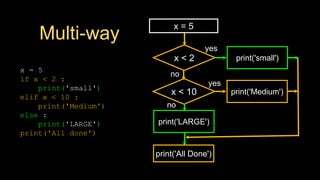
Multi-way
x = 5
if x < 2 :
print('small')
elif x < 10 :
print('Medium')
else :
print('LARGE')
print('All done')
x < 2 print('small')
yes
no
print('All Done')
x < 10 print('Medium')
yes
print('LARGE')
no
x = 5
Multi-way
x = 20
if x < 2 :
print('small')
elif x < 10 :
print('Medium')
else :
print('LARGE')
print('All done')
x < 2 print('small')
yes
no
print('All Done')
x < 10 print('Medium')
yes
print('LARGE')
no
x = 20
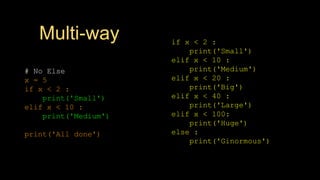
Multi-way
# No Else
x = 5
if x < 2 :
print('Small')
elif x < 10 :
print('Medium')
print('All done')
if x < 2 :
print('Small')
elif x < 10 :
print('Medium')
elif x < 20 :
print('Big')
elif x < 40 :
print('Large')
elif x < 100:
print('Huge')
else :
print('Ginormous')
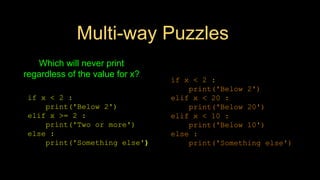
Multi-way Puzzles
if x < 2 :
print('Below 2')
elif x < 20 :
print('Below 20')
elif x < 10 :
print('Below 10')
else :
print('Something else')
if x < 2 :
print('Below 2')
elif x >= 2 :
print('Two or more')
else :
print('Something else')
Which will never print
regardless of the value for x?
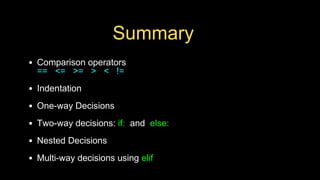
Summary
• Comparison operators
== <= >= > < !=
• Indentation
• One-way Decisions
• Two-way decisions: if: and else:
• Nested Decisions
• Multi-way decisions using elif

Decision and Control Statements.pdf

  • 1.
  • 2.
    Conditional Steps Output: Smaller End Program: x =5 if x < 10: print('Smaller') if x > 20: print('Bigger') print(‘End') x = 5 x < 10 ? print('Smaller') x > 20 ? print('Bigger') print(‘End') Yes No Yes No
  • 3.
    Comparison Operators • Booleanexpressions ask a question and produce a Yes or No result which we use to control program flow • Boolean expressions using comparison operators evaluate to True / False or Yes / No • Comparison operators look at variables but do not change the variables Remember: “=” is used for assignment. Python Meaning < Less than <= Less than or Equal to == Equal to >= Greater than or Equal to > Greater than != Not equal
  • 4.
    Comparison Operators x =5 if x == 5 : print('Equals 5') if x > 4 : print('Greater than 4') if x >= 5 : print('Greater than or Equals 5') if x < 6 : print('Less than 6') if x <= 5 : print('Less than or Equals 5') if x != 6 : print('Not equal 6') Equals 5 Greater than 4 Greater than or Equals 5 Less than 6 Less than or Equals 5 Not equal 6
  • 5.
    One-Way Decisions x =5 print('Before 5') if x == 5 : print('Is 5') print('Is Still 5') print('Third 5') print('Afterwards 5') print('Before 6') if x == 6 : print('Is 6') print('Is Still 6') print('Third 6') print('Afterwards 6') Before 5 Is 5 Is Still 5 Third 5 Afterwards 5 Before 6 Afterwards 6 x == 5 ? Yes print('Still 5') print('Third 5') No print('Is 5’)
  • 6.
    Indentation • Increase indentindent after an if statement or for statement (after : ) • Maintain indent to indicate the scope of the block (which lines are affected by the if/for) • Reduce indent back to the level of the if statement or for statement to indicate the end of the block • Blank lines are ignored - they do not affect indentation • Comments on a line by themselves are ignored with regard to indentation
  • 7.
    x = 5 ifx > 2 : print('Bigger than 2') print('Still bigger') print('Done with 2') for i in range(5) : print(i) if i > 2 : print('Bigger than 2') print('Done with i', i) print('All Done') increase / maintain after if or for decrease to indicate end of block
  • 8.
    x = 5 ifx > 2 : print('Bigger than 2') print('Still bigger') print('Done with 2') for i in range(5) : print(i) if i > 2 : print('Bigger than 2') print('Done with i', i) print('All Done') Think About begin/end Blocks
  • 9.
    x = 42 ifx > 1 : print('More than one') if x < 100 : print('Less than 100') print('All done') Nested Decisions x > 1 print('More than one’) x < 100 print('Less than 100') print('All Done') yes yes no no
  • 10.
    Two-way Decisions • Sometimeswe want to do one thing if a logical expression is true and something else if the expression is false • It is like a fork in the road - we must choose one or the other path but not both x > 2 print('Bigger') yes no x = 4 print('Not bigger') print('All Done')
  • 11.
    Two-way Decisions with else: x> 2 print('Bigger') yes no x = 4 print('All Done') x = 4 if x > 2 : print('Bigger') else : print('Smaller') print('All done') print('Not bigger')
  • 12.
    Visualize Blocks x =4 if x > 2 : print('Bigger') else : print('Smaller') print('All done') x > 2 print('Bigger') yes no x = 4 print('All Done') print('Not bigger')
  • 13.
  • 14.
    Multi-way if x <2 : print('small') elif x < 10 : print('Medium') else : print('LARGE') print('All done') x < 2 print('small') yes no print('All Done') x < 10 print('Medium') yes print('LARGE') no
  • 15.
    Multi-way x = 0 ifx < 2 : print('small') elif x < 10 : print('Medium') else : print('LARGE') print('All done') x < 2 print('small') yes no print('All Done') x < 10 print('Medium') yes print('LARGE') no x = 0
  • 16.
    Multi-way x = 5 ifx < 2 : print('small') elif x < 10 : print('Medium') else : print('LARGE') print('All done') x < 2 print('small') yes no print('All Done') x < 10 print('Medium') yes print('LARGE') no x = 5
  • 17.
    Multi-way x = 20 ifx < 2 : print('small') elif x < 10 : print('Medium') else : print('LARGE') print('All done') x < 2 print('small') yes no print('All Done') x < 10 print('Medium') yes print('LARGE') no x = 20
  • 18.
    Multi-way # No Else x= 5 if x < 2 : print('Small') elif x < 10 : print('Medium') print('All done') if x < 2 : print('Small') elif x < 10 : print('Medium') elif x < 20 : print('Big') elif x < 40 : print('Large') elif x < 100: print('Huge') else : print('Ginormous')
  • 19.
    Multi-way Puzzles if x< 2 : print('Below 2') elif x < 20 : print('Below 20') elif x < 10 : print('Below 10') else : print('Something else') if x < 2 : print('Below 2') elif x >= 2 : print('Two or more') else : print('Something else') Which will never print regardless of the value for x?
  • 20.
    Summary • Comparison operators ==<= >= > < != • Indentation • One-way Decisions • Two-way decisions: if: and else: • Nested Decisions • Multi-way decisions using elif