Dechinta	
Vision
Dynamic, sustainable and self-determining
communities where human capacity is rooted
in indigenous knowledge and values


Mission
To support a new generation of leaders and
researchers by providing accessible and
practical learning and development
experiences, respectful of traditional ways,
in a taiga bush environment
Dechinta	


• 	
  Is	
  a	
  single	
  semester	
  university-­‐credited	
  program	
  

• 	
  Provides	
  university	
  level	
  experience	
  to	
  students	
  in	
  an	
  
environment	
  that	
  respects	
  culture	
  and	
  northern	
  needs.	
  

• 	
  Provides	
  a	
  unique	
  land-­‐based	
  learning	
  opportunity	
  for	
  both	
  
northern	
  and	
  southern	
  university	
  students	
  
Why Dechinta 	?
The	
  NSERC-­‐SSHRC	
  2000	
  Task	
  Force	
  on	
  Northern	
  Research	
  report	
  From	
  Crisis	
  to	
  
Opportunity	
  urges	
  Canada	
  to	
  rebuild	
  its	
  university-­‐based	
  Northern	
  research	
  
capacity	
  in	
  order	
  to	
  help	
  Northerners	
  cope	
  with	
  the	
  unprecedented	
  social,	
  physical	
  
and	
  environmental	
  challenges	
  currently	
  facing	
  the	
  region.	
  

The	
  report	
  calls	
  for	
  new	
  partnerships	
  between	
  universities	
  and	
  Northern	
  
communities	
  and	
  the	
  direct	
  involvement	
  of	
  Northerners	
  in	
  research	
  and	
  
training.	
  

The	
  Recent	
  Northern	
  Policy	
  and	
  
Governance	
  Conference	
  in	
  Yellowknife	
  
made	
  4	
  key	
  recommendations,	
  one	
  of	
  
which	
  was	
  to	
  increase	
  support	
  and	
  
funding	
  for	
  	
  Dechinta.	
  
Why Dechinta 	?	
  
    There is a need to reduce the barriers between
        Northerners and university education


•            The	
  majority	
  of	
  Northern	
  high	
  school	
  graduates	
  do	
  not	
  pursue	
  
         	
  postsecondary	
  education	
  

• 	
     	
  Contributing	
  factors	
  include:	


                • The	
  cost	
  of	
  postsecondary	
  education	
  
                • Lack	
  of	
  confidence	
  /	
  fear	
  of	
  failure	
  
                • Distance	
  between	
  home	
  and	
  postsecondary	
  institutions	
  
                • Lack	
  of	
  support	
  for	
  students	
  away	
  from	
  home	
  and	
  family	
  
                • Family	
  obligations	
  and	
  responsibilities	
  
Why Dechinta 	?	
  
               Within the Aboriginal population in the NWT:

      • 	
     	
  15.4%	
  hold	
  a	
  high	
  school	
  diploma	
  
      • 	
     	
  25.1%	
  hold	
  other	
  certificates	
  or	
  diplomas	
  
      • 	
     	
  4.6%	
  hold	
  university	
  degrees	
  
               	
  (NWT	
  Bureau	
  of	
  statistics,	
  2004)	


These	
  statistics	
  do	
  not	
  accurately	
  represent	
  
the	
  highly	
  diverse	
  skill	
  set	
  and	
  true	
  capacity	
  
of	
  northerners.	
  	
  Unaccredited	
  expertise	
  
within	
  the	
  Northern	
  population	
  exists	
  in	
  
areas	
  such	
  as	
  land-­‐based	
  traditional	
  
knowledge,	
  community	
  governance,	
  
business	
  and	
  economy.	
  
Why Dechinta 	?	
  
    • 	
   	
  There	
  is	
  a	
  need	
  for	
  a	
  university	
  that	
  
    will	
  respect	
  and	
  honour	
  Northern	
   	
  and	
  
    Indigenous	
  knowledge	
  and	
  skills	
  

    • 	
   	
  There	
  is	
  a	
  need	
  to	
  create	
  a	
  university	
  
    environment	
  that	
  includes	
  land-­‐based	
  
    teaching	
  and	
  knowledge	
  in	
  the	
  	
  Northern	
  
    context	
  

    •  	
  
       There	
  is	
  a	
  need	
  to	
  increase	
  Northern	
  
    research	
  capacity.	
  
Dechinta Offers
• 	
  University	
  Credited	
  Courses,	
  developed	
  and	
  delivered	
  by	
  Northern	
  experts	
  ,	
  
elders	
  and	
  leading	
  professors	
  

• 	
  Inclusive	
  programming	
  for	
  student’s	
  children	
  and	
  families	
  

• 	
  Land-­‐based	
  experiences	
  and	
  
educational	
  opportunities	
  

• 	
  Environmental	
  monitoring	
  &	
  
field	
  research	
  training	
  

• 	
  Leadership	
  development	
  
and	
  mentoring	
  

• 	
  Youth	
  programming	
  
Who would attend Dechinta?


•  Northerners	
  who	
  are	
  interested	
  in	
  doing	
  a	
  semester	
  or	
  full-­‐year	
  university	
  
course	
  

• 	
  Northerners	
  who	
  are	
  interested	
  in	
  specific,	
  short,	
  intensive	
  courses	
  

• Southern	
  and	
  Northern	
  business	
  and	
  community	
  leaders	
  who	
  want	
  to	
  
foster	
  increased	
  understanding,	
  awareness	
  and	
  partnerships	
  

• 	
  Southerners	
  who	
  want	
  to	
  increase	
  their	
  awareness	
  and	
  understanding	
  of	
  
the	
  challenges	
  and	
  opportunities	
  in	
  Canada’s	
  North	
  

• 	
  Researchers	
  doing	
  subarctic	
  and	
  arctic	
  research	
  
Dechinta Bush University	
   Dechinta courses will be delivered in a taiga bush
   environment. Field Schools boast higher student
   success rates, provide integrated community and
educational experience and are noted amongst students
    and teachers to offer life changing educational
                     experiences.
Dechinta Bush University	


The Dechinta curriculum will be housed in a sustainable-
 off grid centre. A self-governing community formed by
students, professors and elders will engage in hunting,
  gathering and sustainable living practices under the
        guidance of resident Elders and experts.
Dechinta Bush University	
  
         This community-based model
         supports a whole-person, healthy
         educational experience for all
         participants. Child-care and family-
         living are an integral aspect of
         Dechinta, and complimentary
         programming will be offered for the
         families of our students.
The Dechinta site offers…	
  
         •    Central	
  lodge	
  with	
  commercial	
  kitchen,	
  central	
  meeting	
  
              room	
  for	
  45	
  and	
  	
  a	
  number	
  of	
  "breakout"	
  learning	
  areas	
  

         •    3	
  types	
  of	
  all-­‐season	
  accommodation	
  for	
  50+	
  guests	
  (lodge,	
  
              cabin	
  and	
  tent	
  frame),	
  Dene	
  tipi	
  and	
  cultural	
  area.	
  

         •    Modern	
  conference	
  amenities	
  including	
  high	
  speed	
  wireless	
  
              internet,	
  satellite	
  and	
  Vonage	
  phone	
  system,	
  LCD	
  projector,	
  
              Northern	
  library	
  and	
  photo	
  collection.	
  

         •    Sustainable	
  Design	
  and	
  Systems:	
  Composting	
  Toilets,	
  Solar	
  
              energy,	
  battery	
  bank,	
  passive	
  solar,	
  compost,	
  garden	
  and	
  
              green	
  house.	
  

         •    Helipad,	
  2	
  summer	
  float	
  plane	
  landing	
  docks,	
  14	
  boats	
  and	
  
              motors,	
  5	
  snowmobiles,	
  canoes,	
  sea	
  	
  kayaks	
  and	
  a	
  variety	
  of	
  
              four-­‐season	
  activity	
  equipment.	


         •    A	
  three	
  month	
  lease	
  at	
  cost	
  to	
  demonstrate	
  the	
  
              sustainability	
  of	
  a	
  permanent	
  community	
  owned	
  program.	
  
Dechinta                                             Curriculum	
The	
  Dechinta	
  Curriculum	
  is	
  designed	
  to	
  give	
  students	
  a	
  strong	
  grounding	
  in	
  
a	
  broad	
  range	
  of	
  Northern	
  issues	
  and	
  a	
  deep	
  understanding	
  of	
  how	
  those	
  
issues	
  are	
  interrelated.	
  

Traditional	
  Knowledge	
  will	
  be	
  inherent	
  in	
  every	
  course,	
  
respecting	
  the	
  information	
  that	
  our	
  elders	
  hold	
  as	
  well	
  as	
  
the	
  manner	
  in	
  which	
  they	
  share	
  it.	
  	
  As	
  such,	
  a	
  key	
  
component	
  of	
  the	
  curriculum	
  is	
  the	
  development	
  of	
  
personal,	
  emotional	
  and	
  spiritual	
  attributes	
  as	
  they	
  pertain	
  
to	
  leadership,	
  community,	
  respect,	
  cooperation	
  and	
  vision.	
  

Each	
  student	
  will	
  be	
  paired	
  with	
  a	
  mentor	
  to	
  provide	
  
support	
  throughout	
  the	
  duration	
  of	
  the	
  program	
  and	
  
continued	
  guidance	
  following	
  program	
  completion.	
  
Dechinta	
                                          Program Description
                                   Pilot	
  Semester:   	
  16	
  Indigenous	
  Northern	
  Students	


• 	
  Land	
  Claims	
  and	
  Law	
                                                     • 	
  Journalism	
  

• 	
  Political	
  History	
                                                             • 	
  Self-­‐Governance	
  

• 	
  Language	
  and	
  Culture	
                                                       • 	
  Sustainable	
  Building	
  and	
  Energy	
  

• 	
  Environmental	
  Monitoring	
                                                      • 	
  The	
  North	
  in	
  a	
  Global	
  Context	
  

• 	
  Community	
  Research	
  Methods	
                                                 • 	
  Traditional	
  Nutrition	
  

• 	
  Boreal	
  Ecology	
                                                                • 	
  Mining	
  and	
  Exploration:	
  
                                                                                         Business,	
  Environment	
  and	
  
• 	
  Creative	
  Writing	
                                                              Regulation	
  
Dechinta                                             Pilot Goals	


• 	
  	
  Refine	
  co-­‐teaching	
  method	
               • 	
  	
  Test	
  curriculum	
  content	
  

• 	
  	
  Explore	
  Dechinta	
  site	
  suitability	
     • 	
  	
  Clarify	
  long-­‐term	
  goals	
  

• 	
  	
  Provide	
  feedback	
  on	
  subject	
  matter	
  and	
  delivery	
  method	
  
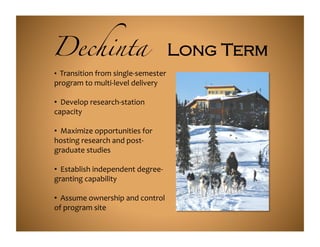
Dechinta                                              Long Term	
  
• 	
  	
  Transition	
  from	
  single-­‐semester	
  
program	
  to	
  multi-­‐level	
  delivery	
  

• 	
  	
  Develop	
  research-­‐station	
  
capacity	
  

• 	
  	
  Maximize	
  opportunities	
  for	
  
hosting	
  research	
  and	
  post-­‐
graduate	
  studies	
  

• 	
  	
  Establish	
  independent	
  degree-­‐
granting	
  capability	
  

• 	
  	
  Assume	
  ownership	
  and	
  control	
  
of	
  program	
  site	
  
Dechinta                                         Benefits	
      How will Northern communities benefit?
Northern	
  communities	
  will	
  benefit	
  from	
  increased	
  capacity	
  and	
  skill	
  level	
  of	
  
community	
  members	
  who	
  attend	
  the	
  program	
  

Northern	
  communities	
  will	
  see	
  more	
  university	
  
graduates	
  and	
  increased	
  southern	
  awareness	
  of	
  
Northern	
  and	
  Indigenous	
  issues,	
  values	
  and	
  culture.	
  

Employment	
  will	
  increase	
  as	
  community	
  members	
  
teach	
  and	
  lead	
  at	
  the	
  School.	
  

Communities	
  will	
  play	
  a	
  key	
  role	
  in	
  designing	
  and	
  
delivering	
  relevant	
  curriculum	
  and	
  teaching	
  methods	
  
for	
  northern	
  and	
  southern	
  students	
  using	
  northern	
  
expertise.	
  
Dechinta                         Benefits	
  
  How will Canada Benefit?

       Canada	
  will	
  benefit	
  from	
  having	
  quality	
  post-­‐secondary	
  
       education	
  focusing	
  on	
  northern	
  issues	
  from	
  a	
  northern	
  
       perspective.	
  

       Dechinta	
  will	
  support	
  dialogue	
  and	
  discussion	
  of	
  
       pertinent	
  domestic	
  and	
  international	
  policy.	
  	
  Investment	
  
       in	
  northern	
  research	
  and	
  building	
  the	
  capacity	
  of	
  
       northerners	
  to	
  direct	
  their	
  own	
  research	
  and	
  policy	
  will	
  
       build	
  a	
  stronger	
  Canada.	
  

       An	
  increased	
  Canadian	
  awareness	
  of	
  Northern	
  and	
  
       Indigenous	
  knowledge,	
  leaders	
  and	
  thinkers	
  will	
  build	
  
       bridges	
  between	
  the	
  north	
  and	
  the	
  rest	
  of	
  Canada,	
  
       broadening	
  national	
  pride	
  and	
  putting	
  human	
  faces	
  on	
  
       northern	
  issues	
  on	
  a	
  global	
  level.	
  
Dechinta 	 Next Steps
• 	
  	
  Continued	
  Fundraising	
  

• 	
  	
  Continued	
  Curriculum	
  Development	
  

          • 	
  Language	
  
          • 	
  Leadership	
  
          • 	
  Governance	
  
          • 	
  Land	
  Claims	
  and	
  Law	
  
          • 	
  Land	
  and	
  Resources	
  
          • 	
  Diversity	
  and	
  Change	
  

          • 	
  	
  Co-­‐teaching	
  Gatherings	
  

          • 	
  	
  Pilot	
  Semester	
  
Dechinta Partnerships
The	
  University	
  of	
  Alberta-­‐	
  
Canadian	
  Circumpolar	
  Institute	
  and	
  Faculty	
  of	
  Native	
  Studies	
  

Walter	
  and	
  Duncan	
  Gordon	
  Foundation	
  

INAC	
  SINED	
  Program	
  

Institute	
  for	
  Circumpolar	
  Health	
  Research	
  	
  
(AHRN	
  YK)	
  

Indigenous	
  Cooperative	
  on	
  the	
  Environment	
  

Kopykat	
  North	
  
Dechinta Contact

       Kyla	
  Kakfwi	
  Scott	
  
       Program	
  Manager	
  

       (867)	
  445-­‐1897	
  

       dechintaadmin@gmail.com	
  

       www.dechinta.ca	
  

Dechinta Overview

  • 2.
    Dechinta Vision Dynamic, sustainable andself-determining communities where human capacity is rooted in indigenous knowledge and values Mission To support a new generation of leaders and researchers by providing accessible and practical learning and development experiences, respectful of traditional ways, in a taiga bush environment
  • 3.
    Dechinta •   Is  a  single  semester  university-­‐credited  program   •   Provides  university  level  experience  to  students  in  an   environment  that  respects  culture  and  northern  needs.   •   Provides  a  unique  land-­‐based  learning  opportunity  for  both   northern  and  southern  university  students  
  • 4.
    Why Dechinta ? The  NSERC-­‐SSHRC  2000  Task  Force  on  Northern  Research  report  From  Crisis  to   Opportunity  urges  Canada  to  rebuild  its  university-­‐based  Northern  research   capacity  in  order  to  help  Northerners  cope  with  the  unprecedented  social,  physical   and  environmental  challenges  currently  facing  the  region.   The  report  calls  for  new  partnerships  between  universities  and  Northern   communities  and  the  direct  involvement  of  Northerners  in  research  and   training.   The  Recent  Northern  Policy  and   Governance  Conference  in  Yellowknife   made  4  key  recommendations,  one  of   which  was  to  increase  support  and   funding  for    Dechinta.  
  • 5.
    Why Dechinta ?   There is a need to reduce the barriers between Northerners and university education • The  majority  of  Northern  high  school  graduates  do  not  pursue    postsecondary  education   •     Contributing  factors  include:     • The  cost  of  postsecondary  education   • Lack  of  confidence  /  fear  of  failure   • Distance  between  home  and  postsecondary  institutions   • Lack  of  support  for  students  away  from  home  and  family   • Family  obligations  and  responsibilities  
  • 6.
    Why Dechinta ?   Within the Aboriginal population in the NWT: •     15.4%  hold  a  high  school  diploma   •     25.1%  hold  other  certificates  or  diplomas   •     4.6%  hold  university  degrees    (NWT  Bureau  of  statistics,  2004)   These  statistics  do  not  accurately  represent   the  highly  diverse  skill  set  and  true  capacity   of  northerners.    Unaccredited  expertise   within  the  Northern  population  exists  in   areas  such  as  land-­‐based  traditional   knowledge,  community  governance,   business  and  economy.  
  • 7.
    Why Dechinta ?   •     There  is  a  need  for  a  university  that   will  respect  and  honour  Northern    and   Indigenous  knowledge  and  skills   •     There  is  a  need  to  create  a  university   environment  that  includes  land-­‐based   teaching  and  knowledge  in  the    Northern   context   •    There  is  a  need  to  increase  Northern   research  capacity.  
  • 8.
    Dechinta Offers •   University  Credited  Courses,  developed  and  delivered  by  Northern  experts  ,   elders  and  leading  professors   •   Inclusive  programming  for  student’s  children  and  families   •   Land-­‐based  experiences  and   educational  opportunities   •   Environmental  monitoring  &   field  research  training   •   Leadership  development   and  mentoring   •   Youth  programming  
  • 9.
    Who would attendDechinta? •  Northerners  who  are  interested  in  doing  a  semester  or  full-­‐year  university   course   •   Northerners  who  are  interested  in  specific,  short,  intensive  courses   • Southern  and  Northern  business  and  community  leaders  who  want  to   foster  increased  understanding,  awareness  and  partnerships   •   Southerners  who  want  to  increase  their  awareness  and  understanding  of   the  challenges  and  opportunities  in  Canada’s  North   •   Researchers  doing  subarctic  and  arctic  research  
  • 10.
    Dechinta Bush University Dechinta courses will be delivered in a taiga bush environment. Field Schools boast higher student success rates, provide integrated community and educational experience and are noted amongst students and teachers to offer life changing educational experiences.
  • 11.
    Dechinta Bush University   The Dechinta curriculum will be housed in a sustainable- off grid centre. A self-governing community formed by students, professors and elders will engage in hunting, gathering and sustainable living practices under the guidance of resident Elders and experts.
  • 12.
    Dechinta Bush University   This community-based model supports a whole-person, healthy educational experience for all participants. Child-care and family- living are an integral aspect of Dechinta, and complimentary programming will be offered for the families of our students.
  • 13.
    The Dechinta siteoffers…   •  Central  lodge  with  commercial  kitchen,  central  meeting   room  for  45  and    a  number  of  "breakout"  learning  areas   •  3  types  of  all-­‐season  accommodation  for  50+  guests  (lodge,   cabin  and  tent  frame),  Dene  tipi  and  cultural  area.   •  Modern  conference  amenities  including  high  speed  wireless   internet,  satellite  and  Vonage  phone  system,  LCD  projector,   Northern  library  and  photo  collection.   •  Sustainable  Design  and  Systems:  Composting  Toilets,  Solar   energy,  battery  bank,  passive  solar,  compost,  garden  and   green  house.   •  Helipad,  2  summer  float  plane  landing  docks,  14  boats  and   motors,  5  snowmobiles,  canoes,  sea    kayaks  and  a  variety  of   four-­‐season  activity  equipment.     •  A  three  month  lease  at  cost  to  demonstrate  the   sustainability  of  a  permanent  community  owned  program.  
  • 14.
    Dechinta Curriculum The  Dechinta  Curriculum  is  designed  to  give  students  a  strong  grounding  in   a  broad  range  of  Northern  issues  and  a  deep  understanding  of  how  those   issues  are  interrelated.   Traditional  Knowledge  will  be  inherent  in  every  course,   respecting  the  information  that  our  elders  hold  as  well  as   the  manner  in  which  they  share  it.    As  such,  a  key   component  of  the  curriculum  is  the  development  of   personal,  emotional  and  spiritual  attributes  as  they  pertain   to  leadership,  community,  respect,  cooperation  and  vision.   Each  student  will  be  paired  with  a  mentor  to  provide   support  throughout  the  duration  of  the  program  and   continued  guidance  following  program  completion.  
  • 15.
    Dechinta Program Description Pilot  Semester:  16  Indigenous  Northern  Students   •   Land  Claims  and  Law   •   Journalism   •   Political  History   •   Self-­‐Governance   •   Language  and  Culture   •   Sustainable  Building  and  Energy   •   Environmental  Monitoring   •   The  North  in  a  Global  Context   •   Community  Research  Methods   •   Traditional  Nutrition   •   Boreal  Ecology   •   Mining  and  Exploration:   Business,  Environment  and   •   Creative  Writing   Regulation  
  • 16.
    Dechinta Pilot Goals •     Refine  co-­‐teaching  method   •     Test  curriculum  content   •     Explore  Dechinta  site  suitability   •     Clarify  long-­‐term  goals   •     Provide  feedback  on  subject  matter  and  delivery  method  
  • 17.
    Dechinta Long Term   •     Transition  from  single-­‐semester   program  to  multi-­‐level  delivery   •     Develop  research-­‐station   capacity   •     Maximize  opportunities  for   hosting  research  and  post-­‐ graduate  studies   •     Establish  independent  degree-­‐ granting  capability   •     Assume  ownership  and  control   of  program  site  
  • 18.
    Dechinta Benefits How will Northern communities benefit? Northern  communities  will  benefit  from  increased  capacity  and  skill  level  of   community  members  who  attend  the  program   Northern  communities  will  see  more  university   graduates  and  increased  southern  awareness  of   Northern  and  Indigenous  issues,  values  and  culture.   Employment  will  increase  as  community  members   teach  and  lead  at  the  School.   Communities  will  play  a  key  role  in  designing  and   delivering  relevant  curriculum  and  teaching  methods   for  northern  and  southern  students  using  northern   expertise.  
  • 19.
    Dechinta Benefits   How will Canada Benefit? Canada  will  benefit  from  having  quality  post-­‐secondary   education  focusing  on  northern  issues  from  a  northern   perspective.   Dechinta  will  support  dialogue  and  discussion  of   pertinent  domestic  and  international  policy.    Investment   in  northern  research  and  building  the  capacity  of   northerners  to  direct  their  own  research  and  policy  will   build  a  stronger  Canada.   An  increased  Canadian  awareness  of  Northern  and   Indigenous  knowledge,  leaders  and  thinkers  will  build   bridges  between  the  north  and  the  rest  of  Canada,   broadening  national  pride  and  putting  human  faces  on   northern  issues  on  a  global  level.  
  • 20.
    Dechinta NextSteps •     Continued  Fundraising   •     Continued  Curriculum  Development   •   Language   •   Leadership   •   Governance   •   Land  Claims  and  Law   •   Land  and  Resources   •   Diversity  and  Change   •     Co-­‐teaching  Gatherings   •     Pilot  Semester  
  • 21.
    Dechinta Partnerships The  University  of  Alberta-­‐   Canadian  Circumpolar  Institute  and  Faculty  of  Native  Studies   Walter  and  Duncan  Gordon  Foundation   INAC  SINED  Program   Institute  for  Circumpolar  Health  Research     (AHRN  YK)   Indigenous  Cooperative  on  the  Environment   Kopykat  North  
  • 22.
    Dechinta Contact Kyla  Kakfwi  Scott   Program  Manager   (867)  445-­‐1897   dechintaadmin@gmail.com   www.dechinta.ca