Decentralized Indoor Localization Framework Based on
Real-Time-Trainable Models Running on IoT Devices
Kyeong Soo (Joseph) Kim
with Z. Tang, S. Li, Z. Huang, G. Yang, and J. S. Smith
Department of Communications and Networking
School of Advanced Technology
Xi’an Jiaotong-Liverpool University (XJTLU)
The 17th International Conference on Advanced Computer Theory and Engineering (ICACTE 2024)
15 September 2024
Credits
• This talk is based on our latest work reported in the following
paper:
– Zhe Tang, Sihao Li, Zichen Huang, Guandong Yang, Kyeong Soo Kim,
and Jeremy S. Smith, “SGP-RI: A Real-Time-Trainable and
Decentralized IoT Indoor Localization Model Based on Sparse
Gaussian Process with Reduced-Dimensional Inputs,” submitted to
IEEE Internet of Things Journal, Aug. 22, 2024. [Online]. Available:
https://arxiv.org/abs/2409.00078
1
Outline
• Introduction
• Real-Time-Trainable Indoor Localization Model Based on SGP
• Experimental Results
• Conclusions
2
INTRODUCTION
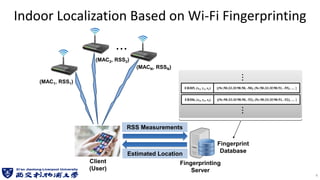
Fingerprinting
Server
(MAC1, RSS1)
(MAC2, RSS2)
(MACN, RSSN)
Estimated Location
Client
(User)

RSS Measurements
Fingerprint
Database
EB306, (x2, y2, z2) {(9c:50:33:3f:98:50, -52), (9c:50:33:3f:98:51, -52), … }


EB305, (x1, y1, z1) {(9c:50:33:3f:98:50, -50), (9c:50:33:3f:98:51, -55), … }
Indoor Localization Based on Wi-Fi Fingerprinting
4
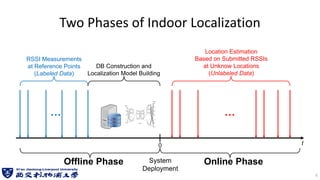
Two Phases of Indoor Localization
6
0 t
…
…







Hidden

Input
Output
RSSI Measurements
at Reference Points
(Labeled Data)
DB Construction and
Localization Model Building
Location Estimation
Based on Submitted RSSIs
at Unknow Locations
(Unlabeled Data)
System
Deployment
Offline Phase Online Phase
7
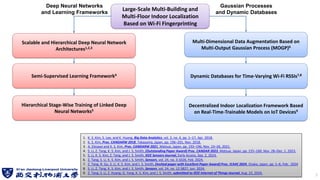
Large-Scale Multi-Building and
Multi-Floor Indoor Localization
Based on Wi-Fi Fingerprinting
Hierarchical Stage-Wise Training of Linked Deep
Neural Networks5
Multi-Dimensional Data Augmentation Based on
Multi-Output Gaussian Process (MOGP)6
Dynamic Databases for Time-Varying Wi-Fi RSSIs7,8
Scalable and Hierarchical Deep Neural Network
Architectures1,2,3
Deep Neural Networks
and Learning Frameworks
Gaussian Processes
and Dynamic Databases
Decentralized Indoor Localization Framework Based
on Real-Time-Trainable Models on IoT Devices9
1. K. S. Kim, S. Lee, and K. Huang, Big Data Analytics, vol. 3, no. 4, pp. 1–17, Apr. 2018.
2. K. S. Kim, Proc. CANDARW 2018, Takayama, Japan, pp. 196–201, Nov. 2018.
3. A. Elesawi and K. S. Kim, Proc. CANDARW 2021, Matsue, Japan, pp. 193–196, Nov. 23–26, 2021.
4. S. Li, Z. Tang, K. S. Kim, and J. S. Smith, (Outstanding Paper Award) Proc. CANDAR 2023, Matsue, Japan, pp. 155–160, Nov. 28–Dec. 1, 2023.
5. S. Li, K. S. Kim, Z. Tang, and J. S. Smith, IEEE Sensors Journal, Early Access, Sep. 2, 2024.
6. Z. Tang, S. Li, K. S. Kim, and J. S. Smith, Sensors, vol. 24, no. 3:1026, Feb. 2024.
7. Z. Tang, R. Gu, S. Li, K. S. Kim, and J. S. Smith, (Invited paper with Excellent Paper Award) Proc. ICAIIC 2024, Osaka, Japan, pp. 1–6, Feb. 2024
8. S. Li, Z. Tang, K. S. Kim, and J. S. Smith, Sensors, vol. 24, no. 12:3827, Jun. 2024.
9. Z. Tang, S. Li, Z. Huang, G. Yang, K. S. Kim, and J. S. Smith, submitted to IEEE Internet of Things Journal, Aug. 22, 2024.
Semi-Supervised Learning Framework4
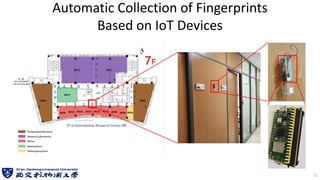
Automatic Collection of Fingerprints
Based on IoT Devices
11
REAL-TIME-TRAINABLE INDOOR LOCALIZATION
MODEL BASED ON SGP
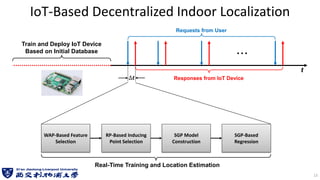
IoT-Based Decentralized Indoor Localization
13
t
Train and Deploy IoT Device
Based on Initial Database
WAP-Based Feature
Selection
RP-Based Inducing
Point Selection
SGP Model
Construction
SGP-Based
Regression
Real-Time Training and Location Estimation
Requests from User
Responses from IoT Device

∆𝒕
Why Gaussian Process (GP)?
• While the primary focus of statistics is on understanding the
data and their relationships (e.g., linear, independence), that of
machine learning is on making predictions as accurately as
possible.
• GP, bridging statistics and machine learning, could produce
models easier to handle and interpret than their conventional
counterparts like neural networks that often result in black box
models.
14
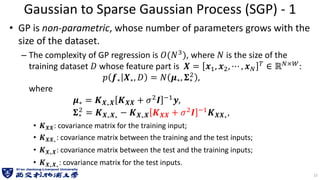
Gaussian to Sparse Gaussian Process (SGP) - 1
• GP is non-parametric, whose number of parameters grows with the
size of the dataset.
– The complexity of GP regression is 𝑂(𝑁3), where 𝑁 is the size of the
training dataset 𝐷 whose feature part is 𝑿 = 𝒙1, 𝒙2, ⋯ , 𝒙𝑁
𝑇 ∈ ℝ𝑁×𝑊:
𝑝 𝒇∗ 𝑿∗, 𝐷 = 𝑁 𝝁∗, 𝚺∗
2 ,
where
𝝁∗ = 𝑲𝑿∗𝑿 𝑲𝑿𝑿 + 𝜎2𝑰 −1𝒚,
𝚺∗
2
= 𝑲𝑿∗𝑿∗
− 𝑲𝑿∗𝑿 𝑲𝑿𝑿 + 𝜎2
𝑰 −1
𝑲𝑿𝑿∗
,
• 𝑲𝑿𝑿: covariance matrix for the training input;
• 𝑲𝑿𝑿∗
: covariance matrix between the training and the test inputs;
• 𝑲𝑿∗𝑿: covariance matrix between the test and the training inputs;
• 𝑲𝑿∗𝑿∗
: covariance matrix for the test inputs.
15
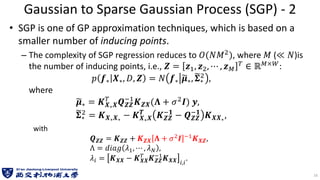
Gaussian to Sparse Gaussian Process (SGP) - 2
• SGP is one of GP approximation techniques, which is based on a
smaller number of inducing points.
– The complexity of SGP regression reduces to 𝑂(𝑁𝑀2), where 𝑀 (≪ 𝑁)is
the number of inducing points, i.e., 𝒁 = 𝒛1, 𝒛2, ⋯ , 𝒛𝑀
𝑇 ∈ ℝ𝑀×𝑊:
𝑝 𝒇∗ 𝑿∗, 𝐷, 𝒁 = 𝑁 𝒇∗ ෥
𝝁∗, ෩
𝚺∗
2 ,
where
෥
𝝁∗ = 𝑲𝑿∗𝑿
𝑇
𝑸𝒁𝒁
−1
𝑲𝒁𝑿(𝚲 + 𝜎2𝑰) 𝒚,
෩
𝚺∗
2 = 𝑲𝑿∗𝑿∗
− 𝑲𝑿∗𝑿
𝑻
𝑲𝒁𝒁
−𝟏
− 𝑸𝒁𝒁
−𝟏
𝑲𝑿𝑿∗
,
with
𝑸𝒁𝒁 = 𝑲𝒁𝒁 + 𝑲𝒁𝑿 𝚲 + 𝜎2𝑰 −1𝑲𝑿𝒁,
Λ = 𝑑𝑖𝑎𝑔 𝜆1, ⋯ , 𝜆𝑁 ,
𝜆𝑖 = 𝑲𝑿𝑿 − 𝑲𝑿𝑿
𝑇
𝑲𝒁𝒁
−1
𝑲𝑿𝑿 𝑖,𝑖
.
16
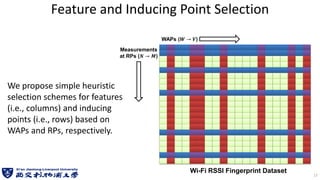
Feature and Inducing Point Selection
We propose simple heuristic
selection schemes for features
(i.e., columns) and inducing
points (i.e., rows) based on
WAPs and RPs, respectively.
17
Wi-Fi RSSI Fingerprint Dataset
Measurements
at RPs (𝑵 → 𝑴)
WAPs (𝑾 → 𝑽)
EXPERIMENTAL RESULTS
18
Results Based on GPU Server and XJTLU
Dynamic Database
Model 2D Error [m] Training Time [s] Model Sparsity
GP 5.32 12.79 ⎯
SGP-RI 5.80 6.08 50%
SGP-RI 5.96 5.52 40%
SGP-RI 6.44 5.00 30%
DNN 5.86 17.181 ⎯
CNN 5.87 12.061 ⎯
RF2 7.00 1.11 ⎯
k-NN3 7.12 0.07 ⎯
19
1. GPU enabled.
2. Random forest.
3. k-nearest neighbors.
Results Based on Raspberry Pi 4B and XJTLU
Dynamic Database
Model 2D Error [m] Training Time [s] Model Sparsity
GP* 5.44 96.34 ⎯
SGP-RI 5.84 24.03 50%
SGP-RI 5.96 20.45 40%
SGP-RI 6.50 18.20 30%
RF 7.08 2.62 ⎯
k-NN 7.10 1.17 ⎯
20
* At least 64 GB of storage and active cooling are required for successful completion.
2D Errors under Dynamic Localization Scenario
Model 2D Error for Each Test Period [m]
1—5 6—10 11—15 16—20
DNN 5.58 5.77 5.96 6.12
CNN 5.72 5.82 6.05 5.89
SGP-RI 5.46 5.42 5.64 5.80
RF 6.76 6.66 6.81 6.82
k-NN 6.88 6.68 6.90 7.07
21
CONCLUSIONS
23
Conclusions
• A real-time-trainable and decentralized IoT indoor localization
is proposed, which is based on SGP-RI.
• The feasibility of the SGP-RI model is demonstrated through
the experimental results based on both dynamic and static Wi-
Fi fingerprint databases and scenarios.
• The proposed SGP-RI model enables a new indoor localization
framework, which is suitable for IoT ecosystems.
24
If you have any question, please email me at
kyeongsoo.kim@xjtlu.edu.cn!
25

Decentralized Indoor Localization Framework Based on Real-Time-Trainable Models Running on IoT Devices

  • 1.
    Decentralized Indoor LocalizationFramework Based on Real-Time-Trainable Models Running on IoT Devices Kyeong Soo (Joseph) Kim with Z. Tang, S. Li, Z. Huang, G. Yang, and J. S. Smith Department of Communications and Networking School of Advanced Technology Xi’an Jiaotong-Liverpool University (XJTLU) The 17th International Conference on Advanced Computer Theory and Engineering (ICACTE 2024) 15 September 2024
  • 2.
    Credits • This talkis based on our latest work reported in the following paper: – Zhe Tang, Sihao Li, Zichen Huang, Guandong Yang, Kyeong Soo Kim, and Jeremy S. Smith, “SGP-RI: A Real-Time-Trainable and Decentralized IoT Indoor Localization Model Based on Sparse Gaussian Process with Reduced-Dimensional Inputs,” submitted to IEEE Internet of Things Journal, Aug. 22, 2024. [Online]. Available: https://arxiv.org/abs/2409.00078 1
  • 3.
    Outline • Introduction • Real-Time-TrainableIndoor Localization Model Based on SGP • Experimental Results • Conclusions 2
  • 4.
  • 5.
    Fingerprinting Server (MAC1, RSS1) (MAC2, RSS2) (MACN,RSSN) Estimated Location Client (User)  RSS Measurements Fingerprint Database EB306, (x2, y2, z2) {(9c:50:33:3f:98:50, -52), (9c:50:33:3f:98:51, -52), … }   EB305, (x1, y1, z1) {(9c:50:33:3f:98:50, -50), (9c:50:33:3f:98:51, -55), … } Indoor Localization Based on Wi-Fi Fingerprinting 4
  • 6.
    Two Phases ofIndoor Localization 6 0 t … …        Hidden  Input Output RSSI Measurements at Reference Points (Labeled Data) DB Construction and Localization Model Building Location Estimation Based on Submitted RSSIs at Unknow Locations (Unlabeled Data) System Deployment Offline Phase Online Phase
  • 7.
    7 Large-Scale Multi-Building and Multi-FloorIndoor Localization Based on Wi-Fi Fingerprinting Hierarchical Stage-Wise Training of Linked Deep Neural Networks5 Multi-Dimensional Data Augmentation Based on Multi-Output Gaussian Process (MOGP)6 Dynamic Databases for Time-Varying Wi-Fi RSSIs7,8 Scalable and Hierarchical Deep Neural Network Architectures1,2,3 Deep Neural Networks and Learning Frameworks Gaussian Processes and Dynamic Databases Decentralized Indoor Localization Framework Based on Real-Time-Trainable Models on IoT Devices9 1. K. S. Kim, S. Lee, and K. Huang, Big Data Analytics, vol. 3, no. 4, pp. 1–17, Apr. 2018. 2. K. S. Kim, Proc. CANDARW 2018, Takayama, Japan, pp. 196–201, Nov. 2018. 3. A. Elesawi and K. S. Kim, Proc. CANDARW 2021, Matsue, Japan, pp. 193–196, Nov. 23–26, 2021. 4. S. Li, Z. Tang, K. S. Kim, and J. S. Smith, (Outstanding Paper Award) Proc. CANDAR 2023, Matsue, Japan, pp. 155–160, Nov. 28–Dec. 1, 2023. 5. S. Li, K. S. Kim, Z. Tang, and J. S. Smith, IEEE Sensors Journal, Early Access, Sep. 2, 2024. 6. Z. Tang, S. Li, K. S. Kim, and J. S. Smith, Sensors, vol. 24, no. 3:1026, Feb. 2024. 7. Z. Tang, R. Gu, S. Li, K. S. Kim, and J. S. Smith, (Invited paper with Excellent Paper Award) Proc. ICAIIC 2024, Osaka, Japan, pp. 1–6, Feb. 2024 8. S. Li, Z. Tang, K. S. Kim, and J. S. Smith, Sensors, vol. 24, no. 12:3827, Jun. 2024. 9. Z. Tang, S. Li, Z. Huang, G. Yang, K. S. Kim, and J. S. Smith, submitted to IEEE Internet of Things Journal, Aug. 22, 2024. Semi-Supervised Learning Framework4
  • 8.
    Automatic Collection ofFingerprints Based on IoT Devices 11
  • 9.
  • 10.
    IoT-Based Decentralized IndoorLocalization 13 t Train and Deploy IoT Device Based on Initial Database WAP-Based Feature Selection RP-Based Inducing Point Selection SGP Model Construction SGP-Based Regression Real-Time Training and Location Estimation Requests from User Responses from IoT Device  ∆𝒕
  • 11.
    Why Gaussian Process(GP)? • While the primary focus of statistics is on understanding the data and their relationships (e.g., linear, independence), that of machine learning is on making predictions as accurately as possible. • GP, bridging statistics and machine learning, could produce models easier to handle and interpret than their conventional counterparts like neural networks that often result in black box models. 14
  • 12.
    Gaussian to SparseGaussian Process (SGP) - 1 • GP is non-parametric, whose number of parameters grows with the size of the dataset. – The complexity of GP regression is 𝑂(𝑁3), where 𝑁 is the size of the training dataset 𝐷 whose feature part is 𝑿 = 𝒙1, 𝒙2, ⋯ , 𝒙𝑁 𝑇 ∈ ℝ𝑁×𝑊: 𝑝 𝒇∗ 𝑿∗, 𝐷 = 𝑁 𝝁∗, 𝚺∗ 2 , where 𝝁∗ = 𝑲𝑿∗𝑿 𝑲𝑿𝑿 + 𝜎2𝑰 −1𝒚, 𝚺∗ 2 = 𝑲𝑿∗𝑿∗ − 𝑲𝑿∗𝑿 𝑲𝑿𝑿 + 𝜎2 𝑰 −1 𝑲𝑿𝑿∗ , • 𝑲𝑿𝑿: covariance matrix for the training input; • 𝑲𝑿𝑿∗ : covariance matrix between the training and the test inputs; • 𝑲𝑿∗𝑿: covariance matrix between the test and the training inputs; • 𝑲𝑿∗𝑿∗ : covariance matrix for the test inputs. 15
  • 13.
    Gaussian to SparseGaussian Process (SGP) - 2 • SGP is one of GP approximation techniques, which is based on a smaller number of inducing points. – The complexity of SGP regression reduces to 𝑂(𝑁𝑀2), where 𝑀 (≪ 𝑁)is the number of inducing points, i.e., 𝒁 = 𝒛1, 𝒛2, ⋯ , 𝒛𝑀 𝑇 ∈ ℝ𝑀×𝑊: 𝑝 𝒇∗ 𝑿∗, 𝐷, 𝒁 = 𝑁 𝒇∗ ෥ 𝝁∗, ෩ 𝚺∗ 2 , where ෥ 𝝁∗ = 𝑲𝑿∗𝑿 𝑇 𝑸𝒁𝒁 −1 𝑲𝒁𝑿(𝚲 + 𝜎2𝑰) 𝒚, ෩ 𝚺∗ 2 = 𝑲𝑿∗𝑿∗ − 𝑲𝑿∗𝑿 𝑻 𝑲𝒁𝒁 −𝟏 − 𝑸𝒁𝒁 −𝟏 𝑲𝑿𝑿∗ , with 𝑸𝒁𝒁 = 𝑲𝒁𝒁 + 𝑲𝒁𝑿 𝚲 + 𝜎2𝑰 −1𝑲𝑿𝒁, Λ = 𝑑𝑖𝑎𝑔 𝜆1, ⋯ , 𝜆𝑁 , 𝜆𝑖 = 𝑲𝑿𝑿 − 𝑲𝑿𝑿 𝑇 𝑲𝒁𝒁 −1 𝑲𝑿𝑿 𝑖,𝑖 . 16
  • 14.
    Feature and InducingPoint Selection We propose simple heuristic selection schemes for features (i.e., columns) and inducing points (i.e., rows) based on WAPs and RPs, respectively. 17 Wi-Fi RSSI Fingerprint Dataset Measurements at RPs (𝑵 → 𝑴) WAPs (𝑾 → 𝑽)
  • 15.
  • 16.
    Results Based onGPU Server and XJTLU Dynamic Database Model 2D Error [m] Training Time [s] Model Sparsity GP 5.32 12.79 ⎯ SGP-RI 5.80 6.08 50% SGP-RI 5.96 5.52 40% SGP-RI 6.44 5.00 30% DNN 5.86 17.181 ⎯ CNN 5.87 12.061 ⎯ RF2 7.00 1.11 ⎯ k-NN3 7.12 0.07 ⎯ 19 1. GPU enabled. 2. Random forest. 3. k-nearest neighbors.
  • 17.
    Results Based onRaspberry Pi 4B and XJTLU Dynamic Database Model 2D Error [m] Training Time [s] Model Sparsity GP* 5.44 96.34 ⎯ SGP-RI 5.84 24.03 50% SGP-RI 5.96 20.45 40% SGP-RI 6.50 18.20 30% RF 7.08 2.62 ⎯ k-NN 7.10 1.17 ⎯ 20 * At least 64 GB of storage and active cooling are required for successful completion.
  • 18.
    2D Errors underDynamic Localization Scenario Model 2D Error for Each Test Period [m] 1—5 6—10 11—15 16—20 DNN 5.58 5.77 5.96 6.12 CNN 5.72 5.82 6.05 5.89 SGP-RI 5.46 5.42 5.64 5.80 RF 6.76 6.66 6.81 6.82 k-NN 6.88 6.68 6.90 7.07 21
  • 19.
  • 20.
    Conclusions • A real-time-trainableand decentralized IoT indoor localization is proposed, which is based on SGP-RI. • The feasibility of the SGP-RI model is demonstrated through the experimental results based on both dynamic and static Wi- Fi fingerprint databases and scenarios. • The proposed SGP-RI model enables a new indoor localization framework, which is suitable for IoT ecosystems. 24
  • 21.
    If you haveany question, please email me at kyeongsoo.kim@xjtlu.edu.cn! 25