ALAN T DIXON
OCTOBER 2015
DECA
• Cover Letter
InterNational Business Consult,
Business Services and Marketing
International Business Members;
(DECA) Delta Epsilon Chi Alpha,
I aspire to strive for economic development & to bring forth an aeon in which a Nation
Conglomeration & their elite scholars can work together in creating a new found world, a world
built upon itself in separate & individual pathways & united under the economic culture patriarch
for economic improvement & purpose driven self determination for humanities economic &
technologic advancement. As financial associates & leaders, we as a united economic force for
humanities knowledge & social human capital & global economic wealth are obligated to
research & improve economic relations among all trading partners. We as a financial society are
to serve as guides in the globes markets honoring & respecting nations & peoples far & wide.
Our purpose as a members to a nation conglomeration is to live as a peaceful economic society,
a society which guards & protects rights to privacy with confidence; serving to honor all
conglomerates & individual members accumulated economic wealth with the goal to form
economic relations in domestic markets & markets abroad. In form serving clients &
conglomerates with the initiative to create lasting economic relations which advance & connect
human ventures & accomplishments with respect to diversity & the economies health.
The Economic Leaders conglomeration as an educated & balanced society functions with
regards to PMI & CPI pursuing information, inter culture dynamics, economic relations, & higher
knowledge. We as economic research advisors serve to procure a greater International Market
with greater international values for a greater financial capital net worth, whether in intellectual
derivatives or in material assets. In essence our purpose is to aspire for common capital
advancement in the world we share. Fore we with superb standards as financial guides serve
clients to bring forth a stronger more secure economy & to evaluate & asses with accuracy the
International Society & Global Markets with calculated organization, while simultaneously
working in political affairs to combat environmental struggles & the social & economic battles
facing humanity. May we as financial associates work to counter those who oppose social &
economic tolerance. Fore We as an international society must accel & promote international
diversity & acceptance in the global market place. Fore there are a great many among the
International society who seek pure peaceful eloquence & economic harmony in the greater
agenda for culture & economic diversity. & we as Financial associates & global trading partners
in the mass economy exists to serve the global exchanges & to protect the interwoven markets.
I am one who aspires to forge a tolerant & peaceful International Society, a civil economic
peoples conglomeration whom together respect & honor their fellow humans with truth & clarity.
In truth functioning as a pure human conglomeration which aspires & seeks to increase the
economies health via a diverse trade market, & an interconnected, & well educated International
Economic Society, one which honors & respects Human Rights .
I Forecasted: (October 2014***Oil prices are expected to go down in the next twenty years
unless demand via more cars on the road drive up costs but if we maintain our level of cars on
the road via baby boomers generation ceasing to be on the roads in vehicles then oil prices will
go down in costs because we will have more energy efficient cars like electric gas hybrids & all
ALAN T DIXON
OCTOBER 2015
DECA
electric cars as well as alternative fuel sources like ethanol & LNG & new discoveries from Asia,
Africa, South America, Caspian Sea & shale discoveries in North America***)
Nation building construction & institution building construction is vital to the global economies
development and prosperity. Due to the global souths poverty level and inability to contribute to
the global norths export requirements, the high human development index nations & unions like
the USA, Japan, & the EU are facing sovereign debt crises & fiscal budget cliffs with ever rising
commodities & resources prices that affect human services budgets of which contribute to
housing transportation & food security budget funds. & with the rising security threats that effect
the human psyche & public comfort levels global north nations are spending greater & greater
budget funds for defensive & counter offensive attacks from state sponsored terrorist & private
funded radical organizations. ThusGDP in foreign nations must be increased so that these
LCD's can purchase Global North exports.
Thus to correct these issues, whether it be class divide in a domestic economy or economic
divide per global nation per capita economic distribution, technocrats & business
oligarchs need to develop a system similar to the South Korean economic model for economic
wealth distribution. This system is to give social organizations and businesses corporate
structures a balanced per employee income payment, one that promotes equal moderate unity
in corporate fellows & a proper hierarchy structure that allocates a moderate fair partner &
executive payable income to corporate stakeholders & executives. the SK corporate economic
model with reduced corporate payables to high ranking employees allows for additional funds to
be reallocated for bonus payables to lower level employees who work tedious hours that require
high repetition services. Upon fund reallocations to lower income workers with finance
counseling the bonus funds can be directed towards generating economic commerce & trade
among corporate to corporate or business to business enterprises which will enable an effect
that allows greater wealth to flow from enterprises to households which as an effect allow
products generated by enterprises to flow into consumers or corporate employees households
with a wealth return to enterprises & institutions. The most vital part though to healthy economic
flow from (enterprise to households) with a wealth profit return to enterprises is a weighted tax
system that functions with a transaction tax on certain consumer, enterprise products & services
by governing tax institutions that return wealth to enterprises via tax credits to enterprises & no
income peoples under the condition that high profit enterprises meet employment quotas to hire
more employees thus as an effect this critique to the SK corporate economic models creates
jobs & enables low income employees to acquire consumer products with guided direction from
finance councils of which are either offered by government institutions or an enterprise's
services within a private institution for private citizens or for an enterprises employees to cause
a wealth return to enterprises via enterprise tax credits for employment acquisition & via
personalized technocratic counsel from enterprise & Charity entities or governing institutions
with the ultimate goal to balance commerce interaction among social peoples organizations &
institutions.
Nation building construction & institution building construction is vital to the global economies
development and prosperity. Due to the global souths poverty level and inability to contribute to
the global norths export requirements, the high human development index nations & unions like
the USA, Japan, & the EU are facing sovereign debt crises & fiscal budget cliffs with ever rising
commodities & resources prices that affect human services budgets of which contribute to
housing transportation & food security budget funds. & with the rising security threats that effect
ALAN T DIXON
OCTOBER 2015
DECA
the human psyche & public comfort levels global north nations are spending greater & greater
budget funds for defensive & counter offensive attacks from state sponsored terrorist & private
funded radical organizations. Thus to correct these issues, whether it be class divide in a
domestic economy or economic divide per global nation per capita economic distribution,
technocrats & business oligarchs need to develop a system similar to the South Korean economic
model for economic wealth distribution. This system is to give social organizations and
businesses corporate structures a balanced per employee income payment, one that promotes
equal moderate unity in corporate fellows & a proper hierarchy structure that allocates a
moderate fair partner & executive payable income to corporate stakeholders & executives. the
SK corporate economic model with reduced corporate payables to high ranking employees
allows for additional funds to be reallocated for bonus payables to lower level employees who
work tedious hours that require high repetition services. Upon fund reallocations to lower income
workers with finance counseling the bonus funds can be directed towards generating economic
commerce & trade among corporate to corporate or business to business enterprises which will
enable an effect that allows greater wealth to flow from enterprises to households which as an
effect allow products generated by enterprises to flow into consumers or corporate employees
households with a wealth return to enterprises & institutions. The most vital part though to
healthy economic flow from (enterprise to households) with a wealth profit return to enterprises
is a weighted tax system that functions with a transaction tax on certain consumer, enterprise
products & services by governing tax institutions that return wealth to enterprises via tax credits
to enterprises & no income peoples under the condition that high profit enterprises meet
employment quotas to hire more employees thus as an effect this critique to the SK corporate
economic models creates jobs & enables low income employees to acquire consumer products
with guided direction from finance councils of which are either offered by government
institutions or an enterprise's services within a private institution for private citizens or for an
enterprises employees to cause a wealth return to enterprises via enterprise tax credits for
employment acquisition & via personalized technocratic counsel from enterprise & Charity
entities or governing institutions with the ultimate goal to balance commerce interaction among
social peoples organizations & institutions.
*****
History:
ALAN T DIXON
OCTOBER 2015
DECA
Economic Independent Scholar Study
Economies of the world benefit from freedom due to a rise in choices that become available to
those that participate in the free market. China is a peculiar case in which democracy did not
flourish when an increase in economic activity occurred.
Chin is a command economy where the government has tight control of all economic policies.
mean the regime controls which businesses flourish or gain capital & which don't, therefore only
companies in the scope of the government economic plan can begin to grow outside the
country. Thus the regime controls how the nation-state functions in the international market.
This control of appeal can influence other businesses and countries to act in accordance with
China's views. This economic control has resulted in extreme growth for the Chinese people
and allowed the country to assume control of international ports to exercise its new found trade
around the globe. This development has allowed china to become a monopolizer in the free
market and has enabled the country to be a large supplier of goods and services around the
world. Indicating that government control is a mor conscious choice when economic policy is
concerned.
Democracy since it enables freedom of choice it jump starts the possibility of trade
through sheer numbers of choices, but investments made through misguided choices, made by
immoral people causes market forces to hinder the general economy, but increases prosperity
for the few that either made the economic decisions that affected everybody or the few that wont
be effected by disparity.
Therefore democracy and economic prosperity do not go hand and hand.
Economies handled correctly can lead to prosperity but handled erratically like the freee
market economies can lead to disparity and poverty.
A command economy and free market economy cannot remain adjacent to none another
eventually the overall guided direction of a planned economy will monopolize and control the
free market or the command economy will be shut down by those acting for the free market.
One will prevail over the other but which one benefits the people most at the least cost matters
most.
A command economy does not mean that democracy can not suffice for the people.
Just because a regime has a planned economy does not mean it is not democratic. The
economy could be guided by the state, like South Korea for example, and be representative of
the present day people by the people who are in power. This concludes that the free market is
dangerous, hurts the general population, and is damaging to a nations economy over a period
of cyclastic policies that effect everybody. Therefore a command economy is more just to
society and permits the freedom of individual choice. South Korea, once again, controlled
businesses in the form that the government decided which corporations developed and which
were to be put on the back burner. This enabled the country which is primarily focused on the
national security to dictate the capital flow in and out the nation-state. The state imposed a
substitute import tariffs to prevent outside competition and to accelerate trade within its borders.
Eventually the state allowed corporations to expand abroad giving the south Koreans a stake in
the international market and increasing its purchasing power parity above 30,000 dollars. All
this proves is that control of weighted transactions, the stock market corporations businesses
and organizations improves the economy for everybody as a whole rather than for just a few
and that democracy can remain despite the power entrusted to individuals of a command
ALAN T DIXON
OCTOBER 2015
DECA
economy. In essence a political science & diplomatic-financial technocratic class or society is
required to tend to the financial economics for a nation state. ATMD
The seven hundred billion dollar tarp and 600 billion quantitative easing policy which continued
further into 2014
Dodd Frank wall street reform act July 2010 is to be repealed via the TTIP & financial integration
which is in current in lobbying process in DC & Brussels
The Federal Reserve consists of a Board of governors and twelve regional Banks
The Federal Reserve can create money at will in banking system and is done so through
companies via bond buy for banks which in turn lend monies to companies & with the Federal
Reserve controlling interest rates, loans, are in essence cheap with quick profits from
acquisitions & mergers with bottom line cost cutting which in turn enable companies to make
good on their loans with surplus returns causing stock market values to rise. However this
reduces the quantity of businesses in the market place in essence enabling an elite socialist
state to emerge. & with the controls on the Purchasing Managers Index & the Consumer Price
Index manipulated via polls from consumers an economy can be regulated to reduce inflation,
which in form allows Keynesian economic policies to flourish. Though for continued growth there
must be constant flow for emerging businesses. & thats where federal grant opportunities come
to surface. Grants & Contracts via the FBO or Federal Business Opportunities must be
stimulated with a steady monetary flow from the Treasury, which enables a mini free market in
regards to small businesses which will eventually be bought up by the super socialist economic
powers that control the major economic sectors. & this functions in tandem with the bond buying
from the Federal Reserve which is the source to which Corporate M&A mergers & acquisitions
acquire their funding for market expansion.
Struggling Young Americans are in constant search of work and employment of quality
standards, due to a rise in technological advancement or modernism and a lack of human
development capital among the youth of the Nation. Most Americans aged twenty one to 35 are
underemployed or are without a job. The cause technological advancements which have reduced
the need for labor & have increased the speed at which products are produced in industries
around the world; in addition also contributing to the cause of unemployment is massive social
engineering of which is designed to increase the gap between the rich and the poor or the
privileged and the underprivileged.
There are more than ninety-two Americans who are unemployed and the numbers for
those who do not participate in the labor market is greater than the recorded numbers of those
who are on record as unemployed. The statistics that account for the unemployed only account
for those who file for unemployment benefits, thus the number of people not in the labor market
or the number of people not participating in the labor market is enormous & much higher than
the documented 6%. Also to note the jobs created due to the health care policy which requires
companies with fifty or more full time employees to provide health insurance to their employees
which as an effect causes companies to hire more part time employees in an attempt to stay under
the fifty full time employee policy. Thus when the media reports lower unemployment, the
employment gains are in regards to low income/wage or rather part time employment creation &
ALAN T DIXON
OCTOBER 2015
DECA
not high income/wage employment or rather full time employment creation. Therefore as
statistics show more low income/wage employees are added every month & not economy driving
high income/wage employment.
As a result of social engineering in the labor market and the resource market asset bubbles
have formed in the greater resource market of scarcity. These asset bubbles are based on
assumptions that resources for construction projects and materialistic products are more than the
actual price or cost of the resources in the market. Mass amounts of goods have been produced
and the number of products and resources saved in storage are much more than what goes
reported.
Hedge funds record and analyze market forces and place estimated figures on
commodities and resources via the scarcity & goods market. And the bets which
forecast for commodities and resources inflate and thus as a result asset bubbles form,
which causes markets to become inflated and in essence causes consumer goods and
products to be over priced via the socially engineered markets like the hydrocarbon
industry and the manufactured (CPI) or Consumer Price Index, which is manipulated
via the (PMI) or Purchasing Managers Index; thus consumer goods like housing and
real-estate and material products forged at construction sites and in factories with over
priced resources is a result originating from the over priced resource market like
hydrocarbons, of which most consumer products consist of, Thus as a result consumer
products are over priced which effectively causes goods and services to cost more.
To begin with regarding PMI & interest rates: Higher interest rates cause home
mortgages to cost more reducing housing demand due to high borrowing costs which
as an effect lowers demand for home building materials & appliances & in turn raises
manufacturing costs via the low demand for manufacturing materials which as an
effect lowers PMI, due to borrowing costs increases; which in turn raises CPI due to
low PMI which causes, according to supply & demand laws, "higher prices"; since
demand is high & supplies are low. Or rather the bottom line being inflation; thus
materials & goods costs rise.
But higher interest rates increase bond buying & the return on bond purchases enables
bond buyers a secure path to yielding profits; yet high interests rates causes borrowing
costs to rise for corporations & Home buyers, which effectively cause manufacturing
goods to cost more due to loan interest rates in tandem with inflation. Though deep
manipulation in the Production Management Index causes the obscuring of real
resources/asset/commodity prices; which derive their price on resource yields like oil,
minerals, & crops, which ultimately derive their prices from production levels &
climate conditions. As an effect for corporate stocks, stock prices rise or fall due to
high or low quantitative easing or rather bond buying by central banks, which reduces
ALAN T DIXON
OCTOBER 2015
DECA
or increases interest rates in turn lowers or raises borrowing costs for corporations.
symbol
metaphor
The PMI like the oil and gas energy market are manipulated by how much is produced
in a given market quarter. Managers and owners of major multinational corporations
like factories of Proctor and Gambel for example read PMI to decide whether to turn
up production in their factories or turn down production and this is due to their desire
to control markets in hopes of making the factors of production cost more for profits
gained from consumers of the general market or rather to influence the consumer
price index and public opinion of what goods and products cost in a given market for
profit margin gain.
The cost of resources has a vital role in the PMI inconjunction with the CPI or public
opinion of the cost of goods. Thus with asset bubbles, a manufactured inflation of the
cost of resources in the scarcity market of resources for material products, cause
market shareholders and business managers who dictate the PMI to turn production
up or down according to their beliefs of the information or intelligence that they have
of resources cost in the market place.
Thus simply so in regards to supply chain PMI, raw materials general price composites
are directly effected by the level of production or PMI levels within production
factories, due to the fact that when production or manufacturing capacity is increased
more resources are in demand and thus prices for raw materials are pushed up and as
an effect commodities are more expensive; however when production is scaled back or
decreased, the cost of raw resources and their general market value become
significantly reduced— hence supply and demand laws of economics. Another way to
express this concept is the heating or cooling of a market, for example when the speed
of activity or production within factories cools, the levels of manufacturing is reducing
in volume or units generated. For example, like in chemistry and physics, when
particles in a a petridish or sealed beaker become less active or near inert, movement
and temperature within the container decreases. However in the case of economics
within the biosphere regarding the exchange and processing of raw materials and in
turn the conversion of raw resources into finished products, the effect is a market cool
down or rather it is when activity and PMI reduce in volume the amount of gross units
generated per quarter; thus as an effect we see a reduction in the price of raw
resources, and therefore controlling the supply chain or factory generated units per
quarter or PMI is a methodical system or tool for influencing raw material output
prices in relation to units generated per quarter.
ALAN T DIXON
OCTOBER 2015
DECA
OPEC and major mining conglomerates for example controls the price of oil and rare
earths and dictate how much oil is produced and as a result effect the CPI and the
PMI, because most goods and products consist of hydrocarbons and mined minerals.
Therefore when asset bubbles form due to elevated levels of production within these
industries, there is a market devaluation due to the large number of reserves, of which
are reported on monthly statements, and therefore when manufacturing levels or
supply chain PMI reduce out put or units generated per quarter there is in turn a drop
in demand for raw materials, which in tandem with the asset bubble cause prices of
raw materials to reduce in value in even greater numbers; and as an effect the supply
chain PMI managers gain a competitive edge where by they game the market by way of
influencing the reduction of raw resources and there costs via reducing manufacturing
production out put or units generated per quarter. However if production levels or
supply chain PMI and raw material PMI were simultaneously increased the result
would enable reduced costs for consumers, of which would allow for the CPI to lower
in turn effecting prices of all products and generating rapid growth models for modern
society.
And since the age of technological advancement machines are able to produce large
amounts of goods and products for a relatively low cost. Thus with machines and the
technological era of three-D printers and the assembly lines and with inflated prices
within the resource scarcity market, the cost of producing products should be much
lower than what the manufactured CPI and PMI indexes display in the market and
people should be able to purchase more goods in the market place and have more
purchasing power to build and develop houses and their human capital worth, which
would result in a higher incentive for people especially young adults to appreciate their
lives more and develop into prosperous young adults with valuables and monies; and
with the extra incentives young adults would be incentivized to improve their socio-
economic status with hope of a better life.
And thus effectively with their incentives to work more with more appreciation for what
they own and what they can achieve; which I believe as a result would spur new
employment and job growth among those who need incentive or reason to develop
themselves and their social and economic net-worth. In essence giving reason to spend
monies in the market place.
In its purest form when asset bubbles are nullified and resources are accurately priced
resources in the market place become available for a relatively low cost and incentivize
people to seek employment with a hope of improving their net wealth and overall lives,
especially young adults who aspire for better lives and as a result increase demand for
ALAN T DIXON
OCTOBER 2015
DECA
products; and given the laws of supply and demand resources and products and goods
manufactured by machines become relatively more affordable.
Alan Dixon
VU Business Services
There is an increase in Mergers & Acquisitions of corporate enterprises & there is an
increase in bond sell offs, also Treasury Sales are increasing thus in all of the above
their values are increasing; as a result the dollar is increasing in value & in turn U.S.
Exports are more expensive & as a result are declining in amount exported. However
due to the dollars value increase U.S. Imports are less expensive & exports that are
sold are more valuable.
ATMD
The EU transaction tax which is a tax on the exchange of financial products & any & all
transactions that relate to finance or the exchange of a product whether a service or intellectual or
material product for a monetary sum value.
-CNN
[This Transaction tax upon TTIP integration will effect tech companies and all USA & EU firms
in an attempt to recoup from the sovereign debt crisis plaguing both the USA and EU, of which
will be used to finance greater military & industrial endeavors to compete in the future among
the growing multipolar world of fast paced growing economies in the BRICS influence sphere.
In essence the transaction tax will be implemented upon an USA - EU tax treaty once the TTIP is
completed. This will be an integral contributing factor to the USA Foreign Account Tax
Compliance Act. FACTA is designed to reign in tax evaders from around the world & any & all
transactions in USD, in light of this FACTA tax many nations especially the BRICS nations &
South Korea & Japan are beginning to trade in a basket of currencies with other nations rather
than using the USA dollar as a reserve currency. Effectively they are pushing up the dollar value
like the British pound to a strength level that the USA has not known since pre recession eras,
because large capital acquisitions in the USA known as M&A are enabling mega firms to invest
in foreign markets with a basket of currencies which in turn also pushes up emerging market
currencies, which as an effect will enable foreign nations and foreign firms to buy Western
produced products in larger numbers in turn growing western exports & cutting USA - EU trade
deficits]. 29 November 2014, 2:30

"Today the top 1 percent own 40 percent of all wealth while the bottom 60% owns 2 percent.
China owns as of 2010 1,160.1 billion of foreign investment which is 26%, which means they
ALAN T DIXON
OCTOBER 2015
DECA
hold 8.1% of USA 14 trillion debt which is as of july 9th has risen to 16.6 trillion with the
expected debt to rise to 24.5 trillion usa dollars in 2015
Peter Eavis NYT 'with rare twist Banks increase Mortgage profit'
"The jump in revenue for the banks is not coming from charging consumers higher
fees."[However banks do require a twenty five percent downpayment for mortgages, though
Fannie Mae & Freddie Mac in tandem with government officials from the Treasury are requiring
new regulation that require banks to reduce mortgage down payments to 3 - 5 %.](ATMD)
"Instead it comes from their role as middlemen" Banks make their money by taking the
mortgages and building them into bonds that they then sell to investors like pensions and mutual
funds" "The higher the mortgage rate paid by homeowners and the lower the interest rate paid
by on the bonds the bigger the profit for the bank." [Mortgage lending consolidation US
Bancorp, BoFA, Wells Fargo, JP Morgan Chase, Goldman Sachs] "Fewer players in the
mortgage origination business means higher profit margins for the remaining ones: said Stijn
VAn Nieuwerburgh, Directo for the Center for Real Estates Finance REsearch of New Yorkt
University.: After they [Banks] bundle mortgages into bonds the banks transfer nearly all of the
loans to government controlled entities like Fannie Mae and Freddie Mac." The entities then
gurantee the bond investors a steady stream of payments." From tax payers or programs like
TARP. "The banks that originated the loans then take the guranteed bonds called mortgage
backed securities and sell them to investors. The banks always book a profit whom the bonds are
sold." "High mortgage rates do not help recovery for high rates make it harder for new
homebuyer to finance." [Fannie Mae & Freddie Mac have now turned a profit as of 2015 & are
paying back all their bailout funds with profits, which is why the entities are now allowing for
lower down payments on new mortgages & this is in tandem with the government sponsored
program known as HARP or the federal Home Affordable Refinance Program.]
bloomberg.com/news/2011-11-28/secret-fed-loans-undisclosed-to-congress-gave-banks-13-
billion-in-income.html
160 billion dollars in TARP as much as 460 billion from federal reserve
" the six - JP morgan, bank of America, Citigroup, wells fargo, Goldman Sachs inc and Morgan
Stanley
Accounted for 63 percent of all daily debt payed to fed
excludes cash that banks passed along to money market funds [or what Peter Eavis calls
mortgage pension funds sold to investors.]
borrowing reached 99.5 billion in 2009 to citigroup, 91.4 billion of BoFA
Unlimited financing by feds Morgan Stanley took 107 billion dollars from feds in sept 08 & 10
billion from TARP "enough to and pay off on tenth of the countries delinquent mortgages" which
means the mortgage crisis was 1.7 trillion dollars
ALAN T DIXON
OCTOBER 2015
DECA
{Bloomberg
Dodd frank wall street reform an consumer protection act
Ted Kaufman Democratic senator from Delaware
Some banks are so big that their failure could trigger a chain reaction in the financial system
the cost of borrowing for so-called to big to fail banks is lower than that of smaller firms because
lenders believe the government wont let them go under
if congress had been aware of the extent of the fed rescue kaufman says he would have been able
to line up more support for breaking up the biggest banks}
M&A allowed big banks to get bigger
Bloomberg
"toatal assets held by the six biggest banks increased 39 percent to 9.5 trillion on September
30, 2011 from 6.8 trillion
Richard W fisher of the dallas fed reserve bank in favor of breaking up banks [antitrust bill
needed]
bloomberg employees at six biggest banks made twice the average for all us workers in 2010
Bofa bought Merrill Lynch & wells fargo bough Wachovia but before $50 billion in loans were
absorbed
JP Morgan bough mutual inc & Bear Sterns
inflation occurs when extra money is put to work that is not allocated for through taxes
inflation benefits the corporations and hurts the individual
S&D if a state increases productions (supply) of goods and services then prices will decrease. If
a state increases the money supply simultaneously then prices will equalize, (quantitative
easing) But if a state increase the money supply without increasing goods and services or GDP
rather inflation occurs which is exactly what the IMF has veen doing since 1997 because Nation
- States aren't developing their institutional infrastructure which effectively causes austerity due
to the fact that a nation state is not growing.
high exports = inflation , high imports increases purchasing power, where as increasing money
supply via quantitative easing while the supply of goods and services goes unchanged results in
austerity or budged deficits & inflation; which is currently happening in the United States
because there is not a large enough equity & liquid growth in services or rather exchanges of
hard assets & monies via transactions which can be regarded as hoarding on the part of
preppers & savers or trust & mutual & pension funds that is in essence is stationary money,
ALAN T DIXON
OCTOBER 2015
DECA
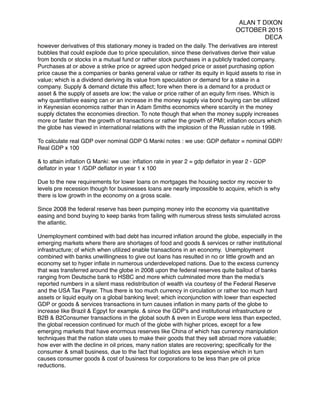
however derivatives of this stationary money is traded on the daily. The derivatives are interest
bubbles that could explode due to price speculation, since these derivatives derive their value
from bonds or stocks in a mutual fund or rather stock purchases in a publicly traded company.
Purchases at or above a strike price or agreed upon hedged price or asset purchasing option
price cause the a companies or banks general value or rather its equity in liquid assets to rise in
value; which is a dividend deriving its value from speculation or demand for a stake in a
company. Supply & demand dictate this affect; fore when there is a demand for a product or
asset & the supply of assets are low; the value or price rather of an equity firm rises. Which is
why quantitative easing can or an increase in the money supply via bond buying can be utilized
in Keynesian economics rather than in Adam Smiths economics where scarcity in the money
supply dictates the economies direction. To note though that when the money supply increases
more or faster than the growth of transactions or rather the growth of PMI; inflation occurs which
the globe has viewed in international relations with the implosion of the Russian ruble in 1998.
To calculate real GDP over nominal GDP G Manki notes : we use: GDP deflator = nominal GDP/
Real GDP x 100
& to attain inflation G Manki: we use: inflation rate in year 2 = gdp deflator in year 2 - GDP
deflator in year 1 /GDP deflator in year 1 x 100
Due to the new requirements for lower loans on mortgages the housing sector my recover to
levels pre recession though for businesses loans are nearly impossible to acquire, which is why
there is low growth in the economy on a gross scale.
Since 2008 the federal reserve has been pumping money into the economy via quantitative
easing and bond buying to keep banks from failing with numerous stress tests simulated across
the atlantic.
Unemployment combined with bad debt has incurred inflation around the globe, especially in the
emerging markets where there are shortages of food and goods & services or rather institutional
infrastructure; of which when utilized enable transactions in an economy. Unemployment
combined with banks unwillingness to give out loans has resulted in no or little growth and an
economy set to hyper inflate in numerous underdeveloped nations. Due to the excess currency
that was transferred around the globe in 2008 upon the federal reserves quite bailout of banks
ranging from Deutsche bank to HSBC and more which culminated more than the media's
reported numbers in a silent mass redistribution of wealth via courtesy of the Federal Reserve
and the USA Tax Payer. Thus there is too much currency in circulation or rather too much hard
assets or liquid equity on a global banking level; which inconjunction with lower than expected
GDP or goods & services transactions in turn causes inflation in many parts of the globe to
increase like Brazil & Egpyt for example. & since the GDP's and institutional infrastructure or
B2B & B2Consumer transactions in the global south & even in Europe were less than expected,
the global recession continued for much of the globe with higher prices, except for a few
emerging markets that have enormous reserves like China of which has currency manipulation
techniques that the nation state uses to make their goods that they sell abroad more valuable;
how ever with the decline in oil prices, many nation states are recovering; specifically for the
consumer & small business, due to the fact that logistics are less expensive which in turn
causes consumer goods & cost of business for corporations to be less than pre oil price
reductions.
ALAN T DIXON
OCTOBER 2015
DECA
ATMD
VUBS PATHOS GROUP
ALANDIXON@ME.COM
Effect of currency trading
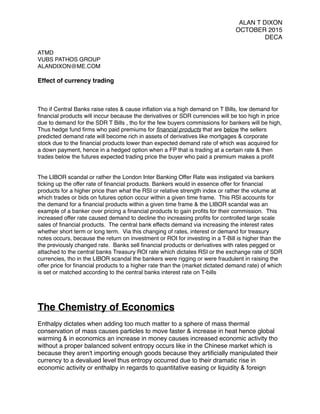
Tho if Central Banks raise rates & cause inflation via a high demand on T Bills, low demand for
financial products will inccur because the derivatives or SDR currencies will be too high in price
due to demand for the SDR T Bills , tho for the few buyers commissions for bankers will be high,
Thus hedge fund firms who paid premiums for financial products that are below the sellers
predicted demand rate will become rich in assets of derivatives like mortgages & corporate
stock due to the financial products lower than expected demand rate of which was acquired for
a down payment, hence in a hedged option when a FP that is trading at a certain rate & then
trades below the futures expected trading price the buyer who paid a premium makes a profit
The LIBOR scandal or rather the London Inter Banking Offer Rate was instigated via bankers
ticking up the offer rate of financial products. Bankers would in essence offer for financial
products for a higher price than what the RSI or relative strength index or rather the volume at
which trades or bids on futures option occur within a given time frame. This RSI accounts for
the demand for a financial products within a given time frame & the LIBOR scandal was an
example of a banker over pricing a financial products to gain profits for their commission. This
increased offer rate caused demand to decline tho increasing profits for controlled large scale
sales of financial products. The central bank effects demand via increasing the interest rates
whether short term or long term. Via this changing of rates, interest or demand for treasury
notes occurs, because the return on investment or ROI for investing in a T-Bill is higher than the
the previously changed rate. Banks sell financial products or derivatives with rates pegged or
attached to the central banks Treasury ROI rate which dictates RSI or the exchange rate of SDR
currencies, tho in the LIBOR scandal the bankers were rigging or were fraudulent in raising the
offer price for financial products to a higher rate than the (market dictated demand rate) of which
is set or matched according to the central banks interest rate on T-bills
The Chemistry of Economics
Enthalpy dictates when adding too much matter to a sphere of mass thermal
conservation of mass causes particles to move faster & increase in heat hence global
warming & in economics an increase in money causes increased economic activity tho
without a proper balanced solvent entropy occurs like in the Chinese market which is
because they aren't importing enough goods because they artificially manipulated their
currency to a devalued level thus entropy occurred due to their dramatic rise in
economic activity or enthalpy in regards to quantitative easing or liquidity & foreign
ALAN T DIXON
OCTOBER 2015
DECA
companies investment capital injected into their economy that upon which was not able
to be harnessed & applied or rather if you will "put to work" in regards to their (foreign
reserves & bond markets) therefore the uncontrolled exponential enthalpy caused rapid
growth followed by entropy or market chaos (where-by) there stock exchange dropped
dramatically. The U.S. Is preventing their market collapse via initiating trade deals like
the TPP & TTIP of which motions to balance the enthalpy via balanced distribution of
their liquidity or quantitative easing if you will
 
Of which the plan is for liquidity will balance or match if you will with the production or
material sectors within the TPP & TTIP
 
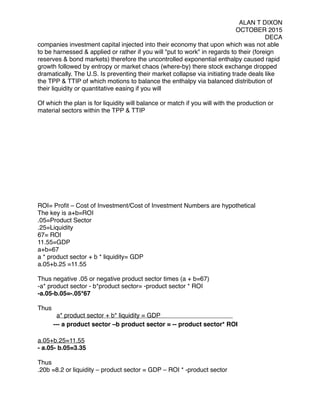
ROI= Profit – Cost of Investment/Cost of Investment Numbers are hypothetical
The key is a+b=ROI
.05=Product Sector
.25=Liquidity
67= ROI
11.55=GDP
a+b=67
a * product sector + b * liquidity= GDP
a.05+b.25 =11.55
Thus negative .05 or negative product sector times (a + b=67)
-a* product sector - b*product sector= -product sector * ROI
-a.05-b.05=-.05*67
Thus
a* product sector + b* liquidity = GDP
--- a product sector –b product sector = -- product sector* ROI
a.05+b.25=11.55
- a.05- b.05=3.35
Thus
.20b =8.2 or liquidity – product sector = GDP – ROI * -product sector
ALAN T DIXON
OCTOBER 2015
DECA
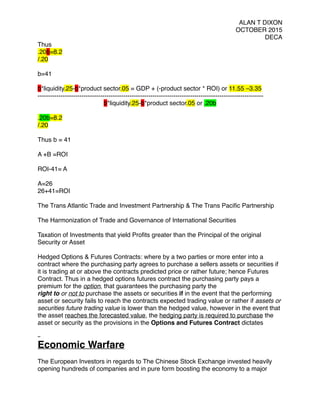
Thus
.20b=8.2
/.20
b=41
b*liquidity.25-b*product sector.05 = GDP + (-product sector * ROI) or 11.55 –3.35
------------------------------------------------------------------------------------------------------------
b*liquidity.25-b*product sector.05 or .20b
.20b=8.2
/.20
Thus b = 41
A +B =ROI
ROI-41= A
A=26
26+41=ROI
 
The Trans Atlantic Trade and Investment Partnership & The Trans Pacific Partnership
 
The Harmonization of Trade and Governance of International Securities
 
Taxation of Investments that yield Profits greater than the Principal of the original
Security or Asset
 
Hedged Options & Futures Contracts: where by a two parties or more enter into a
contract where the purchasing party agrees to purchase a sellers assets or securities if
it is trading at or above the contracts predicted price or rather future; hence Futures
Contract. Thus in a hedged options futures contract the purchasing party pays a
premium for the option, that guarantees the purchasing party the
right to or not to purchase the assets or securities if in the event that the performing
asset or security fails to reach the contracts expected trading value or rather if assets or
securities future trading value is lower than the hedged value, however in the event that
the asset reaches the forecasted value, the hedging party is required to purchase the
asset or security as the provisions in the Options and Futures Contract dictates
 
Economic Warfare
 
The European Investors in regards to The Chinese Stock Exchange invested heavily
opening hundreds of companies and in pure form boosting the economy to a major
ALAN T DIXON
OCTOBER 2015
DECA
distributor level only to pull out to in effect cause a sell off of Chinese stock and a
devaluation of the Chinese Stock Market and in turn causing Chinese stocks and the
yaun to have less value in response the Chinese PRC party moved to prevent new
IPO’s, as an effect causing Chinese manufactured goods to cost less on the
international market. Which is why Chinese investors diversified their economic
portfolios via investing in US Treasuries, & EU Treasury Bonds, and US & EU
companies and in general Foreign stock exchanges with emphasis in general American
Midwest and American Northeast real-estate most notably New York & Utah as are
Chinese investors major investors in US & EU & Central Asian international ports and
harbors specifically in the EU, Iran, and India; all to compensate for the potential
Chinese stock exchange revaluation.
An example: Link 9--( para 4) and Link 7 --- Adjacent quote supporting claim--“Chinese
firms have bought stakes in Brazil's electrical grid; they are building steel mills, car
plants and a telecommunications infrastructure in that country. Chinese grain
companies are negotiating to buy huge tracts -- some larger than 600,000 acres -- of
Brazilian outback to plant soybeans. Chinese firms have the inside track on landing a
huge high-speed-rail contract. They want to help realize Brazil's gargantuan plans --
estimated at more than $250 billion -- to tap its offshore oil reserves.”(6)
 
The European and North American investors increased Mergers and Acquisitions to
reduce the number of publicly traded companies, thus in turn as supply and demand
laws dictate the lower the supply --the higher the demand; and in regards to the number
of companies, the supply is less than it would be without the M&A. Therefore stock
prices are higher because there is infused liquidity from the stimulus or quantative
easing, thus giving banks greater purchasing power, thus greater demand for the limited
number of stocks; hence why stocks are at all times highs, and because the investors
and corporations acted to consolidate business capital into a fewer set of hands via
Merging Corporations and in turn with moves that reduce costs via job cutting and
combining cash flows into each corporations unified commercial structure, the
corporations were able to increase the capital value of all US stock. Also with a major
treasury bond sell off the US dollar treasury yield increased in value of which when the
federal reserve raises short term and long term interest rates will cause inflation
because the US deficit is too great to make good on the treasury yields, thus the ROI is
inequitable, therefore to counter this asset to equity imbalance the duties on the capital
product & securities sector of the 11 Asian nations must correspond to the US equity
market via harmonizing trade relations or regulations rather and in pure form enabling a
free trade agreement where intermingling GNP of TPP nations can apply towards a
unified duties code that will in turn allow the US and TPP member nations to mutually
share duties and in turn as an effect reduce inflation via mixing goods and services and
underlying securities with the prime effect of sharing the taxable value of all goods in
services within the TPP domain; and in pure form affording to the eleven Asian nations
free trade rights to purchase & sell, or rather trade if you will, US Treasuries and goods
and services without tariffs & conversely enabling the US to purchase & sell TPP
member securities & treasuries of which will increase the value of all TPP goods and
services & Securities under a unified free trade code, thus balancing the Asian gdp
ALAN T DIXON
OCTOBER 2015
DECA
inflation rate with the US liquidity Inflation hence harmonization. An example: “US
merger and acquisition activity hit an all time monthly
high” 2015
 
Thus in turn the Gross Partnership Value will enable the TPP to trade its goods and
services with nations not in the TPP for higher values, as an effect increasing the Net
Present value of the TPP. The same harmonization can be applied to the TTIP as will
the value of the Euro will increase upon when united with the US industrial and Tech
sectors, hence a balancing measure that as an effect will enable US equity markets to
invest in European Securities & vice versa for US Markets. Thus the TTIP in general will
increase the trade of goods and services among TTIP members via duties
harmonization and as an extension give the right to all TPP members to access & invest
in the European Market via the US Market.(8) Link 9 (para 10)
 
Therefore with the implementation of the TPP and TTIP and in pure form the increase in
M&A and in general the US & EU stock exchange trading volume; all hedged contracts
will be executed and all premiums paid on Chinese stocks will be acquired for the
premium paid at all Futures Contracts signing. Thus investors who hedged equity into
Chinese Markets will attain Chinese stocks for values less than their expected worth
and in pure form for less than what their trading at at present, all due to the futures
contracts that Chinese brokers entered into with foreign investors; hence the premium
option to, when the futures contract matures, acquire securities and assets at the
premium paid value upon which if the securities & assets value are less than what the
futures contract provisions dictates.
 
[if !supportLists]1. [endif]http://www.eastasiaforum.org/2013/03/24/chinas-strategic-
interests-in-pakistans-port-at-gwadar/
[if !supportLists]2. [endif]http://www.clingendael.nl/sites/default/files/2014%20-
%20Chinese%20investment%20in%20Piraeus%20-%20Clingendael%20Report.pdf
[if !supportLists]3. [endif]https://euobserver.com/china/116537
[if !supportLists]4. [endif]http://epthinktank.eu/2013/05/13/chinas-presence-in-african-
ports-investment-across-the-ocean/
[if !supportLists]5. [endif]http://www.washingtonpost.com/wp-dyn/content/article/
2010/07/25/AR2010072502979.html
[if !supportLists]6. [endif]http://www.washingtonpost.com/wp-dyn/content/article/
2010/07/25/AR2010072502979.html
[if !supportLists]7. [endif]http://rt.com/business/271723-china-freeze-ipo-decline/
[if !supportLists]8. [endif]http://www.iomtoday.co.im/news/business/spotlight-on-all-
time-high-for-mergers-and-acquisitions-in-the-us-1-7301952
[if !supportLists]9. [endif]http://www.fundsglobalasia.com/worldwide-news/14828-
european-investors-pull-out-of-equities-in-october
http://mobile.nytimes.com/2015/07/26/business/international/chinas-global-ambitions-
ALAN T DIXON
OCTOBER 2015
DECA
with-loans-and-strings-attached.html?referrer=
EBITDA measure. EBIAT is calculated as: EBIT x (1 - Tax rate).
The usual shortcut to calculate EBITDA is to start with operating profit, also called
earnings before interest and tax (EBIT), and then add back depreciation and
amortization. (To learn more, read Understanding The Income Statement, What Is A
Cash Flow Statement? and Advanced Financial Statements Analysis.)
In the single-step method, sales minus materials and production equal gross income.
And, by subtracting marketing and administrative and R&D expenses from gross
income, we get the operating income figure.
http://www.investopedia.com/articles/04/022504.asp
Corporate Finance and the structure of Money Supply & the effects of Yield curve
Higher interest rates cause home mortgages to cost more which effectively lowers
demand for home building materials & appliances manufacturing which lowers PMI &
raises CPI & materialS costs
But higher interest rates increase bond buying & return on bond purchases yet HI
causes borrowing costs to rise for corporations & Home buyers
The Production Possibility Frontier can change when new tech releases enable manufacturing
capacity to increase, hence high production capacity equates to increases in supplies, thus
effectively enabling low costs, hence supply & demand laws when supply is higher than demand
or rather outpaces demand quantity, the equilibrium in turn equates to low prices. Thus as moores
law & high numbers of manufactures & distributors or sellers rather dictates commercial
expansion because technology advancement enables low manufacturing costs for all goods &
ALAN T DIXON
OCTOBER 2015
DECA
services, for example robotics in car manufacturing like the original assembly line enable for
faster manufacturing capabilities, hence reducing the costs of labor & enhancing the production
speed. Of which is an example of the Production Possibility Frontier.
Variance is the calculation of Volatility or the oscallations of trading frequency within a specific
time sequence like the number of trades per hour per day per quarter per year, thus the
calculation of trades over a time period; which can be calculated in line graphs or histograms.
Inventory rates must be lower for bonds to be valuable, because low inventory rated indicates
high fractional reserve holding and the number of returns on loans, thus the banks are credit
worthy on their bonds when businesses are low on inventory; in essence high sales & low
inventory equals profits thus revenue from people receiving loans = debtors transferring back to
the banks that gave out loans = creditors
Basis points or BPS is a system where one percent equals one one-hundredth of a scale that
measures a financial products margin of change.
Now as to Start: First to note: The Yield Curve on Interest is the rate at which an asset or a
financial product like monies increase in value, hence their value of yield upon maturity .
To determine the spot rate on a T-Bill or Dividend that due to be issued in six month a formula is
used, thus calculating the potential rate of the up coming issue. This is accomplished via
determining the forward rate, which is the current rate times one plus the Tbill or Bond’s current
rate times one half the current bond or Tbill rate {x(1+z1) & thus if the six month bond or Tbill
is reinvested {x(1+z1)(1+F) is the formula to assess the return on investment if the original six
month bill or bond was reinvested, however for the one year bond or tibill you would simply
square the six month bill, tho to determine the forward rate or spot rate on the one year bond or
note you would equal the six month rate times two squared divided by the six month rate minus
one.
ROI or Return on Investment is calculated as ROI= profit-investment cost/investment cost
RSI= 100-100/(1+RS*)
MACD & EMA
SEMIVARIANCE= 1/N * SUM (AVERAGE – Rt) ^2
Pivot Point Calculation:
R2 = P + (H-L)=P + (R1- S1)
R1= (P x 2) – L
P= (H + L + C) / 3
ALAN T DIXON
OCTOBER 2015
DECA
S1+ (P X 20 – H
S2= P – 9H –L) + P – ( R1 – S1)
ROE or Return on Equity = Profit Margin (profit/Sales) x 1
*Total Asset Turnover
(Sales/Assets) x 1 * Equity Multiplier
(Assets/Equity) x 1
Thus Assets= (Equity-Liabilities)=(Income-Expenses)+(Debit-Credit)
Sharpe Ratio: Mean Portfolio Return – Mean Risk-Free Return/ Portfolio Standard Deviation
In regards to accrual accounting & Matching Principle: Revenue Recognized upon Earnment yet not Received +
Expenses Recognized upon Incurrment yet not due or rather Paid for; are exercised in Adjusted in Trial Accounts in
Interim & Fiscal Time Periods where by Accounts are Adjusted upon when cash is Received & Dispersed to
Businesses, Employees & Clients:
 When you credit Revenue that is unearned or not received you are effectively overstating your equity, because the
cash is not reveieved, however the asset account is debited; which in turn is a credit towards Equity that reduces
liabilities while increasing equity accounts, or rather Revenues which is a businesses' Cash Capital.
{Assets = [equity: (Revenues - Expenses)  - Liabilities: (Accounts Receivable & Accounts Payable)]}
In regards to accural accounting & Matching Principle: Revenue Recognized upon Earnment yet not Received +
Expenses Recognized upon Incurrment yet not due or rather Paid for; are exercised in   Adjusted Trial Accounts with
regards to Interim & Fiscal Time Periods, where by Accounts are Adjusted upon when cash is Received &
Dispersed to Businesses, Employees & Clients;
like when a Service is provided via a contract, payment is accounted as received after Earning which is in turn after
Service is provided; Debiting an Asset Account & Crediting the Revenue to an Equity Account. 
Scenario:  when Cash is received in advance like pre paid insurance; Insurance is used up & applied in a
depreciating fashion in a monthly Time Period during a Contracts length of duration, for example during a contracts
duration Insurance is each month Debited as an Expense in an Equity Account & Credited to an Asset
Account. Regarding a Service Contract like Receiving Cash in Advance for a Business Remodeling; upon
completing portions of the installed work througout the contracts duration, cash is Debited to an           Asset
Account & Credited to a Revenue Account while simultaneously reducing Liability in the way of Debiting a
Liability Account:
noting upon each segway of service provided Credit to Equity & noting Debit to Liabilities for
Account Unearned Revenue.
 When you credit Revenue that is unearned or not received you are effectively overstating your equity, because the
cash is not reveieved, however the asset account is debited; which in turn is a credit towards Equity that reduces
liabilities while increasing equity accounts, or rather Revenues which is a businesses' Cash Capital.
{Assets = [equity: (Revenues - Expenses)  - Liabilities: (Acounts Receivable & Accounts Payable)]}
Higher interest rates cause home mortgages to cost more which effectively lowers
demand for home building materials & appliances manufacturing which lowers PMI &
ALAN T DIXON
OCTOBER 2015
DECA
raises CPI & materialS costs
But higher interest rates increase bond buying & return on bond purchases yet HI
causes borrowing costs to rise for corporations & Home buyers
There is an increase in Mergers & Acquisitions of corporate enterprises & there is an
increase in bond sell offs, also Treasury Sales are increasing thus in all of the above
their values are increasing; as a result the dollar is increasing in value & in turn U.S.
Exports are more expensive & as a result goods are declining in amount exported.
However due to the dollars value increase U.S. Imports are less expensive & exports
that are sold are more valuable.
ATMD
So a higher T bill rate
Tho if CB raise rates & cause inflation via a high demand on T Bills, low demand for financial
products will inccur because the derivatives or SDR currencies will be too high in price due to
demand for the SDR T Bills , tho for the few buyers commissions for bankers will be high, Thus
hedge fund firms who paid premiums for financial products that are below the sellers
predicted demand rate or future contract will become rich in assets of derivatives like
mortgages & corporate stock due to the financial products lower than expected demand rate of
which was acquired for a premium or down payment, hence in a hedged option when a financial
product that is trading at a certain rate & then trades below the futures expected trading price
the buyer who paid a premium makes a profit
Option: Choice to buy or sell for a buyer or seller when hedging a financial product
Premium: A downpayment to have the option to buy at a lower price if the item for sell is trading
at lower than the agreed upon predicted or hedged price or rather “Future” that the seller had
set; where upon the settled negotiated price for the Future, which is called the strike price or
deal mark of which-- indicates a deal for an agreed Hedged Future Price for a commodities or
securities expected performance—has successfully been reached & signed for, regarding the
Futures contract time frame & expected yield within a trading cycle such as a day, a week, a
month, or three month cycle or even quarterly, yearly, and multi year trading cycle.
The Dodd Frank Act limits banks frorm deceiving clients via prohibiting practices like setting up
a proxy set of accounts or investment bank one that is separate from the general balance
sheets of a company of which if set up would enable mass speculation and inflated prices on
the proxy investment bank’s balance sheet
{Traders have attributed the heightened volatility in government bonds in part to structural
factors, including the rise of electronic trading and prevalence of high speed computer
algorithms that were long prevalent in the equity, futures, and foreign exchange markets(http://
www.wsj.com/articles/icap-weighs-treasurys-trading-collars-1433285708)}
ALAN T DIXON
OCTOBER 2015
DECA
The LIBOR scandal or rather the London Inter Banking Offer Rate was instigated via bankers
ticking up the offer rate of financial products. Bankers would in essence offer financial products
for a higher price than what the RSI or relative strength index or rather the volume at which
trades or bids on futures option occur within a given time frame. This RSI accounts for the
demand of financial products within a given time frame & the LIBOR scandal was an example of
a banker over pricing financial products to gain profits for their commission. This increased offer
rate caused demand to decline tho increasing profits for controlled large scale sales of financial
products.
The central bank effects demand via increasing the interest rates whether short term or long
term. Via this changing of rates, interest or demand for treasury notes occurs, because the
return on investment or ROI for investing in a T-Bill is higher than the previously changed rate.
Banks sell financial products or derivatives with rates pegged or attached to the central banks
Treasury ROI rate which dictates RSI or the exchange rate of SDR currencies, tho in the LIBOR
scandal the bankers were rigging or were fraudulent in raising the offer price for financial
products to a higher rate than the (market dictated demand rate) of which is set or matched
according to the central banks interest rate on T-bills.
Yield Curve is the rate at which a note or bond or security or mortgage returns revenue,
with housing it's the rate at which a homeowner pays for the upfront material asset sold,
refinancing via HARP can alter your mortgage interest as can putting down more money
on your mortgage. Now in regards to bonds securities & treasuries there are short term
& long term interest rates, where via the central bank, rates are set to yield returns,
whether the rate be for a monthly treasury a quarter or year or three, five, ten year note;
thus the ROI or return on investment that the investor receives for putting down money
or funds on a financial product like a state apparatus, however the financial product like
the SDR derives its true net value via the collective wealth of material assets held by the
public sector or in the case of a private company the material assets that the company
underwrites on its ledger or balance sheet
Interest is also the rate at which a buyer pays to compensate for assets given or offered upfront,
however down payments which is a small percentage of a product like a houses value of which is
paid to attract the seller. Down payments can also alter the interest rate.
Depreciation is the rate at which an asset decreases in value also termed deflation
when in regards to value of a financial product
1. Securities are Treasury Bills and Bonds that are issued to investors who
buy the securities to upon the Securities maturity receive a profit from the
seller
2. Securities are used to finance a companies’ or government’s production
activities like the manufacturing capacity for products or construction of
facilities like offices and factories or in regards to the government the
investment of procuring construction contracts for infrastructure, another
example would be to pay services offered by the government like paying
ALAN T DIXON
OCTOBER 2015
DECA
tax collection agents IRS, the military, emergency services, & the
Executive, Congressional, Judicial, & Human Services divisions of the
government.
3. Stocks are ownership of a companies’ equity that incline or decline based
upon the demand of a companies stock hence supply and demand laws,
when demand increases stock prices increase.
4. Dividends are a percentage of a companies profits yielded within a trading
cycle or rather a trading cycle’s yielding profits
5. Shareholder is an owner of stock in a company, shareholders meet to vote
on company decisions like liquidation of a company or to split the stocks
value into smaller purchasable stock like one stock which is one share 20
dollars split into two shares at 10 dollars apiece tho carrying the same
public trading value which is only carried out when demand for a
companies stock is in high demand. This is because the laws of supply and
demand, which dictate that when supply increases an asset like a
companies stock will decrease in value, thus the reason why shareholders
would only vote for a stock split in the event that there is a high demand
for a companies stock
6. A companies stock which derives its value from demand of a companies
stock is only in demand when the company is performing goodwill like for
example if a company reports to shareholders and the media that the
company is turning a profit from sales of its products like apple selling
high numbers of computers.
7. Derivative is a packaged financial product which derives its value from
the pooled value of underlying securities or rather wealth that draws its
value from assets on a balance sheet like a set of mortgages or treasury
securities that a bank has on its books with an expected ROI via interest or
capital gains
8. Bonds are notes issued by governments and corporations to investors
whom buy bonds to receive their principal investment and interest or
rather a percentage of the companies future profits, however in the event
that a companies internal rate of return is less than forecasted or rather if a
company does not attain a profit (from investor financing) the companies
assets are in turn offered as a compensation to the bond holders.
9. Mutual Fund is a portfolio of investor monies tied up in bonds, stocks, &
securities
ALAN T DIXON
OCTOBER 2015
DECA
10. Stock Exchange is a united group of companies who have there value
open to public investors, investors can buy derivatives or stock rather in an
exchanges’ total value as a conglomerate of companies
11. Initial Public Offering IPO is when a company opens its investor
portfolio to the general trading market which means that the company is
allowing the company to
Example Mortgages & bank assets like in the 2008 financial crisis were
offered as compensation to hedge fund firm managers who represented bond
holders whom also did not receive a profit from the their investment in banks,
banks of who had bad mortgages on there charts. This is also applicable to
stocks like if a companies stock decreases in value and the company becomes
insolvent in turn the company liquidates which means the sell off of assets to
obtain monies to pay back the companies investors or stock holders.
Mortgages are assets given to a buyer or property investor who in turn pays for
the asset during a set length of time, however with interest
There are Treasury bills that government central banks issue to attain revenue for
appropriations & the financing of government activities. These T-Bills are in turn repaid to T-Bill
holders or government investors with interest.
There are Floating Rate Notes FRN that are attached to Consumer Price Indexes and are
protected from inflation however if the general consumer population assesses that the cost of
goods are increasing in price which is a method for evaluating inflation thos separate from
inflation because inflation is mainly a calculator for the financial industries Currencies and
financial products like Derivatives, Securities, Stocks, Bonds, & Treasury Bills (Securities)
TIPS or Treasury Inflation Protects Securities are T-Bills that are protected
against inflation however they are pegged to the CPI & if the CPI rises than the TIPS will
decrease in value.
The CPI is determined via the NMI & PMI which is the Non-Manufacturing
Index and the Production Managers Index: the PMI is dictated by how much companies as an
aggregate produce or rather at what they set their production and manufacturing levels, which in
a free market companies have the right to set there manufacturing capacities at which ever level
they like however supply and demand laws typically dictate at which level a producer sets its
manufacturing level or resource mining level like the farming of crops or mining of raw
resources like rare earths. Tho due to media & published company reports companies in specific
industries and manufactures in general among the entire market analyze calculate via reports &
media at which level to set their manufacturing capacity. These levels are thus a way to stabilize
prices or rather to maintain a high profit price level. Tho with CPI levels the masses in a free
market can influence PMI which in mass assessment of what the consumer thinks the price of
products are worth can as an effect cause producers who set the PMI to produce less or more.
However if the CPI has a low assessment of the value of consumer products then manufactures
will lower the PMI, which is in essence manipulation of the market; thus expert analysis of CPI
& PMI & NMI leads to the notion that there is no free market & that Keynesian economics & a
Royal Zaibatsu Guild System & Central Banking system whom sets PMI & sets interest rates is
ALAN T DIXON
OCTOBER 2015
DECA
the ideal method for enabling a healthy economy; where high quality products can be available
for relatively low costs to the general consumer
There is what is called a Private Public Partnership in which companies in the
private sector and governments set agendas or plans rather to construct infrastructure like
housing, highways, dams, and the maintenance of these infrastructures. The private sector &
government will together sponsor a project like the construction of a super highway & together
will maintain the infrastructures maintenance. To pay for the maintenance taxes collected from
citizens will be used to maintain the infrastructure which can be accomplished with toll roads or
tax increases however in regards to private public partnership the private portion of the
construction & maintenance will be carried out via private collection of monies from users of the
infrastructure like toll booths for example. Tho to note the private companies that construct the
infrastructure will have a stake in the infrastructure due to their role in construction of the
infrastructure; thus the private companies become stakeholders in the asset or infrastructure
hence Private Public Partnership.
In supply chain management there are raw resources and these raw resources are mined &
procured for use in material manufacturing. Raw resources are the beginning stage of the supply
chain management, the second step is where an intermediate good is produced, this intermediate
good like cement is then used in a final good like the construction of a highway or driveway.
The services that procure these goods & the steps to the final good are considered Supply Chain
Services, these services are rendered at the different steps, of which entail, for example first the
service raw resource generation & second the generation of intermediate good or intermediate
product like first hard hat mining; where raw resources are taken from the earths surfaces & are
in the second step incorporated into industrial trade techniques like melting of ore, for use in
metallic impression printing of vehicle parts or laser lithography on silicone wafers for the
production of electronic intermediate parts. However, If this method is to be applied in cyber
terms “data mining”, changing of composite or format or rather involving the application of
engineering techniques to generate a product like an intermediate good like glass windows, car
parts, electronic super conductors or information data bits that is upon development &
procurement used in the construction, engineering, or generation of a final good like a house,
engine, computer or software program.
Seasonal adjustments are calculations that vary the costs associated with final good demand, of
which is in turn via relation to PMI a direct variance of how the potential production frontier & a
manufactures’ manufacturing level in a free market dictates the CPI. However there are
unsponken conspiracies in which manufactures “collude”, via media reports, to adjust
manufacturing levels for price control. For example a billion luggage bags could be produced
and manufactured however because manufactures read the media & view the PMI reports,
manufactures in turn will lower or raise their manufacturing levels within their factories to
increase or decrease or rather raise or lower the price of their intermediate or final good. Like for
ALAN T DIXON
OCTOBER 2015
DECA
example a cell phone of which requires many varying parts & each part is produced in a factory,
thus the factory that produces the micro chip or touch screen for example can reduce its
manufacturing levels or the rate at which it generates micro chips, which in turn causes the effect
of high costs associated with engineering the final good like a cell phone, thus goods and
products like cell phones are in general worth more or rather can be understood in markets as
material accounts with greater costs due to scarcity or limited manufacturing. This form of
collusion is a market effect that raises the good or products costs hence relation with supply and
demand & an end result of low supply with great demand of which equates to high prices, hence
scarcity.
There are what is called retained earning, which is the profit from the proceeds of financial
transactions or commerce. Retained earning is the opposite of capital investment. Capital
investment is where profits are reinvested into new financial instruments like the purchases of a
new mortgage or bonds for a company. Capital gains made from investments and reinvestments
are taxed, however these taxes can be avoided if all available earning can be reinvested, thus as
an effect allowing for low balance sheet margin, thus low taxes.
There is what is called disposable income, which is after taxes, all available monies. These
monies that are either reinvested to circumnavigate taxes or to gain greater earnings are what is
considered in accounting withdraw monies or monies that can be used to pay employees bonuses
or if its small business with the owner its monies that can be used to spend on home
improvements or luxury items.
Investments are capital equipment, structures, and inventories of financial products that are used
to produce goods and services.
Transfer payments are government purchase or transfer payments or negative taxes, where rents
as it is coined in political science function as a transfer of wealth that does not produce anything,
however a transfer of capital that produces or generates economic activity is a what is termed a
productive transfer; which is the primary purpose of the private sectors agenda; example an
investment in a business where buying financial products like mortgages or (401)k plans or
IRA’s or mutual funds for the establishment to sell to a third party as a derivative for profit is a
capital investment
Fractional Reserve Banking, if their was a run on the bank which means everyone withdrawing
their monies within the same time frame, everyone would lose their money because there would
not be enough reserves, gold, liquid to distribute to the depositers
Deposit of assets or liquid currency like gold that is then lent to a debitor then redeposited by the
first debitor who is already paying a creditor for a debt, this is in essence re lending which is a
ALAN T DIXON
OCTOBER 2015
DECA
process method that distributes 90% of the original creditors funds for expected interest returns
or rather funds are distributed until 10% of the creditors funds are available, because by law
banks are only required to keep 10% of a creditors funds available, hence if there was a run on
the bank the financial system would collapse because the banks are unable to account to all the
creditors.
The FDIC insures up to 250,000$ and this is a system that values the GDP of a nation’s economy
upon land and all assets held by American companies, thus the FDIC insurance derives its value
from the GDP of the nation, which in the event of a systemic crisis would divide the wealth of all
who hold in bank accounts a value greater than 250,000$ into dividends of 250,000$
This is true to a systemic criteria that relates to the subprime mortgage crisis where insurance
only covered so much financial systemic risk, meaning that the banks who were unable to pay
their creditors were bought by the government or tax payer dollars which derives its marginal
value from the portion of PPP that is taxed on each person or family in respect to the greater total
of national GDP, hence TARP or Troubled Asset Relief Program where BearSterns & GM
Automaker were covered via Federal Leveraged Buyouts & home owners similarly via HARP
or Home Affordable Refinancing Program, where home owners who had signed contracts for
homes that they couldn’t afford or rather wouldn’t pay for because the 2008 Market collapse
caused realestate to be worth – less than the appraised values of 2001 - 2008, hence a speculation
bubble that burst when the market corrected via new appraisals valuing mortgages or rather real-
estate at a lower rate than the contracts that home owners had originally signed to.
The Federal Government has been running what is called a Trade Deficit, meaning that the
government is increasing its debt to pay congressional bills or rather the expenses of operating a
government are greater than the revenue received within a fiscal year. A trade deficit in sum is,
like in accounting, expenses that are greater than the credit or income gained. Taxes can be
raised to acquire greater revenue or rather greater income, however this is last resort option, a
much more acceptable option is Austerity in which fiscal reforms are taken into effect that law
makers impose upon the federal earmark system or rather the reduction of allotment to specific
programs within the federal budget. Like cutting back on defense spending or decreasing the
amount of funds spent on small business investments or rather reducing subsidies for small
businesses or reducing subsidies for a program like a farm bill.
A few key notes when considering macro economics are as listed
Nominal GDP : the accounting of adjustments in prices to inflation
Real GDP: is current economic values at rates or prices of the previous year
The GDP deflator is as follows: (Nominal GDP / Real GDP x 100)
ALAN T DIXON
OCTOBER 2015
DECA
Inflation Rate: GDP deflator yr 2 –GDP deflator yr 1/ GDP deflator yr 1 x 100
Consumer Price Index: price of a basket of goods in current year/ price of basket of goods in
base year
CPI inflation: CPI yr2-CPIyr1/CPI yr 1 x100
PPI or Producer Price Index same model as above
As a reference point like in Chemistry, etropy or enthalpy when more mass is added to given
sample or environment or sphere, heat increases since mass is energy in the law of conservation
of energy & mass
However in economic markets an increase in the value of the dollar occurs when new goods are
introduced to the market because the total number of dollars in the market is matched in value to
the total sum of assets in the market, Thus supply & demand where the product sector is greater
than the liquid currency sector hence giving greater PPP or purchasing power parity to each
dollar, Tho with QE or quantitative easing or rather stimulus injections of liquidity are used as
an account for matching new monies to the new products in the market with the goal of reducing
the strength of the dollar, however if too much liquidity in the form of monetary injections is
introduced to the market inflation will take hold which causes prices for average goods to
increase at exponential rates & the value of the dollar to decrease dramatiacally. The ECB, FR,
BOJ, & PBC are all in rounds of QE with the goal of matching the new products generated by
factories with new Monies from central banks hence one reason why the subprime loans were
over speculated in the 2008 financial crisis that in turn caused a revaluation of markets in the
default of insurance & mortgage payments world wide. However if the QE was overt in financial
distribution of the monies then inflation could occur, however lobbyist and lawmakers are in the
process of solving this issue via pooling the monies & service & product sectors of multiple
nations’ GNP within a common network for economic stabilization.
So What causes aggregate demand to increase: thus prices rise due to limited goods or scarcity
or a increase in the monies supply causes inflation both are factors
As production increases the aggregate supply of liquid injection of currency should increase to
keep prices from falling
PMI increase causes prices to drop due to supply
Thus for Real out put an increase in the money supply must occur to balance the demand for
monies from the new manufactured products
ALAN T DIXON
OCTOBER 2015
DECA
Thus when aggregate demand rises PMI needs to rise to match aggregate money supply and as
an effect increased inflation occurs especially if PMI is below 4.0%
When aggregate demand (population rise = food demand rise) rises pmi must rise at double the
to maintain prices, if PMI falls short of expectations when Aggregate Demand rises then then
inflation occurs
Thus contracting PMI equals inflation especially when aggregate demand increases, yet if
aggregate demand decreases and PMI rises then prices fall or deflation occurs.
~ALAN T DIXON
~PATHOSCRESCENDO

DECA, Busines Economic Synopsis

  • 1.
    ALAN T DIXON OCTOBER2015 DECA • Cover Letter InterNational Business Consult, Business Services and Marketing International Business Members; (DECA) Delta Epsilon Chi Alpha, I aspire to strive for economic development & to bring forth an aeon in which a Nation Conglomeration & their elite scholars can work together in creating a new found world, a world built upon itself in separate & individual pathways & united under the economic culture patriarch for economic improvement & purpose driven self determination for humanities economic & technologic advancement. As financial associates & leaders, we as a united economic force for humanities knowledge & social human capital & global economic wealth are obligated to research & improve economic relations among all trading partners. We as a financial society are to serve as guides in the globes markets honoring & respecting nations & peoples far & wide. Our purpose as a members to a nation conglomeration is to live as a peaceful economic society, a society which guards & protects rights to privacy with confidence; serving to honor all conglomerates & individual members accumulated economic wealth with the goal to form economic relations in domestic markets & markets abroad. In form serving clients & conglomerates with the initiative to create lasting economic relations which advance & connect human ventures & accomplishments with respect to diversity & the economies health. The Economic Leaders conglomeration as an educated & balanced society functions with regards to PMI & CPI pursuing information, inter culture dynamics, economic relations, & higher knowledge. We as economic research advisors serve to procure a greater International Market with greater international values for a greater financial capital net worth, whether in intellectual derivatives or in material assets. In essence our purpose is to aspire for common capital advancement in the world we share. Fore we with superb standards as financial guides serve clients to bring forth a stronger more secure economy & to evaluate & asses with accuracy the International Society & Global Markets with calculated organization, while simultaneously working in political affairs to combat environmental struggles & the social & economic battles facing humanity. May we as financial associates work to counter those who oppose social & economic tolerance. Fore We as an international society must accel & promote international diversity & acceptance in the global market place. Fore there are a great many among the International society who seek pure peaceful eloquence & economic harmony in the greater agenda for culture & economic diversity. & we as Financial associates & global trading partners in the mass economy exists to serve the global exchanges & to protect the interwoven markets. I am one who aspires to forge a tolerant & peaceful International Society, a civil economic peoples conglomeration whom together respect & honor their fellow humans with truth & clarity. In truth functioning as a pure human conglomeration which aspires & seeks to increase the economies health via a diverse trade market, & an interconnected, & well educated International Economic Society, one which honors & respects Human Rights . I Forecasted: (October 2014***Oil prices are expected to go down in the next twenty years unless demand via more cars on the road drive up costs but if we maintain our level of cars on the road via baby boomers generation ceasing to be on the roads in vehicles then oil prices will go down in costs because we will have more energy efficient cars like electric gas hybrids & all
  • 2.
    ALAN T DIXON OCTOBER2015 DECA electric cars as well as alternative fuel sources like ethanol & LNG & new discoveries from Asia, Africa, South America, Caspian Sea & shale discoveries in North America***) Nation building construction & institution building construction is vital to the global economies development and prosperity. Due to the global souths poverty level and inability to contribute to the global norths export requirements, the high human development index nations & unions like the USA, Japan, & the EU are facing sovereign debt crises & fiscal budget cliffs with ever rising commodities & resources prices that affect human services budgets of which contribute to housing transportation & food security budget funds. & with the rising security threats that effect the human psyche & public comfort levels global north nations are spending greater & greater budget funds for defensive & counter offensive attacks from state sponsored terrorist & private funded radical organizations. ThusGDP in foreign nations must be increased so that these LCD's can purchase Global North exports. Thus to correct these issues, whether it be class divide in a domestic economy or economic divide per global nation per capita economic distribution, technocrats & business oligarchs need to develop a system similar to the South Korean economic model for economic wealth distribution. This system is to give social organizations and businesses corporate structures a balanced per employee income payment, one that promotes equal moderate unity in corporate fellows & a proper hierarchy structure that allocates a moderate fair partner & executive payable income to corporate stakeholders & executives. the SK corporate economic model with reduced corporate payables to high ranking employees allows for additional funds to be reallocated for bonus payables to lower level employees who work tedious hours that require high repetition services. Upon fund reallocations to lower income workers with finance counseling the bonus funds can be directed towards generating economic commerce & trade among corporate to corporate or business to business enterprises which will enable an effect that allows greater wealth to flow from enterprises to households which as an effect allow products generated by enterprises to flow into consumers or corporate employees households with a wealth return to enterprises & institutions. The most vital part though to healthy economic flow from (enterprise to households) with a wealth profit return to enterprises is a weighted tax system that functions with a transaction tax on certain consumer, enterprise products & services by governing tax institutions that return wealth to enterprises via tax credits to enterprises & no income peoples under the condition that high profit enterprises meet employment quotas to hire more employees thus as an effect this critique to the SK corporate economic models creates jobs & enables low income employees to acquire consumer products with guided direction from finance councils of which are either offered by government institutions or an enterprise's services within a private institution for private citizens or for an enterprises employees to cause a wealth return to enterprises via enterprise tax credits for employment acquisition & via personalized technocratic counsel from enterprise & Charity entities or governing institutions with the ultimate goal to balance commerce interaction among social peoples organizations & institutions. Nation building construction & institution building construction is vital to the global economies development and prosperity. Due to the global souths poverty level and inability to contribute to the global norths export requirements, the high human development index nations & unions like the USA, Japan, & the EU are facing sovereign debt crises & fiscal budget cliffs with ever rising commodities & resources prices that affect human services budgets of which contribute to housing transportation & food security budget funds. & with the rising security threats that effect
  • 3.
    ALAN T DIXON OCTOBER2015 DECA the human psyche & public comfort levels global north nations are spending greater & greater budget funds for defensive & counter offensive attacks from state sponsored terrorist & private funded radical organizations. Thus to correct these issues, whether it be class divide in a domestic economy or economic divide per global nation per capita economic distribution, technocrats & business oligarchs need to develop a system similar to the South Korean economic model for economic wealth distribution. This system is to give social organizations and businesses corporate structures a balanced per employee income payment, one that promotes equal moderate unity in corporate fellows & a proper hierarchy structure that allocates a moderate fair partner & executive payable income to corporate stakeholders & executives. the SK corporate economic model with reduced corporate payables to high ranking employees allows for additional funds to be reallocated for bonus payables to lower level employees who work tedious hours that require high repetition services. Upon fund reallocations to lower income workers with finance counseling the bonus funds can be directed towards generating economic commerce & trade among corporate to corporate or business to business enterprises which will enable an effect that allows greater wealth to flow from enterprises to households which as an effect allow products generated by enterprises to flow into consumers or corporate employees households with a wealth return to enterprises & institutions. The most vital part though to healthy economic flow from (enterprise to households) with a wealth profit return to enterprises is a weighted tax system that functions with a transaction tax on certain consumer, enterprise products & services by governing tax institutions that return wealth to enterprises via tax credits to enterprises & no income peoples under the condition that high profit enterprises meet employment quotas to hire more employees thus as an effect this critique to the SK corporate economic models creates jobs & enables low income employees to acquire consumer products with guided direction from finance councils of which are either offered by government institutions or an enterprise's services within a private institution for private citizens or for an enterprises employees to cause a wealth return to enterprises via enterprise tax credits for employment acquisition & via personalized technocratic counsel from enterprise & Charity entities or governing institutions with the ultimate goal to balance commerce interaction among social peoples organizations & institutions. ***** History:
  • 4.
    ALAN T DIXON OCTOBER2015 DECA Economic Independent Scholar Study Economies of the world benefit from freedom due to a rise in choices that become available to those that participate in the free market. China is a peculiar case in which democracy did not flourish when an increase in economic activity occurred. Chin is a command economy where the government has tight control of all economic policies. mean the regime controls which businesses flourish or gain capital & which don't, therefore only companies in the scope of the government economic plan can begin to grow outside the country. Thus the regime controls how the nation-state functions in the international market. This control of appeal can influence other businesses and countries to act in accordance with China's views. This economic control has resulted in extreme growth for the Chinese people and allowed the country to assume control of international ports to exercise its new found trade around the globe. This development has allowed china to become a monopolizer in the free market and has enabled the country to be a large supplier of goods and services around the world. Indicating that government control is a mor conscious choice when economic policy is concerned. Democracy since it enables freedom of choice it jump starts the possibility of trade through sheer numbers of choices, but investments made through misguided choices, made by immoral people causes market forces to hinder the general economy, but increases prosperity for the few that either made the economic decisions that affected everybody or the few that wont be effected by disparity. Therefore democracy and economic prosperity do not go hand and hand. Economies handled correctly can lead to prosperity but handled erratically like the freee market economies can lead to disparity and poverty. A command economy and free market economy cannot remain adjacent to none another eventually the overall guided direction of a planned economy will monopolize and control the free market or the command economy will be shut down by those acting for the free market. One will prevail over the other but which one benefits the people most at the least cost matters most. A command economy does not mean that democracy can not suffice for the people. Just because a regime has a planned economy does not mean it is not democratic. The economy could be guided by the state, like South Korea for example, and be representative of the present day people by the people who are in power. This concludes that the free market is dangerous, hurts the general population, and is damaging to a nations economy over a period of cyclastic policies that effect everybody. Therefore a command economy is more just to society and permits the freedom of individual choice. South Korea, once again, controlled businesses in the form that the government decided which corporations developed and which were to be put on the back burner. This enabled the country which is primarily focused on the national security to dictate the capital flow in and out the nation-state. The state imposed a substitute import tariffs to prevent outside competition and to accelerate trade within its borders. Eventually the state allowed corporations to expand abroad giving the south Koreans a stake in the international market and increasing its purchasing power parity above 30,000 dollars. All this proves is that control of weighted transactions, the stock market corporations businesses and organizations improves the economy for everybody as a whole rather than for just a few and that democracy can remain despite the power entrusted to individuals of a command
  • 5.
    ALAN T DIXON OCTOBER2015 DECA economy. In essence a political science & diplomatic-financial technocratic class or society is required to tend to the financial economics for a nation state. ATMD The seven hundred billion dollar tarp and 600 billion quantitative easing policy which continued further into 2014 Dodd Frank wall street reform act July 2010 is to be repealed via the TTIP & financial integration which is in current in lobbying process in DC & Brussels The Federal Reserve consists of a Board of governors and twelve regional Banks The Federal Reserve can create money at will in banking system and is done so through companies via bond buy for banks which in turn lend monies to companies & with the Federal Reserve controlling interest rates, loans, are in essence cheap with quick profits from acquisitions & mergers with bottom line cost cutting which in turn enable companies to make good on their loans with surplus returns causing stock market values to rise. However this reduces the quantity of businesses in the market place in essence enabling an elite socialist state to emerge. & with the controls on the Purchasing Managers Index & the Consumer Price Index manipulated via polls from consumers an economy can be regulated to reduce inflation, which in form allows Keynesian economic policies to flourish. Though for continued growth there must be constant flow for emerging businesses. & thats where federal grant opportunities come to surface. Grants & Contracts via the FBO or Federal Business Opportunities must be stimulated with a steady monetary flow from the Treasury, which enables a mini free market in regards to small businesses which will eventually be bought up by the super socialist economic powers that control the major economic sectors. & this functions in tandem with the bond buying from the Federal Reserve which is the source to which Corporate M&A mergers & acquisitions acquire their funding for market expansion. Struggling Young Americans are in constant search of work and employment of quality standards, due to a rise in technological advancement or modernism and a lack of human development capital among the youth of the Nation. Most Americans aged twenty one to 35 are underemployed or are without a job. The cause technological advancements which have reduced the need for labor & have increased the speed at which products are produced in industries around the world; in addition also contributing to the cause of unemployment is massive social engineering of which is designed to increase the gap between the rich and the poor or the privileged and the underprivileged. There are more than ninety-two Americans who are unemployed and the numbers for those who do not participate in the labor market is greater than the recorded numbers of those who are on record as unemployed. The statistics that account for the unemployed only account for those who file for unemployment benefits, thus the number of people not in the labor market or the number of people not participating in the labor market is enormous & much higher than the documented 6%. Also to note the jobs created due to the health care policy which requires companies with fifty or more full time employees to provide health insurance to their employees which as an effect causes companies to hire more part time employees in an attempt to stay under the fifty full time employee policy. Thus when the media reports lower unemployment, the employment gains are in regards to low income/wage or rather part time employment creation &
  • 6.
    ALAN T DIXON OCTOBER2015 DECA not high income/wage employment or rather full time employment creation. Therefore as statistics show more low income/wage employees are added every month & not economy driving high income/wage employment. As a result of social engineering in the labor market and the resource market asset bubbles have formed in the greater resource market of scarcity. These asset bubbles are based on assumptions that resources for construction projects and materialistic products are more than the actual price or cost of the resources in the market. Mass amounts of goods have been produced and the number of products and resources saved in storage are much more than what goes reported. Hedge funds record and analyze market forces and place estimated figures on commodities and resources via the scarcity & goods market. And the bets which forecast for commodities and resources inflate and thus as a result asset bubbles form, which causes markets to become inflated and in essence causes consumer goods and products to be over priced via the socially engineered markets like the hydrocarbon industry and the manufactured (CPI) or Consumer Price Index, which is manipulated via the (PMI) or Purchasing Managers Index; thus consumer goods like housing and real-estate and material products forged at construction sites and in factories with over priced resources is a result originating from the over priced resource market like hydrocarbons, of which most consumer products consist of, Thus as a result consumer products are over priced which effectively causes goods and services to cost more. To begin with regarding PMI & interest rates: Higher interest rates cause home mortgages to cost more reducing housing demand due to high borrowing costs which as an effect lowers demand for home building materials & appliances & in turn raises manufacturing costs via the low demand for manufacturing materials which as an effect lowers PMI, due to borrowing costs increases; which in turn raises CPI due to low PMI which causes, according to supply & demand laws, "higher prices"; since demand is high & supplies are low. Or rather the bottom line being inflation; thus materials & goods costs rise. But higher interest rates increase bond buying & the return on bond purchases enables bond buyers a secure path to yielding profits; yet high interests rates causes borrowing costs to rise for corporations & Home buyers, which effectively cause manufacturing goods to cost more due to loan interest rates in tandem with inflation. Though deep manipulation in the Production Management Index causes the obscuring of real resources/asset/commodity prices; which derive their price on resource yields like oil, minerals, & crops, which ultimately derive their prices from production levels & climate conditions. As an effect for corporate stocks, stock prices rise or fall due to high or low quantitative easing or rather bond buying by central banks, which reduces
  • 7.
    ALAN T DIXON OCTOBER2015 DECA or increases interest rates in turn lowers or raises borrowing costs for corporations. symbol metaphor The PMI like the oil and gas energy market are manipulated by how much is produced in a given market quarter. Managers and owners of major multinational corporations like factories of Proctor and Gambel for example read PMI to decide whether to turn up production in their factories or turn down production and this is due to their desire to control markets in hopes of making the factors of production cost more for profits gained from consumers of the general market or rather to influence the consumer price index and public opinion of what goods and products cost in a given market for profit margin gain. The cost of resources has a vital role in the PMI inconjunction with the CPI or public opinion of the cost of goods. Thus with asset bubbles, a manufactured inflation of the cost of resources in the scarcity market of resources for material products, cause market shareholders and business managers who dictate the PMI to turn production up or down according to their beliefs of the information or intelligence that they have of resources cost in the market place. Thus simply so in regards to supply chain PMI, raw materials general price composites are directly effected by the level of production or PMI levels within production factories, due to the fact that when production or manufacturing capacity is increased more resources are in demand and thus prices for raw materials are pushed up and as an effect commodities are more expensive; however when production is scaled back or decreased, the cost of raw resources and their general market value become significantly reduced— hence supply and demand laws of economics. Another way to express this concept is the heating or cooling of a market, for example when the speed of activity or production within factories cools, the levels of manufacturing is reducing in volume or units generated. For example, like in chemistry and physics, when particles in a a petridish or sealed beaker become less active or near inert, movement and temperature within the container decreases. However in the case of economics within the biosphere regarding the exchange and processing of raw materials and in turn the conversion of raw resources into finished products, the effect is a market cool down or rather it is when activity and PMI reduce in volume the amount of gross units generated per quarter; thus as an effect we see a reduction in the price of raw resources, and therefore controlling the supply chain or factory generated units per quarter or PMI is a methodical system or tool for influencing raw material output prices in relation to units generated per quarter.
  • 8.
    ALAN T DIXON OCTOBER2015 DECA OPEC and major mining conglomerates for example controls the price of oil and rare earths and dictate how much oil is produced and as a result effect the CPI and the PMI, because most goods and products consist of hydrocarbons and mined minerals. Therefore when asset bubbles form due to elevated levels of production within these industries, there is a market devaluation due to the large number of reserves, of which are reported on monthly statements, and therefore when manufacturing levels or supply chain PMI reduce out put or units generated per quarter there is in turn a drop in demand for raw materials, which in tandem with the asset bubble cause prices of raw materials to reduce in value in even greater numbers; and as an effect the supply chain PMI managers gain a competitive edge where by they game the market by way of influencing the reduction of raw resources and there costs via reducing manufacturing production out put or units generated per quarter. However if production levels or supply chain PMI and raw material PMI were simultaneously increased the result would enable reduced costs for consumers, of which would allow for the CPI to lower in turn effecting prices of all products and generating rapid growth models for modern society. And since the age of technological advancement machines are able to produce large amounts of goods and products for a relatively low cost. Thus with machines and the technological era of three-D printers and the assembly lines and with inflated prices within the resource scarcity market, the cost of producing products should be much lower than what the manufactured CPI and PMI indexes display in the market and people should be able to purchase more goods in the market place and have more purchasing power to build and develop houses and their human capital worth, which would result in a higher incentive for people especially young adults to appreciate their lives more and develop into prosperous young adults with valuables and monies; and with the extra incentives young adults would be incentivized to improve their socio- economic status with hope of a better life. And thus effectively with their incentives to work more with more appreciation for what they own and what they can achieve; which I believe as a result would spur new employment and job growth among those who need incentive or reason to develop themselves and their social and economic net-worth. In essence giving reason to spend monies in the market place. In its purest form when asset bubbles are nullified and resources are accurately priced resources in the market place become available for a relatively low cost and incentivize people to seek employment with a hope of improving their net wealth and overall lives, especially young adults who aspire for better lives and as a result increase demand for
  • 9.
    ALAN T DIXON OCTOBER2015 DECA products; and given the laws of supply and demand resources and products and goods manufactured by machines become relatively more affordable. Alan Dixon VU Business Services There is an increase in Mergers & Acquisitions of corporate enterprises & there is an increase in bond sell offs, also Treasury Sales are increasing thus in all of the above their values are increasing; as a result the dollar is increasing in value & in turn U.S. Exports are more expensive & as a result are declining in amount exported. However due to the dollars value increase U.S. Imports are less expensive & exports that are sold are more valuable. ATMD The EU transaction tax which is a tax on the exchange of financial products & any & all transactions that relate to finance or the exchange of a product whether a service or intellectual or material product for a monetary sum value. -CNN [This Transaction tax upon TTIP integration will effect tech companies and all USA & EU firms in an attempt to recoup from the sovereign debt crisis plaguing both the USA and EU, of which will be used to finance greater military & industrial endeavors to compete in the future among the growing multipolar world of fast paced growing economies in the BRICS influence sphere. In essence the transaction tax will be implemented upon an USA - EU tax treaty once the TTIP is completed. This will be an integral contributing factor to the USA Foreign Account Tax Compliance Act. FACTA is designed to reign in tax evaders from around the world & any & all transactions in USD, in light of this FACTA tax many nations especially the BRICS nations & South Korea & Japan are beginning to trade in a basket of currencies with other nations rather than using the USA dollar as a reserve currency. Effectively they are pushing up the dollar value like the British pound to a strength level that the USA has not known since pre recession eras, because large capital acquisitions in the USA known as M&A are enabling mega firms to invest in foreign markets with a basket of currencies which in turn also pushes up emerging market currencies, which as an effect will enable foreign nations and foreign firms to buy Western produced products in larger numbers in turn growing western exports & cutting USA - EU trade deficits]. 29 November 2014, 2:30
 "Today the top 1 percent own 40 percent of all wealth while the bottom 60% owns 2 percent. China owns as of 2010 1,160.1 billion of foreign investment which is 26%, which means they
  • 10.
    ALAN T DIXON OCTOBER2015 DECA hold 8.1% of USA 14 trillion debt which is as of july 9th has risen to 16.6 trillion with the expected debt to rise to 24.5 trillion usa dollars in 2015 Peter Eavis NYT 'with rare twist Banks increase Mortgage profit' "The jump in revenue for the banks is not coming from charging consumers higher fees."[However banks do require a twenty five percent downpayment for mortgages, though Fannie Mae & Freddie Mac in tandem with government officials from the Treasury are requiring new regulation that require banks to reduce mortgage down payments to 3 - 5 %.](ATMD) "Instead it comes from their role as middlemen" Banks make their money by taking the mortgages and building them into bonds that they then sell to investors like pensions and mutual funds" "The higher the mortgage rate paid by homeowners and the lower the interest rate paid by on the bonds the bigger the profit for the bank." [Mortgage lending consolidation US Bancorp, BoFA, Wells Fargo, JP Morgan Chase, Goldman Sachs] "Fewer players in the mortgage origination business means higher profit margins for the remaining ones: said Stijn VAn Nieuwerburgh, Directo for the Center for Real Estates Finance REsearch of New Yorkt University.: After they [Banks] bundle mortgages into bonds the banks transfer nearly all of the loans to government controlled entities like Fannie Mae and Freddie Mac." The entities then gurantee the bond investors a steady stream of payments." From tax payers or programs like TARP. "The banks that originated the loans then take the guranteed bonds called mortgage backed securities and sell them to investors. The banks always book a profit whom the bonds are sold." "High mortgage rates do not help recovery for high rates make it harder for new homebuyer to finance." [Fannie Mae & Freddie Mac have now turned a profit as of 2015 & are paying back all their bailout funds with profits, which is why the entities are now allowing for lower down payments on new mortgages & this is in tandem with the government sponsored program known as HARP or the federal Home Affordable Refinance Program.] bloomberg.com/news/2011-11-28/secret-fed-loans-undisclosed-to-congress-gave-banks-13- billion-in-income.html 160 billion dollars in TARP as much as 460 billion from federal reserve " the six - JP morgan, bank of America, Citigroup, wells fargo, Goldman Sachs inc and Morgan Stanley Accounted for 63 percent of all daily debt payed to fed excludes cash that banks passed along to money market funds [or what Peter Eavis calls mortgage pension funds sold to investors.] borrowing reached 99.5 billion in 2009 to citigroup, 91.4 billion of BoFA Unlimited financing by feds Morgan Stanley took 107 billion dollars from feds in sept 08 & 10 billion from TARP "enough to and pay off on tenth of the countries delinquent mortgages" which means the mortgage crisis was 1.7 trillion dollars
  • 11.
    ALAN T DIXON OCTOBER2015 DECA {Bloomberg Dodd frank wall street reform an consumer protection act Ted Kaufman Democratic senator from Delaware Some banks are so big that their failure could trigger a chain reaction in the financial system the cost of borrowing for so-called to big to fail banks is lower than that of smaller firms because lenders believe the government wont let them go under if congress had been aware of the extent of the fed rescue kaufman says he would have been able to line up more support for breaking up the biggest banks} M&A allowed big banks to get bigger Bloomberg "toatal assets held by the six biggest banks increased 39 percent to 9.5 trillion on September 30, 2011 from 6.8 trillion Richard W fisher of the dallas fed reserve bank in favor of breaking up banks [antitrust bill needed] bloomberg employees at six biggest banks made twice the average for all us workers in 2010 Bofa bought Merrill Lynch & wells fargo bough Wachovia but before $50 billion in loans were absorbed JP Morgan bough mutual inc & Bear Sterns inflation occurs when extra money is put to work that is not allocated for through taxes inflation benefits the corporations and hurts the individual S&D if a state increases productions (supply) of goods and services then prices will decrease. If a state increases the money supply simultaneously then prices will equalize, (quantitative easing) But if a state increase the money supply without increasing goods and services or GDP rather inflation occurs which is exactly what the IMF has veen doing since 1997 because Nation - States aren't developing their institutional infrastructure which effectively causes austerity due to the fact that a nation state is not growing. high exports = inflation , high imports increases purchasing power, where as increasing money supply via quantitative easing while the supply of goods and services goes unchanged results in austerity or budged deficits & inflation; which is currently happening in the United States because there is not a large enough equity & liquid growth in services or rather exchanges of hard assets & monies via transactions which can be regarded as hoarding on the part of preppers & savers or trust & mutual & pension funds that is in essence is stationary money,
  • 12.
    ALAN T DIXON OCTOBER2015 DECA however derivatives of this stationary money is traded on the daily. The derivatives are interest bubbles that could explode due to price speculation, since these derivatives derive their value from bonds or stocks in a mutual fund or rather stock purchases in a publicly traded company. Purchases at or above a strike price or agreed upon hedged price or asset purchasing option price cause the a companies or banks general value or rather its equity in liquid assets to rise in value; which is a dividend deriving its value from speculation or demand for a stake in a company. Supply & demand dictate this affect; fore when there is a demand for a product or asset & the supply of assets are low; the value or price rather of an equity firm rises. Which is why quantitative easing can or an increase in the money supply via bond buying can be utilized in Keynesian economics rather than in Adam Smiths economics where scarcity in the money supply dictates the economies direction. To note though that when the money supply increases more or faster than the growth of transactions or rather the growth of PMI; inflation occurs which the globe has viewed in international relations with the implosion of the Russian ruble in 1998. To calculate real GDP over nominal GDP G Manki notes : we use: GDP deflator = nominal GDP/ Real GDP x 100 & to attain inflation G Manki: we use: inflation rate in year 2 = gdp deflator in year 2 - GDP deflator in year 1 /GDP deflator in year 1 x 100 Due to the new requirements for lower loans on mortgages the housing sector my recover to levels pre recession though for businesses loans are nearly impossible to acquire, which is why there is low growth in the economy on a gross scale. Since 2008 the federal reserve has been pumping money into the economy via quantitative easing and bond buying to keep banks from failing with numerous stress tests simulated across the atlantic. Unemployment combined with bad debt has incurred inflation around the globe, especially in the emerging markets where there are shortages of food and goods & services or rather institutional infrastructure; of which when utilized enable transactions in an economy. Unemployment combined with banks unwillingness to give out loans has resulted in no or little growth and an economy set to hyper inflate in numerous underdeveloped nations. Due to the excess currency that was transferred around the globe in 2008 upon the federal reserves quite bailout of banks ranging from Deutsche bank to HSBC and more which culminated more than the media's reported numbers in a silent mass redistribution of wealth via courtesy of the Federal Reserve and the USA Tax Payer. Thus there is too much currency in circulation or rather too much hard assets or liquid equity on a global banking level; which inconjunction with lower than expected GDP or goods & services transactions in turn causes inflation in many parts of the globe to increase like Brazil & Egpyt for example. & since the GDP's and institutional infrastructure or B2B & B2Consumer transactions in the global south & even in Europe were less than expected, the global recession continued for much of the globe with higher prices, except for a few emerging markets that have enormous reserves like China of which has currency manipulation techniques that the nation state uses to make their goods that they sell abroad more valuable; how ever with the decline in oil prices, many nation states are recovering; specifically for the consumer & small business, due to the fact that logistics are less expensive which in turn causes consumer goods & cost of business for corporations to be less than pre oil price reductions.
  • 13.
    ALAN T DIXON OCTOBER2015 DECA ATMD VUBS PATHOS GROUP ALANDIXON@ME.COM Effect of currency trading Tho if Central Banks raise rates & cause inflation via a high demand on T Bills, low demand for financial products will inccur because the derivatives or SDR currencies will be too high in price due to demand for the SDR T Bills , tho for the few buyers commissions for bankers will be high, Thus hedge fund firms who paid premiums for financial products that are below the sellers predicted demand rate will become rich in assets of derivatives like mortgages & corporate stock due to the financial products lower than expected demand rate of which was acquired for a down payment, hence in a hedged option when a FP that is trading at a certain rate & then trades below the futures expected trading price the buyer who paid a premium makes a profit The LIBOR scandal or rather the London Inter Banking Offer Rate was instigated via bankers ticking up the offer rate of financial products. Bankers would in essence offer for financial products for a higher price than what the RSI or relative strength index or rather the volume at which trades or bids on futures option occur within a given time frame. This RSI accounts for the demand for a financial products within a given time frame & the LIBOR scandal was an example of a banker over pricing a financial products to gain profits for their commission. This increased offer rate caused demand to decline tho increasing profits for controlled large scale sales of financial products. The central bank effects demand via increasing the interest rates whether short term or long term. Via this changing of rates, interest or demand for treasury notes occurs, because the return on investment or ROI for investing in a T-Bill is higher than the the previously changed rate. Banks sell financial products or derivatives with rates pegged or attached to the central banks Treasury ROI rate which dictates RSI or the exchange rate of SDR currencies, tho in the LIBOR scandal the bankers were rigging or were fraudulent in raising the offer price for financial products to a higher rate than the (market dictated demand rate) of which is set or matched according to the central banks interest rate on T-bills The Chemistry of Economics Enthalpy dictates when adding too much matter to a sphere of mass thermal conservation of mass causes particles to move faster & increase in heat hence global warming & in economics an increase in money causes increased economic activity tho without a proper balanced solvent entropy occurs like in the Chinese market which is because they aren't importing enough goods because they artificially manipulated their currency to a devalued level thus entropy occurred due to their dramatic rise in economic activity or enthalpy in regards to quantitative easing or liquidity & foreign
  • 14.
    ALAN T DIXON OCTOBER2015 DECA companies investment capital injected into their economy that upon which was not able to be harnessed & applied or rather if you will "put to work" in regards to their (foreign reserves & bond markets) therefore the uncontrolled exponential enthalpy caused rapid growth followed by entropy or market chaos (where-by) there stock exchange dropped dramatically. The U.S. Is preventing their market collapse via initiating trade deals like the TPP & TTIP of which motions to balance the enthalpy via balanced distribution of their liquidity or quantitative easing if you will   Of which the plan is for liquidity will balance or match if you will with the production or material sectors within the TPP & TTIP   ROI= Profit – Cost of Investment/Cost of Investment Numbers are hypothetical The key is a+b=ROI .05=Product Sector .25=Liquidity 67= ROI 11.55=GDP a+b=67 a * product sector + b * liquidity= GDP a.05+b.25 =11.55 Thus negative .05 or negative product sector times (a + b=67) -a* product sector - b*product sector= -product sector * ROI -a.05-b.05=-.05*67 Thus a* product sector + b* liquidity = GDP --- a product sector –b product sector = -- product sector* ROI a.05+b.25=11.55 - a.05- b.05=3.35 Thus .20b =8.2 or liquidity – product sector = GDP – ROI * -product sector
  • 15.
    ALAN T DIXON OCTOBER2015 DECA Thus .20b=8.2 /.20 b=41 b*liquidity.25-b*product sector.05 = GDP + (-product sector * ROI) or 11.55 –3.35 ------------------------------------------------------------------------------------------------------------ b*liquidity.25-b*product sector.05 or .20b .20b=8.2 /.20 Thus b = 41 A +B =ROI ROI-41= A A=26 26+41=ROI   The Trans Atlantic Trade and Investment Partnership & The Trans Pacific Partnership   The Harmonization of Trade and Governance of International Securities   Taxation of Investments that yield Profits greater than the Principal of the original Security or Asset   Hedged Options & Futures Contracts: where by a two parties or more enter into a contract where the purchasing party agrees to purchase a sellers assets or securities if it is trading at or above the contracts predicted price or rather future; hence Futures Contract. Thus in a hedged options futures contract the purchasing party pays a premium for the option, that guarantees the purchasing party the right to or not to purchase the assets or securities if in the event that the performing asset or security fails to reach the contracts expected trading value or rather if assets or securities future trading value is lower than the hedged value, however in the event that the asset reaches the forecasted value, the hedging party is required to purchase the asset or security as the provisions in the Options and Futures Contract dictates   Economic Warfare   The European Investors in regards to The Chinese Stock Exchange invested heavily opening hundreds of companies and in pure form boosting the economy to a major
  • 16.
    ALAN T DIXON OCTOBER2015 DECA distributor level only to pull out to in effect cause a sell off of Chinese stock and a devaluation of the Chinese Stock Market and in turn causing Chinese stocks and the yaun to have less value in response the Chinese PRC party moved to prevent new IPO’s, as an effect causing Chinese manufactured goods to cost less on the international market. Which is why Chinese investors diversified their economic portfolios via investing in US Treasuries, & EU Treasury Bonds, and US & EU companies and in general Foreign stock exchanges with emphasis in general American Midwest and American Northeast real-estate most notably New York & Utah as are Chinese investors major investors in US & EU & Central Asian international ports and harbors specifically in the EU, Iran, and India; all to compensate for the potential Chinese stock exchange revaluation. An example: Link 9--( para 4) and Link 7 --- Adjacent quote supporting claim--“Chinese firms have bought stakes in Brazil's electrical grid; they are building steel mills, car plants and a telecommunications infrastructure in that country. Chinese grain companies are negotiating to buy huge tracts -- some larger than 600,000 acres -- of Brazilian outback to plant soybeans. Chinese firms have the inside track on landing a huge high-speed-rail contract. They want to help realize Brazil's gargantuan plans -- estimated at more than $250 billion -- to tap its offshore oil reserves.”(6)   The European and North American investors increased Mergers and Acquisitions to reduce the number of publicly traded companies, thus in turn as supply and demand laws dictate the lower the supply --the higher the demand; and in regards to the number of companies, the supply is less than it would be without the M&A. Therefore stock prices are higher because there is infused liquidity from the stimulus or quantative easing, thus giving banks greater purchasing power, thus greater demand for the limited number of stocks; hence why stocks are at all times highs, and because the investors and corporations acted to consolidate business capital into a fewer set of hands via Merging Corporations and in turn with moves that reduce costs via job cutting and combining cash flows into each corporations unified commercial structure, the corporations were able to increase the capital value of all US stock. Also with a major treasury bond sell off the US dollar treasury yield increased in value of which when the federal reserve raises short term and long term interest rates will cause inflation because the US deficit is too great to make good on the treasury yields, thus the ROI is inequitable, therefore to counter this asset to equity imbalance the duties on the capital product & securities sector of the 11 Asian nations must correspond to the US equity market via harmonizing trade relations or regulations rather and in pure form enabling a free trade agreement where intermingling GNP of TPP nations can apply towards a unified duties code that will in turn allow the US and TPP member nations to mutually share duties and in turn as an effect reduce inflation via mixing goods and services and underlying securities with the prime effect of sharing the taxable value of all goods in services within the TPP domain; and in pure form affording to the eleven Asian nations free trade rights to purchase & sell, or rather trade if you will, US Treasuries and goods and services without tariffs & conversely enabling the US to purchase & sell TPP member securities & treasuries of which will increase the value of all TPP goods and services & Securities under a unified free trade code, thus balancing the Asian gdp
  • 17.
    ALAN T DIXON OCTOBER2015 DECA inflation rate with the US liquidity Inflation hence harmonization. An example: “US merger and acquisition activity hit an all time monthly high” 2015   Thus in turn the Gross Partnership Value will enable the TPP to trade its goods and services with nations not in the TPP for higher values, as an effect increasing the Net Present value of the TPP. The same harmonization can be applied to the TTIP as will the value of the Euro will increase upon when united with the US industrial and Tech sectors, hence a balancing measure that as an effect will enable US equity markets to invest in European Securities & vice versa for US Markets. Thus the TTIP in general will increase the trade of goods and services among TTIP members via duties harmonization and as an extension give the right to all TPP members to access & invest in the European Market via the US Market.(8) Link 9 (para 10)   Therefore with the implementation of the TPP and TTIP and in pure form the increase in M&A and in general the US & EU stock exchange trading volume; all hedged contracts will be executed and all premiums paid on Chinese stocks will be acquired for the premium paid at all Futures Contracts signing. Thus investors who hedged equity into Chinese Markets will attain Chinese stocks for values less than their expected worth and in pure form for less than what their trading at at present, all due to the futures contracts that Chinese brokers entered into with foreign investors; hence the premium option to, when the futures contract matures, acquire securities and assets at the premium paid value upon which if the securities & assets value are less than what the futures contract provisions dictates.   [if !supportLists]1. [endif]http://www.eastasiaforum.org/2013/03/24/chinas-strategic- interests-in-pakistans-port-at-gwadar/ [if !supportLists]2. [endif]http://www.clingendael.nl/sites/default/files/2014%20- %20Chinese%20investment%20in%20Piraeus%20-%20Clingendael%20Report.pdf [if !supportLists]3. [endif]https://euobserver.com/china/116537 [if !supportLists]4. [endif]http://epthinktank.eu/2013/05/13/chinas-presence-in-african- ports-investment-across-the-ocean/ [if !supportLists]5. [endif]http://www.washingtonpost.com/wp-dyn/content/article/ 2010/07/25/AR2010072502979.html [if !supportLists]6. [endif]http://www.washingtonpost.com/wp-dyn/content/article/ 2010/07/25/AR2010072502979.html [if !supportLists]7. [endif]http://rt.com/business/271723-china-freeze-ipo-decline/ [if !supportLists]8. [endif]http://www.iomtoday.co.im/news/business/spotlight-on-all- time-high-for-mergers-and-acquisitions-in-the-us-1-7301952 [if !supportLists]9. [endif]http://www.fundsglobalasia.com/worldwide-news/14828- european-investors-pull-out-of-equities-in-october http://mobile.nytimes.com/2015/07/26/business/international/chinas-global-ambitions-
  • 18.
    ALAN T DIXON OCTOBER2015 DECA with-loans-and-strings-attached.html?referrer= EBITDA measure. EBIAT is calculated as: EBIT x (1 - Tax rate). The usual shortcut to calculate EBITDA is to start with operating profit, also called earnings before interest and tax (EBIT), and then add back depreciation and amortization. (To learn more, read Understanding The Income Statement, What Is A Cash Flow Statement? and Advanced Financial Statements Analysis.) In the single-step method, sales minus materials and production equal gross income. And, by subtracting marketing and administrative and R&D expenses from gross income, we get the operating income figure. http://www.investopedia.com/articles/04/022504.asp Corporate Finance and the structure of Money Supply & the effects of Yield curve Higher interest rates cause home mortgages to cost more which effectively lowers demand for home building materials & appliances manufacturing which lowers PMI & raises CPI & materialS costs But higher interest rates increase bond buying & return on bond purchases yet HI causes borrowing costs to rise for corporations & Home buyers The Production Possibility Frontier can change when new tech releases enable manufacturing capacity to increase, hence high production capacity equates to increases in supplies, thus effectively enabling low costs, hence supply & demand laws when supply is higher than demand or rather outpaces demand quantity, the equilibrium in turn equates to low prices. Thus as moores law & high numbers of manufactures & distributors or sellers rather dictates commercial expansion because technology advancement enables low manufacturing costs for all goods &
  • 19.
    ALAN T DIXON OCTOBER2015 DECA services, for example robotics in car manufacturing like the original assembly line enable for faster manufacturing capabilities, hence reducing the costs of labor & enhancing the production speed. Of which is an example of the Production Possibility Frontier. Variance is the calculation of Volatility or the oscallations of trading frequency within a specific time sequence like the number of trades per hour per day per quarter per year, thus the calculation of trades over a time period; which can be calculated in line graphs or histograms. Inventory rates must be lower for bonds to be valuable, because low inventory rated indicates high fractional reserve holding and the number of returns on loans, thus the banks are credit worthy on their bonds when businesses are low on inventory; in essence high sales & low inventory equals profits thus revenue from people receiving loans = debtors transferring back to the banks that gave out loans = creditors Basis points or BPS is a system where one percent equals one one-hundredth of a scale that measures a financial products margin of change. Now as to Start: First to note: The Yield Curve on Interest is the rate at which an asset or a financial product like monies increase in value, hence their value of yield upon maturity . To determine the spot rate on a T-Bill or Dividend that due to be issued in six month a formula is used, thus calculating the potential rate of the up coming issue. This is accomplished via determining the forward rate, which is the current rate times one plus the Tbill or Bond’s current rate times one half the current bond or Tbill rate {x(1+z1) & thus if the six month bond or Tbill is reinvested {x(1+z1)(1+F) is the formula to assess the return on investment if the original six month bill or bond was reinvested, however for the one year bond or tibill you would simply square the six month bill, tho to determine the forward rate or spot rate on the one year bond or note you would equal the six month rate times two squared divided by the six month rate minus one. ROI or Return on Investment is calculated as ROI= profit-investment cost/investment cost RSI= 100-100/(1+RS*) MACD & EMA SEMIVARIANCE= 1/N * SUM (AVERAGE – Rt) ^2 Pivot Point Calculation: R2 = P + (H-L)=P + (R1- S1) R1= (P x 2) – L P= (H + L + C) / 3
  • 20.
    ALAN T DIXON OCTOBER2015 DECA S1+ (P X 20 – H S2= P – 9H –L) + P – ( R1 – S1) ROE or Return on Equity = Profit Margin (profit/Sales) x 1 *Total Asset Turnover (Sales/Assets) x 1 * Equity Multiplier (Assets/Equity) x 1 Thus Assets= (Equity-Liabilities)=(Income-Expenses)+(Debit-Credit) Sharpe Ratio: Mean Portfolio Return – Mean Risk-Free Return/ Portfolio Standard Deviation In regards to accrual accounting & Matching Principle: Revenue Recognized upon Earnment yet not Received + Expenses Recognized upon Incurrment yet not due or rather Paid for; are exercised in Adjusted in Trial Accounts in Interim & Fiscal Time Periods where by Accounts are Adjusted upon when cash is Received & Dispersed to Businesses, Employees & Clients:  When you credit Revenue that is unearned or not received you are effectively overstating your equity, because the cash is not reveieved, however the asset account is debited; which in turn is a credit towards Equity that reduces liabilities while increasing equity accounts, or rather Revenues which is a businesses' Cash Capital. {Assets = [equity: (Revenues - Expenses)  - Liabilities: (Accounts Receivable & Accounts Payable)]} In regards to accural accounting & Matching Principle: Revenue Recognized upon Earnment yet not Received + Expenses Recognized upon Incurrment yet not due or rather Paid for; are exercised in   Adjusted Trial Accounts with regards to Interim & Fiscal Time Periods, where by Accounts are Adjusted upon when cash is Received & Dispersed to Businesses, Employees & Clients; like when a Service is provided via a contract, payment is accounted as received after Earning which is in turn after Service is provided; Debiting an Asset Account & Crediting the Revenue to an Equity Account.  Scenario:  when Cash is received in advance like pre paid insurance; Insurance is used up & applied in a depreciating fashion in a monthly Time Period during a Contracts length of duration, for example during a contracts duration Insurance is each month Debited as an Expense in an Equity Account & Credited to an Asset Account. Regarding a Service Contract like Receiving Cash in Advance for a Business Remodeling; upon completing portions of the installed work througout the contracts duration, cash is Debited to an           Asset Account & Credited to a Revenue Account while simultaneously reducing Liability in the way of Debiting a Liability Account: noting upon each segway of service provided Credit to Equity & noting Debit to Liabilities for Account Unearned Revenue.  When you credit Revenue that is unearned or not received you are effectively overstating your equity, because the cash is not reveieved, however the asset account is debited; which in turn is a credit towards Equity that reduces liabilities while increasing equity accounts, or rather Revenues which is a businesses' Cash Capital. {Assets = [equity: (Revenues - Expenses)  - Liabilities: (Acounts Receivable & Accounts Payable)]} Higher interest rates cause home mortgages to cost more which effectively lowers demand for home building materials & appliances manufacturing which lowers PMI &
  • 21.
    ALAN T DIXON OCTOBER2015 DECA raises CPI & materialS costs But higher interest rates increase bond buying & return on bond purchases yet HI causes borrowing costs to rise for corporations & Home buyers There is an increase in Mergers & Acquisitions of corporate enterprises & there is an increase in bond sell offs, also Treasury Sales are increasing thus in all of the above their values are increasing; as a result the dollar is increasing in value & in turn U.S. Exports are more expensive & as a result goods are declining in amount exported. However due to the dollars value increase U.S. Imports are less expensive & exports that are sold are more valuable. ATMD So a higher T bill rate Tho if CB raise rates & cause inflation via a high demand on T Bills, low demand for financial products will inccur because the derivatives or SDR currencies will be too high in price due to demand for the SDR T Bills , tho for the few buyers commissions for bankers will be high, Thus hedge fund firms who paid premiums for financial products that are below the sellers predicted demand rate or future contract will become rich in assets of derivatives like mortgages & corporate stock due to the financial products lower than expected demand rate of which was acquired for a premium or down payment, hence in a hedged option when a financial product that is trading at a certain rate & then trades below the futures expected trading price the buyer who paid a premium makes a profit Option: Choice to buy or sell for a buyer or seller when hedging a financial product Premium: A downpayment to have the option to buy at a lower price if the item for sell is trading at lower than the agreed upon predicted or hedged price or rather “Future” that the seller had set; where upon the settled negotiated price for the Future, which is called the strike price or deal mark of which-- indicates a deal for an agreed Hedged Future Price for a commodities or securities expected performance—has successfully been reached & signed for, regarding the Futures contract time frame & expected yield within a trading cycle such as a day, a week, a month, or three month cycle or even quarterly, yearly, and multi year trading cycle. The Dodd Frank Act limits banks frorm deceiving clients via prohibiting practices like setting up a proxy set of accounts or investment bank one that is separate from the general balance sheets of a company of which if set up would enable mass speculation and inflated prices on the proxy investment bank’s balance sheet {Traders have attributed the heightened volatility in government bonds in part to structural factors, including the rise of electronic trading and prevalence of high speed computer algorithms that were long prevalent in the equity, futures, and foreign exchange markets(http:// www.wsj.com/articles/icap-weighs-treasurys-trading-collars-1433285708)}
  • 22.
    ALAN T DIXON OCTOBER2015 DECA The LIBOR scandal or rather the London Inter Banking Offer Rate was instigated via bankers ticking up the offer rate of financial products. Bankers would in essence offer financial products for a higher price than what the RSI or relative strength index or rather the volume at which trades or bids on futures option occur within a given time frame. This RSI accounts for the demand of financial products within a given time frame & the LIBOR scandal was an example of a banker over pricing financial products to gain profits for their commission. This increased offer rate caused demand to decline tho increasing profits for controlled large scale sales of financial products. The central bank effects demand via increasing the interest rates whether short term or long term. Via this changing of rates, interest or demand for treasury notes occurs, because the return on investment or ROI for investing in a T-Bill is higher than the previously changed rate. Banks sell financial products or derivatives with rates pegged or attached to the central banks Treasury ROI rate which dictates RSI or the exchange rate of SDR currencies, tho in the LIBOR scandal the bankers were rigging or were fraudulent in raising the offer price for financial products to a higher rate than the (market dictated demand rate) of which is set or matched according to the central banks interest rate on T-bills. Yield Curve is the rate at which a note or bond or security or mortgage returns revenue, with housing it's the rate at which a homeowner pays for the upfront material asset sold, refinancing via HARP can alter your mortgage interest as can putting down more money on your mortgage. Now in regards to bonds securities & treasuries there are short term & long term interest rates, where via the central bank, rates are set to yield returns, whether the rate be for a monthly treasury a quarter or year or three, five, ten year note; thus the ROI or return on investment that the investor receives for putting down money or funds on a financial product like a state apparatus, however the financial product like the SDR derives its true net value via the collective wealth of material assets held by the public sector or in the case of a private company the material assets that the company underwrites on its ledger or balance sheet Interest is also the rate at which a buyer pays to compensate for assets given or offered upfront, however down payments which is a small percentage of a product like a houses value of which is paid to attract the seller. Down payments can also alter the interest rate. Depreciation is the rate at which an asset decreases in value also termed deflation when in regards to value of a financial product 1. Securities are Treasury Bills and Bonds that are issued to investors who buy the securities to upon the Securities maturity receive a profit from the seller 2. Securities are used to finance a companies’ or government’s production activities like the manufacturing capacity for products or construction of facilities like offices and factories or in regards to the government the investment of procuring construction contracts for infrastructure, another example would be to pay services offered by the government like paying
  • 23.
    ALAN T DIXON OCTOBER2015 DECA tax collection agents IRS, the military, emergency services, & the Executive, Congressional, Judicial, & Human Services divisions of the government. 3. Stocks are ownership of a companies’ equity that incline or decline based upon the demand of a companies stock hence supply and demand laws, when demand increases stock prices increase. 4. Dividends are a percentage of a companies profits yielded within a trading cycle or rather a trading cycle’s yielding profits 5. Shareholder is an owner of stock in a company, shareholders meet to vote on company decisions like liquidation of a company or to split the stocks value into smaller purchasable stock like one stock which is one share 20 dollars split into two shares at 10 dollars apiece tho carrying the same public trading value which is only carried out when demand for a companies stock is in high demand. This is because the laws of supply and demand, which dictate that when supply increases an asset like a companies stock will decrease in value, thus the reason why shareholders would only vote for a stock split in the event that there is a high demand for a companies stock 6. A companies stock which derives its value from demand of a companies stock is only in demand when the company is performing goodwill like for example if a company reports to shareholders and the media that the company is turning a profit from sales of its products like apple selling high numbers of computers. 7. Derivative is a packaged financial product which derives its value from the pooled value of underlying securities or rather wealth that draws its value from assets on a balance sheet like a set of mortgages or treasury securities that a bank has on its books with an expected ROI via interest or capital gains 8. Bonds are notes issued by governments and corporations to investors whom buy bonds to receive their principal investment and interest or rather a percentage of the companies future profits, however in the event that a companies internal rate of return is less than forecasted or rather if a company does not attain a profit (from investor financing) the companies assets are in turn offered as a compensation to the bond holders. 9. Mutual Fund is a portfolio of investor monies tied up in bonds, stocks, & securities
  • 24.
    ALAN T DIXON OCTOBER2015 DECA 10. Stock Exchange is a united group of companies who have there value open to public investors, investors can buy derivatives or stock rather in an exchanges’ total value as a conglomerate of companies 11. Initial Public Offering IPO is when a company opens its investor portfolio to the general trading market which means that the company is allowing the company to Example Mortgages & bank assets like in the 2008 financial crisis were offered as compensation to hedge fund firm managers who represented bond holders whom also did not receive a profit from the their investment in banks, banks of who had bad mortgages on there charts. This is also applicable to stocks like if a companies stock decreases in value and the company becomes insolvent in turn the company liquidates which means the sell off of assets to obtain monies to pay back the companies investors or stock holders. Mortgages are assets given to a buyer or property investor who in turn pays for the asset during a set length of time, however with interest There are Treasury bills that government central banks issue to attain revenue for appropriations & the financing of government activities. These T-Bills are in turn repaid to T-Bill holders or government investors with interest. There are Floating Rate Notes FRN that are attached to Consumer Price Indexes and are protected from inflation however if the general consumer population assesses that the cost of goods are increasing in price which is a method for evaluating inflation thos separate from inflation because inflation is mainly a calculator for the financial industries Currencies and financial products like Derivatives, Securities, Stocks, Bonds, & Treasury Bills (Securities) TIPS or Treasury Inflation Protects Securities are T-Bills that are protected against inflation however they are pegged to the CPI & if the CPI rises than the TIPS will decrease in value. The CPI is determined via the NMI & PMI which is the Non-Manufacturing Index and the Production Managers Index: the PMI is dictated by how much companies as an aggregate produce or rather at what they set their production and manufacturing levels, which in a free market companies have the right to set there manufacturing capacities at which ever level they like however supply and demand laws typically dictate at which level a producer sets its manufacturing level or resource mining level like the farming of crops or mining of raw resources like rare earths. Tho due to media & published company reports companies in specific industries and manufactures in general among the entire market analyze calculate via reports & media at which level to set their manufacturing capacity. These levels are thus a way to stabilize prices or rather to maintain a high profit price level. Tho with CPI levels the masses in a free market can influence PMI which in mass assessment of what the consumer thinks the price of products are worth can as an effect cause producers who set the PMI to produce less or more. However if the CPI has a low assessment of the value of consumer products then manufactures will lower the PMI, which is in essence manipulation of the market; thus expert analysis of CPI & PMI & NMI leads to the notion that there is no free market & that Keynesian economics & a Royal Zaibatsu Guild System & Central Banking system whom sets PMI & sets interest rates is
  • 25.
    ALAN T DIXON OCTOBER2015 DECA the ideal method for enabling a healthy economy; where high quality products can be available for relatively low costs to the general consumer There is what is called a Private Public Partnership in which companies in the private sector and governments set agendas or plans rather to construct infrastructure like housing, highways, dams, and the maintenance of these infrastructures. The private sector & government will together sponsor a project like the construction of a super highway & together will maintain the infrastructures maintenance. To pay for the maintenance taxes collected from citizens will be used to maintain the infrastructure which can be accomplished with toll roads or tax increases however in regards to private public partnership the private portion of the construction & maintenance will be carried out via private collection of monies from users of the infrastructure like toll booths for example. Tho to note the private companies that construct the infrastructure will have a stake in the infrastructure due to their role in construction of the infrastructure; thus the private companies become stakeholders in the asset or infrastructure hence Private Public Partnership. In supply chain management there are raw resources and these raw resources are mined & procured for use in material manufacturing. Raw resources are the beginning stage of the supply chain management, the second step is where an intermediate good is produced, this intermediate good like cement is then used in a final good like the construction of a highway or driveway. The services that procure these goods & the steps to the final good are considered Supply Chain Services, these services are rendered at the different steps, of which entail, for example first the service raw resource generation & second the generation of intermediate good or intermediate product like first hard hat mining; where raw resources are taken from the earths surfaces & are in the second step incorporated into industrial trade techniques like melting of ore, for use in metallic impression printing of vehicle parts or laser lithography on silicone wafers for the production of electronic intermediate parts. However, If this method is to be applied in cyber terms “data mining”, changing of composite or format or rather involving the application of engineering techniques to generate a product like an intermediate good like glass windows, car parts, electronic super conductors or information data bits that is upon development & procurement used in the construction, engineering, or generation of a final good like a house, engine, computer or software program. Seasonal adjustments are calculations that vary the costs associated with final good demand, of which is in turn via relation to PMI a direct variance of how the potential production frontier & a manufactures’ manufacturing level in a free market dictates the CPI. However there are unsponken conspiracies in which manufactures “collude”, via media reports, to adjust manufacturing levels for price control. For example a billion luggage bags could be produced and manufactured however because manufactures read the media & view the PMI reports, manufactures in turn will lower or raise their manufacturing levels within their factories to increase or decrease or rather raise or lower the price of their intermediate or final good. Like for
  • 26.
    ALAN T DIXON OCTOBER2015 DECA example a cell phone of which requires many varying parts & each part is produced in a factory, thus the factory that produces the micro chip or touch screen for example can reduce its manufacturing levels or the rate at which it generates micro chips, which in turn causes the effect of high costs associated with engineering the final good like a cell phone, thus goods and products like cell phones are in general worth more or rather can be understood in markets as material accounts with greater costs due to scarcity or limited manufacturing. This form of collusion is a market effect that raises the good or products costs hence relation with supply and demand & an end result of low supply with great demand of which equates to high prices, hence scarcity. There are what is called retained earning, which is the profit from the proceeds of financial transactions or commerce. Retained earning is the opposite of capital investment. Capital investment is where profits are reinvested into new financial instruments like the purchases of a new mortgage or bonds for a company. Capital gains made from investments and reinvestments are taxed, however these taxes can be avoided if all available earning can be reinvested, thus as an effect allowing for low balance sheet margin, thus low taxes. There is what is called disposable income, which is after taxes, all available monies. These monies that are either reinvested to circumnavigate taxes or to gain greater earnings are what is considered in accounting withdraw monies or monies that can be used to pay employees bonuses or if its small business with the owner its monies that can be used to spend on home improvements or luxury items. Investments are capital equipment, structures, and inventories of financial products that are used to produce goods and services. Transfer payments are government purchase or transfer payments or negative taxes, where rents as it is coined in political science function as a transfer of wealth that does not produce anything, however a transfer of capital that produces or generates economic activity is a what is termed a productive transfer; which is the primary purpose of the private sectors agenda; example an investment in a business where buying financial products like mortgages or (401)k plans or IRA’s or mutual funds for the establishment to sell to a third party as a derivative for profit is a capital investment Fractional Reserve Banking, if their was a run on the bank which means everyone withdrawing their monies within the same time frame, everyone would lose their money because there would not be enough reserves, gold, liquid to distribute to the depositers Deposit of assets or liquid currency like gold that is then lent to a debitor then redeposited by the first debitor who is already paying a creditor for a debt, this is in essence re lending which is a
  • 27.
    ALAN T DIXON OCTOBER2015 DECA process method that distributes 90% of the original creditors funds for expected interest returns or rather funds are distributed until 10% of the creditors funds are available, because by law banks are only required to keep 10% of a creditors funds available, hence if there was a run on the bank the financial system would collapse because the banks are unable to account to all the creditors. The FDIC insures up to 250,000$ and this is a system that values the GDP of a nation’s economy upon land and all assets held by American companies, thus the FDIC insurance derives its value from the GDP of the nation, which in the event of a systemic crisis would divide the wealth of all who hold in bank accounts a value greater than 250,000$ into dividends of 250,000$ This is true to a systemic criteria that relates to the subprime mortgage crisis where insurance only covered so much financial systemic risk, meaning that the banks who were unable to pay their creditors were bought by the government or tax payer dollars which derives its marginal value from the portion of PPP that is taxed on each person or family in respect to the greater total of national GDP, hence TARP or Troubled Asset Relief Program where BearSterns & GM Automaker were covered via Federal Leveraged Buyouts & home owners similarly via HARP or Home Affordable Refinancing Program, where home owners who had signed contracts for homes that they couldn’t afford or rather wouldn’t pay for because the 2008 Market collapse caused realestate to be worth – less than the appraised values of 2001 - 2008, hence a speculation bubble that burst when the market corrected via new appraisals valuing mortgages or rather real- estate at a lower rate than the contracts that home owners had originally signed to. The Federal Government has been running what is called a Trade Deficit, meaning that the government is increasing its debt to pay congressional bills or rather the expenses of operating a government are greater than the revenue received within a fiscal year. A trade deficit in sum is, like in accounting, expenses that are greater than the credit or income gained. Taxes can be raised to acquire greater revenue or rather greater income, however this is last resort option, a much more acceptable option is Austerity in which fiscal reforms are taken into effect that law makers impose upon the federal earmark system or rather the reduction of allotment to specific programs within the federal budget. Like cutting back on defense spending or decreasing the amount of funds spent on small business investments or rather reducing subsidies for small businesses or reducing subsidies for a program like a farm bill. A few key notes when considering macro economics are as listed Nominal GDP : the accounting of adjustments in prices to inflation Real GDP: is current economic values at rates or prices of the previous year The GDP deflator is as follows: (Nominal GDP / Real GDP x 100)
  • 28.
    ALAN T DIXON OCTOBER2015 DECA Inflation Rate: GDP deflator yr 2 –GDP deflator yr 1/ GDP deflator yr 1 x 100 Consumer Price Index: price of a basket of goods in current year/ price of basket of goods in base year CPI inflation: CPI yr2-CPIyr1/CPI yr 1 x100 PPI or Producer Price Index same model as above As a reference point like in Chemistry, etropy or enthalpy when more mass is added to given sample or environment or sphere, heat increases since mass is energy in the law of conservation of energy & mass However in economic markets an increase in the value of the dollar occurs when new goods are introduced to the market because the total number of dollars in the market is matched in value to the total sum of assets in the market, Thus supply & demand where the product sector is greater than the liquid currency sector hence giving greater PPP or purchasing power parity to each dollar, Tho with QE or quantitative easing or rather stimulus injections of liquidity are used as an account for matching new monies to the new products in the market with the goal of reducing the strength of the dollar, however if too much liquidity in the form of monetary injections is introduced to the market inflation will take hold which causes prices for average goods to increase at exponential rates & the value of the dollar to decrease dramatiacally. The ECB, FR, BOJ, & PBC are all in rounds of QE with the goal of matching the new products generated by factories with new Monies from central banks hence one reason why the subprime loans were over speculated in the 2008 financial crisis that in turn caused a revaluation of markets in the default of insurance & mortgage payments world wide. However if the QE was overt in financial distribution of the monies then inflation could occur, however lobbyist and lawmakers are in the process of solving this issue via pooling the monies & service & product sectors of multiple nations’ GNP within a common network for economic stabilization. So What causes aggregate demand to increase: thus prices rise due to limited goods or scarcity or a increase in the monies supply causes inflation both are factors As production increases the aggregate supply of liquid injection of currency should increase to keep prices from falling PMI increase causes prices to drop due to supply Thus for Real out put an increase in the money supply must occur to balance the demand for monies from the new manufactured products
  • 29.
    ALAN T DIXON OCTOBER2015 DECA Thus when aggregate demand rises PMI needs to rise to match aggregate money supply and as an effect increased inflation occurs especially if PMI is below 4.0% When aggregate demand (population rise = food demand rise) rises pmi must rise at double the to maintain prices, if PMI falls short of expectations when Aggregate Demand rises then then inflation occurs Thus contracting PMI equals inflation especially when aggregate demand increases, yet if aggregate demand decreases and PMI rises then prices fall or deflation occurs. ~ALAN T DIXON ~PATHOSCRESCENDO