Approaches of Development planning
Dilip Kumar Chapagain
2072/4/28
Presentation outline
• Introduction of development plan.
• Different prospective role of state.
• Introduction of development planning approaches.
• Economic development approaches and its practices.
What is development planning ?
Development Planning is the preparation of the Development Plan and other supporting policies,
information or studies which form the basis for making decisions on planning applications.
Development planning as a process helps the formulation of effective development policies. The
plan is the product of the planning process.
Planning is to "devise detailed methods for doing, arranging and making something". For different
things different approaches should be adopted
Role of development plan
• A key tool which influences decisions about priorities and resource
allocation, and aims to influence the direction, and pace of
development.
• Often involves linkages between different sectors of development and
levels of government.
• An opportunity to ensure micro-macro links.
• An opportunity to integrate actions of different government and non-
government agencies.
• A major point where integration and the Sustainable Livelihoods
principles of holism and partnerships can be fostered.
• A set of actions to achieve a certain goal.
A. Different prospective role of state
1. Liberal prospective ( Capital economy)
• Right of individuals to life, liberty and property.
• Market driven economy / Free market.
• Limited state- That state is best which governs the least.
2.Marxist prospective (Socialist economy).
• State-owned economy where the government plans the goods and
services that a country produces, the quantity that is produced, and the
prices as which they are sold
• Planned economy in which resources are allocated by need. Governments
allocate resources for “the good of society”
• The spread of wealth and income is more equal. The individuals tend to
lose motivation because the pay off is vastly less.
• This distribution scheme is a humane, but mostly an inefficient one.
Different prospective role……..
3.Mixed economy.
• An economic system that features characteristics of both capitalism and
socialism.
• A mixed economy is an economic system that is variously defined as
containing a mixture of markets and economic planning, in which both
the private sector and state direct the economy; or as a mixture of public
ownership and private ownership; or as a mixture of free
markets with economic interventionism.
B. Different development planning approaches.
• 1.Economic growth approach.
• Economic growth refers to an increase in a country's ability to produce
goods and services.
• The advantage of economic growth is that an increase in real national
income allows more goods for consumption.
• All the growth models obviously emphasized growth.
• Growth was to be seen in production or output .
• To generate output, inputs were necessary, namely, labor, land, and
capital.
• Increasing inputs would generate increased output,
Growth targets in 13th
Plan
Indicators Status of FY2012/13 Targets
Annual average economic growth rate (%) 3.6 6.
Annual average agricultural growth rate (%) 1.3 4.5
Annual average non-agricultural sector growth rate (%) 5.0 6.7
Annual average growth rate in employment (%) 2.9 3.2
Life expectancy at birth (in years) 69.1 7 71.0
2. Strategic planning approach
• Strategic planning is setting goals, determining actions to achieve
the goals, and mobilizing resources to execute the actions.
• A strategy describes how the ends (goals) will be achieved by the
means (resources)
• Strategic planning is an organization's process of defining its
strategy, or direction, and making decisions on allocating its
resources to pursue this strategy.
• It may also extend to control mechanisms for guiding the
implementation of the strategy
Strategic planning approach in 13th
Plan
• Long-Term Vision : To upgrade Nepal from a least developed to a
developing country by 2022.
• Objective : To bring about a direct positive change in the living
standards of the general public by reducing the economic and human
poverty prevalent in the nation.
• Goal : The main goal is to decrease the proportion of the population
living below the poverty line to 18 percent.
3. Top down approach
• Coming from or directed by those of highest rank.
• Top managers provide guidelines, information, plans and fund processes.
• Top down” approach tends to centralise decision making and is often
linked to development through large projects.
• This is also trickle down approach - richer individuals and larger
companies are the driving force behind economic growth.
• The wealth created by the more successful parts of the economy
and more successful people will naturally trickle down and benefit
everyone.
4. Bottom up approach.
• This is “Grass roots” development approach.
• The aim is to lift people out of poverty by helping them directly.
• Helping them to help themselves. Local involvement in the decision making
process.
• Identifying their needs and deciding on the most effective solution. Use of
appropriate technology.
5. Participatory development approach.
• Participatory development is not an attempt to replace the top-down development
approach with a local-community-led approach.
• Participatory development attempts to introduce a bottom-up style of development in
order to remedy the government-led approach's shortcomings, specifically by focusing on
qualitative improvements in local society's participation.
• Participatory planning emphasizes involving the entire community in the strategic and
management processes of planning; or, community-level planning processes, urban or
rural.
• Participatory planning aims to harmonize views among all of its participants as well as
prevent conflict between opposing parties.
• Marginalized groups have an opportunity to participate in the planning process.[
6. Demand-driven community development approach.
• This is a development initiatives that provides control of
the development process, resources and decision process authority
directly to community groups.
• The assumption are that communities are the best judges of how
their lives and livelihoods can be improved .
• Providing adequate resources and information, they can organize
themselves to fulfil their immediate needs.
7. Integrated development approach
• The integrated development approach emphasis on need of coordinating
different agencies under a single management system of essential
components (including education) required to get agricultural or rural
development moving.
• The management system may be highly authoritarian credit may be designed
to provide an important role for local people in planning, decision making and
implementation of the programmers.
• The main emphasis is on rational development and coordination of all
principal factors required for agricultural and rural development.
8. Inclusive Development approach.
• Many people are excluded from development because of their gender, ethnicity,
age, sexual orientation, disability or poverty.
• The effects of such exclusion are staggering, deepening inequality across the
world. If it is not inclusive it can generate very severe social tensions.
• Inclusive development consists of ensuring that all marginalized and excluded
groups are stakeholders in development processes.
• Disability-inclusive development is founded upon the three key principles
of participation, non-discrimination and accessibility.
• The strategy of 13th
plan is – “Achieve inclusive, broad-based and sustainable
economic growth by enhancing the contributions of the private, government
and cooperative sectors to the development process.”
• Politically, for having a stable and democratic society one needs to have inclusive
growth.
9. Target group approach.
• Target groups may relate to population groups or communities,
families/households, individuals, organisations or labour force groups.
• Characteristics may include age, cultural identity, geographic location,
specific needs and other relevant characteristics.
• Categorize community members into specific groups for the purpose of
targeting development assistance. ( such as the ‘poor’, ‘marginalized’,
‘disadvantaged’, ‘socially excluded’, etc.)
• Poverty indicators are crucial for the definition of a target group as well as
for the identification of the members of the target group.
• The target groups are mobilized by Gos or NGOs to establish power or to
gain access to specific benefits
Target group approach….
• Target groups as stakeholders Target groups belong to the broader group
of stakeholders of a development project
• Example: The Millennium development goals ( UN/2002
Poverty reduction goal (GoN)
• The strategy of 13th
plan is to “empower targeted groups and sectors both
socially and economically.”
11. Export led growth approach.
• Economic growth through the production and export of
products which the country has a comparative advantage at
producing.
• This approach adopted by many East and South-East Asian
countries particularly successful in Taiwan.
• There can be significant state involvement in the form of
investment, subsidies and protectionist measures.
12. Import substitution approach
• Production of products domestically instead of import of products.
• Subsidies and protection of domestic industries from foreign competition
and tariffs and non-tariff barriers reducing imports.
• Proponents of free trade argue that by following this approach the
benefits of free trade are lost and the country is wasting resources trying
to produce what it would be better off importing.
• The country should focus resources on what it has a comparative
advantage at producing.
13. Foreign Direct Investment approach.
• Encourage foreign companies to locate in the country to stimulate
economic growth.
• The foreign companies would provide the investment the economy needs.
• Policy encouraged by the World Bank. Particularly significant in extractive
industries such as mining and oil where the initial costs are very high.
• Some protection of domestic industries needed.
14. Rights-based approach.
• There are two stakeholder groups in rights-based development—the
rights holders (who do not experience full rights) and the duty bearers
(the institutions obligated to fulfil the holders' rights).
• Rights-based approaches aim at strengthening the capacity of duty
bearers and empower the rights holders.
• Downward accountability in relation to development.
15. Low carbon development approach.
• A low-carbon economy (LCE), low-fossil-fuel economy (LFFE), or decarbonised economy is
an economy based on low carbon power sources that therefore has a minimal output of greenhouse
gas (GHG) emissions into the environment biosphere ( ecosystem)
• (The primary greenhouse gases in Earth's atmosphere are water vapour, carbon dioxide, methane,, nitrous oxide,
and ozone. )
• First emerged under the United Nations Framework Convention on Climate Change (UNFCCC) in 2008.
• This approach claims mitigation and adaptation to the climate change without compromising the
national developmental activities.
• Promote economic growth or (sustainable) development while keeping greenhouse gas emissions low,
• The Government of Nepal has therefore stated the need for the development of Low Carbon
Development Strategy (LCDS) in Climate Change Policy, 2011
16. Flexible approach
• Flexibility means leaving rooms for future adjustment, modification, or revision.
• This also means that the planned targets should be progressive, i.e. smaller at
the very beginning and gradually expanding with the added experience.
17. Growth Pole approach
• Development of a core region or growth pole.
• Development of a specific location through agglomeration
(A group of things gathered haphazardly)
• Leading to spread effects benefiting the country as a whole.
• Growth Pole – Could be planned or unplanned.
C. Approaches to Economic Development
Literature on economic development is dominated by the following four
strands of thought:
 Linear-stages-of-growth model: 1950s and 1960s
 Theories and patterns of structural change: 1970s
 Neo-classical, free-market counterrevolution or market fundamentalism:
1980s and 1990s
 New Approached to Development :Right based Approach/ Inclusive
Development
• Four major and often competing development theories, all trying to explain how
and why development does or does not occur.
• Newer models often draw on various aspects of these classical theories.
Economic growth models and concept.
– Representative Models are:
– Rostow’s Stages of Growth ( W.W. Rostow)
– Harrod-Domar’s Growth Model ( Roy F. Harrod in 1939, and Evsey
Domar in 1946)
• Emphasis was on:
Central planning
Industrialization
Import substitution
• Emphasized the role of: accelerated capital accumulation; augmented
savings/investment; and adequate supplies of foreign exchange
(for imports of capital goods).
– Strong bias towards western model of modernization which tries to fit
economic progress into a linear system .
Influence of Linear Growth Model in Nepal
• Periodic Plans:
First Plan: 1956-61 (2013-17 BS)
Second Plan: 1962-65 (2018-21 BS )
Third Plan : 1965-71 (2021-26 BS)
– Started its initial plans under the complete absence of data and
information and any infrastructure to begin with.
– Plans focused mainly on growth led strategies giving priority to the
expansion of infrastructures to develop industrial Sector.
– Plans emphasized the role of capital formation and increase investment in
the modern industrial sector.
Structural-Change Models
In the 1970s
• Representative examples of this strand of thought are
The Lewis theory of development ( Arthur Lewis)
Chenery’s patterns of development (Hollis Burnley Chenery )
– These models tend to emphasize the transformation of domestic
economic structures from traditional agriculture economies to
more modern, urbanized and industrially diverse manufacturing
and service economies.
Shift in emphasis:
• basic needs and poverty reduction – McNamara, Nairobi
1973
• integrated area development
• investment in social sectors – human capital
• Concerns for the distributional consequences of growth; sharing
benefits of development more equally
Influence of structure change model in Nepal
Periodic Plans
Fourth Plan : 1971-76
Fifth Plan : 1976-81
Sixth Plan 1981-86
– During early 1970s, it had become clear that the
modernization strategies of the initial plans could not induce
industrial investment.
– Adopted regional approach in development planning
– Adopted distributive approach in development strategies
– Nepal adopted the ideology of Basic Needs and Integrated
Rural Development in this era.
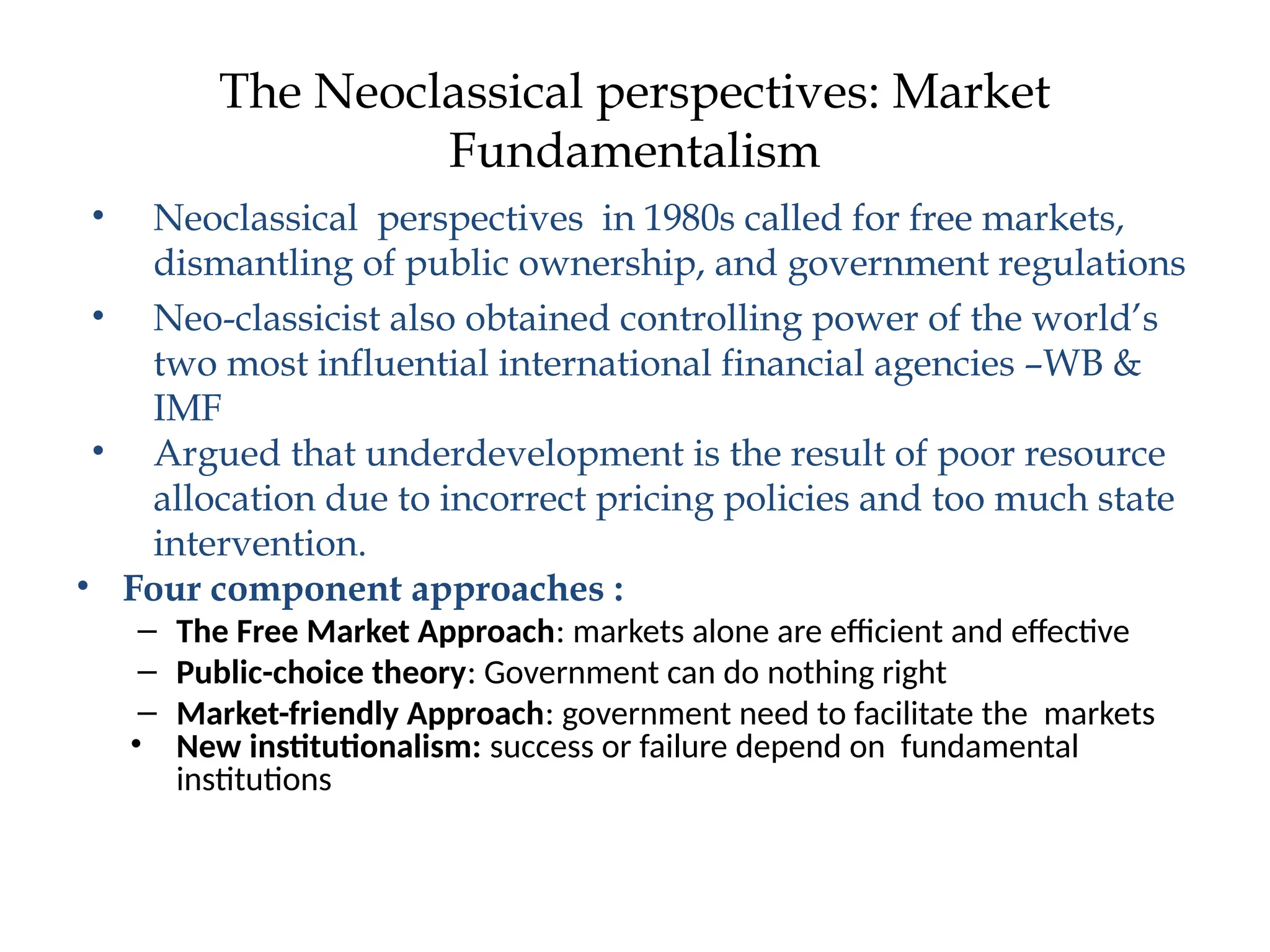
The Neoclassical perspectives: Market
Fundamentalism
• Neoclassical perspectives in 1980s called for free markets,
dismantling of public ownership, and government regulations
• Neo-classicist also obtained controlling power of the world’s
two most influential international financial agencies –WB &
IMF
• Argued that underdevelopment is the result of poor resource
allocation due to incorrect pricing policies and too much state
intervention.
• Four component approaches :
– The Free Market Approach: markets alone are efficient and effective
– Public-choice theory: Government can do nothing right
– Market-friendly Approach: government need to facilitate the markets
• New institutionalism: success or failure depend on fundamental
institutions
Influence of The Neoclassical Counterrevolution in
Nepalese Plan
• Plan Period
 Seventh Plan : 1986-1991
 Eight Plan : 1993-1998
 Ninth Plan : 1998 – 2002
– The failure of previous development strategies had created
macroeconomic imbalance.
– Accepted IMF Stabilization package and WB's Structural Adjustment
Programme and shifted towards the ideology of liberalization and open
market policies.
– The main objectives of these plan were attainment of sustainable
economic growth, poverty alleviation.
– Efforts made to adopt the market based economy by promoting private
sector participation and investment and by reducing the role of the
state.
New Approaches to development
Since 2000:
– Much attention in this decade also to other “solutions” to under-
development, including:
 establishment of appropriate institutions (“more important than policy”)
 promotion of better governance:
 anti-corruption
 democracy
 bureaucratic competence
 corporate oversight
– And more proposed remedies that have something of the “silver
bullet”( complete solution) about them: micro-credit; social entrepreneurship
– Finally, renewed emphasis on human capital – partly a result of the focus on
knowledge; distributional issues; and growing concern about environmental
impacts of growth.
Influence of New Approaches in Nepalese
Plan
Plan Period
 Tenth Plan 2002-2007
 Eleventh Plan 2007 – 10
 Twelfth Plan : 2010 – 13
 Thirteenth plan:
• These plans focused more on poverty alleviation,
reconstruction, rehabilitations and peace mitigations.
• Realized that that governments do fail, but so do markets; a
balance is needed
• Attentions to institutional and political realities
• Focused on inclusiveness in planning
Conclusion
• There is a need to have a broad based and inclusive growth to
benefit all sections of society and improve economic growth.
• It is more challenging for the country to achieve inclusive
growth than getting 8 to 10 per cent growth in GDP
• Socially, lack of inclusive growth leads to unrest among many
people.
• There is also an economic argument. The measures which
raise equity also promote economic growth.
• Lastly, the political argument is that no government in a
democracy can afford to ignore large sections of workers and
non-working population

Approaches of Development planning .pptx

  • 1.
    Approaches of Developmentplanning Dilip Kumar Chapagain 2072/4/28
  • 2.
    Presentation outline • Introductionof development plan. • Different prospective role of state. • Introduction of development planning approaches. • Economic development approaches and its practices.
  • 3.
    What is developmentplanning ? Development Planning is the preparation of the Development Plan and other supporting policies, information or studies which form the basis for making decisions on planning applications. Development planning as a process helps the formulation of effective development policies. The plan is the product of the planning process. Planning is to "devise detailed methods for doing, arranging and making something". For different things different approaches should be adopted
  • 4.
    Role of developmentplan • A key tool which influences decisions about priorities and resource allocation, and aims to influence the direction, and pace of development. • Often involves linkages between different sectors of development and levels of government. • An opportunity to ensure micro-macro links. • An opportunity to integrate actions of different government and non- government agencies. • A major point where integration and the Sustainable Livelihoods principles of holism and partnerships can be fostered. • A set of actions to achieve a certain goal.
  • 5.
    A. Different prospectiverole of state 1. Liberal prospective ( Capital economy) • Right of individuals to life, liberty and property. • Market driven economy / Free market. • Limited state- That state is best which governs the least. 2.Marxist prospective (Socialist economy). • State-owned economy where the government plans the goods and services that a country produces, the quantity that is produced, and the prices as which they are sold • Planned economy in which resources are allocated by need. Governments allocate resources for “the good of society” • The spread of wealth and income is more equal. The individuals tend to lose motivation because the pay off is vastly less. • This distribution scheme is a humane, but mostly an inefficient one.
  • 6.
    Different prospective role…….. 3.Mixedeconomy. • An economic system that features characteristics of both capitalism and socialism. • A mixed economy is an economic system that is variously defined as containing a mixture of markets and economic planning, in which both the private sector and state direct the economy; or as a mixture of public ownership and private ownership; or as a mixture of free markets with economic interventionism.
  • 7.
    B. Different developmentplanning approaches. • 1.Economic growth approach. • Economic growth refers to an increase in a country's ability to produce goods and services. • The advantage of economic growth is that an increase in real national income allows more goods for consumption. • All the growth models obviously emphasized growth. • Growth was to be seen in production or output . • To generate output, inputs were necessary, namely, labor, land, and capital. • Increasing inputs would generate increased output,
  • 8.
    Growth targets in13th Plan Indicators Status of FY2012/13 Targets Annual average economic growth rate (%) 3.6 6. Annual average agricultural growth rate (%) 1.3 4.5 Annual average non-agricultural sector growth rate (%) 5.0 6.7 Annual average growth rate in employment (%) 2.9 3.2 Life expectancy at birth (in years) 69.1 7 71.0
  • 9.
    2. Strategic planningapproach • Strategic planning is setting goals, determining actions to achieve the goals, and mobilizing resources to execute the actions. • A strategy describes how the ends (goals) will be achieved by the means (resources) • Strategic planning is an organization's process of defining its strategy, or direction, and making decisions on allocating its resources to pursue this strategy. • It may also extend to control mechanisms for guiding the implementation of the strategy
  • 10.
    Strategic planning approachin 13th Plan • Long-Term Vision : To upgrade Nepal from a least developed to a developing country by 2022. • Objective : To bring about a direct positive change in the living standards of the general public by reducing the economic and human poverty prevalent in the nation. • Goal : The main goal is to decrease the proportion of the population living below the poverty line to 18 percent.
  • 11.
    3. Top downapproach • Coming from or directed by those of highest rank. • Top managers provide guidelines, information, plans and fund processes. • Top down” approach tends to centralise decision making and is often linked to development through large projects. • This is also trickle down approach - richer individuals and larger companies are the driving force behind economic growth. • The wealth created by the more successful parts of the economy and more successful people will naturally trickle down and benefit everyone.
  • 12.
    4. Bottom upapproach. • This is “Grass roots” development approach. • The aim is to lift people out of poverty by helping them directly. • Helping them to help themselves. Local involvement in the decision making process. • Identifying their needs and deciding on the most effective solution. Use of appropriate technology.
  • 13.
    5. Participatory developmentapproach. • Participatory development is not an attempt to replace the top-down development approach with a local-community-led approach. • Participatory development attempts to introduce a bottom-up style of development in order to remedy the government-led approach's shortcomings, specifically by focusing on qualitative improvements in local society's participation. • Participatory planning emphasizes involving the entire community in the strategic and management processes of planning; or, community-level planning processes, urban or rural. • Participatory planning aims to harmonize views among all of its participants as well as prevent conflict between opposing parties. • Marginalized groups have an opportunity to participate in the planning process.[
  • 14.
    6. Demand-driven communitydevelopment approach. • This is a development initiatives that provides control of the development process, resources and decision process authority directly to community groups. • The assumption are that communities are the best judges of how their lives and livelihoods can be improved . • Providing adequate resources and information, they can organize themselves to fulfil their immediate needs.
  • 15.
    7. Integrated developmentapproach • The integrated development approach emphasis on need of coordinating different agencies under a single management system of essential components (including education) required to get agricultural or rural development moving. • The management system may be highly authoritarian credit may be designed to provide an important role for local people in planning, decision making and implementation of the programmers. • The main emphasis is on rational development and coordination of all principal factors required for agricultural and rural development.
  • 16.
    8. Inclusive Developmentapproach. • Many people are excluded from development because of their gender, ethnicity, age, sexual orientation, disability or poverty. • The effects of such exclusion are staggering, deepening inequality across the world. If it is not inclusive it can generate very severe social tensions. • Inclusive development consists of ensuring that all marginalized and excluded groups are stakeholders in development processes. • Disability-inclusive development is founded upon the three key principles of participation, non-discrimination and accessibility. • The strategy of 13th plan is – “Achieve inclusive, broad-based and sustainable economic growth by enhancing the contributions of the private, government and cooperative sectors to the development process.” • Politically, for having a stable and democratic society one needs to have inclusive growth.
  • 17.
    9. Target groupapproach. • Target groups may relate to population groups or communities, families/households, individuals, organisations or labour force groups. • Characteristics may include age, cultural identity, geographic location, specific needs and other relevant characteristics. • Categorize community members into specific groups for the purpose of targeting development assistance. ( such as the ‘poor’, ‘marginalized’, ‘disadvantaged’, ‘socially excluded’, etc.) • Poverty indicators are crucial for the definition of a target group as well as for the identification of the members of the target group. • The target groups are mobilized by Gos or NGOs to establish power or to gain access to specific benefits
  • 18.
    Target group approach…. •Target groups as stakeholders Target groups belong to the broader group of stakeholders of a development project • Example: The Millennium development goals ( UN/2002 Poverty reduction goal (GoN) • The strategy of 13th plan is to “empower targeted groups and sectors both socially and economically.”
  • 19.
    11. Export ledgrowth approach. • Economic growth through the production and export of products which the country has a comparative advantage at producing. • This approach adopted by many East and South-East Asian countries particularly successful in Taiwan. • There can be significant state involvement in the form of investment, subsidies and protectionist measures.
  • 20.
    12. Import substitutionapproach • Production of products domestically instead of import of products. • Subsidies and protection of domestic industries from foreign competition and tariffs and non-tariff barriers reducing imports. • Proponents of free trade argue that by following this approach the benefits of free trade are lost and the country is wasting resources trying to produce what it would be better off importing. • The country should focus resources on what it has a comparative advantage at producing.
  • 21.
    13. Foreign DirectInvestment approach. • Encourage foreign companies to locate in the country to stimulate economic growth. • The foreign companies would provide the investment the economy needs. • Policy encouraged by the World Bank. Particularly significant in extractive industries such as mining and oil where the initial costs are very high. • Some protection of domestic industries needed.
  • 22.
    14. Rights-based approach. •There are two stakeholder groups in rights-based development—the rights holders (who do not experience full rights) and the duty bearers (the institutions obligated to fulfil the holders' rights). • Rights-based approaches aim at strengthening the capacity of duty bearers and empower the rights holders. • Downward accountability in relation to development.
  • 23.
    15. Low carbondevelopment approach. • A low-carbon economy (LCE), low-fossil-fuel economy (LFFE), or decarbonised economy is an economy based on low carbon power sources that therefore has a minimal output of greenhouse gas (GHG) emissions into the environment biosphere ( ecosystem) • (The primary greenhouse gases in Earth's atmosphere are water vapour, carbon dioxide, methane,, nitrous oxide, and ozone. ) • First emerged under the United Nations Framework Convention on Climate Change (UNFCCC) in 2008. • This approach claims mitigation and adaptation to the climate change without compromising the national developmental activities. • Promote economic growth or (sustainable) development while keeping greenhouse gas emissions low, • The Government of Nepal has therefore stated the need for the development of Low Carbon Development Strategy (LCDS) in Climate Change Policy, 2011
  • 24.
    16. Flexible approach •Flexibility means leaving rooms for future adjustment, modification, or revision. • This also means that the planned targets should be progressive, i.e. smaller at the very beginning and gradually expanding with the added experience. 17. Growth Pole approach • Development of a core region or growth pole. • Development of a specific location through agglomeration (A group of things gathered haphazardly) • Leading to spread effects benefiting the country as a whole. • Growth Pole – Could be planned or unplanned.
  • 25.
    C. Approaches toEconomic Development Literature on economic development is dominated by the following four strands of thought:  Linear-stages-of-growth model: 1950s and 1960s  Theories and patterns of structural change: 1970s  Neo-classical, free-market counterrevolution or market fundamentalism: 1980s and 1990s  New Approached to Development :Right based Approach/ Inclusive Development • Four major and often competing development theories, all trying to explain how and why development does or does not occur. • Newer models often draw on various aspects of these classical theories.
  • 26.
    Economic growth modelsand concept. – Representative Models are: – Rostow’s Stages of Growth ( W.W. Rostow) – Harrod-Domar’s Growth Model ( Roy F. Harrod in 1939, and Evsey Domar in 1946) • Emphasis was on: Central planning Industrialization Import substitution • Emphasized the role of: accelerated capital accumulation; augmented savings/investment; and adequate supplies of foreign exchange (for imports of capital goods). – Strong bias towards western model of modernization which tries to fit economic progress into a linear system .
  • 27.
    Influence of LinearGrowth Model in Nepal • Periodic Plans: First Plan: 1956-61 (2013-17 BS) Second Plan: 1962-65 (2018-21 BS ) Third Plan : 1965-71 (2021-26 BS) – Started its initial plans under the complete absence of data and information and any infrastructure to begin with. – Plans focused mainly on growth led strategies giving priority to the expansion of infrastructures to develop industrial Sector. – Plans emphasized the role of capital formation and increase investment in the modern industrial sector.
  • 28.
    Structural-Change Models In the1970s • Representative examples of this strand of thought are The Lewis theory of development ( Arthur Lewis) Chenery’s patterns of development (Hollis Burnley Chenery ) – These models tend to emphasize the transformation of domestic economic structures from traditional agriculture economies to more modern, urbanized and industrially diverse manufacturing and service economies. Shift in emphasis: • basic needs and poverty reduction – McNamara, Nairobi 1973 • integrated area development • investment in social sectors – human capital • Concerns for the distributional consequences of growth; sharing benefits of development more equally
  • 29.
    Influence of structurechange model in Nepal Periodic Plans Fourth Plan : 1971-76 Fifth Plan : 1976-81 Sixth Plan 1981-86 – During early 1970s, it had become clear that the modernization strategies of the initial plans could not induce industrial investment. – Adopted regional approach in development planning – Adopted distributive approach in development strategies – Nepal adopted the ideology of Basic Needs and Integrated Rural Development in this era.
  • 30.
    The Neoclassical perspectives:Market Fundamentalism • Neoclassical perspectives in 1980s called for free markets, dismantling of public ownership, and government regulations • Neo-classicist also obtained controlling power of the world’s two most influential international financial agencies –WB & IMF • Argued that underdevelopment is the result of poor resource allocation due to incorrect pricing policies and too much state intervention. • Four component approaches : – The Free Market Approach: markets alone are efficient and effective – Public-choice theory: Government can do nothing right – Market-friendly Approach: government need to facilitate the markets • New institutionalism: success or failure depend on fundamental institutions
  • 31.
    Influence of TheNeoclassical Counterrevolution in Nepalese Plan • Plan Period  Seventh Plan : 1986-1991  Eight Plan : 1993-1998  Ninth Plan : 1998 – 2002 – The failure of previous development strategies had created macroeconomic imbalance. – Accepted IMF Stabilization package and WB's Structural Adjustment Programme and shifted towards the ideology of liberalization and open market policies. – The main objectives of these plan were attainment of sustainable economic growth, poverty alleviation. – Efforts made to adopt the market based economy by promoting private sector participation and investment and by reducing the role of the state.
  • 32.
    New Approaches todevelopment Since 2000: – Much attention in this decade also to other “solutions” to under- development, including:  establishment of appropriate institutions (“more important than policy”)  promotion of better governance:  anti-corruption  democracy  bureaucratic competence  corporate oversight – And more proposed remedies that have something of the “silver bullet”( complete solution) about them: micro-credit; social entrepreneurship – Finally, renewed emphasis on human capital – partly a result of the focus on knowledge; distributional issues; and growing concern about environmental impacts of growth.
  • 33.
    Influence of NewApproaches in Nepalese Plan Plan Period  Tenth Plan 2002-2007  Eleventh Plan 2007 – 10  Twelfth Plan : 2010 – 13  Thirteenth plan: • These plans focused more on poverty alleviation, reconstruction, rehabilitations and peace mitigations. • Realized that that governments do fail, but so do markets; a balance is needed • Attentions to institutional and political realities • Focused on inclusiveness in planning
  • 34.
    Conclusion • There isa need to have a broad based and inclusive growth to benefit all sections of society and improve economic growth. • It is more challenging for the country to achieve inclusive growth than getting 8 to 10 per cent growth in GDP • Socially, lack of inclusive growth leads to unrest among many people. • There is also an economic argument. The measures which raise equity also promote economic growth. • Lastly, the political argument is that no government in a democracy can afford to ignore large sections of workers and non-working population