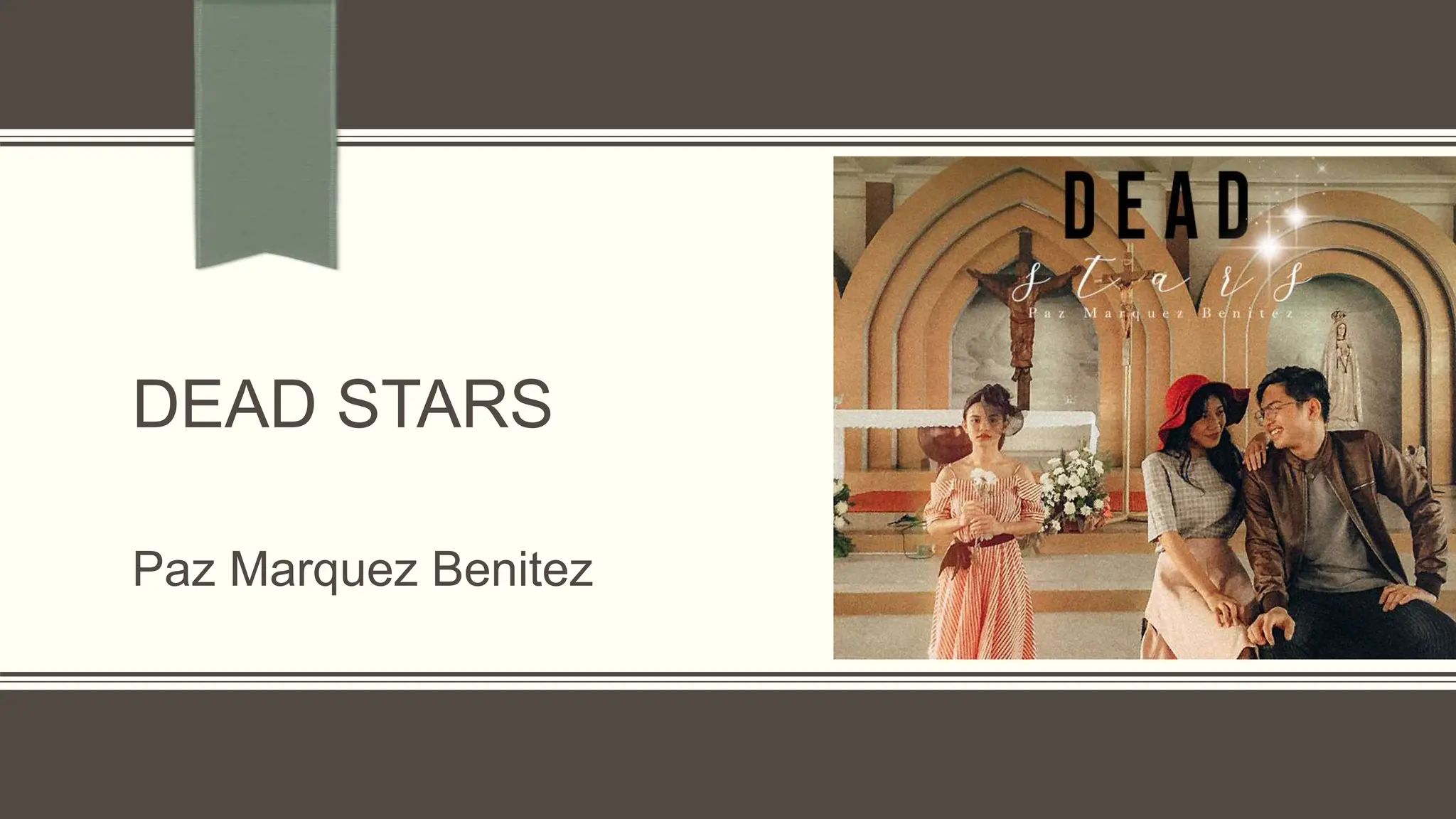
DEAD STARS
Paz Marquez Benitez
About the Author
Paz Marquez-Benitez was a
Filipina short story writer
born in Lucena City, Quezon.
She authored the first
Filipino modern English
language story.
A member of the first
freshman class of the
University of the Philippines
Dead Stars was published in
the Philippine Herald in
1925.
Context
• What if???
Discussion Guide
Let’s watch the
story first.
https://www.youtube.com/watch?v=DMxmYsF3CNo
ELEMENTS
OF THE
STORY
Alfredo Salazar
son of Don Julian;
engaged to Esperanza
but is still fleeting to
Julia Salas
Esperanza
literal-minded and
intensely acquisitive;
 one of those fortunate
women who have the
gift of uniformly beauty
Engaged to Alfredo
Salazar
Julia Salas
sister-in-law of Judge
Del Valle;
the other girl of Alfredo
Salazar that remains
single in her entire life
Don Julian
Father of Alfredo
Salazar and Carmen
Carmen
 sister of Alfredo
Salazar
Judge Del Valle
Brother-in-law of Julia
Salas
Donna Adella
 sister of Julia Salas
SUMMARY
Alfredo Salazar was
betrothed to Esperanza, his
girlfriend for four years. The
start of their relationship
was relatively “warm”, with
Alfredo wooing Esperanza
like a man in dire
lovesickness. But as the
years went by, the warm
love’s fire slowly flickered
and it was because of Julia
Salas.
SUMMARY
She was charming and gleeful.
Alfredo shared moments of light
with her but sometimes deep
conversations when he visits Julia’s
brother-in-law, who was a judge.
He always went there with his
father and since it was his father
who needed to talk to the judge, he
was always left to Julia’s company.
He never told her he was engaged.
At first he didn’t notice that a
change in his heart was taking
form.
SUMMARY
But then he started
keeping details of his
activities to his fiancée
and then the guilty feeling
crept in. When he found
out that Julia was about to
head back to her distant
hometown, he felt blue
and frightened.
SUMMARY
He met her in the church after
the Holy Thursday procession,
although he knew that
Esperanza was already
waiting for him. He
approached her and she
conversed with him with an
expression that told him she
finally knew. She
congratulated him and said
she will be at his wedding.
Then they parted.
SUMMARY
When he visited Esperanza in her
house, he overheard her talking to
another woman about infidelity and
immorality, to which he reasoned in
favor of the condemned. The
statement caused an intense fury to
Esperanza and she told him that
she knew. She dared Alfredo to
abandon her, along with morality
and reason and her dignity as a
woman as well as her image before
the society all for the sake of his
“being fair to himself”.
SUMMARY
Eventually the wedding took place.
And after several years, Alfredo
was sent to a distant village due to
a legal assignment. It bothered him
so much because it was near
Julia’s hometown. But he still found
himself making his way to her
house. And there, he found her, just
as how and where he expected her
to be. She never married. And he
wondered how life would be if he
ended up being with her.
SUMMARY
But all was too late and he could
never bring things back. He also
noticed that Julia lost something,
albeit the fact that he didn’t know
what that is – youth, love, luster?
And when he looked at her he
doubted if she ever cared for him, if
he has mistaken the past light in
her eyes as manifestations of a
possible romance. But now they’re
all gone and so it was indeed all
done.
Setting
• Don Julian’s house
• Judge Del Valle’s house
• Don Julian’s house in
Tanda
• Calle Real
• Calle Luz (Sta.Cruz)
Conflict
• Man vs.
Circumstances
• In the story, Alfredo
struggles against his fate
and the circumstances of
life & love facing him. He
needs to face problems in
choosing between difficult
choices of his life.
"Julita," he said in his slow,
thoughtful manner, "did you
ever have to choose
between something you
wanted to do and
somethingyou had todo?"
Theme
• Forbidden Love
• The short story "Dead Stars" by Paz Marquez Benitez is
conveying the theme that pertains to forbidden love. It says that
forbidden love is only apparent, and its banes haunt the person
until such time that he realizes his faults.
Theme
• Love and Infatuation
• Love is the dominant theme of the story. Alfredo loved
Esperanza and she believed in his love to marry him. Alfredo
thought he and Julia loved each other but had to sacrifice their
taboo affair.
Theme
• Regret
• Another thematic expression of the story is of regret and pain.
Alfredo regretted never telling Julia about his engagement before
he learned on her own. He even regretted not being honest to
Esperanza regarding his affection for Julia.
• Succumbing to social conventions and scrutiny he marries
Esperanza and ends up ruining eight years of his and his wife’s
marriage
Theme
• Transience & Mutability of
Circumstance
• The story highlights the futility of chasing momentary
gratification over true and gradual emotions. The craving for
something forbidden over something moral and legitimate can
lead to disastrous results.
• It also touches on the theme of using patience as a tool before
committing harebrained and frivolous pleasure-seeking.
Theme
• Morality & Fidelity
• It foregrounds the need, to be honest, and earnest in one’s actions and
words. Every relationship must be built on truth and sincerity for it to
succeed which Alfredo understands at the very end of the story.
• Morality is addressed as time and age-appropriate quality as it keeps
being defined by the time period the actions are committed. This is
reflected in the thoughts about infidelity, courtship and marriage at that
time (the 1900s) which are a lot different than the modern age of
amorphous morality.
• Social norms define what can be coined as subjective morality which
varies according to circumstance and context. Of course, such moral
standards are different from religious tenets which are considered
ahistorical, objective and timeless.
Theme
• Masculine Domination & Feminine
Subservience
• Alfredo is painted as a normal man who can afford to be experimental and
selective with his affairs of the heart. He can have a dalliance with Julia
and still end up marrying Esperanza even after keeping both women in
dark.
• On the other hand the female characters, Esperanza and Julia are both
react softly to his transgressions. Julia never marries and Esperanza
remains loyal to Alfredo in a genial but loveless marriage.
POINT OF VIEW
Third Person Omniscient
 Carmen sighed impatiently. "Why he is not a bit more decided, I wonder.
He is over thirty, is he not? And still a bachelor! Esperanza must be tired
waiting." "She does not seem to be in much of a hurry either," Don
Julian nasally commented, while his rose scissors busily snipped away.
 "A last spurt of hot blood," finished the old man. He and Julia Salas
stood looking out into the quiet night. Sensing unwanted intensity,
laughed, woman-like, asking, "Amusement?"
 Carmen sighed impatiently. "Why is he not a bit more decided, I wonder.
He is over thirty, is he not? And still a bachelor! Esperanza must be tired
waiting." "How can a woman be in a hurry when the man does not hurry
her?" Carmen returned, pinching off a worm with a careful, somewhat
absent air.
MORAL/PHILOSOPHICAL AND
INTELLECTUAL APPROACH
Moral/Philosophical and Intellectual
Approach
 Carmen sighed impatiently. "Why he is not a bit more decided, I wonder.
He is over thirty, is he not? And still a bachelor! Esperanza must be tired
waiting." "She does not seem to be in much of a hurry either," Don
Julian nasally commented, while his rose scissors busily snipped away.
 At last Our Lady of Sorrows entered the church, and with her the priest
and the choir, whose voices now echoed from the arched ceiling. The
bells rang the close of the procession.
 Alfredo was suffering as he could not remember ever having suffered
before. What people will say--what will they not say? What don't they
say when long engagements are broken almost on the eve of the
wedding? I
THE STORY BEGINS IN MEDIAS RES AND
THEN MAKES A FLASHBACK. MAKE A
CHRONOLOGY OF EVENTS. WHAT DOES
BENITEZ GAIN BY NOT PRESENTING
THE EVENTS CHRONOLOGICALLY?
DISCUSS ALFREDO’S
CHARACTER. HOW IS IT
REVEALED? WHAT
ATTRIBUTES DOES HE
POSSESS?
WHAT IS THE CLIMAX OF THE STORY?
ACCOUNT FOR THE DECISION
ALFREDO MAKES. IS IT A RESULT OF
HIS CHARACTER, CHANCE, OR THE
GENERAL ENVIRONMENT?
THE STORY DEPICTS A LOVE
TRIANGLE. ALFREDO HAS TO
MAKE A DECISION BETWEEN
JULIA AND ESPERANZA. BUT
IS HIS DILEMMA MERELY A
CHOICE BETWEEN TWO
WOMEN? EXPLAIN.
BENITEZ RESORTS TO NAME
SYMBOLISM IN THE STORY. CAN
YOU EXPLAIN THE SIGNIFICANCE
OF “ESPERANZA,” “CALLE LUZ,”
AND “CALLE REAL’?
EXPLAIN: “SHE WAS A BELIEVER IN THE
REGENERATIVE VIRTUE OF
INSTITUTIONS, IN THEIR POWER TO
REGULATE FEELING AS WELL AS
CONDUCT. IF A MAN WERE MARRIED,
WHY, OF COURSE, HE LOVED HIS WIFE;
IF HE WERE ENGAGED, HE COULD NOT
POSSIBLY LOVE ANOTHER WOMAN”
THE HISTORICAL CONTEXT IS, OF
COURSE, THE AMERICAN COLONIAL
PERIOD. IS THIS SIGNIFICANT? WHY?
EXPLAIN THE TITLE. CAN YOU
RELATE IT TO THE THEME OF
THE STORY? ARE THE “DEAD
STARS” SYMBOLIC?

dead stars discussion guide for students.pptx

  • 1.
  • 2.
    About the Author PazMarquez-Benitez was a Filipina short story writer born in Lucena City, Quezon. She authored the first Filipino modern English language story. A member of the first freshman class of the University of the Philippines Dead Stars was published in the Philippine Herald in 1925.
  • 3.
  • 4.
    Discussion Guide Let’s watchthe story first. https://www.youtube.com/watch?v=DMxmYsF3CNo
  • 5.
  • 6.
    Alfredo Salazar son ofDon Julian; engaged to Esperanza but is still fleeting to Julia Salas
  • 7.
    Esperanza literal-minded and intensely acquisitive; one of those fortunate women who have the gift of uniformly beauty Engaged to Alfredo Salazar
  • 8.
    Julia Salas sister-in-law ofJudge Del Valle; the other girl of Alfredo Salazar that remains single in her entire life
  • 9.
    Don Julian Father ofAlfredo Salazar and Carmen Carmen  sister of Alfredo Salazar
  • 10.
    Judge Del Valle Brother-in-lawof Julia Salas Donna Adella  sister of Julia Salas
  • 11.
    SUMMARY Alfredo Salazar was betrothedto Esperanza, his girlfriend for four years. The start of their relationship was relatively “warm”, with Alfredo wooing Esperanza like a man in dire lovesickness. But as the years went by, the warm love’s fire slowly flickered and it was because of Julia Salas.
  • 12.
    SUMMARY She was charmingand gleeful. Alfredo shared moments of light with her but sometimes deep conversations when he visits Julia’s brother-in-law, who was a judge. He always went there with his father and since it was his father who needed to talk to the judge, he was always left to Julia’s company. He never told her he was engaged. At first he didn’t notice that a change in his heart was taking form.
  • 13.
    SUMMARY But then hestarted keeping details of his activities to his fiancée and then the guilty feeling crept in. When he found out that Julia was about to head back to her distant hometown, he felt blue and frightened.
  • 14.
    SUMMARY He met herin the church after the Holy Thursday procession, although he knew that Esperanza was already waiting for him. He approached her and she conversed with him with an expression that told him she finally knew. She congratulated him and said she will be at his wedding. Then they parted.
  • 15.
    SUMMARY When he visitedEsperanza in her house, he overheard her talking to another woman about infidelity and immorality, to which he reasoned in favor of the condemned. The statement caused an intense fury to Esperanza and she told him that she knew. She dared Alfredo to abandon her, along with morality and reason and her dignity as a woman as well as her image before the society all for the sake of his “being fair to himself”.
  • 16.
    SUMMARY Eventually the weddingtook place. And after several years, Alfredo was sent to a distant village due to a legal assignment. It bothered him so much because it was near Julia’s hometown. But he still found himself making his way to her house. And there, he found her, just as how and where he expected her to be. She never married. And he wondered how life would be if he ended up being with her.
  • 17.
    SUMMARY But all wastoo late and he could never bring things back. He also noticed that Julia lost something, albeit the fact that he didn’t know what that is – youth, love, luster? And when he looked at her he doubted if she ever cared for him, if he has mistaken the past light in her eyes as manifestations of a possible romance. But now they’re all gone and so it was indeed all done.
  • 18.
    Setting • Don Julian’shouse • Judge Del Valle’s house • Don Julian’s house in Tanda • Calle Real • Calle Luz (Sta.Cruz)
  • 19.
    Conflict • Man vs. Circumstances •In the story, Alfredo struggles against his fate and the circumstances of life & love facing him. He needs to face problems in choosing between difficult choices of his life. "Julita," he said in his slow, thoughtful manner, "did you ever have to choose between something you wanted to do and somethingyou had todo?"
  • 20.
    Theme • Forbidden Love •The short story "Dead Stars" by Paz Marquez Benitez is conveying the theme that pertains to forbidden love. It says that forbidden love is only apparent, and its banes haunt the person until such time that he realizes his faults.
  • 21.
    Theme • Love andInfatuation • Love is the dominant theme of the story. Alfredo loved Esperanza and she believed in his love to marry him. Alfredo thought he and Julia loved each other but had to sacrifice their taboo affair.
  • 22.
    Theme • Regret • Anotherthematic expression of the story is of regret and pain. Alfredo regretted never telling Julia about his engagement before he learned on her own. He even regretted not being honest to Esperanza regarding his affection for Julia. • Succumbing to social conventions and scrutiny he marries Esperanza and ends up ruining eight years of his and his wife’s marriage
  • 23.
    Theme • Transience &Mutability of Circumstance • The story highlights the futility of chasing momentary gratification over true and gradual emotions. The craving for something forbidden over something moral and legitimate can lead to disastrous results. • It also touches on the theme of using patience as a tool before committing harebrained and frivolous pleasure-seeking.
  • 24.
    Theme • Morality &Fidelity • It foregrounds the need, to be honest, and earnest in one’s actions and words. Every relationship must be built on truth and sincerity for it to succeed which Alfredo understands at the very end of the story. • Morality is addressed as time and age-appropriate quality as it keeps being defined by the time period the actions are committed. This is reflected in the thoughts about infidelity, courtship and marriage at that time (the 1900s) which are a lot different than the modern age of amorphous morality. • Social norms define what can be coined as subjective morality which varies according to circumstance and context. Of course, such moral standards are different from religious tenets which are considered ahistorical, objective and timeless.
  • 25.
    Theme • Masculine Domination& Feminine Subservience • Alfredo is painted as a normal man who can afford to be experimental and selective with his affairs of the heart. He can have a dalliance with Julia and still end up marrying Esperanza even after keeping both women in dark. • On the other hand the female characters, Esperanza and Julia are both react softly to his transgressions. Julia never marries and Esperanza remains loyal to Alfredo in a genial but loveless marriage.
  • 26.
  • 27.
    Third Person Omniscient Carmen sighed impatiently. "Why he is not a bit more decided, I wonder. He is over thirty, is he not? And still a bachelor! Esperanza must be tired waiting." "She does not seem to be in much of a hurry either," Don Julian nasally commented, while his rose scissors busily snipped away.  "A last spurt of hot blood," finished the old man. He and Julia Salas stood looking out into the quiet night. Sensing unwanted intensity, laughed, woman-like, asking, "Amusement?"  Carmen sighed impatiently. "Why is he not a bit more decided, I wonder. He is over thirty, is he not? And still a bachelor! Esperanza must be tired waiting." "How can a woman be in a hurry when the man does not hurry her?" Carmen returned, pinching off a worm with a careful, somewhat absent air.
  • 28.
  • 29.
    Moral/Philosophical and Intellectual Approach Carmen sighed impatiently. "Why he is not a bit more decided, I wonder. He is over thirty, is he not? And still a bachelor! Esperanza must be tired waiting." "She does not seem to be in much of a hurry either," Don Julian nasally commented, while his rose scissors busily snipped away.  At last Our Lady of Sorrows entered the church, and with her the priest and the choir, whose voices now echoed from the arched ceiling. The bells rang the close of the procession.  Alfredo was suffering as he could not remember ever having suffered before. What people will say--what will they not say? What don't they say when long engagements are broken almost on the eve of the wedding? I
  • 30.
    THE STORY BEGINSIN MEDIAS RES AND THEN MAKES A FLASHBACK. MAKE A CHRONOLOGY OF EVENTS. WHAT DOES BENITEZ GAIN BY NOT PRESENTING THE EVENTS CHRONOLOGICALLY?
  • 31.
    DISCUSS ALFREDO’S CHARACTER. HOWIS IT REVEALED? WHAT ATTRIBUTES DOES HE POSSESS?
  • 32.
    WHAT IS THECLIMAX OF THE STORY? ACCOUNT FOR THE DECISION ALFREDO MAKES. IS IT A RESULT OF HIS CHARACTER, CHANCE, OR THE GENERAL ENVIRONMENT?
  • 33.
    THE STORY DEPICTSA LOVE TRIANGLE. ALFREDO HAS TO MAKE A DECISION BETWEEN JULIA AND ESPERANZA. BUT IS HIS DILEMMA MERELY A CHOICE BETWEEN TWO WOMEN? EXPLAIN.
  • 34.
    BENITEZ RESORTS TONAME SYMBOLISM IN THE STORY. CAN YOU EXPLAIN THE SIGNIFICANCE OF “ESPERANZA,” “CALLE LUZ,” AND “CALLE REAL’?
  • 35.
    EXPLAIN: “SHE WASA BELIEVER IN THE REGENERATIVE VIRTUE OF INSTITUTIONS, IN THEIR POWER TO REGULATE FEELING AS WELL AS CONDUCT. IF A MAN WERE MARRIED, WHY, OF COURSE, HE LOVED HIS WIFE; IF HE WERE ENGAGED, HE COULD NOT POSSIBLY LOVE ANOTHER WOMAN”
  • 36.
    THE HISTORICAL CONTEXTIS, OF COURSE, THE AMERICAN COLONIAL PERIOD. IS THIS SIGNIFICANT? WHY?
  • 37.
    EXPLAIN THE TITLE.CAN YOU RELATE IT TO THE THEME OF THE STORY? ARE THE “DEAD STARS” SYMBOLIC?

Editor's Notes

  • #2 NOTE: To change the image on this slide, select the picture and delete it. Then click the Pictures icon in the placeholder to insert your own image.