NIMBLE	
  
	
  (First	
  release	
  by	
  summer)	
  
model	
  
language	
  
(BUGS)	
  
Algorithm	
  
language	
  
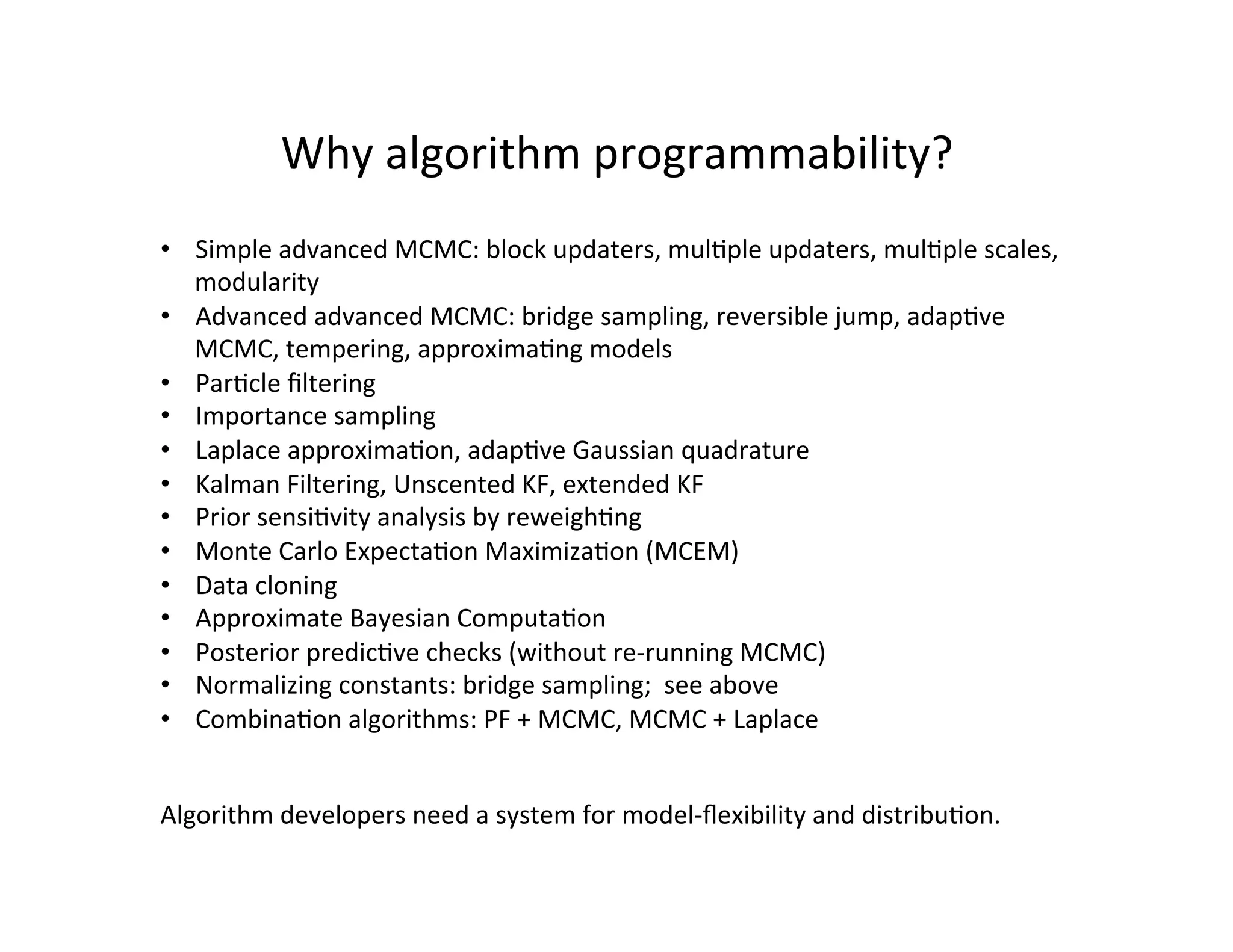
Why	
  algorithm	
  programmability?	
  
•  Simple	
  advanced	
  MCMC:	
  block	
  updaters,	
  mulHple	
  updaters,	
  mulHple	
  scales,	
  
modularity	
  
•  Advanced	
  advanced	
  MCMC:	
  bridge	
  sampling,	
  reversible	
  jump,	
  adapHve	
  
MCMC,	
  tempering,	
  approximaHng	
  models	
  
•  ParHcle	
  filtering	
  
•  Importance	
  sampling	
  
•  Laplace	
  approximaHon,	
  adapHve	
  Gaussian	
  quadrature	
  
•  Kalman	
  Filtering,	
  Unscented	
  KF,	
  extended	
  KF	
  
•  Prior	
  sensiHvity	
  analysis	
  by	
  reweighHng	
  
•  Monte	
  Carlo	
  ExpectaHon	
  MaximizaHon	
  (MCEM)	
  
•  Data	
  cloning	
  
•  Approximate	
  Bayesian	
  ComputaHon	
  
•  Posterior	
  predicHve	
  checks	
  (without	
  re-­‐running	
  MCMC)	
  
•  Normalizing	
  constants:	
  bridge	
  sampling;	
  	
  see	
  above	
  
•  CombinaHon	
  algorithms:	
  PF	
  +	
  MCMC,	
  MCMC	
  +	
  Laplace	


Algorithm	
  developers	
  need	
  a	
  system	
  for	
  model-­‐flexibility	
  and	
  distribuHon.	
  
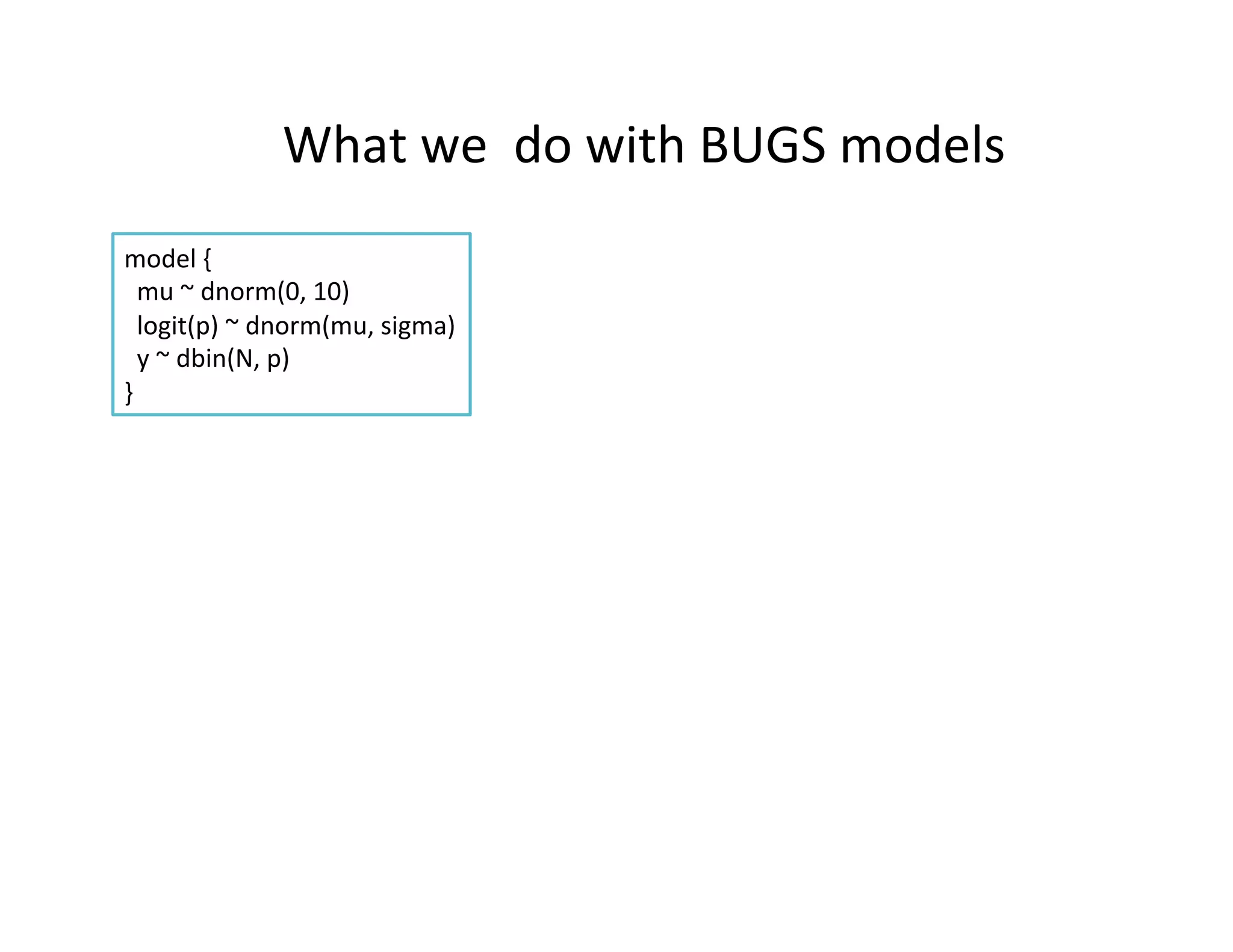
What	
  we	
  	
  do	
  with	
  BUGS	
  models	
  
model	
  {	


  mu	
  ~	
  dnorm(0,	
  10)	


  logit(p)	
  ~	
  dnorm(mu,	
  sigma)	


  y	
  ~	
  dbin(N,	
  p)	
  
}	
  
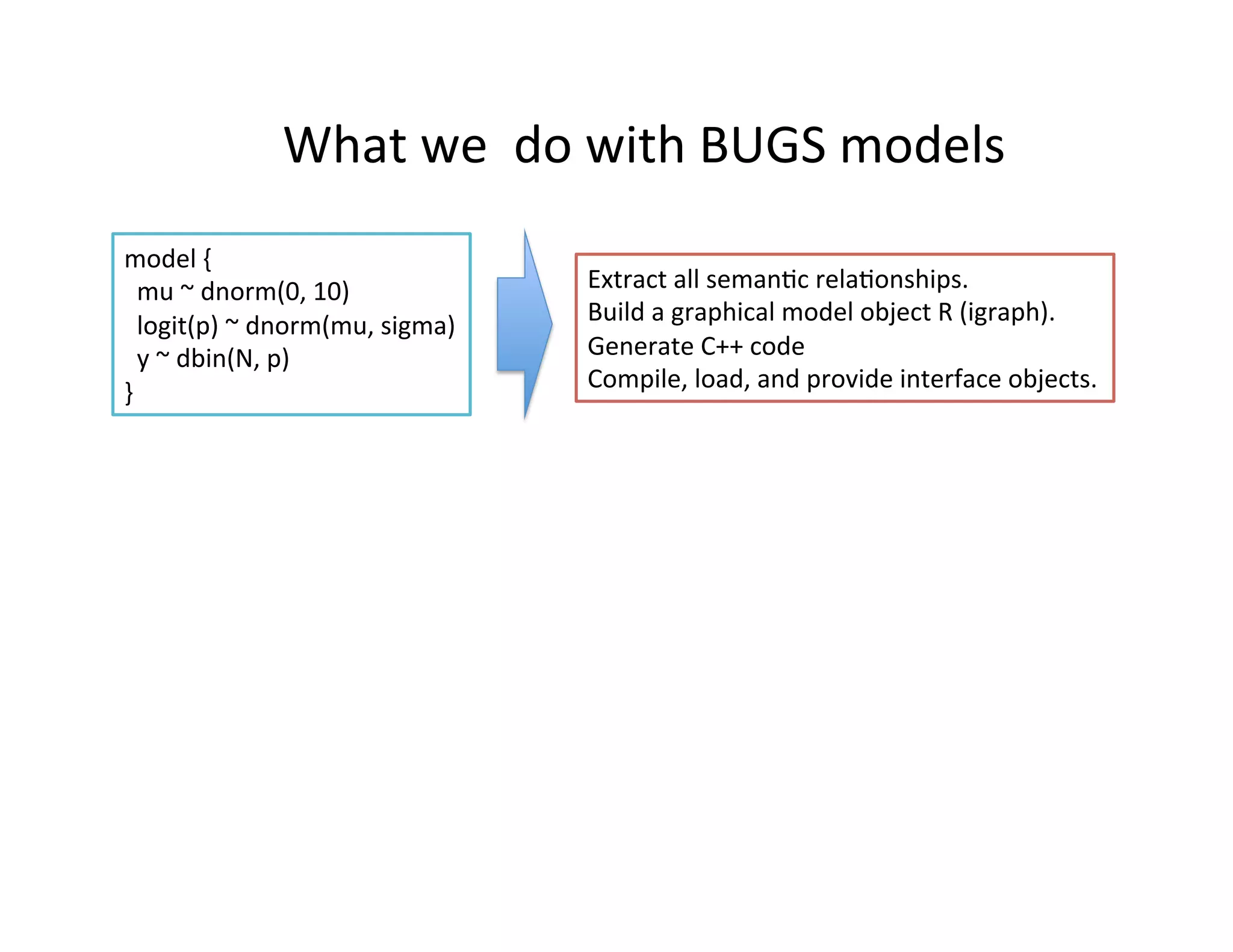
What	
  we	
  	
  do	
  with	
  BUGS	
  models	
  
model	
  {	


  mu	
  ~	
  dnorm(0,	
  10)	


  logit(p)	
  ~	
  dnorm(mu,	
  sigma)	


  y	
  ~	
  dbin(N,	
  p)	
  
}	
  
Extract	
  all	
  semanHc	
  relaHonships.	
  
Build	
  a	
  graphical	
  model	
  object	
  R	
  (igraph).	
  
Generate	
  C++	
  code	
  
Compile,	
  load,	
  and	
  provide	
  interface	
  objects.	
  
What	
  we	
  	
  do	
  with	
  BUGS	
  models	
  
model	
  {	


  mu	
  ~	
  dnorm(0,	
  10)	


  logit(p)	
  ~	
  dnorm(mu,	
  sigma)	


  y	
  ~	
  dbin(N,	
  p)	
  
}	
  
Extract	
  all	
  semanHc	
  relaHonships.	
  
Build	
  a	
  graphical	
  model	
  object	
  R	
  (igraph).	
  
Generate	
  C++	
  code	
  
Compile,	
  load,	
  and	
  provide	
  interface	
  objects.	
  
mymodel$mu	
  <-­‐	
  5	
  
toCalc	
  <-­‐	
  getDependencies(mymodel,	
  "mu")	
  
calculate(mymodel,	
  toCalc)	
  
What	
  we	
  	
  do	
  with	
  BUGS	
  models	
  
Some	
  "automaHc"	
  extensions	
  of	
  BUGS	
  
1.  Expressions	
  as	
  arguments	
  
2.  MulHple	
  parameterizaHons	
  for	
  distribuHons	
  (e.g.	
  precision	
  or	
  std.	
  deviaHon)	
  
3.  Compile-­‐Hme	
  if-­‐then-­‐else	
  
4.  Single-­‐line	
  moHfs:	
  	
  y[1:10]	
  ~	
  glmm(X	
  *	
  A	
  +	
  (1	
  |	
  Group),	
  family	
  =	
  "binomial")	
  
model	
  {	


  mu	
  ~	
  dnorm(0,	
  10)	


  logit(p)	
  ~	
  dnorm(mu,	
  sigma)	


  y	
  ~	
  dbin(N,	
  p)	
  
}	
  
Extract	
  all	
  semanHc	
  relaHonships.	
  
Build	
  a	
  graphical	
  model	
  object	
  R	
  (igraph).	
  
Generate	
  C++	
  code	
  
Compile,	
  load,	
  and	
  provide	
  interface	
  objects.	
  
mymodel$mu	
  <-­‐	
  5	
  
toCalc	
  <-­‐	
  getDependencies(mymodel,	
  "mu")	
  
calculate(mymodel,	
  toCalc)	
  
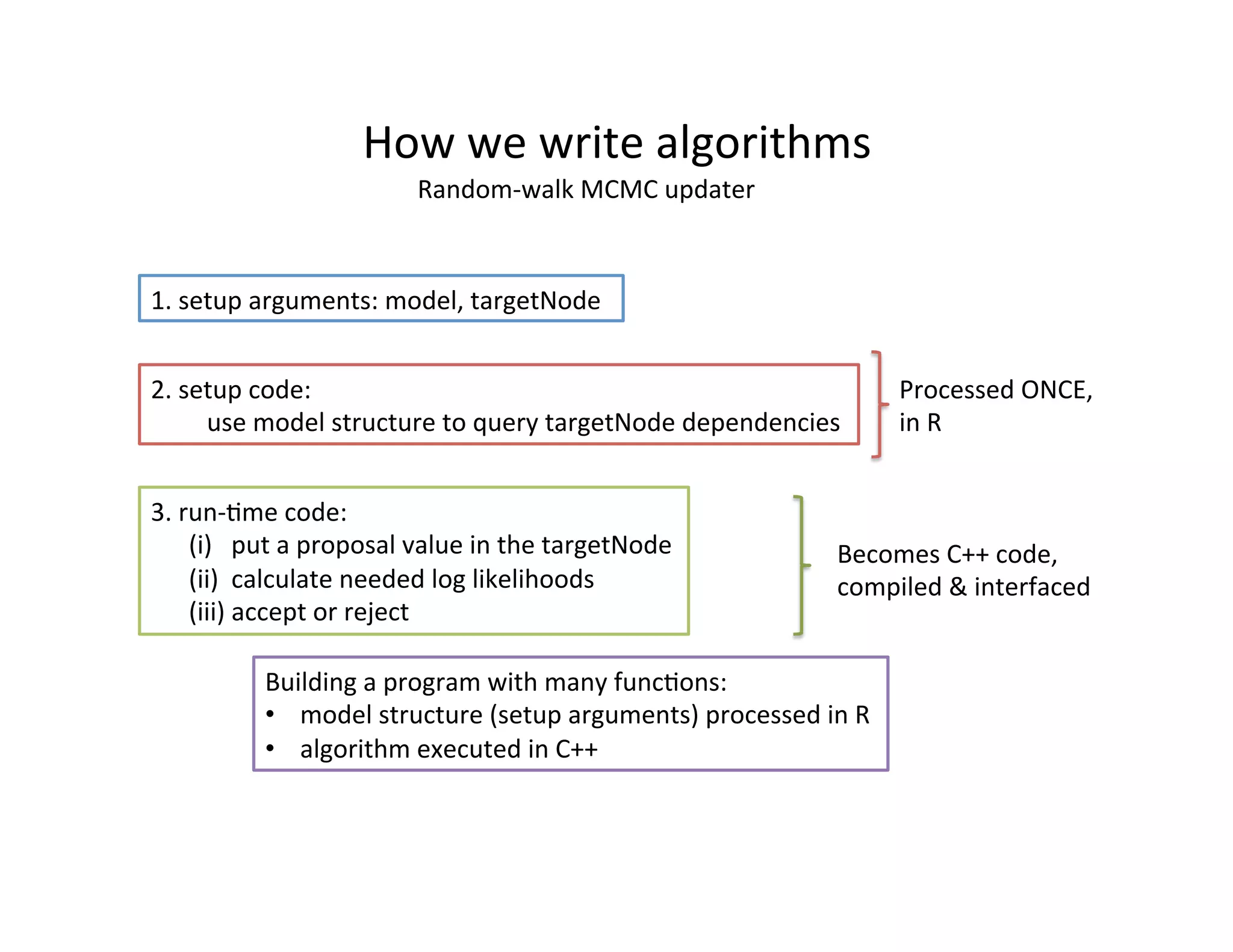
How	
  we	
  write	
  algorithms	
  
Random-­‐walk	
  MCMC	
  updater	
  
1.	
  setup	
  arguments:	
  model,	
  targetNode	
  
How	
  we	
  write	
  algorithms	
  
Random-­‐walk	
  MCMC	
  updater	
  
1.	
  setup	
  arguments:	
  model,	
  targetNode	
  
2.	
  setup	
  code:	


  use	
  model	
  structure	
  to	
  query	
  targetNode	
  dependencies	
  
Processed	
  ONCE,	
  
in	
  R	
  
How	
  we	
  write	
  algorithms	
  
Random-­‐walk	
  MCMC	
  updater	
  
1.	
  setup	
  arguments:	
  model,	
  targetNode	
  
2.	
  setup	
  code:	


  use	
  model	
  structure	
  to	
  query	
  targetNode	
  dependencies	
  
Processed	
  ONCE,	
  
in	
  R	
  
3.	
  run-­‐Hme	
  code:	


  (i)	
  	
  	
  put	
  a	
  proposal	
  value	
  in	
  the	
  targetNode	


  (ii)	
  	
  calculate	
  needed	
  log	
  likelihoods	


  (iii)	
  accept	
  or	
  reject	
  
Becomes	
  C++	
  code,	
  
compiled	
  &	
  interfaced	
  
How	
  we	
  write	
  algorithms	
  
Random-­‐walk	
  MCMC	
  updater	
  
1.	
  setup	
  arguments:	
  model,	
  targetNode	
  
2.	
  setup	
  code:	


  use	
  model	
  structure	
  to	
  query	
  targetNode	
  dependencies	
  
Processed	
  ONCE,	
  
in	
  R	
  
3.	
  run-­‐Hme	
  code:	


  (i)	
  	
  	
  put	
  a	
  proposal	
  value	
  in	
  the	
  targetNode	


  (ii)	
  	
  calculate	
  needed	
  log	
  likelihoods	


  (iii)	
  accept	
  or	
  reject	
  
Becomes	
  C++	
  code,	
  
compiled	
  &	
  interfaced	
  
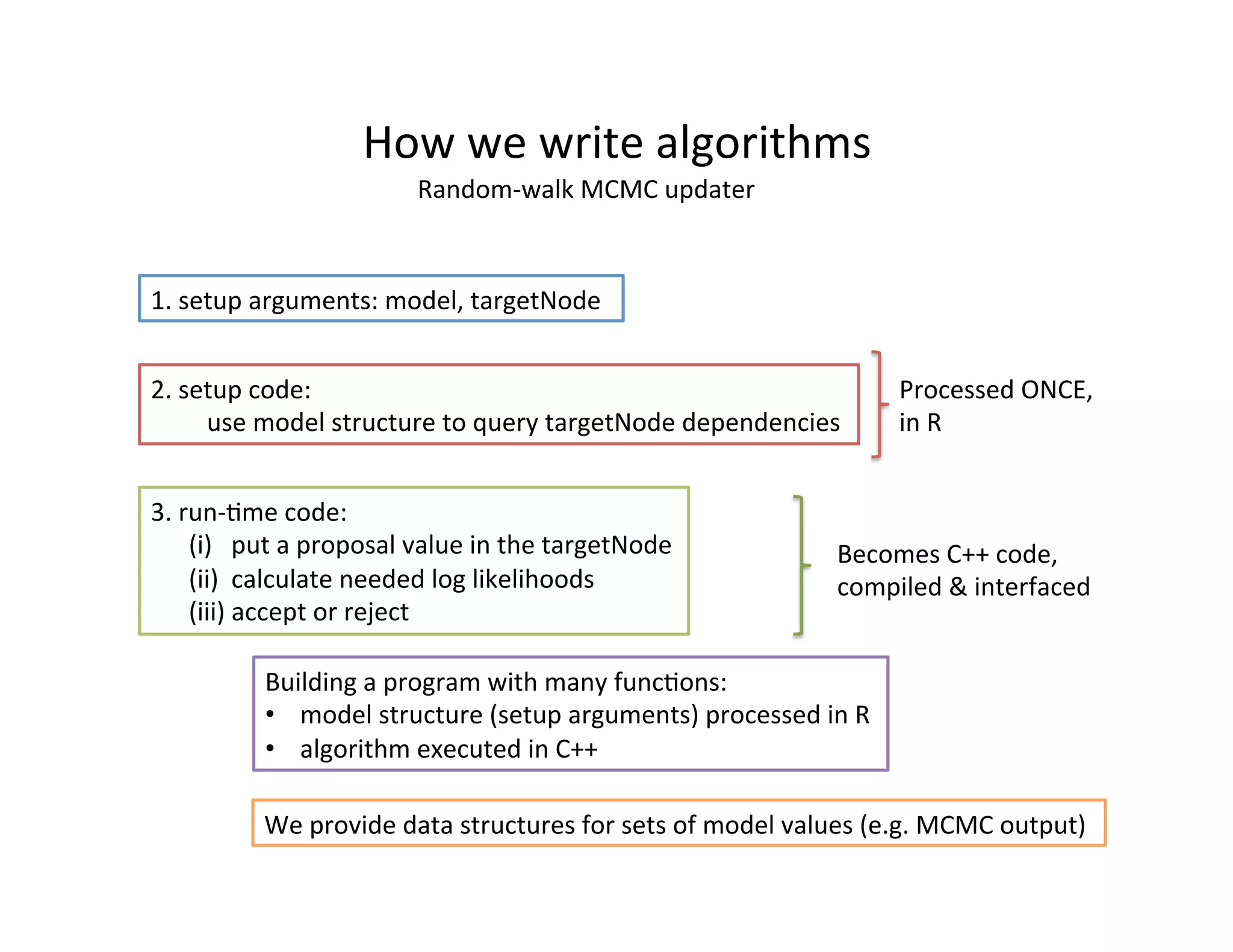
Building	
  a	
  program	
  with	
  many	
  funcHons:	
  
•  model	
  structure	
  (setup	
  arguments)	
  processed	
  in	
  R	
  
•  algorithm	
  executed	
  in	
  C++	
  
How	
  we	
  write	
  algorithms	
  
Random-­‐walk	
  MCMC	
  updater	
  
1.	
  setup	
  arguments:	
  model,	
  targetNode	
  
2.	
  setup	
  code:	


  use	
  model	
  structure	
  to	
  query	
  targetNode	
  dependencies	
  
Processed	
  ONCE,	
  
in	
  R	
  
3.	
  run-­‐Hme	
  code:	


  (i)	
  	
  	
  put	
  a	
  proposal	
  value	
  in	
  the	
  targetNode	


  (ii)	
  	
  calculate	
  needed	
  log	
  likelihoods	


  (iii)	
  accept	
  or	
  reject	
  
Becomes	
  C++	
  code,	
  
compiled	
  &	
  interfaced	
  
Building	
  a	
  program	
  with	
  many	
  funcHons:	
  
•  model	
  structure	
  (setup	
  arguments)	
  processed	
  in	
  R	
  
•  algorithm	
  executed	
  in	
  C++	
  
We	
  provide	
  data	
  structures	
  for	
  sets	
  of	
  model	
  values	
  (e.g.	
  MCMC	
  output)	
  
ConnecHons	
  to	
  other	
  engines	
  
When	
  another	
  system	
  has	
  a	
  great	
  algorithm,	
  we	
  want	
  to	
  wrap	
  access	
  to	
  it.	
  
ConnecHons	
  to	
  other	
  engines	
  
When	
  another	
  system	
  has	
  a	
  great	
  algorithm,	
  we	
  want	
  to	
  wrap	
  access	
  to	
  it.	
  
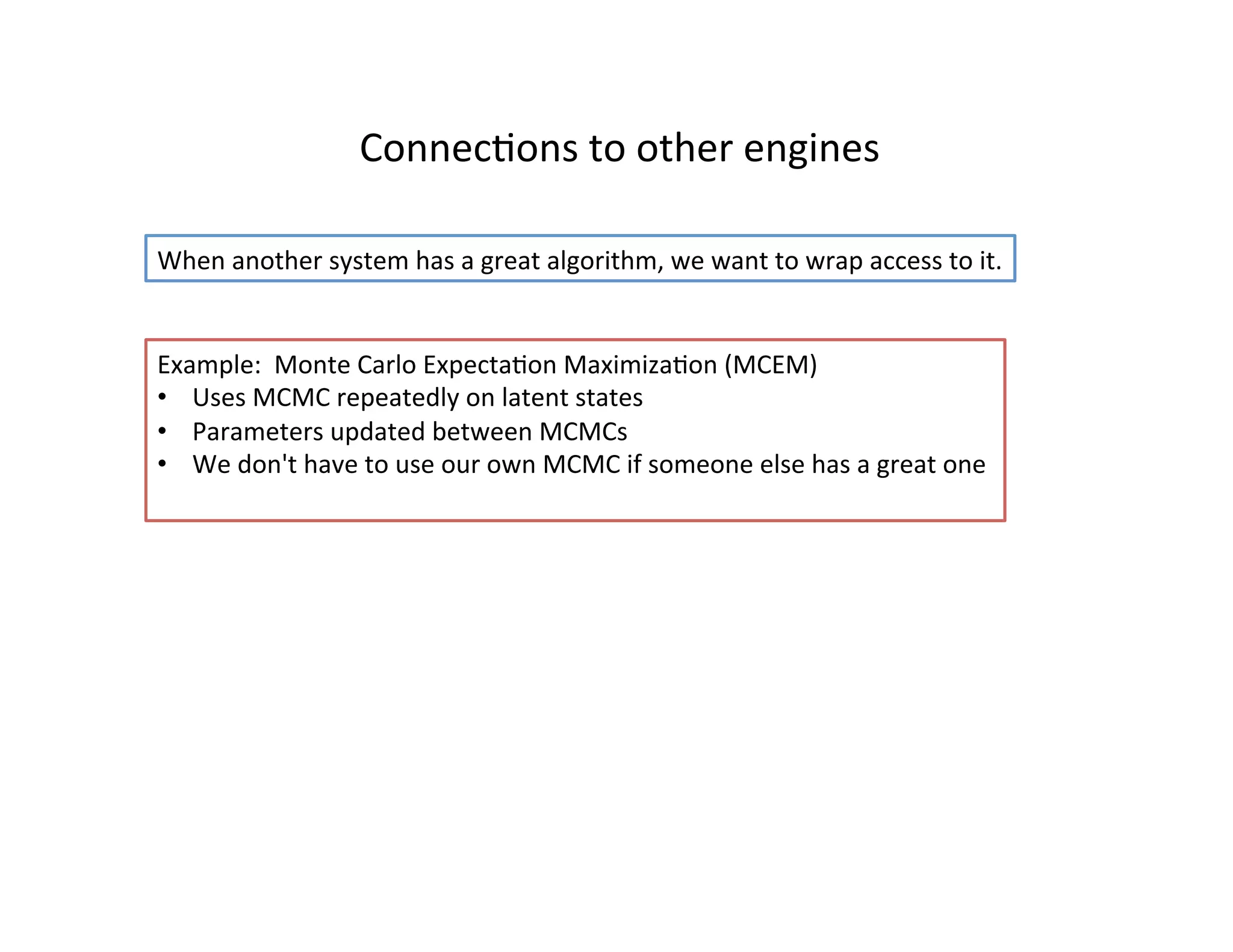
Example:	
  	
  Monte	
  Carlo	
  ExpectaHon	
  MaximizaHon	
  (MCEM)	
  
•  Uses	
  MCMC	
  repeatedly	
  on	
  latent	
  states	
  
•  Parameters	
  updated	
  between	
  MCMCs	
  
•  We	
  don't	
  have	
  to	
  use	
  our	
  own	
  MCMC	
  if	
  someone	
  else	
  has	
  a	
  great	
  one	


ConnecHons	
  to	
  other	
  engines	
  
When	
  another	
  system	
  has	
  a	
  great	
  algorithm,	
  we	
  want	
  to	
  wrap	
  access	
  to	
  it.	
  
Example:	
  	
  Monte	
  Carlo	
  ExpectaHon	
  MaximizaHon	
  (MCEM)	
  
•  Uses	
  MCMC	
  repeatedly	
  on	
  latent	
  states	
  
•  Parameters	
  updated	
  between	
  MCMCs	
  
•  We	
  don't	
  have	
  to	
  use	
  our	
  own	
  MCMC	
  if	
  someone	
  else	
  has	
  a	
  great	
  one	


How?	


We	
  have	
  high-­‐level	
  representaHon	
  of	
  model	
  structure.	
  
Can	
  generate	
  specificaHons	
  needed	
  for	
  other	
  packages.	
  	
  
Who	
  we	
  think	
  will	
  use	
  NIMBLE	
  
1.	
  Algorithm	
  developers	
  
2.	
  Data	
  analysts	
  
3.	
  Workflow	
  pipelines	
  
Numerical!
Integration of!
Mixture Models for!
Bayesian and !
Likelihood!
Estimation!
Team:!
Perry de Valpine!
Chris Paciorek!
Daniel Turek!
Cliff Anderson-Bergmann!
Ras Bodik!
Duncan Temple Lang!
Funding:!
NSF Advances in !
Biological Informatics!
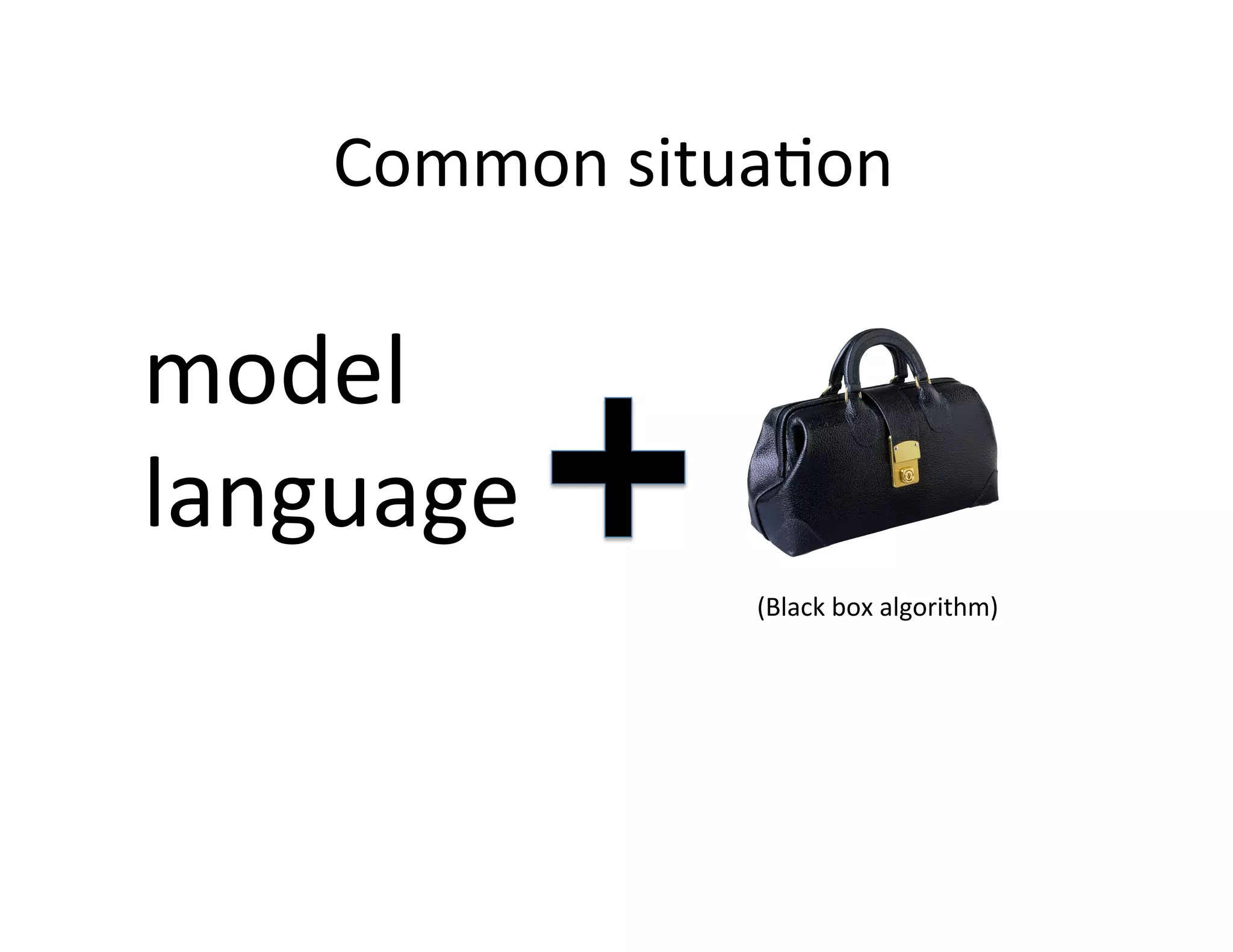
Common	
  situaHon	
  
model	
  
language	
  
(Black	
  box	
  algorithm)	
  
How	
  we	
  build	
  an	
  MCMC	
  
1.	
  R	
  funcHons	
  use	
  model/graph	
  objects	
  in	
  R	
  to	
  inspect	
  a	
  parHcular	
  model:	
  
	
  -­‐	
  	
  Build	
  list	
  of	
  updaters	


  -­‐	
  	
  Can	
  be	
  inspected,	
  modified	


  -­‐	
  	
  You	
  can	
  write	
  your	
  own	
  
How	
  we	
  build	
  an	
  MCMC	
  
1.	
  R	
  funcHons	
  use	
  model/graph	
  objects	
  in	
  R	
  to	
  inspect	
  a	
  parHcular	
  model:	
  
	
  -­‐	
  	
  Build	
  list	
  of	
  updaters	


  -­‐	
  	
  Can	
  be	
  inspected,	
  modified	


  -­‐	
  	
  You	
  can	
  write	
  your	
  own	
  
2.	
  Generate	
  C++	
  code	
  for	
  all	
  updaters.	
  
How	
  we	
  build	
  an	
  MCMC	
  
1.	
  R	
  funcHons	
  use	
  model/graph	
  objects	
  in	
  R	
  to	
  inspect	
  a	
  parHcular	
  model:	
  
	
  -­‐	
  	
  Build	
  list	
  of	
  updaters	


  -­‐	
  	
  Can	
  be	
  inspected,	
  modified	


  -­‐	
  	
  You	
  can	
  write	
  your	
  own	
  
2.	
  Generate	
  C++	
  code	
  for	
  all	
  updaters.	
  
3.	
  Compile,	
  load,	
  build	
  and	
  interface	
  to	
  objects.	
  

de Valpine NIMBLE

  • 1.
    NIMBLE    (First  release  by  summer)   model   language   (BUGS)   Algorithm   language  
  • 2.
    Why  algorithm  programmability?   •  Simple  advanced  MCMC:  block  updaters,  mulHple  updaters,  mulHple  scales,   modularity   •  Advanced  advanced  MCMC:  bridge  sampling,  reversible  jump,  adapHve   MCMC,  tempering,  approximaHng  models   •  ParHcle  filtering   •  Importance  sampling   •  Laplace  approximaHon,  adapHve  Gaussian  quadrature   •  Kalman  Filtering,  Unscented  KF,  extended  KF   •  Prior  sensiHvity  analysis  by  reweighHng   •  Monte  Carlo  ExpectaHon  MaximizaHon  (MCEM)   •  Data  cloning   •  Approximate  Bayesian  ComputaHon   •  Posterior  predicHve  checks  (without  re-­‐running  MCMC)   •  Normalizing  constants:  bridge  sampling;    see  above   •  CombinaHon  algorithms:  PF  +  MCMC,  MCMC  +  Laplace     Algorithm  developers  need  a  system  for  model-­‐flexibility  and  distribuHon.  
  • 3.
    What  we    do  with  BUGS  models   model  {      mu  ~  dnorm(0,  10)      logit(p)  ~  dnorm(mu,  sigma)      y  ~  dbin(N,  p)   }  
  • 4.
    What  we    do  with  BUGS  models   model  {      mu  ~  dnorm(0,  10)      logit(p)  ~  dnorm(mu,  sigma)      y  ~  dbin(N,  p)   }   Extract  all  semanHc  relaHonships.   Build  a  graphical  model  object  R  (igraph).   Generate  C++  code   Compile,  load,  and  provide  interface  objects.  
  • 5.
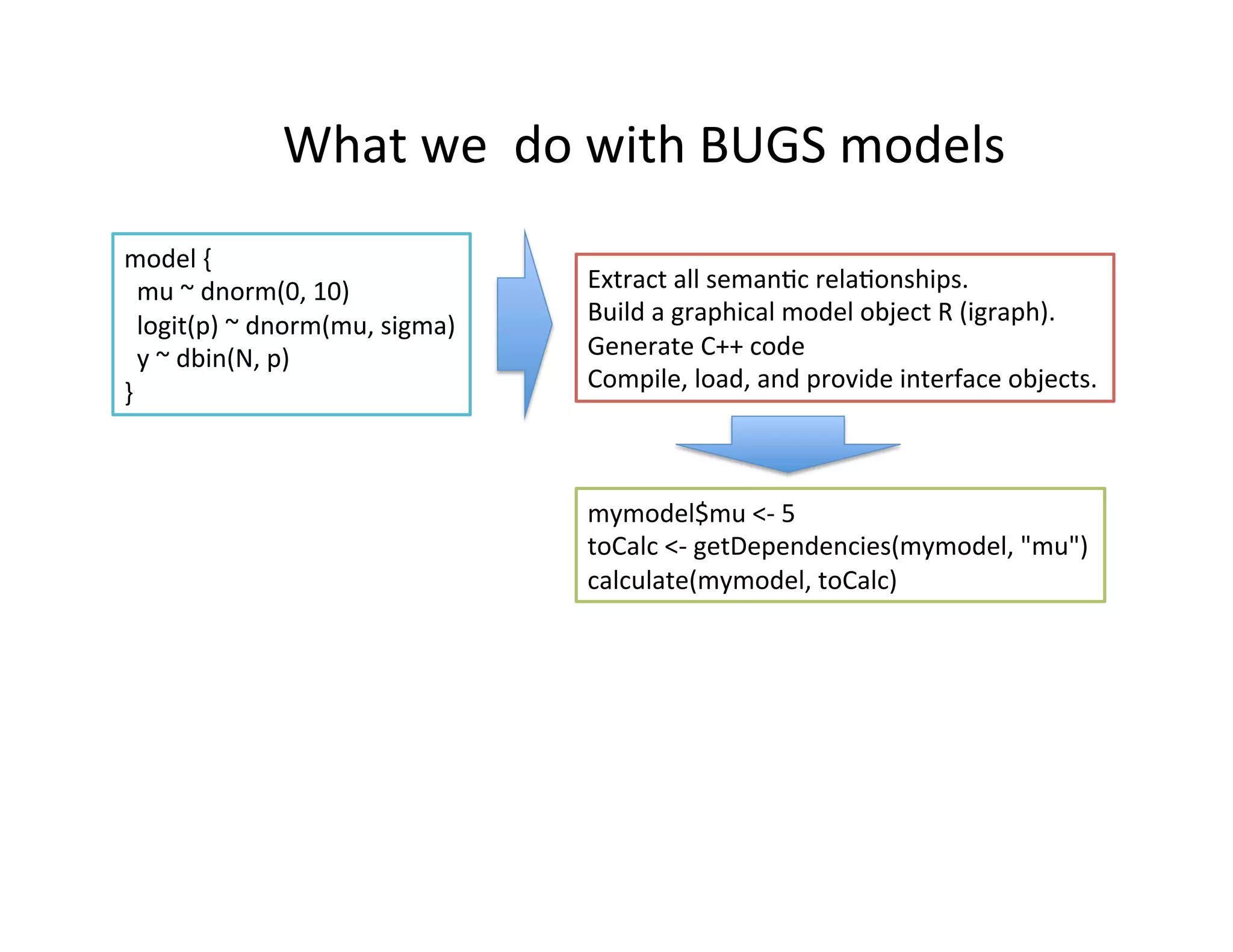
    What  we    do  with  BUGS  models   model  {      mu  ~  dnorm(0,  10)      logit(p)  ~  dnorm(mu,  sigma)      y  ~  dbin(N,  p)   }   Extract  all  semanHc  relaHonships.   Build  a  graphical  model  object  R  (igraph).   Generate  C++  code   Compile,  load,  and  provide  interface  objects.   mymodel$mu  <-­‐  5   toCalc  <-­‐  getDependencies(mymodel,  "mu")   calculate(mymodel,  toCalc)  
  • 6.
    What  we    do  with  BUGS  models   Some  "automaHc"  extensions  of  BUGS   1.  Expressions  as  arguments   2.  MulHple  parameterizaHons  for  distribuHons  (e.g.  precision  or  std.  deviaHon)   3.  Compile-­‐Hme  if-­‐then-­‐else   4.  Single-­‐line  moHfs:    y[1:10]  ~  glmm(X  *  A  +  (1  |  Group),  family  =  "binomial")   model  {      mu  ~  dnorm(0,  10)      logit(p)  ~  dnorm(mu,  sigma)      y  ~  dbin(N,  p)   }   Extract  all  semanHc  relaHonships.   Build  a  graphical  model  object  R  (igraph).   Generate  C++  code   Compile,  load,  and  provide  interface  objects.   mymodel$mu  <-­‐  5   toCalc  <-­‐  getDependencies(mymodel,  "mu")   calculate(mymodel,  toCalc)  
  • 7.
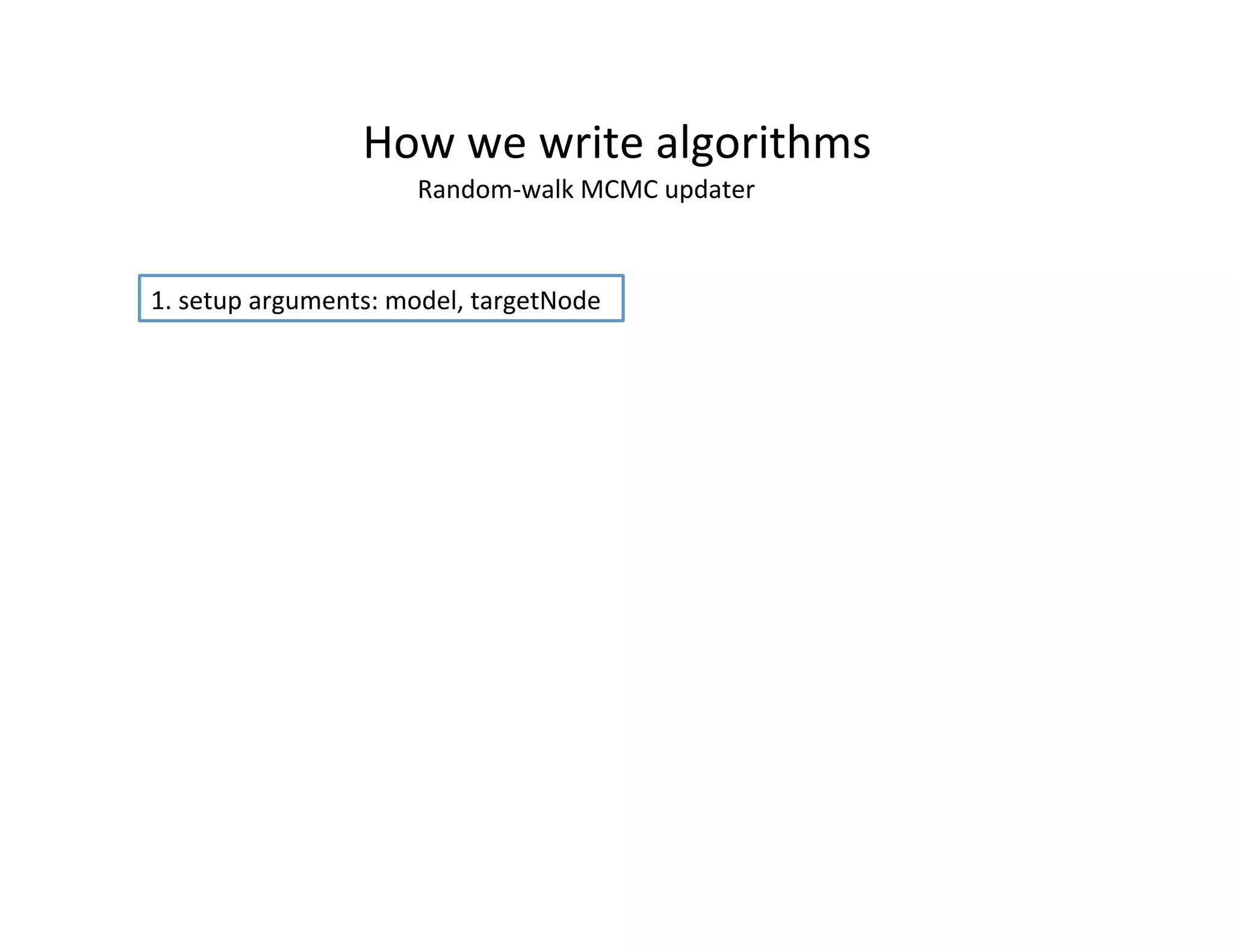
    How  we  write  algorithms   Random-­‐walk  MCMC  updater   1.  setup  arguments:  model,  targetNode  
  • 8.
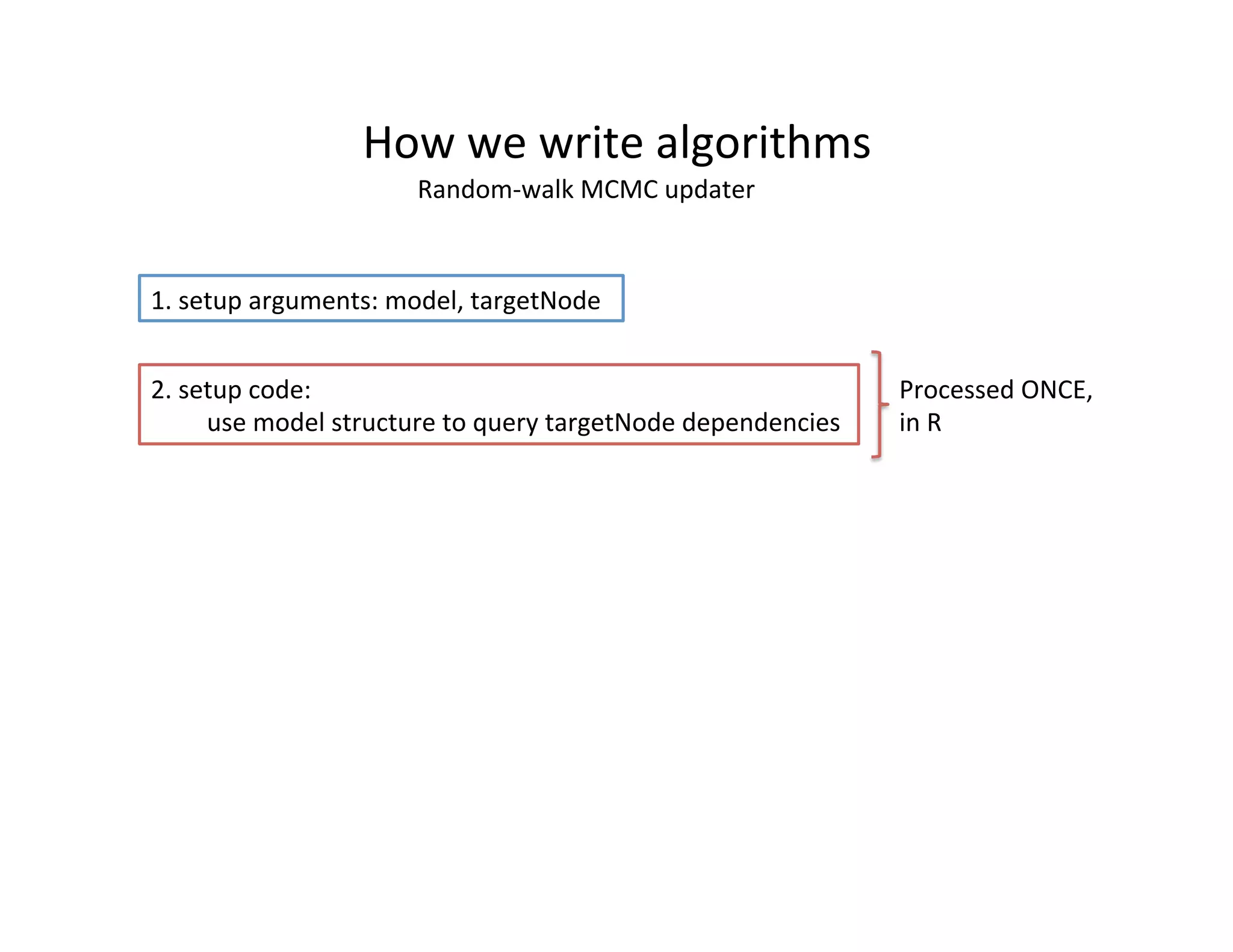
    How  we  write  algorithms   Random-­‐walk  MCMC  updater   1.  setup  arguments:  model,  targetNode   2.  setup  code:      use  model  structure  to  query  targetNode  dependencies   Processed  ONCE,   in  R  
  • 9.
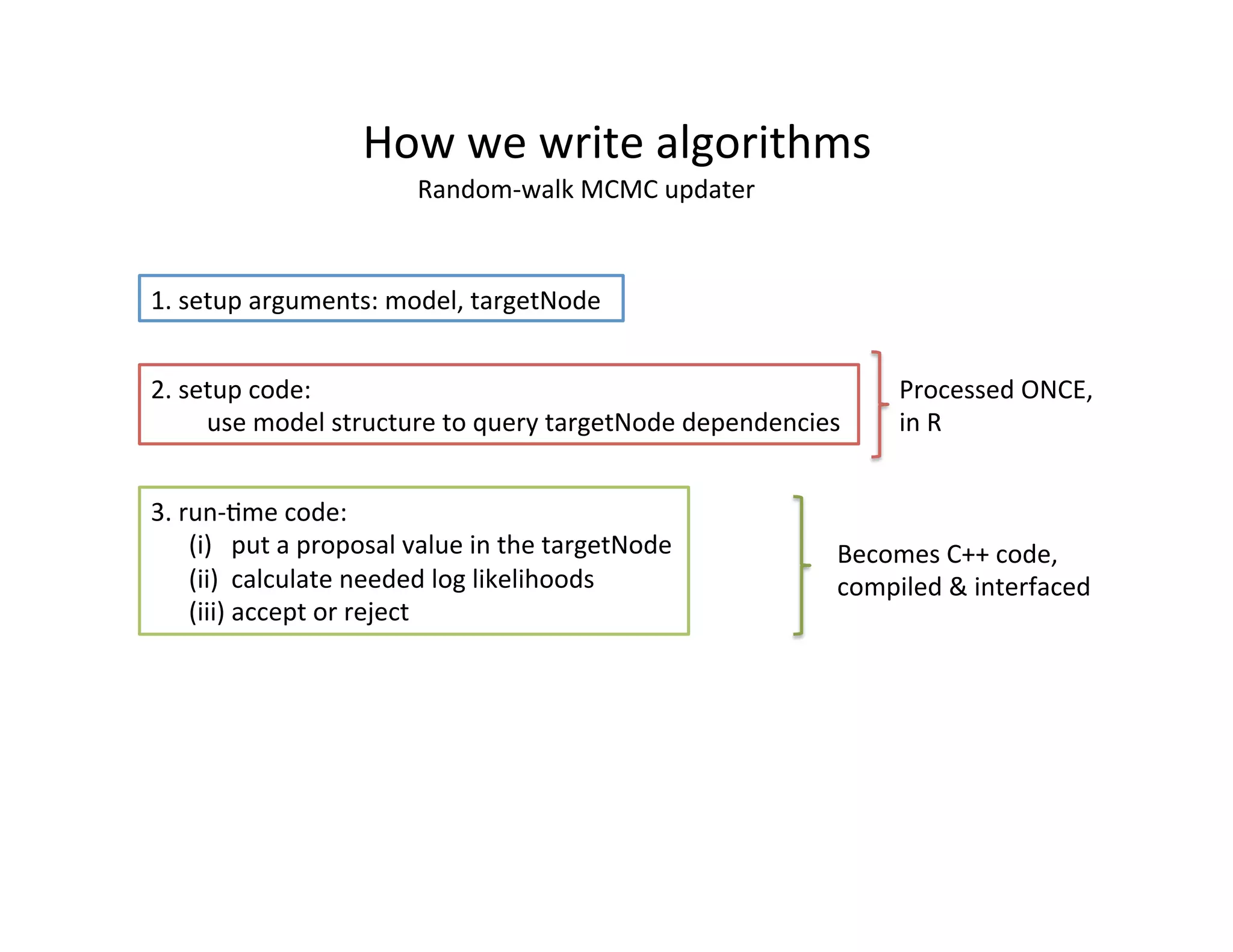
    How  we  write  algorithms   Random-­‐walk  MCMC  updater   1.  setup  arguments:  model,  targetNode   2.  setup  code:      use  model  structure  to  query  targetNode  dependencies   Processed  ONCE,   in  R   3.  run-­‐Hme  code:              (i)      put  a  proposal  value  in  the  targetNode              (ii)    calculate  needed  log  likelihoods              (iii)  accept  or  reject   Becomes  C++  code,   compiled  &  interfaced  
  • 10.
    How  we  write  algorithms   Random-­‐walk  MCMC  updater   1.  setup  arguments:  model,  targetNode   2.  setup  code:      use  model  structure  to  query  targetNode  dependencies   Processed  ONCE,   in  R   3.  run-­‐Hme  code:              (i)      put  a  proposal  value  in  the  targetNode              (ii)    calculate  needed  log  likelihoods              (iii)  accept  or  reject   Becomes  C++  code,   compiled  &  interfaced   Building  a  program  with  many  funcHons:   •  model  structure  (setup  arguments)  processed  in  R   •  algorithm  executed  in  C++  
  • 11.
    How  we  write  algorithms   Random-­‐walk  MCMC  updater   1.  setup  arguments:  model,  targetNode   2.  setup  code:      use  model  structure  to  query  targetNode  dependencies   Processed  ONCE,   in  R   3.  run-­‐Hme  code:              (i)      put  a  proposal  value  in  the  targetNode              (ii)    calculate  needed  log  likelihoods              (iii)  accept  or  reject   Becomes  C++  code,   compiled  &  interfaced   Building  a  program  with  many  funcHons:   •  model  structure  (setup  arguments)  processed  in  R   •  algorithm  executed  in  C++   We  provide  data  structures  for  sets  of  model  values  (e.g.  MCMC  output)  
  • 12.
    ConnecHons  to  other  engines   When  another  system  has  a  great  algorithm,  we  want  to  wrap  access  to  it.  
  • 13.
    ConnecHons  to  other  engines   When  another  system  has  a  great  algorithm,  we  want  to  wrap  access  to  it.   Example:    Monte  Carlo  ExpectaHon  MaximizaHon  (MCEM)   •  Uses  MCMC  repeatedly  on  latent  states   •  Parameters  updated  between  MCMCs   •  We  don't  have  to  use  our  own  MCMC  if  someone  else  has  a  great  one      
  • 14.
    ConnecHons  to  other  engines   When  another  system  has  a  great  algorithm,  we  want  to  wrap  access  to  it.   Example:    Monte  Carlo  ExpectaHon  MaximizaHon  (MCEM)   •  Uses  MCMC  repeatedly  on  latent  states   •  Parameters  updated  between  MCMCs   •  We  don't  have  to  use  our  own  MCMC  if  someone  else  has  a  great  one       How?       We  have  high-­‐level  representaHon  of  model  structure.   Can  generate  specificaHons  needed  for  other  packages.    
  • 15.
    Who  we  think  will  use  NIMBLE   1.  Algorithm  developers   2.  Data  analysts   3.  Workflow  pipelines  
  • 16.
    Numerical! Integration of! Mixture Modelsfor! Bayesian and ! Likelihood! Estimation! Team:! Perry de Valpine! Chris Paciorek! Daniel Turek! Cliff Anderson-Bergmann! Ras Bodik! Duncan Temple Lang! Funding:! NSF Advances in ! Biological Informatics!
  • 18.
    Common  situaHon   model   language   (Black  box  algorithm)  
  • 19.
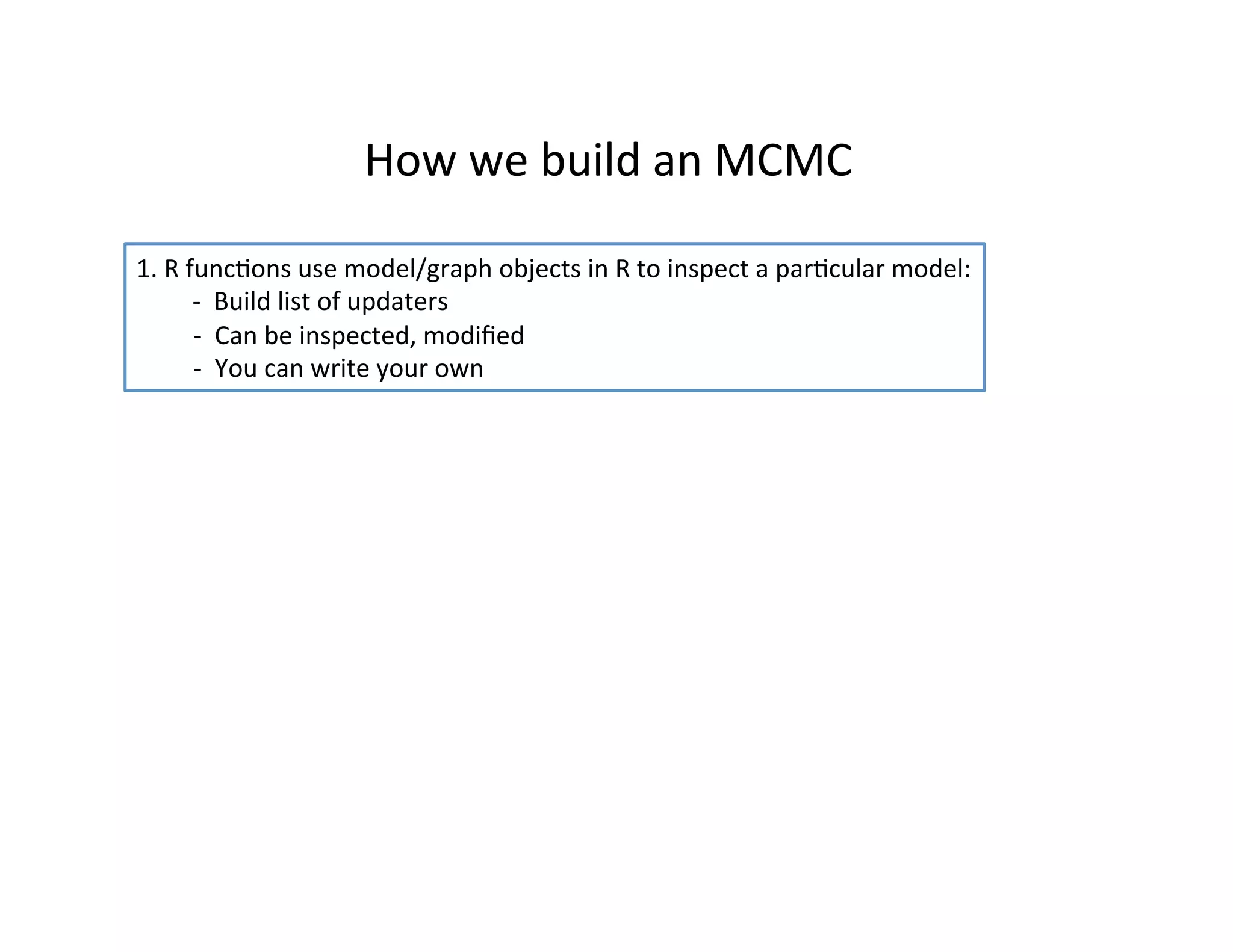
    How  we  build  an  MCMC   1.  R  funcHons  use  model/graph  objects  in  R  to  inspect  a  parHcular  model:    -­‐    Build  list  of  updaters                    -­‐    Can  be  inspected,  modified                    -­‐    You  can  write  your  own  
  • 20.
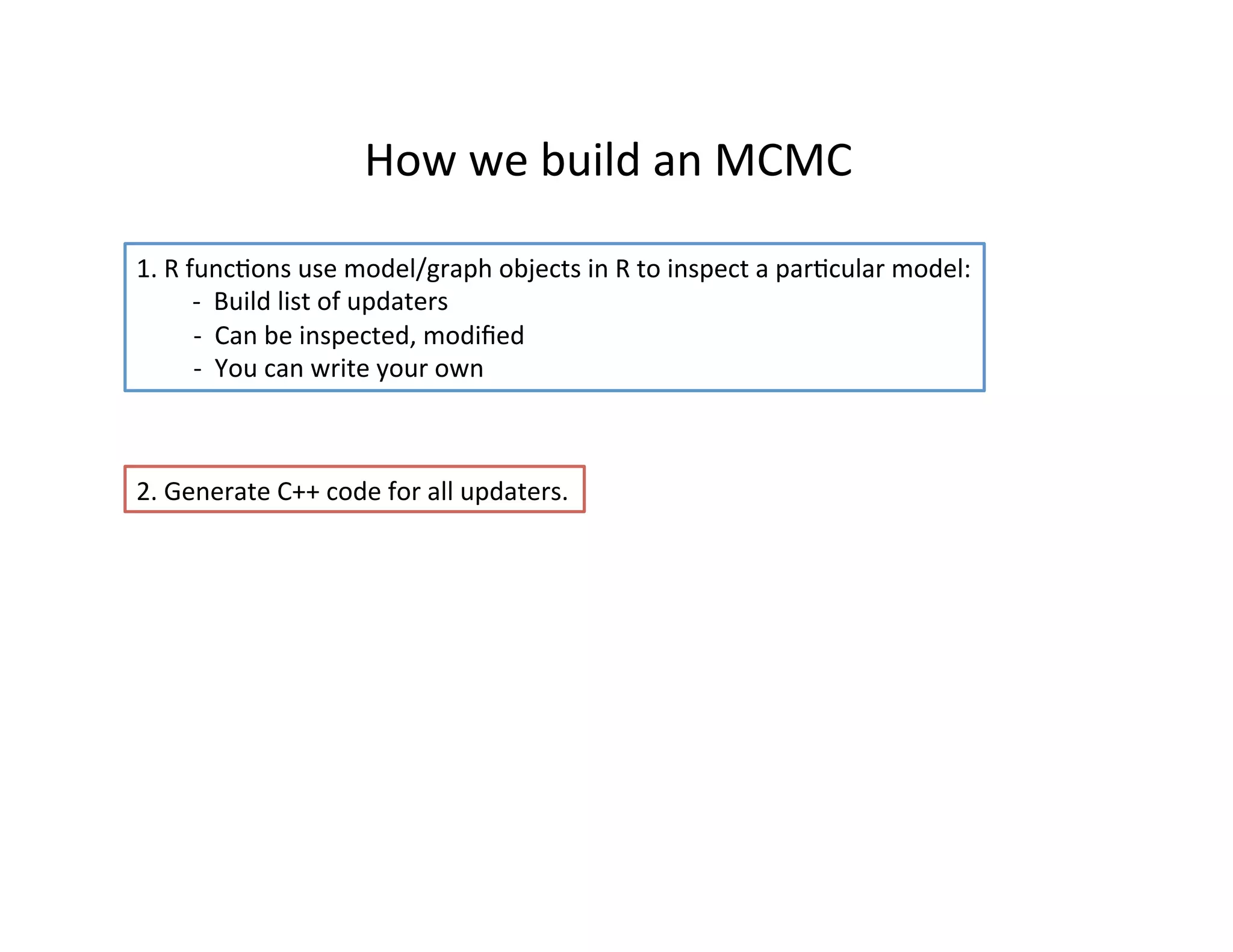
    How  we  build  an  MCMC   1.  R  funcHons  use  model/graph  objects  in  R  to  inspect  a  parHcular  model:    -­‐    Build  list  of  updaters                    -­‐    Can  be  inspected,  modified                    -­‐    You  can  write  your  own   2.  Generate  C++  code  for  all  updaters.  
  • 21.
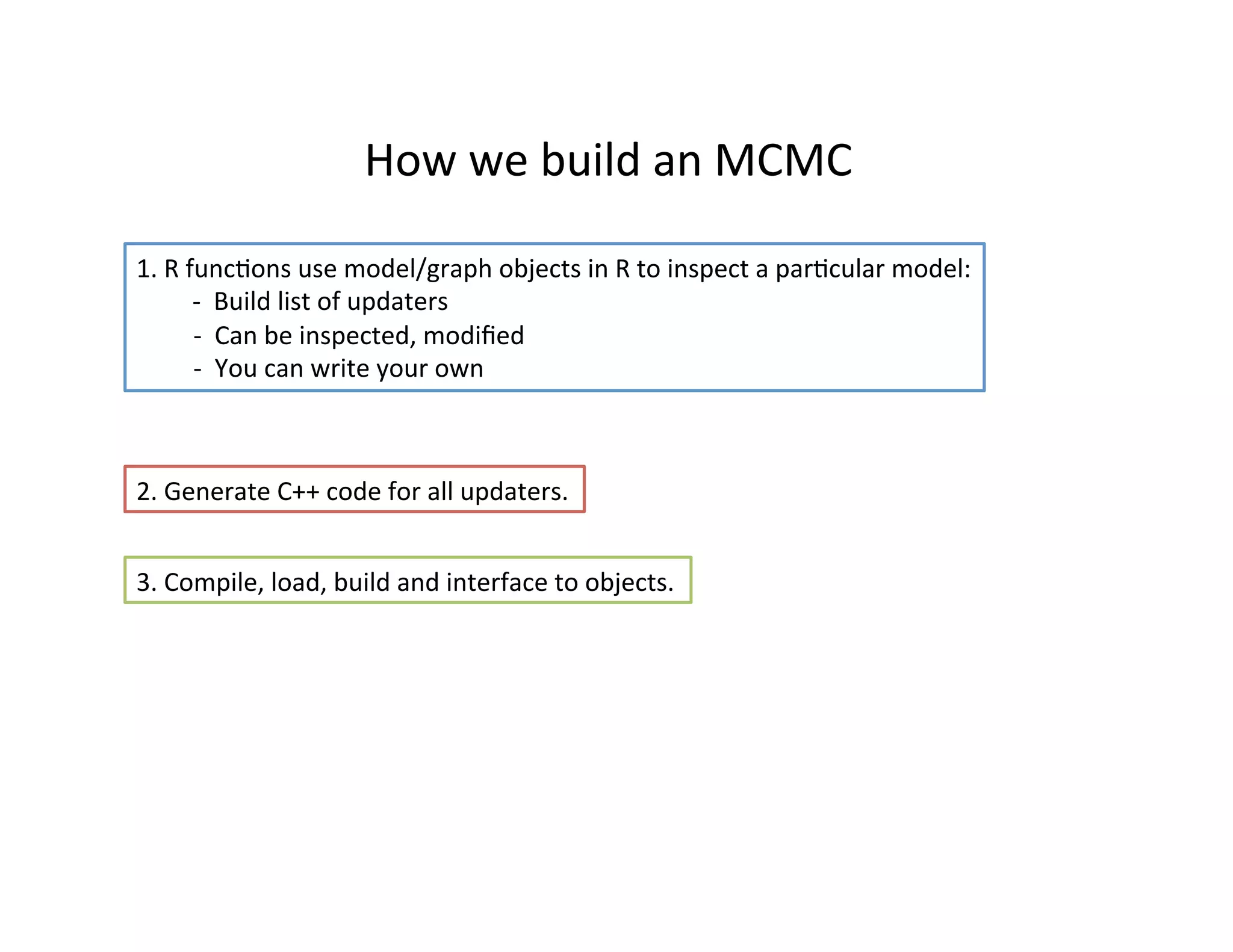
    How  we  build  an  MCMC   1.  R  funcHons  use  model/graph  objects  in  R  to  inspect  a  parHcular  model:    -­‐    Build  list  of  updaters                    -­‐    Can  be  inspected,  modified                    -­‐    You  can  write  your  own   2.  Generate  C++  code  for  all  updaters.   3.  Compile,  load,  build  and  interface  to  objects.