PEcAn
The Predictive Ecosystem Analyzer
Motivation
Synthesize heterogeneous data
Bridge gap between conceptual and computational models
Summarize what we know, based on available data and mechanistic models
Identify sources of uncertainty -> prioritize data collection and model improvement
Make complex workflows accessible, reproducible, and extensible
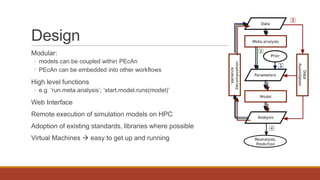
Design
Modular:
◦ models can be coupled within PEcAn
◦ PEcAn can be embedded into other workflows
High level functions
◦ e.g. ‘run.meta.analysis’; ‘start.model.runs(model)’
Web Interface
Remote execution of simulation models on HPC
Adoption of existing standards, libraries where possible
Virtual Machines  easy to get up and running
Modules
Analysis:
◦ Meta-analysis
◦ Data assimilation
◦ Visualization
◦ Priors
◦ Uncertainty
◦ more …
Utilities:
◦ QAQC
◦ Database
◦ Logger
◦ Settings
Models (min 2 functions each):
◦ Ecosystem Demography v2
◦ BioCro
◦ Sipnet
◦ Dalec
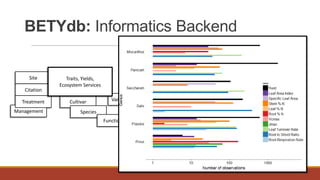
BETYdb: Informatics Backend
Cultivar
Species Prior
Covariates
Variable
Management
Site
Citation
Treatment
Functional Type
Traits, Yields,
Ecosystem Services
Functional Type
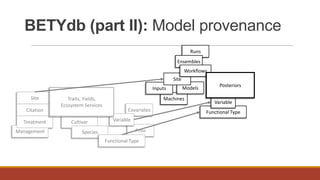
BETYdb (part II): Model provenance
Machines
Runs
Inputs Models
Site
Ensembles
Cultivar
Species Prior
Covariates
Variable
Management
Site
Citation
Treatment
Functional Type
Traits, Yields,
Ecosystem Services
Variable
Workflows
Posteriors
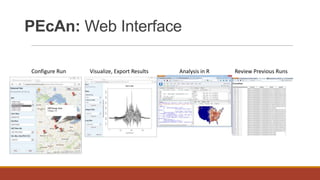
PEcAn: Web Interface
Configure Run Visualize, Export Results Analysis in R Review Previous Runs
Future Directions
Model Intercomparisons
Integration into existing workflows
Automated ‘real-time’ data assimilation
Improved web-interface – enable end users to ask new questions
More Information
Who:
David LeBauer, University of Illinois
Mike Dietze, Boston University
Rob Kooper, National Center for Supercomputing Applications
Shawn Serbin, Brookhaven National Laboratories
Where:
pecanproject.org
github.com/PecanProject
Funding:
Energy Biosciences Institute, NSF

David LeBauer PEcAn

  • 1.
  • 2.
    Motivation Synthesize heterogeneous data Bridgegap between conceptual and computational models Summarize what we know, based on available data and mechanistic models Identify sources of uncertainty -> prioritize data collection and model improvement Make complex workflows accessible, reproducible, and extensible
  • 3.
    Design Modular: ◦ models canbe coupled within PEcAn ◦ PEcAn can be embedded into other workflows High level functions ◦ e.g. ‘run.meta.analysis’; ‘start.model.runs(model)’ Web Interface Remote execution of simulation models on HPC Adoption of existing standards, libraries where possible Virtual Machines  easy to get up and running
  • 4.
    Modules Analysis: ◦ Meta-analysis ◦ Dataassimilation ◦ Visualization ◦ Priors ◦ Uncertainty ◦ more … Utilities: ◦ QAQC ◦ Database ◦ Logger ◦ Settings Models (min 2 functions each): ◦ Ecosystem Demography v2 ◦ BioCro ◦ Sipnet ◦ Dalec
  • 5.
    BETYdb: Informatics Backend Cultivar SpeciesPrior Covariates Variable Management Site Citation Treatment Functional Type Traits, Yields, Ecosystem Services
  • 6.
    Functional Type BETYdb (partII): Model provenance Machines Runs Inputs Models Site Ensembles Cultivar Species Prior Covariates Variable Management Site Citation Treatment Functional Type Traits, Yields, Ecosystem Services Variable Workflows Posteriors
  • 7.
    PEcAn: Web Interface ConfigureRun Visualize, Export Results Analysis in R Review Previous Runs
  • 8.
    Future Directions Model Intercomparisons Integrationinto existing workflows Automated ‘real-time’ data assimilation Improved web-interface – enable end users to ask new questions
  • 9.
    More Information Who: David LeBauer,University of Illinois Mike Dietze, Boston University Rob Kooper, National Center for Supercomputing Applications Shawn Serbin, Brookhaven National Laboratories Where: pecanproject.org github.com/PecanProject Funding: Energy Biosciences Institute, NSF

Editor's Notes

  • #2 This will focus on PEcAn as a workflow; but it is a very specific workflow for model data synthesis. Mike Dietze will present the model-data synthesis “inference engine” part in the next session.
  • #5 Modularity is a key featureeach module is an “R” packageEach model requires two translator functions: 1) write inputs and executable2) Convert outputs