A DCT-DOMAIN SYSTEM FOR ROBUST IMAGEWATERMARKING
Prepared by:-
DineshThakur
Nisarg Shah
3/30/2017 ELG 5378 1
Outline
• Background
• Theoretical Understanding
• Implementation
• Future Work
• Conclusion
3/30/2017 ELG 5378 2
Background
• Digitalization unfolds its boundary at every phase and into all applications.
• Protecting the integrity and originality of data confined in the form of audio, video, text and images
is the need of the hour.
• Cryptography, Steganography,Watermarking are information hiding technique.
• Watermarking is emerged as one of the technological solution to provide ownership of content.
3/30/2017 ELG 5378 3
Background
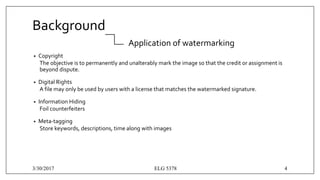
Application of watermarking
• Copyright
The objective is to permanently and unalterably mark the image so that the credit or assignment is
beyond dispute.
• Digital Rights
A file may only be used by users with a license that matches the watermarked signature.
• Information Hiding
Foil counterfeiters
• Meta-tagging
Store keywords, descriptions, time along with images
3/30/2017 ELG 5378 4
Background
Steganography vs.Watermarking
• Steganography is to hide a message m in data such eavesdropper cannot detect the presence of m
in d.
• Watermarking is to hide a message m in data d, to obtain new data s0 an eavesdropper cannot
remove or replace m in d.
Cryptography vs.Watermarking
• Methods to protect data owners against unauthorized copying and illicit distribution can be done by
watermarking.
• Encryption systems do not completely solve the problem, because once encryption is removed there
is no more control on the airing of data
3/30/2017 ELG 5378 5
Background
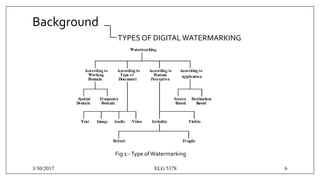
TYPES OF DIGITALWATERMARKING
Fig 1:-Type ofWatermarking
3/30/2017 ELG 5378 6
Background
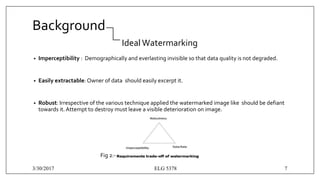
IdealWatermarking
• Imperceptibility : Demographically and everlasting invisible so that data quality is not degraded.
• Easily extractable: Owner of data should easily excerpt it.
• Robust: Irrespective of the various technique applied the watermarked image like shouId be defiant
towards it. Attempt to destroy must leave a visible deterioration on image.
Fig 2:-
3/30/2017 ELG 5378 7
Theoretical Understanding
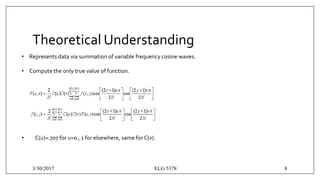
• C(u)=.707 for u=0 , 1 for elsewhere, same for C(v).
• Represents data via summation of variable frequency cosine waves.
• Compute the only true value of function.
3/30/2017 ELG 5378 8
Theoretical Understanding
• Energy Compactness
• Decorrelation
• Separable function
• Orthogonality
• Quantization is lossy element not transformation.
3/30/2017 ELG 5378 9
Theoretical Understanding
Fig 3:- Co-relation between image before and after DCT [11]
3/30/2017 ELG 5378 10
Theoretical Understanding
Fig 4 :- Energy Compactness of different transformation[7]
3/30/2017 ELG 5378 11
Theoretical Understanding
Fig 5 :- Comparison of DCT vs DFT[8]
• DFT assumes that each block is repeated having the same value n pixel away.
• DCT assumes that the pixel is identical just next to it with periodicity 2N with
mirror symmetry3/30/2017 ELG 5378 12
Theoretical Understanding
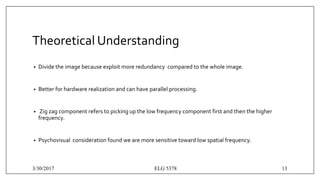
• Divide the image because exploit more redundancy compared to the whole image.
• Better for hardware realization and can have parallel processing.
• Zig zag component refers to picking up the low frequency component first and then the higher
frequency.
• Psychovisual consideration found we are more sensitive toward low spatial frequency.
3/30/2017 ELG 5378 13
Theoretical Understanding
• Truncation of higher spectral coefficients results in blurring when the details are high.
• Variance from block to block lead in artifacts creating checker board effect.[9]
• Coarse quantization of some of the low spectral coefficients introduces graininess in the smooth
portions of the images.
• So beyond a bit rate we can’t use DCT.
3/30/2017 ELG 5378 14
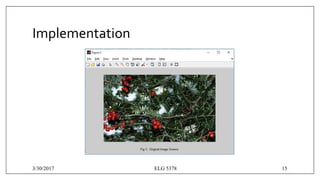
Implementation
3/30/2017 ELG 5378 15
Implementation
matrix = zeros(300,500);%[Height=300,Width=500]
matrix(100:250,100:350)=1;
figure,imshow(matrix);
3/30/2017 ELG 5378 Slide 16 of 28
Implementation
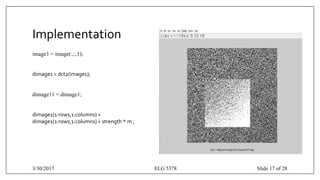
image1 = image(:,:,1);
dimage1 = dct2(image1);
dimage11 = dimage1;
dimage1(1:rows,1:columns) =
dimage1(1:rows,1:columns) + strength * m ;
3/30/2017 ELG 5378 Slide 17 of 28
Implementation
• Strength is defined as maximum allowable weight for an invisible conversion to the (i,j) DCT co-
efficient.[4]
• Fi & Fj are the vertical and horizontal spatial frequency.
• R is set to .7
• Tmin is the minimum value for a given fmin .
3/30/2017 ELG 5378 18
Implementation
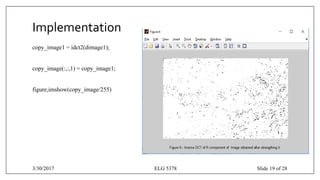
copy_image1 = idct2(dimage1);
copy_image(:,:,1) = copy_image1;
figure,imshow(copy_image/255)
3/30/2017 ELG 5378 Slide 19 of 28
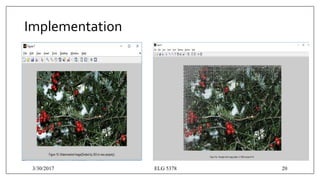
Implementation
3/30/2017 ELG 5378 20
Implementation
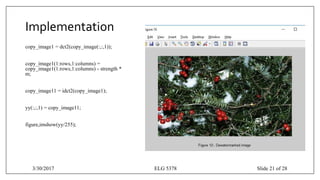
copy_image1 = dct2(copy_image(:,:,1));
copy_image1(1:rows,1:columns) =
copy_image1(1:rows,1:columns) - strength *
m;
copy_image11 = idct2(copy_image1);
yy(:,:,1) = copy_image11;
figure,imshow(yy/255);
3/30/2017 ELG 5378 Slide 21 of 28
Implementation
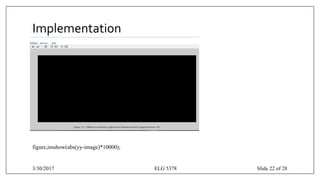
figure,imshow(abs(yy-image)*10000);
3/30/2017 ELG 5378 Slide 22 of 28
FutureWork
1) Testing the DCT domain Watermarking under the following conditions:
• JPEG Compression
• Cropping
• Gaussian Noise
2) Using combined DCT &DWT watermarking methods for better results :
• DCT and DWT domain watermarking combined can give us the better result.
• DCT domain watermarking can survive against the attacks such as noising, compression , sharpening.
• DWT uses embedded zero-tree wavelet (EZW) image compression scheme and high frequency sub bands as
LH,HL,HH etc.
3/30/2017 ELG 5378 23
Conclusion
• Digital watermarking is one of the keys for protecting the integrity and authenticity of the digital
content(audio , video , text , image etc..).
• It focuses on embedding information inside a digital object such that tampering with the watermark or
otherwise altering a watermarked object should always be detectable, and attempting to remove a
watermark from its object should make the object useless.
• DCT domain watermarking is comparatively much better than the spatial domain watermarking .
• DCT domain watermarking is more robust as it can survive against the attacks such as noising,
compression, sharpening and filtering and also use JPEG compression method.
3/30/2017 ELG 5378 24
References
[1]. Potdar, Vidyasagar M., Song Han, and Elizabeth Chang. "A survey of digital image watermarking
techniques." Industrial Informatics, 2005. INDIN'05. 2005 3rd IEEE International Conference on. IEEE, 2005.
[2]. Barni, Mauro, et al. "A DCT-domain system for robust image watermarking." Signal processing 66.3
(1998): 357-372.
[3]. Lee, Sin-Joo, and Sung-Hwan Jung. "A survey of watermarking techniques applied to
multimedia." Industrial Electronics, 2001. Proceedings. ISIE 2001. IEEE International Symposium on. Vol. 1.
IEEE, 2001.
[4]. Hernandez, Juan R., Martin Amado, and Fernando Perez-Gonzalez. "DCT-domain watermarking
techniques for still images: Detector performance analysis and a new structure." IEEE transactions on image
processing 9.1 (2000): 55-68.
3/30/2017 ELG 5378 25
Reference
[5]. Wong, Ping Wah, and Nasir Memon. "Secret and public key image watermarking schemes for image
authentication and ownership verification." IEEE transactions on image processing 10.10 (2001): 1593-
1601.
[6]. Al-Haj, Ali. "Combined DWT-DCT digital image watermarking." Journal of computer science 3.9
(2007): 740-746.
[7] Nptelhrd. "Lecture - 15 Discrete Cosine Transform." YouTube. YouTube, 15 Oct. 2008. Web. 28 Mar.
2017. <https://www.youtube.com/watch?v=S8FkaEWfCOg&t=449s>.
[8] Alfred936. "Digital image processing: p010 - The Discrete Cosine Transform (DCT)." YouTube.
YouTube, 15 Mar. 2013. Web. 12 Mar. 2017.
3/30/2017 ELG 5378 26
Reference
[9] "Compression artifact." Wikipedia. Wikimedia Foundation, 21 Mar. 2017. Web. 23 Mar. 2017.
[10] "Discrete Cosine Transform." Discrete Cosine Transform. N.p., 12 Jan. 2014. Web. 28 Mar. 2017.
[11] "The Discrete Cosine Transform (DCT) | Mathematics of the DFT." DSPRelated.com | DSP. N.p.,
26 May 2013. Web. 28 Mar. 2017.
3/30/2017 ELG 5378 27
Thank you.
28

DCT based Image Watermarking

  • 1.
    A DCT-DOMAIN SYSTEMFOR ROBUST IMAGEWATERMARKING Prepared by:- DineshThakur Nisarg Shah 3/30/2017 ELG 5378 1
  • 2.
    Outline • Background • TheoreticalUnderstanding • Implementation • Future Work • Conclusion 3/30/2017 ELG 5378 2
  • 3.
    Background • Digitalization unfoldsits boundary at every phase and into all applications. • Protecting the integrity and originality of data confined in the form of audio, video, text and images is the need of the hour. • Cryptography, Steganography,Watermarking are information hiding technique. • Watermarking is emerged as one of the technological solution to provide ownership of content. 3/30/2017 ELG 5378 3
  • 4.
    Background Application of watermarking •Copyright The objective is to permanently and unalterably mark the image so that the credit or assignment is beyond dispute. • Digital Rights A file may only be used by users with a license that matches the watermarked signature. • Information Hiding Foil counterfeiters • Meta-tagging Store keywords, descriptions, time along with images 3/30/2017 ELG 5378 4
  • 5.
    Background Steganography vs.Watermarking • Steganographyis to hide a message m in data such eavesdropper cannot detect the presence of m in d. • Watermarking is to hide a message m in data d, to obtain new data s0 an eavesdropper cannot remove or replace m in d. Cryptography vs.Watermarking • Methods to protect data owners against unauthorized copying and illicit distribution can be done by watermarking. • Encryption systems do not completely solve the problem, because once encryption is removed there is no more control on the airing of data 3/30/2017 ELG 5378 5
  • 6.
    Background TYPES OF DIGITALWATERMARKING Fig1:-Type ofWatermarking 3/30/2017 ELG 5378 6
  • 7.
    Background IdealWatermarking • Imperceptibility :Demographically and everlasting invisible so that data quality is not degraded. • Easily extractable: Owner of data should easily excerpt it. • Robust: Irrespective of the various technique applied the watermarked image like shouId be defiant towards it. Attempt to destroy must leave a visible deterioration on image. Fig 2:- 3/30/2017 ELG 5378 7
  • 8.
    Theoretical Understanding • C(u)=.707for u=0 , 1 for elsewhere, same for C(v). • Represents data via summation of variable frequency cosine waves. • Compute the only true value of function. 3/30/2017 ELG 5378 8
  • 9.
    Theoretical Understanding • EnergyCompactness • Decorrelation • Separable function • Orthogonality • Quantization is lossy element not transformation. 3/30/2017 ELG 5378 9
  • 10.
    Theoretical Understanding Fig 3:-Co-relation between image before and after DCT [11] 3/30/2017 ELG 5378 10
  • 11.
    Theoretical Understanding Fig 4:- Energy Compactness of different transformation[7] 3/30/2017 ELG 5378 11
  • 12.
    Theoretical Understanding Fig 5:- Comparison of DCT vs DFT[8] • DFT assumes that each block is repeated having the same value n pixel away. • DCT assumes that the pixel is identical just next to it with periodicity 2N with mirror symmetry3/30/2017 ELG 5378 12
  • 13.
    Theoretical Understanding • Dividethe image because exploit more redundancy compared to the whole image. • Better for hardware realization and can have parallel processing. • Zig zag component refers to picking up the low frequency component first and then the higher frequency. • Psychovisual consideration found we are more sensitive toward low spatial frequency. 3/30/2017 ELG 5378 13
  • 14.
    Theoretical Understanding • Truncationof higher spectral coefficients results in blurring when the details are high. • Variance from block to block lead in artifacts creating checker board effect.[9] • Coarse quantization of some of the low spectral coefficients introduces graininess in the smooth portions of the images. • So beyond a bit rate we can’t use DCT. 3/30/2017 ELG 5378 14
  • 15.
  • 16.
  • 17.
    Implementation image1 = image(:,:,1); dimage1= dct2(image1); dimage11 = dimage1; dimage1(1:rows,1:columns) = dimage1(1:rows,1:columns) + strength * m ; 3/30/2017 ELG 5378 Slide 17 of 28
  • 18.
    Implementation • Strength isdefined as maximum allowable weight for an invisible conversion to the (i,j) DCT co- efficient.[4] • Fi & Fj are the vertical and horizontal spatial frequency. • R is set to .7 • Tmin is the minimum value for a given fmin . 3/30/2017 ELG 5378 18
  • 19.
    Implementation copy_image1 = idct2(dimage1); copy_image(:,:,1)= copy_image1; figure,imshow(copy_image/255) 3/30/2017 ELG 5378 Slide 19 of 28
  • 20.
  • 21.
    Implementation copy_image1 = dct2(copy_image(:,:,1)); copy_image1(1:rows,1:columns)= copy_image1(1:rows,1:columns) - strength * m; copy_image11 = idct2(copy_image1); yy(:,:,1) = copy_image11; figure,imshow(yy/255); 3/30/2017 ELG 5378 Slide 21 of 28
  • 22.
  • 23.
    FutureWork 1) Testing theDCT domain Watermarking under the following conditions: • JPEG Compression • Cropping • Gaussian Noise 2) Using combined DCT &DWT watermarking methods for better results : • DCT and DWT domain watermarking combined can give us the better result. • DCT domain watermarking can survive against the attacks such as noising, compression , sharpening. • DWT uses embedded zero-tree wavelet (EZW) image compression scheme and high frequency sub bands as LH,HL,HH etc. 3/30/2017 ELG 5378 23
  • 24.
    Conclusion • Digital watermarkingis one of the keys for protecting the integrity and authenticity of the digital content(audio , video , text , image etc..). • It focuses on embedding information inside a digital object such that tampering with the watermark or otherwise altering a watermarked object should always be detectable, and attempting to remove a watermark from its object should make the object useless. • DCT domain watermarking is comparatively much better than the spatial domain watermarking . • DCT domain watermarking is more robust as it can survive against the attacks such as noising, compression, sharpening and filtering and also use JPEG compression method. 3/30/2017 ELG 5378 24
  • 25.
    References [1]. Potdar, VidyasagarM., Song Han, and Elizabeth Chang. "A survey of digital image watermarking techniques." Industrial Informatics, 2005. INDIN'05. 2005 3rd IEEE International Conference on. IEEE, 2005. [2]. Barni, Mauro, et al. "A DCT-domain system for robust image watermarking." Signal processing 66.3 (1998): 357-372. [3]. Lee, Sin-Joo, and Sung-Hwan Jung. "A survey of watermarking techniques applied to multimedia." Industrial Electronics, 2001. Proceedings. ISIE 2001. IEEE International Symposium on. Vol. 1. IEEE, 2001. [4]. Hernandez, Juan R., Martin Amado, and Fernando Perez-Gonzalez. "DCT-domain watermarking techniques for still images: Detector performance analysis and a new structure." IEEE transactions on image processing 9.1 (2000): 55-68. 3/30/2017 ELG 5378 25
  • 26.
    Reference [5]. Wong, PingWah, and Nasir Memon. "Secret and public key image watermarking schemes for image authentication and ownership verification." IEEE transactions on image processing 10.10 (2001): 1593- 1601. [6]. Al-Haj, Ali. "Combined DWT-DCT digital image watermarking." Journal of computer science 3.9 (2007): 740-746. [7] Nptelhrd. "Lecture - 15 Discrete Cosine Transform." YouTube. YouTube, 15 Oct. 2008. Web. 28 Mar. 2017. <https://www.youtube.com/watch?v=S8FkaEWfCOg&t=449s>. [8] Alfred936. "Digital image processing: p010 - The Discrete Cosine Transform (DCT)." YouTube. YouTube, 15 Mar. 2013. Web. 12 Mar. 2017. 3/30/2017 ELG 5378 26
  • 27.
    Reference [9] "Compression artifact."Wikipedia. Wikimedia Foundation, 21 Mar. 2017. Web. 23 Mar. 2017. [10] "Discrete Cosine Transform." Discrete Cosine Transform. N.p., 12 Jan. 2014. Web. 28 Mar. 2017. [11] "The Discrete Cosine Transform (DCT) | Mathematics of the DFT." DSPRelated.com | DSP. N.p., 26 May 2013. Web. 28 Mar. 2017. 3/30/2017 ELG 5378 27
  • 28.