DB #2: 2nd STUDENT POST
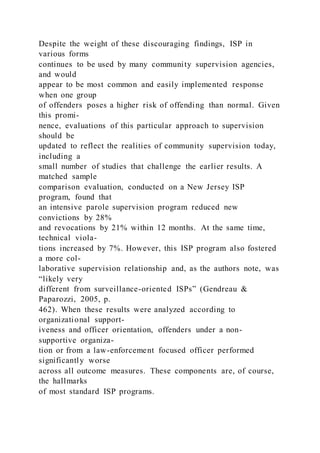
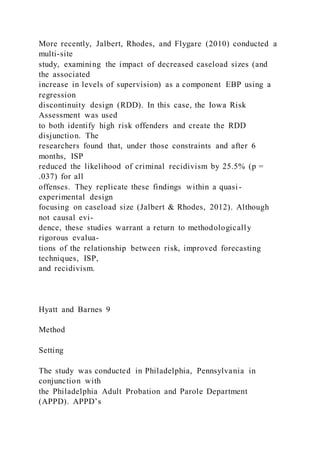
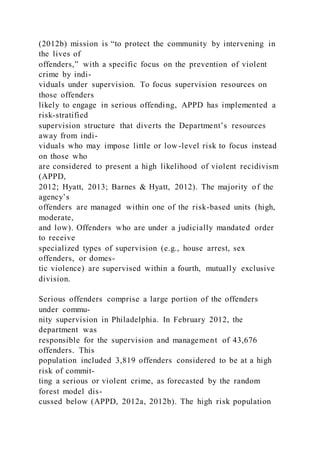
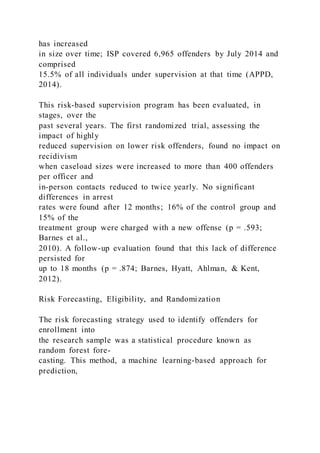
Iddrisu Ibrahim
Deterrence Scaring Offenders Straight
Top of Form
Deterrence Theory: Pros, Cons, and Improvements
Deterrence theory assumes offenders are rational and that
they calculate the risk of being caught, prosecuted, and
sentenced before deciding to commit a crime. A
few of the pros and cons of deterrence theory are identified
while highlighting additional value this theory can have at the
national level in combatting counterterrorism.
Pros of a Pure Deterrence Theory Correctional Policy
As deterrence theory is defined today, several studies have
shown that there are few advantages of control-oriented
interventions that aim to deter offenders from
reoffending (Cullen & Jonson, 2017, p. 98). However, in
general, punishment is a reasonable response to violations of
social norms. Realizing its utilitarian purpose,
deterrence theory can achieve justice and restore social balance.
Also, as a key correctional policy of deterrence theory,
mandatory sentencing would remove discretion
and personal bias at the prosecutorial and judicial level (Cullen
& Jonson, 2017, p. 17).
Cons of a Pure Deterrence Theory Correctional Policy
Deterrence theory does not explain extenuating
circumstances or the motivation to commit crime which can be
problematic. Individual differences, such as
personality and circumstances, inject variations in the
consequences that people are aware of, accentuate, and are
willing to accept (Cullen & Jonson, 2017, p. 78). Despite
the public’s lack of ability to identify punishment levels with
any precision (Nixon & Barnes, 2019; Thomas et al., 2017),
even when some are aware of laws and policies in
place, they still decide to commit a criminal act. For example,
emigrants fleeing peril in their countries, fully aware of the
dangers they are likely to encounter, still choose
to illegally cross the border between Mexico and the United
States (Hiskey et al., 2018). Despite the strong political
message including border enforcement, migrant
detention, and expedited deportation, the violence in
Guatemala, El Salvador, and Honduras has employed a powerful
influence on refugees’ emigration calculus.
We should acknowledge God’s sovereignty with our set of
circumstances. We should trust in the Lord when we are
confronting our enemies and facing situations that
challenge our moral and religious beliefs, even those that are
life-threatening (Christian Standard Bible, 1769/2017, 2
Chronicles 20:6-15).
Improvements to Deterrence Theory
Changes in the international security environment have
altered the context for deterrence. At the national level, the
fundamentals of deterrence theory should be
reexamined to better fit into today’s modern world that is faced
with emerging forms of warfare including threats to American
security posed by transnational terrorists,
military strategies and capabilities, and the proliferation of
weapons of mass destruction (Chilton & Weaver, 2009). Unless
the source of cyber-attacks can be determined,
the attackers may perceive that their criminal acts involve little
risk and significant gain. Innovative processes need to be
developed to enhance collaboration with
America’s allies to enhance deterrence. An improved deterrence
theory would examine the interests and motives of potential
criminals at the local, state, federal levels.
Deterrence should involve the shaping of perceptions so that
potential criminals see the alternatives to crime or aggressive
acts (i.e., conformity) as a more attractive
alternative.
Bottom of Form
CJUS 840
Discussion Assignment Instructions
The student will complete 5 Discussions in this course. The
student will post one thread of at least 1000 words by 11:59
a.m. (ET) on Wednesday.
The student must then post 2 replies of at least 500 words each
by 11:59a.m. (ET) of the same Week.
For each thread, students must support their assertions with at
least 2 scholarly citations in current APA format. Each reply
must incorporate at least 2 scholarly citations in current APA
format. Any sources cited must have been published within the
last five years. Acceptable sources include the textbooks
(readings provided), and the Bible.
*The Bible context must be included in the response.
4 Deterrence Scaring Offenders Straight
Daniel S. Nagin
Carnegie Mellon University
Scholar of Deterrence Theory and Research
Deterrence is based on the notion that people consciously try to
avoid pain and seek pleasure. It follows that by making a choice
painful enough—such as the choice of crime—individuals will
choose not to engage in the act. Across society as a whole, this
perspective would predict that crime rates would be lowest in
those places where offending evokes the most “pain” (or costs)
and highest in those places where offending brings the most
“pleasure” (or benefits). In short, deterrence is held to explain
why individuals do or do not offend and to explain why
certain places in society—called by criminologists “macro-
level” or “ecological” units—have higher or lower crime rates.
In turn, this way of thinking has clear implications
for correctional policy and practice. If deterrence theory is
correct, then to reduce crime, the correctional system should be
organized to maximize the pain of crime and to minimize its
benefits. Its whole aim should be to scare people straight—
those who have engaged in crime (specific deterrence) and those
who are thinking about committing crime (general deterrence).
For the past three or four decades, the United States has been
engaged in a costly experiment in which policy makers have bet
literally billions of dollars that getting tough on crime—
especially through mass incarceration—will reduce reoffending.
When was the last time you have heard of any politician or
judge campaign for office with the slogan, “I promise to get
lenient on crime!” And would you vote for that public official?
In contemporary America, Todd Clear (1994) has referred to
this ongoing attempt to use the correctional system to be an
instrument for inflicting pain as the penal harm movement (see
also Currie, 1998).
Deterrence theory is attractive because of its inherent intuitive
appeal. This is the hot-stove phenomenon. When growing up,
we learn that when we touch a hot stove top, we get burned. So,
we don’t touch hot stoves. We are “deterred.” We decide, in
short, not to do things that are like “hot stoves.” So, it seems
like commonsense that if we could make committing crime like
a hot stove, people would not do it. Break the law, and you get
burnt right away. If crime were like this, then offenders would
be too scared to touch the stove again. And if people in general
saw someone with a burnt hand, they would be too scared to
touch the stove in the first place.
Stoves are good at deterrence, because the pain they administer
is immediate, certain, and severe. Touch a hot stove top, and
it’s “ouch”; lesson learned. Unfortunately, it is difficult for us
to make corrections like a stove. Most correctional punishments
are not immediate and not certain—although they may be severe
(or may not). This inability to make punishments efficient is
one hindrance to achieving large deterrent effects when
attempting to put this theory into practice.
The other problem is that of individual differences. Not
everyone experiences the threat of a correctional punishment
the same way. In particular, some people pay attention to future
consequences but others do not—or at least not as much. Some
people are more impulsive, short-sighted, inebriated, under the
sway of peer influence; alas, these people tend to be offenders!
They are not good at paying attention to future consequences.
But paying attention to future consequences is essential if
someone is to be deterred by the threat or even the imposition
of a criminal punishment. Scaring offenders straight is thus a
difficult business.
This insight reminds us of the lesson taught to Cullen by his
beloved family dog, Bartlett. Yes, Bartlett has passed away, but
dogs are important and, in Bartlett’s case, memorable. Right
now, Cullen has two canines: Topspin (a golden retriever) and
Deuce (a big mutt). For those of you who are tennis fans, you
will notice the tennis reference (Topspin as in “topspin
forehand”; Deuce as in “the score is deuce”). The dogs reflect
that somewhat pathological addiction to tennis of those in the
Cullen clan. Topspin also is a model of how to live a contented
life. Unlike Cullen, Topspin does not worry about global
warming, world hunger, wars, and who is the nation’s president.
He is quite happy, virtually all the time. He is also his own
man—err, canine. He will not fetch a ball if thrown, but when
people arrive at the front door, he will go retrieve one of
Cullen’s shoes and prance around the house with the shoe in his
mouth. He is a retriever high on self-efficacy, not on a need to
please. But, alas, neither Topspin nor Deuce has taught Cullen
anything about criminology. This is what made Bartlett so
special!
Now, back to Bartlett’s lesson. As Cullen was walking Bartlett
one day, he thought of how we are commonly taught that when a
dog poops on the rug, we should rub his nose in it. Yet as
Bartlett meandered down the street, Cullen noticed that every
time he came to a pile of poop on someone’s lawn, what did he
do? He stuck his nose in it! And every time he came to another
dog, where did he smell?
This is an individual difference, because Cullen, and especially
Jonson, certainly would be deterred by the prospect of their
noses going into a pile of poop! That is, Bartlett versus Cullen
and Jonson differ in their assessment of whether poop sniffing
is a cost or a benefit. Economists call this a difference in
our tastes, a concept we would not want to apply too literally in
this example! But the serious point here—the criminological
lesson—is that what we think might deter those most likely to
offend may not have the intended effect. What we think would
deter us, in short, may not deter those with different
personalities that predispose them to crime. In fact, some
criminologists worry that sticking people’s noses in it—being
nasty and punitive—actually makes offenders more
criminogenic (Sherman, 1993). There is that iatrogenic effect
again.
The appeal, and danger, of deterrence is that it seems so darn
simple: just increase the punishment and crime should go down.
Of course, if it were that simple, we would be a crime-free
society. This has not happened.
We do not wish to push the anti-deterrence point too far.
Punishing offenders in society almost certainly has some
deterrent effect (Apel & Nagin, 2011; Nagin, 1998, 2013).
Imagine, for example, if we did away with the criminal justice
system and there was no threat of any punishment. Break the
law, and unless some vigilante shoots you, you get away with it.
Might crime increase? Cullen and Jonson think so and, as
prudent criminologists, would greet this abolitionist experiment
by heading to Canada! Still, as the “Bartlett incident” cautions,
these deterrent effects are complex. In particular, it is
questionable whether deterrence-oriented correctional policies
and programs reduce the recidivism of those who enter the
correctional system as serious or chronic offenders. In a point
we will reiterate later, it seems that criminal sanctions have a
general deterrent effect but not much of a specific deterrent
effect (see also Paternoster, 2010).
With this context set up, what’s the strategy for the remainder
of this chapter? Well, we start out with three introductory-type
sections:
· We go over key definitions, telling the difference between
general deterrence and specific deterrence.
· We discuss whether deterrence theory is necessarily politically
conservative. The answer is “no,” although in practice
conservatives like the idea of scaring offenders more than
bleeding-heart liberals do.
· We explore the theoretical assumptions about crime that
underlie deterrence. This analysis is important because every
correctional intervention is based on some underlying theory of
crime (i.e., a theory of why people commit crime). In the case
of deterrence, the framework is rational choice theory. The key
issue is whether this criminological explanation is multifaceted
enough to base a whole correctional system on; Cullen and
Jonson do not think so.
After these issues are considered, we turn to the heart of the
chapter: subjecting deterrence theory to evidence-based
analysis. Readers should realize that nobody on this planet truly
knows in a precise way whether deterrence works to reduce
crime. It is not one of those clear-cut matters. Studying human
behavior—especially a behavior like crime that people try to
conceal from the police and even researchers—is a daunting
challenge. One option is to throw up our hands and go read
philosophy on the meaning of life. Or perhaps to find happiness
in retrieving shoes like Topspin does. The other option, which
Cullen and Jonson believe in, is to amass as much evidence as
possible to supply the most plausible answer possible as to the
likely deterrent effect of correctional interventions. So, in this
key section of Chapter 4, we review different types of evidence.
Deterrence theory will make certain predictions. Mainly, the
predictions are all the same: The more punishment there is, the
less crime there should be. The more offenders are watched and
threatened with punishment, the less crime there should be. The
more people think they will be punished, the less crime there
should be. Remember, advocates of deterrence theory truly
believe that consequences matter. They truly believe that only
fools would touch the stove—or commit a crime—if they had
been burned for doing so in the past. All of us would li ke to
believe this because corrections would be really simple: Punish
people and crime will vanish. Unfortunately, offenders seem
more like Bartlett than they are like the rest of us. Sticking their
noses in it just is not that effective. When we look at various
types of evidence, for the most part, deterrence theory proves to
be either incorrect or only weakly supported.
The Concept of Deterrence
Types of Deterrence: General and Specific
How do we prevent someone from committing a crime?
Deterrence theory suggests that people will commit a crime if it
gratifies them—if it is experienced as beneficial. Conversely,
the assumption is made that people will not commit a crime if it
brings unpleasant consequences—if it is experienced as costly.
In everyday language, people commit crime if it pays and will
not commit crime if it does not pay.
In this context, deterrence is said to occur when people do not
commit crimes because they fear the costs or unpleasant
consequences that will be imposed on them. In this sense, we
can say that people are scared straight. The deterrence effect is
how much crime is saved through the threat and application of
criminal punishments.
Now, which people do we wish to deter or to scare straight?
Well, two kinds. First, there are the people who have not yet
broken the law but are thinking about it (or might think about
it). Second, there are the people who have broken the law and
might do it again (i.e., who might recidivate). Depending on the
focus of who we are trying to scare, a different type of
deterrence is said to be involved.
Thus, when we punish an offender so that other people do not
go into crime, this is called general deterrence. As noted
in Chapter 1, this is “punishing Peter to deter Paul.” We are, in
essence, making an example of offenders so that other people in
society figure out that “crime does not pay.” Some
philosophers—especially those who believe in retribution or
just deserts—think that this practice is morally reprehensible,
because “Peter” is being used as a means to benefit society.
Why should we punish Peter in such a way in the hope of
stopping another party (Paul) from engaging in a behavior that
has not yet occurred? Peter is getting punished for
what Paul might do. We will leave the philosophical debates to
others, but it is an issue that general deterrence must confront.
The wonderful thing about general deterrence is that its effects
are potentially general! If it works, then it is a very efficient
and cost-effective way of controlling crime: By punishing a
limited number of offenders, we may persuade a whole bunch of
other potential offenders not to break the law.
The other type of deterrence, of course, is specific
deterrence (sometimes also called special deterrence). Here, we
punish Peter so that Peter will not recidivate. That is, the
deterrent effect is specific to the person being punished.
Importantly, when we focus on specific deterrence, we are
moving more closely to what precisely the correctional system
does with offenders. If specific deterrence is effective, we
might expect to see these kinds of findings:
· Offenders sentenced to prison would be less likely to
recidivate than offenders put on probation.
· Offenders given longer prison terms would be less likely to
recidivate than offenders given shorter prison terms.
· Offenders placed in community programs that emphasize close
supervision and the threat of probation/parole revocation should
be less likely to recidivate.
As we will see, however, the research does not support any of
these three propositions. This leaves deterrence theory with a
lot of explaining to do!
Certainty and Severity of Punishment
Certainty and severity of punishment are fairly simple concepts
that may, however, be related in complex ways. As the term
implies, certainty of punishment involves the probability that a
criminal act will be followed by punishment. The greater the
probability that crime prompts punishment, the greater the
certainty of punishment. The severity of punishment involves
the level of punishment that is meted out. The harsher the
punishment, the greater the severity of punishment. (There is
also something called the celerity of punishment, which is how
quickly a punishment follows a criminal act. It is rarely studied
in the research.)
Now, can you anticipate what predictions deterrence theory
would make regarding the certainty and severity of punishment?
Here they are:
· The greater the certainty of punishment, the less likely crime
will occur.
· The greater the severity of punishment, the less likely crime
will occur.
Some authors like to combine certainty and severity of
punishment into a single concept, like the expected utility of
crime. Again, the prediction would be the same: The more
combined certainty and severity there is (the lower the expected
utility of crime), the less likely it is that crime will occur.
In general, which component of deterrence—certainty or
severity—do you think is more important in deterring crime?
The answer is clear: certainty of punishment. It appears that
people do not become concerned (or as concerned) about the
severity of punishment if they do not believe that they will ever
get caught (if they think the probability of arrest and
sanctioning is low).
Is Deterrence a “Conservative” Theory?
Is deterrence theory conservative? The answer to this question
is “yes” and “no.” It is “yes” because deterrence is typically
associated with imposing more punishment on offenders—that
is, it is justified by the claim that we have high crime and
recidivism rates because offenders are punished too leniently.
This leads to the view that reducing crime should involve
getting tough. Conservative politicians have generally embraced
this rhetoric. They have argued that we must make crime not
pay by implementing a range of laws that increases the costs of
crime (e.g., mandatory minimum penalties). Regardless of the
wisdom of these approaches, it should be realized that
deterrence is not inherently a conservative theory. That is, it
does not inevitably lead to a justification of harsh correctional
policies.
Now, when most advocates look at deterrence, they tend to
focus on two factors: first, the cost of crime as measured by the
certainty and/or severity of punishment; and, second, the
benefits of crime as measured by how much money crime may
bring. But the decision to go into crime is not just an
assessment of the costs and benefits of crime. It also involves
an assessment of the costs and benefits of conformity—that
is, of non-crime. If deterrence theory is based on an accurate
theory of human behavior, it must explain not only why crime is
chosen but also why someone chooses to commit a crime rather
than do what the rest of us do: go to school, obtain a job, settle
down with a family, and so on. It also means that the reason
why people go into crime is not only that crime is attractive but
also that conformity or non-crime is unattractive.
Can you see what implication this has for correctional
interventions? The answer is that offender recidivism might be
reduced if interventions increased the likelihood that conformity
would be beneficial! If making conformity attractive were the
focus, then corrections might not concentrate on inflicting pain.
Rather, the goal would be to make the choice of conformity
more possible and profitable by placing offenders in programs
that would increase their education and employment skills. Such
programs as these are often called “liberal” because they seek to
improve offenders. In general, however, advocates of deterrence
focus almost exclusively on manipulating the costs of crime
through punishment. To the extent that this is their limited
perspective, they embrace a conservative political ideology.
The Theoretical Assumptions of Deterrence
Every utilitarian correctional intervention (except
incapacitation) has, embedded within it, a criminological
theory. Logic demands it! This is because the state is doing
something to an offender with the expectation that this person
will not go back into crime. By applying criminal sanctions, the
state is trying to affect the reasons why the person offends.
Deterrence is based on the belief that people go into crime
because it pays—the benefits outweigh the costs. This approach
thus assumes that before offending, people sit back—if only for
a moment—and calculate the likely consequences of their
action. It is sort of like a business decision: Am I going to make
a profit from this crime or not? This is when the little
accountant in our head is supposed to pop up, calibrate the cost-
benefit ratio, and tell us whether to invest in crime.
This view of offenders can be traced back to the Enlightenment
Era (1700s) and the work of theorists within the Classical
School of criminology, especially Cesare Beccaria and Jeremy
Bentham (Bruinsma, in press). These theorists differed from one
another, but their writings shared common themes. The big
question of the day (and perhaps of today as well) is how to
achieve social order. They were appalled at the arbitrary, unfair,
and often brutal legal system of their day; they argued that its
enlightened reform was needed for this system to contribute to
crime prevention and thus order. Now, for our purposes, here is
the key: Humans were viewed as self-interested and as seeking
to maximize gain in any situation. They pursued happiness—
they wished to secure pleasure and avoid pain. In turn, this view
of human nature informed the theorists’ proposals for a
reformed legal system. To prevent crime, punishments should be
arranged to make crime more painful than pleasurable. Because
punishment was a potential evil, the amount of harm done to
offenders should be just enough to outweigh the benefits a
criminal act might accrue. Certainty of sanction was seen as
critically important. In this way, they argued that an enlightened
legal system would be both morally defensible and be a
deterrent to crime (see Geis, 1972; Monachesi, 1972).
The Classical School’s linking of human nature and deterrence
remains relevant today. In particular, economists who have
studied crime have embraced this way of thinking. This is
because when economists study any behavioral choice—whether
it is investing in the stock market, taking a job, getting married,
or committing a crime—they assume that people’s choices are
affected by the likely consequences (or by their self-interest).
You would not invest in a company’s stock if you thought you
would lose money. Or you would not cheat on a test if the
professor was watching you like hawk and you thought you
would get caught and earn a grade of zero. We think you get the
point.
Most often, the underlying criminological theory is
called rational choice theory. This term implies two things:
first, that crime is a choice; and, second, that this choice
is rational—that is, based on a calculation of costs and benefits.
From the very fact that someone engages in an act, we can infer
that a choice has been made. But the key issue is why has this
choice occurred? The distinctive thing with rational choice
theory is that it assumes that choices are rooted in a conscious
assessment of costs and benefits.
Note that rational choice theory—at least in its pure form—
assumes that offenders and regular citizens are exactly the
same. The only thing that differs is that offenders happened to
be in situations where crime is rational and regular citizens —
we—are not. There are no individual differences that
distinguish offenders from non-offenders—that make some
people more likely to be criminals. We are all self-interested
rational decision makers. Thus, all of us would commit a crime
if we were confronted with the same set of costs and benefits.
Not committing the crime would be irrational; committing the
crime, rational. What differs are not individual traits but the
costs and benefits we confront.
As you might imagine, nearly all of modern
criminology rejects rational choice theory. Most believe in the
approach of the Positivist School of criminology first developed
by Cesare Lombroso and fellow Italian scholars in the last
quarter of the 19th century. Here, the assumptions about crime
are quite at odds with rational choice theory:
· Crime is not a rational choice but is caused.
· Crime is caused by biological, psychological, and/or
sociological factors.
· Offenders are different from non-offenders; there is something
special about them or their social situation that makes them
commit crimes.
It is possible that rational choice theory is partially correct.
That is, a range of factors might create a person’s propensity to
commit crimes, but that one factor in determining whether a
crime takes place is the person’s perception of the likely
certainty and severity of punishment. If this were the case (and
we suspect it is), this is good news and bad news for deterrence
theory: The good news is that increasing certainty/severity of
punishment should have some deterrent effect (because part of
the reason for crime is the view that it pays). The bad news is
that the deterrent effect is likely to be modest (because other
factors involved in the causation of crime are not changed by
punitive interventions).
A key issue in corrections is what factors are being targeted for
change in an intervention. If a theory about crime is wrong or
only partially correct, then an intervention is likely to be
targeting for change either (1) the wrong factors or (2) only
some of the factors that should be altered. Again, rational
choice theory has some merit, but its fundamental weakness is
its willingness to ignore a mountain of evidence that other
factors are involved in the causation of crime (more generally,
see Thaler & Sunstein, 2008). In turn, a key limitation of
deterrence as a correctional approach is that it is based on
an incomplete understanding of crime causation. It follows that
its proposed interventions are necessarily also incomplete, if
not incorrect.
Studying Whether Deterrence Works: Assessing Types of
Evidence
Now we have arrived at that point where we focus on the guts of
the issue of deterrence. What do the studies say about the
effectiveness of deterrence? The key point here is that there are
different types of studies that may be used to assess the
extent to which the punishments handed out by the courts and
correctional system deter. We examine five types of studies.
Note that although all the studies are important, the most
significant assessments are drawn from the last three types of
studies. This research is most relevant to corrections because it
assesses how sanctions and correctional interventions affect
individuals and, in particular, offenders brought into the
system.
· Studies of policy changes that increase the level of
punishment. If crime goes down after get tough policies are
implemented, then this would be evidence in favor of deterrence
theory.
· Macro-level (or ecological level) studies of punishment and
crime rates. If geographical areas (e.g., cities, states) that have
higher levels of punishment have correspondingly lower crime
rates, then this would be evidence in favor of deterrence theory.
· Perceptual deterrence studies. If individuals who perceive
punishment to be certain and/or severe are less involved in
crime, then this would be evidence in favor of deterrence
theory.
· Studies of correctional interventions that are control or
punishment oriented. If offenders who are exposed to more
control or punishment are less likely to recidivate, then this
would be evidence in favor of deterrence theory.
· Studies of the effects of imprisonment. If offenders who are
exposed to prisons (as opposed to probation) or to longer terms
or harsher conditions are less likely to recidivate, then this
would be evidence in favor of deterrence theory.
The strategy underlying this assessment is to try to determine if
the predictions made by deterrence theory are consistently
supported. If so, then this would be compelling evidence that
punitive policies and interventions reduce crime. However, if
the evidence is weak and contradictory, then deterrence theory
would be judged to be less viable. As a guide through this
assessment process of the five types of evidence, we have
developed Table 4.1.
Policy Changes That Increase Punishment
There are lots of times in which legislators, the police, or the
courts make policies or practices more punitive in order to
“crack down on crime” and to “get tough.” These efforts might
involve laws that increase punishments for particular crimes
(e.g., selling crack, possessing a gun) or policy decisions that
increase arrests (e.g., mandatory arrests for domestic violence,
police crackdowns on open-air drug markets in a high-crime
neighborhood, roadblocks to test for drunk driving). These
policies are meant to heighten either the certainty or severity of
punishment.
Often, these studies fall into a category of research
called interrupted time-series studies (Nagin, 1998). This term
is used because the data on crime are collected over time—over
a series of months or years. At some point, the punitive
intervention occurs that “interrupts” this “time series.” The
researcher then examines crime rates before the intervention
and compares it to crime rates after the intervention. If crime
goes down, then the evidence would favor the existence of a
deterrent effect. If not, then deterrence theory is not supported.
Scholars differ in how they interpret these existing studies—
some being more favorable to deterrence theory than others
(Apel & Nagin, 2011; Doob & Webster, 2003; Levitt, 2002;
Pogarsky, 2009; Tonry, 2008, 2009; Wikström, 2007). Cullen
and Jonson read the evidence more on the negative side, seeing
the deterrent effects as weaker than some other scholars may;
but we are not alone in our views. The results are complex, but
we believe that four main conclusions can be drawn:
· There appear to be real short-term deterrent effects.
· The deterrent effects tend to decay over time—to “wear off.”
· Many interventions show weak or no effects on crime, or they
vary by context. For example, studies of mandatory arrest for
domestic violence find results in some places but not in others.
Other studies suggest that arrest mainly works for people with
social bonds to the community (i.e., those who are employed).
Those without such bonds, which includes many serious
offenders, are not deterred by increased arrest.
· In some instances (not frequent), there may be a “brutalization
effect,” in which increased punishment is associated with
increased crime (this has been seen, for example, in studies of
capital punishment in which certain crimes increase following
executions).
Taken together, these studies suggest that when punishment
increases in a visible way, it has the potential to deter offenders
(or would-be offenders) for a limited period of time. Limited
deterrent effects are not unimportant from a policy standpoint.
Still, as a general strategy for reducing crime, the decay in
effects is a problem. It suggests that get tough interventions
cannot sustain enough fear of punishment to have long-term
effects on crime. The fact that the effects tend to decay suggests
that people may return to crime when:
· They find out they can, after all, escape detection.
· They no longer think about the punishment as the publicity
around a new punishment subsides.
· The factors causing them to go into crime (e.g., antisocial
attitudes) reassert themselves in the offenders’ lives—that is,
criminal propensities overpower temporary worries about
punishment.
We want to be clear that we are not saying that people’s
decisions are not affected at all by sensitivity to costs and
threats of sanctions. There is a whole field called environmental
criminology in which scholars plot and scheme to figure out
ways to divert offenders from committing crime. These scholars
engage in something known as situational crime prevention.
Here, the focus is on doing things in a particular place that
make it impossible or inconvenient to offend. Such preventative
strategies might involve installing locks or burglar alarms,
placing surveillance cameras, or having an attendant at the door
of an apartment complex. Offenders tend not to break the law
where they think that they might get detected or have to work
too hard to steal a desired good (see, e.g., Felson, 2002; Wels h
& Farrington, 2009).
Importantly, the genius of situational crime prevention is that it
is situational. The threat of possible punishment through
detection or the cost of offending is immediate—at the precise
time when the decision to break the law is being made. By
contrast, many policy changes that increase punishments for
criminal acts are typically not situational. Rather, they involve
passing laws that heighten punishments that may never be
applied to a specific offender and, even if so, only come into
play after the crime is already committed. Situational crime
prevention is much like the hot stove top: The cost is immediate
and certain—that is, the burglar alarm goes off, the camera
points right at you, the attendant at the door does not allow you
to enter. The point we are making is likely clear: When policies
that enhance punishment cannot operate like a hot stove, then
they are not likely to have a strong deterrent effect.
Macro-Level Studies of Punishment and Crime Rates
Conducting a Macro-Level Study
In a macro-level or ecological-level study, the unit of
analysis is not the individual. Instead, it is some geographical
area—a macro or ecological unit—such as a state, a county, a
Standard Metropolitan Statistical Area (SMSA), a city, a
neighborhood, or a census tract. In this research, the outcome
or dependent variable is the crime rate for each unit. Usually,
the FBI’s crime statistics are used for the study, because they
are one of the few sources that has data on crime across things
like states, counties, SMSAs, and cities.
The researcher then tries to see what characteristics about the
macro-level unit might explain why some areas have high rates
of crime and why others have low rates of crime. Can you think
about what factors researchers might consider in their models?
Well, crime rates might plausibly vary by the level of poverty in
areas, by the composition of the area (i.e., age, gender, race), by
the density of living conditions, by the stability of families, and
so on. In fact, studies have included variables such as these in
their empirical analyses.
Now, if we want to show that criminal punishments deter, then
we would have to show that above and beyond these other
variables, differences in levels of punishment account for
differences in levels of crime across the macro-level areas.
Thus, to conduct a good study, the model would have to
be multivariate, containing all at once the many factors that
could potentially influence crime rates. Keep this point in mind;
we are going to get back to it in one moment.
As we have said, crime rates are typically measured by using
crime statistics compiled by the FBI and published annually
in Crime in America: Uniform Crime Reports. The trickier
matter, however, is to measure the variable of deterrence. This
is no simple matter. There are different possibilities that would
“get at” a person’s risk of being caught and punished for a
crime in a given area. These include:
· The size of the police department.
· The size of the police department relative to the population
size.
· Money spent on police activities.
· The percentage of arrests made once crimes become known to
the police (this is often called the arrest ratio).
· The rate of imprisonment in an area.
What would deterrence theory predict? Well, you guessed it: the
more police, arrests, and incarceration, the lower the crime rate.
There are a couple of important methodological issues that we
need to consider before discussing what the macro-level
research reveals. First, one daunting problem is how to interpret
findings from research on levels of imprisonment. This is a
problem because we do not know what this variable actually
measures! Can you think about what it could measure other than
deterrence? Tough question, but here’s the answer. It could
measure incapacitation—or how much crime is saved simply by
having offenders locked up and off the street. In fact, it is
highly likely that most of any imprisonment effect is due to
incapacitation and not to deterrence (i.e., it comes from getting
offenders off the street rather than scaring people straight).
Second, beware of studies that are bivariate. Do you know what
a “bivariate” study is? It is a study that has only two variables
in it. The two variables would be (1) some measure of
deterrence and (2) some measure of crime rates. Can you figure
out what the problem is with bivariate studies? It is that the
world is not bivariate but multivariate. Accordingly, for a
meaningful scientific study to be conducted, it is essential to
include in the study measures of all variables that might
influence the dependent variable—in this case, crime rates.
What happens if some important variables are left out of the
analysis? Well, the study potentially suffers from something
called specification error. That is, the model is
likely misspecified. In plain language, it means that we just
cannot know if the results that are reported are true—an
accurate reflection of reality—or would change if all relevant
variables had been included in the statistical model.
To be direct, bivariate studies that include only (1) levels of
punishment and (2) crime rates are unreliable; they have no
scientific credibility. This does not mean that the bivariate
findings are wrong; it only means that we can never know if
they are right. They may be suggestive—even plausible—
because the relationship between two variables may persist (to a
degree) even when the full multivariate analysis is undertaken.
Still, there really is no reason to do a bivariate study. Solid
science demands that scholars undertake multivariate studies
that provide the most accurate picture of reality that the existing
data sources can make possible.
Now, why have we subjected you to all this methodology stuff?
Well, it is because bivariate studies and bivariate thinking are
commonplace when assessing the relationship between levels of
punishment and crime rates. Conservatives are likely to select a
state and show how a rise in imprisonment resulted in a
decrease in crime (e.g., Texas), whereas liberals are likely to
select a state and show how a rise in imprisonment resulted in
an increase in crime (e.g., California). Again, these results are
meaningless unless other variables that could influence the
crime rate are also included in the statistical analysis.
What Macro-Level Studies Find
As it turns out, criminologists have done a number of macro-
level studies on how a whole bunch of factors influence crime
rates. Along with Travis Pratt, Cullen thought it would be an
excellent idea to try to organize all existing studies so that we
would know what, taken as a whole, they told us about what
influences crime rates. Accordingly, Pratt and Cullen (2005)
reviewed 214 macro-level studies conducted between 1960 and
1999. This study synthesizes the results using a statistical
technique called meta-analysis.
In Chapter 7, what a meta-analysis is will be discussed in more
detail. For now, we will note that this technique is like
computing a batting average. Each study is similar to a time up
at bat. When a study is conducted, the variables get to swing at
the dependent variable—so to speak. If a variable—such as a
measure of deterrence or inequality in an area—is found to
influence the crime rate in the study’s analysis, then it is like a
batter getting a hit. If a variable does not influence the crime
rate, then it is like making an out. What we try to determine is
the batting average for that variable across all studies. The
higher the average—or effect size—the more confident we are
that the variable is a cause of crime. In essence, meta-analysis
tells us quantitatively the relationship of predictor variables to
crime—including deterrence variables—across all studies that
have been undertaken.
Back to our specific concerns—meta-analysis answers this
question: If you look at all the deterrence studies that have been
done, what is the average size of the relationship between (1)
measures of punishment and (2) crime rates? Pratt and Cullen’s
(2005) meta-analysis examined 31 predictor variables. Of these,
6 could be considered measures of deterrence: incarceration, the
arrest ratio, police expenditures, get tough policy, police per
capita, and police size. Each of these variables assesses either
the level of punishment imposed or chances of being caught for
a crime committed. The results are presented in Table 4.2.
Several conclusions are warranted:
· Of the 31 predictors of crime rates measured, the deterrence
measures were among the weakest predictors (see numbers 27,
28, 30, and 31).
· The only punishment variable to have strong effects was
the level of incarceration (see number 5). However, this is most
likely a measure of incapacitation and not deterrence. The very
fact that the effect of incarceration was so different from the
other deterrence variables suggests that it is measuring
incapacitation (i.e., its results are inconsistent with the other
deterrence measures).
· Overall, macro-level studies suggest that the deterrent effect
on crime rates is modest at best.
· The variables that most account for macro-level differences in
crime rates are social variables, especially the concentration of
social disadvantage.
· If this finding is correct, it suggests that efforts to control
crime through deterrence are likely to be only minimally
successful. Why? Because the other causes of crime will remain
unchanged.
Again, some scholars might read this evidence a bit more
positively, especially if they examine only a limited number of
the macro-level studies that focus only on deterrence. But
overall, our assessment seems reasonable: Measures of
deterrence have effects, but they are not among the stronger
macro-level predictors of crime. Many other things matter. We
will note one other consideration as well.
Measures of deterrence such as the arrest ratio or the size of the
police force are mainly measures of certainty of punishment—of
an offender’s chances of being caught. Let us agree that these
effects exist. But in and of themselves, they say nothing about
what to do with offenders after they have been arrested.
Virtually every theory of corrections starts with the assumption
that it is a good thing to arrest criminals, especially those
offending at a high rate. Take rehabilitation, for example. There
can be no rehabilitation if offenders do not enter the
correctional system. The crucial correctional policy
issue, therefore, is not certainty of arrest but rather whether the
subsequent response is one that emphasizes the infliction of
pain—deterrence theory’s embrace of severity of punishment—
or one that emphasizes doing something productive with the
offender (such as rehabilitation advocates). As we will see,
studies have been conducted that directly address this debate.
We will review this research after the following section.
SOURCE: Pratt and Cullen (2005, p. 399).
Perceptual Deterrence Studies
Beware of the Ecological Fallacy
Thus far, most of the research we have reviewed has as its unit
of analysis macro-level areas (i.e., geographical areas like cities
and states). This research is important in allowing us to draw
inferences about the relationship of levels of punishment to
crime. Still, this methodological approach has one weakness: It
does not directly measure how punishment
affects individuals and the decisions they make about crime.
In macro-level studies, the inference is made that if a
relationship between punishment and crime rates exists in
ecological units or areas, it is because individuals in these areas
are being deterred either specifically or generally. This
inference is plausible but risky. Unless one
measures individuals directly, we really do not know for certain
that processes observed on the macro or ecological level
actually occur as we think they do on the individual level. In
fact, when researchers make inferences about individuals based
on macro-level data, this opens them up to what has been called
the ecological fallacy. That is, they assume that what is found
in macro-level data reflects what is occurring among the
individuals living in that macro-area.
Often, there is a consistency between what one finds on the
macro level and what happens to individuals; that is, the
inferences are correct. But this is not always the case. Let’s
take one example from Table 4.2. As we noted, the research
reveals that macro-level units (e.g., states) with high levels of
incarceration have low rates of crime. A deterrence theorist
would conclude that this is because the individuals living in
places with different levels of imprisonment calculate the costs
of crime differently. The little accountant in their heads sits up
and tries to decide if crime pays. In the get tough geographical
locations, the little accountant advises against offending and
thus crime rates are lower. In the get lenient geographical
locations, the advice is to go ahead and break the law and thus
crime rates are higher.
But do macro-level researchers know for sure
that individuals look at the risk of incarceration and then make
a rational decision about whether to commit a crime? How do
they know what individuals are perceiving and thinking? Of
course, they do not! Rather, based on the theory of deterrence,
they simply infer that people in high incarceration states must
be aware of the high costs of crime. Remember: They obtain
their data from statistics collected by the FBI and other
government agencies. They never talk to a single living human
being.
This interpretation is plausible, but as we have seen, it is almost
surely incorrect. In all likelihood, the reason why higher levels
of incarceration result in lower crime rates is not because they
make people fear punishment but because more offenders
are incapacitated. That is, even if no one changed his or her
perceptions of the risks associated with crime, crime would go
down where he or she lives simply because more people are in
prison and not on the street. Again, this is an example of
the ecological fallacy: the use of data from the macro or
ecological level to make statements —incorrect statements—
about individuals.
Studying Individuals’ Perceptions of Punishment
Now, here is an interesting question: How do you think we can
avoid the ecological fallacy? How can we know whether
individuals are affected by the certainty and severity of
punishment? This is not a trick question. Actually, the answer is
a matter of common sense. The answer is that we need to
conduct studies where the unit of analysis is the individual
respondent!
Lo and behold, many scholars figured this out! In fact, this
insight has led to numerous studies being done in which
individuals are surveyed about punishment and criminal
involvement. These studies have been called perceptual
deterrence studies—and we will return to this issue right below.
The other way of studying individuals is to examine
correctional interventions in which individual offenders are
exposed to different levels of punishment. We will focus on this
later in this chapter.
In any event, a whole bunch of studies have been conducted that
investigate how perceptions of the certainty and severity of
punishment are related to delinquent/criminal involvement. The
standard study is conducted in this way:
· Develop questions that measure what a respondent thinks will
happen if a crime is committed in terms of: (1) the probability
of getting caught—the certainty of punishment—and (2) the
amount of punishment that will occur once detected—
the severity of punishment.
· Measure involvement in crime through a self-report survey (a
series of questions about crimes that a person may have
committed “in the past year”). Most often, the measure is of
“delinquency,” because the sample is drawn from a high school.
Some studies of adults, however, do exist.
· Include on the same survey questions measuring other possible
causes of crime. These might include, for example, measures of
moral beliefs, attachment to parents, commitment to school,
association with delinquent peers, and so on.
· In a multivariate model that also controls (i.e., takes into
account the effects of) these other variables, see if the measures
of certainty and severity of punishment are related to crime in
the predicted direction (i.e., with more punishment resulting in
lower involvement in delinquency).
Importantly, these studies focus on individuals’ perceptions of
punishment. But why the focus on perceptions? Well, there are
two reasons. First is a theoretical reason. This is the belief that
what precedes a decision to commit a crime is not simply how
much punishment actually exists in objective reality but what a
person thinks or perceives to be the risks at hand. There is, out
there in the world, an objective level of risk of punishment. And
we would expect that there would be some correspondence
between objective levels of risk and perceived levels of risk.
But in the end, individuals make decisions not based on
objective risks but on what is inside their own heads—what
they perceive to be the risks of committing a crime.
Second is a practical reason. In a survey, perceptual deterrence
is relatively easy to measure if one develops appropriate
questions. But how would one measure the objective risks to
individuals who were completing a questionnaire? In short,
methodologically, it is a lot easier to measure perceptions of
punishment than objective levels of punishment in the
environment.
In any event, in our view, the findings in perceptual deterrence
studies are inconsistent. Again, different scholars might read
the evidence differently. Why is this so? Well, they may give
more weight to some studies than to others. Thus, readers
should realize that when scholars are making qualitative
judgments about a research literature, their conclusions may
differ to a degree. We will return to the point below when we
talk about a meta-analysis conducted by Pratt, Cullen, and a
bunch of other people.
In Cullen and Jonson’s view, the influence of deterrence on
criminal behavior diminishes as the quality of the research
study increases. The better the design, the weaker the
relationship that exists between perceived deterrence and crime
(see also Paternoster, 1987). Three factors are especially
relevant here:
· Controlling for other predictors of crime. When studies
include a full range of variables in addition to measures of
deterrence—variables like peer influences, antisocial attitudes,
and relationships with parents—the strength of the relationship
of deterrence variables to crime decreases. That is, the mor e
fully specified the model is, the weaker the relationship of
deterrence to crime.
· Longitudinal studies of crime. Studies that follow a sample
over time tend to find that perceptions of deterrence at “time 1”
are not a strong predictor of delinquency at “time 2.”
· The experiential effect. There is also the problem
of causal ordering. Deterrence theory predicts that perceptions
lead to behavior. But it is also the case that participating in
delinquent behavior lowers the perception of deterrence. Studies
that control for these prior delinquent experiences—called the
experiential effect—tend to report weaker relationships between
deterrence and delinquent involvement.
Where does this leave us, then, in assessing what perceptual
deterrence studies teach us about whether deterrence works to
reduce criminal involvement? This is a hard question to answer,
but our readings lead to three conclusions:
· It is likely that perceptions of punishment are related to
criminal involvement.
· Perceptions of certainty of punishment are more strongly
related to criminal involvement than are perceptions of the
severity of punishment.
· Compared to other known predictors (i.e., causes) of crime,
perceptions of deterrence are a relatively weak to moderate
cause of criminal involvement.
This last conclusion—the third one—has important policy
implications. It means that get tough policies are likely to have
some effect on crime if they can increase perceptions of
deterrence. Even so, such policies are likely to leave untouched
a range of strong predictors of crime that have nothing to do
with punishment. If true, this means that deterrence is a narrow
or limited approach to reducing crime.
Two Studies
Are Cullen and Jonson, your authors, correct? Well, relatively
recent research seems to confirm our assessment of the existing
literature. We will review two studies here—one by Pogarsky et
al., which seems to provide a complex investigation of key
issues, and one by Pratt et al. (Cullen is an “et” in this study!),
which is the most systematic summary of studies in this area.
First, Pogarsky, Kim, and Paternoster (2005) examined waves 6
and 7 (1984 and 1987) of the National Youth Survey, which
involved a national sample of over 1,200 youths, to see if being
arrested affected perceptions of the certainty of punishment.
What would deterrence theory predict? Well, obviously that
sanctions directly affect perceptions—that youths who were
arrested would now perceive that offending would place them at
greater risk of detection and punishment. But the data
did not support the deterrence hypothesis. As Pogarsky et al.
(2005) note, “Arrests had little effect on perceptions of the
certainty of punishment for stealing and attacking” (the two
offenses examined in their analysis) (p. 1). They did find,
however, that if youths and/or their peers engaged in offending,
then the youths’ perceptions of certainty of punishment tended
to decline.
What this means, then, is that deterrence theory is likely half
correct: (1) If youths offend and get away with it—or see their
friends get away with crimes—then perception of certainty
declines. But (2) if youths offend and get arrested, this sanction
does not cause them to change their perceptions of the certainty
of punishment. It is thus unlikely that sanctioning has effects on
behavior through perceptions—a core thesis of deterrence
theory.
It is risky, of course, to evaluate deterrence theory—or any
theory—based on a single study, which is why in a moment we
will turn to a meta-analysis that considers the literature as a
whole. The issues Pogarsky et al. address are complex, and
conflicting evidence exists (see, e.g., Matsueda & Kreager,
2006; Matthews & Agnew, 2008; Pogarsky, 2010). It is clear,
however, that the impact of being arrested and receiving a
criminal justice sanction on perceived risk of punishment is
complex and not fully unraveled (Nagin, 1998; Pogarsky &
Piquero, 2003). Now, this situation is complicated even more by
a related finding: Consistent with labeling theory, an increasing
number of studies are showing that arresting—and then perhaps
convicting and processing individuals in the justice system—is
associated with greater criminal involvement (for summaries,
see Cullen, Jonson, & Chouhy, 2015; Farrington & Murray,
2014). Hmm. Not good news for deterrence theory!
Further, we do not have much of an understanding of the extent
to which get tough policies or, alternatively, reductions in
enforcement affect people’s perceptions of the risks of
offending. Policy makers assume that when they pass new l aws
that escalate punishments (e.g., longer prison terms), offenders
will somehow know about this, change their risk perceptions,
and refrain from crime. The causal assumptions underlying each
link in this chain (new law → changed perceptions → lower
crime) are questionable and hardly established. As Daniel Nagin
(1998) notes, “knowledge about the relationship of sanction risk
perceptions to actual policy is virtually nonexistent” (p. 36).
This point is important. Even if the perceived risk of
punishment is related to the level of criminal involvement, it is
not known whether, for most street offenders, policy changes
ever reach their minds, affect their thinking, and alter their
behavioral choices.
Second, Travis Pratt, myself (Cullen), Kristie Blevins, Leah
Daigle, and Tamara Madensen (2006) set out to examine the
results of all studies that had examined perceived deterrence. In
this case, we again used a meta-analysis. As alluded to above,
part of the problem in the existing reviews of the deterrence
literature is that authors conduct a qualitative assessment. This
means that they use their judgment to discuss those studies that
they think are most important. By necessity, they include or
emphasize some studies and exclude or de-emphasize other
studies. Such qualitative assessments are likely to lead to
scholars reaching different conclusions, if not in kind (i.e., they
reach opposite conclusions) then at least in degree (i.e., in the
extent to which they find the evidence is favorable to
deterrence). One way around this difference in interpretation is
to use a meta-analysis, as Pratt et al. (2006) did. Again, a meta-
analysis seeks to review all studies and measures their
effects quantitatively. Although all approaches have their limits
and potential biases, meta-analysis has two advantages. First, it
is inclusive of all studies and thus is not susceptible to a
scholar’s qualitative judgment—or bias—about what research is
important enough to review. Second, it can be replicated by
scholars who might question the findings. If you think the data
are cooked, then re-do the study!
This project examined 40 studies. The main findings are
summarized in Table 4.3, which is taken from the Pratt et al.
(2006, p. 385) article. We can boil down what the table says
into three essential points:
· Multivariate studies—ones that study how deterrence variables
stack up against predictors from other theories—suggest that the
effects of certainty of punishment are weak (stronger in samples
of college students) and the effects of severity of punishment
are weak to non-existent.
· Perception of punishment is thus likely to be a minor cause of
criminal involvement.
· Legal sanctions might have effects on future crime not through
fear of sanctions but through the non-legal or social costs they
evoke. This might include rejection by family members, feelings
of shame or guilt, loss of a job, and so on. More research and
theory on this possibility are needed.
One final observation: Reality is not always simple; sometimes
it is awfully complex. It takes scholars a while to figure this out
and then to try to unpack all this complexity. This is now
happening in perceptual deterrence research. As social
psychologists have long understood, a lot of things affect
people’s perceptions and then the decisions that they reach (see,
e.g., Kahenman, 2011; Mischel, 2014). For example, people
who are impulsive or have low self-control might go into crime
because they focus on the immediate benefits that this decision
provides (e.g., drugs, money) and ignore potential longer term
costs. But it could also be that among people with low self-
control, one of the few things that restrains them from offending
is if they believe that their chances of getting caught are high.
People might also differ in their capacity to avoid making bad
decisions. Well, you get the point: It is complicated!
Importantly, in a systematic review essay, Piquero, Paternoster,
Pogarsky, and Loughran (2011) have detailed a variety of ways
in which “individual differences” can affect perceptions and
decision making. Much theoretical and empirical work remains
to be done to determine how and to what extent “deterrability”
varies across individuals (p. 356) (see also Paternoster &
Bachman, 2013).
SOURCE: Pratt, Cullen, Blevins, Daigle, and Madensen (2006,
p. 385).
So, let us return to the crucial point. We have been examining
different types of evidence to see if we can marshal evidence to
show that criminal sanctions deter offenders from reoffending.
From what we have reviewed in this section, however, the
research on perceptual deterrence does not offer strong and
consistent support for deterrence theory. While perceptions of
deterrence might have some relationship with offending, the
effects of such perceptions are likely to be limited and to occur
only under specific conditions.
Deterrence in the Community
The research reviewed thus far provides important insights into
the nature of deterrence and its likely effects on criminal
decision making. In our view, however, this research is largely
removed from the correctional system. If deterrence theory is
correct, then punishment should work best—and be most easily
detected in research—when it is applied directly to offenders
within the correctional system. That is, deterrence should be
most visible when we compare interventions that impose more
punishments on one group of offenders than on another,
preferably using an experimental design in which the effects of
punishment can be isolated from other potential causes of
crime.
In the next section, we will examine whether imprisonment
versus non-custodial sanctions achieves deterrent effects.
In Chapter 7, we will examine so-called treatment programs that
use a get tough, deterrence-oriented approach (e.g., scared
straight programs). In this section, however, we review the
evidence on attempts to deter offenders in the community by
increasing control over them. Just so that readers are aware of
the punch line, here is what we will report: Punishment-oriented
or control-oriented correctional interventions have little, if any,
impact on offender recidivism. This is bad news for correctional
deterrence theory.
Do Community Control Programs Work?
Most Interventions Do Not Deter.
In the 1980s, a movement emerged to bring deterrence into
community corrections. This occurred in the intermediate
punishment movement. These sanctions were
called intermediate because they fell in between prison, which
was a harsh penalty, and probation, which was often seen as a
lenient penalty (Morris & Tonry, 1990). These sanctions were
called punishment because the goal was to increase control over
offenders in the community—more surveillance over and more
discomfort imposed on them. As a result, this movement was
part of the attack on rehabilitation discussed in Chapters
2 and 3. Since nothing worked in rehabilitation—the thinking
went—it was foolhardy to deliver treatment services in
probation and parole. Better to use probation and parole officers
to police and punish the offenders on their case loads.
Intermediate punishments were particularly attractive to
conservatives, because using these sanctions allowed them to
have their cake and eat it too. In general, conservatives want to
get tough on crime. But they also like to keep government taxes
and expenditures down. The problem, however, was that rising
prison populations were straining state budgets. So, how could
one be tough on crime but do so in an inexpensive way? The
answer to this seeming riddle: Punish offenders not in prison
but in the community! The high expense of imprisonment would
be avoided, but offenders would still feel the sting of the law.
Liberals also embraced this movement. That’s because liberals
like any reform that does not send offenders to prison! In fact,
almost all writings by liberals on corrections are about the evils
of prisons and why their use should be limited. Intermediate
punishments may be punishment, but they are administered in
the community or for only short times behind bars (such as in
boot camps). Again, for liberals who embraced the nothing
works doctrine and forsook rehabilitation—including, by
implication, treatment in the community—the policy options
that remained were limited. Anything that might provide judges
with a reasonable alternative to imposing a prison sentence
seemed like a good idea.
So, it seemed as though everyone—from Right-wingers to Left-
wingers—liked the proposal to try to punish or control
offenders in the community (Cullen, Wright, & Applegate,
1996). At the heart of this movement was the assumption that if
offenders in the community were more closely monitored and
threatened with punishments, they would refrain from going
into crime. That is, these programs would be cost effective only
if offenders were, in fact, deterred. If this did not occur, then
offenders initially placed in the community rather than in prison
would recidivate and end up in prison anyway. This would upset
conservatives: There would be no cost savings, and a bunch of
resources would have been wasted trying to monitor offenders
in the community. This also would upset liberals: There would
be no diversion from imprisonment if offenders were revoked
and incarcerated.
Could intermediate punishments be designed that would deter
offenders? Four main interventions were implemented:
· Intensive probation and parole programs in which offenders
were watched closely by officers who had small caseloads and
increased contacts.
· Electronic monitoring and home confinement (which often
went together).
· Drug testing.
· Boot camps, which are military-style programs that last for a
limited period of time (e.g., three to six months); sometimes
this intervention is called shock incarceration.
Did these programs work? In 1993, Cullen undertook a project
to find all the studies that had evaluated the impact of
intermediate punishment programs on recidivism. Cullen was
not an expert in the area, but he received a call from Alan
Harland, who asked him to prepare a paper for an upcoming
conference; the papers were to be published in a book as well
(see Harland, 1996). Cullen was about to decline the invitation
when Harland said that the participants, including Cullen,
would be paid $6,000 to review various aspects of corrections.
Readers should realize that except when academics write books,
they rarely get paid for anythi ng they publish, including journal
articles. Not being independently wealthy, Cullen immediately
decided to become an expert in community deterrence programs.
He enticed John Paul Wright and Brandon Applegate, then
trusted graduate assistants who have gone on to become well-
known criminologists, to collaborate on this project (see Cullen
et al., 1996). He even told them about the $6,000 and shared
some of the loot with them.
When the review began, we—Cullen, Wright, and Applegate—
did not know what we would find. But as we secured both
published and unpublished studies evaluating intermediate
punishment interventions from around the nation, the results did
not seem promising. Indeed, in the end, the studies revealed that
the deterrence-oriented programs had little impact on offender
recidivism. We were able to find a few isolated successes, but
these mainly occurred when rehabilitation services were grafted
onto the control programs. As we concluded from our review of
existing studies: “Intermediate punishments are unlikely to
deter criminal behavior more effectively than regular probation
and prison placements” (Cullen et al., 1996, p. 114).
It is also possible that Cullen and his collaborators were biased
or incompetent criminologists. But even if true, these traits did
not affect our reading of the evidence! Indeed, other scholars
who have reviewed the extant evaluation literature on this topic
have reached virtually the same conclusions (see, e.g., Byrne &
Pattavina, 1992; Caputo, 2004; Gendreau, Goggin, Cullen, &
Andrews, 2000; MacKenzie, 2006; Tonry, 1998; see also
Cullen, Blevins, Trager, & Gendreau, 2005; Cullen, Pratt,
Micelli, & Moon, 2002). This is, again, troubling news for
deterrence theory. Some of the programs evaluated failed
because they were poorly implemented. But even when the
programs increased control over offenders, they did not have
much of an impact on recidivism. For offenders who are already
in the correctional system, there is just not much evidence that
trying to punish them makes them less criminogenic. This is a
conclusion we will state again in the section on the effects of
imprisonment on reoffending. More generally, as noted briefly
above, it appears that bringing offenders into the criminal
justice system does little to reduce their criminality and, if
anything, worsens it (see, e.g., Bernburg & Krohn, 2003;
Bernburg, Krohn, & Rivera, 2006; Chiricos, Barrick, Bales, &
Bontrager, 2007; Doherty, Cwick, Green, & Ensminger, 2015;
Gatti, Tremblay, & Vitaro, 2009; Lieberman, Kirk, & Kim,
2014; McGuire, 2002; Petrosino, Turpin-Petrosino, &
Guckenburg, 2010).
A Few Interventions Might Deter.
Before moving forward, however, we do need to add one final
qualification. Cullen and Jonson do not contend that deterrence-
oriented community programs can never reduce recidivism. The
impact of interventions is complex, and it can vary by whether
or not the program’s administrator is charismatic and
competent, the resources allocated to the program, the quality of
the program’s implementation, the nature of the offenders, the
specific intervention used, and the context in which the
intervention is taking place.
For example, Padgett, Bales, and Blomberg (2006) studied
Florida offenders on home incarceration, some of whom were
placed on electronic monitori ng and some of whom were not.
They found data consistent with a specific deterrence effect.
Offenders on electronic monitoring (whether GPS or radio
frequency) were less likely to have their probation revoked for a
technical violation or for a new offense. They also were less
likely to abscond from supervision (see also Di Tella &
Schargrodsky, 2013). But let’s not jump to conclusions about
this intervention. “A large body of research, including random
assignment,” cautions MacKenzie (2006, p. 322), “consistently
shows the failure of . . . EM programs to lower recidivism.”
Omori and Turner (2015, p. 875) similarly conclude in their
review of relevant research that “evidence has been relatively
weak for electronic monitoring’s success” (see also Renzema &
Mayo-Wilson, 2005).
Correctional life is thus complicated, which is shown by another
evaluation of electronic monitoring by Susan Turner and her
colleagues (Turner, Chamberlain, Jannetta, & Hess, 2015;
Omori & Turner, 2015). All participants were high-risk sex-
offender parolees assigned to “small, specialized caseloads”
(Turner, Chamberlain, et al., 2015, p. 7). To assess the
effectiveness of added monitoring, a quasi-experimental design
was used in which some offenders were equipped with a one-
piece GPS ankle unit. Based on a 12-month follow-up, the
results were, well, complicated. Deterrence advocates would be
heartened by the finding that compared to the control group,
GPS-monitored offenders were less likely to abscond and less
likely to fail to register as a sex offender as required by law.
Alas, they should not be too celebratory. Turner, Chamberlain,
et al. also found that, overall, the study’s “findings coincide
with previous research in which intermediate sanctions were
found to have no effect on recidivism” (p. 18). There were “no
significant differences between comparisons and GPS parolees
with regard to criminal sex and assault violation” (p. 18,
emphasis in the original). Further, a subsequent analysis
revealed that the use of GPS tracking was not cost effective
(Omori & Turner, 2015).
Another so-called deterrence program receiving publicity is an
initiative carrying the acronym of “HOPE”—or “Hawaii’s
Opportunity Probation with Enforcement” (Hawken & Kleiman,
2009; Kleiman, 2009). Upon his appointment to the bench in
2001, Judge Steven S. Alm noticed that probationers regularly
failed drug tests, missed appointments with probation officers,
and broke the law. Most often, these violations triggered no
sanction because revoking probation typically meant sending
offenders to prison for 5 or 10 years. So, in essence,
misbehaving probationers either were treated with the utmost of
leniency or, if they had the misfortune of lightning striking,
they were whacked with a severe prison sentence.
This approach struck Judge Alm as being, well, stupid. Instead,
he succeeded in implementing a much different system that
involved two steps: (1) drug-test and other probation violations
would lead to immediate, on-the-spot detention, followed
shortly thereafter by a hearing (within 72 hours); (2) all
offenders would then be punished, but with very short jail
sentences (typically several days, at times served on the
weekend so as not to interfere with employment). The program
thus was oriented to the certain, swift, and mild punishment of
probation infractions (Kleiman, 2009). But would the program
work or would the system be overwhelmed with violations,
hearings, and sending too many offenders to jail? A rigorous
randomized experimental evaluation discovered that compared
to those on regular probation, the HOPE probationers failed
fewer drug tests, missed fewer appointments, and committed
fewer new crimes (Hawken & Kleiman, 2009; Kleiman, 2009).
Unfortunately, long-term behavioral change—did this approach
reduce drug use and recidivism after offenders left probation
supervision?—was not examined. However, if post-program
reoffending is unaffected, then the cost of focusing on short-
term compliance with conditions of probation might mean that
interventions aimed at more durable offender reform (e.g.,
treatment programs) are being sacrificed—a trade-off Cullen
and Jonson would not wish to make.
In any event, advocates of deterrence can rightly point to this
program and say: “See, Cullen and Jonson—you bleeding
hearts—deterrence works!” And Cullen and Jonson would have
to admit as much. But three rejoinders are crucial to share.
First, deterrence is effective in the HOPE program precisely
because punishment is applied in a way that is not typically
followed in the regular criminal justice system! In the HOPE
program, punishment was certain because the probation officers
can read a drug test report and can know when someone is not
sitting in their office for a scheduled appointment! A sanction
can then be applied right away and be kept very short. Again,
punishment is certain, swift, and mild. (HOPE offenders are
also urged to be responsible and have access to rehabilitation
services—so the context is supportive, not mean-spirited.) In
the regular system, however, crimes are committed that are
never detected (i.e., certainty is low), the sanction might take
months or longer to be applied (i.e., swiftness is low), and the
punishment can be harsh (i.e., severity is high). The lesson to
be learned is that under very narrow or special conditions, it
might be possible to deter some offenders for a while
(probationers while under supervision). Achieving such a
deterrent effect more generally is doubtful and would,
ironically, call for getting lenient on crime (see also Durlauf &
Nagin, 2011; Kleiman, 2009).
Second, “H” in the word “HOPE” has been changed from
Hawaii to “Honest,” a way perhaps to ease its use in other
places. And, indeed, similar models have been initiated,
according to Hawken, in “at least 40 jurisdictions in 18 states”
(quoted in Pearsall, 2014, p. 3). This is worrisome because this
intervention is being implemented based on a limited evaluation
study. In fact, along with Stephanie Duriez and Sarah Manchak,
Cullen has voiced serious concerns about the possibility that
Project HOPE might be “creating a false sense of hope”
(Duriez, Cullen, & Manchak, 2014). If interested, consult this
article (Duriez et al.) and the following exchange in the same
journal issue between Cullen, Manchak, and Duriez (2014) and
Kleiman, Kilmer, and Fisher (2014); it might prove interesting
to hear both sides! In any event, it is possible that Project
HOPE could work in jurisdictions other than Hawaii, especially
if Kleiman and Hawken help to monitor its implementation.
Researcher involvement tends to help interventions work more
effectively. But when the program “goes to scale” and is tried in
other places, the risk of failure is likely to mount (see Welsh,
Sullivan, & Olds, 2010).
One example is a HOPE-like program tried in Delaware called
“Decide Your Time” (DYT). The program “was designed to
manage high risk substance-using probationers by focusing on
the certainty of detection through frequent drug tests and
graduated but not severer sanctions” (O’Connell, Visher,
Martin, Parker, & Brent, 2011, p. 261). Implementing DYT,
however, strained resources, which may have contributed to its
participants having recidivism outcomes comparable to those
receiving standard probation. As the program evaluators
concluded, “swift and certain sanctions can work (see HOPE)”
and “swift and certain sanctions can also not work (see DYT)”
(O’Connell, Visher, Brent, Bacon, & Hines, 2013, power point
slide 34).
Third, and more broadly, occasional findings such as those
reported for Project HOPE in Hawaii cannot be taken as proof
that deterrence theory should be the foundation of corrections.
Such studies might provide insights on where deterrence
strategies might prove effective—if the results can be replicated
in other settings. But in establishing any social policy, it is
important to consider the totality of the research. This is one
reason why Cullen and Jonson put great faith in works that try
to assess all the available evidence on a topic. And in this
instance, the vast majority of the evaluation studies cast serious
doubt that meaningful reductions in recidivism can be achieved
by using correctional interventions that try to get tough with
offenders.
The RAND ISP Study: A Classic Experiment in Corrections
Again, advocates of deterrence theory should be troubled by the
failure of correctional programs to specifically deter offenders
to whom more punishment and control is applied. If deterrence
were to work anywhere, it should be in controlled experiments
where researchers ensure that offenders are subjected to
increased control. But this does not seem to be the case.
To illustrate this point one final time, we will alert you to one
of the greatest studies ever undertaken in corrections—an
evaluation of control-oriented intensive supervision programs
(ISP) across multiple sites. Joan Petersilia and Susan Turner,
who at that time worked for RAND, directed the study. (They
are now well-known professors at Stanford University and the
University of California, Irvine, respectively.) Why was this
study so important? Here are some reasons why we view this
investigation as a criminological classic:
· The study used an experimental design in which offenders
were randomly assigned to intensive supervision or to regular
supervision (in 12 sites) or to prison (in 2 sites). This is
important because it means that the risk of selection bias was
eliminated. In many programs, the treatment effect is
contaminated because researchers allow offenders to volunteer
for the program. But if those most amenable to the intervention
volunteer for it, then the program may appear to be a success
not because it works but because offenders more amenable to
change joined the treatment group.
· The study was conducted across 14 sites in nine states. Since
findings can be affected by the context in which a study was
conducted, research studies on only one agency are unable to
see if the findings reported may not generalize to other places
(this is another example of the N-of-1 problem). However, the
RAND study examined ISPs across many contexts. Accordingly,
it could assess whether findings were specific to certain
contexts.
· The study was conducted in jurisdictions that agreed to have a
control-oriented ISP intervention and in which increased
monitoring (contacts with offenders) was going to occur. This is
the issue of the integrity of the intervention. Is it going to be
implemented as intended? If not, then we are back to wondering
whether the program failed because it was based on a faulty
theory (it could never work) or because it was poorly
implemented (it could work if done correctly). Importantly,
although having problems in two sites, the RAND study was
conducted in a way that the intervention had integrity.
Offenders randomly assigned to the ISP condition were
subjected to more surveillance and control (i.e., some
combination of weekly contacts, drug testing, electronic
monitoring, and strict probation conditions).
The upshot of all this is that the methodology of the RAND
study was rigorous. This means that the study’s findings almost
certainly reflect empirical reality and cannot be attributed to
some methodological problem. So, what did Petersilia and
Turner find? Remember, for deterrence theory to be supported,
we would anticipate that offenders placed on intensive
supervision would have a lower rate of recidivism.
Alas, this did not occur. “At no site,” reported Petersilia and
Turner (1993), “did ISP participants experience arrest less
often, have a longer time to failure, or experience arrests for
less serious offenses than did offenders under routi ne
supervision” (pp. 310–311). This result is stunning. By chance
alone, we might have expected to find some deterrent effect at
one of the sites. But this was not the case. Indeed, Petersilia and
Turner realized that they had produced a “strong finding, given
the wide range of programs, geographical variation, and
clientele represented in the demonstration projects” (p. 311). In
fact, in terms of recidivism, the ISP group had a higher rate of
official arrest (37%) than the non-ISP group (33%). In short, the
control-oriented programs did not work.
In supplementary analyses on programs in California and Texas,
Petersilia and Turner explored one more issue. Although the
ISPs across the sites were designed to deliver control and
deterrence, offenders differed in whether they received
treatment services. Petersilia and Turner (1993) found that
recidivism was lower among offenders who participated more
extensively in rehabilitation programs. As they noted, “higher
levels of program participation were associated with a 10–20
percent reduction in recidivism” (p. 315). It thus appears that
decreasing offenders’ criminality requires programs that move
beyond punishment and deliver treatment services to
offenders—a finding detected by other researchers as well
(Bonta, Wallace-Capretta, & Rooney, 2000; Lowenkamp,
Flores, Holsinger, Makarios, & Latessa, 2010; Lowenkamp,
Latessa, & Smith, 2006; Paparozzi & Gendreau, 2005; see also
Gendreau, Cullen, & Bonta, 1994). Notably, Gill’s (2010, p. 37)
meta-analysis of ISP interventions examined 38 randomized
trials and nine quasi-experiments, but was “unable to find any
evidence to contradict prior reports that suggest that ISP ‘does
not work’” (see also Hyatt & Barnes, 2014). Consistent with
prior research, the analysis revealed that ISP increased technical
violations. When potential moderator variables were examined,
“no policy-relevant program features that indicated any
circumstances under which ISP may be more successful” were
detected (2010, p. 37).
Given all these findings, we might have expected that
jurisdictions around the nation would have avoided
surveillance-only ISPs. But this is not the case; people running
corrections do not always embrace evidence-based practices.
Thus, in Hamilton County, Ohio—the home county of
Cincinnati—the state of Ohio spent $1.7 million to fund an ISP
meant to keep offenders in the community and out of prison. In
the program, 23 officers supervise between 68 and 80 offenders.
They “function like a law enforcement unit,” having offenders
visit their offices once a week and seeing supervisees in the
community once a month (Coolidge, 2009, p. A1). Predictably,
the evaluation results were dismal, with the program being “so
ineffective that the convicts in it are more likely to commit
crimes than others convicted of similar crimes who never
receive supervision” (p. A1). Only 29% of offenders completed
the ISP successfully. A county official lamented that his
“biggest frustration is that while the state pays for probation
officers, it does not provide money for the programming needed
to help rehabilitate people” (p. A10).
Cullen and Jonson feel compelled to note that this insight on the
need to supplement control with treatment services has been
known for the better part of two decades. Hmm! Should we pay
attention to this research? Nooooo! Instead, let’s not go to the
library, read the research, and see if ISPs are a good idea. Let’s
rely on commonsense deterrence thinking (don’t hot stove tops
deter?). And let’s spend $1.7 million of the taxpayers’ money
and then wonder why the law enforcement–oriented ISP does
not work. Does the concept of correctional quackery come to
mind?
The Effects of Imprisonment
Studying Imprisonment and Recidivism
“Okay,” deterrence fans might say, “we have just been warming
up with all these other studies. Let’s get down to what really
matters: putting offenders in prison. All these other correctional
sanctions—including intensive supervision—leave law-breakers
in the community. They will never learn their lesson until they
are incarcerated. After all, prisons are painful and virtually
nobody wants to be there. That’s why there are bars, locks,
guard towers with armed correctional officers, barbed-wire
fences, and high walls.”
The effects of imprisonment, then, are the litmus test for
deterrence as a correctional theory. Its advocates bet that people
who go to prison will be less likely to recidivate than those who
are given a non-custodial sentence. Further, they bet that those
sent to prison for longer rather than shorter sentences and who
live in harsher rather than softer conditions will also be less
likely to reoffend. Okay, the bets are made. Let’s roll the dice—
look at the data—and see who the winner is: the get tough
crowd or the bleeding-heart liberals who do not like prisons?
Well, deciding the winner is not simple due to an amazing
criminological oversight. Despite more than 2.2 million people
behind bars on any given day, we know remarkably little about
how prisons affect recidivism. Cullen and Jonson are not saying
that we criminologists know nothing; some decent studies have
been undertaken—and they are being published more regularly
these days. But given the human and financial cost of America’s
40-year policy of mass incarceration, it is incredible that our
knowledge base in this area must be considered suggestive
rather than definitive. Still, given what we do know, the data
are not overly favorable to deterrence theory. The dice have
come up mostly snake eyes.
An initial problem for deterrence theory is the high levels of
recidivism among those who go to prison. There is variation in
recidivism across states, jurisdictions within states, and prisons,
but there is a rule of thumb that seems to hold true across time.
First, among those who enter prison for the first time, the
recidivism rate is about one third. Second, among all those sent
to prison—which include first-time, second-time, and multiple-
time inmates—the recidivism rate is about two thirds. The
follow-up period is typically three years. Now, offenders can be
returned to prison for new crimes or for not obeying the
conditions of parole, such as failing to show up for scheduled
meetings with the parole officer, absconding from the
jurisdiction, getting drunk, or affiliating with other criminals.
Either way, it seems right off that a lot of offenders are not
scared straight by their prison experience. We revisit this issue
in Chapter 8 where we focus on the issue of prisoner reentry.
Of course, the empirical issue is whether such offenders are
more likely to refrain from crime than those given sentences in
the community. Again, deterrence theory predicts that prison is
a higher cost than a community-based penalty. A custodial
sentence is thus seen to deter more than a non-custodial
sanction. The problem is a shortage of really good studies that
use a randomized experimental design to place offenders in the
community versus in prison. Readers might see the ethical
problems of using the luck of the draw—random assignment—to
determine who does or does not go to prison. As a result,
criminologists typically study this issue through a quasi-
experimental design in which a group of inmates is compared
with a group of offenders under community supervision. In
making comparisons between offenders sent to prison versus the
community, a special challenge is to account for selection bias.
Thus, if more serious or higher-risk offenders are sent to prison
(“selected” for prison), then, of course, the prison group will
have higher recidivism rates. Studies account for these effects
by controlling statistically for these risk differences.
One more point is important to share. Because correctional
deterrence theory is based on rational choice theory, prison is
conceived of as a cost of committing a crime. Criminologists,
however, see this approach as truncating reality. For them,
imprisonment is not a cost but a social experience. This
experience exposes offenders not only to pains (costs) but also
to a range of experiences that may make crime more likely.
These might include socializing with other antisocial offenders
for years on end or having conventional social bonds to families
cut off. Criminologists are concerned that these experiences
may overwhelm concerns about punishment and result in the net
effect of prisons being criminoge nic. This perspective is
sometimes called labeling theory. It makes the opposite
prediction to deterrence theory: Labeling and treating people as
offenders—especially sending them to prison—sets in motion a
number of processes that increase, rather than decrease,
criminal involvement.
Does Imprisonment Deter?
When Cullen was a criminological pup—just starting out in the
field—he read a fascinating book by Gordon Hawkins (1976)
called The Prison, which contained a fascinating chapter called
“The Effects of Imprisonment.” Hawkins criticized the easy
acceptance by virtually all criminologists that institutions were
schools of crime and that inmates all suffered prisonization. Yet
he also rejected the notion that prisons somehow reduced
criminal propensities. While “inmates are not being corrupted,”
concluded Hawkins, “neither their attitudes nor their behavior
are being affected in any significant fashion by the experience
of imprisonment” (pp. 72–73). With some qualifications added,
the gist of his message was that prisons may not have much of
an enduring effect on offenders’ future criminality.
Cullen thought that this was an intriguing possibility and, as
inmate populations expanded, he waited for a wealth of
empirical studies assessing this null effect conclusion reached
by Hawkins. And he waited, and waited, and waited. Somewhat
shockingly, although criminologists continued to decry prisons
and assume that they had bad effects on people’s lives—
something Cullen wanted to believe—they did not conduct much
research to confirm this belief. Did it really matter, though, that
criminologists felt comfortable believing, but not empirically
validating, their prisons-as-schools-of-crime ideology? It did
for one important reason: Policy makers from across the nation
did not share this view. In particular, many conservative
legislators thought that incarcerating offenders was a neat idea
because it would scare bad people into acting like good people.
If criminologists had presented compelling evidence that this
was not the case, it might have curbed this insatiable appetite to
lock up more and more people.
Over the years, Cullen kept an eye out for studies that might
provide data on the effects of imprisonment. Then, in 1993,
Sampson and Laub published their classic book, Crime in the
Making. They had found data originally collected by Sheldon
and Eleanor Glueck in the subbasement of the Harvard Law
School library, which followed 1,000 boys born in the 1930s’
Boston area for nearly two decades (starting in 1939–1940).
Sampson and Laub reconstructed and reanalyzed the data, with
their main interest devoted to understanding what led some, but
not other, boys to follow a criminal life course. Embedded in
their larger study, however, Cullen found an assessment of what
happened when boys were sent to prison, controlling for all
other factors. Importantly, Sampson and Laub discovered that
serving time in prison weakened conventional social bonds
(e.g., to quality marriage and work), which in
turn increased recidivism. In short, imprisonment did not deter;
this experience was criminogenic.
A 2002 study by Cassia Spohn and David Holleran reached a
similar conclusion. Using 1993 data from offenders convicted of
felonies in Jackson County, Missouri (which contains Kansas
City), they compared the recidivism rates of 776 offenders
placed on probation versus 301 offenders sent to prison. They
followed offenders for 48 months. Here are their major
findings:
· Being sent to prison increased recidivism.
· Those sent to prison reoffended more quickly than those
placed on probation.
· The criminogenic effect of prison was especially high for drug
offenders, who were five to six times more likely to recidivate
than those placed on probation.
These findings are not limited to the United States. Thus,
questions about the deterrent effects of prisons also are raised
by Paula Smith’s (2006) study of 5,469 male offenders in the
Canadian federal penitentiary system. Smith discovered that
imprisonment increased recidivism among low-risk offenders.
Similarly, in a study that compared first-time inmates with a
matched sample of non-imprisoned offenders in the
Netherlands, Nieuwbeerta, Nagin, and Blokland (2009) found
that imprisonment increased recidivism over three years. And
just to give one other example, we can cite Cid’s (2009)
research on offenders given either a prison sentence or a
suspended sentence by the Criminal Courts of Barcelona in
Spain. Cid notes that the study’s findings support labeling
theory over deterrence theory. Thus, his analysis show ed “that
prison sanctions do not reduce recidivism more effectively than
suspended sentences. On the contrary, the risk of recidivism
increases when the offender is imprisoned” (2009, p. 471).
Several literature reviews of existing studies on prison effects
have been conducted, including one that Cullen and Jonson
published with Daniel Nagin, who headed up the project (Nagin,
Cullen, & Jonson, 2009; see also Cullen, Jonson, & Nagin,
2011; Gendreau et al., 2000; Jonson, 2013; Smith, Goggin, &
Gendreau, 2002; Ritchie, 2011; Villetez, Gillieron, & Killias,
2015; Villetez, Killias, & Zoder, 2006). Most notably, Jonson
(2010) herself conducted a comprehensive meta-analysis of
published and unpublished investigations of the effects of
imprisonment on recidivism—85 studies, which is a lot of work!
It is difficult to reach definitive conclusions because of the lack
of studies using random experimental designs. Still, no matter
who did them or what strategy for synthesizing findings was
used, the clear consensus of the reviews is that imprisonment
versus a non-custodial sanction either has a null effect or
slightly increases recidivism. The policy implications of this
growing body of research are quite important. As economist
Levitt (2002) notes, “it is critical to the deterrence hypothesis
that longer prison sentences be associated with reductions in
crime” (p. 443). When such critical evidence cannot be found—
as is the case here—it is time to rethink deterrence theory.
Deterrence advocates could take solace in the fact that the
effects of imprisonment—virtually like the effects of every
possible sanction!—are likely to be heterogeneous (Mears,
Cochran, & Cullen, 2015). This gives them hope that they might
find a deterrent effect of prisons somewhere. One possibility is
to say that what really matters in deterrence is not a prison
sentence per se but how long offenders stay in prison. Cullen
and Jonson wish to remind everyone that if deterrence theory
was as awesome as its get tough policy advocates think it is,
signs of its effects would be popping up all over the place and
easy to find! But let’s put that aside for the moment and focus
on whether the dose of incarceration—as researchers now call
it—makes a difference. The answer is “not really.” Mostly, the
effect of length of imprisonment on recidivism tends to be weak
and inconsistent. When effects are found, they occur under
specific circumstances that mostly are unique to the study in
which they are found—such as some effect after an inmate has
served more than five years or for prisoners locked up for some
crimes but not others (see, e.g., Loughran et al., 2009; Meade,
Steiner, Makarios, & Travis, 2013; Rydberg & Clark, 2015;
Snodgrass, Blokland, Haviland, Nieuwbeerta, & Nagin, 2011).
Maybe the clearest test of the dose thesis is found in a study by
Hunt and Peterson (2014). In 2007, the United States
Sentencing Commission decided, in essence, to revise federal
sentencing guidelines and reduce the recommended prison terms
for those convicted of possessing certain quantities of crack
cocaine. They also voted to allow these revised guidelines to be
applied retroactively to offenders currently behind bars. As of
June 29, 2011, the courts had granted motions to more than
16,000 inmates that led to their release. The purpose was to
reduce racial disparities linked to types of cocaine used by
Whites (powder) and Blacks (crack). Thus, most of those
released were African American and male.
Now, here is the key thing: These offenders were released
earlier than would have been the case if they had served their
assigned sentence. This created the opportunity to conduct what
is called a natural experiment—that is, a study that is possible
because of some fluke of nature. The fluke here was that a
historic ruling—adjusting for racial inequities—allowed inmates
to be let out of prison unexpectedly. We do not usually do such
things in the United States (well, California is now another
example!). Remember, there had been a whole bunch of inmates
convicted for the same crime who before this time had to serve
their entire sentence. They were in prison longer and thus had a
higher dose of punishment. Do you see where this discussion is
headed? It now became possible to compare the inmates
released early (less punishment) with those released later (more
punishment). Alas, the findings were bad news for deterrence!
As Hunt and Peterson (2014, pp. 1–2) report, “there is no
evidence that offenders whose sentence lengths were reduced . .
. had higher recidivism rates than a comparison group of crack
cocaine offenders who were released before the effective date of
the 2007 Crack Cocaine Amendment and who served their full
prison terms.”
A final possibility exists: Maybe it is not a prison sentence or a
longer prison sentence that matters, but rather in an institution
that has particularly harsh living conditions. Maybe we have to
make inmates suffer to make them realize the folly of
reoffending. No country clubs, just dungeons! Admittedly, the
evidence here is scarce. But, again, the studies that do exist
report results contrary to the predictions of deterrence theory.
Research reported by economists Chen and Shapiro (2007)
explored whether inmates sentenced to easier prison conditions
(minimum security level) or harsher prison conditions (higher
security level) within the Federal Bureau of Prisons were more
likely to recidivate. They concluded that harsher prison
conditions did not reduce recidivism and, “if anything . . . may
lead to more post-release crime” (2007, p. 1). Drago, Galbiati,
and Vertova (2008) report similar results with Italian inmates,
finding no evidence that harsher living conditions decrease
recidivism. Other studies also show similar results (Gaes &
Camp, 2009; Listwan, Sullivan, Agnew, Cullen, & Colvin,
2013; cf. Windzio, 2006).
Let us drive home this point with one final example. In
Maricopa County, Arizona (home of Phoenix), Sheriff Joe
Arpaio has earned national attention for his administration of
the county jails. He is a conservative’s dream correctional
official, keeping costs at a minimum while creating harsh living
conditions for offenders. Many inmates live in tents and thus
are exposed to the extreme Arizona summer heat. He dresses
them in pink underwear and striped uniforms. They work on
chain gangs. Television is limited to the Disney and Weather
channels. His philosophy is that discipline and discomfort will
teach offenders a lesson and deter their offending. As Sheriff
Arpaio proudly asserts in his autobiography, carrying the
subtitle America’s Toughest Sheriff:
Most—and I mean 70 percent—choose to learn nothing, choose
to keep breaking the law, choose to keep returning to jail. If all
those inmates who comprise the 70 percent are just too stupid or
corrupted or just plain vicious to go straight for their own good
or the good of their families, then maybe my jails will convince
a few, or maybe more than a few, to obey the law and get an
honest job just to stay out of the tents and away from the green
bologna. (Arpaio & Sherman, 1996, p. 50)
As he continues about his jail’s tough regimen:
That might sound harsh to you. I don’t know. If it sounds harsh,
that’s all right, because jail is a harsh place. Jail is not a reward
or an achievement, it is punishment. Amazingly, much of
society seems to have forgotten that unvarnished reality. If
you’ve ever visited my jails, tent or hard facility variety, you
know I haven’t forgotten. I promise the people I never will.
(Arpaio & Sherman, 1996, p. 51)
Sheriff Arpaio was so confident in the deterrent powers of his
jail that he enlisted Arizona State University criminologists
John Hepburn and Marie Griffin (1998) to conduct an
evaluation of his practices. A random assignment experiment
was not possible, but a comparison could be made of jail
inmates’ recidivism before and after Sheriff Arpaio took office
and instituted his get tough living conditions. As Hepburn and
Griffin (1998) noted, the key research question was this: “To
what extent do recent changes in the policies and programs that
affect the conditions of confinement in the jail add to the
deterrent effect of detention?” (p. 6).
After reading this chapter, we suspect you can predict what the
study found. The first problem for Sheriff Arpaio is the high
recidivism rate of his jail population. As Hepburn and Griffin
(1998) report, “within 30 months following release from jail,
61.8% of the offenders studied were rearrested for some new
offense and 55.2% of the offenders studied were rearrested for a
felony offense” (p. 38). No magic bullet cure for recidivism was
found. The second problem for Sheriff Arpaio was that the
recidivism rate before and after he implemented his regimen
remained virtually the same. As Hepburn and Griffin concluded,
“there is no indication here that the policies and programs
recently initiated by the Sheriff’s Office add to the deterrent
effect of detention” (p. 40).
Sheriff Arpaio’s hubris about his correctional theory was
undaunted by these data. So much for evidence-based
corrections. But why should he change? We are certain he
passionately believes in what he does. The electorate seems to
love him, reelecting him without worry and repeatedly. He also
has a national reputation (Arpaio & Sherman, 1996, 2008). His
treatment of offenders is celebrated and often seen as amusing,
especially the tent city and the pink underwear. Ha! Ha! What is
not appreciated—what is not so funny—is the potentially high
cost of running a jail based on a correctional theory with
limited empirical support. What if Sheriff Arpaio had used his
charisma, his organizational skills, and political acumen to
implement correctional practices supported by the evidence?
How many offenders’ lives might he have saved? How many
victimizations might he have prevented? What a shame.
Conclusion: The Limits of Deterrence
We have taken a lengthy excursion across the types of evidence
that can be used to assess deterrence theory. We will boil our
conclusions down to four take-away points:
· There is evidence of a general deterrent effect of both having
a criminal justice system and of having a criminal justice
system that does a better, rather than a poorer, job of catching
offenders. The size of this effect is in question, and whether
this “size” is seen as larger or smaller may depend on your
vantage point. Thus, the effect of deterrence versus that of other
causes of crime is limited. Still, it would seem better to have a
system that catches offenders than one that does not. None of
us, Cullen and Jonson suspect, would like to live in a
community that was marked by the lawlessness of the Wild
West. Letting people offend with impunity is not a good idea—
especially if they are allowed to go on a crime spree where
Cullen and Jonson live!
· We cannot discount that criminal sanctions have a deterrent
effect with some offenders. Criminologists have not developed a
systematic theory of the criminal sanction (Cullen & Jonson,
2011b; Sherman, 1993). We need to understand the conditions
under which punishing offenders makes them more or less likely
to recidivate.
· Most important, there is no consistent evidence that punitive-
oriented correctional sanctions—such as ISPs, prisons as
opposed to community-based placements, lengthier versus
shorter sentences, and harsher living conditions—reduce
recidivism. The failure of deterrence theory to be supported
when punitive correctional interventions are evaluated is
damning evidence. The existing evidence, in fact, leads us to
doubt whether, across all offenders, punishment has a specific
deterrent effect.
· Deterrence theory appears to be based on a limited
understanding of criminal behavior. Criminologists, especially
life-course scholars, have documented an array of factors that
are implicated in criminal participation in different stages in
life. When correctional interventions ignore these causes of
reoffending, their impact on recidivism will be weak, if not
non-existent.
In the end, correctional deterrence theory seems to rest on a
shaky evidentiary foundation. In designing the content of
interventions with offenders, better options exist. In the chapter
to follow, we explore another get tough option: If offenders
cannot be scared straight, then we can save crime by locking
them up and getting them off the streets.
Crime & Delinquency
2017, Vol. 63(1) 3 –38
© The Author(s) 2014
Reprints and permissions:
sagepub.com/journalsPermissions.nav
DOI: 10.1177/0011128714555757
cad.sagepub.com
Article
An Experimental
Evaluation of the
Impact of Intensive
Supervision on the
Recidivism of
High-Risk Probationers
Jordan M. Hyatt1 and Geoffrey C. Barnes1
Abstract
This article reports the results of an experimental evaluation of
the impact of
Intensive Supervision Probation (ISP) on probationer
recidivism. Participants,
who were assessed at an increased likelihood of committing
serious crimes
and not ordered to specialized supervision, were randomly
assigned to
ISP (n = 447) or standard probation (n = 385). ISP probationers
received
more restrictive supervision and experienced more office
contacts, home
visitations, and drug screenings. After 12 months, there was no
difference in
offending. This equivalence holds across multiple types of
crimes, including
violent, non-violent, property, and drug offenses, as well as in a
survival
analysis conducted for each offense type. ISP probationers
absconded from
supervision, were charged with technical violations, and were
incarcerated at
significantly higher rates. Policy implications for these results
are discussed.
Keywords
community corrections, punishment, intensive probation,
randomized trial,
recidivism
1University of Pennsylvania, Philadelphia, PA, USA
Corresponding Author:
Jordan M. Hyatt, Department of Criminology, University of
Pennsylvania, 3718 Locust Walk,
483 McNeil Building, Philadelphia, PA 19104, USA.
Email: [email protected]
555757CADXXX10.1177/0011128714555757Crime &
DelinquencyHyatt and Barnes
research-article2014
mailto:[email protected]
http://crossmark.crossref.org/dialog/?doi=10.1177%2F00111287
14555757&domain=pdf&date_stamp=2014-11-12
4 Crime & Delinquency 63(1)
Prison overcrowding and other concerns have led to an
increased use of
community-based supervision for serious offenders, and
community corrections
have become an increasingly common form of social control
(Grattet, Lin, &
Petersilia, 2011; Sampson, 1986). In response to increased
demand, probation
agencies have been forced to adopt increasingly differentiated
supervision pro-
tocols for the most dangerous offenders in their caseloads.
Intensive Supervision
Probation (ISP), a control-based approach focused on small
caseloads and
increased reporting requirements, has been in use for decades,
despite non-
supportive findings in numerous evaluations. Advances in risk
forecasting have
left probation and parole agencies with a dilemma. These
agencies are increas-
ingly able to identify individuals who threaten public safety, but
they have very
few evidence-based options for managing these offenders. The
result is that they
continue to use the responses available and increase the
intensity of traditional
supervision methods. Updated and convincing research may
better inform deci-
sions and lead to policy change (see Lin, 2012).
The tailoring of supervision intensity to actuarially assessed
levels of risk is a
key component of the principles of risk–needs–responsivity
(Andrews, Bonta, &
Wormith, 2006; Taxman, Thanner, & Weisburd, 2006) and the
implementation of
evidence-based programming (EBP) in community corrections
(McNeill, Farrall,
Lightowler, & Maruna, 2012; Taxman & Belenko, 2012). In
addition, recent
promising developments with ISP programs combine treatment
with enhanced
surveillance, and some of these efforts are currently under
evaluation across the
country (Smith, Gendreau, & Swartz, 2009; Taxman et al.,
2006). Because
today’s ISP often combines two or more different theoretical
“levers” to modify
offender behavior, there is an emerging need to replicate prior
research on ISP so
that evaluations can isolate the impact of the supervision
component from that of
any treatment elements. Understanding this relationship
between supervision
intensity and outcomes is necessary for the development of
“effective and tar-
geted interventions” (White, 2005, p. 12). In addition,
identifying the down-
stream impact of ISP, including reincarceration and the
prosecution of technical
violations in court, illustrates the full costs of increasing
supervision intensity
today. We therefore replicate some of the ISP experiments of
the past (Petersilia
& Turner, 1990a, 1990b, 1993) to update our understanding
about the effects of
control-focused intensive supervision on serious offenders
under modern con-
straints and conditions, including the use of advanced
behavioral forecasting.
Background
The Use of ISP for Community-Based Supervision
In recent years, community corrections have been relied on with
increasing
frequency. Driven by both concerns about prison overcrowding
and shifts in
Hyatt and Barnes 5
sentencing trends away from incarceration, increasingly large
numbers of
offenders are being sentenced directly to non-custodial
supervision, and this
option is being used for a more diverse range of offenses
(Austin, 2010;
Petersilia, 2001). At the same time, reforms in indeterminate
sentencing poli-
cies and parole eligibility have increased the frequency and
nature of early
release from incarceration (King, 2009; Tonry, 1999). A large
majority of
these individuals will be placed onto some form of probation or
parole
(Solomon, Kachinowski, & Bhati, 2005).
These forces have combined to make community corrections an
increas-
ingly common source of supervision within the criminal justice
system
(Clear, Reisig, & Cole, 2013; Pew Center on the States, 2009a).
By 2012,
approximately 1 in every 50 adults in the United States was
under some form
of community correctional supervision: 1 in 284 individuals
were on parole
and 1 in 61 were on probation (Maruschak & Bonczar, 2013). In
Pennsylvania,
relatively recent estimates of the prevalence of community
correctional
supervision have been as high as 1 in 37 residents (Pew Center
on the States,
2009b). Our increasing reliance on probation and parole for an
ever-widening
range of offenders and offenses is not simply a temporary trend.
This growth
places enormous pressure on community corrections agencies,
especially as
historical data indicate that, at the agency level, staffing and
budgetary
increases have not kept pace with an exploding population
(Gifford, 2002). If
nothing else, the net effect of changes in community corrections
and sentenc-
ing policy has been to increase the quantity and dangerousness
of offenders
being supervised on probation.1
Despite this increasing dependence on their services,
community correc-
tions agencies are often faced with criticism that their approach
is “soft on
crime” and cannot effectively prevent criminal conduct
(Petersilia, 1999).
This perception may also contribute to chronic under-funding of
probation
agencies, making it difficult to deliver effective supervision and
protect pub-
lic safety (Beto, Corbett, & Hinzman, 1999). At the same time,
recidivism
rates are generally high among probationers (Langan & Levin,
2002;
Petersilia, 1987). These criminally active probationers and
parolees are often
reincarcerated (Petersilia & Turner, 1990a, 1993; Turner,
Petersilia, &
Deschenes, 1992), commonly for committing new offenses
(Cohen, 1995;
Solomon et al., 2005). These high rates have caused some to “ .
. . question
the ability of community supervision to effect meaningful
behavioral change
in a direction favorable to public safety” (Lowencamp, Latessa,
& Smith,
2006, p. 576).
One way that probation agencies have responded to these
critiques is to
intensify probation. Intensive supervision probation (ISP) is an
umbrella
term that encompasses many types of institutional responses
characterized by
stricter supervision protocols. These programs generally come
in two types:
6 Crime & Delinquency 63(1)
prison diversion and probation/parole enhancement (Petersilia &
Turner,
1990b). Across both contexts, these programs often consist of
increased
office visits, more frequent drug testing, curfews, and a zero-
tolerance policy
toward minor infractions (Gill & Hyatt, in press). There is,
however, signifi-
cant between-program variation in supervision characteristics;
there is no
single, widely accepted definition of ISP.
ISP is, by itself, largely atheoretical and much of the related
literature has
treated it accordingly. The focus has remained on delivering
higher levels of
scrutiny and on increasing the frequency of contacts between
officers and pro-
bationers; the specific mechanism for any assumed benefits is
not often explored.
As Petersilia and Turner (1993) noted, “[r]outine community
supervision offers
the weakest crime control. It often does not . . . deter . . .
people from committing
crimes, and it imposes relatively few punitive conditions” (p.
287). ISP was
developed, in part, to address this feebleness and increase the
impact of proba-
tion. It was implied that, because traditional probation produced
little deterrence
due to its lack of punitive measures, increasing supervision
intensity would rem-
edy this. ISP protocols, featuring faster and more severe
punishment along with
higher levels of scrutiny, therefore adhere closer to the
traditional principles of
deterrence theory (Pratt, Cullen, Blevins, Daigle, & Madensen,
2006; Sherman,
1993) and discourage offending at the group and individual
levels.
This ratcheting-up of supervision and sanctioning intensity for
certain
groups of offenders is also being used outside community
corrections agen-
cies. ISP and other types of intensive, control-focused
supervision strategies
have also thrived in light of the growth of specialty courts.
These courts (e.g.,
drug, mental health, reentry, veterans) have addressed specific
populations of
offenders, focusing on the unique needs of each population
(Dorf & Fagan,
2003; Marlowe & Kirby, 1999). Although not exclusively
focused on control,
and often using a meaningful treatment component, the
programs run by
these courts have placed a large number of offenders under ISP-
like supervi-
sion. Given this combination of treatment with more intensive
supervision,
specialty courts provide yet another reason to understand the
independent
effects of both these elements, as well how they interact to
influence subse-
quent offending. It is therefore crucial to isolate the impact of
supervision
intensity to demonstrate the separate effects of these more
therapeutic ele-
ments. This study provides some of the necessary evaluati ve
evidence on the
control side of the supervision equation.
Evaluating ISP
Researchers and policymakers have been assessing the potential
of ISP pro-
grams for some time. Early, quasi-experimental evaluations of
ISP were
Hyatt and Barnes 7
completed in Georgia and Florida, and indicated that intensive
probation had
little impact on subsequent offending (Erwin, 1986; Nath,
Clement, &
Sistrunk, 1976). Regardless, these programs would become the
model for
many of the ISP programs that proliferated in the 1980s and
early 1990s.
Efforts to better understand the effects of ISP increased along
with
practitioner-led demand for these programs. The largest of these
early eval-
uations used a randomized design to evaluate 12 jurisdictions in
which ISP
was compared with some form of standard probation.
Considered together,
this multi-site evaluation found that ISP did not reduce multiple
measures
of recidivism, but rather increased rates of technical violations,
and resulted
in increased levels of incarceration. For example, across four of
the larger
sites (Houston, Los Angeles, Santa Fe, and Seattle), arrest rates
were higher
among the ISP group. However, the treatment group in three
other sites
(DeMoines, Macon and Ventura County) had lower reported
arrest rates.
Across the study, none of the comparisons reached statistical
significance
(p < .05). At the conclusion of the 1-year follow-up period, and
aggregated
across all of the evaluations, about 37% of ISP and 33% of
comparison
offenders had been arrested (Petersilia & Turner, 1993). This
evaluation,
although now more than 20 years old, provided clear evidence
of the ISP’s
impact on offending, at least in the specific context
implemented at the sites
of the RAND evaluation.
A recent meta-analysis considered the experimental and quasi-
experimental evaluations of ISP conducted to date, examining
both the
impact of ISP on offending and the role of key moderator
variables. Gill
and Hyatt (in press), after reviewing 239 studies, assessed a
total of 47
individual treatment–comparison contrasts—38 randomized
trials and 9
quasi-experiments. Among the randomized controlled trials
(RCTs), assign-
ment to intensive supervision made no difference in the
prevalence of rear-
rest (odds ratio = .93; p = .72). Similarly, non-significant
results were
observed for quasi-experiments and for each of the policy-
relevant program
features considered in the meta-analysis. These results support
the general
conclusion regarding the effectiveness of ISP, but the relatively
few true
experiments, as well as a large degree of intra-program
variation, make
broad generalizations difficult.
Reductions in caseload size, a hallmark of many ISP programs,
have also
been shown to have little impact on offending. Latessa,
Lawrence, Fulton,
and Stichman (1998), using a randomized design, found no
effect on arrest
rates when caseloads were reduced as a component of ISP.
Although officers
who supervised fewer probationers had more time for
administrative respon-
sibilities (Taxman, 2002), and were therefore better able to cope
with the
increased contacts and stricter rules of ISP, this did not
translate to reduced
8 Crime & Delinquency 63(1)
offending. These general findings have been observed in
numerous other
studies (Farrington & Welsh, 2005; Gendreau, Goggin, Cullin,
& Andrews,
2000; Taxman, 2002). Sherman and colleagues therefore
classified control-
only intensive probation as an approach to supervision that
“doesn’t work” in
preventing crime (Sherman et al., 1997). Aggregating the results
of ISP eval-
uations across sites, outcomes, and populations does not
challenge these ver-
dicts. For example, a meta-analysis of more than 20,000
offenders enrolled in
almost 50 studies of various types found that ISP, in the best
cases, had no
effect on recidivism, or, in the worst, increased offending by up
to 6%
(Gendreau et al., 2000).
Despite the weight of these discouraging findings, ISP in
various forms
continues to be used by many community supervision agencies,
and would
appear to be most common and easily implemented response
when one group
of offenders poses a higher risk of offending than normal. Given
this promi-
nence, evaluations of this particular approach to supervision
should be
updated to reflect the realities of community supervision today,
including a
small number of studies that challenge the earlier results. A
matched sample
comparison evaluation, conducted on a New Jersey ISP
program, found that
an intensive parole supervision program reduced new
convictions by 28%
and revocations by 21% within 12 months. At the same time,
technical viola-
tions increased by 7%. However, this ISP program also fostered
a more col-
laborative supervision relationship and, as the authors note, was
“likely very
different from surveillance-oriented ISPs” (Gendreau &
Paparozzi, 2005, p.
462). When these results were analyzed according to
organizational support-
iveness and officer orientation, offenders under a non-
supportive organiza-
tion or from a law-enforcement focused officer performed
significantly worse
across all outcome measures. These components are, of course,
the hallmarks
of most standard ISP programs.
More recently, Jalbert, Rhodes, and Flygare (2010) conducted a
multi-site
study, examining the impact of decreased caseload sizes (and
the associated
increase in levels of supervision) as a component EBP using a
regression
discontinuity design (RDD). In this case, the Iowa Risk
Assessment was used
to both identify high risk offenders and create the RDD
disjunction. The
researchers found that, under those constraints and after 6
months, ISP
reduced the likelihood of criminal recidivism by 25.5% (p =
.037) for all
offenses. They replicate these findings within a quasi -
experimental design
focusing on caseload size (Jalbert & Rhodes, 2012). Although
not causal evi-
dence, these studies warrant a return to methodologically
rigorous evalua-
tions of the relationship between risk, improved forecasting
techniques, ISP,
and recidivism.
Hyatt and Barnes 9
Method
Setting
The study was conducted in Philadelphia, Pennsylvania in
conjunction with
the Philadelphia Adult Probation and Parole Department
(APPD). APPD’s
(2012b) mission is “to protect the community by intervening in
the lives of
offenders,” with a specific focus on the prevention of violent
crime by indi-
viduals under supervision. To focus supervision resources on
those offenders
likely to engage in serious offending, APPD has implemented a
risk-stratified
supervision structure that diverts the Department’s resources
away from indi-
viduals who may impose little or low-level risk to focus instead
on those who
are considered to present a high likelihood of violent recidivism
(APPD,
2012; Hyatt, 2013; Barnes & Hyatt, 2012). The majority of the
agency’s
offenders are managed within one of the risk-based units (high,
moderate,
and low). Offenders who are under a judicially mandated order
to receive
specialized types of supervision (e.g., house arrest, sex
offenders, or domes-
tic violence) are supervised within a fourth, mutually exclusive
division.
Serious offenders comprise a large portion of the offenders
under commu-
nity supervision in Philadelphia. In February 2012, the
department was
responsible for the supervision and management of 43,676
offenders. This
population included 3,819 offenders considered to be at a high
risk of commit-
ting a serious or violent crime, as forecasted by the random
forest model dis-
cussed below (APPD, 2012a, 2012b). The high risk population
has increased
in size over time; ISP covered 6,965 offenders by July 2014 and
comprised
15.5% of all individuals under supervision at that time (APPD,
2014).
This risk-based supervision program has been evaluated, in
stages, over the
past several years. The first randomized trial, assessing the
impact of highly
reduced supervision on lower risk offenders, found no impact on
recidivism
when caseload sizes were increased to more than 400 offenders
per officer and
in-person contacts reduced to twice yearly. No significant
differences in arrest
rates were found after 12 months; 16% of the control group and
15% of the
treatment group were charged with a new offense (p = .593;
Barnes et al.,
2010). A follow-up evaluation found that this lack of difference
persisted for
up to 18 months (p = .874; Barnes, Hyatt, Ahlman, & Kent,
2012).
Risk Forecasting, Eligibility, and Randomization
The risk forecasting strategy used to identify offenders for
enrollment into
the research sample was a statistical procedure known as
random forest fore-
casting. This method, a machine learning-based approach for
prediction,
10 Crime & Delinquency 63(1)
allows for the adaptation of the forecasting procedure to both
the data that are
available and the pragmatic needs of the agency. As Berk
(2008) noted, the
random forest approach controls for over-fitting, allows for the
identification
of non-linear relationships, and provides for the imposition of
asymmetric
costs for false positives versus false negatives. A complete
discussion of the
specifications and accuracy of this approach are beyond the
scope of this
article (see, Berk, 2012; Berk, Li, & Hickman, 2005; Breiman,
2001),
although an analysis of this particular model can be found in
Barnes and
Hyatt (2012).
Outcomes for the model were each offender’s likely conduct
over the first
2 years of their term of supervision. The classification
categories were mutu-
ally exclusive. All of the offenders involved in this research
were classified
as high risk, and were therefore predicted to commit a serious
offense with
this 2-year time frame. Serious, for these purposes, was defined
as a murder,
attempted murder, aggravated assault, robbery, or a sexual
offense (e.g., rape,
indecent assault). Moderate risk offenders were those forecasted
to commit
only offenses not classified as serious, including property and
drug crimes.
Finally, low risk offenders were those who were not predicted
to commit any
new offenses within the 2-year window.
A long-term follow-up of this model’s forecasts (Barnes &
Hyatt, 2012)
showed that those placed into the high and moderate risk groups
reoffended
at very similar rates when crimes of any type were considered
(54.8% of
highs and 52.1% of moderates committed a new offense within
2 years). Not
surprisingly, however, predicted high risks were much more
likely (21.0%)
than predicted moderates (11.0%) to have engaged in new
serious offenses
over this same period of time. The model identified a distinct
population of
high risk offenders for the present research. Although similar to
moderate
risk offenders in their overall likelihood of reoffending, the
high risk proba-
tioners who participated in this experiment were noticeably
more likely to
commit new serious crimes.
The random forest model deployed by APPD during the course
of this
study used 48 different predictors to make these forecasts of
future criminal
behavior. These predictor variables, derived from administrative
data sources,
included measures of offender demographics, prior criminal
history, the
nature of the current offense, stays in the local jail system, prior
sentences to
both probation and incarceration, and neighborhood
characteristics derived
from census data (Barnes & Hyatt, 2012).
Risk forecasting is hardly an innovation in community
corrections.
However, the use of random forest forecasting models is
uncommon. These
models can be difficult to construct and rely on a vast amount
of historical
data (Berk, 2012). The development of more accurate
forecasting methods,
Hyatt and Barnes 11
however, is a key to effective program evaluation, especially for
those inter-
ventions—such as ISP—that are intended only for serious
offenders. In
essence, because the risk of recidivism has been shown to
correlate with the
magnitude of effect sizes (see Lipsey, Landenberger, & Wilson,
2007), these
“next generation” models allow for the identification of
appropriately dan-
gerous samples and for the development of evaluations that
better reflect the
true impact on the recidivism of serious offenders. They also
may identify
populations of offenders that are different, in unpredictable
ways, from those
on whom ISP has been tested in the past.
Both eligibility screening and random assignment for this RCT
were con-
ducted in a manner invisible to the end user and as part of
APPD’s intake
process. Because this process required that every new period of
supervision
be accompanied by a risk assessment, nearly every offender who
began
supervision during the enrollment period was screened for
eligibility in the
experiment. This screening took place automatically, using only
machine-
readable data, and required no direct effort by agency staff.
Importantly, this
allowed eligibility screening to be conducted uniformly
throughout the entire
experiment.
The most fundamental eligibility criterion for RCT eligibility
was the
offender’s forecasted risk category. Only offenders who were
predicted as
“high risk” were randomly assigned. In addition, those
offenders placed into
the experiment needed to be newly assigned to APPD’s
forecasted high risk
category. Offenders who were already on high risk supervision,
or who had a
previous high risk forecast within the previous year, were
excluded from
enrollment in the RCT. This ensured that our participants would
have little
prior experience with APPD’s normal procedures for high risk
offenders, and
that those assigned into ISP would be experiencing their
randomly assigned
treatment (in most cases) for the very first time. Along with a
number of other
eligibility criteria,2 these rules were applied to the 27,196
forecasts run for
the 19,998 offenders who began new cases3 between May 1,
2010, and April
30, 2011. The resulting sample was composed of 832 male
offenders4 who
were placed either into the ISP treatment group (n = 447) or
into a control
condition (n = 385).
All screenings were conducted, as noted above, by an automated
computer
program integrated into the agency’s case management system.
This allowed
all potential participants, regardless of officer preconceptions or
demograph-
ics, to be screened consistently and universally. This system
also recorded the
reasons that an individual was considered ineligible. During the
enrollment
period, 4,203 high risk offenders (comprising 76.5% of high
risk results5) did
not meet the enrollment criteria and were excluded. As
described in Table 1,
each person could be ineligible for multiple reasons. The most
common
12 Crime & Delinquency 63(1)
reasons for ineligibility occurred when an individual was
already supervised
in one of the high risk units (23.3%), meaning that he or she had
been exposed
to the treatment condition prior to the RCT, or when an
individual was judi-
cially ordered into a specialized supervision unit (22.0%),
meaning that he or
she could not receive either of the randomly assigned
treatments.
These criteria, representing the compromises and practical
decisions nec-
essary to implement an RCT of this scope, resulted in an
evaluation sample
that was likely to be slightly older (some younger offenders
were diverted to
a juvenile program), to have less experience with ISP (offenders
already in
ISP were ineligible), was all male (females were excluded by
design), and
which had longer sentences (because 9 months of supervision
were required).
As with most experiments, these qualifications should be
considered when
seeking to generalize these findings (Campbell, 1957;
Weisburd, 2003).
Groups, Treatment Design, and Statistical Power
The experimental ISP treatment, as defined by the department’s
written pro-
tocols, mandated an increased level of supervision and control
across a num-
ber of dimensions. High risk offenders were required to report
to APPD’s
centralized office location for a face-to-face meeting with their
officer on a
weekly basis. The protocol also mandated drug testing at least
twice per
month. The ratio of offenders to officers in the high risk units
was intended to
be 50:1, with the smaller caseload sizes allowing for monthly
home visits and
frequent follow-up contacts. Offenders under this protocol
operated under a
“zero-tolerance” policy for any rule violations, and all technical
violations
Table 1. Reasons for RCT Ineligibility.
Count %
Already enrolled in RCT 458 8.4
CBT graduate 9 0.0
To be sent to specialized unit 1,203 22.0
Already in specialized unit 652 11.9
Eligible for YVRP 1,198 21.9
Already assigned to Anti-Violence unit 1,274 23.3
Less than 9 months remaining 908 16.6
Female 536 9.8
Non-Philadelphia resident 103 1.9
Previous high within last year 1,691 30.9
Note. CBT = cognitive-behavioral therapy; YVRP = Youth
Violence Reduction Partnership.
Hyatt and Barnes 13
were intended to be prosecuted fully. The ISP offenders were
supervised in
three geographically organized “Anti-Violence” units, each of
which oper-
ated under identical protocols.6
Within the control group, high risk offenders were assigned to
the level of
supervision traditionally reserved for offenders assessed as
moderate risk.
Delivering this treatment required these offenders to have the
visible results
of their risk forecasts changed during the assessment process.
Although all of
them were, in fact, forecasted as “high risk,” the result that
appeared in the
agency’s data systems instead labeled them as “moderate risk.”
These altered
forecast results allowed the offenders to be supervised within
multiple
“General Supervision” units, while also removing any labeling
effects of
being formally designated as high risk. Under this protocol, the
offenders
reported only once a month, and urinalysis screenings were
administered
only by judicial order or with cause. In addition, no out-of-
office contacts,
such as home visits, were permitted. Each officer in the
moderate units was
expected to manage approximately 150 probationers. This
supervision plan
closely mirrored the “one-size-fits-all” approach to supervision
that was used
in Philadelphia prior to the risk-based reorganization in 2009
(Barnes et al.,
2010).
Because prior examinations of ISP have found little or no effect
on recidi-
vism, it was essential to design the evaluation with a strong
likelihood of
detecting even modest between-group differences. The random
assignment
of 832 offenders into the ISP (n = 447) and control (n = 385)
groups produces
a notable amount of statistical power when making these
comparisons. With
a “small” effect size of just d = 0.20 (Cohen, 1988), a randomly
assigned
sample of this size will present no less than an 82% chance of
detecting a
statistically significant difference.
Figure 1 reports the flow of cases into and within the
experiment and fol-
lows the Consolidated Standards of Reporting Trials
(CONSORT; 2010) for-
mat. This format, in addition to encouraging transparency in the
reporting of
experiments, increases the descriptive validity of trials, a
challenge in
research of this nature (Mayo-Wilson et al., 2013; Perry,
Weisburd, & Hewitt,
2010).
Sample, Participants, and Equivalence at Random Assignment
Table 2 shows the results of a series of independent-sample t
tests that com-
pare the two treatment groups across a range of variables,
measured at the
moment that the offenders were randomly assigned.7 It
describes the types of
offenders who were enrolled into the RCT, while also
demonstrating that the
randomization procedures successfully produced two
statistically equivalent
14 Crime & Delinquency 63(1)
treatment groups. This holds true across several important
variables types,
including race, neighborhood-level socioeconomic status (SES),
age, and
criminal history. As Table 2 shows, the participants in the
experiment were
mostly African American, had extensive prior histories of
criminal conduct
(including violent offenses), and had spent previous time both
on probation
and in the local Philadelphia prison system. Although not
available within the
data, measures of gang involvement and substance abuse should
also have
been equivalent across the two conditions, in keeping with the
strong assump-
tions that underlie randomized trials (see Sherman, 2003).
The identification of a treatment group and a control group
which were
uniformly assessed as high risk, prior to randomization, has
been challenging
Figure 1. CONSORT diagram.
Note. CONSORT = Consolidated Standards of Reporting Trials;
ISP = Intensive Supervision
Probation.
Hyatt and Barnes 15
in prior studies (e.g., Jalbert et al., 2010; Petersilia & Turner,
1993). The auto-
mated risk forecasting, eligibility screening program, and
simultaneous data
collection ensured that 100% of enrolled offenders were
assessed, using the
random forest model, as high risk. In addition, this process
permitted the
actual risk forecasting outcomes of the control group to be
concealed from all
APPD staff, with all of the control offenders instead being
labeled and treated
as moderate risk cases. In effect, this method of random
assignment allowed
Table 2. Equivalence at Random Assignment.
ISP Control
Category Variable M (SD) M (SD) p
Race % Black 71.8 (0.45) 71.4 (0.45) .903
% White 21.0 (0.41) 21.6 (0.41) .853
% Other 0.72 (0.26) 0.7 (0.26) .935
Age Age at assignment 29.41 (9.482) 29.14 (9.32) .686
SES M household income 11,078 (16,084) 9,930 (15,480) .298
M home value 22,472 (21,077) 22,177 (20,724) .804
Juvenile
history
Any charge count 9.36 (11.53) 8.61 (11.99) .362
Serious charge count 0.94 (1.759) 0.96 (1.84) .866
Violent charge count 2.90 (4.80) 2.88 (4.93) .950
Sexual charge count 0.12 (0.676) 0.12 (0.90) .916
Property charge count 2.76 (4.76) 2.65 (4.66) .739
Drug charge count 1.23 (2.30) 0.96 (1.86) .063
Adult
history
Any charge count 58.03 (47.35) 52.71 (40.39) .085
Serious charge count 8.27 (8.17) 7.67 (7.24) .260
Violent charge count 19.23 (18.15) 17.81 (15.36) .228
Sexual charge count 0.79 (3.21) 0.87 (3.49) .751
Property charge count 15.55 (21.53) 13.62 (16.97) .156
Drug charge count 5.81 (6.32) 5.92 (6.41) .804
Instant
offense
Serious charge count 0.72 (1.35) 0.87 (1.62) .144
Violent charge count 1.44 (2.27) 1.67 (2.60) .178
Sexual charge count 0.05 (0.56) 0.06 (0.45) .964
Property charge count 0.97 (1.67) 1.00 (1.70) .804
Drug charge count 0.77 (1.14) 0.77 (1.12) .948
Instant
sentence
Probation sentence(s) 0.61 (0.97) 0.80 (1.21) .015
Incarceration sentence(s) 0.43 (0.80) 0.47 (0.88) .456
Supervision
history
% prior probation 62.6 (0.48) 67.2 (0.46) .440
% prior incarceration 94.4% (0.230) 95.5 (0.205) .163
Note. ISP = Intensive Supervision Probation; SES =
socioeconomic status.
16 Crime & Delinquency 63(1)
Table 3. Fidelity to Treatment Protocol.
ISP Control
Treatment event M (SD) M (SD) p
Scheduled office meetings 21.47 (15.03) 9.09 (5.62) .000
Successful office meetings 18.67 (13.878) 7.35 (5.62) .000
Scheduled home visits 8.82 (8.119) 0.12 (0.753) .000
Successful home visits 5.32 (6.072) 0.08 (0.634) .000
Scheduled phone contacts 8.45 (9.478) 4.08 (6.482) .000
Successful phone contacts 5.5 (5.908) 2.69 (4.07) .000
Drug tests administered 6.61 (5.849) 0.85 (2.063) .000
Note. ISP = Intensive Supervision Probation.
this experiment to be double-blinded, a rarity in criminology. In
both treat-
ment groups, neither the offenders nor their supervising officers
were aware
that they were participating in a randomized trial, and there was
effectively no
way that these specific offenders could be isolated from the
non-participating
members of their officers’ caseloads by anyone other than the
research team.8
Supervision Intensity as Delivered
As seen in Table 3, levels of treatment fidelity to APPD’s
written protocol
were generally high. Probationers assigned to the ISP treatment
group exhib-
ited significantly higher levels of supervision and control when
the two
groups were compared using independent-sample t tests. This
holds true for
the number of face-to-face office meetings held (p = .000) and
the number of
home visits (p = .000), as well as for non-mandatory phone
contacts (p =
.000). As was expected, the ISP group also was subjected to
significantly
more frequent urinalysis screenings (p = .000). Exact
measurement of treat-
ment dosage is often lacking in ISP evaluations (Latessa et al.,
1998). In this
instance, these data were available and reliable, and all of the
measured
aspects of supervision indicate that the ISP group received the
more intensive
levels of supervision required.
The protocols governing supervision within both the high and
moderate
units do not provide for any therapeutic elements that directly
address crimi-
nogenic needs, nor do they require that officers make or seek
out referrals to
such programs. Offenders assigned to ISP, who had far more
frequent contact
with their supervising officers, could have been more likely to
have these
needs discussed during the normal course of supervision.
Information on
Hyatt and Barnes 17
informal interventions, however, are largely invisible in these
data; rates of
referral to any form of external treatment programs are simply
unavailable.
Outcome Measures
Offense and criminal history data were collected for the 12
months following
each participant’s enrollment into the randomized trial.
Although this means
that the follow-up period for each probationer did not occur
simultaneously
due to the rolling RCT enrollment procedure, it ensures that
each participant
had equal time, post assignment, to engage in crime.
Recidivism is quantified as any charge for a new offense
committed after
random assignment. These data are limited to new criminal acts,
and do not
include technical violations of probation conditions. Charges
are used in
place of conviction data to better estimate underlying crime
rates, as they are
not confounded by systemic delays (Neithercutt, 1987).
Although both mea-
sures are conservative and will undercount actual behavior, as
Blumstein
notes, “the errors of commission associated with truly false
arrests are
believed to be far less serious than the errors of omission that
would occur if
the more stringent standard of conviction were required”
(Blumstein &
Cohen, 1979, p. 565). Charges were grouped categorically:
violent, serious,
non-violent drug, property, and sexual offenses. These
classifications, derived
from a manual review of the full Pennsylvania Crimes code,
were the same
as those used to classify offenses for the risk forecasting
process.
Information on new criminal offenses, including the date and
nature of the
offense, was extracted directly from the unified, computerized
databases
used by the police, courts, and correctional agencies in
Philadelphia.
Additional data, developed to more fully capture the impact of
the ISP proto-
col on supervision compliance, were also collected during the
same follow-
up time frame. Data on absconding, drug test results, and
supervision contacts
were obtained directly from APPD’s case management system.
Imprisonment
data were available from the local jail system by using the daily
jail census
files provided to the research team. In each case, the analysis
period for all of
these secondary measures was calculated in the same manner as
the primary
outcomes relating to criminal recidivism, covering 1 full year
after each par-
ticipant’s enrollment into the RCT.
Results
Prior research, discussed in some detail above, has found that
ISP has a lim-
ited impact on the offending of participating offenders
(Gottfredson &
Gottfredson, 1985; MacKenzie, 2000; Petersilia & Turner,
1990a, 1993).
18 Crime & Delinquency 63(1)
Some more recent work has challenged this contention (Jalbert
et al., 2010).
In this analysis, our goal is to assess the impact that ISP has on
relatively
short-term offending patterns and on compliance with
probationary
conditions.
This analysis uses an Intention to Treat (ITT) design. This
method requires
the inclusion of all subjects, including those who fail to receive
any treat-
ment, who drop out of the trial, or who receive an intervention
other than
designated through the random assignment process (Hollis &
Campbell,
1999). In this instance, we include probationers who, during the
trial but after
random assignment, were transferred out of their assignment
unit. Deviations
from the randomly assigned treatment were rare in both of the
treatment
groups. In total, the 832 offenders who participated in this
research spent
272,222 days on active supervision9 during their first year after
random
assignment. Their officer and unit assignments during this time
show that
they were supervised in accordance with their random
assignment on 93.6%
(254,704) of these supervision days.
With treatment integrity at these levels, an ITT approach is the
optimal
way to examine these findings. Although this method is
relatively conserva-
tive, and may understate the magnitude of the observed effects
(Aos, Miller
& Drake, 2007; Gupta, 2011; Hollis & Campbell, 1999), it
remains the best
measure of the impact that implementing ISP for high risk
probationers
would have in a “real world” policy setting. This approach may
be less than
ideal for the identification of individual-level effects, but it is
appropriate for
specifying the types of “pragmatic estimate[s] of a change in
treatment” that
are essential in program evaluation and, in this case, for our
agency partners
(Hollis & Campbell, 1999, p. 673).
Offending
The implementation of an ISP supervision strategy for high risk
offenders
had no significant effects on offending after 1 year. As
indicated in Figure 2,
roughly equal percentages of both the ISP treatment group
(40.5%) and the
comparison group (41.6%) were charged with any new offense
(p = .756).
When these offenses are broken down by type, comparisons of
violent
offenses (p = .520), serious offenses (p = .814), non-violent
offenses (p =
.234), property offenses (p = .603), and drug offenses (p = .551)
all fail to
reach customary levels of statistical significance.10
This pattern of non-significance observed in prevalence is
mirrored in the
measures of frequency, here quantified as the average number of
charges
lodged against members of each treatment group within 1 year
of random
assignment. Because the two groups spent roughly equivalent
amounts of
Hyatt and Barnes 19
time in local jails during this period (see below), these
frequency values stem
from the raw offense counts over the entire year, and are not
adjusted for the
amount of time spent on the street.
The average numbers of offenses committed by the high risk
offenders
assigned to each of the two treatment groups were statistically
indistinguish-
able. The mean differences are slight and average less than a
single offense
over the 1-year follow-up period. As shown in Figure 3,
differences in the
frequency of overall (M difference = .46, p = .535), violent (M
difference =
.22, p = .484), serious (M difference = .20, p = .334), non-
violent (M differ-
ence = .24, p = .611), and drug offending (M difference = .02, p
= .648) sug-
gest little practical difference between the two treatment
groups.
Time to Failure
A survival analysis was conducted to determine whether, even
in light of a
lack of overall differentiation in offending, ISP had an impact
on how long
probationers remained on supervision before offending. Because
ISP is a
control and surveillance focused approach to supervision,
criminal misbe-
havior could have been detected earlier. We use a Kaplan–Meier
survival
analysis to study recidivism as a function of elapsed time. Each
individual
participant has exactly 1 full year of post-random assignment
time included
in this analysis. As noted in Table 4, below, differences in
incarceration were
not significantly different between the two groups, resulting in
equivalent
amounts of measurable “opportunity time” to offend. Results
from
Figure 2. Prevalence of offending within 12 months.
Note. ISP = Intensive Supervision Probation.
20 Crime & Delinquency 63(1)
Kaplan–Meier survival analyses for the time to first offense of
any kind are
presented in Figure 4. Analyses for the other offense categories
were simi-
larly not significant.
Among those probationers who committed a new offense, the
two groups
exhibited no significant differences in time between random
assignment and
their first charge of any type (p = .772). This lack of a
differential effect is
also reflected in time elapsed until an offender’s first charge for
a serious
(p = .551), violent (p = .250), property (p = .637), non-violent
(p = .814), and
drug (p = .492) offense. Pragmatically and statistically, the
impact of ISP on
time until offending was minimal.
Absconding
ISP had a clear impact on multiple measures of absconding. In
Philadelphia, an
offender was deemed to have potentially absconded after
missing, without
excuse or justification, two consecutive scheduled contacts. At
that time, a con-
tact notice was mailed to the address of record and additional
attempts were
made to locate the offender. If the offender did not get in touch
with his or her
officer, he or she was officially classified as having absconded,
his or her case
was transferred to a separate unit, and a warrant was requested.
For the pur-
poses of this evaluation, the absconding event was deemed to
have taken place
at the moment that the case was transferred into the absconding
caseload.
Figure 3. Mean number of charges, by offense, within 12
months.
Note. ISP = Intensive Supervision Probation.
Hyatt and Barnes 21
Differences in absconding persisted across measures of
frequency and
prevalence. Within 1 year of their assignment date, 11.2% more
of the ISP
group had absconded at least once (27.3%; p = .000). Within
that same time
period, 16.1% of the comparison group absconded. On average,
offenders in
the experimental group engaged in 0.185 more individual
absconding events
(p = .000) than those in the control group. These absconding
rates are, across
Table 4. Absconding and Incarceration Within 12 Months.
ISP Control p
Incarceration
Percent incarcerated 67.6% 55.3% .000
Number of incarceration incident 0.97 0.79 .003
Number of jail days 87.19 77.45 .181
Absconding
Percent absconded 27.3% 16.10% .000
M abscondings 0.365 0.18 .000
Note. ISP = Intensive Supervision Probation.
0%
5%
10%
15%
20%
25%
30%
35%
40%
45%
0 2 4 6 8 10 12
P
er
ce
n
t
W
it
h
A
n
y
N
ew
O
ff
en
se
s
Months After Random Assignment
Control
Intensive
Supervision
n.s.
Figure 4. Time to failure, all offenses.
22 Crime & Delinquency 63(1)
both conditions, artificially low, as it is unlikely that an
offender would pick
up more than one absconding event during the observation
period and, in
both groups, the majority of probationers did not abscond.
Incarceration
Offenders assigned to the ISP treatment condition were also
incarcerated in
the local jail system at significantly higher rates. Table 4 shows
that, during
the 1-year follow-up period, 12.3% more of the total ISP group
was in cus-
tody, at least once, in the Philadelphia County Prison System (p
= .000). This
count includes incarceration for any reason, including pre-trial
detention,
short sentences for technical violations, and any new judicial
sentences of up
to 24 months.11 ISP offenders, on average, entered jail .20
more times in their
first 12 months after random assignment (p = .003). Despite
being more
likely to experience incarceration, however, it is important to
note that ISP
participants did not spend a significant number of additional
days in the
county correctional facility (M difference = 9.7 days, p = .181)
within the 12
month analysis period. Based on the available data, the two
groups spent a
statistically equivalent amount of time on the street during the
first year after
random assignment.
Violations of Probation
An offender is charged with a technical violation when he or
she does not
adhere to the requirements of his or her supervision. These
failures can take
a number of forms, including failing to report, a positive drug
screening,
missing treatment or other court-mandated conditions, or not
paying fines
and court costs, among others. An arrest for a new offense is
both a technical
and a direct violation of probation, and gives rise to a new
criminal matter
that must be handled separately.
The violations process is handled in two stages. The first
hearing after an
individual is taken into custody for a violation is held via
videoconference
from the county jail (Gagnon 1). If the judge determines that
there is suffi-
cient evidence to proceed, a second, in-person hearing, referred
to as a
Gagnon 2, is subsequently held. At this hearing, which adopts
many of the
hallmarks of a standard court proceeding, the judge hears
evidence about the
alleged violation, renders a decision, and determines the
appropriate
sentence.
During the 12-month follow-up period, 43% of the ISP group
was charged
with a violation of probation and subject to a Gagnon 1 hearing.
Only 27% of
the comparison group had a violation hearing in that same time
(p = .000).
Hyatt and Barnes 23
Not all of these violations were proven, as evidenced by the
percentage that
did not progress to a Gagnon 2 hearing. At this first stage,
violations were
dismissed at the same rate between groups. Seventy-seven
(17.2%) ISP par-
ticipants and 53 (13.7%) control offenders (p = .168) were taken
into custody
and completed a Gagnon 1 hearing, but did not have a
subsequent Gagnon 2
hearing within 1 year of random assignment.
Despite having equivalent rates of dismissal, violations were
more preva-
lent in the ISP group. As a result, ISP offenders were
significantly more likely
to proceed on to a Gagnon 2 hearing, at 26% as compared with
13% (p =
.000) in control. The hearings in these two groups, however,
took place for
very different reasons. As shown in Table 5, this differentia tion
was driven by
an increase in technical, not direct (i.e., a new arrest),
violations. In addition
to prevalence, ISP participants had, on average, twice as many
hearings for
technical violations (.29 compared with .12 hearings, p = .000).
There was no
difference in direct violation counts (p = .618). This is
additional evidence of
the implementation of a “zero-tolerance” policy within ISP, as
well as the
lack of an effect on underlying offending rates.
The full supervision file and court records for each violation
hearing were
manually reviewed, and the reason (or reasons) for every
hearing was coded
into mutually exclusive categories.12 Counts were aggregated at
the offender
level. Table 5 also reports the percentage of probationers in
each group that
had at least one Gagnon 2 hearing in which each justification
was recorded in
the supporting documentation.
Table 5. Recorded Types for Violation Hearings and Prevalence
of Justifications
for Violation Hearings.
ISP Control p
Type of violation
Direct violation(s) 5.30% 4.40% .618
Technical violation 29.30% 12.40% .000
No reason given 1.10% 0.05% .333
Justification for violation (prevalence)
Drug test results 12.98% 1.30% .000
Employment 0.22% 0.26% .916
Failure to report 7.61% 4.94% .111
Unpaid fines 3.58% 1.82% .114
Misc. rules 4.25% 1.30% .008
New arrest 14.32% 7.79% .002
Treatment 1.82% 4.25% .039
Note. ISP = Intensive Supervision Probation.
24 Crime & Delinquency 63(1)
Unsurprisingly, given the accelerated rate and frequency of drug
testing in
the ISP group, positive drug tests were listed as a justification
for signifi-
cantly more ISP offenders (p = .000). On a per-offender basis,
new arrests
were used as a reason to support a violation of probation for
those assigned to
ISP significantly more often (p = .002). It is worth noting that
the underlying
rates of offending were the same between the groups, and that a
new arrest
could be presented as either a direct violation or a component of
a technical
violation with multiple causes. These measures are derived from
the super-
vising officer’s written justification for the violation and,
therefore, reflect
APPD’s high risk protocol, not actual differences in criminal
conduct. This
evidence that officers were more likely to pursue violations
under ISP pro-
vides additional empirical support for the successful
implementation of the
stricter ISP protocol during the evaluation.
Although the rate of missed appointments was higher for ISP
offenders, there
were no significant differences found in the percent of offenders
who were vio-
lated for failing to report (p = .111). This was surprising, as the
ISP protocol
required weekly (as opposed to monthly in the control group)
reporting, and the
supervision rules required less tolerance of missed reporting for
offenders
assigned to ISP. It may have been the case that, under the
stricter guidelines, an
ISP-supervised offender would have been classified as an
absconder after miss-
ing several meetings and removed from active supervision,
while someone in
the less intensive comparison group would have been retained
on supervision
and eventually been referred for a violation hearing. Violation
hearings for the
absconders in ISP, which we know there were significantly
more of, could not
be held until the offender was located or rearrested, a series of
events that were
unlikely to occur within the 1-year follow-up period.13
ISP supervision also resulted in different outcomes for Gagnon
2 hearings.
In this instance, a revocation of probation would result in the
imposition of a
new sentence, a continuation would leave the active probation
sentences
unchanged, and a termination of probation would end a
probationer’s super-
vision by APPD, at least for that specific case. All other
sentences, including
concurrent, active probation sentences would remain
unmodified.
Overall revocation rates were significantly different. 14.9% of
the ISP
group and 8.3% of the comparison group had their probation
revoked at some
time during the evaluation (p = .002). Although difficult to
explain with the
currently available data, offenders being supervised under ISP
were also
more likely to have their probation continued, leaving their
sentence undis-
turbed (p = .002), and terminated, thus ending their supervision
on that case
(p = .008).
Lastly, we compared the prevalence of various sentencing
outcomes for
violation hearings between the two groups. A new sentence was
required
Hyatt and Barnes 25
when the judge, at the Gagnon 2 hearing, revoked an
individual’s active pro-
bation term. Given the series of conditional probabilities
required to reach the
sentencing phase of a violations hearing within 1 year, the
proportion of each
group that received each type of sentence is relatively small.
However, sig-
nificant and meaningful differences persist. As Table 6 also
shows, differ-
ences in the prevalence of new sentences to further probation (p
= .001),
incarceration (p = .012), and parole (p = .025) were significant,
and more
likely to occur in the ISP group.
Discussion
Overall, after 12 months of supervision under an ISP
supervision protocol,
high risk offenders were not charged with significantly more (or
less) offenses
than those in the control group. This equivalence holds across
multiple types
of offending, including violent, non-violent, property, and drug
offending, as
well as for a survival analysis conducted for each offense type.
Probationers
receiving ISP supervision, however, absconded more frequently
and were
more likely to be incarcerated at least once during the 12-month
follow-up
period.
The observed increase in absconding in response to ISP
supervision is, in
many ways, unsurprising. ISP, at its inception, was designed to
be a commu-
nity-based supervision program as restrictive and invasive as
full custody
incarceration (Petersilia, 1990). For example, approximately
15% of all
offenders who signed up for a voluntary New Jersey ISP
program, designed
Table 6. Prevalence of Outcomes for Violation Hearings and
Sentences Resulting
from Violation Hearings.
ISP Control p
Outcomes of violations hearings (prevalence)
Revoked 14.90% 8.30% .002
Terminated 3.40% 0.80% .008
Continued 10.30% 4.70% .002
No sentence within 12 months 0.00% 0.05% .158
Sentences resulting from violation hearings
Probation 18.57% 10.13% .001
Incarceration 9.40% 4.94% .012
House arrest 0.00% 0.26% .318
Parole 1.12% 0.00% .025
No sentence recorded 1.30% 3.13% .069
Note. ISP = Intensive Supervision Probation.
26 Crime & Delinquency 63(1)
to encourage prisoners to take an early release option, withdrew
their applica-
tion when the program’s requirements became clear (Pearson,
1988). High
absconding rates may simply signal that, even with the
increased conse-
quences, the regularity of reporting and the intensity of control
are too much
for some high risk offenders to bear.
The significant differences in absconding and incarceration are
problem-
atic for agencies wishing to use an ISP strategy to increase their
control
over, or deliver therapeutic interventions to, serious offenders.
Not only is
it difficult to manage offenders who fail to maintain
communication and
report to their appointments, but once an offender has
absconded, he or she
cannot receive any treatment or access any reentry
programming. In the
long run, an increase in absconding probationers requires the
expenditure
of a significant amount of resources to locate these offenders, to
incarcerate
them on arrest, to hold violation hearings, and—in the vast
majority of
cases—to reintroduce them to a new (often longer) term of
probationary
supervision. From a cost-based perspective, this has the
potential to offset
any benefits of a risk-targeted ISP approach and, depending on
the magni-
tude, overwhelm judicial and correctional systems already
operating close
to capacity.
It is clear that ISP failed to reduce offending and has negative
implica-
tions for many other indicators of a successful supervision
program.
Although the reduction of crime is a key goal for probation
agencies, it is not
the only one. These results suggest that ISP is, in fact, a more
severe, more
invasive, and more restrictive protocol than traditional
probation. The inten-
sity and invasiveness of probation, which many offenders see as
less appeal-
ing than prison (Crouch, 1993; Petersilia, 1990), allow for the
scaling of
punishment severity and the integration of probation into
intermediate sanc-
tioning and prison release systems. In addition, under these
goals, ISP is not
designed to reduce offending, but rather to serve as a
mechanism through
which infractions can be detected and non-complying offenders
removed
from the community (Tonry, 1999; Turner & Petersilia, 1992).
Agencies
may also, to satisfy the demands of policymakers and the
general public,
perceive a need to increase the intensity of supervision,
especially for seri-
ous offenders released to the community. In this regard, the ISP
program in
Philadelphia met its goals.
Many jurisdictions are trying to move away from the control-
only super-
vision strategies being evaluated here. Several recent meta-
analyses have
shown, across multiple treatment and intervention types, that
the integra-
tion of a therapeutic component into supervision can have a
positive impact
on offending rates (Cullen, Wright, & Applegate, 1996; Dowden
&
Andrews, 2000; Lipsey & Landenberger, 2005; Smith et al.,
2009). If
Hyatt and Barnes 27
nothing else, ISP provides the opportunity and ability to levy
sanctions for
offenders who fail to comply with the requirements of their
therapeutic
programming. Increased contact requirements, a common
characteristic of
ISP, may also be necessary in creating the frequency and
duration of inter-
action that has been shown to increase treatment effectiveness
(Lipsey
et al., 2007). For example, in Philadelphia, the delivery of
cognitive-behavioral
therapy to probationers requires, at a minimum, weekly contacts
with
offenders, an opportunity only available to high risk offenders
who are
supervised under ISP (Hyatt, 2013).
Limitations
Despite a rigorous and well-implemented design, this study is
subject to a
number of limitations derived from the data that were accessible
at the time
of analysis and the sample studied. Like other studies relying on
administra-
tive data, our measures of recidivism are only as accurate as the
records
themselves and are limited in scope to information regularly
collected by the
agency. We therefore do not have access to many common
measures associ-
ated with recidivism, including gang involvement, substance
abuse history,
and socioeconomic and marital statuses. Outcome data used
here are also
limited to conduct that took place in Philadelphia County,
including informa-
tion on new arrests and incarceration. Data on technical
violations were
developed through the manual review of supervision files and
are subject to
incomplete record keeping. However, an audit of the technical
violations did
not uncover systematic differences in record keeping between
groups. Last,
data on incarceration were derived from the prison system’s
daily census files
and, as such, did not include an explanation of why an
incarceration incident
took place (i.e., revocation, new sentence, pre-trial detention,
etc.).
The data used in this research are subject to certain
qualifications.
Conviction data were not used in this evaluation by design. We
maintain, as
others have, that arrests and new charges are the best proxy for
offending pat-
terns in the community (Neithercutt, 1987). However, using this
as the sole
outcome measure does impose some limitations on the policy
implications of
our findings. Many agencies are sensitive to the relationship
between super-
vision strategies and the jail population. In Philadelphia, the
probation agency
has been singled out as a major contributor to overpopulation
(Pew Center on
the States, 2010). Therefore, even if ISP were to reduce
offending but increase
longer term returns to custody, the utility of the approach would
need to be
reconsidered.
These data also do not take the effects of external treatment
services,
which may reduce recidivism, into account (Lipsey, Chapman,
&
28 Crime & Delinquency 63(1)
Landenberger, 2001; Peters & Murrin, 2000). Our agency
partners did not
deliver any services directly, including drug treatment or mental
health ser-
vices, and so collected no data on participation in these
programs. We cannot,
however, discount that the provision of needs-focused treatment
services,
perhaps outside the scope and supervision of the agency, could
have been
distributed unequally among the treatment and control groups.
At the same
time, the null findings for subsequent offending make any
effects from this
potential difference in accessing treatment seem unlikely.
Our analysis has also focused only on the effects of ISP as a
blanket policy
for high risk offenders, and has not examined the possibility
that ISP might
be more effective for certain types of individuals. Determining
these interac-
tion effects would require a series of sub-group analyses within
our sample of
offenders, an approach that is fraught with potential challenges
in both execu-
tion and interpretation (Wang, Lagakos, Ware, Hunter, &
Drazen, 2007). It is
also possible that the current sample, although large in
aggregate terms, may
become too small as it is repeatedly divided into a series of sub -
groups.
Nevertheless, differential effects for ISP (or other supervision
strategies) are
an intriguing possibility that has been little explored in the
literature, and
presents a promising avenue for further research.
This evaluation, like any randomized trial, also has clear
limitations in
external validity (Campbell, 1957; Weisburd, 2003), a
constraint intensified
by the stringent eligibility criteria used in the sample
identification process
during this experiment. We note, as many have before us
(Farrington, 1983),
the need for replication of these findings across other contexts.
This study, if
nothing else, may serve as an opportunity to revisit and
reevaluate control-
only ISP under more modern constraints, including the
implementation of
evidence-based policies in community corrections, and using the
methods
appropriate for causal identification.
Implications
ISP programs remain, despite a wealth of contraindicating
research findings,
a prevailing model in community corrections. One meta-analysis
of commu-
nity corrections found that only 18% of such programs included
a treatment
component of any scope or quality (Gendreau et al., 2000). It is
clear that,
despite prior findings, ISP programs, such as the one in
Philadelphia, remain
in widespread use. By challenging this approach with modern
and experi-
mental evidence, these results open the door for the introduction
of a thera-
peutic, hybrid model. The basic principles of EBP in community
corrections
require actuarial assessments of both risk and needs, as well as
using inter-
ventions, including supervision, that target these identified
criminogenic
Hyatt and Barnes 29
factors (MacKenzie, 2000; Bogue, et al., 2011). The results
reported here
underscore the importance of integrated needs assessment and
the delivery
(or facilitation of) treatment that can address those specific
criminogenic fac-
tors. In keeping with recent, meta-analytic findings, as well as
the body of
prior research (e.g., Gill & Hyatt, in press), these findings
contribute to the
conclusion that supervision alone is likely not an effective
approach to crime
reduction when these other factors are not directly and overtly
addressed.
A policy of delivering an ISP protocol can still be evidence -
based and remain
a key component in managing high risk offenders when it
creates the opportuni-
ties necessary to deliver treatment. As many other have
suggested (Lowencamp,
Flores, Holsinger, Makarious, & Latessa, 2010; Taxman, 2002;
Thanner &
Taxman, 2003), it is this integration of treatment into
supervision that returns
benefits. If nothing else, these null findings reinforce the claims
that a hybrid
approach reduces offending through exposure to therapeutic
interventions, and
not due to the increased intensity of supervision contacts.
Associated increases
in absconding, incarceration, and technical violations may
encourage those
wishing to deliver a longer term treatme nt to consider the
implication of
increased supervision requirements on potential program
attendance.
Although there have been several notable evaluations of ISP in
the past
(Nath et al., 1976; Petersilia & Turner, 1990a, 1990b), research
is an ongoing
and iterative process. All too often, criminological research
fails to explore
issues of construct and external validity through replication
(Farrington,
1983). This is especially important in experimental work given
the intracta-
ble effects of context and implementation on RCT results. For
example, a
subsequent multi-site replication of the Minneapolis domestic
violence
experiment was necessary to better specify the relationship
between police
conduct and spousal abuse and, in some cases, these results
were inconsistent
(Sherman, 1992; Sherman, Schmidt, Rogan, & Smith, 1992).
This need for replication is especially apparent in light of more
recent
results that suggest that ISP may, contrary to the older,
experimental litera-
ture, have a beneficial effect of offending rates (i.e., Gendreau
& Paparozzi,
2005; Jalbert & Rhodes, 2012). An important question is why
our findings
failed to demonstrate a similar effect. These studies did not
examine ISP in
isolation, but instead used it as one component in broader array
of evidence-
based practices. They also used different procedures to identify
their samples,
and did not use the randomized experimental design needed to
demonstrate a
clear chain of cause and effect. A more detailed comparison of
these findings
(e.g., Gill & Hyatt, in press) may better shed light on how ISP
can be lever-
aged to produce more beneficial results than it did here.
Finally, these results should be considered in light of the actual
costs of
running the ISP programs, not just in how ISP can be used to
reallocate
30 Crime & Delinquency 63(1)
resources. Drake, Aos, and Miller (2009), using a cost–benefit
analysis,
found that ISP is a net negative program, in that the costs far
outweigh the
value of the program. Each offender enrolled in a surveillance-
based ISP pro-
gram costs the system US$3,869 and saves almost nothing in
crime preven-
tion or community benefits. Risk forecasting and stratification
allow for
resources to be spent according to the likelihood of offending,
but this fails to
take into account the opportunity cost of ISP itself. Based on
these results,
less intense and costly supervision alternatives can, without
endangering the
public, return the same benefits. The political pressures to
implement inten-
sive, ISP-like strategies for high risk offenders, in some
jurisdictions, may
make this consideration immaterial. Going forward, any
evidence-based ISP
supervision strategy should take these costs and results into
account when
determining the components of the protocol.
Conclusion
Research on the impact of ISP has been largely consistent:
Intensive probation,
focused only on mechanisms of formal social control (e.g.,
Grattet et al., 2011),
has little impact on recidivism. Our results here reinforce this
conclusion using
a rigorous methodology, an advanced risk forecasting technique,
and under
updated conditions of supervision. High risk offenders managed
under a super-
vision policy that uses more restrictive protocols commit the
same amount of
crimes, but the increased supervision, including more frequent
contacts, leads
to absconding and could result in increased usage of law
enforcement and cor-
rectional resources. Technical violations, a costly component of
supervision,
also are significantly more likely to occur. The efforts dedicated
to increasing
the intensity of supervision may be better allocated elsewhere,
including treat-
ment, especially for agencies operating under significant
resource constraints.
These results underscore the notion that a policy of increasing
the severity
of supervision for high risk offenders is a potentially necessary,
but certainly
not sufficient, condition for the reduction of offending among a
probation
population. Supervision strategies focusing on the integration of
treatment and
control-focused characteristics represent an opportunity to
utilize community
corrections as a mechanism to reduce offending (Taxman,
2002). For many
jurisdictions, however, therapeutic interventions are simply not
within their
budget. In those cases, these results should, at a minimum,
serve as a catalyst
for a reconsideration of how the intensity of supervision is
allocated.
Author’s Notes
The authors would like to acknowledge and thank Dr. Richard
Berk, for his efforts in
building the forecasting model, and Dr. Lawrence Sherman, for
his leadership in
Hyatt and Barnes 31
developing the partnership that gave rise to this study. The
authors also remain indebted
to the staff and leadership of APPD and the First Judicial
District of Pennsylvania,
including Chief Robert Malvestuto, Chief Charles Hoyt and Dr.
Ellen Kurtz.
Declaration of Conflicting Interests
The author(s) declared no potential conflicts of interest with
respect to the research,
authorship, and/or publication of this article.
Funding
The author(s) disclosed receipt of the following financial
support for the research,
authorship, and/or publication of this article: This study was
funded by the National
Institute of Justice, 2008-IJ-CX-0024 and the Smith Richardson
Foundation.
Notes
1. Although probation and parole are, from a sentencing and
procedural perspective,
distinctly different sanctions, we refer to both options as simply
probation for the
duration of the article. In Philadelphia, probationers and (local)
parolees are super-
vised by the same agency. They were not distinguished within
the experiment.
2. The full set of eligibility criteria for this experiment
required that (a) the offender
started a new term of supervision at Adult Probation and Parole
Department
(APPD), (b) the new case resulted in a forecast of high risk
using the APPD
risk screening model, (c) the offender had no previous high risk
forecasts within
the past year, (d) the offender was not under current supervision
by any of the
units, which handled forecasted high risk offenders, (e) the
offender was not
currently under supervision within a specialized unit, (f) the
offender was not
already enrolled in the randomized control trial (RCT), (g) the
offender was
male, (h) the offender had a valid local police identification
number, (i) the
offender was a Philadelphia resident, (j) the offender was
expected to remain
under APPD supervision for at least the next 9 months, (k) there
were no known
court orders that required the offender to be supervised by a
specific specialized
unit at APPD (e.g., drug treatment, domestic violence), (l) the
offender was not
eligible for a targeted Youth Violence Reduction Partnership
(YVRP) program in
Philadelphia, and (m) the offender had not previously completed
the cognitive-
behavioral therapy (CBT) program during the pilot phase.
3. Each forecast applied to a criminal case. Individual
offenders could, and often did,
have multiple cases that were consolidated into concurrent
sentences beginning
on the same day. In that situation, the intake department would
run a risk forecast
for each case, and, once all forecasts were made, use only the
highest score.
4. The experiment also included a third treatment group (n =
457) that combined
Intensive Supervision Probation (ISP) with a classroom-based
CBT training pro-
gram. This CBT group is excluded from this analysis.
5. A single person could have been, and in many cases was,
screened for enrollment at
the start of several new cases, all of which fell within the
enrollment period. These
32 Crime & Delinquency 63(1)
probationers appear in analyses of enrollment and screening
results multiple times
(one for each new case). By design, an individual was rejected
from enrolling in the
RCT (as they were already an active participant) in all but the
first instance.
6. Because the three “Anti-Violence” units operated under the
same constraints, the
ISP treatment group was, in fact, comprised of individuals from
all of the units.
When combined, these three units covered the entire city area,
and there were no
geographic limits on eligibility for the research.
7. Measures of neighborhood-level socioeconomic status,
including income and
home values, are derived from the year 2000 census data, the
most recent avail-
able at the time the research was being conducted.
8. All of the offenders in this experiment were placed under
APPD supervision,
with the requirements and exact nature of their supervision to
be determined by
the agency. Each participant was identified as high risk, making
the most inten-
sive levels of supervision appropriate under agency protocols. It
is worth noting
that no participant had their supervision requirements increased
as part of this
research. The agency also had no requirement to inform the
offenders about how
these decisions were made.
9. Active supervision, as used here, includes the time when the
offender had an
active sentence to supervision, was assigned to the caseload of a
specific pro-
bation officer, and had not absconded from supervision. Note
that APPD often
retains an offender under this active supervision status, even
when he or she is
incarcerated for brief periods of time.
10. These frequency analyses were conducted using
independent-sample t tests on
counts of new charges for various types of crime. All of these
count distributions
were over-dispersed, with variances far higher than the means.
Although the large
sample sizes in this study suggest that t tests should be adequate
for these analyses,
they were repeated using negative binomial regression to
correct for this over-
dispersion. The results of these regressions were identical to
those produced by the
t tests, and no significant between-group differences were
found.
11. In Pennsylvania, sentences of less than 2 years can be
served within the county
in which the offense took place. Offenders with a longer
sentence are remanded
to the state custody and serve their sentence in state prison.
12. The “Misc. Rules” category includes all other conduct
recorded in the files.
These reasons included not providing a valid address, missing a
status hearing,
failing to receive a GED, refusing to submit to urinalysis,
providing false infor-
mation to APPD, tampering with drug testing process, failing to
submit DNA as
required, failing to attend status hearings, failing to report to
immigration, not
maintaining phone service while on house arrest, refusing to
testify in a trial,
fighting while in custody, impersonating an attorney, “improper
sunscreening,”
damaging ankle monitor, failing to register as a sex offender,
escaping from cus-
tody, and attacking APPD security guards.
13. Because ISP group participants reported 4 times more often,
it was also pos-
sible for them to miss more meetings in a given period of time.
This would have
resulted in their being formally declared as an absconder
(generally after failing
Hyatt and Barnes 33
to make two consecutive appointments) in 2 weeks, a process
that would have
taken more than 2 months in the control group. Therefore, a
violation hearing
for failing to appear would have been redundant for a higher
percentage of ISP
participants as a bench warrant for absconding would already
have been issued.
References
Adult Probation and Parole Department. (2012a). Adult
Probation and Parole
Department Internal Report. Philadelphia: First Judicial District
of Pennsylvania,
Court of Common Pleas, Trial Division.
Adult Probation and Parole Department. (2012b). 2011 Adult
Probation and Parole
Department Annual Report. Philadelphia: First Judicial District
of Pennsylvania,
Court of Common Pleas, Trial Division.
Adult Probation and Parole Department. (2014). Adult
Probation and Parole
Department Internal Population Report. Philadelphia: First
Judicial District of
Pennsylvania, Court of Common Pleas, Trial Division.
Andrews, D. A., Bonta, J., & Wormith, J. S. (2006). The recent
past and near future of
risk and/or need assessment. Crime & Delinquency, 52, 7-27.
Aos, S., Miller, M., & Drake, E., & Washington State Institute
for Public Policy.
(2007). Evidence-based public policy options to reduce future
prison construc-
tion, criminal justice costs, and crime rates (Oct. 2006). Federal
Sentencing
Reporter, 19, 275-290.
Austin, A. (2010). Criminal justice trends: Key legislative
changes in sentencing
policy, 2001-2010. New York, NY: Vera Institute of Justice.
Barnes, G. C., Ahlman, L., Gill, C., Sherman, L. W., Kurtz, E.,
& Malvestuto, R.
(2010). Low-intensity community supervision for low-risk
offenders: A random-
ized, controlled trial. Journal of Experimental Criminology, 6,
159-189.
Barnes, G. C., & Hyatt, J. (2012). Classifying adult
probationers by Forecasting
Future Offending. Washington, DC: National Institute of
Justice.
Barnes, G. C., Hyatt, J. M., Ahlman, L. C., & Kent, D. T. L.
(2012). The effects
of low-intensity supervision for lower-risk probationers:
Updated results from a
randomized controlled trial. Journal of Crime & Justice, 35,
200-220.
Berk, R. A. (2008). Forecasting methods in crime and justice.
Annual Review of Law
and Social Science, 4, 219-238.
Berk, R. A. (2012). Criminal justice forecasts of risk: A
machine learning approach.
New York, NY: Springer.
Berk, R. A., Li, A., & Hickman, L. J. (2005). Statistical
difficulties in determining
the role of race in capital cases: A re-analysis of data from the
state of Maryland.
Journal of Quantitative Criminology, 21, 365-390.
Beto, D., Corbett, R., & Hinzman, G. (1999). Embracing key
strategies for a rational
probation system. In T. R. P. Council (Ed.), Transforming
probation through
leadership: The “broken windows” model (pp. 3-6). New York,
NY: Center for
Civic Innovation at the Manhattan Institute.
Blumstein, A., & Cohen, J. (1979). Estimation of individual
crime rates from arrest
records. Journal of Criminal Law and Criminology, 70, 561-585.
34 Crime & Delinquency 63(1)
Bogue, B., Campbell, N., Carey, M., Clawson, E., Faust, D.,
Florio, K., & …
Woodward, W. (2004). Implementing evidence-based practice in
commu-
nity corrections: The principles of effective intervention.
National Institute of
Corrections, Washington, DC.
Breiman, L. (2001). Random forests. Machine Learning, 45, 5-
32.
Campbell, D. T. (1957). Factors relevant to the validity of
experiments in social set-
tings. Psychological Bulletin, 54, 297-312.
Clear, T. R., Reisig, M. D., & Cole, G. F. (2013). American
corrections. Belmont,
CA: Wadsworth.
Cohen, J. (1988). Statistical power analysis for the behavioral
sciences (2nd ed.).
Hillsdale, NJ: Lawrence Erlbaum.
Cohen, R. L. (1995). Probation and parole violators in state
prison. Washington, DC:
Bureau of Justice Statistics, U.S. Department of Justice.
Consolidated Standards of Reporting Trials. (2010). CONSORT:
Flow diagram.
Retrieved from http://www.consort-
statement.org/download/Media/Default/
Downloads/CONSORT%202010%20Flow%20Diagram.doc
Crouch, B. M. (1993). Is incarceration really worse? Analysis of
offenders’ prefer-
ences for prison over probation. Justice Quarterly, 10, 67-88.
Cullen, F. T., Wright, J. P., & Applegate, B. K. (1996). Control
in the community:
The limits of reform. In A. T. Harland (Ed.), Choosing
correctional options that
work: Defining the demand and evaluating the supply (pp. 69-
116). Thousand
Oaks, CA: Sage.
Dorf, M. C., & Fagan, J. A. (2003). Problem-solving courts:
From innovation to insti-
tutionalization. American Criminal Law Review, 40, 1501-1511.
Dowden, C., & Andrews, D. A. (2000). Effective correctional
treatment and violent
reoffending: A meta-analysis. Canadian Journal of Criminology,
42, 449-467.
Drake, E. K., Aos, S., & Miller, M. G. (2009). Evidence-based
public policy options
to reduce crime and criminal justice costs: Implications in
Washington State.
Victims & Offenders, 4, 170-196.
Erwin, B. (1986). Turning up the heat on probationers in
Georgia. Federal Probation,
50(109), 17-24.
Farrington, D. P. (1983). Randomized experiments on crime and
justice. Crime and
Justice, 4, 257-308.
Farrington, D. P., & Welsh, B. C. (2005). Randomized
experiments in criminol-
ogy: What have we learned in the last two decades? Journal of
Experimental
Criminology, 1, 9-38.
Gendreau, P. A., Goggin, C., Cullin, F., & Andrews, D. (2000).
The effects of commu-
nity sanctions and incarceration on recidivism. Forum on
Corrections Research,
12, 10-13.
Gendreau, P. A., & Paparozzi, M. A. (2005). An intensive
supervision program that
worked: Service delivery, professional orientation, and
organizational support-
iveness. The Prison Journal, 85, 445-466.
Gifford, S. L. (2002). Justice expenditures and employment in
the United States,
1999. Washington, DC: Bureau of Justice Statistics, Office of
Justice Programs.
http://www.consort-
statement.org/download/Media/Default/Downloads/CONSORT%
202010%20Flow%20Diagram.doc
http://www.consort-
statement.org/download/Media/Default/Downloads/CONSORT%
202010%20Flow%20Diagram.doc
Hyatt and Barnes 35
Gill, C. E., & Hyatt, J. M. (in press). Not just a numbers game:
Is there hope for inten-
sive supervision probation?
Gottfredson, S. D., & Gottfredson, D. M. (1985). Screening for
risk among parol-
ees: Policy, practice, and method. In D. P. Farrington & R.
Tarling (Eds.),
Prediction in criminology (pp. 54-78). New York: State
University of New
York Press.
Grattet, R., Lin, J., & Petersilia, J. (2011). Supervision regimes,
risk, and official reac-
tions to parolee deviance. Criminology, 49, 371-399.
Gupta, S. (2011). Intention-to-treat concept: A review.
Perspectives in Clinical
Research, 2, 109-112.
Hollis, S., & Campbell, F. (1999). What is meant by intention to
treat analysis?
Survey of published randomised controlled trials. British
Journal of Medicine,
319, 670-674.
Hyatt, J. M. (2013). The impact of cognitive behavioral therapy
on the recidivism of
high risk offenders: Results from a randomized trial.
Philadelphia: University of
Pennsylvania.
Jalbert, S., & Rhodes, W. (2012). Reduced caseloads improve
probation outcomes.
Journal of Crime & Justice, 35, 221-238.
Jalbert, S., Rhodes, W., & Flygare, C. (2010). Testing probation
outcomes in an evi-
dence-based practice setting: Reduced caseload size and
intensive supervision
effectiveness. Journal of Offender Rehabilitation, 49, 233-253.
King, R. (2009). A change of course: Developments in state
sentencing policy and
their implications for the federal system. Federal Sentencing
Reporter, 22,
48-52.
Langan, P., & Levin, D. (2002). Recidivism of prisoners
released in 1994. Washington,
DC: Bureau of Justice Statistics, Office of Justice Programs.
Latessa, E. J., Lawrence, T., Fulton, B., & Stichman, A. (1998).
Evaluating the proto-
typical ISP program. Washington, DC: National Institute of
Justice.
Lin, J. (2012). Resisting “evidence” in challenging correctional
environments.
Criminology & Public Policy, 11, 421-428.
Lipsey, M. W., Chapman, G. L., & Landenberger, N. A. (2001).
Cognitive-behavioral
programs for offenders. The Annals of the American Academy
of Political and
Social Science, 578, 144-157.
Lipsey, M. W., & Landenberger, N. A. (2005). Cognitive-
behavioral interventions:
A meta-analysis of randomized controlled studies. In B. C.
Walsh & D. P.
Farrington (Eds.), Preventing crime: What works for children,
offenders, victims,
and places (pp. 57-71). Berlin, Germany: Springer.
Lipsey, M. W., Landenberger, N. A., & Wilson, S. J. (2007).
Effects of cognitive-
behavioral programs for criminal offenders. Oslo, Norway:
Campbell Systematic
Reviews.
Lowencamp, C. T., Flores, A. W., Holsinger, A. M., Makarious,
M. D., & Latessa,
E. J. (2010). Intensive supervision programs: Does program
philosophy and
the principles of effective intervention matter? Journal of
Criminal Justice, 38,
368-375.
36 Crime & Delinquency 63(1)
Lowencamp, C. T., Latessa, E. J., & Smith, P. (2006). Does
correctional program
quality really matter? The impact of adhering to the principles
of effective inter-
vention. Criminology & Public Policy, 5, 575-594.
MacKenzie, D. L. (2000). Evidence-based corrections:
Identifying what works. Crime
& Delinquency, 46, 457-471.
Marlowe, D. B., & Kirby, K. C. (1999). Effective use of
sanctions in drug courts:
Lessons from behavioral research. National Drug Court Institute
Review, 2(1),
1-32.
Maruschak, L. M., & Bonczar, T. P. (2013). Probation and
parole in the United States,
2012. Washington, DC: Bureau of Justice Statistics, U.S.
Department of Justice.
Mayo-Wilson, E., Montgomery, P., Hopewell, S., Macdonald,
G., Moher, D., &
Grant, S. (2013). Developing a reporting guideline for social
and psychological
intervention trials. The British Journal of Psychiatry, 203, 250-
254.
McNeill, F., Farrall, S., Lightowler, C., & Maruna, S. (2012).
Reexamining evidence-
based practice in community corrections: Beyond “a confined
view” of what
works. Justice Research and Policy, 14(1), 35-60.
Nath, S. B., Clement, D. E., & Sistrunk, F. (1976). Parole and
probation caseload size
variation: The Florida Intensive Supervision Project. Criminal
Justice Review,
1, 61-71.
Neithercutt, M. G. (1987). Time to recidivism in
probation/parole cohorts. Journal of
Contemporary Criminal Justice, 3(2), 7-24.
Pearson, F. S. (1988). Evaluation of New Jersey’s Intensive
Supervision Program.
Crime & Delinquency, 34, 437-448.
Perry, A., Weisburd, D., & Hewitt, C. (2010). Are
criminologists describing random-
ized controlled trials in ways that allow us to assess them?
Findings from a sam-
ple of crime and justice trials. Journal of Experimental
Criminology, 6, 245-262.
Peters, R. H., & Murrin, M. R. (2000). Effectiveness of
treatment-based drug courts in
reducing criminal recidivism. Criminal Justice and Behavior,
27, 72-96.
Petersilia, J. (1987). Probation and felony offenders. Federal
Probation, 51(2),
56-61.
Petersilia, J. (1990). When probation becomes more dreaded
than prison. Federal
Probation, 54(1), 23-27.
Petersilia, J. (1999). A decade of experimenting with
intermediate sanctions: What
have we learned? Justice Research and Policy, 1(1), 9-23.
Petersilia, J. (2001). Prisoner reentry: Public safety and
reintegration challenges. The
Prison Journal, 81, 360-375.
Petersilia, J., & Turner, S. (1990a). Diverting prisoners to
intensive probation: Results
of an experiment in Oregon. Santa Monica, CA: RAND
Corporation.
Petersilia, J., & Turner, S. (1990b). Intensive supervision for
high-risk probationers.
Santa Monica, CA: RAND Corporation.
Petersilia, J., & Turner, S. (1993). Intensive probation and
parole. Crime and Justice,
17, 281-335.
Pew Center on the States. (2009a). One in Thirty One: The long
reach of American
corrections. Washington, DC: The Pew Charitable Trusts.
Hyatt and Barnes 37
Pew Center on the States. (2009b). 1 in 31: The long reach of
American corrections,
Pennsylvania. Washington, DC: The Pew Charitable Trusts.
Pew Center on the States. (2010). Philadelphia’s crowded,
costly jails: The search for
safe solutions. Washington, DC: The Pew Charitable Trusts.
Pratt, T. C., Cullen, F. T., Blevins, K. R., Daigle, L. E., &
Madensen, T. D. (2006).
The empirical status of deterrence theory: A meta-analysis. In
F. T. Cullen, J. P.
Wright & K. R. Blevins (Eds.), Taking stock: The status of
criminological theory
(pp. 367-396). New Brunswick, NJ: Transaction Publishers.
Sampson, R. J. (1986). Crime in cities: The effects of formal
and informal social con-
trol. Crime and Justice, 8, 271-311.
Sherman, L. W. (1992). Policing domestic violence:
Experiments and dilemmas. New
York, NY: Free Press.
Sherman, L. W. (1993). Defiance, deterrence, and irrelevance:
A theory of the crimi-
nal sanction. Journal of Research in Crime & Delinquency, 30,
445-473.
Sherman, L. W. (2003). Misleading evidence and evidence-led
policy: Making social
science more experimental. The Annals of the American
Academy of Political
and Social Science, 589, 6-19.
Sherman, L. W., Gottfredson, D., MacKenzie, D., Eck, J.,
Reuter, P., & Bushway, S.
(1997). Preventing crime: What works, what doesn’t, what’s
promising—A report
to the United States Congress. Washington, DC: Office of
Justice Programs, U.S.
Department of Justice.
Sherman, L. W., Schmidt, J. D., Rogan, D. P., & Smith, D. A.
(1992). The variable
effects of arrest on criminal careers: The Milwaukee domestic
violence experi-
ment. Journal of Criminal Law and Criminology, 83, 137-169.
Smith, P., Gendreau, P., & Swartz, K. (2009). Validating the
principles of effective
intervention: A systematic review of the contributions of meta-
analysis in the
field of corrections. Victims & Offenders, 4, 148-169.
Solomon, A. L., Kachinowski, V., & Bhati, A. (2005). Does
parole work: Analyzing
the impact of postprison supervision on rearrest outcomes.
Washington, DC:
Urban Institute.
Taxman, F. S. (2002). Supervision: Exploring the dimensions of
effectiveness.
Federal Probation, 66(2), 14-27.
Taxman, F. S., & Belenko, S. (2012). Implementing evidence-
based practices in com-
munity corrections and addiction treatment. New York, NY:
Springer.
Taxman, F. S., Thanner, M., & Weisburd, D. (2006). Risk, need,
and responsivity
(RNR): It all depends. Crime & Delinquency, 52, 28-51.
Thanner, M., & Taxman, F. (2003). Responsivity: The value of
providing inten-
sive services to high-risk offenders. Journal of Substance Abuse
Treatment, 24,
137-147.
Tonry, M. (1999). Reconsidering indeterminate and structured
sentencing: Issues for
the 21st century. Washington, DC: National Institute of Justice.
Turner, S., & Petersilia, J. (1992). Focusing on high-risk
parolees: An experiment
to reduce commitments to the Texas Department of Corrections.
Journal of
Research in Crime & Delinquency, 29, 34-61.
38 Crime & Delinquency 63(1)
Turner, S., Petersilia, J., & Deschenes, E. P. (1992). Evaluating
Intensive Supervision
Probation/Parole (ISP) for drug offenders. Crime &
Delinquency, 38, 539-556.
Wang, R., Lagakos, S. W., Ware, J. H., Hunter, D. J., & Drazen,
J. M. (2007).
Statistics in medicine—Reporting of subgroup analyses in
clinical trials. New
England Journal of Medicine, 357, 2189-2194.
Weisburd, D. (2003). Ethical practice and evaluation of
interventions in crime and
justice: The moral imperative for randomized trials. Evaluation
Review, 27,
336-354.
White, T. F. (2005). Re-engineering probation towards greater
public safety: A
framework for recidivism reduction through evidence-based
practice. Court
Support Services Division, State of Connecticut, Judicial
Branch. Hartford, CT.
Author Biographies
Jordan M. Hyatt is the senior research associate at the Jerry Lee
Center of
Criminology of the University of Pennsylvania. His research
interests include experi-
mental evaluations, community corrections, sentencing and
reenty.
Geoffrey C. Barnes is a research assistant professor in the
Department of Criminology
at the University of Pennsylvania. His research interests include
risk forecasting, ran-
domized experimentation, and restorative justice.
The Prison Journal
Supplement to 91(3) 48S –65S
© 2011 SAGE Publications
Reprints and permission:
sagepub.com/journalsPermissions.nav
DOI: 10.1177/0032885511415224
http://tpj.sagepub.com
415224TPJ91310.1177/003288551
1415224Cullen et al.The Prison Journal
© 2011 SAGE Publications
Reprints and permission:
sagepub.com/journalsPermissions.nav
1University of Cincinnati, Cincinnati, OH
2Northern Kentucky University, Highland Heights, KY
3Carnegie Mellon University, Pittsburgh, PA
Corresponding Author:
Francis T. Cullen, School of Criminal Justice, PO Box 210389,
University of Cincinnati,
Cincinnati, OH 45221-0389
Email: [email protected]
Prisons Do Not
Reduce Recidivism:
The High Cost
of Ignoring Science
Francis T. Cullen1, Cheryl Lero Jonson2,
and Daniel S. Nagin3
Abstract
One of the major justifications for the rise of mass incarceration
in the United
States is that placing offenders behind bars reduces recidivism
by teaching
them that “crime does not pay.” This rationale is based on the
view that cus-
todial sanctions are uniquely painful and thus exact a higher
cost than noncus-
todial sanctions. An alternative position, developed mainly by
criminologists,
is that imprisonment is not simply a “cost” but also a social
experience that
deepens illegal involvement. Using an evidence-based approach,
we conclude
that there is little evidence that prisons reduce recidivism and at
least some
evidence to suggest that they have a criminogenic effect. The
policy implications
of this finding are significant, for it means that beyond crime
saved through
incapacitation, the use of custodial sanctions may have the
unanticipated con-
sequence of making society less safe.
Keywords
effect of imprisonment, specific deterrence, prison policy,
evidence-based
corrections
http://crossmark.crossref.org/dialog/?doi=10.1177%2F00328855
11415224&domain=pdf&date_stamp=2011-07-19
Cullen et al. 49S
On any given day, more than 2.4 million Americans are under
some form of
imprisonment (Sabol, West, & Cooper, 2009). In more concrete
terms, 1 in
100 adults is behind bars; for African Americans the figure is 1
in 11 (Pew Center
on the States, 2008). In the early 1970s, the state and federal
prison imprison-
ment rate had remained stable for a half century at about 100
per 100,000 resi-
dents (Blumstein & Cohen, 1973), and the inmate population
hovered around
200,000. Today, this per-100,000 rate has jumped to more than
500, and
those housed in state and federal institutions stands at more
than 1.6 million
(Sabol et al., 2009). When jail inmates are included, the
imprisonment rate is
760. Internationally, these statistics make the United States the
world leader
in incarceration, locking up 750,000 more individuals than
China and 1.5
million more than Russia (World Prison Brief, 2009). The
imprisonment rate
for European nations is a fraction of America’s, with Spain
(164) and Eng-
land and Wales (154) at the high end. Canada, our neighbor to
the North, has
a rate of 116 (Hartney, 2006; World Prison Brief, 2009).
Although the United
States accounts for 5% of the world’s population, it houses 25%
of the 9 mil-
lion people incarcerated worldwide (Pew Center on the States,
2008)
This numerical litany is recited so often that its statement
approaches banality.
For many decades now, serious students of crime have been
decrying the
seemingly intractable growth in the nation’s prison population
(see, for example,
Currie, 1985, 1998). The mass incarceration movement,
however, has been
deaf to criticism. Most elected officials jumped on board this
campaign, either
because they welcomed sending offenders to prison or because
they were
afraid to appear lenient on crime. But perhaps we have arrived
at a true turning
point in correctional policy. Much as the subprime housing
market bubble has
burst, we are witnessing signs that the imprisonment bubble is
bursting as
well. As states struggle to balance public treasuries, they are
discovering that
prisons are consuming vast sums of tax revenues that might be
spent on other
government services. Recently in California, then - Governor
Schwarzenegger
(2010) called for a constitutional amendment that would
prohibit spending
more on prisons than on the state’s colleges. It is instructive
that as of
January 1, 2010, state prison populations declined for the first
time in 38
years (Pew Center on the States, 2010).
In this context, the political space has been created to have a
serious con-
versation about the effective use of prisons. Only the most
criminologically
ignorant among us would deny that high-risk offenders exist and
that, due to
their strong criminal propensities, warrant a custodial
placement. Nonetheless,
it is equally clear that over the past four decades, too many
elected officials
have enabled their states to binge on imprisonment without
weighing the
50S The Prison Journal Supplement to 91(3)
consequences of doing so—especially for the next generation.
We now face
the reality of the future that past officials have chosen for us.
We cannot leave
a similar legacy for those who will follow us.
In this essay, we offer one starting point for such a conversation
about
making new correctional choices: the science of the effects of
imprisonment.
We recognize that sometimes offenders will be sentenced to
prison because
the sheer heinousness of their crimes leaves little choice. But
the mass use of
imprisonment also has been widely justified on the grounds that
locking up
offenders is a uniquely effective strategy for protecting public
safety. This
assertion deserves to be scrutinized. Is it rooted in scientific
evidence or a
reflection of mere hubris? The answer to this question is
consequential. If send-
ing offenders to prison does not reduce their criminal
involvement, then we
should know this fact and be far more judicious in when we
employ custodial
sanctions. As a number of commentators have argued,
correctional policy and
practice need to be evidence-based (see, for example,
MacKenzie, 2006).
The use of hospitalization is perhaps a useful point of
comparison. On any
given day, about 540,000 Americans lie in hospital beds. As a
society, we are
concerned about not sending patients to hospitals who can be
treated effec-
tively in the community. Hospital stays are expensive and they
carry the risk
of exposure to infections. As such, hospital care should be
reserved for the
most at-risk patients who cannot be otherwise treated elsewhere.
Furthermore,
for those sent to hospitals, every step should be taken to ensure
that iatrogenic
(i.e., adverse) effects are avoided.
In a similar manner, we should only use prison when this
penalty can
be shown to produce better results than noncustodial sanctions.
For advo-
cates of imprisonment, they thus must be able to show that
placing an offender
behind bars not only does not have iatrogenic effects but also
makes the
person “better”—that is, less likely to reoffend. Advocates
assert that prisons
are able to have such an effect because they are more costly—
painful—to
offenders than a “lenient” sentence in the community. They
argue, in short,
that prisons scare offenders straight—or, in the language of
criminologists—
have a specific deterrent effect. Over the past 3 years, we have
probed the
effect of imprisonment on reoffending. We readily admit that
the existing
research is of variable quality and, given the salience of the
mass imprison-
ment issue, in short supply. Still, having pulled together the
best available
evidence, we have been persuaded that prisons do not reduce
recidivism more
than noncustodial sanctions.
We will immediately soften this bold and unqualified claim—
and harden it
as well. On the one hand, it may well be possible that when the
effect of prison
Cullen et al. 51S
is fully unpacked., researchers will discover that incarceration
has variable
effects, leading some categories of offenders to recidivate less
often. On the
other hand, the overall impact of imprisonment might not
simply be null but
be iatrogenic; that is, prisons might have a criminogenic effect
on those who
experience it. Our broad claim here is that, across the offender
population,
imprisonment does not have special powers in persuading the
wayward to
go straight. To the extent that prisons are used because of the
belief that they
reduce reoffending more than other penalty options, then this
policy is unjusti-
fied. The evidence substantiating this conclusion is presented
below.
Before proceeding, we need to note briefly that prisons can
reduce the crim-
inal participation of inmates in another way: simply by caging
them so that they
cannot break the law in the community. This is called
incapacitation—the
amount of crime not committed because offenders are behind
bars and thus
physically unable to victimize citizens. There is no doubt that
there is some
incapacitation effect. After all, if 2.4 million offenders are not
on the street,
much crime would have to be prevented by this fact alone.
Estimates of how
many offenses are saved vary by individual studies and depend
on factors such
as the inmates’ risk level (high or low) and stage in their
criminal career (near
the beginning or near the end) (Bushway & Paternoster, 2009;
Kleiman, 2009).
The key policy question is thus not whether some offenders
need to be inca-
pacitated but rather how many and for how long. Furthermore,
most estimates
of the size of the incapacitation effect inadvertently rig the data
in favor of find-
ing such an effect. This is because they compare how many
crimes are prevented
if offenders are locked up as compared with doing nothing to
them. Of course,
this comparison makes no sense because the alternative to
imprisonment would
be some noncustodial penalty (Cullen & Jonson, 2012). A more
balanced ques-
tion is whether more crime is saved through incapacitation
versus placing
offenders in high-quality community treatment programs—and
using the thou-
sands of dollars left over to fund crime prevention programs as
well.
We also acknowledge that the threat of imprisonment may have
a general
deterrent effect on the population writ large. A detailed
discussion of these
effects is beyond the scope of our analysis. However, we can
note that recent
reviews of the evidence by Durlauf and Nagin (2011, in press)
conclude
there is scant evidence that further increasing our already long
prison sen-
tences would have a general deterrent effect.
In any event, we recognize that a full discussion of how much to
use
imprisonment—and with whom—will involve a reasoned
assessment of the
incapacitation and general deterrence effects. Our more limited
goal is to con-
sider the equally important issue of what happens to those
placed in prison
after they are released into the community.
52S The Prison Journal Supplement to 91(3)
Prisons as a Cost Versus an Experience
A key component of get-tough rhetoric is the assertion that
throwing offend-
ers behind bars will teach them that crime does not pay. In
criminology, this
idea is called rational choice theory. Its central premise is that
people, includ-
ing offenders, tend to commit less of a behavior as the cost to
them increases.
For example, as the price of cigarettes or gasoline rises, then
people will smoke
and drive less often. Not everyone, of course, will stop smoking
and driving.
But across all people, a general rationality will prevail: Rates of
the behavior
will decrease as its price increases.
Advocates of the crime-pays idea see imprisonment as central to
crime-
control policy. But why is this so? Many of the costs offenders
suffer occur
prior to sentencing—arrest, pretrial detention, having to make
bail, public humil-
iation, payment of legal fees, and worries over when and how
their case will
be resolved (Feeley, 1979). Furthermore, community-based
sanctions can exact
substantial costs from offenders. They can be lengthy, involve a
high degree
of “intensive supervision,” mandate electronic monitoring and
home confine-
ment, require random drug testing, and stipulate the payment of
fines to the court
or restitution to victims (Byrne, Lurigio, & Petersilia, 1992;
Caputo, 2004).
Indeed, surveys of offenders reveal that they are more likely to
dread intensive
and lengthy community-based punishments than shorter prison
terms (e.g.,
1 year in prison; see, for example, Moore, May, & Wood, 2008;
Petersilia &
Deschenes, 1994). These findings complicate the assumption
that imprison-
ment has a unique capacity to scare offenders straight.
Nonetheless, deterrence advocates make this assumption of
unique effects.
In part, it may be because prison is qualitatively different in
that it removes
offenders from the community and places them in a total
institution. A practical
matter is also likely involved: As a sanction, imprisonment is
easy to measure.
After consulting criminal justice records, scholars can
determine who has or
has not been sent to prison and, among those incarcerated, can
determine who
served more time behind bars. Their statistical tests will then
enter a variable
for custody versus noncustody or for time served. The key point
is that deter-
rence scholars wish to boil down punishment to a simple price
tag. The theo-
retical prediction is that making crime more costly will, similar
to the choice
of any other product, make the choice of crime less likely.
Thus, when offenders
are compelled to pay for their crime with a prison sentence—or
serve longer
rather than shorter terms—they will be less likely to recidivate.
By contrast, most criminologists reject the idea that the
extended experience
of imprisonment can be adequately captured in terms of a
simple price tag or a
cost. Such an approach truncates reality. When offenders are
incarcerated,
Cullen et al. 53S
they enter a “prison community” (Clemmer, 1940) or a “society
of captives”
(Sykes, 1958). For a lengthy period of time, they associate with
other offend-
ers, endure the pains of imprisonment, risk physical
victimization, are cut
off from family and prosocial contacts on the outside, and face
stigmatiza-
tion as “cons.” Imprisonment is thus not simply a cost to be
weighed in future
offending but, more important, a social influence that shapes
inmates’ attitudes
toward crime and violence, peer networks, ties to the
conventional order, and
identity.
Most criminologists would predict that, on balance, offenders
become more,
rather than less, criminally oriented due to their prison
experience. In academic
language, they would argue that imprisonment increases
exposure to crimino-
genic risk factors. These would include differential associations
with offend-
ers in a “school of crime,” enduring noxious strains, having
conventional
social bonds severed, and facing stigmatizing labels that foster
anger and a
sense of defiance. Even if inmates might wish to avoid prisons
in the future,
they reenter society harboring an intensified, if not
overpowering, propensity
to offend.
We have, then, two diametrically opposed views about the
effect of impris-
onment on recidivism. Deterrence theory predicts that prisons
increase the
cost of offending and thus reduce recidivism. Social experience
theory predicts
that prisons increase criminal propensity and thus increase
recidivism. Oddly,
these two competing views have not been subjected to a wealth
of rigorous
empirical analyses. Nonetheless, some relevant research can be
cited in
attempt to decipher which theory is more accurate.
The Failure of Prisons
One way to assess the capacity of prisons to reduce reoffending
is to inspect
rates of recidivism. If such rates are high—if numerous
offenders return to
crime—then this finding would call into question specific
deterrence theory.
Of course, even with high recidivism rates, custodial sanctions
might stop
more crime than noncustodial sanctions. Still, if a high
proportion of inmates
reoffend, this would be like saying that a high proportion of
hospital patients
are not cured of their ailments. Given the inordinate investment
of resources
that 24/7 care in a total institution requires, the efficacy of
prisons—or
hospitals—would be problematic.
In fact, the news for prisons is not promising. In one of the
most sophisti-
cated assessments of recidivism, Langan and Levin (2002)
traced the criminal
involvement of state prisoners released in 1994 (for similar
results, see Beck &
Shipley, 1989). Within 3 years of release, 67.5% of the
prisoners were rearrested
54S The Prison Journal Supplement to 91(3)
for a new offense, 46.9% were reconvicted for a new crime, and
25.4% were
resentenced to prison. Notably, within 3 months of release,
roughly 30% of
the inmates had been rearrested. For the sample, Langan and
Levin also exam-
ined the rate of return to prison for either new crimes or
technical violations,
discovering that 51.8% ended up back behind bars. Furthermore,
these figures
surely underestimate the extent to which these prisoners
recidivated because
they include only those cases in which officials detected a
releasee commit-
ting a crime.
These findings are inconsistent with prisons as a powerful
specific deter-
rent. Remember, prisons are not a mild or temporary behavioral
incentive—
such as glancing at a price tag when deciding to purchase a coat
or cell phone.
Rather, the cost of imprisonment is imposed on offenders daily
and for months,
if not for years, on end. Despite this reality, prisons appear to
be a weak change
agent. Indeed, high recidivism rates suggest that many offenders
simply are
not moved by imprisonment to stay out of trouble.
Five Illustrative Studies
In recent years, criminologists have become increasingly
interested in whether
contact with the justice system (and not simply prisons) makes
offenders more
or less criminal (see, for example, Sherman, 1993). These
studies typically
test specific deterrence theory against labeling theory—a
perspective that
hypothesizes that such contact has the ironic and unanticipated
effect of increas-
ing offenders’ criminal propensity by stigmatizing them, cutting
their family
bonds, increasing their association with other offenders, and
reducing their
employment opportunities. Notably, this newer body of research
is tilting decid-
edly in favor of labeling theory.
For example, Chiricos, Barrick, Bales, and Bontrager (2007)
examined a
Florida law that allowed judges that sentenced felons to
probation to withhold
a formal adjudication of guilt, with the record of arrest
vanishing if probation
was successfully completed. In essence, this allowed for a
natural experiment
in which some offenders received a felony label whereas others
did not. Based
on a study of 95,919 men and women over 2 years, they
discovered that those
who received a formal label were more likely to recidivate.
Similarly, data
from the Rochester Youth Survey show that formal criminal
labeling—juvenile
justice intervention—was associated with increased unlawful
conduct both in
the short term and into adulthood (Bernberg & Krohn, 2003;
Bernberg, Krohn,
& Rivera, 2006; see also Gatti, Tremblay, & Vitaro, 2009).
Furthermore, in a
review of 29 controlled trials conducted for The Campbell
Collaboration,
Petrosino, Turpin-Petrosino, and Guckenburg (2010) found that
juvenile justice
Cullen et al. 55S
system processing “does not appear to have a crime control
effect. In fact, almost
all of the results were negative” (p. 6).
Taken together, these findings create doubt about the ability of
criminal pen-
alties to function as a cost that, when imposed, dissuades
offenders from
recidivating. Again, these sanctions risk disrupting conventional
relationships
and pushing offenders into more antisocial contexts. Still, we
need to address
the more significant issue of whether, despite their potential
problems, custo-
dial sanctions can be shown to have a specific deterrent effect.
In this section,
we thus consider five important studies. We used three criteria
in deciding
which investigations to highlight. First, the studies had to be of
the highest
quality so that their findings could not be attributed to
methodological bias.
Second, the studies had to approach the issue of prison effects
from different
angles so that their findings could not be attributed to the use of
a particular
methodological strategy. And third, the studies had to be
conducted in differ-
ent times and/or places so that their findings could not be
attributed to a specific
social context. Collectively, these five works illustrate the
limits of incarceration
as a crime-control strategy. In the next section, we will consider
systematic
reviews of evidence on this topic. A similar conclusion will be
reached.
We begin with the classic study by Sampson and Laub (1993)
published
in Crime in the Making. Reanalyzing the Gluecks’ data, they
examined how
length of incarceration as a juvenile and adult influenced
offending. They found
no direct effects, leading them to note that “these results would
seem to sug-
gest that incarceration is unimportant in explaining crime over
the life course”
(p. 165). Such a conclusion, however, would be misleading. As
Sampson and
Laub point out, controlling for criminal propensity, time
incarcerated substan-
tially lessened job stability, which in turn affected recidivism.
Phrased differ-
ently, imprisonment had strong indirect criminogenic effects.
“Perhaps the
most troubling aspect of our analysis,” conclude Sampson and
Laub, “is that
the effects of long periods of incarceration appear quite severe
when mani-
fested in structural labeling—many of the Glueck men were
simply cut off
from the most promising avenues of desistance from crime” (pp.
255-256;
see Wimer, Sampson, & Laub, 2008).
Second, Cassia Spohn and David Holleran (2002) examined
1993 data from
offenders convicted of felonies in Jackson County, Missouri
(which contains
Kansas City). Following subjects for 48 months, they compared
the recidi-
vism rates of 776 offenders placed on probation versus 301
offenders sent to
prison. Their message was straightforward: “We find no
evidence that impris-
onment reduces the likelihood of recidivism” (p. 329). Indeed,
they found
that being sent to prison was associated with increased
recidivism and that
those incarcerated reoffended more quickly than those placed on
probation.
56S The Prison Journal Supplement to 91(3)
Furthermore, they discovered that the criminogenic effect of
prison was espe-
cially high for drug offenders, who were 5 to 6 times more
likely to recidivate
than those placed on probation.
Third, Smith and Gendreau (2010; see also Smith, 2006) also
reveal that
imprisonment might have differential effects on offenders. For 2
years, they
followed a sample of 5,469 male offenders serving time in
Canadian federal
penitentiaries. Notably, these institutions had a commitment to
rehabilitating
offenders. Their analysis showed that for high-risk offenders,
the impact of
imprisonment varied by whether inmates received appropriate
rehabilitation
(which reduced recidivism) or inappropriate treatment (which
increased
recidivism) (for a discussion of appropriate treatment, see
Andrews & Bonta,
2010). Most telling, regardless of the type of programming
received, low-risk
offenders were negatively impacted by incarceration,
experiencing inflated
recidivism rates.
Fourth, Nieuwbeerta, Nagin, and Blokland (2009) used data
from the
Criminal Career and Life-Course Study, which is based in the
Netherlands.
They studied 1,475 men who were imprisoned for the first time
between ages
18 and 38. The focus on first-time imprisonment was innovative
because it
avoided the problem of discerning the effects of current as
opposed to past
incarceration experiences. The comparison group included 1,315
offenders
who were convicted but not imprisoned. To minimize problems
of selection
bias, Nieuwbeerta et al. used a sophisticated methodology (i.e.,
group-based
trajectory modeling combined with risk-set matching). Over a 3-
year follow-
up period, they reported that “first-time imprisonment is
associated with an
increase in criminal activity”—a finding that held across
offense type (p. 227).
We should add that these results are important because they
occurred in a
nation where the conditions of confinement are less harsh than
in the United
States and for a sample where the mean stay in prison was only
14 weeks
(and only 1% of the sample served more than 1 year). It is
possible that the
effects of imprisonment might be stronger in the United States
or that any form
of imprisonment is so disruptive as to have untoward
consequences.
Fifth, Nagin and Snodgrass (2010) recently took advantage of a
system used
in Pennsylvania (and in other states) whereby offenders are
randomly assigned
to judges. Research on the effect of incarceration on recidivism
based on
nonexperimental data may be biased because those sent to
prison may differ
from those not sent to prison in systematic ways even with
extensive statisti-
cal controls. Such hidden bias may then distort the results. To
avoid this poten-
tial problem, Nagin and Snodgrass capitalized on the random
assignment
of cases to judges in Pennsylvania —judges who differed in their
harshness.
This allowed Nagin and Snodgrass to compare the recidivism of
the caseloads
Cullen et al. 57S
of judges with very different propensities to send convicted
defendants to prison
or jail. If incarceration specifically deterred, then the recidivism
rates of the
caseloads assigned to harsh judges should have been lower than
the caseloads
assigned to more lenient judges. But this did not occur. The
analysis revealed
no differences in the recidivism of caseloads across judges.
These studies thus illustrate how, across various contexts and
methodolo-
gies, scholars have investigated the effect of imprisonment. In
the least, they
suggest that incarcerating offenders is not a magic bullet with
special powers
to invoke such dread that offenders refrain from recidivating
when released. If
anything, it appears that imprisonment is a crude strategy that
does not address
the underlying causes of recidivism and thus that has no, or
even criminogenic,
effects on offenders. As we see below, systematic reviews of all
available
studies tend to confirm this conclusion.
Systematic Reviews of Evidence
A systematic review attempts to examine a number of studies so
as to provide
an overall assessment of how some factor—in this case,
imprisonment—
affects criminal involvement. Gendreau, Goggin, Cullen, and
Andrews (2000)
undertook one of the first of these reviews, concluding that
“clearly, the prison
deterrent hypothesis is not supported” (p. 13). Across all
comparisons, they
found that incarceration resulted in a 7% increase in recidivism
compared
with a community sanction. They also examined the weighted
effect size;
this is a statistic that takes into account the size of each study
and gives more
“weight” to the findings computed on larger as opposed to
smaller samples.
In this analysis, the impact of a custodial sanction was not
criminogenic, with
the effect falling to zero. Nonetheless, there was still no
evidence that sentenc-
ing offenders to prison reduced recidivism. A subsequent
extension of this
research by Smith, Goggin, and Gendreau (2002) reached
similar results—
with one important exception. They discovered that when the
analysis focused
on studies with high-quality research designs, the criminogenic
effect associ-
ated with imprisonment jumped to 11%. Even when the
weighted mean effect
size was calculated, the iatrogenic effect of imprisonment
remained, with cus-
todial sanctions associated with an 8% increase in recidivism.
In a more extensive consideration of the literature, Villettaz,
Killias, and
Zoder (2006) investigated 23 studies that included 27
comparisons of custo-
dial versus noncustodial sanctions. Custodial sanctions were
associated with
reduced recidivism only twice, with increased recidivism for 11
comparisons,
and with no difference for 14 comparisons. A subsequent “meta-
analysis
based on four controlled and one natural experiment” revealed
“no significant
58S The Prison Journal Supplement to 91(3)
difference” between custodial and noncustodial sanctions. In the
least, these
findings again suggest no clear specific deterrent effect of
imprisonment.
Notably, a similar review by Nagin, Cullen, and Jonson (2009)
examined
6 experimental/quasi-experimental, 11 matching, and 31
regression-based
studies. They echoed Villettaz et al.’s call for more rigorous
studies. They
also concluded that incarceration has a null or slight
criminogenic effect on
recidivism.
Finally, in the most systematic review, Jonson (2010) meta-
analyzed
57 studies. She discovered that, overall, the impact of a
custodial versus a
noncustodial sanction was slightly criminogenic, increasing
recidivism 14%.
When Jonson limited her assessment to studies of the highest
methodological
quality, the effect size for custodial sanctions was reduced but
still crimino-
genic, boosting reoffending 5%. Furthermore, she examined a
limited num-
ber of studies that explored whether harsher prison conditions
were associated
with lower reduction (see, for example, Chen & Shapiro, 2007).
Inconsistent
with deterrence theory, harsher conditions were associated with
increased
recidivism.
Again, we must caution that despite the mass usage of
imprisonment, the
research in this area is not extensive or of high quality. Precise
estimates of
prison effects are not possible, and more work is needed to
unpack whether
the prison experience has differential impacts on offenders of
varying charac-
teristics. Nonetheless, when all sources of information are taken
into account,
the weight of the evidence falls clearly on one side of the issue:
Placing offend-
ers in prison does not appear to reduce their chances of
recidivating.
Conclusion: The High Cost of Ignoring Science
Imagine a medical system in which very sick and mildly sick
patients are
hospitalized with virtually no idea of whether they will emerge
cured, termi-
nally ill, or unchanged. Theories abound, however. On one side,
we have those
arguing that hospitals make patients less ill than if left in the
community. On the
other side, we have those arguing that hospitals expose patients
to disease
risk factors (e.g., infections from other patients). Research
trying to decipher
which view was correct is widely scattered and, with a few
exceptions, of
poor quality. But this does not cause too many doubts about the
practice of
mass hospitalization. Those institutionalizing sick patients
claim that they
have a “gut-level feeling” that hospitalization has curative
effects. After
all, they know a bunch of patients who reentered the community
and did not
get sick again. They do not need to consult any scientific
studies to know
that hospitals reduce repeated illness.
Cullen et al. 59S
If this situation were to occur, the public would call those in the
medical
profession quacks, file endless lawsuits for malpractice, and
demand studies
to prove which interventions were safe or unsafe. But if we
were to substitute
the word “imprisonment” for “hospitalization” in the previous
paragraph,
we would be roughly describing the current use of prisons and
of correc-
tional policy.
The era of mass imprisonment has taken over corrections even
though
nobody has had a firm idea of whether placing offenders behind
bars makes
them more or less likely to recidivate. To be sure, hubris has
not been in short
supply. We include criminologists in this critique because, with
little data at
their disposal, they often have claimed that prisons are
criminogenic. But they
are the least of the problem; few people listen to them—or
should I say “us”!
Most important, they do not have power over other people’s
lives. By contrast,
many policy makers and judges, showing equal hubris, have
made bold claims
about prisons’ specific deterrent effect when taking actions that
matter a great
deal—that is, when placing offenders in custody for years, if
not decades.
They have perhaps acted on the heartfelt belief that they were
protecting vic-
tims and the public. Even so, we should all realize that things
that seem
“obvious” to us—especially views based on so-called
commonsense—can
be incorrect. In the end, it is essential to test our
understandings, including
those about prisons, with the best scientific data available. And
depending
on what the evidence tells us, we need to have the intellectual
and moral cour-
age to change our minds and our policies.
We recognize, of course, that the decision to incarcerate is
complex, involv-
ing the seriousness of the act, the past record and culpability of
the offender,
and community values that may wish some crimes to be harshly
punished.
Nonetheless, science should be one factor that is considered in
sentencing
policy. When formulating public policy, officials should know
clearly whether
imprisoning offenders will make them more or less criminal
upon their return
to society. Without such knowledge, ignorance reigns, and the
risk rises that
prison policies will needlessly endanger community safety,
drain the public
treasury, and entrap offenders in a life in crime. There is, in
short, a high cost
for ignoring the science of prison effects (see also Van Voorhis,
1987).
This article is rooted in the belief that correctional policy and
practice
should be evidence-based. We reiterate our observation that it is
inexplicable
that we place so many Americans behind bars and have only a
weak scientific
understanding of the effect of imprisonment. If nothing else, we
trust we have
exposed this instance of correctional quackery and will inspire
efforts to cor-
rect it through high-quality research (Latessa, Cullen, &
Gendreau, 2002).
60S The Prison Journal Supplement to 91(3)
In the interim, our review of the evidence does allow for a
provisional assess-
ment of the likely effects of imprisonment on recidivism. Three
observations,
based on the existing science, are possible:
• With some confidence, we can conclude that, across all
offenders,
prisons do not have a specific deterrent effect. Custodial
sentences
do not reduce recidivism more than noncustodial sanctions.
• With less confidence, we can propose that prisons, especially
gratu-
itously painful ones, may be criminogenic. On balance, the
evidence
tilts in the direction of those proposing that the social
experiences of
imprisonment are likely crime generating.
• Although the evidence is very limited, it is likely that low -
risk offenders
are most likely to experience increased recidivism due to
incarcera-
tion. From a policy perspective, it is essential to screen
offenders
for their risk level and to be cautious about imprisoning those
not deeply entrenched in a criminal career or manifesting
attitudes,
relationships, and traits associated with recidivism.
For policy makers, these findings should be sobering and
inspire a willing-
ness to know more about the science of imprisonment. We need
to take a giant
collective step backward and understand that imprisonment is
not a panacea
for the crime problem. As with any other human-made social
institution, it has
its functions and its limitations. It likely does a good job
exacting justice on
those who have inflicted serious harm on others and of
warehousing the truly
wicked. But it also seems that as an instrument for changing
offenders for the
better—for persuading them to avoid future crime—it is without
much value.
It is beyond the scope of this essay to discuss in detail potential
alterna-
tives to the use of prison as the lynchpin of the nation’s effort
to control crime.
But we can end with three important observations. First, policy
makers and
judges must forfeit the belief that imprisonment is the only
sanction that pun-
ishes offenders—that all other penalties are tantamount to
defendants “getting
off easy.” As surveys of offenders show, community-based
sanctions are expe-
rienced as punitive and impose social and financial costs on
offenders (Moore
et al., 2008; Petersilia & Deschenes, 1994). Prisons have no
special powers to
scare offenders straight. They should be a sanction of last
resort, not first resort.
Second, when high-risk, serious offenders are within the grasp
of the
correctional system—including while they are incarcerated—
sound policy
would demand subjecting them to evidence-based rehabilitation
programs.
These interventions have been shown to reduce recidivism and
thus to be an
Cullen et al. 61S
important tool in protecting public safety (Andrews & Bonta,
2010; MacKenzie,
2006). The American public, moreover, strongly supports a
correctional sys-
tem that embraces rehabilitation as one of its core goals
(Cullen, Fisher, &
Applegate, 2000).
Third, the investment of extraordinary resources in mass
imprisonment
has diverted money and attention from other policies that might
prevent sub-
stantial amounts of crime, including in high-crime, inner-city
areas. These
include situational crime prevention programs that seek to
reduce opportunities
to offend (e.g., use of alarms, surveillance cameras, and
guardians over prop-
erty or potential victims), problem-oriented policing that
encourages officers
to know where and why crimes are concentrated and to develop
proactive
strategies to solve this “problem,” and early intervention efforts
that seek to
identify at-risk youths and to work with families, peers groups,
and schools so
as to divert these youngsters from a criminal career (Durlauf &
Nagin, 2011,
in press Farrington & Welsh, 2007; Felson & Boba, 2010;
Kleiman, 2009;
Waller, 2006). A wise approach to crime control thus would be
broad based
and have a clear appreciation—given the rigorous scientific
evidence now
available—for the limits of what imprisonment can accomplish.
Declaration of Conflicting Interests
The author(s) declared no potential conflicts of interest with
respect to the research,
authorship, and/or publication of this article.
Funding
The author(s) received no financial support for the research,
authorship, and/or publica-
tion of this article.
References
Andrews, D. A., & Bonta, J. (2010). The psychology of criminal
conduct (5th ed.).
New Providence, NJ: Anderson/LexisNexis.
Bernburg, J. G., & Krohn, M. D. (2003). Labeling, life chances,
and adult crime: The
direct and indirect effects of official intervention in adolescence
on crime in early
adulthood. Criminology, 41, 1287-1318.
Bernburg, J. G., Krohn, M. D., & Rivera, C. J. (2006). Official
labeling, criminal
embeddedness, and subsequent delinquency: A longitudinal test
of labeling theory.
Journal of Research in Crime and Delinquency, 43, 67-88.
Blumstein, A., & Cohen, J. (1973). A theory of the stability of
punishment. Journal of
Criminal Law and Criminology, 64, 198-206.
Beck, A. J., & Shipley, B. E. (1989). Recidivism of prisoners
released in 1983.
Washington, DC: Bureau of Justice Statistics, U.S. Departme nt
of Justice.
62S The Prison Journal Supplement to 91(3)
Bushway, S. D., & Paternoster, R. (2009). The impact of prison
on crime. In S. Raphael
& M. A. Stoll (Eds.), Do prisons make us safer? The benefits
and costs of the
prison boom (pp. 119-150). New York: Russell Sage.
Byrne, J. M., Lurigio, A. J., & Petersilia, J. (Eds.). (1992).
Smart sentencing: The emergence
of intermediate sanctions. Newbury Park, CA: SAGE.
Caputo, G. A. (2004). Intermediate sanctions in corrections.
Denton: University of
North Texas Press.
Chen, M. K., & Shapiro, J. M. (2007). Do harsher prison
conditions reduce recidivism?
A discontinuity-based approach. American Law and Economic
Review, 9, 1-29.
Chiricos, T., Barrick, K., Bales, W., & Bontrager, S. (2007).
The labeling of convicted
felons and its consequences for recidivism. Criminology, 45,
547-581.
Clemmer, D. (1940). The prison community. New York:
Rinehart.
Cullen, F. T., Fisher, B. S., & Applegate, B. K. (2000). Public
opinion about punishment
and corrections. In M. Tonry (Ed.), Crime and justice: A review
of research (Vol. 14,
pp. 1-79). Chicago: University of Chicago Press.
Cullen, F. T., & Jonson, C. L. (2012). Correctional theory:
Context and consequences.
Thousand Oaks, CA: SAGE.
Currie, E. (1985). Confronting crime: An American challenge.
New York: Pantheon.
Currie, E. (1998). Crime and punishment in America. New
York: Metropolitan Books.
Durlauf, S. N., & Nagin, D. S. (2011). Imprisonment and crime:
Can both be reduced?
Criminological and Public Policy, 10, 13-54.
Durlauf, S. N., & Nagin, D. S. (in press). The deterrent effect of
imprisonment. In P.
J. Cook, J. Ludwig, & J. McCrary (Eds.), Controlling crime:
Strategies and trad-
eoffs. Chicago: University of Chicago Press.
Farrington, D. P., & Welsh, B. C. (2007). Saving children from
a life in crime: Early
risk factors and effective interventions. New York: Oxford
University Press.
Feeley, M. M. (1979). The process is the punishment: Handling
cases in a lower
criminal court New York: Russell Sage.
Felson, M., & Boba, R. (2010). Crime and everyday life (4th
ed.). Thousand Oaks,
CA: SAGE.
Gatti, U., Tremblay, R. E., & Vitaro, F. (2009). Iatrogenic
effect of juvenile justice.
Journal of Child Psychology and Psychiatry, 50, 991-998.
Gendreau, P., Goggin, C., Cullen, F. T., & Andrews, D. A.
(2000). The effects of com-
munity sanctions and incarceration on recidivism. Forum on
Corrections Research,
12(May), 10-13.
Hartney, C. (2006). U.S. rates of incarceration: A global
perspective. Oakland, CA:
National Council on Crime and Delinquency.
Jonson, C. L. (2010). The impact of imprisonment of
reoffending: A meta-analysis.
Unpublished doctoral dissertation, University of Cincinnati,
OH.
Cullen et al. 63S
Kleiman, M. A. (2009). When brute force fails: How to have
less crime and less punish-
ment. Princeton, NJ: Princeton University Press.
Langan, P. A., & Levin, D. J. (2002). Recidivism of prisoners
released in 1994.
Washington, DC: Bureau of Justice Statistics, U.S. Department
of Justice.
Latessa, E. J., Cullen, F. T., & Gendreau, P. (2002). Beyond
correctional quackery:
Professionalism and the possibility of effective treatment.
Federal Probation,
66(2), 43-49.
MacKenzie, D. L. (2006). What works in corrections: Reducing
the criminal activities
of offenders and delinquents. Cambridge, UK: Cambridge
University Press.
Moore, N. T., May, D. C., & Wood, P. B. (2008). Offenders,
judges, and officers rate the
relative severity of alternative sanctions compared to prison.
Journal of Offender
Rehabilitation, 46(3-4), 49-70.
Nagin, D. S., Cullen, F. T., & Jonson, C. L. (2009).
Imprisonment and reoffending. In
M. Tonry (Ed.), Crime and justice: A review of research (Vol.
38, pp. 115-200).
Chicago: University of Chicago Press.
Nagin, D. S., & Snodgrass, G. M. (2010). The effect of
incarceration on recidivism.
Paper presented at the annual meeting of the American Society
of Criminology,
San Francisco.
Nieuwbeerta, P., Nagin, D. S., & Blokland, A. A. (2009). The
relationship between first
imprisonment and criminal career development: A matched
samples comparison.
Journal of Quantitative Criminology, 25, 227-257.
Petersilia, J., & Deschenes, E. P. (1994). Perceptions of
punishment: Inmates and staff
rank the severity of prison versus intermediate sanctions. Prison
Journal, 74,
306-328.
Petrosino, A., Turpin-Petrosino, C., & Guckenburg, S. (2010).
Formal system process-
ing of juveniles: Effects on delinquency. Oslo, Norway: The
Campbell Collaboration.
Pew Center on the States. (2008). One in 100: Behind bars in
America 2008. Washing-
ton, DC: Pew Charitable Trusts.
Pew Center on the States. (2010). Prison count 2010: State
population declines for the
first time in 38 years. Washington, DC: Pew Charitable Trusts.
Sabol, W. J., West, H. C., & Cooper, M. (2009). Prisoners in
2008. Washington, DC:
Bureau of Justice Statistics, U.S. Department of Justice.
Sampson, R. J., & Laub, J. H. (1993). Crime in the making:
Pathways and turning points
through life. Cambridge, MA: Harvard University Press.
Schwarzenegger, A. (2010). Governor Schwarzenegger delivers
2010 State of the State
Address. Sacramento, CA: Office of the Governor. Retrieved
January 7, 2010,
from http://gov.ca.gov/speech/14118/
Sherman, L. W. (1993). Defiance, deterrence, and irrelevance:
A theory of the criminal
sanction. Journal of Research in Crime and Delinquency, 30,
445-473.
64S The Prison Journal Supplement to 91(3)
Smith, P. (2006). The effects of incarceration on recidivism: A
longitudinal examina-
tion of program participation and institutional adjustment in
federally sentenced
adult male offenders. Unpublished doctoral dissertation,
University of New
Brunswick, Canada.
Smith, P., & Gendreau, P. (2010). A longitudinal examination
of inmate behavior and
program activities on institutional adjustment and recidivism.
Unpublished paper,
University of Cincinnati, OH.
Smith, P., Goggin, C., & Gendreau, P. (2002). The effects of
prison sentences and
intermediate sanctions on recidivism: General effects and
individual differences.
Ottawa, Ontario, Canada: Solicitor General of Canada.
Spohn, C., & Holleran, D. (2002). The effect of imprisonment
on recidivism rates of
felony offenders: A focus on drug offenders. Criminology, 40,
329-347.
Sykes, G. M. (1958): The society of captives: A study of a
maximum security prison.
Princeton, NJ: Princeton University Press.
Van Voorhis, P. (1987). Correctional effectiveness: The high
cost of ignoring success.
Federal Probation, 51(1), 59-62.
Villettaz, P., Killias, M., & Zoder, I. (2006). The effects of
custodial vs. noncustodial sen-
tences on re-offending: A systematic review of the state of
knowledge. Philadelphia:
The Campbell Collaboration Crime and Justice Group.
Waller, I. (2006). Less law, more order: The truth about
reducing crime. Westport, CT:
Praeger.
Wimer, C., Sampson, R. J., & Laub, J. H. (2008). Estimating
time-varying causes
and outcomes, with application to incarceration and crime. In P.
Cohen (Ed.),
Applied data analytic techniques for turning points research (pp.
37-59). New
York: Routledge.
World prison brief. (2009). London: King’s College London,
International Centre for
Prison Studies.
Bios
Francis T. Cullen is Distinguished Research Professor of
Criminal Justice and
Sociology, University of Cincinnati. His recent works include
Unsafe in the Ivory
Tower: The Sexual Victimization of College Women, the
Encyclopedia of
Criminological Theory, and Correctional Theory: Context and
Consequences. His
current research areas include the organization of
criminological knowledge and
rehabilitation as a correctional policy. Past president of both the
American Society
of Criminology and the Academy of Criminal Justice Sciences,
he was recently hon-
ored with ASC’s Edwin H. Sutherland Award.
Cullen et al. 65S
Cheryl Lero Jonson is assistant professor, Department of
Political Science and
Criminal Justice, Northern Kentucky University. Her
publications include Correctional
Theory: Context and Consequences, and The Origins of
American Criminology. Her
current research interests include the impact of prison on
recidivism, sources of
inmate violence, and the use of meta-analysis to organize
criminological knowledge.
Daniel S. Nagin is Teresa and H. John Heinz III University
Professor of Public Policy
and Statistics in the Heinz College, Carnegie Mellon University.
An elected fellow of
both the American Society of Criminology and the American
Society for the Advancement
of Science, he received the 2006 American Society of
Criminology Edwin H.
Sutherland Award. His research focuses on the evolution of
criminal and antisocial
behaviors over the life course, the deterrent effect of criminal
and noncriminal pen-
alties on illegal behaviors, and the development of statistical
methods for analyzing
longitudinal data. His writings include Group-based Modeling
of Development
(Harvard University Press, 2005) and extensive journal
publications.
CJUS 703
Discussion Grading Rubric
Criteria
Levels of Achievement
Content
70%
Advanced
92–100%
Proficient
84-91%
Developing
1–83%
Not
Present
Points Earned
Thread:
Key Components
Major Point Support
9 to 10 points
All key components of the Discussion Forum prompt are
answered in the thread.
Major points are supported by all of the following:
Reading & Study materials;
Pertinent examples (conceptual and/or personal);
Thoughtful analysis (considering assumptions, analyzing
implications, and comparing/contrasting concepts);
At least 2 scholarly citations, in current APA format.
7 to 8 points
Most key components of the Discussion Forum prompt are
answered in the thread.
Major points are supported by most of the following:
· Reading & Study materials;
· Pertinent examples (conceptual and/or personal);
· Thoughtful analysis (considering assumptions, analyzing
implications, and comparing/contrasting concepts);
· At least 2 scholarly citations, in current APA format.
1 to 6 points
Some key components of the Discussion Forum prompt are
answered in the thread.
Major points are supported by some of the following:
· Reading & Study materials;
· Pertinent examples (conceptual and/or personal);
· Thoughtful analysis (considering assumptions, analyzing
implications, and comparing/contrasting concepts);
· At least 2 scholarly citations, in current APA format.
0 points
No key components of the Discussion Forum prompt are
answered in the thread.
Major points are supported by none of the following:
· Reading & Study materials;
· Pertinent examples (conceptual and/or personal);
· Thoughtful analysis (considering assumptions, analyzi ng
implications, and comparing/contrasting concepts);
· At least 2 scholarly citations, in current APA format.
Replies:
Components
Major Point Support
9 to 10 points
Contribution made to discussion with each reply (2) expounding
on the thread.
Major points are supported by all of the following:
Reading & Study materials;
Pertinent examples (conceptual and/or personal);
Thoughtful analysis (considering assumptions, analyzing
implications, and comparing/contrasting concepts); and
At least 2 scholarly citations, in current APA format.
7 to 8 points
Marginal contribution made to discussion with each reply (2)
marginally expounding on the thread.
Major points are supported by most of the following:
Reading & Study materials;
Pertinent examples (conceptual and/or personal);
Thoughtful analysis (considering assumptions, analyzing
implications, and comparing/contrasting concepts); and
At least 2 scholarly citations, in current APA format.
1 to 6 points
Minimal contribution (2 minimal or only 1 reply) made to
discussion with each reply minimally expounding on the thread.
Major points are supported by some of the following:
Reading & Study materials;
Pertinent examples (conceptual and/or personal);
Thoughtful analysis (considering assumptions, analyzing
implications, and comparing/contrasting concepts); and
At least 2 scholarly citations, in current APA format.
0 points
No contribution made to discussion.
Major points are supported by none of the following:
Reading & Study materials;
Pertinent examples (conceptual and/or personal);
Thoughtful analysis (considering assumptions, analyzing
implications, and comparing/contrasting concepts); and
At least 2 scholarly citations, in current APA format.
Structure 30%
Advanced
92–100%
Proficient
84–91%
Developing
1–83%
Not
Present
Points Earned
Grammar/Spelling
4 to 5 points
Proper spelling and grammar are used.
2 to 3 points
Between 1–2 spelling and grammar errors are present.
1 to 1 points
Between 3–4 spelling and grammar errors are present.
0 points
More than 4 spelling and grammar errors are present.
Word Count
4 to 5 points
Thread: at least 1000 words. Reply at least 500 words.
2 to 3 points
Thread: 400–599 words. Reply: 300–499 words.
1 to 1 points
Thread: 300–399 words. Reply: 200–299 words.
0 points
Thread: < 299 words. Reply: < 199 words.
Total
/30
Page 2 of 2
STUDENT POST 1
Kescia Holmes
Deterrence Theory Pros/Cons
Top of Form
The theory of deterrence can be connected to jurisprudence's
sociological school (Cullen & Jonson, 2017). The sociological
faculty establishes a relationship between society and law. It
states regulation to be a social phenomenon with a direct and
oblique connection to the community. One of the main targets
of the deterrence principle is to create an example for the
individuals inside the society via growing worry of punishment
(Cullen & Jonson, 2017).
Deterrence theory is defined as the method of persuading others
who might be willing to offend not to achieve this. The
deterrence principle has its pros and cons. The professionals are
the blessings that it could lessen crime charge notably and
sharply. An example of this is a three-strikes coverage in most
states which means that if a person has already been in prison
instances and if this character commits the 3rd crime, they
might mechanically be sentenced for 25 years no matter the
crime. The con is that criminals usually think they may not be
arrested, so they continue committing crimes (Cullen & Jonson,
2017).
Critics of deterrence theory factor to high recidivism
costs as evidence that the concept does no longer works.
Recidivism a way to relapse into crime. In different phrases,
individuals who are punished with the aid of the crook justice
machine tend to re-offend at a high fee. Some critics also argue
that the rational desire idea does no longer paintings. They say
that such things as crimes of ardor and crimes dedicated by way
of those beneath the impact of medicine and alcohol aren't
fabricated from the rational fee-advantage analysis (Cullen&
Jonson, 2017). Now let's discuss the pros and cons more
specifically.
Pros
In discussing the pros of deterrence theory, this student would
like to discuss focused deterrence theory. The focused-
deterrence strategy originated in a trouble-oriented policing
initiative to address teens-gang gun violence in Boston within
the past Nineteen Nineties. Since then, dozens of jurisdictions
inside the United States have followed and adapted the model
(Scott, 2021).
The focused deterrence technique stems from the
deterrence principle of crime, which asserts that people are
discouraged from committing crimes if they accept as accurate
with they're possible to be stuck and punished certainly,
critically, and unexpectedly (Scott, 2021). These three
punishment elements theoretically paintings exceptional in
concert: if anybody of the elements is susceptible, the threat of
punishment is faded, and the individual is less deterred from
committing the crime. Specific deterrence refers to times while
the man or woman punished is discouraged from offending
again. General deterrence is when other human beings become
aware of an individual's punishment and are prevented from
committing similar offenses. FDIs purpose often to deter
excessive-chance offenders from re-offending; however, if well-
publicized to offenders' associates and the broader public,
general deterrence can occur as well (Scott, 2021).
The police position in deterring crime lies basically with the
first detail certainty. By law, police aren't supposed to affect
the severity of punishment, at least no longer a reliable
punishment meted out under the criminal regulation: for the top
part, that is left to legislatures, prosecutors, and judges to
decide (Scott, 2021). Nor do police have a lot say within the
swiftness of punishment: that lies mainly within the arms of the
courts. Much of conventional police images are designed to
boom the likelihood that those engaged in criminal activities are
stuck and brought to the courtroom. Police patrols, speedy
reaction to crimes in progress, and criminal investigations are
all meant to boost the probabilities that criminals could be
arrested (Scott, 2021).
Cons
This incapacity to make punishments effective is one hindrance
to achieving significant deterrent consequences, although
attempting to put this principle into exercise. The other
difficulty is that of personal differences (Scott, 2021). Not
everyone studies the danger of disciplinary punishment in the
same manner. In specific, some individuals are mindful of the
consequences, but others do now not—or at least no longer as a
whole lot. Some human beings are thoughtless, short-sighted,
under the influence of alcohol, impact of peer influence;
regrettably, these human beings tend to be offenders (Scott,
2021)! They aren't good at paying attention to destiny
outcomes. But listening to future consequences is essential if
someone is deterred by using the chance or maybe the
imposition of criminal punishment. Scaring criminal’s straight
is consequently a challenging task to accomplish.
Deterrence is usually related to imposing more punishment on
offenders. This is, it's far justified by using the claim that we've
got high crime and recidivism costs. Reducing crime must
involve getting difficult (Cullen & Jonson, 2017). Conservative
politicians have commonly embraced this rhetoric. They have
argued that we have to make crime no longer pay by imposing
various legal guidelines that boost crime costs (Cullen &
Jonson, 2017). Regardless of the knowledge of those tactics, it
needs to be realized that deterrence is not inherently a
conservative principle. That is, it does now not necessarily
cause a justification of harsh correctional guidelines (Cullen &
Jonson, 2017).
Biblical Perspective
In Leviticus 19:15, the Bible reminds us; Do not pervert justice;
do now not show prejudice to the poor or favoritism to the
superb, but judge your neighbor pretty (Leviticus 19:15, New
International Version). The scripture tells us that all individuals
should be treated the same. Allowing deterrence theory in the
criminal justice system allows everyone to be aware of the steps
to deter crime.
Conclusion
It is easy to expect that everyone knows the dangers of being
caught and punished if they commit crimes, and to count on
that, they worry about outcomes. In most groups, the fact is that
instead, few human beings are caught for each crime they
dedicate. Even when human beings are stuck, the punishments
they endure are often some distance less excessive or hastily
administered than might be predicted. The overall threat of
punishment from routine policing and prosecution is
exceedingly vulnerable (Cullen & Jonson, 2017). Most criminal
offenders who go through the justice system realize this better
than maximum human beings. Thus, even though prolific
offenders realize that their odds of having stuck and punished
over the years are almost inevitable, their odds for any precise
crime they dedicate are as an alternative low (Cullen & Jonson,
2017).
Bottom of Form
References
Cullen, F. T., Jonson, C. L., & Nagin, D. S. (2011). Prisons Do
Not Reduce Recidivism: The High Cost of Ignoring
Science. The Prison Journal, 91(3_suppl), 48S-65S.
https://doi.org/10.1177/0032885511415224
Cullen, F. T., & Jonson, C. L. (2017). Correctional theory:
Context and consequences. Sage Publications.
Hyatt, J. M., & Barnes, G. C. (2017). An Experimental
Evaluation of the Impact of Intensive Supervision on the
Recidivism of High-Risk Probationers. Crime &
Delinquency, 63(1), 3–38.
https://doi.org/10.1177/0011128714555757
King James Bible. (1970). The Holy Bible. Camden, New
Jersey. Thomas Nelson, Inc.

DB #2 2nd STUDENT POSTIddrisu Ibrahim Deterrence Scaring Offe

  • 1.
    DB #2: 2ndSTUDENT POST Iddrisu Ibrahim Deterrence Scaring Offenders Straight Top of Form Deterrence Theory: Pros, Cons, and Improvements Deterrence theory assumes offenders are rational and that they calculate the risk of being caught, prosecuted, and sentenced before deciding to commit a crime. A few of the pros and cons of deterrence theory are identified while highlighting additional value this theory can have at the national level in combatting counterterrorism. Pros of a Pure Deterrence Theory Correctional Policy As deterrence theory is defined today, several studies have shown that there are few advantages of control-oriented interventions that aim to deter offenders from reoffending (Cullen & Jonson, 2017, p. 98). However, in general, punishment is a reasonable response to violations of social norms. Realizing its utilitarian purpose, deterrence theory can achieve justice and restore social balance. Also, as a key correctional policy of deterrence theory, mandatory sentencing would remove discretion and personal bias at the prosecutorial and judicial level (Cullen & Jonson, 2017, p. 17). Cons of a Pure Deterrence Theory Correctional Policy Deterrence theory does not explain extenuating circumstances or the motivation to commit crime which can be problematic. Individual differences, such as personality and circumstances, inject variations in the consequences that people are aware of, accentuate, and are willing to accept (Cullen & Jonson, 2017, p. 78). Despite the public’s lack of ability to identify punishment levels with any precision (Nixon & Barnes, 2019; Thomas et al., 2017), even when some are aware of laws and policies in
  • 2.
    place, they stilldecide to commit a criminal act. For example, emigrants fleeing peril in their countries, fully aware of the dangers they are likely to encounter, still choose to illegally cross the border between Mexico and the United States (Hiskey et al., 2018). Despite the strong political message including border enforcement, migrant detention, and expedited deportation, the violence in Guatemala, El Salvador, and Honduras has employed a powerful influence on refugees’ emigration calculus. We should acknowledge God’s sovereignty with our set of circumstances. We should trust in the Lord when we are confronting our enemies and facing situations that challenge our moral and religious beliefs, even those that are life-threatening (Christian Standard Bible, 1769/2017, 2 Chronicles 20:6-15). Improvements to Deterrence Theory Changes in the international security environment have altered the context for deterrence. At the national level, the fundamentals of deterrence theory should be reexamined to better fit into today’s modern world that is faced with emerging forms of warfare including threats to American security posed by transnational terrorists, military strategies and capabilities, and the proliferation of weapons of mass destruction (Chilton & Weaver, 2009). Unless the source of cyber-attacks can be determined, the attackers may perceive that their criminal acts involve little risk and significant gain. Innovative processes need to be developed to enhance collaboration with America’s allies to enhance deterrence. An improved deterrence theory would examine the interests and motives of potential criminals at the local, state, federal levels. Deterrence should involve the shaping of perceptions so that potential criminals see the alternatives to crime or aggressive acts (i.e., conformity) as a more attractive alternative. Bottom of Form
  • 3.
    CJUS 840 Discussion AssignmentInstructions The student will complete 5 Discussions in this course. The student will post one thread of at least 1000 words by 11:59 a.m. (ET) on Wednesday. The student must then post 2 replies of at least 500 words each by 11:59a.m. (ET) of the same Week. For each thread, students must support their assertions with at least 2 scholarly citations in current APA format. Each reply must incorporate at least 2 scholarly citations in current APA format. Any sources cited must have been published within the last five years. Acceptable sources include the textbooks (readings provided), and the Bible. *The Bible context must be included in the response. 4 Deterrence Scaring Offenders Straight Daniel S. Nagin Carnegie Mellon University Scholar of Deterrence Theory and Research Deterrence is based on the notion that people consciously try to avoid pain and seek pleasure. It follows that by making a choice painful enough—such as the choice of crime—individuals will choose not to engage in the act. Across society as a whole, this perspective would predict that crime rates would be lowest in
  • 4.
    those places whereoffending evokes the most “pain” (or costs) and highest in those places where offending brings the most “pleasure” (or benefits). In short, deterrence is held to explain why individuals do or do not offend and to explain why certain places in society—called by criminologists “macro- level” or “ecological” units—have higher or lower crime rates. In turn, this way of thinking has clear implications for correctional policy and practice. If deterrence theory is correct, then to reduce crime, the correctional system should be organized to maximize the pain of crime and to minimize its benefits. Its whole aim should be to scare people straight— those who have engaged in crime (specific deterrence) and those who are thinking about committing crime (general deterrence). For the past three or four decades, the United States has been engaged in a costly experiment in which policy makers have bet literally billions of dollars that getting tough on crime— especially through mass incarceration—will reduce reoffending. When was the last time you have heard of any politician or judge campaign for office with the slogan, “I promise to get lenient on crime!” And would you vote for that public official? In contemporary America, Todd Clear (1994) has referred to this ongoing attempt to use the correctional system to be an instrument for inflicting pain as the penal harm movement (see also Currie, 1998). Deterrence theory is attractive because of its inherent intuitive appeal. This is the hot-stove phenomenon. When growing up, we learn that when we touch a hot stove top, we get burned. So, we don’t touch hot stoves. We are “deterred.” We decide, in short, not to do things that are like “hot stoves.” So, it seems like commonsense that if we could make committing crime like a hot stove, people would not do it. Break the law, and you get burnt right away. If crime were like this, then offenders would be too scared to touch the stove again. And if people in general saw someone with a burnt hand, they would be too scared to touch the stove in the first place. Stoves are good at deterrence, because the pain they administer
  • 5.
    is immediate, certain,and severe. Touch a hot stove top, and it’s “ouch”; lesson learned. Unfortunately, it is difficult for us to make corrections like a stove. Most correctional punishments are not immediate and not certain—although they may be severe (or may not). This inability to make punishments efficient is one hindrance to achieving large deterrent effects when attempting to put this theory into practice. The other problem is that of individual differences. Not everyone experiences the threat of a correctional punishment the same way. In particular, some people pay attention to future consequences but others do not—or at least not as much. Some people are more impulsive, short-sighted, inebriated, under the sway of peer influence; alas, these people tend to be offenders! They are not good at paying attention to future consequences. But paying attention to future consequences is essential if someone is to be deterred by the threat or even the imposition of a criminal punishment. Scaring offenders straight is thus a difficult business. This insight reminds us of the lesson taught to Cullen by his beloved family dog, Bartlett. Yes, Bartlett has passed away, but dogs are important and, in Bartlett’s case, memorable. Right now, Cullen has two canines: Topspin (a golden retriever) and Deuce (a big mutt). For those of you who are tennis fans, you will notice the tennis reference (Topspin as in “topspin forehand”; Deuce as in “the score is deuce”). The dogs reflect that somewhat pathological addiction to tennis of those in the Cullen clan. Topspin also is a model of how to live a contented life. Unlike Cullen, Topspin does not worry about global warming, world hunger, wars, and who is the nation’s president. He is quite happy, virtually all the time. He is also his own man—err, canine. He will not fetch a ball if thrown, but when people arrive at the front door, he will go retrieve one of Cullen’s shoes and prance around the house with the shoe in his mouth. He is a retriever high on self-efficacy, not on a need to please. But, alas, neither Topspin nor Deuce has taught Cullen anything about criminology. This is what made Bartlett so
  • 6.
    special! Now, back toBartlett’s lesson. As Cullen was walking Bartlett one day, he thought of how we are commonly taught that when a dog poops on the rug, we should rub his nose in it. Yet as Bartlett meandered down the street, Cullen noticed that every time he came to a pile of poop on someone’s lawn, what did he do? He stuck his nose in it! And every time he came to another dog, where did he smell? This is an individual difference, because Cullen, and especially Jonson, certainly would be deterred by the prospect of their noses going into a pile of poop! That is, Bartlett versus Cullen and Jonson differ in their assessment of whether poop sniffing is a cost or a benefit. Economists call this a difference in our tastes, a concept we would not want to apply too literally in this example! But the serious point here—the criminological lesson—is that what we think might deter those most likely to offend may not have the intended effect. What we think would deter us, in short, may not deter those with different personalities that predispose them to crime. In fact, some criminologists worry that sticking people’s noses in it—being nasty and punitive—actually makes offenders more criminogenic (Sherman, 1993). There is that iatrogenic effect again. The appeal, and danger, of deterrence is that it seems so darn simple: just increase the punishment and crime should go down. Of course, if it were that simple, we would be a crime-free society. This has not happened. We do not wish to push the anti-deterrence point too far. Punishing offenders in society almost certainly has some deterrent effect (Apel & Nagin, 2011; Nagin, 1998, 2013). Imagine, for example, if we did away with the criminal justice system and there was no threat of any punishment. Break the law, and unless some vigilante shoots you, you get away with it. Might crime increase? Cullen and Jonson think so and, as prudent criminologists, would greet this abolitionist experiment by heading to Canada! Still, as the “Bartlett incident” cautions,
  • 7.
    these deterrent effectsare complex. In particular, it is questionable whether deterrence-oriented correctional policies and programs reduce the recidivism of those who enter the correctional system as serious or chronic offenders. In a point we will reiterate later, it seems that criminal sanctions have a general deterrent effect but not much of a specific deterrent effect (see also Paternoster, 2010). With this context set up, what’s the strategy for the remainder of this chapter? Well, we start out with three introductory-type sections: · We go over key definitions, telling the difference between general deterrence and specific deterrence. · We discuss whether deterrence theory is necessarily politically conservative. The answer is “no,” although in practice conservatives like the idea of scaring offenders more than bleeding-heart liberals do. · We explore the theoretical assumptions about crime that underlie deterrence. This analysis is important because every correctional intervention is based on some underlying theory of crime (i.e., a theory of why people commit crime). In the case of deterrence, the framework is rational choice theory. The key issue is whether this criminological explanation is multifaceted enough to base a whole correctional system on; Cullen and Jonson do not think so. After these issues are considered, we turn to the heart of the chapter: subjecting deterrence theory to evidence-based analysis. Readers should realize that nobody on this planet truly knows in a precise way whether deterrence works to reduce crime. It is not one of those clear-cut matters. Studying human behavior—especially a behavior like crime that people try to conceal from the police and even researchers—is a daunting challenge. One option is to throw up our hands and go read philosophy on the meaning of life. Or perhaps to find happiness in retrieving shoes like Topspin does. The other option, which Cullen and Jonson believe in, is to amass as much evidence as possible to supply the most plausible answer possible as to the
  • 8.
    likely deterrent effectof correctional interventions. So, in this key section of Chapter 4, we review different types of evidence. Deterrence theory will make certain predictions. Mainly, the predictions are all the same: The more punishment there is, the less crime there should be. The more offenders are watched and threatened with punishment, the less crime there should be. The more people think they will be punished, the less crime there should be. Remember, advocates of deterrence theory truly believe that consequences matter. They truly believe that only fools would touch the stove—or commit a crime—if they had been burned for doing so in the past. All of us would li ke to believe this because corrections would be really simple: Punish people and crime will vanish. Unfortunately, offenders seem more like Bartlett than they are like the rest of us. Sticking their noses in it just is not that effective. When we look at various types of evidence, for the most part, deterrence theory proves to be either incorrect or only weakly supported. The Concept of Deterrence Types of Deterrence: General and Specific How do we prevent someone from committing a crime? Deterrence theory suggests that people will commit a crime if it gratifies them—if it is experienced as beneficial. Conversely, the assumption is made that people will not commit a crime if it brings unpleasant consequences—if it is experienced as costly. In everyday language, people commit crime if it pays and will not commit crime if it does not pay. In this context, deterrence is said to occur when people do not commit crimes because they fear the costs or unpleasant consequences that will be imposed on them. In this sense, we can say that people are scared straight. The deterrence effect is how much crime is saved through the threat and application of criminal punishments. Now, which people do we wish to deter or to scare straight? Well, two kinds. First, there are the people who have not yet broken the law but are thinking about it (or might think about it). Second, there are the people who have broken the law and
  • 9.
    might do itagain (i.e., who might recidivate). Depending on the focus of who we are trying to scare, a different type of deterrence is said to be involved. Thus, when we punish an offender so that other people do not go into crime, this is called general deterrence. As noted in Chapter 1, this is “punishing Peter to deter Paul.” We are, in essence, making an example of offenders so that other people in society figure out that “crime does not pay.” Some philosophers—especially those who believe in retribution or just deserts—think that this practice is morally reprehensible, because “Peter” is being used as a means to benefit society. Why should we punish Peter in such a way in the hope of stopping another party (Paul) from engaging in a behavior that has not yet occurred? Peter is getting punished for what Paul might do. We will leave the philosophical debates to others, but it is an issue that general deterrence must confront. The wonderful thing about general deterrence is that its effects are potentially general! If it works, then it is a very efficient and cost-effective way of controlling crime: By punishing a limited number of offenders, we may persuade a whole bunch of other potential offenders not to break the law. The other type of deterrence, of course, is specific deterrence (sometimes also called special deterrence). Here, we punish Peter so that Peter will not recidivate. That is, the deterrent effect is specific to the person being punished. Importantly, when we focus on specific deterrence, we are moving more closely to what precisely the correctional system does with offenders. If specific deterrence is effective, we might expect to see these kinds of findings: · Offenders sentenced to prison would be less likely to recidivate than offenders put on probation. · Offenders given longer prison terms would be less likely to recidivate than offenders given shorter prison terms. · Offenders placed in community programs that emphasize close supervision and the threat of probation/parole revocation should be less likely to recidivate.
  • 10.
    As we willsee, however, the research does not support any of these three propositions. This leaves deterrence theory with a lot of explaining to do! Certainty and Severity of Punishment Certainty and severity of punishment are fairly simple concepts that may, however, be related in complex ways. As the term implies, certainty of punishment involves the probability that a criminal act will be followed by punishment. The greater the probability that crime prompts punishment, the greater the certainty of punishment. The severity of punishment involves the level of punishment that is meted out. The harsher the punishment, the greater the severity of punishment. (There is also something called the celerity of punishment, which is how quickly a punishment follows a criminal act. It is rarely studied in the research.) Now, can you anticipate what predictions deterrence theory would make regarding the certainty and severity of punishment? Here they are: · The greater the certainty of punishment, the less likely crime will occur. · The greater the severity of punishment, the less likely crime will occur. Some authors like to combine certainty and severity of punishment into a single concept, like the expected utility of crime. Again, the prediction would be the same: The more combined certainty and severity there is (the lower the expected utility of crime), the less likely it is that crime will occur. In general, which component of deterrence—certainty or severity—do you think is more important in deterring crime? The answer is clear: certainty of punishment. It appears that people do not become concerned (or as concerned) about the severity of punishment if they do not believe that they will ever get caught (if they think the probability of arrest and sanctioning is low). Is Deterrence a “Conservative” Theory? Is deterrence theory conservative? The answer to this question
  • 11.
    is “yes” and“no.” It is “yes” because deterrence is typically associated with imposing more punishment on offenders—that is, it is justified by the claim that we have high crime and recidivism rates because offenders are punished too leniently. This leads to the view that reducing crime should involve getting tough. Conservative politicians have generally embraced this rhetoric. They have argued that we must make crime not pay by implementing a range of laws that increases the costs of crime (e.g., mandatory minimum penalties). Regardless of the wisdom of these approaches, it should be realized that deterrence is not inherently a conservative theory. That is, it does not inevitably lead to a justification of harsh correctional policies. Now, when most advocates look at deterrence, they tend to focus on two factors: first, the cost of crime as measured by the certainty and/or severity of punishment; and, second, the benefits of crime as measured by how much money crime may bring. But the decision to go into crime is not just an assessment of the costs and benefits of crime. It also involves an assessment of the costs and benefits of conformity—that is, of non-crime. If deterrence theory is based on an accurate theory of human behavior, it must explain not only why crime is chosen but also why someone chooses to commit a crime rather than do what the rest of us do: go to school, obtain a job, settle down with a family, and so on. It also means that the reason why people go into crime is not only that crime is attractive but also that conformity or non-crime is unattractive. Can you see what implication this has for correctional interventions? The answer is that offender recidivism might be reduced if interventions increased the likelihood that conformity would be beneficial! If making conformity attractive were the focus, then corrections might not concentrate on inflicting pain. Rather, the goal would be to make the choice of conformity more possible and profitable by placing offenders in programs that would increase their education and employment skills. Such programs as these are often called “liberal” because they seek to
  • 12.
    improve offenders. Ingeneral, however, advocates of deterrence focus almost exclusively on manipulating the costs of crime through punishment. To the extent that this is their limited perspective, they embrace a conservative political ideology. The Theoretical Assumptions of Deterrence Every utilitarian correctional intervention (except incapacitation) has, embedded within it, a criminological theory. Logic demands it! This is because the state is doing something to an offender with the expectation that this person will not go back into crime. By applying criminal sanctions, the state is trying to affect the reasons why the person offends. Deterrence is based on the belief that people go into crime because it pays—the benefits outweigh the costs. This approach thus assumes that before offending, people sit back—if only for a moment—and calculate the likely consequences of their action. It is sort of like a business decision: Am I going to make a profit from this crime or not? This is when the little accountant in our head is supposed to pop up, calibrate the cost- benefit ratio, and tell us whether to invest in crime. This view of offenders can be traced back to the Enlightenment Era (1700s) and the work of theorists within the Classical School of criminology, especially Cesare Beccaria and Jeremy Bentham (Bruinsma, in press). These theorists differed from one another, but their writings shared common themes. The big question of the day (and perhaps of today as well) is how to achieve social order. They were appalled at the arbitrary, unfair, and often brutal legal system of their day; they argued that its enlightened reform was needed for this system to contribute to crime prevention and thus order. Now, for our purposes, here is the key: Humans were viewed as self-interested and as seeking to maximize gain in any situation. They pursued happiness— they wished to secure pleasure and avoid pain. In turn, this view of human nature informed the theorists’ proposals for a reformed legal system. To prevent crime, punishments should be arranged to make crime more painful than pleasurable. Because punishment was a potential evil, the amount of harm done to
  • 13.
    offenders should bejust enough to outweigh the benefits a criminal act might accrue. Certainty of sanction was seen as critically important. In this way, they argued that an enlightened legal system would be both morally defensible and be a deterrent to crime (see Geis, 1972; Monachesi, 1972). The Classical School’s linking of human nature and deterrence remains relevant today. In particular, economists who have studied crime have embraced this way of thinking. This is because when economists study any behavioral choice—whether it is investing in the stock market, taking a job, getting married, or committing a crime—they assume that people’s choices are affected by the likely consequences (or by their self-interest). You would not invest in a company’s stock if you thought you would lose money. Or you would not cheat on a test if the professor was watching you like hawk and you thought you would get caught and earn a grade of zero. We think you get the point. Most often, the underlying criminological theory is called rational choice theory. This term implies two things: first, that crime is a choice; and, second, that this choice is rational—that is, based on a calculation of costs and benefits. From the very fact that someone engages in an act, we can infer that a choice has been made. But the key issue is why has this choice occurred? The distinctive thing with rational choice theory is that it assumes that choices are rooted in a conscious assessment of costs and benefits. Note that rational choice theory—at least in its pure form— assumes that offenders and regular citizens are exactly the same. The only thing that differs is that offenders happened to be in situations where crime is rational and regular citizens — we—are not. There are no individual differences that distinguish offenders from non-offenders—that make some people more likely to be criminals. We are all self-interested rational decision makers. Thus, all of us would commit a crime if we were confronted with the same set of costs and benefits. Not committing the crime would be irrational; committing the
  • 14.
    crime, rational. Whatdiffers are not individual traits but the costs and benefits we confront. As you might imagine, nearly all of modern criminology rejects rational choice theory. Most believe in the approach of the Positivist School of criminology first developed by Cesare Lombroso and fellow Italian scholars in the last quarter of the 19th century. Here, the assumptions about crime are quite at odds with rational choice theory: · Crime is not a rational choice but is caused. · Crime is caused by biological, psychological, and/or sociological factors. · Offenders are different from non-offenders; there is something special about them or their social situation that makes them commit crimes. It is possible that rational choice theory is partially correct. That is, a range of factors might create a person’s propensity to commit crimes, but that one factor in determining whether a crime takes place is the person’s perception of the likely certainty and severity of punishment. If this were the case (and we suspect it is), this is good news and bad news for deterrence theory: The good news is that increasing certainty/severity of punishment should have some deterrent effect (because part of the reason for crime is the view that it pays). The bad news is that the deterrent effect is likely to be modest (because other factors involved in the causation of crime are not changed by punitive interventions). A key issue in corrections is what factors are being targeted for change in an intervention. If a theory about crime is wrong or only partially correct, then an intervention is likely to be targeting for change either (1) the wrong factors or (2) only some of the factors that should be altered. Again, rational choice theory has some merit, but its fundamental weakness is its willingness to ignore a mountain of evidence that other factors are involved in the causation of crime (more generally, see Thaler & Sunstein, 2008). In turn, a key limitation of deterrence as a correctional approach is that it is based on
  • 15.
    an incomplete understandingof crime causation. It follows that its proposed interventions are necessarily also incomplete, if not incorrect. Studying Whether Deterrence Works: Assessing Types of Evidence Now we have arrived at that point where we focus on the guts of the issue of deterrence. What do the studies say about the effectiveness of deterrence? The key point here is that there are different types of studies that may be used to assess the extent to which the punishments handed out by the courts and correctional system deter. We examine five types of studies. Note that although all the studies are important, the most significant assessments are drawn from the last three types of studies. This research is most relevant to corrections because it assesses how sanctions and correctional interventions affect individuals and, in particular, offenders brought into the system. · Studies of policy changes that increase the level of punishment. If crime goes down after get tough policies are implemented, then this would be evidence in favor of deterrence theory. · Macro-level (or ecological level) studies of punishment and crime rates. If geographical areas (e.g., cities, states) that have higher levels of punishment have correspondingly lower crime rates, then this would be evidence in favor of deterrence theory. · Perceptual deterrence studies. If individuals who perceive punishment to be certain and/or severe are less involved in crime, then this would be evidence in favor of deterrence theory. · Studies of correctional interventions that are control or punishment oriented. If offenders who are exposed to more control or punishment are less likely to recidivate, then this would be evidence in favor of deterrence theory. · Studies of the effects of imprisonment. If offenders who are exposed to prisons (as opposed to probation) or to longer terms or harsher conditions are less likely to recidivate, then this
  • 16.
    would be evidencein favor of deterrence theory. The strategy underlying this assessment is to try to determine if the predictions made by deterrence theory are consistently supported. If so, then this would be compelling evidence that punitive policies and interventions reduce crime. However, if the evidence is weak and contradictory, then deterrence theory would be judged to be less viable. As a guide through this assessment process of the five types of evidence, we have developed Table 4.1. Policy Changes That Increase Punishment There are lots of times in which legislators, the police, or the courts make policies or practices more punitive in order to “crack down on crime” and to “get tough.” These efforts might involve laws that increase punishments for particular crimes (e.g., selling crack, possessing a gun) or policy decisions that increase arrests (e.g., mandatory arrests for domestic violence, police crackdowns on open-air drug markets in a high-crime neighborhood, roadblocks to test for drunk driving). These policies are meant to heighten either the certainty or severity of punishment. Often, these studies fall into a category of research called interrupted time-series studies (Nagin, 1998). This term is used because the data on crime are collected over time—over a series of months or years. At some point, the punitive intervention occurs that “interrupts” this “time series.” The researcher then examines crime rates before the intervention and compares it to crime rates after the intervention. If crime goes down, then the evidence would favor the existence of a deterrent effect. If not, then deterrence theory is not supported. Scholars differ in how they interpret these existing studies— some being more favorable to deterrence theory than others (Apel & Nagin, 2011; Doob & Webster, 2003; Levitt, 2002; Pogarsky, 2009; Tonry, 2008, 2009; Wikström, 2007). Cullen and Jonson read the evidence more on the negative side, seeing the deterrent effects as weaker than some other scholars may;
  • 17.
    but we arenot alone in our views. The results are complex, but we believe that four main conclusions can be drawn: · There appear to be real short-term deterrent effects. · The deterrent effects tend to decay over time—to “wear off.” · Many interventions show weak or no effects on crime, or they vary by context. For example, studies of mandatory arrest for domestic violence find results in some places but not in others. Other studies suggest that arrest mainly works for people with social bonds to the community (i.e., those who are employed). Those without such bonds, which includes many serious offenders, are not deterred by increased arrest. · In some instances (not frequent), there may be a “brutalization effect,” in which increased punishment is associated with increased crime (this has been seen, for example, in studies of capital punishment in which certain crimes increase following executions). Taken together, these studies suggest that when punishment increases in a visible way, it has the potential to deter offenders (or would-be offenders) for a limited period of time. Limited deterrent effects are not unimportant from a policy standpoint. Still, as a general strategy for reducing crime, the decay in effects is a problem. It suggests that get tough interventions cannot sustain enough fear of punishment to have long-term effects on crime. The fact that the effects tend to decay suggests that people may return to crime when: · They find out they can, after all, escape detection. · They no longer think about the punishment as the publicity around a new punishment subsides. · The factors causing them to go into crime (e.g., antisocial attitudes) reassert themselves in the offenders’ lives—that is, criminal propensities overpower temporary worries about punishment. We want to be clear that we are not saying that people’s decisions are not affected at all by sensitivity to costs and threats of sanctions. There is a whole field called environmental criminology in which scholars plot and scheme to figure out
  • 18.
    ways to divertoffenders from committing crime. These scholars engage in something known as situational crime prevention. Here, the focus is on doing things in a particular place that make it impossible or inconvenient to offend. Such preventative strategies might involve installing locks or burglar alarms, placing surveillance cameras, or having an attendant at the door of an apartment complex. Offenders tend not to break the law where they think that they might get detected or have to work too hard to steal a desired good (see, e.g., Felson, 2002; Wels h & Farrington, 2009). Importantly, the genius of situational crime prevention is that it is situational. The threat of possible punishment through detection or the cost of offending is immediate—at the precise time when the decision to break the law is being made. By contrast, many policy changes that increase punishments for criminal acts are typically not situational. Rather, they involve passing laws that heighten punishments that may never be applied to a specific offender and, even if so, only come into play after the crime is already committed. Situational crime prevention is much like the hot stove top: The cost is immediate and certain—that is, the burglar alarm goes off, the camera points right at you, the attendant at the door does not allow you to enter. The point we are making is likely clear: When policies that enhance punishment cannot operate like a hot stove, then they are not likely to have a strong deterrent effect. Macro-Level Studies of Punishment and Crime Rates Conducting a Macro-Level Study In a macro-level or ecological-level study, the unit of analysis is not the individual. Instead, it is some geographical area—a macro or ecological unit—such as a state, a county, a Standard Metropolitan Statistical Area (SMSA), a city, a neighborhood, or a census tract. In this research, the outcome or dependent variable is the crime rate for each unit. Usually, the FBI’s crime statistics are used for the study, because they are one of the few sources that has data on crime across things like states, counties, SMSAs, and cities.
  • 19.
    The researcher thentries to see what characteristics about the macro-level unit might explain why some areas have high rates of crime and why others have low rates of crime. Can you think about what factors researchers might consider in their models? Well, crime rates might plausibly vary by the level of poverty in areas, by the composition of the area (i.e., age, gender, race), by the density of living conditions, by the stability of families, and so on. In fact, studies have included variables such as these in their empirical analyses. Now, if we want to show that criminal punishments deter, then we would have to show that above and beyond these other variables, differences in levels of punishment account for differences in levels of crime across the macro-level areas. Thus, to conduct a good study, the model would have to be multivariate, containing all at once the many factors that could potentially influence crime rates. Keep this point in mind; we are going to get back to it in one moment. As we have said, crime rates are typically measured by using crime statistics compiled by the FBI and published annually in Crime in America: Uniform Crime Reports. The trickier matter, however, is to measure the variable of deterrence. This is no simple matter. There are different possibilities that would “get at” a person’s risk of being caught and punished for a crime in a given area. These include: · The size of the police department. · The size of the police department relative to the population size. · Money spent on police activities. · The percentage of arrests made once crimes become known to the police (this is often called the arrest ratio). · The rate of imprisonment in an area. What would deterrence theory predict? Well, you guessed it: the more police, arrests, and incarceration, the lower the crime rate. There are a couple of important methodological issues that we need to consider before discussing what the macro-level research reveals. First, one daunting problem is how to interpret
  • 20.
    findings from researchon levels of imprisonment. This is a problem because we do not know what this variable actually measures! Can you think about what it could measure other than deterrence? Tough question, but here’s the answer. It could measure incapacitation—or how much crime is saved simply by having offenders locked up and off the street. In fact, it is highly likely that most of any imprisonment effect is due to incapacitation and not to deterrence (i.e., it comes from getting offenders off the street rather than scaring people straight). Second, beware of studies that are bivariate. Do you know what a “bivariate” study is? It is a study that has only two variables in it. The two variables would be (1) some measure of deterrence and (2) some measure of crime rates. Can you figure out what the problem is with bivariate studies? It is that the world is not bivariate but multivariate. Accordingly, for a meaningful scientific study to be conducted, it is essential to include in the study measures of all variables that might influence the dependent variable—in this case, crime rates. What happens if some important variables are left out of the analysis? Well, the study potentially suffers from something called specification error. That is, the model is likely misspecified. In plain language, it means that we just cannot know if the results that are reported are true—an accurate reflection of reality—or would change if all relevant variables had been included in the statistical model. To be direct, bivariate studies that include only (1) levels of punishment and (2) crime rates are unreliable; they have no scientific credibility. This does not mean that the bivariate findings are wrong; it only means that we can never know if they are right. They may be suggestive—even plausible— because the relationship between two variables may persist (to a degree) even when the full multivariate analysis is undertaken. Still, there really is no reason to do a bivariate study. Solid science demands that scholars undertake multivariate studies that provide the most accurate picture of reality that the existing data sources can make possible.
  • 21.
    Now, why havewe subjected you to all this methodology stuff? Well, it is because bivariate studies and bivariate thinking are commonplace when assessing the relationship between levels of punishment and crime rates. Conservatives are likely to select a state and show how a rise in imprisonment resulted in a decrease in crime (e.g., Texas), whereas liberals are likely to select a state and show how a rise in imprisonment resulted in an increase in crime (e.g., California). Again, these results are meaningless unless other variables that could influence the crime rate are also included in the statistical analysis. What Macro-Level Studies Find As it turns out, criminologists have done a number of macro- level studies on how a whole bunch of factors influence crime rates. Along with Travis Pratt, Cullen thought it would be an excellent idea to try to organize all existing studies so that we would know what, taken as a whole, they told us about what influences crime rates. Accordingly, Pratt and Cullen (2005) reviewed 214 macro-level studies conducted between 1960 and 1999. This study synthesizes the results using a statistical technique called meta-analysis. In Chapter 7, what a meta-analysis is will be discussed in more detail. For now, we will note that this technique is like computing a batting average. Each study is similar to a time up at bat. When a study is conducted, the variables get to swing at the dependent variable—so to speak. If a variable—such as a measure of deterrence or inequality in an area—is found to influence the crime rate in the study’s analysis, then it is like a batter getting a hit. If a variable does not influence the crime rate, then it is like making an out. What we try to determine is the batting average for that variable across all studies. The higher the average—or effect size—the more confident we are that the variable is a cause of crime. In essence, meta-analysis tells us quantitatively the relationship of predictor variables to crime—including deterrence variables—across all studies that have been undertaken. Back to our specific concerns—meta-analysis answers this
  • 22.
    question: If youlook at all the deterrence studies that have been done, what is the average size of the relationship between (1) measures of punishment and (2) crime rates? Pratt and Cullen’s (2005) meta-analysis examined 31 predictor variables. Of these, 6 could be considered measures of deterrence: incarceration, the arrest ratio, police expenditures, get tough policy, police per capita, and police size. Each of these variables assesses either the level of punishment imposed or chances of being caught for a crime committed. The results are presented in Table 4.2. Several conclusions are warranted: · Of the 31 predictors of crime rates measured, the deterrence measures were among the weakest predictors (see numbers 27, 28, 30, and 31). · The only punishment variable to have strong effects was the level of incarceration (see number 5). However, this is most likely a measure of incapacitation and not deterrence. The very fact that the effect of incarceration was so different from the other deterrence variables suggests that it is measuring incapacitation (i.e., its results are inconsistent with the other deterrence measures). · Overall, macro-level studies suggest that the deterrent effect on crime rates is modest at best. · The variables that most account for macro-level differences in crime rates are social variables, especially the concentration of social disadvantage. · If this finding is correct, it suggests that efforts to control crime through deterrence are likely to be only minimally successful. Why? Because the other causes of crime will remain unchanged. Again, some scholars might read this evidence a bit more positively, especially if they examine only a limited number of the macro-level studies that focus only on deterrence. But overall, our assessment seems reasonable: Measures of deterrence have effects, but they are not among the stronger macro-level predictors of crime. Many other things matter. We will note one other consideration as well.
  • 23.
    Measures of deterrencesuch as the arrest ratio or the size of the police force are mainly measures of certainty of punishment—of an offender’s chances of being caught. Let us agree that these effects exist. But in and of themselves, they say nothing about what to do with offenders after they have been arrested. Virtually every theory of corrections starts with the assumption that it is a good thing to arrest criminals, especially those offending at a high rate. Take rehabilitation, for example. There can be no rehabilitation if offenders do not enter the correctional system. The crucial correctional policy issue, therefore, is not certainty of arrest but rather whether the subsequent response is one that emphasizes the infliction of pain—deterrence theory’s embrace of severity of punishment— or one that emphasizes doing something productive with the offender (such as rehabilitation advocates). As we will see, studies have been conducted that directly address this debate. We will review this research after the following section. SOURCE: Pratt and Cullen (2005, p. 399). Perceptual Deterrence Studies Beware of the Ecological Fallacy Thus far, most of the research we have reviewed has as its unit of analysis macro-level areas (i.e., geographical areas like cities and states). This research is important in allowing us to draw inferences about the relationship of levels of punishment to crime. Still, this methodological approach has one weakness: It does not directly measure how punishment affects individuals and the decisions they make about crime. In macro-level studies, the inference is made that if a relationship between punishment and crime rates exists in ecological units or areas, it is because individuals in these areas are being deterred either specifically or generally. This inference is plausible but risky. Unless one measures individuals directly, we really do not know for certain that processes observed on the macro or ecological level actually occur as we think they do on the individual level. In
  • 24.
    fact, when researchersmake inferences about individuals based on macro-level data, this opens them up to what has been called the ecological fallacy. That is, they assume that what is found in macro-level data reflects what is occurring among the individuals living in that macro-area. Often, there is a consistency between what one finds on the macro level and what happens to individuals; that is, the inferences are correct. But this is not always the case. Let’s take one example from Table 4.2. As we noted, the research reveals that macro-level units (e.g., states) with high levels of incarceration have low rates of crime. A deterrence theorist would conclude that this is because the individuals living in places with different levels of imprisonment calculate the costs of crime differently. The little accountant in their heads sits up and tries to decide if crime pays. In the get tough geographical locations, the little accountant advises against offending and thus crime rates are lower. In the get lenient geographical locations, the advice is to go ahead and break the law and thus crime rates are higher. But do macro-level researchers know for sure that individuals look at the risk of incarceration and then make a rational decision about whether to commit a crime? How do they know what individuals are perceiving and thinking? Of course, they do not! Rather, based on the theory of deterrence, they simply infer that people in high incarceration states must be aware of the high costs of crime. Remember: They obtain their data from statistics collected by the FBI and other government agencies. They never talk to a single living human being. This interpretation is plausible, but as we have seen, it is almost surely incorrect. In all likelihood, the reason why higher levels of incarceration result in lower crime rates is not because they make people fear punishment but because more offenders are incapacitated. That is, even if no one changed his or her perceptions of the risks associated with crime, crime would go down where he or she lives simply because more people are in
  • 25.
    prison and noton the street. Again, this is an example of the ecological fallacy: the use of data from the macro or ecological level to make statements —incorrect statements— about individuals. Studying Individuals’ Perceptions of Punishment Now, here is an interesting question: How do you think we can avoid the ecological fallacy? How can we know whether individuals are affected by the certainty and severity of punishment? This is not a trick question. Actually, the answer is a matter of common sense. The answer is that we need to conduct studies where the unit of analysis is the individual respondent! Lo and behold, many scholars figured this out! In fact, this insight has led to numerous studies being done in which individuals are surveyed about punishment and criminal involvement. These studies have been called perceptual deterrence studies—and we will return to this issue right below. The other way of studying individuals is to examine correctional interventions in which individual offenders are exposed to different levels of punishment. We will focus on this later in this chapter. In any event, a whole bunch of studies have been conducted that investigate how perceptions of the certainty and severity of punishment are related to delinquent/criminal involvement. The standard study is conducted in this way: · Develop questions that measure what a respondent thinks will happen if a crime is committed in terms of: (1) the probability of getting caught—the certainty of punishment—and (2) the amount of punishment that will occur once detected— the severity of punishment. · Measure involvement in crime through a self-report survey (a series of questions about crimes that a person may have committed “in the past year”). Most often, the measure is of “delinquency,” because the sample is drawn from a high school. Some studies of adults, however, do exist. · Include on the same survey questions measuring other possible
  • 26.
    causes of crime.These might include, for example, measures of moral beliefs, attachment to parents, commitment to school, association with delinquent peers, and so on. · In a multivariate model that also controls (i.e., takes into account the effects of) these other variables, see if the measures of certainty and severity of punishment are related to crime in the predicted direction (i.e., with more punishment resulting in lower involvement in delinquency). Importantly, these studies focus on individuals’ perceptions of punishment. But why the focus on perceptions? Well, there are two reasons. First is a theoretical reason. This is the belief that what precedes a decision to commit a crime is not simply how much punishment actually exists in objective reality but what a person thinks or perceives to be the risks at hand. There is, out there in the world, an objective level of risk of punishment. And we would expect that there would be some correspondence between objective levels of risk and perceived levels of risk. But in the end, individuals make decisions not based on objective risks but on what is inside their own heads—what they perceive to be the risks of committing a crime. Second is a practical reason. In a survey, perceptual deterrence is relatively easy to measure if one develops appropriate questions. But how would one measure the objective risks to individuals who were completing a questionnaire? In short, methodologically, it is a lot easier to measure perceptions of punishment than objective levels of punishment in the environment. In any event, in our view, the findings in perceptual deterrence studies are inconsistent. Again, different scholars might read the evidence differently. Why is this so? Well, they may give more weight to some studies than to others. Thus, readers should realize that when scholars are making qualitative judgments about a research literature, their conclusions may differ to a degree. We will return to the point below when we talk about a meta-analysis conducted by Pratt, Cullen, and a bunch of other people.
  • 27.
    In Cullen andJonson’s view, the influence of deterrence on criminal behavior diminishes as the quality of the research study increases. The better the design, the weaker the relationship that exists between perceived deterrence and crime (see also Paternoster, 1987). Three factors are especially relevant here: · Controlling for other predictors of crime. When studies include a full range of variables in addition to measures of deterrence—variables like peer influences, antisocial attitudes, and relationships with parents—the strength of the relationship of deterrence variables to crime decreases. That is, the mor e fully specified the model is, the weaker the relationship of deterrence to crime. · Longitudinal studies of crime. Studies that follow a sample over time tend to find that perceptions of deterrence at “time 1” are not a strong predictor of delinquency at “time 2.” · The experiential effect. There is also the problem of causal ordering. Deterrence theory predicts that perceptions lead to behavior. But it is also the case that participating in delinquent behavior lowers the perception of deterrence. Studies that control for these prior delinquent experiences—called the experiential effect—tend to report weaker relationships between deterrence and delinquent involvement. Where does this leave us, then, in assessing what perceptual deterrence studies teach us about whether deterrence works to reduce criminal involvement? This is a hard question to answer, but our readings lead to three conclusions: · It is likely that perceptions of punishment are related to criminal involvement. · Perceptions of certainty of punishment are more strongly related to criminal involvement than are perceptions of the severity of punishment. · Compared to other known predictors (i.e., causes) of crime, perceptions of deterrence are a relatively weak to moderate cause of criminal involvement. This last conclusion—the third one—has important policy
  • 28.
    implications. It meansthat get tough policies are likely to have some effect on crime if they can increase perceptions of deterrence. Even so, such policies are likely to leave untouched a range of strong predictors of crime that have nothing to do with punishment. If true, this means that deterrence is a narrow or limited approach to reducing crime. Two Studies Are Cullen and Jonson, your authors, correct? Well, relatively recent research seems to confirm our assessment of the existing literature. We will review two studies here—one by Pogarsky et al., which seems to provide a complex investigation of key issues, and one by Pratt et al. (Cullen is an “et” in this study!), which is the most systematic summary of studies in this area. First, Pogarsky, Kim, and Paternoster (2005) examined waves 6 and 7 (1984 and 1987) of the National Youth Survey, which involved a national sample of over 1,200 youths, to see if being arrested affected perceptions of the certainty of punishment. What would deterrence theory predict? Well, obviously that sanctions directly affect perceptions—that youths who were arrested would now perceive that offending would place them at greater risk of detection and punishment. But the data did not support the deterrence hypothesis. As Pogarsky et al. (2005) note, “Arrests had little effect on perceptions of the certainty of punishment for stealing and attacking” (the two offenses examined in their analysis) (p. 1). They did find, however, that if youths and/or their peers engaged in offending, then the youths’ perceptions of certainty of punishment tended to decline. What this means, then, is that deterrence theory is likely half correct: (1) If youths offend and get away with it—or see their friends get away with crimes—then perception of certainty declines. But (2) if youths offend and get arrested, this sanction does not cause them to change their perceptions of the certainty of punishment. It is thus unlikely that sanctioning has effects on behavior through perceptions—a core thesis of deterrence theory.
  • 29.
    It is risky,of course, to evaluate deterrence theory—or any theory—based on a single study, which is why in a moment we will turn to a meta-analysis that considers the literature as a whole. The issues Pogarsky et al. address are complex, and conflicting evidence exists (see, e.g., Matsueda & Kreager, 2006; Matthews & Agnew, 2008; Pogarsky, 2010). It is clear, however, that the impact of being arrested and receiving a criminal justice sanction on perceived risk of punishment is complex and not fully unraveled (Nagin, 1998; Pogarsky & Piquero, 2003). Now, this situation is complicated even more by a related finding: Consistent with labeling theory, an increasing number of studies are showing that arresting—and then perhaps convicting and processing individuals in the justice system—is associated with greater criminal involvement (for summaries, see Cullen, Jonson, & Chouhy, 2015; Farrington & Murray, 2014). Hmm. Not good news for deterrence theory! Further, we do not have much of an understanding of the extent to which get tough policies or, alternatively, reductions in enforcement affect people’s perceptions of the risks of offending. Policy makers assume that when they pass new l aws that escalate punishments (e.g., longer prison terms), offenders will somehow know about this, change their risk perceptions, and refrain from crime. The causal assumptions underlying each link in this chain (new law → changed perceptions → lower crime) are questionable and hardly established. As Daniel Nagin (1998) notes, “knowledge about the relationship of sanction risk perceptions to actual policy is virtually nonexistent” (p. 36). This point is important. Even if the perceived risk of punishment is related to the level of criminal involvement, it is not known whether, for most street offenders, policy changes ever reach their minds, affect their thinking, and alter their behavioral choices. Second, Travis Pratt, myself (Cullen), Kristie Blevins, Leah Daigle, and Tamara Madensen (2006) set out to examine the results of all studies that had examined perceived deterrence. In this case, we again used a meta-analysis. As alluded to above,
  • 30.
    part of theproblem in the existing reviews of the deterrence literature is that authors conduct a qualitative assessment. This means that they use their judgment to discuss those studies that they think are most important. By necessity, they include or emphasize some studies and exclude or de-emphasize other studies. Such qualitative assessments are likely to lead to scholars reaching different conclusions, if not in kind (i.e., they reach opposite conclusions) then at least in degree (i.e., in the extent to which they find the evidence is favorable to deterrence). One way around this difference in interpretation is to use a meta-analysis, as Pratt et al. (2006) did. Again, a meta- analysis seeks to review all studies and measures their effects quantitatively. Although all approaches have their limits and potential biases, meta-analysis has two advantages. First, it is inclusive of all studies and thus is not susceptible to a scholar’s qualitative judgment—or bias—about what research is important enough to review. Second, it can be replicated by scholars who might question the findings. If you think the data are cooked, then re-do the study! This project examined 40 studies. The main findings are summarized in Table 4.3, which is taken from the Pratt et al. (2006, p. 385) article. We can boil down what the table says into three essential points: · Multivariate studies—ones that study how deterrence variables stack up against predictors from other theories—suggest that the effects of certainty of punishment are weak (stronger in samples of college students) and the effects of severity of punishment are weak to non-existent. · Perception of punishment is thus likely to be a minor cause of criminal involvement. · Legal sanctions might have effects on future crime not through fear of sanctions but through the non-legal or social costs they evoke. This might include rejection by family members, feelings of shame or guilt, loss of a job, and so on. More research and theory on this possibility are needed. One final observation: Reality is not always simple; sometimes
  • 31.
    it is awfullycomplex. It takes scholars a while to figure this out and then to try to unpack all this complexity. This is now happening in perceptual deterrence research. As social psychologists have long understood, a lot of things affect people’s perceptions and then the decisions that they reach (see, e.g., Kahenman, 2011; Mischel, 2014). For example, people who are impulsive or have low self-control might go into crime because they focus on the immediate benefits that this decision provides (e.g., drugs, money) and ignore potential longer term costs. But it could also be that among people with low self- control, one of the few things that restrains them from offending is if they believe that their chances of getting caught are high. People might also differ in their capacity to avoid making bad decisions. Well, you get the point: It is complicated! Importantly, in a systematic review essay, Piquero, Paternoster, Pogarsky, and Loughran (2011) have detailed a variety of ways in which “individual differences” can affect perceptions and decision making. Much theoretical and empirical work remains to be done to determine how and to what extent “deterrability” varies across individuals (p. 356) (see also Paternoster & Bachman, 2013). SOURCE: Pratt, Cullen, Blevins, Daigle, and Madensen (2006, p. 385). So, let us return to the crucial point. We have been examining different types of evidence to see if we can marshal evidence to show that criminal sanctions deter offenders from reoffending. From what we have reviewed in this section, however, the research on perceptual deterrence does not offer strong and consistent support for deterrence theory. While perceptions of deterrence might have some relationship with offending, the effects of such perceptions are likely to be limited and to occur only under specific conditions. Deterrence in the Community The research reviewed thus far provides important insights into the nature of deterrence and its likely effects on criminal
  • 32.
    decision making. Inour view, however, this research is largely removed from the correctional system. If deterrence theory is correct, then punishment should work best—and be most easily detected in research—when it is applied directly to offenders within the correctional system. That is, deterrence should be most visible when we compare interventions that impose more punishments on one group of offenders than on another, preferably using an experimental design in which the effects of punishment can be isolated from other potential causes of crime. In the next section, we will examine whether imprisonment versus non-custodial sanctions achieves deterrent effects. In Chapter 7, we will examine so-called treatment programs that use a get tough, deterrence-oriented approach (e.g., scared straight programs). In this section, however, we review the evidence on attempts to deter offenders in the community by increasing control over them. Just so that readers are aware of the punch line, here is what we will report: Punishment-oriented or control-oriented correctional interventions have little, if any, impact on offender recidivism. This is bad news for correctional deterrence theory. Do Community Control Programs Work? Most Interventions Do Not Deter. In the 1980s, a movement emerged to bring deterrence into community corrections. This occurred in the intermediate punishment movement. These sanctions were called intermediate because they fell in between prison, which was a harsh penalty, and probation, which was often seen as a lenient penalty (Morris & Tonry, 1990). These sanctions were called punishment because the goal was to increase control over offenders in the community—more surveillance over and more discomfort imposed on them. As a result, this movement was part of the attack on rehabilitation discussed in Chapters 2 and 3. Since nothing worked in rehabilitation—the thinking went—it was foolhardy to deliver treatment services in probation and parole. Better to use probation and parole officers
  • 33.
    to police andpunish the offenders on their case loads. Intermediate punishments were particularly attractive to conservatives, because using these sanctions allowed them to have their cake and eat it too. In general, conservatives want to get tough on crime. But they also like to keep government taxes and expenditures down. The problem, however, was that rising prison populations were straining state budgets. So, how could one be tough on crime but do so in an inexpensive way? The answer to this seeming riddle: Punish offenders not in prison but in the community! The high expense of imprisonment would be avoided, but offenders would still feel the sting of the law. Liberals also embraced this movement. That’s because liberals like any reform that does not send offenders to prison! In fact, almost all writings by liberals on corrections are about the evils of prisons and why their use should be limited. Intermediate punishments may be punishment, but they are administered in the community or for only short times behind bars (such as in boot camps). Again, for liberals who embraced the nothing works doctrine and forsook rehabilitation—including, by implication, treatment in the community—the policy options that remained were limited. Anything that might provide judges with a reasonable alternative to imposing a prison sentence seemed like a good idea. So, it seemed as though everyone—from Right-wingers to Left- wingers—liked the proposal to try to punish or control offenders in the community (Cullen, Wright, & Applegate, 1996). At the heart of this movement was the assumption that if offenders in the community were more closely monitored and threatened with punishments, they would refrain from going into crime. That is, these programs would be cost effective only if offenders were, in fact, deterred. If this did not occur, then offenders initially placed in the community rather than in prison would recidivate and end up in prison anyway. This would upset conservatives: There would be no cost savings, and a bunch of resources would have been wasted trying to monitor offenders in the community. This also would upset liberals: There would
  • 34.
    be no diversionfrom imprisonment if offenders were revoked and incarcerated. Could intermediate punishments be designed that would deter offenders? Four main interventions were implemented: · Intensive probation and parole programs in which offenders were watched closely by officers who had small caseloads and increased contacts. · Electronic monitoring and home confinement (which often went together). · Drug testing. · Boot camps, which are military-style programs that last for a limited period of time (e.g., three to six months); sometimes this intervention is called shock incarceration. Did these programs work? In 1993, Cullen undertook a project to find all the studies that had evaluated the impact of intermediate punishment programs on recidivism. Cullen was not an expert in the area, but he received a call from Alan Harland, who asked him to prepare a paper for an upcoming conference; the papers were to be published in a book as well (see Harland, 1996). Cullen was about to decline the invitation when Harland said that the participants, including Cullen, would be paid $6,000 to review various aspects of corrections. Readers should realize that except when academics write books, they rarely get paid for anythi ng they publish, including journal articles. Not being independently wealthy, Cullen immediately decided to become an expert in community deterrence programs. He enticed John Paul Wright and Brandon Applegate, then trusted graduate assistants who have gone on to become well- known criminologists, to collaborate on this project (see Cullen et al., 1996). He even told them about the $6,000 and shared some of the loot with them. When the review began, we—Cullen, Wright, and Applegate— did not know what we would find. But as we secured both published and unpublished studies evaluating intermediate punishment interventions from around the nation, the results did not seem promising. Indeed, in the end, the studies revealed that
  • 35.
    the deterrence-oriented programshad little impact on offender recidivism. We were able to find a few isolated successes, but these mainly occurred when rehabilitation services were grafted onto the control programs. As we concluded from our review of existing studies: “Intermediate punishments are unlikely to deter criminal behavior more effectively than regular probation and prison placements” (Cullen et al., 1996, p. 114). It is also possible that Cullen and his collaborators were biased or incompetent criminologists. But even if true, these traits did not affect our reading of the evidence! Indeed, other scholars who have reviewed the extant evaluation literature on this topic have reached virtually the same conclusions (see, e.g., Byrne & Pattavina, 1992; Caputo, 2004; Gendreau, Goggin, Cullen, & Andrews, 2000; MacKenzie, 2006; Tonry, 1998; see also Cullen, Blevins, Trager, & Gendreau, 2005; Cullen, Pratt, Micelli, & Moon, 2002). This is, again, troubling news for deterrence theory. Some of the programs evaluated failed because they were poorly implemented. But even when the programs increased control over offenders, they did not have much of an impact on recidivism. For offenders who are already in the correctional system, there is just not much evidence that trying to punish them makes them less criminogenic. This is a conclusion we will state again in the section on the effects of imprisonment on reoffending. More generally, as noted briefly above, it appears that bringing offenders into the criminal justice system does little to reduce their criminality and, if anything, worsens it (see, e.g., Bernburg & Krohn, 2003; Bernburg, Krohn, & Rivera, 2006; Chiricos, Barrick, Bales, & Bontrager, 2007; Doherty, Cwick, Green, & Ensminger, 2015; Gatti, Tremblay, & Vitaro, 2009; Lieberman, Kirk, & Kim, 2014; McGuire, 2002; Petrosino, Turpin-Petrosino, & Guckenburg, 2010). A Few Interventions Might Deter. Before moving forward, however, we do need to add one final qualification. Cullen and Jonson do not contend that deterrence- oriented community programs can never reduce recidivism. The
  • 36.
    impact of interventionsis complex, and it can vary by whether or not the program’s administrator is charismatic and competent, the resources allocated to the program, the quality of the program’s implementation, the nature of the offenders, the specific intervention used, and the context in which the intervention is taking place. For example, Padgett, Bales, and Blomberg (2006) studied Florida offenders on home incarceration, some of whom were placed on electronic monitori ng and some of whom were not. They found data consistent with a specific deterrence effect. Offenders on electronic monitoring (whether GPS or radio frequency) were less likely to have their probation revoked for a technical violation or for a new offense. They also were less likely to abscond from supervision (see also Di Tella & Schargrodsky, 2013). But let’s not jump to conclusions about this intervention. “A large body of research, including random assignment,” cautions MacKenzie (2006, p. 322), “consistently shows the failure of . . . EM programs to lower recidivism.” Omori and Turner (2015, p. 875) similarly conclude in their review of relevant research that “evidence has been relatively weak for electronic monitoring’s success” (see also Renzema & Mayo-Wilson, 2005). Correctional life is thus complicated, which is shown by another evaluation of electronic monitoring by Susan Turner and her colleagues (Turner, Chamberlain, Jannetta, & Hess, 2015; Omori & Turner, 2015). All participants were high-risk sex- offender parolees assigned to “small, specialized caseloads” (Turner, Chamberlain, et al., 2015, p. 7). To assess the effectiveness of added monitoring, a quasi-experimental design was used in which some offenders were equipped with a one- piece GPS ankle unit. Based on a 12-month follow-up, the results were, well, complicated. Deterrence advocates would be heartened by the finding that compared to the control group, GPS-monitored offenders were less likely to abscond and less likely to fail to register as a sex offender as required by law. Alas, they should not be too celebratory. Turner, Chamberlain,
  • 37.
    et al. alsofound that, overall, the study’s “findings coincide with previous research in which intermediate sanctions were found to have no effect on recidivism” (p. 18). There were “no significant differences between comparisons and GPS parolees with regard to criminal sex and assault violation” (p. 18, emphasis in the original). Further, a subsequent analysis revealed that the use of GPS tracking was not cost effective (Omori & Turner, 2015). Another so-called deterrence program receiving publicity is an initiative carrying the acronym of “HOPE”—or “Hawaii’s Opportunity Probation with Enforcement” (Hawken & Kleiman, 2009; Kleiman, 2009). Upon his appointment to the bench in 2001, Judge Steven S. Alm noticed that probationers regularly failed drug tests, missed appointments with probation officers, and broke the law. Most often, these violations triggered no sanction because revoking probation typically meant sending offenders to prison for 5 or 10 years. So, in essence, misbehaving probationers either were treated with the utmost of leniency or, if they had the misfortune of lightning striking, they were whacked with a severe prison sentence. This approach struck Judge Alm as being, well, stupid. Instead, he succeeded in implementing a much different system that involved two steps: (1) drug-test and other probation violations would lead to immediate, on-the-spot detention, followed shortly thereafter by a hearing (within 72 hours); (2) all offenders would then be punished, but with very short jail sentences (typically several days, at times served on the weekend so as not to interfere with employment). The program thus was oriented to the certain, swift, and mild punishment of probation infractions (Kleiman, 2009). But would the program work or would the system be overwhelmed with violations, hearings, and sending too many offenders to jail? A rigorous randomized experimental evaluation discovered that compared to those on regular probation, the HOPE probationers failed fewer drug tests, missed fewer appointments, and committed fewer new crimes (Hawken & Kleiman, 2009; Kleiman, 2009).
  • 38.
    Unfortunately, long-term behavioralchange—did this approach reduce drug use and recidivism after offenders left probation supervision?—was not examined. However, if post-program reoffending is unaffected, then the cost of focusing on short- term compliance with conditions of probation might mean that interventions aimed at more durable offender reform (e.g., treatment programs) are being sacrificed—a trade-off Cullen and Jonson would not wish to make. In any event, advocates of deterrence can rightly point to this program and say: “See, Cullen and Jonson—you bleeding hearts—deterrence works!” And Cullen and Jonson would have to admit as much. But three rejoinders are crucial to share. First, deterrence is effective in the HOPE program precisely because punishment is applied in a way that is not typically followed in the regular criminal justice system! In the HOPE program, punishment was certain because the probation officers can read a drug test report and can know when someone is not sitting in their office for a scheduled appointment! A sanction can then be applied right away and be kept very short. Again, punishment is certain, swift, and mild. (HOPE offenders are also urged to be responsible and have access to rehabilitation services—so the context is supportive, not mean-spirited.) In the regular system, however, crimes are committed that are never detected (i.e., certainty is low), the sanction might take months or longer to be applied (i.e., swiftness is low), and the punishment can be harsh (i.e., severity is high). The lesson to be learned is that under very narrow or special conditions, it might be possible to deter some offenders for a while (probationers while under supervision). Achieving such a deterrent effect more generally is doubtful and would, ironically, call for getting lenient on crime (see also Durlauf & Nagin, 2011; Kleiman, 2009). Second, “H” in the word “HOPE” has been changed from Hawaii to “Honest,” a way perhaps to ease its use in other places. And, indeed, similar models have been initiated, according to Hawken, in “at least 40 jurisdictions in 18 states”
  • 39.
    (quoted in Pearsall,2014, p. 3). This is worrisome because this intervention is being implemented based on a limited evaluation study. In fact, along with Stephanie Duriez and Sarah Manchak, Cullen has voiced serious concerns about the possibility that Project HOPE might be “creating a false sense of hope” (Duriez, Cullen, & Manchak, 2014). If interested, consult this article (Duriez et al.) and the following exchange in the same journal issue between Cullen, Manchak, and Duriez (2014) and Kleiman, Kilmer, and Fisher (2014); it might prove interesting to hear both sides! In any event, it is possible that Project HOPE could work in jurisdictions other than Hawaii, especially if Kleiman and Hawken help to monitor its implementation. Researcher involvement tends to help interventions work more effectively. But when the program “goes to scale” and is tried in other places, the risk of failure is likely to mount (see Welsh, Sullivan, & Olds, 2010). One example is a HOPE-like program tried in Delaware called “Decide Your Time” (DYT). The program “was designed to manage high risk substance-using probationers by focusing on the certainty of detection through frequent drug tests and graduated but not severer sanctions” (O’Connell, Visher, Martin, Parker, & Brent, 2011, p. 261). Implementing DYT, however, strained resources, which may have contributed to its participants having recidivism outcomes comparable to those receiving standard probation. As the program evaluators concluded, “swift and certain sanctions can work (see HOPE)” and “swift and certain sanctions can also not work (see DYT)” (O’Connell, Visher, Brent, Bacon, & Hines, 2013, power point slide 34). Third, and more broadly, occasional findings such as those reported for Project HOPE in Hawaii cannot be taken as proof that deterrence theory should be the foundation of corrections. Such studies might provide insights on where deterrence strategies might prove effective—if the results can be replicated in other settings. But in establishing any social policy, it is important to consider the totality of the research. This is one
  • 40.
    reason why Cullenand Jonson put great faith in works that try to assess all the available evidence on a topic. And in this instance, the vast majority of the evaluation studies cast serious doubt that meaningful reductions in recidivism can be achieved by using correctional interventions that try to get tough with offenders. The RAND ISP Study: A Classic Experiment in Corrections Again, advocates of deterrence theory should be troubled by the failure of correctional programs to specifically deter offenders to whom more punishment and control is applied. If deterrence were to work anywhere, it should be in controlled experiments where researchers ensure that offenders are subjected to increased control. But this does not seem to be the case. To illustrate this point one final time, we will alert you to one of the greatest studies ever undertaken in corrections—an evaluation of control-oriented intensive supervision programs (ISP) across multiple sites. Joan Petersilia and Susan Turner, who at that time worked for RAND, directed the study. (They are now well-known professors at Stanford University and the University of California, Irvine, respectively.) Why was this study so important? Here are some reasons why we view this investigation as a criminological classic: · The study used an experimental design in which offenders were randomly assigned to intensive supervision or to regular supervision (in 12 sites) or to prison (in 2 sites). This is important because it means that the risk of selection bias was eliminated. In many programs, the treatment effect is contaminated because researchers allow offenders to volunteer for the program. But if those most amenable to the intervention volunteer for it, then the program may appear to be a success not because it works but because offenders more amenable to change joined the treatment group. · The study was conducted across 14 sites in nine states. Since findings can be affected by the context in which a study was conducted, research studies on only one agency are unable to see if the findings reported may not generalize to other places
  • 41.
    (this is anotherexample of the N-of-1 problem). However, the RAND study examined ISPs across many contexts. Accordingly, it could assess whether findings were specific to certain contexts. · The study was conducted in jurisdictions that agreed to have a control-oriented ISP intervention and in which increased monitoring (contacts with offenders) was going to occur. This is the issue of the integrity of the intervention. Is it going to be implemented as intended? If not, then we are back to wondering whether the program failed because it was based on a faulty theory (it could never work) or because it was poorly implemented (it could work if done correctly). Importantly, although having problems in two sites, the RAND study was conducted in a way that the intervention had integrity. Offenders randomly assigned to the ISP condition were subjected to more surveillance and control (i.e., some combination of weekly contacts, drug testing, electronic monitoring, and strict probation conditions). The upshot of all this is that the methodology of the RAND study was rigorous. This means that the study’s findings almost certainly reflect empirical reality and cannot be attributed to some methodological problem. So, what did Petersilia and Turner find? Remember, for deterrence theory to be supported, we would anticipate that offenders placed on intensive supervision would have a lower rate of recidivism. Alas, this did not occur. “At no site,” reported Petersilia and Turner (1993), “did ISP participants experience arrest less often, have a longer time to failure, or experience arrests for less serious offenses than did offenders under routi ne supervision” (pp. 310–311). This result is stunning. By chance alone, we might have expected to find some deterrent effect at one of the sites. But this was not the case. Indeed, Petersilia and Turner realized that they had produced a “strong finding, given the wide range of programs, geographical variation, and clientele represented in the demonstration projects” (p. 311). In fact, in terms of recidivism, the ISP group had a higher rate of
  • 42.
    official arrest (37%)than the non-ISP group (33%). In short, the control-oriented programs did not work. In supplementary analyses on programs in California and Texas, Petersilia and Turner explored one more issue. Although the ISPs across the sites were designed to deliver control and deterrence, offenders differed in whether they received treatment services. Petersilia and Turner (1993) found that recidivism was lower among offenders who participated more extensively in rehabilitation programs. As they noted, “higher levels of program participation were associated with a 10–20 percent reduction in recidivism” (p. 315). It thus appears that decreasing offenders’ criminality requires programs that move beyond punishment and deliver treatment services to offenders—a finding detected by other researchers as well (Bonta, Wallace-Capretta, & Rooney, 2000; Lowenkamp, Flores, Holsinger, Makarios, & Latessa, 2010; Lowenkamp, Latessa, & Smith, 2006; Paparozzi & Gendreau, 2005; see also Gendreau, Cullen, & Bonta, 1994). Notably, Gill’s (2010, p. 37) meta-analysis of ISP interventions examined 38 randomized trials and nine quasi-experiments, but was “unable to find any evidence to contradict prior reports that suggest that ISP ‘does not work’” (see also Hyatt & Barnes, 2014). Consistent with prior research, the analysis revealed that ISP increased technical violations. When potential moderator variables were examined, “no policy-relevant program features that indicated any circumstances under which ISP may be more successful” were detected (2010, p. 37). Given all these findings, we might have expected that jurisdictions around the nation would have avoided surveillance-only ISPs. But this is not the case; people running corrections do not always embrace evidence-based practices. Thus, in Hamilton County, Ohio—the home county of Cincinnati—the state of Ohio spent $1.7 million to fund an ISP meant to keep offenders in the community and out of prison. In the program, 23 officers supervise between 68 and 80 offenders. They “function like a law enforcement unit,” having offenders
  • 43.
    visit their officesonce a week and seeing supervisees in the community once a month (Coolidge, 2009, p. A1). Predictably, the evaluation results were dismal, with the program being “so ineffective that the convicts in it are more likely to commit crimes than others convicted of similar crimes who never receive supervision” (p. A1). Only 29% of offenders completed the ISP successfully. A county official lamented that his “biggest frustration is that while the state pays for probation officers, it does not provide money for the programming needed to help rehabilitate people” (p. A10). Cullen and Jonson feel compelled to note that this insight on the need to supplement control with treatment services has been known for the better part of two decades. Hmm! Should we pay attention to this research? Nooooo! Instead, let’s not go to the library, read the research, and see if ISPs are a good idea. Let’s rely on commonsense deterrence thinking (don’t hot stove tops deter?). And let’s spend $1.7 million of the taxpayers’ money and then wonder why the law enforcement–oriented ISP does not work. Does the concept of correctional quackery come to mind? The Effects of Imprisonment Studying Imprisonment and Recidivism “Okay,” deterrence fans might say, “we have just been warming up with all these other studies. Let’s get down to what really matters: putting offenders in prison. All these other correctional sanctions—including intensive supervision—leave law-breakers in the community. They will never learn their lesson until they are incarcerated. After all, prisons are painful and virtually nobody wants to be there. That’s why there are bars, locks, guard towers with armed correctional officers, barbed-wire fences, and high walls.” The effects of imprisonment, then, are the litmus test for deterrence as a correctional theory. Its advocates bet that people who go to prison will be less likely to recidivate than those who are given a non-custodial sentence. Further, they bet that those sent to prison for longer rather than shorter sentences and who
  • 44.
    live in harsherrather than softer conditions will also be less likely to reoffend. Okay, the bets are made. Let’s roll the dice— look at the data—and see who the winner is: the get tough crowd or the bleeding-heart liberals who do not like prisons? Well, deciding the winner is not simple due to an amazing criminological oversight. Despite more than 2.2 million people behind bars on any given day, we know remarkably little about how prisons affect recidivism. Cullen and Jonson are not saying that we criminologists know nothing; some decent studies have been undertaken—and they are being published more regularly these days. But given the human and financial cost of America’s 40-year policy of mass incarceration, it is incredible that our knowledge base in this area must be considered suggestive rather than definitive. Still, given what we do know, the data are not overly favorable to deterrence theory. The dice have come up mostly snake eyes. An initial problem for deterrence theory is the high levels of recidivism among those who go to prison. There is variation in recidivism across states, jurisdictions within states, and prisons, but there is a rule of thumb that seems to hold true across time. First, among those who enter prison for the first time, the recidivism rate is about one third. Second, among all those sent to prison—which include first-time, second-time, and multiple- time inmates—the recidivism rate is about two thirds. The follow-up period is typically three years. Now, offenders can be returned to prison for new crimes or for not obeying the conditions of parole, such as failing to show up for scheduled meetings with the parole officer, absconding from the jurisdiction, getting drunk, or affiliating with other criminals. Either way, it seems right off that a lot of offenders are not scared straight by their prison experience. We revisit this issue in Chapter 8 where we focus on the issue of prisoner reentry. Of course, the empirical issue is whether such offenders are more likely to refrain from crime than those given sentences in the community. Again, deterrence theory predicts that prison is a higher cost than a community-based penalty. A custodial
  • 45.
    sentence is thusseen to deter more than a non-custodial sanction. The problem is a shortage of really good studies that use a randomized experimental design to place offenders in the community versus in prison. Readers might see the ethical problems of using the luck of the draw—random assignment—to determine who does or does not go to prison. As a result, criminologists typically study this issue through a quasi- experimental design in which a group of inmates is compared with a group of offenders under community supervision. In making comparisons between offenders sent to prison versus the community, a special challenge is to account for selection bias. Thus, if more serious or higher-risk offenders are sent to prison (“selected” for prison), then, of course, the prison group will have higher recidivism rates. Studies account for these effects by controlling statistically for these risk differences. One more point is important to share. Because correctional deterrence theory is based on rational choice theory, prison is conceived of as a cost of committing a crime. Criminologists, however, see this approach as truncating reality. For them, imprisonment is not a cost but a social experience. This experience exposes offenders not only to pains (costs) but also to a range of experiences that may make crime more likely. These might include socializing with other antisocial offenders for years on end or having conventional social bonds to families cut off. Criminologists are concerned that these experiences may overwhelm concerns about punishment and result in the net effect of prisons being criminoge nic. This perspective is sometimes called labeling theory. It makes the opposite prediction to deterrence theory: Labeling and treating people as offenders—especially sending them to prison—sets in motion a number of processes that increase, rather than decrease, criminal involvement. Does Imprisonment Deter? When Cullen was a criminological pup—just starting out in the field—he read a fascinating book by Gordon Hawkins (1976) called The Prison, which contained a fascinating chapter called
  • 46.
    “The Effects ofImprisonment.” Hawkins criticized the easy acceptance by virtually all criminologists that institutions were schools of crime and that inmates all suffered prisonization. Yet he also rejected the notion that prisons somehow reduced criminal propensities. While “inmates are not being corrupted,” concluded Hawkins, “neither their attitudes nor their behavior are being affected in any significant fashion by the experience of imprisonment” (pp. 72–73). With some qualifications added, the gist of his message was that prisons may not have much of an enduring effect on offenders’ future criminality. Cullen thought that this was an intriguing possibility and, as inmate populations expanded, he waited for a wealth of empirical studies assessing this null effect conclusion reached by Hawkins. And he waited, and waited, and waited. Somewhat shockingly, although criminologists continued to decry prisons and assume that they had bad effects on people’s lives— something Cullen wanted to believe—they did not conduct much research to confirm this belief. Did it really matter, though, that criminologists felt comfortable believing, but not empirically validating, their prisons-as-schools-of-crime ideology? It did for one important reason: Policy makers from across the nation did not share this view. In particular, many conservative legislators thought that incarcerating offenders was a neat idea because it would scare bad people into acting like good people. If criminologists had presented compelling evidence that this was not the case, it might have curbed this insatiable appetite to lock up more and more people. Over the years, Cullen kept an eye out for studies that might provide data on the effects of imprisonment. Then, in 1993, Sampson and Laub published their classic book, Crime in the Making. They had found data originally collected by Sheldon and Eleanor Glueck in the subbasement of the Harvard Law School library, which followed 1,000 boys born in the 1930s’ Boston area for nearly two decades (starting in 1939–1940). Sampson and Laub reconstructed and reanalyzed the data, with their main interest devoted to understanding what led some, but
  • 47.
    not other, boysto follow a criminal life course. Embedded in their larger study, however, Cullen found an assessment of what happened when boys were sent to prison, controlling for all other factors. Importantly, Sampson and Laub discovered that serving time in prison weakened conventional social bonds (e.g., to quality marriage and work), which in turn increased recidivism. In short, imprisonment did not deter; this experience was criminogenic. A 2002 study by Cassia Spohn and David Holleran reached a similar conclusion. Using 1993 data from offenders convicted of felonies in Jackson County, Missouri (which contains Kansas City), they compared the recidivism rates of 776 offenders placed on probation versus 301 offenders sent to prison. They followed offenders for 48 months. Here are their major findings: · Being sent to prison increased recidivism. · Those sent to prison reoffended more quickly than those placed on probation. · The criminogenic effect of prison was especially high for drug offenders, who were five to six times more likely to recidivate than those placed on probation. These findings are not limited to the United States. Thus, questions about the deterrent effects of prisons also are raised by Paula Smith’s (2006) study of 5,469 male offenders in the Canadian federal penitentiary system. Smith discovered that imprisonment increased recidivism among low-risk offenders. Similarly, in a study that compared first-time inmates with a matched sample of non-imprisoned offenders in the Netherlands, Nieuwbeerta, Nagin, and Blokland (2009) found that imprisonment increased recidivism over three years. And just to give one other example, we can cite Cid’s (2009) research on offenders given either a prison sentence or a suspended sentence by the Criminal Courts of Barcelona in Spain. Cid notes that the study’s findings support labeling theory over deterrence theory. Thus, his analysis show ed “that prison sanctions do not reduce recidivism more effectively than
  • 48.
    suspended sentences. Onthe contrary, the risk of recidivism increases when the offender is imprisoned” (2009, p. 471). Several literature reviews of existing studies on prison effects have been conducted, including one that Cullen and Jonson published with Daniel Nagin, who headed up the project (Nagin, Cullen, & Jonson, 2009; see also Cullen, Jonson, & Nagin, 2011; Gendreau et al., 2000; Jonson, 2013; Smith, Goggin, & Gendreau, 2002; Ritchie, 2011; Villetez, Gillieron, & Killias, 2015; Villetez, Killias, & Zoder, 2006). Most notably, Jonson (2010) herself conducted a comprehensive meta-analysis of published and unpublished investigations of the effects of imprisonment on recidivism—85 studies, which is a lot of work! It is difficult to reach definitive conclusions because of the lack of studies using random experimental designs. Still, no matter who did them or what strategy for synthesizing findings was used, the clear consensus of the reviews is that imprisonment versus a non-custodial sanction either has a null effect or slightly increases recidivism. The policy implications of this growing body of research are quite important. As economist Levitt (2002) notes, “it is critical to the deterrence hypothesis that longer prison sentences be associated with reductions in crime” (p. 443). When such critical evidence cannot be found— as is the case here—it is time to rethink deterrence theory. Deterrence advocates could take solace in the fact that the effects of imprisonment—virtually like the effects of every possible sanction!—are likely to be heterogeneous (Mears, Cochran, & Cullen, 2015). This gives them hope that they might find a deterrent effect of prisons somewhere. One possibility is to say that what really matters in deterrence is not a prison sentence per se but how long offenders stay in prison. Cullen and Jonson wish to remind everyone that if deterrence theory was as awesome as its get tough policy advocates think it is, signs of its effects would be popping up all over the place and easy to find! But let’s put that aside for the moment and focus on whether the dose of incarceration—as researchers now call it—makes a difference. The answer is “not really.” Mostly, the
  • 49.
    effect of lengthof imprisonment on recidivism tends to be weak and inconsistent. When effects are found, they occur under specific circumstances that mostly are unique to the study in which they are found—such as some effect after an inmate has served more than five years or for prisoners locked up for some crimes but not others (see, e.g., Loughran et al., 2009; Meade, Steiner, Makarios, & Travis, 2013; Rydberg & Clark, 2015; Snodgrass, Blokland, Haviland, Nieuwbeerta, & Nagin, 2011). Maybe the clearest test of the dose thesis is found in a study by Hunt and Peterson (2014). In 2007, the United States Sentencing Commission decided, in essence, to revise federal sentencing guidelines and reduce the recommended prison terms for those convicted of possessing certain quantities of crack cocaine. They also voted to allow these revised guidelines to be applied retroactively to offenders currently behind bars. As of June 29, 2011, the courts had granted motions to more than 16,000 inmates that led to their release. The purpose was to reduce racial disparities linked to types of cocaine used by Whites (powder) and Blacks (crack). Thus, most of those released were African American and male. Now, here is the key thing: These offenders were released earlier than would have been the case if they had served their assigned sentence. This created the opportunity to conduct what is called a natural experiment—that is, a study that is possible because of some fluke of nature. The fluke here was that a historic ruling—adjusting for racial inequities—allowed inmates to be let out of prison unexpectedly. We do not usually do such things in the United States (well, California is now another example!). Remember, there had been a whole bunch of inmates convicted for the same crime who before this time had to serve their entire sentence. They were in prison longer and thus had a higher dose of punishment. Do you see where this discussion is headed? It now became possible to compare the inmates released early (less punishment) with those released later (more punishment). Alas, the findings were bad news for deterrence! As Hunt and Peterson (2014, pp. 1–2) report, “there is no
  • 50.
    evidence that offenderswhose sentence lengths were reduced . . . had higher recidivism rates than a comparison group of crack cocaine offenders who were released before the effective date of the 2007 Crack Cocaine Amendment and who served their full prison terms.” A final possibility exists: Maybe it is not a prison sentence or a longer prison sentence that matters, but rather in an institution that has particularly harsh living conditions. Maybe we have to make inmates suffer to make them realize the folly of reoffending. No country clubs, just dungeons! Admittedly, the evidence here is scarce. But, again, the studies that do exist report results contrary to the predictions of deterrence theory. Research reported by economists Chen and Shapiro (2007) explored whether inmates sentenced to easier prison conditions (minimum security level) or harsher prison conditions (higher security level) within the Federal Bureau of Prisons were more likely to recidivate. They concluded that harsher prison conditions did not reduce recidivism and, “if anything . . . may lead to more post-release crime” (2007, p. 1). Drago, Galbiati, and Vertova (2008) report similar results with Italian inmates, finding no evidence that harsher living conditions decrease recidivism. Other studies also show similar results (Gaes & Camp, 2009; Listwan, Sullivan, Agnew, Cullen, & Colvin, 2013; cf. Windzio, 2006). Let us drive home this point with one final example. In Maricopa County, Arizona (home of Phoenix), Sheriff Joe Arpaio has earned national attention for his administration of the county jails. He is a conservative’s dream correctional official, keeping costs at a minimum while creating harsh living conditions for offenders. Many inmates live in tents and thus are exposed to the extreme Arizona summer heat. He dresses them in pink underwear and striped uniforms. They work on chain gangs. Television is limited to the Disney and Weather channels. His philosophy is that discipline and discomfort will teach offenders a lesson and deter their offending. As Sheriff Arpaio proudly asserts in his autobiography, carrying the
  • 51.
    subtitle America’s ToughestSheriff: Most—and I mean 70 percent—choose to learn nothing, choose to keep breaking the law, choose to keep returning to jail. If all those inmates who comprise the 70 percent are just too stupid or corrupted or just plain vicious to go straight for their own good or the good of their families, then maybe my jails will convince a few, or maybe more than a few, to obey the law and get an honest job just to stay out of the tents and away from the green bologna. (Arpaio & Sherman, 1996, p. 50) As he continues about his jail’s tough regimen: That might sound harsh to you. I don’t know. If it sounds harsh, that’s all right, because jail is a harsh place. Jail is not a reward or an achievement, it is punishment. Amazingly, much of society seems to have forgotten that unvarnished reality. If you’ve ever visited my jails, tent or hard facility variety, you know I haven’t forgotten. I promise the people I never will. (Arpaio & Sherman, 1996, p. 51) Sheriff Arpaio was so confident in the deterrent powers of his jail that he enlisted Arizona State University criminologists John Hepburn and Marie Griffin (1998) to conduct an evaluation of his practices. A random assignment experiment was not possible, but a comparison could be made of jail inmates’ recidivism before and after Sheriff Arpaio took office and instituted his get tough living conditions. As Hepburn and Griffin (1998) noted, the key research question was this: “To what extent do recent changes in the policies and programs that affect the conditions of confinement in the jail add to the deterrent effect of detention?” (p. 6). After reading this chapter, we suspect you can predict what the study found. The first problem for Sheriff Arpaio is the high recidivism rate of his jail population. As Hepburn and Griffin (1998) report, “within 30 months following release from jail, 61.8% of the offenders studied were rearrested for some new offense and 55.2% of the offenders studied were rearrested for a felony offense” (p. 38). No magic bullet cure for recidivism was found. The second problem for Sheriff Arpaio was that the
  • 52.
    recidivism rate beforeand after he implemented his regimen remained virtually the same. As Hepburn and Griffin concluded, “there is no indication here that the policies and programs recently initiated by the Sheriff’s Office add to the deterrent effect of detention” (p. 40). Sheriff Arpaio’s hubris about his correctional theory was undaunted by these data. So much for evidence-based corrections. But why should he change? We are certain he passionately believes in what he does. The electorate seems to love him, reelecting him without worry and repeatedly. He also has a national reputation (Arpaio & Sherman, 1996, 2008). His treatment of offenders is celebrated and often seen as amusing, especially the tent city and the pink underwear. Ha! Ha! What is not appreciated—what is not so funny—is the potentially high cost of running a jail based on a correctional theory with limited empirical support. What if Sheriff Arpaio had used his charisma, his organizational skills, and political acumen to implement correctional practices supported by the evidence? How many offenders’ lives might he have saved? How many victimizations might he have prevented? What a shame. Conclusion: The Limits of Deterrence We have taken a lengthy excursion across the types of evidence that can be used to assess deterrence theory. We will boil our conclusions down to four take-away points: · There is evidence of a general deterrent effect of both having a criminal justice system and of having a criminal justice system that does a better, rather than a poorer, job of catching offenders. The size of this effect is in question, and whether this “size” is seen as larger or smaller may depend on your vantage point. Thus, the effect of deterrence versus that of other causes of crime is limited. Still, it would seem better to have a system that catches offenders than one that does not. None of us, Cullen and Jonson suspect, would like to live in a community that was marked by the lawlessness of the Wild West. Letting people offend with impunity is not a good idea— especially if they are allowed to go on a crime spree where
  • 53.
    Cullen and Jonsonlive! · We cannot discount that criminal sanctions have a deterrent effect with some offenders. Criminologists have not developed a systematic theory of the criminal sanction (Cullen & Jonson, 2011b; Sherman, 1993). We need to understand the conditions under which punishing offenders makes them more or less likely to recidivate. · Most important, there is no consistent evidence that punitive- oriented correctional sanctions—such as ISPs, prisons as opposed to community-based placements, lengthier versus shorter sentences, and harsher living conditions—reduce recidivism. The failure of deterrence theory to be supported when punitive correctional interventions are evaluated is damning evidence. The existing evidence, in fact, leads us to doubt whether, across all offenders, punishment has a specific deterrent effect. · Deterrence theory appears to be based on a limited understanding of criminal behavior. Criminologists, especially life-course scholars, have documented an array of factors that are implicated in criminal participation in different stages in life. When correctional interventions ignore these causes of reoffending, their impact on recidivism will be weak, if not non-existent. In the end, correctional deterrence theory seems to rest on a shaky evidentiary foundation. In designing the content of interventions with offenders, better options exist. In the chapter to follow, we explore another get tough option: If offenders cannot be scared straight, then we can save crime by locking them up and getting them off the streets. Crime & Delinquency 2017, Vol. 63(1) 3 –38
  • 54.
    © The Author(s)2014 Reprints and permissions: sagepub.com/journalsPermissions.nav DOI: 10.1177/0011128714555757 cad.sagepub.com Article An Experimental Evaluation of the Impact of Intensive Supervision on the Recidivism of High-Risk Probationers Jordan M. Hyatt1 and Geoffrey C. Barnes1 Abstract This article reports the results of an experimental evaluation of the impact of Intensive Supervision Probation (ISP) on probationer recidivism. Participants, who were assessed at an increased likelihood of committing serious crimes and not ordered to specialized supervision, were randomly assigned to ISP (n = 447) or standard probation (n = 385). ISP probationers received more restrictive supervision and experienced more office contacts, home visitations, and drug screenings. After 12 months, there was no difference in offending. This equivalence holds across multiple types of crimes, including
  • 55.
    violent, non-violent, property,and drug offenses, as well as in a survival analysis conducted for each offense type. ISP probationers absconded from supervision, were charged with technical violations, and were incarcerated at significantly higher rates. Policy implications for these results are discussed. Keywords community corrections, punishment, intensive probation, randomized trial, recidivism 1University of Pennsylvania, Philadelphia, PA, USA Corresponding Author: Jordan M. Hyatt, Department of Criminology, University of Pennsylvania, 3718 Locust Walk, 483 McNeil Building, Philadelphia, PA 19104, USA. Email: [email protected] 555757CADXXX10.1177/0011128714555757Crime & DelinquencyHyatt and Barnes research-article2014 mailto:[email protected] http://crossmark.crossref.org/dialog/?doi=10.1177%2F00111287 14555757&domain=pdf&date_stamp=2014-11-12 4 Crime & Delinquency 63(1) Prison overcrowding and other concerns have led to an increased use of community-based supervision for serious offenders, and community corrections
  • 56.
    have become anincreasingly common form of social control (Grattet, Lin, & Petersilia, 2011; Sampson, 1986). In response to increased demand, probation agencies have been forced to adopt increasingly differentiated supervision pro- tocols for the most dangerous offenders in their caseloads. Intensive Supervision Probation (ISP), a control-based approach focused on small caseloads and increased reporting requirements, has been in use for decades, despite non- supportive findings in numerous evaluations. Advances in risk forecasting have left probation and parole agencies with a dilemma. These agencies are increas- ingly able to identify individuals who threaten public safety, but they have very few evidence-based options for managing these offenders. The result is that they continue to use the responses available and increase the intensity of traditional supervision methods. Updated and convincing research may better inform deci- sions and lead to policy change (see Lin, 2012). The tailoring of supervision intensity to actuarially assessed levels of risk is a key component of the principles of risk–needs–responsivity (Andrews, Bonta, & Wormith, 2006; Taxman, Thanner, & Weisburd, 2006) and the implementation of evidence-based programming (EBP) in community corrections (McNeill, Farrall, Lightowler, & Maruna, 2012; Taxman & Belenko, 2012). In addition, recent
  • 57.
    promising developments withISP programs combine treatment with enhanced surveillance, and some of these efforts are currently under evaluation across the country (Smith, Gendreau, & Swartz, 2009; Taxman et al., 2006). Because today’s ISP often combines two or more different theoretical “levers” to modify offender behavior, there is an emerging need to replicate prior research on ISP so that evaluations can isolate the impact of the supervision component from that of any treatment elements. Understanding this relationship between supervision intensity and outcomes is necessary for the development of “effective and tar- geted interventions” (White, 2005, p. 12). In addition, identifying the down- stream impact of ISP, including reincarceration and the prosecution of technical violations in court, illustrates the full costs of increasing supervision intensity today. We therefore replicate some of the ISP experiments of the past (Petersilia & Turner, 1990a, 1990b, 1993) to update our understanding about the effects of control-focused intensive supervision on serious offenders under modern con- straints and conditions, including the use of advanced behavioral forecasting. Background The Use of ISP for Community-Based Supervision In recent years, community corrections have been relied on with
  • 58.
    increasing frequency. Driven byboth concerns about prison overcrowding and shifts in Hyatt and Barnes 5 sentencing trends away from incarceration, increasingly large numbers of offenders are being sentenced directly to non-custodial supervision, and this option is being used for a more diverse range of offenses (Austin, 2010; Petersilia, 2001). At the same time, reforms in indeterminate sentencing poli- cies and parole eligibility have increased the frequency and nature of early release from incarceration (King, 2009; Tonry, 1999). A large majority of these individuals will be placed onto some form of probation or parole (Solomon, Kachinowski, & Bhati, 2005). These forces have combined to make community corrections an increas- ingly common source of supervision within the criminal justice system (Clear, Reisig, & Cole, 2013; Pew Center on the States, 2009a). By 2012, approximately 1 in every 50 adults in the United States was under some form of community correctional supervision: 1 in 284 individuals were on parole and 1 in 61 were on probation (Maruschak & Bonczar, 2013). In Pennsylvania,
  • 59.
    relatively recent estimatesof the prevalence of community correctional supervision have been as high as 1 in 37 residents (Pew Center on the States, 2009b). Our increasing reliance on probation and parole for an ever-widening range of offenders and offenses is not simply a temporary trend. This growth places enormous pressure on community corrections agencies, especially as historical data indicate that, at the agency level, staffing and budgetary increases have not kept pace with an exploding population (Gifford, 2002). If nothing else, the net effect of changes in community corrections and sentenc- ing policy has been to increase the quantity and dangerousness of offenders being supervised on probation.1 Despite this increasing dependence on their services, community correc- tions agencies are often faced with criticism that their approach is “soft on crime” and cannot effectively prevent criminal conduct (Petersilia, 1999). This perception may also contribute to chronic under-funding of probation agencies, making it difficult to deliver effective supervision and protect pub- lic safety (Beto, Corbett, & Hinzman, 1999). At the same time, recidivism rates are generally high among probationers (Langan & Levin, 2002; Petersilia, 1987). These criminally active probationers and parolees are often
  • 60.
    reincarcerated (Petersilia &Turner, 1990a, 1993; Turner, Petersilia, & Deschenes, 1992), commonly for committing new offenses (Cohen, 1995; Solomon et al., 2005). These high rates have caused some to “ . . . question the ability of community supervision to effect meaningful behavioral change in a direction favorable to public safety” (Lowencamp, Latessa, & Smith, 2006, p. 576). One way that probation agencies have responded to these critiques is to intensify probation. Intensive supervision probation (ISP) is an umbrella term that encompasses many types of institutional responses characterized by stricter supervision protocols. These programs generally come in two types: 6 Crime & Delinquency 63(1) prison diversion and probation/parole enhancement (Petersilia & Turner, 1990b). Across both contexts, these programs often consist of increased office visits, more frequent drug testing, curfews, and a zero- tolerance policy toward minor infractions (Gill & Hyatt, in press). There is, however, signifi- cant between-program variation in supervision characteristics; there is no single, widely accepted definition of ISP.
  • 61.
    ISP is, byitself, largely atheoretical and much of the related literature has treated it accordingly. The focus has remained on delivering higher levels of scrutiny and on increasing the frequency of contacts between officers and pro- bationers; the specific mechanism for any assumed benefits is not often explored. As Petersilia and Turner (1993) noted, “[r]outine community supervision offers the weakest crime control. It often does not . . . deter . . . people from committing crimes, and it imposes relatively few punitive conditions” (p. 287). ISP was developed, in part, to address this feebleness and increase the impact of proba- tion. It was implied that, because traditional probation produced little deterrence due to its lack of punitive measures, increasing supervision intensity would rem- edy this. ISP protocols, featuring faster and more severe punishment along with higher levels of scrutiny, therefore adhere closer to the traditional principles of deterrence theory (Pratt, Cullen, Blevins, Daigle, & Madensen, 2006; Sherman, 1993) and discourage offending at the group and individual levels. This ratcheting-up of supervision and sanctioning intensity for certain groups of offenders is also being used outside community corrections agen- cies. ISP and other types of intensive, control-focused supervision strategies
  • 62.
    have also thrivedin light of the growth of specialty courts. These courts (e.g., drug, mental health, reentry, veterans) have addressed specific populations of offenders, focusing on the unique needs of each population (Dorf & Fagan, 2003; Marlowe & Kirby, 1999). Although not exclusively focused on control, and often using a meaningful treatment component, the programs run by these courts have placed a large number of offenders under ISP- like supervi- sion. Given this combination of treatment with more intensive supervision, specialty courts provide yet another reason to understand the independent effects of both these elements, as well how they interact to influence subse- quent offending. It is therefore crucial to isolate the impact of supervision intensity to demonstrate the separate effects of these more therapeutic ele- ments. This study provides some of the necessary evaluati ve evidence on the control side of the supervision equation. Evaluating ISP Researchers and policymakers have been assessing the potential of ISP pro- grams for some time. Early, quasi-experimental evaluations of ISP were Hyatt and Barnes 7
  • 63.
    completed in Georgiaand Florida, and indicated that intensive probation had little impact on subsequent offending (Erwin, 1986; Nath, Clement, & Sistrunk, 1976). Regardless, these programs would become the model for many of the ISP programs that proliferated in the 1980s and early 1990s. Efforts to better understand the effects of ISP increased along with practitioner-led demand for these programs. The largest of these early eval- uations used a randomized design to evaluate 12 jurisdictions in which ISP was compared with some form of standard probation. Considered together, this multi-site evaluation found that ISP did not reduce multiple measures of recidivism, but rather increased rates of technical violations, and resulted in increased levels of incarceration. For example, across four of the larger sites (Houston, Los Angeles, Santa Fe, and Seattle), arrest rates were higher among the ISP group. However, the treatment group in three other sites (DeMoines, Macon and Ventura County) had lower reported arrest rates. Across the study, none of the comparisons reached statistical significance (p < .05). At the conclusion of the 1-year follow-up period, and aggregated across all of the evaluations, about 37% of ISP and 33% of comparison
  • 64.
    offenders had beenarrested (Petersilia & Turner, 1993). This evaluation, although now more than 20 years old, provided clear evidence of the ISP’s impact on offending, at least in the specific context implemented at the sites of the RAND evaluation. A recent meta-analysis considered the experimental and quasi- experimental evaluations of ISP conducted to date, examining both the impact of ISP on offending and the role of key moderator variables. Gill and Hyatt (in press), after reviewing 239 studies, assessed a total of 47 individual treatment–comparison contrasts—38 randomized trials and 9 quasi-experiments. Among the randomized controlled trials (RCTs), assign- ment to intensive supervision made no difference in the prevalence of rear- rest (odds ratio = .93; p = .72). Similarly, non-significant results were observed for quasi-experiments and for each of the policy- relevant program features considered in the meta-analysis. These results support the general conclusion regarding the effectiveness of ISP, but the relatively few true experiments, as well as a large degree of intra-program variation, make broad generalizations difficult. Reductions in caseload size, a hallmark of many ISP programs, have also been shown to have little impact on offending. Latessa,
  • 65.
    Lawrence, Fulton, and Stichman(1998), using a randomized design, found no effect on arrest rates when caseloads were reduced as a component of ISP. Although officers who supervised fewer probationers had more time for administrative respon- sibilities (Taxman, 2002), and were therefore better able to cope with the increased contacts and stricter rules of ISP, this did not translate to reduced 8 Crime & Delinquency 63(1) offending. These general findings have been observed in numerous other studies (Farrington & Welsh, 2005; Gendreau, Goggin, Cullin, & Andrews, 2000; Taxman, 2002). Sherman and colleagues therefore classified control- only intensive probation as an approach to supervision that “doesn’t work” in preventing crime (Sherman et al., 1997). Aggregating the results of ISP eval- uations across sites, outcomes, and populations does not challenge these ver- dicts. For example, a meta-analysis of more than 20,000 offenders enrolled in almost 50 studies of various types found that ISP, in the best cases, had no effect on recidivism, or, in the worst, increased offending by up to 6% (Gendreau et al., 2000).
  • 66.
    Despite the weightof these discouraging findings, ISP in various forms continues to be used by many community supervision agencies, and would appear to be most common and easily implemented response when one group of offenders poses a higher risk of offending than normal. Given this promi- nence, evaluations of this particular approach to supervision should be updated to reflect the realities of community supervision today, including a small number of studies that challenge the earlier results. A matched sample comparison evaluation, conducted on a New Jersey ISP program, found that an intensive parole supervision program reduced new convictions by 28% and revocations by 21% within 12 months. At the same time, technical viola- tions increased by 7%. However, this ISP program also fostered a more col- laborative supervision relationship and, as the authors note, was “likely very different from surveillance-oriented ISPs” (Gendreau & Paparozzi, 2005, p. 462). When these results were analyzed according to organizational support- iveness and officer orientation, offenders under a non- supportive organiza- tion or from a law-enforcement focused officer performed significantly worse across all outcome measures. These components are, of course, the hallmarks of most standard ISP programs.
  • 67.
    More recently, Jalbert,Rhodes, and Flygare (2010) conducted a multi-site study, examining the impact of decreased caseload sizes (and the associated increase in levels of supervision) as a component EBP using a regression discontinuity design (RDD). In this case, the Iowa Risk Assessment was used to both identify high risk offenders and create the RDD disjunction. The researchers found that, under those constraints and after 6 months, ISP reduced the likelihood of criminal recidivism by 25.5% (p = .037) for all offenses. They replicate these findings within a quasi - experimental design focusing on caseload size (Jalbert & Rhodes, 2012). Although not causal evi- dence, these studies warrant a return to methodologically rigorous evalua- tions of the relationship between risk, improved forecasting techniques, ISP, and recidivism. Hyatt and Barnes 9 Method Setting The study was conducted in Philadelphia, Pennsylvania in conjunction with the Philadelphia Adult Probation and Parole Department (APPD). APPD’s
  • 68.
    (2012b) mission is“to protect the community by intervening in the lives of offenders,” with a specific focus on the prevention of violent crime by indi- viduals under supervision. To focus supervision resources on those offenders likely to engage in serious offending, APPD has implemented a risk-stratified supervision structure that diverts the Department’s resources away from indi- viduals who may impose little or low-level risk to focus instead on those who are considered to present a high likelihood of violent recidivism (APPD, 2012; Hyatt, 2013; Barnes & Hyatt, 2012). The majority of the agency’s offenders are managed within one of the risk-based units (high, moderate, and low). Offenders who are under a judicially mandated order to receive specialized types of supervision (e.g., house arrest, sex offenders, or domes- tic violence) are supervised within a fourth, mutually exclusive division. Serious offenders comprise a large portion of the offenders under commu- nity supervision in Philadelphia. In February 2012, the department was responsible for the supervision and management of 43,676 offenders. This population included 3,819 offenders considered to be at a high risk of commit- ting a serious or violent crime, as forecasted by the random forest model dis- cussed below (APPD, 2012a, 2012b). The high risk population
  • 69.
    has increased in sizeover time; ISP covered 6,965 offenders by July 2014 and comprised 15.5% of all individuals under supervision at that time (APPD, 2014). This risk-based supervision program has been evaluated, in stages, over the past several years. The first randomized trial, assessing the impact of highly reduced supervision on lower risk offenders, found no impact on recidivism when caseload sizes were increased to more than 400 offenders per officer and in-person contacts reduced to twice yearly. No significant differences in arrest rates were found after 12 months; 16% of the control group and 15% of the treatment group were charged with a new offense (p = .593; Barnes et al., 2010). A follow-up evaluation found that this lack of difference persisted for up to 18 months (p = .874; Barnes, Hyatt, Ahlman, & Kent, 2012). Risk Forecasting, Eligibility, and Randomization The risk forecasting strategy used to identify offenders for enrollment into the research sample was a statistical procedure known as random forest fore- casting. This method, a machine learning-based approach for prediction,
  • 70.
    10 Crime &Delinquency 63(1) allows for the adaptation of the forecasting procedure to both the data that are available and the pragmatic needs of the agency. As Berk (2008) noted, the random forest approach controls for over-fitting, allows for the identification of non-linear relationships, and provides for the imposition of asymmetric costs for false positives versus false negatives. A complete discussion of the specifications and accuracy of this approach are beyond the scope of this article (see, Berk, 2012; Berk, Li, & Hickman, 2005; Breiman, 2001), although an analysis of this particular model can be found in Barnes and Hyatt (2012). Outcomes for the model were each offender’s likely conduct over the first 2 years of their term of supervision. The classification categories were mutu- ally exclusive. All of the offenders involved in this research were classified as high risk, and were therefore predicted to commit a serious offense with this 2-year time frame. Serious, for these purposes, was defined as a murder, attempted murder, aggravated assault, robbery, or a sexual offense (e.g., rape, indecent assault). Moderate risk offenders were those forecasted to commit only offenses not classified as serious, including property and drug crimes.
  • 71.
    Finally, low riskoffenders were those who were not predicted to commit any new offenses within the 2-year window. A long-term follow-up of this model’s forecasts (Barnes & Hyatt, 2012) showed that those placed into the high and moderate risk groups reoffended at very similar rates when crimes of any type were considered (54.8% of highs and 52.1% of moderates committed a new offense within 2 years). Not surprisingly, however, predicted high risks were much more likely (21.0%) than predicted moderates (11.0%) to have engaged in new serious offenses over this same period of time. The model identified a distinct population of high risk offenders for the present research. Although similar to moderate risk offenders in their overall likelihood of reoffending, the high risk proba- tioners who participated in this experiment were noticeably more likely to commit new serious crimes. The random forest model deployed by APPD during the course of this study used 48 different predictors to make these forecasts of future criminal behavior. These predictor variables, derived from administrative data sources, included measures of offender demographics, prior criminal history, the nature of the current offense, stays in the local jail system, prior sentences to
  • 72.
    both probation andincarceration, and neighborhood characteristics derived from census data (Barnes & Hyatt, 2012). Risk forecasting is hardly an innovation in community corrections. However, the use of random forest forecasting models is uncommon. These models can be difficult to construct and rely on a vast amount of historical data (Berk, 2012). The development of more accurate forecasting methods, Hyatt and Barnes 11 however, is a key to effective program evaluation, especially for those inter- ventions—such as ISP—that are intended only for serious offenders. In essence, because the risk of recidivism has been shown to correlate with the magnitude of effect sizes (see Lipsey, Landenberger, & Wilson, 2007), these “next generation” models allow for the identification of appropriately dan- gerous samples and for the development of evaluations that better reflect the true impact on the recidivism of serious offenders. They also may identify populations of offenders that are different, in unpredictable ways, from those on whom ISP has been tested in the past. Both eligibility screening and random assignment for this RCT
  • 73.
    were con- ducted ina manner invisible to the end user and as part of APPD’s intake process. Because this process required that every new period of supervision be accompanied by a risk assessment, nearly every offender who began supervision during the enrollment period was screened for eligibility in the experiment. This screening took place automatically, using only machine- readable data, and required no direct effort by agency staff. Importantly, this allowed eligibility screening to be conducted uniformly throughout the entire experiment. The most fundamental eligibility criterion for RCT eligibility was the offender’s forecasted risk category. Only offenders who were predicted as “high risk” were randomly assigned. In addition, those offenders placed into the experiment needed to be newly assigned to APPD’s forecasted high risk category. Offenders who were already on high risk supervision, or who had a previous high risk forecast within the previous year, were excluded from enrollment in the RCT. This ensured that our participants would have little prior experience with APPD’s normal procedures for high risk offenders, and that those assigned into ISP would be experiencing their randomly assigned treatment (in most cases) for the very first time. Along with a
  • 74.
    number of other eligibilitycriteria,2 these rules were applied to the 27,196 forecasts run for the 19,998 offenders who began new cases3 between May 1, 2010, and April 30, 2011. The resulting sample was composed of 832 male offenders4 who were placed either into the ISP treatment group (n = 447) or into a control condition (n = 385). All screenings were conducted, as noted above, by an automated computer program integrated into the agency’s case management system. This allowed all potential participants, regardless of officer preconceptions or demograph- ics, to be screened consistently and universally. This system also recorded the reasons that an individual was considered ineligible. During the enrollment period, 4,203 high risk offenders (comprising 76.5% of high risk results5) did not meet the enrollment criteria and were excluded. As described in Table 1, each person could be ineligible for multiple reasons. The most common 12 Crime & Delinquency 63(1) reasons for ineligibility occurred when an individual was already supervised in one of the high risk units (23.3%), meaning that he or she had been exposed
  • 75.
    to the treatmentcondition prior to the RCT, or when an individual was judi- cially ordered into a specialized supervision unit (22.0%), meaning that he or she could not receive either of the randomly assigned treatments. These criteria, representing the compromises and practical decisions nec- essary to implement an RCT of this scope, resulted in an evaluation sample that was likely to be slightly older (some younger offenders were diverted to a juvenile program), to have less experience with ISP (offenders already in ISP were ineligible), was all male (females were excluded by design), and which had longer sentences (because 9 months of supervision were required). As with most experiments, these qualifications should be considered when seeking to generalize these findings (Campbell, 1957; Weisburd, 2003). Groups, Treatment Design, and Statistical Power The experimental ISP treatment, as defined by the department’s written pro- tocols, mandated an increased level of supervision and control across a num- ber of dimensions. High risk offenders were required to report to APPD’s centralized office location for a face-to-face meeting with their officer on a weekly basis. The protocol also mandated drug testing at least twice per
  • 76.
    month. The ratioof offenders to officers in the high risk units was intended to be 50:1, with the smaller caseload sizes allowing for monthly home visits and frequent follow-up contacts. Offenders under this protocol operated under a “zero-tolerance” policy for any rule violations, and all technical violations Table 1. Reasons for RCT Ineligibility. Count % Already enrolled in RCT 458 8.4 CBT graduate 9 0.0 To be sent to specialized unit 1,203 22.0 Already in specialized unit 652 11.9 Eligible for YVRP 1,198 21.9 Already assigned to Anti-Violence unit 1,274 23.3 Less than 9 months remaining 908 16.6 Female 536 9.8 Non-Philadelphia resident 103 1.9 Previous high within last year 1,691 30.9 Note. CBT = cognitive-behavioral therapy; YVRP = Youth Violence Reduction Partnership. Hyatt and Barnes 13 were intended to be prosecuted fully. The ISP offenders were supervised in three geographically organized “Anti-Violence” units, each of which oper- ated under identical protocols.6
  • 77.
    Within the controlgroup, high risk offenders were assigned to the level of supervision traditionally reserved for offenders assessed as moderate risk. Delivering this treatment required these offenders to have the visible results of their risk forecasts changed during the assessment process. Although all of them were, in fact, forecasted as “high risk,” the result that appeared in the agency’s data systems instead labeled them as “moderate risk.” These altered forecast results allowed the offenders to be supervised within multiple “General Supervision” units, while also removing any labeling effects of being formally designated as high risk. Under this protocol, the offenders reported only once a month, and urinalysis screenings were administered only by judicial order or with cause. In addition, no out-of- office contacts, such as home visits, were permitted. Each officer in the moderate units was expected to manage approximately 150 probationers. This supervision plan closely mirrored the “one-size-fits-all” approach to supervision that was used in Philadelphia prior to the risk-based reorganization in 2009 (Barnes et al., 2010). Because prior examinations of ISP have found little or no effect on recidi- vism, it was essential to design the evaluation with a strong
  • 78.
    likelihood of detecting evenmodest between-group differences. The random assignment of 832 offenders into the ISP (n = 447) and control (n = 385) groups produces a notable amount of statistical power when making these comparisons. With a “small” effect size of just d = 0.20 (Cohen, 1988), a randomly assigned sample of this size will present no less than an 82% chance of detecting a statistically significant difference. Figure 1 reports the flow of cases into and within the experiment and fol- lows the Consolidated Standards of Reporting Trials (CONSORT; 2010) for- mat. This format, in addition to encouraging transparency in the reporting of experiments, increases the descriptive validity of trials, a challenge in research of this nature (Mayo-Wilson et al., 2013; Perry, Weisburd, & Hewitt, 2010). Sample, Participants, and Equivalence at Random Assignment Table 2 shows the results of a series of independent-sample t tests that com- pare the two treatment groups across a range of variables, measured at the moment that the offenders were randomly assigned.7 It describes the types of offenders who were enrolled into the RCT, while also demonstrating that the randomization procedures successfully produced two
  • 79.
    statistically equivalent 14 Crime& Delinquency 63(1) treatment groups. This holds true across several important variables types, including race, neighborhood-level socioeconomic status (SES), age, and criminal history. As Table 2 shows, the participants in the experiment were mostly African American, had extensive prior histories of criminal conduct (including violent offenses), and had spent previous time both on probation and in the local Philadelphia prison system. Although not available within the data, measures of gang involvement and substance abuse should also have been equivalent across the two conditions, in keeping with the strong assump- tions that underlie randomized trials (see Sherman, 2003). The identification of a treatment group and a control group which were uniformly assessed as high risk, prior to randomization, has been challenging Figure 1. CONSORT diagram. Note. CONSORT = Consolidated Standards of Reporting Trials; ISP = Intensive Supervision Probation.
  • 80.
    Hyatt and Barnes15 in prior studies (e.g., Jalbert et al., 2010; Petersilia & Turner, 1993). The auto- mated risk forecasting, eligibility screening program, and simultaneous data collection ensured that 100% of enrolled offenders were assessed, using the random forest model, as high risk. In addition, this process permitted the actual risk forecasting outcomes of the control group to be concealed from all APPD staff, with all of the control offenders instead being labeled and treated as moderate risk cases. In effect, this method of random assignment allowed Table 2. Equivalence at Random Assignment. ISP Control Category Variable M (SD) M (SD) p Race % Black 71.8 (0.45) 71.4 (0.45) .903 % White 21.0 (0.41) 21.6 (0.41) .853 % Other 0.72 (0.26) 0.7 (0.26) .935 Age Age at assignment 29.41 (9.482) 29.14 (9.32) .686 SES M household income 11,078 (16,084) 9,930 (15,480) .298 M home value 22,472 (21,077) 22,177 (20,724) .804 Juvenile history Any charge count 9.36 (11.53) 8.61 (11.99) .362 Serious charge count 0.94 (1.759) 0.96 (1.84) .866
  • 81.
    Violent charge count2.90 (4.80) 2.88 (4.93) .950 Sexual charge count 0.12 (0.676) 0.12 (0.90) .916 Property charge count 2.76 (4.76) 2.65 (4.66) .739 Drug charge count 1.23 (2.30) 0.96 (1.86) .063 Adult history Any charge count 58.03 (47.35) 52.71 (40.39) .085 Serious charge count 8.27 (8.17) 7.67 (7.24) .260 Violent charge count 19.23 (18.15) 17.81 (15.36) .228 Sexual charge count 0.79 (3.21) 0.87 (3.49) .751 Property charge count 15.55 (21.53) 13.62 (16.97) .156 Drug charge count 5.81 (6.32) 5.92 (6.41) .804 Instant offense Serious charge count 0.72 (1.35) 0.87 (1.62) .144 Violent charge count 1.44 (2.27) 1.67 (2.60) .178 Sexual charge count 0.05 (0.56) 0.06 (0.45) .964 Property charge count 0.97 (1.67) 1.00 (1.70) .804 Drug charge count 0.77 (1.14) 0.77 (1.12) .948 Instant sentence Probation sentence(s) 0.61 (0.97) 0.80 (1.21) .015 Incarceration sentence(s) 0.43 (0.80) 0.47 (0.88) .456 Supervision history % prior probation 62.6 (0.48) 67.2 (0.46) .440 % prior incarceration 94.4% (0.230) 95.5 (0.205) .163
  • 82.
    Note. ISP =Intensive Supervision Probation; SES = socioeconomic status. 16 Crime & Delinquency 63(1) Table 3. Fidelity to Treatment Protocol. ISP Control Treatment event M (SD) M (SD) p Scheduled office meetings 21.47 (15.03) 9.09 (5.62) .000 Successful office meetings 18.67 (13.878) 7.35 (5.62) .000 Scheduled home visits 8.82 (8.119) 0.12 (0.753) .000 Successful home visits 5.32 (6.072) 0.08 (0.634) .000 Scheduled phone contacts 8.45 (9.478) 4.08 (6.482) .000 Successful phone contacts 5.5 (5.908) 2.69 (4.07) .000 Drug tests administered 6.61 (5.849) 0.85 (2.063) .000 Note. ISP = Intensive Supervision Probation. this experiment to be double-blinded, a rarity in criminology. In both treat- ment groups, neither the offenders nor their supervising officers were aware that they were participating in a randomized trial, and there was effectively no way that these specific offenders could be isolated from the non-participating members of their officers’ caseloads by anyone other than the research team.8 Supervision Intensity as Delivered
  • 83.
    As seen inTable 3, levels of treatment fidelity to APPD’s written protocol were generally high. Probationers assigned to the ISP treatment group exhib- ited significantly higher levels of supervision and control when the two groups were compared using independent-sample t tests. This holds true for the number of face-to-face office meetings held (p = .000) and the number of home visits (p = .000), as well as for non-mandatory phone contacts (p = .000). As was expected, the ISP group also was subjected to significantly more frequent urinalysis screenings (p = .000). Exact measurement of treat- ment dosage is often lacking in ISP evaluations (Latessa et al., 1998). In this instance, these data were available and reliable, and all of the measured aspects of supervision indicate that the ISP group received the more intensive levels of supervision required. The protocols governing supervision within both the high and moderate units do not provide for any therapeutic elements that directly address crimi- nogenic needs, nor do they require that officers make or seek out referrals to such programs. Offenders assigned to ISP, who had far more frequent contact with their supervising officers, could have been more likely to have these needs discussed during the normal course of supervision. Information on
  • 84.
    Hyatt and Barnes17 informal interventions, however, are largely invisible in these data; rates of referral to any form of external treatment programs are simply unavailable. Outcome Measures Offense and criminal history data were collected for the 12 months following each participant’s enrollment into the randomized trial. Although this means that the follow-up period for each probationer did not occur simultaneously due to the rolling RCT enrollment procedure, it ensures that each participant had equal time, post assignment, to engage in crime. Recidivism is quantified as any charge for a new offense committed after random assignment. These data are limited to new criminal acts, and do not include technical violations of probation conditions. Charges are used in place of conviction data to better estimate underlying crime rates, as they are not confounded by systemic delays (Neithercutt, 1987). Although both mea- sures are conservative and will undercount actual behavior, as Blumstein notes, “the errors of commission associated with truly false arrests are
  • 85.
    believed to befar less serious than the errors of omission that would occur if the more stringent standard of conviction were required” (Blumstein & Cohen, 1979, p. 565). Charges were grouped categorically: violent, serious, non-violent drug, property, and sexual offenses. These classifications, derived from a manual review of the full Pennsylvania Crimes code, were the same as those used to classify offenses for the risk forecasting process. Information on new criminal offenses, including the date and nature of the offense, was extracted directly from the unified, computerized databases used by the police, courts, and correctional agencies in Philadelphia. Additional data, developed to more fully capture the impact of the ISP proto- col on supervision compliance, were also collected during the same follow- up time frame. Data on absconding, drug test results, and supervision contacts were obtained directly from APPD’s case management system. Imprisonment data were available from the local jail system by using the daily jail census files provided to the research team. In each case, the analysis period for all of these secondary measures was calculated in the same manner as the primary outcomes relating to criminal recidivism, covering 1 full year after each par- ticipant’s enrollment into the RCT.
  • 86.
    Results Prior research, discussedin some detail above, has found that ISP has a lim- ited impact on the offending of participating offenders (Gottfredson & Gottfredson, 1985; MacKenzie, 2000; Petersilia & Turner, 1990a, 1993). 18 Crime & Delinquency 63(1) Some more recent work has challenged this contention (Jalbert et al., 2010). In this analysis, our goal is to assess the impact that ISP has on relatively short-term offending patterns and on compliance with probationary conditions. This analysis uses an Intention to Treat (ITT) design. This method requires the inclusion of all subjects, including those who fail to receive any treat- ment, who drop out of the trial, or who receive an intervention other than designated through the random assignment process (Hollis & Campbell, 1999). In this instance, we include probationers who, during the trial but after random assignment, were transferred out of their assignment unit. Deviations from the randomly assigned treatment were rare in both of the treatment
  • 87.
    groups. In total,the 832 offenders who participated in this research spent 272,222 days on active supervision9 during their first year after random assignment. Their officer and unit assignments during this time show that they were supervised in accordance with their random assignment on 93.6% (254,704) of these supervision days. With treatment integrity at these levels, an ITT approach is the optimal way to examine these findings. Although this method is relatively conserva- tive, and may understate the magnitude of the observed effects (Aos, Miller & Drake, 2007; Gupta, 2011; Hollis & Campbell, 1999), it remains the best measure of the impact that implementing ISP for high risk probationers would have in a “real world” policy setting. This approach may be less than ideal for the identification of individual-level effects, but it is appropriate for specifying the types of “pragmatic estimate[s] of a change in treatment” that are essential in program evaluation and, in this case, for our agency partners (Hollis & Campbell, 1999, p. 673). Offending The implementation of an ISP supervision strategy for high risk offenders had no significant effects on offending after 1 year. As indicated in Figure 2,
  • 88.
    roughly equal percentagesof both the ISP treatment group (40.5%) and the comparison group (41.6%) were charged with any new offense (p = .756). When these offenses are broken down by type, comparisons of violent offenses (p = .520), serious offenses (p = .814), non-violent offenses (p = .234), property offenses (p = .603), and drug offenses (p = .551) all fail to reach customary levels of statistical significance.10 This pattern of non-significance observed in prevalence is mirrored in the measures of frequency, here quantified as the average number of charges lodged against members of each treatment group within 1 year of random assignment. Because the two groups spent roughly equivalent amounts of Hyatt and Barnes 19 time in local jails during this period (see below), these frequency values stem from the raw offense counts over the entire year, and are not adjusted for the amount of time spent on the street. The average numbers of offenses committed by the high risk offenders assigned to each of the two treatment groups were statistically indistinguish- able. The mean differences are slight and average less than a
  • 89.
    single offense over the1-year follow-up period. As shown in Figure 3, differences in the frequency of overall (M difference = .46, p = .535), violent (M difference = .22, p = .484), serious (M difference = .20, p = .334), non- violent (M differ- ence = .24, p = .611), and drug offending (M difference = .02, p = .648) sug- gest little practical difference between the two treatment groups. Time to Failure A survival analysis was conducted to determine whether, even in light of a lack of overall differentiation in offending, ISP had an impact on how long probationers remained on supervision before offending. Because ISP is a control and surveillance focused approach to supervision, criminal misbe- havior could have been detected earlier. We use a Kaplan–Meier survival analysis to study recidivism as a function of elapsed time. Each individual participant has exactly 1 full year of post-random assignment time included in this analysis. As noted in Table 4, below, differences in incarceration were not significantly different between the two groups, resulting in equivalent amounts of measurable “opportunity time” to offend. Results from Figure 2. Prevalence of offending within 12 months.
  • 90.
    Note. ISP =Intensive Supervision Probation. 20 Crime & Delinquency 63(1) Kaplan–Meier survival analyses for the time to first offense of any kind are presented in Figure 4. Analyses for the other offense categories were simi- larly not significant. Among those probationers who committed a new offense, the two groups exhibited no significant differences in time between random assignment and their first charge of any type (p = .772). This lack of a differential effect is also reflected in time elapsed until an offender’s first charge for a serious (p = .551), violent (p = .250), property (p = .637), non-violent (p = .814), and drug (p = .492) offense. Pragmatically and statistically, the impact of ISP on time until offending was minimal. Absconding ISP had a clear impact on multiple measures of absconding. In Philadelphia, an offender was deemed to have potentially absconded after missing, without excuse or justification, two consecutive scheduled contacts. At that time, a con- tact notice was mailed to the address of record and additional attempts were
  • 91.
    made to locatethe offender. If the offender did not get in touch with his or her officer, he or she was officially classified as having absconded, his or her case was transferred to a separate unit, and a warrant was requested. For the pur- poses of this evaluation, the absconding event was deemed to have taken place at the moment that the case was transferred into the absconding caseload. Figure 3. Mean number of charges, by offense, within 12 months. Note. ISP = Intensive Supervision Probation. Hyatt and Barnes 21 Differences in absconding persisted across measures of frequency and prevalence. Within 1 year of their assignment date, 11.2% more of the ISP group had absconded at least once (27.3%; p = .000). Within that same time period, 16.1% of the comparison group absconded. On average, offenders in the experimental group engaged in 0.185 more individual absconding events (p = .000) than those in the control group. These absconding rates are, across Table 4. Absconding and Incarceration Within 12 Months. ISP Control p
  • 92.
    Incarceration Percent incarcerated 67.6%55.3% .000 Number of incarceration incident 0.97 0.79 .003 Number of jail days 87.19 77.45 .181 Absconding Percent absconded 27.3% 16.10% .000 M abscondings 0.365 0.18 .000 Note. ISP = Intensive Supervision Probation. 0% 5% 10% 15% 20% 25% 30% 35% 40% 45% 0 2 4 6 8 10 12 P er ce
  • 93.
    n t W it h A n y N ew O ff en se s Months After RandomAssignment Control Intensive Supervision n.s. Figure 4. Time to failure, all offenses.
  • 94.
    22 Crime &Delinquency 63(1) both conditions, artificially low, as it is unlikely that an offender would pick up more than one absconding event during the observation period and, in both groups, the majority of probationers did not abscond. Incarceration Offenders assigned to the ISP treatment condition were also incarcerated in the local jail system at significantly higher rates. Table 4 shows that, during the 1-year follow-up period, 12.3% more of the total ISP group was in cus- tody, at least once, in the Philadelphia County Prison System (p = .000). This count includes incarceration for any reason, including pre-trial detention, short sentences for technical violations, and any new judicial sentences of up to 24 months.11 ISP offenders, on average, entered jail .20 more times in their first 12 months after random assignment (p = .003). Despite being more likely to experience incarceration, however, it is important to note that ISP participants did not spend a significant number of additional days in the county correctional facility (M difference = 9.7 days, p = .181) within the 12 month analysis period. Based on the available data, the two groups spent a statistically equivalent amount of time on the street during the first year after
  • 95.
    random assignment. Violations ofProbation An offender is charged with a technical violation when he or she does not adhere to the requirements of his or her supervision. These failures can take a number of forms, including failing to report, a positive drug screening, missing treatment or other court-mandated conditions, or not paying fines and court costs, among others. An arrest for a new offense is both a technical and a direct violation of probation, and gives rise to a new criminal matter that must be handled separately. The violations process is handled in two stages. The first hearing after an individual is taken into custody for a violation is held via videoconference from the county jail (Gagnon 1). If the judge determines that there is suffi- cient evidence to proceed, a second, in-person hearing, referred to as a Gagnon 2, is subsequently held. At this hearing, which adopts many of the hallmarks of a standard court proceeding, the judge hears evidence about the alleged violation, renders a decision, and determines the appropriate sentence. During the 12-month follow-up period, 43% of the ISP group was charged
  • 96.
    with a violationof probation and subject to a Gagnon 1 hearing. Only 27% of the comparison group had a violation hearing in that same time (p = .000). Hyatt and Barnes 23 Not all of these violations were proven, as evidenced by the percentage that did not progress to a Gagnon 2 hearing. At this first stage, violations were dismissed at the same rate between groups. Seventy-seven (17.2%) ISP par- ticipants and 53 (13.7%) control offenders (p = .168) were taken into custody and completed a Gagnon 1 hearing, but did not have a subsequent Gagnon 2 hearing within 1 year of random assignment. Despite having equivalent rates of dismissal, violations were more preva- lent in the ISP group. As a result, ISP offenders were significantly more likely to proceed on to a Gagnon 2 hearing, at 26% as compared with 13% (p = .000) in control. The hearings in these two groups, however, took place for very different reasons. As shown in Table 5, this differentia tion was driven by an increase in technical, not direct (i.e., a new arrest), violations. In addition to prevalence, ISP participants had, on average, twice as many hearings for technical violations (.29 compared with .12 hearings, p = .000).
  • 97.
    There was no differencein direct violation counts (p = .618). This is additional evidence of the implementation of a “zero-tolerance” policy within ISP, as well as the lack of an effect on underlying offending rates. The full supervision file and court records for each violation hearing were manually reviewed, and the reason (or reasons) for every hearing was coded into mutually exclusive categories.12 Counts were aggregated at the offender level. Table 5 also reports the percentage of probationers in each group that had at least one Gagnon 2 hearing in which each justification was recorded in the supporting documentation. Table 5. Recorded Types for Violation Hearings and Prevalence of Justifications for Violation Hearings. ISP Control p Type of violation Direct violation(s) 5.30% 4.40% .618 Technical violation 29.30% 12.40% .000 No reason given 1.10% 0.05% .333 Justification for violation (prevalence) Drug test results 12.98% 1.30% .000 Employment 0.22% 0.26% .916 Failure to report 7.61% 4.94% .111 Unpaid fines 3.58% 1.82% .114 Misc. rules 4.25% 1.30% .008 New arrest 14.32% 7.79% .002
  • 98.
    Treatment 1.82% 4.25%.039 Note. ISP = Intensive Supervision Probation. 24 Crime & Delinquency 63(1) Unsurprisingly, given the accelerated rate and frequency of drug testing in the ISP group, positive drug tests were listed as a justification for signifi- cantly more ISP offenders (p = .000). On a per-offender basis, new arrests were used as a reason to support a violation of probation for those assigned to ISP significantly more often (p = .002). It is worth noting that the underlying rates of offending were the same between the groups, and that a new arrest could be presented as either a direct violation or a component of a technical violation with multiple causes. These measures are derived from the super- vising officer’s written justification for the violation and, therefore, reflect APPD’s high risk protocol, not actual differences in criminal conduct. This evidence that officers were more likely to pursue violations under ISP pro- vides additional empirical support for the successful implementation of the stricter ISP protocol during the evaluation. Although the rate of missed appointments was higher for ISP offenders, there
  • 99.
    were no significantdifferences found in the percent of offenders who were vio- lated for failing to report (p = .111). This was surprising, as the ISP protocol required weekly (as opposed to monthly in the control group) reporting, and the supervision rules required less tolerance of missed reporting for offenders assigned to ISP. It may have been the case that, under the stricter guidelines, an ISP-supervised offender would have been classified as an absconder after miss- ing several meetings and removed from active supervision, while someone in the less intensive comparison group would have been retained on supervision and eventually been referred for a violation hearing. Violation hearings for the absconders in ISP, which we know there were significantly more of, could not be held until the offender was located or rearrested, a series of events that were unlikely to occur within the 1-year follow-up period.13 ISP supervision also resulted in different outcomes for Gagnon 2 hearings. In this instance, a revocation of probation would result in the imposition of a new sentence, a continuation would leave the active probation sentences unchanged, and a termination of probation would end a probationer’s super- vision by APPD, at least for that specific case. All other sentences, including concurrent, active probation sentences would remain unmodified.
  • 100.
    Overall revocation rateswere significantly different. 14.9% of the ISP group and 8.3% of the comparison group had their probation revoked at some time during the evaluation (p = .002). Although difficult to explain with the currently available data, offenders being supervised under ISP were also more likely to have their probation continued, leaving their sentence undis- turbed (p = .002), and terminated, thus ending their supervision on that case (p = .008). Lastly, we compared the prevalence of various sentencing outcomes for violation hearings between the two groups. A new sentence was required Hyatt and Barnes 25 when the judge, at the Gagnon 2 hearing, revoked an individual’s active pro- bation term. Given the series of conditional probabilities required to reach the sentencing phase of a violations hearing within 1 year, the proportion of each group that received each type of sentence is relatively small. However, sig- nificant and meaningful differences persist. As Table 6 also shows, differ- ences in the prevalence of new sentences to further probation (p = .001),
  • 101.
    incarceration (p =.012), and parole (p = .025) were significant, and more likely to occur in the ISP group. Discussion Overall, after 12 months of supervision under an ISP supervision protocol, high risk offenders were not charged with significantly more (or less) offenses than those in the control group. This equivalence holds across multiple types of offending, including violent, non-violent, property, and drug offending, as well as for a survival analysis conducted for each offense type. Probationers receiving ISP supervision, however, absconded more frequently and were more likely to be incarcerated at least once during the 12-month follow-up period. The observed increase in absconding in response to ISP supervision is, in many ways, unsurprising. ISP, at its inception, was designed to be a commu- nity-based supervision program as restrictive and invasive as full custody incarceration (Petersilia, 1990). For example, approximately 15% of all offenders who signed up for a voluntary New Jersey ISP program, designed Table 6. Prevalence of Outcomes for Violation Hearings and Sentences Resulting from Violation Hearings.
  • 102.
    ISP Control p Outcomesof violations hearings (prevalence) Revoked 14.90% 8.30% .002 Terminated 3.40% 0.80% .008 Continued 10.30% 4.70% .002 No sentence within 12 months 0.00% 0.05% .158 Sentences resulting from violation hearings Probation 18.57% 10.13% .001 Incarceration 9.40% 4.94% .012 House arrest 0.00% 0.26% .318 Parole 1.12% 0.00% .025 No sentence recorded 1.30% 3.13% .069 Note. ISP = Intensive Supervision Probation. 26 Crime & Delinquency 63(1) to encourage prisoners to take an early release option, withdrew their applica- tion when the program’s requirements became clear (Pearson, 1988). High absconding rates may simply signal that, even with the increased conse- quences, the regularity of reporting and the intensity of control are too much for some high risk offenders to bear. The significant differences in absconding and incarceration are problem- atic for agencies wishing to use an ISP strategy to increase their control over, or deliver therapeutic interventions to, serious offenders.
  • 103.
    Not only is itdifficult to manage offenders who fail to maintain communication and report to their appointments, but once an offender has absconded, he or she cannot receive any treatment or access any reentry programming. In the long run, an increase in absconding probationers requires the expenditure of a significant amount of resources to locate these offenders, to incarcerate them on arrest, to hold violation hearings, and—in the vast majority of cases—to reintroduce them to a new (often longer) term of probationary supervision. From a cost-based perspective, this has the potential to offset any benefits of a risk-targeted ISP approach and, depending on the magni- tude, overwhelm judicial and correctional systems already operating close to capacity. It is clear that ISP failed to reduce offending and has negative implica- tions for many other indicators of a successful supervision program. Although the reduction of crime is a key goal for probation agencies, it is not the only one. These results suggest that ISP is, in fact, a more severe, more invasive, and more restrictive protocol than traditional probation. The inten- sity and invasiveness of probation, which many offenders see as less appeal- ing than prison (Crouch, 1993; Petersilia, 1990), allow for the
  • 104.
    scaling of punishment severityand the integration of probation into intermediate sanc- tioning and prison release systems. In addition, under these goals, ISP is not designed to reduce offending, but rather to serve as a mechanism through which infractions can be detected and non-complying offenders removed from the community (Tonry, 1999; Turner & Petersilia, 1992). Agencies may also, to satisfy the demands of policymakers and the general public, perceive a need to increase the intensity of supervision, especially for seri- ous offenders released to the community. In this regard, the ISP program in Philadelphia met its goals. Many jurisdictions are trying to move away from the control- only super- vision strategies being evaluated here. Several recent meta- analyses have shown, across multiple treatment and intervention types, that the integra- tion of a therapeutic component into supervision can have a positive impact on offending rates (Cullen, Wright, & Applegate, 1996; Dowden & Andrews, 2000; Lipsey & Landenberger, 2005; Smith et al., 2009). If Hyatt and Barnes 27
  • 105.
    nothing else, ISPprovides the opportunity and ability to levy sanctions for offenders who fail to comply with the requirements of their therapeutic programming. Increased contact requirements, a common characteristic of ISP, may also be necessary in creating the frequency and duration of inter- action that has been shown to increase treatment effectiveness (Lipsey et al., 2007). For example, in Philadelphia, the delivery of cognitive-behavioral therapy to probationers requires, at a minimum, weekly contacts with offenders, an opportunity only available to high risk offenders who are supervised under ISP (Hyatt, 2013). Limitations Despite a rigorous and well-implemented design, this study is subject to a number of limitations derived from the data that were accessible at the time of analysis and the sample studied. Like other studies relying on administra- tive data, our measures of recidivism are only as accurate as the records themselves and are limited in scope to information regularly collected by the agency. We therefore do not have access to many common measures associ- ated with recidivism, including gang involvement, substance abuse history, and socioeconomic and marital statuses. Outcome data used here are also
  • 106.
    limited to conductthat took place in Philadelphia County, including informa- tion on new arrests and incarceration. Data on technical violations were developed through the manual review of supervision files and are subject to incomplete record keeping. However, an audit of the technical violations did not uncover systematic differences in record keeping between groups. Last, data on incarceration were derived from the prison system’s daily census files and, as such, did not include an explanation of why an incarceration incident took place (i.e., revocation, new sentence, pre-trial detention, etc.). The data used in this research are subject to certain qualifications. Conviction data were not used in this evaluation by design. We maintain, as others have, that arrests and new charges are the best proxy for offending pat- terns in the community (Neithercutt, 1987). However, using this as the sole outcome measure does impose some limitations on the policy implications of our findings. Many agencies are sensitive to the relationship between super- vision strategies and the jail population. In Philadelphia, the probation agency has been singled out as a major contributor to overpopulation (Pew Center on the States, 2010). Therefore, even if ISP were to reduce offending but increase longer term returns to custody, the utility of the approach would
  • 107.
    need to be reconsidered. Thesedata also do not take the effects of external treatment services, which may reduce recidivism, into account (Lipsey, Chapman, & 28 Crime & Delinquency 63(1) Landenberger, 2001; Peters & Murrin, 2000). Our agency partners did not deliver any services directly, including drug treatment or mental health ser- vices, and so collected no data on participation in these programs. We cannot, however, discount that the provision of needs-focused treatment services, perhaps outside the scope and supervision of the agency, could have been distributed unequally among the treatment and control groups. At the same time, the null findings for subsequent offending make any effects from this potential difference in accessing treatment seem unlikely. Our analysis has also focused only on the effects of ISP as a blanket policy for high risk offenders, and has not examined the possibility that ISP might be more effective for certain types of individuals. Determining these interac- tion effects would require a series of sub-group analyses within our sample of
  • 108.
    offenders, an approachthat is fraught with potential challenges in both execu- tion and interpretation (Wang, Lagakos, Ware, Hunter, & Drazen, 2007). It is also possible that the current sample, although large in aggregate terms, may become too small as it is repeatedly divided into a series of sub - groups. Nevertheless, differential effects for ISP (or other supervision strategies) are an intriguing possibility that has been little explored in the literature, and presents a promising avenue for further research. This evaluation, like any randomized trial, also has clear limitations in external validity (Campbell, 1957; Weisburd, 2003), a constraint intensified by the stringent eligibility criteria used in the sample identification process during this experiment. We note, as many have before us (Farrington, 1983), the need for replication of these findings across other contexts. This study, if nothing else, may serve as an opportunity to revisit and reevaluate control- only ISP under more modern constraints, including the implementation of evidence-based policies in community corrections, and using the methods appropriate for causal identification. Implications ISP programs remain, despite a wealth of contraindicating research findings,
  • 109.
    a prevailing modelin community corrections. One meta-analysis of commu- nity corrections found that only 18% of such programs included a treatment component of any scope or quality (Gendreau et al., 2000). It is clear that, despite prior findings, ISP programs, such as the one in Philadelphia, remain in widespread use. By challenging this approach with modern and experi- mental evidence, these results open the door for the introduction of a thera- peutic, hybrid model. The basic principles of EBP in community corrections require actuarial assessments of both risk and needs, as well as using inter- ventions, including supervision, that target these identified criminogenic Hyatt and Barnes 29 factors (MacKenzie, 2000; Bogue, et al., 2011). The results reported here underscore the importance of integrated needs assessment and the delivery (or facilitation of) treatment that can address those specific criminogenic fac- tors. In keeping with recent, meta-analytic findings, as well as the body of prior research (e.g., Gill & Hyatt, in press), these findings contribute to the conclusion that supervision alone is likely not an effective approach to crime reduction when these other factors are not directly and overtly
  • 110.
    addressed. A policy ofdelivering an ISP protocol can still be evidence - based and remain a key component in managing high risk offenders when it creates the opportuni- ties necessary to deliver treatment. As many other have suggested (Lowencamp, Flores, Holsinger, Makarious, & Latessa, 2010; Taxman, 2002; Thanner & Taxman, 2003), it is this integration of treatment into supervision that returns benefits. If nothing else, these null findings reinforce the claims that a hybrid approach reduces offending through exposure to therapeutic interventions, and not due to the increased intensity of supervision contacts. Associated increases in absconding, incarceration, and technical violations may encourage those wishing to deliver a longer term treatme nt to consider the implication of increased supervision requirements on potential program attendance. Although there have been several notable evaluations of ISP in the past (Nath et al., 1976; Petersilia & Turner, 1990a, 1990b), research is an ongoing and iterative process. All too often, criminological research fails to explore issues of construct and external validity through replication (Farrington, 1983). This is especially important in experimental work given the intracta- ble effects of context and implementation on RCT results. For
  • 111.
    example, a subsequent multi-sitereplication of the Minneapolis domestic violence experiment was necessary to better specify the relationship between police conduct and spousal abuse and, in some cases, these results were inconsistent (Sherman, 1992; Sherman, Schmidt, Rogan, & Smith, 1992). This need for replication is especially apparent in light of more recent results that suggest that ISP may, contrary to the older, experimental litera- ture, have a beneficial effect of offending rates (i.e., Gendreau & Paparozzi, 2005; Jalbert & Rhodes, 2012). An important question is why our findings failed to demonstrate a similar effect. These studies did not examine ISP in isolation, but instead used it as one component in broader array of evidence- based practices. They also used different procedures to identify their samples, and did not use the randomized experimental design needed to demonstrate a clear chain of cause and effect. A more detailed comparison of these findings (e.g., Gill & Hyatt, in press) may better shed light on how ISP can be lever- aged to produce more beneficial results than it did here. Finally, these results should be considered in light of the actual costs of running the ISP programs, not just in how ISP can be used to reallocate
  • 112.
    30 Crime &Delinquency 63(1) resources. Drake, Aos, and Miller (2009), using a cost–benefit analysis, found that ISP is a net negative program, in that the costs far outweigh the value of the program. Each offender enrolled in a surveillance- based ISP pro- gram costs the system US$3,869 and saves almost nothing in crime preven- tion or community benefits. Risk forecasting and stratification allow for resources to be spent according to the likelihood of offending, but this fails to take into account the opportunity cost of ISP itself. Based on these results, less intense and costly supervision alternatives can, without endangering the public, return the same benefits. The political pressures to implement inten- sive, ISP-like strategies for high risk offenders, in some jurisdictions, may make this consideration immaterial. Going forward, any evidence-based ISP supervision strategy should take these costs and results into account when determining the components of the protocol. Conclusion Research on the impact of ISP has been largely consistent: Intensive probation, focused only on mechanisms of formal social control (e.g., Grattet et al., 2011),
  • 113.
    has little impacton recidivism. Our results here reinforce this conclusion using a rigorous methodology, an advanced risk forecasting technique, and under updated conditions of supervision. High risk offenders managed under a super- vision policy that uses more restrictive protocols commit the same amount of crimes, but the increased supervision, including more frequent contacts, leads to absconding and could result in increased usage of law enforcement and cor- rectional resources. Technical violations, a costly component of supervision, also are significantly more likely to occur. The efforts dedicated to increasing the intensity of supervision may be better allocated elsewhere, including treat- ment, especially for agencies operating under significant resource constraints. These results underscore the notion that a policy of increasing the severity of supervision for high risk offenders is a potentially necessary, but certainly not sufficient, condition for the reduction of offending among a probation population. Supervision strategies focusing on the integration of treatment and control-focused characteristics represent an opportunity to utilize community corrections as a mechanism to reduce offending (Taxman, 2002). For many jurisdictions, however, therapeutic interventions are simply not within their budget. In those cases, these results should, at a minimum,
  • 114.
    serve as acatalyst for a reconsideration of how the intensity of supervision is allocated. Author’s Notes The authors would like to acknowledge and thank Dr. Richard Berk, for his efforts in building the forecasting model, and Dr. Lawrence Sherman, for his leadership in Hyatt and Barnes 31 developing the partnership that gave rise to this study. The authors also remain indebted to the staff and leadership of APPD and the First Judicial District of Pennsylvania, including Chief Robert Malvestuto, Chief Charles Hoyt and Dr. Ellen Kurtz. Declaration of Conflicting Interests The author(s) declared no potential conflicts of interest with respect to the research, authorship, and/or publication of this article. Funding The author(s) disclosed receipt of the following financial support for the research, authorship, and/or publication of this article: This study was funded by the National Institute of Justice, 2008-IJ-CX-0024 and the Smith Richardson Foundation.
  • 115.
    Notes 1. Although probationand parole are, from a sentencing and procedural perspective, distinctly different sanctions, we refer to both options as simply probation for the duration of the article. In Philadelphia, probationers and (local) parolees are super- vised by the same agency. They were not distinguished within the experiment. 2. The full set of eligibility criteria for this experiment required that (a) the offender started a new term of supervision at Adult Probation and Parole Department (APPD), (b) the new case resulted in a forecast of high risk using the APPD risk screening model, (c) the offender had no previous high risk forecasts within the past year, (d) the offender was not under current supervision by any of the units, which handled forecasted high risk offenders, (e) the offender was not currently under supervision within a specialized unit, (f) the offender was not already enrolled in the randomized control trial (RCT), (g) the offender was male, (h) the offender had a valid local police identification number, (i) the offender was a Philadelphia resident, (j) the offender was expected to remain under APPD supervision for at least the next 9 months, (k) there were no known court orders that required the offender to be supervised by a specific specialized

  • 116.
    unit at APPD(e.g., drug treatment, domestic violence), (l) the offender was not eligible for a targeted Youth Violence Reduction Partnership (YVRP) program in Philadelphia, and (m) the offender had not previously completed the cognitive- behavioral therapy (CBT) program during the pilot phase. 3. Each forecast applied to a criminal case. Individual offenders could, and often did, have multiple cases that were consolidated into concurrent sentences beginning on the same day. In that situation, the intake department would run a risk forecast for each case, and, once all forecasts were made, use only the highest score. 4. The experiment also included a third treatment group (n = 457) that combined Intensive Supervision Probation (ISP) with a classroom-based CBT training pro- gram. This CBT group is excluded from this analysis. 5. A single person could have been, and in many cases was, screened for enrollment at the start of several new cases, all of which fell within the enrollment period. These 32 Crime & Delinquency 63(1) probationers appear in analyses of enrollment and screening results multiple times (one for each new case). By design, an individual was rejected from enrolling in the
  • 117.
    RCT (as theywere already an active participant) in all but the first instance. 6. Because the three “Anti-Violence” units operated under the same constraints, the ISP treatment group was, in fact, comprised of individuals from all of the units. When combined, these three units covered the entire city area, and there were no geographic limits on eligibility for the research. 7. Measures of neighborhood-level socioeconomic status, including income and home values, are derived from the year 2000 census data, the most recent avail- able at the time the research was being conducted. 8. All of the offenders in this experiment were placed under APPD supervision, with the requirements and exact nature of their supervision to be determined by the agency. Each participant was identified as high risk, making the most inten- sive levels of supervision appropriate under agency protocols. It is worth noting that no participant had their supervision requirements increased as part of this research. The agency also had no requirement to inform the offenders about how these decisions were made. 9. Active supervision, as used here, includes the time when the offender had an active sentence to supervision, was assigned to the caseload of a specific pro- bation officer, and had not absconded from supervision. Note
  • 118.
    that APPD often retainsan offender under this active supervision status, even when he or she is incarcerated for brief periods of time. 10. These frequency analyses were conducted using independent-sample t tests on counts of new charges for various types of crime. All of these count distributions were over-dispersed, with variances far higher than the means. Although the large sample sizes in this study suggest that t tests should be adequate for these analyses, they were repeated using negative binomial regression to correct for this over- dispersion. The results of these regressions were identical to those produced by the t tests, and no significant between-group differences were found. 11. In Pennsylvania, sentences of less than 2 years can be served within the county in which the offense took place. Offenders with a longer sentence are remanded to the state custody and serve their sentence in state prison. 12. The “Misc. Rules” category includes all other conduct recorded in the files. These reasons included not providing a valid address, missing a status hearing, failing to receive a GED, refusing to submit to urinalysis, providing false infor- mation to APPD, tampering with drug testing process, failing to submit DNA as required, failing to attend status hearings, failing to report to immigration, not
  • 119.
    maintaining phone servicewhile on house arrest, refusing to testify in a trial, fighting while in custody, impersonating an attorney, “improper sunscreening,” damaging ankle monitor, failing to register as a sex offender, escaping from cus- tody, and attacking APPD security guards. 13. Because ISP group participants reported 4 times more often, it was also pos- sible for them to miss more meetings in a given period of time. This would have resulted in their being formally declared as an absconder (generally after failing Hyatt and Barnes 33 to make two consecutive appointments) in 2 weeks, a process that would have taken more than 2 months in the control group. Therefore, a violation hearing for failing to appear would have been redundant for a higher percentage of ISP participants as a bench warrant for absconding would already have been issued. References Adult Probation and Parole Department. (2012a). Adult Probation and Parole Department Internal Report. Philadelphia: First Judicial District of Pennsylvania, Court of Common Pleas, Trial Division.
  • 120.
    Adult Probation andParole Department. (2012b). 2011 Adult Probation and Parole Department Annual Report. Philadelphia: First Judicial District of Pennsylvania, Court of Common Pleas, Trial Division. Adult Probation and Parole Department. (2014). Adult Probation and Parole Department Internal Population Report. Philadelphia: First Judicial District of Pennsylvania, Court of Common Pleas, Trial Division. Andrews, D. A., Bonta, J., & Wormith, J. S. (2006). The recent past and near future of risk and/or need assessment. Crime & Delinquency, 52, 7-27. Aos, S., Miller, M., & Drake, E., & Washington State Institute for Public Policy. (2007). Evidence-based public policy options to reduce future prison construc- tion, criminal justice costs, and crime rates (Oct. 2006). Federal Sentencing Reporter, 19, 275-290. Austin, A. (2010). Criminal justice trends: Key legislative changes in sentencing policy, 2001-2010. New York, NY: Vera Institute of Justice. Barnes, G. C., Ahlman, L., Gill, C., Sherman, L. W., Kurtz, E., & Malvestuto, R. (2010). Low-intensity community supervision for low-risk offenders: A random- ized, controlled trial. Journal of Experimental Criminology, 6, 159-189. Barnes, G. C., & Hyatt, J. (2012). Classifying adult
  • 121.
    probationers by Forecasting FutureOffending. Washington, DC: National Institute of Justice. Barnes, G. C., Hyatt, J. M., Ahlman, L. C., & Kent, D. T. L. (2012). The effects of low-intensity supervision for lower-risk probationers: Updated results from a randomized controlled trial. Journal of Crime & Justice, 35, 200-220. Berk, R. A. (2008). Forecasting methods in crime and justice. Annual Review of Law and Social Science, 4, 219-238. Berk, R. A. (2012). Criminal justice forecasts of risk: A machine learning approach. New York, NY: Springer. Berk, R. A., Li, A., & Hickman, L. J. (2005). Statistical difficulties in determining the role of race in capital cases: A re-analysis of data from the state of Maryland. Journal of Quantitative Criminology, 21, 365-390. Beto, D., Corbett, R., & Hinzman, G. (1999). Embracing key strategies for a rational probation system. In T. R. P. Council (Ed.), Transforming probation through leadership: The “broken windows” model (pp. 3-6). New York, NY: Center for Civic Innovation at the Manhattan Institute. Blumstein, A., & Cohen, J. (1979). Estimation of individual crime rates from arrest records. Journal of Criminal Law and Criminology, 70, 561-585.
  • 122.
    34 Crime &Delinquency 63(1) Bogue, B., Campbell, N., Carey, M., Clawson, E., Faust, D., Florio, K., & … Woodward, W. (2004). Implementing evidence-based practice in commu- nity corrections: The principles of effective intervention. National Institute of Corrections, Washington, DC. Breiman, L. (2001). Random forests. Machine Learning, 45, 5- 32. Campbell, D. T. (1957). Factors relevant to the validity of experiments in social set- tings. Psychological Bulletin, 54, 297-312. Clear, T. R., Reisig, M. D., & Cole, G. F. (2013). American corrections. Belmont, CA: Wadsworth. Cohen, J. (1988). Statistical power analysis for the behavioral sciences (2nd ed.). Hillsdale, NJ: Lawrence Erlbaum. Cohen, R. L. (1995). Probation and parole violators in state prison. Washington, DC: Bureau of Justice Statistics, U.S. Department of Justice. Consolidated Standards of Reporting Trials. (2010). CONSORT: Flow diagram. Retrieved from http://www.consort- statement.org/download/Media/Default/
  • 123.
    Downloads/CONSORT%202010%20Flow%20Diagram.doc Crouch, B. M.(1993). Is incarceration really worse? Analysis of offenders’ prefer- ences for prison over probation. Justice Quarterly, 10, 67-88. Cullen, F. T., Wright, J. P., & Applegate, B. K. (1996). Control in the community: The limits of reform. In A. T. Harland (Ed.), Choosing correctional options that work: Defining the demand and evaluating the supply (pp. 69- 116). Thousand Oaks, CA: Sage. Dorf, M. C., & Fagan, J. A. (2003). Problem-solving courts: From innovation to insti- tutionalization. American Criminal Law Review, 40, 1501-1511. Dowden, C., & Andrews, D. A. (2000). Effective correctional treatment and violent reoffending: A meta-analysis. Canadian Journal of Criminology, 42, 449-467. Drake, E. K., Aos, S., & Miller, M. G. (2009). Evidence-based public policy options to reduce crime and criminal justice costs: Implications in Washington State. Victims & Offenders, 4, 170-196. Erwin, B. (1986). Turning up the heat on probationers in Georgia. Federal Probation, 50(109), 17-24. Farrington, D. P. (1983). Randomized experiments on crime and justice. Crime and Justice, 4, 257-308.
  • 124.
    Farrington, D. P.,& Welsh, B. C. (2005). Randomized experiments in criminol- ogy: What have we learned in the last two decades? Journal of Experimental Criminology, 1, 9-38. Gendreau, P. A., Goggin, C., Cullin, F., & Andrews, D. (2000). The effects of commu- nity sanctions and incarceration on recidivism. Forum on Corrections Research, 12, 10-13. Gendreau, P. A., & Paparozzi, M. A. (2005). An intensive supervision program that worked: Service delivery, professional orientation, and organizational support- iveness. The Prison Journal, 85, 445-466. Gifford, S. L. (2002). Justice expenditures and employment in the United States, 1999. Washington, DC: Bureau of Justice Statistics, Office of Justice Programs. http://www.consort- statement.org/download/Media/Default/Downloads/CONSORT% 202010%20Flow%20Diagram.doc http://www.consort- statement.org/download/Media/Default/Downloads/CONSORT% 202010%20Flow%20Diagram.doc Hyatt and Barnes 35 Gill, C. E., & Hyatt, J. M. (in press). Not just a numbers game: Is there hope for inten-
  • 125.
    sive supervision probation? Gottfredson,S. D., & Gottfredson, D. M. (1985). Screening for risk among parol- ees: Policy, practice, and method. In D. P. Farrington & R. Tarling (Eds.), Prediction in criminology (pp. 54-78). New York: State University of New York Press. Grattet, R., Lin, J., & Petersilia, J. (2011). Supervision regimes, risk, and official reac- tions to parolee deviance. Criminology, 49, 371-399. Gupta, S. (2011). Intention-to-treat concept: A review. Perspectives in Clinical Research, 2, 109-112. Hollis, S., & Campbell, F. (1999). What is meant by intention to treat analysis? Survey of published randomised controlled trials. British Journal of Medicine, 319, 670-674. Hyatt, J. M. (2013). The impact of cognitive behavioral therapy on the recidivism of high risk offenders: Results from a randomized trial. Philadelphia: University of Pennsylvania. Jalbert, S., & Rhodes, W. (2012). Reduced caseloads improve probation outcomes. Journal of Crime & Justice, 35, 221-238. Jalbert, S., Rhodes, W., & Flygare, C. (2010). Testing probation outcomes in an evi-
  • 126.
    dence-based practice setting:Reduced caseload size and intensive supervision effectiveness. Journal of Offender Rehabilitation, 49, 233-253. King, R. (2009). A change of course: Developments in state sentencing policy and their implications for the federal system. Federal Sentencing Reporter, 22, 48-52. Langan, P., & Levin, D. (2002). Recidivism of prisoners released in 1994. Washington, DC: Bureau of Justice Statistics, Office of Justice Programs. Latessa, E. J., Lawrence, T., Fulton, B., & Stichman, A. (1998). Evaluating the proto- typical ISP program. Washington, DC: National Institute of Justice. Lin, J. (2012). Resisting “evidence” in challenging correctional environments. Criminology & Public Policy, 11, 421-428. Lipsey, M. W., Chapman, G. L., & Landenberger, N. A. (2001). Cognitive-behavioral programs for offenders. The Annals of the American Academy of Political and Social Science, 578, 144-157. Lipsey, M. W., & Landenberger, N. A. (2005). Cognitive- behavioral interventions: A meta-analysis of randomized controlled studies. In B. C. Walsh & D. P. Farrington (Eds.), Preventing crime: What works for children, offenders, victims, and places (pp. 57-71). Berlin, Germany: Springer.
  • 127.
    Lipsey, M. W.,Landenberger, N. A., & Wilson, S. J. (2007). Effects of cognitive- behavioral programs for criminal offenders. Oslo, Norway: Campbell Systematic Reviews. Lowencamp, C. T., Flores, A. W., Holsinger, A. M., Makarious, M. D., & Latessa, E. J. (2010). Intensive supervision programs: Does program philosophy and the principles of effective intervention matter? Journal of Criminal Justice, 38, 368-375. 36 Crime & Delinquency 63(1) Lowencamp, C. T., Latessa, E. J., & Smith, P. (2006). Does correctional program quality really matter? The impact of adhering to the principles of effective inter- vention. Criminology & Public Policy, 5, 575-594. MacKenzie, D. L. (2000). Evidence-based corrections: Identifying what works. Crime & Delinquency, 46, 457-471. Marlowe, D. B., & Kirby, K. C. (1999). Effective use of sanctions in drug courts: Lessons from behavioral research. National Drug Court Institute Review, 2(1), 1-32. Maruschak, L. M., & Bonczar, T. P. (2013). Probation and
  • 128.
    parole in theUnited States, 2012. Washington, DC: Bureau of Justice Statistics, U.S. Department of Justice. Mayo-Wilson, E., Montgomery, P., Hopewell, S., Macdonald, G., Moher, D., & Grant, S. (2013). Developing a reporting guideline for social and psychological intervention trials. The British Journal of Psychiatry, 203, 250- 254. McNeill, F., Farrall, S., Lightowler, C., & Maruna, S. (2012). Reexamining evidence- based practice in community corrections: Beyond “a confined view” of what works. Justice Research and Policy, 14(1), 35-60. Nath, S. B., Clement, D. E., & Sistrunk, F. (1976). Parole and probation caseload size variation: The Florida Intensive Supervision Project. Criminal Justice Review, 1, 61-71. Neithercutt, M. G. (1987). Time to recidivism in probation/parole cohorts. Journal of Contemporary Criminal Justice, 3(2), 7-24. Pearson, F. S. (1988). Evaluation of New Jersey’s Intensive Supervision Program. Crime & Delinquency, 34, 437-448. Perry, A., Weisburd, D., & Hewitt, C. (2010). Are criminologists describing random- ized controlled trials in ways that allow us to assess them? Findings from a sam- ple of crime and justice trials. Journal of Experimental
  • 129.
    Criminology, 6, 245-262. Peters,R. H., & Murrin, M. R. (2000). Effectiveness of treatment-based drug courts in reducing criminal recidivism. Criminal Justice and Behavior, 27, 72-96. Petersilia, J. (1987). Probation and felony offenders. Federal Probation, 51(2), 56-61. Petersilia, J. (1990). When probation becomes more dreaded than prison. Federal Probation, 54(1), 23-27. Petersilia, J. (1999). A decade of experimenting with intermediate sanctions: What have we learned? Justice Research and Policy, 1(1), 9-23. Petersilia, J. (2001). Prisoner reentry: Public safety and reintegration challenges. The Prison Journal, 81, 360-375. Petersilia, J., & Turner, S. (1990a). Diverting prisoners to intensive probation: Results of an experiment in Oregon. Santa Monica, CA: RAND Corporation. Petersilia, J., & Turner, S. (1990b). Intensive supervision for high-risk probationers. Santa Monica, CA: RAND Corporation. Petersilia, J., & Turner, S. (1993). Intensive probation and parole. Crime and Justice, 17, 281-335.
  • 130.
    Pew Center onthe States. (2009a). One in Thirty One: The long reach of American corrections. Washington, DC: The Pew Charitable Trusts. Hyatt and Barnes 37 Pew Center on the States. (2009b). 1 in 31: The long reach of American corrections, Pennsylvania. Washington, DC: The Pew Charitable Trusts. Pew Center on the States. (2010). Philadelphia’s crowded, costly jails: The search for safe solutions. Washington, DC: The Pew Charitable Trusts. Pratt, T. C., Cullen, F. T., Blevins, K. R., Daigle, L. E., & Madensen, T. D. (2006). The empirical status of deterrence theory: A meta-analysis. In F. T. Cullen, J. P. Wright & K. R. Blevins (Eds.), Taking stock: The status of criminological theory (pp. 367-396). New Brunswick, NJ: Transaction Publishers. Sampson, R. J. (1986). Crime in cities: The effects of formal and informal social con- trol. Crime and Justice, 8, 271-311. Sherman, L. W. (1992). Policing domestic violence: Experiments and dilemmas. New York, NY: Free Press. Sherman, L. W. (1993). Defiance, deterrence, and irrelevance: A theory of the crimi- nal sanction. Journal of Research in Crime & Delinquency, 30, 445-473.
  • 131.
    Sherman, L. W.(2003). Misleading evidence and evidence-led policy: Making social science more experimental. The Annals of the American Academy of Political and Social Science, 589, 6-19. Sherman, L. W., Gottfredson, D., MacKenzie, D., Eck, J., Reuter, P., & Bushway, S. (1997). Preventing crime: What works, what doesn’t, what’s promising—A report to the United States Congress. Washington, DC: Office of Justice Programs, U.S. Department of Justice. Sherman, L. W., Schmidt, J. D., Rogan, D. P., & Smith, D. A. (1992). The variable effects of arrest on criminal careers: The Milwaukee domestic violence experi- ment. Journal of Criminal Law and Criminology, 83, 137-169. Smith, P., Gendreau, P., & Swartz, K. (2009). Validating the principles of effective intervention: A systematic review of the contributions of meta- analysis in the field of corrections. Victims & Offenders, 4, 148-169. Solomon, A. L., Kachinowski, V., & Bhati, A. (2005). Does parole work: Analyzing the impact of postprison supervision on rearrest outcomes. Washington, DC: Urban Institute. Taxman, F. S. (2002). Supervision: Exploring the dimensions of effectiveness. Federal Probation, 66(2), 14-27.
  • 132.
    Taxman, F. S.,& Belenko, S. (2012). Implementing evidence- based practices in com- munity corrections and addiction treatment. New York, NY: Springer. Taxman, F. S., Thanner, M., & Weisburd, D. (2006). Risk, need, and responsivity (RNR): It all depends. Crime & Delinquency, 52, 28-51. Thanner, M., & Taxman, F. (2003). Responsivity: The value of providing inten- sive services to high-risk offenders. Journal of Substance Abuse Treatment, 24, 137-147. Tonry, M. (1999). Reconsidering indeterminate and structured sentencing: Issues for the 21st century. Washington, DC: National Institute of Justice. Turner, S., & Petersilia, J. (1992). Focusing on high-risk parolees: An experiment to reduce commitments to the Texas Department of Corrections. Journal of Research in Crime & Delinquency, 29, 34-61. 38 Crime & Delinquency 63(1) Turner, S., Petersilia, J., & Deschenes, E. P. (1992). Evaluating Intensive Supervision Probation/Parole (ISP) for drug offenders. Crime & Delinquency, 38, 539-556. Wang, R., Lagakos, S. W., Ware, J. H., Hunter, D. J., & Drazen,
  • 133.
    J. M. (2007). Statisticsin medicine—Reporting of subgroup analyses in clinical trials. New England Journal of Medicine, 357, 2189-2194. Weisburd, D. (2003). Ethical practice and evaluation of interventions in crime and justice: The moral imperative for randomized trials. Evaluation Review, 27, 336-354. White, T. F. (2005). Re-engineering probation towards greater public safety: A framework for recidivism reduction through evidence-based practice. Court Support Services Division, State of Connecticut, Judicial Branch. Hartford, CT. Author Biographies Jordan M. Hyatt is the senior research associate at the Jerry Lee Center of Criminology of the University of Pennsylvania. His research interests include experi- mental evaluations, community corrections, sentencing and reenty. Geoffrey C. Barnes is a research assistant professor in the Department of Criminology at the University of Pennsylvania. His research interests include risk forecasting, ran- domized experimentation, and restorative justice.
  • 134.
    The Prison Journal Supplementto 91(3) 48S –65S © 2011 SAGE Publications Reprints and permission: sagepub.com/journalsPermissions.nav DOI: 10.1177/0032885511415224 http://tpj.sagepub.com 415224TPJ91310.1177/003288551 1415224Cullen et al.The Prison Journal © 2011 SAGE Publications Reprints and permission: sagepub.com/journalsPermissions.nav 1University of Cincinnati, Cincinnati, OH 2Northern Kentucky University, Highland Heights, KY 3Carnegie Mellon University, Pittsburgh, PA Corresponding Author: Francis T. Cullen, School of Criminal Justice, PO Box 210389, University of Cincinnati, Cincinnati, OH 45221-0389 Email: [email protected] Prisons Do Not Reduce Recidivism: The High Cost of Ignoring Science Francis T. Cullen1, Cheryl Lero Jonson2, and Daniel S. Nagin3 Abstract
  • 135.
    One of themajor justifications for the rise of mass incarceration in the United States is that placing offenders behind bars reduces recidivism by teaching them that “crime does not pay.” This rationale is based on the view that cus- todial sanctions are uniquely painful and thus exact a higher cost than noncus- todial sanctions. An alternative position, developed mainly by criminologists, is that imprisonment is not simply a “cost” but also a social experience that deepens illegal involvement. Using an evidence-based approach, we conclude that there is little evidence that prisons reduce recidivism and at least some evidence to suggest that they have a criminogenic effect. The policy implications of this finding are significant, for it means that beyond crime saved through incapacitation, the use of custodial sanctions may have the unanticipated con- sequence of making society less safe. Keywords effect of imprisonment, specific deterrence, prison policy, evidence-based corrections http://crossmark.crossref.org/dialog/?doi=10.1177%2F00328855 11415224&domain=pdf&date_stamp=2011-07-19 Cullen et al. 49S
  • 136.
    On any givenday, more than 2.4 million Americans are under some form of imprisonment (Sabol, West, & Cooper, 2009). In more concrete terms, 1 in 100 adults is behind bars; for African Americans the figure is 1 in 11 (Pew Center on the States, 2008). In the early 1970s, the state and federal prison imprison- ment rate had remained stable for a half century at about 100 per 100,000 resi- dents (Blumstein & Cohen, 1973), and the inmate population hovered around 200,000. Today, this per-100,000 rate has jumped to more than 500, and those housed in state and federal institutions stands at more than 1.6 million (Sabol et al., 2009). When jail inmates are included, the imprisonment rate is 760. Internationally, these statistics make the United States the world leader in incarceration, locking up 750,000 more individuals than China and 1.5 million more than Russia (World Prison Brief, 2009). The imprisonment rate for European nations is a fraction of America’s, with Spain (164) and Eng- land and Wales (154) at the high end. Canada, our neighbor to the North, has a rate of 116 (Hartney, 2006; World Prison Brief, 2009). Although the United States accounts for 5% of the world’s population, it houses 25% of the 9 mil- lion people incarcerated worldwide (Pew Center on the States, 2008)
  • 137.
    This numerical litanyis recited so often that its statement approaches banality. For many decades now, serious students of crime have been decrying the seemingly intractable growth in the nation’s prison population (see, for example, Currie, 1985, 1998). The mass incarceration movement, however, has been deaf to criticism. Most elected officials jumped on board this campaign, either because they welcomed sending offenders to prison or because they were afraid to appear lenient on crime. But perhaps we have arrived at a true turning point in correctional policy. Much as the subprime housing market bubble has burst, we are witnessing signs that the imprisonment bubble is bursting as well. As states struggle to balance public treasuries, they are discovering that prisons are consuming vast sums of tax revenues that might be spent on other government services. Recently in California, then - Governor Schwarzenegger (2010) called for a constitutional amendment that would prohibit spending more on prisons than on the state’s colleges. It is instructive that as of January 1, 2010, state prison populations declined for the first time in 38 years (Pew Center on the States, 2010). In this context, the political space has been created to have a serious con- versation about the effective use of prisons. Only the most criminologically
  • 138.
    ignorant among uswould deny that high-risk offenders exist and that, due to their strong criminal propensities, warrant a custodial placement. Nonetheless, it is equally clear that over the past four decades, too many elected officials have enabled their states to binge on imprisonment without weighing the 50S The Prison Journal Supplement to 91(3) consequences of doing so—especially for the next generation. We now face the reality of the future that past officials have chosen for us. We cannot leave a similar legacy for those who will follow us. In this essay, we offer one starting point for such a conversation about making new correctional choices: the science of the effects of imprisonment. We recognize that sometimes offenders will be sentenced to prison because the sheer heinousness of their crimes leaves little choice. But the mass use of imprisonment also has been widely justified on the grounds that locking up offenders is a uniquely effective strategy for protecting public safety. This assertion deserves to be scrutinized. Is it rooted in scientific evidence or a reflection of mere hubris? The answer to this question is consequential. If send- ing offenders to prison does not reduce their criminal
  • 139.
    involvement, then we shouldknow this fact and be far more judicious in when we employ custodial sanctions. As a number of commentators have argued, correctional policy and practice need to be evidence-based (see, for example, MacKenzie, 2006). The use of hospitalization is perhaps a useful point of comparison. On any given day, about 540,000 Americans lie in hospital beds. As a society, we are concerned about not sending patients to hospitals who can be treated effec- tively in the community. Hospital stays are expensive and they carry the risk of exposure to infections. As such, hospital care should be reserved for the most at-risk patients who cannot be otherwise treated elsewhere. Furthermore, for those sent to hospitals, every step should be taken to ensure that iatrogenic (i.e., adverse) effects are avoided. In a similar manner, we should only use prison when this penalty can be shown to produce better results than noncustodial sanctions. For advo- cates of imprisonment, they thus must be able to show that placing an offender behind bars not only does not have iatrogenic effects but also makes the person “better”—that is, less likely to reoffend. Advocates assert that prisons are able to have such an effect because they are more costly— painful—to
  • 140.
    offenders than a“lenient” sentence in the community. They argue, in short, that prisons scare offenders straight—or, in the language of criminologists— have a specific deterrent effect. Over the past 3 years, we have probed the effect of imprisonment on reoffending. We readily admit that the existing research is of variable quality and, given the salience of the mass imprison- ment issue, in short supply. Still, having pulled together the best available evidence, we have been persuaded that prisons do not reduce recidivism more than noncustodial sanctions. We will immediately soften this bold and unqualified claim— and harden it as well. On the one hand, it may well be possible that when the effect of prison Cullen et al. 51S is fully unpacked., researchers will discover that incarceration has variable effects, leading some categories of offenders to recidivate less often. On the other hand, the overall impact of imprisonment might not simply be null but be iatrogenic; that is, prisons might have a criminogenic effect on those who experience it. Our broad claim here is that, across the offender population, imprisonment does not have special powers in persuading the
  • 141.
    wayward to go straight.To the extent that prisons are used because of the belief that they reduce reoffending more than other penalty options, then this policy is unjusti- fied. The evidence substantiating this conclusion is presented below. Before proceeding, we need to note briefly that prisons can reduce the crim- inal participation of inmates in another way: simply by caging them so that they cannot break the law in the community. This is called incapacitation—the amount of crime not committed because offenders are behind bars and thus physically unable to victimize citizens. There is no doubt that there is some incapacitation effect. After all, if 2.4 million offenders are not on the street, much crime would have to be prevented by this fact alone. Estimates of how many offenses are saved vary by individual studies and depend on factors such as the inmates’ risk level (high or low) and stage in their criminal career (near the beginning or near the end) (Bushway & Paternoster, 2009; Kleiman, 2009). The key policy question is thus not whether some offenders need to be inca- pacitated but rather how many and for how long. Furthermore, most estimates of the size of the incapacitation effect inadvertently rig the data in favor of find- ing such an effect. This is because they compare how many crimes are prevented
  • 142.
    if offenders arelocked up as compared with doing nothing to them. Of course, this comparison makes no sense because the alternative to imprisonment would be some noncustodial penalty (Cullen & Jonson, 2012). A more balanced ques- tion is whether more crime is saved through incapacitation versus placing offenders in high-quality community treatment programs—and using the thou- sands of dollars left over to fund crime prevention programs as well. We also acknowledge that the threat of imprisonment may have a general deterrent effect on the population writ large. A detailed discussion of these effects is beyond the scope of our analysis. However, we can note that recent reviews of the evidence by Durlauf and Nagin (2011, in press) conclude there is scant evidence that further increasing our already long prison sen- tences would have a general deterrent effect. In any event, we recognize that a full discussion of how much to use imprisonment—and with whom—will involve a reasoned assessment of the incapacitation and general deterrence effects. Our more limited goal is to con- sider the equally important issue of what happens to those placed in prison after they are released into the community.
  • 143.
    52S The PrisonJournal Supplement to 91(3) Prisons as a Cost Versus an Experience A key component of get-tough rhetoric is the assertion that throwing offend- ers behind bars will teach them that crime does not pay. In criminology, this idea is called rational choice theory. Its central premise is that people, includ- ing offenders, tend to commit less of a behavior as the cost to them increases. For example, as the price of cigarettes or gasoline rises, then people will smoke and drive less often. Not everyone, of course, will stop smoking and driving. But across all people, a general rationality will prevail: Rates of the behavior will decrease as its price increases. Advocates of the crime-pays idea see imprisonment as central to crime- control policy. But why is this so? Many of the costs offenders suffer occur prior to sentencing—arrest, pretrial detention, having to make bail, public humil- iation, payment of legal fees, and worries over when and how their case will be resolved (Feeley, 1979). Furthermore, community-based sanctions can exact substantial costs from offenders. They can be lengthy, involve a high degree of “intensive supervision,” mandate electronic monitoring and home confine- ment, require random drug testing, and stipulate the payment of
  • 144.
    fines to thecourt or restitution to victims (Byrne, Lurigio, & Petersilia, 1992; Caputo, 2004). Indeed, surveys of offenders reveal that they are more likely to dread intensive and lengthy community-based punishments than shorter prison terms (e.g., 1 year in prison; see, for example, Moore, May, & Wood, 2008; Petersilia & Deschenes, 1994). These findings complicate the assumption that imprison- ment has a unique capacity to scare offenders straight. Nonetheless, deterrence advocates make this assumption of unique effects. In part, it may be because prison is qualitatively different in that it removes offenders from the community and places them in a total institution. A practical matter is also likely involved: As a sanction, imprisonment is easy to measure. After consulting criminal justice records, scholars can determine who has or has not been sent to prison and, among those incarcerated, can determine who served more time behind bars. Their statistical tests will then enter a variable for custody versus noncustody or for time served. The key point is that deter- rence scholars wish to boil down punishment to a simple price tag. The theo- retical prediction is that making crime more costly will, similar to the choice of any other product, make the choice of crime less likely. Thus, when offenders are compelled to pay for their crime with a prison sentence—or
  • 145.
    serve longer rather thanshorter terms—they will be less likely to recidivate. By contrast, most criminologists reject the idea that the extended experience of imprisonment can be adequately captured in terms of a simple price tag or a cost. Such an approach truncates reality. When offenders are incarcerated, Cullen et al. 53S they enter a “prison community” (Clemmer, 1940) or a “society of captives” (Sykes, 1958). For a lengthy period of time, they associate with other offend- ers, endure the pains of imprisonment, risk physical victimization, are cut off from family and prosocial contacts on the outside, and face stigmatiza- tion as “cons.” Imprisonment is thus not simply a cost to be weighed in future offending but, more important, a social influence that shapes inmates’ attitudes toward crime and violence, peer networks, ties to the conventional order, and identity. Most criminologists would predict that, on balance, offenders become more, rather than less, criminally oriented due to their prison experience. In academic language, they would argue that imprisonment increases exposure to crimino-
  • 146.
    genic risk factors.These would include differential associations with offend- ers in a “school of crime,” enduring noxious strains, having conventional social bonds severed, and facing stigmatizing labels that foster anger and a sense of defiance. Even if inmates might wish to avoid prisons in the future, they reenter society harboring an intensified, if not overpowering, propensity to offend. We have, then, two diametrically opposed views about the effect of impris- onment on recidivism. Deterrence theory predicts that prisons increase the cost of offending and thus reduce recidivism. Social experience theory predicts that prisons increase criminal propensity and thus increase recidivism. Oddly, these two competing views have not been subjected to a wealth of rigorous empirical analyses. Nonetheless, some relevant research can be cited in attempt to decipher which theory is more accurate. The Failure of Prisons One way to assess the capacity of prisons to reduce reoffending is to inspect rates of recidivism. If such rates are high—if numerous offenders return to crime—then this finding would call into question specific deterrence theory. Of course, even with high recidivism rates, custodial sanctions might stop more crime than noncustodial sanctions. Still, if a high
  • 147.
    proportion of inmates reoffend,this would be like saying that a high proportion of hospital patients are not cured of their ailments. Given the inordinate investment of resources that 24/7 care in a total institution requires, the efficacy of prisons—or hospitals—would be problematic. In fact, the news for prisons is not promising. In one of the most sophisti- cated assessments of recidivism, Langan and Levin (2002) traced the criminal involvement of state prisoners released in 1994 (for similar results, see Beck & Shipley, 1989). Within 3 years of release, 67.5% of the prisoners were rearrested 54S The Prison Journal Supplement to 91(3) for a new offense, 46.9% were reconvicted for a new crime, and 25.4% were resentenced to prison. Notably, within 3 months of release, roughly 30% of the inmates had been rearrested. For the sample, Langan and Levin also exam- ined the rate of return to prison for either new crimes or technical violations, discovering that 51.8% ended up back behind bars. Furthermore, these figures surely underestimate the extent to which these prisoners recidivated because they include only those cases in which officials detected a releasee commit-
  • 148.
    ting a crime. Thesefindings are inconsistent with prisons as a powerful specific deter- rent. Remember, prisons are not a mild or temporary behavioral incentive— such as glancing at a price tag when deciding to purchase a coat or cell phone. Rather, the cost of imprisonment is imposed on offenders daily and for months, if not for years, on end. Despite this reality, prisons appear to be a weak change agent. Indeed, high recidivism rates suggest that many offenders simply are not moved by imprisonment to stay out of trouble. Five Illustrative Studies In recent years, criminologists have become increasingly interested in whether contact with the justice system (and not simply prisons) makes offenders more or less criminal (see, for example, Sherman, 1993). These studies typically test specific deterrence theory against labeling theory—a perspective that hypothesizes that such contact has the ironic and unanticipated effect of increas- ing offenders’ criminal propensity by stigmatizing them, cutting their family bonds, increasing their association with other offenders, and reducing their employment opportunities. Notably, this newer body of research is tilting decid- edly in favor of labeling theory. For example, Chiricos, Barrick, Bales, and Bontrager (2007)
  • 149.
    examined a Florida lawthat allowed judges that sentenced felons to probation to withhold a formal adjudication of guilt, with the record of arrest vanishing if probation was successfully completed. In essence, this allowed for a natural experiment in which some offenders received a felony label whereas others did not. Based on a study of 95,919 men and women over 2 years, they discovered that those who received a formal label were more likely to recidivate. Similarly, data from the Rochester Youth Survey show that formal criminal labeling—juvenile justice intervention—was associated with increased unlawful conduct both in the short term and into adulthood (Bernberg & Krohn, 2003; Bernberg, Krohn, & Rivera, 2006; see also Gatti, Tremblay, & Vitaro, 2009). Furthermore, in a review of 29 controlled trials conducted for The Campbell Collaboration, Petrosino, Turpin-Petrosino, and Guckenburg (2010) found that juvenile justice Cullen et al. 55S system processing “does not appear to have a crime control effect. In fact, almost all of the results were negative” (p. 6). Taken together, these findings create doubt about the ability of criminal pen-
  • 150.
    alties to functionas a cost that, when imposed, dissuades offenders from recidivating. Again, these sanctions risk disrupting conventional relationships and pushing offenders into more antisocial contexts. Still, we need to address the more significant issue of whether, despite their potential problems, custo- dial sanctions can be shown to have a specific deterrent effect. In this section, we thus consider five important studies. We used three criteria in deciding which investigations to highlight. First, the studies had to be of the highest quality so that their findings could not be attributed to methodological bias. Second, the studies had to approach the issue of prison effects from different angles so that their findings could not be attributed to the use of a particular methodological strategy. And third, the studies had to be conducted in differ- ent times and/or places so that their findings could not be attributed to a specific social context. Collectively, these five works illustrate the limits of incarceration as a crime-control strategy. In the next section, we will consider systematic reviews of evidence on this topic. A similar conclusion will be reached. We begin with the classic study by Sampson and Laub (1993) published in Crime in the Making. Reanalyzing the Gluecks’ data, they examined how length of incarceration as a juvenile and adult influenced
  • 151.
    offending. They found nodirect effects, leading them to note that “these results would seem to sug- gest that incarceration is unimportant in explaining crime over the life course” (p. 165). Such a conclusion, however, would be misleading. As Sampson and Laub point out, controlling for criminal propensity, time incarcerated substan- tially lessened job stability, which in turn affected recidivism. Phrased differ- ently, imprisonment had strong indirect criminogenic effects. “Perhaps the most troubling aspect of our analysis,” conclude Sampson and Laub, “is that the effects of long periods of incarceration appear quite severe when mani- fested in structural labeling—many of the Glueck men were simply cut off from the most promising avenues of desistance from crime” (pp. 255-256; see Wimer, Sampson, & Laub, 2008). Second, Cassia Spohn and David Holleran (2002) examined 1993 data from offenders convicted of felonies in Jackson County, Missouri (which contains Kansas City). Following subjects for 48 months, they compared the recidi- vism rates of 776 offenders placed on probation versus 301 offenders sent to prison. Their message was straightforward: “We find no evidence that impris- onment reduces the likelihood of recidivism” (p. 329). Indeed, they found that being sent to prison was associated with increased
  • 152.
    recidivism and that thoseincarcerated reoffended more quickly than those placed on probation. 56S The Prison Journal Supplement to 91(3) Furthermore, they discovered that the criminogenic effect of prison was espe- cially high for drug offenders, who were 5 to 6 times more likely to recidivate than those placed on probation. Third, Smith and Gendreau (2010; see also Smith, 2006) also reveal that imprisonment might have differential effects on offenders. For 2 years, they followed a sample of 5,469 male offenders serving time in Canadian federal penitentiaries. Notably, these institutions had a commitment to rehabilitating offenders. Their analysis showed that for high-risk offenders, the impact of imprisonment varied by whether inmates received appropriate rehabilitation (which reduced recidivism) or inappropriate treatment (which increased recidivism) (for a discussion of appropriate treatment, see Andrews & Bonta, 2010). Most telling, regardless of the type of programming received, low-risk offenders were negatively impacted by incarceration, experiencing inflated recidivism rates.
  • 153.
    Fourth, Nieuwbeerta, Nagin,and Blokland (2009) used data from the Criminal Career and Life-Course Study, which is based in the Netherlands. They studied 1,475 men who were imprisoned for the first time between ages 18 and 38. The focus on first-time imprisonment was innovative because it avoided the problem of discerning the effects of current as opposed to past incarceration experiences. The comparison group included 1,315 offenders who were convicted but not imprisoned. To minimize problems of selection bias, Nieuwbeerta et al. used a sophisticated methodology (i.e., group-based trajectory modeling combined with risk-set matching). Over a 3- year follow- up period, they reported that “first-time imprisonment is associated with an increase in criminal activity”—a finding that held across offense type (p. 227). We should add that these results are important because they occurred in a nation where the conditions of confinement are less harsh than in the United States and for a sample where the mean stay in prison was only 14 weeks (and only 1% of the sample served more than 1 year). It is possible that the effects of imprisonment might be stronger in the United States or that any form of imprisonment is so disruptive as to have untoward consequences. Fifth, Nagin and Snodgrass (2010) recently took advantage of a
  • 154.
    system used in Pennsylvania(and in other states) whereby offenders are randomly assigned to judges. Research on the effect of incarceration on recidivism based on nonexperimental data may be biased because those sent to prison may differ from those not sent to prison in systematic ways even with extensive statisti- cal controls. Such hidden bias may then distort the results. To avoid this poten- tial problem, Nagin and Snodgrass capitalized on the random assignment of cases to judges in Pennsylvania —judges who differed in their harshness. This allowed Nagin and Snodgrass to compare the recidivism of the caseloads Cullen et al. 57S of judges with very different propensities to send convicted defendants to prison or jail. If incarceration specifically deterred, then the recidivism rates of the caseloads assigned to harsh judges should have been lower than the caseloads assigned to more lenient judges. But this did not occur. The analysis revealed no differences in the recidivism of caseloads across judges. These studies thus illustrate how, across various contexts and methodolo- gies, scholars have investigated the effect of imprisonment. In the least, they
  • 155.
    suggest that incarceratingoffenders is not a magic bullet with special powers to invoke such dread that offenders refrain from recidivating when released. If anything, it appears that imprisonment is a crude strategy that does not address the underlying causes of recidivism and thus that has no, or even criminogenic, effects on offenders. As we see below, systematic reviews of all available studies tend to confirm this conclusion. Systematic Reviews of Evidence A systematic review attempts to examine a number of studies so as to provide an overall assessment of how some factor—in this case, imprisonment— affects criminal involvement. Gendreau, Goggin, Cullen, and Andrews (2000) undertook one of the first of these reviews, concluding that “clearly, the prison deterrent hypothesis is not supported” (p. 13). Across all comparisons, they found that incarceration resulted in a 7% increase in recidivism compared with a community sanction. They also examined the weighted effect size; this is a statistic that takes into account the size of each study and gives more “weight” to the findings computed on larger as opposed to smaller samples. In this analysis, the impact of a custodial sanction was not criminogenic, with the effect falling to zero. Nonetheless, there was still no evidence that sentenc- ing offenders to prison reduced recidivism. A subsequent
  • 156.
    extension of this researchby Smith, Goggin, and Gendreau (2002) reached similar results— with one important exception. They discovered that when the analysis focused on studies with high-quality research designs, the criminogenic effect associ- ated with imprisonment jumped to 11%. Even when the weighted mean effect size was calculated, the iatrogenic effect of imprisonment remained, with cus- todial sanctions associated with an 8% increase in recidivism. In a more extensive consideration of the literature, Villettaz, Killias, and Zoder (2006) investigated 23 studies that included 27 comparisons of custo- dial versus noncustodial sanctions. Custodial sanctions were associated with reduced recidivism only twice, with increased recidivism for 11 comparisons, and with no difference for 14 comparisons. A subsequent “meta- analysis based on four controlled and one natural experiment” revealed “no significant 58S The Prison Journal Supplement to 91(3) difference” between custodial and noncustodial sanctions. In the least, these findings again suggest no clear specific deterrent effect of imprisonment. Notably, a similar review by Nagin, Cullen, and Jonson (2009) examined
  • 157.
    6 experimental/quasi-experimental, 11matching, and 31 regression-based studies. They echoed Villettaz et al.’s call for more rigorous studies. They also concluded that incarceration has a null or slight criminogenic effect on recidivism. Finally, in the most systematic review, Jonson (2010) meta- analyzed 57 studies. She discovered that, overall, the impact of a custodial versus a noncustodial sanction was slightly criminogenic, increasing recidivism 14%. When Jonson limited her assessment to studies of the highest methodological quality, the effect size for custodial sanctions was reduced but still crimino- genic, boosting reoffending 5%. Furthermore, she examined a limited num- ber of studies that explored whether harsher prison conditions were associated with lower reduction (see, for example, Chen & Shapiro, 2007). Inconsistent with deterrence theory, harsher conditions were associated with increased recidivism. Again, we must caution that despite the mass usage of imprisonment, the research in this area is not extensive or of high quality. Precise estimates of prison effects are not possible, and more work is needed to unpack whether the prison experience has differential impacts on offenders of varying charac-
  • 158.
    teristics. Nonetheless, whenall sources of information are taken into account, the weight of the evidence falls clearly on one side of the issue: Placing offend- ers in prison does not appear to reduce their chances of recidivating. Conclusion: The High Cost of Ignoring Science Imagine a medical system in which very sick and mildly sick patients are hospitalized with virtually no idea of whether they will emerge cured, termi- nally ill, or unchanged. Theories abound, however. On one side, we have those arguing that hospitals make patients less ill than if left in the community. On the other side, we have those arguing that hospitals expose patients to disease risk factors (e.g., infections from other patients). Research trying to decipher which view was correct is widely scattered and, with a few exceptions, of poor quality. But this does not cause too many doubts about the practice of mass hospitalization. Those institutionalizing sick patients claim that they have a “gut-level feeling” that hospitalization has curative effects. After all, they know a bunch of patients who reentered the community and did not get sick again. They do not need to consult any scientific studies to know that hospitals reduce repeated illness.
  • 159.
    Cullen et al.59S If this situation were to occur, the public would call those in the medical profession quacks, file endless lawsuits for malpractice, and demand studies to prove which interventions were safe or unsafe. But if we were to substitute the word “imprisonment” for “hospitalization” in the previous paragraph, we would be roughly describing the current use of prisons and of correc- tional policy. The era of mass imprisonment has taken over corrections even though nobody has had a firm idea of whether placing offenders behind bars makes them more or less likely to recidivate. To be sure, hubris has not been in short supply. We include criminologists in this critique because, with little data at their disposal, they often have claimed that prisons are criminogenic. But they are the least of the problem; few people listen to them—or should I say “us”! Most important, they do not have power over other people’s lives. By contrast, many policy makers and judges, showing equal hubris, have made bold claims about prisons’ specific deterrent effect when taking actions that matter a great deal—that is, when placing offenders in custody for years, if not decades. They have perhaps acted on the heartfelt belief that they were protecting vic-
  • 160.
    tims and thepublic. Even so, we should all realize that things that seem “obvious” to us—especially views based on so-called commonsense—can be incorrect. In the end, it is essential to test our understandings, including those about prisons, with the best scientific data available. And depending on what the evidence tells us, we need to have the intellectual and moral cour- age to change our minds and our policies. We recognize, of course, that the decision to incarcerate is complex, involv- ing the seriousness of the act, the past record and culpability of the offender, and community values that may wish some crimes to be harshly punished. Nonetheless, science should be one factor that is considered in sentencing policy. When formulating public policy, officials should know clearly whether imprisoning offenders will make them more or less criminal upon their return to society. Without such knowledge, ignorance reigns, and the risk rises that prison policies will needlessly endanger community safety, drain the public treasury, and entrap offenders in a life in crime. There is, in short, a high cost for ignoring the science of prison effects (see also Van Voorhis, 1987). This article is rooted in the belief that correctional policy and practice should be evidence-based. We reiterate our observation that it is
  • 161.
    inexplicable that we placeso many Americans behind bars and have only a weak scientific understanding of the effect of imprisonment. If nothing else, we trust we have exposed this instance of correctional quackery and will inspire efforts to cor- rect it through high-quality research (Latessa, Cullen, & Gendreau, 2002). 60S The Prison Journal Supplement to 91(3) In the interim, our review of the evidence does allow for a provisional assess- ment of the likely effects of imprisonment on recidivism. Three observations, based on the existing science, are possible: • With some confidence, we can conclude that, across all offenders, prisons do not have a specific deterrent effect. Custodial sentences do not reduce recidivism more than noncustodial sanctions. • With less confidence, we can propose that prisons, especially gratu- itously painful ones, may be criminogenic. On balance, the evidence tilts in the direction of those proposing that the social experiences of imprisonment are likely crime generating. • Although the evidence is very limited, it is likely that low - risk offenders
  • 162.
    are most likelyto experience increased recidivism due to incarcera- tion. From a policy perspective, it is essential to screen offenders for their risk level and to be cautious about imprisoning those not deeply entrenched in a criminal career or manifesting attitudes, relationships, and traits associated with recidivism. For policy makers, these findings should be sobering and inspire a willing- ness to know more about the science of imprisonment. We need to take a giant collective step backward and understand that imprisonment is not a panacea for the crime problem. As with any other human-made social institution, it has its functions and its limitations. It likely does a good job exacting justice on those who have inflicted serious harm on others and of warehousing the truly wicked. But it also seems that as an instrument for changing offenders for the better—for persuading them to avoid future crime—it is without much value. It is beyond the scope of this essay to discuss in detail potential alterna- tives to the use of prison as the lynchpin of the nation’s effort to control crime. But we can end with three important observations. First, policy makers and judges must forfeit the belief that imprisonment is the only sanction that pun- ishes offenders—that all other penalties are tantamount to defendants “getting
  • 163.
    off easy.” Assurveys of offenders show, community-based sanctions are expe- rienced as punitive and impose social and financial costs on offenders (Moore et al., 2008; Petersilia & Deschenes, 1994). Prisons have no special powers to scare offenders straight. They should be a sanction of last resort, not first resort. Second, when high-risk, serious offenders are within the grasp of the correctional system—including while they are incarcerated— sound policy would demand subjecting them to evidence-based rehabilitation programs. These interventions have been shown to reduce recidivism and thus to be an Cullen et al. 61S important tool in protecting public safety (Andrews & Bonta, 2010; MacKenzie, 2006). The American public, moreover, strongly supports a correctional sys- tem that embraces rehabilitation as one of its core goals (Cullen, Fisher, & Applegate, 2000). Third, the investment of extraordinary resources in mass imprisonment has diverted money and attention from other policies that might prevent sub- stantial amounts of crime, including in high-crime, inner-city areas. These
  • 164.
    include situational crimeprevention programs that seek to reduce opportunities to offend (e.g., use of alarms, surveillance cameras, and guardians over prop- erty or potential victims), problem-oriented policing that encourages officers to know where and why crimes are concentrated and to develop proactive strategies to solve this “problem,” and early intervention efforts that seek to identify at-risk youths and to work with families, peers groups, and schools so as to divert these youngsters from a criminal career (Durlauf & Nagin, 2011, in press Farrington & Welsh, 2007; Felson & Boba, 2010; Kleiman, 2009; Waller, 2006). A wise approach to crime control thus would be broad based and have a clear appreciation—given the rigorous scientific evidence now available—for the limits of what imprisonment can accomplish. Declaration of Conflicting Interests The author(s) declared no potential conflicts of interest with respect to the research, authorship, and/or publication of this article. Funding The author(s) received no financial support for the research, authorship, and/or publica- tion of this article. References
  • 165.
    Andrews, D. A.,& Bonta, J. (2010). The psychology of criminal conduct (5th ed.). New Providence, NJ: Anderson/LexisNexis. Bernburg, J. G., & Krohn, M. D. (2003). Labeling, life chances, and adult crime: The direct and indirect effects of official intervention in adolescence on crime in early adulthood. Criminology, 41, 1287-1318. Bernburg, J. G., Krohn, M. D., & Rivera, C. J. (2006). Official labeling, criminal embeddedness, and subsequent delinquency: A longitudinal test of labeling theory. Journal of Research in Crime and Delinquency, 43, 67-88. Blumstein, A., & Cohen, J. (1973). A theory of the stability of punishment. Journal of Criminal Law and Criminology, 64, 198-206. Beck, A. J., & Shipley, B. E. (1989). Recidivism of prisoners released in 1983. Washington, DC: Bureau of Justice Statistics, U.S. Departme nt of Justice. 62S The Prison Journal Supplement to 91(3) Bushway, S. D., & Paternoster, R. (2009). The impact of prison on crime. In S. Raphael & M. A. Stoll (Eds.), Do prisons make us safer? The benefits and costs of the prison boom (pp. 119-150). New York: Russell Sage. Byrne, J. M., Lurigio, A. J., & Petersilia, J. (Eds.). (1992).
  • 166.
    Smart sentencing: Theemergence of intermediate sanctions. Newbury Park, CA: SAGE. Caputo, G. A. (2004). Intermediate sanctions in corrections. Denton: University of North Texas Press. Chen, M. K., & Shapiro, J. M. (2007). Do harsher prison conditions reduce recidivism? A discontinuity-based approach. American Law and Economic Review, 9, 1-29. Chiricos, T., Barrick, K., Bales, W., & Bontrager, S. (2007). The labeling of convicted felons and its consequences for recidivism. Criminology, 45, 547-581. Clemmer, D. (1940). The prison community. New York: Rinehart. Cullen, F. T., Fisher, B. S., & Applegate, B. K. (2000). Public opinion about punishment and corrections. In M. Tonry (Ed.), Crime and justice: A review of research (Vol. 14, pp. 1-79). Chicago: University of Chicago Press. Cullen, F. T., & Jonson, C. L. (2012). Correctional theory: Context and consequences. Thousand Oaks, CA: SAGE. Currie, E. (1985). Confronting crime: An American challenge. New York: Pantheon. Currie, E. (1998). Crime and punishment in America. New York: Metropolitan Books. Durlauf, S. N., & Nagin, D. S. (2011). Imprisonment and crime: Can both be reduced?
  • 167.
    Criminological and PublicPolicy, 10, 13-54. Durlauf, S. N., & Nagin, D. S. (in press). The deterrent effect of imprisonment. In P. J. Cook, J. Ludwig, & J. McCrary (Eds.), Controlling crime: Strategies and trad- eoffs. Chicago: University of Chicago Press. Farrington, D. P., & Welsh, B. C. (2007). Saving children from a life in crime: Early risk factors and effective interventions. New York: Oxford University Press. Feeley, M. M. (1979). The process is the punishment: Handling cases in a lower criminal court New York: Russell Sage. Felson, M., & Boba, R. (2010). Crime and everyday life (4th ed.). Thousand Oaks, CA: SAGE. Gatti, U., Tremblay, R. E., & Vitaro, F. (2009). Iatrogenic effect of juvenile justice. Journal of Child Psychology and Psychiatry, 50, 991-998. Gendreau, P., Goggin, C., Cullen, F. T., & Andrews, D. A. (2000). The effects of com- munity sanctions and incarceration on recidivism. Forum on Corrections Research, 12(May), 10-13. Hartney, C. (2006). U.S. rates of incarceration: A global perspective. Oakland, CA: National Council on Crime and Delinquency.
  • 168.
    Jonson, C. L.(2010). The impact of imprisonment of reoffending: A meta-analysis. Unpublished doctoral dissertation, University of Cincinnati, OH. Cullen et al. 63S Kleiman, M. A. (2009). When brute force fails: How to have less crime and less punish- ment. Princeton, NJ: Princeton University Press. Langan, P. A., & Levin, D. J. (2002). Recidivism of prisoners released in 1994. Washington, DC: Bureau of Justice Statistics, U.S. Department of Justice. Latessa, E. J., Cullen, F. T., & Gendreau, P. (2002). Beyond correctional quackery: Professionalism and the possibility of effective treatment. Federal Probation, 66(2), 43-49. MacKenzie, D. L. (2006). What works in corrections: Reducing the criminal activities of offenders and delinquents. Cambridge, UK: Cambridge University Press. Moore, N. T., May, D. C., & Wood, P. B. (2008). Offenders, judges, and officers rate the relative severity of alternative sanctions compared to prison. Journal of Offender Rehabilitation, 46(3-4), 49-70. Nagin, D. S., Cullen, F. T., & Jonson, C. L. (2009).
  • 169.
    Imprisonment and reoffending.In M. Tonry (Ed.), Crime and justice: A review of research (Vol. 38, pp. 115-200). Chicago: University of Chicago Press. Nagin, D. S., & Snodgrass, G. M. (2010). The effect of incarceration on recidivism. Paper presented at the annual meeting of the American Society of Criminology, San Francisco. Nieuwbeerta, P., Nagin, D. S., & Blokland, A. A. (2009). The relationship between first imprisonment and criminal career development: A matched samples comparison. Journal of Quantitative Criminology, 25, 227-257. Petersilia, J., & Deschenes, E. P. (1994). Perceptions of punishment: Inmates and staff rank the severity of prison versus intermediate sanctions. Prison Journal, 74, 306-328. Petrosino, A., Turpin-Petrosino, C., & Guckenburg, S. (2010). Formal system process- ing of juveniles: Effects on delinquency. Oslo, Norway: The Campbell Collaboration. Pew Center on the States. (2008). One in 100: Behind bars in America 2008. Washing- ton, DC: Pew Charitable Trusts. Pew Center on the States. (2010). Prison count 2010: State population declines for the first time in 38 years. Washington, DC: Pew Charitable Trusts.
  • 170.
    Sabol, W. J.,West, H. C., & Cooper, M. (2009). Prisoners in 2008. Washington, DC: Bureau of Justice Statistics, U.S. Department of Justice. Sampson, R. J., & Laub, J. H. (1993). Crime in the making: Pathways and turning points through life. Cambridge, MA: Harvard University Press. Schwarzenegger, A. (2010). Governor Schwarzenegger delivers 2010 State of the State Address. Sacramento, CA: Office of the Governor. Retrieved January 7, 2010, from http://gov.ca.gov/speech/14118/ Sherman, L. W. (1993). Defiance, deterrence, and irrelevance: A theory of the criminal sanction. Journal of Research in Crime and Delinquency, 30, 445-473. 64S The Prison Journal Supplement to 91(3) Smith, P. (2006). The effects of incarceration on recidivism: A longitudinal examina- tion of program participation and institutional adjustment in federally sentenced adult male offenders. Unpublished doctoral dissertation, University of New Brunswick, Canada. Smith, P., & Gendreau, P. (2010). A longitudinal examination of inmate behavior and program activities on institutional adjustment and recidivism. Unpublished paper, University of Cincinnati, OH.
  • 171.
    Smith, P., Goggin,C., & Gendreau, P. (2002). The effects of prison sentences and intermediate sanctions on recidivism: General effects and individual differences. Ottawa, Ontario, Canada: Solicitor General of Canada. Spohn, C., & Holleran, D. (2002). The effect of imprisonment on recidivism rates of felony offenders: A focus on drug offenders. Criminology, 40, 329-347. Sykes, G. M. (1958): The society of captives: A study of a maximum security prison. Princeton, NJ: Princeton University Press. Van Voorhis, P. (1987). Correctional effectiveness: The high cost of ignoring success. Federal Probation, 51(1), 59-62. Villettaz, P., Killias, M., & Zoder, I. (2006). The effects of custodial vs. noncustodial sen- tences on re-offending: A systematic review of the state of knowledge. Philadelphia: The Campbell Collaboration Crime and Justice Group. Waller, I. (2006). Less law, more order: The truth about reducing crime. Westport, CT: Praeger. Wimer, C., Sampson, R. J., & Laub, J. H. (2008). Estimating time-varying causes and outcomes, with application to incarceration and crime. In P. Cohen (Ed.), Applied data analytic techniques for turning points research (pp. 37-59). New
  • 172.
    York: Routledge. World prisonbrief. (2009). London: King’s College London, International Centre for Prison Studies. Bios Francis T. Cullen is Distinguished Research Professor of Criminal Justice and Sociology, University of Cincinnati. His recent works include Unsafe in the Ivory Tower: The Sexual Victimization of College Women, the Encyclopedia of Criminological Theory, and Correctional Theory: Context and Consequences. His current research areas include the organization of criminological knowledge and rehabilitation as a correctional policy. Past president of both the American Society of Criminology and the Academy of Criminal Justice Sciences, he was recently hon- ored with ASC’s Edwin H. Sutherland Award. Cullen et al. 65S Cheryl Lero Jonson is assistant professor, Department of Political Science and Criminal Justice, Northern Kentucky University. Her publications include Correctional Theory: Context and Consequences, and The Origins of American Criminology. Her current research interests include the impact of prison on recidivism, sources of
  • 173.
    inmate violence, andthe use of meta-analysis to organize criminological knowledge. Daniel S. Nagin is Teresa and H. John Heinz III University Professor of Public Policy and Statistics in the Heinz College, Carnegie Mellon University. An elected fellow of both the American Society of Criminology and the American Society for the Advancement of Science, he received the 2006 American Society of Criminology Edwin H. Sutherland Award. His research focuses on the evolution of criminal and antisocial behaviors over the life course, the deterrent effect of criminal and noncriminal pen- alties on illegal behaviors, and the development of statistical methods for analyzing longitudinal data. His writings include Group-based Modeling of Development (Harvard University Press, 2005) and extensive journal publications. CJUS 703 Discussion Grading Rubric Criteria Levels of Achievement Content 70% Advanced 92–100% Proficient 84-91% Developing 1–83%
  • 174.
    Not Present Points Earned Thread: Key Components MajorPoint Support 9 to 10 points All key components of the Discussion Forum prompt are answered in the thread. Major points are supported by all of the following: Reading & Study materials; Pertinent examples (conceptual and/or personal); Thoughtful analysis (considering assumptions, analyzing implications, and comparing/contrasting concepts); At least 2 scholarly citations, in current APA format. 7 to 8 points Most key components of the Discussion Forum prompt are answered in the thread. Major points are supported by most of the following: · Reading & Study materials; · Pertinent examples (conceptual and/or personal); · Thoughtful analysis (considering assumptions, analyzing implications, and comparing/contrasting concepts); · At least 2 scholarly citations, in current APA format. 1 to 6 points Some key components of the Discussion Forum prompt are answered in the thread. Major points are supported by some of the following: · Reading & Study materials; · Pertinent examples (conceptual and/or personal); · Thoughtful analysis (considering assumptions, analyzing implications, and comparing/contrasting concepts); · At least 2 scholarly citations, in current APA format. 0 points No key components of the Discussion Forum prompt are answered in the thread.
  • 175.
    Major points aresupported by none of the following: · Reading & Study materials; · Pertinent examples (conceptual and/or personal); · Thoughtful analysis (considering assumptions, analyzi ng implications, and comparing/contrasting concepts); · At least 2 scholarly citations, in current APA format. Replies: Components Major Point Support 9 to 10 points Contribution made to discussion with each reply (2) expounding on the thread. Major points are supported by all of the following: Reading & Study materials; Pertinent examples (conceptual and/or personal); Thoughtful analysis (considering assumptions, analyzing implications, and comparing/contrasting concepts); and At least 2 scholarly citations, in current APA format. 7 to 8 points Marginal contribution made to discussion with each reply (2) marginally expounding on the thread. Major points are supported by most of the following: Reading & Study materials; Pertinent examples (conceptual and/or personal); Thoughtful analysis (considering assumptions, analyzing implications, and comparing/contrasting concepts); and At least 2 scholarly citations, in current APA format. 1 to 6 points Minimal contribution (2 minimal or only 1 reply) made to discussion with each reply minimally expounding on the thread. Major points are supported by some of the following: Reading & Study materials; Pertinent examples (conceptual and/or personal); Thoughtful analysis (considering assumptions, analyzing implications, and comparing/contrasting concepts); and
  • 176.
    At least 2scholarly citations, in current APA format. 0 points No contribution made to discussion. Major points are supported by none of the following: Reading & Study materials; Pertinent examples (conceptual and/or personal); Thoughtful analysis (considering assumptions, analyzing implications, and comparing/contrasting concepts); and At least 2 scholarly citations, in current APA format. Structure 30% Advanced 92–100% Proficient 84–91% Developing 1–83% Not Present Points Earned Grammar/Spelling 4 to 5 points Proper spelling and grammar are used. 2 to 3 points Between 1–2 spelling and grammar errors are present. 1 to 1 points Between 3–4 spelling and grammar errors are present. 0 points More than 4 spelling and grammar errors are present. Word Count 4 to 5 points Thread: at least 1000 words. Reply at least 500 words. 2 to 3 points Thread: 400–599 words. Reply: 300–499 words. 1 to 1 points
  • 177.
    Thread: 300–399 words.Reply: 200–299 words. 0 points Thread: < 299 words. Reply: < 199 words. Total /30 Page 2 of 2 STUDENT POST 1 Kescia Holmes Deterrence Theory Pros/Cons Top of Form The theory of deterrence can be connected to jurisprudence's sociological school (Cullen & Jonson, 2017). The sociological faculty establishes a relationship between society and law. It states regulation to be a social phenomenon with a direct and oblique connection to the community. One of the main targets of the deterrence principle is to create an example for the individuals inside the society via growing worry of punishment (Cullen & Jonson, 2017). Deterrence theory is defined as the method of persuading others who might be willing to offend not to achieve this. The deterrence principle has its pros and cons. The professionals are the blessings that it could lessen crime charge notably and sharply. An example of this is a three-strikes coverage in most states which means that if a person has already been in prison instances and if this character commits the 3rd crime, they might mechanically be sentenced for 25 years no matter the crime. The con is that criminals usually think they may not be arrested, so they continue committing crimes (Cullen & Jonson, 2017). Critics of deterrence theory factor to high recidivism costs as evidence that the concept does no longer works. Recidivism a way to relapse into crime. In different phrases,
  • 178.
    individuals who arepunished with the aid of the crook justice machine tend to re-offend at a high fee. Some critics also argue that the rational desire idea does no longer paintings. They say that such things as crimes of ardor and crimes dedicated by way of those beneath the impact of medicine and alcohol aren't fabricated from the rational fee-advantage analysis (Cullen& Jonson, 2017). Now let's discuss the pros and cons more specifically. Pros In discussing the pros of deterrence theory, this student would like to discuss focused deterrence theory. The focused- deterrence strategy originated in a trouble-oriented policing initiative to address teens-gang gun violence in Boston within the past Nineteen Nineties. Since then, dozens of jurisdictions inside the United States have followed and adapted the model (Scott, 2021). The focused deterrence technique stems from the deterrence principle of crime, which asserts that people are discouraged from committing crimes if they accept as accurate with they're possible to be stuck and punished certainly, critically, and unexpectedly (Scott, 2021). These three punishment elements theoretically paintings exceptional in concert: if anybody of the elements is susceptible, the threat of punishment is faded, and the individual is less deterred from committing the crime. Specific deterrence refers to times while the man or woman punished is discouraged from offending again. General deterrence is when other human beings become aware of an individual's punishment and are prevented from committing similar offenses. FDIs purpose often to deter excessive-chance offenders from re-offending; however, if well- publicized to offenders' associates and the broader public, general deterrence can occur as well (Scott, 2021). The police position in deterring crime lies basically with the first detail certainty. By law, police aren't supposed to affect the severity of punishment, at least no longer a reliable punishment meted out under the criminal regulation: for the top
  • 179.
    part, that isleft to legislatures, prosecutors, and judges to decide (Scott, 2021). Nor do police have a lot say within the swiftness of punishment: that lies mainly within the arms of the courts. Much of conventional police images are designed to boom the likelihood that those engaged in criminal activities are stuck and brought to the courtroom. Police patrols, speedy reaction to crimes in progress, and criminal investigations are all meant to boost the probabilities that criminals could be arrested (Scott, 2021). Cons This incapacity to make punishments effective is one hindrance to achieving significant deterrent consequences, although attempting to put this principle into exercise. The other difficulty is that of personal differences (Scott, 2021). Not everyone studies the danger of disciplinary punishment in the same manner. In specific, some individuals are mindful of the consequences, but others do now not—or at least no longer as a whole lot. Some human beings are thoughtless, short-sighted, under the influence of alcohol, impact of peer influence; regrettably, these human beings tend to be offenders (Scott, 2021)! They aren't good at paying attention to destiny outcomes. But listening to future consequences is essential if someone is deterred by using the chance or maybe the imposition of criminal punishment. Scaring criminal’s straight is consequently a challenging task to accomplish. Deterrence is usually related to imposing more punishment on offenders. This is, it's far justified by using the claim that we've got high crime and recidivism costs. Reducing crime must involve getting difficult (Cullen & Jonson, 2017). Conservative politicians have commonly embraced this rhetoric. They have argued that we have to make crime no longer pay by imposing various legal guidelines that boost crime costs (Cullen & Jonson, 2017). Regardless of the knowledge of those tactics, it needs to be realized that deterrence is not inherently a conservative principle. That is, it does now not necessarily cause a justification of harsh correctional guidelines (Cullen &
  • 180.
    Jonson, 2017). Biblical Perspective InLeviticus 19:15, the Bible reminds us; Do not pervert justice; do now not show prejudice to the poor or favoritism to the superb, but judge your neighbor pretty (Leviticus 19:15, New International Version). The scripture tells us that all individuals should be treated the same. Allowing deterrence theory in the criminal justice system allows everyone to be aware of the steps to deter crime. Conclusion It is easy to expect that everyone knows the dangers of being caught and punished if they commit crimes, and to count on that, they worry about outcomes. In most groups, the fact is that instead, few human beings are caught for each crime they dedicate. Even when human beings are stuck, the punishments they endure are often some distance less excessive or hastily administered than might be predicted. The overall threat of punishment from routine policing and prosecution is exceedingly vulnerable (Cullen & Jonson, 2017). Most criminal offenders who go through the justice system realize this better than maximum human beings. Thus, even though prolific offenders realize that their odds of having stuck and punished over the years are almost inevitable, their odds for any precise crime they dedicate are as an alternative low (Cullen & Jonson, 2017). Bottom of Form References Cullen, F. T., Jonson, C. L., & Nagin, D. S. (2011). Prisons Do Not Reduce Recidivism: The High Cost of Ignoring Science. The Prison Journal, 91(3_suppl), 48S-65S. https://doi.org/10.1177/0032885511415224 Cullen, F. T., & Jonson, C. L. (2017). Correctional theory: Context and consequences. Sage Publications.
  • 181.
    Hyatt, J. M.,& Barnes, G. C. (2017). An Experimental Evaluation of the Impact of Intensive Supervision on the Recidivism of High-Risk Probationers. Crime & Delinquency, 63(1), 3–38. https://doi.org/10.1177/0011128714555757 King James Bible. (1970). The Holy Bible. Camden, New Jersey. Thomas Nelson, Inc.