Assignment 1 Review
Questions? Comments? Concerns?
Too much? Too little? Anything we
should have covered more?
MODELS!
And other such related topics and things
Pillars of Relational Databases
• ACID Compliance
• Atomicity
– All or nothing, multipart transactions
• Consistency
– Data written must be valid according to all rules
• Isolation
– If transactions are executed concurrently, the result
will be the same as if they are executed serially
• Durability
– Once committed the data is stored safely in the event
of power failure or crash
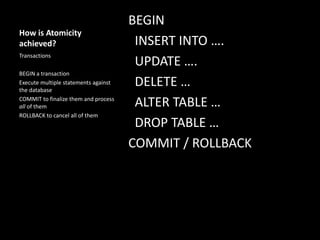
How is Atomicity
achieved?
BEGIN
INSERT INTO ….
UPDATE ….
DELETE …
ALTER TABLE …
DROP TABLE …
COMMIT / ROLLBACK
Transactions
BEGIN a transaction
Execute multiple statements against
the database
COMMIT to finalize them and process
all of them
ROLLBACK to cancel all of them
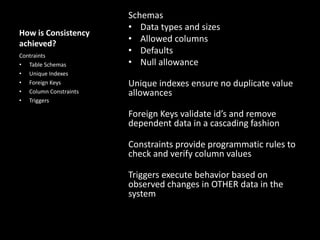
How is Consistency
achieved?
Schemas
• Data types and sizes
• Allowed columns
• Defaults
• Null allowance
Unique indexes ensure no duplicate value
allowances
Foreign Keys validate id’s and remove
dependent data in a cascading fashion
Constraints provide programmatic rules to
check and verify column values
Triggers execute behavior based on
observed changes in OTHER data in the
system
Contraints
• Table Schemas
• Unique Indexes
• Foreign Keys
• Column Constraints
• Triggers
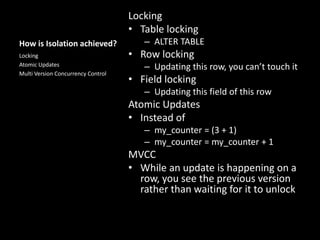
How is Isolation achieved?
Locking
• Table locking
– ALTER TABLE
• Row locking
– Updating this row, you can’t touch it
• Field locking
– Updating this field of this row
Atomic Updates
• Instead of
– my_counter = (3 + 1)
– my_counter = my_counter + 1
MVCC
• While an update is happening on a
row, you see the previous version
rather than waiting for it to unlock
Locking
Atomic Updates
Multi Version Concurrency Control
How is Durability
achieved?
It must write to the hard drive
Also, synchronous replication to
ensure a backup is always
available
This is pretty simple…
SO WHY DOES ALL THAT MATTER?
I’m glad you asked…
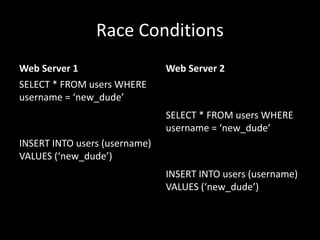
Race Conditions
Web Server 1
SELECT * FROM users WHERE
username = ‘new_dude’
INSERT INTO users (username)
VALUES (‘new_dude’)
Web Server 2
SELECT * FROM users WHERE
username = ‘new_dude’
INSERT INTO users (username)
VALUES (‘new_dude’)
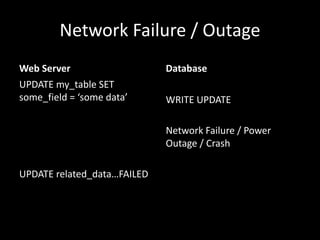
Network Failure / Outage
Web Server
UPDATE my_table SET
some_field = ‘some data’
UPDATE related_data…FAILED
Database
WRITE UPDATE
Network Failure / Power
Outage / Crash
DATABASE RULES WILL ENSURE
DATA INTEGRITY
Outside systems cannot make that guarantee…ever
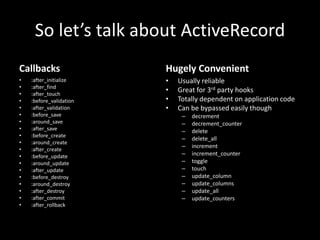
So let’s talk about ActiveRecord
Callbacks
• :after_initialize
• :after_find
• :after_touch
• :before_validation
• :after_validation
• :before_save
• :around_save
• :after_save
• :before_create
• :around_create
• :after_create
• :before_update
• :around_update
• :after_update
• :before_destroy
• :around_destroy
• :after_destroy
• :after_commit
• :after_rollback
Hugely Convenient
• Usually reliable
• Great for 3rd party hooks
• Totally dependent on application code
• Can be bypassed easily though
– decrement
– decrement_counter
– delete
– delete_all
– increment
– increment_counter
– toggle
– touch
– update_column
– update_columns
– update_all
– update_counters
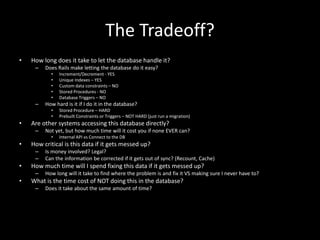
The Tradeoff?
• How long does it take to let the database handle it?
– Does Rails make letting the database do it easy?
• Increment/Decrement - YES
• Unique Indexes – YES
• Custom data constraints – NO
• Stored Procedures - NO
• Database Triggers – NO
– How hard is it if I do it in the database?
• Stored Procedure – HARD
• Prebuilt Constraints or Triggers – NOT HARD (just run a migration)
• Are other systems accessing this database directly?
– Not yet, but how much time will it cost you if none EVER can?
• Internal API vs Connect to the DB
• How critical is this data if it gets messed up?
– Is money involved? Legal?
– Can the information be corrected if it gets out of sync? (Recount, Cache)
• How much time will I spend fixing this data if it gets messed up?
– How long will it take to find where the problem is and fix it VS making sure I never have to?
• What is the time cost of NOT doing this in the database?
– Does it take about the same amount of time?
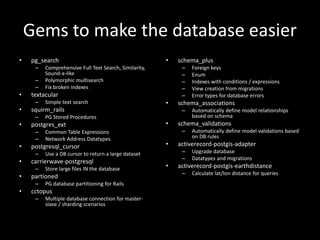
Gems to make the database easier
• pg_search
– Comprehensive Full Text Search, Similarity,
Sound-a-like
– Polymorphic multisearch
– Fix broken indexes
• textacular
– Simple text search
• squirm_rails
– PG Stored Procedures
• postgres_ext
– Common Table Expressions
– Network Address Datatypes
• postgresql_cursor
– Use a DB cursor to return a large dataset
• carrierwave-postgresql
– Store large files IN the database
• partioned
– PG database partitioning for Rails
• cctopus
– Multiple database connection for master-
slave / sharding scenarios
• schema_plus
– Foreign keys
– Enum
– Indexes with conditions / expressions
– View creation from migrations
– Error types for database errors
• schema_associations
– Automatically define model relationships
based on schema
• schema_validations
– Automatically define model validations based
on DB rules
• activerecord-postgis-adapter
– Upgrade database
– Datatypes and migrations
• activerecord-postgis-earthdistance
– Calculate lat/lon distance for queries
So, let’s do it
• Go to your project and open a rails console
– Type `rails console`
– Fully loaded rails application that you can code
against
Adding Data
• http://guides.rubyonrails.org/active_record_b
asics.html#crud-reading-and-writing-data
Validations
• http://guides.rubyonrails.org/active_record_v
alidations.html
Queries
• http://guides.rubyonrails.org/active_record_q
uerying.html#conditions
Callbacks
• http://guides.rubyonrails.org/active_record_c
allbacks.html
Associations
• http://guides.rubyonrails.org/association_basi
cs.html
Scopes
• http://guides.rubyonrails.org/active_record_q
uerying.html#scopes
Build a query in parts
• Add conditions
• Update your query in multiple steps
• Change things with overrides
– http://guides.rubyonrails.org/active_record_quer
ying.html#overriding-conditions
Transactions and Locking
• http://guides.rubyonrails.org/active_record_q
uerying.html#locking-records-for-update
Calculations
• http://guides.rubyonrails.org/active_record_q
uerying.html#calculations
Pluck
• http://guides.rubyonrails.org/active_record_q
uerying.html#pluck
Explain
• http://guides.rubyonrails.org/active_record_q
uerying.html#running-explain
PostgreSQL Custom
Datatypes
• Excellent blog post that
covers, uuid, hstore, array
• http://yousefourabi.com/bl
og/2014/03/rails-
postgresql/
uuid
hstore
Array

Day 4 - Models

  • 1.
    Assignment 1 Review Questions?Comments? Concerns? Too much? Too little? Anything we should have covered more?
  • 2.
    MODELS! And other suchrelated topics and things
  • 3.
    Pillars of RelationalDatabases • ACID Compliance • Atomicity – All or nothing, multipart transactions • Consistency – Data written must be valid according to all rules • Isolation – If transactions are executed concurrently, the result will be the same as if they are executed serially • Durability – Once committed the data is stored safely in the event of power failure or crash
  • 4.
    How is Atomicity achieved? BEGIN INSERTINTO …. UPDATE …. DELETE … ALTER TABLE … DROP TABLE … COMMIT / ROLLBACK Transactions BEGIN a transaction Execute multiple statements against the database COMMIT to finalize them and process all of them ROLLBACK to cancel all of them
  • 5.
    How is Consistency achieved? Schemas •Data types and sizes • Allowed columns • Defaults • Null allowance Unique indexes ensure no duplicate value allowances Foreign Keys validate id’s and remove dependent data in a cascading fashion Constraints provide programmatic rules to check and verify column values Triggers execute behavior based on observed changes in OTHER data in the system Contraints • Table Schemas • Unique Indexes • Foreign Keys • Column Constraints • Triggers
  • 6.
    How is Isolationachieved? Locking • Table locking – ALTER TABLE • Row locking – Updating this row, you can’t touch it • Field locking – Updating this field of this row Atomic Updates • Instead of – my_counter = (3 + 1) – my_counter = my_counter + 1 MVCC • While an update is happening on a row, you see the previous version rather than waiting for it to unlock Locking Atomic Updates Multi Version Concurrency Control
  • 7.
    How is Durability achieved? Itmust write to the hard drive Also, synchronous replication to ensure a backup is always available This is pretty simple…
  • 8.
    SO WHY DOESALL THAT MATTER? I’m glad you asked…
  • 9.
    Race Conditions Web Server1 SELECT * FROM users WHERE username = ‘new_dude’ INSERT INTO users (username) VALUES (‘new_dude’) Web Server 2 SELECT * FROM users WHERE username = ‘new_dude’ INSERT INTO users (username) VALUES (‘new_dude’)
  • 10.
    Network Failure /Outage Web Server UPDATE my_table SET some_field = ‘some data’ UPDATE related_data…FAILED Database WRITE UPDATE Network Failure / Power Outage / Crash
  • 11.
    DATABASE RULES WILLENSURE DATA INTEGRITY Outside systems cannot make that guarantee…ever
  • 12.
    So let’s talkabout ActiveRecord Callbacks • :after_initialize • :after_find • :after_touch • :before_validation • :after_validation • :before_save • :around_save • :after_save • :before_create • :around_create • :after_create • :before_update • :around_update • :after_update • :before_destroy • :around_destroy • :after_destroy • :after_commit • :after_rollback Hugely Convenient • Usually reliable • Great for 3rd party hooks • Totally dependent on application code • Can be bypassed easily though – decrement – decrement_counter – delete – delete_all – increment – increment_counter – toggle – touch – update_column – update_columns – update_all – update_counters
  • 13.
    The Tradeoff? • Howlong does it take to let the database handle it? – Does Rails make letting the database do it easy? • Increment/Decrement - YES • Unique Indexes – YES • Custom data constraints – NO • Stored Procedures - NO • Database Triggers – NO – How hard is it if I do it in the database? • Stored Procedure – HARD • Prebuilt Constraints or Triggers – NOT HARD (just run a migration) • Are other systems accessing this database directly? – Not yet, but how much time will it cost you if none EVER can? • Internal API vs Connect to the DB • How critical is this data if it gets messed up? – Is money involved? Legal? – Can the information be corrected if it gets out of sync? (Recount, Cache) • How much time will I spend fixing this data if it gets messed up? – How long will it take to find where the problem is and fix it VS making sure I never have to? • What is the time cost of NOT doing this in the database? – Does it take about the same amount of time?
  • 14.
    Gems to makethe database easier • pg_search – Comprehensive Full Text Search, Similarity, Sound-a-like – Polymorphic multisearch – Fix broken indexes • textacular – Simple text search • squirm_rails – PG Stored Procedures • postgres_ext – Common Table Expressions – Network Address Datatypes • postgresql_cursor – Use a DB cursor to return a large dataset • carrierwave-postgresql – Store large files IN the database • partioned – PG database partitioning for Rails • cctopus – Multiple database connection for master- slave / sharding scenarios • schema_plus – Foreign keys – Enum – Indexes with conditions / expressions – View creation from migrations – Error types for database errors • schema_associations – Automatically define model relationships based on schema • schema_validations – Automatically define model validations based on DB rules • activerecord-postgis-adapter – Upgrade database – Datatypes and migrations • activerecord-postgis-earthdistance – Calculate lat/lon distance for queries
  • 15.
    So, let’s doit • Go to your project and open a rails console – Type `rails console` – Fully loaded rails application that you can code against
  • 16.
  • 17.
  • 18.
  • 19.
  • 20.
  • 21.
  • 22.
    Build a queryin parts • Add conditions • Update your query in multiple steps • Change things with overrides – http://guides.rubyonrails.org/active_record_quer ying.html#overriding-conditions
  • 23.
    Transactions and Locking •http://guides.rubyonrails.org/active_record_q uerying.html#locking-records-for-update
  • 24.
  • 25.
  • 26.
  • 27.
    PostgreSQL Custom Datatypes • Excellentblog post that covers, uuid, hstore, array • http://yousefourabi.com/bl og/2014/03/rails- postgresql/ uuid hstore Array