What is a clause?
• The subject of a sentence is the person or thing that is carrying
out the main action of that sentence.
• Verbs can describe an action (e.g. sing, climb),
emotion (e.g. loves, hates), thought (e.g. thinks),
opinion (e.g. believes) or state of being (e.g. am,
is, are, was, were).
• A clause is a group of words that contains a
verb and a subject.
• There are two types of clauses, main
and subordinate.
Main Clause
• A main clause is the key part of a sentence. Every sentence has a
main clause. A main clause can form a complete sentence; it makes
sense on its own.
Subordinate Clause
• A subordinate clause gives us more information about the main
clause. If we removed the main clause, a subordinate clause would
not make sense on its own, it is not a ‘full’ sentence.
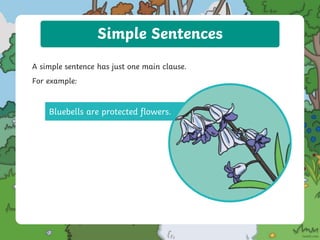
Simple Sentences
A simple sentence has just one main clause.
For example:
Bluebells are protected flowers.
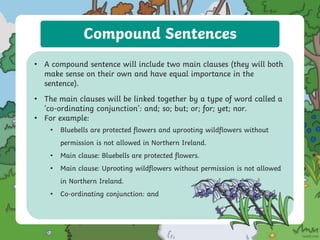
Compound Sentences
• A compound sentence will include two main clauses (they will both
make sense on their own and have equal importance in the
sentence).
• The main clauses will be linked together by a type of word called a
‘co-ordinating conjunction’: and; so; but; or; for; yet; nor.
• For example:
• Bluebells are protected flowers and uprooting wildflowers without
permission is not allowed in Northern Ireland.
• Main clause: Bluebells are protected flowers.
• Main clause: Uprooting wildflowers without permission is not allowed
in Northern Ireland.
• Co-ordinating conjunction: and
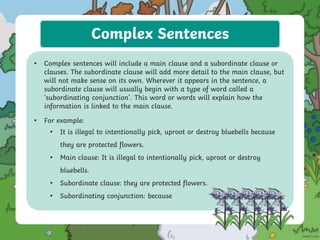
Complex Sentences
• Complex sentences will include a main clause and a subordinate clause or
clauses. The subordinate clause will add more detail to the main clause, but
will not make sense on its own. Wherever it appears in the sentence, a
subordinate clause will usually begin with a type of word called a
‘subordinating conjunction’. This word or words will explain how the
information is linked to the main clause.
• For example:
• It is illegal to intentionally pick, uproot or destroy bluebells because
they are protected flowers.
• Main clause: It is illegal to intentionally pick, uproot or destroy
bluebells.
• Subordinate clause: they are protected flowers.
• Subordinating conjunction: because
Activity 1
• Read the sentence and decide if it is a simple, compound or
complex sentence.
Roses are red and violets are blue.
Compound
Activity 2
• Read the sentence and decide if it is a simple, compound or
complex sentence.
I can search for minibeasts, now that I’ve
finished my homework.
Complex
Activity 3
• Read the sentence and decide if it is a simple, compound or
complex sentence.
Wintry weather might include frost, hail,
sleet and snow.
Simple
Activity 4
• Read the sentence and decide if it is a simple, compound or
complex sentence.
Even though it was about to rain, I wanted to go
for a walk.
Complex
Activity 5
• Read the sentence and decide if it is a simple, compound or
complex sentence.
Many trees are bare in winter but evergreen
trees do not lose their leaves.
Compound
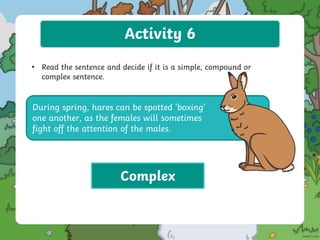
Activity 6
• Read the sentence and decide if it is a simple, compound or
complex sentence.
During spring, hares can be spotted ‘boxing’
one another, as the females will sometimes
fight off the attention of the males.
Complex
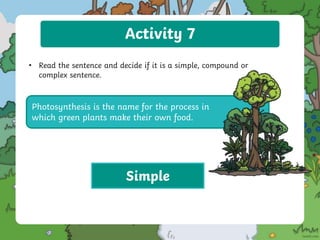
Activity 7
• Read the sentence and decide if it is a simple, compound or
complex sentence.
Photosynthesis is the name for the process in
which green plants make their own food.
Simple
Activity 8
• Read the sentence and decide if it is a simple, compound or
complex sentence.
The winter solstice occurs in December and
the summer solstice takes place in June.
Compound
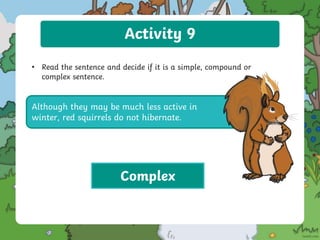
Activity 9
• Read the sentence and decide if it is a simple, compound or
complex sentence.
Although they may be much less active in
winter, red squirrels do not hibernate.
Complex
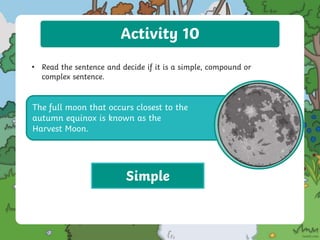
Activity 10
• Read the sentence and decide if it is a simple, compound or
complex sentence.
The full moon that occurs closest to the
autumn equinox is known as the
Harvest Moon.
Simple
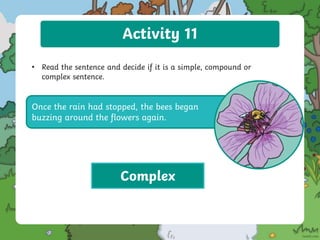
Activity 11
• Read the sentence and decide if it is a simple, compound or
complex sentence.
Once the rain had stopped, the bees began
buzzing around the flowers again.
Complex
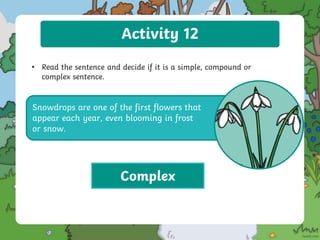
Activity 12
• Read the sentence and decide if it is a simple, compound or
complex sentence.
Snowdrops are one of the first flowers that
appear each year, even blooming in frost
or snow.
Complex
2nd class
Students are divided in 3 groups: simple, compound, and complex sentences.
In the court, there are several sentences for students to collect.
They must identify if the sentence is simple, compound, or complex.
The group that gathers all the sentences correctly wins.
Day 2 Simple, Compound, Complex Sentences Game.pptx

Day 2 Simple, Compound, Complex Sentences Game.pptx

  • 2.
    What is aclause? • The subject of a sentence is the person or thing that is carrying out the main action of that sentence. • Verbs can describe an action (e.g. sing, climb), emotion (e.g. loves, hates), thought (e.g. thinks), opinion (e.g. believes) or state of being (e.g. am, is, are, was, were). • A clause is a group of words that contains a verb and a subject. • There are two types of clauses, main and subordinate.
  • 3.
    Main Clause • Amain clause is the key part of a sentence. Every sentence has a main clause. A main clause can form a complete sentence; it makes sense on its own.
  • 4.
    Subordinate Clause • Asubordinate clause gives us more information about the main clause. If we removed the main clause, a subordinate clause would not make sense on its own, it is not a ‘full’ sentence.
  • 5.
    Simple Sentences A simplesentence has just one main clause. For example: Bluebells are protected flowers.
  • 6.
    Compound Sentences • Acompound sentence will include two main clauses (they will both make sense on their own and have equal importance in the sentence). • The main clauses will be linked together by a type of word called a ‘co-ordinating conjunction’: and; so; but; or; for; yet; nor. • For example: • Bluebells are protected flowers and uprooting wildflowers without permission is not allowed in Northern Ireland. • Main clause: Bluebells are protected flowers. • Main clause: Uprooting wildflowers without permission is not allowed in Northern Ireland. • Co-ordinating conjunction: and
  • 7.
    Complex Sentences • Complexsentences will include a main clause and a subordinate clause or clauses. The subordinate clause will add more detail to the main clause, but will not make sense on its own. Wherever it appears in the sentence, a subordinate clause will usually begin with a type of word called a ‘subordinating conjunction’. This word or words will explain how the information is linked to the main clause. • For example: • It is illegal to intentionally pick, uproot or destroy bluebells because they are protected flowers. • Main clause: It is illegal to intentionally pick, uproot or destroy bluebells. • Subordinate clause: they are protected flowers. • Subordinating conjunction: because
  • 8.
    Activity 1 • Readthe sentence and decide if it is a simple, compound or complex sentence. Roses are red and violets are blue. Compound
  • 9.
    Activity 2 • Readthe sentence and decide if it is a simple, compound or complex sentence. I can search for minibeasts, now that I’ve finished my homework. Complex
  • 10.
    Activity 3 • Readthe sentence and decide if it is a simple, compound or complex sentence. Wintry weather might include frost, hail, sleet and snow. Simple
  • 11.
    Activity 4 • Readthe sentence and decide if it is a simple, compound or complex sentence. Even though it was about to rain, I wanted to go for a walk. Complex
  • 12.
    Activity 5 • Readthe sentence and decide if it is a simple, compound or complex sentence. Many trees are bare in winter but evergreen trees do not lose their leaves. Compound
  • 13.
    Activity 6 • Readthe sentence and decide if it is a simple, compound or complex sentence. During spring, hares can be spotted ‘boxing’ one another, as the females will sometimes fight off the attention of the males. Complex
  • 14.
    Activity 7 • Readthe sentence and decide if it is a simple, compound or complex sentence. Photosynthesis is the name for the process in which green plants make their own food. Simple
  • 15.
    Activity 8 • Readthe sentence and decide if it is a simple, compound or complex sentence. The winter solstice occurs in December and the summer solstice takes place in June. Compound
  • 16.
    Activity 9 • Readthe sentence and decide if it is a simple, compound or complex sentence. Although they may be much less active in winter, red squirrels do not hibernate. Complex
  • 17.
    Activity 10 • Readthe sentence and decide if it is a simple, compound or complex sentence. The full moon that occurs closest to the autumn equinox is known as the Harvest Moon. Simple
  • 18.
    Activity 11 • Readthe sentence and decide if it is a simple, compound or complex sentence. Once the rain had stopped, the bees began buzzing around the flowers again. Complex
  • 19.
    Activity 12 • Readthe sentence and decide if it is a simple, compound or complex sentence. Snowdrops are one of the first flowers that appear each year, even blooming in frost or snow. Complex
  • 20.
    2nd class Students aredivided in 3 groups: simple, compound, and complex sentences. In the court, there are several sentences for students to collect. They must identify if the sentence is simple, compound, or complex. The group that gathers all the sentences correctly wins.