Supply and Demand Insights
from Research
Josephine Kibe, CGAP
14 June 2016
Key Findings
• Demand, openness and perception of benefits
• Organizational culture shift around e-learning
• Content priority areas
• Technical capability and considerations
• Staff IT skills
• Contribution to career progression
Demand Study: Methodology and Objectives
30 interviews were conducted with FSP managers across SSA, 13 with industry
stakeholders and 149 FSP staff completed an online survey.
Study focus areas:
• Content - technical skills, managerial skills and industry knowledge required of
Financial Service Providers’ (FSPs) staff members from the perspective of
individuals, their managers and other industry stakeholders.
• Technical Capabilities - engagement modality preferences and
technological constraints.
• Willingness to pay - at an individual and institutional level
Content
Technical
• Credit management (individual)
• Customer service and client satisfaction
• Delinquency management
• Risk management (credit)
• Loan appraisal and monitoring – SME
Leadership and Management
• People management and motivation
• Management essentials – mid level
• Strategic planning
• People management – delegation
• Communication skills
• Microfinance / financial inclusion essentials
• Mobile banking
• Digital finance
• Agriculture finance
• Regulation and compliance principles
Industry knowledge
Willingness to Pay
2.6%
17.9%
25.6%
25.6%
12.8%
5.1%
7.7%
12.0%
18.1%
16.9%
24.1%
12.0%
10.8%
3.6%
1.2%
0
1 - 250 USD
251 - 500 USD
501 - 1,000 USD
1,001- 2,000 USD
2,001-5,000 USD
5,001-10,000 USD
10,001-20,000USD
% of respondents
Seven countries
Rest of SSA
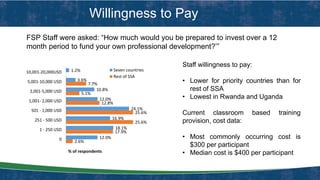
FSP Staff were asked: “How much would you be prepared to invest over a 12
month period to fund your own professional development?’”
Staff willingness to pay:
• Lower for priority countries than for
rest of SSA
• Lowest in Rwanda and Uganda
Current classroom based training
provision, cost data:
• Most commonly occurring cost is
$300 per participant
• Median cost is $400 per participant
Technical Capabilities
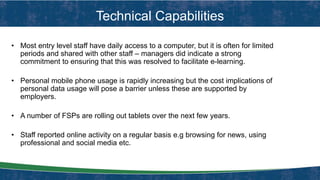
• Most entry level staff have daily access to a computer, but it is often for limited
periods and shared with other staff – managers did indicate a strong
commitment to ensuring that this was resolved to facilitate e-learning.
• Personal mobile phone usage is rapidly increasing but the cost implications of
personal data usage will pose a barrier unless these are supported by
employers.
• A number of FSPs are rolling out tablets over the next few years.
• Staff reported online activity on a regular basis e.g browsing for news, using
professional and social media etc.
Design Considerations
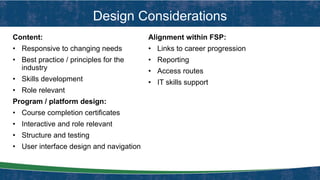
Content:
• Responsive to changing needs
• Best practice / principles for the
industry
• Skills development
• Role relevant
Program / platform design:
• Course completion certificates
• Interactive and role relevant
• Structure and testing
• User interface design and navigation
Alignment within FSP:
• Links to career progression
• Reporting
• Access routes
• IT skills support
Implications for the Academy
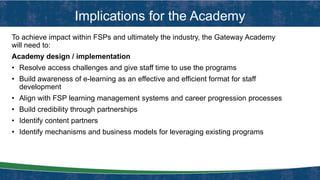
To achieve impact within FSPs and ultimately the industry, the Gateway Academy
will need to:
Academy design / implementation
• Resolve access challenges and give staff time to use the programs
• Build awareness of e-learning as an effective and efficient format for staff
development
• Align with FSP learning management systems and career progression processes
• Build credibility through partnerships
• Identify content partners
• Identify mechanisms and business models for leveraging existing programs
• Effect a culture change regarding efficacy of e-learning within target FSPs
• Shift the dominant focus on loan officer induction training to a broader focus on a
wider curriculum
• Work with industry actors to generate support and interest
• Create a pool of advocates for the Academy to support early adoption
Industry Engagement
Thank you

Day 1 Supply and Demand

  • 1.
    Supply and DemandInsights from Research Josephine Kibe, CGAP 14 June 2016
  • 2.
    Key Findings • Demand,openness and perception of benefits • Organizational culture shift around e-learning • Content priority areas • Technical capability and considerations • Staff IT skills • Contribution to career progression
  • 3.
    Demand Study: Methodologyand Objectives 30 interviews were conducted with FSP managers across SSA, 13 with industry stakeholders and 149 FSP staff completed an online survey. Study focus areas: • Content - technical skills, managerial skills and industry knowledge required of Financial Service Providers’ (FSPs) staff members from the perspective of individuals, their managers and other industry stakeholders. • Technical Capabilities - engagement modality preferences and technological constraints. • Willingness to pay - at an individual and institutional level
  • 4.
    Content Technical • Credit management(individual) • Customer service and client satisfaction • Delinquency management • Risk management (credit) • Loan appraisal and monitoring – SME Leadership and Management • People management and motivation • Management essentials – mid level • Strategic planning • People management – delegation • Communication skills
  • 5.
    • Microfinance /financial inclusion essentials • Mobile banking • Digital finance • Agriculture finance • Regulation and compliance principles Industry knowledge
  • 6.
    Willingness to Pay 2.6% 17.9% 25.6% 25.6% 12.8% 5.1% 7.7% 12.0% 18.1% 16.9% 24.1% 12.0% 10.8% 3.6% 1.2% 0 1- 250 USD 251 - 500 USD 501 - 1,000 USD 1,001- 2,000 USD 2,001-5,000 USD 5,001-10,000 USD 10,001-20,000USD % of respondents Seven countries Rest of SSA FSP Staff were asked: “How much would you be prepared to invest over a 12 month period to fund your own professional development?’” Staff willingness to pay: • Lower for priority countries than for rest of SSA • Lowest in Rwanda and Uganda Current classroom based training provision, cost data: • Most commonly occurring cost is $300 per participant • Median cost is $400 per participant
  • 7.
    Technical Capabilities • Mostentry level staff have daily access to a computer, but it is often for limited periods and shared with other staff – managers did indicate a strong commitment to ensuring that this was resolved to facilitate e-learning. • Personal mobile phone usage is rapidly increasing but the cost implications of personal data usage will pose a barrier unless these are supported by employers. • A number of FSPs are rolling out tablets over the next few years. • Staff reported online activity on a regular basis e.g browsing for news, using professional and social media etc.
  • 8.
    Design Considerations Content: • Responsiveto changing needs • Best practice / principles for the industry • Skills development • Role relevant Program / platform design: • Course completion certificates • Interactive and role relevant • Structure and testing • User interface design and navigation Alignment within FSP: • Links to career progression • Reporting • Access routes • IT skills support
  • 9.
    Implications for theAcademy To achieve impact within FSPs and ultimately the industry, the Gateway Academy will need to: Academy design / implementation • Resolve access challenges and give staff time to use the programs • Build awareness of e-learning as an effective and efficient format for staff development • Align with FSP learning management systems and career progression processes • Build credibility through partnerships • Identify content partners • Identify mechanisms and business models for leveraging existing programs
  • 10.
    • Effect aculture change regarding efficacy of e-learning within target FSPs • Shift the dominant focus on loan officer induction training to a broader focus on a wider curriculum • Work with industry actors to generate support and interest • Create a pool of advocates for the Academy to support early adoption Industry Engagement
  • 11.