“ DON’T SHOOT” Police Leadership Conference Vancouver, BC Canada April 13, 2012 David M. Kennedy Director Center for Crime Prevention and Control John Jay College of Criminal Justice [email_address] 212 484-1323
IN MANY OF OUR CITIES, CRIME IS VERY SERIOUS Violent crime remains very high in some places, even in “safe” cities Concentrated in poor minority neighborhoods Concentrated by place and group even within those neighborhoods Driven by violent groups and drug markets
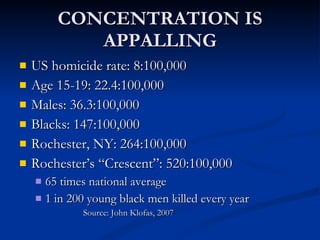
CONCENTRATION IS APPALLING US homicide rate: 8:100,000 Age 15-19: 22.4:100,000 Males: 36.3:100,000 Blacks: 147:100,000 Rochester, NY: 264:100,000 Rochester’s “Crescent”: 520:100,000 65 times national average 1 in 200 young black men killed every year Source: John Klofas, 2007
WHAT WE’D LIKE TO BE ABLE TO DO Eliminate gangs Enforcement Prevention and intervention Prevent gang offending Stop recruitment Separate gang members from gangs “ Solve the gang problem”
THE UNPLEASANT TRUTH There is no evidence that any approaches or combination of approaches can accomplish any of these goals Nobody has ever addressed a serious gang problem effectively in these ways Effects of traditional interventions, when they exist, are small, and smaller for the most serious offenders and offending
WHY MOST OF WHAT WE DO DOESN’T WORK We continue to pursue strongly held and desirable goals, using strongly felt and logical means, that so far cannot be attained and are not effective We separate authority, services, and moral engagement We address individuals, not “gangs” and groups We do not engage directly with the street culture
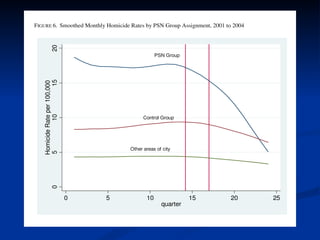
WHAT WE CAN DO Have a large, rapid impact on selected elements of gang behavior
 
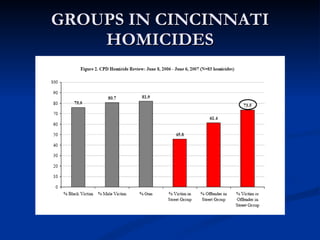
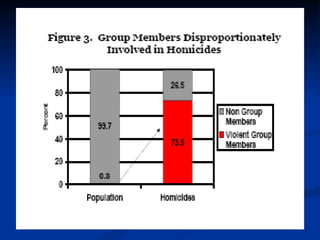
THIS IS ABOUT GROUPS AND GROUP DYNAMICS Groups drive a huge share of the action Cincinnati: ~60 groups/1500 people/75% of the homicide/0.3% of the city Doesn’t matter if they’re “gangs” Group dynamics drive things – groups are different than individuals Groups carry the street code Vendettas and rivalries “ Pluralistic ignorance” So: identify and engage with these groups
REALITY OF THESE GROUPS Most not what we think of as “gangs” Most “gangs” aren’t what we think of as gangs No real leadership Little organization or hierarchy Little common purpose Most violence basically personal, not economic “ Gangs” can be a huge distraction
THE BASIC FRAMEWORK Wide-ranging partnership: law enforcement, community, services Very small target populations Violent groups Direct, sustained communication with offenders  as groups Simple, unified message The community needs this to stop We’ll help We’re not asking: consequences are certain Meticulous follow-up
VERY  SMALL POPULATION Even in hardest-hit neighborhoods, typically less than 5% of young men in high-risk age group Even fewer “impact players” Enormous impact on community, next age group
OFFENDER IDEAS MATTER THE MOST Majority of violence, usually, not about business: beefs, boy/girl, respect We’re really dealing with the street code Disrespect requires violence We’re not afraid of death or prison We handle our own business We’ve got each other’s back We’re victims We’re justified in what we do
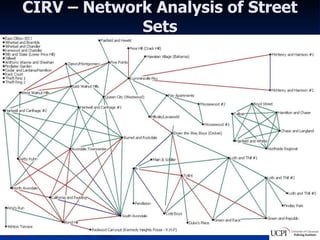
CIRV – Network Analysis of Street Sets Red – Beef Green – Alliance Blue – Volatile
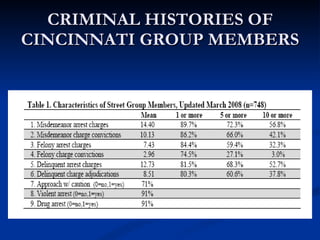
CRIMINAL HISTORIES OF CINCINNATI GROUP MEMBERS
GROUPS IN CINCINNATI HOMICIDES
 
STRATEGIC INTERVENTION Direct, sustained engagement with street groups: community, services, law enforcement standing and acting  together Face-to-face with groups Explicit focus on violence
1) CONSEQUENCES Group accountability for homicide: group dynamic, group sanction Last resort Explained ahead of time By any legal means: “pulling levers” Most serious sanctions on impact players Careful promise: sanction on next homicide; on most violent group Reversal of pro-violence peer pressure “ Honorable exit”
2) MORAL ENGAGEMENT WITH OFFEN DERS Offenders can and will choose, are responsible human beings There’s right, there’s wrong, no gray area Enormous harm being done – community can’t have it Engagement with dangerous and mistaken street code Everyone is important, everyone matters Best with “influentials” involved
THIS COMES BEST FROM THE COMMUNITY ITSELF Why don’t we get this naturally? Community racial narratives Unpopularity of even legitimate actions  Real illegality and abuse Community narrative: conspiracy and deliberate oppression, the latest in a long history Community anger, suspicion, and silence misunderstood by law enforcement and dealers as tolerance for crime and violence
ADDRESS KEY NORMS AND NARRATIVES In order for law enforcement and community to truly work together, mutual and toxic misunderstandings need to be explicitly addressed Law enforcement is not solving problem, is doing harm, is playing into racial stereotypes Community is not taking responsibility, is not setting standards, is playing into racial stereotypes
THE MORAL VOICE OF THE COMMUNITY Clear, direct, community stand Most important step possible Respected local figures Parents Ministers, mothers, activists “ Do you want your mother standing here?” “ We need you, you’re better than this.” Offenders and ex-offenders “ Shot any CIA agents lately?” “ Who helped your mother last time you were locked up?” “ Who thinks it’s OK for little kids to get shot?”
3) HELP IS A MORAL AND PRACTICAL OBLIGATION Everyone who wants it deserves it Some will take it Changes moral narratives Has to be honest We will do everything we can Limited resources and effectiveness don’t change the core fact that the violence is completely unacceptable Teny Gross: “We don’t negotiate life”
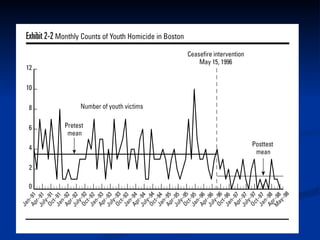
DIRECT ENGAGEMENT You have to communicate with the groups “ Forums”: group members who happen to be on probation – way of communicating city-wide with most or all groups at once.  Not about the people in the room  (Boston ) Community call-ins, individual offenders on parole/probation (Chicago) Community call-ins of identified offenders, voluntary with hook (High Point model) Purely voluntary: Cincinnati, Providence, others
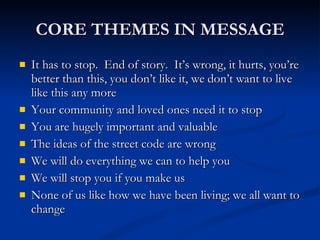
CORE THEMES IN MESSAGE It has to stop.  End of story.  It’s wrong, it hurts, you’re better than this, you don’t like it, we don’t want to live like this any more Your community and loved ones need it to stop You are hugely important and valuable The ideas of the street code are wrong We will do everything we can to help you We will stop you if you make us None of us like how we have been living; we all want to change
 
 
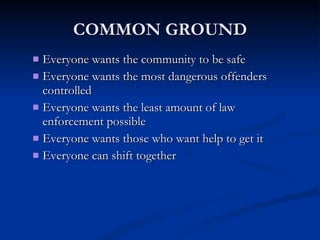
COMMON GROUND Everyone wants the community to be safe Everyone wants the most dangerous offenders controlled  Everyone wants the least amount of law enforcement possible Everyone wants those who want help to get it Everyone can shift together
NATIONAL NETWORK  FOR  SAFE COMMUNITIES  www.nnscommunities.org

David Kennedy

  • 1.
    “ DON’T SHOOT”Police Leadership Conference Vancouver, BC Canada April 13, 2012 David M. Kennedy Director Center for Crime Prevention and Control John Jay College of Criminal Justice [email_address] 212 484-1323
  • 2.
    IN MANY OFOUR CITIES, CRIME IS VERY SERIOUS Violent crime remains very high in some places, even in “safe” cities Concentrated in poor minority neighborhoods Concentrated by place and group even within those neighborhoods Driven by violent groups and drug markets
  • 3.
    CONCENTRATION IS APPALLINGUS homicide rate: 8:100,000 Age 15-19: 22.4:100,000 Males: 36.3:100,000 Blacks: 147:100,000 Rochester, NY: 264:100,000 Rochester’s “Crescent”: 520:100,000 65 times national average 1 in 200 young black men killed every year Source: John Klofas, 2007
  • 4.
    WHAT WE’D LIKETO BE ABLE TO DO Eliminate gangs Enforcement Prevention and intervention Prevent gang offending Stop recruitment Separate gang members from gangs “ Solve the gang problem”
  • 5.
    THE UNPLEASANT TRUTHThere is no evidence that any approaches or combination of approaches can accomplish any of these goals Nobody has ever addressed a serious gang problem effectively in these ways Effects of traditional interventions, when they exist, are small, and smaller for the most serious offenders and offending
  • 6.
    WHY MOST OFWHAT WE DO DOESN’T WORK We continue to pursue strongly held and desirable goals, using strongly felt and logical means, that so far cannot be attained and are not effective We separate authority, services, and moral engagement We address individuals, not “gangs” and groups We do not engage directly with the street culture
  • 7.
    WHAT WE CANDO Have a large, rapid impact on selected elements of gang behavior
  • 8.
  • 9.
    THIS IS ABOUTGROUPS AND GROUP DYNAMICS Groups drive a huge share of the action Cincinnati: ~60 groups/1500 people/75% of the homicide/0.3% of the city Doesn’t matter if they’re “gangs” Group dynamics drive things – groups are different than individuals Groups carry the street code Vendettas and rivalries “ Pluralistic ignorance” So: identify and engage with these groups
  • 10.
    REALITY OF THESEGROUPS Most not what we think of as “gangs” Most “gangs” aren’t what we think of as gangs No real leadership Little organization or hierarchy Little common purpose Most violence basically personal, not economic “ Gangs” can be a huge distraction
  • 11.
    THE BASIC FRAMEWORKWide-ranging partnership: law enforcement, community, services Very small target populations Violent groups Direct, sustained communication with offenders as groups Simple, unified message The community needs this to stop We’ll help We’re not asking: consequences are certain Meticulous follow-up
  • 12.
    VERY SMALLPOPULATION Even in hardest-hit neighborhoods, typically less than 5% of young men in high-risk age group Even fewer “impact players” Enormous impact on community, next age group
  • 13.
    OFFENDER IDEAS MATTERTHE MOST Majority of violence, usually, not about business: beefs, boy/girl, respect We’re really dealing with the street code Disrespect requires violence We’re not afraid of death or prison We handle our own business We’ve got each other’s back We’re victims We’re justified in what we do
  • 14.
    CIRV – NetworkAnalysis of Street Sets Red – Beef Green – Alliance Blue – Volatile
  • 15.
    CRIMINAL HISTORIES OFCINCINNATI GROUP MEMBERS
  • 16.
  • 17.
  • 18.
    STRATEGIC INTERVENTION Direct,sustained engagement with street groups: community, services, law enforcement standing and acting together Face-to-face with groups Explicit focus on violence
  • 19.
    1) CONSEQUENCES Groupaccountability for homicide: group dynamic, group sanction Last resort Explained ahead of time By any legal means: “pulling levers” Most serious sanctions on impact players Careful promise: sanction on next homicide; on most violent group Reversal of pro-violence peer pressure “ Honorable exit”
  • 20.
    2) MORAL ENGAGEMENTWITH OFFEN DERS Offenders can and will choose, are responsible human beings There’s right, there’s wrong, no gray area Enormous harm being done – community can’t have it Engagement with dangerous and mistaken street code Everyone is important, everyone matters Best with “influentials” involved
  • 21.
    THIS COMES BESTFROM THE COMMUNITY ITSELF Why don’t we get this naturally? Community racial narratives Unpopularity of even legitimate actions Real illegality and abuse Community narrative: conspiracy and deliberate oppression, the latest in a long history Community anger, suspicion, and silence misunderstood by law enforcement and dealers as tolerance for crime and violence
  • 22.
    ADDRESS KEY NORMSAND NARRATIVES In order for law enforcement and community to truly work together, mutual and toxic misunderstandings need to be explicitly addressed Law enforcement is not solving problem, is doing harm, is playing into racial stereotypes Community is not taking responsibility, is not setting standards, is playing into racial stereotypes
  • 23.
    THE MORAL VOICEOF THE COMMUNITY Clear, direct, community stand Most important step possible Respected local figures Parents Ministers, mothers, activists “ Do you want your mother standing here?” “ We need you, you’re better than this.” Offenders and ex-offenders “ Shot any CIA agents lately?” “ Who helped your mother last time you were locked up?” “ Who thinks it’s OK for little kids to get shot?”
  • 24.
    3) HELP ISA MORAL AND PRACTICAL OBLIGATION Everyone who wants it deserves it Some will take it Changes moral narratives Has to be honest We will do everything we can Limited resources and effectiveness don’t change the core fact that the violence is completely unacceptable Teny Gross: “We don’t negotiate life”
  • 25.
    DIRECT ENGAGEMENT Youhave to communicate with the groups “ Forums”: group members who happen to be on probation – way of communicating city-wide with most or all groups at once. Not about the people in the room (Boston ) Community call-ins, individual offenders on parole/probation (Chicago) Community call-ins of identified offenders, voluntary with hook (High Point model) Purely voluntary: Cincinnati, Providence, others
  • 26.
    CORE THEMES INMESSAGE It has to stop. End of story. It’s wrong, it hurts, you’re better than this, you don’t like it, we don’t want to live like this any more Your community and loved ones need it to stop You are hugely important and valuable The ideas of the street code are wrong We will do everything we can to help you We will stop you if you make us None of us like how we have been living; we all want to change
  • 27.
  • 28.
  • 29.
    COMMON GROUND Everyonewants the community to be safe Everyone wants the most dangerous offenders controlled Everyone wants the least amount of law enforcement possible Everyone wants those who want help to get it Everyone can shift together
  • 30.
    NATIONAL NETWORK FOR SAFE COMMUNITIES www.nnscommunities.org