Database security &
Integrity
Presented by:
Ali Abbas
Database security
 Database security includes a variety of measures used
to secure database management systems from
malicious cyber-attacks and illegitimate use.
 Database security programs are designed to protect not
only the data within the database, but also the data
management system itself, and every application that
accesses it, from misuse, damage, and intrusion.
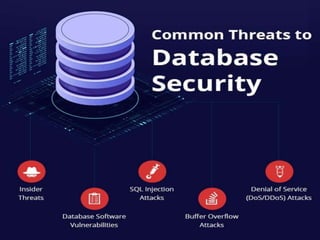
• SQL Injection: SQL injection occurs when an attacker
inserts malicious SQL code into a query to fool a
database into performing unintended commands that
lead to unauthorized data access, manipulation, or even
the complete compromise of a database. This can result
in accessing or altering sensitive information without
authorization and creating potential access violations for
further attacks against it.
• Unauthorized Access: Unauthorized access refers to
any unauthorized use or manipulation of sensitive data
stored in a database system by individuals who gain
entry via stolen credentials, weak authentication
mechanisms, or improper access control settings.
• Malware Attacks: Malware threats such as viruses,
pose significant dangers to databases. Malware
infections can enter through infected files or malicious
links and lead to corruption of the database contents, or
hijacking for illicit uses.
• Insider Threats: An insider threat is a type of cyber
attack originating from an individual who works for an
organization or has authorized access to its networks or
systems.
• An insider threat could be a current or former employee,
consultant, board member, or business partner and
could be intentional, unintentional, or malicious.
• Denial-of-Service (DoS) Attacks: DoS attacks seek to
disrupt the availability and functionality of databases by
flooding them with requests or malicious traffic, leading
to them becoming inaccessible or even crashing,
potentially leading to service disruptions and data loss.
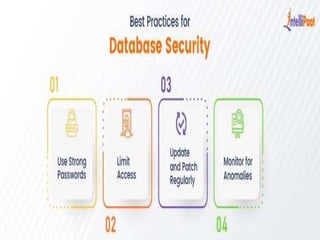
• Use Strong Passwords
Passwords serve as the initial barrier against
unauthorized entry into databases. Using weak
passwords makes it easier for hackers to gain access to
sensitive information. It is crucial to use strong
passwords that are complex and difficult to guess.
• Limit Access
Limiting access to databases is an effective way to
prevent unauthorized access to sensitive data. Not all
employees or users require access to all the data stored
in the database.
• Update and Patch Regularly
Keeping the database software up-to-date is crucial to
preventing any potential security vulnerabilities.
• Monitor for Anomalies
Detecting and preventing potential security threats can
be effectively achieved through the monitoring of
database anomalies.
Data Integrity
• Data integrity is the maintenance of data and the
validation of its accuracy and consistency throughout its
life cycle. Organizations maintain the integrity of the
information in their databases by referring to standards
and customized processes implemented during the
data's design phase.
• Types of data integrity:
1. Physical integrity
2. Logical integrity
Types
• Physical integrity refers to the methods organizations use to
ensure they can store and retrieve data in its complete,
accurate form.
• Logical integrity refers to the accuracy and consistency of
the data itself. Logical integrity ensures that the data makes
sense its context.
Types of logical integrity include:
1. Entity integrity:
2. Domain integrity:
3. Referential integrity:
4. User-defined integrity:
1. Entity integrity: Data professionals create primary keys for
individual points of data, which differentiate them from others. This
prevents data duplication and null tables, which have no value, in
relational databases.
2. Domain integrity: Domain integrity ensures the accuracy of each
piece of data in a domain, or a set of acceptable values. It may also
include constraints that restrict certain types of data.
3. Referential integrity: Referential integrity ensures the proper
storage and use of data. It may also contain constraints that prevent
duplicate data, inaccuracies or irrelevant data.
4. User-defined integrity: Users can define their own processes for
system integrity. User-defined integrity can help strengthen other
data integrity measures.
Data Integrity Risks
• Human error: Human error offers a major data integrity
risk to organizations. This is often caused by users
entering duplicate or incorrect data, deleting data, not
following protocols, or making mistakes with procedures
put in place to protect information.
• Bugs and Viruses: Hackers threaten organizations’
data integrity by using software, and viruses to attack
computers in an attempt to steal, amend, or delete user
data.
• Transfer errors: Companies experience data transfer
errors when personnel unsuccessfully attempt to send
information from one database to another. This typically
occurs when the data only exists in the destination table
but not in the source. Data professionals can prevent
transfer errors by implementing error detection programs
and keeping records of each time they add or modify
data.
How To Ensure Data Integrity?
• Validate Input
• Data entry must be validated and verified to ensure its
accuracy. Validating input is important when data is
provided by known and unknown sources, such as
applications.
• Remove Duplicate Data
• It is important to ensure that sensitive data stored in
secure databases cannot be duplicated onto publicly
available documents, emails, folders, or spreadsheets.
Removing duplicated data can help prevent
unauthorized access to business-critical data or
personally identifiable information (PII).
• Back Up Data
• Data backups are crucial to data security and integrity. Backing up
data can prevent it from being permanently lost and should be done
as frequently as possible. Data backups are especially important for
organizations that suffer ransomware attacks, enabling them to
restore recent versions of their databases and documents.
• Access Controls
• Applying appropriate access controls is also important to
maintaining data integrity. This is reliant on implementing a least-
privileged approach to data access, which ensures users are only
able to access data, documents, folders, and servers that they need
to do their job successfully. This limits the chances of hackers being
able to impersonate users and prevents unauthorized access to
data.
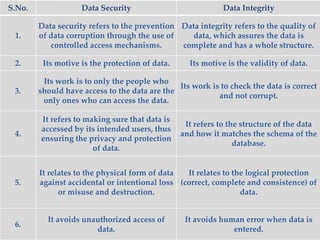
S.No. Data Security Data Integrity
1.
Data security refers to the prevention
of data corruption through the use of
controlled access mechanisms.
Data integrity refers to the quality of
data, which assures the data is
complete and has a whole structure.
2. Its motive is the protection of data. Its motive is the validity of data.
3.
Its work is to only the people who
should have access to the data are the
only ones who can access the data.
Its work is to check the data is correct
and not corrupt.
4.
It refers to making sure that data is
accessed by its intended users, thus
ensuring the privacy and protection
of data.
It refers to the structure of the data
and how it matches the schema of the
database.
5.
It relates to the physical form of data
against accidental or intentional loss
or misuse and destruction.
It relates to the logical protection
(correct, complete and consistence) of
data.
6.
It avoids unauthorized access of
data.
It avoids human error when data is
entered.
Conclusion
• Maintaining database security and integrity is vital for
protecting sensitive information and ensuring its
reliability. By implementing access controls, encryption,
and regular checks, organizations can prevent data
breaches and maintain trust with stakeholders. It's
crucial to educate everyone in the organization about
security practices to uphold the confidentiality and
accuracy of data assets.
Thank you

Database security & Integrity presentation.pptx

  • 1.
  • 2.
    Database security  Databasesecurity includes a variety of measures used to secure database management systems from malicious cyber-attacks and illegitimate use.  Database security programs are designed to protect not only the data within the database, but also the data management system itself, and every application that accesses it, from misuse, damage, and intrusion.
  • 4.
    • SQL Injection:SQL injection occurs when an attacker inserts malicious SQL code into a query to fool a database into performing unintended commands that lead to unauthorized data access, manipulation, or even the complete compromise of a database. This can result in accessing or altering sensitive information without authorization and creating potential access violations for further attacks against it. • Unauthorized Access: Unauthorized access refers to any unauthorized use or manipulation of sensitive data stored in a database system by individuals who gain entry via stolen credentials, weak authentication mechanisms, or improper access control settings.
  • 5.
    • Malware Attacks:Malware threats such as viruses, pose significant dangers to databases. Malware infections can enter through infected files or malicious links and lead to corruption of the database contents, or hijacking for illicit uses. • Insider Threats: An insider threat is a type of cyber attack originating from an individual who works for an organization or has authorized access to its networks or systems. • An insider threat could be a current or former employee, consultant, board member, or business partner and could be intentional, unintentional, or malicious.
  • 6.
    • Denial-of-Service (DoS)Attacks: DoS attacks seek to disrupt the availability and functionality of databases by flooding them with requests or malicious traffic, leading to them becoming inaccessible or even crashing, potentially leading to service disruptions and data loss.
  • 8.
    • Use StrongPasswords Passwords serve as the initial barrier against unauthorized entry into databases. Using weak passwords makes it easier for hackers to gain access to sensitive information. It is crucial to use strong passwords that are complex and difficult to guess. • Limit Access Limiting access to databases is an effective way to prevent unauthorized access to sensitive data. Not all employees or users require access to all the data stored in the database.
  • 9.
    • Update andPatch Regularly Keeping the database software up-to-date is crucial to preventing any potential security vulnerabilities. • Monitor for Anomalies Detecting and preventing potential security threats can be effectively achieved through the monitoring of database anomalies.
  • 10.
    Data Integrity • Dataintegrity is the maintenance of data and the validation of its accuracy and consistency throughout its life cycle. Organizations maintain the integrity of the information in their databases by referring to standards and customized processes implemented during the data's design phase. • Types of data integrity: 1. Physical integrity 2. Logical integrity
  • 11.
    Types • Physical integrityrefers to the methods organizations use to ensure they can store and retrieve data in its complete, accurate form. • Logical integrity refers to the accuracy and consistency of the data itself. Logical integrity ensures that the data makes sense its context. Types of logical integrity include: 1. Entity integrity: 2. Domain integrity: 3. Referential integrity: 4. User-defined integrity:
  • 12.
    1. Entity integrity:Data professionals create primary keys for individual points of data, which differentiate them from others. This prevents data duplication and null tables, which have no value, in relational databases. 2. Domain integrity: Domain integrity ensures the accuracy of each piece of data in a domain, or a set of acceptable values. It may also include constraints that restrict certain types of data. 3. Referential integrity: Referential integrity ensures the proper storage and use of data. It may also contain constraints that prevent duplicate data, inaccuracies or irrelevant data. 4. User-defined integrity: Users can define their own processes for system integrity. User-defined integrity can help strengthen other data integrity measures.
  • 13.
    Data Integrity Risks •Human error: Human error offers a major data integrity risk to organizations. This is often caused by users entering duplicate or incorrect data, deleting data, not following protocols, or making mistakes with procedures put in place to protect information. • Bugs and Viruses: Hackers threaten organizations’ data integrity by using software, and viruses to attack computers in an attempt to steal, amend, or delete user data.
  • 14.
    • Transfer errors:Companies experience data transfer errors when personnel unsuccessfully attempt to send information from one database to another. This typically occurs when the data only exists in the destination table but not in the source. Data professionals can prevent transfer errors by implementing error detection programs and keeping records of each time they add or modify data.
  • 15.
    How To EnsureData Integrity? • Validate Input • Data entry must be validated and verified to ensure its accuracy. Validating input is important when data is provided by known and unknown sources, such as applications. • Remove Duplicate Data • It is important to ensure that sensitive data stored in secure databases cannot be duplicated onto publicly available documents, emails, folders, or spreadsheets. Removing duplicated data can help prevent unauthorized access to business-critical data or personally identifiable information (PII).
  • 16.
    • Back UpData • Data backups are crucial to data security and integrity. Backing up data can prevent it from being permanently lost and should be done as frequently as possible. Data backups are especially important for organizations that suffer ransomware attacks, enabling them to restore recent versions of their databases and documents. • Access Controls • Applying appropriate access controls is also important to maintaining data integrity. This is reliant on implementing a least- privileged approach to data access, which ensures users are only able to access data, documents, folders, and servers that they need to do their job successfully. This limits the chances of hackers being able to impersonate users and prevents unauthorized access to data.
  • 17.
    S.No. Data SecurityData Integrity 1. Data security refers to the prevention of data corruption through the use of controlled access mechanisms. Data integrity refers to the quality of data, which assures the data is complete and has a whole structure. 2. Its motive is the protection of data. Its motive is the validity of data. 3. Its work is to only the people who should have access to the data are the only ones who can access the data. Its work is to check the data is correct and not corrupt. 4. It refers to making sure that data is accessed by its intended users, thus ensuring the privacy and protection of data. It refers to the structure of the data and how it matches the schema of the database. 5. It relates to the physical form of data against accidental or intentional loss or misuse and destruction. It relates to the logical protection (correct, complete and consistence) of data. 6. It avoids unauthorized access of data. It avoids human error when data is entered.
  • 18.
    Conclusion • Maintaining databasesecurity and integrity is vital for protecting sensitive information and ensuring its reliability. By implementing access controls, encryption, and regular checks, organizations can prevent data breaches and maintain trust with stakeholders. It's crucial to educate everyone in the organization about security practices to uphold the confidentiality and accuracy of data assets.
  • 19.