Subject Name :Database Management System
Subject Code: BCA-501 N
Subject Topic: Data Models
Dr. Mamta Tiwari
Assistant Professor
Department Of Computer Application
UIET,CSJM University, Kanpur
What is DBMS
•A database-management system (DBMS) is a
collection of interrelated data and a set of
programs to access those data.
• The collection of data, usually referred to as
the database.
• DBMS provides an environment that is both
convenient and efficient to use
Purpose of Databasesystem
Before database management systems (DBMSs) came along, organizations
usually stored information in files processing systems.
Disadvantages of File processing system
1. Data redundancy and inconsistency same information may be
duplicated in several places (files). For example, the address and
telephone number of a particular customer may appear in a file that
consists of savings-account records and in a file that consists of checking-
account records.
2. Difficulty in accessing data
3. Data Isolation Because data are scattered in various files, and files may
be in different formats, writing new application programs to retrieve the
appropriate data is difficult.
6.
4. Integrity problemintegrity constraints (e.g. account balance > 0)
become part of program code
Hard to add new constraints or change existing ones
5. Atomicity updates A computer system, like any other
mechanical or electrical device, is subject to failure. In many applications,
it is crucial that, if a failure occurs, the data be restored to the consistent
state that existed prior to the failure.
6. Concurrent-access anomalies Concurrent accessed needed for
faster response, In file processing system , interaction of concurrent
updates may result in inconsistent data
7.
7. Security problems.Not every user of the
database system should be able to access all
the data.
Database systems offer solutions to all the
above problems
8.
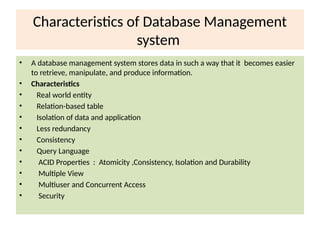
Characteristics of DatabaseManagement
system
• A database management system stores data in such a way that it becomes easier
to retrieve, manipulate, and produce information.
• Characteristics
• Real world entity
• Relation-based table
• Isolation of data and application
• Less redundancy
• Consistency
• Query Language
• ACID Properties : Atomicity ,Consistency, Isolation and Durability
• Multiple View
• Multiuser and Concurrent Access
• Security
9.
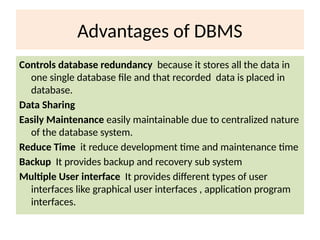
Advantages of DBMS
Controlsdatabase redundancy because it stores all the data in
one single database file and that recorded data is placed in
database.
Data Sharing
Easily Maintenance easily maintainable due to centralized nature
of the database system.
Reduce Time it reduce development time and maintenance time
Backup It provides backup and recovery sub system
Multiple User interface It provides different types of user
interfaces like graphical user interfaces , application program
interfaces.
10.
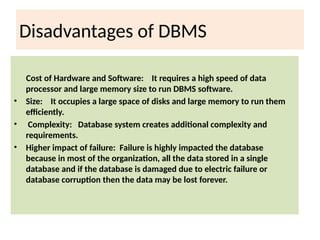
Disadvantages of DBMS
Costof Hardware and Software: It requires a high speed of data
processor and large memory size to run DBMS software.
• Size: It occupies a large space of disks and large memory to run them
efficiently.
• Complexity: Database system creates additional complexity and
requirements.
• Higher impact of failure: Failure is highly impacted the database
because in most of the organization, all the data stored in a single
database and if the database is damaged due to electric failure or
database corruption then the data may be lost forever.
11.
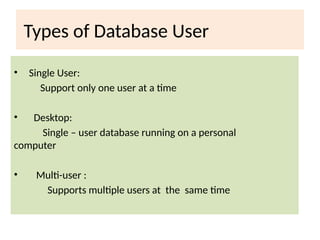
Types of DatabaseUser
• Single User:
Support only one user at a time
• Desktop:
Single – user database running on a personal
computer
• Multi-user :
Supports multiple users at the same time
12.
Workgroup:
Multiuser database thatsupports a small
group of users or a single department
Enterprise:
Multi-user database that supports a large
group of users or an entire organization
13.
Databases are classifiedby location:
• Centralized:
Supports data located at a single site
• Distributed:
Supports data distributed across several
sites
14.
Databases can beclassified by use:
Transactional :
Supports a company day-to-day operations
Data warehouse:
Stores data used to generate information
required for decision making
Often used to store historical data
Structure is based on multidimensional Data
Model
15.
Problems with filesystem
Every task requires extensive programming in a
third generation language(3GL)
Queries are not possible
Writing program to produce new reports takes
time
Modern databases use fourth-generation
language(4GL)
Allow users to specify what must be done
without specify how it is to be done
16.
Programming is Time-consuming,high-level
activity
Making changes in existing file structure is
difficult
Data structure changes require modifications in
whole program
Security features hard to program



![unit 1 introduction to dbms [1-1.2].pptx](https://cdn.slidesharecdn.com/ss_thumbnails/unit11-1-240826101701-c858199a-thumbnail.jpg?width=640&height=640&fit=bounds)


