Data Warehouse LearnIn 1 Day Krishna Rungta
download
https://ebookbell.com/product/data-warehouse-learn-in-1-day-
krishna-rungta-47839280
Explore and download more ebooks at ebookbell.com
2.
Here are somerecommended products that we believe you will be
interested in. You can click the link to download.
Data Warehouse Systems Design And Implementation Alejandro Vaisman
https://ebookbell.com/product/data-warehouse-systems-design-and-
implementation-alejandro-vaisman-46769938
Data Warehouse And Data Mining Concepts Techniques And Real Life
Applications Kumar
https://ebookbell.com/product/data-warehouse-and-data-mining-concepts-
techniques-and-real-life-applications-kumar-55939120
Data Warehouse Systems Design And Implementation 2nd Edition 2nd
Edition Alejandro Vaisman
https://ebookbell.com/product/data-warehouse-systems-design-and-
implementation-2nd-edition-2nd-edition-alejandro-vaisman-44032660
Data Warehouse Design Modern Principles And Methodologies Matteo
Golfarelli
https://ebookbell.com/product/data-warehouse-design-modern-principles-
and-methodologies-matteo-golfarelli-5219324
3.
Data Warehouse AndData Mining Concepts And Techniques Nitu Sharma
https://ebookbell.com/product/data-warehouse-and-data-mining-concepts-
and-techniques-nitu-sharma-56320838
Data Warehouse Requirements Engineering A Decision Based Approach
Naveen Prakash
https://ebookbell.com/product/data-warehouse-requirements-engineering-
a-decision-based-approach-naveen-prakash-6858742
Data Warehouse Requirements Engineering Naveen Prakash Deepika Prakash
https://ebookbell.com/product/data-warehouse-requirements-engineering-
naveen-prakash-deepika-prakash-51146448
Data Warehouse Design Modern Principles And Methodologies Matteo
Golfarelli Stefano Rizzi
https://ebookbell.com/product/data-warehouse-design-modern-principles-
and-methodologies-matteo-golfarelli-stefano-rizzi-231845298
The Data Warehouse Etl Toolkit Practical Techniques For Extracting
Cleaning Conforming And Delivering Data Ralph Kimball
https://ebookbell.com/product/the-data-warehouse-etl-toolkit-
practical-techniques-for-extracting-cleaning-conforming-and-
delivering-data-ralph-kimball-45129336
Page 2
Learn DataWarehouse in 1
Day
By Krishna Rungta
Copyright 2022 - All Rights Reserved – Krishna Rungta
ALL RIGHTS RESERVED. No part of this publication may be
reproduced or transmitted in any form whatsoever, electronic, or
mechanical, including photocopying, recording, or by any
informational storage or retrieval system without express written,
dated and signed permission from the author.
7.
Page 3
Table OfContent
Chapter 1: What Is Data Warehousing? Types, Definition &
Example
1. What is Data Warehousing?
2. History of Datawarehouse
3. How Datawarehouse works?
4. Types of Data Warehouse
5. General stages of Data Warehouse
6. Components of Data warehouse
7. Who needs Data warehouse?
8. What Is a Data Warehouse Used For?
9. Steps to Implement Data Warehouse
10. Best practices to implement a Data Warehouse
11. Why We Need Data Warehouse? Advantages & Disadvantages
12. The Future of Data Warehousing
13. Data Warehouse Tools
Chapter 2: Database vs Data Warehouse: Key Differences
1. What is Database?
2. What is a Data Warehouse?
3. Why use a Database?
4. Why Use Data Warehouse?
5. Characteristics of Database
6. Characteristics of Data Warehouse
7. Difference between Database and Data Warehouse
8. Applications of Database
8.
Page 4
9. Applicationsof Data Warehousing
10. Disadvantages of Database
11. Disadvantages of Data Warehouse
12. What Works Best for You?
Chapter 3: Data Warehouse Architecture, Concepts and
Components
1. What is Data warehouse?
2. Characteristics of Data warehouse
3. Data Warehouse Architectures
4. Datawarehouse Components
5. Query Tools
6. Data warehouse Bus Architecture
7. Data warehouse Architecture Best Practices
Chapter 4: ETL (Extract, Transform, and Load) Process
1. What is ETL?
2. Why do you need ETL?
3. ETL Process in Data Warehouses
4. Step 1) Extraction
5. Step 2) Transformation
6. Step 3) Loading
7. ETL tools
8. Best practices ETL process
Chapter 5: ETL vs ELT: Must Know Differences
1. What is ETL?
2. What is ELT?
9.
Page 5
3. Differencebetween ETL vs. ELT
Chapter 6: What is Data Modelling? Conceptual, Logical, &
Physical Data Models
1. What is Data Modelling?
2. Why use Data Model?
3. Types of Data Models
4. Conceptual Model
5. Logical Data Model
6. Physical Data Model
7. Advantages and Disadvantages of Data Model
Chapter 7: What is OLAP (Online Analytical Processing):
Cube, Operations & Types
1. What is Online Analytical Processing?
2. OLAP cube:
3. Basic analytical operations of OLAP
4. Types of OLAP systems
5. ROLAP
6. MOLAP
7. Hybrid OLAP
8. Advantages of OLAP
9. Disadvantages of OLAP
Chapter 8: What is MOLAP? Architecture, Advantages,
Example, Tools
1. What is MOLAP?
2. MOLAP Architecture
10.
Page 6
3. Implementationconsiderations is MOLAP
4. MOLAP Advantages
5. MOLAP Disadvantages
6. MOLAP Tools
Chapter 9: OLTP vs OLAP: What's the Difference?
1. What is OLAP?
2. What is OLTP?
3. Example of OLAP
4. Example of OLTP system
5. Benefits of using OLAP services
6. Benefits of OLTP method
7. Drawbacks of OLAP service
8. Drawbacks of OLTP method
9. Difference between OLTP and OLAP
Chapter 10: What is Dimensional Model in Data Warehouse?
1. What is Dimensional Model?
2. Elements of Dimensional Data Model
3. Steps of Dimensional Modelling
4. Rules for Dimensional Modelling
5. Benefits of dimensional modeling
Chapter 11: Star and SnowFlake Schema in Data
Warehousing
1. What is Multidimensional schemas?
2. What is a Star Schema?
3. What is a Snowflake Schema?
11.
Page 7
4. StarVs Snowflake Schema: Key Differences
5. What is a Galaxy schema?
6. What is Star Cluster Schema?
Chapter 12: Data Mart Tutorial: What is Data Mart, Types &
Example
1. What is Data Mart?
2. Why do we need Data Mart?
3. Type of Data Mart
4. Steps in Implementing a Datamart
5. Best practices for Implementing Data Marts
6. Advantages and Disadvantages of a Data Mart
Chapter 13: Data Warehouse vs Data Mart: Know the
Difference
1. What is Data Warehouse?
2. What is Data Mart?
3. Differences between Data Warehouse and Data Mart
Chapter 14: What is Data Lake? It's Architecture
1. What is Data Lake?
2. Why Data Lake?
3. Data Lake Architecture
4. Key Data Lake Concepts
5. Maturity stages of Data Lake
6. Best practices for Data Lake Implementation:
7. Difference between Data lakes and Data warehouse
8. Benefits and Risks of using Data Lake
12.
Page 8
Chapter 15:Data Lake vs Data Warehouse: What's the
Difference?
1. What is Data Warehouse?
2. What is Data Lake?
3. Data Warehouse Concept:
4. Data Lake Concept:
5. Key Difference between the Data Lake and Data Warehouse
Chapter 16: What is Business Intelligence? Definition &
Example
1. What is Business Intelligence?
2. Why is BI important?
3. How Business Intelligence systems are implemented?
4. Examples of Business Intelligence System used in Practice
5. Four types of BI users
6. Advantages of Business Intelligence
7. BI System Disadvantages
8. Trends in Business Intelligence
Chapter 17: Data Mining Tutorial: Process, Techniques,
Tools, EXAMPLES
1. What is Data Mining?
2. Types of Data
3. Data Mining Implementation Process
4. Business understanding:
5. Data understanding:
6. Data preparation:
7. Data transformation:
13.
Page 9
8. Modelling
9.Data Mining Techniques
10. Challenges of Implementation of Data mine:
11. Data mining Examples:
12. Data Mining Tools
13. Benefits of Data Mining:
14. Disadvantages of Data Mining
15. Data Mining Applications
Chapter 18: DataStage Tutorial: Beginner's Training
1. What is DataStage?
2. DataStage Overview
3. DataStage Components and Architecture
4. Pre-requisite for Datastage tool
5. Download and Installation InfoSphere Information Server
6. Process flow of Change data in a CDC Transaction stage Job.
7. Setting Up SQL Replication
8. Creating the SQL Replication objects
9. Creating the definition files to map CCD tables to DataStage
10. Starting Replication
11. How to create Projects in Datastage tool
12. How to import replication Jobs in Datastage and QualityStage
Designer
13. Creating a data connection from DataStage to the STAGEDB
database
14. Importing table definitions from STAGEDB into DataStage
15. Setting properties for the DataStage jobs
16. Compiling and running the DataStage jobs
17. Testing integration between SQL Replication and DataStage
14.
Page 10
Chapter 19:Difference between Data Mining and Data
Warehouse
1. What is Data warehouse?
2. What Is Data Mining?
3. Data Mining Vs Data Warehouse: Key Differences
4. Why use Data Warehouse?
5. Why use Data mining?
Chapter 20: Difference Between Fact Table and Dimension
Table
1. Fact Table:
2. Dimension table:
3. Difference between Dimension table vs. Fact table
4. Type of facts
5. Types of Dimensions:
Chapter 21: Difference between Information and Data
1. What is Data?
2. What is Information?
3. Data Vs. Information
4. DIKW (Data Information Knowledge Wisdom)
Chapter 22: Teradata Tutorial: Learn Basics for Beginners
1. What is Teradata?
2. History of Teradata:
3. Why Teradata?
4. Features of Teradata:
15.
Page 11
5. Teradata– Architecture
6. MPP vs. SMP
7. Teradata Warehouse Product Suite
8. Applications of Teradata:
9. Difference between Teradata and other RDBMS
16.
Page 12
Chapter 1:What Is Data
Warehousing? Types,
Definition & Example
What is Data Warehousing?
A data warehousing is defined as a technique for collecting and
managing data from varied sources to provide meaningful business
insights. It is a blend of technologies and components which aids the
strategic use of data.
It is electronic storage of a large amount of information by a business
which is designed for query and analysis instead of transaction
processing. It is a process of transforming data into information and
making it available to users in a timely manner to make a difference.
The decision support database (Data Warehouse) is maintained
separately from the organization's operational database. However, the
data warehouse is not a product but an environment. It is an
architectural construct of an information system which provides users
with current and historical decision support information which is
difficult to access or present in the traditional operational data store.
The data warehouse is the core of the BI system which is built for data
analysis and reporting.
You many know that a 3NF-designed database for an inventory system
many have tables related to each other. For example, a report on
17.
Page 13
current inventoryinformation can include more than 12 joined
conditions. This can quickly slow down the response time of the query
and report. A data warehouse provides a new design which can help to
reduce the response time and helps to enhance the performance of
queries for reports and analytics.
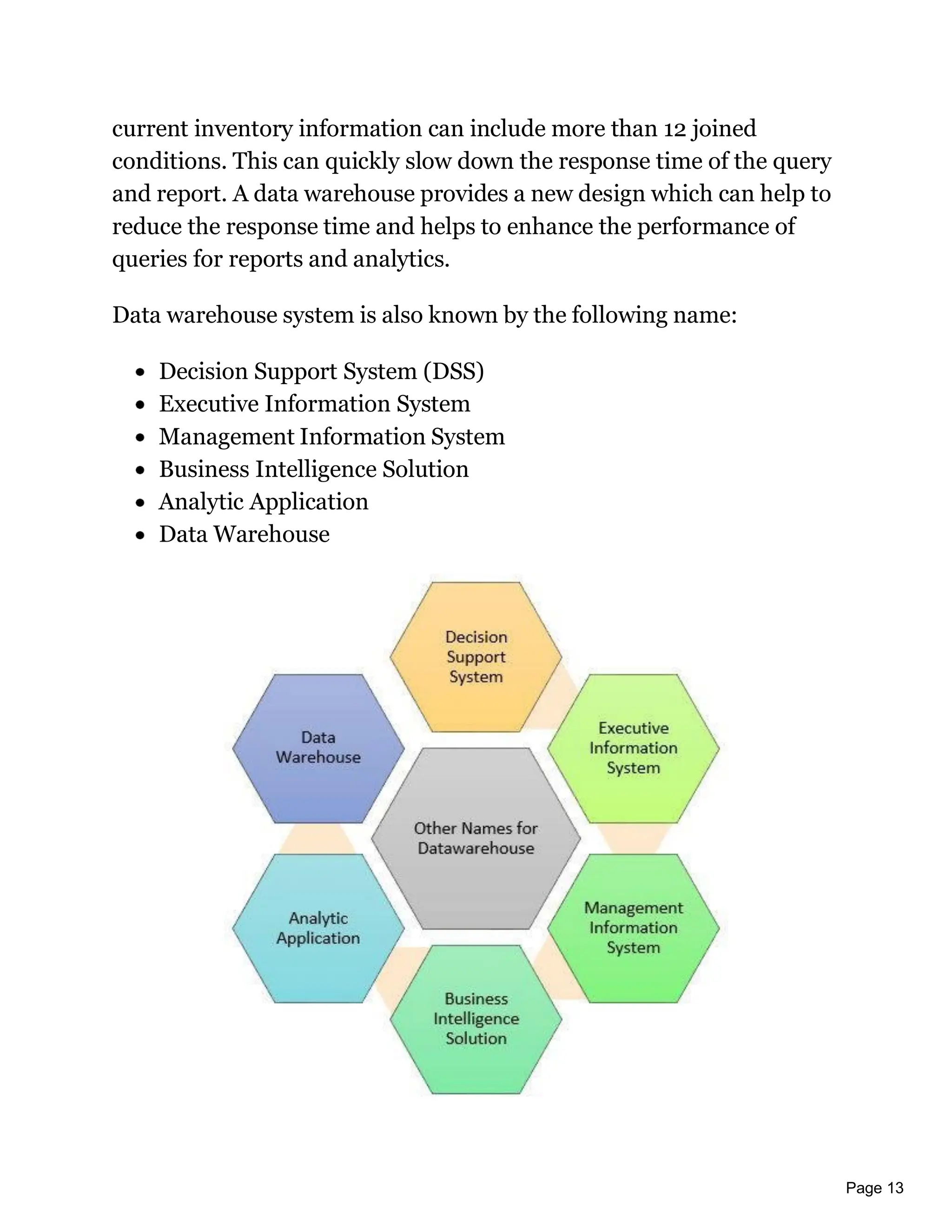
Data warehouse system is also known by the following name:
Decision Support System (DSS)
Executive Information System
Management Information System
Business Intelligence Solution
Analytic Application
Data Warehouse
18.
Page 14
History ofDatawarehouse
The Datawarehouse benefits users to understand and enhance their
organization's performance. The need to warehouse data evolved as
computer systems became more complex and needed to handle
increasing amounts of Information. However, Data Warehousing is a
not a new thing.
Here are some key events in evolution of Data Warehouse-
1960- Dartmouth and General Mills in a joint research project,
develop the terms dimensions and facts.
1970- A Nielsen and IRI introduces dimensional data marts for
retail sales.
1983- Tera Data Corporation introduces a database management
system which is specifically designed for decision support
Data warehousing started in the late 1980s when IBM worker
Paul Murphy and Barry Devlin developed the Business Data
Warehouse.
However, the real concept was given by Inmon Bill. He was
considered as a father of data warehouse. He had written about a
variety of topics for building, usage, and maintenance of the
warehouse & the Corporate Information Factory.
How Datawarehouse works?
A Data Warehouse works as a central repository where information
arrives from one or more data sources. Data flows into a data
19.
Page 15
warehouse fromthe transactional system and other relational
databases.
Data may be:
1. Structured
2. Semi-structured
3. Unstructured data
The data is processed, transformed, and ingested so that users can
access the processed data in the Data Warehouse through Business
Intelligence tools, SQL clients, and spreadsheets. A data warehouse
merges information coming from different sources into one
comprehensive database.
By merging all of this information in one place, an organization can
analyze its customers more holistically. This helps to ensure that it has
considered all the information available. Data warehousing makes
data mining possible. Data mining is looking for patterns in the data
that may lead to higher sales and profits.
Types of Data Warehouse
Three main types of Data Warehouses are:
1. Enterprise Data Warehouse:
Enterprise Data Warehouse is a centralized warehouse. It provides
decision support service across the enterprise. It offers a unified
approach for organizing and representing data. It also provide the
ability to classify data according to the subject and give access
according to those divisions.
20.
Page 16
2. OperationalData Store:
Operational Data Store, which is also called ODS, are nothing but data
store required when neither Data warehouse nor OLTP systems
support organizations reporting needs. In ODS, Data warehouse is
refreshed in real time. Hence, it is widely preferred for routine
activities like storing records of the Employees.
3. Data Mart:
A data mart is a subset of the data warehouse. It specially designed for
a particular line of business, such as sales, finance, sales or finance. In
an independent data mart, data can collect directly from sources.
General stages of Data Warehouse
Earlier, organizations started relatively simple use of data
warehousing. However, over time, more sophisticated use of data
warehousing begun.
The following are general stages of use of the data warehouse:
Offline Operational Database:
In this stage, data is just copied from an operational system to another
server. In this way, loading, processing, and reporting of the copied
data do not impact the operational system's performance.
Offline Data Warehouse:
Data in the Datawarehouse is regularly updated from the Operational
Database. The data in Datawarehouse is mapped and transformed to
21.
Page 17
meet theDatawarehouse objectives.
Real time Data Warehouse:
In this stage, Data warehouses are updated whenever any transaction
takes place in operational database. For example, Airline or railway
booking system.
Integrated Data Warehouse:
In this stage, Data Warehouses are updated continuously when the
operational system performs a transaction. The Datawarehouse then
generates transactions which are passed back to the operational
system.
Components of Data warehouse
Four components of Data Warehouses are:
Load manager: Load manager is also called the front component. It
performs with all the operations associated with the extraction and
load of data into the warehouse. These operations include
transformations to prepare the data for entering into the Data
warehouse.
Warehouse Manager: Warehouse manager performs operations
associated with the management of the data in the warehouse. It
performs operations like analysis of data to ensure consistency,
creation of indexes and views, generation of denormalization and
aggregations, transformation and merging of source data and
archiving and baking-up data.
22.
Page 18
Query Manager:Query manager is also known as backend
component. It performs all the operation operations related to the
management of user queries. The operations of this Data warehouse
components are direct queries to the appropriate tables for scheduling
the execution of queries.
End-user access tools:
This is categorized into five different groups like 1. Data Reporting 2.
Query Tools 3. Application development tools 4. EIS tools, 5. OLAP
tools and data mining tools.
Who needs Data warehouse?
Data warehouse is needed for all types of users like:
Decision makers who rely on mass amount of data
Users who use customized, complex processes to obtain
information from multiple data sources.
It is also used by the people who want simple technology to access
the data
It also essential for those people who want a systematic approach
for making decisions.
If the user wants fast performance on a huge amount of data
which is a necessity for reports, grids or charts, then Data
warehouse proves useful.
Data warehouse is a first step If you want to discover 'hidden
patterns' of data-flows and groupings.
What Is a Data Warehouse Used
23.
Page 19
For?
Here, aremost common sectors where Data warehouse is used:
Airline:
In the Airline system, it is used for operation purpose like crew
assignment, analyses of route profitability, frequent flyer program
promotions, etc.
Banking:
It is widely used in the banking sector to manage the resources
available on desk effectively. Few banks also used for the market
research, performance analysis of the product and operations.
Healthcare:
Healthcare sector also used Data warehouse to strategize and predict
outcomes, generate patient's treatment reports, share data with tie-in
insurance companies, medical aid services, etc.
Public sector:
In the public sector, data warehouse is used for intelligence gathering.
It helps government agencies to maintain and analyze tax records,
health policy records, for every individual.
Investment and Insurance sector:
In this sector, the warehouses are primarily used to analyze data
patterns, customer trends, and to track market movements.
24.
Page 20
Retain chain:
Inretail chains, Data warehouse is widely used for distribution and
marketing. It also helps to track items, customer buying pattern,
promotions and also used for determining pricing policy.
Telecommunication:
A data warehouse is used in this sector for product promotions, sales
decisions and to make distribution decisions.
Hospitality Industry:
This Industry utilizes warehouse services to design as well as estimate
their advertising and promotion campaigns where they want to target
clients based on their feedback and travel patterns.
Steps to Implement Data Warehouse
The best way to address the business risk associated with a
Datawarehouse implementation is to employ a three-prong strategy as
below
1. Enterprise strategy: Here we identify technical including
current architecture and tools. We also identify facts, dimensions,
and attributes. Data mapping and transformation is also passed.
2. Phased delivery: Datawarehouse implementation should be
phased based on subject areas. Related business entities like
booking and billing should be first implemented and then
integrated with each other.
3. Iterative Prototyping: Rather than a big bang approach to
implementation, the Datawarehouse should be developed and
25.
Page 21
tested iteratively.
Here,are key steps in Datawarehouse implementation along with its
deliverables.
Step Tasks Deliverables
1 Need to define project scope Scope Definition
2 Need to determine business needs Logical Data Model
3 Define Operational Datastore requirements Operational Data Store Model
4 Acquire or develop Extraction tools Extract tools and Software
5 Define Data Warehouse Data requirements Transition Data Model
6 Document missing data To Do Project List
7
Maps Operational Data Store to Data
Warehouse
D/W Data Integration Map
8 Develop Data Warehouse Database design D/W Database Design
9 Extract Data from Operational Data Store Integrated D/W Data Extracts
10 Load Data Warehouse Initial Data Load
11 Maintain Data Warehouse
On-going Data Access and Subsequent
Loads
26.
Page 22
Best practicesto implement a Data
Warehouse
Decide a plan to test the consistency, accuracy, and integrity of
the data.
The data warehouse must be well integrated, well defined and
time stamped.
While designing Datawarehouse make sure you use right tool,
stick to life cycle, take care about data conflicts and ready to learn
you're your mistakes.
Never replace operational systems and reports
Don't spend too much time on extracting, cleaning and loading
data.
Ensure to involve all stakeholders including business personnel in
Datawarehouse implementation process. Establish that Data
warehousing is a joint/ team project. You don't want to create
Data warehouse that is not useful to the end users.
Prepare a training plan for the end users.
Why We Need Data Warehouse?
Advantages & Disadvantages
Advantages of Data Warehouse:
Data warehouse allows business users to quickly access critical
data from some sources all in one place.
Data warehouse provides consistent information on various cross-
functional activities. It is also supporting ad-hoc reporting and
query.
27.
Page 23
Data Warehousehelps to integrate many sources of data to reduce
stress on the production system.
Data warehouse helps to reduce total turnaround time for analysis
and reporting.
Restructuring and Integration make it easier for the user to use
for reporting and analysis.
Data warehouse allows users to access critical data from the
number of sources in a single place. Therefore, it saves user's time
of retrieving data from multiple sources.
Data warehouse stores a large amount of historical data. This
helps users to analyze different time periods and trends to make
future predictions.
Disadvantages of Data Warehouse:
Not an ideal option for unstructured data.
Creation and Implementation of Data Warehouse is surely time
confusing affair.
Data Warehouse can be outdated relatively quickly
Difficult to make changes in data types and ranges, data source
schema, indexes, and queries.
The data warehouse may seem easy, but actually, it is too complex
for the average users.
Despite best efforts at project management, data warehousing
project scope will always increase.
Sometime warehouse users will develop different business rules.
Organisations need to spend lots of their resources for training
and Implementation purpose.
The Future of Data Warehousing
28.
Page 24
Change inRegulatory constrains may limit the ability to
combine source of disparate data. These disparate sources may
include unstructured data which is difficult to store.
As the size of the databases grows, the estimates of what
constitutes a very large database continue to grow. It is complex
to build and run data warehouse systems which are always
increasing in size. The hardware and software resources are
available today do not allow to keep a large amount of data online.
Multimedia data cannot be easily manipulated as text data,
whereas textual information can be retrieved by the relational
software available today. This could be a research subject.
Data Warehouse Tools
There are many Data Warehousing tools are available in the market.
Here, are some most prominent one:
1. MarkLogic:
MarkLogic is useful data warehousing solution that makes data
integration easier and faster using an array of enterprise features. This
tool helps to perform very complex search operations. It can query
different types of data like documents, relationships, and metadata.
http://developer.marklogic.com/products
2. Oracle:
Oracle is the industry-leading database. It offers a wide range of choice
of data warehouse solutions for both on-premises and in the cloud. It
helps to optimize customer experiences by increasing operational
29.
Page 25
efficiency.
https://www.oracle.com/index.html
3. AmazonRedShift:
Amazon Redshift is Data warehouse tool. It is a simple and cost-
effective tool to analyze all types of data using standard SQL and
existing BI tools. It also allows running complex queries against
petabytes of structured data, using the technique of query
optimization.
https://aws.amazon.com/redshift/?nc2=h_m1
Here is a complete list of useful Datawarehouse Tools.
Conclusion:
The data warehouse works as a central repository where
information is coming from one or more data sources.
Three main types of Data warehouses are Enterprise Data
Warehouse, Operational Data Store, and Data Mart.
General state of a datawarehouse are Offline Operational
Database, Offline Data Warehouse, Real time Data Warehouse
and Integrated Data Warehouse.
Four main components of Datawarehouse are Load manager,
Warehouse Manager, Query Manager, End-user access tools
Datawarehouse is used in diverse industries like Airline, Banking,
Healthcare, Insurance, Retail etc.
Implementing Datawarehosue is a 3 prong strategy viz. Enterprise
strategy, Phased delivery and Iterative Prototyping.
30.
Page 26
Data warehouseallows business users to quickly access critical
data from some sources all in one place.
31.
Page 27
Chapter 2:Database vs Data
Warehouse: Key Differences
What is Database?
A database is a collection of related data which represents some
elements of the real world. It is designed to be built and populated
with data for a specific task. It is also a building block of your data
solution.
What is a Data Warehouse?
A data warehouse is an information system which stores historical and
commutative data from single or multiple sources. It is designed to
analyze, report, integrate transaction data from different sources.
Data Warehouse eases the analysis and reporting process of an
organization. It is also a single version of truth for the organization for
decision making and forecasting process.
Why use a Database?
Here, are prime reasons for using Database system:
It offers the security of data and its access
A database offers a variety of techniques to store and retrieve
data.
32.
Page 28
Database actas an efficient handler to balance the requirement of
multiple applications using the same data
A DBMS offers integrity constraints to get a high level of
protection to prevent access to prohibited data.
A database allows you to access concurrent data in such a way
that only a single user can access the same data at a time.
Why Use Data Warehouse?
Here, are Important reasons for using Data Warehouse:
Data warehouse helps business users to access critical data from
some sources all in one place.
It provides consistent information on various cross-functional
activities
Helps you to integrate many sources of data to reduce stress on
the production system.
Data warehouse helps you to reduce TAT (total turnaround time)
for analysis and reporting.
Data warehouse helps users to access critical data from different
sources in a single place so, it saves user's time of retrieving data
information from multiple sources. You can also access data from
the cloud easily.
Data warehouse allows you to stores a large amount of historical
data to analyze different periods and trends to make future
predictions.
Enhances the value of operational business applications and
customer relationship management systems
Separates analytics processing from transactional databases,
improving the performance of both systems
33.
Page 29
Stakeholders andusers may be overestimating the quality of data
in the source systems. Data warehouse provides more accurate
reports.
Characteristics of Database
Offers security and removes redundancy
Allow multiple views of the data
Database system follows the ACID compliance ( Atomicity,
Consistency, Isolation, and Durability).
Allows insulation between programs and data
Sharing of data and multiuser transaction processing
Relational Database support multi-user environment
Characteristics of Data Warehouse
A data warehouse is subject oriented as it offers information
related to theme instead of companies' ongoing operations.
The data also needs to be stored in the Datawarehouse in common
and unanimously acceptable manner.
The time horizon for the data warehouse is relatively extensive
compared with other operational systems.
A data warehouse is non-volatile which means the previous data is
not erased when new information is entered in it.
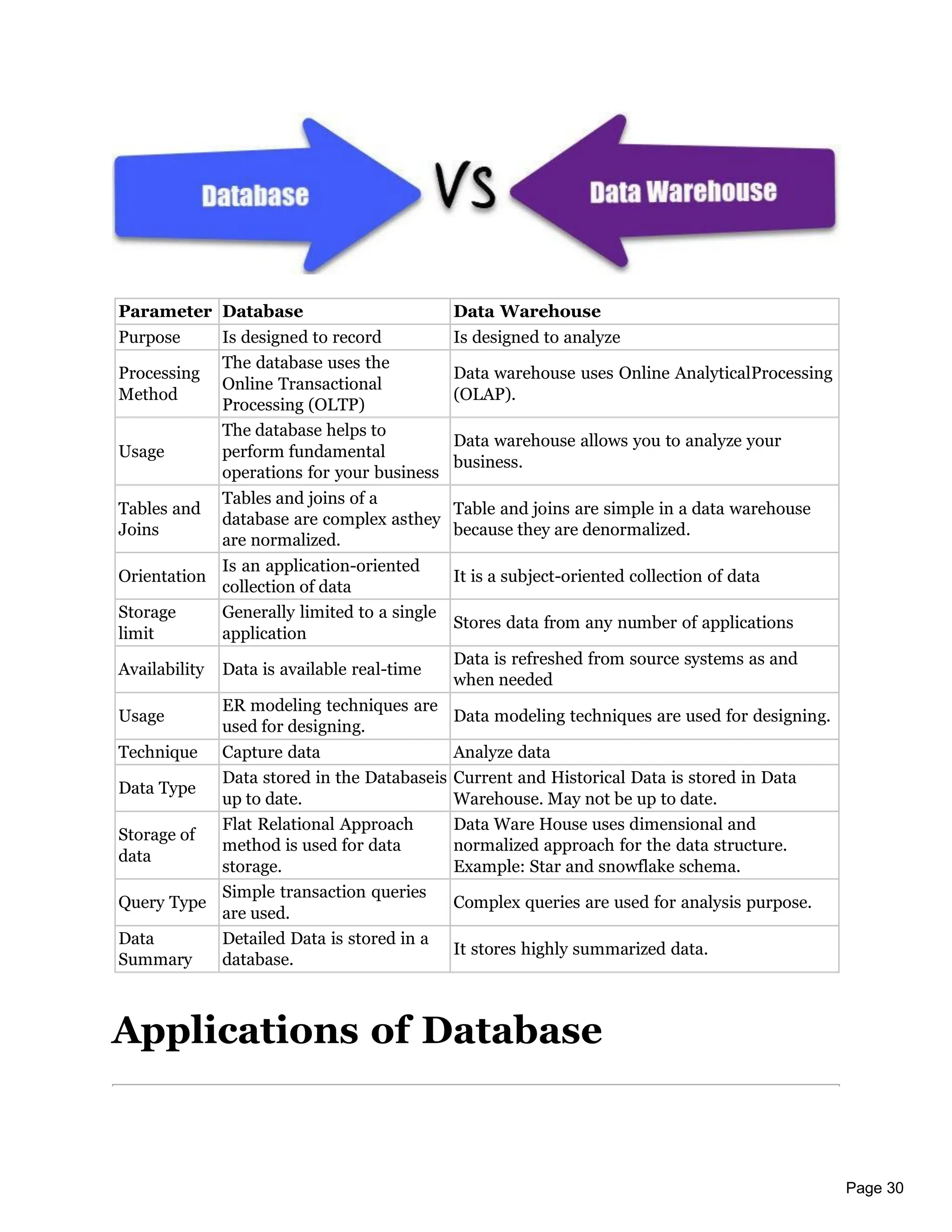
Difference between Database and
Data Warehouse
34.
Page 30
Parameter DatabaseData Warehouse
Purpose Is designed to record Is designed to analyze
Processing
Method
The database uses the
Online Transactional
Processing (OLTP)
Data warehouse uses Online AnalyticalProcessing
(OLAP).
Usage
The database helps to
perform fundamental
operations for your business
Data warehouse allows you to analyze your
business.
Tables and
Joins
Tables and joins of a
database are complex asthey
are normalized.
Table and joins are simple in a data warehouse
because they are denormalized.
Orientation
Is an application-oriented
collection of data
It is a subject-oriented collection of data
Storage
limit
Generally limited to a single
application
Stores data from any number of applications
Availability Data is available real-time
Data is refreshed from source systems as and
when needed
Usage
ER modeling techniques are
used for designing.
Data modeling techniques are used for designing.
Technique Capture data Analyze data
Data Type
Data stored in the Databaseis
up to date.
Current and Historical Data is stored in Data
Warehouse. May not be up to date.
Storage of
data
Flat Relational Approach
method is used for data
storage.
Data Ware House uses dimensional and
normalized approach for the data structure.
Example: Star and snowflake schema.
Query Type
Simple transaction queries
are used.
Complex queries are used for analysis purpose.
Data
Summary
Detailed Data is stored in a
database.
It stores highly summarized data.
Applications of Database
35.
Page 31
Sector Usage
Banking
Usein the banking sector for customer
information, account-related activities,
payments, deposits, loans, credit cards, etc.
Airlines
Use for reservations and schedule
information.
Universities
To store student information, course
registrations, colleges, and results.
Telecommunication
It helps to store call records, monthly bills,
balance maintenance, etc.
Finance
Helps you to store information related stock,
sales, and purchases of stocks and bonds.
Sales & Production
Use for storing customer, product and sales
details.
Manufacturing
It is used for the data management of the
supply chain and for tracking production of
items, inventories status.
HR Management
Detail about employee's salaries, deduction,
generation of paychecks, etc.
Applications of Data Warehousing
Sector Usage
Airline
It is used for airline system management
operations like crew assignment, analyzes of
route, frequent flyer program discount
schemes for passenger, etc.
Banking
It is used in the banking sector to manage the
resources available on the desk effectively.
Healthcare sector
Data warehouse used to strategize and
predict outcomes, create patient's treatment
reports, etc. Advanced machine learning, big
data enable datawarehouse systems can
predict ailments.
Insurance sector
Data warehouses are widely used to analyze
data patterns, customer trends, and to track
market movements quickly.
Retain chain
It helps you to track items, identify the
buying pattern of the customer, promotions
and also used for determining pricing policy.
36.
Page 32
Telecommunication
In thissector, data warehouse used for
product promotions, sales decisions and to
make distribution decisions.
Disadvantages of Database
Cost of Hardware and Software of an implementing Database
system is high which can increase the budget of your organization.
Many DBMS systems are often complex systems, so the training
for users to use the DBMS is required.
DBMS can't perform sophisticated calculations
Issues regarding compatibility with systems which is already in
place
Data owners may lose control over their data, raising security,
ownership, and privacy issues.
Disadvantages of Data Warehouse
Adding new data sources takes time, and it is associated with high
cost.
Sometimes problems associated with the data warehouse may be
undetected for many years.
Data warehouses are high maintenance systems. Extracting,
loading, and cleaning data could be time-consuming.
The data warehouse may look simple, but actually, it is too
complicated for the average users. You need to provide training to
end-users, who end up not using the data mining and warehouse.
Despite best efforts at project management, the scope of data
warehousing will always increase.
37.
Page 33
What WorksBest for You?
To sum up, we can say that the database helps to perform the
fundamental operation of business while the data warehouse helps you
to analyze your business. You choose either one of them based on your
business goals.
38.
Page 34
Chapter 3:Data Warehouse
Architecture, Concepts and
Components
What is Data warehouse?
Data warehouse is an information system that contains historical and
commutative data from single or multiple sources. It simplifies
reporting and analysis process of the organization.
It is also a single version of truth for any company for decision making
and forecasting.
Characteristics of Data warehouse
A data warehouse has following characteristics:
Subject-Oriented
Integrated
Time-variant
Non-volatile
Subject-Oriented
A data warehouse is subject oriented as it offers information regarding
a theme instead of companies' ongoing operations. These subjects can
be sales, marketing, distributions, etc.
39.
Page 35
A datawarehouse never focuses on the ongoing operations. Instead, it
put emphasis on modeling and analysis of data for decision making.
It also provides a simple and concise view around the specific subject
by excluding data which not helpful to support the decision process.
Integrated
In Data Warehouse, integration means the establishment of a common
unit of measure for all similar data from the dissimilar database. The
data also needs to be stored in the Datawarehouse in common and
universally acceptable manner.
A data warehouse is developed by integrating data from varied sources
like a mainframe, relational databases, flat files, etc. Moreover, it must
keep consistent naming conventions, format, and coding.
This integration helps in effective analysis of data. Consistency in
naming conventions, attribute measures, encoding structure etc. have
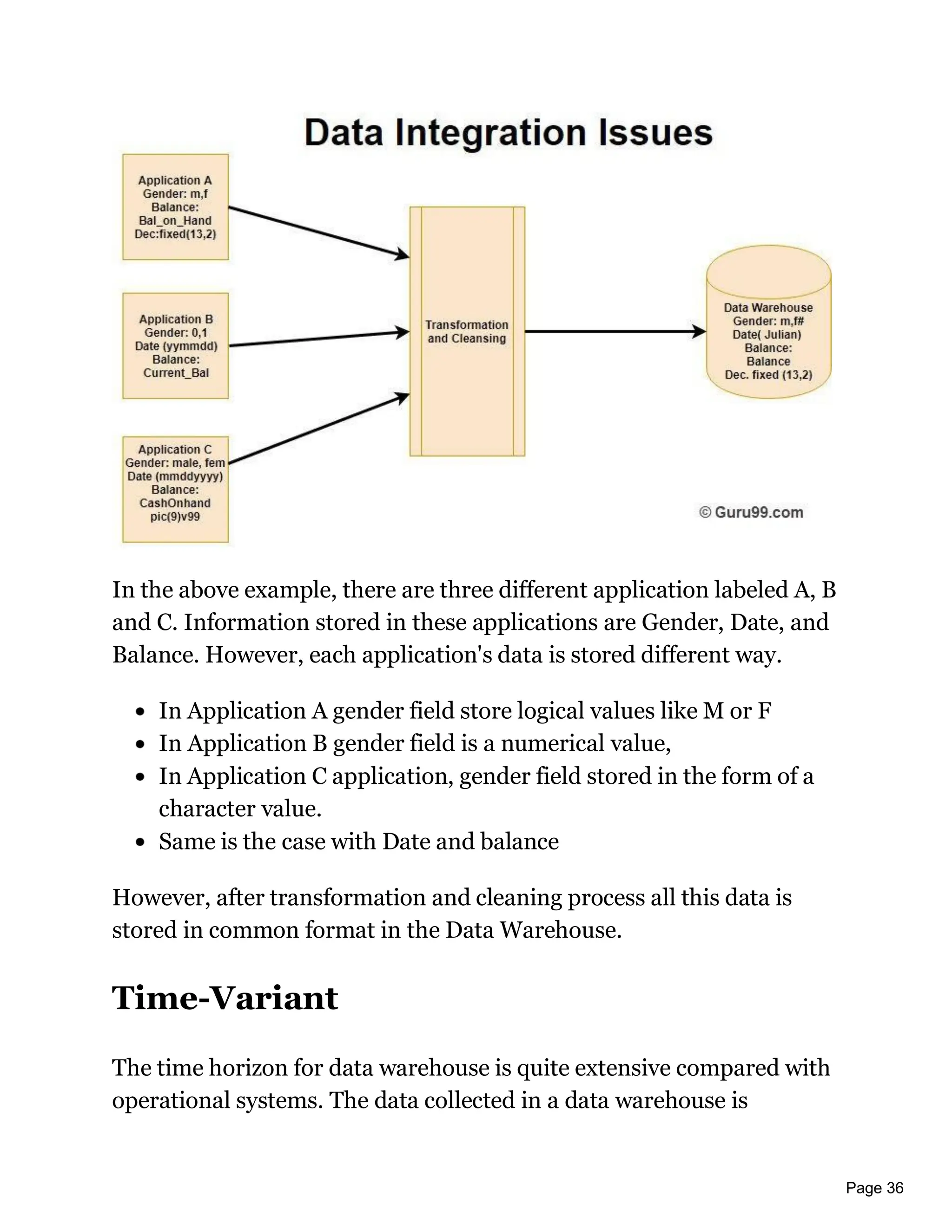
to be ensured. Consider the following example:
40.
Page 36
In theabove example, there are three different application labeled A, B
and C. Information stored in these applications are Gender, Date, and
Balance. However, each application's data is stored different way.
In Application A gender field store logical values like M or F
In Application B gender field is a numerical value,
In Application C application, gender field stored in the form of a
character value.
Same is the case with Date and balance
However, after transformation and cleaning process all this data is
stored in common format in the Data Warehouse.
Time-Variant
The time horizon for data warehouse is quite extensive compared with
operational systems. The data collected in a data warehouse is
41.
Page 37
recognized witha particular period and offers information from the
historical point of view. It contains an element of time, explicitly or
implicitly.
One such place where Datawarehouse data display time variance is in
in the structure of the record key. Every primary key contained with
the DW should have either implicitly or explicitly an element of time.
Like the day, week month, etc.
Another aspect of time variance is that once data is inserted in the
warehouse, it can't be updated or changed.
Non-volatile
Data warehouse is also non-volatile means the previous data is not
erased when new data is entered in it.
Data is read-only and periodically refreshed. This also helps to analyze
historical data and understand what & when happened. It does not
require transaction process, recovery and concurrency control
mechanisms.
Activities like delete, update, and insert which are performed in an
operational application environment are omitted in Data warehouse
environment. Only two types of data operations performed in the Data
Warehousing are
1. Data loading
2. Data access
Here, are some major differences between Application and Data
Warehouse
42.
Page 38
Operational ApplicationData Warehouse
Complex program must be coded to make
sure that data upgrade processes maintain
high integrity of the final product.
This kind of issues does not happen because
data update is not performed.
Data is placed in a normalized form to ensure
minimal redundancy.
Data is not stored in normalized form.
Technology needed to support issues of
transactions, data recovery, rollback, and
resolution as its deadlock is quite complex.
It offers relative simplicity in technology.
Data Warehouse Architectures
There are mainly three types of Datawarehouse Architectures: -
Single-tier architecture
The objective of a single layer is to minimize the amount of data
stored. This goal is to remove data redundancy. This architecture is
not frequently used in practice.
Two-tier architecture
Two-layer architecture separates physically available sources and data
warehouse. This architecture is not expandable and also not
supporting a large number of end-users. It also has connectivity
problems because of network limitations.
Three-tier architecture
This is the most widely used architecture.
It consists of the Top, Middle and Bottom Tier.
1. Bottom Tier: The database of the Datawarehouse servers as the
43.
Page 39
bottom tier.It is usually a relational database system. Data is
cleansed, transformed, and loaded into this layer using back-end
tools.
2. Middle Tier: The middle tier in Data warehouse is an OLAP
server which is implemented using either ROLAP or MOLAP
model. For a user, this application tier presents an abstracted
view of the database. This layer also acts as a mediator between
the end-user and the database.
3. Top-Tier: The top tier is a front-end client layer. Top tier is the
tools and API that you connect and get data out from the data
warehouse. It could be Query tools, reporting tools, managed
query tools, Analysis tools and Data mining tools.
Datawarehouse Components
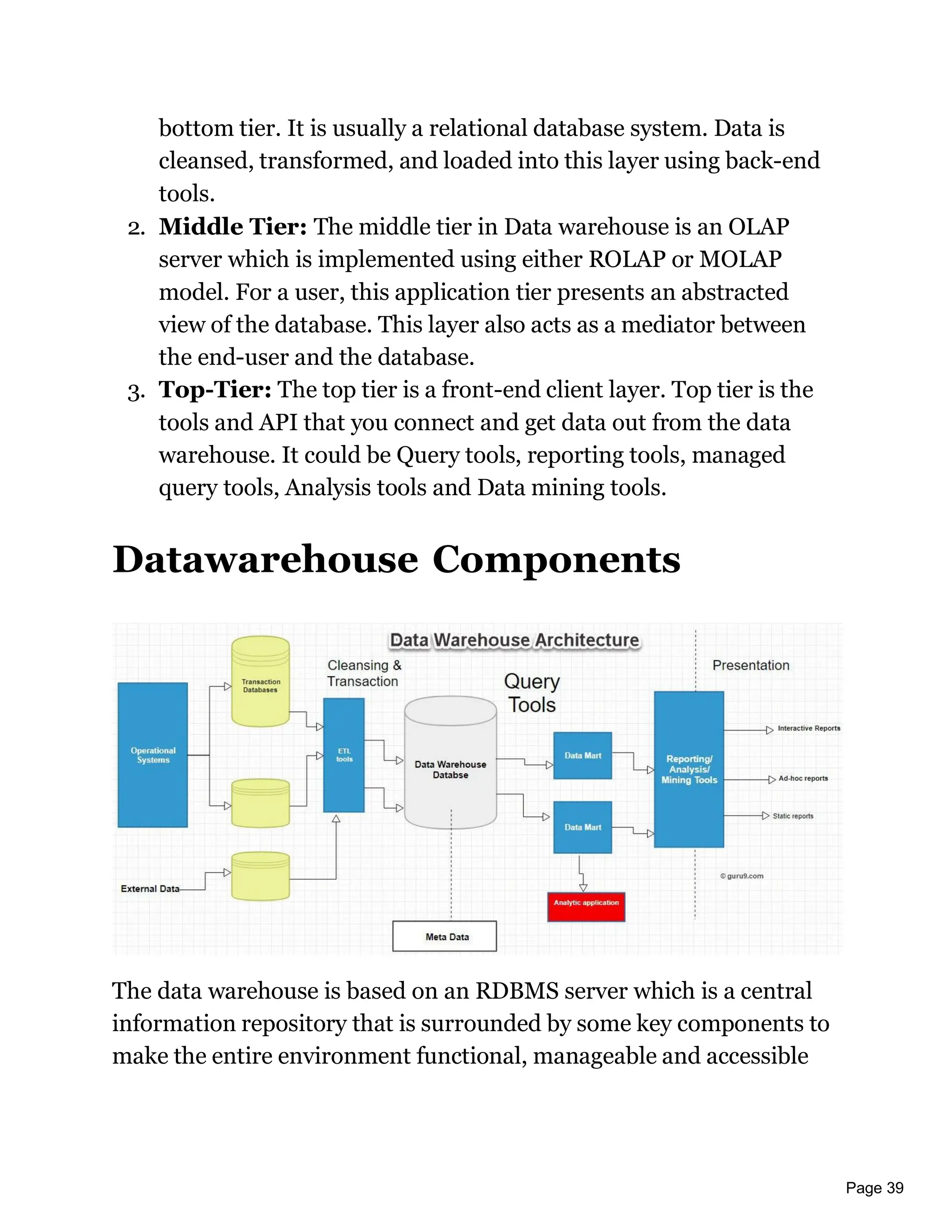
The data warehouse is based on an RDBMS server which is a central
information repository that is surrounded by some key components to
make the entire environment functional, manageable and accessible
44.
Page 40
There aremainly five components of Data Warehouse:
Data Warehouse Database
The central database is the foundation of the data warehousing
environment. This database is implemented on the RDBMS
technology. Although, this kind of implementation is constrained by
the fact that traditional RDBMS system is optimized for transactional
database processing and not for data warehousing. For instance, ad-
hoc query, multi-table joins, aggregates are resource intensive and
slow down performance.
Hence, alternative approaches to Database are used as listed below-
In a datawarehouse, relational databases are deployed in parallel
to allow for scalability. Parallel relational databases also allow
shared memory or shared nothing model on various
multiprocessor configurations or massively parallel processors.
New index structures are used to bypass relational table scan and
improve speed.
Use of multidimensional database (MDDBs) to overcome any
limitations which are placed because of the relational data model.
Example: Essbase from Oracle.
Sourcing, Acquisition, Clean-up and
Transformation Tools (ETL)
The data sourcing, transformation, and migration tools are used for
performing all the conversions, summarizations, and all the changes
needed to transform data into a unified format in the datawarehouse.
45.
Page 41
They arealso called Extract, Transform and Load (ETL) Tools.
Their functionality includes:
Anonymize data as per regulatory stipulations.
Eliminating unwanted data in operational databases from loading
into Data warehouse.
Search and replace common names and definitions for data
arriving from different sources.
Calculating summaries and derived data
In case of missing data, populate them with defaults.
De-duplicated repeated data arriving from multiple datasources.
These Extract, Transform, and Load tools may generate cron jobs,
background jobs, Cobol programs, shell scripts, etc. that regularly
update data in datawarehouse. These tools are also helpful to maintain
the Metadata.
These ETL Tools have to deal with challenges of Database & Data
heterogeneity.
Metadata
The name Meta Data suggests some high- level technological concept.
However, it is quite simple. Metadata is data about data which defines
the data warehouse. It is used for building, maintaining and managing
the data warehouse.
In the Data Warehouse Architecture, meta-data plays an important
role as it specifies the source, usage, values, and features of data
warehouse data. It also defines how data can be changed and
processed. It is closely connected to the data warehouse.
46.
Page 42
4030 KJ732299.90
For example, a line in sales database may contain:
This is a meaningless data until we consult the Meta that tell us it was
Model number: 4030
Sales Agent ID: KJ732
Total sales amount of $299.90
Therefore, Meta Data are essential ingredients in the transformation
of data into knowledge.
Metadata helps to answer the following questions
What tables, attributes, and keys does the Data Warehouse
contain?
Where did the data come from?
How many times do data get reloaded?
What transformations were applied with cleansing?
Metadata can be classified into following categories:
1. Technical Meta Data: This kind of Metadata contains
information about warehouse which is used by Data warehouse
designers and administrators.
2. Business Meta Data: This kind of Metadata contains detail that
gives end-users a way easy to understand information stored in
the data warehouse.
Query Tools
47.
Page 43
One ofthe primary objects of data warehousing is to provide
information to businesses to make strategic decisions. Query tools
allow users to interact with the data warehouse system.
These tools fall into four different categories:
1. Query and reporting tools
2. Application Development tools
3. Data mining tools
4. OLAP tools
1. Query and reporting tools:
Query and reporting tools can be further divided into
Reporting tools
Managed query tools
Reporting tools: Reporting tools can be further divided into
production reporting tools and desktop report writer.
1. Report writers: This kind of reporting tool are tools designed for
end-users for their analysis.
2. Production reporting: This kind of tools allows organizations to
generate regular operational reports. It also supports high volume
batch jobs like printing and calculating. Some popular reporting
tools are Brio, Business Objects, Oracle, PowerSoft, SAS Institute.
Managed query tools:
This kind of access tools helps end users to resolve snags in database
and SQL and database structure by inserting meta-layer between users
48.
Page 44
and database.
2.Application development tools:
Sometimes built-in graphical and analytical tools do not satisfy the
analytical needs of an organization. In such cases, custom reports are
developed using Application development tools.
3. Data mining tools:
Data mining is a process of discovering meaningful new correlation,
pattens, and trends by mining large amount data. Data mining tools
are used to make this process automatic.
4. OLAP tools:
These tools are based on concepts of a multidimensional database. It
allows users to analyse the data using elaborate and complex
multidimensional views.
Data warehouse Bus Architecture
Data warehouse Bus determines the flow of data in your warehouse.
The data flow in a data warehouse can be categorized as Inflow,
Upflow, Downflow, Outflow and Meta flow.
While designing a Data Bus, one needs to consider the shared
dimensions, facts across data marts.
Data Marts
49.
Page 45
A datamart is an access layer which is used to get data out to the
users. It is presented as an option for large size data warehouse as it
takes less time and money to build. However, there is no standard
definition of a data mart is differing from person to person.
In a simple word Data mart is a subsidiary of a data warehouse. The
data mart is used for partition of data which is created for the specific
group of users.
Data marts could be created in the same database as the
Datawarehouse or a physically separate Database.
Data warehouse Architecture Best
Practices
To design Data Warehouse Architecture, you need to follow below
given best practices:
Use a data model which is optimized for information retrieval
which can be the dimensional mode, denormalized or hybrid
approach.
Need to assure that Data is processed quickly and accurately. At
the same time, you should take an approach which consolidates
data into a single version of the truth.
Carefully design the data acquisition and cleansing process for
Data warehouse.
Design a MetaData architecture which allows sharing of metadata
between components of Data Warehouse
Consider implementing an ODS model when information retrieval
need is near the bottom of the data abstraction pyramid or when
50.
Page 46
there aremultiple operational sources required to be accessed.
One should make sure that the data model is integrated and not
just consolidated. In that case, you should consider 3NF data
model. It is also ideal for acquiring ETL and Data cleansing tools
Summary:
Data warehouse is an information system that contains historical
and commutative data from single or multiple sources.
A data warehouse is subject oriented as it offers information
regarding subject instead of organization's ongoing operations.
In Data Warehouse, integration means the establishment of a
common unit of measure for all similar data from the different
databases
Data warehouse is also non-volatile means the previous data is
not erased when new data is entered in it.
A Datawarehouse is Time-variant as the data in a DW has high
shelf life.
There are 5 main components of a Datawarehouse. 1) Database 2)
ETL Tools 3) Meta Data 4) Query Tools 5) DataMarts
These are four main categories of query tools 1. Query and
reporting, tools 2. Application Development tools, 3. Data mining
tools 4. OLAP tools
The data sourcing, transformation, and migration tools are used
for performing all the conversions and summarizations.
In the Data Warehouse Architecture, meta-data plays an
important role as it specifies the source, usage, values, and
features of data warehouse data.
51.
Page 47
Chapter 4:ETL (Extract,
Transform, and Load)
Process
What is ETL?
ETL is defined as a process that extracts the data from different
RDBMS source systems, then transforms the data (like applying
calculations, concatenations, etc.) and finally loads the data into the
Data Warehouse system. ETL full-form is Extract, Transform and
Load.
It's tempting to think a creating a Data warehouse is simply extracting
data from multiple sources and loading into database of a Data
warehouse. This is far from the truth and requires a complex ETL
process. The ETL process requires active inputs from various
stakeholders including developers, analysts, testers, top executives
and is technically challenging.
In order to maintain its value as a tool for decision-makers, Data
warehouse system needs to change with business changes. ETL is a
recurring activity (daily, weekly, monthly) of a Data warehouse system
and needs to be agile, automated, and well documented.
Why do you need ETL?
There are many reasons for adopting ETL in the organization:
52.
Page 48
It helpscompanies to analyze their business data for taking
critical business decisions.
Transactional databases cannot answer complex business
questions that can be answered by ETL.
A Data Warehouse provides a common data repository
ETL provides a method of moving the data from various sources
into a data warehouse.
As data sources change, the Data Warehouse will automatically
update.
Well-designed and documented ETL system is almost essential to
the success of a Data Warehouse project.
Allow verification of data transformation, aggregation and
calculations rules.
ETL process allows sample data comparison between the source
and the target system.
ETL process can perform complex transformations and requires
the extra area to store the data.
ETL helps to Migrate data into a Data Warehouse. Convert to the
various formats and types to adhere to one consistent system.
ETL is a predefined process for accessing and manipulating
source data into the target database.
ETL offers deep historical context for the business.
It helps to improve productivity because it codifies and reuses
without a need for technical skills.
ETL Process in Data Warehouses
ETL is a 3-step process
53.
Page 49
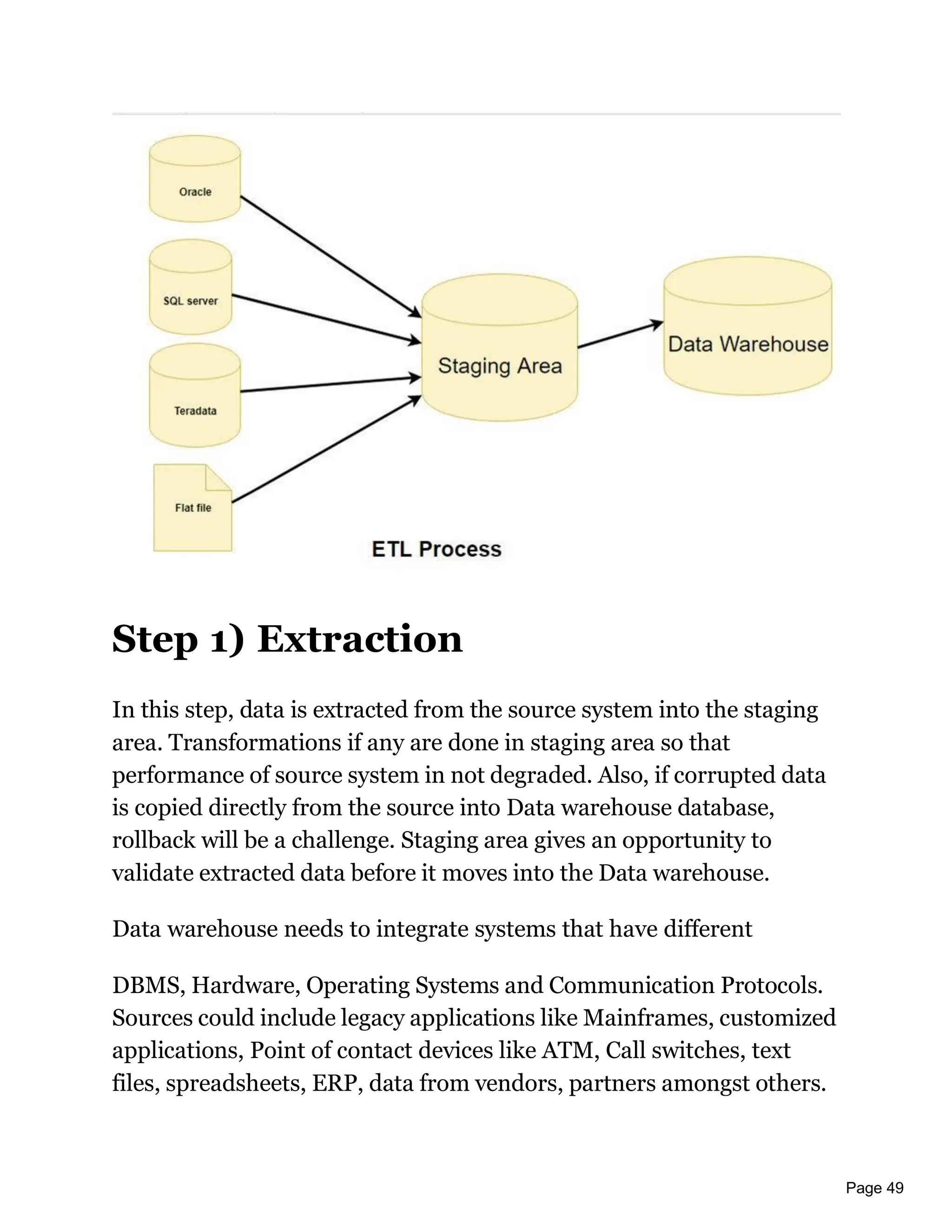
Step 1)Extraction
In this step, data is extracted from the source system into the staging
area. Transformations if any are done in staging area so that
performance of source system in not degraded. Also, if corrupted data
is copied directly from the source into Data warehouse database,
rollback will be a challenge. Staging area gives an opportunity to
validate extracted data before it moves into the Data warehouse.
Data warehouse needs to integrate systems that have different
DBMS, Hardware, Operating Systems and Communication Protocols.
Sources could include legacy applications like Mainframes, customized
applications, Point of contact devices like ATM, Call switches, text
files, spreadsheets, ERP, data from vendors, partners amongst others.
54.
Page 50
Hence oneneeds a logical data map before data is extracted and
loaded physically. This data map describes the relationship between
sources and target data.
Three Data Extraction methods:
1. Full Extraction
2. Partial Extraction- without update notification.
3. Partial Extraction- with update notification
Irrespective of the method used, extraction should not affect
performance and response time of the source systems. These source
systems are live production databases. Any slow down or locking could
effect company's bottom line.
Some validations are done during Extraction:
Reconcile records with the source data
Make sure that no spam/unwanted data loaded
Data type check
Remove all types of duplicate/fragmented data
Check whether all the keys are in place or not
Step 2) Transformation
Data extracted from source server is raw and not usable in its original
form. Therefore it needs to be cleansed, mapped and transformed. In
fact, this is the key step where ETL process adds value and changes
data such that insightful BI reports can be generated.
In this step, you apply a set of functions on extracted data. Data that
does not require any transformation is called as direct move or pass
well rubbed inby a soft brush kept for the purpose, the paraffine
should be well wiped away with a soft cloth. If the block is to be
stored away for a long time, it should be waxed. The best way of
doing this will be to make it rather warmer than is necessary to melt
wax, and then to rub it over with a piece of yellow bees’-wax, after
which the excess is wiped off with a piece of flannel.”
Sometimes zinc blocks are electroplated with copper or nickel (a
necessity when they are to be used for certain color work), and such
blocks should also be treated in the same way as the bare zinc, as
they cannot be safely cleaned with the lye solution.
57.
CHAPTER V.
THE TRANSFEROF THE DRAWING, AND ITS TREATMENT
BEFORE ETCHING.
According to the methods of producing them, classify the drawings
as follows:
(a) Freehand drawings in crayon or ink, drawn with lithographical
chalk on rough paper, or with pen and chemical Indian ink on paper
prepared for transferring.
(b) Lithographical transfer of engravings, pen-and-ink crayon
drawings, or drawings on stone.
(c) Transfers from relief plates made in copper, steel, zinc, or lead
(music).
(d) Anastatic transfers.
(e) Fat or resin prints from photographic negatives.
Proceed as follows:
(a) Transfer of hand-drawing.—Place the drawing to be
transferred with its face upon a sheet of clean, white paper, and
moisten the back with a weak solution of nitric acid (1
⁄
2
° Baumé), by
means of a sponge. Over-moistening causes obliteration of the
drawing, fringing of the single lines, and the running together of the
hatched portions. The correct degree of moisture can be ascertained
when the side prepared and drawn upon grows slightly sticky, and
when the drawing becomes glossy. This will take place in from four
to five minutes after moistening. This time is to be spent in
arranging the zinc in the press, after having freed it from all
greasiness. Place a card on the rolling press below the drawing and
the zinc; above it, a sheet of good blotting-paper, a sheet of Bristol
paper and are of pressing board; then make a trial print with the
58.
press, a cleanpiece of paper taking the place of the drawing. The
correct pressure is a matter of experience; it is advisable to begin
with a pressure less by one sheet, in order to be able to increase it
during the process of transfer.
In the lithographic press the ink-block is first to be adjusted; since
it needs a greater “setting in” than the rolling press, the zinc must
be cut larger. It must extend three centimetres on all sides beyond
the drawing. The edges of the cut plate must be well ground off, in
order that the ink-block may not be {74} caught; at all events, it is
advisable to have the latter smaller than the plate. Observe that the
range of the press should be regulated; then place the zinc directly,
without any intervening layer of paper, on a solid stone; lay upon it a
clean sheet of paper, a blotter, a sheet of Bristol paper, and a
pressing board well covered with tallow. Make a trial by drawing the
sheet through at a moderate pressure. If all is arranged, the work of
transfer can be started. The temperature of the zinc should now be
about 35° C.
Place the drawing down carefully, without moving it about; upon it
the blotter, the Bristol paper, and a pressing board, and draw it
through three times with constantly increasing pressure; turn the
plate in a contrary direction, and draw it through three times in the
same manner. Now place a moistened sheet of good paper between
the blotter and the drawing, and draw through, first with weak, and
then with strong pressure, three times in both positions. Instead of
turning the zinc, the ink-block may be reversed. This finishes the
operation of transprinting, and the next question is the loosening of
the paper from the zinc. Here we can pursue two methods: first, we
can have hot water and a porcelain tray at hand; place the copied
plate in the tray, and pour the water upon it. The coated layer
bearing the drawing begins to separate from the paper. Shaking the
tray promotes this action, and soon the paper will loosen itself from
the layer which remains attached to the zinc. With the second
method proceed thus: moisten the back of the copied drawing,
59.
thoroughly with asponge and cold water; allow it to soak in, warm
the plate to 60°–65° C. and carefully rub all parts by hand. The layer
will again separate by degrees from the paper, which latter we can
then easily lift off from the plate.
On account of the strongly gelatinous layer, crayons on grained
paper should only be moistened moderately before and after the first
rolling, in order to avoid the coiling of the paper.
Hand-drawings on paper without coloring require treatment with
stronger acid (I recommend nitric acid, 4° Beaumé). At the same
time the drawing should be cut as close as possible. To draw it
through securely, place it as usual upon the zinc, and above it a
piece of prepared copy paper moderately moistened, and a trifle
larger than the drawing, then a blotter, a Bristol board, and a thick
card, and draw through as before. The coated copy paper sticks
tight to the zinc after the first rolling; it also retains the drawing in
its first position, and allows repeated rolling. If the original was over-
moist when {75} copying, it sticks to the zinc and separates with
difficulty; if the moistening was just right, two perfect copies can
often be made from the same original.
I have attempted to copy drawings on a fatty zinc surface, and to
etch them strongly, but, far from being satisfied with the result, I
prefer the above method.
(b and c) Copies of lithographs, type, plates for printing of any
kind, plates for deep printing, I make on well satinized copying
paper*; in making the prints, I employ a copying ink as thick as
possible, with the addition of a few drops of a thick solution of
asphaltum in lavender oil, rolling a long time with but little color, so
as to get a sharp rather than a heavy print.
* Instead of the paste-gelatine-chalk, I prefer to
prepare the surface with a decoction of semina psyllii.
Plates for deep printing, I heat equally throughout before applying
the color. Instead of color, I rub them with chemical Indian ink, wipe
the surface carefully, even polish it finally with a ball and some
60.
Frankfort black. Ithen draw it through and again heat it uniformly,
so that the copy comes off of itself. Fine, sharp transfers, with
perfect relief, are thus obtained.
(d) Anastatic copies are no longer of great value, since they
always turn out roughly and cannot compare with photographic
copies. Although I possess a safe method, I believe that I will have
to omit it on account of the limited space of my work and the minute
importance of the results.
(e) Photographic fat or resin prints should be treated like ordinary
prints. Moisten them on the back with water—which is preferable to
placing them between moistened blotting-paper, since the drawing
does not grow too wet—and wait till they are easily flexible. Drops of
water on the film can and often do destroy the proof. Draw the plate
through with increasing pressure and one intermediate moistening.
Prints in fatty inks necessitate a temperature of plate of 35° C. Prints
with dissolved etching varnish (resin) as a printing film should have
from 50°–60° C. When loosening the paper avoid warming, but
moisten well. Sticking of the gelatine film happens, especially with
Husnik’s paper; a safe remedy is to dry the copy in strong light, after
developing. Old sensitized paper, on the contrary, seldom sticks at
all, and fresh paper should always be sought.
In printing with the rolling press, I observe that the rollers of the
press need only once to be regulated, and that greater or less
pressure can be attained by thicker or thinner covering of the print
with sheets of paper. This gives much greater security than can be
had when constantly readjusting the rollers. {76}
THE FURTHER TREATMENT OF THE TRANSFER.
Should we now proceed directly to etch the copy, the acid would
act through the drawing, which is as yet but loosely attached to the
zinc, and would at last cause the lines to appear broken, if not
destroy them.
61.
It is, therefore,necessary to replace the loose copy by a possibly
dense etching varnish, attached fast to the zinc, and to produce an
intimate connection between the latter and the etching varnish. Here
we meet a difference between the French and Austrian methods.
The former, totally based on the lithographic process, favors the use
of a resinous dense color as a strengthening material, whereas the
Austrian method employs an ordinary copying color and endeavors
to form an etching varnish by sprinkling and melting in a quantity of
finely pulverized resin. In the method of etching with copper
sulphate, it was attempted to restrict the corroding action of the
sulphuric acid by the following method: The drawing, rubbed with
color and thinly besprinkled with resin, was slightly melted in, then
sprinkled and rubbed with the finest silver graphite or real water-
gold. It was thus made an electric conductor. A thin coating of
copper was then deposited on the drawing, which, in point of fact,
hindered the destruction of the film. At the same time, however, the
process became uncontrollable, since often a deposit of amorphous
copper became tightly fastened to the metallic surface. The lateral
action could not well be ascertained, since the narrowest parts were
often clogged with metal, without preventing corrosion from below.
The French method of etching is this: A thick solution of gum-
arabic is mixed with extract of nutgalls; this is carefully spread over
the surface of the plate by means of a fine sponge, and dried by a
fan. Then a knife’s point full of etching color (composed of 500
grammes chalk color, 40 grammes coagulated mutton suet, 40
grammes soap, 125 grammes yellow wax, 40 grammes margarin,
and 40 grammes oleine, melted in the warm bath and passed
through the color mill) is dissolved in oil of turpentine, and a portion
of this solution is spread uniformly on the grinding stone by means
of a fine sponge, so that the latter contains a similar layer of color
throughout. The fatty gum film is then washed, with a wet sponge,
free from fat and acid; a fresh quantity of the gum and nutgall
solution is poured out, and the copy is by degrees strengthened by
62.
rubbing on theetching color with a sponge. This is repeated until
the drawing has attained the proper strength throughout. The
superposed layer of gum is then washed off, the superfluous water is
removed with a sponge, a wet cloth, and blotting-paper, dried with a
fan, then gently warmed. {77}
Now the plate is to be dusted with the finest pulverized resin,
consisting of equal parts of Syrian asphalt, washed in alcohol, and of
mastic; the superfluous resin is removed with a brush and some
cotton; the plate is then carefully heated, without beginning to melt
the resin, however.
This, by the French method, finishes the plate for etching. Only
weak acid is safe for such a plate, however.
According to the Austrian method (practised by me for several
years), we proceed as follows: The copied plate is first copiously
coated with a cold saturated solution of gallic acid, and then with a
pure solution of gum. Without allowing it to dry, I remove the
superfluous preparing materials with a wet sponge, and pour on
some fresh gallic acid, as with an excess of acid the drawing
assumes a more brilliant black color.
The strengthening with ordinary copying color I effect, as the case
may be, with the rollers, the sponge, or by coating.
(a) Strengthening with the Rollers.—I roll out some thick copying
ink with good, rough rollers which have been frequently used, and
begin to roll the transfer plate while still damp, without any pressure,
till its surface begins to dry. I then grasp the handles of the rollers
more firmly and blacken the dry plate uniformly, giving it a thin coat
of ink. This done, I moisten it a little and roll it regularly with rollers
freshly treated with color, so that the picture comes up harmoniously
and strongly.
Rolling off during drying keeps the gum solution from the drawing
while drying on, and keeps open the connection for rolling in.
Before going further I will explain the terms used*: To roll in is to
give color or ink, and is done slowly, with tightly grasped handles
63.
and certain pressure.Rolling off is effected with loosely grasped
handles, without pressure, and quickly, and is intended to draw off
with the rollers any excess of color on the plate. To work out or
make the rollers means to bring fresh color on it from the grinding
stone, and is done with strong pressure and strong traction. The
correct management of the rollers rests in the wrists. To reverse the
rollers, to change the handles, means to turn the rollers around, to
make the left-hand handle the right-hand one, and thus to correct
irregularities in the distribution of color. After every advance and
return on the stone or plate to be blackened the rollers are newly
adjusted. The plate thus strengthened must be well {78} washed
with clear water, to be dried, and at times even to be retouched with
a brush and color dissolved in oil of turpentine.
* Color and ink are synonymous. “Burn in” and “melt
in” mean the same.
(b) Blackening in with a sponge. The initiatory etching is done
with gallic acid, the gum coating put on and additional gallic acid
poured over; then some turpentine solution of copy color, the
consistency of syrup, is rubbed over the plate until the picture is
uniformly strengthened. If, as may happen in hand-drawings, the
color should become massed and not attach itself smoothly, it must
be washed off with turpentine and then clean color must be rubbed
on.
This operation requires great delicacy. After having finished the
blackening in, rinse well, dry with a sponge and thick blotting paper.
Heat, so as to vaporize the last remnants of dampness, and retouch.
(c) A peculiar method of strengthening, nowhere described, as far
as I know, is that of drying the plate after coating it with gum, then
washing the gum with water; then, after drying, of covering the
plate with a thin solution of wax, asphaltum, rosin, and shellac in
ether, and of carefully coating the quickly drying film with gum. The
film remains on the lines of the copy, but easily detaches itself from
64.
the bright metallicspaces, which have an insoluble combination with
the gallic acid and gum, and are thus protected from the fat.
Faults in strengthening are caused by the following:
a. By ink which is too thick or too thin, or which has not been well
ground. Stripes are caused by the dissolving of the color which is
already present.
b. By excessive dampness on the plate (it does not take the color;
the color in the sponge changes to a slimy emulsion).
c. By too great pressure with the color sponge the fine parts are
lost. The same is the case with careless washing of the color of
hand-drawings.
d. In rolling on excessive moisture on the plate spoils the work.
The surface of the rollers becomes glossy and must be again inked.
e. In pouring out the ink a very thick layer prevents the
strengthening of the finest lines.
Dirt on the plate often comes from handling the drawings; it must
be scratched off and the plate must be perfect before proceeding.
Now comes the changing of the ink into an etching varnish. But
before beginning we must cover the free edges of the zinc for the
distance of half a centimetre around the drawing with a solution of
ink in turpentine; the same applies to large white surfaces in the
drawing, which it is more convenient to cut out with a scroll saw.
Then subject the plate to the finest asphaltum {79} powder, passed
through a hair-sieve, and cover it by the dusting brush copiously
with powdered rosin. Continue the rubbing on of fresh powder for a
minute, until the ink is saturated, then dust out the superfluous
powder with the dusting brush and fine cotton, so that the metal is
bright (no film should be perceptible on looking over it).
The plate should now be heated to about 60° C., till the color of
the asphaltum changes from a coffee tint to a dead (matt) black.
Place the plate in this condition a second time with the asphaltum,
which is again absorbed rapidly. Dust off carefully as before and
burn in again till the color changes to a somewhat shiny black; the
65.
yellow tint mustbe avoided, because this degree of burning exposes
the lights in the closest hatchings to the danger of running together.
Thus the coat of color is changed into an etching varnish of
excellent resistance and adhesion, and the plate is ready for etching.
THE ETCHING AND ITS INTERMEDIATE TREATMENT BEFORE MOUNTING
THE CLICHÉ.
Introductory remarks.—If we examine a wood cut or an
electrotype with regard to the depth of its narrow and wide-line
complexes, we can at once determine a plane for the closest
hatchings; in a uniformly deep layer the lines lie at a moderate
distance apart, and those of the highest lights are very deep. These
three planes are situated higher or lower according to the very
narrow or very wide series of lines. This gives a natural division of
the different stages of etching, and, according to the three depths,
we distinguish the sharp etching or etching on in which the
engraving must advance far enough to place the narrowest portions
sufficiently low; middle etching, which has to accomplish the same
for the moderately narrow portions, and deep etching, which must
attain sufficient depth for the highest lights.
On account of the lateral action of the acid it is impossible to etch
down perpendicularly, but a wider covering is taken for each stage.
Of these wider coverings there remain after etching all around the
relief two terrace like grades, which must also be removed.
We have, then, in addition to the above, three sorts of etching, a
round etching, in which the grade remaining from the deep etching
is to be removed, and a clean etching, or a removal of the wire-edge
left after middle etching.
This natural subdivision is found in the old French method as well
as in the {80} new method, and both coating and the acids are of a
strength proportionate to the different stages of the work.
We have already alluded to the lateral action of the acid; it is a
factor that taxes the care of the etcher in the highest degree. In the
66.
beginning of theaction of the acid, the edge of the metal under the
coating is exposed the more, the longer the action lasts; here, of
course, the dissolving power becomes apparent. The deeper we go,
the more the metal under the line is exposed, and the action on the
lateral edge continually increases. In the effect of the acid we
distinguish thence, a perpendicular and a lateral action. Since the
latter cannot be removed by changing the character of the acid, we
must give it a part in this process of dissolving metals, but at the
same time must invent a method which will prevent the lines from
growing thin.
But in order to do this we must know the relation of the
perpendicular to side action. Both are in proportion, a result both of
theoretical and practical consideration. In order then to attain a
certain depth of etching, a proportional lateral protection must take
place, which is by degrees destroyed by the lateral action. Since this
lateral action sets in at the beginning of the work, the dimension of
the line must be secured from the start. This is done in the Vienna
method by the already mentioned formation of the etching varnish,
by means of dusting with resin and burning in, by which an almost
imperceptible growing of the width of line is attained. The French
method endeavors to correct this by using a very weak acid and a
correspondingly thin coating, but coating oftener and etching at
every new coating, as we shall see below. Also the coating for
middle and deep etching must be arranged in accordance with the
principles above elucidated. As deep as the middle or deep etching is
desired, so wide must the lines be surrounded by etching varnish.
ETCHING BY THE FRENCH METHOD.
We have already seen (p. 76) how a copy is made by the French
method for etching, and we now continue the development of this
process.
Into a tray pour 4 litres of water at 18° C., add 15 c.cm. nitric acid
and mix well by shaking. Then place the prepared plate into the bath
67.
and rock itfor seven or ten minutes (according to the fineness of the
drawing), rinse well with water, remove the remaining water with
blotting paper, and, finally, dry thoroughly with a fan. (Do not forget
to dry the back.) Now warm the plate from the back, moving the
flame about continually, so as to secure uniform heating and prevent
warping of the zinc. The asphalt powder, which is as {81} yet but
loosely attached, is more intimately connected with the subjacent ink
through this heating process. The combination becomes evident
from the assumption of a black lustre. With the appearance of this,
stop heating, and lay the plate on a cold stone to cool. This done,
spread some gallic acid over it with a soft sponge, and without
washing it off, spread gum on the surface of the plate, and hasten
the drying with a fan.
Mix some etching ink with varnish and work it out into a thin layer
with good rough rollers. If the rollers are in order, wash the coat of
gallic acid and gum from the plate, remove superfluous water and
roll in (the manner similar to that used in lithography). The surface
of the plate should not be more than moderately damp, so that the
rollers may not slip. If a coat of color has been uniformly deposited,
wash the plate with clean water, remove the excess with a sponge
and blotter, dry by fan and remove all moisture by heating to 45° C.
Dust the warm plate again with asphaltum (remove the excess), and
warm it a trifle to secure better adherence. Strengthen the bath by
the addition of 15 c.cm. nitric acid, and etch again for seven or ten
minutes under continued shaking. Then rinse the plate, remove the
water and dry with a fan, and burn in the resin powder well. Careful
inspection will now show a successful and uniform but still weak
relief.
As before, the plate is coated with gallic acid and solution of gum,
is dried, washed, and blackened in, in which treatment one-third
“wax pomatum”* is mixed with the etching ink. After washing and
drying heat the plate up to 60° C., thus causing an imperceptible
widening of the drawing. After coating dust once more with
68.
asphaltum, warm itand cover only the back and the white rim
around the drawing with a solution of shellac (1 part ruby shellac in
10 parts spirits). Strengthen the bath with 20 c.cm. of acid and
bathe it for seven to ten minutes, shaking the bath regularly.
Continue until you see that the lateral action of the acid has almost
wholly destroyed the lateral covering produced by heating. Do not,
however, etch too long, and do not mistake the over-hanging coat
for the other. Then follow washing, drying, melting on some resin,
cooling, coating with gum, blacking in with equal parts of etching ink
and “wax pomatum,” then washing, drying, greater heating (70° C.)
(so that by increasing the ink each line receives lateral protection),
cool and dust to excess with the finest resin dust. {82}
* Wax pomatum is prepared by cutting beeswax into
fine parts and covering it in a wide-necked flask with
oil of turpentine. In a few days a jelly-like mixture will
remain, which serves the above purpose.
As we have now reached the necessary depth for the narrowest
portions, we use, instead of the asphaltum, resin, which melts easily
and spreads out readily, in order to attain protection for our middle
etching.
Strengthen the bath with 30 c.cm. acid, and bathe until the lateral
action of the acid has reduced the lateral coating to a narrow edge.
Then wash, dry, melt on some resin, cool, prepare with gum.
Blacken in as before, but employ one-third etching ink and two-
thirds wax pomade and apply so thickly that all the narrowest spaces
of the drawing are completely filled with color. Continue warming
until the ink, which was applied, has well covered each line; then dry
and use resin as before.
The acid may now be strengthened by 100–158 c.cm., according
to the strength of coating chosen. Bathing must be continued until
the edge that has run off begins to grow narrow. Wash, dry, burn in
resin, cool, coat with gum, and blacken in by rollers with clean wax.
Continue heating until each line is well covered by ink. Always dust
until the ink is fully saturated and then heat gently.
69.
Strengthen the bath200 c.cm. and begin the deep etching.
According to the depth to be attained repeat the manipulation of
strengthening once or twice. Whenever a corrosion of the lateral
coating becomes apparent, coat freshly, adhering to the above order
of operation. For obtaining the necessary depth ink is applied about
ten times, adding wax each time to facilitate the spreading when
warming.
In order to attain a fine, regular lateral coating, great ability in
manipulating the rollers is necessary, since without such the correct
degree of strengthening is never attained. Irregular coating leads, of
course, to irregular melting of the ink; one spot then is already
sufficiently wide, while another is not yet covered. In such cases
coating with a brush must be resorted to.
If the necessary depth is attained, the plate is to be freed carefully
from the coating with a brush and oil of turpentine, and then placed
in fresh sawdust, which absorbs the oil of turpentine and leaves
behind a clean surface. Now the work can be criticised in all its
parts. To every coating is a corresponding narrow edge of etching,
which is now to be removed in order to make the plate fit for
printing. To removing these edges we must devote our attention. We
begin with the top one, and make preparations thus: Roll out on a
clean, warm stone with faultlessly smooth rollers a very thin gauze-
like layer of etching ink. Likewise warm the zinc plate and roll it in all
directions without pressure till the picture becomes beautifully black.
{83}
Pressure must not be employed, but the coating must be obtained
by renewed working out of the rollers on the color-slab, and
repeated coating. When at last the desired strength is obtained, dust
with the finest asphaltum powder, blow the traces of dust out of the
hollows, and warm till the layer becomes slightly brilliant. Next, etch
in a new bath of 4000 c.cm. of water and 40 c.cm. of acid for 7
minutes, wash, and dry well; then, with more ink on the rollers, coat
the dried plate, dust once with resin, heat gently, then apply the
70.
asphaltum and burnin strongly. Thus the first relief is protected
laterally, and the first grade can be etched down completely, without
endangering the drawing. To remove the second grade, we repeat
washing, and put on etching ink mixed with one-third wax. Rolling
must continue till the narrowest spaces of the etching are completely
closed. Then follow dusting with resin, warming, and placing the
warm plate in the asphalt, dusting, removing the excess, and finally
burning in.
With this coating a further rounding of the grades can take place
(in a bath of 10° Baumé). Continue this process until all the grades
are removed and the etching appears as perfect as a cast plate.
Since hitherto all publications on chemigraphy have duly described
this method, I believe that I should not enter into further details,
improvements, etc. Suffice it to call attention to weak points. In view
of the new method later to be described, the reader may make a
comparison between the two.
A very weak point is the method of strengthening based on the
lithographic process of superimposing new color upon the old color.
In consequence of the repeated melting in of resin, this latter
acquires an uneven surface, which can be blackened in only with
great difficulty. Equally untrustworthy is the lateral protection by
melting off, which is only attained with safe uniformity by skilled
workers. And what is more, with the weak coating at the beginning;
even weak acid often works its way through to the etching, so that
the finished etching appears slightly porous, and gives no dense
black print. Also shaking, which is to promote the removal of the
metallic mud and the gas bubbles from the lines of the etching, has
an unsatisfactory effect, inasmuch as the single lines are often thus
under-washed.
But the principal defect is that no accurate determination of the
degree of each operation can be made, everything depending on the
delicate execution of the process.
71.
The time thatthe etching of a correct, deep cliché requires by this
method is from eight to ten hours. This procedure also demands
better trained hands {84} than the Austrian, which, in large
establishments, is based on a division of labor, and in which men
trained in a single manipulation, under good supervision, accomplish
the maximum work surely and excellently.
Furthermore, the expenses of the manufacture on a large scale
are far greater, since each etcher draws a greater salary than a
workman skilled in a few manipulations, such as the following
method requires.
THE AUSTRIAN METHOD—THE ETCHING ON.
I have already shown how a transferred plate should be prepared
for etching by this method. Before proceeding to the details,
however, we will prepare the etching baths, which, by the way, may
always be employed for several plates. Corresponding to the three
steps of etching, we require three baths of different concentration to
be determined by means of an areometer with a Baumé scale. The
bath for etching on is prepared in strength of 2° Baumé at a
temperature of 18° C. There must be a quantity sufficient to cover
the plate to a depth of 4 to 5 centimetres. The bath for middle
etching requires 10° Baumé and a temperature of 18° C.; the bath
for deep etching, 18° Baumé. These baths are prepared at the
beginning, and are used for the five successive stages of etching. If,
after continued use, the bath for deep etching should grow weak, it
may be used for middle etching. For protecting the trays, I
recommend a coat of gutta-percha over a well-coated inner surface
of asphaltum. Everything being ready, immerse the prepared plate in
the bath, and with an etching-brush brush the surface of the plate
uniformly for two minutes.
The hairs of the brush must only rest lightly on the metallic
surface. For determining time, use sand-glasses of two, three, and
five minutes. After two minutes, take the plate out of the acid, wash
72.
it well withwater, and examine it carefully. If the effect has not been
uniform, see that two minutes more can be safely given in the
etching bath. If by any sort of careless handling the plate has been
injured, dry it with blotting-paper, vaporize the remaining dampness,
and cover the soiled spot with very thick solution of asphaltum in
turpentine. Cool, and continue brushing lightly for two minutes in
the bath.
At the end of this time, wash and examine again. Even now
everything will be intact. With very fine drawings, however, lateral
action has already progressed so far that, under all circumstances,
the exposed edges must be covered. Coarser drawings generally
stand one or two minutes more.
To try the depth of etching: with your finger-nail on the edge of
the black {85} rim, feel how far the etching-on has proceeded. As
soon as the finger-nail catches, the depth is sufficient, and the sides
of the lines may be covered.
For this operation the plate needs, above all, thorough washing,
drying on both sides by blotting-paper and gentle heat, and a
temperature of 45° C. At this temperature place the plate into the
finest resin-powder, and rub the latter several times over the warm
drawing, using for this purpose a fine brush. The protection, which
has grown sticky through heating, retains a thin coating of resin,
which, after dusting off the bright metallic spots with a brush and
fine cotton, and after careful fanning off, is reheated to about 50° C.
At this temperature the plate is returned to the white rosin, receives
a good dusting-in, and being freed from excess as before, is heated
to about 65°, so that the easily fusible rosin begins to spread out. At
this moment extinguish the light, and put the plate into the
asphaltum, which will attach itself copiously to the sticky resin.
Brush the plate well with the substance, remove any excess from the
bright spots, heat to 80° C.; then place it again into the asphaltum,
brush it, clean it by removing any excess, and heat it to 100° C.,
when a complete combination of the resinous mass takes place, and
73.
a uniform etchingvarnish is formed. This last coating is extremely
regular, and it is wonderful to see the accuracy with which the lines
have been covered. Beginners are warned to pay attention to the
careful cleaning of the bright parts of the plate when brushing and
dusting it; should any resin remain behind, it melts on, and grows by
degrees to a strong yellow tint, which is very difficult to remove, but
very easy to guard against. Never forget to dust off the back.
While the plate is still hot, lean it against the wall, face in, and the
back covered with a solution of shellac.
Now the plate is ready for further etching, which is carried on for
two minutes in the first bath. At the end of two minutes, wash and
examine critically. In almost every case we may etch for a third, or
even a fourth time. It is, however, sufficient for the beginner to
know that he has sufficiently etched in two spaces of two minutes
each, after preparing with resin. Trying and examining with the
finger-nail on the black edge will show a fine relief. Should it be
possible to etch for a third space of two minutes, or even of one,
without danger, it is preferable to do so. It should be a rule to
proceed as far as possible, judging from the character of drawing
and coating. Experience is easily gained in two or three trials, since
anything can be examined at any moment. Beginners would do well
to use a magnifying-glass with good field of view in examining, when
they can observe the most sensitive portion, and {86} all changes
may easily be noticed. The brush should be used lightly, to prevent
scratching. Usually, it is fastened at right angles to a stick to protect
the hands from the effect of the acid.
To raise the plates out of the tray, lay a gutta-percha thread into
the bottom of each tray, fastened at one end to the top edge of the
tray, projecting over the same on the other side. The plate is placed
on the thread while etching. It may be removed without touching
the bath by pulling the free end of the thread.
As already remarked, the spreading of ink on a surface which is
more or less rough is difficult. For this reason the plate, when
74.
etched-on after mymethod, is to be washed out with oil of
turpentine. A strong brush should be used for this, and some of the
oil rubbed over the plate without pressure. You must cause a
dissolving, not a rubbing off, of the coat. On continuing the addition
of turpentine, the metal grows bright. Take, then, a handful of the
coarsest of pine-wood sawdust and rub off the surface. This
removes instantly every trace of turpentine, leaving a clean surface
behind. For the sake of security, pour on more turpentine, rub with a
somewhat softer brush, and remove again with clean sawdust.
It is important that the wash-table should always remain free from
sawdust, which latter should fall through the grating into a suitable
receptacle. If this rule is disregarded, the wash-brush will soon be a
conglomerate of sawdust and hairs. Sawdust and turpentine will
stick to the brush so tightly that a new brush will have to be
purchased.
Now we again examine our work. It is a mark of success if the
relief still shows its original smoothness in all its parts, and has
nowhere grown porous. All the parts must be clear in their correct
proportional strength, as seen in the transfer.
The treatment of the plate from the time of transfer to the close
of the etching-on takes: for the saving of the edges and the white
portions of the drawing, 2 minutes; for preparing twice with
asphaltum, 4 minutes; for varnishing the back and coloring the
plate, 4 minutes; for etching-on the lateral protection, 4 to 5
minutes; for preparing twice with resin, asphaltum, and varnishing,
16 minutes; for renewed etching, 4 to 5 minutes; and for washing, 5
minutes—that is, 33 minutes in all. Add 7 minutes for inspection and
retouching, and 40 minutes will be the space allowed for etching-on.
{87}
75.
MIDDLE ETCHING.
In orderto give to the middle tints of the drawing the depth
necessary for printing, we begin with a new blacking-in. We need for
this purpose excellent, smooth, and hard rollers, which are
immersed in minium and linseed oil, and are then left to dry for a
short time. Contrary to the French method, we need here a thin
composition for the etching ink, obtained by concocting equal parts
of paraffine, suet, beeswax, and ordinary ink, prepared in an excess
of good linseed oil. (Ready-made color of right composition may be
had of E. Liesegang, in Dusseldorf, and other dealers.)
This color, when of right composition, possesses the power of
absorbing resin-powder, and changes in combination with the same,
when heated, to a compact, very solid, yet brittle mass.
Of this color, which is soft as butter, take a portion on a knife-
point, and spread it upon the smooth rollers, forming a perfectly
uniform layer. The complete covering is done by rolling, changing the
adjustment at intervals. When a perfectly uniform, oily coat is spread
on the color-slab and the rollers, begin rolling-in the washed plate.
Do not exert any pressure, but roll, carrying the handles so as to
black the relief only from the surface of the rollers. Of course, it
cannot be prevented, and is of no consequence, if ink attaches itself
to the large white spots. Rolling continues till the oily brown coating
has deposited itself uniformly. Exercise care in order not to get more
ink on some spots than on others. The plate, now completely rolled,
is placed in the finely powdered resin, with which it must be
completely covered. For the space of two minutes the oily color
absorbs the powder, which should, therefore, be strewn on it and
rubbed off repeatedly. If saturation in the cold has taken place, dust
off lightly with brush and cotton, blow off well, and heat uniformly to
35° C. The resin should not melt now, but should only grow sticky
and combine intimately with the color, which forms the binding
material. This change is observed immediately in the change
76.
Fig. 6.
resulting inthe gray resin coat. As soon as the change occurs
(beware of unequal heating), again place the warm plate into the
resin, saturate as before, dust out, blow strongly on the bright,
metallic spaces, to remove remaining traces of resin, and heat to
50°–55° C. At this temperature cover the film with fine asphalt
powder, dust off as before, and heat to 65° or 70° C. In this
condition the plate is again saturated with asphalt, and the layer,
after careful dusting and blowing, is heated until it grows slightly
{88} brilliant. Thus a complete coating is formed, and the plate has
the appearance of Fig. 6. The black spots represent the dirt which
has clung to the intensest lights, and must be removed. But before
attempting this, we varnish the back of our plate with a solution of
shellac, and cool it completely in water.
Now take a very coarse scraper,
ground with a sharp edge; hold it
between the index and middle fingers,
and scratch away the dirt from the light
spots, making the edge of the scratcher
draw the strokes close together. The
brittle backing breaks off finely, and in
a few minutes the dirt is removed and
the plate is ready for etching. If (which
will only happen to beginners) the
drawing should be scratched, the exposed spot must be covered, by
means of a brush, with a thick, warm solution of asphalt in
turpentine; the dirt which was scratched loose is brushed off, and
the plate goes into the bath for middle etching for about three
minutes. Brushing and washing follow in the same way as in the
previous operation. At the expiration of three minutes inspect (with
or without a magnifying glass); places that have been uncovered
must instantly be covered with asphaltum, as already directed.
Etching is continued till the lateral coating no longer protects the
first relief, which generally takes place after the third period (in
77.
about nine minutes)in a new bath, but requires twelve to fifteen
minutes in an old one. It is proved by the existence of only a narrow
thread alongside of the relief. The moment can be well ascertained.
If we wish to be sure of it we may do so by exposing the edge of the
black rim at different places; the width of the thread is then
apparent, and a safe conclusion may be drawn from the single spots
as to the whole plate. If not enough middle etching has taken place,
the thread remains wide and requires an extraordinary clean
etching, which may lead to the picture growing thin and endanger
the finest lines. Care, then, is necessary to ascertain the right
moment of suspending the middle etching, and of continuing in the
above-described manner with oil of turpentine, brushing,
sawdusting, and washing. After drying and brushing off the sawdust
with a strong brush, we have the clean plate ready for examination.
We observe the grade of etching produced by {89} middle etching
parallel to the contours of the different parts, and can safely assert
that the process has taken its natural course. Etchings without real
deep places (as high lights) might here be etched clean—that is,
might undergo removal of the formed etching grade. Yet it is
preferable to place the edge of the drawing as low as possible, to
prevent a tendency to crookedness, so-called facetting, and to get a
deep edge for nailing the plate on wood. The outward appearance of
the etching improves considerably, and the cliché can be fastened
much more securely. The chemigraphist must endeavor to satisfy the
demands of the printer in all respects, and should omit nothing that
serves to perfect his work. Thus only can he gain a good reputation
both for himself and for his work.
78.
DEEP ETCHING.
Having beensuccessfully treated in the middle etching process,
the plate needs only depression of the larger light spots. Some
simplify this part of the work by cutting out the highest lights by
means of a chisel, reverse ground. This can easily be done after a
little practice, and often saves time and acid. Care should be taken
with the chisel; the plate should lie on a flat surface and the cutting
twist be executed lightly and regularly. If this course is decided upon
and is applied to the highest lights, proceed to the execution of the
deep etching. Such chiselling does not happen in my laboratory,
since I prefer to etch all plates alike to their normal depth.
An excess of ink is now well spread over the rollers and the plate
is rolled in all directions. Close up all the middle tints and give the
acid room only in the densest lights. This coating is done by
warming the regularly covered plate to 31° C., and allowing the ink
to flow down rapidly and cover the recesses. A second coating with
slow manipulating of the rollers and manipulation of the handles
without pressure, will yield a sufficient coat from above. If, despite
this, certain parts should not be sufficiently blackened, rub on more
ink till the covering is sufficient and the side protection perfect.
As in middle etching, we must proceed to the formation of an
etching varnish by dusting with gums, placing into resin, by lightly
rubbing this resin on in constantly renewed layers, till the absorptive
power of the ink ceases; then warming and dusting warm with the
same resin to complete saturation; then raising the heat as above,
and dusting with asphaltum to saturation, heating stronger and
finally placing the hot plate into asphaltum, which again secures all
parts covered with ink and resin. {90}
At the different times of removing the dust, pay particular
attention to the bright metallic parts. Over-removal of dust removes
resin from the layer; under-removal leaves behind an obstinate
79.
Fig. 7.
yellow tintin the bright spots. Practice and experience readily prove
the best teachers in this respect.
The final heating of the etching varnish must be pushed so far
that an intimate connection is effected between all of its parts. This
is easily noticeable from the uniform gloss of the mass. While still
hot, the back of the plate is carefully varnished and cooling is
promoted by dipping it into cold water.
But few spots are to be removed by
chiselling (see Fig. 7), for the rollers
have only blacked the middle of the
highest lights. These spots, as indicated
in middle etching, are scratched bright
with a chisel. It is important always to
scrape off the white edge around the
drawing. Scratching of the plate does
not even happen with beginners,
except in cases of gross carelessness. If
it does happen, a good covering with the turpentine solution of
asphalt must be used. When this is all done properly we proceed to
etch.
The process of etching by the aid of a brush is continued in
periods of five minutes each. It is necessary to examine the side
covering carefully at the end of every operation; a diligent brushing
off of the surface is also to be recommended. Etching is continued
until, by degrees, the lateral coating decreases and the grade grows
narrower. At this juncture—that is, after about five to six operations
(twenty-five minutes) the necessary depth is attained. In few cases
(and almost always with beginners), it happens that a single coating
does not suffice for deep etching without endangering the plate. In
such cases wash the plate, coat it a second time, and form a second
etching varnish.
When the depth is satisfactory the plate is washed and the new
grade may be criticised.
80.
After a properexamination, we proceed to the
ROUND ETCHING.
Its object is to remove the last formed grade. Coat the plate with
a very uniform coating of ink, corresponding to the one used in
middle etching. A {91} criterion for correct coating is, that only the
grade caused by middle etching be covered, while the grade from
deep etching must remain exposed. Remember also that in heating
the plate a further spreading is caused by melting.
To the inexperienced it may happen that the grade caused by
deep etching is of variable width. These places must be removed by
working over with a graver before continuing, as otherwise we will
not attain symmetrical round etching.
The plate prepared for the latter treatment is only dusted once in
resin, and then blown out. It is then heated to 45° C., and is dusted
and heated twice with asphaltum at increasing temperature, just as
in both the previous processes. Nothing now remains to be
scratched away. After having varnished the back, the plate is etched
in the middle etching bath two or three times for three minutes. At
the end of each period examine whether another whole period is
necessary, or whether rounding the plate requires less time. When
this is over (several parts, which perhaps were already finished
beforehand, have been covered), wash and approach the next
problem, the removal of the grade resulting from the middle etching.
This is called
CLEAN ETCHING.
Upon the clean, smooth rollers spread thick transfer ink and roll it
out perfectly. It is advisable to warm the stone previously with a little
alcohol, which promotes the working out of the color. When the
surface of the color has become perfectly uniform the plate is rolled
in slowly and without pressure. Pressure would deposit too much
color in the finest recesses, and prevent the clean etching and
sharpening of the same, thus causing lack of harmony in the prints.
81.
Fig. 8.
It isbetter to coat the shadows with a pad, as they require more
color.
The plate, thus blackened, is to be dusted once with the finest
asphalt powder, then freed from excess by dusting off and blowing
until the coating becomes brilliant.
Clean etching then takes place in the bath for etching on, in
periods of one minute each, and repeatedly until the last thread has
disappeared.
Now everything is ready for a proof, and for subsequent mounting.
Fig. 6 shows a print of the little
picture given during the process of
middle and deep etching, and admits of
an instructive comparison during the
progress of the work. {92}
Proofs are made from the cleaned
plate (the back of which has been
scratched clean) in the following
manner: Upon a good lithographic roller
place a quantity of the best ink and
coat the etching uniformly. Help the shadows along by dabbing on
some ink with a leather pad. When this is done, carefully rub off the
excess in the lightest spots, and fix the plate in the rolling-press;
place on it a sheet of well-calendered tissue paper, next a sheet of
writing paper, a sheet of Bristol paper, and a cardboard. With very
little pressure (the thickness of one cardboard less than in the
transfer) draw it through. If the print is too weak, place paper below,
sheet by sheet. The stronger spots may be blackened separately.
82.
FINISHING AND MOUNTINGTHE PLATE.
The first thing to be done is the removal of the black edge left by
etching and the sawing out of such spots in the drawing as were
spared for this from the beginning. The waste may be removed by
means of a circular saw or a fine-toothed carpenter’s saw. Do not,
however, forget to leave behind a margin of about three millimetres
for the purpose of nailing the plate to the wood. The edges must be
smoothed with a graver, filed and chipped off to a suitable plane,
since sawing produces a sharp edge.
To remove the spots spared in the drawing, bore a hole through
the metal at that spot with an American gimlet, introduce a scroll
saw, and thus cut out the metal. The edge should be worked over
with a dog-leg chisel.
By aid of the borer we also make the conical holes in the edge,
through which the nails are to be hammered. Elevations caused on
the back of the plate by boring should be removed by filing.
The block of wood which is to raise the height of the plate to that
of type should be cut from perfectly dry maple, oak, or mahogany
wood. With the plate it must just reach to the top of the type; the
sides must be parallel, and all should be perfectly smooth.
Cutting at right angles can be done with a circular saw or with the
aid of a mitre saw used by printers for such work. For exact
examination of height, {93} pass the block and zinc through the
caliber-bridge (Fig. 9). Roughen the base and top surface of the
block with a toothing-plane. When convinced that the block fits
perfectly, nail the etching upon it, taking care to drive the heads of
the nails well into the holes provided for them, otherwise they will
show in the print. If other small details are noticed, they may be
removed with a dog-leg chisel.
This finishes the plate for delivery.
In the expounded explanation of my chemigraphical method, the
following arrangement may serve the beginner as a guide to the
83.
Fig. 9.
manipulations fromthe beginning
to the end of the work:
1. Planing the plate. 2. Grinding
it out. 3. Freeing from fat, and then
testing its cleanliness. 4.
Transferring the drawing to the
metal. 5. Preparing the metallic surface after transfer. 6.
Strengthening the transferred drawing by rubbing, rolling, or
flooding it as directed. 7. Transmutation of the transferred drawing
into a resisting etching varnish by double besprinkling and burning in
of asphaltum, subsequent to covering the edges and large light
parts, and after varnishing the back. 8. Sharp or preliminary etching,
strengthening with resin powder, and finishing preliminary etching.
9. Washing and examining the work. 10. Coating with etching ink for
middle etching. 11. Formation of the etching varnish by double
dusting and increasing burning-in of (a) resin and (b) asphalt;
varnishing the back. 12. Chiselling out the lights of the picture. 13.
Middle etching. 14. Washing and examining the result. 15. Coating
for deep etching. 16. Formation of etching varnish by dusting,
heating with increasing strength of resin and asphaltum; varnishing
the back. 17. Deep etching. 18. Washing out and examining. 19.
Coating for round etching. 20. Formation of etching varnish by single
dusting and warming of resin, and double dusting and burning-in of
asphaltum; varnishing the back. 21. Round etching. 22. Washing and
examining the plate. 23. Coating for clean etching. 24. Formation of
etching varnish by single dusting and burning-in of asphaltum at a
high temperature. 25. Clean etching. 26. Washing and scraping the
back. 27. Proofs. 28. Cutting out and mounting the plate.
84.
CHAPTER VI.
HINTS FROMALL SOURCES.
Although the number increases almost every week, there are but
few persons who understand photo-reproductive processes in all
their details. Those who do, have been so chary of giving of what
they know, that our literature on the subject is very scanty indeed.
Consequently, as all the hints that are obtainable are very welcome,
I have collated a few from various sources, and make a mosaics of
them here for the general good.
Every would-be photo-engraver, if he is not already a skilled
photographer, should obtain and study a good photographic text-
book. If he proposes to make his own drawings, he should also
obtain Burnet’s Essays on Art. The first will not only teach the best
formula for the production of negatives, but it will also enjoin the
importance of being careful, cleanly, and exact in all the
manipulations. The second will teach how to draw according to the
best rules of art. Remember always, the old injunction, whatever you
are, be best! After the regular photographic manipulations are well
looked after, the preparation of the drawing should have attention.—
EDWARD L. WILSON.
85.
AS TO THEDRAWING.
There are two separate and distinct styles of drawing for
reproductive purposes, whether the artistic engraver be employed,
or any of the means of automatic engraving be used. These two
methods are technically known respectively as fac simile drawing,
and drawing in wash. The former consists in the sole employment of
lines, in which the shading is to be produced as well as the outline of
a picture. Every line and mark that is subsequently to appear in the
engraving must be traced in the original. This description of drawing
is applicable to wood engraving, to line engraving upon copper or
steel, as well as to all the methods for automatically producing
blocks for relief printing. The line method is also universally adopted
by etchers in intaglio.
Successfully to prepare drawings for photographic reproduction it
is essential that some knowledge should be possessed of the
fundamental principles of {95} photography, as well as an
acquaintance with the capabilities of the particular process of
production which is to be employed. Thus, the material upon which
the drawing is to be made should be of such a character as will yield
a strong and well-defined contrast to the lines of the drawing; while
the pigment employed for the drawing should be as black as can be
procured. White Bristol board of fine surface, and the best India ink
meet these conditions. A blue-black does not form a desirable
drawing medium, but the introduction of red or orange into the
composition should serve to intensify the photographic image. To
draw upon a dark orange-colored paper with a pale blue-gray ink
would be simply to disregard all photographic principles, for the
photographic value of the paper and of the ink would be nearly
equal, and the drawing would consequently be lost.
Uniformity of color in the drawing is also desirable, and the artist
should resist the natural tendency to express distance and to
produce his effects by diminishing the intensity of color in parts of
86.
his picture. Froma drawing uniform in color a satisfactory negative
is obtained; but, in the other case, the photographer must estimate
an average duration of exposure, and will rarely escape the dilemma
of some portions being overexposed while others are comparatively
undeveloped. This theory receives illustration from the fact that very
good subdued effects can be obtained from well-executed pencil
drawings, where this uniformity of color is preserved. A longer
exposure may be required, but every part of the picture will be
equally developed.
To return to the matter of the paper used, color is not the only
important consideration. If the surface of the paper is irregular and
coarse in texture, such as painters in water-color delight in, good
results must not be expected. A negative, taken in the ordinary way
from a drawing made on such material, would inevitably reproduce
all the inequalities of the texture of the paper, to the manifest injury
of the more delicate parts of the drawing. In reproductions from old
prints or printed books, the conditions and character of the paper
present some of the greatest difficulties with which the
photographer has to contend. The ridges in the surface of the paper
cast shadows which are too faithfully reproduced in the negative.
The employment of a diffusive rather than a direct light is the usual
remedy, but the best way of dealing with the difficulty is that
employed in the studio of the Autotype Company. The original is laid
upon the floor under a strong light, and the camera set at an angle
of forty-five degrees.
Mr. Alfred Dawson informs me that he inclines to the opinion,
founded upon {96} his extensive experience and untiring experiment,
that it is desirable to get rid of the surface of the paper altogether,
by covering it with a substance similar to an enamel.
87.
Welcome to ourwebsite – the perfect destination for book lovers and
knowledge seekers. We believe that every book holds a new world,
offering opportunities for learning, discovery, and personal growth.
That’s why we are dedicated to bringing you a diverse collection of
books, ranging from classic literature and specialized publications to
self-development guides and children's books.
More than just a book-buying platform, we strive to be a bridge
connecting you with timeless cultural and intellectual values. With an
elegant, user-friendly interface and a smart search system, you can
quickly find the books that best suit your interests. Additionally,
our special promotions and home delivery services help you save time
and fully enjoy the joy of reading.
Join us on a journey of knowledge exploration, passion nurturing, and
personal growth every day!
ebookbell.com