Pig Latin Overview and Primitive
Data Types
Pig Latin is a simple language used to transform English words. It's a fun way to learn about language structure and practice
pronunciation.
AJ
by Ahamed Hassian J
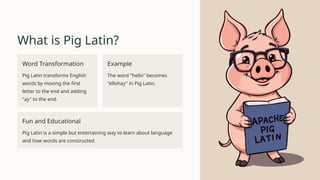
What is Pig Latin?
Word Transformation
Pig Latin transforms English
words by moving the first
letter to the end and adding
"ay" to the end.
Example
The word "hello" becomes
"ellohay" in Pig Latin.
Fun and Educational
Pig Latin is a simple but entertaining way to learn about language
and how words are constructed.
Motivation for Pig Latin
1 Language Learning
Pig Latin is a fun and
interactive way to teach
children about language
structure and
pronunciation.
2 Code Obfuscation
Pig Latin can be used as a
simple form of code
obfuscation, making text
more difficult to
understand.
3 Entertainment
Pig Latin is a playful and entertaining way to communicate with
friends and family.
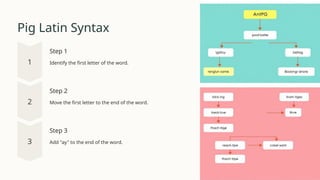
Pig Latin Syntax
Step 1
Identify the first letter of the word.
Step 2
Move the first letter to the end of the word.
Step 3
Add "ay" to the end of the word.
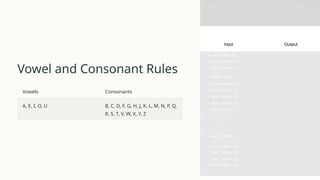
Vowel and Consonant Rules
Vowels Consonants
A, E, I, O, U B, C, D, F, G, H, J, K, L, M, N, P, Q,
R, S, T, V, W, X, Y, Z
Primitive Data Types in Pig Latin
Integers
Represent whole numbers, such as 1,
2, 3, etc.
Strings
Represent sequences of characters,
such as "hello," "world," etc.
Booleans
Represent truth values, either "true"
or "false."
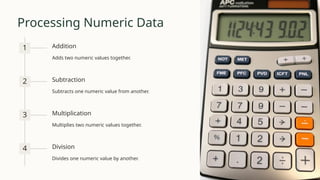
Processing Numeric Data
1 Addition
Adds two numeric values together.
2 Subtraction
Subtracts one numeric value from another.
3 Multiplication
Multiplies two numeric values together.
4 Division
Divides one numeric value by another.
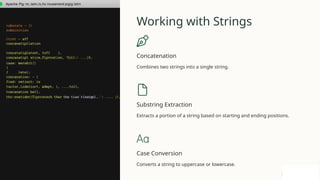
Working with Strings
Concatenation
Combines two strings into a single string.
Substring Extraction
Extracts a portion of a string based on starting and ending positions.
Case Conversion
Converts a string to uppercase or lowercase.
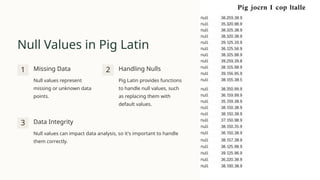
Null Values in Pig Latin
1 Missing Data
Null values represent
missing or unknown data
points.
2 Handling Nulls
Pig Latin provides functions
to handle null values, such
as replacing them with
default values.
3 Data Integrity
Null values can impact data analysis, so it's important to handle
them correctly.
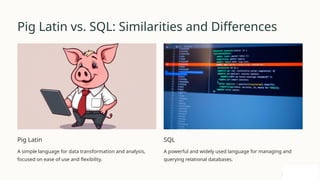
Pig Latin vs. SQL: Similarities and Differences
Pig Latin
A simple language for data transformation and analysis,
focused on ease of use and flexibility.
SQL
A powerful and widely used language for managing and
querying relational databases.

Pig-Latin-Overview-and-Primitive-Data-Types.pptx

  • 1.
    Pig Latin Overviewand Primitive Data Types Pig Latin is a simple language used to transform English words. It's a fun way to learn about language structure and practice pronunciation. AJ by Ahamed Hassian J
  • 2.
    What is PigLatin? Word Transformation Pig Latin transforms English words by moving the first letter to the end and adding "ay" to the end. Example The word "hello" becomes "ellohay" in Pig Latin. Fun and Educational Pig Latin is a simple but entertaining way to learn about language and how words are constructed.
  • 3.
    Motivation for PigLatin 1 Language Learning Pig Latin is a fun and interactive way to teach children about language structure and pronunciation. 2 Code Obfuscation Pig Latin can be used as a simple form of code obfuscation, making text more difficult to understand. 3 Entertainment Pig Latin is a playful and entertaining way to communicate with friends and family.
  • 4.
    Pig Latin Syntax Step1 Identify the first letter of the word. Step 2 Move the first letter to the end of the word. Step 3 Add "ay" to the end of the word.
  • 5.
    Vowel and ConsonantRules Vowels Consonants A, E, I, O, U B, C, D, F, G, H, J, K, L, M, N, P, Q, R, S, T, V, W, X, Y, Z
  • 6.
    Primitive Data Typesin Pig Latin Integers Represent whole numbers, such as 1, 2, 3, etc. Strings Represent sequences of characters, such as "hello," "world," etc. Booleans Represent truth values, either "true" or "false."
  • 7.
    Processing Numeric Data 1Addition Adds two numeric values together. 2 Subtraction Subtracts one numeric value from another. 3 Multiplication Multiplies two numeric values together. 4 Division Divides one numeric value by another.
  • 8.
    Working with Strings Concatenation Combinestwo strings into a single string. Substring Extraction Extracts a portion of a string based on starting and ending positions. Case Conversion Converts a string to uppercase or lowercase.
  • 9.
    Null Values inPig Latin 1 Missing Data Null values represent missing or unknown data points. 2 Handling Nulls Pig Latin provides functions to handle null values, such as replacing them with default values. 3 Data Integrity Null values can impact data analysis, so it's important to handle them correctly.
  • 10.
    Pig Latin vs.SQL: Similarities and Differences Pig Latin A simple language for data transformation and analysis, focused on ease of use and flexibility. SQL A powerful and widely used language for managing and querying relational databases.