DATA TRANSMISSION
2.1 CONCEPTS AND
TERMINOLOGY
2.2 ANALOG AND
DIGITAL DATA
TRANSMISSION
2.3 TRANSMISSION
IMPAIRMENTS
DATA TRANSMISSION
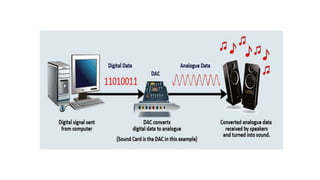
Data transmission is a process of sending digital and analog
data over a acommunication medium to one more
computing network.
Sending and receiving data via cables
• The successful
transmission of data
depends principally n
two factors;
• Quality of the signal
being transmitted
• The characteristics of
the transmission
medium ( Bandwith,
cost, ease of
installatio, etc…)
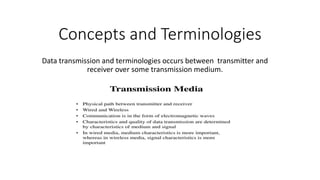
Concepts and Terminologies
Data transmission and terminologies occurs between transmitter and
receiver over some transmission medium.
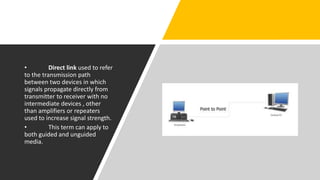
• Direct link used to refer
to the transmission path
between two devices in which
signals propagate directly from
transmitter to receiver with no
intermediate devices , other
than amplifiers or repeaters
used to increase signal strength.
• This term can apply to
both guided and unguided
media.
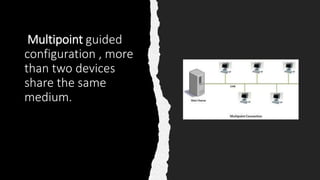
Multipoint guided
configuration , more
than two devices
share the same
medium.
Electromagnetic signals is use as a means to transmit data. The
signal is a function of time, but it can also be expressed as function
time, but it can also be expressed as a function of frequency; that is
the signal components of different frequencies. It turns out that the
frequency-domain view of signal is far more important to
understanding of data transmission than a time-domain view .
Analog and
Digital Data
Transmission
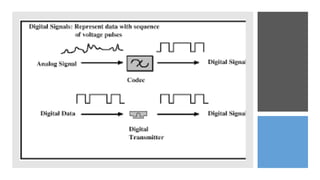
• The terms analog and digital
corresponds roughly to continuous and
discrete , respectively. These two terms are
frequently in data communications in at least
three context.
• Data
• Signaling
• Transmission
Data
The concepts of analog and digital
data are simple enough. Analog
data take on continuous values on
some interval.
For example, voice and video are
continuously varying patterns of
intensity. Most data collected, by
sensors, such as temperature and
pressure, are continuous valued.
Digital data take on discrete values ,
examples are text and integers.
• We can define data as entities that convey
meaning. Signals are electric or electromagnetic
encoding data. Signaling is the act of propagating
the signal along a suitable medium. Finally
transmission is the communication of data by the
the propagation and processing of signals.
Transmission
Impairments
The impairment is caused by the strength of signals that degrades
with distance over a transmission link.
The most significant impairments are:
•Attenuation
•Delay distortion
•Noise
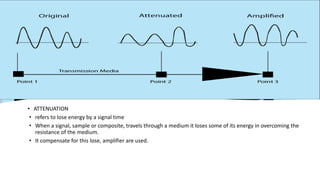
• ATTENUATION
• refers to lose energy by a signal time
• When a signal, sample or composite, travels through a medium it loses some of its energy in overcoming the
resistance of the medium.
• It compensate for this lose, amplifier are used.
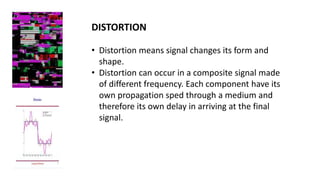
DISTORTION
• Distortion means signal changes its form and
shape.
• Distortion can occur in a composite signal made
of different frequency. Each component have its
own propagation sped through a medium and
therefore its own delay in arriving at the final
signal.
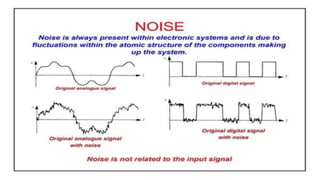
• Noise maybe devided into
four categories:
• Thermal use
• Intermodulation
• Crosstalk
• Impulse noise
data transmission

data transmission

  • 1.
    DATA TRANSMISSION 2.1 CONCEPTSAND TERMINOLOGY 2.2 ANALOG AND DIGITAL DATA TRANSMISSION 2.3 TRANSMISSION IMPAIRMENTS
  • 2.
    DATA TRANSMISSION Data transmissionis a process of sending digital and analog data over a acommunication medium to one more computing network. Sending and receiving data via cables
  • 3.
    • The successful transmissionof data depends principally n two factors; • Quality of the signal being transmitted • The characteristics of the transmission medium ( Bandwith, cost, ease of installatio, etc…)
  • 4.
    Concepts and Terminologies Datatransmission and terminologies occurs between transmitter and receiver over some transmission medium.
  • 6.
    • Direct linkused to refer to the transmission path between two devices in which signals propagate directly from transmitter to receiver with no intermediate devices , other than amplifiers or repeaters used to increase signal strength. • This term can apply to both guided and unguided media.
  • 7.
    Multipoint guided configuration ,more than two devices share the same medium.
  • 9.
    Electromagnetic signals isuse as a means to transmit data. The signal is a function of time, but it can also be expressed as function time, but it can also be expressed as a function of frequency; that is the signal components of different frequencies. It turns out that the frequency-domain view of signal is far more important to understanding of data transmission than a time-domain view .
  • 10.
    Analog and Digital Data Transmission •The terms analog and digital corresponds roughly to continuous and discrete , respectively. These two terms are frequently in data communications in at least three context. • Data • Signaling • Transmission
  • 11.
    Data The concepts ofanalog and digital data are simple enough. Analog data take on continuous values on some interval. For example, voice and video are continuously varying patterns of intensity. Most data collected, by sensors, such as temperature and pressure, are continuous valued. Digital data take on discrete values , examples are text and integers.
  • 12.
    • We candefine data as entities that convey meaning. Signals are electric or electromagnetic encoding data. Signaling is the act of propagating the signal along a suitable medium. Finally transmission is the communication of data by the the propagation and processing of signals.
  • 16.
    Transmission Impairments The impairment iscaused by the strength of signals that degrades with distance over a transmission link.
  • 17.
    The most significantimpairments are: •Attenuation •Delay distortion •Noise
  • 18.
    • ATTENUATION • refersto lose energy by a signal time • When a signal, sample or composite, travels through a medium it loses some of its energy in overcoming the resistance of the medium. • It compensate for this lose, amplifier are used.
  • 19.
    DISTORTION • Distortion meanssignal changes its form and shape. • Distortion can occur in a composite signal made of different frequency. Each component have its own propagation sped through a medium and therefore its own delay in arriving at the final signal.
  • 21.
    • Noise maybedevided into four categories: • Thermal use • Intermodulation • Crosstalk • Impulse noise