03/20/25 CS 201
DataStructure
• A construct that can be defined within a
programming language to store a
collection of data
– one may store some data in an array of
integers, an array of objects, or an array of
arrays
3.
03/20/25 CS 201
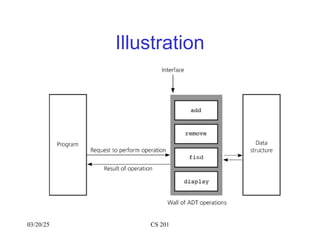
AbstractData Type (ADT)
• Definition: a collection of data together
with a set of operations on that data
– specifications indicate what ADT
operations do, but not how to implement
them
– data structures are part of an ADT’s
implementation
• Programmer can use an ADT without
knowing its implementation.
4.
03/20/25 CS 201
TypicalOperations on Data
• Add data to a data collection
• Remove data from a data collection
• Ask questions about the data in a data
collection. E.g., what is the value at a
particular location, and is x in the
collection?
5.
03/20/25 CS 201
WhyADT
• Hide the unnecessary details
• Help manage software complexity
• Easier software maintenance
• Functionalities are less likely to change
• Localised rather than global changes
03/20/25 CS 201
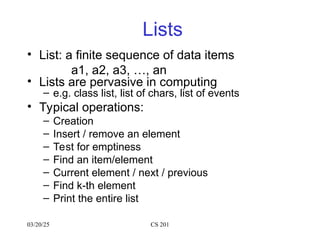
Lists
•List: a finite sequence of data items
a1, a2, a3, …, an
• Lists are pervasive in computing
– e.g. class list, list of chars, list of events
• Typical operations:
– Creation
– Insert / remove an element
– Test for emptiness
– Find an item/element
– Current element / next / previous
– Find k-th element
– Print the entire list
9.
03/20/25 CS 201
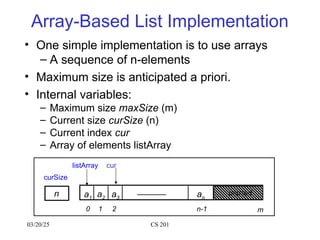
Array-BasedList Implementation
• One simple implementation is to use arrays
– A sequence of n-elements
• Maximum size is anticipated a priori.
• Internal variables:
– Maximum size maxSize (m)
– Current size curSize (n)
– Current index cur
– Array of elements listArray
n
curSize
a1 a2 a3 an
listArray
unused
0 1 2 n-1 m
cur
10.
03/20/25 CS 201
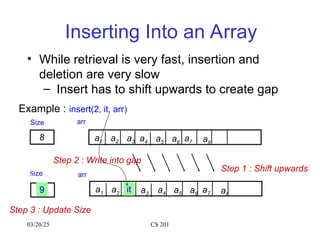
InsertingInto an Array
• While retrieval is very fast, insertion and
deletion are very slow
– Insert has to shift upwards to create gap
a1 a2 a7 a8
a4 a5 a6
a3
Step 1 : Shift upwards
8
Size arr
8 a1 a2 a3 a7 a8
Size arr
a4 a5 a6
Example : insert(2, it, arr)
Step 2 : Write into gap
it
Step 3 : Update Size
9
11.
03/20/25 CS 201
Coding
typedefstruct {
int arr[MAX];
int max;
int size;
} LIST
void insert(int j, int it, LIST *pl)
{ // pre : 1<=j<=size+1
int i;
for (i=pl->size; i>=j; i=i-1)
// Step 1: Create gap
{ pl->arr[i+1]= pl->arr[i]; };
pl->arr[j]= it; // Step 2: Write to gap
pl->size = pl->size + 1; // Step 3: Update size
}
12.
03/20/25 CS 201
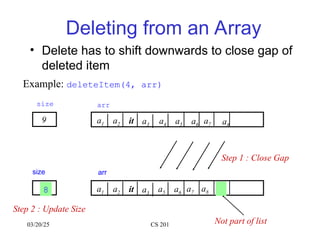
Deletingfrom an Array
• Delete has to shift downwards to close gap of
deleted item
Step 1 : Close Gap
9 a1 a2 it a7
a8
size
a5 a6
a3
a8
arr
9 a1 a2 it a7 a8
size
a4 a5 a6
a3
arr
Example: deleteItem(4, arr)
Step 2 : Update Size
8
Not part of list
13.
03/20/25 CS 201
Coding
voiddelete(int j, LIST *pl)
{ // pre :
1<=j<=size
for (i=j+1; i<=pl->size; i=i+1)
// Step1: Close
gap
{ pl->arr[i-i]=pl->arr[i]; };
// Step 2: Update
size
pl->size = pl->size - 1;
}
14.
03/20/25 CS 201
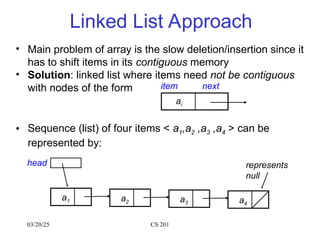
LinkedList Approach
• Main problem of array is the slow deletion/insertion since it
has to shift items in its contiguous memory
• Solution: linked list where items need not be contiguous
with nodes of the form
• Sequence (list) of four items < a1,a2 ,a3 ,a4 > can be
represented by:
item next
ai
a1 a2 a3 a4
head represents
null
15.
Pointer-Based Linked Lists
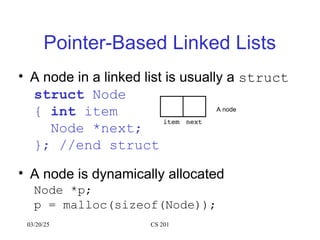
•A node in a linked list is usually a struct
struct Node
{ int item
Node *next;
}; //end struct
• A node is dynamically allocated
Node *p;
p = malloc(sizeof(Node));
A node
03/20/25 CS 201
16.
Pointer-Based Linked Lists
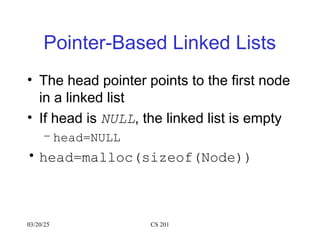
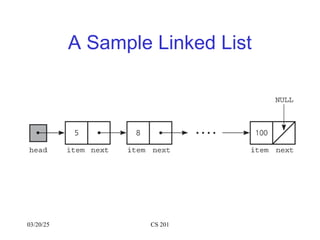
•The head pointer points to the first node
in a linked list
• If head is NULL, the linked list is empty
– head=NULL
• head=malloc(sizeof(Node))
03/20/25 CS 201
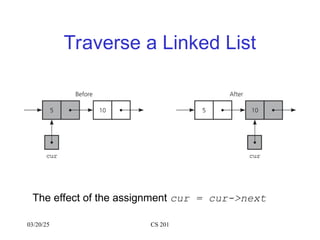
Traverse a LinkedList
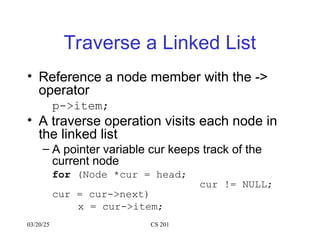
• Reference a node member with the ->
operator
p->item;
• A traverse operation visits each node in
the linked list
– A pointer variable cur keeps track of the
current node
for (Node *cur = head;
cur != NULL;
cur = cur->next)
x = cur->item;
03/20/25 CS 201
19.
Traverse a LinkedList
The effect of the assignment cur = cur->next
03/20/25 CS 201
20.
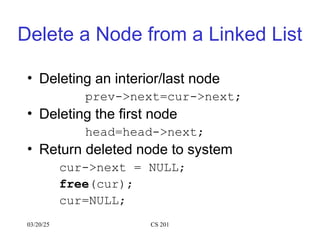
Delete a Nodefrom a Linked List
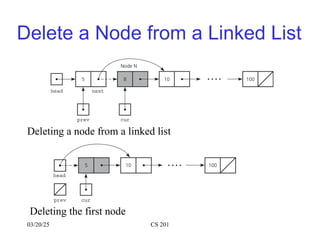
• Deleting an interior/last node
prev->next=cur->next;
• Deleting the first node
head=head->next;
• Return deleted node to system
cur->next = NULL;
free(cur);
cur=NULL;
03/20/25 CS 201
21.
Delete a Nodefrom a Linked List
Deleting a node from a linked list
Deleting the first node
03/20/25 CS 201
22.
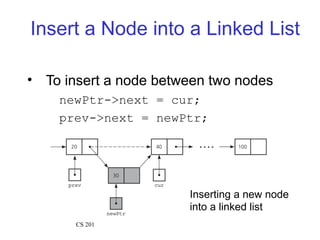
Insert a Nodeinto a Linked List
• To insert a node between two nodes
newPtr->next = cur;
prev->next = newPtr;
Inserting a new node
into a linked list
CS 201
23.
Insert a Nodeinto a Linked List
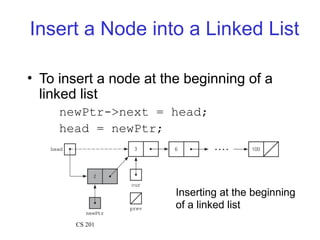
• To insert a node at the beginning of a
linked list
newPtr->next = head;
head = newPtr;
Inserting at the beginning
of a linked list
CS 201
24.
Insert a Nodeinto a Linked List
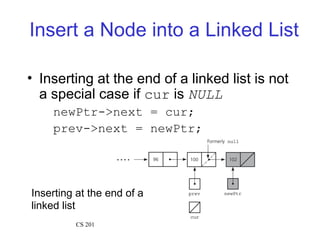
• Inserting at the end of a linked list is not
a special case if cur is NULL
newPtr->next = cur;
prev->next = newPtr;
Inserting at the end of a
linked list
CS 201
25.
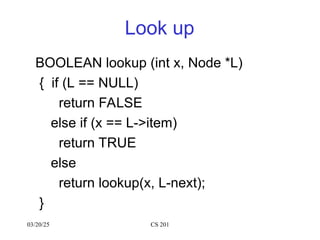
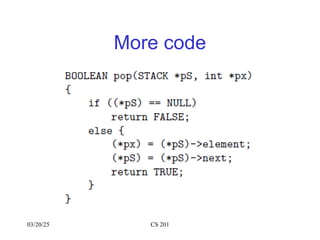
Look up
BOOLEAN lookup(int x, Node *L)
{ if (L == NULL)
return FALSE
else if (x == L->item)
return TRUE
else
return lookup(x, L-next);
}
03/20/25 CS 201
26.
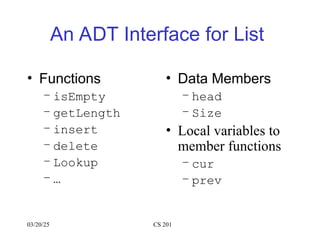
An ADT Interfacefor List
• Functions
– isEmpty
– getLength
– insert
– delete
– Lookup
– …
• Data Members
– head
– Size
• Local variables to
member functions
– cur
– prev
03/20/25 CS 201
27.
03/20/25 CS 201
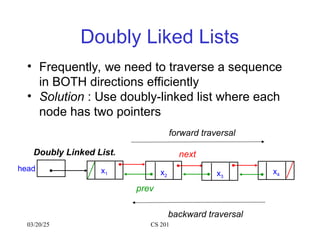
DoublyLiked Lists
• Frequently, we need to traverse a sequence
in BOTH directions efficiently
• Solution : Use doubly-linked list where each
node has two pointers
next
forward traversal
Doubly Linked List.
x1 x4
x2
head
x3
backward traversal
prev
28.
03/20/25 CS 201
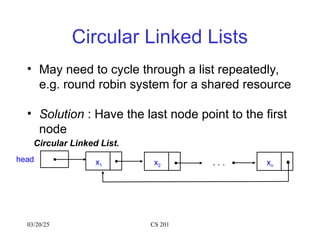
CircularLinked Lists
• May need to cycle through a list repeatedly,
e.g. round robin system for a shared resource
• Solution : Have the last node point to the first
node
x1 x2 xn
. . .
Circular Linked List.
head
03/20/25 CS 201
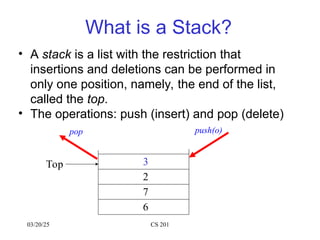
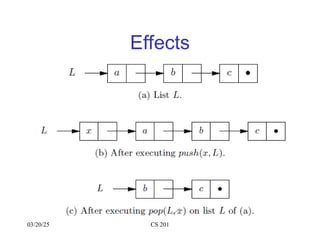
Whatis a Stack?
• A stack is a list with the restriction that
insertions and deletions can be performed in
only one position, namely, the end of the list,
called the top.
• The operations: push (insert) and pop (delete)
pop push(o)
6
7
2
3
Top
31.
03/20/25 CS 201
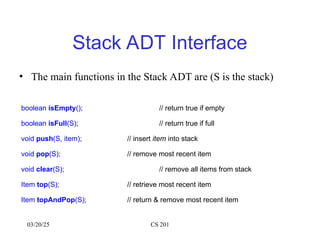
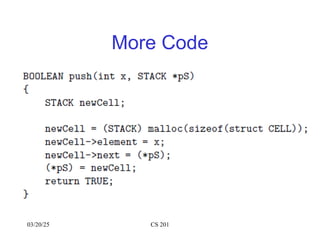
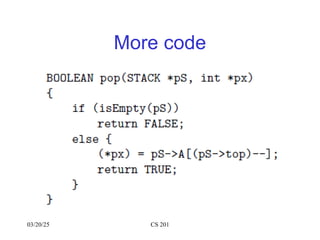
StackADT Interface
• The main functions in the Stack ADT are (S is the stack)
boolean isEmpty(); // return true if empty
boolean isFull(S); // return true if full
void push(S, item); // insert item into stack
void pop(S); // remove most recent item
void clear(S); // remove all items from stack
Item top(S); // retrieve most recent item
Item topAndPop(S); // return & remove most recent item
32.
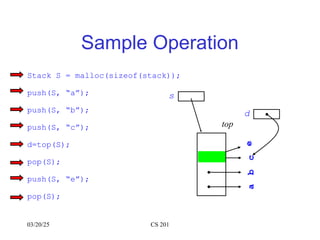
03/20/25 CS 201
SampleOperation
Stack S = malloc(sizeof(stack));
push(S, “a”);
push(S, “b”);
push(S, “c”);
d=top(S);
pop(S);
push(S, “e”);
pop(S);
s
a
b
c
top
e
d
33.
03/20/25 CS 201
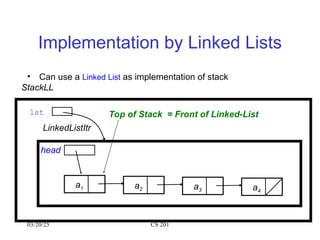
Implementationby Linked Lists
• Can use a Linked List as implementation of stack
Top of Stack = Front of Linked-List
StackLL
lst
a1 a2 a3 a4
head
LinkedListItr
03/20/25 CS 201
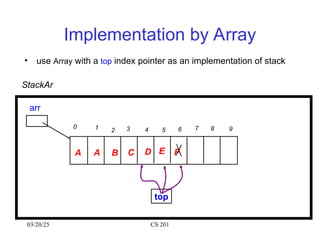
Implementationby Array
• use Array with a top index pointer as an implementation of stack
E F
0 1 7 8 9
2 3 4 5 6
A B C D
top
StackAr
arr
A
03/20/25 CS 201
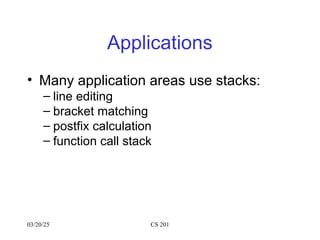
Applications
•Many application areas use stacks:
– line editing
– bracket matching
– postfix calculation
– function call stack
43.
03/20/25 CS 201
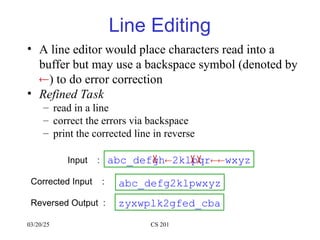
LineEditing
• A line editor would place characters read into a
buffer but may use a backspace symbol (denoted by
) to do error correction
• Refined Task
– read in a line
– correct the errors via backspace
– print the corrected line in reverse
Input :
Corrected Input :
Reversed Output :
abc_defgh2klpqrwxyz
abc_defg2klpwxyz
zyxwplk2gfed_cba
44.
03/20/25 CS 201
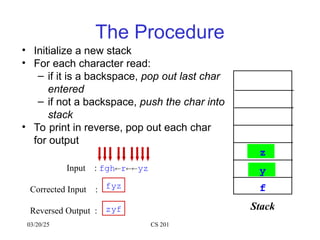
TheProcedure
• Initialize a new stack
• For each character read:
– if it is a backspace, pop out last char
entered
– if not a backspace, push the char into
stack
• To print in reverse, pop out each char
for output
Input : fghryz
Corrected Input :
Reversed Output :
fyz
zyf Stack
f
g
h
r
y
z
45.
03/20/25 CS 201
BracketMatching Problem
• Ensures that pairs of brackets are properly matched
• An Example: {a,(b+f[4])*3,d+f[5]}
• Bad Examples:
(..)..) // too many closing brackets
(..(..) // too many open brackets
[..(..]..) // mismatched brackets
46.
03/20/25 CS 201
InformalProcedure
Initialize the stack to empty
For every char read
if open bracket then push onto stack
if close bracket, then
return & remove most recent item
from the stack
if doesn’t match then flag error
if non-bracket, skip the char read
Example
{a,(b+f[4])*3,d+f[5]}
Stack
{
(
[
)
}
]
[ ]
47.
03/20/25 CS 201
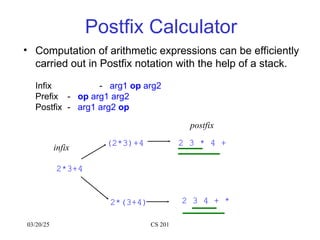
PostfixCalculator
• Computation of arithmetic expressions can be efficiently
carried out in Postfix notation with the help of a stack.
Infix - arg1 op arg2
Prefix - op arg1 arg2
Postfix - arg1 arg2 op
(2*3)+4
2*(3+4) 2 3 4 + *
2*3+4
infix
2 3 * 4 +
postfix
48.
03/20/25 CS 201
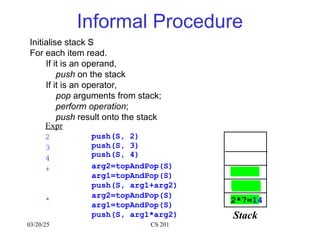
InformalProcedure
Initialise stack S
For each item read.
If it is an operand,
push on the stack
If it is an operator,
pop arguments from stack;
perform operation;
push result onto the stack
2
3
4
Stack
Expr
2
3
4
+
*
push(S, 2)
push(S, 3)
push(S, 4)
arg2=topAndPop(S)
arg1=topAndPop(S)
push(S, arg1+arg2)
arg2=topAndPop(S)
arg1=topAndPop(S)
push(S, arg1*arg2)
3+4=7
2*7=14
49.
03/20/25 CS 201
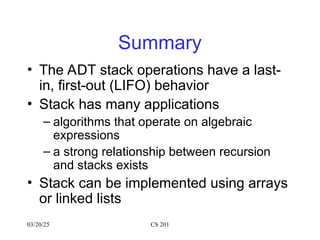
Summary
•The ADT stack operations have a last-
in, first-out (LIFO) behavior
• Stack has many applications
– algorithms that operate on algebraic
expressions
– a strong relationship between recursion
and stacks exists
• Stack can be implemented using arrays
or linked lists
03/20/25 CS 201
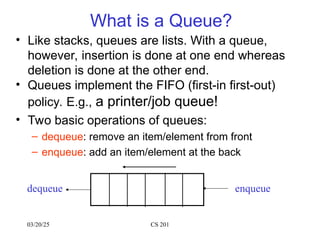
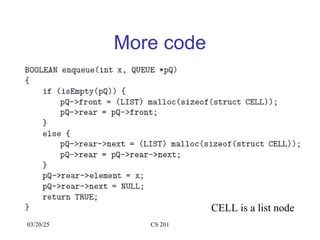
Whatis a Queue?
• Like stacks, queues are lists. With a queue,
however, insertion is done at one end whereas
deletion is done at the other end.
• Queues implement the FIFO (first-in first-out)
policy. E.g., a printer/job queue!
• Two basic operations of queues:
– dequeue: remove an item/element from front
– enqueue: add an item/element at the back
dequeue enqueue
52.
03/20/25 CS 201
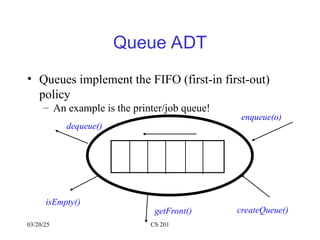
QueueADT
• Queues implement the FIFO (first-in first-out)
policy
– An example is the printer/job queue!
enqueue(o)
dequeue()
isEmpty()
getFront() createQueue()
53.
03/20/25 CS 201
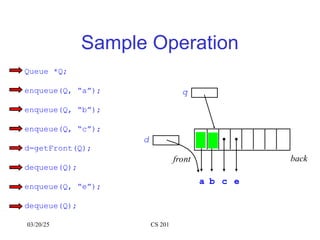
SampleOperation
Queue *Q;
enqueue(Q, “a”);
enqueue(Q, “b”);
enqueue(Q, “c”);
d=getFront(Q);
dequeue(Q);
enqueue(Q, “e”);
dequeue(Q);
q
front back
a b c e
d
54.
03/20/25 CS 201
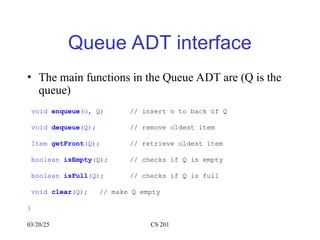
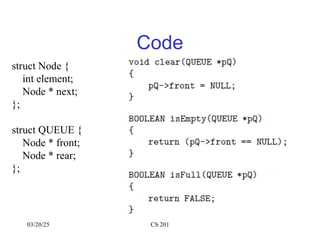
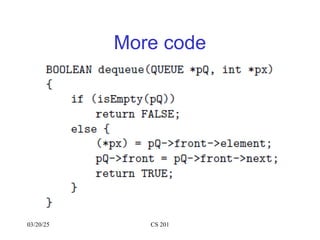
QueueADT interface
• The main functions in the Queue ADT are (Q is the
queue)
void enqueue(o, Q) // insert o to back of Q
void dequeue(Q); // remove oldest item
Item getFront(Q); // retrieve oldest item
boolean isEmpty(Q); // checks if Q is empty
boolean isFull(Q); // checks if Q is full
void clear(Q); // make Q empty
}
55.
03/20/25 CS 201
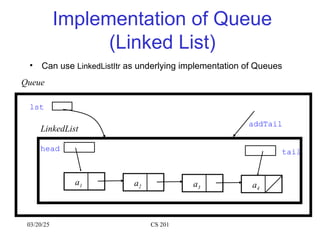
Implementationof Queue
(Linked List)
• Can use LinkedListItr as underlying implementation of Queues
a1 a2 a3 a4
head tail
Queue
lst
LinkedList
addTail
03/20/25 CS 201
Implementationof Queue
(Array)
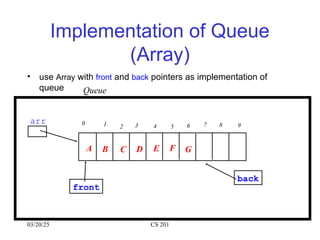
• use Array with front and back pointers as implementation of
queue Queue
arr 0 1 7 8 9
2 3 4 5 6
A B C D E F G
front
back
60.
03/20/25 CS 201
CircularArray
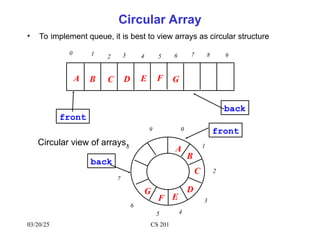
• To implement queue, it is best to view arrays as circular structure
0 1 7 8 9
2 3 4 5 6
A B C D E F G
front
back
front
back
A
B
C
D
E
F
G
0
1
7
8
9
2
3
4
5
6
Circular view of arrays.
61.
03/20/25 CS 201
Howto Advance
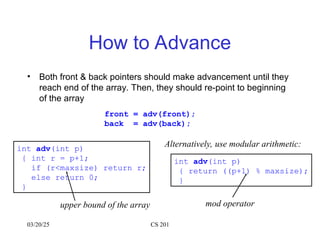
• Both front & back pointers should make advancement until they
reach end of the array. Then, they should re-point to beginning
of the array
front = adv(front);
back = adv(back);
int adv(int p)
{ return ((p+1) % maxsize);
}
Alternatively, use modular arithmetic:
mod operator
int adv(int p)
{ int r = p+1;
if (r<maxsize) return r;
else return 0;
}
upper bound of the array
62.
03/20/25 CS 201
Sample
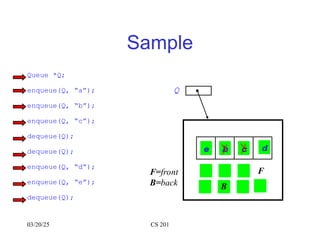
Queue*Q;
enqueue(Q, “a”);
enqueue(Q, “b”);
enqueue(Q, “c”);
dequeue(Q);
dequeue(Q);
enqueue(Q, “d”);
enqueue(Q, “e”);
dequeue(Q);
a
Q
F=front
B=back
F
B
b c d
F
B B B
F F
B B
e
63.
03/20/25 CS 201
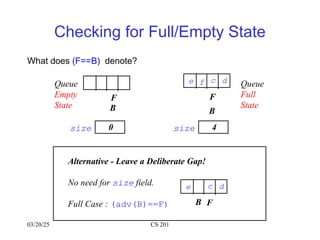
Checkingfor Full/Empty State
What does (F==B) denote?
F
B
Queue
Empty
State
c d
e
B
F
f Queue
Full
State
size 0 size 4
c d
e
B F
Alternative - Leave a Deliberate Gap!
No need for size field.
Full Case : (adv(B)==F)
64.
03/20/25 CS 201
Summary
•The definition of the queue operations
gives the ADT queue first-in, first-out
(FIFO) behavior
• The queue can be implemented by
linked lists or by arrays
• There are many applications
– Printer queues,
– Telecommunication queues,
– Simulations,
– Etc.

![03/20/25 CS 201
Coding
typedef struct {
int arr[MAX];
int max;
int size;
} LIST
void insert(int j, int it, LIST *pl)
{ // pre : 1<=j<=size+1
int i;
for (i=pl->size; i>=j; i=i-1)
// Step 1: Create gap
{ pl->arr[i+1]= pl->arr[i]; };
pl->arr[j]= it; // Step 2: Write to gap
pl->size = pl->size + 1; // Step 3: Update size
}](https://image.slidesharecdn.com/cs201-list-stack-queue-250320222652-a8272a65/85/Data-Structures-and-Discrete-Mathematics-11-320.jpg)
![03/20/25 CS 201
Coding
void delete(int j, LIST *pl)
{ // pre :
1<=j<=size
for (i=j+1; i<=pl->size; i=i+1)
// Step1: Close
gap
{ pl->arr[i-i]=pl->arr[i]; };
// Step 2: Update
size
pl->size = pl->size - 1;
}](https://image.slidesharecdn.com/cs201-list-stack-queue-250320222652-a8272a65/85/Data-Structures-and-Discrete-Mathematics-13-320.jpg)


![03/20/25 CS 201
Bracket Matching Problem
• Ensures that pairs of brackets are properly matched
• An Example: {a,(b+f[4])*3,d+f[5]}
• Bad Examples:
(..)..) // too many closing brackets
(..(..) // too many open brackets
[..(..]..) // mismatched brackets](https://image.slidesharecdn.com/cs201-list-stack-queue-250320222652-a8272a65/85/Data-Structures-and-Discrete-Mathematics-45-320.jpg)
![03/20/25 CS 201
Informal Procedure
Initialize the stack to empty
For every char read
if open bracket then push onto stack
if close bracket, then
return & remove most recent item
from the stack
if doesn’t match then flag error
if non-bracket, skip the char read
Example
{a,(b+f[4])*3,d+f[5]}
Stack
{
(
[
)
}
]
[ ]](https://image.slidesharecdn.com/cs201-list-stack-queue-250320222652-a8272a65/85/Data-Structures-and-Discrete-Mathematics-46-320.jpg)


![제 23회 보아즈(BOAZ) 빅데이터 컨퍼런스 - [MBOAX] : ABSA를 활용한 소비자 반응 분석 기반 운영 효율화 대시보드 설계](https://cdn.slidesharecdn.com/ss_thumbnails/3-1boaz23rdconferencemboax-260203102709-9d519923-thumbnail.jpg?width=640&height=640&fit=bounds)


