Data Science Training
Let’s Get Started!
Description
Data science is a "concept to unify statistics, data
analysis and their related methods" to "understand and
analyze actual phenomena" with data. It employs
techniques and theories drawn from many fields within
the broad areas of mathematics, statistics, information
science, and computer science from the subdomains of
machine learning, classification, cluster analysis, data
mining, databases, and visualization. The Data Science
Training enables you to gain knowledge of the entire Life
Cycle of Data Science, analyzing and visualizing different
data sets, different Machine Learning Algorithms like K-
Means Clustering, Decision Trees, Random Forest, and
Naive Bayes.
Objectives
• Gain insight into the 'Roles' played by a Data
Scientist
• Analyze several types of data using R
• Describe the Data Science Life Cycle
• Work with different data formats like XML,
CSV etc.
• Learn tools and techniques for Data
Transformation
• Discuss Data Mining techniques and their
implementation
Objectives
• Analyze data using Machine Learning algorithms in
R
• Explain Time Series and it’s related concepts
• Perform Text Mining and Sentimental analyses on
text data
• Gain insight into Data Visualization and
Optimization techniques
• Understand the concepts of Deep Learning
Why learn Data Science
Data science incorporates tools from multi disciplines
to gather a data set, process and derive insights from
the data set, extract meaningful data from the set,
and interpret it for decision-making purposes. The
disciplinary areas that make up the data science field
include mining, statistics, machine learning, analytics,
and some programming. Data mining applies
algorithms in the complex data set to reveal patterns
which are then used to extract useable and relevant
data from the set. Statistical measures like predictive
analytics utilize this extracted data to gauge events
that are likely to happen in the future based on what
the data shows happened in the past.
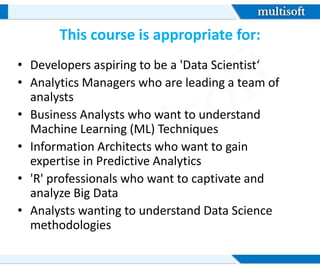
This course is appropriate for:
• Developers aspiring to be a 'Data Scientist‘
• Analytics Managers who are leading a team of
analysts
• Business Analysts who want to understand
Machine Learning (ML) Techniques
• Information Architects who want to gain
expertise in Predictive Analytics
• 'R' professionals who want to captivate and
analyze Big Data
• Analysts wanting to understand Data Science
methodologies
Prerequistes
There is no specific pre-requisite for this training program,
however basic understanding of R can be beneficial.
Data Science Training

Data Science Training

  • 1.
  • 2.
    Description Data science isa "concept to unify statistics, data analysis and their related methods" to "understand and analyze actual phenomena" with data. It employs techniques and theories drawn from many fields within the broad areas of mathematics, statistics, information science, and computer science from the subdomains of machine learning, classification, cluster analysis, data mining, databases, and visualization. The Data Science Training enables you to gain knowledge of the entire Life Cycle of Data Science, analyzing and visualizing different data sets, different Machine Learning Algorithms like K- Means Clustering, Decision Trees, Random Forest, and Naive Bayes.
  • 3.
    Objectives • Gain insightinto the 'Roles' played by a Data Scientist • Analyze several types of data using R • Describe the Data Science Life Cycle • Work with different data formats like XML, CSV etc. • Learn tools and techniques for Data Transformation • Discuss Data Mining techniques and their implementation
  • 4.
    Objectives • Analyze datausing Machine Learning algorithms in R • Explain Time Series and it’s related concepts • Perform Text Mining and Sentimental analyses on text data • Gain insight into Data Visualization and Optimization techniques • Understand the concepts of Deep Learning
  • 5.
    Why learn DataScience Data science incorporates tools from multi disciplines to gather a data set, process and derive insights from the data set, extract meaningful data from the set, and interpret it for decision-making purposes. The disciplinary areas that make up the data science field include mining, statistics, machine learning, analytics, and some programming. Data mining applies algorithms in the complex data set to reveal patterns which are then used to extract useable and relevant data from the set. Statistical measures like predictive analytics utilize this extracted data to gauge events that are likely to happen in the future based on what the data shows happened in the past.
  • 6.
    This course isappropriate for: • Developers aspiring to be a 'Data Scientist‘ • Analytics Managers who are leading a team of analysts • Business Analysts who want to understand Machine Learning (ML) Techniques • Information Architects who want to gain expertise in Predictive Analytics • 'R' professionals who want to captivate and analyze Big Data • Analysts wanting to understand Data Science methodologies
  • 7.
    Prerequistes There is nospecific pre-requisite for this training program, however basic understanding of R can be beneficial.