Probabilistic data structures
https://www.linkedin.com/in/taras-yaroshchuk-551383105/
Taras Yaroshchuk
Senior Data Engineer at Sigma Software
- 4 years in Data Engineering
- AdTech, IoT, FinTech
- Scala/Java/Python
- Trying to contribute to big data community
Skype/Telegram/FB/everywhere: taras.yaroshchuk
Use cases
● Membership (Bloom filter, Quotient filter, Cuckoo filter)
● Frequency (Frequent algorithm, Count-Min Sketch)
● Cardinality (Linear Counting, LogLog, HyperLogLog)
● Rank (Random sampling, q-digest, t-digest)
● Similarity (Locality-Sensitive Hashing, MinHash, SimHash)
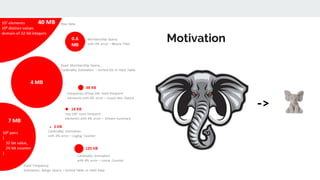
Motivation
->
Use cases
● Membership (Bloom filter, Quotient filter, Cuckoo filter)
● Frequency (Frequent algorithm, Count-Min Sketch)
● Cardinality (Linear Counting, LogLog, HyperLogLog)
● Rank (Random sampling, q-digest, t-digest)
● Similarity (Locality-Sensitive Hashing, MinHash, SimHash)
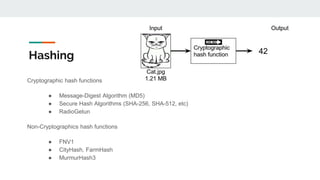
Hashing
Cryptographic hash functions
● Message-Digest Algorithm (MD5)
● Secure Hash Algorithms (SHA-256, SHA-512, etc)
● RadioGetun
Non-Cryptographics hash functions
● FNV1
● CityHash, FarmHash
● MurmurHash3
42
Bloom Filter (Membership)
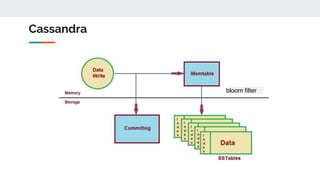
- Google Bigtable, HBase, Cassandra and
PostgreSQL use Bloom filters to reduce the disk
lookups for non-existent rows or columns.
- Medium uses bloom filter to avoid showing
duplicate recommendations
- Bad URLs for Google Chrome
- Compromised passwords
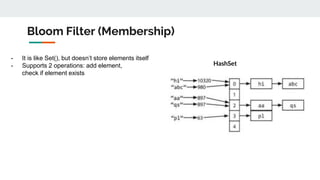
Bloom Filter (Membership)
- It is like Set(), but doesn’t store elements itself
- Supports 2 operations: add element,
check if element exists
HashSet
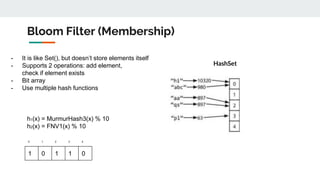
Bloom Filter (Membership)
0 1 2 3 4
1 0 1 1 0
- It is like Set(), but doesn’t store elements itself
- Supports 2 operations: add element,
check if element exists
- Bit array
- Use multiple hash functions
h1(x) = MurmurHash3(x) % 10
h2(x) = FNV1(x) % 10
HashSet
Bloom Filter (Membership)
Example:
- camera on highway
- bad internet connection
- police in 400m
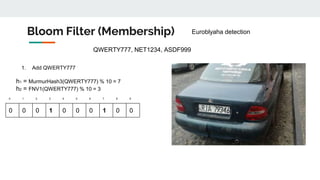
Bloom Filter (Membership)
0 1 2 3 4 5 6 7 8 9
0 0 0 1 0 0 0 1 0 0
Euroblyaha detection
QWERTY777, NET1234, ASDF999
1. Add QWERTY777
h1 = MurmurHash3(QWERTY777) % 10 = 7
h2 = FNV1(QWERTY777) % 10 = 3
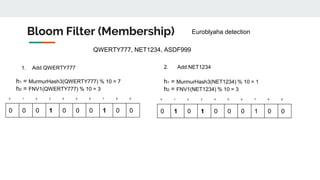
Bloom Filter (Membership)
0 1 2 3 4 5 6 7 8 9
0 0 0 1 0 0 0 1 0 0
Euroblyaha detection
QWERTY777, NET1234, ASDF999
1. Add QWERTY777
h1 = MurmurHash3(QWERTY777) % 10 = 7
h2 = FNV1(QWERTY777) % 10 = 3
0 1 2 3 4 5 6 7 8 9
0 1 0 1 0 0 0 1 0 0
2. Add NET1234
h1 = MurmurHash3(NET1234) % 10 = 1
h2 = FNV1(NET1234) % 10 = 3
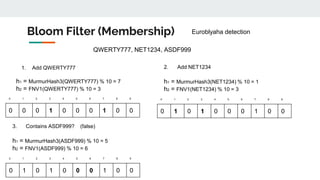
Bloom Filter (Membership)
0 1 2 3 4 5 6 7 8 9
0 0 0 1 0 0 0 1 0 0
Euroblyaha detection
QWERTY777, NET1234, ASDF999
1. Add QWERTY777
h1 = MurmurHash3(QWERTY777) % 10 = 7
h2 = FNV1(QWERTY777) % 10 = 3
0 1 2 3 4 5 6 7 8 9
0 1 0 1 0 0 0 1 0 0
2. Add NET1234
h1 = MurmurHash3(NET1234) % 10 = 1
h2 = FNV1(NET1234) % 10 = 3
0 1 2 3 4 5 6 7 8 9
0 1 0 1 0 0 0 1 0 0
3. Contains ASDF999? (false)
h1 = MurmurHash3(ASDF999) % 10 = 5
h2 = FNV1(ASDF999) % 10 = 6
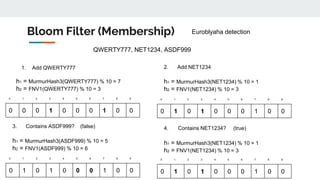
Bloom Filter (Membership)
0 1 2 3 4 5 6 7 8 9
0 0 0 1 0 0 0 1 0 0
Euroblyaha detection
QWERTY777, NET1234, ASDF999
1. Add QWERTY777
h1 = MurmurHash3(QWERTY777) % 10 = 7
h2 = FNV1(QWERTY777) % 10 = 3
0 1 2 3 4 5 6 7 8 9
0 1 0 1 0 0 0 1 0 0
2. Add NET1234
h1 = MurmurHash3(NET1234) % 10 = 1
h2 = FNV1(NET1234) % 10 = 3
0 1 2 3 4 5 6 7 8 9
0 1 0 1 0 0 0 1 0 0
3. Contains ASDF999? (false)
h1 = MurmurHash3(ASDF999) % 10 = 5
h2 = FNV1(ASDF999) % 10 = 6
0 1 2 3 4 5 6 7 8 9
0 1 0 1 0 0 0 1 0 0
4. Contains NET1234? (true)
h1 = MurmurHash3(NET1234) % 10 = 1
h2 = FNV1(NET1234) % 10 = 3
Bloom Filter (Membership)
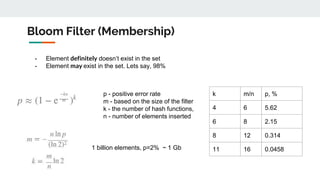
- Element definitely doesn’t exist in the set
- Element may exist in the set. Lets say, 98%
Bloom Filter (Membership)
p - positive error rate
m - based on the size of the filter
k - the number of hash functions,
n - number of elements inserted
- Element definitely doesn’t exist in the set
- Element may exist in the set. Lets say, 98%
k m/n p, %
4 6 5.62
6 8 2.15
8 12 0.314
11 16 0.04581 billion elements, p=2% ~ 1 Gb
Cassandra
bloom filter
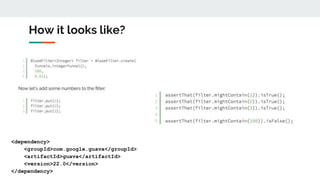
How it looks like?
<dependency>
<groupId>com.google.guava</groupId>
<artifactId>guava</artifactId>
<version>22.0</version>
</dependency>
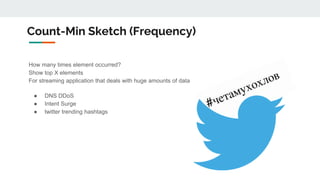
How many times element occurred?
Show top X elements
For streaming application that deals with huge amounts of data
● DNS DDoS
● Intent Surge
● twitter trending hashtags
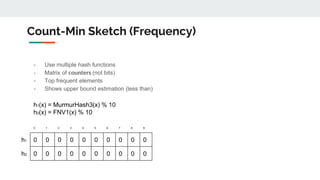
Count-Min Sketch (Frequency)
- Use multiple hash functions
- Matrix of counters (not bits)
- Top frequent elements
- Shows upper bound estimation (less than)
Count-Min Sketch (Frequency)
h1(x) = MurmurHash3(x) % 10
h2(x) = FNV1(x) % 10
0 1 2 3 4 5 6 7 8 9
h1 0 0 0 0 0 0 0 0 0 0
h2 0 0 0 0 0 0 0 0 0 0
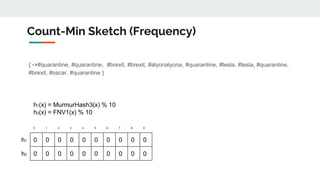
{ ->#quarantine, #quarantine, #brexit, #brexit, #alyonalyona, #quarantine, #tesla, #tesla, #quarantine,
#brexit, #oscar, #quarantine }
Count-Min Sketch (Frequency)
h1(x) = MurmurHash3(x) % 10
h2(x) = FNV1(x) % 10
0 1 2 3 4 5 6 7 8 9
h1 0 0 0 0 0 0 0 0 0 0
h2 0 0 0 0 0 0 0 0 0 0
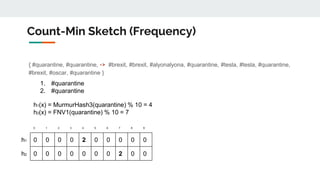
{ #quarantine, #quarantine, -> #brexit, #brexit, #alyonalyona, #quarantine, #tesla, #tesla, #quarantine,
#brexit, #oscar, #quarantine }
Count-Min Sketch (Frequency)
0 1 2 3 4 5 6 7 8 9
h1 0 0 0 0 2 0 0 0 0 0
h2 0 0 0 0 0 0 0 2 0 0
h1(x) = MurmurHash3(quarantine) % 10 = 4
h2(x) = FNV1(quarantine) % 10 = 7
1. #quarantine
2. #quarantine
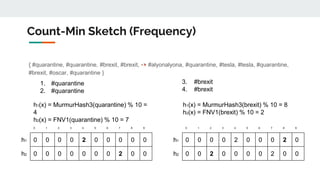
{ #quarantine, #quarantine, #brexit, #brexit, -> #alyonalyona, #quarantine, #tesla, #tesla, #quarantine,
#brexit, #oscar, #quarantine }
Count-Min Sketch (Frequency)
0 1 2 3 4 5 6 7 8 9
h1 0 0 0 0 2 0 0 0 0 0
h2 0 0 0 0 0 0 0 2 0 0
h1(x) = MurmurHash3(quarantine) % 10 =
4
h2(x) = FNV1(quarantine) % 10 = 7
1. #quarantine
2. #quarantine
0 1 2 3 4 5 6 7 8 9
h1 0 0 0 0 2 0 0 0 2 0
h2 0 0 2 0 0 0 0 2 0 0
3. #brexit
4. #brexit
h1(x) = MurmurHash3(brexit) % 10 = 8
h2(x) = FNV1(brexit) % 10 = 2
{ #quarantine, #quarantine, #brexit, #brexit, #alyonalyona, #quarantine, #tesla, #tesla, #quarantine,
#brexit, #oscar, #quarantine -> }
Count-Min Sketch (Frequency)
0 1 2 3 4 5 6 7 8 9
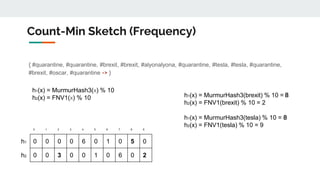
h1 0 0 0 0 6 0 1 0 5 0
h2 0 0 3 0 0 1 0 6 0 2
h1(x) = MurmurHash3(x) % 10
h2(x) = FNV1(x) % 10 h1(x) = MurmurHash3(brexit) % 10 = 8
h2(x) = FNV1(brexit) % 10 = 2
h1(x) = MurmurHash3(tesla) % 10 = 8
h2(x) = FNV1(tesla) % 10 = 9
{ #quarantine, #quarantine, #brexit, #brexit, #alyonalyona, #quarantine, #tesla, #tesla, #quarantine,
#brexit, #oscar, #quarantine -> }
Count-Min Sketch (Frequency)
0 1 2 3 4 5 6 7 8 9
h1 0 0 0 0 6 0 1 0 5 0
h2 0 0 3 0 0 1 0 6 0 2
How many times #tesla?
h1(x) = MurmurHash3(tesla) % 10 = 8
h2(x) = FNV1(tesla) % 10 = 9
Final answer = min(h1[8], h2[9]) = min(5, 2) = 2
Count-Min Sketch (Frequency)
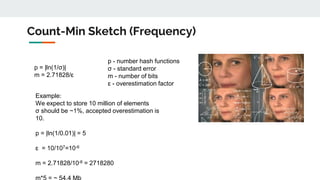
p = |ln(1/σ)|
m = 2.71828/ɛ
p - number hash functions
σ - standard error
m - number of bits
ɛ - overestimation factor
Example:
We expect to store 10 million of elements
σ should be ~1%, accepted overestimation is
10.
p = |ln(1/0.01)| = 5
ɛ = 10/107=10-6
m = 2.71828/10-6 = 2718280
Conclusions
- Probabilistic data structures are not general purpose
- They should be used as optimization
- They can save you memory and time
- Sound complex, but not so scary in practice
- Learn them and impress your interviewer
https://www.amazon.com/Probabilistic-Data-Structures-Algorithms-Applications/dp/3748190484
Thanks!

Data monsters probablistic data structures

  • 1.
  • 2.
    https://www.linkedin.com/in/taras-yaroshchuk-551383105/ Taras Yaroshchuk Senior DataEngineer at Sigma Software - 4 years in Data Engineering - AdTech, IoT, FinTech - Scala/Java/Python - Trying to contribute to big data community Skype/Telegram/FB/everywhere: taras.yaroshchuk
  • 3.
    Use cases ● Membership(Bloom filter, Quotient filter, Cuckoo filter) ● Frequency (Frequent algorithm, Count-Min Sketch) ● Cardinality (Linear Counting, LogLog, HyperLogLog) ● Rank (Random sampling, q-digest, t-digest) ● Similarity (Locality-Sensitive Hashing, MinHash, SimHash)
  • 4.
  • 7.
    Use cases ● Membership(Bloom filter, Quotient filter, Cuckoo filter) ● Frequency (Frequent algorithm, Count-Min Sketch) ● Cardinality (Linear Counting, LogLog, HyperLogLog) ● Rank (Random sampling, q-digest, t-digest) ● Similarity (Locality-Sensitive Hashing, MinHash, SimHash)
  • 8.
    Hashing Cryptographic hash functions ●Message-Digest Algorithm (MD5) ● Secure Hash Algorithms (SHA-256, SHA-512, etc) ● RadioGetun Non-Cryptographics hash functions ● FNV1 ● CityHash, FarmHash ● MurmurHash3 42
  • 9.
    Bloom Filter (Membership) -Google Bigtable, HBase, Cassandra and PostgreSQL use Bloom filters to reduce the disk lookups for non-existent rows or columns. - Medium uses bloom filter to avoid showing duplicate recommendations - Bad URLs for Google Chrome - Compromised passwords
  • 10.
    Bloom Filter (Membership) -It is like Set(), but doesn’t store elements itself - Supports 2 operations: add element, check if element exists HashSet
  • 11.
    Bloom Filter (Membership) 01 2 3 4 1 0 1 1 0 - It is like Set(), but doesn’t store elements itself - Supports 2 operations: add element, check if element exists - Bit array - Use multiple hash functions h1(x) = MurmurHash3(x) % 10 h2(x) = FNV1(x) % 10 HashSet
  • 12.
    Bloom Filter (Membership) Example: -camera on highway - bad internet connection - police in 400m
  • 13.
    Bloom Filter (Membership) 01 2 3 4 5 6 7 8 9 0 0 0 1 0 0 0 1 0 0 Euroblyaha detection QWERTY777, NET1234, ASDF999 1. Add QWERTY777 h1 = MurmurHash3(QWERTY777) % 10 = 7 h2 = FNV1(QWERTY777) % 10 = 3
  • 14.
    Bloom Filter (Membership) 01 2 3 4 5 6 7 8 9 0 0 0 1 0 0 0 1 0 0 Euroblyaha detection QWERTY777, NET1234, ASDF999 1. Add QWERTY777 h1 = MurmurHash3(QWERTY777) % 10 = 7 h2 = FNV1(QWERTY777) % 10 = 3 0 1 2 3 4 5 6 7 8 9 0 1 0 1 0 0 0 1 0 0 2. Add NET1234 h1 = MurmurHash3(NET1234) % 10 = 1 h2 = FNV1(NET1234) % 10 = 3
  • 15.
    Bloom Filter (Membership) 01 2 3 4 5 6 7 8 9 0 0 0 1 0 0 0 1 0 0 Euroblyaha detection QWERTY777, NET1234, ASDF999 1. Add QWERTY777 h1 = MurmurHash3(QWERTY777) % 10 = 7 h2 = FNV1(QWERTY777) % 10 = 3 0 1 2 3 4 5 6 7 8 9 0 1 0 1 0 0 0 1 0 0 2. Add NET1234 h1 = MurmurHash3(NET1234) % 10 = 1 h2 = FNV1(NET1234) % 10 = 3 0 1 2 3 4 5 6 7 8 9 0 1 0 1 0 0 0 1 0 0 3. Contains ASDF999? (false) h1 = MurmurHash3(ASDF999) % 10 = 5 h2 = FNV1(ASDF999) % 10 = 6
  • 16.
    Bloom Filter (Membership) 01 2 3 4 5 6 7 8 9 0 0 0 1 0 0 0 1 0 0 Euroblyaha detection QWERTY777, NET1234, ASDF999 1. Add QWERTY777 h1 = MurmurHash3(QWERTY777) % 10 = 7 h2 = FNV1(QWERTY777) % 10 = 3 0 1 2 3 4 5 6 7 8 9 0 1 0 1 0 0 0 1 0 0 2. Add NET1234 h1 = MurmurHash3(NET1234) % 10 = 1 h2 = FNV1(NET1234) % 10 = 3 0 1 2 3 4 5 6 7 8 9 0 1 0 1 0 0 0 1 0 0 3. Contains ASDF999? (false) h1 = MurmurHash3(ASDF999) % 10 = 5 h2 = FNV1(ASDF999) % 10 = 6 0 1 2 3 4 5 6 7 8 9 0 1 0 1 0 0 0 1 0 0 4. Contains NET1234? (true) h1 = MurmurHash3(NET1234) % 10 = 1 h2 = FNV1(NET1234) % 10 = 3
  • 17.
    Bloom Filter (Membership) -Element definitely doesn’t exist in the set - Element may exist in the set. Lets say, 98%
  • 18.
    Bloom Filter (Membership) p- positive error rate m - based on the size of the filter k - the number of hash functions, n - number of elements inserted - Element definitely doesn’t exist in the set - Element may exist in the set. Lets say, 98% k m/n p, % 4 6 5.62 6 8 2.15 8 12 0.314 11 16 0.04581 billion elements, p=2% ~ 1 Gb
  • 19.
  • 20.
    How it lookslike? <dependency> <groupId>com.google.guava</groupId> <artifactId>guava</artifactId> <version>22.0</version> </dependency>
  • 21.
    How many timeselement occurred? Show top X elements For streaming application that deals with huge amounts of data ● DNS DDoS ● Intent Surge ● twitter trending hashtags Count-Min Sketch (Frequency)
  • 22.
    - Use multiplehash functions - Matrix of counters (not bits) - Top frequent elements - Shows upper bound estimation (less than) Count-Min Sketch (Frequency) h1(x) = MurmurHash3(x) % 10 h2(x) = FNV1(x) % 10 0 1 2 3 4 5 6 7 8 9 h1 0 0 0 0 0 0 0 0 0 0 h2 0 0 0 0 0 0 0 0 0 0
  • 23.
    { ->#quarantine, #quarantine,#brexit, #brexit, #alyonalyona, #quarantine, #tesla, #tesla, #quarantine, #brexit, #oscar, #quarantine } Count-Min Sketch (Frequency) h1(x) = MurmurHash3(x) % 10 h2(x) = FNV1(x) % 10 0 1 2 3 4 5 6 7 8 9 h1 0 0 0 0 0 0 0 0 0 0 h2 0 0 0 0 0 0 0 0 0 0
  • 24.
    { #quarantine, #quarantine,-> #brexit, #brexit, #alyonalyona, #quarantine, #tesla, #tesla, #quarantine, #brexit, #oscar, #quarantine } Count-Min Sketch (Frequency) 0 1 2 3 4 5 6 7 8 9 h1 0 0 0 0 2 0 0 0 0 0 h2 0 0 0 0 0 0 0 2 0 0 h1(x) = MurmurHash3(quarantine) % 10 = 4 h2(x) = FNV1(quarantine) % 10 = 7 1. #quarantine 2. #quarantine
  • 25.
    { #quarantine, #quarantine,#brexit, #brexit, -> #alyonalyona, #quarantine, #tesla, #tesla, #quarantine, #brexit, #oscar, #quarantine } Count-Min Sketch (Frequency) 0 1 2 3 4 5 6 7 8 9 h1 0 0 0 0 2 0 0 0 0 0 h2 0 0 0 0 0 0 0 2 0 0 h1(x) = MurmurHash3(quarantine) % 10 = 4 h2(x) = FNV1(quarantine) % 10 = 7 1. #quarantine 2. #quarantine 0 1 2 3 4 5 6 7 8 9 h1 0 0 0 0 2 0 0 0 2 0 h2 0 0 2 0 0 0 0 2 0 0 3. #brexit 4. #brexit h1(x) = MurmurHash3(brexit) % 10 = 8 h2(x) = FNV1(brexit) % 10 = 2
  • 26.
    { #quarantine, #quarantine,#brexit, #brexit, #alyonalyona, #quarantine, #tesla, #tesla, #quarantine, #brexit, #oscar, #quarantine -> } Count-Min Sketch (Frequency) 0 1 2 3 4 5 6 7 8 9 h1 0 0 0 0 6 0 1 0 5 0 h2 0 0 3 0 0 1 0 6 0 2 h1(x) = MurmurHash3(x) % 10 h2(x) = FNV1(x) % 10 h1(x) = MurmurHash3(brexit) % 10 = 8 h2(x) = FNV1(brexit) % 10 = 2 h1(x) = MurmurHash3(tesla) % 10 = 8 h2(x) = FNV1(tesla) % 10 = 9
  • 27.
    { #quarantine, #quarantine,#brexit, #brexit, #alyonalyona, #quarantine, #tesla, #tesla, #quarantine, #brexit, #oscar, #quarantine -> } Count-Min Sketch (Frequency) 0 1 2 3 4 5 6 7 8 9 h1 0 0 0 0 6 0 1 0 5 0 h2 0 0 3 0 0 1 0 6 0 2 How many times #tesla? h1(x) = MurmurHash3(tesla) % 10 = 8 h2(x) = FNV1(tesla) % 10 = 9 Final answer = min(h1[8], h2[9]) = min(5, 2) = 2
  • 28.
    Count-Min Sketch (Frequency) p= |ln(1/σ)| m = 2.71828/ɛ p - number hash functions σ - standard error m - number of bits ɛ - overestimation factor Example: We expect to store 10 million of elements σ should be ~1%, accepted overestimation is 10. p = |ln(1/0.01)| = 5 ɛ = 10/107=10-6 m = 2.71828/10-6 = 2718280
  • 29.
    Conclusions - Probabilistic datastructures are not general purpose - They should be used as optimization - They can save you memory and time - Sound complex, but not so scary in practice - Learn them and impress your interviewer https://www.amazon.com/Probabilistic-Data-Structures-Algorithms-Applications/dp/3748190484
  • 30.