Topic : Data Models
Presented by : Jawad Ahamed Jamali(23CSE-**)
What is a Data
Model?
What is the
Relational Data
Model?
Components of the
Relational Model
Advantages of the
Relational Model
Table of contents
01 02
03 04
Example of a
Relational Database
Conclusion and
Future of Relational
Databases
Table of contents
05 06
What is a Data
Model?
01
What is a Data
Model?
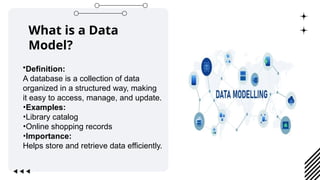
•Definition:
A database is a collection of data
organized in a structured way, making
it easy to access, manage, and update.
•Examples:
•Library catalog
•Online shopping records
•Importance:
Helps store and retrieve data efficiently.
What is the
Relational Data
Model?
02
What is the
Relational Data
Model?
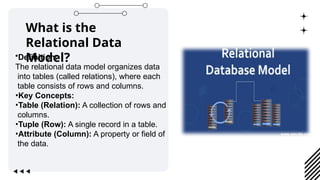
•Definition:
The relational data model organizes data
into tables (called relations), where each
table consists of rows and columns.
•Key Concepts:
•Table (Relation): A collection of rows and
columns.
•Tuple (Row): A single record in a table.
•Attribute (Column): A property or field of
the data.
Components of the
Relational Model
03
Components of the
Relational Model:
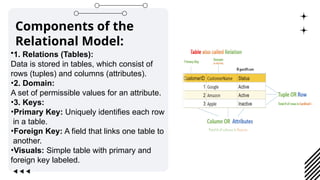
•1. Relations (Tables):
Data is stored in tables, which consist of
rows (tuples) and columns (attributes).
•2. Domain:
A set of permissible values for an attribute.
•3. Keys:
•Primary Key: Uniquely identifies each row
in a table.
•Foreign Key: A field that links one table to
another.
•Visuals: Simple table with primary and
foreign key labeled.
Advantages of the
Relational Model
04
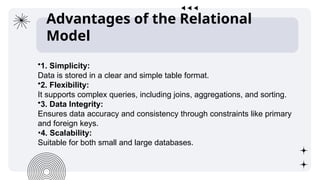
Advantages of the Relational
Model
•1. Simplicity:
Data is stored in a clear and simple table format.
•2. Flexibility:
It supports complex queries, including joins, aggregations, and sorting.
•3. Data Integrity:
Ensures data accuracy and consistency through constraints like primary
and foreign keys.
•4. Scalability:
Suitable for both small and large databases.
Example of a Relational Database
05
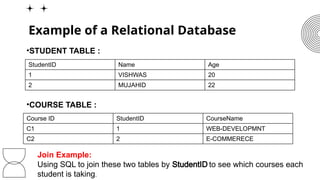
Example of a Relational Database
StudentID Name Age
1 VISHWAS 20
2 MUJAHID 22
Course ID StudentID CourseName
C1 1 WEB-DEVELOPMNT
C2 2 E-COMMERECE
•COURSE TABLE :
•STUDENT TABLE :
Join Example:
Using SQL to join these two tables by StudentID to see which courses each
student is taking.
Conclusion and Future of
Relational Databases
06
Conclusion and Future of
Relational Databases :
•Summary:
The Relational Data Model is one of the most widely used models, offering a
simple, effective way to manage structured data in tables.
•Future Trends:
•Cloud databases using relational models.
•Integration of relational databases with big data tools.
•Call to Action:
Learn SQL for interacting with relational databases.
CREDITS: This presentation template was
created by Slidesgo, including icons by
Flaticon and infographics & images by
Freepik
THANKS Do you have any questions?
Please keep this slide for attribution

Data Models PPT DBMS.pptx (Data Base Management

  • 1.
    Topic : DataModels Presented by : Jawad Ahamed Jamali(23CSE-**)
  • 2.
    What is aData Model? What is the Relational Data Model? Components of the Relational Model Advantages of the Relational Model Table of contents 01 02 03 04
  • 3.
    Example of a RelationalDatabase Conclusion and Future of Relational Databases Table of contents 05 06
  • 4.
    What is aData Model? 01
  • 5.
    What is aData Model? •Definition: A database is a collection of data organized in a structured way, making it easy to access, manage, and update. •Examples: •Library catalog •Online shopping records •Importance: Helps store and retrieve data efficiently.
  • 6.
    What is the RelationalData Model? 02
  • 7.
    What is the RelationalData Model? •Definition: The relational data model organizes data into tables (called relations), where each table consists of rows and columns. •Key Concepts: •Table (Relation): A collection of rows and columns. •Tuple (Row): A single record in a table. •Attribute (Column): A property or field of the data.
  • 8.
  • 9.
    Components of the RelationalModel: •1. Relations (Tables): Data is stored in tables, which consist of rows (tuples) and columns (attributes). •2. Domain: A set of permissible values for an attribute. •3. Keys: •Primary Key: Uniquely identifies each row in a table. •Foreign Key: A field that links one table to another. •Visuals: Simple table with primary and foreign key labeled.
  • 10.
  • 11.
    Advantages of theRelational Model •1. Simplicity: Data is stored in a clear and simple table format. •2. Flexibility: It supports complex queries, including joins, aggregations, and sorting. •3. Data Integrity: Ensures data accuracy and consistency through constraints like primary and foreign keys. •4. Scalability: Suitable for both small and large databases.
  • 12.
    Example of aRelational Database 05
  • 13.
    Example of aRelational Database StudentID Name Age 1 VISHWAS 20 2 MUJAHID 22 Course ID StudentID CourseName C1 1 WEB-DEVELOPMNT C2 2 E-COMMERECE •COURSE TABLE : •STUDENT TABLE : Join Example: Using SQL to join these two tables by StudentID to see which courses each student is taking.
  • 14.
    Conclusion and Futureof Relational Databases 06
  • 15.
    Conclusion and Futureof Relational Databases : •Summary: The Relational Data Model is one of the most widely used models, offering a simple, effective way to manage structured data in tables. •Future Trends: •Cloud databases using relational models. •Integration of relational databases with big data tools. •Call to Action: Learn SQL for interacting with relational databases.
  • 16.
    CREDITS: This presentationtemplate was created by Slidesgo, including icons by Flaticon and infographics & images by Freepik THANKS Do you have any questions? Please keep this slide for attribution