Data mining techniques for the life sciences 1st Edition Stefan Washietl
Data mining techniques for the life sciences 1st Edition Stefan Washietl
Data mining techniques for the life sciences 1st Edition Stefan Washietl
Data mining techniques for the life sciences 1st Edition Stefan Washietl
Data mining techniques for the life sciences 1st Edition Stefan Washietl
1.
Instant Ebook Access,One Click Away – Begin at ebookgate.com
Data mining techniques for the life sciences 1st
Edition Stefan Washietl
https://ebookgate.com/product/data-mining-techniques-for-
the-life-sciences-1st-edition-stefan-washietl/
OR CLICK BUTTON
DOWLOAD EBOOK
Get Instant Ebook Downloads – Browse at https://ebookgate.com
Click here to visit ebookgate.com and download ebook now
2.
Instant digital products(PDF, ePub, MOBI) available
Download now and explore formats that suit you...
LIFE SCIENCE DATA MINING 1st Edition Stephen Wong
https://ebookgate.com/product/life-science-data-mining-1st-edition-
stephen-wong/
ebookgate.com
Introduction to Statistical Data Analysis for the Life
Sciences 1st Edition Sørensen
https://ebookgate.com/product/introduction-to-statistical-data-
analysis-for-the-life-sciences-1st-edition-sorensen/
ebookgate.com
Statistical Modeling and Analysis for Database Marketing
Effective Techniques for Mining Big Data 1st Edition Bruce
Ratner
https://ebookgate.com/product/statistical-modeling-and-analysis-for-
database-marketing-effective-techniques-for-mining-big-data-1st-
edition-bruce-ratner/
ebookgate.com
Clustering for Data Mining A Data Recovery Approach 1st
Edition Boris Mirkin
https://ebookgate.com/product/clustering-for-data-mining-a-data-
recovery-approach-1st-edition-boris-mirkin/
ebookgate.com
3.
Computerized Data Acquisitionand Analysis for the Life
Sciences A Hands on Guide 1st Edition Simon S. Young
https://ebookgate.com/product/computerized-data-acquisition-and-
analysis-for-the-life-sciences-a-hands-on-guide-1st-edition-simon-s-
young/
ebookgate.com
Chemistry for the Life Sciences Second Edition Rockett
https://ebookgate.com/product/chemistry-for-the-life-sciences-second-
edition-rockett/
ebookgate.com
Data Mining Tools for Malware Detection 1° Edition Mehedy
Masud
https://ebookgate.com/product/data-mining-tools-for-malware-
detection-1-edition-mehedy-masud/
ebookgate.com
Data Mining and Knowledge Discovery for Geoscientists 1st
Edition Guangren Shi (Auth.)
https://ebookgate.com/product/data-mining-and-knowledge-discovery-for-
geoscientists-1st-edition-guangren-shi-auth/
ebookgate.com
Data Mining for Intelligence Fraud Criminal Detection
Advanced 1st Edition Christopher Westphal
https://ebookgate.com/product/data-mining-for-intelligence-fraud-
criminal-detection-advanced-1st-edition-christopher-westphal/
ebookgate.com
6.
M E TH O D S I N M O L E C U L A R B I O L O G Y
TM
Series Editor
John M. Walker
School of Life Sciences
University of Hertfordshire
Hatfield, Hertfordshire, AL10 9AB, UK
For other titles published in this series, go to
www.springer.com/series/7651
7.
Data Mining Techniquesfor the Life
Sciences
Edited by
Oliviero Carugo
University of Pavia, Pavia, Italy
Vienna University, Vienna, Austria
Frank Eisenhaber
Bioinformatics Institute, Agency for Science, Technology and Research, Singapore
8.
Editors
Oliviero Carugo
Universität Wien
MaxF. Perutz Laboratories
GmbH
Structural & Computational
Biology Group
Dr. Bohr-Gasse 9
1030 Wien
Campus-Vienna-Biocenter
Austria
oliviero.carugo@univie.ac.at
Frank Eisenhaber
Bioinformatics Institute (BII)
Agency for Science, Technology and
Research (A*STAR)
30 Biopolis Street, Singapore 138671
#07-01 Matrix Building
Singapore
franke@bii.a-star.edu.sg
ISSN 1064-3745 e-ISSN 1940-6029
ISBN 978-1-60327-240-7 e-ISBN 978-1-60327-241-4
DOI 10.1007/978-1-60327-241-4
Library of Congress Control Number: 2009939505
# Humana Press, a part of Springer ScienceþBusiness Media, LLC 2010
All rights reserved. This work may not be translated or copied in whole or in part without the written permission of the
publisher (Humana Press, c/o Springer ScienceþBusiness Media, LLC, 233 Spring Street, New York, NY 10013,
USA), except for brief excerpts in connection with reviews or scholarly analysis. Use in connection with any form of
information storage and retrieval, electronic adaptation, computer software, or by similar or dissimilar methodology
now known or hereafter developed is forbidden.
The use in this publication of trade names, trademarks, service marks, and similar terms, even if they are not identified as
such, is not to be taken as an expression of opinion as to whether or not they are subject to proprietary rights.
Printed on acid-free paper
springer.com
9.
Preface
Most life scienceresearchers will agree that biology is not a truly theoretical branch of
science. The hype around computational biology and bioinformatics beginning in the
nineties of the 20th century was to be short lived (1, 2). When almost no value of
practical importance such as the optimal dose of a drug or the three-dimensional
structure of an orphan protein can be computed from fundamental principles, it is
still more straightforward to determine them experimentally. Thus, experiments and
observations do generate the overwhelming part of insights into biology and medicine.
The extrapolation depth and the prediction power of the theoretical argument in life
sciences still have a long way to go.
Yet, two trends have qualitatively changed the way how biological research is done
today. The number of researchers has dramatically grown and they, armed with the
same protocols, have produced lots of similarly structured data. Finally, high-through-
put technologies such as DNA sequencing or array-based expression profiling have
been around for just a decade. Nevertheless, with their high level of uniform data
generation, they reach the threshold of totally describing a living organism at the
biomolecular level for the first time in human history. Whereas getting exact data
about living systems and the sophistication of experimental procedures have primarily
absorbed the minds of researchers previously, the weight increasingly shifts to the
problem of interpreting accumulated data in terms of biological function and biomo-
lecular mechanisms. It is possible now that biological discoveries are the result of
computational work, for example, in the area of biomolecular sequence analysis and
gene function prediction (2, 3).
Electronically readable biomolecular databases are at the heart of this development.
Biological systems consist of a giant number of biomacromolecules, both nucleic acids
and proteins together with other compounds, organized in complexes pathways, sub-
cellular structures such as organelles, cells, and the like that is interpreted in a hier-
archical manner. Obviously, much remains unknown and not understood.
Nevertheless, electronic databases organize the existing body of knowledge and experi-
mental results about the building blocks, their relationships, and the corresponding
experimental evidence in a form that enables the retrieval, visualization, comparison,
and other sophisticated analyses. The significance of many of the pieces of information
might not be understood when they enter databases; yet, they do not get lost and
remain stored for the future.
Importantly, databases allow analyses of the data in a continuous workflow detached
from any further experimentation itself. In a formal, mathematical framework,
researchers can now develop theoretical approaches that may lead to new insights at a
meta-analytic level. Indeed, results from many independently planned and executed
experiments become coherently accessible with electronic databases. Together, they
v
10.
can provide aninsight that might not be possible from the individual pieces of informa-
tion in isolation. It is also interesting to see this work in a human perspective: in the
framework of such meta-analyses, people of various backgrounds who have never met
essentially cooperate for the sake of scientific discoveries via database entries. From the
technical viewpoint, because the data are astronomically numerous and the algorithms
for their analysis are complex, the computer is the natural tool to help researchers in
their task; yet, it is just a tool and not the center of the intellectual concept. The ideas
and approaches selected by researchers driven by the goal to achieve biologically
relevant discoveries remain the most important factor. Due to the need of computer-
assisted data analysis, electronic availability of databases, the possibility of their down-
load for local processing, the uniform structure of all database entries as well as the
accuracy of all pieces of information including that for the level of experimental
evidence are of utmost importance. To allow curiosity-driven research for as many as
possible researchers and to enable the serendipity of discovery, the full public avail-
ability of the databases is critical.
Nucleic acid and protein sequence and structure databases were the first biological
data collections in this context; the emergence of the sequence homology concept and
the successes of gene function prediction are scientific outcomes of working with these
data (3). To emphasize, they would be impossible without prior existence of the
sequence databases. Thus, biological data mining is going to become the core of
biological and biomedical research work in the future, and every member of the
community is well advised to keep himself informed about the sources of information
and the techniques used for ‘‘mining’’ new insights out of databases. This book is
thought as a support for the reader in this endeavor.
The variety of biological databases reflects the complexity of and the hierarchical
interpretation we use for the living world as well as the different techniques that are
used to study them (4). The first section of the book is dedicated to describing concepts
and structures of important groups of databases for biomolecular mechanism research.
There are databases for sequences of genomes, nucleic acids such as RNAs and proteins,
and biomacromolecular structures. With regard to proteins, databases collect instances
of sequence architectural elements, thermodynamic properties, enzymes, complexes,
and pathway information. There are many more specialized databases that are beyond
the scope of this book; the reader is advised to consult the annual January database
supplement of the journal ‘‘Nucleic Acids Research’’ for more detail (5).
The second section of this book focuses on formal methods for analyzing biomole-
cular data. Obviously, biological data are very heterogeneous and there are specific
methodologies for the analysis of each type of data. The chapters of this book provide
information about approaches that are of general relevance. Most of all, these are
methods for comparison (measuring similarity of items and their classification) as well
as concepts and tools for automated learning. In all cases, the approaches are described
with the view of biological database mining.
The third section provides reviews on concepts for analyzing biomolecular sequence
data in context with other experimental results that can be mapped onto genomes. The
vi Preface
11.
topics range fromgene structure detection in genomes and analyses of transcript
sequences over aspects of protein sequence studies such as conformational disorder,
2D, 3D, and 4D structure prediction, protein crystallizability, recognition of post-
translational modification sites or subcellular translocation signals to integrated protein
function prediction.
It should be noted that the biological and biomedical scientific literature is the largest
and possibly most important source of information. We do not analyze the issue here in
this book since there is a lot in the flow. Whereas sources such as PUBMED or the
Chemical Abstracts currently provide bibliographic information and abstracts, the
trend is towards full-text availability. With the help of the open access movement, this
goal might be practically achieved in a medium term. The processing of abstracts and
full articles for mining biological facts is an area of actively ongoing research and
exciting developments can be expected here.
Creating and maintaining a biological database requires considerable expertise and
generates an immense work load. Especially maintaining and updating are expensive.
Although future success of research in the life sciences depends on the completeness
and quality of the data in databases and of software tools for their usage, this issue does
not receive sufficient recognition within the community as well as from the funding
agencies. Unfortunately, the many academic groups feel unable to continue the main-
tenance of databases and software tools because funding might cover only the initial
development phase but not the continued maintenance. An exit into commercial
development is not a true remedy; typically, the access to the database becomes hidden
by a system of fees and its download for local processing is excluded. Likewise, it appears
important to assess before the creation of the database whether it will be useful for the
scientific community and whether the effort necessary for maintenance is commensu-
rate with the potential benefit for biological discovery (6). For example, maintaining
programs that update databases automatically is a vastly more efficient way than cases
where all entries need to be curated manually in an individual manner.
We hope that this book is of value for students and researchers in the life sciences who
wish to get a condensed introduction to the world of biological databases and their
applications. Thanks go to all authors of the chapters who have invested considerable
time for preparing their reviews. The support of the Austrian GENAU BIN programs
(2003–2009) for the editors of this book is gratefully acknowledged.
Oliviero Carugo
Frank Eisenhaber
References
1. Ouzounis, C.A. (2000) Two or three myths about bioinformatics. Bioinformatics 17, 853–854
2. Eisenhaber, F. (2006) Bioinformatics: Mystery, astrology or service technology. Preface for ‘‘Discovering
Biomolecular Mechanisms with Computational Biology’’, Eisenhaber, F. (Ed.), 1st edition, pp. pp.1–10.
Georgetown, New York: Landes Biosciences, Springer
Preface vii
12.
3. Eisenhaber, F.(2006) Prediction of protein function: Two basic concepts and one practical recipe. In
Eisenhaber, F. (Ed.), ‘‘Discovering Biomolecular Mechanisms with Computational Biology’’, 1st edition,
pp. 39–54. Georgetown, New York: Landes Biosciences, Springer
4. Carugo, O., Pongor, S. (2002) The evolution of structural databases. Trends Biotech. 20, 498–501
5. Galperin, M.Y., Cochrane, G.R. (2009) Nucleic acids research annual database issue and the NAR online
molecular biology database collection in 2009. Nucleic Acids Res. 37, D1–D4
6. Wren, J.D., Bateman, A. (2008) Databases, data tombs and dust in the wind. Bioinformatics 24,
2127–2128
viii Preface
Contributors
ASA BEN-HUR •Department of Computer Science, Colorado State University, Fort
Collins, CO, USA
BRUNO CANARD • Architecture et Fonction des Macromolécules Biologiques, UMR 6098
CNRS et Universités Aix-Marseille I et II, Marseille, France
OLIVIERO CARUGO • Department of General Chemistry, Pavia University, Pavia, Italy;
Department of Structural and Computational Biology, MFPL – Vienna University,
Vienna, Austria
YING-LEONG CHAN • Bioinformatics Institute (BII), Agency for Science, Technology,
and Research (A*STAR), Singapore
BIRGIT EISENHABER • Experimental Therapeutic Centre (ETC), Bioinformatics Insti-
tute (BII), Agency for Science, Technology, and Research (A*STAR), Singapore
FRANK EISENHABER • Bioinformatics Institute (BII), Agency for Science, Technology,
and Research (A*STAR), Singapore
DMITRIJ FRISHMAN • MIPS & Helmholz Institute München, Martinsried, Germany
ANDREAS FUTSCHIK • Institute of Statistics, University of Vienna, Vienna, Austria
M. MICHAEL GROMIHA • Computational Biology Research Center (CBRC), National
Institute of Advanced Industrial Science and Technology (AIST), Tokyo, Japan
JAAP HERINGA • Centre for Integrative Bioinformatics VU (IBIVU), VU University,
Amsterdam, The Netherlands
IVO L. HOFACKER • Department of Theoretical Chemistry, University of Vienna, Wien,
Austria
JOEL JANIN • Yeast Structural Genomics, IBBMC UMR 8619 CNRS, Université Paris-
Sud, Orsay, France
ROMAN A. LASKOWSKI • EMBL-European Bioinformatics Institute, Wellcome Trust
Genome Campus, Hinxton, Cambridge, UK
PHILIPPE LIEUTAUD • Architecture et Fonction des Macromolécules Biologiques, UMR
6098 CNRS et Universités Aix-Marseille I et II, Marseille, France
TENG-TING LIM • Bioinformatics Institute (BII), Agency for Science, Technology, and
Research (A*STAR), Singapore
SONIA LONGHI • Architecture et Fonction des Macromolécules Biologiques, UMR 6098
CNRS et Universités Aix-Marseille I et II, Marseille, France
SEBASTIAN MAURER-STROH • Bioinformatics Institute (BII), Agency for Science, Tech-
nology, and Research (A*STAR), Singapore
NICOLA J. MULDER • National Bioinformatics Network Node, Institute for Infectious
Diseases and Molecular Medicine, Faculty of Health Sciences, University of Cape Town,
Cape Town, South Africa
HONG SAIN OOI • Bioinformatics Institute (BII), Agency for Science, Technology, and
Research (A*STAR), Singapore
xi
16.
GRAZIANO PESOLE •Dipartimento di Biochimica e Biologia Molecolare ‘‘E. Quagliar-
iello’’, University of Bari, Bari, Italy
ERNESTO PICARDI • Dipartimento di Biochimica e Biologia Molecolare ‘‘E. Quagliar-
iello’’, University of Bari, Bari, Italy
WALTER PIROVANO • Centre for Integrative Bioinformatics VU (IBIVU), VU Univer-
sity, Amsterdam, The Netherlands
ANNE POUPON • Yeast Structural Genomics, IBBMC UMR 8619 CNRS, Université
Paris-Sud, Orsay, France
MICHAEL REBHAN • Head Bioinformatics Support, Friedrich Miescher Institute for Bio-
medical Research, Basel, Switzerland
AKINORI SARAI • Department of Bioscience & Bioinformatics, Kyushu Institute of Tech-
nology (KIT), Iizuka, Japan
DIETMAR SCHOMBURG • Department of Bioinformatics and Biochemistry, Technische
Universität Carolo-Wilhelmina zu Braunschweig, Braunschweig, Germany
IDA SCHOMBURG • Department of Bioinformatics and Biochemistry, Technische Univer-
sität Carolo-Wilhelmina zu Braunschweig, Braunschweig, Germany
GEORG SCHNEIDER • Bioinformatics Institute (BII), Agency for Science, Technology, and
Research (A*STAR), Singapore
FERNANDA L. SIROTA • Bioinformatics Institute (BII), Agency for Science, Technology,
and Research (A*STAR), Singapore
PAWEL SMIALOWSKI • MIPS & Helmholz Institute München, Martinsried, Germany
TATIANA TATUSOVA • National Institute of Heath, Bethesda, MD, USA
CLAUS VOGL • Institute of Animal Breeding and Genetics, University of Veterinary
Medicine Vienna, Vienna, Austria
STEFAN WASHIETL • Department of Theoretical Chemistry, University of Vienna, Wien,
Austria; EMBL-European Bioinformatics Institute, Wellcome Trust Genome Campus,
Hinxton, Cambridge, UK
JASON WESTON • NEC Labs America, Princeton, NJ, USA
MICHAEL WILDPANER • Google Switzerland GmbH, Zürich, Switzerland
ZHENG RONG YANG • School of Biosciences, University of Exeter, Exeter, UK
xii Contributors
Chapter 1
Nucleic AcidSequence and Structure Databases
Stefan Washietl and Ivo L. Hofacker
Abstract
This chapter gives an overview of the most commonly used biological databases of nucleic acid sequences
and their structures. We cover general sequence databases, databases for specific DNA features, noncoding
RNA sequences, and RNA secondary and tertiary structures.
Key words: Sequence repositories, nucleic acids databases, RNA structures.
1. Introduction
Both sequence and structure data have experienced exponen-
tial growth during the last two decades, a trend that is most
likely to continue in the foreseeable future. As a consequence,
there is also a growing number of database resources that try
to make these data accessible and help with their analysis.
Here we give an overview of existing resources for nucleic
acid sequences and structures. In addition to the well-known
sequence repositories like GenBank, we also cover databases
for various functional and other genomic DNA features. In the
second part, we describe databases collecting noncoding RNA
sequences and their secondary structures, a topic that has
received special attention in the past years. Finally, we cover
databases of RNA tertiary structures and motifs. Many of the
databases mentioned below were published in the database
issue of Nucleic Acids Research, which covers new and
updated databases every year.
O. Carugo, F. Eisenhaber (eds.), Data Mining Techniques for the Life Sciences, Methods in Molecular Biology 609,
DOI 10.1007/978-1-60327-241-4_1, ª Humana Press, a part of Springer Science+Business Media, LLC 2010
3
19.
2. Sequence
Databases
An overviewincluding Web addresses for the databases discussed
in this section is given in Tables 1.1 and 1.2.
Table 1.1
General nucleotide sequence databases and DNA databases
Name URL Description References
General nucleotide databases
EMBL www.ebi.ac.uk/embl/ Central sequence
repository
(1)
GenBank http://
www.ncbi.nlm.nih.gov/
Genbank
Central sequence
repository
(2)
DNA databank of
Japan (DDBJ)
www.ddbj.nig.ac.jp Central sequence
repository
(3)
RefSeq http://
www.ncbi.nlm.nih.gov/
RefSeq/
Nonredundant and curated
sequences (DNA, RNA,
protein) from GenBank
(4)
Transcript structures and alternative splicing
Alternative splicing and
transcript diversity
database (ASTD)
www.ebi.ac.uk/astd Alternative splicing in
human, mouse and rat
(5)
Human-transcriptome
DataBase for
Alternative Splicing
(H-DBAS)
www.h-invitational.jp/h-dbas Alternative spliced human
full length cDNAs
(6)
Repeats and mobile elements
RepBase http://www.girinst.org/
server/RepBase
Eykaryotic repeat
sequences, registration
required
(53)
STRBase www.cstl.nist.gov/biotech/
strbase/
Short tandem repeats (7)
TIGR plant repeat
database
www.tigr.org/tdb/e2k1/
plant.repeats
Plant repeat sequences (8)
ACLAME aclame.ulb.ac.be Prokaryotic mobile genetic
elements
(9)
(continued)
4 Washietl and Hofacker
20.
Table 1.1 (continued)
NameURL Description References
ISfinder http://www-is.biotoul.fr Insertion sequences from
eubacteria and archaea
(10)
MICdb http://www.cdfd.org.in/
micas
Prokaryotic microsatellites (11)
Islander http://www.indiana.edu/
islander
Prokaryotic genomic
islands
(12)
Promoters and regulation
TRANSFAC http://www.gene-
regulation.com/
Transcription factor
binding sites
(13)
JASPAR Transcription factor
binding sites
(14)
SCPD Promoter sequences in S.
cerevisiae
(15)
PlantCARE http://
bioinformatics.psb.ugent.be
/webtools/plantcare/html
Plant regulatory elements (16)
RegulonDB http://www.cifn.unam.mx/
Computational_Genomics/
regulondb
Gene regulation in E. coli (17)
Table 1.2
RNA sequence databases
Name URL Description References
Noncoding RNA sequences
Rfam www.sanger.ac.uk/
Software/Rfam
Structural ncRNAs and
regulatory elements
(44)
NONCODE www.noncode.org ncRNAs from all species (19)
RNAdb research.imb.uq.edu.au/
rnadb
Mammalian ncRNAs (18)
fRNAdb www.ncrna.org ncRNA meta-database (20)
mRNA elements
UTRdb/UTRsite www.ba.itb.cnr.it/UTR Elements in untranslated
regions
(21)
ARED rc.kfshrc.edu.sa/ared AU-rich elements (22)
(continued)
Nucleic Acid Sequence and Structure Databases 5
21.
Table 1.2 (continued)
NameURL Description References
PolyA_DB polya.umdnj.edu Polyadenylation sites (23)
IRESdb www.rangueil.inserm.fr/
IRESdatabase
Internal ribosome entry
sites
(24)
RNA editing
REDIdb biologia.unical.it/py_script/
search.html
RNA editing sites (25)
dbRES bioinfo.au.tsinghua.edu.cn/
dbRES
RNA editing sites (26)
Specific RNA families
European Ribosomal
Database
bioinformatics.psb.ugent.be/
webtools/rRNA
Large and small subunit
rRNAs
(27)
Ribosomal Database
Project
rdp.cme.msu.edu Large and small subunit
rRNAs
(28)
5S ribosomal RNA
database
www.man.poznan.pl/5SData 5S rRNAs (28)
Sprinzl’s tRNA
compilation
www.tRNA.uni-bayreuth.de tRNAs (30)
Genomic tRNA
database (GtRDB)
Predicted tRNAs in
completely sequenced
genomes
–
SRPDB rnp.uthct.edu/rnp/SRPDB/
SRPDB.html
Signal recognition particle
RNA
(31)
tmRDB rnp.uthct.edu/rnp/
tmRDB/tmRDB.html
Transfer/messenger
(tm)RNAs
(33)
Group I intron
sequence and
structure Database
(GISSD)
http://
www.rna.whu.edu.cn/
gissd/
Group I self-splicing introns (34)
Group II intron
database
www.fp.ucalgary.ca/
group2introns
Group II self-splicing
introns
(35)
mirBase microrna.sanger.ac.uk Official miRNA repository (36)
Argonaute www.ma.uni-heidelberg.de/
apps/zmf/argonaute
miRNA resources (37)
miRNAmap mirnamap.mbc.nctu.edu.tw miRNA resources (38)
miRNApath lgmb.fmrp.usp.br/mirnapath miRNA resources (39)
miRGen www.diana.pcbi.upenn.edu/
miRGen.html
miRNA resources (40)
(continued)
6 Washietl and Hofacker
22.
2.1. General Nucleotide
SequenceDatabases
There are three general nucleotide sequence database resources of
outstanding importance: The EMBL Nucleotide Sequence Data-
base (1) maintained by the European Bioinformatics Institute,
GenBank (2) maintained by the US National Center for Biotech-
nology Information, and the DNA databank of Japan (DDBJ) (3).
All different types of nucleotide sequences are considered by
EMBL/GenBank/DDBJ. Entries are typically submitted indivi-
dually by researchers or come from large-scale genomic projects.
In close collaboration, the content of all three databases is syn-
chronized on a daily basis to provide one extensive global collec-
tion of nucleotide sequences. Database records submitted to one
of these databases are guaranteed to remain permanently accessible
through a unique accession number and journals generally require
all new sequence data to be deposited to EMBL, GenBank or
DDBJ. This explains the central importance of this sequence col-
lection and why many other databases described in this chapter
build on and refer to entries from EMBL/GenBank/DDBJ.
All three databases provide a Web interface for searching the
database as well as direct access to the data for downloading. The
most popular interface is probably provided by the NCBI.
When using EMBL/GenBank/DDBJ one has to bear in mind
thattheentriesdirectly comefrom thousandsofdifferent researchers
worldwide and are not extensively reviewed. This results in many
redundant entries and variation in sequence quality. The entries
usually also contain annotation information of the sequences. Also
here, the quality of annotation can vary considerably and the infor-
mation given can be misleading or in many cases even simply wrong.
As an effort to provide nonredundant, high-quality sequences
and annotation for genomes and transcripts, NCBI has started the
RefSeq project (4). GenBank entries are systematically organized
and annotated using a combination of automatic procedures and
manual curation.
Table 1.2 (continued)
Name URL Description References
snoRNA-LBME-db www-snorna.biotoul.fr Human snoRNAs (41)
Plant snoRNA DB bioinf.scri.sari.ac.uk/
cgi-bin/plant_snorna/
home
Plant snoRNAs (42)
Artificially selected RNAs
Aptamer database aptamer.icmb.utexas.edu Artificial nucleic acid
aptamers from in vitro
selection experiments
(43)
Nucleic Acid Sequence and Structure Databases 7
23.
2.2. DNA Databases
2.2.1.Transcript Structures
and Alternative Splicing
Annotation of coding regions and transcript structures may be
given in EMBL/GenBank/DDBJ entries. If available, RefSeq
sequences should be used since their annotation is more consis-
tent. Since alternative splicing is common, there may be several
entries of different transcripts for one locus. The Alternative Spli-
cing and Transcript Diversity database (ASTD, (5)) is designed to
specifically study alternative splicing in human, mouse, and rat. It
contains computationally detected and manually curated data sets
of splicing events, isoforms, and regulatory motifs associated with
alternative splicing. Also the Human-transcriptome DataBase for
Alternative Splicing (H-DBAS, (6)) is a database of alternatively
spliced transcripts. It provides alternatively spliced transcripts that
correspond to completely sequenced and carefully annotated
human full-length cDNAs.
2.2.2. Repeats and Mobile
Elements
Apartfromgenesandtranscripts,repeatsandmobileelementsarealso
important DNA features shaping eukaryotic and prokaryotic gen-
omes. Repbase is a database of prototypic sequences representing
repetitive DNA from various eukaryotic species. It is probably the
most commonly used repeat database, in particular for identifying
(and masking) repeats in genomes using RepeatMasker. Download-
ing RepBase requires registration and is only free for academic use.
STRBase (7) is a database of short tandem DNA repeats maintained
by the Institute of Standards and Technology and aimed specifically at
the forensic DNA typing community. The TIGR plant repeat data-
base classifies and provides sequences of repeats from numerous plant
genera (8). There are also databases for prokaryotic repeats:
ACLAME (9), ISfinder (10), MCdb (11), and Islander (12) provide
information and sequence data for transposons, insertion elements,
prophages, microsatellites, and pathogenicity islands.
2.2.3. Promoters and
Regulation
Regulation at the transcriptional level is crucial for understanding
gene function. There are many resources available that specifically
collect data of regulatory regions in particular transcription factor
binding sites (TFBSs). The most popular database resource for
transcriptional regulation is TRANSFAC (13). It provides
sequence information for transcription factors, experimentally
proven binding sites, and regulated genes. It also provides position
specific scoring matrices (PSSM) for prediction of TFBSs. A major
drawback of TRANSFAC is that only a limited version (reduced
functionality and data) is freely available for academic use. To get
full access or use it in a nonacademic environment a paid subscrip-
tion is required. An alternative resource with open data access is
JASPAR (14). It also features TFBSs and PSSMs. The data set is
much smaller and currently consists of 123 nonredundant and
hand-curated profiles. There are specialized TFBS databases for
yeast (SCPD, (15)) and plants (PlantCARE, (16)), which do not
seem to be updated any more but are still quite commonly used.
8 Washietl and Hofacker
24.
Finally, we wantto mention RegulonDB (17) that provides infor-
mation on prokaryotic transcriptional regulation specifically on
operons and regulons in Escherichia. coli.
2.3. RNA Databases
2.3.1. Noncoding RNA
Sequences
The most central resource for noncoding RNA sequences is the
Rfam database maintained at the Sanger Institute. It is specifically
designed for structured RNAs (including cis-acting elements, see
Sect. 3) and currently contains 607 families. It regularly scans
primary sequence databases (EMBL) for new sequences which
are added to the families. It also contains structure information
as well as annotation for all families.
In the past 3 years, three big database projects on noncoding
RNAs were started: RNAdb (18), NONCODE (19), and fRNAdb
(20). RNAdb and NONCODE manually collect GenBank entries
that correspond to noncoding RNAs. RNAdb is specialized to
mammalian noncoding RNAs and also provides additional high-
throughput datasets of noncoding transcripts as well as computa-
tional predictions. fRNAdb is part of the noncoding RNA portal
site www.ncrna.org and is basically a meta-database that collects
datasets from other databases (Rfam, NONCODE, RNAdb) and
high-throughput experiments.
2.3.2. mRNA Elements UTRdb/UTRsite (21) are database resources for untranslated
regions of mRNAs (UTRs). UTRdb contains curated 3’ and 5’
UTRs from the EMBL nucleotide database including annotation
of regulatory elements. A collection of such regulatory elements
(sequence or structural patterns) are available in the UTRsite
database. We want to mention three additional, more specialized
databases for mRNA elements. ARED (22) is specifically dedicated
to AU-rich elements which mediate mRNA turnover. PolyA_DB
(23) provides data on polyadenylation sites and their locations
with respect to the genomic structure of genes as well as cis-
elements surrounding polyadenylation sites. IRESdb (24) is a
database of internal ribosome entry sites which mediate internal
translational initiation in viral and some eukaryotic mRNAs.
2.3.3. RNA Editing RNA editing is a posttranscriptional modification of RNA that
changes the sequence of the transcript compared to the DNA
template. There are two dedicated databases gathering examples
and additional information on different types of RNA editing:
REDIdb (25) and dbRES (26).
2.3.4. Specific RNA
Families
Databases of ribosomal RNAs have a long tradition since rRNA
sequences have been generated already extensively in the early days
of nucleotide sequencing for the purpose of molecular phyloge-
netics. The European Ribosomal Database (27) collects small-
subunit and large-subunit sequences from the EMBL nucleotide
database. The entries contain both primary and secondary
Nucleic Acid Sequence and Structure Databases 9
25.
structure information aswell as other information about the
sequences such as literature references and taxonomic data. How-
ever, it does not seem to be updated regularly any longer. The
Ribosomal Database Project (28) is a novel up-to-date resource for
small and large-subunit rRNAs that also provides structure anno-
tation as well as online tools for phylogenetic analysis. The 5S
ribosomal RNA database (29) specifically contains the 5S rRNA
of the large ribosome subunit that is not covered in the other
databases. It also provides alignments and structure annotations.
In addition to rRNAs, there are databases for all well-known
‘‘classical’’ noncoding RNA families: Sprinzl and colleagues have
put together a widely used compilation of tRNA genes (30) which
was first published in 1980 and is still updated. Systematic com-
putational screens for tRNAs using tRNAscanSE are provided for
most available sequenced genomes by the genomic tRNA database
(GtRDB). Databases containing sequences and structure annota-
tions for the signal recognition particle RNA (SRPDB, (31)),
RNAse P (32), tmRNA (tmRNAdb, (33)) group I (GISSD,
(34)) and group II introns (35) are available as well.
In the past few years, abundant classes of small RNAs have been
detected, most prominently microRNAs (miRNAs). The official
database resource for miRNA sequences is mirBase (36). It stores
miRNA sequences and provides a systematic nomenclature for
novel miRNAs submitted by researchers. MirBase also features a
section for computational target predictions for microRNAs across
many species. In addition to mirBase, there are several other online
resources with similar features (miRNA sequences, target predic-
tions, genomic tools, pathways) including Argonaute (37), miR-
NAmap (38), miRNApath (39), and miRGen (40).
Also snoRNAs were found to be a class of small RNAs that is
more abundant than previously thought. snoRNAs are contained in
the general RNA databases like Rfam or NONCODE. In addition,
there are two specific databases for human snoRNAs (snoRNA-
LBME-db, (41)) and plants (plant snoRNA DB, (42)) including
both subfamilies of C/D box and H/ACA box snoRNAs.
2.3.5. Artificial Selected/
Designed RNAs
The aptamer database (43) is a comprehensive resource of artificially
selected nucleic acids from in vitro evolution experiments. It contains
RNA/DNAaptamersthatspecificallybindothernucleicacidsequences,
proteins, small organiccompounds,or even entireorganisms.
3. Secondary
Structures
The largest general collection of RNA secondary structures is
provided by the Rfam database (44). As mentioned above, it
collects families of ncRNAs and cis-acting regulatory elements.
10 Washietl and Hofacker
26.
For each family,a so-called seed-alignment is manually cre-
ated. It contains a subset of sequences from different species
and a consensus secondary structure. The consensus secondary
structure is either derived from experimental data from litera-
ture or computationally predicted using various methods gen-
erally including covariance analysis. A relatively new database
of RNA secondary structure is the RNA Secondary STRucture
and statistical ANalysis Database (RNA SSTRAND). It collects
known secondary structures from different sources including
Rfam and many of the family-specific databases described in
Sect. 2.3.4. The secondary structures contained in all these
databases may contain pseudoknots and noncanonical base-
pairs. There are two specialized databases dealing with these
aspects of secondary structures. PseudoBase (45) collects
known RNA secondary structures with pseudo-knots. NCIR
(46) is a compilation of noncanonical interactions in known
secondary structures.
4. Tertiary
Structures
In spite of recent advances, the number of known nucleic acid
tertiary structures lags far behind protein structures. As with pro-
teins, most tertiary structures can be found in the PDB database
(47). For researchers interested in nucleic acids, however, the
primary resource for atomic resolution tertiary structures is the
Nucleic Acid Database, NDB (48) since it provides a more con-
venient repository that allows complex searches for structures
containing nucleic acid-specific features (such as a hairpin loop).
As of May 2008, the NDB contained about 3,800 structures
(compared to 51,000 structures in the PDB), about half of them
are protein nucleic acid complexes and most contain only relatively
short RNA or DNA sequences.
The SCOR (structural classification of RNA) database (49)
performs a hierarchical classification of RNA structure motifs
extracted from X-ray and NMR structures. It currently contains
579 RNA structures with over 500 internal loops and almost
3,000 hairpin loops. It can be browsed by structural classification
(loop types), functional classification (e.g., RNA family), as well as
tertiary interactions motifs (e.g., kissing hairpins).
In addition, there are a number of smaller databases dedi-
cated to particular tertiary structure motifs, usually extracted
from the known tertiary structures in PDB or NDB. The
MeRNA database (50), for example, lists all metal-ion binding
sites in known structures. The RNAjunction database (51) has
Nucleic Acid Sequence and Structure Databases 11
27.
extracted more than12,000 multiloop structures and kissing
hairpin motifs for use in tertiary structure modelling. Similarly,
RNA FRAbase (52) allows to search for fragments of known
tertiary structures consistent with an input sequence and sec-
ondary structure.
All Web addresses for the databases on secondary and tertiary
structures can be found in Table 1.3.
Acknowledgements
SW was supported by a GEN-AU mobility fellowship sponsored
by the Bundesministeriums für Wissenschaft und Forschung.
Table 1.3
Structure databases
Name URL Description References
Secondary structures
Rfam www.sanger.ac.uk/
Software/Rfam
Structural ncRNAs and
regulatory elements
(44)
RNA SSTRAND www.rnasoft.ca/sstrand Collection of RNA secondary
structures from various
databases
–
PseudoBase wwwbio.leidenuniv.nl/
Batenburg/PKB.html
Known secondary structures
with pseudoknots
(45)
NCIR prion.bchs.uh.edu/
bp_type/
Noncanonical interactions in
RNAs
(46)
Tertiary structures
Nucleic Acid
Database (NDB)
ndbserver.rutgers.edu Atomic resolution tertiary
structures of nucleic acids
(48)
Structural
Classification of
RNA (SCOR)
scor.lbl.gov Three-dimensional motifs in
RNAs
(49)
MeRNA database http://merna.lbl.gov Metal ion binding sites in known
structures
(50)
RNAjunction rnajunction.abcc.ncifcrf.gov Multiloop structures and kissing
hairpin motifs
(51)
FRAbase Three-dimensional fragments of
RNA structures
(52)
12 Washietl and Hofacker
28.
References
1. Kanz, C.,Aldebert, P., Althorpe, N., Baker,
W., Baldwin, A., Bates, K., Browne, P., van
den Broek, A., Castro, M., Cochrane, G.,
Duggan, K., Eberhardt, R., Faruque, N.,
Gamble, J., Diez, F. G., Harte, N., Kuli-
kova, T., Lin, Q., Lombard, V., Lopez, R.,
Mancuso, R., McHale, M., Nardone, F.,
Silventoinen, V., Sobhany, S., Stoehr, P.,
Tuli, M. A., Tzouvara, K., Vaughan, R.,
Wu, D., Zhu, W. and Apweiler, R. (2005)
The EMBL Nucleotide Sequence Database.
Nucleic Acids Res 33, D29–33
2. Benson, D. A., Karsch-Mizrachi, I., Lipman,
D. J., Ostell, J. and Wheeler, D. L. (2008)
GenBank. Nucleic Acids Res 36, D25–30
3. Miyazaki,S.,Sugawara,H.,Ikeo,K.,Gojobori,
T. and Tateno, Y. (2004) DDBJ in the stream
of various biological data. Nucleic Acids Res
32, D31–4
4. Pruitt, K. D., Tatusova, T. and Maglott, D. R.
(2005) NCBI Reference Sequence (Ref-Seq):
a curated non-redundant sequence database
of genomes, transcripts and proteins. Nucleic
Acids Res 33, D501–4
5. Stamm, S., Riethoven, J. J., Le Texier, V.,
Gopalakrishnan, C., Kumanduri, V., Tang,
Y., Barbosa-Morais, N. L. and Thanaraj, T.
A. (2006) ASD: a bioinformatics resource
on alternative splicing. Nucleic Acids Res
34, D46–55
6. Takeda, J., Suzuki, Y., Nakao, M., Kuroda,
T., Sugano, S., Gojobori, T. and Imanishi,
T. (2007) H-DBAS: alternative splicing
database of completely sequenced and
manually annotated full-length cDNAs
based on H-Invitational. Nucleic Acids Res
35, D104–9
7. Ruitberg, C. M., Reeder, D. J. and Butler,
J. M. (2001) STRBase: a short tandem repeat
DNA database for the human identity testing
community. Nucleic Acids Res 29, 320–2
8. Ouyang, S. and Buell, C. R. (2004) The
TIGR Plant Repeat Databases: a collective
resource for the identification of repetitive
sequences in plants. Nucleic Acids Res 32,
D360–3
9. Leplae, R., Hebrant, A., Wodak, S. J. and
Toussaint, A. (2004) ACLAME: a CLAssi-
fication of Mobile genetic Elements. Nucleic
Acids Res 32, D45–9
10. Siguier, P., Perochon, J., Lestrade, L.,
Mahillon, J. and Chandler, M. (2006) ISfin-
der: the reference centre for bacterial inser-
tion sequences. Nucleic Acids Res 34,
D32–6
11. Sreenu, V. B., Alevoor, V., Nagaraju, J. and
Nagarajaram, H. A. (2003) MICdb: data-
base of prokaryotic microsatellites. Nucleic
Acids Res 31, 106–8
12. Mantri, Y. and Williams, K. P. (2004) Islan-
der: a database of integrative islands in pro-
karyotic genomes, the associated integrases
and their DNA site specificities. Nucleic
Acids Res 32, D55–8
13. Matys, V., Kel-Margoulis, O. V., Fricke, E.,
Liebich, I., Land, S., Barre-Dirrie, A., Reu-
ter, I., Chekmenev, D., Krull, M., Hor-
nischer, K., Voss, N., Stegmaier, P.,
Lewicki-Potapov, B., Saxel, H., Kel, A. E.
and Wingender, E. (2006) TRANSFAC and
its module TRANSCompel: transcriptional
gene regulation in eukaryotes. Nucleic Acids
Res 34, D108–10
14. Bryne, J. C., Valen, E., Tang, M. H.,
Marstrand, T., Winther, O., da Piedade,
I., Krogh, A., Lenhard, B. and Sandelin,
A. (2008) JASPAR, the open access data-
base of transcription factor-binding pro-
files: new content and tools in the 2008
update. Nucleic Acids Res 36, D102–6
15. Zhu, J. and Zhang, M. Q. (1999) SCPD: a
promoter database of the yeast Saccharo-
myces cerevisiae. Bioinformatics 15, 607–11
16. Lescot, M., Déhais, P., Thijs, G., Marchal,
K., Moreau, Y., Van de Peer, Y., Rouzé, P.
and Rombauts, S. (2002) PlantCARE, a
database of plant cis-acting regulatory ele-
ments and a portal to tools for in silico ana-
lysis of promoter sequences. Nucleic Acids
Res 30, 325–7
17. Salgado, H., Gama-Castro, S., Peralta-Gil,
M., Dı́az-Peredo, E., Sánchez-Solano, F.,
Santos-Zavaleta, A., Martı́nez-Flores, I.,
Jiménez-Jacinto, V., Bonavides-Martı́nez,
C., Segura-Salazar, J., Martı́nez-Antonio,
A. and Collado-Vides, J. (2006) Regu-
lonDB (version 5.0): Escherichia coli K-12
transcriptional regulatory network, operon
organization, and growth conditions.
Nucleic Acids Res 34, D394–7
18. Pang, K. C., Stephen, S., Dinger, M. E.,
Engström, P. G., Lenhard, B. and Mattick,
J. S. (2007) RNAdb 2.0–an expanded data-
base of mammalian non-coding RNAs.
Nucleic Acids Res 35, D178–82
19. He, S., Liu, C., Skogerbø, G., Zhao, H.,
Wang, J., Liu, T., Bai, B., Zhao, Y. and
Chen, R. (2008) NONCODE v2.0: decod-
ing the non-coding. Nucleic Acids Res 36,
D170–2
Nucleic Acid Sequence and Structure Databases 13
29.
20. Kin, T.,Yamada, K., Terai, G., Okida, H.,
Yoshinari, Y., Ono, Y., Kojima, A., Kimura,
Y., Komori, T. and Asai, K. (2007) fRNAdb:
a platform for mining/annotating func-
tional RNA candidates from non-coding
RNA sequences. Nucleic Acids Res 35,
D145–8
21. Mignone, F., Grillo, G., Licciulli, F.,
Iacono, M., Liuni, S., Kersey, P. J., Duarte,
J., Saccone, C. and Pesole, G. (2005)
UTRdb and UTRsite: a collection of
sequences and regulatory motifs of the
untranslated regions of eukaryotic mRNAs.
Nucleic Acids Res 33, D141–6
22. Bakheet, T., Williams, B. R. and Khabar, K.
S. (2006) ARED 3.0: the large and diverse
AU-rich transcriptome. Nucleic Acids Res
34, D111–4
23. Lee, J. Y., Yeh, I., Park, J. Y. and Tian, B.
(2007) PolyA_DB 2: mRNA polyadenyla-
tion sites in vertebrate genes. Nucleic Acids
Res 35, D165–8
24. Bonnal, S., Boutonnet, C., Prado-Lourenço,
L. and Vagner, S. (2003) IRESdb: the Inter-
nal Ribosome Entry Site database. Nucleic
Acids Res 31, 427–8
25. Picardi, E., Regina, T. M., Brennicke, A. and
Quagliariello, C. (2007) REDIdb: the RNA
editing database. Nucleic Acids Res 35,
D173–7
26. He, T., Du, P. and Li, Y. (2007) dbRES: a
web-oriented database for annotated RNA
editing sites. Nucleic Acids Res 35, D141–4
27. Wuyts, J., Perrière, G. and Van De Peer, Y.
(2004) The European ribosomal RNA data-
base. Nucleic Acids Res 32, D101–3
28. Cole, J. R., Chai, B., Farris, R. J., Wang, Q.,
Kulam-Syed-Mohideen, A. S., McGarrell, D.
M., Bandela, A. M., Cardenas, E., Garrity, G.
M. and Tiedje, J. M. (2007) The ribosomal
database project (RDP-II): introducing
myRDP space and quality controlled public
data. Nucleic Acids Res 35, D169–72
29. Szymanski, M., Barciszewska, M. Z.,
Erdmann, V. A. and Barciszewski, J.
(2002) 5S Ribosomal RNA Database.
Nucleic Acids Res 30, 176–8
30. Sprinzl, M. and Vassilenko, K. S. (2005)
Compilation of tRNA sequences and
sequences of tRNA genes. Nucleic Acids
Res 33, D139–40
31. Rosenblad, M. A., Gorodkin, J., Knudsen,
B., Zwieb, C. and Samuelsson, T. (2003)
SRPDB: Signal Recognition Particle Data-
base. Nucleic Acids Res 31, 363–4
32. Brown, J. W. (1999) The Ribonuclease P
Database. Nucleic Acids Res 27, 314
33. Zwieb, C., Larsen, N. and Wower, J. (1998)
The tmRNA database (tmRDB). Nucleic
Acids Res 26, 166–7
34. Zhou, Y., Lu, C., Wu, Q. J., Wang, Y., Sun,
Z. T., Deng, J. C. and Zhang, Y. (2008)
GISSD: Group I Intron Sequence and Struc-
ture Database. Nucleic Acids Res 36, D31–7
35. Dai, L., Toor, N., Olson, R., Keeping, A.
and Zimmerly, S. (2003) Database for
mobile group II introns. Nucleic Acids Res
31, 424–6
36. Griffiths-Jones, S., Saini, H. K., van Dongen,
S. and Enright, A. J. (2008) miRBase: tools
for microRNA genomics. Nucleic Acids Res
36, D154–8
37. Shahi, P., Loukianiouk, S., Bohne-Lang, A.,
Kenzelmann, M., Küffer, S., Maertens, S.,
Eils, R., Gröne, H. J., Gretz, N. and Brors,
B. (2006) Argonaute–a database for gene
regulation by mammalian microRNAs.
Nucleic Acids Res 34, D115–8
38. Hsu, S. D., Chu, C. H., Tsou, A. P., Chen,
S. J., Chen, H. C., Hsu, P. W., Wong, Y. H.,
Chen, Y. H., Chen, G. H. and Huang, H. D.
(2008) miRNAMap 2.0: genomic maps of
microRNAs in metazoan genomes. Nucleic
Acids Res 36, D165–9
39. Chiromatzo, A. O., Oliveira, T. Y., Pereira,
G., Costa, A. Y., Montesco, C. A., Gras, D.
E., Yosetake, F., Vilar, J. B., Cervato, M.,
Prado, P. R., Cardenas, R. G., Cerri, R.,
Borges, R. L., Lemos, R. N., Alvarenga, S.
M., Perallis, V. R., Pinheiro, D. G., Silva, I.
T., Brandäo, R. M., Cunha, M. A., Giuliatti,
S. and Silva, W. A., Jr (2007) miRNApath: a
database of miRNAs, target genes and meta-
bolic pathways. Genet Mol Res 6, 859–65
40. Megraw, M., Sethupathy, P., Corda, B. and
Hatzigeorgiou, A. G. (2007) miRGen: a
database for the study of animal microRNA
genomic organization and function. Nucleic
Acids Res 35, D149–55
41. Lestrade, L. and Weber, M. J. (2006)
snoRNA-LBME-db, a comprehensive data-
base of human H/ACA and C/D box snoR-
NAs. Nucleic Acids Res 34, D158–62
42. Brown, J. W., Echeverria, M., Qu, L. H.,
Lowe, T. M., Bachellerie, J. P., Hüttenho-
fer, A., Kastenmayer, J. P., Green, P. J.,
Shaw, P. and Marshall, D. F. (2003) Plant
snoRNA database. Nucleic Acids Res 31,
432–5
43. Lee, J. F., Hesselberth, J. R., Meyers, L. A.
and Ellington, A. D. (2004) Aptamer data-
base. Nucleic Acids Res 32, D95–100
44. Griffiths-Jones, S., Moxon, S., Marshall, M.,
Khanna, A., Eddy, S. R. and Bateman, A.
14 Washietl and Hofacker
30.
(2005) Rfam: annotatingnon-coding RNAs
in complete genomes. Nucleic Acids Res 33,
D121–4
45. van Batenburg, F. H., Gultyaev, A. P. and
Pleij, C. W. (2001) PseudoBase: structural
information on RNA pseudoknots. Nucleic
Acids Res 29, 194–5
46. Nagaswamy, U., Larios-Sanz, M., Hury, J.,
Collins, S., Zhang, Z., Zhao, Q. and Fox, G.
E. (2002) NCIR: a database of non-canoni-
cal interactions in known RNA structures.
Nucleic Acids Res 30, 395–7
47. Berman, H. M., Westbrook, J., Feng, Z.,
Gilliland, G., Bhat, T. N., Weissig, H., Shin-
dyalov, I. N. and Bourne, P. E. (2000) The
Protein Data Bank. Nucleic Acids Res 28,
235–42
48. Berman, H., Westbrook, J., Feng, Z., Iype,
L., Schneider, B. and Zardecki, C. (2003)
The Nucleic Acid Database: A repository of
three-dimensional structural information
about nucleic acids. Structural Bioinfor-
matics , 199–216
49. Tamura, M., Hendrix, D. K., Klosterman, P.
S., Schimmelman, N. R., Brenner, S. E. and
Holbrook, S. R. (2004) SCOR: Structural
Classification of RNA, version 2.0. Nucleic
Acids Res 32, D182–4
50. Stefan, L. R., Zhang, R., Levitan, A. G.,
Hendrix, D. K., Brenner, S. E. and Hol-
brook, S. R. (2006) MeRNA: a database of
metal ion binding sites in RNA structures.
Nucleic Acids Res 34, D131–4
51. Bindewald, E., Hayes, R., Yingling, Y. G.,
Kasprzak, W. and Shapiro, B. A. (2008)
RNAJunction: a database of RNA junctions
and kissing loops for three-dimensional
structural analysis and nanodesign. Nucleic
Acids Res 36, D392–7
52. Popenda, M., Blazewicz, M., Szachniuk, M.
and Adamiak, R. W. (2008) RNA FRA-
BASE version 1.0: an engine with a database
to search for the three-dimensional frag-
ments within RNA structures. Nucleic
Acids Res 36, D386–91
53. Jurka, J., Kapitonov, V. V., Pavlicek, A., Klo-
nowski, P., Kohany, O. and Walichiewicz, J.
(2005) Repbase Update, a database of eukar-
yotic repetitive elements. Cytogenet Genome
Res 110, 462–7
Nucleic Acid Sequence and Structure Databases 15
31.
Chapter 2
Genomic Databasesand Resources at the National Center
for Biotechnology Information
Tatiana Tatusova
Abstract
The National Center for Biotechnology Information (NCBI), as a primary public repository of genomic
sequence data, collects and maintains enormous amounts of heterogeneous data. Data for genomes, genes,
gene expressions, gene variation, gene families, proteins, and protein domains are integrated with the
analytical, search, and retrieval resources through the NCBI Web site. Entrez, a text-based search and
retrieval system, provides a fast and easy way to navigate across diverse biological databases.
Customized genomic BLAST enables sequence similarity searches against a special collection of organ-
ism-specific sequence data and viewing the resulting alignments within a genomic context using NCBI’s
genome browser, Map Viewer.
Comparative genome analysis tools lead to further understanding of evolutionary processes, quickening
the pace of discovery.
Key words: bioinformatics, genome, metagenome, database, data management system, sequence
analysis.
1. Introduction
Recent advances in biotechnology and bioinformatics led to a
flood of genomic data and tremendous growth in the number of
associated databases. As of February 2008, NCBI Genome Project
collection describes more than 2,000 genome sequencing pro-
jects: 1,500 Bacteria and Archaea (631 complete genomes, 462
draft assemblies, and 507 in progress) as listed at the NCBI
Genome Project site: http://www.ncbi.nlm.nih.gov/genomes/
lproks.cgi and almost 500 eukaryotic genomes (23 complete, 195
draft assemblies, and 221 in progress) as listed at http://
www.ncbi.nlm.nih.gov/genomes/leuks.cgi.
O. Carugo, F. Eisenhaber (eds.), Data Mining Techniques for the Life Sciences, Methods in Molecular Biology 609,
DOI 10.1007/978-1-60327-241-4_2, ª Humana Press, a part of Springer Science+Business Media, LLC 2010
17
32.
Information on completeand ongoing genome projects is also
available in Genomes OnLine Database (GOLD) (1), a commu-
nity-supported World Wide Web resource. Hundreds of thou-
sands of genomic sequences for viruses, organelles, and plasmids
are available in the three public databases of the International
Nucleotide Sequence Database Collaboration [INSDC,
www.insdc.org] – EMBL (2), GenBank (3), and the DNA Data
Bank of Japan (4). Additional information on biomedical data is
stored in an increasing number of various databases. As published
in the 15th annual edition of the journal Nucleic Acid Research
(NAR), also known as Database Issue, the number of databases in
2008 crossed the 1,000 landmark. This issue listed 1,078 data-
bases, 110 more than in the previous year (5). Navigating through
the large number of genomic and other related ‘‘omic’’ resources
becomes a great challenge to the average researcher. Understand-
ing the basics of data management systems developed for the
maintenance, search, and retrieval of the large volume of genomic
sequences will provide necessary assistance in traveling through
the information space.
This chapter is focused on the infrastructure developed by the
National Center for Biotechnology Information over the last 20
years. NCBI, as a primary public repository of genomic sequence
data, collects and maintains enormous amounts of heterogeneous
data. The databases vary in size, data types, design, and implemen-
tation. They cover most of the genomic biology data types includ-
ing the project description, project sequence data (genomic,
transcript, protein sequences), raw sequence reads, and related
bibliographical data (6). More recently, NCBI started to collect
the results of studies that have investigated the interaction of
genotype and phenotype. Such studies include genome-wide asso-
ciation studies, medical sequencing, molecular diagnostic assays, as
well as association between genotype and nonclinical traits (7). All
these databases are integrated in a single Entrez system and use a
common engine for data search and retrieval. This provides
researchers with a common interface and simplifies navigation
through the large information space.
There are many different ways of accessing genomic data at
NCBI. Depending on the focus and the goal of the research
project or the level of interest, the user would select a particular
route for accessing the genomic databases and resources. These are
(1) text searches, (2) direct genome browsing, and (3) searches by
sequence similarity. All of these search types enable navigation
through precomputed links to other NCBI resources.
This chapter describes the details of text searching and the
retrieval system of three major genomic databases, Entrez
Genome and Entrez Genome Project and Entrez Protein
Clusters, and also illustrates two other methods of accessing
the genomic data.
18 Tatusova
33.
2. Data Flow
andProcessing
The National Center for Biotechnology Information was estab-
lished on November 4, 1988, as a division of the National Library
of Medicine (NLM) at the National Institutes of Health (NIH)
in order to develop computerized processing methods for bio-
medical research data. As a national resource for molecular biol-
ogy information, NCBI’s mission is to develop automated
systems for storing and analyzing knowledge about molecular
biology, biochemistry, and genetics; facilitate the use of such
databases and software by the research and medical community;
coordinate efforts to gather biotechnology information both
nationally and internationally; and perform research into
advanced methods of computer-based information processing
for analyzing the structure and function of biologically impor-
tant molecules.
The fundamental sequence data resources at NCBI consist of
both primary databases and derived or curated databases. Primary
databases such as GenBank (3) archive the original submissions
that come from large sequencing centers or individual experi-
mentalists. The database staff organizes the data but do not add
additional information. Curated databases such as Reference
Sequence Collection (8) provide a curated/expert view by com-
pilation and correction of the data. Records in the primary data-
base are analogous to research articles in a journal, and curated
databases to review articles. This difference is not always well
understood by the users of NCBI sequence data. In response to
the users’ inquiries, and more specifically to a request from
attendees at a 2006 workshop on microbial genomes held at
NCBI, the differences between GenBank, Ref Seq, and TPA
databases have been recently described in the May 2007 issue of
the American Society for Microbiology’s journal Microbe
(http://www.asm.org/microbe/index.asp?bid=50523).
In the same way as a review article can present an expert view or
provide a result of computational analysis, the databases can be
manually curated and/or computationally derived (Table 2.1).
For more detailed information on all NCBI and database resources
see also (6).
The biological sequence information that builds the founda-
tion of NCBI primary databases and curated resources comes from
many sources (Fig. 2.1).
This section discusses the flow of sequence data, from the
management of data submission to the generation of publicly
available data products. An information management system
that consists of two major components, the ID database and
the IQ database, underlies the submission, storage, and access of
Genomic Databases and Resources 19
34.
Table 2.1
Primary andderived databases at NCBI
Database type Database name Database description
Primary
databases
GenBank/EMBL/
DDBJ (core
nucleotide)
Author submissions of nucleotide (genomic and cDNA)
sequence with conceptual translations as appropriate
Primary GEO Gene expression experimental data sets
Primary dbGSS Genome Survey Sequences
Primary dbEST Expressed Sequence Tags
Primary dbMHC DNA and clinical data related to the human major
histocompatibility complex
Primary dbRBC A resource dedicated to the genetics of red blood cell
antigens
Primary dbSNP Single nucleotide polymorphism
Primary dbSTS Sequence tagged sites
Primary ProbeDB Registry of nucleic acid reagents
Primary Trace Archive Raw trace data from sequencers
Primary SRA Short Read Archive
Primary GenSAT Gene expression atlas of mouse central nervous system
Primary CancerChromosomes Molecular cytogenetic data in cancer
Primary dbGAP Phenotype and genometype database
Primary ProjectDB
Derived RefSeq Curated representative sequence for major molecules of
the central dogma
Derived Genome Complete and near-complete genomes, chromosomes,
and plasmids
Derived Gene Gene-centered information from curated RefSeq
transcripts, genome annotation
Derived Homologene Clusters of related genes from eukaryotic genomes
Derived Protein Clusters A collection of related protein sequences
Derived Protein Neighbors Database of precalculated protein BLAST hits
Derived CDD Conserved protein domains database
Derived UniGene Gene-oriented clusters of transcript sequences
Derived UniSTS Markers and mapping data
20 Tatusova
35.
GenBank (3), BLAST(9), and other curated data resources
[such as the Reference Sequences (8) or Entrez Gene (10)].
Whereas ID handles incoming sequences and feeds other data-
bases with subsets to suit different needs, IQ holds links between
sequences stored in ID and between these sequences and other
resources.
The data in ID system are stored in Abstract Syntax Notation
(ASN.1) format, a standard descriptive language for describing
structured information. NCBI has adopted ASN.1 language to
describe the biological sequence and all related information (tax-
onomical, bibliographical) in a structured way. Many NCBI users
think of the GenBank flatfile as the archetypal sequence data
format. However, within NCBI and especially within the ID
internal data flow system, ASN.1 is considered the original format
from which reports such as the GenBank flatfile can be generated.
As an object-oriented structured language, ASN.1 is easily trans-
formed to other high-level programming languages such as XML,
C, and C++. The NCBI Toolkit provides the converters between
the data structures. Entrez display options allow to view the data
in various text formats including ASN.1, XML, and GenBank
flatfiles.
The ID database is a group of standard relational databases
that holds both ASN.1 objects and sequence identifier-related
information. In the ID database, blobs (binary large objects) are
added into a single column of a relational database and are stored
and processed as a unit.
Fig. 2.1. Sources of primary sequence data available at NCBI. Rectangles represent data
providers; cylinders represent primary NCBI databases.
Genomic Databases and Resources 21
36.
Although the columnsbehave as in a relational database, the
information that makes each blob, such as biological features, raw
sequence data, and author information, is neither parsed nor split
out. In this sense, the ID database can be considered as a hybrid
database that stores complex objects.
The IQ database is a Sybase data-warehousing product that
preserves its SQL language interface, but which inverts its data by
storing them by column, not by row. Its strength is in its ability to
increase speed of searches based on anticipated indexing. This
nonrelational database holds links between many different objects.
3. Text Search
and Retrieval
System: Entrez
3.1. Organizing
Principles
Entrez is the text-based search and retrieval system used at NCBI
for all of the major databases, and it provides an organizing prin-
ciple for biomedical information. Entrez integrates data from a
large number of sources, formats, and databases into a uniform
information model and retrieval system. The actual databases from
which records are retrieved and on which the Entrez indexes are
based have different designs, based on the type of data, and reside
on different machines. These will be referred to as the ‘‘source
databases.’’ A common theme in the implementation of Entrez is
that some functions are unique to each source database, whereas
others are common to all Entrez databases.
An Entrez ‘‘node’’ is a collection of data that is grouped and
indexed together. Some of the common routines and formats for
every Entrez node include the term lists and posting files (i.e.,
the retrieval engine) used for Boolean queries, the links within
and between nodes, and the summary format used for listing
search results in which each record is called a DocSum. Gener-
ally, an Entrez query is a Boolean expression that is evaluated by
the common Entrez engine and yields a list of unique ID num-
bers (UIDs), which identify records in an Entrez node. Given
one or more UIDs, Entrez can retrieve the DocSum(s) very
quickly.
3.1.1. Query Examples Each Entrez database (‘‘node’’) can be searched independently by
selecting the database from the main Entrez Web page (http://
www.ncbi.nlm.nih.gov/sites/gquery) (see Fig. 2.2). Typing a
query into a text box provided at the top of the Web page and
clicking the ‘‘Go’’ button will return a list of DocSum records that
match the query in each Entrez category. These include nucleo-
tides, proteins, genomes, publications (PubMed), taxonomy, and
many other databases. The numbers of results returned in each
category are provided on a single summary page and provide the
22 Tatusova
37.
user with aneasily visible view of the results in each of 35
databases. The results are presented differently in each database
but within the same framework, which includes the common
elements such as search bar, display options, page formatting,
and links.
In processing a query, Entrez parses the query string into a
series of tokens separated by spaces and Boolean operators (AND,
NOT, OR). An independent search is performed for each term,
and the results are then combined according to the Boolean
operators.
Query uses the following syntax: term [field] OPERATOR
term [field] where ‘‘term’’ refers to the search terms, ‘‘field’’ to the
search field defined by specific Entrez database, and ‘‘OPERA-
TOR’’ to the Boolean operators.
Fig. 2.2. Cross database search Web Entrez interface. The counts next to the database description show the number of the
records in each database matching the simple text query ‘‘mouse.’’
Genomic Databases and Resources 23
38.
More sophisticated searchescan be performed by constructing
complex search strategies using Boolean operators and the various
functions listed below, provided in the Feature Bar:
‘‘Limits’’ restricts search terms to a specific search field.
‘‘Preview/Index’’ allows users to view and select terms from search
field indexes and to preview the number of search results before
displaying citations.
‘‘History’’ holds previous search strategies and results. The results
can be combined to make new searches.
‘‘Clipboard’’ allows users to save or view selected citations from
one search or several searches.
‘‘Details’’ displays the search strategy as it was translated by query
engine, including error messages.
More information about Entrez system can be found from NCBI
online Help Manual at http://www.ncbi.nlm.nih.gov/books/
bv.fcgi?rid=helpentrez.chapter.EntrezHelp.
The main goals of the information system are reliable data
storage and maintenance, and efficient access to the information.
The retrieval is considered reliable if the same information that was
deposited can be successfully retrieved. The Entrez system goes
beyond that by providing the links between the nodes and pre-
computing links within the nodes. The links made within or
between Entrez nodes from one or more UIDs (Unique IDenti-
fier) are also a function across all Entrez source databases. There
are three different linking mechanisms described below.
3.1.2. Links Between the
Nodes
The power of Entrez organization lies in the connections between
the individual nodes that increase the information space. These
links, created during indexing, are reciprocal and stored in a special
database, for example, links between genome sequence records
and the corresponding genome project. Links can also be provided
by the original submitters, for example, links between a nucleotide
sequence and a publication (PMID). Links between nucleotide
and protein sequences (conceptual translation) of the annotated
coding region can also be provided by the original submitters.
Figure 2.3 shows the diagram of the Entrez databases and the
connections between them.
3.1.3. Links Within the
Nodes
Entrez data can be also integrated by calculating the relationships
between the records in a single database. For example, nucleotide
and protein sequences can be linked by sequence similarity. The
similarity is calculated using BLAST (9), stored in a special data-
base, and made readily available in Entrez via the ‘‘Related
Sequences’’ link. In PubMed, the inter-database links are calcu-
lated by comparing the frequency terms of the document. The
similarity between two documents is based on the number of the
24 Tatusova
39.
weighted terms thetwo documents have in common. The highest
scoring documents can be viewed for each document by selecting
Related Articles from the Links menu.
3.1.4. Links Outside the
Nodes
Links to outside resources are available through LinkOut, a
special service of the Entrez system. It allows relevant outside
online resources to link directly to the records in Entrez system.
The outside users provide a URL, a resource name, the UID of
the record they wish to link to, and a brief description of their
Web site in a simple XML format. The request is processed
automatically and links are added to the corresponding records
in Entrez. This resource gives the end user a central place to look
for the information available at NCBI and easily explore the
relevant resources.
Fig. 2.3. The diagram of the Entrez databases and the connections between them. Each database is represented by a
colored circle, where the color indicates the approximate number of records in the database.
Genomic Databases and Resources 25
40.
3.2. Tools forAdvanced
Users
The Entrez Programming Utilities (eUtils) are a set of eight server-
side programs that provide a stable interface to the Entrez query and
database system. The eUtils use a fixed URL syntax that translates a
standard set of input parameters into the values necessary for various
NCBI software components to search for and retrieve data and
represent a structured interface to the Entrez system databases.
To access these data, a piece of software first posts an eUtils
URL to NCBI, then retrieves the results of this posting, after
which it processes the data as required. The software can thus use
any computer language that can send a URL to the eUtils server
and interpret the XML response, such as Perl, Python, Java, and
C++. Combining eUtils components to form customized data
pipelines within these applications is a powerful approach to data
manipulation. More information and training on this process are
available through a course on NCBI Powerscripting: http://
www.ncbi.nlm.nih.gov/Class/PowerTools/eutils/course.html.
4. Genomic
Databases
The genome sequencing era that started about 20 years ago has
brought into being a range of genome resources. Genomic studies
of model organisms give insights into understanding of the biology
of humans enabling better prevention and treatment of human
diseases. Comparative genome analysis leads to further understand-
ing of fundamental concepts of evolutionary biology and genetics. A
review on genome resources (11) reports on a selection of genomes
of model species – from microbes to human. Species-specific geno-
mic databases comprise a lot of invaluable information on genome
biology, phenotype, and genetics. However, primary genomic
sequences for all the species are archived in public repositories that
provide reliable, free, and stable access to sequence information. In
addition, NCBI provides several genomic biology tools and online
resources, including group-specific and organism-specific pages
that contain links to many relevant Web sites and databases (see
Table 2.2 for the list of available resources and URLs).
4.1. Trace Repositories Most of the data generated in genome sequencing projects is
produced by whole genome shotgun sequencing, resulting in
random short fragments (traces).
For many years, the traces (raw sequence reads) remained out
of the public domain because the scientific community has focused
its attention primarily on the end product: the fully assembled final
genome sequence. As the analysis of genomic data progressed, it
became necessary to go back to the experimental evidence that
underlies the genome sequence to see if there is any ambiguity or
uncertainty about the sequence.
26 Tatusova
41.
4.1.1. Trace ArchiveTo meet these needs, NCBI and The Wellcome Trust Genome
Campus in Hinxton, United Kingdom, created in 2001 a reposi-
tory of the raw sequence traces generated by large sequencing
projects that allows retrieval of both the sequence file and the
underlying data that generated the file, including the quality
scores. The Assembly Archive (12) created at NCBI in 2004
links the raw sequence information found in the Trace Archive
with consensus genomic sequence.
4.1.2. Short Read Archive
(SRA)
Trace Archive has successfully served as a repository for the data
produced by capillary-based sequencing technologies for many
years. New parallel sequencing technologies (e.g., 454, Solexa,
Illumina, ABI Solid, Helicos) have started to produce massive
amounts of short sequence reads (20–100 kb). Due to the
Table 2.2
Web genome resources at NCBI
Trace Archive http://www.ncbi.nlm.nih.gov/Traces/trace.cgi?
Assembly Archive http://www.ncbi.nlm.nih.gov/Traces/assembly/assmbrowser.cgi?
Short Read Archive (SRA) http://www.ncbi.nlm.nih.gov/Traces/sra/sra.cgi?
Entrez (cross-database
search)
http://www.ncbi.nlm.nih.gov/sites/gquery
Genomic Biology http://www.ncbi.nlm.nih.gov/Genomes/
Fungal Genome Central http://www.ncbi.nlm.nih.gov/projects/genome/guide/fungi/
Microbial genomes http://www.ncbi.nlm.nih.gov/genomes/MICROBES/
microbial_taxtree.html
Organelles http://www.ncbi.nlm.nih.gov/genomes/ORGANELLES/
organelles.html
Plant Genome Central http://www.ncbi.nlm.nih.gov/genomes/PLANTS/PlantList.html
Influenza Virus Resource http://www.ncbi.nlm.nih.gov/genomes/FLU/FLU.html
Retrovirus Genomes http://www.ncbi.nlm.nih.gov/retroviruses/
Viral genomes http://www.ncbi.nlm.nih.gov/genomes/VIRUSES/viruses.html
Genomic BLAST http://www.ncbi.nlm.nih.gov/sutils/genom_table.cgi
Concise BLAST http://www.ncbi.nlm.nih.gov/genomes/prokhits.cgi
gMap http://www.ncbi.nlm.nih.gov/sutils/gmap.cgi
Map Viewer http://www.ncbi.nlm.nih.gov/projects/mapview/
ProtMap http://www.ncbi.nlm.nih.gov/sutils/protmap.cgi
TaxPlot http://www.ncbi.nlm.nih.gov/sutils/taxik2.cgi
Genomic Databases and Resources 27
42.
structure and volumeof this data, it is clear that it does not
efficiently and effectively fit in the current Trace Archive design,
so NCBI has constructed a more appropriate repository, the Short
Read Archive. The SRA project is well underway and is being built
in collaboration with Ensembl, sequencing centers, and the ven-
dors themselves. SRA Web site has been launched in January 2008:
http://www.ncbi.nlm.nih.gov/Traces/sra.
4.1.3. GenBank – Primary
Sequence Archive
GenBank is the NIH genetic sequence database, an archival collec-
tion of all publicly available DNA sequences (3). GenBank is part
of the International Nucleotide Sequence Database Collabora-
tion, which comprises the DNA DataBank of Japan (DDBJ) (4),
the European Molecular Biology Laboratory (EMBL) (2), and
GenBank at NCBI. These three organizations exchange data on
a daily basis. Many journals require submission of sequence infor-
mation to a database prior to publication to ensure an accession
number will be available to appear in the paper. As of February
2008 GenBank release 164.0 (ftp://ftp.ncbi.nih.gov/genbank/
release.notes/gb164.release.notes) contains more than 83 billion
bases in over 80 million sequence entries. The data come from the
large sequencing centers as well as from small experimentalists.
These sequences are accessible via Web interface by text queries
using Entrez or by sequence queries using BLAST. Quarterly
GenBank releases are also downloadable via FTP (see Section 8).
4.2. Entrez Databases A family of Entrez databases comprise an integrated information
system that links together heterogeneous information on biome-
dical and bibliographical data. The major concepts of Entrez
information system are described in Section 3. Below are three
examples of Entrez databases containing information on genome
projects, genomic sequences, and protein sequence encoded by
complete microbial genomes.
4.2.1. Entrez Genome Entrez Genome (13), the integrated database of genomic infor-
mation at the NCBI, includes the types of records and formats for
major taxonomic groups, as well as the precomputed data and
online analytical programs developed to aid investigation. The
database was created as part of Entrez in September 1995 for
large-scale genome sequencing projects. It was motivated by the
release of the first complete microbial genome of Haemophilus
influenzae sequenced at TIGR (14).
Entrez Genome displays data from small viral and organelle
genomes, complete and nearly complete genomes from bacteria,
and eukaryotes. An entry in Genomes database represents a single
replicon such as a chromosome, organelle, or plasmid. As of Feb-
ruary 2008 Entrez Genome houses a collection of 7,850 entries
organized in six large taxonomic groups: Archaea, Bacteria, Eukar-
yota, Viroids, Viruses, and Plasmids. It presents the tools and views
28 Tatusova
43.
at various levelsof detail. For each record, Entrez Genome pro-
vides a graphical overview of the chromosome with genes color-
coded by COG (clusters of orthologous groups) (15) functional
categories (Fig. 2.4) as well as other types of text views including
flat file, ASN.1, XML, and many others that can be user-selected
from a menu. The table provides additional genome information
and access to analysis tools.
The available tools include multiple alignments of complete
genomes for viruses, precomputed protein clusters from microbial
genomes, GenePlot (a genome-scale dotplot generator), TaxPlot
(for three-way genome comparisons), gMap, and many others.
Some of these tools are described in Section 5 of this chapter.
More detailed description of microbial genome resources at NCBI
can be found in ‘‘In Silico Genomics and Proteomics’’ (16). Plant
genome resources at NCBI have been recently published in a
chapter of ‘‘Plant Bioinformatics’’ (17).
Microbial genome sequencing has come a long way since the
first H. influenzae project. As of February 2008 public collection
contains more than 600 complete genomes and close to 500 draft
Fig. 2.4. Haemophilus influenzae complete genome: single circular chromosome overview. Entrez provides a graphical
view of the chromosome with genes color-coded by COG functional categories.
Genomic Databases and Resources 29
44.
genome assemblies. Thecollection represents a very diverse set of
organisms; ranging from small (160 kb) endosymbiont Carsonella
(18) to the 13-Mb genome of myxobacterium Sorangium cellulo-
sum (19). There are organisms isolated from extreme environ-
ments such as Hyperthermus butylicus (20), an extreme
hyperthermophilic, anaerobic archeon, and bacterial species repre-
senting deeply branching taxa such as Rhodopirellula baltica (21).
On the other hand, many projects are aimed toward the compara-
tive analysis of pathogenic bacteria and sequencing multiple strains
and isolates of the same organism. For example, H. influenzae
bacterium is represented in the database by 16 entries including
chromosomes and plasmids from different isolated strains. Entrez
provides tools that facilitate comparative genome analysis leading
into new insights to be gained from genome sequences.
Query examples
Find all the chromosomes of Haemophilus influenzae:
Haemophilus influenzae[organism] AND chromosome[repli-
con type]
4.2.2. Entrez Genome
Project
The NCBI Genome Project database is a collection of complete and
incomplete (in-progress) large-scale sequencing, assembly, annota-
tion, and mapping projects for cellular organisms. A project is
defined by a unique combination of organism name (or metage-
nomic project name), sequencing center, and sequencing method.
Currently, the database is comprised of projects that have sub-
mitted data to NCBI, intend to submit data, or have received public
funding. A large eukaryotic genome project usually consists of
several components. In the database, projects are organized in a
hierarchical, parent–child relationship. A top-level project represents
an organism-specific overview and links together all relevant child
projects. Each project has its own unique identifier, the Project ID.
The International Nucleotide Sequence Databases Consor-
tium (INSDC) has acknowledged the need to organize genomic
and metagenomic data and to capture project metadata. Starting
from 2006, the submitters of genome sequence data are required
to register their project and obtain a unique project ID. As pre-
sented at EMBL guidelines Web site, http://www.ebi.ac.uk/
embl/Documentation/project_guidelines.html,
‘‘A project is defined as a collection of INSDC database
records originating from a single organization, or from a consor-
tium of coordinated organizations. The collective database records
from a project make up a complete genome or metagenome and
may contain genomic sequence, EST libraries and any other
sequences that contribute to the assembly and annotation of the
genome or metagenome. Projects group records either from single
organism studies or from metagenomic studies comprising com-
munities of organisms.’’
30 Tatusova
45.
NCBI has developeda SOAP (simple object access protocol)
compliant Web service, supporting the functions of inserting,
updating, deleting, and retrieving of the documents which are
used by INSDC collaborators to access/edit the Genome Project
database, which in turn controls ProjectIDs and Locus-tag prefixes
as well as other project information.
The NCBI Entrez Genome Project database (GenomePrj) is
organized into organism-specific overviews that function as portals
from which all projects pertaining to that organism can be browsed
and retrieved. Figure 2.5 shows a schematic diagram of a generic
eukaryotic genome project.
GenomePrj is integrated into the Entrez search and retrieval
system, enabling the use of the same search terms and query
structure used in other Entrez databases.
GenomePrj is a companion database to Entrez Genome.
Sequence data are stored in Entrez Genome (as complete chromo-
somes, plasmids, organelles, and viruses) and Entrez Nucleotide
(as chromosome or genomic fragments such as contigs). While
Fig. 2.5. Schematic diagram of a generic eukaryotic genome project. The main overview
page shows links to all subprojects, numbered 1–6. Various sequencing centers are
associated with each subproject (A–F). These various centers could actually be con-
sortiums consisting of multiple centers. A given center could produce more than one type
of project, and data for a given project type could be generated from multiple indepen-
dent centers. Some of the projects are complete with associated data present in various
forms in different Entrez databases at NCBI, while other projects are in progress with no
publicly available data at NCBI. A project could be converted over time from containing
preliminary data (e.g., WGS) to one where a complete data set is present. RefSeq
genomic data are associated with the overview project. Links to third-party sites
which contain information of interest regarding the organism are provided.
Genomic Databases and Resources 31
46.
Entrez Genome doesnot collect all data for a given organism,
GenomePrj provides an umbrella view of the status of each gen-
ome project, links to project data in the other Entrez databases and
a variety of other NCBI and external resources associated with a
given genome project. Sequences associated with a given organism
can also be retrieved in the taxonomy browser. However, no
distinction is made between GenBank (non-curated) and RefSeq
(curated) sequences. There is also no distinction based on which
sequencing center submitted the data. Entrez Genome Project
also lists projects that are in progress or for which NCBI has not
yet received any data. See Table 2.3 for a comparison of all three
databases.
As of January 2008 Genome Project database contains 80
metagenomics project. As shown in Fig. 2.6, the database entry
contains brief project description, listing of all related subprojects,
and project data which include links to genomic data, publication,
and Trace data. NCBI Resource Links include an option to BLAST
against this particular collection as well as an option to BLAST
against all available environmental sequences.
Query examples
Find all complete fungal genome projects.
fungi[ORGN] AND complete[SEQSTAT]
Find all projects that correspond to pathogens that can infect
humans.
human[HOST]
Find all metagenomic projects
type_environmental[All Fields]
4.2.3. Entrez Protein
Clusters
Protein Clusters database is a rich collection of related protein
sequences from complete prokaryotic and organelle Reference
Sequence (RefSeq) genomes.
Table 2.3
Comparison of entrez databases
Entrez
databases
Organism-
specific
sequences
Project-
specific
sequences
Submitter-
specific
sequences
Complete
and in
progress
GenBank and
RefSeq
sequences
Genome Yes No Yes No Separated
Taxonomy Yes No No No Together
Genome
project
Yes No Yes Yes Separated
32 Tatusova
47.
Proteins from allcomplete microbial genomes and plasmids (and
separately all chloroplasts) are compared using BLAST all-against-all.
Protein clusters are created using a modified BLAST score that takes
into account the length of the hit (alignment) versus both the query
and the subject. The modified score is then sorted, and all proteins
that are contained within the top hits are clustered together. Auto-
matically constructed clusters are then evaluated manually by cura-
tors. Based on the sequence alignment information and biological
expertise, curators can join or split clusters and add annotation infor-
mation (protein name, gene name, description) and publication links.
As of January 2008, the database contains 1.4 million proteins
that compose 6,043 curated clusters and more than 200,000
automatic clusters. The Entrez Protein Clusters database uses all
of the features of other Entrez databases. There are numerous ways
to query protein clusters, either with search terms in Entrez or with
Fig. 2.6. Mouse gut metagenome project in Entrez Genome Project database: comparisons of the distal gut microbiota of
genetically obese mice and their lean littermates.
Genomic Databases and Resources 33
48.
a protein ornucleotide sequence. The display for each cluster
provides information on cluster accession, cluster name, and
gene name, as well as links to protein display tools, external data-
bases, and publications (Fig. 2.7). Protein Clusters database can
be queried with a protein or nucleotide sequence by using Concise
Protein BLAST, a new Web resource developed at NCBI. Concise
BLAST is an efficient alternative to standard BLAST. The search-
able database is comprised of only one randomly chosen protein
from each cluster, and also proteins which are not included in any
cluster to assure completeness. This allows rapid searching of the
smaller database, but still assures an accurate identification of the
query while providing a broader taxonomic view.
Fig. 2.7. Shikimate 5-dehydrogenase overview in Entrez Protein Clusters database. The top part of the page presents text
description, some statistics (Cluster Info), direct access to Cluster Tools, cross-references to outside resources, and links
to other Entrez databases. The bottom part presents a colored table: clusters are organized into taxonomic groups; cluster
position neighbors are shown as well as a summary of alignments and conserved domains. Clicking on alignment
summary will open a detailed multiple alignment view (not shown).
34 Tatusova
49.
Query examples
Retrieve allclusters containing the protein beta galactosidase:
beta galactosidase [Protein Name]
Find all clusters associated with Escherichia coli:
Escherichia coli[Organism]
5. Analysis of
Prokaryotic
Genome Data
5.1. gMap – Compare
Genomes by Genomic
Sequence Similarity
gMap is one of the tools available in Entrez Genome that allows to
view and analyze the regions of similarity in closely related gen-
omes. Figure 2.8 shows closely related strains of H. influenzae.
Genomic sequences are compared using BLAST and the resul-
tant hits are filtered out to find the largest syntenic regions. Similar
regions are shown color-coded and numbered in each genome
with an arrow denoting the 50
–30
direction of the hit with respect
to similar segments in other genomes. Additional sequences can be
added by inputting the accession number.
Fig. 2.8. gMap results for four closely related strains of Haemophilus influenzae at 25% coverage.
Genomic Databases and Resources 35
This ebook isfor the use of anyone anywhere in the United
States and most other parts of the world at no cost and with
almost no restrictions whatsoever. You may copy it, give it away
or re-use it under the terms of the Project Gutenberg License
included with this ebook or online at www.gutenberg.org. If you
are not located in the United States, you will have to check the
laws of the country where you are located before using this
eBook.
Title: Old Age Deferred
Author: Arnold Lorand
Release date: January 8, 2021 [eBook #64237]
Most recently updated: October 18, 2024
Language: English
Credits: Turgut Dincer, Barry Abrahamsen, and the Online
Distributed Proofreading Team at
https://www.pgdp.net (This file was produced from
images generously made available by The Internet
Archive)
*** START OF THE PROJECT GUTENBERG EBOOK OLD AGE
DEFERRED ***
56.
The cover imagewas created by the transcriber and is placed in the public
domain.
58.
Old Age Deferred
THECAUSES OF OLD AGE AND ITS POSTPONEMENT
BY HYGIENIC AND THERAPEUTIC MEASURES
Man does not die,
he kills himself.
—Seneca
By
A R N O L D LO R A N D, M . D.
F I F T H E D I T I O N
Translated, with additions, by the Author
from the Third German Edition
──────────
COPYRIGHT, 1910
COPYRIGHT, 1916
BY
F.A. DAVIS COMPANY
───
Copyright, Great Britain. All Rights Reserved
──────────
REPRINTED: February, April, October, 1911; May, November, 1912; May, 1913;
February, 1914; January, June, November, 1915; March, September, 1916;
February 1917; February, June, September, 1920.
───────────
PRESS OF
F. A. DAVIS COMPANY
PHILADELPHIA, U.S.A.
───────────
62.
T
PREFACE TO NEWREVISED EDITION.
HE sudden and premature deaths in recent years of numerous
prominent people, through arteriosclerosis, impressed me
strongly that these persons might be still alive if they had been
better informed of hygienic living. This gave me the idea of
preparing a special section in this new edition, dealing with the
prevention of this high mortality from arteriosclerosis and also with
the prevention and treatment of high blood-pressure. At the same
time, I am availing myself of this opportunity with an endeavor to
augment, so far as possible, the general purpose of this book, which
is to fight old age by all means that are at our disposal. I am also
adding a few suggestions on the treatment of old looks.
Dr. Arnold Lorand.
64.
PREFACE.
──
Whoever takes upthis book with the idea that the aged can be
transformed into sprightly adolescents will be disappointed. A work
based entirely on evidence of a scientific nature, as is the present
volume, cannot have such an end in view, since it is altogether
unattainable—at least with what knowledge is now available.
But while it is still impossible for us to create a young man out of
an old one, it is quite within the bounds of possibility, as we shall
endeavor to demonstrate herein, to prolong our term of youthfulness
by ten or twenty years. In other words we need no longer grow old
at forty or fifty; we may live to the age of ninety or one hundred
years, instead of dying at sixty or seventy. All this can be brought
about by the observance of certain hygienic measures, and by
improving the functions of a certain few of the glandular structures
in our body, provided incurable organic disorders have not already
too gravely compromised one or more of our main organs.
In a communication to the Paris Biological Society, presented in
our name by Dr. Gley, Professor of Physiology at the University of
Paris, and in an address delivered before the Brussels Royal Society
of Medical and Natural Sciences, we described old age as a chronic
disease due to degeneration of the glands with internal secretions
(hereinafter frequently referred to as the ductless glands), of the
thyroid, the sexual glands, and the adrenals in particular. In this
work we will show that this degeneration is amenable to treatment,
just as are chronic diseases in general.
65.
The facts hereinpresented are illustrated and sustained by
numerous experimental and clinical observations. Being desirous of
proving the correctness of all our statements, we have had to enter,
sometimes very fully, into the question of the ductless glands, in
order to point out the marvelous influence they exert upon the
various vital functions.
In view of the fact that the ductless glands have already been
treated in a very elaborate and exhaustive manner by a well-known
American author, Professor C. E. de M. Sajous, of Philadelphia, in his
work on the “Internal Secretions” (2 volumes) which introduces
many new thoughts and important discoveries, we have paid
particular attention to the thyroid and sexual glands, which we have
carefully studied anatomically, histologically, experimentally and
clinically.
Not being a native of, or even resident in, either America or
England, though possessed of a fair knowledge of the English
language—having delivered addresses in several universities, and
before numerous medical societies in the United States, Canada,
England, and Scotland—it was very difficult for us to avoid idiomatic
errors. We take great pleasure in acknowledging, therefore, our
indebtedness to our friend, Col. Frank Haddan, of London, who,
being impressed with the importance of our subject and its
humanitarian aspect, kindly volunteered to look through our
manuscript and correct most of our errors of style and grammar,
thereby rendering us valuable assistance. Our thanks are also due to
Dr. Leo Rosenthal, of New York, for the adjustment of many
technical sentences.
Every one will admit that the subject treated in this work is not an
easy one. It might be urged also that its presentation here is based
on entirely novel lines, scientific literature on old age being very
scarce.
Considering also that it has been necessary for us to take up
questions beyond the ordinary sphere of a medical practitioner,
sometimes of a philosophical, technical and physical nature, it is to
66.
be expected thatcertain imperfections will be found. But, whatever
may be the opinion of the reader, he will not deny that none should
fail to derive some benefit from the numerous hints we have given
for the preservation of health and prolongation of life. If by reason
of our advice we succeed in saving but a single human life from a
premature grave, our aim will have been attained.
Dr. Arnold Lorand.
68.
CONTENTS.
───
CHAPTER I.
PAGE
On theAppearance of Symptoms of Old Age in Young
Persons
1
CHAPTER II.
On the Agencies which Govern our External Appearance and
the Nutrition of the Tissues
11
CHAPTER III.
On the Agencies which Govern Immunity Against Infections
and Intoxications—The Origin of Fever
21
CHAPTER IV.
On the Agencies that Govern the Condition of the Nervous
System and Mentality
35
CHAPTER V.
On the Influence of the Sexual Glands upon Vitality and
Long Life
45
69.
CHAPTER VI.
On Heredityand Longevity 55
CHAPTER VII.
On Means which can Help us to Determine the Probable
Duration of Life
64
CHAPTER VIII.
On the Causation of Old Age 90
CHAPTER IX.
The Rational Prevention of Premature Old Age and the
Treatment of Old Age
114
CHAPTER X.
The Destruction and Elimination of Toxic Products from
the Body and Hygienic Measures for the Improvement of
these Functions
134
CHAPTER XI.
On the Destruction of Poisonous Products Through the
Thyroid and Parathyroid Glands
138
CHAPTER XII.
Hygiene of the Thyroid Gland 145
70.
CHAPTER XIII.
The Destructionof Toxic Products by the Liver and the
Improvement of its Protective Functions
149
CHAPTER XIV.
The Hygiene of the Liver 155
CHAPTER XV.
On the Destruction of Toxic Products by the Adrenals 159
CHAPTER XVI.
Hygiene of the Adrenals and of the Circulatory System—A
Few Remarks on the Cause, Prevention, and Treatment of
Arteriosclerosis
164
CHAPTER XVII.
The Elimination of Toxic Products Through the Intestines
and the Improvement of This Function
170
CHAPTER XVIII.
On the Prevention and Treatment of Habitual Constipation 175
CHAPTER XIX.
Hygiene of the Intestines 182
CHAPTER XX.
71.
Hygiene of theIntestines—A Few Remarks on the Cause and
Prevention of Appendicitis
192
CHAPTER XXI.
On the Elimination of Toxic Products Through the Kidneys 197
CHAPTER XXII.
Hygiene of the Kidneys, and the Prevention of Renal Disease 203
CHAPTER XXIII.
On the Elimination of Toxic Products Through the Skin 209
CHAPTER XXIV.
The Hygiene of the Skin—Air Baths 215
CHAPTER XXV.
On Rational Clothing 219
CHAPTER XXVI.
Improved Hygiene of the Skin and Kidneys through Bathing
—Foot-baths
231
CHAPTER XXVII.
Hygiene of the Skin and Kidneys by Means of Perspiration 237
72.
CHAPTER XXVIII.
On Exercise,Swedish Gymnastics—Massage—Sport, and
Walking and Running Exercise
244
CHAPTER XXIX.
A Few Remarks on Cold Feet—Their Cause and Treatment 252
CHAPTER XXX.
On the Benefits of Sunlight 255
CHAPTER XXXI.
On the Advantages of an Open Air Life and of Breathing
Exercises
262
CHAPTER XXXII.
On the Dangers of Living in Confined and Ill-Ventilated
Quarters
271
CHAPTER XXXIII.
Hygiene of Artificial Heating—the Dangers of Heat by
Steam and a Few Hints about their Prevention
275
CHAPTER XXXIV.
Food Hygiene—General Remarks 280
CHAPTER XXXV.
73.
On Proteid Food,Animal Food, Meat, Fish, Eggs, Milk, etc. 294
CHAPTER XXXVI.
On Carbohydrates and Fats, and the Great Advantages of
Vegetables and Fruit
301
CHAPTER XXXVII.
On the Advantages and Disadvantages of a Vegetarian Diet 309
CHAPTER XXXVIII.
On the Dangers of a Too Abundant Meat Diet—A Few
Hints on the Dietetics of Meat
317
CHAPTER XXXIX.
On the Great Advantages of Much Milk in the Diet for the
Prevention and Treatment of Old Age
325
CHAPTER XL.
On Blood as an Article of Food Containing Iron and Animal
Extracts—Sausages and Blood Puddings
333
CHAPTER XLI.
Some Remarks on the Hygiene of Eating—How to Obtain an
Appetite—On Mastication
339
CHAPTER XLII.
74.
On the Usesof Small Doses, and the Deleterious Action of
Large Quantities of Alcohol
347
CHAPTER XLIII.
Some Remarks on the Causes and Prevention of the Alcohol
Habit
356
CHAPTER XLIV.
On Other Stimulants—Tea, Coffee, Cocoa, Tobacco: Their
Merits and Disadvantages
362
CHAPTER XLV.
On Sleep, and Its Importance in Ridding the Body of Toxic
Products
368
CHAPTER XLVI.
On the Causation of Sleep, Sleepiness, and Insomnia 372
CHAPTER XLVII.
Hygiene of Sleep—Prevention of Insomnia 377
CHAPTER XLVIII.
The Treatment of Sleepiness and Insomnia 383
CHAPTER XLIX.
75.
Hygiene of theSexual Glands—the Dangers of Sexual
Overactivity and of Total Sexual Abstinence
389
CHAPTER L.
On Married Life as an Important Means for Prolonging Life 400
CHAPTER LI.
Hygiene of the Mind—Emotions and Worry as Causes of
Old Age
404
CHAPTER LII.
Hygiene of the Mind—Religious Belief as a Means of
Prolonging Life
414
CHAPTER LIII.
Disease Considered as a Self-defence of Nature 419
CHAPTER LIV.
Hygiene of the Mind—Advice to Brain Workers 423
CHAPTER LV.
On the Prevention of Premature Old Age, and the
Treatment of Old Age, through Certain Drugs: Arsenic,
Iron, and Iodides
426
CHAPTER LVI.
76.
On the Preventionof Premature Old Age and on the
Treatment of Old Age by Animal Extracts
434
CHAPTER LVII.
A Few Hints on Youthful Appearance 449
CHAPTER LVIII.
The “Twelve Commandments” for the Preservation of Youth,
and the Attainment of a Green Old Age
455
Glossary 459
Index 467
Footnotes 494
78.
W
SPECIAL ANNOUNCEMENT
To theReaders of “Old Age Deferred.”
E have just recently received the manuscript for the following
introductory pages, which are intended as a message direct to
the American people by Dr. Lorand. Their importance justifies a
careful reading.
Although, in accordance with his duty as a citizen of Austria, Dr.
Lorand has had to practically abandon his private practice, and
devote his energies and his abilities to the service of his country in
the time of trial, he has, nevertheless, been so situated as to have a
pretty intimate knowledge of American affairs. He has been
especially grieved and shocked to learn of so many sudden,
untimely, and in his judgment, unnecessary deaths among
prominent Americans since the great war began. Counting as he did,
a great number of friends, not only among American physicians, but
among American tourists, and knowing, as he does, so intimately,
the peculiar physical characteristics of the high-grade American
citizen, he is appalled at the wastage of valuable lives in a country
teeming with prosperity and incidental home comforts.
The following introduction is designed as a warning to high-
pressure Americans that by a little care and the exercise of
reasonable judgment a large number of these premature deaths may
be prevented.
Even if you were to read no further, the careful perusal of this
introduction is well worth while, as it deals directly with the most
I
PREMATURE OLD LOOKS:
TheirPrevention and Treatment.
────
N the previous editions of this book I have attributed premature
old age to the degeneration of certain glands of our body, such as
the thyroid gland and the ovaries. It is my intention now to show,
that precocious old looks can often be caused by certain faulty
habits; thus for instance by not drinking daily a sufficient amount of
liquids. There are many women, who be it by an unjustified fear of
obesity, or for other reasons, scarcely drink any liquids except
possibly a cup of tea or coffee for breakfast. They neither drink with
their meals nor much at other times. In such cases the tissues of the
face will lack the necessary amount of fluids to which is due, mainly,
the roundness and fullness of the cheeks which we so much admire
in the fresh faces of young girls and children. In consequence the
face will appear lean and haggard, the skin shrivelled and folded,
and lines and wrinkles will appear already in the faces of young
women. Besides, as the sufficient amount of fluids will be wanting,
the toxic products formed daily in our bodies is not washed out
through those natural channels, the kidneys and the intestines, but
will take their way through the skin, and eruptions and pimples will
develop, much to the damage of the complexion. An obstinate
constipation will be another consequence, which, giving to the skin
of the face a dirty yellow-brown hue, naturally contributes to
produce an old appearance of the face. More and more, am I
82.
convinced that agenerous purging, as for instance by certain
mineral waters, is a most efficacious remedy to prevent old looks
and at any rate to improve them. Drugs as a general rule are far less
wholesome and effective for this purpose.
By not drinking sufficiently, such substances as, for example, uric
acid, cannot be washed out and their retention will cause a serious
damage to health, facilitating the origin of arteriosclerosis, which
very frequently is associated with such conditions. Persons suffering
from uric acid present frequently an older aspect than corresponds
to their years and the falling out of the hair, or the appearance of
gray hair, in early years, is often the case with them.
It is erroneous to think that water produces fatness. If this were
the case we would advise the poor people to drink plenty of water
that costs nothing, to get fat. It is not water that makes fat, but
water that is taken with the meals, together with copious food, thus
aiding the absorption and assimilation of the same. To avoid obesity
after rich food it is therefore advisable not to drink with the meals,
but at other times. Copious food must be avoided, especially fat,
starchy food and sweets. A diet consisting of plenty of meat, fats,
and above all milk and butter and sweets, is the surest road to
obesity. They must be avoided and the preference given to a diet of
little meat, green vegetables and fruits. For further details of such a
diet I must refer to the chapter, “The Treatment of Obesity,” in my
book, “Health and Longevity through Rational Diet,” publishers, F. A.
Davis Co., Philadelphia. I must emphasize the necessity of great
prudence in reducing cures, for, as I know from my practice in
Carlsbad, there is scarcely anything, unless a serious disease, that
can produce so rapidly the appearance of age in young persons and
the more in riper years, than imprudent and reckless obesity cures,
causing wrinkles and the hanging and sunken cheeks.
I must certainly blame the eagerness of many ladies to transform
their fresh, round and elastic forms into lean and skinny ones,
thinking that thus they will look younger. No; I am certain that many
young women look considerably older after these atrocious and
83.
imprudent diet-cures. Dietingis more permissible with older persons,
if not exceeding certain limits; but young women and girls I would
strongly advise to eat hearty meals of mixed food, for, as I also show
in my above-mentioned book on Diet, we are introducing in our
systems very valuable substances, which are in reality useful
remedies with certain articles of food. Most important among these
are fresh milk (uncooked), numerous fruits, certain kinds of animal
food, which all contain considerable quantities of important mineral
salts, indispensable to our well-being, and to the freshness and
elasticity of mind and body. Besides these salts and valuable
ferments these articles of food contain also a most important
substance, called vitamines, which, as its name shows, conveys a
kind of vitality to the tissues. It is indispensable to the well-being of
the nervous system and also of the muscles, and thus also to the
most important muscle of the body, the heart. The vitamines are
largely represented in the outer coverings of the rice, of the corn,
and also in eggs, potatoes, etc. In fine white bread there is scarcely
any, but there is far more in the brown bread containing all parts of
the grain. Milk also contains them, but mainly fresh, uncooked milk;
strong cooking destroys the vitamines in the plants and the animal
food, and besides such cooking, as I show in the chapter on
“Rational Cooking” of my book on Rational Diet, also destroys other
valuable ferments of great importance for our body. It is certain that
our looks, the beauty and size of the human body and of animals,
and even the color of the feathers of the birds, depend very much,
as I show in the same book, on the wise selection of the food which
we eat. Not only in young growing persons, but also in the adult and
even in aged persons.
Of the different faulty habits there is probably none that would
produce so rapidly the premature appearance of old age in young
women as smoking.
84.
The Dangers ofSmoking in Women.
If excessive smoking is deleterious to man, in the woman
moderate smoking may cause serious alterations. We must not
forget that the tissues of women are more delicate and tender than
those of men, and especially young women can in this respect be
put in the same class with children. The woman is not so well
protected against the influence of poisons such as nicotine as the
man, for in her some of those glands whose duty is to destroy such
poisons, as, for instance, the thyroid, are kept in much greater
activity on account of the frequent changes in the ovaries with each
menstruation, pregnancy, the climacteric, etc., and with their
consequent repercussion upon the thyroid gland, with which the
ovaries are closely related. If to this comes such extra work by the
daily introduction of poisonous substances, although even in small
quantities, the gland may the more readily lose its efficiency. After
my own observations which I made upon my patients in Carlsbad
coming from eastern countries in Europe, I know that smoking
women present a much older aspect, if they have indulged in this
habit to a large extent and for years. They soon fade, the cheeks are
pale, as a rule, and sunk in. The general nutrition suffers, there is
loss of appetite, frequently a catarrh of the stomach and very often
pains in the stomach; indeed there is often neurasthenia with
sleeplessness. With more excessive smoking there will appear all the
symptoms which are common to the chronic nicotine poisoning of
men.
I am not prepared to maintain that, after the dinner, a cigarette or
sometimes two are dangerous to adult women. The aspect of a lady
smoking a cigarette after dinner surely cannot be called attractive,
and it certainly does hurt the æsthetic feelings of a normal man to
see a woman smoking one big cigar after another. It looks too
masculine in a woman, as I have observed in a ladies’ club in
Copenhagen, where most of the women sat with big cigars in their
85.
Welcome to OurBookstore - The Ultimate Destination for Book Lovers
Are you passionate about books and eager to explore new worlds of
knowledge? At our website, we offer a vast collection of books that
cater to every interest and age group. From classic literature to
specialized publications, self-help books, and children’s stories, we
have it all! Each book is a gateway to new adventures, helping you
expand your knowledge and nourish your soul
Experience Convenient and Enjoyable Book Shopping Our website is more
than just an online bookstore—it’s a bridge connecting readers to the
timeless values of culture and wisdom. With a sleek and user-friendly
interface and a smart search system, you can find your favorite books
quickly and easily. Enjoy special promotions, fast home delivery, and
a seamless shopping experience that saves you time and enhances your
love for reading.
Let us accompany you on the journey of exploring knowledge and
personal growth!
ebookgate.com




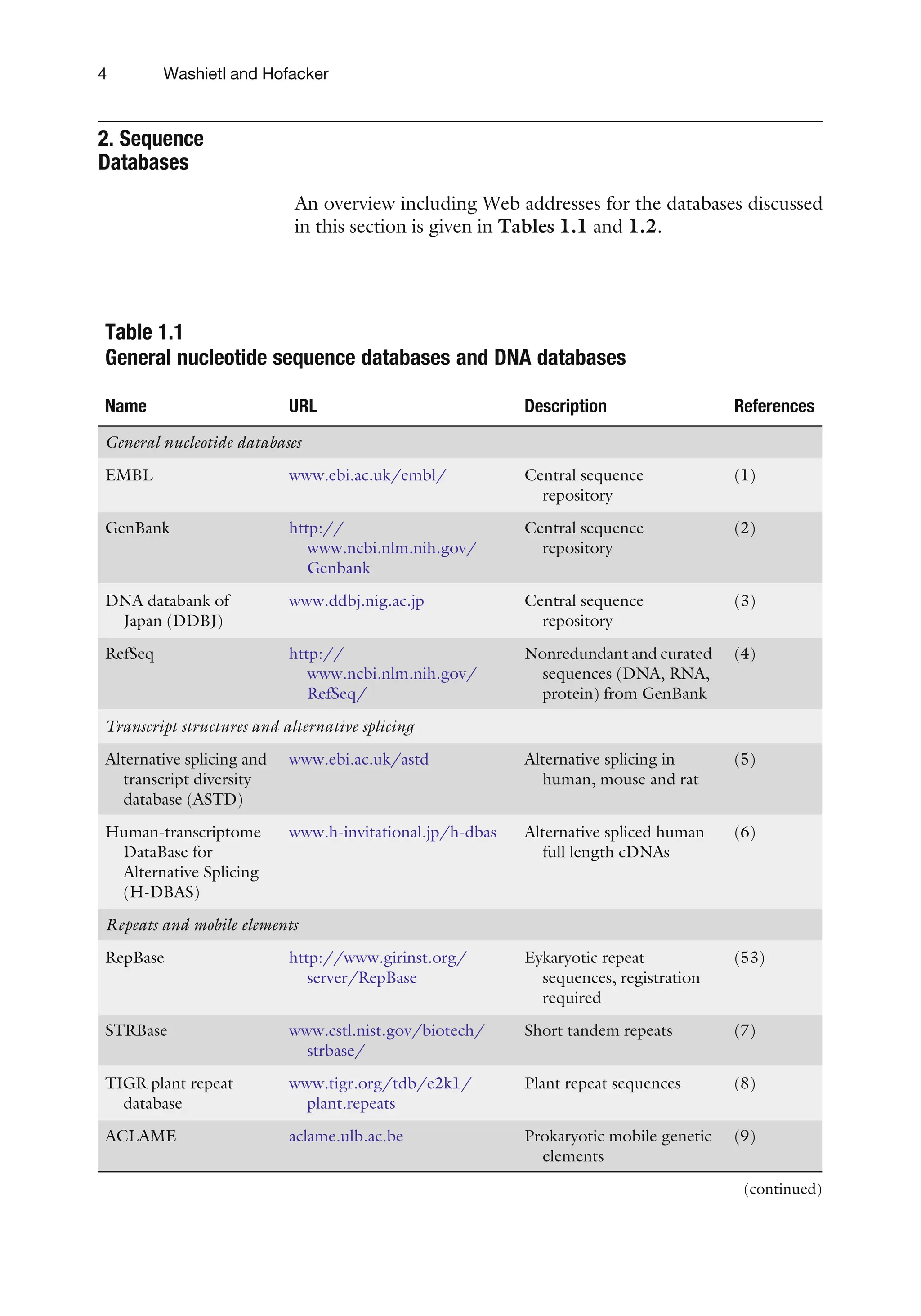
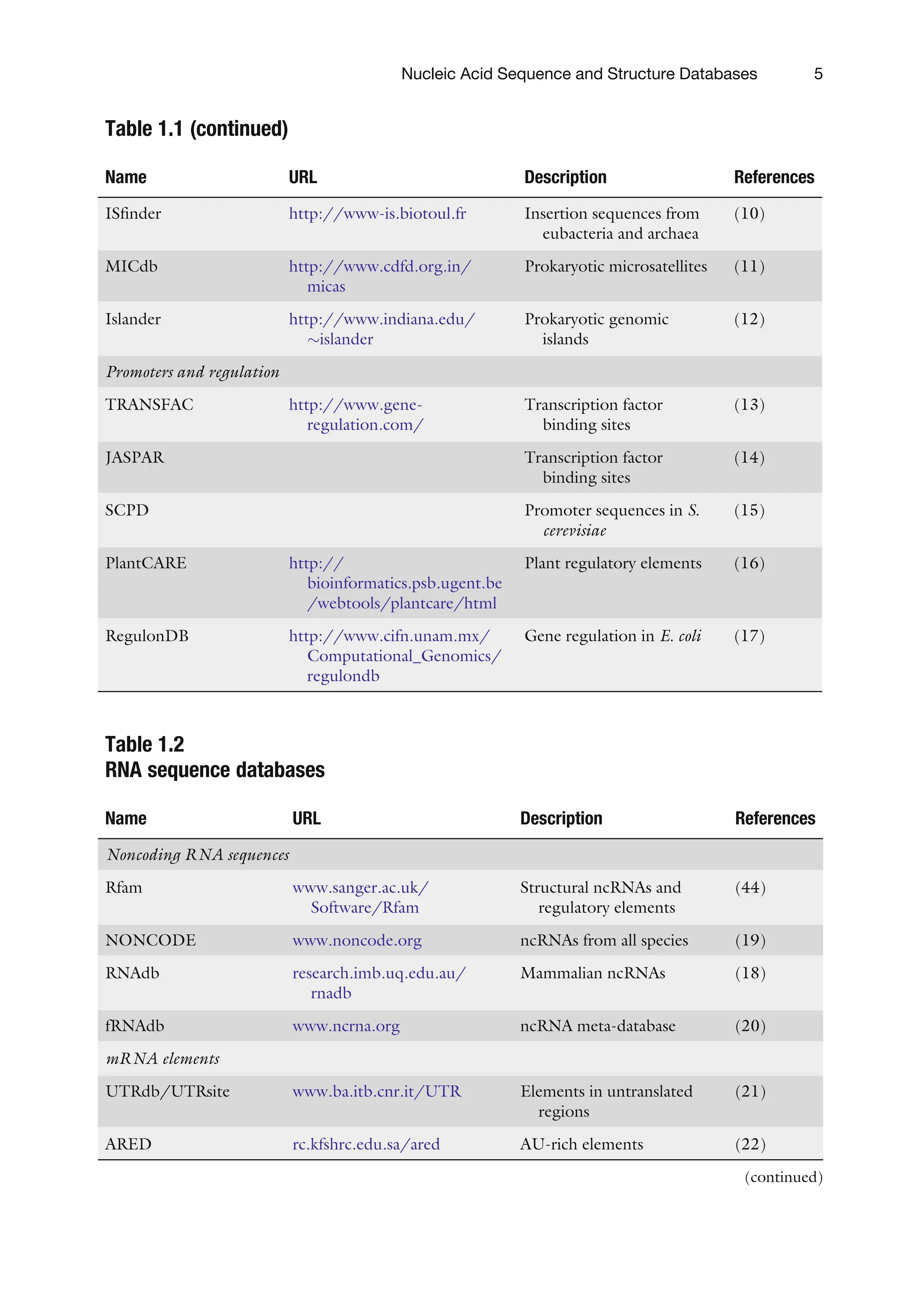
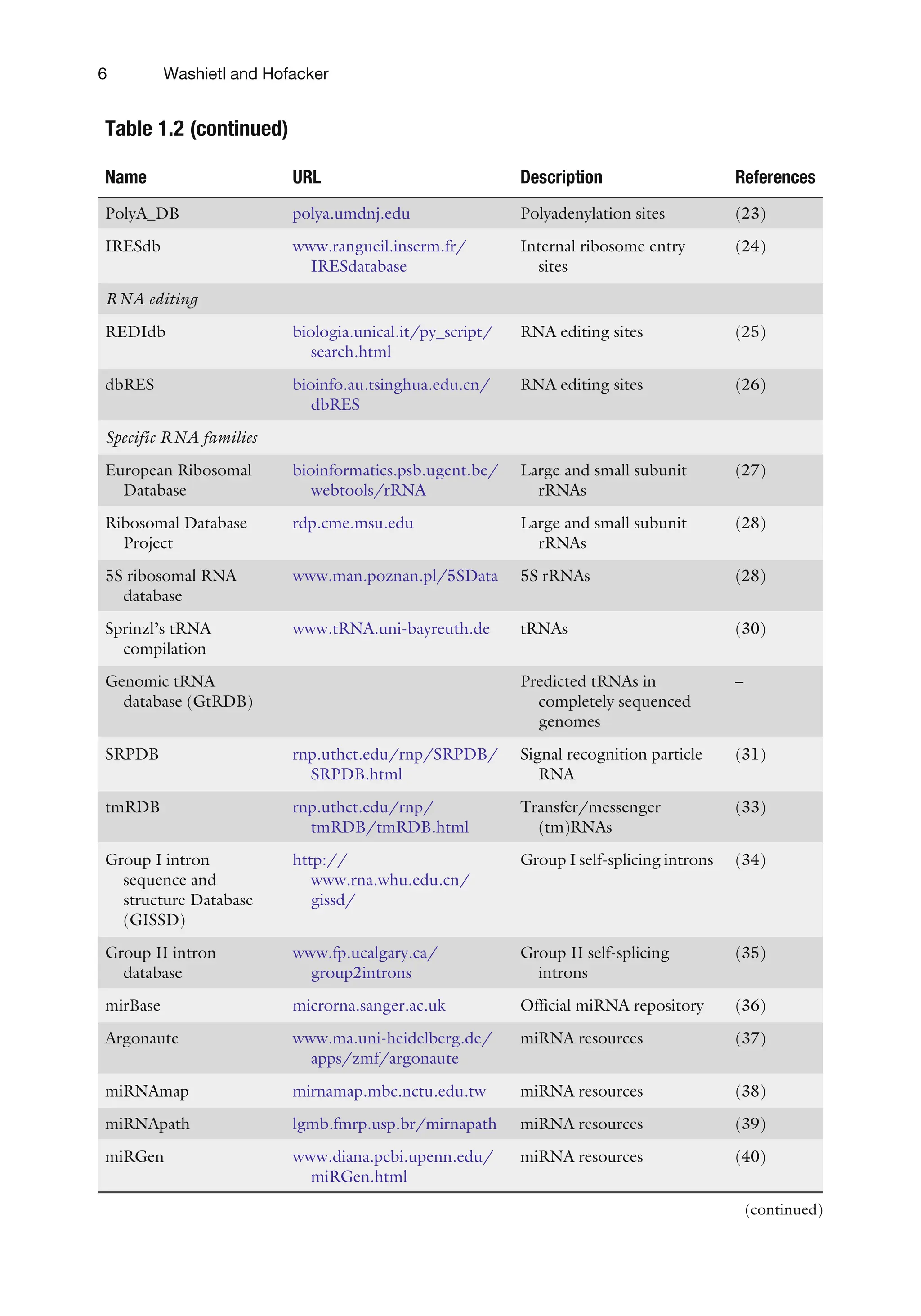
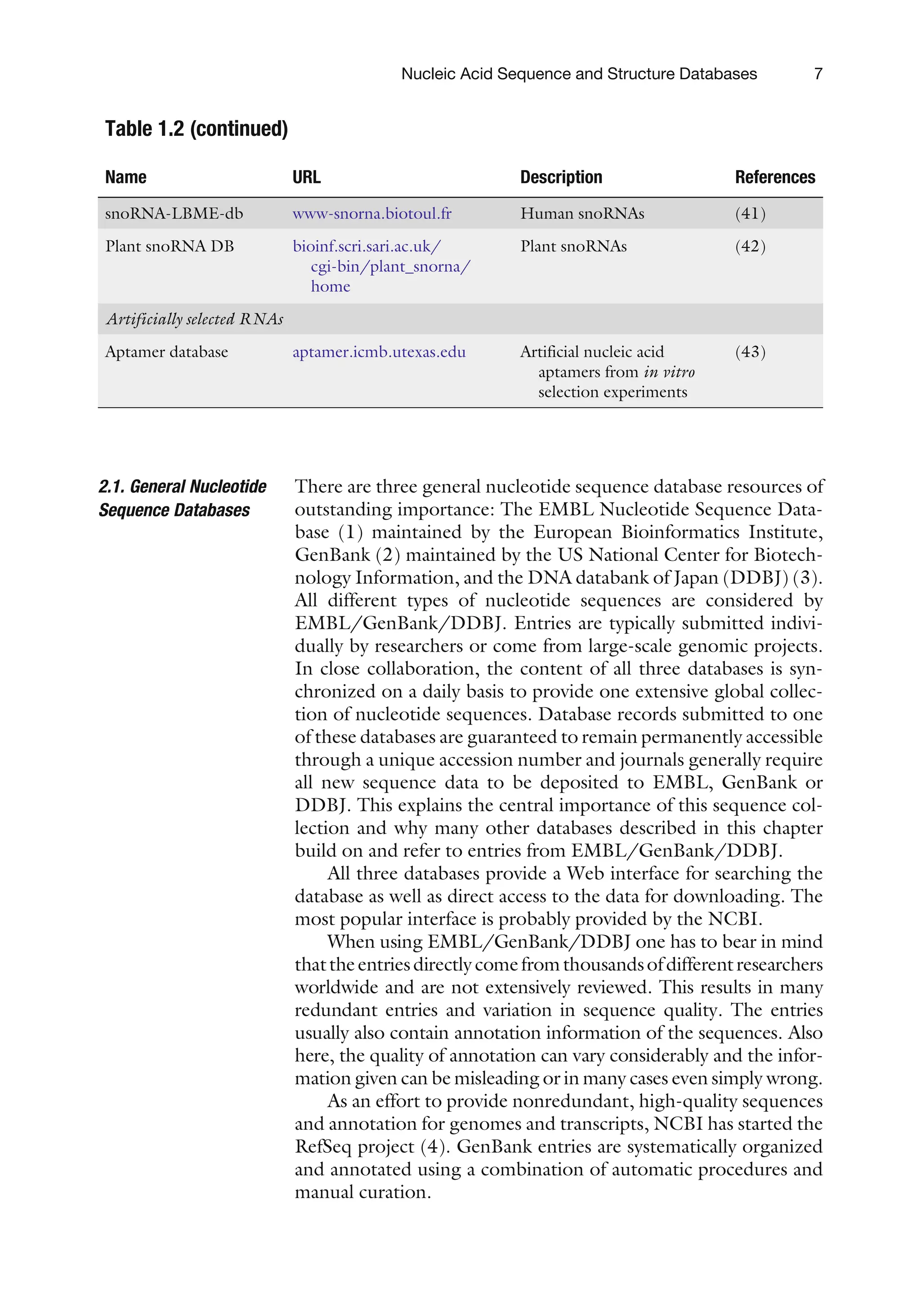
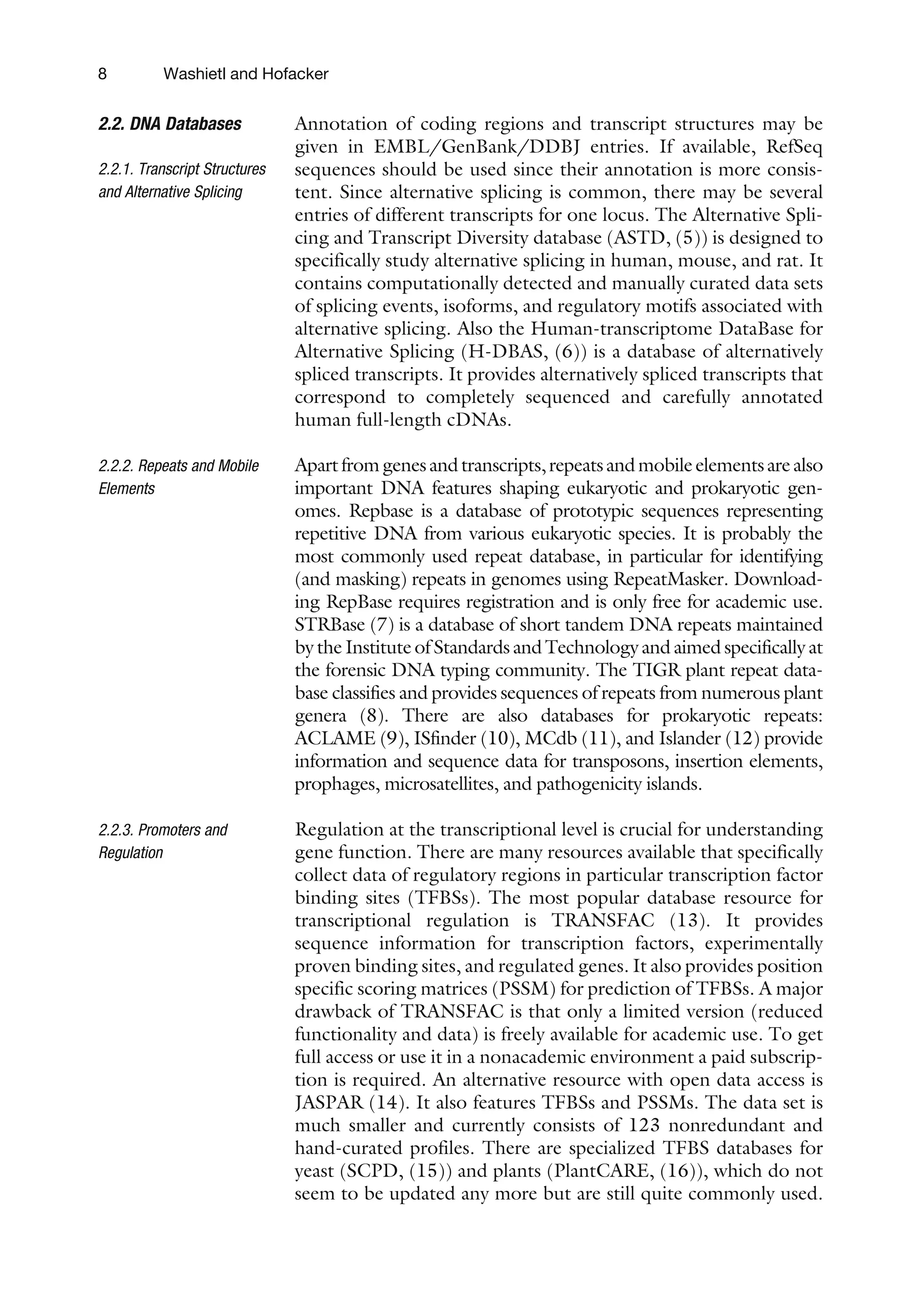
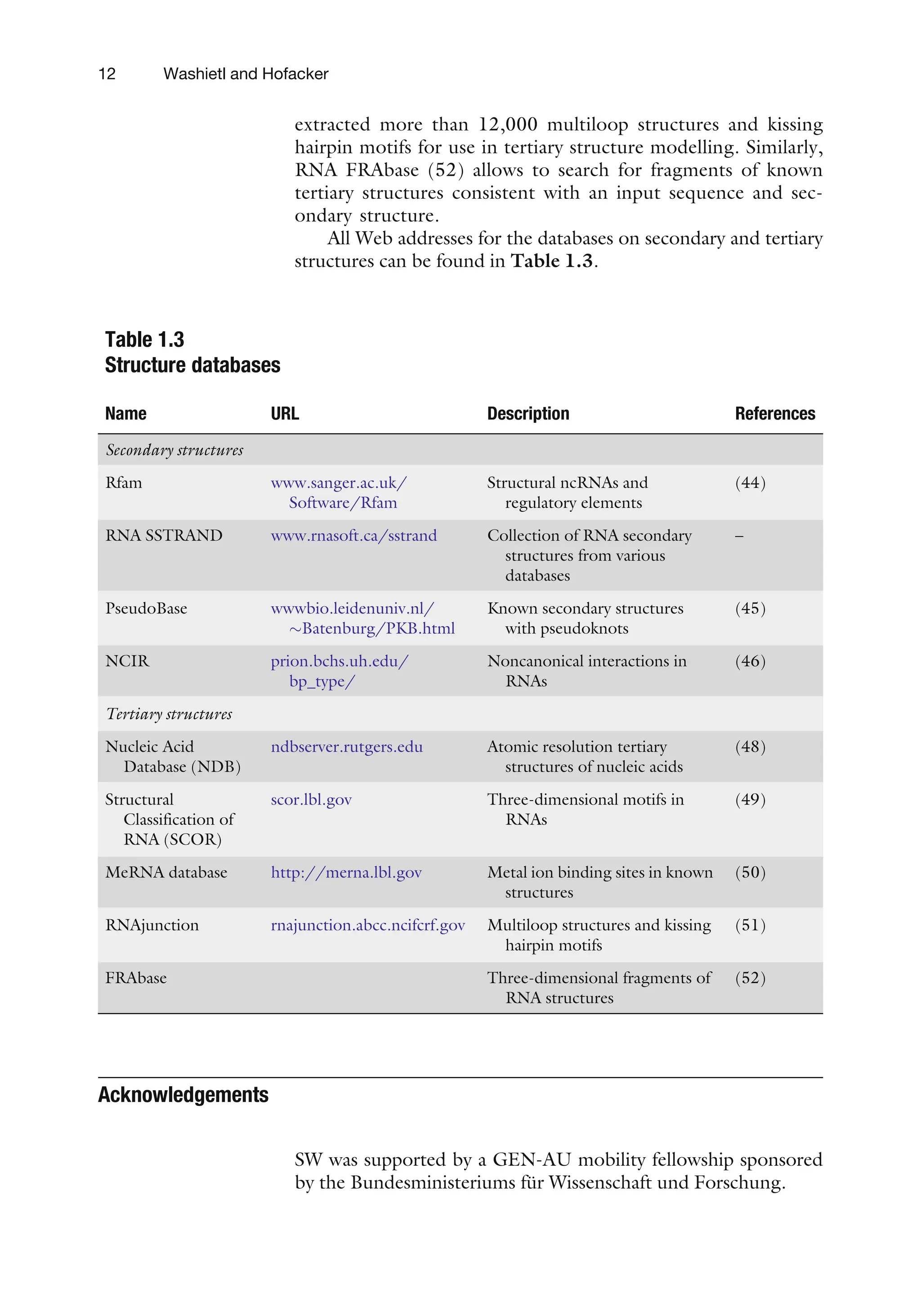
![Information on complete and ongoing genome projects is also
available in Genomes OnLine Database (GOLD) (1), a commu-
nity-supported World Wide Web resource. Hundreds of thou-
sands of genomic sequences for viruses, organelles, and plasmids
are available in the three public databases of the International
Nucleotide Sequence Database Collaboration [INSDC,
www.insdc.org] – EMBL (2), GenBank (3), and the DNA Data
Bank of Japan (4). Additional information on biomedical data is
stored in an increasing number of various databases. As published
in the 15th annual edition of the journal Nucleic Acid Research
(NAR), also known as Database Issue, the number of databases in
2008 crossed the 1,000 landmark. This issue listed 1,078 data-
bases, 110 more than in the previous year (5). Navigating through
the large number of genomic and other related ‘‘omic’’ resources
becomes a great challenge to the average researcher. Understand-
ing the basics of data management systems developed for the
maintenance, search, and retrieval of the large volume of genomic
sequences will provide necessary assistance in traveling through
the information space.
This chapter is focused on the infrastructure developed by the
National Center for Biotechnology Information over the last 20
years. NCBI, as a primary public repository of genomic sequence
data, collects and maintains enormous amounts of heterogeneous
data. The databases vary in size, data types, design, and implemen-
tation. They cover most of the genomic biology data types includ-
ing the project description, project sequence data (genomic,
transcript, protein sequences), raw sequence reads, and related
bibliographical data (6). More recently, NCBI started to collect
the results of studies that have investigated the interaction of
genotype and phenotype. Such studies include genome-wide asso-
ciation studies, medical sequencing, molecular diagnostic assays, as
well as association between genotype and nonclinical traits (7). All
these databases are integrated in a single Entrez system and use a
common engine for data search and retrieval. This provides
researchers with a common interface and simplifies navigation
through the large information space.
There are many different ways of accessing genomic data at
NCBI. Depending on the focus and the goal of the research
project or the level of interest, the user would select a particular
route for accessing the genomic databases and resources. These are
(1) text searches, (2) direct genome browsing, and (3) searches by
sequence similarity. All of these search types enable navigation
through precomputed links to other NCBI resources.
This chapter describes the details of text searching and the
retrieval system of three major genomic databases, Entrez
Genome and Entrez Genome Project and Entrez Protein
Clusters, and also illustrates two other methods of accessing
the genomic data.
18 Tatusova](https://image.slidesharecdn.com/71710-250313122321-d3b5c936/75/Data-mining-techniques-for-the-life-sciences-1st-Edition-Stefan-Washietl-32-2048.jpg)
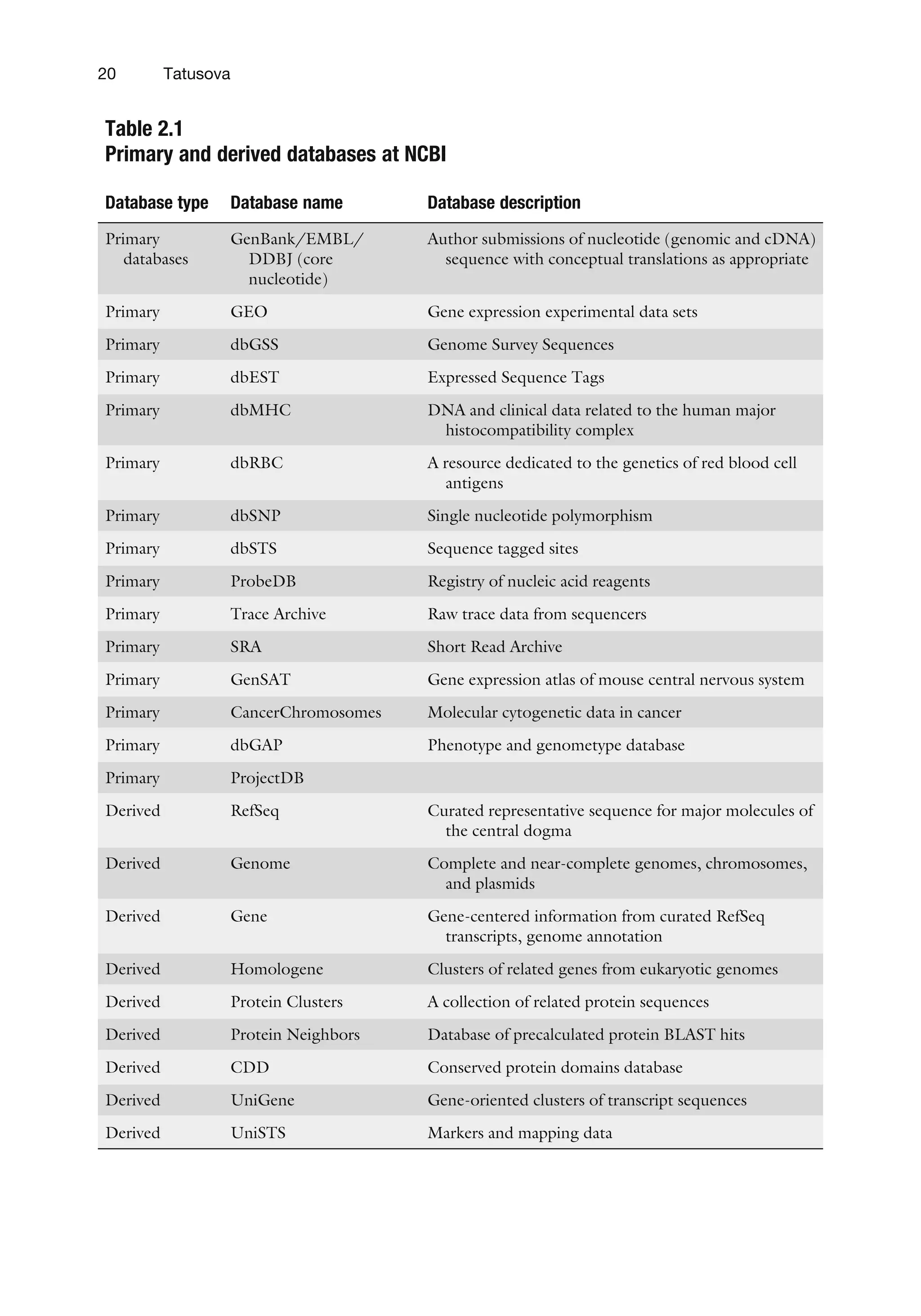
![GenBank (3), BLAST (9), and other curated data resources
[such as the Reference Sequences (8) or Entrez Gene (10)].
Whereas ID handles incoming sequences and feeds other data-
bases with subsets to suit different needs, IQ holds links between
sequences stored in ID and between these sequences and other
resources.
The data in ID system are stored in Abstract Syntax Notation
(ASN.1) format, a standard descriptive language for describing
structured information. NCBI has adopted ASN.1 language to
describe the biological sequence and all related information (tax-
onomical, bibliographical) in a structured way. Many NCBI users
think of the GenBank flatfile as the archetypal sequence data
format. However, within NCBI and especially within the ID
internal data flow system, ASN.1 is considered the original format
from which reports such as the GenBank flatfile can be generated.
As an object-oriented structured language, ASN.1 is easily trans-
formed to other high-level programming languages such as XML,
C, and C++. The NCBI Toolkit provides the converters between
the data structures. Entrez display options allow to view the data
in various text formats including ASN.1, XML, and GenBank
flatfiles.
The ID database is a group of standard relational databases
that holds both ASN.1 objects and sequence identifier-related
information. In the ID database, blobs (binary large objects) are
added into a single column of a relational database and are stored
and processed as a unit.
Fig. 2.1. Sources of primary sequence data available at NCBI. Rectangles represent data
providers; cylinders represent primary NCBI databases.
Genomic Databases and Resources 21](https://image.slidesharecdn.com/71710-250313122321-d3b5c936/75/Data-mining-techniques-for-the-life-sciences-1st-Edition-Stefan-Washietl-35-2048.jpg)
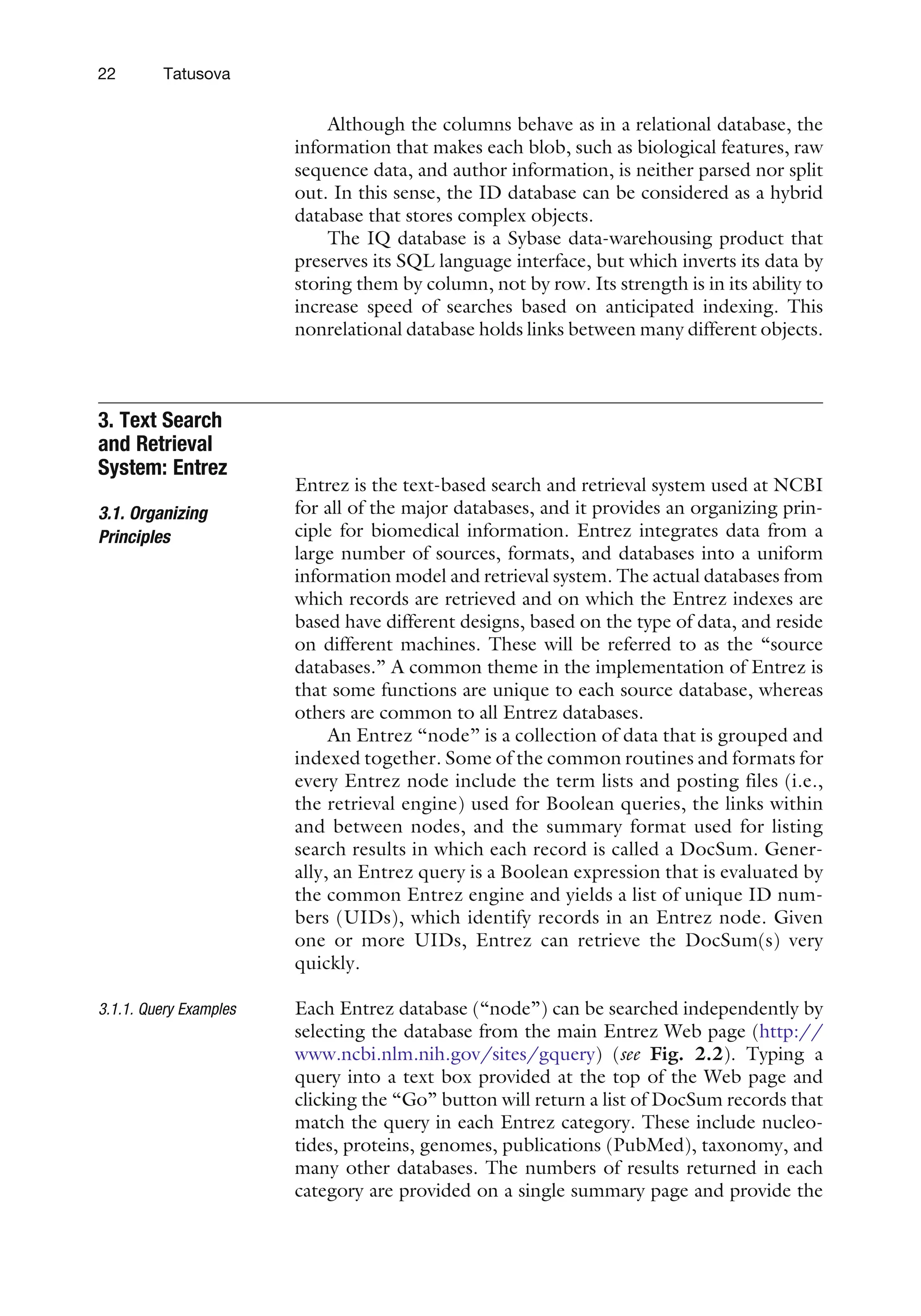
![user with an easily visible view of the results in each of 35
databases. The results are presented differently in each database
but within the same framework, which includes the common
elements such as search bar, display options, page formatting,
and links.
In processing a query, Entrez parses the query string into a
series of tokens separated by spaces and Boolean operators (AND,
NOT, OR). An independent search is performed for each term,
and the results are then combined according to the Boolean
operators.
Query uses the following syntax: term [field] OPERATOR
term [field] where ‘‘term’’ refers to the search terms, ‘‘field’’ to the
search field defined by specific Entrez database, and ‘‘OPERA-
TOR’’ to the Boolean operators.
Fig. 2.2. Cross database search Web Entrez interface. The counts next to the database description show the number of the
records in each database matching the simple text query ‘‘mouse.’’
Genomic Databases and Resources 23](https://image.slidesharecdn.com/71710-250313122321-d3b5c936/75/Data-mining-techniques-for-the-life-sciences-1st-Edition-Stefan-Washietl-37-2048.jpg)
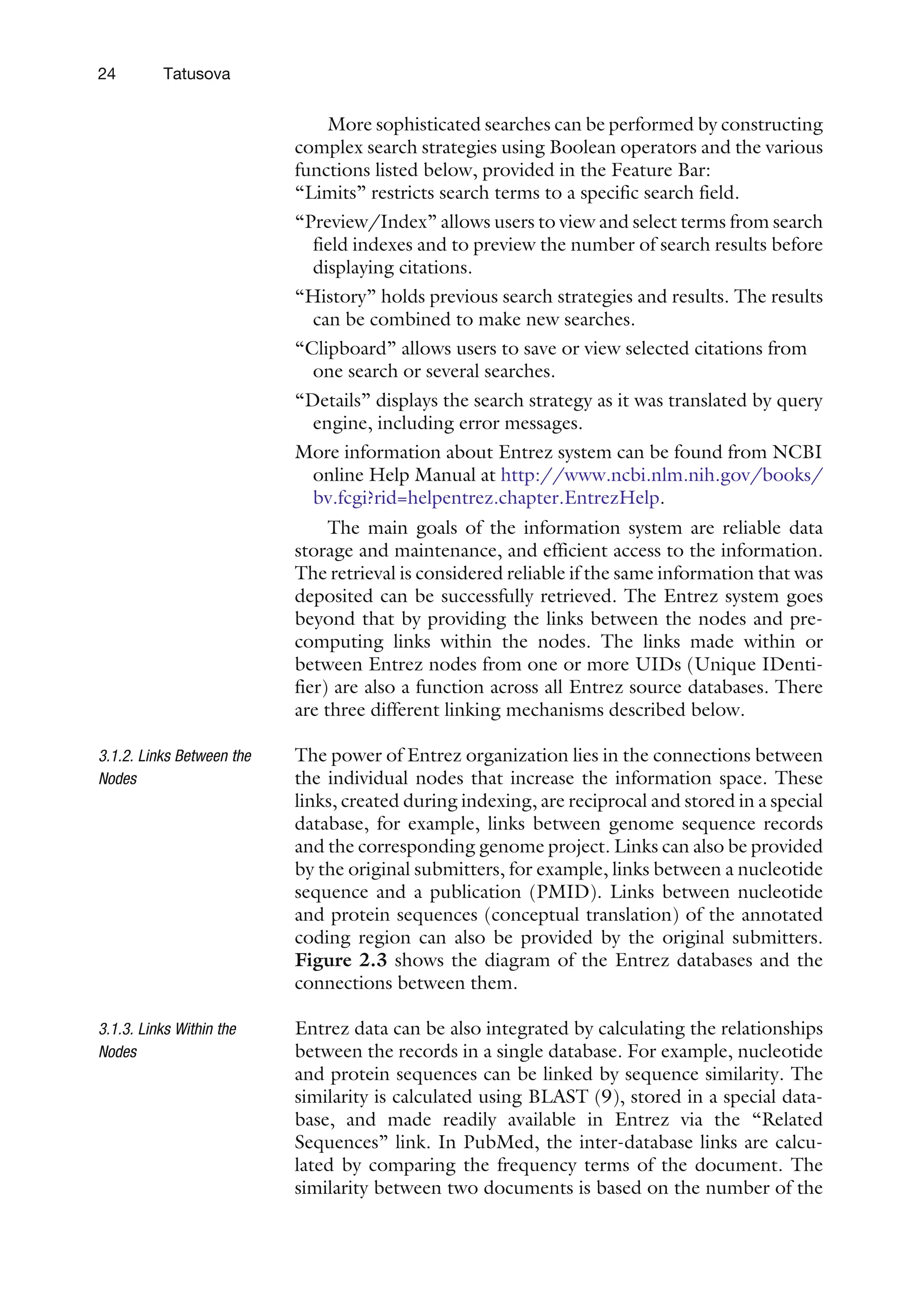
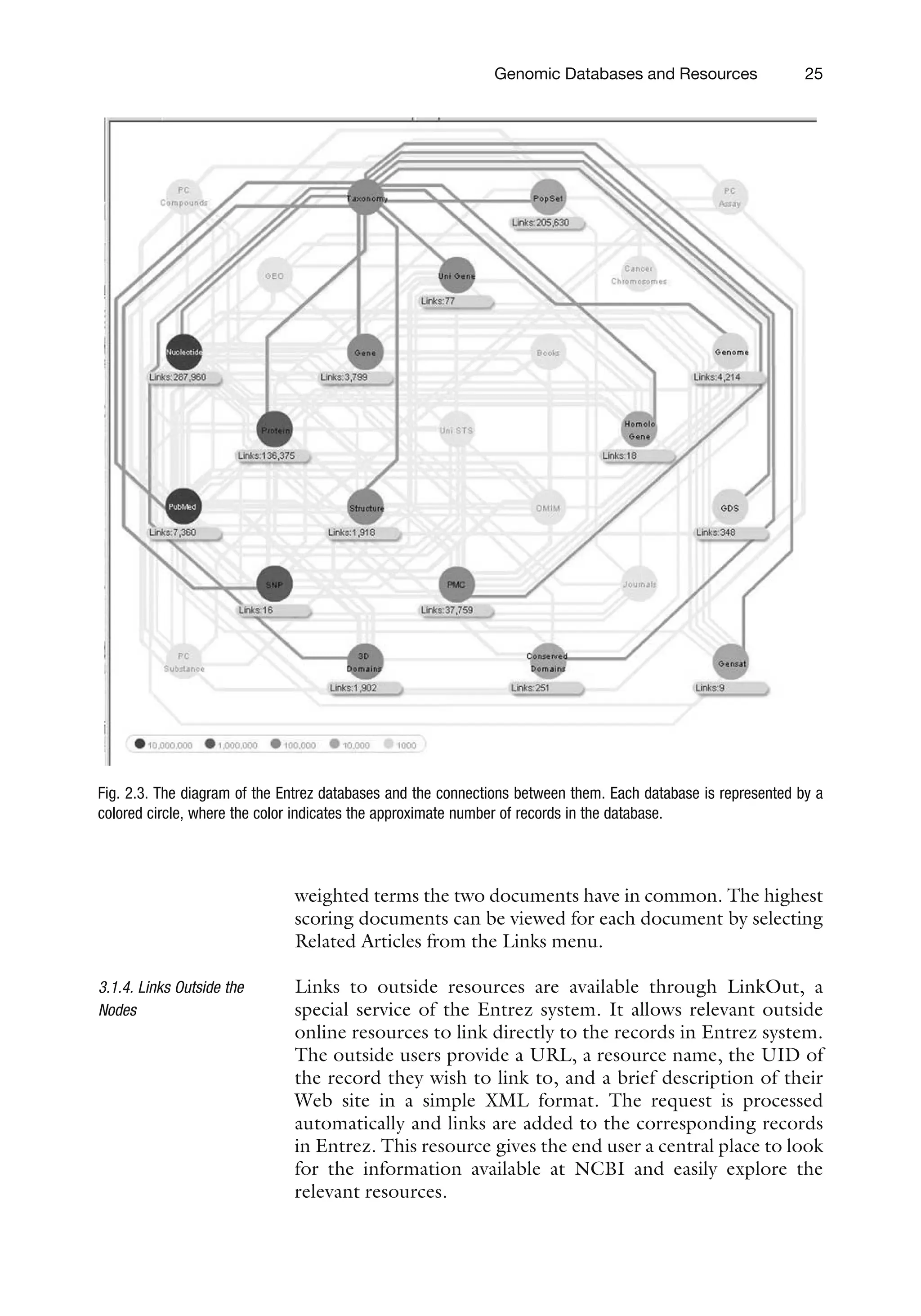
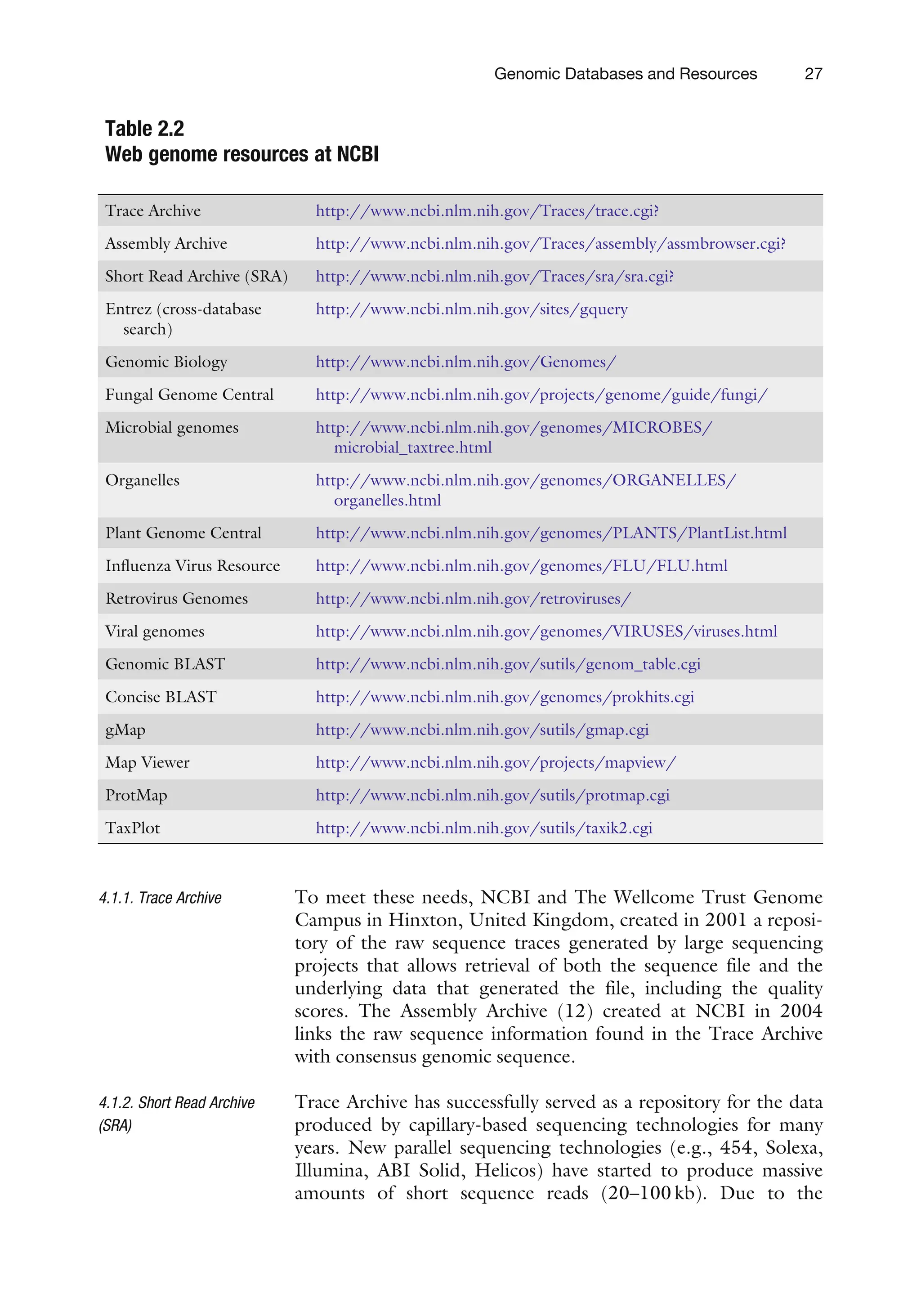
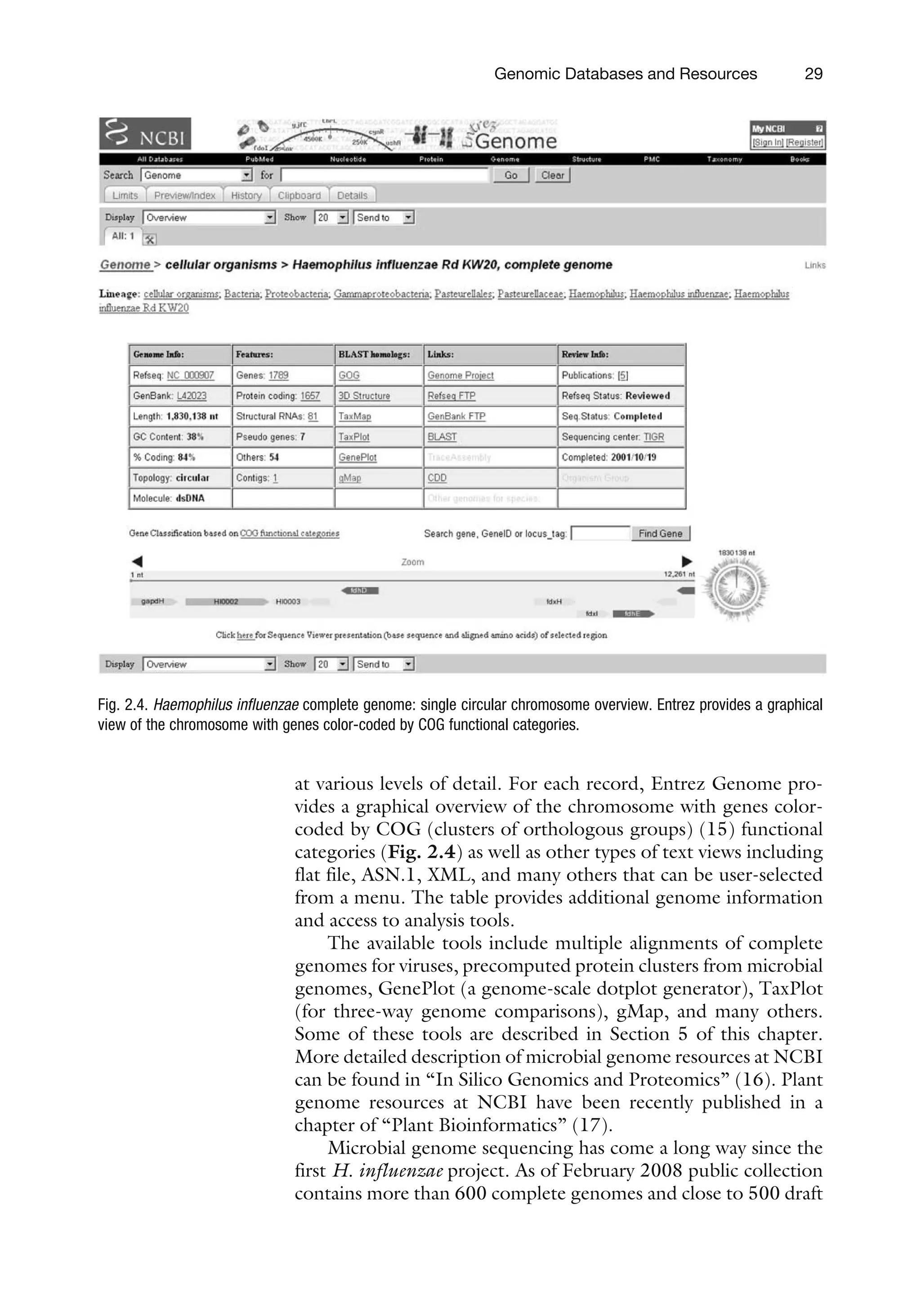
![genome assemblies. The collection represents a very diverse set of
organisms; ranging from small (160 kb) endosymbiont Carsonella
(18) to the 13-Mb genome of myxobacterium Sorangium cellulo-
sum (19). There are organisms isolated from extreme environ-
ments such as Hyperthermus butylicus (20), an extreme
hyperthermophilic, anaerobic archeon, and bacterial species repre-
senting deeply branching taxa such as Rhodopirellula baltica (21).
On the other hand, many projects are aimed toward the compara-
tive analysis of pathogenic bacteria and sequencing multiple strains
and isolates of the same organism. For example, H. influenzae
bacterium is represented in the database by 16 entries including
chromosomes and plasmids from different isolated strains. Entrez
provides tools that facilitate comparative genome analysis leading
into new insights to be gained from genome sequences.
Query examples
Find all the chromosomes of Haemophilus influenzae:
Haemophilus influenzae[organism] AND chromosome[repli-
con type]
4.2.2. Entrez Genome
Project
The NCBI Genome Project database is a collection of complete and
incomplete (in-progress) large-scale sequencing, assembly, annota-
tion, and mapping projects for cellular organisms. A project is
defined by a unique combination of organism name (or metage-
nomic project name), sequencing center, and sequencing method.
Currently, the database is comprised of projects that have sub-
mitted data to NCBI, intend to submit data, or have received public
funding. A large eukaryotic genome project usually consists of
several components. In the database, projects are organized in a
hierarchical, parent–child relationship. A top-level project represents
an organism-specific overview and links together all relevant child
projects. Each project has its own unique identifier, the Project ID.
The International Nucleotide Sequence Databases Consor-
tium (INSDC) has acknowledged the need to organize genomic
and metagenomic data and to capture project metadata. Starting
from 2006, the submitters of genome sequence data are required
to register their project and obtain a unique project ID. As pre-
sented at EMBL guidelines Web site, http://www.ebi.ac.uk/
embl/Documentation/project_guidelines.html,
‘‘A project is defined as a collection of INSDC database
records originating from a single organization, or from a consor-
tium of coordinated organizations. The collective database records
from a project make up a complete genome or metagenome and
may contain genomic sequence, EST libraries and any other
sequences that contribute to the assembly and annotation of the
genome or metagenome. Projects group records either from single
organism studies or from metagenomic studies comprising com-
munities of organisms.’’
30 Tatusova](https://image.slidesharecdn.com/71710-250313122321-d3b5c936/75/Data-mining-techniques-for-the-life-sciences-1st-Edition-Stefan-Washietl-44-2048.jpg)
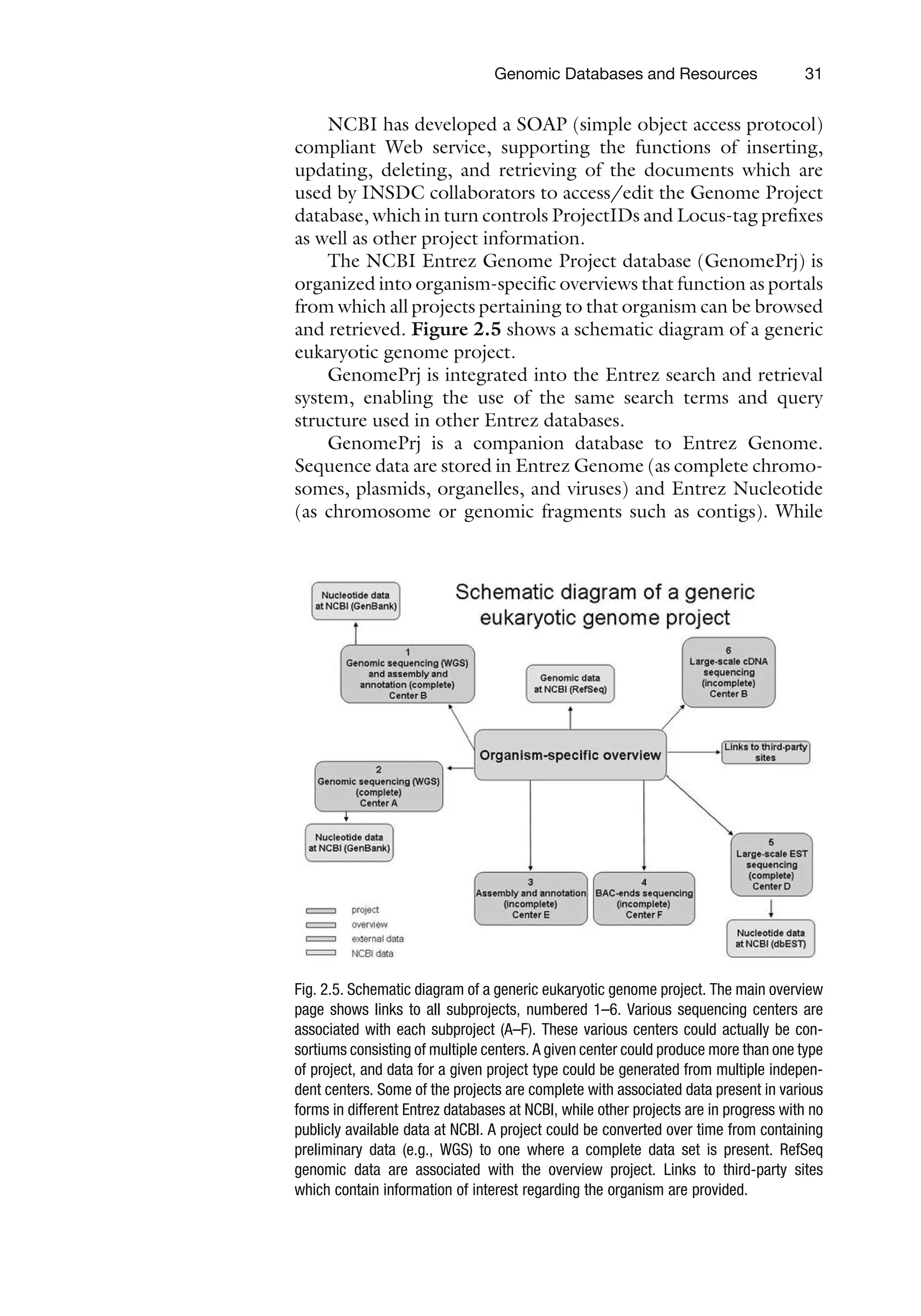
![Entrez Genome does not collect all data for a given organism,
GenomePrj provides an umbrella view of the status of each gen-
ome project, links to project data in the other Entrez databases and
a variety of other NCBI and external resources associated with a
given genome project. Sequences associated with a given organism
can also be retrieved in the taxonomy browser. However, no
distinction is made between GenBank (non-curated) and RefSeq
(curated) sequences. There is also no distinction based on which
sequencing center submitted the data. Entrez Genome Project
also lists projects that are in progress or for which NCBI has not
yet received any data. See Table 2.3 for a comparison of all three
databases.
As of January 2008 Genome Project database contains 80
metagenomics project. As shown in Fig. 2.6, the database entry
contains brief project description, listing of all related subprojects,
and project data which include links to genomic data, publication,
and Trace data. NCBI Resource Links include an option to BLAST
against this particular collection as well as an option to BLAST
against all available environmental sequences.
Query examples
Find all complete fungal genome projects.
fungi[ORGN] AND complete[SEQSTAT]
Find all projects that correspond to pathogens that can infect
humans.
human[HOST]
Find all metagenomic projects
type_environmental[All Fields]
4.2.3. Entrez Protein
Clusters
Protein Clusters database is a rich collection of related protein
sequences from complete prokaryotic and organelle Reference
Sequence (RefSeq) genomes.
Table 2.3
Comparison of entrez databases
Entrez
databases
Organism-
specific
sequences
Project-
specific
sequences
Submitter-
specific
sequences
Complete
and in
progress
GenBank and
RefSeq
sequences
Genome Yes No Yes No Separated
Taxonomy Yes No No No Together
Genome
project
Yes No Yes Yes Separated
32 Tatusova](https://image.slidesharecdn.com/71710-250313122321-d3b5c936/75/Data-mining-techniques-for-the-life-sciences-1st-Edition-Stefan-Washietl-46-2048.jpg)
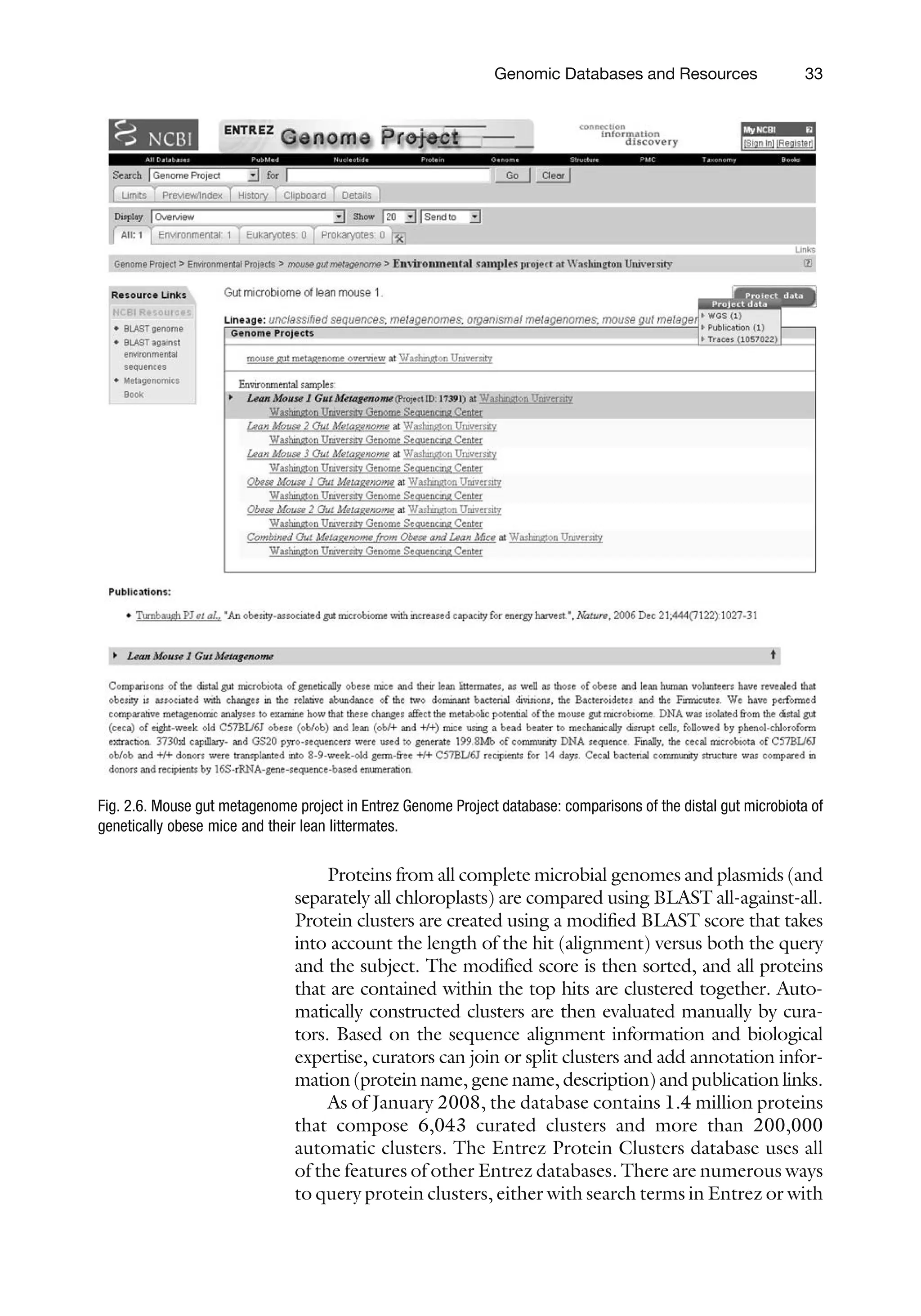
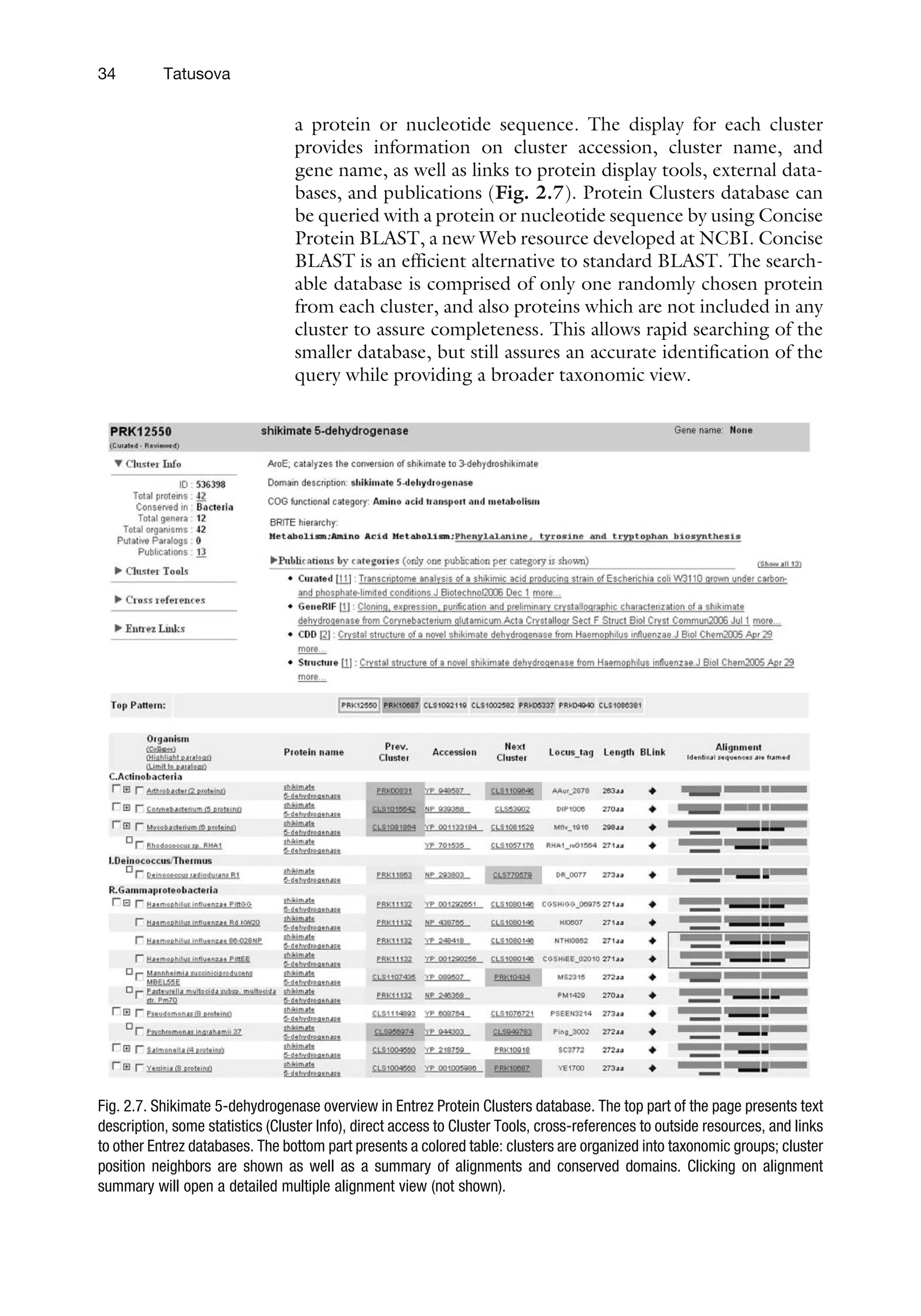
![Query examples
Retrieve all clusters containing the protein beta galactosidase:
beta galactosidase [Protein Name]
Find all clusters associated with Escherichia coli:
Escherichia coli[Organism]
5. Analysis of
Prokaryotic
Genome Data
5.1. gMap – Compare
Genomes by Genomic
Sequence Similarity
gMap is one of the tools available in Entrez Genome that allows to
view and analyze the regions of similarity in closely related gen-
omes. Figure 2.8 shows closely related strains of H. influenzae.
Genomic sequences are compared using BLAST and the resul-
tant hits are filtered out to find the largest syntenic regions. Similar
regions are shown color-coded and numbered in each genome
with an arrow denoting the 50
–30
direction of the hit with respect
to similar segments in other genomes. Additional sequences can be
added by inputting the accession number.
Fig. 2.8. gMap results for four closely related strains of Haemophilus influenzae at 25% coverage.
Genomic Databases and Resources 35](https://image.slidesharecdn.com/71710-250313122321-d3b5c936/75/Data-mining-techniques-for-the-life-sciences-1st-Edition-Stefan-Washietl-49-2048.jpg)



![This ebook is for the use of anyone anywhere in the United
States and most other parts of the world at no cost and with
almost no restrictions whatsoever. You may copy it, give it away
or re-use it under the terms of the Project Gutenberg License
included with this ebook or online at www.gutenberg.org. If you
are not located in the United States, you will have to check the
laws of the country where you are located before using this
eBook.
Title: Old Age Deferred
Author: Arnold Lorand
Release date: January 8, 2021 [eBook #64237]
Most recently updated: October 18, 2024
Language: English
Credits: Turgut Dincer, Barry Abrahamsen, and the Online
Distributed Proofreading Team at
https://www.pgdp.net (This file was produced from
images generously made available by The Internet
Archive)
*** START OF THE PROJECT GUTENBERG EBOOK OLD AGE
DEFERRED ***](https://image.slidesharecdn.com/71710-250313122321-d3b5c936/75/Data-mining-techniques-for-the-life-sciences-1st-Edition-Stefan-Washietl-55-2048.jpg)