DATA-DRIVEN
MARKETING
APPLICATION OF DATA
SCIENCE
 Data-driven marketing involves strategies and
tactics that leverage data to gain insights into
customer behavior, preferences, and trends.
 This approach involves collecting, analyzing, and
applying information to optimize marketing
campaigns, enhance targeting and personalization,
and improve overall marketing effectiveness.
 By using data analytics, marketers can make more
informed decisions, tailor their messages to
specific audiences, and measure the impact of
their strategies, leading to higher engagement.
 For instance, by analyzing search data, a company
can identify what customers are looking for and
optimize their website content to improve search
engine rankings.
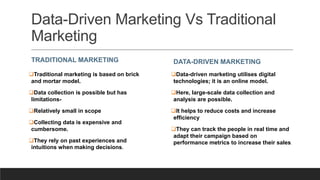
Data-Driven Marketing Vs Traditional
Marketing
TRADITIONAL MARKETING
Traditional marketing is based on brick
and mortar model.
Data collection is possible but has
limitations-
Relatively small in scope
Collecting data is expensive and
cumbersome.
They rely on past experiences and
intuitions when making decisions.
DATA-DRIVEN MARKETING
Data-driven marketing utilises digital
technologies; it is an online model.
Here, large-scale data collection and
analysis are possible.
It helps to reduce costs and increase
efficiency
They can track the people in real time and
adapt their campaign based on
performance metrics to increase their sales.
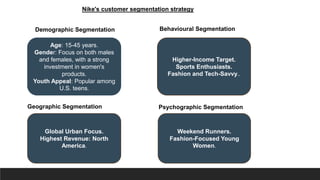
Nike's customer segmentation strategy
Age: 15-45 years.
Gender: Focus on both males
and females, with a strong
investment in women's
products.
Youth Appeal: Popular among
U.S. teens.
Demographic Segmentation
Higher-Income Target.
Sports Enthusiasts.
Fashion and Tech-Savvy..
Global Urban Focus.
Highest Revenue: North
America.
Weekend Runners.
Fashion-Focused Young
Women.
Behavioural Segmentation
Geographic Segmentation Psychographic Segmentation
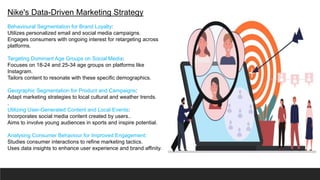
Nike's Data-Driven Marketing Strategy
Behavioural Segmentation for Brand Loyalty:
Utilizes personalized email and social media campaigns.
Engages consumers with ongoing interest for retargeting across
platforms.
Targeting Dominant Age Groups on Social Media:
Focuses on 18-24 and 25-34 age groups on platforms like
Instagram.
Tailors content to resonate with these specific demographics.
Geographic Segmentation for Product and Campaigns:
Adapt marketing strategies to local cultural and weather trends.
.
Utilizing User-Generated Content and Local Events:
Incorporates social media content created by users..
Aims to involve young audiences in sports and inspire potential.
Analysing Consumer Behaviour for Improved Engagement:
Studies consumer interactions to refine marketing tactics.
Uses data insights to enhance user experience and brand affinity.
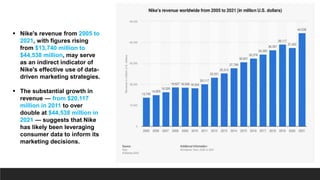
 Nike's revenue from 2005 to
2021, with figures rising
from $13,740 million to
$44,538 million, may serve
as an indirect indicator of
Nike's effective use of data-
driven marketing strategies.
 The substantial growth in
revenue — from $20,117
million in 2011 to over
double at $44,538 million in
2021 — suggests that Nike
has likely been leveraging
consumer data to inform its
marketing decisions.
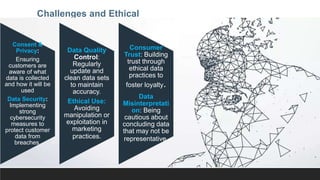
Challenges and Ethical
Considerations
Consent &
Privacy:
Ensuring
customers are
aware of what
data is collected
and how it will be
used
Data Security:
Implementing
strong
cybersecurity
measures to
protect customer
data from
breaches.
Data Quality
Control:
Regularly
update and
clean data sets
to maintain
accuracy.
Ethical Use:
Avoiding
manipulation or
exploitation in
marketing
practices.
Consumer
Trust: Building
trust through
ethical data
practices to
foster loyalty.
Data
Misinterpretati
on: Being
cautious about
concluding data
that may not be
representative.
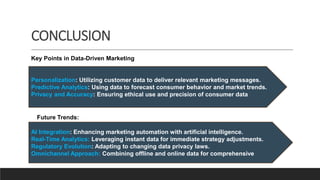
CONCLUSION
Personalization: Utilizing customer data to deliver relevant marketing messages.
Predictive Analytics: Using data to forecast consumer behavior and market trends.
Privacy and Accuracy: Ensuring ethical use and precision of consumer data
Key Points in Data-Driven Marketing
Future Trends:
AI Integration: Enhancing marketing automation with artificial intelligence.
Real-Time Analytics: Leveraging instant data for immediate strategy adjustments.
Regulatory Evolution: Adapting to changing data privacy laws.
Omnichannel Approach: Combining offline and online data for comprehensive

DATA-DRIVEN MARKETING.pptx

  • 1.
  • 2.
     Data-driven marketinginvolves strategies and tactics that leverage data to gain insights into customer behavior, preferences, and trends.  This approach involves collecting, analyzing, and applying information to optimize marketing campaigns, enhance targeting and personalization, and improve overall marketing effectiveness.  By using data analytics, marketers can make more informed decisions, tailor their messages to specific audiences, and measure the impact of their strategies, leading to higher engagement.  For instance, by analyzing search data, a company can identify what customers are looking for and optimize their website content to improve search engine rankings.
  • 3.
    Data-Driven Marketing VsTraditional Marketing TRADITIONAL MARKETING Traditional marketing is based on brick and mortar model. Data collection is possible but has limitations- Relatively small in scope Collecting data is expensive and cumbersome. They rely on past experiences and intuitions when making decisions. DATA-DRIVEN MARKETING Data-driven marketing utilises digital technologies; it is an online model. Here, large-scale data collection and analysis are possible. It helps to reduce costs and increase efficiency They can track the people in real time and adapt their campaign based on performance metrics to increase their sales.
  • 4.
    Nike's customer segmentationstrategy Age: 15-45 years. Gender: Focus on both males and females, with a strong investment in women's products. Youth Appeal: Popular among U.S. teens. Demographic Segmentation Higher-Income Target. Sports Enthusiasts. Fashion and Tech-Savvy.. Global Urban Focus. Highest Revenue: North America. Weekend Runners. Fashion-Focused Young Women. Behavioural Segmentation Geographic Segmentation Psychographic Segmentation
  • 5.
    Nike's Data-Driven MarketingStrategy Behavioural Segmentation for Brand Loyalty: Utilizes personalized email and social media campaigns. Engages consumers with ongoing interest for retargeting across platforms. Targeting Dominant Age Groups on Social Media: Focuses on 18-24 and 25-34 age groups on platforms like Instagram. Tailors content to resonate with these specific demographics. Geographic Segmentation for Product and Campaigns: Adapt marketing strategies to local cultural and weather trends. . Utilizing User-Generated Content and Local Events: Incorporates social media content created by users.. Aims to involve young audiences in sports and inspire potential. Analysing Consumer Behaviour for Improved Engagement: Studies consumer interactions to refine marketing tactics. Uses data insights to enhance user experience and brand affinity.
  • 6.
     Nike's revenuefrom 2005 to 2021, with figures rising from $13,740 million to $44,538 million, may serve as an indirect indicator of Nike's effective use of data- driven marketing strategies.  The substantial growth in revenue — from $20,117 million in 2011 to over double at $44,538 million in 2021 — suggests that Nike has likely been leveraging consumer data to inform its marketing decisions.
  • 7.
    Challenges and Ethical Considerations Consent& Privacy: Ensuring customers are aware of what data is collected and how it will be used Data Security: Implementing strong cybersecurity measures to protect customer data from breaches. Data Quality Control: Regularly update and clean data sets to maintain accuracy. Ethical Use: Avoiding manipulation or exploitation in marketing practices. Consumer Trust: Building trust through ethical data practices to foster loyalty. Data Misinterpretati on: Being cautious about concluding data that may not be representative.
  • 8.
    CONCLUSION Personalization: Utilizing customerdata to deliver relevant marketing messages. Predictive Analytics: Using data to forecast consumer behavior and market trends. Privacy and Accuracy: Ensuring ethical use and precision of consumer data Key Points in Data-Driven Marketing Future Trends: AI Integration: Enhancing marketing automation with artificial intelligence. Real-Time Analytics: Leveraging instant data for immediate strategy adjustments. Regulatory Evolution: Adapting to changing data privacy laws. Omnichannel Approach: Combining offline and online data for comprehensive